




Abstract
This study sought to determine the relationship between monitoring and evaluation (M&E) practices and academic staff motivation in higher education, from a Rwandan perspective. Particularly, the study aimed at describing the M&E practices applied, assessed how quality of feedback affects academic staff motivation, and determined the relationship between M&E practices and academic staff motivation. The study employed a mixed-methods approach to collect data from academic staff. A total of 105 faculties were sampled. The study established that M&E practices, including staff self-evaluation, students–staff evaluation, peer evaluation, and evaluation by supervisor, are applied at varying emphasis. Furthermore, both the supervisees and supervisors agreed that the quality of feedback provided during evaluation is fairly effective, although recognition of their performance is rarely appreciated. It was further established that weak to moderate correlations exist between M&E practices and academic staff motivation with “r” varying from 0.268 to 0.4460. Although some indications for the direction of influence have been generated, the study, however, does not permit one-way final conclusion about the effect of any of the M&E practices to academic staff motivation. Based on the findings, this study recommends that policy makers design a policy on M&E, which would guide supervisors in M&E exercise.
Introduction
In the context of Rwanda, it is after the genocide of 1994 against the Tutsi that there was a rapid increase in the number of higher learning institutions, both public and private. This increase was triggered by the acute shortage of qualified workforce (Ministry of Public Service and Labour, 2009), and expanded enrolment at basic and secondary levels (Ministry of Education, 2008). This increase prompted the Government of Rwanda to establish mechanisms of accountability and strengthening the internal and external quality control systems. This led to the establishment of the National Council for Higher Education (NCHE) whose mission was quality assurance. However, the success of the process with regard to academic activities would greatly depend on how faculty operate and HODs take their supervisory role. The performance of the faculty, to a large extent, determines the quality of student experience and has a significant impact on student and learning (Rowley, 1996). In addition, Armstrong (2004) argued that as employees are the most valuable asset for an organization, they need to be managed and appraised appropriately.
In recent past, there has been increasing interest in monitoring and evaluation (M&E) as a means of assuring and enhancing quality in higher education. Monitoring is the continuous and systematic collection of data during the execution of faculty duties, while evaluation on the contrary, is a periodic and systematic collection of data to make certain judgments about the faculty (Njenga & Kabiru, 2009). Both M&E are closely related, and Njenga and Kabiru (2009) noted that to conduct an effective evaluation, you need to use data from monitoring. Both aim toward tracking the progress of activities and performance review.
In performance management, literature reveals that a motivated staff is crucial in achieving institutional objectives (Shah & Nair, 2012). Education sector in recent times has attracted increasing levels of scrutiny in relation to standards and quality (Egginton, 2010). Accordingly, higher learning institutions must reexamine themselves and have their outputs measured more objectively (Shah & Nair, 2012). This article examined the practice of M&E at the College of Education in the University of Rwanda, the quality of M&E’s feedback provided to academic staff, and the impact of M&E practices on the academic staff motivation.
A number of scholars have written about M&E, and its impact on employee job performance (Itolondo, 2012; Ngware & Ndirangu, 2005; Siddique, Aslam, Khan, & Fatima, 2011; Tozoglu, 2006). However, the linkage to staff motivation has not been fully addressed. As Brauckmann and Pashiardis (2010) observed, any attempt to establish internal evaluation procedures serves as a tool for evaluating external accountability. Furthermore, the ability of institutions to critically evaluate their own performance, as well as that of their employees, is vital to the process of continuous quality improvement. O’Mahony and Garavan (2012) emphasized that the implementation of an effective quality management system in higher education is a dynamic process of monitoring, continuous improvement, and change. It is, therefore, evident that M&E in higher learning institutions calls for adequate management of staff, students, and other stakeholders to continuously improve.
Currently, in the Rwandan system of education, higher education is provided by both public and private institutions (NUFFIC, 2015). There are now four categories of higher learning institutions, namely, University of Rwanda, Integrated Polytechnic Regional Centers (currently grouped under Rwanda Polytechnic), Institute of Legal Practice and Development (ILPD), and Private Higher Learning Institutions. The University of Rwanda was established in 2013 as a result of a merger of all seven public universities, namely, National University of Rwanda (NUR), Kigali Institute of Science and Technology (KIST), Kigali Institute of Education (KIE), Institute of Agriculture and Animal Husbandry (ISAE), School of Finance and Banking (SFB), Higher Institute of Umutara Polytechnic (UP), and Kigali Health Institute (KHI). As constituted, the University of Rwanda consists of six colleges: (a) College of Arts and Social Sciences, (b) College of Education, (c) College of Sciences and Technology, (d) College of Medicine and Health Sciences, (e) College of Business and Economics, (f) College of Agriculture, Animal Sciences and Veterinary Medicine (NUFFIC, 2015).
The University of Rwanda, College of Education (UR-CE)’s core mission is to train highly qualified educational professionals in various areas of national interest. UR-CE, which is the main focus in this study, has been monitoring its faculty activities as well as evaluating how they are fulfilling institutional objectives. However, though the M&E framework of the college has been implemented over the years, little is known about how the M&E practices affect on faculty motivation.
In this study, the independent variable is M&E practices, whereas the dependent variable is academic staff motivation. The study adopted a mixed-methods approach using both quantitative and qualitative methods to examine the relationship of the two variables. Even though the aim of the study is in relation to Rwandan context, it was found worth to confront the findings with those of other researchers elsewhere. Therefore, throughout this study, the analysis and interpretation followed in this structure guided by the following questions:
What are the M&E practices applied at the UR-CE?
How does M&E quality of feedback affect academic staff motivation?
Is there a relationship between institutional M&E practices and the level of motivation of faculty?
M&E Toward Faculty Motivation
Research done on the perspectives, attitudes, and positions of academics toward quality assurance showed that academics may resist or comply with quality assurance procedures (Cardoso, Rosa, & Santos, 2013). According to J. Zhang (2008), academics find performance appraisal acceptable if they lead to satisfaction, suggestions for improvement, or rewards. Shah and Nair (2012) suggested that assessments, when perceived by faculty as improvement-oriented, can generate positive outcomes and even reinforce the relationship of professionals with their organizations. On the contrary, J. Zhang (2008) noted that when assessment is perceived as controlling, it induces pressure and tension and may undermine employee motivation.
A study by Cardoso et al. (2013) highlighted some attitudes of academics toward quality assurance such as generating reports that “do not engage with the heart of the academic endeavor,” and they are viewed as mainly related to monitoring and control rather than with enhancement and transformation. Furthermore, the study showed that academics tend to consider its impact as “moderately positive,” and as an opportunity to reinforce institutional quality. In general, faculty were positive about the effects of quality management in terms of improvement and negative about its effects in terms of control. The analysis of these considerations in relation to faculty attitudes provides further insight into faculty motivation by the performance M&E practices. In this respect, faculty motivation was discussed in relation to M&E practices.
University faculty members are intrinsically motivated to teach well as a matter of professional duty and pride (Bam, 2005). Although there could be linkages between M&E and faculty motivation, a study by Aslam (2011) identified ambiguity in the appraisal process as one of the factors that led to poor motivation. Many researchers have established that faculty members of higher education prefer intrinsic motivation rather than extrinsic motivation (Hum, 2000; Siddique et al., 2011). The factors that can motivate faculty include fascination of research work, recognition, honor, autonomy, career development, and helping others to learn (Siddique et al., 2011). Moreover, Kont (2013) noted that if performance is recognized by others within the organization, it is often rewarded by financial and other benefits. Furthermore, research by Siddique et al. (2011) revealed that faculty members need personal and professional autonomy in their work and decision making. Based on the findings of the aforementioned studies, we expect that the effect of different M&E practices on faculty’s motivation would be mediated by quality of feedback provided to them and their attitudes toward the process.
Feedback Process and Faculty Motivation
Existing research indicates the value of feedback for cognitive, affective, motivational, and behavioral outcomes (Mulder, 2012). Cognitive aspects include perception and acceptance of feedback, while affective outcomes are more about satisfaction (Jawahar, 2010). Motivational outcomes, however, include feeling of competence and autonomy, while behavioral ones consider performance and participation in development activities. Mulder (2012) further observed that when feedback is provided, it can only have positive or negative effects when it is received by one who can accept it.
J. Zhang (2008) provided evidence that the improved motivation toward research and teaching goals has more to do with constructive, supportive and empowering feedback on expectation within the context of academic values. Hughes (2006) established that commitment to high standards of performance is achieved through shared professional norms than bureaucratic controls. It is evident that accuracy in performance appraisal is precondition for accurate and meaningful feedback (Govaerts, Van de Wiel, & Van der Vleuten, 2012). It is important to observe that performance reviews that are confidential to the individual are likely to have a positive impact on academic behavior as compared with strategies that lead to public humiliation or loss of status. It, therefore, follows that whatever sources are used, a reward system should be transparent and not overly bureaucratic. M&E practices guide staff and their supervisors toward targeted results and necessary improvement strategies. They also ensure that staff receives fair and accurate feedback, and increase value to their contribution toward institutional goals.
M&E of staff performance have been applied in many organizations. However, literature reveals that many studies have focused on staff attitudes toward performance assessment (Ojokuku, 2013). There is limited study focusing on the relationship between M&E practices that are applied in higher education institutions and staff motivation. From the relevant existing literature, there is a need to contribute toward filling this gap to enable leaders in higher education to intervene by the use of appropriate practices to enhance staff motivation. Furthermore, there is need for M&E to be taken to a higher level of consideration where both the supervisee and supervisor take them more seriously and accord them necessary attention with the sole aim of improving quality of work. To this end, coherent approaches into M&E process of faculty need more research.
Conceptual Framework
The job characteristic model of Hackman and Oldham (1976) assumes that autonomy and control over work, as well as feedback, increase employee motivation (Okumbe, 2007). The study used this framework and research on staff attitudes toward M&E practices, feedback process and staff motivation to develop a model consisting of several variables, embedded in three general constructs, and the relationships among these variables. The M&E practices include staff self-evaluation, peer evaluation, student staff evaluation, and staff evaluation by the supervisor.
The perspective of faculty members being evaluated is essential, because it allows them to express their own views about their performance and reflect on the personal and institutional factors that had an impact on their teaching or performance. In the context of peer evaluation, evaluators are most likely to be faculty members who are recognized as having in-depth subject knowledge and pedagogical expertise. They are highly proficient and successful practitioners who are able to guide and support others in the teaching process. Through peer evaluation, the staff would benefit a lot from the comments by the more experienced colleagues. Also, the method of seeking feedback from students about a course or module helps to reflect upon features of the educational provision, its delivery, and their own performance and experience.
HODs are the ones entrusted with the supervisory role of the faculty members. Thus, the way HODs execute this role as supervisors, including the quality of feedback provided, has direct impact on the teaching staff’s behavior, hence their motivation to work. Among the techniques that can be used by HODs, observation and documentation of performance on day-to-day basis are included by filling the periodic evaluation forms such as performance contract forms. It is also envisaged in the framework, that the extraneous variables have the potential to influence staff motivation. For instance, the staff performance measurement might be satisfactory, or be carried out within agreed framework and hence hope for better motivation outcomes. However, whenever one of the extraneous variables (M&E policies, feedback, reward system, and staff attitude) intercept between the independent and dependent variables, staff motivation is likely to be affected positively or negatively; that is, for the case of this study, the role played by the M&E policies and regulations, quality of feedback (positive or negative), reward system, and the attitude of staff toward M&E practices.
The quality of feedback to the faculty members and their attitudes toward it are two important components in determining the faculty members’ behavior subsequent to the M&E practices. When a staff experiences a positive feedback such as appreciation for the work well done, he or she may respond to the encouragement by increasing work efforts. On contrary, while experiencing a negative feedback such as performance disapproval, he or she may have different feelings such as incompetence or lack of recognition, which may lead to low performance and hence the failure to accomplish personal and organizational goals and objectives. Furthermore, the policies regulating M&E at the College of Education, as well as the rewarding system would determine the outcomes such as promotion, awards, or other benefits to faculty members.
X. Zhang (2014) observed that there are twelve motivation factors (extrinsic and intrinsic): “promotion, financial rewards, performance appraisal, tenure, recognition, respect, interest, scholar improvement, contribution, sense of achievement, responsibility and autonomy” (p. 82). Therefore, we adapted the job characteristics model of Hackman and Oldham (1976) to the context of university and the observation from X. Zhang (2014) to determine whether monitoring and evaluating affect motivation of faculty members with consideration of the provided feedback.
Method
The study adopted a mixed-methods approach. This multiple approach permits triangulation, which provides important evidence on credibility of findings. These methods were applied in this study conducted at UR-CE as a single case study of public higher learning institutions. Findings, therefore, cannot be generalized in all institutions and contexts, but they provide some similarities for the development of understanding that may be used in the development of M&E systems. The study population consisted of 170 faculty members falling into four departments. Because the faculty members could be conveniently divided into strata of departments, stratified proportionate random sampling was applied. Ultimately, a sample size of 123 academics representing 69.1% of the population was obtained using Guilford and Flruchter’s formula (Mawoli & Babandako, 2011). However, due to inconsistencies in getting back the distributed questionnaires, the realized number of respondents was 98. Moreover, Ary, Cheser, Sorensen, and Rasavieh (2010) pointed out that in purposive sampling, sample elements judged to be typical, or representative, are chosen from the population. Thus, four HODs and three directors of centers were included in the sample as they constitute a typical group of faculty assuming supervisory responsibilities. The total number of respondents was, therefore, 105, which implies 85.3% of the total sample (123).
The main tool used was a Likert-type scale questionnaire consisting of strongly agree, agree, disagree, and strongly disagree. Questionnaire items were based on Ryan and Deci’s (2000) theory that systematic feedbacks on work performance lead to intrinsic motivation thus better outcomes. In addition, it was also enriched by X. Zhang (2014) observations on motivational factors and job characteristics model of Hackman and Oldham (1976).
These concepts were operationalized and measured using existing scales and items formulated on M&E practices, staff attitudes toward these practices, as well as their impact on motivation of academic staff. An advantage of this scale is that points can be assigned to various responses, and thus measures of central tendency, variability, correlation, and the like can be calculated (Babin & Svensson, 2012). In-depth insight regarding perceptions and evaluative comments of causality effect between institutional M&E practices and faculty members’ motivation were collected using a structured interview from faculty with supervisory responsibilities. Interviewees were probed and information obtained helped supplement data from questionnaire, hence triangulation.
Validity of the instruments was established using the both construct and content validity tests. Construct validity was established through the help of experienced lecturers who scrutinized the research tools where indeed some worthy amendment were done, especially in the relevancy of the tools to the study objectives. Content validity was established using the content validity index (CVI) formula by Amin (2005). According to Amin (2005), the instrument will be certified valid when its maximum content index is at least 0.7. The CVI results, for both questionnaire and interview guide, indicated validity of 0.79 and 0.82, respectively, which are greater than 0.7, and this allowed the researchers to conclude that the instruments were valid.
Reliability was ensured through pilot method where a set of questionnaires was distributed to 15 respondents from faculty members, and the data were analyzed using Cronbach’s alpha (Babin & Svensson, 2012). Cronbach’s alpha of .88 was obtained on 36 items. As this value was above .80, the instrument was deemed reliable (Ary et al., 2010).
Quantitative data from the questionnaire were entered into SPSS database and were analyzed using both descriptive statistics and correlation, whereas the Pearson Product Moment Correlation Coefficient was used for correlational analysis. On the contrary, data from interview were analyzed thematically to elucidate the perceptions of interviewees with regard to M&E practices and faculty members’ motivation. The research protocols used in qualitative data analysis involved several matrices to display the data, as they are useful to highlight consistency and differences across the interviewees.
Findings
Demographically, 74.3% of respondents were male and 25.7% were female. There was, however, almost an equal representation of both male and female because the gender proportion for UR-CE academic staff is 70% and 30%, respectively. Views and inferences were, therefore, equally represented for both male and female staff. It was observed that 73.3% of the respondents were master’s and PhD degree holders. Among the faculty members, 98.1% of the staff participating in the study had more than 1-year teaching experience, 65.7% with teaching experience ranging from 1 year to 5 years, whereas 32.4% of them had more than 5 years of teaching experience. This implied that most respondents, therefore, were familiar with the M&E practices at UR-CE.
M&E Practices
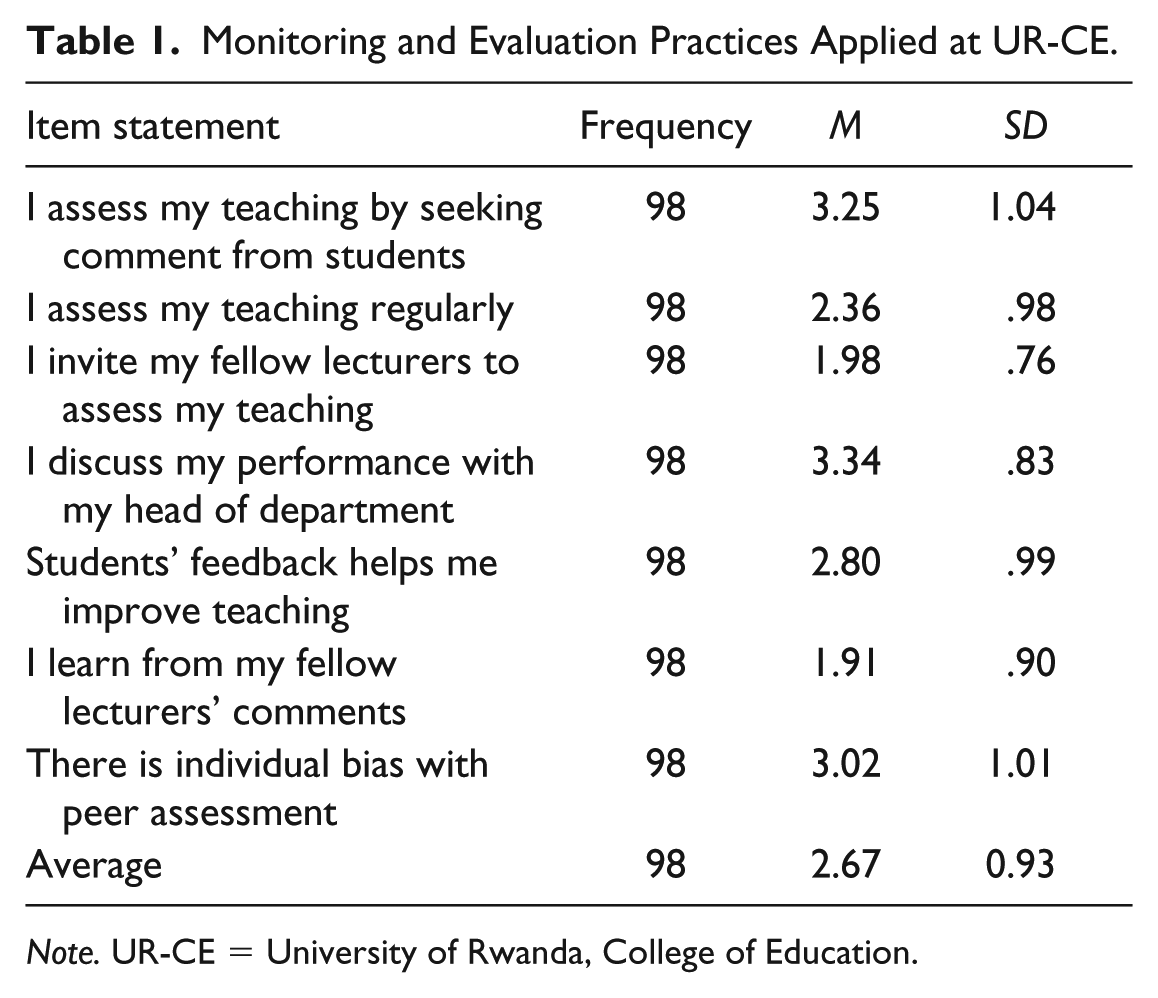
Respondents were asked to give their views on M&E practices. The rating was done according to 4-point Likert-type scale, ranging from strongly agree, agree, disagree, and strongly disagree. The descriptive statistics for the staff’s responses are shown in Table 1.
Monitoring and Evaluation Practices Applied at UR-CE.
Note. UR-CE = University of Rwanda, College of Education.
Results indicate that responses on M&E practices were tending to agree on students–staff evaluation (M = 3.25), and evaluation by supervisor (M = 3.34), while disagreeing with staff self-evaluation (M = 2.36) and peer evaluation (M = 1.98). Faculty members rated themselves highest on the statement “I discuss my performance with my head of department” with M = 3.15 and further rated themselves (staff) lowest on the statement “I learn from my fellow lecturers’ comments” with M = 1.91. It is also indicated in Table 1 that staff rated themselves fairly low on the statement “I invite my fellow lecturers to assess my teaching” (M = 1.98) and further, staff rated high the statement “There is individual bias with peer assessment” (M = 3.02). Indeed, the responses on two statements suggest that fellow staff would not critically assess the performance of their colleagues. Further results show that staff rated themselves fairly low in assessing their teaching regularly (M = 2.36). The results suggested that students–staff evaluation and evaluation by the supervisor or head of department (HOD) are significantly applied at UR-CE. Importantly, it was revealed that staff self-evaluation and peer evaluation were not used at satisfying level. All HODs agreed that M&E exercise is conducted periodically as one observed, “at the end of a module, students complete evaluation forms as part of summing up departmental achievement, and at the end of the year performance contract targets are evaluated.”
It was realized that the students–staff evaluation and evaluation by the supervisor or HOD are the most applied. The results are consistent with the conclusion by Chen and Hoshower (2003) that in most universities students’ ratings are more influential. It is worth emphasizing that students are an integral part of the learning process and, as primary consumers, their objective views are more likely to lead to continuous quality improvement initiatives. In equal strength, if students’ feedback from evaluations is driven by faculty, it is likely to be used explicitly for course and personal development (Becket & Brookes, 2006).
Findings indicate also that a few instances of peer evaluation were occurring. One HOD added, Faculty work in autonomy, we do not ask for daily reports, we move around to observe their attendance in class sessions. We also organize departmental meetings to discuss shortfalls and achievement. (HOD1)
This could be attributed to discomfort that develops among peers as a result of comparison that is likely to display their typical level of performance. There is also a general psychological feeling that peers tend to observe a less biased sample of behavior to project a positive image to their supervisors and by extension their employers. It was further noted that such an evaluation may involve HODs who in most cases assume their role of the supervisor in assisting fellow staff analyze the strong and weak areas noted in the teaching process Greguras, Robie, & Born, 2001). In as much as this should be the norm, findings show that peer evaluation was found to lack emphasis. This is confirmed by the fact that a high number of staff tended to agree that there was individual bias with peer evaluation, implying that a high percentage of faculty members believed peer evaluation was affected by bias. The findings clearly demonstrate a weakness on the side of staff in not willing to engage in peer evaluation as part of their professional development. This can be explained by Greguras et al.’s (2001) observation that interpersonal relationships may cause peers to be too lenient when rating their friends or to not discriminate among friends.
Relationship Between M&E Feedback and Staff Motivation
Performance feedback is often viewed as one of the vital human resource practices (Boswell & Boudreau, 2002). Some organizations used a feedback framework to regulate and enhance a leader’s ability in managing. It is seen as one of the mechanisms, a leader can potentially use to increase employees’ motivation. To further determine the role of feedback as a component of current M&E practices that may lead to staff motivation, correlation was obtained between the perceptions toward quality of feedback (PQF) statements and its motivational impact. PQF is anchored of Ryan and Deci’s (2000) self-determination theory, which holds that individual differences of employees have an impact on their motivation. As part of the environment, feedback and performance appraisal help shape and influence employee motivation, which ultimately lead to job satisfaction and better outcomes (Gagne’ & Deci, 2005). Systematic feedback on work performance, however, leads to intrinsic motivation and thus better outcomes (Ryan & Deci, 2000). Performance feedback and the employee response can also be interpreted using social exchange theory (Cropanzano & Mitchell, 2005). This theory argued that obligations are established through a number of interactions between employee and the supervisor who are in a state of reciprocal interdependence. The following six PQFs and five motivational impact of monitoring and evaluation (MIME) statements were used:
PQF 1: Performance feedback is timely provided
PQF 2: Performance feedback focuses on strengths and weaknesses for improvement
PQF 3: Performance feedback focuses on job content rather than the individual
PQF 4: Recognition of individual performance
PQF 5: Possibility to improve from the feedback received
PQF 6: Individuals do not complain about all aspects of M&E practices
MIME 1: M&E practices create the feeling of achievement
MIME 2: M&E practices create the sense of responsibility
MIME 3: M&E create a sense of pride at work
MIME 4: M&E makes employees feel empowered and motivated
MIME 5: Employees feel recognized and acknowledged for the efforts and contribution made
Table 2 presents a total of 25 correlations, with 16 significant correlations at the 0.01 level, suggesting a significant relationship between staff motivation and the M&E feedback. Important observations to highlight were that PQF statement “The feedback from performance evaluation focuses on strengths and weaknesses to improve” had a significant positive relationship with all MIME statements or subscales, ranging from .347 to .631 at the 0.01 level. On the contrary, PQF subscales “There is possibility to improve from the feedback received” and “The feedback from performance evaluation focuses on the job content rather than the person” had a significant negative relationship with all MIME subscales, ranging from –.293 to –.612, at the 0.01 level. For assessing the strength of correlation, Taylor (1990) suggested the following interpretations: correlation coefficients (r) ≤ .35 are generally considered to represent a low or weak correlation, .36 to .67 modest or moderate correlations, and 0.68 to 1 strong or high correlations. Hence, the results suggest a weak to moderate relationship between staff motivation and M&E feedback.
Pearson Correlation Between the Quality of Feedback and Faculty Motivation.

Note. MIME = motivational impact of monitoring and evaluation; PQF = perceptions toward quality of feedback.
Correlation is significant at the 0.01 level (two tailed).
Majority of those interviewed indicated that quality feedback can affect staff motivation. One respondent said, Yes, the feedback to some degree can motivate staff even though most people give weight to other things. Therefore, after performance evaluation, there should be some kind of rewards such as certificate of merit because that recognition remains memorable to the staff. (HOD2)
A number of scholars argued that feedback is a good motivator and can actually improve intrinsic motivation, such as rising feel of responsibility, empowerment, and recognition (Danner & Lonky, 1981) and that positive feedback (Deci, 1971) facilitated intrinsic motivation by promoting a sense of competence when people felt responsible for their successful performance. Furthermore, negative feedback, which decreased perceived competence was found to undermine both intrinsic and extrinsic motivation leaving people unmotivated (Gagne’ & Deci, 2005). Studies on this relationship extensively demonstrated a strong positive relationship to job performance (Martinsen, 2013). The overall feedback of performance is a strong factor in employee’s performance review (Levy & Williams, 2004). As a matter of fact, a study on Norwegian context indicated that performance appraisal needs to be followed with perceived regular feedback. This suggests that there is an interactive effect between these two activities (Kuvaas, 2011).
Impact of M&E on Staff Motivation
The Pearson correlation was used to identify the degree of association between applied M&E practices and academic staff motivation. The following table indicates correlations calculated at 0.01 significance level. In the table below MEP stands for monitoring and evaluation practices.
Table 3 shows correlations on MEP, four statements including students–staff evaluation, self-evaluation, peer evaluation, and evaluation by supervisor, and the totals of scores from the MIME five statements or subscales. This creates a total of 20 correlations, with seven significant correlations ranging from 0.268 to 0.4460 at the 0.01 level (including positive and negative correlations), suggesting a significant relationship between staff motivation and the MIME subscales.
Correlation Between MEPs and Faculty Motivation.

Note. MIME = motivational impact of monitoring and evaluation; PQF = perceptions toward quality of feedback.
Correlation is significant at the 0.01 level (two tailed).
The positive correlations were found between MEP subscales “Staff self-evaluation” and “peer evaluation” and MIME subscales, while negative correlations were found between the MEP subscale “Student Staff Evaluation” and the MIME subscales. Only the subscale “Evaluation by the supervisor” had no statistically significant relationship with any statement of MIME. Hence the correlations between M&E subscales and its motivational impact were qualified ranging from weak to modest. These results meant that the M&E practices and the subsequent feedback had the ability to stimulate staff motivation if applied effectively by the supervisors.
It is evident from the findings that performance appraisal is a formalized process of ensuring performance and productivity of the faculty. Without a clear and compulsive performance requirement, academics cannot be administered effectively and will lose much of their motivation to improve work (J. Zhang, 2008). As highlighted by Tozoglu (2006), evaluation has two functions: first as feedback to enhance performance, build new practice, or change existing practice, and second is for decision making in respect to retaining, promotion, hiring, or termination. In addition, J. Zhang (2008) observed that the overall purpose of performance appraisal to university academics is to enhance the general level of performance and to provide basis for the implementation of managerial strategies. Moreover, evaluation enables academics to be reflective practitioners by observing their own practice (Bam, 2005).
Regular and systematic evaluation has been identified as indispensable attributes of effective employees (Itolondo, 2012). Procedures for evaluating academics include self-evaluation, student evaluation of teaching effectiveness, peer evaluation, and evaluation by a faculty committee (Ngware & Ndirangu, 2005). In these procedures, evaluation by immediate supervisors needs to be supported by supplementary data from other sources to avoid bias (Tozoglu, 2006). Consequently, peer evaluation can complement evaluation by supervisors. As explained by Itolondo (2012), peers are more likely than administrators to possess the empathy, understanding, contextual awareness, and knowledge of the subject matter. However, Greguras et al. (2001) observed that peers often develop close relationships among themselves and maybe unwilling to provide accurate ratings.
Bam (2005) argued that self-evaluation is equally significant because it provides careful, informed self-criticism of every aspect of teaching. Rigorous self-evaluation enables lecturers to identify areas for improvement and strengths, which triggers them to set professional development goals. Kambanda (2008) emphasized that multiple ratings are significantly more valid than single ratings because an employee gets feedback from different perspectives. However, Kelly, Ang, Chong, and Hu (2008) observed that problems associated with lack of agreement on appropriate appraisal criteria concerns over the validity and reliability of evaluation methods, and the negative perceptions toward the appraisal system.
Conclusion and Implications
Findings confirmed that the M&E practices encompassing staff self-evaluation, students–staff evaluation, peer evaluation, evaluation by supervisor are applied at UR-CE with varied extent. In general, the study established that students–staff evaluation and evaluation by the supervisors or HOD are the most applied. Furthermore, the study established that a weakness exists on the side of staff by their unwillingness to embrace peer evaluation as part of their professional development. In the entire evaluation process, feedback is very critical for continuous professional improvement. Finally, besides other variables M&E has a bearing on academic staff motivation.
Academic staff need to recognize how essential it is for them to assess their performance on individual basis with a more professional approach. This can be achieved through different practices including peer evaluation, where the staff may help fellow colleagues to know what is expected of them. In turn, this helps to build confidence leading to satisfactory performance and a reduction of tension that is associated with M&E. In the entire process of M&E, feedback process should be effective in a way that academic staff would benefit, leading to their improvement. The feedback should be objective focusing on the job content and be timely. It is critical for HODs and supervisors to take a leading role in the M&E of faculty activities on a daily basis. This would address any biases associated with HODs and staff when involved in performance measurement process.
Although findings provide considerable support to the claim that although motivational status is associated with autonomy over work and recognition, it does not automatically warrant that the former was the cause of the latter. It is imperative that any inference regarding the influence of the M&E on academic staff motivation should be interpreted with caution in terms of assumption of causality. Based on the findings, this study recommends that policy makers, especially Higher Education Council and University of Rwanda, design a policy on M&E of faculty, which would guide supervisors in M&E exercise. It is also recommended that the university sensitize and train faculty of on how to conduct a peer review objectively, which makes a significant contribution to faculty’s professional growth.
Footnotes
Declaration of Conflicting Interests
The author(s) declared no potential conflicts of interest with respect to the research, authorship, and/or publication of this article.
Funding
The author(s) received no financial support for the research, authorship, and/or publication of this article.