




Abstract
Faculty is the key agent for internationalization. This interview-based study explored faculty views about the internationalization understanding, rationales, roles, engagement, and motivation in a research-centric, double-first class university in China. Faculty motivation was analyzed using the lens of the motivation systems theory (MST). The main findings concerning the five main themes emerging from the analysis of documents and interviews of twenty-eight faculty members are as follows. First, Chinese faculty’s understanding, rationales, roles, engagement, and motivation were significantly influenced by the national and university policies. Second, they mainly understood internationalization as activities, openness, and cross-cultural exchange. Third, unlike other countries, Chinese faculty espoused a broader scope of internationalization in their rationales, spanning from personal to university, higher education, China, and world development. Fourth, faculty perceived roles in internationalization included main drivers, role models, liaisons, and coordinators. Fifth, faculty motivation comprised goals, beliefs, and emotions. Faculty, among other goals, aspired to improve teaching content and expand students and self-abilities, yet they had mixed context and capacity beliefs. For example, they appreciated the university and national support for international travel, funding, and research but criticized complex travel procedures and teaching evaluation methods. They also felt concerned about their teaching, research, and communicating in a foreign language with students and international peers, except those with foreign backgrounds and experience. Faculty experienced different emotions when undertaking international activities, for example, joy, interest, and excitement to explore and learn. Finally, there was a high-medium level of faculty engagement in teaching and research than service internationalization (low or no engagement).
Introduction
Internationalization has become a norm among higher education institutions (HEIs) worldwide (Criswell & Zhu, 2015; De Wit, 2020; Hudson, 2016). Green and Shoenberg (2006, p.1) stated that “it would be difficult to find a college or university today that is not making some effort to internationalize.” Many experts believe that faculty members are the main drivers and agents in internationalization (Friesen, 2013; Leask et al., 2020; Proctor, 2016). Faculty reinforces internationalization competencies and promotes internationalization activities (Cao et al., 2014; Criswell, 2014; Robson, 2017). Faculty engagement in internationalization (FEI) is pivotal to the success of higher education internationalization (Leask et al., 2020; Sanderson, 2008), but faculty engagement, perceptions, understanding, and motivations remain widely unexplored (Proctor, 2019, p. 47).
Among other nations, China has been integrating internationalization into its educational system and mega-projects, for example, the Belt and Road Initiative and the Maritime Silk Road. In 2015, the Chinese State Council released the Coordinate Development of World-class Universities and First-class Disciplines Construction Overall Plan (Double First-class Initiative). While these plans aim to lift the status, standards, and global competitiveness of HEIs in China (Chinese State Council, 2015), universities face the growing demand for knowledge exchange, high international student enrollments, faculty exchanges, and research collaborations. Faculty members are now integrating more global and multi-cultural dimensions in their work. The scope and significance of internationalization can be estimated from the following facts. In 2018 alone, out of 4.3 million R&D staff in China, 0.98 million belonged to the 2,663 HEIs. A total of RMB1.967.79 billion were allocated to R&D activities, of which the HEIs received RMB145.79 billion. Also, more than one million scientific papers and two million patents were produced (Chinese National Bureau of Statistics, 2019). With over 2,688,900 documents, China ranked second in the Web of Science, trailing behind the US with 4,127,450 publications (Web of Science, 2020). From 2000 to 2018, the number of publications (i.e., papers, book chapters, reviews, and books) from China increased from 5,755 to 101,537, respectively (InCites, 2019). In 2018, more than 662,000 teachers and students traveled abroad for study, while almost 65,8000 of these international travelers received funding from the governments or institutes (Chinese Ministry of Education, 2019). These internationalization initiatives clearly reflect that higher education and faculty internationalization has remained at the heart of national, provincial, and educational sector policies.
Academically, extant works on the topic of internationalization, FEI (Hsieh, 2020; Knight, 1994; Yemini & Sagie, 2016), or student mobility (e.g., Donnelly & Gamsu, 2020; Perez-Encinas et al., 2020; Teichler, 2002) have mainly presented western settings and viewpoint (cf. Nyangau, 2018a; Proctor, 2016; Schwietz, 2006). Many experts (e.g., Leask et al., 2020) have called for international research on faculty internationalization to promote academic diversity in the current literature. China leads the global ranking in many higher education categories (e.g., international students and internationalization funding). Despite that, few empirical studies present information about faculty attitudes toward internationalization (Shu, 2015) and their motivations to engage in international activities (Li & Tu, 2016). This lack of diversity in academic scholarship has created a wide gap between the West and the East while simultaneously disrupting the institutional implementation of faculty internationalization worldwide (cf. Childress, 2010; Stohl, 2007). To our knowledge, there is no qualitative case study comprehensively covering the understanding, rationales, roles, motivation, and engagement of Chinese faculty, especially in a research-centric, double-first class university. There is an imminent need to explore factors affecting faculty internationalization (Sanderlin, 2012) because these factors determine the success of internationalization, especially in research-centric institutions (Hirano, 2012). These knowledge gaps provide sufficient research motivation.
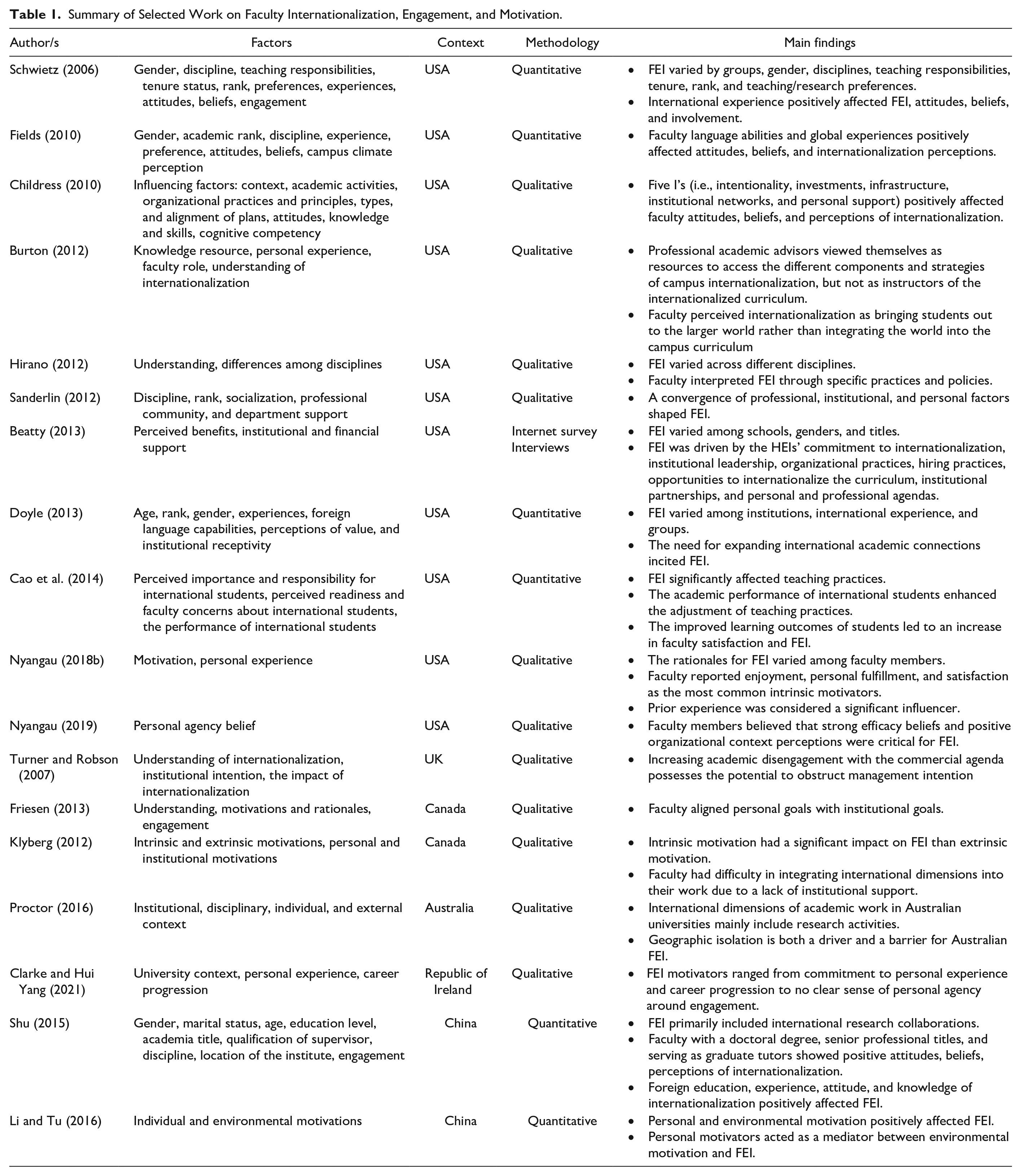
Therefore, this article aims to cover prior knowledge gaps by presenting an initial account of the understanding, rationales, roles, motivation, and engagement from a faculty perspective in China. Some of the main contributions of this work are as follows. First, to the best of our knowledge, this is the first in-depth study offering faculty viewpoints about understanding, rationales, roles, motivation, and engagement in a Chinese university. Second, previous studies on faculty internationalization in research-centric, double-first class universities in China are limited. This study has made an effort in the same direction. Third, this is the first qualitative study on FEI that builds on secondary data, interviews, and document analysis to present an informative case study of FEI practices in a Chinese research-centric, double-first-class university. Fourth, the paper has attempted to summarize and compare some of the important international works on the current topic against the academic scholarship on FEI in China (see Table 1). The current literature review, among other things, highlights knowledge gaps and the lack of empirical studies on faculty motivation and engagement in internationalization in China.
Summary of Selected Work on Faculty Internationalization, Engagement, and Motivation.
This paper is structured as follows. Section 2 presents a review of previous literature on various aspects of internationalization. Section 3 includes the methodology, comprising sampling, instruments, data analysis techniques, and ethical compliance. Section 4 delineates the discussions on the main findings, followed by the conclusion, policy implications, and limitations in Section 5.
Literature Review
Understanding of Internationalization in Higher Education: A Conceptual Overview
Internationalization has remained a mystified and widely misunderstood term because of the vast array of existing concepts and approaches in higher education literature (Zolfaghari et al., 2009). Extant literature offers four different approaches to understand internationalization: (i) activity approach; (ii) process approach; (iii) echo approach; and (iv) capacity approach (Zha, 2003). The activity perspective suggests that internationalization relates to “multiple activities, programs, and services that fall within international studies, international educational exchange, and technical cooperation” (Arum & van de Water, 1992, p.202). As per Knight and De Wit (1995, p.15), internalization is “the process of integrating the international dimension into the teaching, research, and service functions of an institution of high education.” However, Van der Wende (1997) believed that internationalization could be “any systematic effort to make higher education responsive to the requirements and challenges related to the globalization of societies, economy, and labor markets.” This concept is also known as the capacity perspective. The echo perspective views internationalization as an educational process promoting awareness and inclusivity of different cultures (Schoorman, 2000). Butts (1969) also argued that internationalization is about establishing systems to guarantee cross-border educational assistance and cooperation, international contents of the curriculum, and global exchange of training, research, and students. This concept implies a global mindset while responding to the HEI globalization (Paige & Mestenhauser, 1999). De Wit et al. (2015, p. 29) argued that internationalization is “the intentional process of integrating an international, intercultural, or global dimensions into the purpose, functions, and delivery of post-secondary education to enhance the quality of education and research for all students and staff, and to make a meaningful contribution to society.”
Congruent with the above, global learning has given rise to several new terms in higher education. Among them, the term internationalization at home (IAH) refers to “any internationally related activity except for outbound student and staff mobility” (Crowther et al., 2001, p. 8). Academics should focus on the internationalization of curriculum that provides an international dimension for all institutions, rather than just focusing on mobility programs that only a few can access (Jones, 2017). Theoretically, IAH and internationalization abroad are two interdependent streams in the internationalization literature (Knight, 2006). IAH represents an institutional instrument or a set of activities that aim to develop international and intercultural competencies in all students (Beelen & Leask, 2011). It is “the purposeful integration of international and intercultural dimensions into the formal and informal curriculum for all students within domestic learning environments” (Mudiamu, 2020, p. 27). Academics believe that activities like IaH, faculty mobility, and faculty development have strongly impacted student learning and intercultural skills (Kinzie & Helms, 2019; Kinzie et al., 2017). There is a consensus among experts that the success of IAH and other aspects of internationalization depends on the academic staff’s capacity (Beelen & Jones, 2015; Carroll, 2015; Niehaus & Williams, 2016; Robson, 2017; Robson et al., 2018). That said, De Wit et al. (2015) assert that internationalization needs to evolve into a more comprehensive, more intentional, and less elitist (for all students and staff) process, less focused on mobility and less economically driven, with the goal to enhance the quality of education and research and make a meaningful contribution to society. Following De Wit et al. (2015), this study adopted a more comprehensive and inclusive view of internationalization, focusing on all international activities from teaching to research and service internationalization, irrespective of whether it was internationalization at home or abroad.
Faculty Engagement in Internationalization: An Overview of the Study Area
Past research on higher education internationalization has mainly focused on the organizational perspective (cf. Hirano, 2012; Sanderson, 2008). Scholars have paid little attention to faculty perspective, sentiments, views, intrinsic and extrinsic motivators, and other aspects (Sanderlin, 2012). Faculty are key stakeholders and influencers in determining the academic direction, especially in research-centric universities (Hirano, 2012). Faculty are the best resources to implement and diffuse internationalization in universities. They do so by meeting the specific needs and aligning themselves and pupils with institutional values and priorities (Van Der Wende, 1999). Later, Sanderson (2008) highlighted the neglected role of individual actors (e.g., faculty) in the internationalization process. Kehm and Teichler (2007) supported that many studies on faculty internationalization predominantly offer normative assumptions of the researchers, offering any enlightenment to faculty not sharing this normative umbrella. Thus, there is a need to understand the perceptions and beliefs of faculty in other countries. Improved access to the research on internationalization in countries where research findings are predominantly published in languages other than English is needed (Kehm & Teichler, 2007).
Considering previous research, a study sponsored by the American Council on Education investigated faculty perceptions and beliefs about internationalization in the US. The results indicated that 73% of respondents considered internationalization a valuable component of education, while 65% endorsed the faculty’s responsibility to provide students with the awareness of other cultures, countries, and global issues. Despite this favorable response, faculty showed little motivation to incorporate an internalization perspective into curriculum, teaching, or research activities (Siaya & Hayward, 2003). In another USA study, Schwietz (2006) observed three distinct factors of internationalization: (a) scholarship of research and Teaching; (b) instruction and curriculum; and (c) the impact of curriculum on students in Pennsylvanian university. As per results, faculty showed little or no interest in international teaching, research, and improving awareness about internationalization policies. The author reported significant differences in attitude and beliefs among faculty groups. Faculty members in humanity, business, social sciences, and behavioral science demonstrated more positive attitudes and beliefs about internationalization than other academic disciplines.
Moreover, Fields (2010) used a quantitative method to measure faculty’s attitudes and beliefs in a university located in Vermont, USA. The author concluded that faculty members in agriculture, animal sciences, education, and humanities demonstrated a high interest in internationalization than other departments, possibly due to cultural differences between disciplines. In another study, Childress (2010) concluded that a transparent internationalization strategy, increased financial and infrastructure support, institutional networks, and individual support facilitated FEI in the two US universities. In another study, Nyangau (2018b) used a qualitative interview-based approach to explore FEI in institutions with no recognition and rewards for internationalization activities in tenure and promotion decisions. The results showed diverse rationales for FEI. Friesen (2013) examined the internationalization rationales, understanding, and motivations of faculty in a Canadian University. The results suggested that internationalization warrants careful consideration of faculty’s needs, values, engagement, and the potential impact of institutional strategies. Proctor (2016) studies the engagement of Australian academic staff with the international dimensions of their work and the influencing factors through document analysis and in-depth interviews. The study found that the international dimensions of academic work are predominantly centered on research.
For China, Li and Tu (2016) studied the personal and environmental motivators that drive FEI using a structural equation model. Clarke and Hui Yang (2021) examined several aspects of FEI in the Republic of Ireland, ranging from conformity to instrumentalist discourse to feeling or emotion demotivated by the absence of recognition for job-related commitment, the effect of no or low engagement by peers and coworkers, and engagement with the procedure to develop other career goals. Table 1 presents the summary of selected works on the topic.
Retrospectively, it is evident from the literature review that the contributions from the East are scant and limited to few quantitative studies from China (e.g., Li & Tu, 2016; Shu, 2015). Majority of studies have covered faculty motivation, understanding, rationale, and engagement for universities in the West, for example, US, Canada, Ireland, and Australia. Experts believe that the current technological, academic, and scientific gaps between ‘the East” and “the West” signify a lack of diversity in the current literature concerning methods and context (Rhoads & Hu, 2012). As per Hirano (2012), faculty, especially in research-centric universities, are instrumental in shaping the academic direction, yet current works on faculty intrinsic and extrinsic motivation in research-centric universities are scarce (Sanderlin, 2012). This study makes an effort to enrich the current literature by applying a qualitative approach to examine faculty motivation, understanding, rationale, roles, and engagement in China. A unique aspect of this study is that it provides rich and in-depth insight into a research-centric, double first-class university in China.
Methodology
Sampling and Participants
This qualitative study combined multiple data sources to explore faculty internationalization dynamics. Denzin (1970) proposed that one way to accomplish data ‘triangulation” is by retrieving data from several sources to create a single body of data to enhance the completeness, balance, reliability, and validity of the findings (see also Yeasmin & Rahman, 2012). Thus, this study used data from different sources like semi-structured interviews, books, documents, policies, and official websites to corroborate the present findings by converging several perspectives. All interviews were collected from a research-centric, double first-class university in China, hereafter the X University. Based on the site familiarity, the initial interviewees were asked to help identify other participants employing the snowball sampling method (cf. Patton, 2002). Corbin and Strauss (1990) recommend the grounded theory approach to explore a new phenomenon in a new context. Thus, the same approach was adopted to collect data on faculty understanding, rationales, roles, engagement, and motivation for internationalization in the X University. From the beginning, the founding leaders of the same university set a clear international vision to “pursue eastern and western knowledge and spirit, to expound the inherent beauty of Chinese scholarship, so that it can be integrated into a new and perfect culture” (Hong, 1990, p. 25 and 26). Also, the university mission statements asserted the need to “benefit from its location,” that is, attracting overseas Chinese for education (Chinese Editorial Department of China Education Yearbook, 1984, p. 648).
All participants for the interview were selected from a double first-class, research-centric university in Fujian, China. Table 2 presents the demographic details of the participants. Established in 1921, the X University employs more than 110 full-time and above 160 short-term foreign teachers. In line with the national programs, this university has introduced various policies for promoting international activities. These initiatives have opened the channels for student and faculty exchange. The university has been sending around 2,000 students per year to different exchange programs in recent years. As of 2021, the university signed 257 international intercollegiate exchange agreements, trained students from more than 130 countries and regions, co-build 14 Confucius Institutes in 12 countries, and participated in more than 10 multilateral cooperation platforms, for example, the BRICS University Alliance (Yang, 2021).
Demographic Details of the Participants.

Data Collection
First, the document analysis comprised data from various sources, for example, related history books, government/university yearly books, official websites, and policies (university development strategy plans, promotion policies, and research management policies) ranging from 1921 to 2020 (see Table 3). Some documents were retrieved from the X University library, while others were extracted from the several internal websites of the X University (see Annexure for document sources). Second, in-depth semi-structured interviews were used to collect faculty understanding about internationalization, rationales, roles, motivation, and engagement. Some of the main questions are as follows: understanding—What is higher education internationalization in your understanding?; rationales—Why this university promotes internationalization?; faculty role—What role do you play in internationalization?; motivational factors—What motivates you to engage in internalization activities?; faculty engagement—What kind of international teaching, research, and service activities have you participated in? All interviews were conducted in the Chinese language, ranging from 60 to 90 minutes. Interviews were recorded, manually transcribed, and then translated using Brislin’s (1970) back-translation technique.
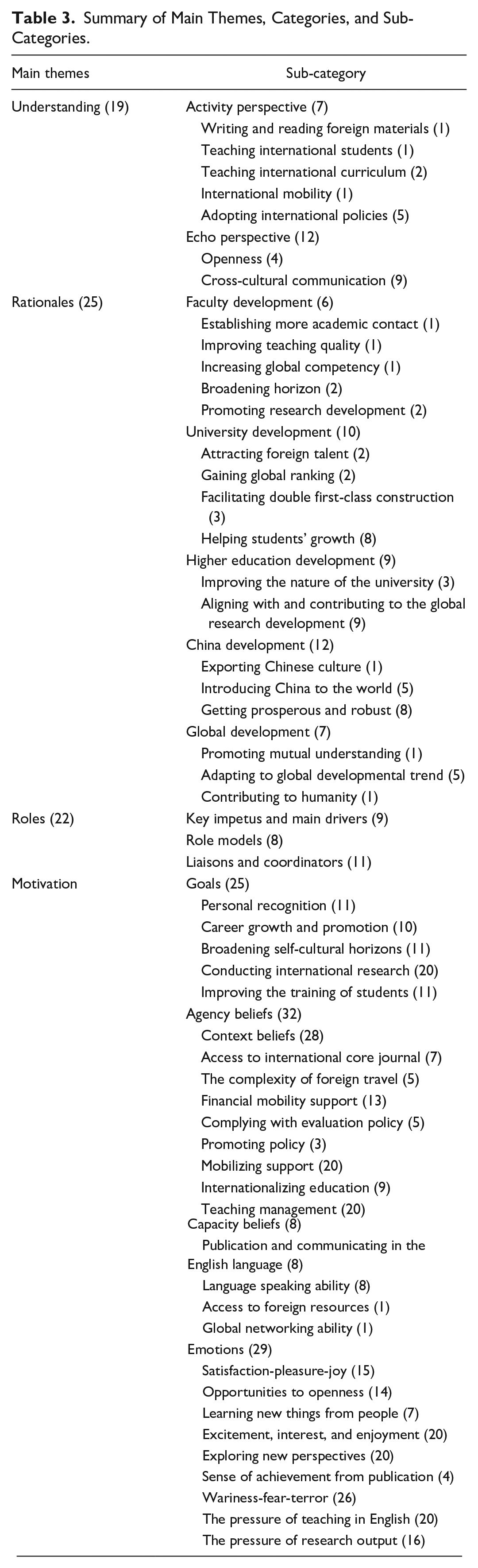
Summary of Main Themes, Categories, and Sub-Categories.
Data Analysis Techniques: Interviews
NVIVO 11 software was used for decoding the interview data. Following Charmaz (2014), a two-step coding process was used. In the first step, all transcripts were coded line-by-line. Tentative codes were created that described the patterns in the data. The second step was focused coding. This stage involved a more selective and conceptual approach, implying that the most critical and frequent past codes were selected to examine and analyze the extensive interview data. The data and the initial codes were reexamined in the process and compared against other codes; consequently, a set of codes were identified that made sense. With probable categories, the batches of data were sorted and then synthesized. The extracted categories were compared to further modification, ensuring that the categories were mutually exclusive and exhaustive. This procedure ended in a set of main categories that best represented our findings. The annotations used for faculty demographics are as follows: M = male; F = female; NS = natural science; SS = social science; HUM = humanities; P = professor; AP = associate professor; C = China. All annotations include C = China and A = administrative position, followed by participant numbers from 1 to 28.
Ethical Considerations
All ethical issues were taken into consideration. The study was approved by a panel of five institutional review board (IRB) members from the Institute of Education at the X University in May 2017. Before the interviews, all participants were briefed about voluntary participation, anonymity, and confidentiality.
Findings and Discussion
Five main categories emerged from the interview analysis: (i) understanding: (ii) rationales; (iii) roles; (iv) motivation; and (v) engagement. These categories correspond to the five main research questions stated earlier. Faculty motivation comprises goals, beliefs, and emotions. The following part discusses the interview findings in line with previous literature, national/institutional requirements and policies, and the document analysis. Table 3 presents the main themes and sub-categories.
Faculty Understanding of Internationalization
Faculty understanding of internationalization may differ significantly, given the complexity of internationalization (Criswell & Zhu, 2015). As seen in Table 3, faculty perceived internationalization as activities (e.g., teaching international students), cultural exchange, cross-cultural communication, or openness, as indicated by the following views:
CA9: “internationalization primarily involves activities like going abroad and returning home to China, foreign visits for education and conferences, on-campus lectures by foreign faculty, and teaching international students. Internationalization means integrating international dimensions into the curriculum because science has no border. The essence of human civilization is created not by one but by many other countries, so we need to update teaching material every year.” (CA9, M, P, SS).
CA3: “internationalization means aligning systems to global standards. Many Chinese universities are now opening new campuses abroad, while foreign universities are building new campuses in China.” (CA3, M, P, SS).
“Internationalization is exchange and communication in a way that we [Chinese] communicate with other countries, i.e., either they guide us, or we guide them” (C22, M, AP, NS).
The current results showing faculty understanding of internationalization as activities, cultural exchange, and openness does not vary significantly from other countries. The British faculty understood internationalization as university activities, reciprocity, and multi-culture communication (Turner & Robson, 2007). Canadian faculty perceived it as a complex and confusing term associated with various possible activities (Friesen, 2013). For both the American and Canadian faculty, internationalization implied different activities, for example, getting funding for international research, teaching, opportunities for international experiences, staffing support, and engagement (Criswell & Zhu, 2015). The British and Brazilian faculty recognized internationalization as institutional strategizing, integrating students, inclusivity of IAH, and curriculum internationalization (Almeida et al., 2019).
Chinese faculty understanding of internationalization as cultural exchange phenomena and activities reflects the impact of various policies introduced by the Chinese national government and the Ministry of Education. These national policies have given directions and stressed universities and faculty to initiate policies, programs, funding, and reward based on specific activities and tasks concerning teaching, research, and service internationalization while asserting openness, cross-cultural exchange, and communication beyond borders. For instance, the Ministry of Education initiated the “Bilingual Teaching Demonstration Course Construction Project” in 2007 to promote the “constructions of hiring foreign teachers, lectures given by foreign experts, construction of bilingual teaching materials, and the reform of bilingual teaching methods” (Chinese Ministry of Education, 2007). Later, Chinese State Council (2016) released a new policy called the “Opinions on Opening Education to the Outside World in the New Era.” In this policy, the government directed higher education institutions to do the following: “improve the efficiency of foreign-related education, expand bilateral and multilateral education cooperation, and enhance the standardization and legalization of education opening to the outside world.”
Faculty Rationales of Internationalization
Internationalization is a multifaceted palette of opportunities, and thus, it may differ among faculty (cf. Turner & Robson, 2007; Wihlborg & Robson, 2018). Van der Wende (1997) proposed that faculty rationales are driven by academic, political, socio-cultural, and economic motives. However, the current results indicated five main internationalization rationales related to the development of faculty, university, higher education, China, and the world. These rationales are like American faculty, who identified three rationales related to the improvement of faculty (e.g., teaching, research, personal growth), students (e.g., global awareness, knowledge, and experience), and university, for example, reputation (Sanderlin, 2012). In the same way, Chinese faculty believed that internationalization was meant to improve faculty and align them with the world-class standards through personal and academic growth, as C22 stated:
“Internationalization, for me, to broaden my horizons, to make more overseas contacts, and to obtain academic material. Internationalization will give me the right opportunity to accomplish both enhance my career and develop myself, simultaneously.” (C22, F, AP, HUM)
Like other countries, Chinese faculty perceived internationalization for global recognition, university improvements, global research development, double first-class construction, student growth, and foreign talent recruitment as developing university and higher education sector. Canadian faculty also mentioned strategic institutional motives like enhancing institutional profile, status, and economic returns (Friesen, 2013). The British faculty reported institutional development motives, such as increasing overseas students and expanding share in the global student market (Turner & Robson, 2007). Iosava and Roxå (2019) agreed that internationalization is a primary source of financing and maintaining a reputable position and disciplinary niche in the global higher education market. Representing the Chinese context, C23 stated:
“Internationalization is a chance for universities to improve scientific research to attain a world-class level. natural science and engineering attract the best talent for global research.” (C23, M, P, NS)
C9, however, asserted the need to adjust the balance between inbound and outbound talent recruitment, as he explained:
“There is a severe scarcity of going-out internationalization exists, at least, in my discipline. What we do most now is to invite foreigners to China.” (C9, F, AP, NS)
According to some participants, internationalization rationales extend beyond individual and institution interests to national and global development. By addressing political, socio-cultural, economic, and academic issues, simultaneously, it has the potential to facilitate global harmony, as some of the faculty believed: “After the foundation of the People’s Republic of China, the country closed its door to the world for almost 30 years (1949-1978). Through the internationalization of education, China aims to make a much-needed contribution to the world. Universities were internationalized from the day they were born. Later, with the development of democratic countries, nations began to have borders. The communication was disrupted. Our motive is to develop mutual understanding through interaction, learning about each other’s cultures and environments, and search for ways to develop a harmonious world. A lack of understanding can lead to misconceptions, inequality, and injustice” (CA4, M, AP, SS).
“Internationalization signifies modernization. It can reduce poverty and help China achieve its status as a responsible economy contributing to the world.” (C20, M, AP, SS).
Drawing from the above, it is safe to assume that Chinese faculty espouse a broader scope of internationalization (i.e., from individual to global) than their global peers. This disposition possibly originates from the Confucius harmony world philosophy and national policies. In the book, Daxue: The Great Learning for Universities Today, Shen (2018) argued that the disciples must first self-cultivate, and then improve their immediate family, country, and the world. In parallel, several national policies have provided clear rationales for universities to follow: to train and cultivate faculty (individual development), to enhance teaching quality, to promote reform of teaching methods (institutional development) (Chinese Ministry of Education, 2007), to build world-class universities and disciplines (institutional and national development) (Chinese State Council, 2015), and to expand collaboration and openness (world development) (Chinese State Council, 2016).
Faculty Role in the Internationalization
This study’s respondents perceived playing different roles in internationalization, ranging from main drivers to role models, liaisons, and coordinators. Past research has established the role of faculty as the main agents (e.g., Dewey & Duff, 2009; Romani-Dias et al., 2019; Rostan et al., 2014) and key agents of internationalization of high education in Canada (Friesen, 2013) and Australia (Proctor, 2016). Perceiving faculty as the main driver, as a male professor from natural sciences explained:
C12: “faculty is the primary advocate of internationalization as they are the ones inviting foreign students and driving global cooperation through faculty-faculty relationships and cooperation. Personally, I have collaborated with foreign professors. Our school has signed different cooperation agreements with universities in Australia and beyond, but they are more symbolic than meaningful. Even though these agreements might have benefited undergraduate exchange and education, I still believe that the real essence of internationalization and perceived benefits would come from initiating more tangible faculty-faculty cooperation. At prime facia, internationalization is nothing more than mementos of cooperation agreements displayed in the halls of universities these days.” (C12, M, P, NS)
Furthermore, eight respondents perceived faculty as role models who inspire students and peers to adopt a global vision. According to Gao (2008), faculty must personify the exemplary morals and expertise of their disciplines. Based on data from an American university, Friesen (2013) found that highly engaged faculty credited the people who encouraged or counseled them to participate in international activities. Academics argue that students value faculty opinion about international cultures, work ethics, and experience (cf. Doyle, 2013; Green et al., 2008). Perceiving teachers as role models, as C1 stated:
“Teachers are role models in a university. I have witnessed an amusing curiosity among students when they meet and interact with a teacher who returns from abroad. Students are eager to go abroad for education and experience, and thus, they often visit faculty members for consultation and recommendation letters. In fact, we act as promoters and ambassadors of internationalization. As a teacher for undergraduate students, students ask me questions about student life, course difficulties, and other things in foreign countries.” (CI, M, AP, NS)
A parallel opinion was that faculty members serve as liaisons or coordinators in the internationalization process, connecting students, teachers, universities, and countries. Delineating this point, C8 stated:
“Faculty has a critical role in internationalization, in terms of connecting and coordinating between universities. Even students and administrative staff rely on faculty to lead the way” (C8, M, P, SS).
Indeed, the internationalization process begins with capturing the hearts and minds of educators and administrators. Faculty serve as a bridge among academic institutions (Van Gyn et al., 2009) and coordinate internationalization activities (cf. Dewey & Duff, 2009; Nyangau, 2019). Apart from the societal values and philosophy that portray teachers as caring figures, role models, and mentors, national and institutional policies potentially influenced faculty role perception. For instance, the “notice of the state council on printing and distributing the overall plan for promoting the construction of world-class universities and first-class disciplines as a whole” directs universities to build first-class teaching staff and strengthen the supporting and leading role of high-level talents (Chinese State Council, 2015). The “Thirteen Five-year Plan and Long-term Plan of the X University” recognizes faculty and students as the fundamental force to promote the development of the X University (X University, 2016b). Released by the Chinese State Council (2018), the “Opinions on Comprehensively Deepening the Reform of Faculty Team Construction in the New Era” identifies faculty as the first resource of educational development. This document directs faculty to undertake the historical mission of disseminating knowledge, ideas, and truth and shoulder the important task of shaping the soul, life, and human beings.
What Motivates Faculty to Engage in Internalization?
Ford’s (1992) Motivation System Theory (MST) was applied in this study for understanding motivations. This theory posits that faculty motivation comprises three intertwined aspects: goals, agency beliefs (capacity and context), and emotions. Responses to each dimension are discussed below.
Goals
Different goals, particularly rewarding ones (cf. Fairweather, 2002), drive faculty engagement (Nyangau, 2018a; Romani-Dias & Carneiro, 2019; Sanderlin, 2012). The interview analysis revealed that faculty anticipated altruistic, self-beneficial (Nyangau, 2018b), within individuals, and people-environment relationships (Ford, 1992) consequences in their goals. Among them, some interviewees expressed a desire to enhance students’ abilities, as C4 stated: “For me, the goal is to improve the mental [cognitive] abilities of our students through best foreign teaching methods and case studies, yet in effect, one must align these materials with the local environment” (F, AP, SS).
Many scholars have established that goals related to students learning and development (cf. Criswell & Zhu, 2015; Nyangau, 2018a; Sanderlin, 2012) and broadening student cultural horizons (Gokbel, 2020; Hartzell, 2019) drive FEI. Apart from being students-oriented, these goals severed important personal motives, broadening cultural horizon, promotion, and recognition, as some of the following participants shared:
“Teachers and students commonly go abroad to learn more about the external world. They compare their environment with the world they visit—this curiosity and anxiety to explore the unknown serve as a key motivation.” (C28, M, P, H)
“Those with a foreign background or foreign education (hai gui), like me, often find teaching [in English] in summer school an unpleasant obligation, yet I feel inspired to deliver my best for my students and my career.” (C1, M, AP, NS). “Through internationalization, I get the chance to show more of myself, learn about others, increase my visibility among international peers, and become known among the international academic circles.” (C12, F, AP, NS).
Despite perceived discomfort (unpleasant obligation, C1), Chinese faculty demonstrated more optimism in their goals than the British faculty who just anticipated the completion of “forced work” imposed by their institution (Turner & Robson, 2007). Unlike British faculty, Canadian faculty sought expansion in Teaching and research internationalization (Friesen, 2013). The Australian faculty anticipated work success and a research-driven academic reputation (Proctor, 2016), but the American faculty sought professional or personal recognition, global travel opportunities, and developing global networks, students, and institutions (Klyberg, 2012; Nyangau, 2018a; Sanderlin, 2012). In India, a non-Anglophone country, faculty were keen on enriching the local learning and research capacity for global competitiveness (Amblee & Dhayanithy, 2018), a view like the Chinese faculty. C20 stated: “We seek internationalization activities to expand our thinking, help us to solve complex problems, and above all, identify trending research. In other words, international cooperation in natural science and other subjects can help us discover international research hotspots. If we are successful, we can actively contribute to the innovations and new ideas emerging from these centers. If properly implemented, these novel concepts can facilitate the future development of China and the world at large” (C20, M, AP, SS)
Comparatively, faculty goals in non-Anglophone countries exhibit a micro-macro perspective, that is, from individual to global. Faculty goals in Anglophone countries span from individual to institution only. It appears that Chinese faculty set goals in line with the government and the X University policies. As per these policies, institutions are expected to train and cultivate faculty (professional development); enhance teaching quality, promote reform of teaching methods (Chinese Ministry of Education, 2007); build world-class universities and disciplines (Chinese State Council, 2015); expand collaboration and openness (Chinese State Council, 2016); and to promote international competency using indicators of faculty team building, research development, and external international service (X University, 2016a).
Agency beliefs: Context and capacity beliefs
By expressing or developing certain beliefs, individuals desire to achieve the personal goals for enhancing or maintaining their unique identity (Ford, 1992). Agency beliefs, comprising the context and capacity beliefs, determine FEI (Criswell, 2014). Bartell (2003) stated that university culture, strength, and operational structure induce positive context beliefs and internationalization performance. Administrative support triggers faculty engagement by nurturing positive context beliefs (cf. Liu et al., 2020; Nyangau, 2019). Childress (2010, p.119) noted that “critical infrastructure, incentives, and communication mechanisms [are needed] to support faculty in developing international dimensions to their teaching and research.” Of some Anglophone countries, American faculty in different studies have appreciated leadership (Dean) commitment and support for internationalization initiatives (Sanderlin, 2012), expressed discomfort with time-commitment, lack of rewards, and insufficient funding (Nyangau, 2018b), and held beliefs that universities less receptive to internationalization (Doyle, 2013). Australian faculty believed that institutional and leadership support was limited to research internationalization (Proctor, 2016). In Britain, faculty perceived support for marketing and recruitment only (Turner & Robson, 2007). In the same way, Chinese faculty had mixed beliefs about the context support. Of some negative sentiments, they felt frustrated with the travel and expense claim procedures that require a pre-visit strict examination, around 75 days notice, and long processing time (see for review, Biao, 2003; Liu, 2009), as C4 explained:
“The complicated procedure to attain visas for conferences and research collaborations has been severely affecting my international commitments. I have projects with South Korea that require me to go once a month, but it takes me almost two and a half months to get a visa. My project has severely suffered due to this travel restriction” (C4, F, AP, SS)
Secondly, the lack of Chinese journals in the global indexes (e.g., SCI) was perceived as discomforting as the requirement to publish in international journals for promotion, as C23 stated:
“We must publish English articles in the journals indexed in JCR, SCI, SCIE or EI for promotion, but we sometimes publish in local journals to help students graduate” (M, P, NS).
Thirdly, faculty were unsatisfied with some teaching-related issues: international teaching remuneration (onetime RMB20000, no longer existing); teaching credits (1.2 teaching credit for English against 1 in Chinese); and evaluations (the international research reward was higher than Teaching in English). Stohl (2007) supported that designing indigenous and comprehensive reward systems (e.g., salary and tenure) encourage FEI. More so, strict teaching management, limited foreign teaching materials, and less course design autonomy incited negative beliefs, as C11 elucidated:
“The level of teaching internationalization is relatively poor. It is hard to detect a difference in the course content used for the master’s degree in engineering by research and course work, but there is a big difference in foreign countries. As students pay money to study there, schools must keep up with the industry requirements for knowledge and technology. Compared to a foreign master’s in engineering, our curriculum system is somewhat immature, and our teaching content is relatively narrow.” (M, AP, NS)
Nonetheless, most faculty admired the university and national government policies, for example, promotion policies requiring overseas visiting experience, overseas travel funding and international publication rewards, “lucrative rewards, incentives, and institutional support” (C4, F, AP, SS). For instance, a 1-year overseas stay was made mandatory to get a promotion to the professor title (X University, 2015, p. 6). As part of the Double First-class Initiative, the rewards for faculty research, especially for those in the Essential Science Indicators global top 1%, have increased significantly over time. In general, the government has been funding universities to promote the teaching in bilingual (Chinese Ministry of Education, 2007), publishing international journals (X University, 2010), and overseas visiting (X University, 2017, p6). Gao and Zheng (2020) observed that faculty in a highly centralized society would follow national policies and projects to contribute to institutional and national construction. Thus, these policies incited enhanced FEI in China.
Some faculty, especially with no foreign experience and education, demonstrated visible signs of distress and pressure in response to capacity beliefs. They were concerned about communicating with foreign peers and students in English, accessing foreign resources, and publishing in international journals. An American study also highlighted that faculty considered knowledge, skills (interpersonal, communication, leadership, problem-solving, technology), and dispositions (patience, humility, open-mindedness, and ability to tolerate ambiguity, cultural proficiency) as vital for success in international engagement (Nyangau, 2018b). Explaining his deficiency, C27 explained:
“I believe that I am not as fluent as faculty members who have studied or worked abroad. When I teach in English, I have observed that students (especially foreigners) often struggle to understand my lectures and content, which affects students learning. In my department, teachers with foreign education and experience feel more confident in interacting, communicating, and developing relationships with western scholars.” (C27, M, AP, SS)
An individual’s beliefs about self-ability, self-confidence, or strengths/weaknesses can inspire him/her for internationalization (Leask et al., 2020). Despite their leverage over other colleagues, Chinese foreign returnees were unsatisfied with several aspects of internationalization activities. C1, a returnee from the US, stated:
“I spent most of my time working in the lab during my studies, which left me little time to communicate or even network with people. The same was the case for other Chinese students and teachers in the natural sciences as I did not see any social event, gathering, or networking party. Each of us was preoccupied with goals to finish work (experiments) and go home to get a job, promote, recognize, or simply meet the family. Most of us rarely went beyond the Chinese social groups and circles that we joined on arrival in the USA” (C1, M, AP, NS)
With the no or low institutional emphasis on service internationalization, it was not surprising that not many faculty members were given enough opportunities to put their foreign experience into practice.
Emotions
Emotions are not merely motivational addendums or postscripts that significantly influence goals and beliefs (Ford, 1992). Careful observation and listening are needed to understand the deeply hidden emotions, often expressed directly through words or indirectly through interviewees’ facial expressions, behaviors, and descriptions of their work and working environment. Faculty would likely continue the behaviors in which they experience satisfaction, pleasure, or joy while making progress toward their goals (cf. Beatty, 2013; Niehaus & Williams, 2016; Nyangau, 2018a). In the present context, faculty expressed both positive and negative sentiments about internationalization. Consistent with previous findings (e.g., Nyangau, 2018a; Romani-Dias et al., 2019), Chinese faculty experienced excitement and joy from various activities, for example, attending conferences, seminars, foreign exchanges, research collaborations, and international students’ supervision. C18 and other faculty members explained:
“Teaching or research in English takes me out of my comfort zone, but I am glad that an increasing level of pressure has compelled many of us to collaborate and form groups. Many of us now have peace of mind, energy, and motivation to pursue through these support networks. Honestly, I am more excited about the financial rewards and the prospects of traveling abroad.” (C18, M, P, NS)
“It is quite fun to participate in international conferences and seminars organized within and abroad. The information presented in these events by scholars from different countries and cultures offers an intriguing and fresh viewpoint on various aspects of my discipline.” (C12, F, AP, NS)
“A high number of articles in international journals give you pride and promotion. I believe that personal interests drive faculty. As for research internationalization, they will continue to do so even without support. If the university wants to promote teaching internationalization, then it needs to provide guidance and support.” (C1, M, AP, NS)
Chinese faculty sentiments, to some extent, resonate with what their global peers experience. For example, a study found that American faculty felt a sense of fulfilment and satisfaction while teaching international students (Nyangau, 2018a; Sanderlin, 2012). Another study revealed that the Canadian faculty were happy with the prospects of gaining direct benefits, but the quantitative assessment of their work stressed them (Friesen, 2013). Despite experiencing geographic isolation, Australian faculty greatly valued and took an interest in world affairs (Proctor, 2016). More so, the British faculty enjoyed the company of international students, but some found internationalization to be frustrating (Turner & Robson, 2007). In the same way, Chinese faculty also experienced negative emotions resulting from pressures concerning research, teaching, and communicating in a foreign language, as CA9 explained:
“It is challenging and stressful to publish in high-impact international journals [English], compete for international projects, and present papers in conferences overseas that determine their promotion. Faculty members, including me, feel pressured, worried, and stressed because most of us have recently started to practice communication and Teaching in a language other than Chinese. Those who actively engage in international are driven by self-interest, resources, and even fears.” (CA9, M, P, SS)
In the non-Anglophone countries (e.g., China), faculty and universities have embraced internationalization to expand personal and institutional objectives of knowledge-sharing, engagement, and cooperation (Turner & Robson, 2007). While feeling frustrated and unhappy with the requirements, evaluation, and credit system used in internationalization activities, Chinese faculty were satisfied and happy about the national and university support (e.g., rewards, recognition, foreign travel, and funding. Instead, faculty in the Anglophone countries broadly conceive that internationalization activities are not rewarding and imposed on them for market-driven purposes, competitiveness, and money gains (Turner & Robson, 2007). This finding implies that institutional and national support is key to sustain positive sentiments among faculty and other stakeholders.
What Internationalization Activities do Faculty Engage in?
Nowadays, the role of faculty is “moving from teaching to service, and then research, reflecting shifting priorities both within the academy and beyond” (Boyer, 1990, p. 11; see also, Criswell & Zhu, 2015). FEI was categorized into high, medium, low, and none (see Figure 1). Using Proctor’s (2016) approach, the sum for each activity within teaching, research, and service was calculated, as reported by interviewees. Proctor (2016) labeled the engagement level as (a) high when the number of participants was above 50%, (b) medium when the number of participants was above a quarter and less than half, and (c) low if the number of participants was below a quarter. As seen in Figure 1, the results showed a high-medium level of engagement in teaching and research internationalization. The engagement of Chinese faculty in the service internationalization was either low or none. Table 4 explains the activity-wise summary of results for faculty engagement in internationalization activities. As depicted in Table 4, almost 60% of the respondents reported that they had conducted lectures in the English language, taught international students, and used international content. Faculty rarely carried out courses in other countries, invited foreign scholars, co-supervised students, and taught overseas.

The levels of faculty engagement in different activities.
Activity-Wise Summary of FEI.

Note. High = ≥14; Medium = 7 to 14; Low = 6 to 1; None = 0.
Drawing from the above, the high engagement of Chinese faculty in teaching internationalization contradicts prior findings. For instance, Proctor (2016) reported low engagement in teaching internationalization in Australia. A feasible explanation for the increased use of English teaching material and English/bilingual content lies in the modernization of China’s higher education system. After the culture revolution, China changed its attitudes to western culture and education, that is, moving from rejection and opposition to study and cooperation (Kang, 2004). Since the late 1970s, China has promoted higher education internationalization in many ways. In 2007, the Ministry of Education launched a unique project for bilingual teaching across all academic institutions in China (Chinese Ministry of Education, 2007). An acute emphasis on bilingual education or teaching in English has gained importance due to government policies and increasing international students. As per UNESCO (2020), Chinese universities are now serving as the new hub for international students. Hsieh (2020) supported that government policies have immense power to shape the collective understandings and activities of actors in the higher education system. Moreover, the Chinese government has sponsored thousands of students and teachers for basic and advanced studies, research, and academic visits in other countries. Universities have integrated international dimensions into teaching and learning through foreign textbooks and other methods (Yang, 2014).
For research internationalization, the highest level of faculty participation was seen in attending international conferences and publication activities. Many researchers have also reported high faculty engagement in international research in the US (Altbach & Lewis, 1996) and Australia (Proctor, 2016). Globally, faculty actively engage in international research, publication, and application of non-native languages (English) in research and instruction (cf. MoChridhe, 2019; Postiglione, 1996) because of growing institutional pressure (De Wit, 2019). In particular, the main drivers of high engagement in publication activities in China are rewards, incentives, and academic titles (Xu et al., 2021). Moreover, the lowest level of engagement was found in activities, including co-publishing with foreign scholars, supervising international students, and translating international content. Some probable causes of the low engagement were the low numbers of faculty who could co-write papers with international scholars, a small number of international students on campus, and rare faculty engagement in global networking.
For service internationalization, the highest level of faculty engagement was observed in hosting and attending international activities and conferences, offering support for past findings (cf. Büyükyavuz, 2016; Green & Olson, 2003). Because different departments organized and hosted numerous conferences, seminars, and symposiums, faculty had a high participation rate. Previous studies suggest high faculty engagement in rapport-building with international peers (cf. Arimoto, 1997; Knight, 2004), but the Chinese faculty rarely engaged in global networking, foreign consultation, and international recruitment events, possibly because of no mandatory service work requirement for faculty.
Conclusion and Policy Recommendations
This paper made an initial attempt to explore the understanding, rationales, roles, motivation, and engagement of faculty in a research-centric, double-first-class university in China using a qualitative interview-based approach. Some of the key findings are presented hereafter. First, faculty considered internationalization as activities, cultural exchange, and openness, partly because of the national and university policies. These policies emphasized specific, controlled, and systematic internationalization interventions in teaching and research activities, openness, and cultural exchange. This understanding of internationalization played an important role in setting the foundations for rationales, role, motivation, and engagement of Chinese faculty.
Second, faculty conjectured five activity-laden rationales of internationalization: faculty development (e.g., broadening horizons); university development (e.g., enabling double first-class construction); higher education development (e.g., improving the nature of university); China development (e.g., exporting Chinese culture), and world development (e.g., contributing to global harmony). As noted earlier, the rationales in non-Anglophone countries mentioned above are vague (e.g., academic and socio-cultural) and narrow in scope and reach, that is, from individuals to institutions. Chinese faculty rationales provided a more inclusive, comprehensive, and stereoscopical view of higher education internationalization. The collective positive attitude toward internationalization among Chinese faculty contradicted previous studies, which reflect significant differences in faculty from different majors in different countries. Chinese faculty support internationalization because most activities initiated and implemented by the government entail financial and non-financial incentives. There is also a great sense of collectivism, nationalism, accountability, and support for national programs and policies. Third, faculty perceived themselves as main drivers, role models, liaisons, and coordinators. Apart from the fundamental role descriptions outlined in the university and national policies, there was an apparent influence of Chinese societal values and philosophy on faculty. These cultural postscripts warranted a teacher to be a caring figure and role model enacting supreme academia and morals for his/her disciples.
Fourth, the motivational factors were divided into goals, beliefs, and emotions using the MST framework. Chinese faculty aspired to improve students’ training, broaden cultural horizons (self and students), get promotion and recognition, and enrich local learning and research capacity for China, a colloquial description of national agenda and internationalization rationales of Chinese faculty. The presence of nationalistic interests in the goals of Chinese and Indian appears far beyond the narrow and market-driven scope of faculty goals in Anglophone countries that were limited to either personal or institutional gains. Moreover, Chinese faculty appreciated the government and institutional support (financial and non-financial), for example, policies for promotion based on overseas experience, travel funding, campus facilities, and international publication rewards. At the same time, they appeared unsatisfied in some areas, for example, complex, strict, and controlled procedures for overseas travel and teaching credits and evaluation systems.
Congruent with the above, Chinese faculty perceived less confidence about their capacity to speak, publish, and communicate in English or access foreign resources, except those with foreign education and experience. Despite that, they experienced mixed emotions, from excitement, enjoyment, and interest in exploring foreign knowledge and culture to a sense of achievement and pride in international publications, the pleasure of interacting and developing rapport with peers from other countries, and pressure/fear of publishing and teaching in English. Fourth, Chinese faculty reported a high-medium level of engagement in teaching and research internationalization compared to Australia. Because of no mandatory institutional requirements, there was low or no engagement in service internationalization. In essence, the national and institutional policies, coupled with collectivism and nationalism, profoundly impacted the understanding, rationales, roles, motivation, and engagement of Chinese faculty.
Based on the above findings, the current study offers the following policy recommendations and suggestions. Firstly, the recent results assert the need for policymakers to set clear and precise internationalization policies. Policymakers should first develop consensus on the understanding, engagement activities, and the role of stakeholders in internationalization for a synchronized nationwide adoption of internationalization. After that, key performance indicators should be designed, communicated, implemented, monitored, and rewarded at national and institutional levels. This process will assist all stakeholders, especially faculty, in understanding institutional expectations and rewards. Second, the five rationales reported by faculty appear deeply rooted in the Chinese philosophy regulating individual-community-environment interactions. These rationales should be integrated into the overall internationalization and performance matrix to design better intrinsic and extrinsic reward systems for faculty and administrative officials. Third, academic institutions can reflect on faculty roles as key impetus, role models, and coordinators in their internationalization strategy. Fourth, the varying faculty engagement levels across teaching, research, and service internationalization reflected partial adoption. This deficiency warrants developing a performance matrix that sets a minimum threshold and scores individuals and institutions for teaching, research, and service internationalization. Fifth, policymakers are expected to facilitate academic institutions in overcoming barriers, anxieties, and fear concerning internationalization. Chinese universities need to recognize and address the faculty’s financial, physiological, administrative, and emotional issues associated with the internationalization process. At the same time, universities should create opportunities within the international process, where faculty can experience work-life balance, joy, excitement, interest, and satisfaction. By faculty engagement, universities should identify the gaps in capacities, skills, and training to enable better adoption. Among other things, faculty should be given autonomy and control, opportunities for improving language and culture awareness, and seminars/workshops on teaching in a multi-cultural context.
Despite its strengths, this study has some limitations. First, the study focuses on a single university in China. Perhaps, future research can examine faculty internationalization by comparing China with other countries. Second, the present findings, drawn from a qualitative method and a small sample size, cannot be generalized to different contexts. Future researchers can build on current results to develop an empirical framework and test it using a statistically acceptable sample size and longitudinal research design. It could explain the causal relationships between attitudes, goals, context belief, capacity belief, emotions and establish measurements of new instruments.
Footnotes
Appendix
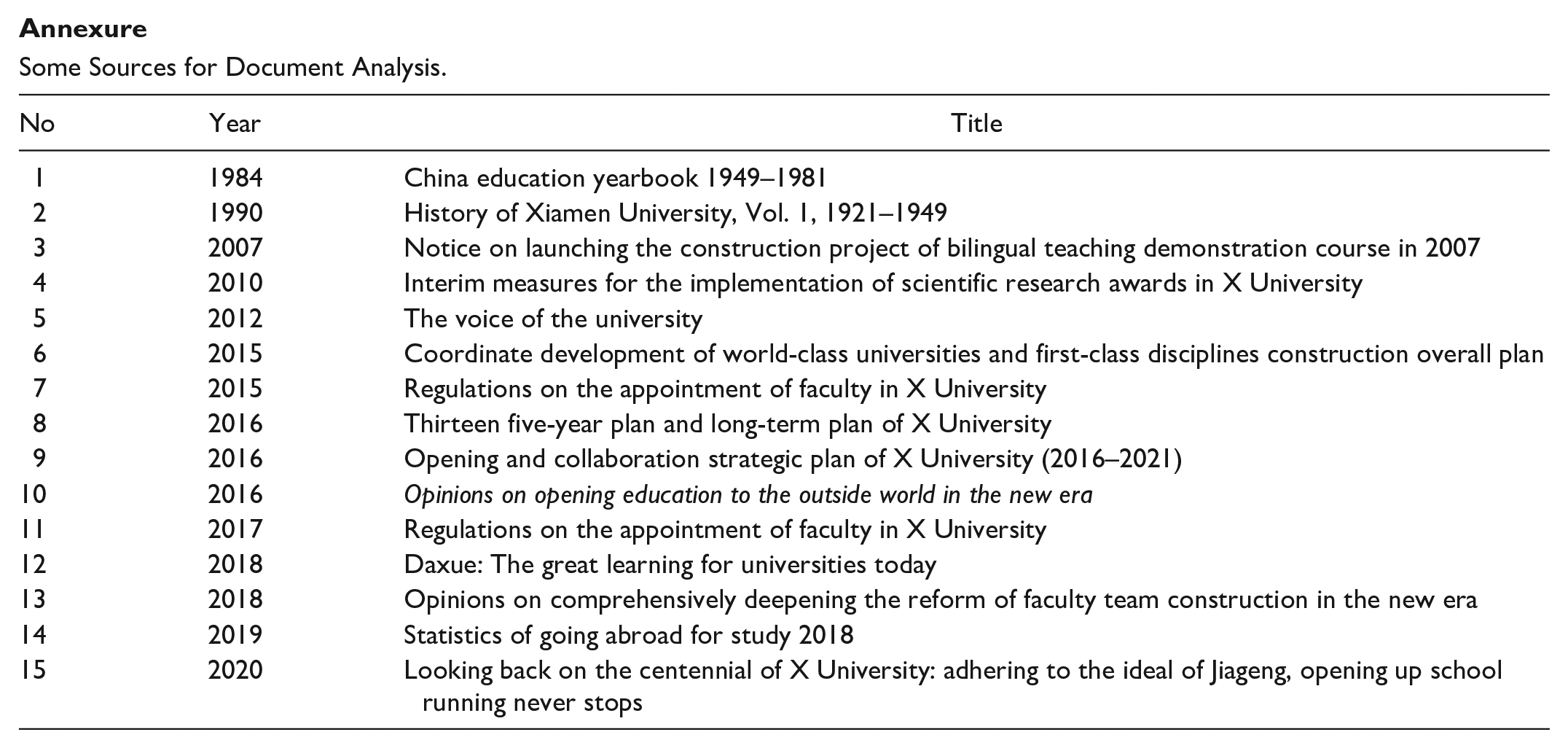
Some Sources for Document Analysis.
| No | Year | Title |
|---|---|---|
| 1 | 1984 | China education yearbook 1949–1981 |
| 2 | 1990 | History of Xiamen University, Vol. 1, 1921–1949 |
| 3 | 2007 | Notice on launching the construction project of bilingual teaching demonstration course in 2007 |
| 4 | 2010 | Interim measures for the implementation of scientific research awards in X University |
| 5 | 2012 | The voice of the university |
| 6 | 2015 | Coordinate development of world-class universities and first-class disciplines construction overall plan |
| 7 | 2015 | Regulations on the appointment of faculty in X University |
| 8 | 2016 | Thirteen five-year plan and long-term plan of X University |
| 9 | 2016 | Opening and collaboration strategic plan of X University (2016–2021) |
| 10 | 2016 | Opinions on opening education to the outside world in the new era |
| 11 | 2017 | Regulations on the appointment of faculty in X University |
| 12 | 2018 | Daxue: The great learning for universities today |
| 13 | 2018 | Opinions on comprehensively deepening the reform of faculty team construction in the new era |
| 14 | 2019 | Statistics of going abroad for study 2018 |
| 15 | 2020 | Looking back on the centennial of X University: adhering to the ideal of Jiageng, opening up school running never stops |
Declaration of Conflicting Interests
The author(s) declared no potential conflicts of interest with respect to the research, authorship, and/or publication of this article.
Funding
The author(s) received no financial support for the research, authorship, and/or publication of this article.
