




Abstract
Kazakhstan has adopted a path to implement inclusive education. As in many other countries of the world, transition to an inclusive education system is not easy and sometimes riddled with anomalies, contradictions, and challenges. This qualitative study takes account of inclusive education in Kazakhstani schools, analyzes the current state of the move toward inclusive education in Kazakhstani schools, discusses achievements to date, highlights some challenges, and makes recommendations on how the implementation of inclusive education in schools could (if necessary) be improved. A generic qualitative research design was used, involving semistructured interviews conducted with school directors, teachers, professionals, and regional representatives of the Department of Education, representatives of the Psychological Medical and Pedagogical Commission, nongovernmental organizations, and parents. The study uses Ainscow’s levers of change as a theoretical lens to analyze the implication of the transition and implementation toward inclusive education in schools. The study was conducted in 12 inclusive schools in one region north and one region south of Kazakhstan. Data were analyzed using an inductive and thematic content analysis framework, from which themes were derived and used to harvest findings and draw some conclusions. Among the findings of the study is that although there has been some shift toward inclusive education, the concept is still not well understood by stakeholders in Kazakhstani schools, as it is currently mainly aimed at disabled children rather than other categories of diversity.
Introduction
Kazakhstan, a former member of the Union of Soviet and Socialist Republics (USSR) situated south of the Russian Federation, has recently adopted a policy on inclusive education and is undergoing educational reforms to make the schooling system of education inclusive, with an ambition to have 70% of schools inclusive this year. Kazakhstan is a multiethnic country with an estimated population of about 18 million people composed of ethnic Kazakhs and Russians. It has a trilingual language policy of Kazakh, Russian, and English. Inclusive education is the responsibility of the Ministry of Education and Science, with special focus on secondary education (which is inclusive of preprimary and primary education). Secondary education comprises primary level (1–4), basic level (5–9) and senior level (10 and 11; United Nations Educational, Scientific and Cultural Organization [UNESCO], 2007). Apart from general secondary schools, Nazarbayev Intellectual Schools (NIS) implement the new international curriculum and are mostly targeted at high-achieving or gifted students. The international experience of NIS is expected to be extended to other schools.
The system of special education in Kazakhstan has emerged from the Soviet medical model, with the Psychological Medical and Pedagogical Commission (PMPC) as the starting point for diagnosing students for placement in schools. The schools are then resourced with defectologists (specialists in special education) and speech therapists to provide remediation. Special education in the USSR, referred to as defectology, entailed the provision of education by the government to those regarded as handicapped. Special settings are referred to as correctional and rehabilitation centers. Although there have been efforts in Kazakhstan to integrate students with special needs in the classroom, some students are placed in correctional classes (intended for remediation). This correctional approach was based on an assumption that handicapped students are better served in special schools, which can provide an appropriate atmosphere for learning with specialized programs developed by specialists (Csapo, 1984; Rollan & Somerton, 2019).
According to recent developments in Kazakhstan, the understanding of inclusive education continues to be associated with students with special needs and does not necessarily cater for different forms of diversity. For instance, Zholtayeva et al. (2013) postulate that inclusive education in a Kazakhstani context means the involvement of every child with special needs in the classroom, with the focus on the application of various methods and modification of study materials, as well as teachers choosing various approaches to the educational process. This view was confirmed by a diagnostic report (Nazarbayev University, Graduate School of Education, 2014).
Although there has been some keen interest in the implementation of inclusive education, the barriers to effective inclusion have been issues of lack of skills and competencies on the part of teachers (Abdrasheva et al., 2016), as well as preparedness to deal with diversity in the classroom (Denivarova & Abdresheva, 2014). Overcrowded classrooms have not made it easy for inclusion to thrive (Scalcione et al., 2016). The implementation of a trilingual education policy has also created some challenges for teachers, as they have to use three languages, that is, Kazakh, Russian, and English, for teaching (Tkachenko, 2015). Although teachers in Kazakhstan are generally positive about inclusive education, their attitudes to children with severe types of disability are that they should not be included in mainstream education (Makhmudayeva, 2016). Given this plethora of events and developments, it was necessary to put inclusive education in Kazakhstan into perspective to understand what is happening.
This study, therefore, did an analysis of the transition process of Kazakhstani schools toward an inclusive education system. The analysis was done by taking stock of the process on which the schools had embarked since the adoption of the inclusive education policy. The purpose was to draw lessons from the implementation and transitioning process to make recommendations and suggestions, if necessary, for accelerated transition toward inclusion in schools.
Problem Statement
The transition by Kazakhstan toward inclusion could fundamentally be traced back to when the country adopted Article 14 (2) of the constitution (Kazakhstan, 1995), which refers to nondiscrimination and universal access to education for all. Furthermore, Kazakhstan became a signatory to the Salamanca Statement (UNESCO, 1994), the UN Convention of Rights of Persons With Disability ((UN, 2006) 2006), and the Convention Against Discrimination in Education (UNESCO, 1961), which all pronounce on nondiscriminatory provision of education for all.
Kazakhstan has set a legislative framework including the Law on Social Support, Medical and Pedagogical Correction to Children With Disability (Kazakhstan, 2002) and the Law on Education (Kazakhstan, 2007). The state’s programs (Kazakhstan, 2011) to 2020/2016 to 2019 have become the roadmaps for achieving inclusive education in 70% of schools by 2020. The implementation of criterion-based assessment in schools has placed Kazakhstan in the leading position in Central Asia in terms of the speed with which inclusive education is being implemented. The country is currently working on a new law on inclusive education.
The adoption of these policies on reforming education to be inclusive has recently led to an increase in the number of children with special or additional needs and abilities in mainstream schools in response to the adoption of the inclusive education policy. Kazakhstan has 102,610 children between the ages of 7 and 18 with additional needs in schools, of which 23,970 are in mainstream classes and 11,352 are in special classes (Information Analytic Centre, 2017). Concomitantly, the number of kindergartens has increased to 9,828, widening the participation of most children in early childhood stages of schooling (Information Analytic Centre, 2017). Kazakhstan has achieved the millennium development goals of universal access to primary education (Ashikbayev, 2019). These milestones are commendable and a clear indication of the path Kazakhstan has taken. However, the notion of inclusive education in Kazakhstani schools is a relatively new concept.
Understanding of the concept of inclusive education in Kazakhstani schools seems to be largely influenced by past educational practices in the former USSR, where it was believed that children with disability would be better educated in separate and specialized pedagogical settings referred to as “correctional.” Now that there is an attempt to change this schooling system toward inclusion, the transition from the USSR educational model is very important in understanding how inclusive education is evolving in Kazakhstani schools. Therefore, the following research questions guided the investigation of the study:
Literature Review
Inclusive Education and Policy Change
For the implementation of any educational policy, such as inclusive education, to succeed, the right political and policy context is usually important to create an environment that is conducive to change. Political will and judicious policy formulation are fundamental in getting the implementation right. For instance, Srivastava et al. (2015) quote Pijl and Meijer (1997) on the matter, as well as Singal (2008), who refers to how Western countries dealt with this through legislation to change policies and practices of schools to achieve inclusion.
Nonetheless, the process of changing education systems toward inclusive education can be hampered by many barriers or promoted by different factors. For instance, Donohue and Bornman (2014) found that, in South Africa, the implementation of inclusive education was influenced by barriers such as teachers’ attitudes, inadequate teacher preparedness and training, and lack of clarity on policy and implementation guidelines. These factors were also prominent in the findings by Travers et al. (2010), who investigated barriers to inclusive education in Irish schools. In changing education systems toward inclusive education, Oliva (2016) postulates that changing the curriculum to one that is accessible is important in realizing inclusive education. This view is echoed by Kearney (2009), who posits that seven aspects of the system need considerable attention for inclusive education to be realized, that is, accessibility, accountability, attitudes, knowledge, responsibility, funding, and resourcing.
Although the concept of inclusive education came about as an understanding that equitable and fair education is to be provided to all children, regardless of disability, race, gender, or creed (Makoelle, 2014; Mitchell, 2015), and is premised on human rights and equity (Ainscow, 2005; Gordon, 2013), its misunderstanding can also be a hindrance to its realization, as its conceptualization or definition could be marred by controversy and confusion (Bourke, 2010; Snyder et al., 2001). In some contexts, role players cling to past special education practices, which hamper transition to real inclusion (Ainscow et al., 2004; Florian, 2008). For instance, in his work Slee (2008), quoting the work of Booth (1978), Ford et al. (1982), Tomlinson (1982), Oliver (1990), Galloway (1985), Barton (1989), and Castells (1996), postulates that special education is a project for social control of difference and more often leads to control than empowerment. This view is echoed by Powell (2015). For this reason some have called for the concept of inclusion to be demystified (Sulochini, 2007).
The processes of developing policies on inclusive education have been characterized by what Phillips and Ochs (2003) call cross-national attraction, which describes how the policies of some countries could be attractive to others and then be borrowed. According to Burdett and O’ Donnell (2016), the borrowing of policies across contexts can lead to the disadvantage that “meaning is lost in translation” if the cultures and practices of the borrowing contexts are ignored. Policies are usually borrowed for different reasons. Steiner-Khamsi (2014) indicates that borrowing and lending have become a globalization drive, as global north/west countries exchange resources for policy transfer with the global south/east. Therefore, there is a tendency for countries to borrow practices from others without taking into account the local realities and peculiarities.
Be that as it may, in changing policies of educational systems toward inclusive education, Ainscow and Sandill (2010) believe that participatory leadership is required to mobilize stakeholders toward a common vision about an inclusive education policy. Although there are different ways in which change toward inclusive education has been effected in different parts of the world, it is important that a whole system/organizational approach is adopted, as this would lead to total change in the system/organization. The school as an organization is at the heart of the change process. As Ainscow (2001) puts it, “If we take this as an appropriate starting point, then, it seems reasonable to argue that if the commitment to inclusion is to be turned into action then it must permeate all aspects of the life of a school” (p. 2). It is for this reason that Ainscow’s levers of change framework is adopted in this study for the purpose of a whole system/organization approach in changing education systems/organizations (in this case schools) toward inclusion.
Ainscow’s Levers of Change Framework: Schools as Centers of Transition
Education reforms toward inclusive education require a number of systemic, structural changes in theory, principles, and practices, and put the schools as an organization at the core of transition toward inclusion. Ainscow (2005) uses a framework called “levers of change” to analyze how changing education systems toward inclusive education can be approached. These levers of change are shown in Table 1.
Matching data analysis themes to the levers of change.

Note. PMPC = Psychological Medical and Pedagogical Commission; NIS = Nazarbayev Intellectual Schools; NGO = nongovernmental organization.
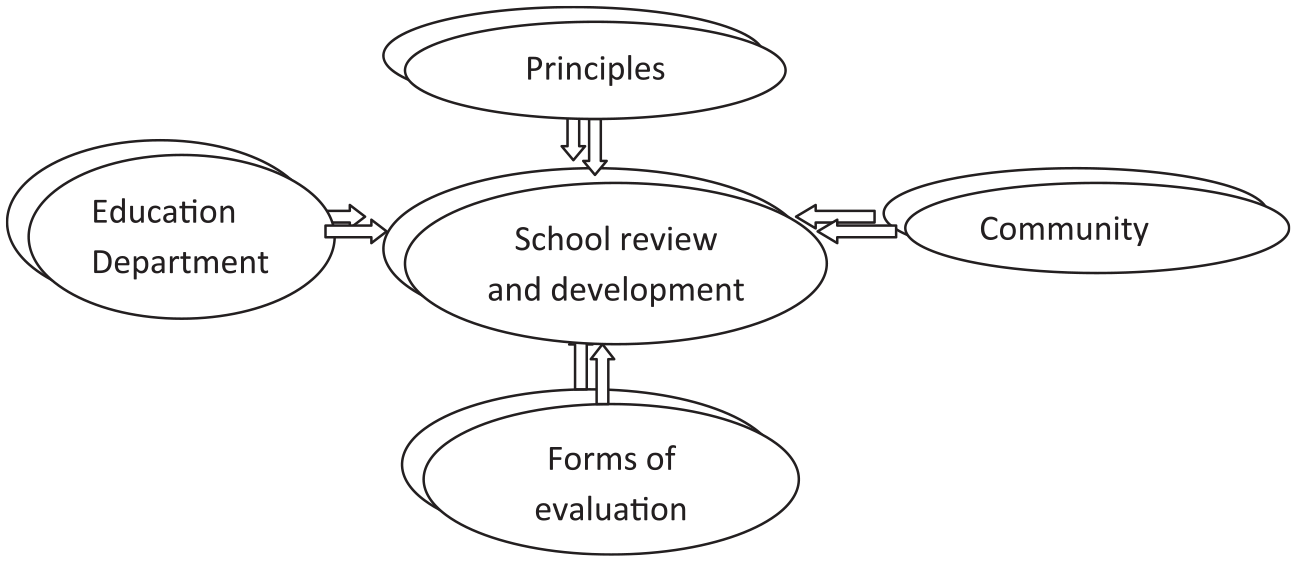
Levers of change.
According to Ainscow, the levers are actions necessary to change the behavior of individuals in an organization. In Ainscow’s understanding of the change process, more attention needs to be devoted to areas considered to be “high leverage” to expedite change in an organization. This framework of understanding change becomes important for this study because it places the school at the center of change. The levers of change help to unmask significant principles, structures, community, and practices important for change to happen. Similarly, the organizational factors that are significant for inclusive education to thrive are highlighted by this model. According to Ainscow and Sandill (2010), organizational factors such as collaboration among stakeholders, student involvement, and a favorable inclusive culture are all important in the implementation of an inclusive schooling system. This model was adopted for this study to analyze areas of high leverage and look at how those affect the school as a center of change and transformation toward an inclusive model of education. The different levers as suggested by Ainscow, that is, principles, community, education department, and forms of evaluation and their connection to the school as the main institution of change, form the basis for the analysis of change toward an inclusive education system in Kazakhstan in this study. These levers were understood to mean the following: Principles meant aspects that influence people’s conceptions and beliefs about inclusive education; community is an embodiment of community structures and participation for inclusive education to be realized; Education Department refers to the role the department can play in promoting a conducive environment for inclusive education to thrive; forms of evaluation are assessment measures, for instance, identification of barriers to teaching and learning and the assessment structures in the inclusive system; and lastly, school review and development refer to all school-related aspects significant for the implementation of inclusive education at the school level.
Method
Research Design
Therefore, this generic qualitative research design, implemented through semistructured interviews conducted with school directors (responsible for managing and leading schools), teachers (teaching in selected inclusive schools), professionals (defectologists and logopedists responsible for supporting students with special needs), and regional representatives of the Department of Education (responsible for district school administration), a representative of the PMPC (responsible for diagnosis, classification, and placement of students with special needs at schools), and parents (of children with special needs at selected schools), was an attempt to understand developments in inclusive education in Kazakhstan.
Participants and Research Sites
The participants were selected purposefully, meaning that they could provide rich data for the study (Welman et al., 2005). The criteria were that they should have worked in the field of special or inclusive education for at least 3 years. Parents were interviewed if their children had been enrolled at these schools for at least three consecutive years. The researcher regarded 3 years as sufficient experience for participants to be able to shed light on the transition period. The study was conducted in 12 inclusive schools in one region north and one region south of Kazakhstan. The schools were selected based on the fact that they were regarded as inclusive by definition of the Department of Education, which is providing education to children with special needs in regular classrooms (UNESCO, 2007).
The distribution of participants and their roles were as follows:
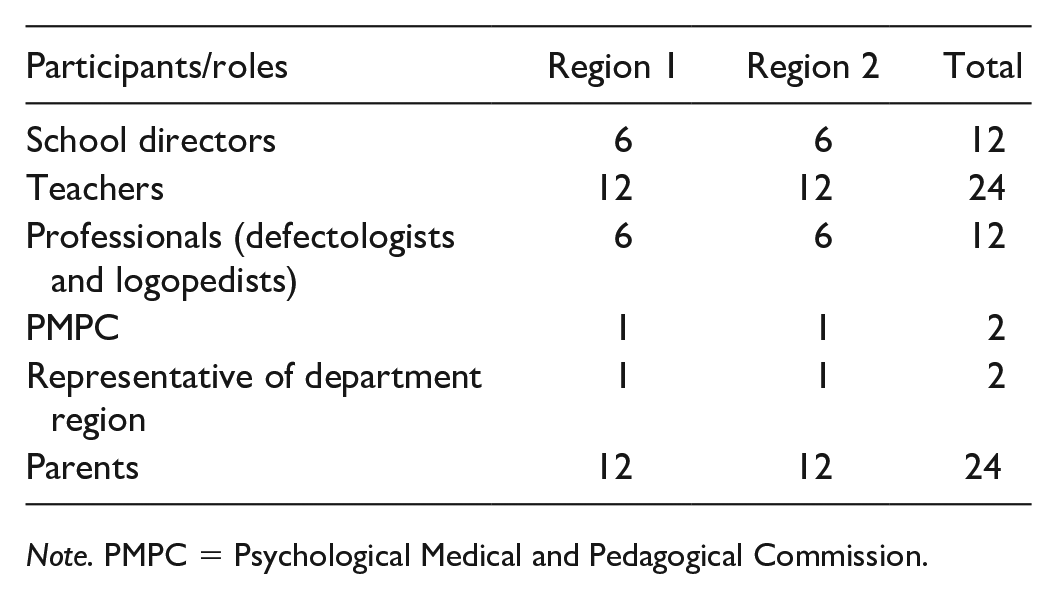
Note. PMPC = Psychological Medical and Pedagogical Commission.
Data Collection and Analysis
Semistructured interviews consisting of a number of open-ended questions were conducted on-site at inclusive schools. The questions were designed to address different aspects of implementation of inclusive education, such as pedagogical aspects, collaboration, assessment, curriculum, leadership, systemic issues, and the role of parents and the community. The following are a sample of the questions asked: What is your understanding of inclusive education and how would you describe your experience with the implementation of inclusive education thus far? In other words, in terms of policy and practice, do you think teachers are prepared for teaching an inclusive class? What forms of stakeholder collaboration are in place and how are these organized? It what way has curriculum delivery and assessment changed to accommodate inclusive education? Who is leading the process of implementation of inclusive education and in what way? How are parents involved in the implementation of inclusive education? What would you regard as the successes of the implementation process and what are the challenges? What would you like to see happening to ensure effective implementation of inclusive education? Each interview was conducted in Russian (which is a language of education in Kazakhstan), took approximately 1 hr in total, and was conducted in the participant’s choice of language, in this case Russian. The interview took place in the presence of a Russian–English translator. Russian data were transcribed into English for the purpose of analysis, as the researcher is not proficient in Russian. Most of the participants consented in writing to the recording of the interviews. Data were analyzed using an inductive content analysis framework, from which themes were derived and used to harvest findings and draw some conclusions. The following steps were adhered to in the process of analysis (Laws et al., 2003):
Step 1: Reading and rereading all the collected data.
Reading the data ensured that the researcher was familiar with the data, thus making the process of analysis much easier and more manageable.
Step 2: Making a preliminary list of themes arising from the data.
The process of categorizing data into themes, referred to as “coding,” has been conceptualized by Miles and Huberman (1994) as labels or texts assigned to units of meaning of pieces of data collected. Similarly, Neuman (2006) refers to the process as organizing raw data into conceptual categories to create themes that will be used to analyze the data. Consequently, the data were categorized into themes.
Step 3: Reading the data again to confirm the themes.
It is crucial that data be studied several times to verify that the interpretations are correct and valid. The data were read several times to confirm the themes.
Step 4: Linking themes to quotations and notes.
The researcher then wrote themes next to the quotations and notes while examining the data.
Step 5: Examining and interpreting the categories of themes.
From the meaning attached to the interpretations of themes, logical conclusions were drawn. The levers of change alluded to earlier were used as a lens to understand where change toward an inclusive education system had occurred and which areas presented a challenge in terms of implementation.
Once 12 themes had been derived from the data inductively, Ainscow’s levers of change framework was mapped against the themes to determine to what extent they matched the framework. The reason was that Ainscow’s levers of change framework analyzes aspects that needed to change in a whole education system/organization if inclusive education should be properly implemented. Each lever would be used to determine the extent of change that has occurred in a particular school area. (Table 1 illustrates the results of the matching process.)
The use of Ainscow’s levers of change meant the following in this study: Regarding the lever of principles, the study explored how the understanding and attitudes of schools’ stakeholders had changed and in what way, whereas the school review and development focused on change regarding teacher competencies, language and terminology use, appropriateness of school leadership, and the relevance of assessment strategies for inclusion. For the education department lever, it was important to understand whether there had been coordination of teacher preparation, curriculum design and development, and facilitation of intersectorial collaboration. The understanding of barriers to inclusion, as well as the role of the PMPC, were explored as part of forms of evaluation. The critical role of the community in the change process was explored in relation to the role of collaboration with NIS, the role of parents and nongovernmental organizations (NGOs) in support of school transition to inclusion.
Ethical Considerations
Ethical procedures were followed, and participants were made aware of their rights in the study, that is, that participation was voluntary, that no names of participants or schools would be made known, and that data were only meant for the study. Participants were made aware that they could withdraw from the study at any given point. All participants signed the consent forms to take part in the study. The consent forms were in the language that they understood, that is, Russian.
Trustworthiness
To maintain dependability and confirmability of the study, data from different interviewees were triangulated. To ensure the credibility of the study, participants were requested to go through the interview transcripts to verify whether these represented their answers correctly and accurately (Krefting, 1994).
Findings
Principles
Understanding inclusive education
The study shows that majority of stakeholders interviewed understood inclusive education as education that supports all students’ learning needs; however, the difference in their understandings was the question of who those students were and how they could be supported, for example, in some instances, inclusive education was thought to be education that is only concerned with children with disabilities in specialized schools or those with correctional classes. This was obviously based on how children with disabilities where dealt with in the past Soviet education system. For instance, one of the principals said, “No, we think ‘inclusive’ is the children who study in the correctional classes.” The implication is that the understanding of inclusive education is primarily based on the medical model, as attested to by the following statement from one of the teachers: First of all, we have children with mental disorders both in correctional classes and in general educational classes. Such children have certificates issued by PMPC (Psychological, Medical and Pedagogical Commission), that they should study either in a correctional class or in a general educational class within inclusive training with application of the individual approach.
Although the study cannot be conclusive about a paradigm shift, it however found that there was a change from the kind of thinking of specialized education as exclusive to thinking that presupposes inclusive education as education that focuses on all students’ learning needs including those special needs. The following statement from one of the teachers provided evidence: “For me inclusive education is the opportunity for every child to get an education, especially, focusing on children with special needs.”
Forms of disability and attitudes of teachers
According to the study, teachers’ attitudes to inclusive education were generally positive; however, they seemed to be concerned about the inclusion of certain categories of learners in mainstream classes, for example, learners experiencing mental and intellectual disabilities. The following quotation from a teacher supported this assertion: “I have a child with mental retardation in my class but he is [a] very difficult child.” The attitude to children who are mentally challenged is that they need not be in mainstream classes. The findings highlighted that teachers were reluctant to include children with behavioral difficulties in their classes. For instance, regarding supervision of classes of children with behavioral difficulties, one of the principals said, Just a couple of days ago we talked to a teacher, R. She is a teacher with big experience. Thirty-five years, of highest category. She brought a letter with the request to release her from supervision of class with children with bad behaviour. Tomorrow we have parents’ meeting with the parents of those children. This is always a problem. Nobody wants class supervision in such classes. This is difficult.
Teachers’ remarks indicated that they believed these kinds of learners should be placed in special schools. However, in some instances, there were those who were positive and willing to include these kinds of learners in the classroom. For example, one of the principals stated, “The attitude is very good. Why? Because we have in Kazakhstan so many different attained and developed techniques only for an individual approach.” This view about the attitude of teachers toward students with intellectual/mental disability was confirmed by the representative from PMPC.
School Review and Development
Teacher competencies in teaching an inclusive class
Observation of teachers in practice showed that teachers in inclusive classrooms were trying their best to teach in ways that accommodated the diversity of learners in the classroom. However, most teachers lamented that they were insufficiently prepared to teach an inclusive class with diverse student abilities and additional needs. One of the teachers had this to say: One always experiences lack of knowledge. Of course, I would like to attend special courses to have a certain programme at last. I haven’t attended any courses. We have some specialists, who attended such courses. They give us recommendations. In addition I search for information on the internet.
There was an outcry from the teachers about their insufficient methodological and pedagogical knowledge; yet, they had to teach in an inclusive classroom. One of the inclusive coordinators said, “Our teachers take specialised courses. It may be a secondary school teacher. We simply are not prepared for it.” When asked a question about teacher training needs, one of the coordinators indicated that the training that is conducted is still not sufficient. One of the teachers stated, In fact I don’t know what kind of training I can have but I would like to learn about new methods of teaching. Therefore, working with special children, maybe some correctional teachers’ training is needed. I don’t have much training for children with special needs.
Terminology that is inherently exclusive
Analysis of the data shows that there is pervasive use of inherently exclusive concepts such as “defectology” or “correctional” in the vocabulary of all stakeholders interviewed on the topic of inclusive education. For instance, learners experiencing barriers to learning in schools were referred to as correctional children and their class was called a correctional class. This quotation from one of the inclusive education coordinators makes reference to this: “Well, first of all, it is when we have kids with diagnoses and children who are supposed to study in special correctional groups but they study in the mainstream classes.” The specialists who work with learners experiencing barriers to learning are still referred to as defectologists. The interviews with teachers revealed that this was still a commonly used concept, regardless of its connotation. Asked to describe her role, one of these professionals answered, “I am a defectologist responsible for correction and rehabilitation of children with some disorders.”
Comprehensive school leadership strategy and structures for inclusion
The data indicate that there is a procedure in schools for dealing with learners with special needs. The following is how one of the principals described the process: First, we define a number of low-performing students, then we recommend them [to] go through PMPC; on the basis of PMPC they are given a recommendation, training is prescribed, a mode of study. Under this mode of study we carry on, whether home study or study in correction classrooms is prescribed. In our school we have classes of correction as corrective and developing study (KRO), there are also classes with developmental delay.
However, this process only describes how learners with special needs are identified and referred to the PMPC for classification and placement. There was no mention of a well-defined policy on inclusion, with a well-defined vision and mission. Nor were other categories of diversity in the school given priority at this stage, as emphasis is placed on disability, implying that schools do not have a well-defined and articulated plan for the inclusion of all diversities in inclusive education. This is what one of the teachers indicated: Our main difficulty lies in the fact that there are no certain programmes. We draw up the programmes for these children on the basis of general education, but we make it easy. But there are no specific requirements, and this is one of the problems.
Assessment strategy and inclusion
Although criterion-based assessment has been implemented in Kazakhstani schools, it seems as though normative assessment still dominates the assessment practices. Teachers described how they try to provide a differentiated curriculum to teach learners with diverse abilities and needs, but the methods of assessment appear to be mostly normative. This quotation from one of the inclusive education coordinators sums it up: Probably, the first difficulty is the absence of criteria for assessment of these children. It means that we assess them as the rest of the group. Therefore, the child gets satisfactory assessment. However, if there were other criteria of assessment, such as in special schools where they assess not only knowledge but the progress that was shown by a child. It means that it is great progress for a child with a diagnosis of developmental delay who learned how to write during the first semester in the first grade.
Teachers thought that assessing learners with special needs with the same instruments used for their mainstream counterparts was not very effective. For instance, asked about assessment, one of the principals suggested: I understand that when the accreditation commission comes they say that in the certificate it is not specified that students finished the remedial class. They say sorry, but students studied according to the mainstream programme and they are required [to perform] at the level of all students. But we must realise that those children have [a] short memory.
Education Department
Teacher preparedness and training
Teachers who have just started their teaching career appear not to be ready and sufficiently prepared to teach an inclusive classroom. This is despite efforts to retrain teachers in inclusive education. This comment from one of the teachers indicated her difficulty with her knowledgeability about teaching inclusively: Of course, there is a lack of information. You have to read books and study additionally, to create and invent something on your own to make classes interesting both for common children and children with special needs. Of course, you have to search for information additionally. Courses with new information would be beneficial. In 2011 I attended [a] course on correctional classes for children with developmental problems.
Although teachers indicated having attended some in-service training and professional training courses on inclusive education, some teachers felt the knowledge they got from such training was not necessarily helping them to deal with the challenges of teaching an inclusive class. In particular, teachers expressed a need for more training on teaching methodologies. This was how one teacher put it: Certainly it would be desirable to pass additional courses in order to receive some additional information. Mainly we obtain additional information from the internet, I have myself passed courses on inclusive education, where we have been informed about the categories of such children, how we should behave with them in certain situations, how to structure lesson plans for them, but certainly at that we also need the methodical help, so that more experienced people would tell us how to work with such children. Because not all of us pass such courses.
Curriculum
The study showed that teachers thought the curriculum had not been structured in a way that makes it easy to implement some ideals of inclusive education. Asked about how the curriculum helps them to deal with inclusion, one of the teachers said, Well, only if it’s an individualised programme or individualised approach or a special class so that it isn’t the regular school programme, because these children are the same as other children, it’s just that there must be an individualised approach.
Therefore, this could mean there was a need to revise curriculum for inclusive education.
Forms of Evaluation
PMPC
Although many stakeholders responded positively to the role and significance of the PMPC, it was apparent that there were parents who rejected the placement recommendations of the commission. These parents were circumventing the established protocols and taking their children to mainstream schools as opposed to special schools, thus placing their children in schools of their choice. The following quotation refers to some instances when the decision of the PMPC is rejected by parents: However, parents have claims. Parents of children with epilepsy complain, since they are not allowed to go to school, even when they have rare seizures. Being based on my practice I don’t know what is the situation in England, however in Germany they not just allow with serious seizures, they even train teachers. Let us suppose, there is a child who had a seizure. School teachers are taught to administer first aid. At least such children are allowed to go to school. At the same time the list of contra-indications causes doubts. If a child has seizures he/she is not allowed to go to school. There is a list which is not always admitted by parents. Even when a child has to be taught at home according to his/her health conditions, he/she must be allowed to go to school at random at least, for instance, twice a week.
This could be interpreted as showing the need for parental involvement in schools about decisions on inclusive education.
Barriers to inclusive education
In this study, several factors/barriers that affect the implementation of inclusive education emerged, that is, ranking of schools, role of technical and vocational education, and number of learners in classrooms.
According to the Organisation for Economic Co-operation and Development (OECD; 2015) and a World Bank report, ranking of schools according to student achievement, as well as the outcomes of schools and the performance of teachers, causes problems and puts disadvantaged individuals and schools in an even more disadvantaged position. Similarly, the ranking of schools according to performance league seems to have implications for inclusive education. For instance, asked about which factors are barriers to inclusive education, one of the principals had this to share: Well, if there were no issues related to the rankings, the school would be willing to work in inclusion and it would be right. But at the end we have the reverse side of it . . .
This implies that ranking forces schools to focus on gifted learners rather than making sure all learners succeed.
As one of the methods to make education accessible to learners with special needs, some teachers seemed to hold the view that these kinds of learners needed to be encouraged to attend technical and vocational institutions. For instance, one of the principals suggested that “students that cannot cope with academic work should be taken to technical and vocational schools, because there they can learn to work with their hands. It is not good forcing them to learn [a] hard regular programme here.”
The above could be interpreted as implying that learners are not been provided with adequate support as there is belief that they belong somewhere and not in mainstream schools.
Although this was not a widespread response in all the schools, there seemed to be a view that the number of learners in the classroom has an impact on the ability of the teacher to pay individual attention to all the learners. One principal thought this was a hindrance to effective inclusion of learners. This quotation attests to this: “The problem is in overcrowded classes. For me as a director of the school the problem is overcrowded classes.” Therefore, this meant that high number of learners in the classroom is thought to make inclusive education impossible.
There seems to be concern from the teachers as to how the trilingual policy would work. One of the principals had this to say about the matter: And of course, this applies to the introduction of multilingualism. I, as a parent of a son, who studies in a school, cannot imagine how this is possible. And how do you imagine multilingualism in correctional classes? Every day I teach them [the] same things for five hours in Kazakh and they understand me only when I translate.
It seems as though there is less clarity and guidance among teachers about the policy and its implementation.
Community
Transfer of NIS experience
The study has shown that NIS schools employed practices that were instrumental for inclusive education to thrive. For instance, there was a strong culture of constructivist teaching, informed by strong practice of action research. Teachers researched their own practices and continually challenged their attitudes and beliefs about teaching, which is important for the development of inclusive teaching practices. When asked about the significance of these issues for inclusion, one of the NIS teachers said, I have read some books on inclusive education and they say teachers who are likely to embrace inclusion are usually reflective and critical to their practice as they have the need to improve it. I am told this is [a] very important skill for inclusive education and this is highly needed to make that transition towards [being] an inclusive teacher.
Parents and inclusive education
Analysis of the data showed that teachers felt parents became negative toward them when their children were identified as having some learning need. Some teachers expressed frustration with parents on the issue. The following quotation is evidence of teachers’ frustration with parents: Barriers? Well, there are some difficulties, first of all, it is—parents, family. Why? Because all parents want their child to be good, healthy, and that’s the most difficult thing—to prove to parents that their child is not the same, he is special. Why? Because children are all good, all healthy until a certain time; even in kindergarten it is not always evident.
Some parents of children with disabilities who are placed in regular classrooms expressed content and appreciation, as opposed to parents whose children were placed in either special schools or correctional classes. For instance, talking about the performance of their children in mainstream classes, one of the parents of a child with cerebral palsy said, At school she writes by herself. We are without a tutor. We had almost half of the year a tutor, and then we refused him. She is independent now. She writes, reads, decides tasks, plays, makes friends, makes contact with the children and draws well.
The parents showed general understanding of what inclusive education was; however, parents of children with special needs worried about their safety. One of the parents expressed this concern: I’m not worried about the schooling part, I’m worried about the children, and nowadays children are very violent. It would have been different if they had studied in the same class since the first year, the other children would’ve gotten used to them.
Parents of children who are homeschooled seem to express interest in their children being allowed to visit schools regularly. It is evident though that this is dependent on the school principal, as there is no regulatory framework. Asked about this, a representative of the PMPC stated, In addition it depends on [the] position of head teachers. Everything is focusing on him/her. We have examples, when children, taught at home, are allowed to go to school several times a week and work with teachers. They attend all events. There is such [a] practice; however it all depends on [the] decision of a head teacher. There is no binding document.
NGOs and inclusive education
When research for this study was conducted, some NGO centers neither worked nor claimed to be working in collaboration with schools, but there were those who had strong ties with local schools, and these schools appreciated the collaboration and cooperation. The data showed that NGOs were concerned about funding to continue providing their services. Asked about how NGOs assisted them with inclusive education, one of the principals stated, Well NGOs are very helpful but I think their activities are not well regulated and coordinated, they just do what they think is helpful but we do not have a structured system governing these schools; each school works with [an] NGO of their choice in their own way.
Discussion of Findings
According to Haug (2017), understanding inclusive education is crucial for its implementation by any country. The study has demonstrated that inclusive education is beginning to be understood by different stakeholders in Kazakhstani schools. However, its conceptualization is influenced by the heavily medically oriented past of Soviet special education (Makoelle, 2016; Nazarbayev University, Graduate School of Education, 2014). In the diagnostic report about inclusive education in Kazakhstan, which surveyed stakeholders such as teachers, school administrators, and departmental officials, it became clear that they associated inclusive education with defectology and correctional education (Nazarbayev University, Graduate School of Education, 2014). This approach is embedded in the need to correct children’s behavior or disorders without taking into account that the core business of inclusive education is to change education provision to respond to the needs of all learners in mainstream education to avoid labeling and segregation. It is evident that currently Kazakhstani teachers’ understanding of inclusion narrows down the concept of inclusion to special education, with the emphasis on disability and an assumption that learners’ behavior is to be corrected and learning defects (as understood) remedied by teachers. The study has confirmed that implementing inclusive education is a process rather than a destination and that it is sometimes very complex (Al Khamisy, 2015). Therefore, efforts are needed to reconceptualize inclusive education and embark on stakeholder advocacy and enlightenment.
Although there was general acceptance of children with disabilities in Kazakhstani classrooms by teachers, the attitudes of teachers to including students with mental and intellectual disabilities in the classroom were divergent (Movkebaieva et al., 2013). This was also confirmed in the work of St-Onge and Lemyra (2017). The indication in this study is that learning barriers are regarded as disorders or health problems. In their work, Zholtayeva et al. (2013) also found that inclusive education in a Kazakhstani context means the involvement of every child with special needs in the classroom, with the focus on application of various methods and modification of study materials, as well as teachers choosing various approaches in educational processes. This implies that more work and training are required on teachers’ attitude to different kinds of disabilities.
The study suggests that the general willingness of teachers to implement inclusive education was positive. This was confirmed by Movkebaieva et al. (2013), when they conducted a study in 50 Kazakhstani schools, which confirmed that the general motivation of Kazakhstani teachers to implement inclusive education was positive, and they were willing to implement inclusive education in their classrooms despite some challenges, such as the presence or absence of support, resources, and teachers’ lack of preparedness in dealing with the classes, both theoretically and practically. However, more training and support are required to prepare teachers sufficiently for inclusive teaching and learning.
Although there have been some attempts to train teachers, the efforts, however important, seemed to be insufficient and not particularly helpful (Abdrasheva et al., 2016; Denivarova & Abdresheva, 2014). This is evident in many studies that suggest that training of teachers is crucial for the implementation of inclusive education (Neilson & Brink, 2008). Therefore, more training of teachers and other stakeholders would be beneficial for the implementation of inclusion and swift transition to it.
Although Kazakhstan has taken some strides in the implementation of inclusive education, the vocabulary and concepts used in the field need some rethinking and reconceptualizing if the education system is to change toward inclusive education (Makoelle, 2016, 2020). This is particularly relevant, given the medically oriented past of special education during the Soviet Era (Makoelle, 2016).
According to the literature, establishing good school-based support teams enhances inclusive education practices in schools (Makoelle, 2014; Rulwa-Mnatwana, 2014). The study has indicated that there is a need for Kazakhstani school leadership to develop clear school policies and inclusive education structures (school-based support teams), consistent across all schools (Shevlin et al., 2009).
Assessment in inclusive classes is a cornerstone of access and support (UNESCO, 2017). According to Meijer et al. (2007), as quoted by the European agency for the development of special needs education, there should be a shift from the medically oriented form of classroom assessment of students, as the focus is on their inabilities rather than on their abilities. Assessment has to focus on changing learning processes in a way that responds to the needs of all students in the classroom. The study points out that although the implementation of criterion assessment by Kazakhstani schools is to be commended, current assessment practices need to be rethought and redesigned to allow them to respond to learners with diverse abilities and additional needs (Aimagambetov, 2018). This finding echoes the findings of the study conducted by Abdrasheva et al. (2016) in Karaganda City, which is one of the largest cities in Kazakhstan. The authors found that although mainstream teachers had satisfactory teaching skills, they did not have enough competencies and skills or adequate methods to promote inclusion through the assessment strategy used to evaluate students.
According to the OECD (2015) and a World Bank report, ranking of schools according to student achievement, as well as the outcomes of schools and the performance of teachers, causes problems and puts disadvantaged individuals and schools in an even more disadvantaged position. Similarly, the ranking of schools according to performance league seems to have implications for inclusive education in terms of technical and vocational education for learners with special needs. Therefore, it would be appropriate to reconsider the whole practice of school ranking to take into account the implications of implementing inclusive education.
In one of the studies conducted by Scalcione et al. (2016), it was reported that overcrowded classes were evidently a challenge in some schools in Kazakhstan. They stressed that Kazakhstani classes in some cases enroll more learners than required, for example, classes that should admit 25 learners instead enroll 35, which is almost 50% higher than the norm. This was confirmed by the current study, as teachers and principals lamented an increase in the number of students with special needs in the classrooms. Therefore, developing clear norms and standards for the student–teacher ratio, with students with special needs in mind, would be helpful.
This study has indicated that the introduction of a trilingual education policy seems to have created another challenge to schools and that the whole concept of knowledge acquisition through the use of three languages, that is, Kazakh, Russian, and English, seems less successful so far. This demonstrates a need for clarity in terms of the practical implementation of the trilingual education policy. This finding concurs with that of Tkachenko (2015), that the trilingual policy has created an additional challenge to implementing inclusive education in Kazakhstan. The author also asserts that providing education in Kazakh language schools for children with disabilities has not been very successful.
The study has indicated that teachers are inadequately prepared for inclusive teaching. Some of the main factors enhancing effective teaching are the level of teachers’ professional development and their ability to be critical and reflective about their own teaching. The study shows that this level has not yet been reached by teachers in schools. Being critical and reflective will allow teachers to research their own practices to improve them, which is important for developing inclusive teaching practices (Howes et al., 2004). Action research and constructivist teaching are very important for successful inclusive pedagogies, as these foster reflexivity and differentiation, which are crucial for inclusive teaching and learning (Howes et al., 2004). The study indicates that the transfer of action research and constructivist culture in NIS schools is urgently needed and needs to be shared with other schools to enhance the practices of inclusive teaching and learning. Therefore, training teaching students and in-service teachers on action research and establishing teacher and school collaboration with NIS schools and teachers could be beneficial for inclusive education practices.
The role of parents in fostering support of children in inclusive schools is indispensable (Afolabu, 2014). It is, therefore, important that parents be given the opportunity to be part of discussions about placements of children with disabilities; the voices of parents could be helpful in galvanizing support for students. Parental involvement in developing action plans for student support is regarded as an important aspect of the implementation of inclusive education (Afolabu, 2014). Although, in general, parents had positive attitudes to the inclusion of all children in mainstream schools, the study showed lack of parental involvement in planning for inclusion of students in a school. Therefore, parents need to be part of the school governance structure to allow them to take part in decisions on inclusive practices in the schools their children attend.
The role of stakeholders such as NGOs is key to the success of inclusive support structures (Futura & Thamburaj, 2014). There also seems to be a need to establish networking between schools and NGOs to provide synergy for inclusive support services (Abugaliyeva, 2018). There seems to be a significant number of NGOs, such as the Dara Foundation, dealing with the care and education of children with disabilities in Kazakhstan (Abugaliyeva, 2018). Kazakhstani NGOs focus on the provision of meaningful education to learners with special educational needs and provide consultancy services. Therefore, more effectively coordinated engagement between schools and NGOs was necessary to determine their respective roles in support of the implementation and transition of the education system toward inclusion.
Conclusion
Although Kazakhstan can move with speed to implement inclusive education and although some commendable action has been taken, it must be borne in mind that inclusive education cannot be achieved overnight, and will require a process that is systematic and well planned. It will be in the interest of this process for Kazakhstan to conceptualize the notion of inclusive education, taking into consideration its historical background, context, and available resources at its disposal. It would be important to support teachers in their transition of beliefs and attitudes about students with mental and intellectual disabilities. The language used in inclusive guidelines and policy documents is revised to be in line with international trends in the field. It is crucial to recommend that a comprehensive strategic approach to school leadership be developed with regard to school-based support teams and inclusive policies that are consistent across all schools. Although criterion-based assessment has been implemented, teachers will have to be empowered to adopt transformational assessment strategies that respond to the needs of all learners. Kazakhstan will have to reimagine the teacher education curriculum to deal with inclusive pedagogical preparedness of preservice teachers and articulate clearly the curriculum of in-service teacher professional development bodies on inclusive teaching and learning. There is an urgent need to transfer the NIS experience to other schools and to create a platform for parental involvement in setting up inclusive support structures for schools and homeschooled children. It is also relevant to recommend analysis of education for the gifted in its current form in relation to the extent to which it encourages access and inclusion. It will be in the interest of the process for the roles of stakeholders such as the PMPC and NGOs to be clarified.
Although this article has analyzed the implementation of inclusive education in Kazakhstan, care should be taken that the process of implementing inclusive education in Kazakhstan is ongoing. However, the article lays a firm foundation for further research and engagements on various issues regarding inclusive education in Kazakhstan.
Footnotes
Declaration of Conflicting Interests
The author(s) declared no potential conflicts of interest with respect to the research, authorship, and/or publication of this article.
Funding
The author(s) received no financial support for the research and/or authorship of this article.
