




Abstract
This article examined a transnational viewing process, in which Chinese audience watch American and Korean TV dramas. Cultural proximity and genre proximity were adopted to predict media involvement and enjoyment. A quantitative content analysis was conducted with a probability sample of 16,440 comments from 411 TV dramas. It was found that cultural proximity failed to predict enjoyment but succeeded in explaining involvement. It also revealed two different routes to enjoyment—to enjoy Korean dramas through involvement with characters and American dramas through involvement with the narrative. Genre proximity was found in action/crime but not in fantasy/adventure. The level of involvement varied in different genres, such as romance, horror/crux, and comedy.
In China, watching foreign television dramas is not only an important means to know about the outside world but also a trendy lifestyle. With the images of modern lives and exotic flavors, foreign TV dramas satisfy the increasing tastes of petit bourgeois in China, who yearn for prosperity, comfort, fashion, and hedonism (Chan & Ma, 1996; Jiang & Leung, 2012; Xu, 2007). The popularity of foreign TV dramas reflects the cultural logic of media globalization, which is shaped in two competing processes—globalized demand of media industry and localized demand of indigenous cultures (Waisbord, 2004). Thus, Chinese viewers’ consumption of foreign TV dramas is simultaneously global and regional (Chan & Ma, 1996). American and Korean dramas are, respectively, characterized with global and regional features and become the most popular in the Chinese market.
To study local reception of foreign media products, prior research usually adopted a number of characteristics of media content and audience to predict local viewers’ choices. They rarely came down to the actual viewing process in which viewers obtain enjoyment through their involvement with media content. This article, therefore, aimed to examine this transnational viewing process, in which Chinese audience watch American and Korean TV dramas. Specifically, cultural proximity and genre proximity were adopted to predict media involvement and enjoyment. A quantitative content analysis was conducted to study Chinese viewers’ comments and ratings for American and Korean dramas at Douban.com, one of the largest social networking platforms in China. A cluster sampling method was used to obtain a sample of 16,440 comments from 411 TV dramas.
Enjoyment
Staying at the heart of media entertainment, enjoyment was used to describe the outcome of viewing experiences (Vorderer, Klimmt, & Ritterfeld, 2004). It was often defined as “a general positive disposition towards and liking of media content” (Nabi & Krcmar, 2004, p. 290). A number of theoretical approaches were adopted to conceptualize enjoyment. From the perspective of audience, for example, Nabi and Krcmar (2004) saw enjoyment as attitude. Their model introduced three dimensions of enjoyment—cognitive, affective, and behavioral, which influence one another. Besides audience, the model developed by Vorderer et al. (2004) took media content into consideration and summarized a number of prerequisites affecting enjoyment, which are listed under three major categories—users, motives, and media. The prerequisites include suspension, empathy, parasocial interaction, presence, interest, escapism, mood management, achievement, competition, technology, design, aesthetics, and content. To integrate audience and media, Raney and Bryant (2002) saw enjoyment as a consequence of their interactions, where audience input cognition and affect, and media input characters and the narrative. Levy and Windahl (1984) used the term of involvement to capture the interactions between audience and media, referring to individuals’ personal participation in message reception, involving cognitive engagement in information processing and emotional reaction to media content (also see Perse, 1990). Although media involvement has been conceptualized in many different ways, prior studies generally pointed out two major categories—involvement with characters and involvement with the narrative (Greenwood, 2008; Greenwood & Long, 2009; Murphy, Frank, Moran, & Patnoe-Woodley, 2011).
Involvement With Characters and With the Narrative
According to Murphy et al. (2011), involvement with characters is an overarching category to describe audience’s perceived connection and psychological interaction with specific fictional characters. Moyer-Guse (2008) argued that involvement with characters at least include five related constructs—identification, wishful identification, similarity, liking, and parasocial interaction. However, it was difficult to distinguish these constructs because they were conceptualized in a variety of ways and often used interchangeably (Cohen, 2001; Moyer-Guse, 2008). For example, Murphy et al. (2011) pointed out a list of definitions of identification, including perceived similarity of a character, liking a character, wishing to be a character, relating to a character, and taking the perspective of a character. Moreover, another group of definitions attempted to combine some of the components above and excluded the others (Eyal & Rubin, 2003; Hoffner & Buchanan, 2005; Slater & Rouner, 2002).
However, involvement with the narrative draws on the theory of transportation, referring to a mental process in which audience are “caught up” or “engrossed” into a narrative world (Green & Brock, 2000). Transportation is a tripartite formulation, requiring an integrated investment of audience’s attention, feelings, and imaginary (Green, Brock, & Kaufman, 2004). Green and Brock (2002) pointed out three processes that are needed for audience to be fully transported. First, it takes audience a lot of cognitive resources to process the information about the fictional world. Second, imaginary creates vivid images of the story plot, making audience feel as though they are experiencing it themselves. Third, empathy helps audience to understand the experiences of characters so as to feel and know the world in the same way as characters do.
Involvement with characters and involvement with the narrative are closely related. Some studies suggested a reciprocal relationship, where one leads to and results from the other (Cohen, 2001; Slater & Rouner, 2002). The others even did not see them as separate constructs, arguing that involvement with characters is a component of transportation (Sood, 2002), or they are two components of a broader construct (Busselle & Bilandzic, 2008). To distinguish them, Murphy et al. (2011) argued that involvement with the narrative refers to audience’s absorption into “a general narrative,” while involvement with characters targets on “a particular character” in the narrative.
Cultural Proximity and Genre Proximity
The theory of cultural proximity was often used to explain transnational media consumption. It argued that audience would like to choose media products that are proximate to their own cultural backgrounds (Straubhaar, 1991). Cultural proximity was defined by similarities in history, ethnicity, religion, language, and geography. Among them, similar language was often highlighted as an important determinant of audience preferences (De Sola Pool, 1977; La Pastina & Straubhaar, 2005; Straubhaar, 2003). Besides language, there are other cultural elements at play, such as dress, ethnic types, gestures, body language, humor, music, religion, gender image, lifestyle, personal experiences, education, family, and organizational affiliation (Ksiazek & Webster, 2008; La Pastina & Straubhaar, 2005; Straubhaar, 2003).
As an extension of cultural proximity, genre proximity refers to particular genres, which have similar structures, formulas, and archetypes that can reach past cultural differences and be accepted in different countries (La Pastina & Straubhaar, 2005). For example, some genres, such as melodrama, use similar forms of storytelling that have been existing in many countries for centuries so that it can be shared across diverse cultures. The other genres appeal to universal themes beyond cultural particularities, such as sex and violence.
Local Reception of Foreign TV Dramas
To explore local reception of foreign TV dramas, prior studies focused on two major types of prerequisites—audience and media content. On the side of audience, gender was identified as an important determinant of viewing foreign dramas, where viewing level of females was higher than that of males (Bihagen, 1999; Chang, Khang, Jeong, Chung, & Nam, 2013). In China, females were more likely to view Korean soap dramas than males, and there was no significant gender difference for American dramas (Jiang & Leung, 2012; Kang, 2014). Education and income were also significant determinants. In China, Kang (2014) found that the high education–high income viewers prefer American actioners and comedies, low education–low income viewers prefer Korean soap opera, and high education–low income viewers prefer Korean and Japanese romance. The other studies also reported that American dramas are viewed by intellectuals in China, who have high levels of education and income (Ishii, Su, & Watanabe, 1999; Jiang & Leung, 2012).
Taking the approach of uses and gratifications, Jiang and Leung (2012) used narrative appeals, lifestyles, and gratifications to predict Chinese viewers’ preferences for American and Korean TV dramas. They found that American drama viewers tend to be practical, value self-sufficiency, yearn for American culture, and be attracted by the complicated narrative, while Korean drama viewers tend to be trendy and concerned with others’ approval, preferring the slow-pace narrative.
On the side of media prerequisites, prior studies explored how media contents are presented, such as technology, aesthetics, design, and storytelling. Chang et al. (2013) found that Korean dramas excel in story diversity and use of stars, and American dramas excel in technological and aesthetical features, such as screen size and music/sound effects. Likewise, Ishii et al. (1999) found that Taiwanese viewers are attracted by high quality of American dramas, which are creative and help them learn new things, and by familiarity of Japanese dramas, which are close to the real life.
The literature review illustrated two major lines of research—the general line of media enjoyment and involvement, and the local line of foreign media reception. There are a couple of theoretical gaps between the two lines. First, the general line concentrated on universal mechanisms in media viewing without considering particular scenarios of transnational media consumption. Second, the local line examined media content and audience separately, but rarely investigated the actual viewing process in which they interact with each other. Furthermore, enjoyment was seldom studied in the local line. Instead, viewing preference and frequency were often used to evaluate reception of local viewers. To fill out the gaps, this article applied the general line of research into a cross-cultural setting, where Chinese viewers receive American and Korean TV dramas. Specifically, it focused on how cultural proximity and genre proximity affect media involvement and enjoyment.
According to the theory of cultural proximity, Korean dramas are culturally closer to Chinese viewers than American dramas. Thus, the following hypothesis was formulated to predict enjoyment by cultural difference:
According to the theory of genre proximity, some genres are easier to be accepted by local audience than the others. Few studies empirically examined what genres are closer to local audience. In the research question given below, genre difference was used to predict enjoyment:
In a similar way, the following question was asked to examine the influences of culture and genre on media involvement:
In addition to the main effects of culture and genre, this article also explored their moderating effects on involvement and enjoyment:
Emotion as a Control
Emotion is a construct that is closely related to involvement and enjoyment. Prior studies assumed a positive relationship between emotion and enjoyment/involvement. For example, emotion has been seen as a manifestation of enjoyment (Vorderer et al., 2004), a dimension of enjoyment (Nabi & Krcmar, 2004), or enjoyment itself (Tan, 2008). Some believed that more emotion evoked, better involved in media products (Cohen, 2001; Green & Brock, 2000; Murphy et al., 2011). However, sometimes emotion also reflects a viewer’s negative response to media. A ridiculous plot or a ham actor often provokes a viewer so as to compromise involvement and enjoyment. According to Vorderer et al. (2004), therefore, emotion cannot be considered as a requisite for enjoyment because viewers can exhibit emotion differently and even one user can respond with varied emotion at different times. Thus, Murphy et al. (2011) paralleled emotion with media involvement and explored its independent influence on viewers’ decision-making. Likewise, emotion was controlled as a separate construct in this study, which aimed to explore the direct relationship between involvement and enjoyment.
Method
In term of methodology, there is another gap between the general line and the local line. To accurately measure involvement and enjoyment, the general line of research often chose a single or a small number of specific media programs viewers watched before and asked their responses. The local line of research, however, did not want to limit the scope of foreign TV dramas into a small number, because researchers worried that the particularities of the dramas they designated might jeopardize the representativeness of the entire population. In the local line, therefore, viewers were often asked to provide their responses about a broad category of American or Korean TV dramas rather than any specific one. That is why the local line of research rarely explored involvement and enjoyment.
To integrate two lines of research, this article adopted a double-level design. On the individual level, we studied individual viewer’s involvement and enjoyment of a specific drama. On the collective level, we put all the dramas together and labeled them with country and genre. The analysis of the relationships between two levels would provide the answers to the hypothesis and research questions. The data used in this study were collected from www.douban.com, one of the largest social networking platforms in China. On Douban, users are organized according to their common interests in books, music, movies, and TV dramas. They are allowed to rate them, post their reviews, and comment on others’ reviews. By now, the total of Douban users has been more than 200 million, and millions of books, movies, and TV dramas have been rated, reviewed, and discussed.
Sampling
The search engine of Douban was used to look for American and Korean TV dramas that were first broadcasted between January 1, 2013, and December 31, 2014. On the discussion forum of each drama, there is a section allowing viewers to rate and post short comments. Usually a drama has a certain number of pages of short comments, and 20 comments are displayed on each page. We excluded the dramas with the total of comments less than 40 because they were not qualified for multilevel analysis. 1 For each drama, then, a cluster sampling was run to randomly select two pages with 40 comments. All the comments on the selected pages entered the sample. Consequently, the final sample consisted of 16,440 short comments from 411 TV dramas.
Measurement
At the collective level, Douban automatically recorded a number of basic characteristics of a TV drama, for example, the country in which it was produced and genre. Country is a binary variable with American (coded as 0) and Korean (coded as 1). Douban used a long list of genres to cover a wide range of drama types. Because of the complexity of storytelling, it is sometimes difficult to use a single genre to define a TV drama. Thus, some dramas have more than one genre. To reduce the number of genres, we chose several popular genres and merged similar ones. Finally, we reached to five major genres—action/crime, fantasy/adventure, horror/crux, comedy, and romance. Each of them is a binary variable (yes coded as 1, no coded as 0).
At the individual level, enjoyment was measured by an individual viewer’s rating of a TV drama. It is a score from 0 to 5 and is recorded together with the short comment the viewer posted. Then, the viewer’s comment was manually coded to measure involvement and emotion. To develop the coding schemes for involvement with characters and involvement with the narrative, we first consulted a number of survey scales about identification, parasocial interaction, and transportation (Auter & Palmgreen, 2000; Cohen, 2001; Green & Brock, 2000; Rubin & Perse, 1987). Then, we applied the items on those scales to short comments on Douban to see (a) if an item statement can be recognized by coders through content analysis and (b) how frequently an item statement appears in short comments. Finally, we used the items that can be easily identified and often appear in comments to construct the coding schemes (see Table 1). Each scheme consisted of several yes/no questions (no coded as 1 and yes coded as 2). Two additive indexes were created by adding responses to the questions under each involvement.
The Coding Scheme for Involvement With Characters and Involvement With the Narrative.

Emotion consisted of two variables—emotion strength and emotion type. Emotion strength refers to the magnitude of emotion that is expressed in a comment. It is calculated by the number of sentences that contain expressed emotion in a comment. The more sentences containing expressed emotion, the more intense emotion is. The measurement of expressed emotion was adapted from FMMS (Five Minutes Speech Sample), which is an assessment instrument developed by Magaña et al. (1986) to measure expressed emotion in clinical psychology (see Table 2). Emotion type is about what kind of emotion is expressed in a comment. According to Turner (2007), there are four primary types of emotion—satisfaction-happiness, assertive-anger, aversion-fear, and disappointment-sadness. Satisfaction-happiness is positive and the others are negative. This study asked coders to identify the major type of emotion expressed in a comment—positive, negative, and no emotion. 2
The Coding Scheme for Emotion Strength.

Coding
Two coders independently coded 16,440 comments in the sample. Each coded 50%. A total of 2,000 comments (about 12%) were randomly selected to test intercoder reliability. Krippendorff’s alpha was used to calculate intercoder reliability for involvement with characters (α = .68), involvement with narratives (α = .72), emotion strength (α = .76), and emotion type (α = .87). In addition, Cronbach’s alpha was used to calculate internal reliability for involvement with characters (α = .65) and involvement with the narrative (α = .63).
Data Analysis
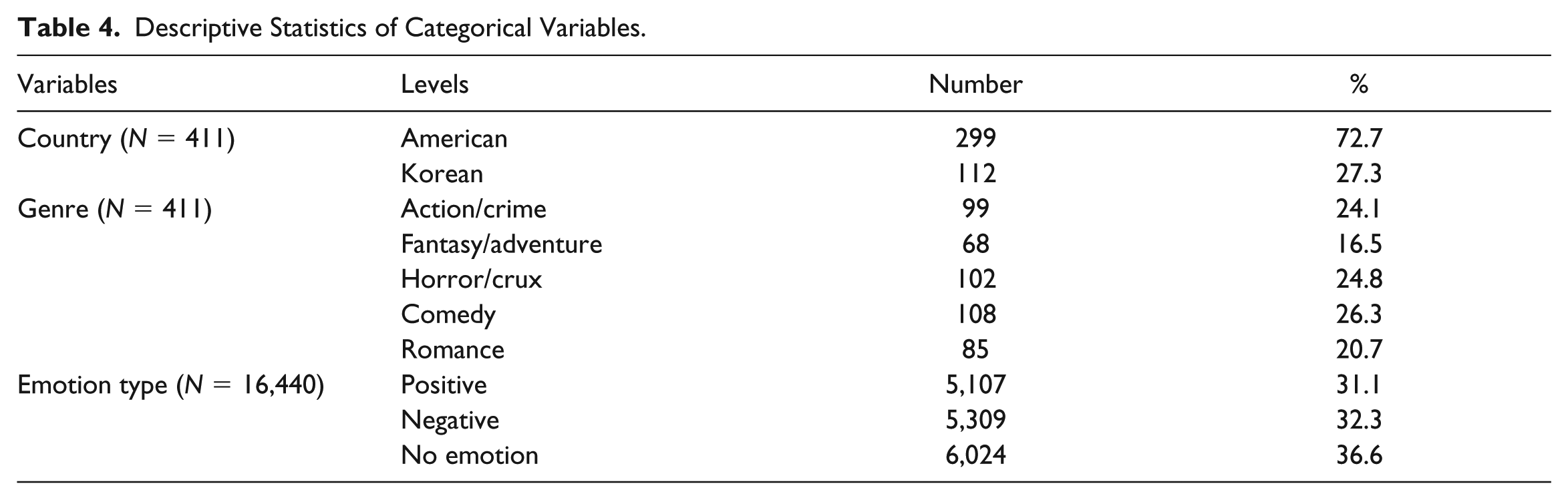
Tables 3 and 4 showed the descriptive statistics of continuous variables and categorical variables.
Descriptive Statistics of Continuous Variables.

Descriptive Statistics of Categorical Variables.
To account for the nested nature of comments in dramas, three hierarchical linear models (HLMs) were constructed to examine collective-level and individual-level effects on enjoyment, involvement with characters, and involvement with the narrative. They allowed us to see whether or not individual and collective variables can significantly affect outcome variables and to observe the interactions between the two levels. Group mean centering was used at the individual level. Restricted maximum likelihood method was adopted for estimation of the model.
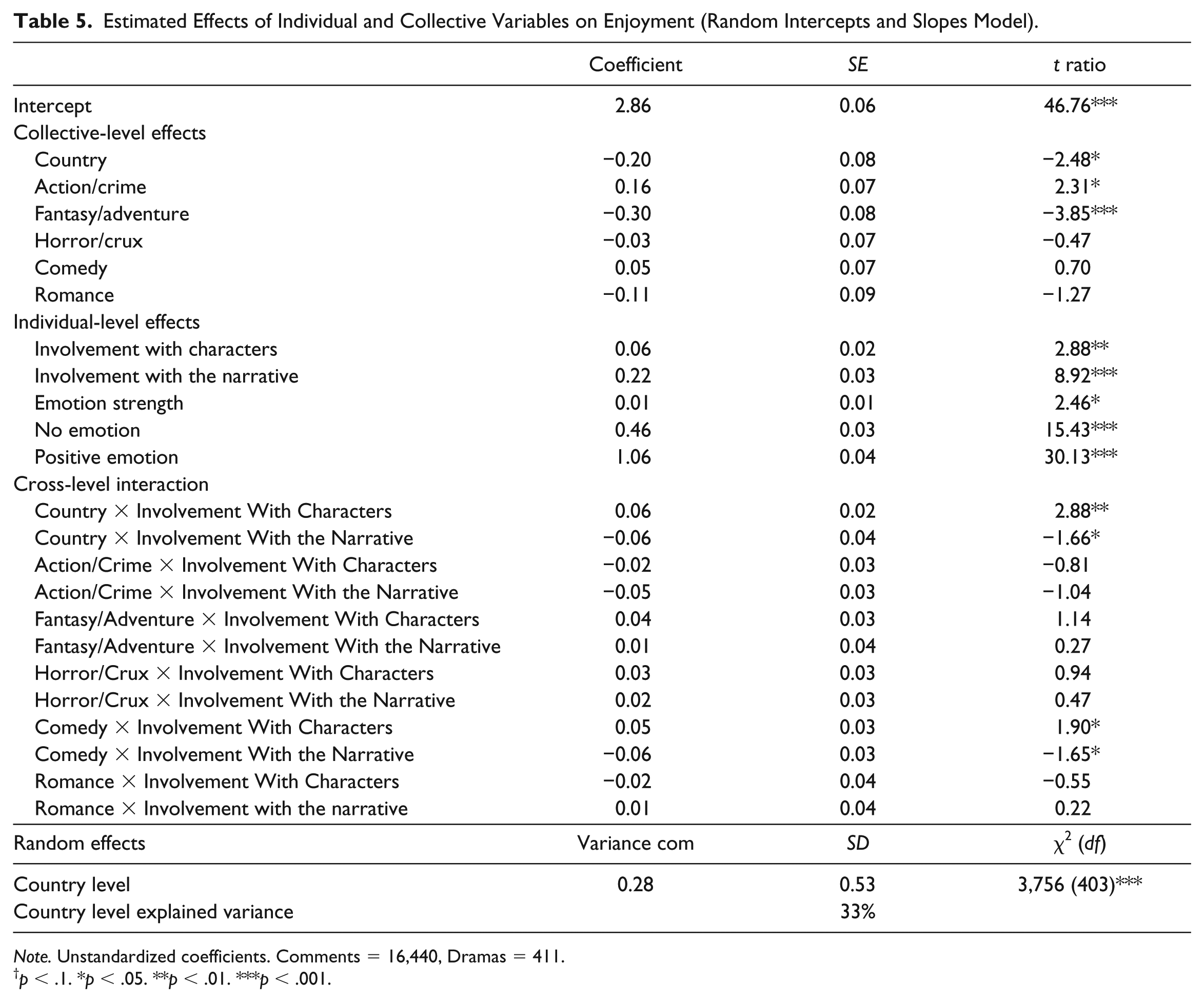
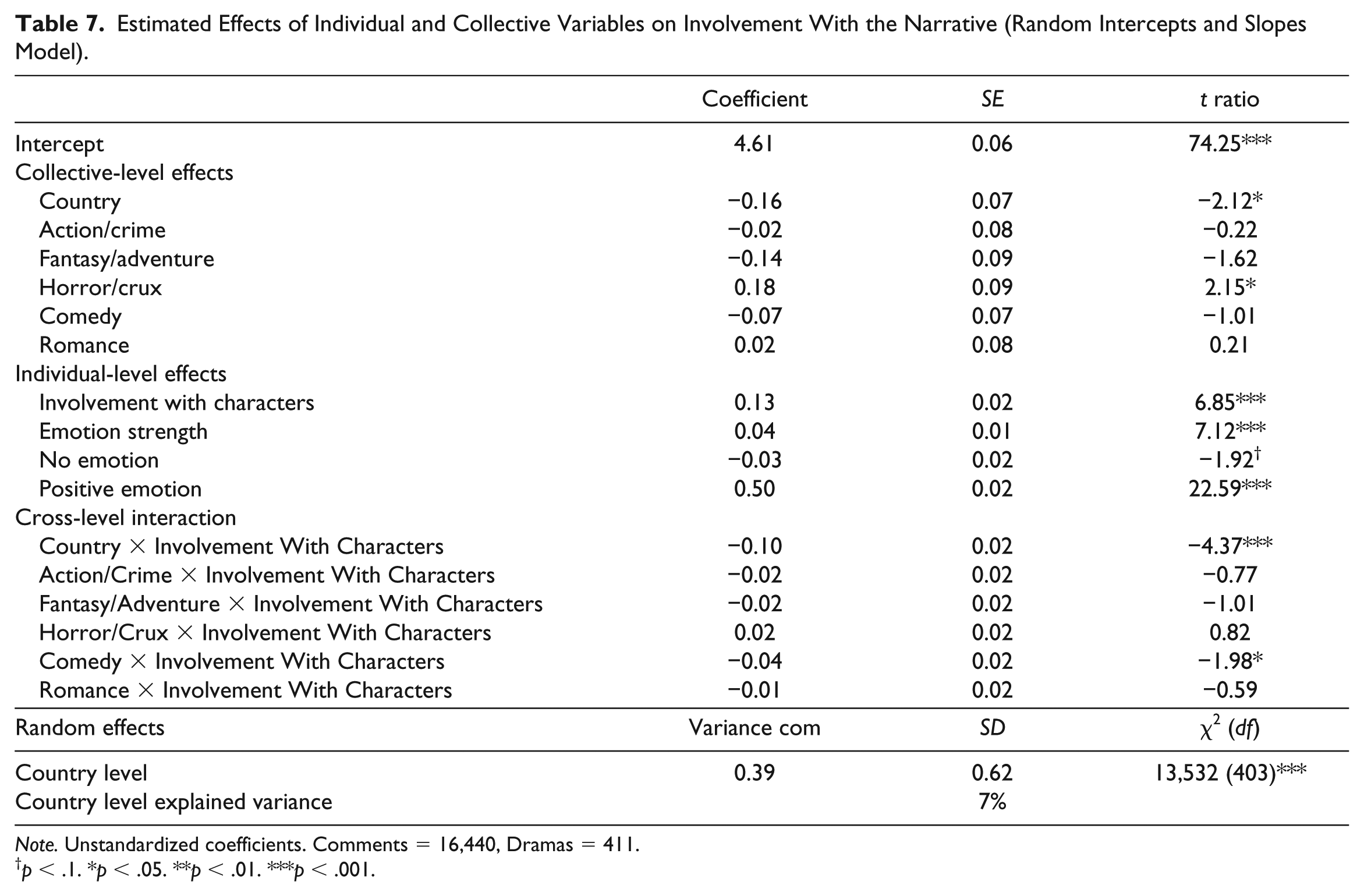
First, three empty models were created to give full information on the variance components for the two levels of influence, and to serve as baselines for comparison with subsequent models. Chi-square tests for variance components indicated the significance of the results (p < .001). It means that there are variances in the outcome variables caused by the Level-2 groupings. Thus, HLM is a legitimate method. The intraclass correlation coefficients (ICC) for enjoyment, involvement with characters, and involvement with the narrative are, respectively, 21%, 18%, and 43%, which represent the percentage of the variances for explaining outcome variables at the collective level. Then, three random intercepts and slopes models were built. All individual-level and collective-level variables were simultaneously entered into the model with interaction terms. The explanatory powers of three random intercepts and slopes models at the collective level were 33%, 10%, and 7%, respectively for enjoyment, involvement with characters, and involvement with the narrative (see Tables 5, 6, and 7).
Estimated Effects of Individual and Collective Variables on Enjoyment (Random Intercepts and Slopes Model).
Note. Unstandardized coefficients. Comments = 16,440, Dramas = 411.
p < .1. *p < .05. **p < .01. ***p < .001.
Estimated Effects of Individual and Collective Variables on Involvement With Characters (Random Intercepts and Slopes Model).

Note. Unstandardized coefficients. Comments = 16,440, Dramas = 411.
p < .1. *p < .05. **p < .01. ***p < .001.
Estimated Effects of Individual and Collective Variables on Involvement With the Narrative (Random Intercepts and Slopes Model).
Note. Unstandardized coefficients. Comments = 16,440, Dramas = 411.
p < .1. *p < .05. **p < .01. ***p < .001.
Results
H1 and RQ1 explored the main effects of culture and genre on enjoyment. American dramas had higher level of enjoyment than Korean dramas (β = −.20, SE = 0.08, p < .05).Thus, H1 was rejected. Action/crime had higher level of enjoyment than nonaction/crime (β = .16, SE = 0.07, p < .05), and fantasy/adventure had lower level of enjoyment than nonfantasy/adventure (β = −.30, SE = 0.08, p < .001).
RQ2 asked about the main effects of culture and genre on involvement. Korean dramas had higher level of involvement with characters (β =.13, SE = 0.06, p < .05) and lower level of involvement with the narrative (β = −.16, SE = 0.07, p < .05) than American dramas. Romance had higher level of involvement with characters than nonromance (β = .18, SE = 0.06, p < .01). Horror/crux had higher level of involvement with the narrative than nonhorror/crux (β = .18, SE = 0.09, p < .05).
RQ3 asked about the moderating effects of culture and genre on the relationship between involvement and enjoyment. Country strengthened the relationship between involvement with characters and enjoyment (β = .06, SE = 0.02, p < .01) but weakened the relationship between involvement with the narrative and enjoyment (β = −.06, SE = 0.04, p < .05). It means that the relationship between involvement with characters and enjoyment in Korean dramas was stronger than the one in American dramas. However, the relationship between involvement with the narrative and enjoyment in American dramas was stronger than the one in Korean dramas.
Comedy strengthened the relationship between involvement with characters and enjoyment (β = .05, SE = 0.03, p < .05) but weakened the relationship between involvement with the narrative and enjoyment (β = −.06, SE = 0.03, p < .05). The relationship between involvement with characters and enjoyment in comedy was stronger than the one in noncomedy. However, the relationship between involvement with the narrative and enjoyment in comedy was weaker than the one in noncomedy.
RQ4 asked about the moderating effects of culture and genre on the relationship between involvement with characters and involvement with the narrative. Country weakened the relationship between involvement with characters and involvement with the narrative in both Table 6 (β = −.18, SE = 0.04, p < .001) and Table 7 (β = −.10, SE = 0.02, p < .001). The relationship between involvement with characters and involvement with the narrative in American dramas was stronger than the one in Korean dramas.
Comedy weakened the relationship between involvement with characters and involvement with the narrative in both Table 6 (β = −.06, SE = 0.04, p < .05) and Table 7 (β = −.04, SE = 0.02, p < .05). The relationship between involvement with characters and involvement with the narrative in comedy was weaker than the one in noncomedy.
Discussion
H1 was developed to test the theory of cultural proximity. It was rejected by the result that American dramas had higher level of enjoyment than Korean dramas. The failure of cultural proximity reflected the trajectory of media globalization, which is led by American media industry and is sweeping out the whole world. For a long time, American media products have served as an important channel for educated and young urban Chinese to actively embrace the western lifestyle and consumer culture (Chan & Ma, 1996; Leung, 2009; Xu, 2007). For them, American culture is no longer exotic. Thus, cultural distance did not compromise their enjoyment of American dramas.
Although it did not successfully predict enjoyment, cultural proximity was useful to explain media involvement. The results indicated that Korean dramas had higher level of involvement with characters and lower level of involvement with the narrative than American dramas. The cultural similarity between Korea and China, such as appearance, dress, lifestyle, and tradition, helped Chinese viewers to understand what characters did and see them as someone they knew about in everyday life. Thus, stars become the primary appeal for Chinese audience and the central selling point of Korean dramas. Yang (2008) pointed out that Korean dramas are often seen as idol dramas that are defined through stars, in particular, “handsome men and beautiful women,” and are promoted through star-centered activities.
American dramas, however, take no advantage of cultural proximity and have to appeal to the narrative, which is less culturally specific and more universal than characters. In general, American dramas excel in the narrative. Jiang and Leung (2012) reported that American dramas are intense, compact, complicated, and fast-paced, while Korean dramas are slow, lengthy, relaxed, and simple. Mittell (2006) used narrative complexity to define the distinct narrational mode in American TV dramas. Narrative complexity has three characteristics. First, it integrates episodic and serial forms by giving a partial conclusion to an episode and continuing the development of an overarching story across the series. Second, it utilizes a variety of sophisticated storytelling devices, such as temporal displacement, shifting perspectives, focalization, and repetition. Third, the operational aesthetics make viewers reflexive about the operation of narrative mechanics, uncovering how it guides, manipulates, and deceives viewers. As a result, narrative complexity is more likely to engage viewers than conventional narrative.
Cultural proximity also had a couple of significant moderating effects on involvement and enjoyment. First, it moderated the relationship between involvement and enjoyment. The results showed that involvement with characters was more likely to lead to enjoyment in Korean dramas, and involvement with the narrative was more likely to lead to enjoyment in American dramas. It means that Chinese viewers tended to enjoy Korean dramas through involvement with characters and American dramas through involvement with the narrative.
Second, cultural proximity moderated the relationship between involvement with characters and involvement with the narrative. It was weaker in Korean dramas than in American dramas. Culture is an important resource viewers draw on to apprehend media products, facilitating involvement and enjoyment (Straubhaar, 1991). Korean dramas allow Chinese viewers to get involved with characters through cultural proximity, and reduce their reliance on the narrative. Cultural proximity serves as an alternative resource, other than the narrative, helping Chinese viewers to get involved with characters. Without cultural proximity, however, American dramas have to rely more on the narrative, through which Chinese viewers get involved with characters. Narrative complexity in American dramas excels in integrating characters into the narrative, strengthening the narrative’s contribution to involvement with characters.
Genre proximity was another key concept this article explored. The results revealed that action/crime was proximate to local viewers, and fantasy/adventure was not. It coincided the previous position that action/crime appeals to universal themes, such as violence and sex, and, thus, is easy to be received by audience in different countries (La Pastina & Straubhaar, 2005). Fantasy/adventure, however, stays far away from the real life, increasing the difficulty for local viewers to understand it. Genre also had significant main effects on media involvement. On one hand, romance highlights characters, whose feelings, relationships, and experiences in the search for love are primary concerns of viewers (Casey, Casey, Calvert, French, & Lewis, 2008). Thus, romance had higher level of involvement with characters than nonromance. On the other hand, horror/crux requires the sophisticated narrative that can draw viewers into a story world where they are entertained through fear and suspense (Casey et al., 2008). Thus, horror/crux had higher level of involvement with the narrative than nonhorror/crux.
In addition, genre moderated the reciprocal relationship between involvement with characters and involvement with the narrative. This article reported the opposite moderating effects in comedy, where involvement with characters was more likely to lead to involvement with the narrative, but involvement with the narrative was less likely to lead to involvement with characters. The results illustrated the central position of characters and the marginal position of the narrative in comedy. Most of the comedies we studied here were sit-coms, where the performance of actors stays at the heart. Comparatively, the narrative in sit-coms is not important. Orlebar (2011), for example, suggested that focusing on performance of actors stops viewers from using the norms of every life to judge the narrative in sit-coms. Therefore, some plots, which are unbelievable in the realistic narrative, become acceptable in sit-coms. In a similar way, comedy also moderated the relationship between involvement and enjoyment. The results showed that involvement with characters was more likely to lead to enjoyment, while involvement with the narrative was less likely to lead to enjoyment. Thus, comedy viewers tended to obtain enjoyment through involvement with characters.
Conclusion and Limitations
This article adopted cultural proximity and genre proximity to predict involvement and enjoyment. The findings offered some insights about local reception of foreign TV dramas. For one thing, cultural proximity failed to predict enjoyment but succeeded in explaining involvement. Cultural proximity also revealed two different routes to enjoyment—to enjoy Korean dramas through involvement with characters and American dramas through involvement with the narrative. In addition, cultural proximity served as an alternative resource to alleviate the mutual reliance between involvement with character and involvement with the narrative.
For another thing, genre proximity was found in action/crime but not in fantasy/adventure. Genre difference also affected involvement. Romance and horror/crux, respectively, had higher level of involvement with characters and involvement with the narrative. In sit-coms, overdependence on performance highlighted involvement with characters through which Chinese viewers acquire enjoyment and accept the narrative.
Despite of the insights, a couple of limitations need to be acknowledged. First, involvement refers to the interaction between viewers and media contents. This article focused on media content, such as culture and genre, but failed to examine the characteristics of viewers. Prior studies pointed out that American and Korean TV dramas had different viewer bases in China (Ishii et al., 1999; Jiang & Leung, 2012; Kang, 2014). Demographical differences also contributed to involvement and enjoyment. Second, culture and genre were conceptualized as two separate constructs. It was necessary for such a quantitative study. In practice, however, culture and genre merged into distinctive features of American and Korean TV dramas. For example, Jiang and Leung (2012) suggested that American dramas are heterogeneous, highlighting action/crime, fantasy/adventure, and horror/crux, while Korean dramas are homogeneous, concentrating on romance and family. Examining culture and genre separately overlooked the intrinsic unity of them.
Footnotes
Declaration of Conflicting Interests
The author(s) declared no potential conflicts of interest with respect to the research, authorship, and/or publication of this article.
Funding
The author(s) disclosed receipt of the following financial support for the research, authorship, and/or publication of this article: Research for this article was supported by National Social Science Foundation of China (18BXW112, 17ZDA288, and 15CGL063).