




Abstract
There has been a growing interest in the rhetorical move structure of research articles (RAs). Research studies reveal that articles written by native and nonnative English speakers show some similarities and differences in their rhetorical structure and linguistic features across disciplines. This study was therefore undertaken to investigate the rhetorical moves of English RA abstracts, which were written by authors from different cultural and linguistic backgrounds. Sixty RA abstracts from two corpora (international corpus and Thai corpus) in the field of accounting were analyzed using Hyland’s framework. The abstracts written by authors of different nationalities and published in internationally scholarly journals were collected for the international corpus, whereas the counterpart consisted of abstracts written by Thai authors and published in indexed Thailand-based journals. Both similarities and differences in terms of rhetorical move and linguistic realizations were found. The use of tenses and voices was quite different not only between the two corpora but also from the previous studies. The findings will provide practical and detailed description of the RA abstracts’ structures of the two corpora. This may lead to pedagogical implications for teaching students how to write accounting English RA abstracts effectively.
Introduction
Move analysis is one of the genre-based approaches used to identify the structure of research articles (RAs) and it has now become an influential method. A “Move” as defined by Nwogu (1997) is “a text segment made up of a bundle of linguistic features (lexical meaning, propositional meanings, illocutionary forces, etc.) which give the segment a uniform orientation and signal the content of discourse in it” (p. 122). Swales (1990, 2004) also termed it as a discoursal segment that performs a particular communicative function. Connor, Upton, and Kanoksilapatham (2007) stated that a move represents text frames that have their own meaning and function. Also, a move is used to classify chunks of text in terms of their particular communicative intentions (Yang & Allison, 2003). Based on these definitions, a move is a semantic unit of texts that is linked to the writer’s purpose. Identifying text units in terms of communicative purpose is considered to be one of the ways to turn teachers’ and students’ attention away from mere surface structures of text to the socially situated use of texts with specific intentions (Hüttner, Smit, & Mehlmauer-Larcher, 2009; Wannaruk & Amnuai, 2016). By focusing on discourse, communications made by writers would not only be valuable for text reading but also for pedagogical implication.
RAs irrespective of disciplines or languages are an interesting genre and have been extensively analyzed using the move-based approach. Several researchers focused their studies on the comparison of rhetorical moves of English RAs with those of RAs written in other languages such as Polish (Duszak, 1994), Slavic (Yakhontova, 2006), Thai (Kanoksilapatham, 2007), and Chinese (Loi & Evans, 2010). Based on these studies, differences were found not only in the structure of rhetorical moves but also writing styles, ways of sharing and interpreting ideas. This means that beyond language ability, there are some factors such as culture, disciplinary discourse, community convention, the close-knit nature of research communities, scope of research, and so on that influence the ways of writing RAs (Kanoksilapatham, 2007).
RA abstract is one of the sections that has been extensively analyzed using move-based analysis. As it is an indispensable research section of a journal article and used to capture the essence of the whole article, an abstract is more important in helping the reader to further continuing or ignoring the remaining sections. Therefore, writers should organize their abstracts as best they can. They need to try to foreground their main claims and present themselves as competent community members (Hyland, 2005). Also, many journals published in languages other than English require the submission of an English version of the abstract (Lorés, 2004; Ventola, 1994). This makes the abstract extremely important.
Besides rhetorical structure analysis, linguistic realizations in RA abstracts including tense and voice are also important and have been increasingly focused on by several research studies because they provide greater insight into the written genre (Esfandiari, 2014; Hanidar, 2016; Tseng, 2011; Tu & Wang, 2013; Zhang, Thuc, & Pramoolsook, 2012). Verb tense, especially, is one of the features that have been most focused on and extensively investigated. As Cooley and Lewkowicz (2003) noted, present tense was used in abstracts to present the form of a summary of the article, while the past tense was used to summarize the research. The three moves of Background, Aim, and Conclusion were presented in the present tense while Method and Results were written using the past tense (Tseng, 2011; Zhang et al., 2012). Zang et al. also found that the active voice was used nearly twice as much as the passive voice. In a study carried out by Salager-Meyer (1992), the present perfect tense, past simple, and present simple were used for different purposes.
Both rhetorical moves and their linguistics realizations are important factors when writing RA abstracts. This is due to the fact that although writers are highly competent to communicate general English, a lack of knowledge of generic types can still make composing RAs difficult, especially for inexperienced nonnative writers who have to write in English (Amnuai, 2017; Ren & Li, 2011; Wannaruk & Amnuai, 2016). With these concerns, the abstracts of the Thai writers in the field of accounting are the focus of the present study with the aim of examining how they structure their abstracts. Also, to my knowledge, there were no research studies comparing the rhetorical moves of RA abstracts published in the Thailand-based journals with those of international journals in the field of accounting. This leads to the focuses of this study, which aim to compare the move patterns of rhetorical move structures and linguistic realizations of English RA abstracts published in two different contexts. The two aims were (a) to investigate the rhetorical structure of accounting English RA abstracts published in Thai and international journals and (b) to explore the linguistic features in terms of the tense and voice used to realize each move in the two corpora. The findings from this genre-based approach will provide researchers, especially those in the field of accounting, with some knowledge of the genre of RA abstracts. With a greater awareness of rhetorical moves and linguistic realizations, it is believed that readers can shape their abstracts more naturally to the conventional pattern used in their fields.
Materials and Methods
Data Collection
Two corpora were compiled for the analysis: an international corpus and a Thai corpus. Each corpus contained 30 English RA abstracts selected from three journals. Each journal had to meet the criteria of representativeness, reputation, and accessibility. Also, it is an ideal notion that larger size of the corpus yields reliable and fruitful results (Amnuai, 2017). However, there was a limited number of English accounting abstracts published in refereed journals that can be accessed via an electronic database. Although the number of the sample was limited, the findings should provide useful insights into the accounting field. As reported in previous studies (Abarghooeinezhad & Simin, 2015; Alhuqbani, 2013; Behnam, 2014; Darabad, 2016; Li & Pramoolsook, 2015; Ren & Li, 2011), the samples of each corpus used in these comparative research studies were between 20 and 32 abstracts. However, the findings showed some significant results in their fields. Therefore, in the present study, 30 abstracts from each set of data should be appropriate and large enough for rhetorical analysis and would provide significant findings for research generalization and implication.
The journals in the international corpus were Accounting, Organizations and Society; Management Accounting Research; and International Journal of Accounting Information System. The ranking of journals in the Journal Citation Reports (2015) published by the Institute for Scientific Information (ISI) was the criterion for journal selection. With this concept, it is believed that the abstracts from the chosen journals are qualified and reliable for the analysis (Amnuai, 2012). The selected articles were written by authors of various nationalities.
Similarly, the Thai corpus consisted of 30 RA abstracts in accounting written in English by Thai writers. The selected articles were taken from three peer-reviewed journals published by universities in Thailand, including the Chulalongkorn Business Review, the Thammasat Business Journal, and the Journal of Accountancy and Management. These journals were listed in the Thai-Journal Citation Index center (TCI), which can be accessed from the website (http://www.kmutt.ac.th/jif/public_html/list%20journal.php?branch=H). The list of analyzed abstracts in both datasets is shown in Appendix. The reasons for the selection of the RA abstracts in the field of accounting were due to the fact that this field is an area of particular interest for pedagogy and it is also an underexplored area. Besides, accountant is one of the free movement professions in Association of Southeast Asian Nations (ASEAN). Therefore, it is important for Thai accountants who aim to compete in the wider contexts by advancing themselves in not only career skills but also academic writing, particularly writing RA abstract in English.
Data Analysis
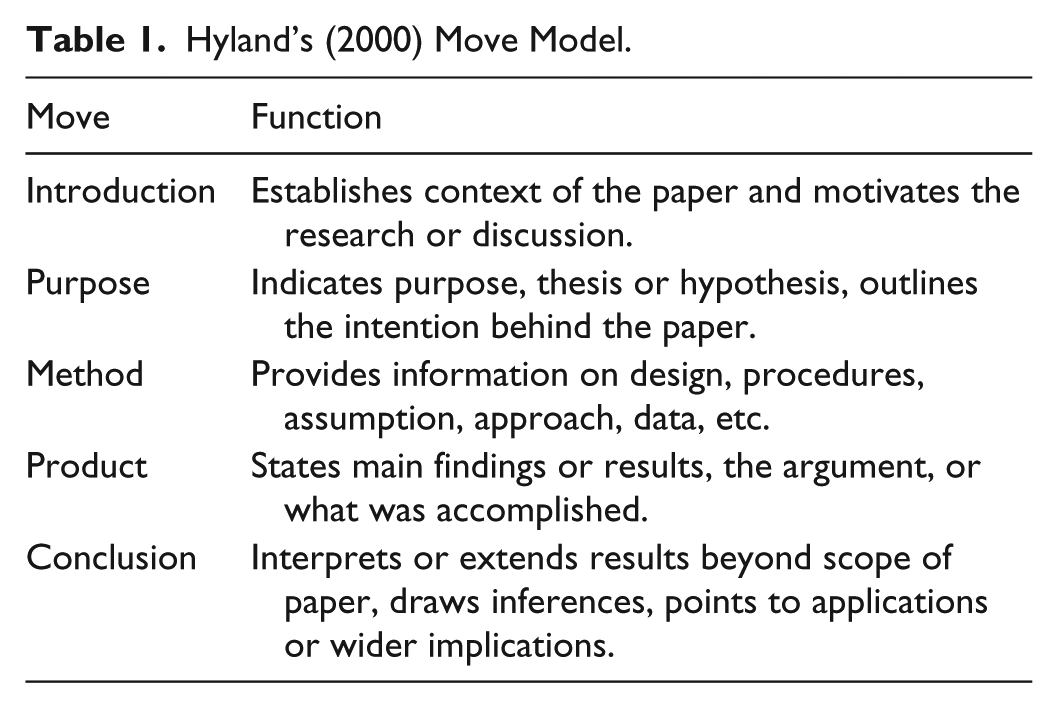
To access each analyzed abstract more easily, all 60 RA abstracts from both corpora were codified separately (I1-I30 for the international corpus and T1-T30 for the Thai corpus). The model developed by Hyland (2000) was employed for the analysis. This is because Hyland’s model contains five main moves beginning with Introduction, Purpose, Method, Product, and Conclusion. Although Santos’s (1996) model is similar to Hyland’s, it was developed from the analysis of 94 abstracts in the field of applied linguistics while Hyland’s model was derived from the analysis of 800 abstracts across eight fields in science and social sciences. Also, Hyland’s (2000) framework has been extensively used for abstract analysis in several research studies (e.g., Saeeaw & Tangkiengsirisin, 2014; Suntara & Usaha, 2013; Zhang et al., 2012). Compared with Bhatia’s (1993) model, Hyland’s model was more appropriate as it contains an Introduction move, which is used to establish a territory or to occupy a niche. However, this move was not represented in Bhatia’s (1993) model. The move model of the Introduction-Method-Result-Discussion (IMRD) pattern developed by Swales (1990) was not selected for the present study because of the lack of the Purpose move, which is very important and which should be stated clearly and separately. As a result of a trial analysis, the researcher found that the Purpose move was the main focus of the research being studied and therefore it should be an individual move in the abstract. Therefore, Hyland’s (2000) model as shown in Table 1 was the most appropriate and well-chosen framework for the move-based analysis in the present study.
Hyland’s (2000) Move Model.
In the process of move identification, the notion of rhetorical function was central to the analysis of RA abstracts aiming to investigate move occurrence, move pattern, and the use of tense and voice. To ensure the reliability of the move analysis, the invited coder, who has experience in move coding, was employed. If there were any coding disagreements, the discussions were made. The cut-off point for move classification was based on Kanoksilapatham’s (2005) criterion, which is classified by the frequency of occurrence of each move covering obligatory, conventional, and optional moves. The frequency of occurrence means 100%, 60% to 99%, and less than 60% of the corpora, respectively.
Results and Discussion
Rhetorical Moves in the Two Corpora
This section presents the results of the move analysis and linguistic realizations. Only the salient points concerning both kinds of analyses are discussed.
Move occurrence
As shown in Table 2, all five moves in Hyland’s (2000) model appeared in both datasets. There were some similarities and differences in the frequency of move occurrence in the two corpora. In the international corpus, there were no obligatory moves and the conventional moves were the Introduction (60%), Purpose (90%), Method (80%), and Product (90%) while the Conclusion was found as an optional move. However, one move was obligatory in the Thai corpus (Product). The Purpose and Method moves were conventional while the Introduction and Conclusion moves were optional.
Frequency of Moves Found in the Abstracts of the Two Corpora.
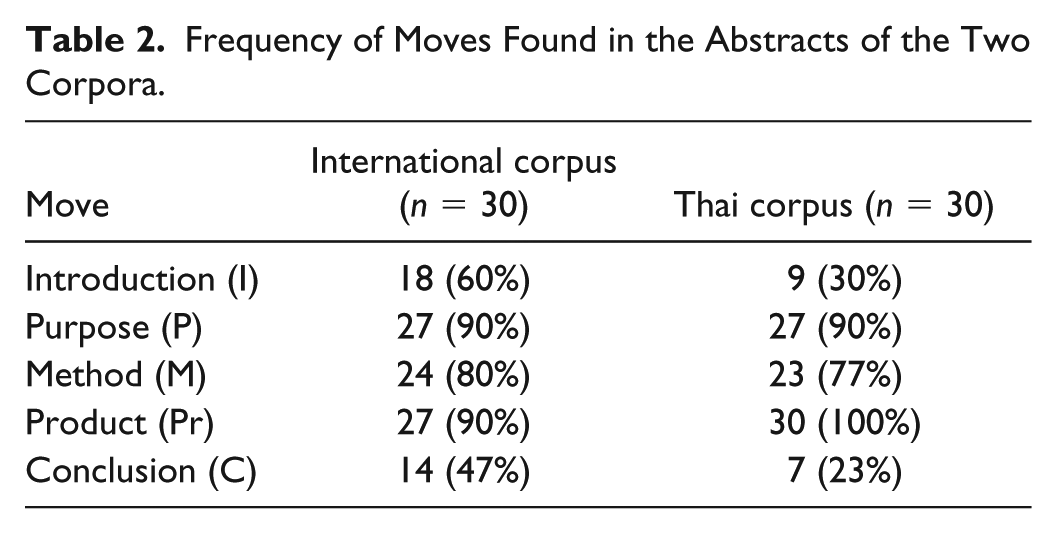
A comparison of the two corpora showed that the frequency of occurrence of the Purpose, Method, and Product moves was similar, but the difference was in the frequency of the Introduction and Conclusion moves. The high frequency of the three moves, especially the Product move, was consistent with previous studies (Huang, 2009; Li & Pramoolsook, 2015; Pho, 2008; Ren & Li, 2011; Suntara & Usaha, 2013; Zhang et al., 2012). The Product move was the dominant move in the abstracts in nearly all fields of studies. The high frequency found in the datasets implies that the authors were aware of the importance of these three moves. Therefore, the authors in the field of accounting should take these findings into consideration when developing their abstracts.
Interestingly, the frequency of the Introduction and Conclusion moves in both corpora was clearly different. In the international corpus, the frequency of these two moves was relatively high, in fact, twice as high as those in the Thai corpus. This is similar to Al-Khasawneh’s (2017) study. He found that these two moves were comparatively less in the abstracts written by nonnative speakers of English. The authors tended to begin their abstracts with Purpose move and ended the abstracts without drawing references to the field. Likewise, most Thai authors in the present study left their abstracts without discussing the wider implications of the findings, which is different from the authors in the international corpus. This implies that the authors in the international corpus regard the background and the significance of the study as important. However, the Thai authors in the Thai corpus tended to ignore these two moves, but gave more details in the other three moves, especially the Product move. As there is no previous similar research on this aspect, it is inclined to consider this as a sign of inadequate rhetorical knowledge of this genre or perhaps the authors simply do not see any importance in stating these two moves. With regard to the Introduction move, the international authors preferred to situate their studies within the literature. This means the readers are provided with the concise rationale or background knowledge for the study in which to some extent reflects the history of the field (Kanoksilapatham, 2005). Although accounting is a well-established field, Thai authors are likely to ignore this move. The study showed that the findings are most likely to be presented using a descriptive style, which differs from that found in Hyland’s (2000) study. He found that results were stated in the form of an argumentative structure. This means the results were not solely presented, but they were also discussed. Therefore, it is recommended that novice accounting writers should be aware of this difference when writing English RA abstracts.
Move ordering
As shown in Table 3, the four most frequent patterns include (a) P-M-Pr, (b) P-M-Pr-C, (c) I-P-M-Pr-C and I-P-M-Pr, and (d) I-M-Pr. This is consistent with Hyland’s (2000) study. He found the “P-M-Pr” pattern was the most frequent structure. The degree of use of these patterns between the two datasets was different. The linear patterns of “P-M-Pr-C” and “I-P-M-Pr-C” were the most preferred ordering patterns in the international corpus, while “P-M-Pr” was the only structure used by most Thai authors. With 85% of usage, this indicates that Thai authors favor to develop their abstracts in the linear pattern of Purpose–Method–Product. In other words, they tend to follow strictly the conventional pattern as found in Hyland’s study. Also, it was found that most of the authors of these 11 abstracts are university lecturers, which presumably means they have some experience in writing article abstracts. Based on the frequency of occurrence in Table 3, most of the abstracts (73%) were in the linear pattern, while 27% were arranged in nonlinear form. This finding differs from those of Ahmed (2015). He found that Tourism abstracts were mostly constructed in nonlinear form. The move arrangement in the present study indicates that although most international authors tend to write their abstract with all five moves, they are likely to present them in different patterns. On the contrary, Thai authors prefer to use particular moves and display them sequentially according to the “Purpose, Method, Product” structure. The variations in move ordering may be to some extent affected by the type and method of the research employed and the author’s freedom (Ahmed, 2015).
Five Most Frequent Linear Move Patterns Found in the Two Corpora.

Note. P = purpose; M = method; Pr = product; C = conclusion; I = introduction.
Linguistic Realizations
Tenses
Table 4 shows that the present simple tense was the most frequent tense used in most moves while the past tense was the second most frequent tense found in both corpora. The present perfect tense was found least appearing in six abstracts only (five in the international corpus and one in the Thai corpus) to present the Introduction move.
Verb Tense Frequency in Each Move in the Two Corpora.
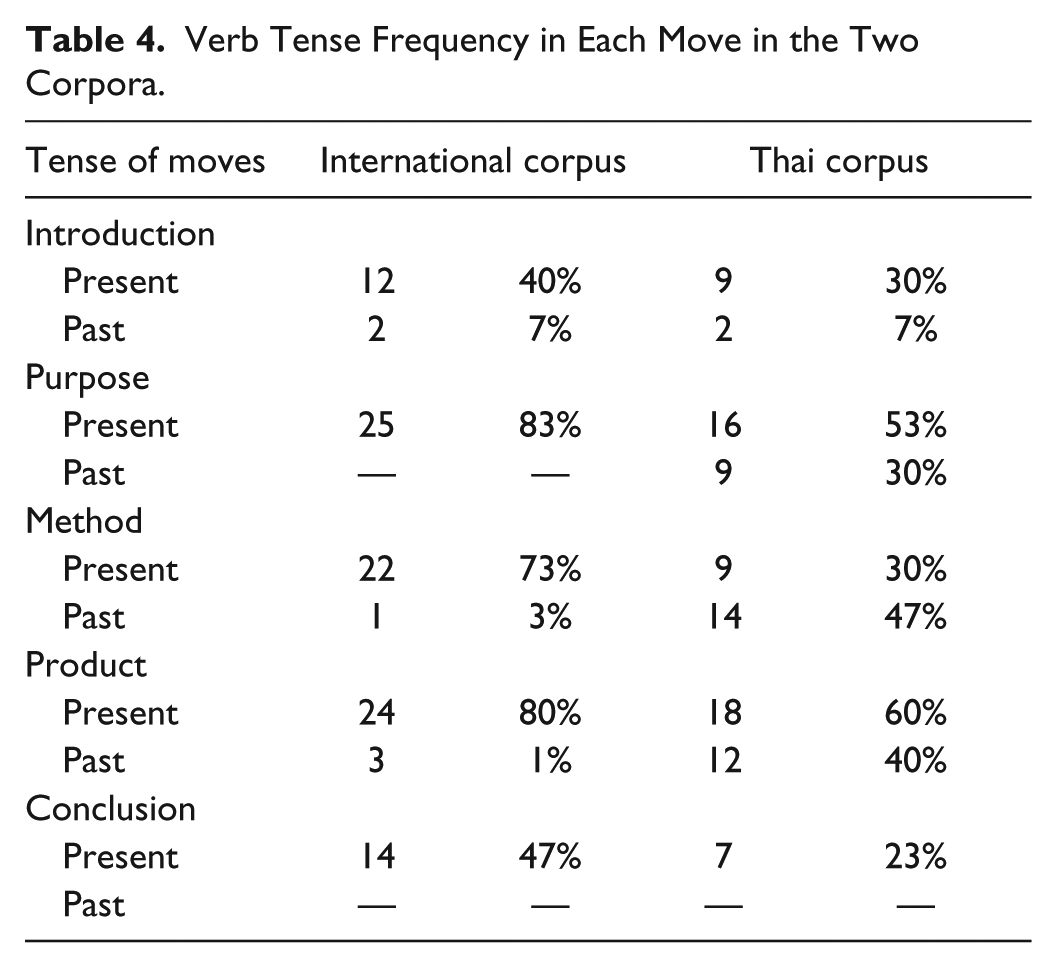
In the international corpus, the present simple tense was used in all five moves (Excerpt 1 shows the Purpose move in the present simple tense). The differences of tense usage of these two corpora were in the Purpose and Method moves. There was no past tense used in the Purpose move in the international corpus, while 30% of the Thai abstracts were generated in the past form. For the Method move, only one international abstract was presented in the past tense form. On the contrary, in the Thai corpus, 47% of the abstracts were written in past tense. However, several previous research studies (e.g., Suntara & Usaha, 2013; Zhang et al., 2012) reported that the past tense was dominant in the Method move. Compared with the findings of previous research studies (Alhuqbani, 2013; Al-Shujairi, Ya’u, & Buba, 2016; Esfandiari, 2014; Suntara & Usaha, 2013; Tseng, 2011), for example, Tseng (2011) found both similarities and differences in tense usage. The Introduction, Purpose, and Conclusion moves were the most similar as they tended to use the present simple tense, but the Method and Product moves were different. Tseng found that these two moves were presented in the past tense form, while in the present study, the use of past tense rather than the present simple tense was found only in the Thai Method move. With regard to the Product move, both sets of data used present simple tense. In a study conducted by Alhuqbani (2013), the Method and Product moves of Medical abstracts were presented in the past tense, accounting for 100 % in both moves. However, the findings of the present study were completely different from those of the study by Zhang et al. (2012). They did not find any use of the present tense in the Method move in Vietnamese agricultural RA abstracts. This suggests that there are disciplinary variations in the writing of research abstract, especially the methodology part. However, the regulation of each journal and the authors’ awareness of tense usage might be other factors in creating these differences.
This survey examines perceptions of auditors, professional users, and general users in Thailand towards the . . . (T1, Excerpt 1)
Voices
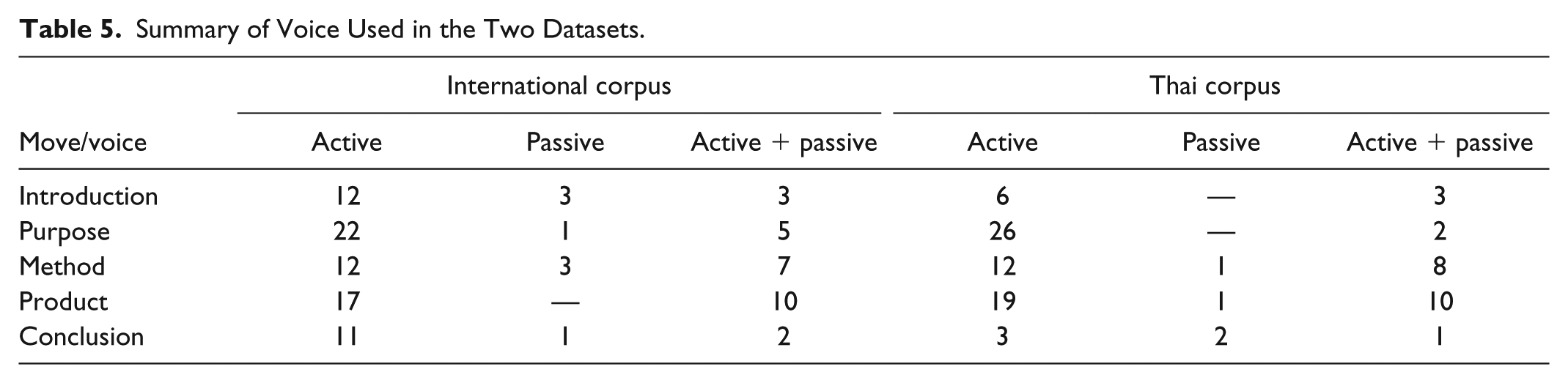
The finding showed that there was no distinct difference in the voice usage between the two sets of data. The active voice was the preferred choice used in both datasets. The second most frequent choice was a mixture of active and passive voices and the passive voice occurred the least (see Table 5). This was similar to Zhang et al. (2012), who reported that the active voice was nearly twice as frequent as the passive voice in their study and it appeared dominantly in both Method and Product moves. This differed from the present study, where two moves that employed active voice were Purpose and Product moves. In contrast, Tu and Wang (2013) discovered that the passive form was frequently used to report the findings in applied linguistics RA abstracts. Hanidar (2016) also demonstrated that presenting research procedure and announcing finding were written in passive form. This means the authors shifted their focus from the subject to the object. However, in the present study, the use of the passive voice alone in the Method or Product moves in both datasets was less frequent, although a combination of the passive and active voice was used (see Excerpts 2 and 3). Thus, it can be seen that most authors tended to develop their abstracts in a direct way rather than using an impersonalized style.
Summary of Voice Used in the Two Datasets.
Questionnaires were distributed to 146 executive directors of internal auditor in Thailand. The statistics used for analyzing the collected data Our findings
Conclusion
The present study aims at investigating the rhetorical structure of English RA abstracts published in journals of different contexts (Thai-based and international journals) using Hyland’s (2000) framework. Four moves (Introduction, Purpose, Method, and Product) were the conventional moves in the international corpus, while three moves (Purpose, Method, and Product) were the conventional moves in the Thai corpus. The frequency of occurrence of the Introduction and Conclusion moves in the international corpus is twice the amount of those of the Thai corpus. The present simple tense in the active form was the favored choice used to present each move in both sets of data. The past tense, present perfect tense, and passive voice were rarely employed. A mixture of active and passive voices was dominant in both the Method and Product moves. The findings would be useful for implementing to pedagogical practice. That is, the RA genre structures can be used to develop teaching materials and be as reference source for genre-related writing classes. As we know, novice nonnative writers or graduate students, particularly those who have less English experience, face serious problems when writing English abstracts for conference presentation or publication. With the full understanding of discoursal and grammatical features, it is believed that they (especially writers in the field of accounting) will be able to generate their abstracts effectively. The use of tense and voice mentioned in the present study provides practical guidelines to nonnative writers when writing English abstracts. However, the sample size and the personal or cultural factors might affect the generalization of the findings of this study. Thus, these limitations should be taken into account when conducting move analysis studies in the future.
Footnotes
Appendix
Declaration of Conflicting Interests
The author(s) declared no potential conflicts of interest with respect to the research, authorship, and/or publication of this article.
Funding
The author(s) received no financial support for the research, authorship, and/or publication of this article.