




Abstract
The purpose of this study was to reveal features of instructors’ explanations in online EMI lectures in China. Through a mixed methods case study, the researcher examined the distribution and linguistic realizations of different types of explanations in the lectures of two online EMI courses and how the instructors and students perceived the explanations. The results showed that instructors’ explanations were prevalent in the lectures of both courses with expositions being the most dominant type regardless of subject contents whereas the other explanation types such as comparisons, clarifications, additions, justifications, solutions and generalizations being subject-specific. Moreover, both instructors were capable of using various linguistic devices for different types of explanations despite some linguistic mistakes in explanations. The results also showed that instructors chose particular types of explanations mainly because of the specific teaching aims and methods of the course, and that students were positive about instructors’ use of different types of explanations in the lectures except for the suggestions that one of the instructors’ pronunciation be improved and more visual means be used to aid explanations. The study has implications for future research on enhancing EMI instructors’ explanatory capacity and addressing students’ linguistic discomfort with EMI lectures in a broader sense.
Plain Language Summary
The purpose of this study was to reveal features of instructors’ explanations in online EMI lectures in China. Through a mixed methods case study, the researcher examined the distribution and linguistic realizations of different types of explanations in the lectures of two online EMI courses and how the instructors and students perceived the explanations. The study identified four major findings: (1) Instructors’ explanations were prevalent in the lectures of the two case study online EMI courses in China. While expositions emerged as the most dominant type regardless of subject contents, other types of explanations were subject-specific. (2) Both instructors were capable of using various linguistic devices for different types of explanations despite some linguistic mistakes in explanations. (3) Instructors chose particular types of explanations mainly because of the specific teaching aims and methods of the course. (4) Students were positive about instructors’ use of different types of explanations in the lectures except for the suggestions that one of the instructors’ pronunciation be improved and more visual means be used to aid explanations. The results of the study have important implications for future research on enhancing EMI instructors’ explanatory capacity and addressing students’ linguistic discomfort with EMI lectures in a broader sense. At the same time, the study is not free from limitations. First, this study only analyzed instructors’ explanations in the lectures of two online EMI courses. Instructor’s explanations in other EMI circumstances, such as EMI lectures with teacher-student interactions or EMI lectures of other disciplines, need further investigation. Second, future studies are needed to investigate the impact of EMI instructors’ explanations on students’ learning of subject knowledge, on students’ academic performance and English ability.
Keywords
Introduction
English medium instruction (EMI) refers to the “use of the English language to teach academic subjects (other than English itself) in countries or jurisdictions where the first language of the majority of the population is not English.” (Macaro et al., 2018, p. 37). In many countries and regions, EMI is considered a major channel to improve institutions’ international profile, attract foreign students, improve home students’ English language proficiency and opportunities to study abroad, without presenting long-term cost to academic content learning (Macaro et al., 2018; Zhao & Dixon, 2017). Likewise, with the overall internationalization of China’s higher education, Chinese universities are offering more and more EMI courses so as to meet China’s Ministry of Education (MOE) requirements (Ministry of Education of the People’s Republic of China, 2001, 2005, 2007) and to enhance universities’ international competitiveness. In addition to the EMI courses provided on campus, an increasing number of EMI courses are available online, the lectures of which are easier to get access to for both learners and researchers. For learners, they can log in to the online EMI lectures at any time of the day and devote more time to reviewing the content they failed to understand. For researchers, they can easily get access to online EMI lectures to collect necessary data for EMI research, which was the case of the researcher in this study.
Similar to other online lectures, teacher talk is central to online EMI lectures which may involve a large quantity of explanations. Research has shown that explanation is one of the commonest speech functions in classrooms (Dalton-Puffer, 2007), and that providing good explanations is essential for student learning (Borko et al., 1992). According to Marzabal et al. (2019, p. 1107), “explanations serve to clarify concepts, procedures, facts, ideas, or types of problems, and are aimed at promoting student understanding.” Given the importance of instructors’ explanations in promoting understanding and learning, there has been increasing academic literature on effective and satisfactory explanations in classroom teaching, especially in science teaching (Kulgemeyer, 2018; Marzabal et al., 2019; Murtafiah et al., 2018; Papadouris et al., 2018). However, there is little research on features of instructors’ explanations in online EMI lectures, not to mention those in China. Additionally, despite the reported dominance of research on teacher and/or student beliefs, perceptions and attitudes toward EMI introduction and practice in higher education (Macaro et al., 2018), there is no research related to instructors’ perspectives about their self-reported explanation strategies and students’ perspectives of the explanation strategies used by instructors in EMI lectures.
Drawing on both quantitative and qualitative data, the present article reported a case study of distribution and linguistic realizations of different types of instructors’ explanations in online EMI lectures in China and instructors and students’ perceptions about these explanations. The findings of this study may offer insights into the types of explanations employed by instructors of online EMI lectures in China and the way instructors’ explanations are intended and received in this respect.
Literature Review
Explanation and Its Structural and Functional Characteristics
Explanation is an attempt to give an understanding of something to others (Hargie, 2006). In giving an explanation, connections are drawn between and among pieces of information. For Bateson (1979, cited in Horwood, 1988, p. 41), “to explain a thing is to map the thing onto a logical system of causality.” According to Dalton-Puffer (2007), explanation is usually oriented toward an interactant who has expressed a problem in comprehension or who is assumed by the speaker to have such a problem. This is made obvious in Gaulmynin’s explanation schema (Gaulmyn, 1986) which consists of the object to be explained (explanandum), the explicator and the addressee, as is shown in Figure 1. For an explanation to be successful, the explicator and the addressee need to share an amount of linguistic, discursive and relevant knowledge, and the basic orientation of explanations is from the explicator to the addressee with reference to the explanandum.

Explanation schema by Gaulmyn (1986).
With regard to the internal structure of explanations, there has been a lack of a generally recognized descriptive framework for analysis. Nevertheless, it is accepted that “if explaining is making explicit the relationships between concepts or terms,” then “explanation should contain such identifiable relationships” (Dalton-Puffer, 2007, p. 144). In Lemke‘s words, it means “how the meanings of two words or phrases are related when they are used together in talking about a particular topic” (Lemke, 1990, p. 221). Besides, Lemke (1990, pp. 231–234) presents a practicable inventory of such meaning relations, as is shown in Table 1.
Semantic Relations of Explanations (Lemke, 1990, Cited in Dalton-Puffer, 2007, p. 145).
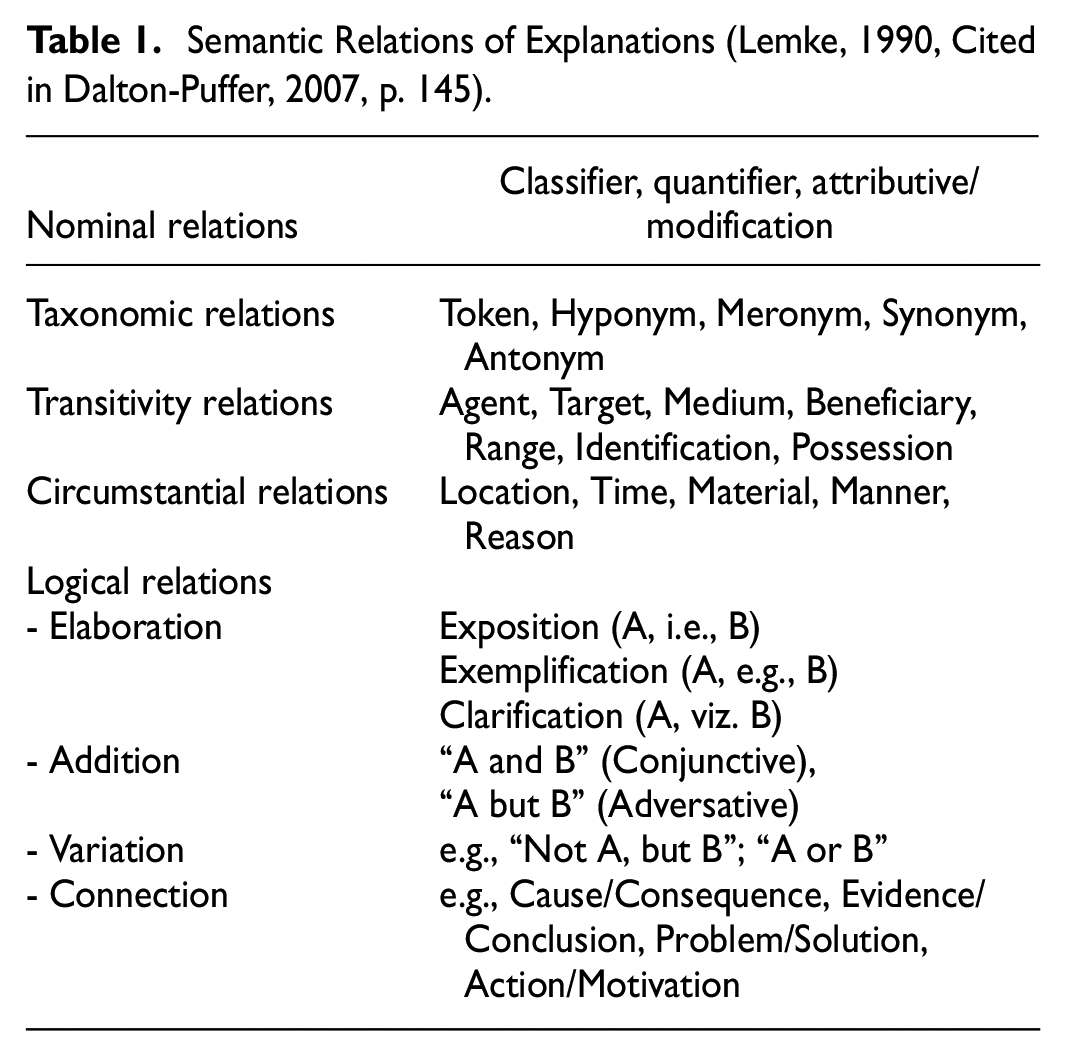
Despite its imperfections (e.g., the relations do not all necessarily operate on the same level; the subcategorization needs further consideration), this inventory is regarded as “considerably richer and more systematic than anything else that seems to be available” (Dalton-Puffer, 2007, p. 145). For example, the functions identified by Kidd (1996) in selected examples of textbook explanations such as comparison, contrast, classifying, generalizing, cause and effect, exemplifying, and time relations show a good fit with those in Table 1, especially with the category of Logical Relations which is believed to represent the macro-structure of explanations. As is argued (Dalton-Puffer, 2007), the relationship between the explanandum and explanan in classroom talk and classroom texts can generally be captured in terms of Logical Relations. Given this, the Logical Relations identified by both Lemke (1990) and Kidd (1996) provide important reference for the present study to analyze instructors’ explanations in online EMI lectures in China.
Instructors’ Explanations as Part of Teacher Talk in Classroom Teaching
Instructors’ explanations are identified as one of the commonest speech functions in the teacher talk of classroom teaching (Dalton-Puffer, 2007) among others such as questioning/eliciting, responding to students’ contributions, organizing/giving instructions, evaluating/correcting, sociating/establishing and maintaining classroom rapport (Malamah-Thomas, 1987). According to Forman (2012), instructors’ explanations are a fundamental part of teaching. It is even pointed out that explaining is a central part of any teacher’s work (Kennedy, 1996). While instructors’ explanations conducted in L1 can be achieved in a swift, accurate and inclusive manner, explanations given in L2 can additionally provide message-oriented teacher talk (Forman, 2012), as is the case of instructors’ explanations in EMI lectures.
In terms of their purpose and function, it is generally agreed that a good explanation is essential to students’ understanding and learning. For Jeong and Chi (2007), explanations are used to enhance learning by enabling and integrating existing and new knowledge. While generating an explanation improves student learning, the quality of the explanation is tailored to the student’s prior knowledge (Chi, 2009; Jeong & Chi, 2007). For Horwood (1988), the purpose of instructors’ explanations is to impart knowledge and promote understanding in students. It is emphasized that one explanatory statement should pave the way for the next, or at least not inhibit the learner from gaining improved explanations in the future. The paramount requirement of instructors’ explanations is the need to satisfy the student as explainee, to resolve for the time being the explainee’s questions.
To fulfill the function of promoting learning, it is pointed out that instructors need to consider the desirable characteristics of explanations for teaching purposes (Horwood, 1988), which agrees with Walsh’s argument about the functions of teacher talk in general that “where language use and pedagogic purpose coincide, learning opportunities are facilitated” (Walsh, 2002, p. 3). According to Walsh (2002), verbal behavior, as well as teacher talk, is goal-oriented. When instructors are sufficiently aware of their teaching aim, they are more likely to use language appropriate to the aim. Therefore, instructors should be made aware of the need to use language appropriate to their teaching aim.
Taken together, it is important for the researcher to recognize the relationship between instructors’ explanations and pedagogic purpose so as to better understand the nature of the explanations. Moreover, it is necessary to explore the way explanations are intended by the instructor and received by the learner so as to gain more insight into instructors’ explanations.
Previous Studies on Instructors’ Explanations in Classroom Teaching
A number of studies have been done on instructors’ explanations in classroom teaching. Fairhurst (1981) examines the criteria of satisfactory explanations given to elementary school students, that is, suitability to content and relationship between explanation and student’s previous knowledge. The explanations described are categorized into descriptive, prescriptive, esthetic, and analytic types. Johnston and Goettsch (2000) investigates the knowledge experienced ESL teachers draw on in explaining grammar and other language points. It is found that three categories of knowledge such as content knowledge, pedagogical content knowledge, and knowledge about learners are intertwined in complex ways as they are played out in the classroom. Drawing on the data from an experienced teacher’s seventh grade science lesson, Roberts (1991) noted conceptual-analysis-of-teaching and task-analysis approaches to explanation for a science teaching event.
Literature review shows that instructors’ explanation in science teaching has always attracted researchers’ attention. In his doctoral dissertation on the explanation of secondary science teaching, Richards (1981) finds that explaining is the most central and important activity of teaching and learning. Two-thirds of teachers’ explanations meet philosophical conditions, but contextual and conceptual features influence the success of an act of explanation and unfamiliar non-technical words block pupils from understanding. More recently, more and more researchers explore features of good and scientific explanations in science teaching. For example, Gilmanshina et al. (2016) propose six types of relationship between induction and deduction in explaining chemical phenomena, theories and laws in chemistry teaching. It is claimed that the ratio of induction and deduction in explanation affects the understanding of the chemical nature of the studied object, the problem of knowing the object, the logical links between the structure of the object and the structure used to explain knowledge. Papadouris et al. (2018), on the other hand, elaborate on three key epistemological features of a good explanation in science teaching, namely empirical validity, interpretive power, and generalizability.
Besides, some studies are focused on pre-service teachers’ explanations in science education. In Murtafiah et al.’s (2018) study, pre-service teachers use three types of explanations in mathematics teaching, that is, descriptive explanations (51.7%), giving of reason (36.2%) and interpretative explanations (12.1%). Descriptive explanations are used to describe mathematical procedures, reason giving explanations to explain reasons based on mathematical principles, and the interpretative explanations to explain the concepts and facts of mathematics. In another study, through an analysis of pre-service chemistry teachers’ explanations throughout a 4-month training process, Marzabal et al. (2019) characterizes the transference of components of pre-service teachers’ subject-adequate science teaching explanations across different chemistry topics. It is found that pre-service teachers’ explanations progressed consistently on the criteria of form such as clarity and coherence and cohesion, but on criteria of function such as sequence, correctness, and completeness their performance is variable.
The previous studies provide valuable insights into instructors’ explanations in classroom teaching. However, there still remains room for further research. Above all, while some types of satisfactory explanations are identified and discussed in the previous studies, they are mostly restricted to only certain aspect of the Logical Relations of explanations. In spite of the elaboration on some key epistemological features of a good explanation in the previous study, features and use patterns of a broader range of Logical Relations of instructors’ explanations have not been fully considered and explored. Further, most previous studies are concerned with explanations in science teaching. There is little research on instructors’ explanations in lectures of other disciplines such as arts and humanities, not to mention the comparative study of instructors’ explanations in lectures of different disciplines. In addition, despite the increasing number of studies on instructors’ explanations abroad, no research has been done on instructors’ explanations in online EMI lectures in China and how the instructors and students perceive these explanations. Considering the importance of instructors’ explanations in teaching and learning and the increasing number of online EMI courses in China, it is worthwhile to carry out a study on features of instructors’ explanations in online EMI lectures in China by analyzing the typical types of instructors’ explanations with Logical Relations as an analytical framework and investigating instructors and students’ perceptions about these explanations.
Therefore, this study aimed at revealing features of instructors’ explanations in online EMI lectures in China via a case study of lectures of two online EMI courses of different disciplines. The overarching research questions are stated as follows.
(1) How were different types of instructors’ explanations distributed in the lectures of the two online EMI courses?
(2) How did the realizations of instructors’ explanations look like linguistically in the the lectures of the two online EMI courses?
(3) How did instructors and students perceive the above-mentioned explanations?
Methods
Mixed Methods Case Study
To address the research questions, this study adopted a mixed methods case study approach, with an explanatory sequential design. As a case study, it allowed for more in-depth investigations of what transpires in a bounded context (Casanave, 2015). Since this study chose to look into two cases (i.e., two online EMI courses of different disciplines) to shed light on the issue, it would “lead to a better understanding, and perhaps better theorizing, about a still larger collection of cases” (Stake, 2005, cited in Hood, 2009, p. 70).
In this case study, mixed methods were used whereby quantitative methods were used first followed by qualitative methods to explain, embellish, enrich the quantitative results. Specifically, to address the first research question concerning the distribution of different types of instructors’ explanations in the lectures of the two online EMI courses, quantitative methods were primarily used followed by qualitative interpretation of the results. Then qualitative methods were used to address the second and the third research question by analyzing linguistic realizations of instructors’ explanations in the lectures of the two online EMI courses and semi-structured interviews concerning instructors and students’ perceptions about the explanations. According to Ivankova and Creswell (2009), the combination of quantitative and qualitative methods within one study could be helpful in gaining in-depth understanding of trends and patterns, studying diverse perspectives, and thus producing a more comprehensive understanding of the research situation than either of them alone could do.
Data Collection
Data Sources
The main sources of data for this study came from lectures of two online EMI courses in China and semi-structured interviews with the two instructors and eight students. Lectures of the two online EMI courses were selected from a website of free online courses in China, with one course concerning western culture (Culture Lecture hereafter) and the other environmental science (Environment Lecture hereafter). Among these, 13 episodes of Culture Lecture totaling about 125 min and 20 episodes of Environment Lecture lasting approximately the same length of time were extracted as one of the main data sources for this study.
As to the semi-structured interviews, the two instructors of the two courses and eight students (S1–S4 of Culture Lecture and S5–S8 of Environment Lecture) were invited to participate in the interviews. Interviews with the instructors were centered around their purpose of using particular types of explanations in the lectures. As for the students, they were first asked to watch the relevant episodes of lectures in this study. Then in the interview, the students expressed opinions about effectiveness of instructors’ use of different types of explanations in the lectures, intelligibility of the explanations, and suggestions for effective explanations. All the interviews, ranging from 30 to 45 min, served as the other main data source for the study.
Additionally, the course descriptions and student comments which had been posted on the website were also collected.
Data Collection Procedure
To collect online EMI lecture data, the researcher logged in to the website of free online courses in China and searched for EMI courses. After a random selection of several EMI courses of different disciplines, the researcher read the course descriptions and watched part of the videoed lectures of each course. Then the Culture Lecture and Environment Lecture were selected for this study. After that, 13 episodes of Culture Lecture totaling about 125 min and 20 episodes of Environment Lecture lasting approximately the same length of time were extracted and transcribed so that two text files of lecture transcripts were established for the case study.
The interviews were conducted and data collected only after the distribution of different types of instructors’ explanations in the lectures had been analyzed, when the researcher contacted the two instructors and eight students, asked for their consent, and conducted interviews with them respectively via QQ or WeChat. All the interviews were audio recorded and transcribed for further analysis.
Data Analysis
Analysis of Instructors’ Explanations in the Lectures
In analysis of the lecture transcripts, different types of instructors’ explanations in Culture Lecture and Environment Lecture were firstly identified. As the relationship between the explanandum and explanan in classroom teaching can generally be captured in terms of Logical Relations (Dalton-Puffer, 2007), this study applied the category system of Logical Relations to identifying different types of instructors’ explanations in Culture Lecture and Environment Lecture. Drawing on Lemke and Kidd’s categorizations (Kidd, 1996; Lemke, 1990), the study derived an inventory of 10 types of explanations, including exposition, exemplification, clarification, addition, variation, justification, generalization, solution, comparison and classification. Table 2 presents the definitions and relevant examples of all these 10 types. With Table 2 as an analytic toolbox, the researcher read through the lecture transcripts, identified different types of instructors’ explanations and tagged each type with a letter from A to J.
Categorization of Explanations in the Present Study.

Note. All examples were cited from the self-built data files of the present study.
Then a quantitative analysis of the distribution of different types of explanations and a qualitative analysis of linguistic realizations of these explanations were conducted, in the process of which the utility of concordance of the corpus tool AntCont 3.5.8 (Anthony, 2019) was used to aid analysis. Specifically, a concordance of different types of instructors’ explanations was retrieved with the aid of AntConc tool. With this, the frequency and percentage of each type were calculated so that the distribution of different types of instructors’ explanations in Culture Lecture and Environment Lecture could be obtained and analyzed. Further, based on the concordance, the researcher was able to observe and generalize the linguistic realizations of different types of instructors’ explanations.
Analysis of Instructors and Students’ Perceptions in the Interviews
Qualitative interview transcripts were uploaded to Taguette (freely available at https://www.taguette.org/) and a content analysis was done using predetermined categories of (a) instructor purpose of particular types of explanations: specific teaching aims, methods of the course; (b) student opinion about effectiveness of instructors’ use of different types of explanations: effective; (c) student opinion about intelligibility of instructors’ explanations: intelligible; and (d) student suggestion for effective explanations: instructors’ English, PowerPoint. The categories or codes were developed and checked by the researcher through reading repeatedly interview transcripts.
Results and Discussion
The present case study examined characteristics of instructors’ explanations in the lectures of two online EMI courses of different disciplines in China (i.e., Culture Lecture and Environment Lecture) and features three sets of findings to deal with the three research questions. To address the first research question, we report and discuss the quantitative results of distribution of different types of instructors’ explanations in Culture Lecture and Environment Lecture. In response to the second research question, we present and discuss the qualitative findings of linguistic realizations of instructors’ explanations in Culture Lecture and Environment Lecture. In dealing with the third research question, we dwell on a qualitative analysis and discussion of instructors’ perceptions about their own explanations in Culture Lecture and Environment Lecture and students’ perceptions about these explanations as well.
Distribution of Different Types of Instructors’ Explanations in Culture Lecture and Environment Lecture
This section addresses the first research question by reporting and discussing the quantitative results of distribution of different types of instructors’ explanations in Culture Lecture and Environment Lecture.
The quantitative results showed that instructors’ explanations were prevalent in both Culture Lecture and Environment Lecture. The normed frequencies of instructors’ explanations in the two lectures were surprisingly similar, there being 77.72 cases per 1000 words in Culture Lecture and 77.64 in Environment Lecture. The prevalence of instructors’ explanations could be attributed to the fact that both online lectures were mainly monologs delivered by instructors, whose main job in the lecture was explaining. Nevertheless, although exposition was the most dominant type of instructors’ explanations in both lectures, the other explanation types such as comparison, clarification, addition, justification, solution and generalization were distributed differently in the two different lectures, as is shown in Figure 2, which is further discussed in what follows.
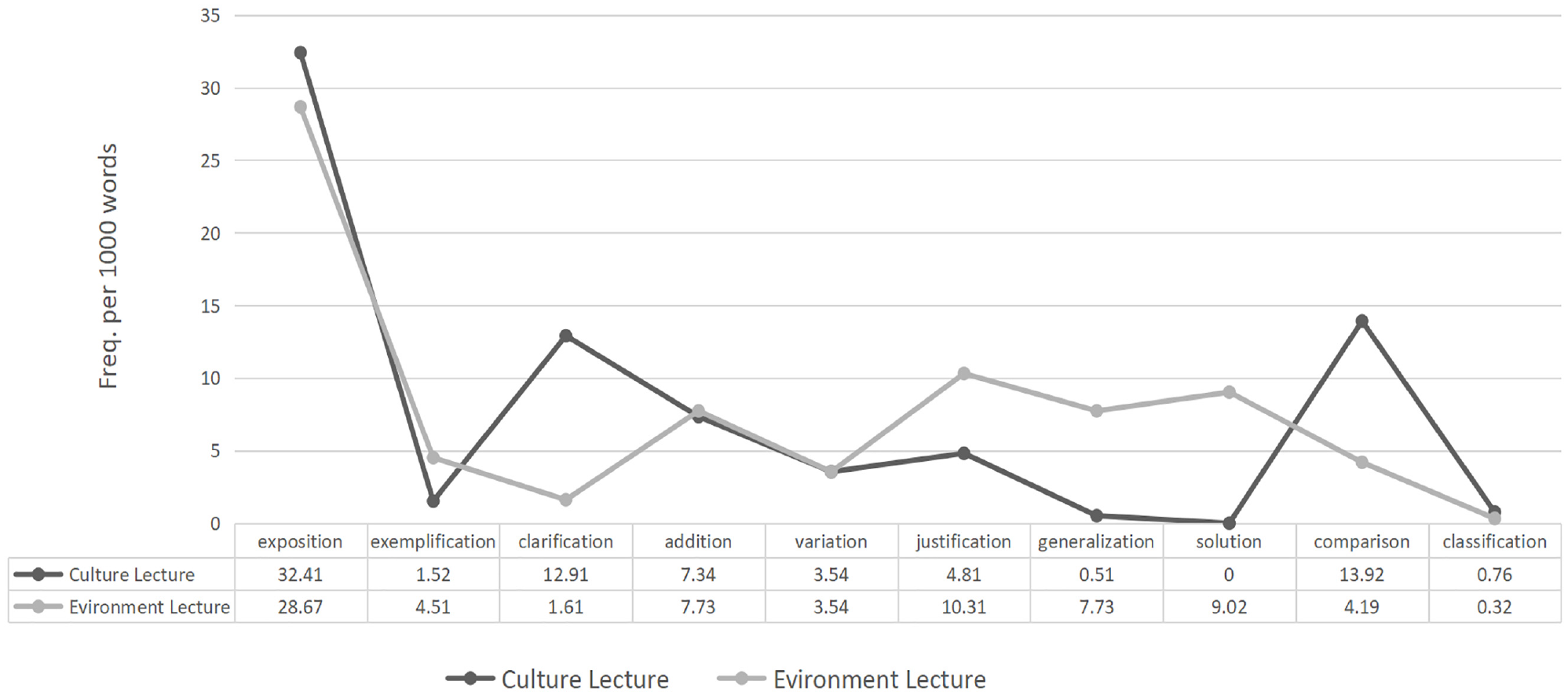
Distribution of different types of instructors’ explanations in Culture Lecture and Environment Lecture.
From Figure 2, it can be seen that exposition was the most dominant type of instructors’ explanations in both lectures. Specifically, there occurred 32.41 cases of exposition per 1000 words in Culture Lecture accounting for 41.7% of all and 28.67 cases in Environment Lecture accounting for 36.93%. By contrast, few cases of classification could be found in either Culture Lecture or Environment Lecture, with only 0.76 and 0.32 cases per 1000 words respectively. Besides, in both lectures there were only a few cases of variation (3.54 cases in either lecture) and exemplification (1.52 cases in Culture Lecture and 4.51 in Environment Lecture).
The function of exposition is for expounding or setting forth information or viewpoint. Its dominance in the lecture suggested that the two lectures, whether it was of a humanity discipline (i.e., Culture Lecture) or a science discipline (i.e., Environment Lecture), attached great importance to making systematic and detailed descriptions of subject contents, which was consistent with the teaching aims of the two EMI courses. As was stated in the course description which had been posted online, Culture Lecture was aimed at “enhancing learners’ understanding of western countries and their culture, expanding their knowledge, and improving their cross-cultural communication ability by systematically introducing the history, geography, politics, economy, culture, customs and language development” of western countries. Environment Lecture, on the other hand, was aimed at “helping students get familiar with the basic concepts, fundamental principles and methods” of the subject so as “to improve their scientific research ability.” What follows are two typical examples of exposition:
Example 1: Apart from this land border, the UK is surrounded by the Atlantic Ocean with the North Sea to its east, the English Channel to its south, and the Celtic Sea to its southwest. (Culture Lecture)
Example 2: It impacts the environment by taking resource from the resources system and emitting the waste to the environment. (Environment Lecture)
Example 1 is a case of exposition introducing the geographical location of the UK, and Example 2 expounding how the environment is polluted by industry. According to Lemke (1990), coherent expositions in lecturing can offer more subject-specific meanings in presenting curricular information and tend to be more explicit regarding subject-specific thematic patterns.
As to the other types of explanations, they were distributed unevenly in the two lectures, and there was a sharp contrast between the distribution patterns of the two lectures. As can be seen in Figure 2, the second, third and fourth most frequent types of explanations in Culture Lecture were comparisons (13.92 cases per 1000 words, 17.91% of all), clarifications (12.91 cases, 16.61%) and additions (7.34 cases, 9.44%) whereas in Environment Lecture, despite the similar number of additions (7.73 cases, 9.96%) to that of Culture Lecture, there were only a small number of clarifications (1.61 cases, 1.5%) and much fewer comparisons (4.81 cases, 6.2%) than in Culture Lecture. In Environment Lecture, it was justifications (10.31 cases per 1000 words, 13.28%), solutions (9.02 cases, 11.62%), and generalizations (7.73 cases, 9.96%) that ranked second, third and fourth respectively. By contrast, no solution type of explanations, rare cases of generalization (0.51 case, 0.66%), and much fewer justifications (4.81 cases, 6.2%) could be found in Culture Lecture.
The relatively frequent use of comparisons (17.91%), clarifications (16.61%) and additions (9.44%) in Culture Lecture suggested that the instructor was devoted to elaborating the subject contents. This could be attributed to the instructional method adopted by the course. As was stated in the course description, it combined online lecturing with offline material reading, classroom discussion and communication. As a result, Culture Lecture as the online lecturing of the course was characterized by the instructor’s elaboration on subject contents with the aid of comparisons, clarifications and additions in addition to expositions. Specifically, with the use of comparisons, particular aspects of subject contents could be examined on their similarities and differences. In so doing, students’ awareness of cultural differences and their ability to deal with the differences were to be enhanced. As is shown in Example 3, the instructor highlighted the importance of Los Angeles in world economy by comparing its GDP with that of New York and Tokyo. Besides, with the use of clarifications, subject contents could be elaborated in greater detail. With the aid of additions, the instructor was able to develop subject contents by adding more details concerning what had been said. Example 4 is a typical case of clarification in which the instructor elaborated the 4 countries in the UK in further detail, that is, “England, Scotland, Wales and Northern Ireland.” According to Borko et al. (1992), providing good instructional clarifications is essential for student learning, for obscure and incomplete teacher explanations may disrupt student learning.
Example 3: It has the world’s third largest GDP for a city behind only New York and Tokyo. (Culture Lecture)
Example 4: The UK is a kingdom consisting of four countries, England, Scotland, Wales and Northern Ireland. (Culture Lecture)
Notwithstanding the scarcity of comparisons, clarifications and additions in Environment Lecture, the explanation types such as justifications (13.28%), solutions (11.62%) and generalizations (9.96%) were quite frequently used by the instructor except for the dominance of expositions. The relatively frequent use of justifications, solutions and generalizations in Environment Lecture could be attributed to the teaching aim and teaching method of the course. As was stated in the course description, it integrated theories with practical applications by adopting a problem-driven, exploratory method that started with a problem to be addressed followed by theoretical analysis and then concluded with its application. With this, the students were expected to learn not only the basic theories and methods of environmental science, but also the causes and preventive measures of environmental pollution, methods of environment monitoring and evaluation, and basic skills of environmental planning and management. In line with the above-mentioned teaching aims and methods, the instructor employed the justification type of explanations to explain the causes of environmental pollution and used the solution or generalization type of explanations to explain preventive measures, environment quality evaluation, environment planning and management. As is shown in Example 5 which is a case of justification, the main cause of environmental problems was explained, that is, “the human disturbance.” In Example 6, the instructor used the solution type of explanation to put forward a way to deal with the problem of resource use and waste emission, that is, “to optimize them.” Example 7 is a typical case of generalization whereby the instructor, based on the preceding analysis, made a general statement on the measures to be taken for environmental protection in the course of development, that is, “we need a technology that permit development without serious environmental consequence.”
Example 5: The environmental problems results mainly from the human disturbance. (Environment Lecture)
Example 6: And then optimize them so that they can use less resource and emit less waste. (Environment Lecture)
Example 7: From this analysis, we may find we need a technology that permit development without serious environmental consequence. (Environment Lecture)
Taken together, it could be followed that instructors’ explanations in online EMI lectures in China were subject-specific. Lectures on different subject contents, especially those of different disciplines with different teaching aims and teaching methods, presented distinct pictures of different choices of explanation types.
Linguistic Realizations of Instructors’ Explanations in Culture Lecture and Environment Lecture
This section addresses the second research question by presenting and discussing the qualitative findings of linguistic realizations of instructors’ explanations in Culture Lecture and Environment Lecture.
Qualitative analysis showed that different types of instructors’ explanations in the case study exhibited different linguistic features that were recognizable by distinctive sentence patterns and/or discourse markers to realize the relevant explanatory functions. However, there was no prominent distinction between the linguistic forms of explanations in Culture Lecture and those in Environment Lecture. Table 3 presents the linguistic realizations of different types of explanations in the two lectures.
Linguistic Realizations of Instructors’ Explanations in the Case Study.

Specifically, in both Culture Lecture and Environment Lecture, the exposition type of explanations were expressed in statements with the structure of “A is B” or “A does B.” Exemplifications were represented by the discourse markers such as “(for/take…as an) example,”“such as,”“like,” and so on. Clarifications were mainly made by means of appositives, which were indicated by the expression “that is” or by the punctuation of a comma, or made with the aid of post-modifiers in the form of attributive clauses, present or past participles, prepositional phrases and so on. The addition type of explanations were characterized by the form of “CLAUSE A + and + CLAUSE B” or “CLAUSE A + but + CLAUSE B,” and the variation type by the form of “A or B.” While justifications were represented by PRESENT PARTICIPLES or by discourse markers that indicated cause and effect such as “for,”“because,”“with,”“due to,”“as,”“(result) from,”“reason,”“cause,”“thus,”“result,”“so,”“therefore,” and so on, the generalization type of explanations were indicated by the markers that presented inferences or source of facts such as “according to,”“based on,”“from,”“in this way,”“find,”“show,”“deduce,”“summary,”“conclusion,” and the solution type by expressions that indicated purposes or measures to be taken such as “(in order) to,”“if,”“for,”“so that,” and “we/I/they (can/may/will / need)…(to…).” As for comparisons and classifications, comparisons were mainly represented by COMPARATIVES, SUPERLATIVES, or by expressions that showed similarities or contrasts such as “than,”“the same as,”“different,”“distinct,”“compare,”“while,”“although,”“however,” and classifications were usually indicated by the expressions such as “classify,”“category,” and so on. All in all, it could be inferred that the instructors of the two EMI lectures had commanded a variety of expressions for different types of explanations. This was as important as a good command of subject contents because appropriate linguistic devices could help clearly articulate the logical relations between the explanandum and explanan thus contributing to successful understanding.
At the same time, however, analysis showed that there still existed some linguistic problems in the explanations, which might be common with EMI lectures in China, especially when they are delivered by instructors of non-English majors. First of all, it was found that one of the two instructors’ spoken English sounded slurred and indistinct due to some mispronunciations. Another problem that was noteworthy lay in the mistakes existing in the instructors’ explanations, especially the misuses of words and sentence patterns. This could be mostly accounted for by the negative transfer of L1 Chinese resulting from calques, as is shown by the underlined parts in Examples 8 to 11. In Example 8, the verb “get” was misused to collocate with the noun “target.” Instead, the phrase “get such a target” should have been replaced by “achieve/reach such a target.” This kind of improper collocation could be attributed to the confusion caused by the shared Chinese equivalent “达到” of the three verbs “get,”“achieve,” and “reach” so that the instructor could not distinguish between them in actual use. In Example 9, the verb “understand” was misused in the phrase “have a better understand” wherein the noun form “understanding” should have been used instead, that is, “have a better understanding.” Similarly, this could be attributed to the confusion caused by the same Chinese equivalent “理解” for both “understand” and “understanding,” for “理解” in Chinese can be used as a verb and a noun as well. In Example 10, the modal verb “can” should have been replaced by the infinitive “to” to collocate with the noun “ability,” and the phrase “remain a heat” replaced by “keep the heat.” For one thing, it seemed that the instructor could not distinguish between countable and uncountable nouns and mistakenly used “heat” as a countable noun mainly because there is no such distinction in Chinese. For another, the instructor confused the two verbs “remain” and “keep” which have the same Chinese equivalent “保持” but with different meanings and usages in English. As for example 11, “may found” should have been replaced by “may find,” and it was hard to understand the latter part of the sentence because of the confusing expression “shows as qualitative relationship as unity of opposites.”
Example 8: In order to
Example 9: In order to
Example 10: Based on this analysis, they find some gases have the ability
Example 11: According to the results from other research, we
The linguistic problems in instructors’ explanations as discussed above were somewhat consistent with Zhao and Dixon’s (2017) findings of the unsatisfactory quality of EMI instructors in China. As known, there are language-related goals alongside the content-subject related ones in EMI, which requires the instructor not only have a good command of professional knowledge but also be proficient in English. Nonetheless, according to (Macaro et al., 2018, p. 36), “research evidence to date is insufficient to assert that EMI benefits language learning nor that it is clearly detrimental to content learning.”
Instructors and Students’ Perceptions About Instructors’ Explanations in Culture Lecture and Environment Lecture
This section addresses the third research question by dwelling on instructors’ perceptions about their own explanations in Culture Lecture and Environment Lecture and students’ perceptions about these explanations as well.
Regarding instructors’ perceptions, the interviews showed that both instructors were quite well aware of the teaching aims of their online courses so that in giving particular types of explanations, they had their own purposes which agreed with the specific teaching aims or methods of the course, as was noted by the two instructors in Excerpt 1 and Excerpt 2 respectively.
Excerpt 1:
I expounded on various aspects of western countries in online lectures [by means of exposition, clarification or addition] to help students get systematic basic information like the history, geography, politics, economy, culture, etc. Then in face-to-face classroom teaching, I didn’t have to spend time on the ABC knowledge. Instead, I gave more in-depth lectures on such topics as poverty problem, civil rights movement. … Since the online lecture contents were organized in terms of topics, it was easy to make comparisons between countries when necessary, for example, when it was concerned with the topic of economy, education or language. These comparisons might help students get a better understanding and develop cross-cultural awareness and communication ability. (Instructor of Culture Lecture)
Excerpt 2:
Through online lectures, students would learn basic theories and methods and develop research abilities. … I usually began the lecture with a practical problem to be solved. Then I expounded on the related theories and methods [i.e., exposition], explained in great detail the causes of the problem [i.e., justification], guided students to explore how the theories and methods could be applied to solving the problem [i.e., solution], and made a generalization. Students could check their understanding by taking online tests. … They could apply what they had learned to fulfilling the task I assigned to them at the end of the lecture. In this way, I hope students’ research ability and creativity will be enhanced. (Instructor of Environment Lecture)
In Excerpt 1, the instructor of Culture Lecture emphasized the use of exposition, clarification, addition and comparison type of explanations to impart systematic basic knowledge and develop students’ cross-cultural awareness, which were among the major aims of the course. In Excerpt 2, on the other hand, the instructor of Environment Lecture stressed the use of exposition, justification, solution and generalization type of explanations to impart basic knowledge and develop students’ research ability, which were also major aims of the course. Additionally, the instructor of Environment Lecture pointed out that it was important to take into consideration student needs and knowledge level in giving lectures and explanations.
In brief, both instructors had particular aims to achieve in giving particular types of explanations. This corroborated Walsh’s (2002) argument that instructors’ verbal behavior in classrooms is goal-oriented and that instructors need to use language appropriate to their teaching aims to facilitate learning.
Regarding students’ perceptions, the interviews indicated that all the eight students were positive about instructors’ use of different types of explanations in the lectures, and that it was suggested one of the instructors’ pronunciation be improved and more visual means be used to aid explanations, which is further discussed in what follows.
Firstly, regarding students’ perceptions about instructors’ use of different types of explanations, students of Culture Lecture (S1-S4) reported that they particularly appreciated instructor’s use of comparison (Excerpt 3) and addition (Excerpt 4) in explanations, which had been found typical of Culture Lecture in this study. Students of Environment Lecture (S5-S8), on the other hand, stated that instructor’s use of justification (Excerpt 5), solution (Excerpt 6), and generalization (Excerpt 6) type of explanations which characterized Environment Lecture was particularly helpful for them to understand the course contents. In students’ words:
Excerpt 3:
In explaining new knowledge, the instructor usually compared new knowledge with our existing knowledge. For example, in explaining the area of the UK, the instructor compared it with that of Hunan province in China. This kind of comparison made it easier for me to understand the new knowledge and helped me consolidate what I had learned before. (S2, S4)
Excerpt 4:
The addition type of explanation was helpful. When explaining an unfamiliar historical event, the instructor would add more details about its social or historical backgrounds. … In explaining America as a country of immigrants, the instructor provided additional information of its relevant history and policies. This helped me get a better understanding and more insight. (S4)
Excerpt 5:
The instructor did very well in providing substantial justifications for cause and effect. For example, the instructor explained the causes of environmental problems by detailing various phenomena and their developing process. This kind of explanation not only gave me a good understanding but also aroused my curiosity and interest. (S5)
Excerpt 6:
I like the instructor explaining solutions to practical problems. The instructor began the lecture with a problem, and then guided us to explore solutions to the problem based on the theory or method expounded in the lecture. … I listened to the lecture with active thinking rather than acting as a passive receiver. … The instructor made generalizations or brief summaries constantly in the lecture, like at the end of a solution, a section or an episode. This was important to me, for it not only helped me grasp the key points but also consolidate what I learned in the lecture. (S8)
Students’ positive comments about instructors’ use of particular types of explanations in particular lectures further corroborated Walsh’s argument that instructors need to use language (e.g., explanations in this study) appropriate to their teaching aims and that “where language use [e.g., instructor’s explanations] and pedagogic purpose coincide, learning opportunities are facilitated” (Walsh, 2002, pp. 2–3).
With respect to students’ perceptions about intelligibility of instructors’ explanations, students of Culture Lecture agreed that the instructor’s explanations had been well articulated and intelligible. As to Environment Lecture, while students acknowledged that the instructor had profound professional knowledge and was fluent and logical in giving explanations, they suggested the instructor’s pronunciation be improved. As S5, S6, and S7 pointed out, the instructor’s accent was a little bit too strong and they managed to get used to it only after listening to the lecture for some time. For S8, she remarked she was not used to the instructor’s pronunciation so that she had to spend some time figuring out some of the actual words in the explanation or referring to the subtitles from time to time for better understanding, as was the case of some students who had posted similar comments on the course website.
Interestingly, however, although the researcher of this study thought the linguistic mistakes in the instructor’s explanations might have caused confusion or difficult understanding, students stated that they didn’t notice the mistakes maybe because the instructor spoke fast and fluently or because they had been concentrated on contents, which could be understood from the context, rather than on language forms. This being said, the researcher of this study might have been overly critical about EMI instructors’ English. The results further corroborated the importance of including students’ perspectives in research of instructors’ explanations.
In addition, regarding students’ suggestions, interview data also showed that students of both lectures suggested the instructors use more visual aids in explanations to achieve better effect, as S2 and S7 remarked in Excerpt 7 and Excerpt 8 respectively.
Excerpt 7:
In explaining important cities, if the instructor marked their locations on a map and showed it to us, it would be much easier for us to understand and memorize. (S2)
Excerpt 8:
The instructor can add some videos or dynamic graphs to make explanations more vivid and impressive. (S7)
Conclusions
This case study indicated that instructors’ explanations were prevalent in the lectures of the two online EMI courses in China with expositions being the most dominant type regardless of subject contents. At the same time, however, other types of explanations were subject-specific mainly because of the different teaching aims and teaching methods of the two courses. While some explanation types such as comparisons, clarifications and additions were most prominent in the lecture on western culture aiming at elaborative introduction, other types such as justifications, solutions and generalizations were typical of the problem-driven, exploratory lecture on environmental science. As regards linguistic realizations, both instructors in the case study were capable of using various linguistic devices for different types of explanations despite some linguistic mistakes in the explanation. The study also showed that instructors chose particular types of explanations mainly because of the specific teaching aims and methods of the course, and that students were positive about instructors’ use of different types of explanations in the lectures except for the suggestions that one of the instructors’ pronunciation be improved and more visual means be used to aid explanations.
The study shed light on some characteristic features of instructors’ explanations in online EMI lectures in China. The results of the study have important implications for EMI research and practice in at least two aspects. At first, EMI instructors can enhance explanatory capacity by formulating appropriate explanations for specific teaching purposes. This requires the instructor be well aware of the teaching aims and methods of the course and keep student needs in mind. Second, instructors need to take some measures to minimize students’ discomfort with EMI lectures which might be caused by instructors’ mixed English proficiency. To do this, instructors can enlist advice and assistance from English language specialists so as to improve English pronunciation and expression in preparing and delivering EMI lectures. Meanwhile, diversity or inclusivity training can be done to students at the inception of a course to help them mediate linguistic discomfort with their instructor and peers. It is advisable the instructor give some preliminary lectures, such as a brief introduction to the course or some key technical terms study and practice, to help students get used to the instructor’s English and get prepared for the course study in the meantime. The instructor can also organize some group activities (or online discussion for online classes) for students to get used to their peers’ English.
Nevertheless, several limitations of the study should be acknowledged. Primarily, this study only analyzed instructors’ explanations in the lectures of two online EMI courses. Instructor’s explanations in other EMI circumstances, such as EMI lectures with teacher-student interactions or EMI lectures of other disciplines, need further investigation. In addition, future studies are needed to investigate the impact of EMI instructors’ explanations on students’ learning of subject knowledge, on students’ academic performance and English ability.
Footnotes
Declaration of Conflicting Interests
The author(s) declared no potential conflicts of interest with respect to the research, authorship, and/or publication of this article.
Funding
The author(s) received no financial support for the research, authorship, and/or publication of this article.

Data Availability Statement
Data sharing not applicable to this article as no datasets were generated or analyzed during the current study.