




Abstract
Although adolescents’ exposure to violence and oppressive gender attitudes is prevalent, comparative knowledge across countries is sparse. This study examined exposure to intimate partner violence (IPV), family violence, and beliefs about violence against women (VAW) in a convenience sample of 2,462 adolescents from 44 schools in Nigeria and South Africa. Findings suggested that exposure to IPV, family violence, and beliefs about VAW differed by gender and country. Specifically, adolescents from Nigeria were more likely to be exposed to IPV and family violence and were more likely to endorse VAW than adolescents from South Africa. Male adolescents were more likely to endorse VAW than were female adolescents. Similarly, higher age, being male, being from Nigeria, being in a relationship, and greater exposure to family violence were associated with higher endorsement of VAW. Findings suggest that effective prevention programs are needed in both countries to mitigate exposure to IPV and family violence. Concerted efforts are also required to work with exposed adolescents to inhibit pro-VAW beliefs and stop the intergenerational transmission of violence. Additional implications of findings for policy, practice, and research are discussed.
Keywords
Introduction
Adolescents in various regions of the world are directly (e.g., through victimization) and indirectly (e.g., through witnessing) exposed to multiple forms of violence (e.g., physical, emotional, sexual) in multiple settings (e.g., schools, family, community). However, the level of such exposure cannot be fully captured due to underreporting and unfavorable social conditions mitigating against disclosing the violence they experience (Afolabi & Deij, 2014; Ajuwon, Fawole, & Osungbade, 2011; Rasool, 2011, 2015, 2017; Eze, 2013; Human Rights Watch, 2018; Olukemi & Folakemi, 2015).
Adolescents assimilate attitudes, beliefs, and values that encourage violent behaviors against women and girls through socialization at home and in the community, when exposed to intimate partner violence (IPV) and violence against women (VAW). Although studies have indicated that such exposure has multiple effects, including but not limited to poor psychosocial outcomes, intergenerational transmission of violence, perpetration of violence, and negative beliefs about VAW in dating and interpersonal relationships (Abrahams & Jewkes, 2005; Barker et al., 2011; Heinze, Stoddard, Aiyer, Eisman, & Zimmerman, 2017; Ho & Cheung, 2010; Jewkes, Sikweyiya, Morrell, & Dunkle, 2011; Mueller, Jouriles, McDonald, & Rosenfield, 2013; Stoddard, Heinze, Choe, & Zimmerman, 2015; Weaver, Borkowski, & Whitman, 2008), the majority of research has focused primarily on individual countries (Russell et al., 2014). Comparative knowledge about adolescents’ exposure to violence across countries, especially in Africa, is relatively sparse. In addition, knowledge about the attitudinal effects of adolescents’ exposures to violence across countries according to gender remains limited in the body of empirical research. Therefore, the purpose of this article is to examine adolescents’ exposure to IPV and family violence and to determine the extent to which such exposure is related to endorsement of negative beliefs about VAW in Nigeria and South Africa. Specifically, the article is written to determine whether adolescents’ exposure to IPV and family violence differ by gender and country and whether such exposure is associated with negative beliefs about VAW across Nigeria and South Africa. Adolescents refer to persons between 10 and 19 years of age (Miller et al., 2017; World Health Organization [WHO], n.d.).
Rationale for the Examination
Several factors underlie the rationale for examining adolescents’ exposure to violence across countries. The findings may identify common experiences, perceptions, attitudes, stereotypes, and beliefs associated with VAW across countries to enhance knowledge of common or variable factors that influence perpetuation of these phenomena to contribute to prevention programs. The findings will contribute to identifying the nature and settings of IPV and risk factors for endorsement of VAW to reduce adolescents’ risks of exposure. The findings can also be useful in identifying strategies for minimizing the effects of exposure.
Comparative knowledge provides the basis for sharing effective preventive measures for violence against women and girls (VAWG) across regions that could be translated to education and awareness-raising about adolescents’ exposure to IPV and family violence. A cross-cultural examination can help to identify the countries in which adolescents are more susceptible to exposure to violence to increase public awareness and implement education interventions in that context. Cross-country comparisons can isolate over-arching risk factors that may be linked to patriarchal systems across countries, as opposed to country-specific factors that may be related to the sociohistorical context of the target countries (e.g., apartheid in South Africa and colonialism, tribal war, and religious conflict in Nigeria). An examination of adolescents’ exposure to violence may generate practical insight that can “help intervention developers plan the content of interventions” and “help interventionists and policy makers and lawmakers develop appropriate educational and legislative campaigns” (Pöllänen, de Vries, Mathews, Schneider, & de Vries, 2018, p. 4) that may have cross-cultural relevance for preventing VAW.
Critically, cross-cultural examinations may generate knowledge that could have broad-based impacts on international transferability of policy and interventions for combating adolescents’ exposure to and beliefs about violence. In general, understanding cross-cultural similarities and differences in exposure to violence and their effects on endorsement of VAW is important due to their implications for identifying preventive and protective measures and policies that could be shared across cultures to minimize exposure to IPV and family violence.
Correlates and Effects of Exposure to Violence and Beliefs About VAW
As indicated in past studies, both direct exposure (e.g., victimization) and indirect exposure (e.g., witnessing violence) have effects on adolescents’ negative beliefs about VAW, as well as on their physical and mental well-being and behavior (e.g., depression, anxiety, posttraumatic stress disorder, aggression, delinquency, violent behaviors, low self-esteem; Heinze et al., 2017; Ho & Cheung, 2010; Stoddard et al., 2015; Weaver et al., 2008). These psychosocial outcomes entail significant social and health costs because of their complex public health repercussions.
Types of violence to which adolescents are exposed may have differential effects. Ho and Cheung (2010) indicated that exposure to school violence and victimization by domestic violence were related to emotional problems, whereas community violence was related to behavior problems (e.g., aggression, delinquency). Students with a “history of interparental violence . . . had a higher likelihood of experiencing violence” than students who were not exposed to interparental violence (Umana, Fawole, & Adeoye, 2014, p. 1). Nevertheless, a common effect of exposure to violence is the perpetration of violence. As indicated in several studies, exposure to violence and intergenerational transmission of violence are significant predictors of perpetration of violence (Barker et al., 2011; Jewkes et al., 2011).
Beyond its effects on perpetration of violence, exposure to violence has effects on adolescents’ beliefs about VAW, primarily because exposure often underlies acceptance and perpetration of violence during adolescence and adulthood (Abrahams & Jewkes, 2005; Mueller et al., 2013). For example, on one hand, it was recently noted that exposure to and experience of sexual partner violence was associated with tolerance of sexual partner violence by both boys and girls (Mason-Jones et al., 2016; Pöllänen et al., 2018). Adolescents who were psychologically abused, on the other hand, were more likely to endorse domestic violence (Kunnuji, 2015). Finally, exposure to violence has poor psychosocial outcomes for adolescents and contributes to intergenerational transmission of violence.
Exposure to Violence and Beliefs About VAW: Cultural Factors
Across societies, cultural norms and practices remain potent mechanisms for transmitting views about what is acceptable behavior for women and men, as well as how men and women should be perceived and treated. The World Development Bank Report (World Bank, 2012) suggested that gender roles provide guides to normative behaviors for each sex within certain social contexts. Roles gain power as they are learned through socialization, elaborated in cultural products, and enacted in daily life. The repeated experience of performing gender roles affects widely shared beliefs about men’s and women’s attributes and one’s own sense of identity. Social norms refer to patterns of behavior that flow from socially shared beliefs and are enforced by informal social sanctions. (p. 8)
By being socialized into values, beliefs, attitudes, and roles that predispose them to victimization of violence and diminishes their capacity for resistance, women remain the captive audience to violent masculinities that are legitimized by gender norms and power inequality (Baloyi, 2010; Buiten & Naidoo, 2013, 2016; Jewkes, Sikweyiya, Morrell, & Dunkle, 2010).
Some types of social norms, beliefs, and practices are present in both Nigeria and South Africa. In both countries, women are expected to submit sexually to their husbands and may be blamed for violent reactions by their men (Fakunmoju, Abrefa-gyan, & Maphosa, 2018; Hargreaves, Vetten, Schneider, Malepe, & Fuller, 2006; Oyediran & Isiugo-Abanihe, 2005). In both countries, women are often treated as the personal properties of their husbands following payment of a bride price (labola in South Africa and dowry in Nigeria). Financial dependency of women, due to occupational segregation and discrimination, means that women are often dependent on men for their and their children’s economic survival, which increases their exposure to violence (Rasool, 2011, 2016). In Nigeria and South Africa, men often use and endorse violence to maintain power and control over women (Abrahams, Jewkes, & Laubsher, 1999; Fakunmoju et al., 2018; Oluremi, 2015) and some invoke a misconceived perception of masculinity to justify VAW.
Some types of VAW are contextually specific to a given country and may not be as prevalent in another country. For example, “jack rolling” (i.e., gang rape of women as payback for perceived misdeeds or disreputable pleasures), “virgin cleansing” (i.e., the belief that a man will be cured of his HIV/AIDS by having sex with a virgin girl), and “corrective rape” (i.e., a practice in which lesbians are raped in the guise of curing them of lesbianism) persist in South Africa (Koraan & Geduld, 2015; Leclerc-Madlala, 2002; Mokwena, 1991). In some communities in South Africa, women are prohibited from leaving the marital home even in cases of IPV and they are expected to be “obedient” to their male partners or husbands (Hargreaves et al., 2006). A similar situation is evident in some Nigerian communities, where women are expected to be submissive to their husbands and it is considered a taboo for women to divorce their husbands, although the husbands could divorce their wives at will (Enwereji, 2008).
In Nigeria, female genital mutilation is still widely practiced, disinheritance of women and girls is prominent (in many communities, property can pass only between persons of the same gender, so women may not inherit from fathers; in Muslim communities, women inherit far less than men), and preference for male children persists (Igbelina-Igbokwe, 2013). Furthermore, “norms about marriage system, the predominant position of male children, and forced marriage, have exposed women to domestic violence” (Abdullahi, Cusairi, & Abdullah, 2017, p. 273) and contributed to women being blamed for violence against them in Nigeria. In South Africa, female genital mutilation is banned and criminalized (Makundi, 2009).
Exposure to Violence and Beliefs About VAW: Demographic Factors
Although exposure to cultural norms and practices are important influencers of VAW behaviors and beliefs held by adolescents, numerous studies have consistently indicated that there are gender differences in exposure to violence and pro-VAW beliefs. Boys seem more likely to hold sexual violence–supportive attitudes and beliefs than girls (Mason-Jones et al., 2016; Pöllänen et al., 2018) and men also seem more likely to encourage or endorse violence-supportive attitudes and practices against women (Adika, Agada, Bodise-Ere, & Ojokojo, 2013; Fakunmoju, Bammeke, Oyekanmi, Temilola, & George, 2016a, 2016b). For example, from examining gender differences in beliefs about forced sex, De Vries et al. (2014) found that boys “held a more positive view about forced sex than girls . . . . The perception that peers and friends considered forced sex to be an effective way to punish a female partner was also more common among boys” (p. 1087). In addition, De Vries et al. (2014) suggested that some adolescent girls have bought into the belief that sexual coercion is an “expression of love” and believe that “silence and submission” is the appropriate response” to sexual coercion (p. 1088). In some cases, submission may be the only option for women and girls who are vulnerable, especially in contexts where formal state responses to VAW are poor and unsupportive and often contribute to the revictimization of survivors. These gender differences in beliefs may be in part attributed to differences in the socialization experiences of boys and girls. For example, boys are socialized to be tough and to engage in aggressive and high-risk behaviors, while females are socialized to be sensitive to the needs and feelings of others (Crespi, 2003; Ho & Cheung, 2010).
Exposure seems to also affect boys and girls differently. Even though boys are exposed to violence more often than girls, research indicates that exposure to violence has more traumatic effects on girls than on boys (Pinchevsky, Wright, & Fagan, 2013; Zona & Milan, 2011) and results in more aggressive behaviors by boys than by girls (Huesmann & Guerra, 1997; Stoddard et al., 2015). Hence, exposure to violence enhances more favorable views of aggressive behaviors among boys, than girls (Huesmann & Guerra, 1997), and girls who are exposed are more likely to become victims. Boys may be influenced by their experiences to justify their perpetration of VAW as normal and expected behavior from their gender; while girls may be influenced to normalize their victimization experiences based on their exposure.
In addition, exposure to violence has differential effects on children across age. In a recent report by Child Trends (2016), it was indicated that “all types of exposure to violence were more common among older children and adolescents” and “the type of violence children are exposed to increases in severity with age” (p. 5). Similarly, from a meta-analysis of IPV across 30 low- and middle-income countries, interaction of age and country indicated that young adult women demonstrated higher risks than adult women and that adolescents demonstrated a comparable risk for partner violence (Decker et al., 2015). It is therefore not surprising that “young age of partners, low socioeconomic status . . . are associated with family violence across nations and cultures” (Marrie-Marthe & Gilles, 2004, p. 945, emphasis added).
The role of relationship status is relevant to understanding relationship violence among adolescents, as well as beliefs that they hold about VAW. In South Africa, adolescents accept and engage in VAW (Jewkes & Morrell, 2010; Sathiparsad, 2008), particularly in the context of relationship. In a recent qualitative study by Mosavel, Ahmed, and Simon (2012), girls reported sexually coercive behaviors by boys, whereas boys justified sexual coercion of girls by claiming that girls often exploit boys for their money and to procure expensive material possessions (Mosavel et al., 2012). Because many incidents of IPV occur in the context of relationships, relationship status may thus be a risk factor in victimization and perpetration of IPV and for endorsement of beliefs about VAW. However, types of VAW such as sexual harassment which occur outside of relationships are less likely to be reported or considered violence.
Violence in Nigeria and South Africa
While violent masculinities remains a problematic reality in understanding VAW, “context and history” of Nigeria and South Africa, as well as “variations and subtleties in manifestations of patriarchy,” must be understood, since VAW may be seen as the product of “socially constructed gender norms and power” (Buiten & Naidoo, 2016, p. 537) in both countries. Many scholars (Gordon, 1996; Hunnicutt, 2009; Rasool, 2011; Walby, 1990) attribute VAW to patriarchy, which is considered to be a system of social, legal, political, religious, and economic arrangements designed to enhance male power and dominance on one hand and reinforce female subordination on the other hand.
In Nigeria, violence pervades every sphere of social life (Irene, 2016; Osawe, 2015) and manifests in various dimensions, including (a) religious terrorism through Boko Haram in the north, culminating in human displacements, kidnapping of adolescents, and loss of property and lives; (b) economic violence and sabotage through bombing of oil installations by Niger Delta Avengers in the delta region; (c) sociopolitical unrest and secessionist movements such as the Movement for the Actualization of the Sovereign State of Biafra (MASSOB) and Indigenous People of Biafra (IPOB) in the east and the Arewa Youth Consultative Forum (AYCF) in the north; (d) ethnic, religious, communal, and intercommunal violence; and (e) violent crime and insecurity in many parts of the country. More men are beating their women to death (Musawa, 2016; Ugbodaga, 2015) and more women are using weapons (e.g., knife) to inflict injury on their men during domestic violence (Audu, 2015). Regrettably, a taboo against discussion and the stigma of reporting domestic violence limit the scope of knowledge about partner violence, which is generally believed to cut across socioeconomic and religious backgrounds (Sogade, 2016; Uzuegbunam, 2013).
As recently noted by Animasaun (2017), domestic violence in Nigeria is increasing at an alarming rate, where “according to the National Demographic and Health Survey in 2008, over a quarter of the population of Nigerian women experienced domestic violence” (para. 6). In a recent survey on domestic violence in Nigeria, 54% of respondents reported either being victims or knowing someone who was a victim of domestic violence (NOI Polls, 2016). The majority (75%) identified women as victims of domestic violence. A similar past national victimization survey by Centre for Law Enforcement Education [CLEEN] Foundation (2013) found an increase in domestic violence from 21% in 2011 to 30% in 2013, with 31% of respondents reporting having been victims of domestic violence.
A recent study of female health workers in Southeast Nigeria suggest that 56.6% of them reported a lifetime experience of abuse with verbal (100%) and sexual abuse (71.7%) being the most frequently cited types of abuse experienced (Aguocha et al., 2017). Among university students in Ibadan, the lifetime prevalence of IPV was 42.3% with psychological violence (41.8%) being the most frequently cited lifetime experience of violence (Umana et al., 2014). Although susceptibility to various forms of crime and violence in Nigeria cuts across gender, recent reports suggest that most acts of physical and sexual violence against women are perpetrated by husbands (Ine, 2012; NOI Polls, 2016; Orpin, Papadopoulos, & Puthussery, 2017). Victimization of GBV or all types of violence was more prevalent among females than males, whereas perpetration was more prevalent among males than females (NOI Polls, 2016; Ogunjuyigbe, Akinlo, & Ebigbola, 2005). Victimization of violence is not limited to adults; children are also victims of violence. From a study conducted in Northern Nigeria, “22.8%, 22.2% and 50.8% of adolescents experienced physical, sexual or emotional violence respectively” by colleagues, strangers, husbands, and boyfriends (Iliyasu, Abubakar, Aliyu, Galadanci, & Salihu, 2011, p. 111).
In South Africa, many children are raised in families where women are at risk of partner violence (Abrahams & Jewkes, 2005), and even post-apartheid VAW continues to manifest in various dimensions. VAW is reported to be widespread, pervasive, underreported, and inextricably linked with other social problems (Mosavel et al., 2012). For example, 20% of women older than 18 reported a history of physical violence (as high as 40% for divorced or separated women) and 6% reported a history of sexual violence (as high as 16% for divorced or separated women) (National Department of Health [NDoH], Statistics South Africa [StatsSA], Southern African Medical Research Council [SAMRC], & Inner City Fund [ICF], 2017; StatsSA, 2018). Younger women and divorced or separated women were more likely to be victims of physical and sexual violence by an intimate partner “and three women die at the hands of their partner every day” (Human Rights Watch, 2018; NDoH et al., 2017, para. 17). Violence is reported among adolescents, too. In a study by Russell et al. (2014), “over 10% of boys reported forcing a partner to have sex, and 39% of girls reported physical IPV (intimate partner violence) victimization” (p. 283, emphasis added). Similarly, in a cross-sectional school-based study in South Africa, 1 in 4 adolescents had experienced gender-based violence before the age of 18 (Rasool, 2017). Hence, rates of VAW are high in both contexts.
Sociocultural Similarities and Differences Between Nigeria and South Africa
The cultural practices of many South Africa and Nigerian communities favor collectivism rather than individualism (Metz, 2014). Many Nigerian and South African communities are influenced by patriarchal cultures (Coetzee, 2001; Makama, 2013). Although the effects of patriarchal structures on VAW beliefs and practices are visible in both countries, Nigeria and South Africa differ on some key components which could contribute to explanations related to the varieties of patriarchy, including human development level, gender egalitarianism, and human rights abuses. For example, Nigeria has poorer human rights records on VAW and remains a high-risk country with regard to violation of human rights, ranking 10th of 197 countries, whereas South Africa remains a medium-risk country (Maplecroft, 2014). With regard to the human freedom index, South Africa (personal 70/159, economic 105/159) ranked higher than Nigeria (personal 145/159, 113/159) in personal and economic freedom (Vásquez & Porčnik, 2016).
Nigeria scores poorly with regard to gender parity in the Gender Development Index (GDI). Nigeria is in the Group 5 category, which includes countries with the lowest scores among all countries measured with regard to equality between men and women using the Human Development Index (HDI; Jahan et al., 2016). South Africa, however, is in the Group 2 category, which includes countries with medium to high levels of equality between men and women in HDI measurements (Jahan et al., 2016). Nigeria passed the Violence against Persons (Prohibition) Act in 2015 (Onyemelukwe, 2016), similar to the Domestic Violence Act No. 116 of 1998 (Domestic Violence Act, No. 116, 1998) that South Africa had passed 15 years earlier. Following promulgation of the Same Sex Marriage (Prohibition) Act (SSMPA) in January 2014, Nigeria prohibits and penalizes homosexuality, whereas homosexual relationships are legal in South Africa.
While South Africa is racially and ethnically diverse, Nigeria is racially homogeneous, although it has ethnic/tribal and religious diversity. Both countries lag in gender egalitarianism and should have more robust national strategies to combat VAW (Human Rights Watch, 2018). Both Nigeria and South Africa have a history of political oppression: while South Africa has a history of apartheid, Nigeria has a history of colonialism, military rule, and civil war. Although both countries have a history of political corruption, the historical and structural basis of political oppression and corruption by the state in Nigeria is more pervasive (Yagboyaju, 2017). Limiting women’s access to political positions, bribery, nepotism, siphoning of public resources to private purses, weakening of public institutions and regulatory agencies, and impunity of politicians and military rulers are more prominent in Nigeria (Yagboyaju, 2017). While some of these issues are burgeoning in South Africa, the new democracy is comparatively better functioning.
In general, as “there are differential effects of risks associated with different forms and settings of exposure to violence” (Ho & Cheung, 2010, p. 1310, emphasis added), differences in variety of patriarchal structures, egalitarian ideals, human development levels, and human rights abuses across societies may have implications for differences in exposure to IPV and family violence as well as beliefs about VAW and responses thereto.
The Present Study
Based on the above review, the following hypotheses were developed:
Method
Design
A cross-sectional survey was conducted in Nigeria and South Africa. In Nigeria, research assistants collected data from 13 public high schools in six school districts in Lagos State. In South Africa, fourth-year social work university students administered the survey to entry-level high school adolescents from 30 high schools in Johannesburg. The Institutional Review Board of Westfield State University, Massachusetts, United States of America approved the study for Nigeria and the ethics committee of University of Johannesburg, South Africa provided ethical clearance for the South African study. A total of 3,188 adolescents (Nigeria = 986, 31%; South Africa = 2,202, 69%) responded to the survey. Adolescents younger than 12 years and older than 18 years were removed from the analysis to focus on adolescents between the ages of 12 and 18, and because the outliers were few. Listwise deletion was applied to response sets in which none of the questions about the independent and dependent variables was answered, leaving a total of 2,462 cases for analysis. Ipsative mean imputation (Schafer & Graham, 2002) was used to address missing data.
Sample
The sample used in the analysis was comprised of 2, 462 adolescents (Table 1), with 34.8% (n = 857) from Nigeria and 65.2% (n = 1,605) from South Africa, as fewer schools were surveyed in Nigeria. The gender composition was 56.6% females (n = 1,394) and 43.4% males (n = 1,068). In Nigeria, the majority were Yoruba adolescents (n = 594, 71.1%), followed by adolescents who identified their ethnic background as Igbo (n = 128, 15.3%). The majority were living with parents (i.e., father and mother; n = 738, 87.6%), whom most adolescents reported to be married and living together (n = 684, 81.1%). Almost half (n = 411, 48.9%) resided in a house that belonged to their parents. The majority (n = 525, 68.0%) reported high school as the highest level of education of their parents. Three fourths (n = 562, 75.0%) were not currently in a relationship (Table not shown).
Demographic Characteristics of Respondents.

Note. Figure may not add to total due to missing data.
Afrikaans (49), Vanda (35), Tsonga (43), Xitsonga (80), SiSwati (10), Northern Sotho (70), and Ndebele (29).
In South Africa, the majority (n = 627, 39.2%) identified Zulu as the language spoken mostly since childhood, followed by English (n = 223, 13.9%). Other languages spoken by respondents included Southern Sotho/Sesotho/Sepedi (n = 158, 9.9%), Tswana/SeTswana (n = 149, 9.3%), and Xhosa (n = 126, 7.9%). Most adolescents (n = 1,089, 70.6%) lived in a house. Most (n = 577, 38.8%) reported that their parents/guardians were married or a legal couple, but almost as many (n = 514, 34.6%) reported that their parent or guardian was single and had never legally married. The majority (n = 651, 45.1%) reported the educational background of their parents or guardians as Grade 12, although a third (n = 438, 30.4%) also reported postschool qualification as the educational background of their parents or guardians. The majority (n = 893, 62.3%) were not currently in a relationship (Table not shown). Overall, the average age of the adolescents was 14.43 years (SD = 1.34 years, range 12 to 18). However, adolescents in Nigeria (M = 15.57, SD = 1.30) were more likely to be older than adolescents in South Africa (M = 13.81, SD = 0.88), t(1286) = 35.57, p < .0005).
Measures
The adolescents responded to a series of questions that focused on witnessing IPV and family violence in their communities. They were also asked a set of questions regarding their beliefs about VAW. The questions were adapted from previous studies that examined witnessing, attitudes, and experiences of gender-based violence (Rasool, 2017; United States Agency for International Development [USAID], 2006).
The section exposure to intimate partner violence (IPV) consisted of six questions that captured the extent to which adolescents had witnessed physical, emotional, or sexual violence and aggression against women by intimate partners in the community. To operationalize exposure to IPV, the adolescents were asked to indicate the extent to which they had witnessed abusive or violent behaviors: (a) physical violence against women by men (women being hit, slapped, beaten, or kicked by their husbands or boyfriends), (b) physical aggression against women by men (men physically aggressive toward female intimate partners), (c) emotional abuse against women by men (women being emotionally abused, such as being talked to or treated in abusive ways, by their male intimate partners), (d) emotional aggression against women by men (men emotionally aggressive toward their female intimate partners), or (e) sexual violence against women by men (women being forced by their male intimate partners to have sex against their will). Response choices were never (1), sometimes (2), half of the time (3), often (4), and always (5). Lower scores indicated lower observation/exposure to VAW and higher scores indicated higher observation/exposure to VAW. Responses were summed for analysis. Cronbach’s alpha was approximately 80.
The section exposure to family violence consisted of six questions that captured the extent to which adolescents witnessed physical, emotional, and sexual violence among family members in their community. To operationalize exposure to family violence, the adolescents were asked to indicate the extent to which they had witnessed the abusive or violent behaviors in their neighborhood: (a) physical violence by partners in the family (partners hit, slapped, beaten, or kicked by opposite-gender family members), (b) physical aggression in the family (family members physically aggressive toward other members), (c) emotional aggression in the family (family members emotionally aggressive toward other members), and (d) sexual violence in the family (family members forced by their partners to have sex against their will). Response choices were never (1), sometimes (2), half of the time (3), often (4), and always (5). Lower scores indicated lower observation/exposure to relationship violence and higher scores indicated higher observation/exposure to relationship violence. Responses were summed for analysis. Cronbach’s alpha was .72.
The section beliefs about violence against women consisted of five questions that captured the extent to which adolescents endorse beliefs about violence directed against women by men, attribute blame to women for the violence directed against them by men, or believe that women should endure the violence that is directed against them by men. To operationalize beliefs about VAW, the adolescents were asked to indicate the extent to which agreed or disagreed with the belief statements: (a) the belief that physical violence against women is justified in certain circumstances (there are times when a woman deserves to be beaten), (b) the belief that women must tolerate violence for family preservation (a woman should tolerate violence in order to keep her family together), (c) the belief that men have a right to punish their partners for perceived misconduct (if a woman does something wrong, her husband/boyfriend has the right to punish her), (d) beliefs that absolve men from taking responsibility for their violence by blaming women for being raped (when a woman is raped, she is usually to blame for putting herself in that situation), and (e) beliefs that a women has consented to sex if she does not fight back physically, and therefore was not raped (if a woman does not physically fight back, it is not rape). Response choices were strongly disagree (1), disagree (2), neither agree nor disagree (3), agree (4), and strongly agree (5). Lower scores indicated lower endorsement of beliefs about VAW and higher scores indicated higher endorsement of beliefs about VAW. Responses were summed for analysis. Cronbach’s alpha was .58.
Data Analysis
Two-way multivariate analysis of variance (MANOVA) and multiple regression analyses were conducted to test the hypotheses. To determine whether exposure to IPV, exposure to family violence, and beliefs about VAW differed by gender and country (Hypotheses 1 and 2), a two-way MANOVA was conducted. To measure the relationships among demographic covariates, country, relationship status, exposure to IPV, exposure to family violence, and beliefs about VAW (Hypothesis 3), a multiple regression analysis (simultaneous entry) was conducted. Descriptive statistics were used to examine the demographic characteristics of respondents and an independent-samples t test was used to determine whether respondent age differed by country. SPSS 20™ (IBM Corporation, 2011) was utilized to analyze the data.
Results
An examination of bivariate correlations indicated that the three dependent variables were significantly correlated. Specifically, exposure to IPV correlated with beliefs about VAW, r = .18 (p = .01), exposure to family violence correlated with beliefs about VAW, r = .22 (p = .01), and exposure to IPV correlated with exposure to family violence, r = .75 (p = .01). Using Pillai’s Trace, there was a statistically significant multivariate main effect of exposure to IPV, exposure to family violence, and beliefs about VAW by country, V = .054, F(3, 2153) = 40.80, p < .0005, partial eta squared = .054, and by gender, V = .022, F(3, 2153) = 16.11, p < .0005, partial eta squared = .022. The interaction effects of gender and country were nonsignificant. Results of tests of between-subjects effects further suggested that country had an effect on exposure to IPV (F[1] = 14.15; p < .0005), exposure to family violence (F[1] = 20.60; p < .0005), and beliefs about VAW (F[1] = 116.73; p < .0005) and that gender had an effect on beliefs about VAW (F[1] = 41.86; p < .0005).
Effects of Country on Exposure to IPV, Exposure to Family Violence, and Beliefs About VAW
Consistent with Hypothesis 1, the average scores of adolescents in Nigeria on exposure to IPV, exposure to family violence, and beliefs about VAW were significantly higher than the average scores of adolescents in South Africa (Table 2). Specifically, adolescents in Nigeria were more likely to report higher exposure to IPV, higher exposure to family violence, and higher endorsement of beliefs about VAW than adolescents in South Africa.
Means and Standard Deviations of Exposure to Intimate Partner Violence, Exposure to Family Violence, and Beliefs About Violence Against Women, by Gender and Country.

Effects of Gender on Beliefs About VAW
Consistent with Hypothesis 2, the average scores of male adolescents on beliefs about VAW were significantly higher than the average scores of female adolescents (Table 2). Specifically, male adolescents were more likely to report stronger endorsement of beliefs about VAW than were female adolescents.
Relationships Among Exposure to IPV, Exposure to Family Violence, and Beliefs About VAW
The overall model describing the relationships among demographic covariates, country, relationship status, exposure to IPV, exposure to family violence, and beliefs about VAW was significant, F(6, 1939) = 46.66, p < .0005. As indicated in Table 3, age ( β = .12, p < .0005), gender ( β = -.12, p < .0005), country ( β = .14, p < .0005), relationship status ( β = .05, p = .034), and exposure to family violence ( β = .206, p < .0005) were associated with beliefs about VAW. Specifically, higher age, being male, being from Nigeria, being in a relationship, and having experienced more exposure to family violence were associated with higher endorsement of beliefs about VAW (Hypothesis 3). The model accounted for approximately 13% (adjusted R2 = .12) of the variance in beliefs about VAW.
Multiple Regression Analysis of Predictors of Beliefs About Violence Against Women.
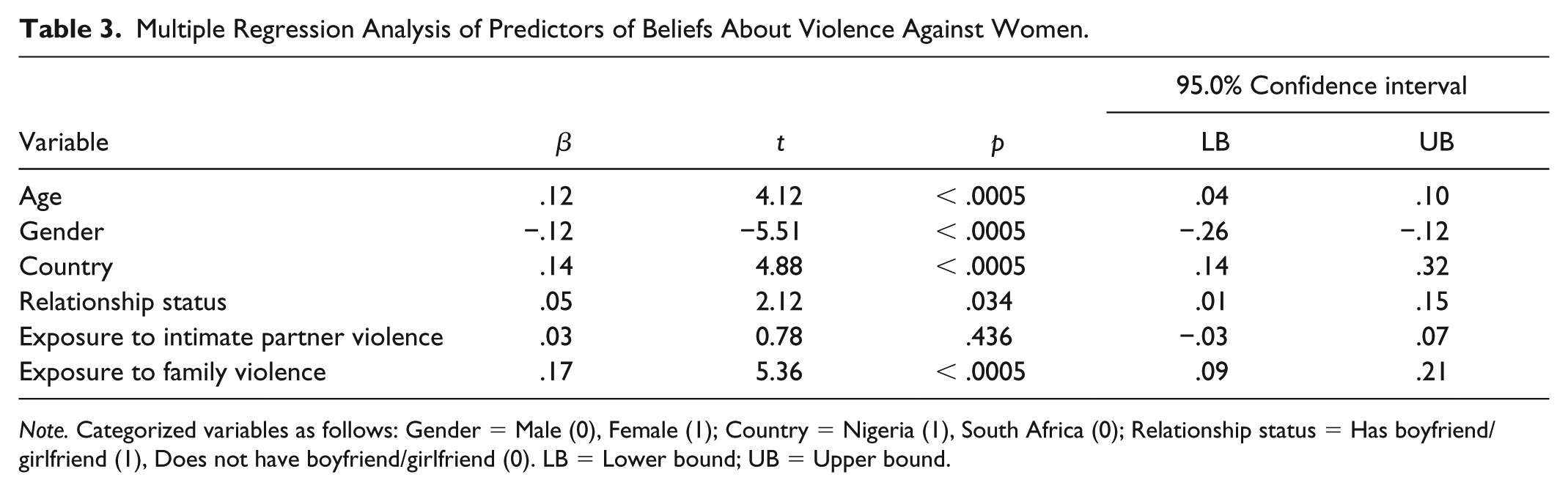
Note. Categorized variables as follows: Gender = Male (0), Female (1); Country = Nigeria (1), South Africa (0); Relationship status = Has boyfriend/girlfriend (1), Does not have boyfriend/girlfriend (0). LB = Lower bound; UB = Upper bound.
Discussions
This study examined adolescents’ indirect exposure to IPV and family violence and measured the extent to which such exposure was related to beliefs about VAW in Nigeria and South Africa. When comparing the two countries across exposure to IPV and family violence and beliefs about VAW, it was found that adolescents from Nigeria were more likely to be exposed to IPV and family violence and were more likely to endorse beliefs about VAW than were adolescents from South Africa. Male adolescents were also found to be more likely to endorse VAW than were female adolescents. Similar examination of the association between exposure to IPV and family violence and beliefs about VAW, controlling for demographic characteristics, showed that higher age, being male, being from Nigeria, being in a relationship, and higher exposure to family violence were related to higher beliefs about VAW.
Effects of Gender and Country on Exposure to IPV, Exposure to Family Violence, and Beliefs About VAW
The findings that adolescents from Nigeria were more likely to be exposed to both IPV and family violence than adolescents from South Africa provide a unique opportunity to understand cross-national differences in experience among adolescents in the two countries, especially given the lack of comparative knowledge about these differences. Although comparative knowledge about adolescents is minimal, the finding that adolescents from Nigeria were more likely to endorse beliefs about VAW than adolescents from South Africa is consistent with previous studies that found adult respondents in Nigeria to be more likely to endorse VAW and gender stereotypes than respondents in South Africa (Fakunmoju & Bammeke, 2017; Fakunmoju et al., 2016).
Altogether, these findings can be explained by some macro-level differences between the two countries as discussed below. Religion plays a stronger role in Nigeria (Igbelina-Igbokwe, 2013), which prides itself on religious observance and where it is argued that women’s subordination is divinely ordained. Extensive research in various contexts, including South Africa, have indicated that many religious practices reinforce traditional gender roles and in some cases even chastisement of women for transgressing these norms (Fakunmoju et al., 2016; Frahm-Arp, 2015; Johnson, 2015). As argued by Igbelina-Igbokwe (2013) with respect to Nigeria, religion remains a weapon of subjugation of women, of gaining compliance with expected behaviors from women, of maintaining male privileges, and of minimizing resistance to oppressive norms. Hence, religion seems to be much more of a factor in Nigeria than in South Africa, although the role of religion in perpetuating poor gender attitudes that reinforce VAW should not be underestimated in any context, since adolescents learn about the role of women in intimate relationships based on their religious learning, which propagates the submissiveness of women and a dominance of men.
The demographic data indicated that the majority (more than 81%) of the Nigerian adolescents reported that their parents were married, compared to 38.8% in South Africa. In South Africa, 10.4% of the parents were divorced or widowed, compared to 2.4% in Nigeria. It could be that more Nigerian adolescents are living with their parents, a possible explanation of high levels of exposure to IPV and family violence, which were subsequently related to endorsement of VAW. This is very different in South Africa, where “45,6% of black African children lived with only their biological mother, while 21,0% lived with neither parent” (StatsSA, 2015, p. 5). Exposure to IPV is less likely to be evident if the partners are not living together, as in the South African context.
In Nigeria, Nollywood may also have had an influence on perpetuation of gender stereotypes that contribute to pro-VAW attitudes. Research in Nigeria has indicated that “access to radio/TV increased the odds of justifying abuse among women” (Okenwa-Emegwa, Lawoko, & Jansson, 2016, p. 1). Furthermore, the content of movies, films, and television dramas, in particular those from Nollywood, seems to endorse VAW (Adewoye, Odesanya, Abubakar, & Jimoh, 2014; Ojukwu & Ezenandu, 2012; Okenwa-Emegwa et al., 2016; Omoera, Edemode, & Aihevba, 2017), as they often convey the subliminal message that failure to comply with men’s instructions and any act of insubordination by women can result in violent consequences (Okenwa-Emegwa et al., 2016). In South Africa, Nollywood movies are not commonly available, and adolescents watch mostly Hollywood movies or South African television programs. While these shows also valorize violence and promote gender stereotypes, the extent to which they promote VAW as an acceptable behavior is perhaps more subtle.
High levels of violence pervade many aspects of social, political, economic, religious, and community life in Nigeria as a result of extensive religious, tribal, and ethnic unrest (Audu, 2015; Musawa, 2016; Osawe, 2015; Ugbodaga, 2015). While South Africa also has high violence levels and high crime rates (Institute for Security Studies [ISS], 2017), South Africa has moved to a democratic dispensation and has a constitution that promotes human rights and gender equality (Constitution of the Republic of South Africa, 1996). It would nevertheless be interesting to determine what types of violence are more prevalent in Nigeria than in South Africa that make Nigerian adolescents more likely to have pro-VAW beliefs.
Developmentally speaking, Nigeria overall has a poorer record with regards to human rights violations than South Africa (Maplecroft, 2014). Nigeria is in the High Inequality and High HDI loss category; South Africa is in the Medium HDI category and has improved in all HDI measures in recent years (Jahan et al., 2016). In addition, Nigeria has much higher levels of gender inequality than South Africa, based on the GDI indicators (Jahan et al., 2016). Igbelina-Igbokwe (2013) confirms that gender inequality is rampant even in the political sphere in Nigeria since, “formal and informal” oppressive patriarchal structures operate to exclude women from “participation in governance” and “corridors of powers” that sustain male privileges in patriarchal structures (p. 4). South Africa has high quotas for the inclusion of women into parliament and there is legislation to address the racial and gender imbalance in all spheres of society. Hence, South Africa has taken active steps to address the” non-racial,” “non-sexist” clauses that are embedded in the constitution.
Moreover, South Africa enacted legislation to deal with domestic violence 15 years earlier than Nigeria. This legislation is important because it brings VAW into the public domain and allows victims to report violence and have access to protection mechanisms (Rasool, 2011), which is not possible in the absence of a law. In post-apartheid South Africa, women’s groups have been active in lobbying for gender equality in legislation and have been working with various criminal justice institutions for effective implementation of these legislative frameworks. In South Africa, there have been responses within a range of sectors to address VAW through increased awareness campaigns, both in the media and in schools (Beksinska, Pillay, Milford, & Smit, 2014). These campaigns and interventions may have to some extent improved gender attitudes; they could also have produced more socially desirable responses.
Although adolescents in South Africa are less supportive of VAW in their beliefs, this does not mean that those beliefs translate into behavior, as many studies (e.g., Abrahams & Jewkes, 2005; Rasool, 2017; Jewkes et al., 2010) have reported high levels of adolescent exposure to victimization and perpetration. Similarly, a Nigerian study (Denny & Nwankwo, 2015) found that, although there was less support than expected for pro-VAW attitudes in their study, levels of exposure, experience, victimization, and perpetration remained high. The researchers were similarly concerned about a social desirability bias. Nevertheless, Nigeria’s poorer commitment and actions with respect to addressing gender equality at a macro level (Igbelina-Igbokwe, 2013) may be contributing to perpetuation of a culture that allows pro-VAW attitudes to flourish.
Effects of Demographics on Beliefs About VAW
Age
It is not surprising that older adolescents were more likely to hold poorer gender beliefs, since they are also more likely to have been exposed to violence over a longer period and have had more time to entrench poor attitudes and views that are socially acceptable in their communities. If VAW is normalized and accepted as a part of marriage and life, as has been articulated in various studies (Abdullahi et al., 2017; Rasool, 2012, 2015; Hargreaves et al., 2006; Jewkes et al., 2011), then older boys are more likely to replicate these socialized beliefs and behaviors. Further, older boys are also more likely than younger boys to be in relationships and to be sexually active (Slap et al., 2003), which means that they will have more opportunities to re-enact violence in their own relationships and perform traditionally oppressive roles and behaviors against women that they have learned from their role models or from exposure to media/films. Further watching the power of violence and the fear that it engenders in their families may be appealing to adolescents who are in an insecure stage of finding themselves and who are in need of validation (Beksinska et al., 2014), hence they may then replicate these behaviours. Boys in Nigeria were older than those in South Africa, which could also contribute to explain the higher levels of pro-VAW attitudes in Nigeria.
Gender
The finding that male adolescents were more likely to endorse VAW than female adolescents is consistent with previous studies (Adika et al., 2013; Fakunmoju et al., 2016a, 2016b; Mason-Jones et al., 2016; Pöllänen et al., 2018) and feminist theories that suggest that men are likely to uphold their patriarchal privilege, and support ideas and beliefs that reinforce this privilege (Igbelina-Igbokwe, 2013; Rani, Bonu, & Diop-Sidibe, 2004). Men and boys are unlikely to take responsibility for their poor behavior if social norms reinforce violent masculinities and provide men with excuses for perpetration of VAW. Findings of a study in Nigeria showed that social norms were influential in “gender-related practices” (Denny & Nwankwo, 2015, p. 17), since in Nigeria, men are still considered the head of the household, gender roles continue to be traditionally defined based on to religious and traditional practices, and VAW is seen as “normal” (Abayomi, 2014; Denny & Nwankwo, 2015). Denny and Nwankwo (2015) based on their Nigerian study, confirmed that “occasional hitting of women in the household is considered acceptable, rather than respondents holding a zero-tolerance attitude toward VAWG” (p. 26).
Odimegwu, Okemgbo, and Ayila (2010) contend that, in Nigeria, pro-VAW attitudes are common due to the belief that the act of men beating their wives is an expression of love. Similar findings of the acceptability and normalization of VAW, as well as notions that abuse is love, were evident in South Africa (Rasool, 2015, 2016; Boonzaier & De la Rey, 2003). Hence, it is not unexpected that adolescent boys have maintained beliefs that are pro-VAW, since socialization of boys reinforces violent masculinities that are supportive of male VAW. These findings seem to provide support for the persistence of patriarchy in South Africa and Nigeria, despite the subtleties and variations that may exist in the tapestry of patriarchies evident in these two very different countries.
Relationship status
Relationship status was found to be associated with negative beliefs about women and pro-VAW attitudes. Entering intimate partner relationships is a complex and difficult terrain for adolescents to negotiate. In trying to engage partners of the opposite sex, they draw on the relationships that they have witnessed in their homes and families to guide their views and behaviors. Hence, the influence of socialization and role modeling of VAWG is replicated by adolescents in their own relationships. Further, being in a relationship forces adolescents to think about their beliefs and to perform gender roles in a real-life situation. If their socialization and role models reinforced pro-violence beliefs and behaviors, the adolescents are more likely to assimilate and re-enact these in their own relationships. Adolescence is the time for engaging in risky behavior (Beksinska et al., 2014); the bravado of youth may not consider violence risky, especially if there are no legal or social ramifications for such behavior, but rather valorization and support for performing violent masculinities.
Strengths and Limitations
The study, conducted in South Africa and Nigeria, has strengths as well as limitations. It advances knowledge about the possibility of exposure to IPV and family violence as risk factors for endorsement of VAW. By examining the cross-cultural exposure of adolescents to VAW and determining the effects of such exposure on beliefs about VAW, the study suggests that differential exposures of adolescents to different patriarchal structures and human development levels may have differential effects on beliefs about gender-based violence across societies. Similarly, by identifying cross-cultural differences between the two countries, the findings draw attention to regions where culturally specific preventive and protective interventions may be beneficial. The findings reflect how successful measures for protecting adolescents in one society may be beneficial for addressing the vulnerabilities of adolescents in another. These findings provide the opportunity for reflection on cross-cultural and contextual conditions that may have been instrumental to identified differences between the two countries.
Despite the above strengths, the study has limitations. A causal relationship is not implied by the findings by the nature of cross-sectional research. Instead, findings can be understood in terms of the association between the examined variables. While the age range of respondents was 12 to 18 years, the fact that the respondents in Nigeria were more likely to be older than those in South Africa suggests that the current findings should be interpreted with caution pending the outcomes of future studies. Since the data were collected from adolescents in major metropolitan areas, the findings may not be generalizable to adolescents in rural or other urban and peri-urban areas of either country. Because exposure to IPV and family violence may differ between urban and rural areas, these findings are not generalizable to urban and rural areas. They also cannot be generalized to other ethnic or race groups or across the class divide.
Similarly, countries differ in efforts and campaigns denouncing VAW, which may have implications for differential disclosure of exposure to violence across countries. Adolescents in a country where legal consequences are more pronounced may be reluctant to disclose exposure to VAW, compared to adolescents in a society where VAW is culturally and religiously endorsed, with minimal legal consequences. Our focus on differences across countries did not preclude an understanding of the hierarchical and nested nature of the examined data and did not imply an absence of joint effects of within-school and country similarities and variations on the examined variables. It also did not preclude our understanding of the moderating effects of school and country factors on the relationship between the examined variables. Because students live in the same community and completed the survey in the classroom, their responses to survey questions cannot be deemed to be completely independent. However, this limitation is perhaps less critical given the realization that the variables examined (i.e., exposure to intimate partner violence and exposure to family violence) focused on events that occurred in students’ home and community settings as opposed to events that occurred only in school settings. Moreover, because cross-culturally empirically validated measures were not available to operationalize the variables examined, valid conclusions about the examined relationships cannot be assumed to have been reached.
Implications of Findings for Policy, Practice, and Research
This study shows that, in both Nigeria and South Africa, adolescents who have witnessed VAW (whether among intimate partners or in the family) are more likely to have pro-VAW attitudes and beliefs. This highlights the need for measures to protect children from witnessing IPV and family violence before antisocial gender attitudes are entrenched in both contexts. It seems that exposure to oppression of women by men through violence establishes, through socialization, adolescent views that women are subordinate to men and deserving of violence. Notwithstanding the possible differences in propensity for pro-VAW beliefs among adolescents in South Africa and Nigeria, successful measures to combat exposure to IPV and family violence in both contexts are imperative to create the sensitivity that is needed to protect vulnerable adolescents from the effects of such exposure. In school and within the community, efforts must be undertaken to deal with the consequences of VAW and mediate pro-VAW behaviors and beliefs among adolescents.
This study confirmed that boys who have witnessed family violence are more likely to hold pro-VAW beliefs. Because boys have more proclivity to VAW than girls (De Vries et al., 2014; Huesmann & Guerra, 1997; Mason-Jones et al., 2016; Pöllänen et al., 2018; Stoddard et al., 2015), enhanced efforts should be made to work with boys to prevent pro-VAW beliefs and behaviors. Such efforts may be beneficial to male adolescents, who are at the age of dating and more vulnerable to perpetration of physical, emotional, and sexual violence against intimate partners. However, this should not preclude working with girls who are more likely to become victims. It is therefore imperative to work with adolescents of both genders, who have been exposed to IPV and family violence to improve their gender attitudes and to mitigate the likelihood of intergenerational transmission of violence, as a consequence of patriarchal socialization.
The evidence which suggests that adolescents in Nigeria were more likely to be exposed to IPV and family violence and more likely to endorse VAW than adolescents in South Africa, suggests that specific interventions strategies are needed in the Nigerian context. In particular, work with older Nigerian boys who are in a relationship and who have been exposed to family violence is needed, as they are most likely to reproduce violence in their own relationships after such exposure. However, prevention should be the focus at an even earlier stage with Nigerian boys who have been exposed to violence, prior to them entering intimate partner relationships, which Slap et al. (2003) noted is younger than 12 years. Providing young boys with options and tools to engage in more respectful and equal relationships before they enter relationships could prevent intergenerational transmission of violence before they enter relationships and before negative beliefs and stereotypes, that reinforce patriarchy, have a chance to take root. It is clear that Nigerian adolescents were more likely to hold pro-VAW beliefs than adolescents in South Africa, and the particularities of the sociocultural contexts, as well as the ways in which patriarchy manifests in these varied contexts, require more qualitative exploration.
An effective approach for improving gender attitudes among adolescents is awareness-raising and education in the school context at a deep level of attitudinal and behavior change, through psycho-educational sessions led by social workers and mental health practitioners. To this effect, elementary and secondary schools should integrate programs into the curriculum that challenge pro-VAWG beliefs and patriarchy. Moreover, because adolescents are often less knowledgeable about the health, mental health, and legal consequences of VAWG (see De Vries et al., 2014), integrating knowledge about such consequences into relevant prevention and intervention programs will go a long way in minimizing violence-supportive beliefs and behaviors. Extramural activities and programs that focus on educating adolescents about the consequences of VAWG will also help to reduce the propensity of holding VAWG-supportive beliefs and attitudes to minimize the perpetration of VAWG among adolescents.
Within countries, punitive, deterrent and detective measures to identify and report occurrence, and protective measures to protect victims and guarantee psychosocial support for recovery may have positive effects in reducing VAWG. It is also important to create an atmosphere that encourages victims to report, update record-keeping mechanisms to capture reports of VAWG as standalone categories, and facilitating adequate resource and budgetary allocations to address this issue at structural and institutional levels.
Working with parents is essential for detection, intervention, and prevention of violence in families. In particular, strengthening the bond and time that parents spend with children in positive and productive ways may be an important intervention, since this could foster better attitudes among young people. However, current exposure to parents and families is largely violent and reproduces negative gender attitudes that reinforce negative gender stereotypes that perpetuate the intergenerational cycle of violence. Norms that are accepting of violence and perceptions of men being superior are two critical determinants of the reproduction of IPV (Jewkes, Levin, & Penn-Kekana, 2002), that need to be addressed in prevention and intervention programs.
Adolescents observe VAW not only in the community; they also observe VAWG in all movies and other social media. Censorship of VAWG-supportive content in movies is essential. Collaboration with movie makers to avoid objectification of women and to remove questionable program content in all media, including all movies, films, and social media, would help to stem the propagation of oppressive beliefs and stereotypes.
When considering the psychosocial, health and cultural impacts of exposure to violence (Heinze et al., 2017; Ho & Cheung, 2010; Stoddard et al., 2015; Weaver et al., 2008), it becomes clear that cross-cultural knowledge to inform policy and practice is imperative. The identification of VAW attitudes and beliefs cross-culturally provides the opportunity for collaboration among practitioners, interventionists, policy makers, film makers, social media activists, and law makers in formulating educational and legislative measures to protect vulnerable adolescents from exposure and the effects of exposure to violence and from perpetrating violence during adolescence and adulthood (see Pöllänen et al., 2018).
This study, based on cross-country research, contributes to the evidence that exposure to IPV and family violence is associated with negative gender attitudes. While the direction of the relationship is unclear, it is necessary to address both these issues in intervention and policy, as both stem from systemic patriarchal orders. Nevertheless, patriarchal beliefs about the superiority of men, which is reinforced through culture and religion that prescribes how women ought to be treated and defines the status and position of women in the relationship (e.g., listen to men, do not talk back to men, men are the head of the family, men have authority over women, men can treat women as personal property) contribute to notions that VAW is justified to gain women’s compliance and obedience. Overall, working to change gender attitudes that give men power and that disempower women, as well as those that valorize VAW, must be addressed through sociocultural reform and the improvement of gender equality and human development indicators in all spheres of both countries.
To arrive at stronger conclusions beyond the current findings, future studies may consider more effective methodologies and analytical approaches to minimize sociodemographic differences among participating adolescents across societies. Such studies should extend data collection to peri-urban and rural areas to enhance generalizability of findings. Future inquiries should be extended to consider the effects of exposure and beliefs on victimization and perpetration of gender-based violence, as well as the effects of victimization and perpetration on attitudes toward VAWG among adolescents. The moderating effects of relevant factors (e.g., parental economic status, religious background) on the associations should be considered in future studies. Longitudinal studies of the long-term effects of exposure to IPV and family violence on gender-based violence perpetration and beliefs among adolescents will generate findings that may enhance international transfer of policy, practice, and measures.
Footnotes
Acknowledgements
The first author received no funding nor specific grant with respect to the Nigerian study reported in this article. The second author received funding from South African National Research Foundation with respect to the South African study reported in this article. The second author would like to acknowledge and thank the fourth year social work students who collected the data for this study. She would also like to thank Professor Roestenburg for his assistance in the initial phases of this study.
Declaration of Conflicting Interests
The author(s) declared no potential conflicts of interest with respect to the research, authorship, and/or publication of this article.
Funding
The author(s) received no financial support for the research, authorship, and/or publication of this article.
