




Abstract
Intimate partner violence (IPV) is a serious social problem with devastating psychological, physical, and economic consequences. While various studies have investigated the causes of IPV, the influence of the type of marriage contracted has not been well explored. Thus, the study investigated the influence of the type of marriage contracted on IPV among married people in north-central Nigeria. The study adopted a cross-sectional survey method. The study population comprised married women who were 15 years of age and older and resided in north-central Nigeria. A multi-cluster sampling method was used to select the respondents for the survey. Both descriptive and inferential statistics were used to analyse the survey data. The descriptive statistics revealed that 67.5% of the sample experienced intimate partner violence in their current marital relationship. As for the form of intimate partner violence, the descriptive statistics revealed that 51%, 30.5%, and 19% of the respondents, respectively, experienced emotional, physical, and sexual IPV in their current marital relationship. The multivariate logistics regression model showed that women who engaged in forced marriage had 8.871 odds of experiencing IPV; women whose husbands had concubines had 23.504 odds of experiencing IPV; women who did court or civil marriage had 3.423 odds of experiencing IPV; and women in monogamous marriages had 1.505 odds of experiencing IPV. Household decision-making was also related to IPV. The study’s findings are germane because they can provide information for the creation of laws and initiatives that aim to stop violence against women.
Introduction
The phenomenon of intimate partner violence is a longstanding global malady affecting all countries (World Health Organisation, 2021). Globally, one out of three women who have been in an intimate relationship have experienced sexual and/or physical violence by either a former or current intimate partner (World Health Organisation, 2021).
The WHO’s systematic review on intimate partner violence (IPV), using aggregated regional and global prevalence estimates, revealed lifetime IPV experience by women to be approximately 23% in WHO high-income countries, 25% in WHO European and Western Pacific Regions, 30% in the WHO region of the Americas, and 37% in the WHO Eastern Mediterranean, African, and South-East Asia Regions (World Health Organisation et al., 2013).
In Nigeria, the 2018 Demographic and Health Survey (DHS) found that 36% of ever-married women aged 15 to 49 have experienced sexual, physical, or emotional IPV by their current or former partner or husband. Different studies have examined the prevalence and causes of intimate partner violence (Adebowale, 2018; Atteraya et al., 2015; Benebo et al., 2018; Erten & Keskin, 2018; Garg et al., 2019; National Population Commission (NPC) [Nigeria], & ICF, 2019; Onigbogi et al., 2015; Tanimu et al., 2016). However, the influence of the type of marriage contracted on IPV has not been explored.
Marriage is the foundation upon which the family and human society are built. It provides optimal conditions for childbearing and upbringing. It can serve as a significant source of instrumental and emotional support and is associated with physical and mental health and increased economic well-being (Oyefara, 2011).
It is important to note that a well-functioning marriage is a fundamental asset to society, while a dysfunctional marriage is a burden. One of the salient factors that could affect the optimal functioning of marriage is conflict. Although conflict is inherent in marriage, the benefits associated with marriage would be difficult to achieve if the intimate partners experienced incessant violence.
The adverse effects of IPV on marriage have been investigated. However, the type of marriage contracted predicts IPV has not been well explored, especially in Nigeria. Furthermore, it is apposite to note that studies on IPV in north-central Nigeria, a geo-political zone with the highest rate (50.1%) of IPV in Nigeria (see National Population Commission (NPC) Nigeria & ICF, 2019), are rare. In fact, to the best of the author’s knowledge, the only known study in the zone is the Nigeria Demographic and Health Survey, which fails to examine the influence of the type of marriage contracted on IPV.
The foregoing exposition indicates a lacuna in the literature on marriage type that determines IPV in north-central Nigeria and the need to fill this gap. Thus, this study fills this gap by investigating the nuances of the forms of marriage that encourage intimate partner violence in north-central Nigeria.
Conceptual Clarification
Various IPV definitions have been proposed depending on the theoretical background, purpose, or angle at which individual researchers, organizations, or countries see it (Wubs, 2015). Some definitions are narrow in scope and only relate to physical violence, while others include all types of violence, whether they be physical, psychological, economic, or sexual.
IPV, according to Krantz and Garcia-Moreno (2005) and Romedenne and Loi (2006), includes sexual, physical, and psychological/emotional abuse used by a person in a relationship to take control over the other. This definition is gender-neutral and specific about the forms of violence that constitute IPV; however, the definition fails to specify the kind of relationship.
IPV, according to Howe (2012), is the violence that occurs between two persons in an intimate relationship during marriage, cohabitating, or dating. This definition sees IPV happening in only current intimate relationships such as marriage, dating, or cohabiting; it does not regard violence by an ex-intimate partner, that is, an ex-spouse, boyfriend, or girlfriend, as IPV. This led Krug et al. (2002) to define IPV as the threatened or actual physical, sexual, and/or psychological abuse directed towards an ex-spouse, a spouse, a former or current boyfriend or girlfriend, or a former or current dating partner.
Similarly, WHO (2016) and Breiding et al. (2015) described IPV as physical, sexual, or psychological violence by a former or current intimate partner—that is, a spouse, girlfriend or boyfriend, sexual partner, or dating partner. The last three definitions above are very specific, as they mentioned what constitutes IPV; the definitions are also gender neutral and also show the kind of relationship.
For the purpose of this study, IPV is conceptualized as violence perpetrated against an individual by his or her current spouse in a heterosexual marital relationship that causes sexual, physical, or psychological harm to the victim. Three forms of IPV are used in this study: physical IPV, emotional and psychological IPV, and sexual IPV.
The concept of marriage is defined in different ways and by different entities based on religious, cultural, and personal factors. Ember et al. (1995) defined marriage as a social contract for the procreation and maintenance of children. To buttress Ember et al.‘s (1995) definition, Mazumdar (2001) defined marriage as a socially approved union of male and female for purposes of entering into sex relations, establishing a household, procreating, and providing care for the offspring.
In defining marriage, it is imperative to consider the variations in the nature of marriage, such as whether more than two individuals can be involved (polygamy), whether spouses are of the same sex (homosexual marriage) or opposite sexes (heterosexual marriage), and how one of the traditional functions of marriage—to produce and nurture children—is understood today. In the light of the above, marriage can be defined as a social contract involving two or more individuals that unites them legally, emotionally, and economically.
Marriage is classified on the basis of several qualities; however, four qualities that are used in this study are discussed. These are: classification based on choice of mates (love marriage, love-cum-arranged marriage, and forced marriage), type of marriage contracted (court, customary/traditional, religious, living together/cohabiting), number of mates (monogamy, polygamy), and degree of authority (egalitarian, patriarchal, matriarchal).
The classification of marriage based on choice of mate has three forms: love marriage, love-cum-arrange marriage, and forced marriage. A love marriage is one that is based on mutual love, affection, attraction, and commitment. In this type of marriage, one is involved directly in the selection of the partner. The partners are directly attracted to each other. With or without their parents’ approval, a love marriage is entirely driven by the couple (Donner, 2002).
A love-cum arrange marriage is a marriage that integrates elements of both arranged and love marriages. The families of the bride and groom participate in the selection process in this kind of marriage, but the couple has chosen to get married after falling in love. It is important to note that love and love-cum-arranged marriage can be regarded as consensual marriages. They are regarded as consensual marriages because the intending couple must mutually agree to be legally married.
A marriage that is forced occurs when one or both partners do not provide their permission. It is a marriage in which one or more people are wed against their will or without their consent. Even if both individuals join a marriage with their full permission, it can nonetheless become forced if one or both of them are later made to remain in the marriage against their will (Council of Europe, 2018).
The classification based on the type of marriage contracted has four forms, as used in this study: court, customary/traditional, religious, living together/cohabiting. In Nigeria, marriage under the act is another name for court marriage. That is, a marriage that is performed in compliance with the Marriage Act. The court registry is where this kind of marriage usually takes place. This kind of marriage is governed by three constitutional acts: the marriage act, the matrimonial causes rules made pursuant to the matrimonial causes act, and the matrimonial causes act, Cap. M7, laws of the Federation of Nigeria, 2004 (Nkume, 2023).
A traditional or customary marriage is one that has been performed in line with the traditions of the families of the bride and husband. Customary law governs this kind of marriage. As for religious marriage, the marriage is guided by either Islamic or Christian laws. Religious marriage is solemnized either in a church or mosque.
Cohabitation can be defined as an intimate sexual relationship between unmarried partners who live together for a sustained period of time (Mynarska & Bernardi, 2007). It is a living arrangement in which two unmarried partners live together in a long-term relationship that looks like a marriage. The two partners are often involved in a sexual, intimate, or romantic relationship on a permanent basis. This relationship is not legally binding but is now becoming normative, especially in some cities in Nigeria.
The third marriage classification is based on the number of mates. This typology has two forms: monogamy and polygamy. Monogamy is a type of marriage in which a man marries one woman. Polygamous marriage is any type of plural marriage. This form of marriage involves more than two individuals. This could be polygyny, in which a man marries two or more women concurrently. This type of marriage is mostly common in Nigeria and sub-Saharan Africa. Polyandry is another type of marriage under polygamy. Polyandry is a form of marriage in which a woman marries more than one man concurrently. This type of polygamous marriage is rare. This does not mean that it is not in existence, as it is found among the Todas, Gonds, and Baigas in India (Ekiran, 2002).
The last classification is based on degree of authority (egalitarian, patriarchal, or matriarchal). In an egalitarian relationship, both the husband and wife are involved in the decision-making process. In this form of relationship, authority is equally distributed between the husband and wife. In a patriarchal relationship, only the husband is involved in the decision-making process. The husband is the head of the household and has the authority to make decisions. This form of authority is common in most traditional African societies. In a matriarchal relationship, the wife has the authority to make decisions. The wife is the head of the household and controls the household. This form of relationship is uncommon in Nigerian society.
Literature Review
The existing literature on family violence has explored the processes and varieties of marriage that lead to the phenomenon of IPV. For instance, marital status has been found to be one of the factors influencing the exposure of women to IPV (Abramsky et al., 2011; Alkan & Tekmanli, 2021; Başkan & Alkan, 2023; Flake, 2005; Flake & Forste, 2006; Hindin et al., 2008).
In an analysis of the Demography and Health Surveys (DHSs) data for Peru, Nicaragua, Haiti, the Dominican Republic, and Colombia, Flake and Forste (2006) found that marital status was the strongest predictor of IPV, having emerged as statistically significant in all five countries studied. From their analysis, cohabiting women had higher odds of experiencing physical IPV than married women. The theoretical explanation often points to the impermanent and temporary nature of cohabitation as the major reason cohabiting partners are more abusive than married couples.
Hindin et al. (2008) multi-country IPV study concluded that marital status was independently associated with IPV in Zimbabwe and Rwanda, where cohabiting union, rather married couple, was associated with an increased risk of IPV. Alkan and Tekmani (2021) investigated the determinants of sexual IPV against women in Turkey. They found marital status to be one of the socio-demographic factors influencing women’s exposure to sexual IPV in Turkey.
Aside from marital status, research has also investigated the influence of the choice of mate in the marriage on IPV (Andarge & Shiferaw, 2018; Asadi et al., 2019; Yari et al., 2013). Marriage is one of the most fundamental stages of life, where the parties involved are attracted to each other. There would be friendship and passion in such a union despite the difficulties and obstacles of a married life. In a sample of 737 married women aged 15 to 49 years in South Ethiopia, Andarge and Shiferaw (2018) found that women who had forced marriages had 1.75 times higher odds of reporting IPV than those who engaged in consensual marriages—love marriage and love-cum-arranged marriage (AOR = 1.75 [1.01–3.06]).
Similarly, forced marriage is found to be statistically significant with IPV against women (Asadi et al., 2011; Nojomi et al., 2007; Yari et al., 2013). In a hospital-based study in Iran, Asadi et al. (2019) found that women who engaged in consensual marriages (love marriage and love-cum-arranged marriage) had a lower risk of physical IPV than women in forced marriages. Consensual marriage is more likely to have a cordial relationship as the partners involved could agree on most household issues since they love each other. This could be the supreme reason the union is not as likely as forced marriage to experience IPV.
Some studies found the typology of marriage based on the number of mates to be significantly associated with IPV (Abeya et al., 2011; Ahinkorah, 2021; Gubi & Wandera, 2022). For instance, Gubi and Wandera (2022), in their analyses of the correlates of IPV among married men in Uganda, found the number of wives a man had to be correlated with physical, emotional, and sexual IPV. Specifically, they found that men who had one wife had lower odds of experiencing IPV than men who had more than one wife.
Similarly, Abeya et al. (2011), in their analyses of the correlates of IPV against women in western Ethiopia, found the number of wives to be associated with IPV against women in western Ethiopia. They found the odds of experiencing IPV to be lower for women in monogamous marriages than polygynous marriages.
However, some studies found no statistically significant association between the number of wives and IPV (Abiodun et al., 2019; Gubi et al., 2020; Vung et al., 2009). In Nigeria, Abiodun et al. (2019), in their investigation of correlates of IPV against married men in Osogbo, found no statistically significant association between the number of wives and IPV against married men. In the same vein, Gubi et al. (2020), in their analyses of the 2016 Uganda Demographic and Health Survey (UDHS), found no statistical association between the number of co-wives and IPV in Uganda.
The influence of non-marital sexual partners (concubines) on IPV also appears in family violence literature. Concubines are unofficial rivals who are considered a threat to the marital relationship. Concubines may come with psychological abuse such as belittlement, negative comparisons, cessation of communication, insults, refusal of the spouse to eat at home, as well as sexual violence (Issahaku, 2017; Mahama, 2004).
Studies (e.g., Abramsky et al., 2011; Alkan et al., 2023; Issahaku, 2017; Townsend et al., 2011) have investigated the influence of the presence of non-marital sexual partners on IPV. For instance, in a sample of 443 married women in northern Ghana, Issahaku (2017) found that 20% of the women reported that their husbands had non-marital sexual partners. As for the association between non-marital sexual partners and IPV, Issahaku (2017) found that women whose partners had non-marital sexual partners (concubines) had 2.33 and 2.10 times the odds of experiencing physical and psychological IPV, respectively.
Alkan et al. (2023) investigated the factors that are associated with controlling behaviors and lifetime physical, emotional, sexual, and economic IPV in Turkey using multivariate probit regression analysis. They found having concubines and some other factors to increase the risk of IPV among women in Turkey. Abramsky et al. (2011) found a positive association between the presence of non-marital sexual partners in the marital relationship and IPV. In their multi-country study, the authors found that women whose husbands had concubines experienced higher levels of IPV than women whose husbands were faithful in 14 out of the 15 sites.
Different studies (Flake, 2005; Gage, 2005; Hindin & Adair, 2002; Hindin et al., 2008; Lawoko et al., 2007) have examined the association between decision-making autonomy and IPV. Hindin and Adair (2002) investigated the relationships between women’s reports of physical IPV and household decision-making using the Cebu Longitudinal Health and Nutrition Survey data. They found that female-dominated or male-dominated decision-making was correlated with more reports of physical IPV, while joint decision-making was protective.
Equally, in Haiti, Gage (2005) found that women who had the major say on most household purchases experienced more physical, sexual, or emotional IPV than those who reported that decisions on most household purchases were made jointly. In Peru, Flake (2005) found that women were more likely to experience physical IPV when decisions were made only by them or when they were divided between spouses than when decision-making was “egalitarian.” Lawoko et al.’s (2007) analysis of the 2003 Kenya DHS showed that women who had some say on issues about their own health care were significantly less likely to report recent physical, sexual, or emotional IPV.
The above literature reveals how some of the nuances of forms of marriage predict IPV. However, no research has explored the influence of the type of marriage contracted (legal, customary, or religious marriage) on IPV. Also, the above literature review shows that there is a paucity of research on the nuances of the form of marriage that predicts IPV in Nigeria. Extant studies on marriage factors and IPV are mostly conducted outside the shores of Nigeria. The study therefore adds to the literature by providing empirical evidence on the influence of the type of marriage contracted and other nuances of marriage on IPV. Thus, the study contributes to the growing evidence on the influence of marriage on IPV in Nigeria. This serves as a base upon which future studies on marriage and IPV could be built.
Focus of this Study
Some studies have been done on intimate partner violence in Nigeria, and the phenomenon has received legislative attention; however, no research has explored the influence of the type of marriage contracted (legal, customary, or religious marriage) on IPV in the country. Being a multicultural country with different marriage forms and processes, it is therefore imperative to investigate the form of marriage that encourages intimate partner violence in the country. Thus, the present study adds to extant scholarship by investigating the type of marriage contracted (legal, customary, or religious marriage) and other nuances of the form of marriage that are associated with IPV in Nigeria.
The type of marriage contracted (legal, customary, or religious marriage) is hypothesized to be significantly associated with IPV. Also, based on what was revealed in the literature, the following are hypothesized:
- Married women in polygynous marriages are more likely to experience IPV than married women in monogamous marriages.
- Women in female-dominated household decision-making marriages (non-egalitarian) are more likely to experience IPV than women in joint household decision-making (egalitarian) marriages.
- Women who engage in forced marriages are more likely to experience IPV than women who engage in consensual marriages (love and love-cum-arranged marriages).
- Women whose husbands have concubines are more likely to experience IPV than women whose husbands do not have concubines.
Study Context
The research took place in the north-central geopolitical zone of Nigeria. The zone has six states—Plateau, Niger, Nasarawa, Kwara, Kogi, and Benue—as well as the country’s Federal Capital Territory. The zone shares borders with two countries: Cameroon and Benin. The population of the entire zone, according to the 2006 census, was 20,369,956. The zone’s current estimated population is about 30,999,168 (National Population Commission, 2020).
Custom and tradition in north-central Nigeria value marriage and the family institution as a whole, in which men are regarded as the head of household. For instance, although young women and men look forward to marriage, it is the responsibility of the man to trigger the process, bring the woman to either his house or his father’s house, and also act as breadwinner and head (Sulaiman, 2023).
In addition, men in traditional or religious weddings have permission to marry an additional wife, while the woman is expected to always commit to one husband at a time. Furthermore, about 70.9% of married women who are between 15 and 49 years old are in monogamous marriages, while about 29.1% are in polygynous marriages (National Population Commission (NPC) [Nigeria], & ICF, 2019).
Method
The study adopted a cross-sectional survey method. The study population comprised married women who were 15 years of age and older and resided in north-central Nigeria. The sample size was calculated using the Epi Info statistical package. The confidence limits are at 3%, the expected frequency sets are at 50.1%, the rate of IPV in north-central Nigeria (see National Population Commission (NPC) [Nigeria], & ICF, 2019), the population size (the estimated population of north-central Nigeria) is 30,999,168, and the confidence level is at 95%. This gives 1067.
A multi-cluster sampling method was used to select the respondents for the survey. With this method, the sampling went through six stages. The first stage involved clustering the study location into states, in which all the six states and the federal capital territory were sampled. The second stage involved the use of the purposive sampling method to choose two local government areas in each state. The choice of purposive sampling was informed by the need to choose urban and rural local government areas. Thus, seven urban and seven rural local government areas were selected for the study.
The third stage involved the use of simple random sampling to select two geopolitical wards in each of the selected LGAs. Hence, a total of 28 geopolitical wards, out of which 14 were urban and 14 were rural, were selected for the study. The fourth stage involved the random selection of 70 regular enumeration areas (EAs) from the list of EAs in all 28 geopolitical wards selected for the study, and this was done with probability proportional to the size of the EAs in each of the 28 geopolitical wards selected for the study.
The fifth stage involved the adoption of systematic random sampling technique to select 15 households in each of the sampled EAs. This was based on the information that 15 respondents would be selected in each of the selected EAs and their knowledge of the number of households in the selected EAs.
The 2015 to 2022 enumeration area demarcation exercise by the National Population Commission shows that each of the 70 EAs sampled has more than 45 regular households. Thus, every third household was selected for the study, after the first household was randomly selected. This sampling of every third household continued until the sample size designated for each of the sampled EAs was achieved. The last stage involves selecting an eligible respondent from each of the sampled households. In households that have more than one eligible respondent, simple random sampling using balloting was used to pick a respondent. An eligible respondent is a married woman of age 15 or older.
As for the research instrument, a structured questionnaire schedule was used to obtain information from the respondents. The structured questionnaire schedule contains questions that are concise and clear. Ten female interviewers with post-secondary school certificates were recruited for the administration of the research instrument. These interviewers were trained for 2 days, and their skills were pre-tested before the commencement of the survey. Three supervisors—the principal investigator and two graduates—supervised and monitored the activities of the ten interviewers.
It is crucial to note that face-to-face interviewing was used for data collection. The research instrument (a structured questionnaire schedule) was administered on a one-on-one basis with the aid of computer-assisted personal interviewing (CAPI) by the interviewers. The interviews took place in or anywhere around the selected households where there was privacy. Consent and privacy were obtained before the questionnaires were administered to all the respondents. Overall, consent and privacy were obtained, and the questionnaires were administered and completed for 1,021 respondents.
At the end of each day of the survey, the supervisors reviewed the completed interviews in order to check for internal consistency, completeness, and other related issues. Since the principal investigator was around in the study location throughout the period of data collection, all the problems encountered by the ten interviewers were reported to him, and necessary steps were taken in order to get both valid and reliable data from the respondents.
In order to guarantee a high level of reliability for the instrument, a pilot study was conducted in which the internal consistency method was used to assess the reliability of the questionnaire. The Cronbach’s alpha coefficient was used to test the consistency of the variables in the scale using a cutoff of .70. The reliability analysis score was Cronbach’s alphas of .76, .75, and .71, respectively, for the sexual, emotional, and physical violence subscales.
Content validity was used to measure the validity of the instruments. The content validity was assessed by a group of family violence scholars who critically looked at the measuring instruments and decided whether they measured what was expected to measure. Specifically, a lot of time and efforts were expended in looking through the research instruments by family violence researchers in and outside the academic world. Their corrections and observations made the instruments go through a rigorous process before taking their final shape.
Measurement of the Dependent Variables
The World Health Organization’s Violence Against Women instrument (VAWI) (see Schraiber et al., 2010) was adapted for this study. The dependent variables were the three forms of IPV (physical, emotional, and sexual). It is imperative to note that the aggregate measure, which combined all three forms of IPV, was generated. The cross-sectional survey data on IPV (physical, emotional, and sexual) were based on the responses of the respondents to the questions on physical, emotional, and sexual IPV in Table 1.
IPV and Marriage Variables.
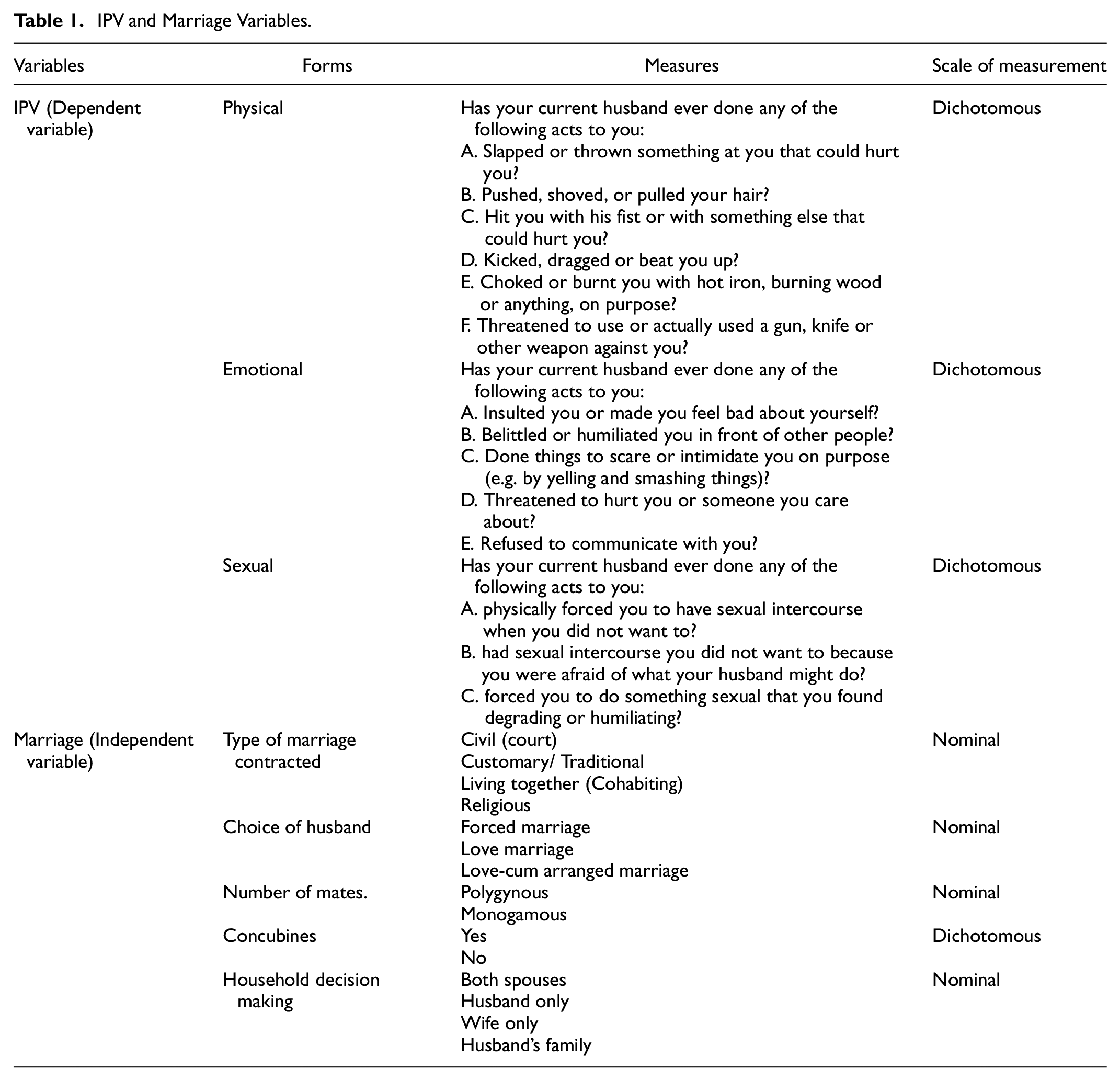
The survey only measured the IPV experienced by married women in their current marriages. The respondents responded to the three forms of IPV with either “yes” or “no”; with “no” to all the sub-questions of all three forms of IPV implies no experience of IPV in the current marital relationship. However, a “yes” to any or all of the sub-questions of all three forms of IPV implies experience with IPV in the current relationship.
Measurement of the Independent Variables
The characteristics of the form of marriage contracted were independent variables. These included the following marriage factors: type of marriage contracted (customary/traditional, civil court, religious, living together), choice of husband (love marriage, love-cum-arranged marriage, or arranged marriage), household decision-making (egalitarian marriage, husband-dominated or wife-dominated), marriage form (polygynous or monogamous), and presence of non-marital sexual partners.
Statistical Analyses
Data analysis was done using SPSS Version 25. Descriptive statistics, which involved frequency distribution, was used to describe the characteristics of the respondents. Chi-square tests were used to test the initial relationships between independent variables and dependent variables. Lastly, multivariate logistic regression was used to examine the independent associations between IPV and the covariates. Specifically, the multivariate logistic regression method was used to assess the adjusted relationship between the respondents’ marriage characteristics and the respondents’ experience of IPV in their current marital relationship.
Results
The descriptive statistics (see Table 2) revealed the following: the mean age of married women interviewed was 34.2 (SD = 9.7), the mean number of children was 2.97 (SD = 1.66), and the mean length of marriage was 13.9 (SD = 8.7). Other socio-demographic characteristics include the following: 50.6% resided in rural areas as against 49.4% that resided in urban areas. The majority (82.7%) of the women interviewed were gainfully employed, as opposed to 17.3% who were not employed.
Demographic Characteristics and Experience of IPV by the Respondents.

As for the type of marriage contracted by the respondents, 41% did religious marriage, 29.3% did court marriage, 17% did customary or traditional marriage, and 12.6% were living together as husbands and wives without making their marital relationships formal. Table 2 also shows that 70.8% of the married women were in monogamous marriages, while 29.2% were in polygynous marriages. As for the choice of husband, 54.4% of the respondents engaged in love marriage, 24% of the marital relationship was forced marriage, and 21.6% was based on love-cum-arranged marriage.
Bivariate Relationships
Table 3 shows cross-tabulations for the bivariate analyses. According to the table, the form of marriage is associated with the risk of IPV. Married women in monogamous marriages experienced IPV more than married people in polygynous marriages. Interestingly, 71.4% of those in monogamous marriages experienced intimate partner violence, compared to 58.1% of those in polygynous marriages. This relationship was statistically significant at the.001 level of significance. As for household decision-making, Table 3 reveals that joint decision-making (egalitarian relationships) is associated with a lower likelihood of experiencing intimate partner violence. That is, marital relationships in which major household decisions are made jointly by both spouses are least likely to experience intimate partner violence compared with marital relationships where major household decisions are made by only husbands, husband’s family, or wives. This relationship was statistically significant at the .001 level of significance.
Bivariate Analysis of Marriage and IPV.
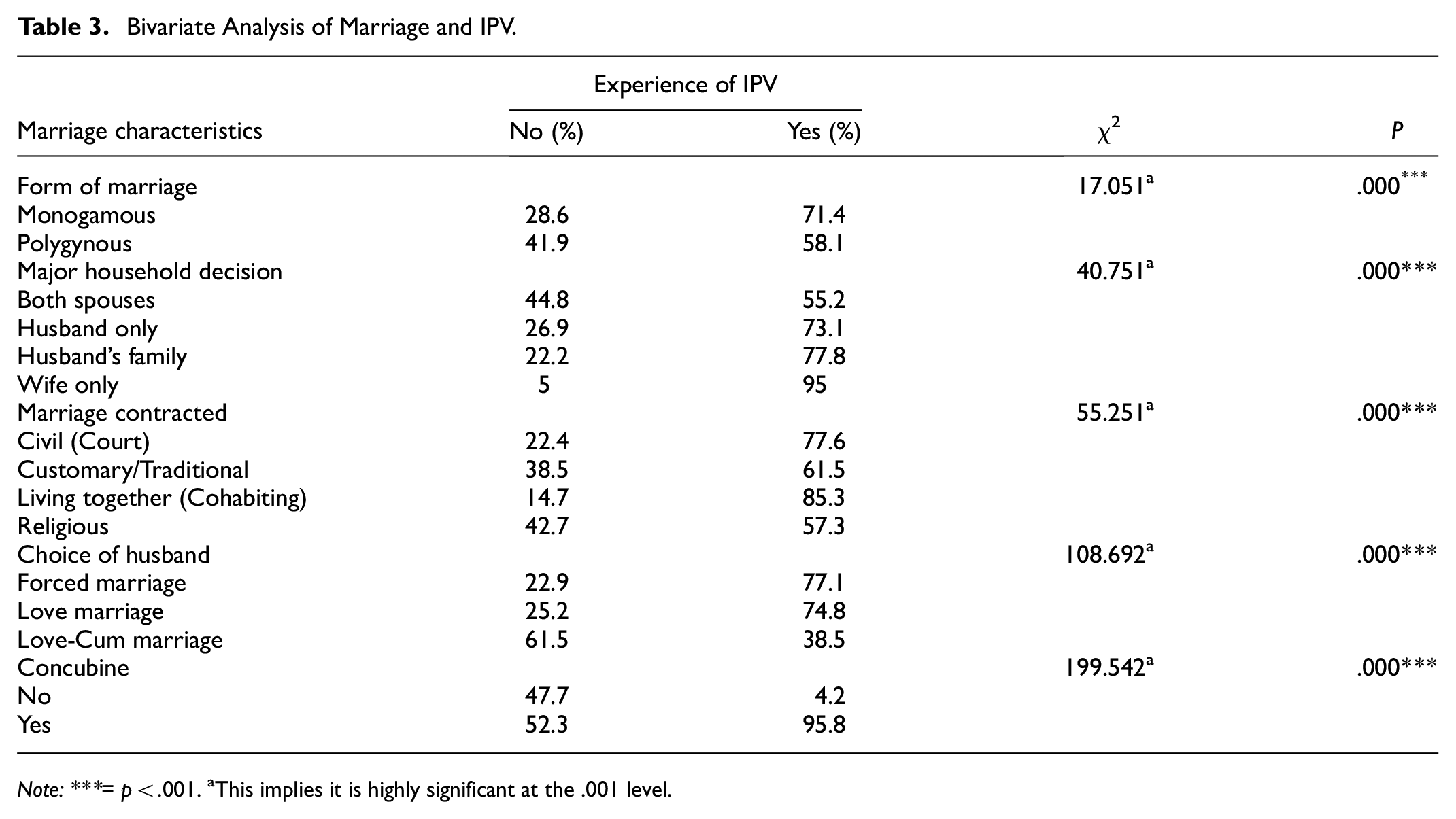
Note:***= p < .001. aThis implies it is highly significant at the .001 level.
Furthermore, the type of marriage contracted is associated with intimate partner violence. This relationship was statistically significant at the .001 level of significance. The pattern from Table 3 shows that women in cohabiting relationships, that is, living together (informally), experienced intimate partner violence more than those who contracted religious, customary, traditional, and civil marriages. For instance, 85.3% of those who were just cohabiting with their partners without making it formal experienced IPV, which is more than 77.6%, 61.5%, and 57.3% of women who did civil, customary, and religious marriages, respectively.
The bivariate analyses (see Table 3) also reveal that the choice of husband of the respondents is found to be statistically significant at .001. The pattern of the relationship shows that those who did forced marriage experienced intimate partner violence more than those who had love and love-cum-arranged marriages. Lastly, Table 3 also revealed that those whose husbands had concubines experienced intimate partner violence more than those whose husbands did not have concubines. This relationship is statistically significant at the .001 level of significance.
Multivariate Logistics Regression Analysis of the Form of Marriage That Determine Intimate Partner Violence in North-Central, Nigeria
It is important to note that necessary checks were done to confirm the data met the necessary assumptions of logistics regression. First, the outcome variable was dichotomous. That is, it is binary in nature, as it has only two possible outcomes: yes or no. As for the assumption of a large sample size, over 1,000 respondents were selected for the study, which is very sufficient for a logistics regression analysis with five independent variables.
The assumption of a linear relationship between the explanatory variables and the logit of the dependent variable was not checked, as all the explanatory variables used in the model were categorical and not continuous. The model was also checked for outliers, in which nine cases were found to be outliers. The cases were retained as they did not significantly affect the results of the model.
The model was also checked for multicollinarity. The variance inflation factor (VIF) reveals there was no multicollinearity between the variables. The VIF values of the model range between 1.01 and 1.144. These values were far below the threshold for moderate multicollinearity, which is between 5 and 9, and a high degree of multicollinearity, which is 10 and above.
Table 4 shows that the logistic regression model was statistically significant: χ2(10) = 420.523, p < .01. The model explained 47.1% (Nagelkerke R2) of the variance in intimate partner violence and correctly classified 67.5% of cases. As shown in Table 4, the form of marriage is a determinant of the occurrence of intimate partner violence in north-central Nigeria. The adjusted odds ratio results show that married people in monogamous marriages are about 1.5 times as likely as married people in polygynous marriages to experience intimate partner violence. Hence, married people in monogamous marriages were more likely to experience intimate partner violence compared with married people in polygynous marriages. This relationship is significant at the.05 level of significance.
Multivariate Logistics Regression Predicting the Determinants of IPV.

p < .05. ***p < .001.
As for the influence of major household decision-making, the adjusted odds ratio shows that women in female-dominated household decision-making, that is, where only the wife was responsible for major household decision-making, were about 7.345 times as likely as women in joint household decision-making (egalitarian union) to experience intimate partner violence.
In addition, women in marital relationships in which only the husband’s family made major household decisions were about 4.303 times as likely as women in joint household decision-making relationships to experience intimate partner violence. Lastly, women in husband-dominated household decision-making were about 2.552 times as likely as women in joint household decision-making to experience intimate partner violence.
Furthermore, as seen in Table 4, women who did religious (AOR = 1.00) and traditional (AOR = 1.064) weddings were least likely to experience intimate partner violence compared with those who did court weddings (AOR = 3.423) and those who did not formalize their relationship, that is, women who lived with their partners as husband and wife without making it formal (AOR = 3.386). The overall relationship between the type of marriage contracted and intimate partner violence is significant at the 0.001 level of significance.
The results of the multivariate logistics regression model also show that choice of husband is a strong determinant of intimate partner violence in the north-central region of Nigeria. The odds ratio results show that women who did forced marriages were about eight times as likely as women who did love-cum-arranged marriages to experience intimate partner violence. In addition, women who did love marriages were about four times as likely as women who did love-cum-arranged marriages to experience intimate partner violence. These relationships are significant at the 0.001 level of significance.
Lastly, the multivariate logistics regression model revealed that, compared with women whose husbands had no concubines, women whose husbands had concubines (AOR = 23.504) were more likely to experience intimate partner violence. This relationship is significant at the 0.001 level of significance.
Discussion of Findings
The prevalence of intimate partner violence was high in this study; 67.5% of women had experienced intimate partner violence in their current marital relationships. This corroborates the findings of studies in settings similar to Nigerian society. For instance, similar to the findings of a study in Ghana, which revealed the prevalence rate of IPV among married women in Northern Ghana to be 69% (Issahaku, 2017). Interestingly, the 2018 Nigeria Demographic and Health Survey reported married women in north central Nigeria to have 50.1% IPV in their current marital relationships, 43.3% for emotional IPV, 28.1% for physical IPV, and 7.5% for sexual IPV. These rates were substantially lower than what was discovered in this study.
The socio-demographic characteristics of the respondents revealed that the majority of the respondents (70.8%) married into monogamous unions, while the remaining 29.2% married into polygynous unions.
A critical examination of the data suggests that although the proportion of married people in monogamous unions is higher in the study area, polygynous marriage is still existing rather than a thing of the past in the study location. The existence of polygynous in the study location may be explained by the culture and religious beliefs of the people in the study location. A very large number of the population of the zone are Muslims, and Islam allows polygyny. Also, the customs and traditions of all ethnic groups in the region allow for polygyny. The recent national data confirm the above finding on the prevalence of polygyny in the study location. The 2018 National Demographic and Health Survey reveals that 30% of currently married women in Nigeria are in polygynous unions (National Population Commission (NPC) [Nigeria] & ICF, 2019).
Interestingly, while other studies from Nigeria (Behrman, 2019; Onigbogi et al., 2015; Tanimu et al., 2016), Ghana (Issahaku, 2017), and Ethiopia (Ebrahim & Atteraya, 2019) all found the number of co-wives to be statistically associated with IPV, with women in polygynous marriages experiencing higher rates of IPV, our findings also found the form of marriage to be associated with IPV in the study location, but with married women in mongamous marriages experiencing higher rates of IPV. For instance, 72% of those in monogamous marriages experienced intimate partner violence, compared to 64.2% of those in polygynous marriages.
The findings of this study on monogamous marriages associated with more exposure to IPV differ from the findings of other studies (Behrman, 2019; Onigbogi et al., 2015; Tanimu et al., 2016) conducted in other regions of Nigeria due to the socio-cultural differences of the study locations. For instance, Onigbogi et al. (2015) conducted their survey in Lagos State, which is an urban and secular state with many Christians. North-central, on the other hand, is more traditional and has a large Muslim population.
Polygynous is an entrenched practice among Muslims in north-central Nigeria. Islam permits a man to marry more than one wife, but not more than four wives, on the condition that the husband must be just to the wives. The religion also encourages men to be kind to their wives. Polygyny was not positively associated with exposure to IPV. This could be because polygynous men in the study location are more religious and very mindful of the Islamic conditions of justice and kindness that are attached to polygyny.
The type of marriage contracted was found to be statistically associated with IPV. Married women who engaged in religious marriages had the lowest odds of experiencing IPV, while those who engaged in civil marriages had the highest odds of experiencing IPV. The relationship between the type of marriage contracted and IPV suggests that women who engage in religious marriages are more likely to have husbands who are religious. They are likely to have husbands who understand the adverse implications of abusing women. Also, they are likely to have husbands who are conservative and can go to any length to ensure their marriage succeeds.
The strongest predictors of intimate partner violence in our logistics regression model were the choice of husband and the presence of concubines by the respondents’ husbands. Over one-third (34.9%) of the married women in our study reported that their husbands had concubines. These women were 23 times as likely as women whose husbands did not have concubines to experience intimate partner violence. Concubines may be seen as illegitimate and immoral rivals (Issahaku, 2017).
Married women may view concubines as unofficial competitors and a financial burden (Issahaku, 2017). As a result, wives whose husbands have concubines may confront their husbands about it and risk physical abuse. However, psychological abuse in the form of insults, derogatory remarks, belittling, communication stopping, reluctance to consume the woman's meal, and sexual assault can also befall concubines. For instance, the husband might starve his wife with sex and might not have a taste for her cuisine if he is completely filled and pleased sexually by the concubine (Issahaku, 2017).
The concubine problem is linked to the husband’s appreciation variable. Men in this social context may not value their wives or even marriages for a variety of reasons. This finding corroborates the findings of the study conducted in Ghana (Issahaku, 2017) and Turkey (Alkan et al., 2023), which found women whose husbands had concubines had higher odds of experiencing IPV than women whose husbands had no concubines.
As for the choice of husband of the respondents, married women who were forced to marry their husbands (forced marriage) had the highest odds (8.871) of experiencing intimate partner violence. This was followed by those that engaged in love marriages (4.754), while those that engaged in love-cum-arranged marriages had the least odds (1.00) of experiencing intimate partner violence in the study location.
Forced marriage increases the likelihood of experiencing intimate partner violence. This is because forced marriage itself is an abuse of the fundamental human rights of women. Also, mismatches in behavior, age, socio-economic characteristics, and other factors could explain the violence in forced marriages. This finding is consistent with the findings of Abeya et al. (2011) and Andarge and Shiferaw (2018). Love-cum arrangements can be regarded as a buffer against intimate partner violence in the study location. This could be a result of the fact that couples in a love-cum-arranged relationship are more likely to have a cordial and peaceful relationship and agree on most household matters since they love each other.
Compared with women who did custom or traditional marriage, women who did court marriage, and women living with their husbands without formalizing their relationship (cohabiting union), they experienced significantly higher levels of intimate partner violence. Household decision-making was also found to be one of the predictors of intimate partner violence in the study location. Women who made solely major household decisions had the highest risk of experiencing intimate partner violence compared with women who made major household decisions jointly with their husbands. This is consistent with the findings of Flake and Forste (2006), Gage (2005), Hindin and Adair (2002), and Ebrahim and Atteraya (2019).
Given the rigidity of gender scripts in the study location, decision-making may have a cogent effect on the likelihood of experiencing intimate partner violence. Female-dominant decision-making may amplify the risk of intimate partner violence. Because of the cultural norm that men should control their families by making salient decisions, men whose wives dominate decision-making might resort to force to reassert dominance over their families.
Although the present study contributes to the body of knowledge on the causes of IPV among married women, there are a few limitations worth noting. Firstly, the sample used in this study was respondents from north-central, a geo-political zone out of the six geo-political zones in Nigeria. Thus, the sample was regional and cannot be used to represent the whole of Nigeria. Also, the cross-sectional nature of the data makes it cumbersome to accurately determine the causal effect of the type of marriage contracted by the respondents on IPV.
Conclusion
The type of marriage contracted, the number of co-wives, the choice of husband, and household decision-making were statistically associated with intimate partner violence among married women in the study location. The study’s findings have implications for policy and practice in Nigeria. The results can be a vital source of information for creating laws and initiatives to stop violence against married women in north-central Nigeria.
Women who said they made household decisions along with their partners had the lowest IPV risk in this study. This finding demonstrates that the egalitarian strategy—shared household decision-making—seems to lessen IPV and advance gender equality in Nigeria. Therefore, social and economic policies that support equal decision-making and empower women may contribute to a decrease in violence against women in Nigeria.
The study emphasizes the strong association between forced marriage and IPV, stressing the importance of abolishing forced marriage in the study location. This can be done by sensitizing parents and religious leaders on the harmful effects of forced marriage. There is also a need to strengthen or encourage love-cum-arranged marriage, as it was found to reduce the risk of intimate partner violence in the study location.
It was found that women in monogamous marriages had higher odds of experiencing IPV than those in polygynous marriages. Campaigns for awareness and education can be directed towards those in monogamous marriages, pointing out the possible dangers and risks of IPV. Hence, there is a need to put in place counselling programmes for monogamous couples.
Another policy intervention suggested is educating men about the negative consequences and immorality of having concubines. It is believed that men will engage in fewer concubine relationships when they are aware of the immorality and negative ramifications of doing so, which will lower the risk of IPV that goes along with it. Government and non-governmental organizations, along with traditional and religious leaders, are vital in raising public awareness of the dangers of concubine ownership.
Suggestions for Further Studies
There is a paucity of research in Nigeria on marriage and intimate partner violence; hence, subsequent research exercises should be extended to other zones of the federation. Also, it is suggested that future studies investigate the consequences of intimate partner violence, which was ignored in this study. An investigation of the adverse effects of intimate partner violence in this social setting will further escalate the need to eradicate the menace of intimate partner violence.
Furthermore, in order to ascertain or establish the real causal effect of marriage and IPV, future research should be either experimental or longitudinal and not cross-sectional. Lastly, future analyses of marriage and IPV should use causal inference analysis methods.
Footnotes
Acknowledgements
None
Author’s Note
This research was conducted while Sulaiman Lanre Abdul-Rasheed (PhD) was at the National Population Commission. He is currently a Postdoctoral Fellow at the Department of Sociology, University of Pretoria, and can be contacted at
Declaration of Conflicting Interests
The author declared no potential conflicts of interest with respect to the research, authorship, and/or publication of this article.
Funding
The author received no financial support for the research, authorship, and/or publication of this article.
Ethical Approval
This study followed the principles set forth in the Declaration of Helsinki, and all procedures involving human participants complied with the institution’s established guidelines. Ethical approval was granted by the University of Ilorin Faculty of Social Sciences Ethical Review Committee, with approval number SOS/APPR/2021/0862.
Informed Consent
Informed consent was obtained from all participants involved in the study.

Data Availability
The datasets used for this study can be obtained from the author upon reasonable request.