




Abstract
This study focuses on knowledge and attitudes toward media campaigns on gender-based violence against women in Southeast, Nigeria. To achieve this, the study examined the level of exposure, cognitive status as well as determinants of attitudes toward gender-based victimization. It was found that social economic facets like academic achievement, religion, cultural factors among others affect attitude toward gender based violence. It was recommended that a clear understanding of the relationship between dominant cultures and suppression of women should inform future campaigns on gender-based violence.
Introduction
Violence against women is a universal abusive phenomenon, fueled by many factors prominent among which are cultures, religion and the media (ActionAid, 2015; Oche et al., 2020; Sutherland et al., 2019). It is indeed a barrier to the attainment of the United Nations Sustainable Development Goal 5, which seeks to remove all hindrances to gender equality (Agbana et al., 2021). One in three women experiences violence before age 15 (Sutherland et al., 2019).While there are functional legal and social systems to fight gender-based violence in developed countries, there is an apparent state of emergency in developing countries with regard to violence against women (Oche et al., 2020; Vagianos, 2017). Several studies show that in sub-Saharan Africa, child marriage is viewed as a cultural right, while rape makes no news since the girl child is seen as a sex object by men (ActionAid, 2015; Jewkes et al., 2017; United Nations Children’s Fund [UNICEF], 2001).
No attempt has been made to suggest that activism and feminism haven’t advanced in Africa in recent decades in terms of reducing violence against women (Ellsberg & Heise, 2005; Flood, 2005; Flood & Pease, 2009). Rights groups, based on the feminist perspective, have attempted to raise the consciousness of women and to realign their attitude toward socio-culturally sanctioned suppression. Unfortunately, feminism itself has been framed negatively in the developing world, where it is seen as an effort by “over-educated” women to incite a revolt among women against men (Gupta, 2020).This further prompts the need to assess media efforts in explaining feminism through campaigns against gender-based violence especially since the famed Beijing Conference of 1995, which may have become synonymous with women dissidence in much of Africa (ActionAid, 2015; Fakunmoju & Rasool, 2018; Oche et al., 2020).
The United Nations Declaration on the Elimination of Violence against Women (DEVW) defines violence against women as: “any act of gender-based violence that results in, or is likely to result in physical, sexual or psychological harm or suffering to women, including threats of such acts, coercion or arbitrary deprivation of liberty, whether occurring in public or in private life” (Afu, 2021; Sutherland et al., 2019). Gender-based violence (GBV) occurs when a person’s indisputable rights, such as freedom, security, and dignity, as well as physical and mental integrity, are violated because of their gender. Research indicates that men are the major culprits of this assault as a result of ingrained views that women are inferior to men (USAID, 2013 cited in Dim, 2018).
Many studies have attempted to explore gender-based violence, focusing majorly on perceptions, causes, prevalence, legal and socio-cultural solutions, and impacts of awareness campaigns (ActionAid, 2015; Adika et al., 2013; Avis, 2017; Chika, 2012; Dauda, 2015; Esere et al., 2009; Jewkes et al., 2017; Oche et al., 2020; Oyediran & Isiugo-Abanihe, 2005). However, studies accessed by the present authors have paid little attention to how women respond to the fight against gender-based violence. In Nigeria, many religious and socio-cultural factors (women as weaker sex and inferior to men) impel gender-based violence, inducing men to naturally “terrorize” women and to also demand subservience from them (ActionAid, 2015; Oladepo et al., 2011). Worse, the same religious and socio-cultural factors tend to negatively affect women’s responses to gender-based violence (United Nations, 1993; Chukwu et al., 2014; Fawole et al., 2005; Oluremi, 2015; Vagianos, 2017).
For instance, studies show that some women in sub-Saharan Africa see domestic violence as normal, as something that should not be reported and that divorce is a taboo (Igbolekwu et al., 2021; Ilika, 2005; Okenwa et al., 2009; Owusu Adjah & Agbemafle, 2016; This Day, 2011). Female respondents in some studies blamed the female victims for being responsible for their fate (AbuTaleb et al., 2012; Fakunmoju & Rasool, 2018; Oyediran & Isiugo-Abanihe, 2005; Yusuf et al., 2011). Hence, the need to complement existing studies and focus specifically at how women respond to communication interventions on violence against women vis-a-vis allegations that women do not do enough to stop such violence (Oladepo et al., 2011). We explored southeast Nigeria women’s attitude to the campaigns in terms of their exposure level, cognitive status, assessment of messages as well as factors affecting responses.
Research Questions
The study was guided by the following questions, based on the objectives of the study.
To what extent do southeast women have exposure to mass media campaigns on gender-based violence?
What is the knowledge level of specific communication interventions on gender-based violence?
What is the credibility assessment of the message components in media campaigns on violence against women?
What is the level of influence of the campaign on violence against women?
What are the factors affecting women’s responses to media campaigns on gender-based violence?
Southeast Nigeria is one of the six geopolitical zones of the country. It is mostly dominated by the Igbos which has been one of Nigeria’s three main ethno-linguistic groups. The others are Hausa and Yoruba. The region is noted for relatively high male and female literacy rates (78.5/77.2%), over 95% adherence to Christianity, and 2% of African Traditional Religion (National Demographic and Health Survey, 2018). Ironically, the region is known for women subservience, with the woman as a cultural subordinate to the man in the marital and social context (Okemgbo et al., 2002). Women do not own property, and are not expected to speak in gatherings of men (Ezeokana, 1999; Okpoko & Okpoko, 2016). Remarkably, the male-oriented socio-political structure is hardly construed as maltreatment to women, though contemporary standards show that most treatments given to women easily qualify as violence (Chukwu et al., 2014; Isichei, 1976). This has therefore necessitated calls from researchers to seek ways to redress injustices cultivated by a social-cultural history dominated by men, and now complicated by modernity (Chukwu et al., 2014).
Overview of Media Campaigns
Around the world, there are various programs in place by the media to tackle violence against women (Baumgartner & Morris, 2010; Flood, 2003; Strength Campaign, 2009; White Ribbon Campaign, 2009; World Health Organization, 2013). The popular #HearMeToo campaign is a global advocacy used by the media to buttress the magnitude of domestic violence across the globe (UN Women, 2018; Vagianos, 2017).
The Federal Ministry of Women Affairs in Nigeria runs a national program in alliance with other government and non-governmental collaborators such as the media to address violence against women. “The woman” is a half hour program on the Nigerian Television Authority, featuring prominent women guests, who discuss the life of women and girls. It airs every Tuesday at 10:30pm. “Everywoman” is a Radio Nigeria program broadcast on Thursdays at 7:30pm. It looks at issues affecting women and girls as well as on the ways of addressing them.
In the present study, a campaign is construed as any targeted media message aimed at influencing behavior or achieving clearly defined goals over a period of time or in an indefinite continuum. Media refers to public channels such as conventional or mainstream mass media (radio, television, newspapers, magazines) as well as to intent-based media such as social media. The major difference between this definition and the general or technical conception of a media campaign is that the latter is run by an identifiable body, with the same persuasive interest, over a period of time with benchmarks to assess performance. As noted by Day (2000, p. 79) cited in Enobakhare, Orem and Ogar (2013) media awareness campaigns “are varied, multifaceted, highly planned and strategically assembled media symphonies designed to increase awareness, inform, or change behavior in target audiences.” Unfortunately, there is an elevated rarity of such campaigns against gender violence in Nigeria. At best, general communication interventions, media programs or activities and messages which are targeted to eradicate all manifestation of violence and prejudice against women are obtained. The study examines women’s responses to such messages, programs and activities, which, in essence, still have other essential attributes of media campaigns such as capacity to influence attitude and opinion.
The term campaign is therefore used in its widest sense in this study to accommodate mass media contents and programs, social media messages, newspaper articles, and films. The term also relates to media messages shared by rights-based groups during fixed international events such as the International Women’s Day (March 8), International Day for the Elimination of Violence Against Women (November 25), International Day for Zero Tolerance for Female Genital Cutting (February 6), International Day for the Elimination of Sexual Violence in Conflicts (June 19), International Widows Day (June 23), International Day of Non-Violence (October 2), International Day of the Girl Child (October 11), and International Day of Rural Women (October 15). The study does not measure any of these messages directly, but the general response patterns of women to the messages as a unified campaign against gender-based violence (United Nations, 2018). Due to the widespread presence of national and local media services, women in Southeast Nigeria are known to receive communication campaigns and interventions on violence against women (Chukwu et al., 2014; Okemgbo et al., 2002).In general, studies have listed the characteristics of an effective campaign to include understandable, credible, targeted at right audience attention, disseminates messages that are capable of influencing or causing a change in the audience attitudes (Coffman, 2002).
Attitude as an Imperative in the Campaign Against Gender-Based Violence
Research shows that, attitudes to and a perception of violence against women is one of the most difficult concerns in dealing with gender-based violence (Chukwu et al., 2014; Metaj-Stojanova, 2017). Attitude has been a major source of concern since it influences the perpetration of violence, victims’ reactions to victimization, and community responses to violence against women (Flood & Pease, 2009). Scholars have similarly expressed the concern that perceptions of violence as a private affair affects attitudes to violence against women, pointing to silence and low exposure to antiviolence measures as critical enemies (Chukwu et al., 2014; Ellsberg & Heise, 2005; Flood, 2005; Flood & Pease, 2009; Hornik & Yanovitzky, 2003; Metaj-Stojanova, 2017).
In the United States, for example, studies show that views against violence against women differ with family living situations, labor market engagement, and socioeconomic level (Markowitz, 2003). Attitudes toward violence are impacted by personal and communal exposure to violence, community-level structural variables that amplify this violence, and other socioeconomic status indicators (AbuTaleb et al., 2012; Markowitz, 2003; Yusuf et al., 2011). Race and ethnicity were found to have a substantial impact on attitudes regarding violence against women, but such influence was also significantly diminished by socioeconomic variables and education (Hargreaves, 2006; Lee et al., 2005; Nagel et al., 2005). Exposure to violence during childhood has been linked with attitudes toward violence later in life (Kitzmann et al., 2003; Schumacher et al., 2001).
Furthermore, age, education, and religion are all socio-demographic variablesthat have been linked with attitudes to violence against women (Igbelina-Igbokwe, 2013; Lee et al., 2005). One study found that men under 55 years of age reflected more informed attitudes toward women, although other studies showed that younger men endorsed rape-supportive norms and were likely to report the possibility of committing rape (Aromäki et al., 2002; Carlson & Worden, 2005). Then again, education and exposure to violence have been linked with differences in attitude toward violence among boys and girls of different ages (Ashimolowo & Otufale, 2012; Flood & Pease, 2009).Studies have cited religion as an institutional means used to condone violence against women or even prolong women’s vulnerability to victimization (Douki et al., 2003; Flood & Pease, 2009; Hajjar, 2004; Ware et al., 2004).The media has also been blamed and praised in varying measures for negative and positive attitudes toward gender-based violence (Fawole & Asekun-Olarimoye, 2005; Oche et al., 2020; Sutherland et al., 2019). Over time, studies on portrayals of women in advertisements, news, films, and reality shows indicate that women are reflected negatively, as second-class and as inferior to men (Jia et al., 2016). However, opinions range sharply on whether media representations have deterministic impacts on attitudes or behaviors, owing to variances in how people interact with media words and pictures. Thus, a few more media outlets attempted to report the issue of men using violence against women in socio-cultural settings and differences (Patil & Purkayastha, 2015; Reimers, 2007; Sutherland et al., 2015) newspaper representations of intimate partner domestic violence (Agbese, 2021; Ekweonu, 2020; Lloyd & Ramon, 2017; Nkwam-Uwaoma et al., 2020), news reporting (Leung, 2019), television (Jamieson & Romer, 2014; Kahlor & Eastin, 2011). There is particular concern, because there is clear research evidence that, news media can also contribute to the shaping of public attitudes (Alfredsson et al., 2016; Carlyle et al., 2014; Karlsson et al., 2020; Mulinari & Neergaard, 2015; Nayak et al., 2003). The importance of synchronizing media representation studies with emerging work on audience reception and news production, as well as gaining a better understanding of online news production, reporting, and audience participation (Sutherland et al., 2015).
The evidence nonetheless suggests strong correlations between media portrayal of violence and aggressive behavior among media users (Huesmann, 2007; Narayana & Ahamad, 2016; Soul City Institute, 2008; Whitaker et al., 2008). Against this backdrop, the present study examines socio-demographic factors, socioeconomic class and religious factors to show their link with women’s attitude to media campaigns against gender-based violence.
Literature Review
The mass media campaign on gender-based violence in Nigeria has been viewed as the obligation to educate and motivate communities by disseminating accurate information and allowing people to identify the underlying issues as well as providing solutions to human rights abuses. An effective campaign influences behavior through audience direct exposure to the persuasive campaign messages. A study on Domestic Violence against Women in the Nigerian Rural Context by Igbolekwu et al. (2021), observed that advocacy organizations should use more realistic and effective communication channels specific to each rural location, such as the use of indigenous languages to create songs, plays, and proverbs to express the consequences of domestic violence against women in their communities may be a better approach.
According to Green et al. (2020), in Countering Violence Against Women by Encouraging Disclosure: A Mass Media Experiment in Rural Uganda, the results of interviews performed few months after the initiative indicated dismissive attitudes toward justifying VAW but a considerable rise in eagerness to disclose to authorities, particularly among women, and a decrease in the proportion of women that suffered abuse.
Consequently, Okeke (2018), study on the effectiveness of mass media campaigns on the knowledge and behavior of women regarding breast cancer. As a result, the purpose of this study was to determine the contributions of mass media on breast cancer knowledge among women in Enugu State. The findings revealed a link between mass media campaigns and good behavior toward breast cancer screening among the study’s female participants.
A study on “Perception of the Influence of Television Broadcast’s in the Campaign Against Discrimination and Violence Among Women” by Orji et al. (2021) found that the level of awareness of the campaign against discrimination and violence among women based on their exposure to television broadcast is minimal at 50% and that television broadcasts in the campaign against discrimination and violence against women were perceived to be unsatisfactory at 46.1%. In essence, the finding indicated that exposure to television broadcasts do not significantly influence women’s participation in the campaign against discrimination and violence among them at 44%.
Social media could be utilized to eradicate violence and sexual harassment in Nigeria by Arikewuyo et al. (2017). The study found that poverty is one of the leading issues that is currently increasing the abuse against the female gender in Nigeria. Social Media was affirmed as one of the tools that have been helping women speak for their rights and as well serves as a mechanism for proper enlightenment on how to protect themselves.
In a study on the use of mass media campaigns to improve health behavior by Wakefield et al. (2010) discovered that mass media campaigns can induce positive outcomes or avoid negative changes in health-related behaviors across broad populations. What contributed to these outcomes, according to the authors, is the simultaneous provision and accessibility of essential services and products, the existence of community-based programs, and policies that hold up behavior change.
In contrast, a study by Fakunmoju and Rasool (2018), found that the media, through the campaign messages, are not over-protecting the women and do not make the women not to be submissive. They observed in their study on “exposure to violence and beliefs about violence against women in Nigeria and South Africa” that most of the respondents believe that: “physical violence against women is justified as there are times a woman deserves to be beaten”; women are trained to tolerate abusive relationships to keep their marriages/relationships; and men have the right to punish the spouse if she does something wrong.
Theoretical Perspectives
The feminist theories are concerned with views about women in the context of gender discourses. It is a sociological theory focusing on the status of women and men in society as a way to highlight the importance of women and to improve on the perception and attitudes toward them (Ropers-Huilman, 2002). Questions are raised about fundamental similarities and difference between men and women with regard to socio-demographic factors such as ethnicity, race, class, nationality, sexuality, and age vis-a-vis gender (Eneh & Nkamnebe, 2010). By implication, feminism points out the (disadvantaged) positions of women and the various factors affecting their opportunities to achieve their full potentials relative to men (Ropers-Huilman, 2002; Ukonu & Ajaebili, 2021). As a result, by examining the responses of women to communication interventions on gender-based violence, the present study assesses the inputs of socioeconomic class, social institutions (religion, family, culture) and the socio-demographic attributes of the women themselves on how women respond to information on gender-based violence. We, therefore, hypothesize that demographic characteristics will not significantly predict the influence of media campaigns on gender-based violence on women in Southeast Nigeria.
Furthermore, responses to media campaigns on gender-based violence may be explained by the agenda setting theory. Studies have noted the power of the media to influence the prioritization of public issues by the audience. Although notions about the capacity of the media to set the public agenda are contained in previous studies, it was M. E. McCombs and Shaw (1972) who first applied the assumptions of agenda setting to empirical research. Folarin (1998) has identified the following as the four elements involved in agenda-setting: “the amount or frequency of reporting, the level of prominence given to the issue reported, the degree of conflict generated by the reports, and the cumulative media-specific effect over time.”
According to the theory, those topics that receive prominence and saliency in media coverage will also be considered prominent and salient in the estimation of the audience. The media are therefore seen as key factors in public opinion formation (Opuamie-Ngoa, 2006). This is not to say that the media have immediate effects on the public’s course of action. Rather, the media have long-term effects on perceptions and cognitions (Protess & McCombs, 1991). Apart from learning about public issues from the media, people also align with media portrayals in the magnitude of importance accorded to public issues (Lang & Lang, 1959; M. McCombs & Valenzuela, 2007).
By implication, the potency of agenda setting on any public issue (such as gender-based violence) depends on how the audience treats such issues. This means that people may react differently to media texts, cues and images, and there are often wide disparities in the types of media contents that attract people’s attention owing to issues about type of sources, message content, and socio-demographic factors. While this is the major weakness of the agenda setting theory, it is also ironically a way to show how potent the media can be in cases where high-level media influence is noticed (McCombs, 2005). Therefore, the question can be asked if media campaigns on gender-based violence have made the subject a focal point of discussion among women to the extent of influencing behavior. The present study connects the factors affecting responses to the messages with attitudes toward the messages. We therefore hypothesize that knowledge of the media campaigns is not significantly correlated with the influence of media campaigns on gender-based violence on women in Southeast Nigeria.
Methods
This study used a cross-sectional survey approach. The study sample was drawn from selected local governments and census enumeration areas in the five states of Southeast Nigeria. The study considers women from 15 years and above. It is assumed that this age group is within active family life or within active male-to-female relationship or other contexts of active social and family relations. The study adopted a probability multi-stage cluster sampling technique due to the impossibility of accessing a sampling frame for the study area. Using the World Health Organization formula
Cochran’s (1963, p. 75) statistical formula for the determination of sample size was used to arrive a sample size of 423, which, based on a 95% response rate was increased to 445 as a resut of expected instrument mortality. The five states were natural clusters, which had homogenous populations and sub-groups of women of every demographic group. Since the states are also natural clusters of local government areas, another set of local government stratification was done by using the list of all the local government areas in the five states following the record of the National Bureau of Statistics (2017). Six local governments were selected from the five strata of local governments using the Cochran’s formula for sample size selection given as

Where n = sample size, t = the abssica from the normal table at chosen level of significance, p = population proportion which is usually unknown and therefore, middle value of 0.5 is recommended, q = 1 − p and d = margin of error (level of precision) which, for small population, is between 0.1 and 0.5. To select the households studied, a list of the population census enumeration areas (EAs) adopted in Nigeria’s 1991 census was obtained as they exist in each local government. Using the Cochran (1963) formula once more yielded a total of six enumeration areas used for the study just as in the selection of local governments. By standard counting, each enumeration holds a minimum of 90 households and maximum of 140 households according to the NPC records. The enumeration areas were treated as clusters, and the simple random technique was applied in selecting the clusters. Once selected, all the households in an enumeration area were studied, while every female from 15 years and above in a household in the cluster was studied until the size allotted to a state was finished (Table 1). A coin was tossed to select the first household once an enumeration area was reached.
Number of Households by Enumeration Areas.

Measures
A 37-item, self-developed, structured questionnaire was adopted in the study. The biographic items were measured at the nominal level (Table 2), while other items were measured at the ordinal level, with 6-point scales as follows: 5 = very large extent, 4 = large extent, 3 = moderate extent, 2 = low extent, 1 = very low extent, 0 = never. The reliability of the research instrument was ascertained through a pilot study. Thirty (30) copies of the questionnaire were pre-tested on respondents from one of the selected local governments for the study. The test was repeated in the same area after a 2-week period. Afterward, the data were subjected to a reliability test using Cronbach’s coefficient alpha method. The researcher obtained a co-efficiency of 0.72, showing the reliability of the instrument.
Frequencies and Percentages on Biographic Factors.

Results
Demographic Factors
Though the respondents are almost equally distributed according to age, the majority (31.8%) fall within the age range of 46 years and above, followed by those within the range of 26 to 35 years (26.0%). Majority of the women in marital status 242 (54.9%) are married followed by 166 (37.6%) who are single. The majority of the respondents (43.4%) have also attained at least tertiary education. Most of the respondents earn less than 100,000 monthly, with 46.2% having no source of income, apparently as a result of the high student makeup of the sample. This may also have affected the socioeconomic status of a majority of the respondents where 79% are either in the lower class or in the lower-lower class. Table 3 contains information on exposure to the campaigns.
Exposure to Media Campaign on Gender-based Violence.

A slight majority of the respondents (54.8%) reported being exposed to the campaign on gender-based violence to a large extent or to a moderate extent. However, the percentage sum (83.4%) of the women who reported being exposed to a low extent, who were not sure of if they pay close attention or who never pay close attention put a big question to the reported high exposure. As indicated in question three, the reported high exposure appeared to be a consequence of heightened awareness campaigns which take place during international days devoted to women. A large majority (93.1%) reported that the media talk about gender-based violence mainly on international women’s days. This trend of response is further buttressed in Table 4 below.
Knowledge of Specific Communication Interventions on Gender-based Violence.
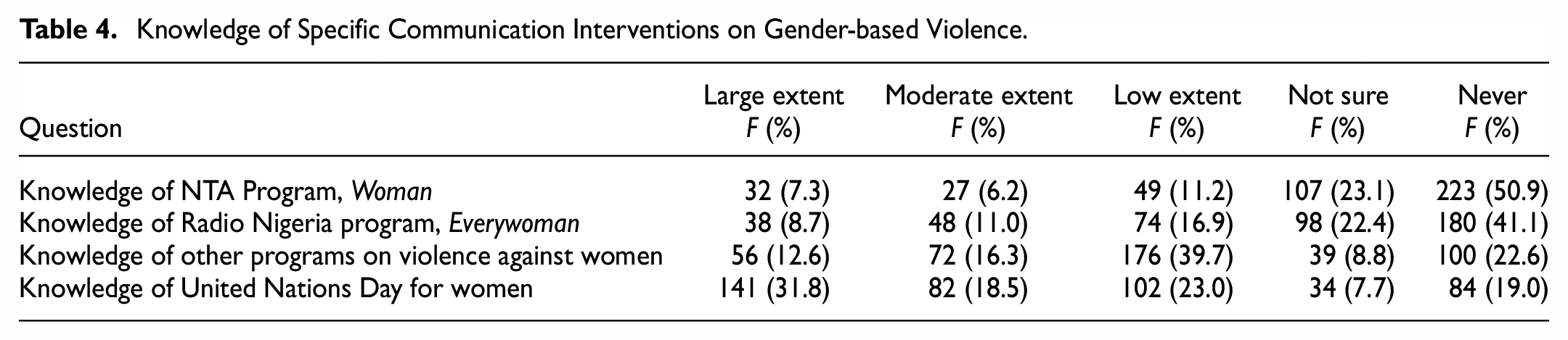
Most of the respondents reported having low knowledge of specific media programs on women such as Woman on NTA or Everywoman on Radio Nigeria. A cumulative 13.5% reported either high knowledge or moderate knowledge of the NTA program, while a cumulative 19.7% reported the same kinds of exposure for the Radio Nigeria program. As indicated above, the reported high exposure is likely caused by high exposure to gender-based issues during international days devoted to women. Just over half of the respondents (50.3) reported knowledge of the United Nations Day for Women. Away from knowledge of specific campaigns, Table 5 presents data on knowledge of message components in the campaigns.
Credibility Assessment of the Message Components in Media Campaigns on Violence Against Women.

Most of the respondents (83.3%) identify wife battery as a form of violence frequently emphasized in the media. The majority (30.6%) of them acknowledge this to a large extent. Themajority (65.5%) of the women admit that media messages often define violence against women, though some of them in a later question (32.2%) say that they are yet to know what violence against women entails. While more than 50% of the respondents (51.6%) reject the statement that the media overstress violence against women, at least 30.3% accept the claim that some of the things said by the media in campaigns on violence against women may not be true. In addition, almost the same number (30.5) reports that media campaigns on violence against women seem to be over-protecting women. Table 6 presents data on the influence of the messages.
Level of Influence of the Campaign on Violence Against Women.

As already foreshadowed in the items above, a large majority of the women (70.9%) indicated their readiness to a large or moderate extent to report acts of violence against them based on media messages. However, an insignificant number (15.8%) has ever done so to the same extents in the past, implying that the reported readiness may be facing some obstacles as shown in Table 7. This is also evidenced in the response where at least 29.7% once felt like reporting but could not do so, while at least 76.5% think that they are content with being sensitized by the media and cannot do much else to help women. Others think that they have not been well informed about what can be called gender-based violence (32.2%).
Factors Affecting Women’s Responses to Media Campaigns on Gender-based Violence.

The majority of respondents (64.8%) are either not sure or do not have any channels that have dedicated programs on gender-based violence. Most of the respondents (67.3%) indicate that they stumble upon the programs rather than plan to watch. More than half of the respondents (55.7%) accepted that to some extent, cultural perceptions of the woman in Igboland affect their attitudes to media campaigns on gender-based violence. This is also evident in the response where 38.9% admitted that they have once been warned by people (especially spouses) about believing some of the things said in the campaigns against gender-based violence. Religion appears to play a similar role given that 54.7% reported to some extent that some of the things said in the campaigns are against religious principles.
Hypothesis 1
Demographic Characteristics Will not Significantly Predict the Influence of Media Campaigns on Gender-Based Violence on Women in Southeast Nigeria
The generalized linear model was used to ascertain the influence of demographic attributes of the respondents on the attitude toward media campaigns on gender-based violence. The predictors are age, marital status, occupation, education, annual income, and social status of the respondents. The results of the Omnibus test indicate that the overall generalized linear model is statistically significant and suitable for predicting attitude of the respondents to the media campaigns against gender-based violence considering the demographic factors.
The tests of model effects (Table 8) show that occupation, education, annual income and social status, at p-value less than .05 level of significance (p < .05), significantly predict the attitudes of the respondents toward media campaign against gender-based violence against women in Southeast Nigeria. However, age and marital status were shown not to significantly predict the attitudes of the respondents.
Predictors of Attitudes to Media Campaigns.

Note. Omnibus Likelihood ratio Chi-square = 85.749, p = .00, df = 27.
The parameter estimates (Table 9) show the specific types of occupation, levels of education, annual incomes and social status which significantly predict the attitudes of the respondents toward the media campaigns against gender-based violence. The redundant parameters were set at zero. The significant educational qualifications include high school, Diploma/National Certificate of Education (NCE) and First Degree (BSc). The significant occupations include artisan/craftsman, trading, farming and student. The significant annual incomes include 200,001 to 300,000, 300,001 to 400,000, and above 400,000. The significant social status is upper class.
Parameter Estimates for Demographic Characteristics Predicting Respondents’ Attitudes.

Hypothesis 2
Knowledge of the Campaign Messages is not Significantly Correlated With the Influence of Media Campaigns on Gender-Based on Women in Southeast Nigeria
The hypothesis was evaluated using the Pearson correlation coefficient. The significance of the relationship was tested at .05 level of significance. The results are presented in Table 10, where N is the number of women who provided responses to the items for the hypothesis.
Correlation Analysis of Knowledge and Influence of the Campaign Messages.

The results in the table show that the hypothesis has a correlation value of .018 and p-value of .702. This correlation value is very low and may be inconsequential, indicating that there is no link between knowledge of the media messages and influences of the campaign messages. Moreover, with the p-value being less than .05 (p < .05), the relationship between the two factors, knowledge and attitudes, is not significant.
Discussion of Findings
The focal point of the study is on the responses of women in Southeast Nigeria to media campaigns on gender-based violence. In addition to many studies on awareness, occurrence and causes of violence against women, the study adds the dimension of women’s attitude to media interventions on gender-based violence. This is done in light of accusations that women do not substantially resist violence against them. The study measures attitude in terms of women’s exposure to, assessment and uses of the campaign messages. The study reveals that the respondents are generally well exposed to the media campaigns on gender-based violence. However, high exposure appeared to relate more to acquaintance with programs and messages given out on international days for women than to specific campaigns. The majority of the women were likely to be exposed to such messages given that 43.4% of them have attained at least tertiary education. Most of the women thus reported low knowledge of specific media programs on gender-based violence such as Woman on the NTA and Everywoman on Radio Nigeria. The majority do not also accept that they have dedicated channels for receiving programs on gender-based violence. A dedicated channel was defined to the women as one which mainstay is a women affair or which is known to regularly carry programs on women.
By implication, since the NTA and Radio Nigeria are received across the country, knowledge of the existence of such programs on the channels, rather than their absence, is the more likely factor affecting exposure to, and knowledge of, media campaigns on gender-based violence despite the response on high exposure. This may be the reason for the acceptance by most of the respondents (67.3%) that they stumble upon programs on women rather than plan to watch. This though is recognized in the study as a factor inhibiting knowledge of media campaigns on gender-based violence.
The findings point to the concern raised by scholars that an effective campaign influences behavior through audience direct exposure to the persuasive campaign messages (Coffman, 2002; Fawole & Asekun-Olarimoye, 2005; Hornik & Yanovitzky, 2003). Studies indicate strong positive correlation between audience exposure to media portrayals of violence against women and public perception of its (violence) importance (Avis, 2017; Oyediran & Isiugo-Abanihe, 2005). In the present study, there was no relationship between knowledge of the media messages and influences of the campaign messages. This is likely as result of the type of knowledge shown by the women as noted above; that is, high exposure appeared to relate more to acquaintance with programs and messages given out on international days for women than to specific campaigns.
Assessment of the messages by the respondents in the present study showed that the women put emphasis on wife battery as the issue most mentioned in the campaigns. This may have a link with the high incidence of wife battery experienced in Southeast Nigeria according to studies (Oyediran & Isiugo-Abanihe, 2005). The respondents also tended to acknowledge that the media does not overstress gender-based violence and that media messages are true. However, given the number of respondents who specified otherwise, there is still considerable indication that some women have negative attitude toward the campaign to end gender-based violence in line with the existing literature on attitudes to violence against women generally (ActionAid, 2015; Igbolekwu et al., 2021; Owusu Adjah & Agbemafle, 2016; Oyediran & Isiugo-Abanihe, 2005; Vagianos, 2017). In another study on “exposure to violence and beliefs about violence against women in Nigeria and South Africa,”Fakunmoju and Rasool (2018) found that the majority of respondents believe that corporeal abuse of women is acceptable because women have been socialized to endure abusive relationships in order to keep their marriages/relationships together.
Despite the indication by a large majority of the women of their readiness to report acts of violence against them based on the campaigns, an insignificant number has ever done so. This is another indication of low agenda setting effect. Furthermore, the reported readiness may be facing some obstacles as shown in the response where some of the women once felt like reporting but could not do so. Moreover, the majority think that they are content with being sensitized by the media and over a third of the respondents say that they have not been well informed about what can be called gender-based violence. In support of this finding, Igbolekwu et al. (2021) evaluated violence against women in rural settings in Nigeria and found that many do not know if they have been abused mainly because they may have accepted men’s abusive behavior as normal. This can also be linked to some factors identified by the women such as culture, religion, and spousal attitudes.
Many scholars see this situation as critical because the abused tend to welcome subservience, leading to underreporting of violence against women (Fakunmoju & Rasool, 2018; Owusu Adjah & Agbemafle, 2016; Oyediran & Isiugo-Abanihe, 2005). As earlier noted, issues like rape and child marriage are no longer news in sub-Saharan Africa as a result of deep-seated cultural perception of the woman as a sex object (ActionAid, 2015; Chukwu et al., 2014; Jewkes et al., 2017; Metaj-Stojanova, 2017).
As it is, responses to media campaigns on gender-based violence is not in line with the feminist perspective, which is based on the recognition, especially by women, of the importance and relative status of the female folk and the need to improve on the perception and attitudes toward them (Ropers-Huilman, 2002). The present study shows that the respondents have yet to react positively toward the disadvantaged positions of women and the various factors affecting their opportunities to achieve their full potentials relative to men as noted other studies (Ropers-Huilman, 2002; Ukonu & Ajaebili, 2021).
The demographic attributes of the respondents played significant roles in the present study, and may be important in understanding the type of agenda the media has set, as well as in managing future media campaigns. In fact, Markowitz’s (2003) study recorded the importance of demographic attributes to audience responses to media campaigns. Socio-demographic factors such as age, education and religion have also been linked with attitudes to violence against women (Igbelina-Igbokwe, 2013; Lee et al., 2005). As earlier noted, studies indicate that race and ethnicity were found to have significant influence on attitude toward violence against women, but such influence was also significantly diminished by socioeconomic variables and education (Hargreaves, 2006; Lee et al., 2005; Nagel et al., 2005). Education and exposure to violence have therefore been linked with differences in attitude toward violence among boys and girls of different ages (Ashimolowo & Otufale, 2012; Flood & Pease, 2009).
Notably, in the present study, occupation, education, annual income and social status significantly predicted the attitudes of the respondents toward media campaign against gender-based violence. However, age and marital status were shown not to significantly predict the attitudes of the respondents. Specifically, higher education levels, being a student and higher income levels predict the attitudes of the women. Conversely, whatever the age and marital status, women were likely to behave in the same way toward gender-based violence. That behavioral pattern, according to the study, is predominantly cognitive response without concomitant behavioral change response. The most important effect of the campaigns therefore is cognition. Agenda setting, using the campaigns, have worked at the level of sensitization.
Conclusion
The study found high exposure to the campaign on gender based violence, which did not translate to knowledge of specific campaigns and specific message contents. General knowledge of the campaign neither had significant positive influence on attitudes toward the campaign against gender-based violence. The factors negatively affecting women’s attitudes to communication interventions align with the general negative attitude to gender-based violence in Southeast Nigeria, and explain the urgent character of the situation as noted by scholars. The delicate relationship between accepted cultures and suppression of women would have dire implications for international developmental agenda for women, for attitude change in men, for feminism, and indeed for women’s attitude toward the fight against gender-based violence. This must become a fundamental consideration in communication interventions on gender-based violence, especially in the area of dedicating targeted campaigns to gender-based violence in Southeast Nigeria as different from general media programs and messages given during women’s international days.
Cultural issues in the perception of women in Igbo land must be woven intricately with issues in feminism (such as gender equality) and attitude change (such as proper perception and greater resistance of women toward gender-based violence) in articulating campaign objectives. Considerations must be given to the key factors of attitudes to violence against women in general such as fear, spousal and community rejection, women’s socioeconomic status and age. Future studies can explore media consumption patterns of women in Southeast Nigeria, which can help in recommendations toward higher and more direct exposure to media campaigns on gender-based violence.
Limitations of the Study
The study cannot make its generalizations based on specific campaigns and specific message components. This would require that a quasi-experiment in which the respondents are exposed to media campaign messages after which they are given questionnaire to complete. This method assures more valid findings about specific messages and their impacts on knowledge and attitudes.
Footnotes
Declaration of Conflicting Interests
The author(s) declared no potential conflicts of interest with respect to the research, authorship, and/or publication of this article.
Funding
The author(s) received no financial support for the research, authorship, and/or publication of this article.
Ethical Approval
Ethical approval for the study was granted by the Faculty of Arts Ethical Committee, University of Nigeria, Nsukka, with the number (FARECUNN/110121). Two experts from a Department of mass communication in a Nigerian university who are also senior lecturers validated the research instrument, which also had a reliability efficiency of .72 using the Cronbach’s coefficient alpha method.
