




Abstract
This study investigates the most important technological tools and techniques that have been introduced in some organizations in the Kurdistan Region of Iraq and compares those tools and techniques with that of the departments that still rely on a manual system. The research claims that technology, aside from its role in facilitating communication between employees and clients, is a potent force for fighting bureaucratic inefficiency and corruption and contributes to reassuring employees and clients. Theoretically, this research relies on an interdisciplinary approach which represents the connection between technology and human behavior, convenience, facilitation, and productivity within the administration communication systems. This research has adopted mixed-method approaches such as semi-structured interviews, participant observation, and surveys (n = 422) as data collection tools, and it also analyzes data collected by thematic analysis as the main method of ethnographic study. The research finds that the communication tools can significantly contribute to administrative services and fight corruption, although such techniques have not been applied in Iraqi Kurdistan. The majority of the respondents recommended expanding technology tools in all organizations as there are no significant obstacles to introducing them even among the organizations that do not have requisite technology skills.
Keywords
Introduction
There are considerable connections between communication tools and fighting bureaucratic corruption (Aneke, 2012; Bussell, 2010, 2012; Remenyi, 2002). The use of advanced technology has been a feature of life in many developed countries for decades, and is essential for providing fast and effective services. In this research, several kinds of communication technologies have been found to effectively contribute toward administration communication. This includes online applications, email services, widespread computerized database, application of the electronic system, closed-circuit television (CCTV), traffic enforcement cameras, queuing machines, devices to record and arrange interviews between employees and clients, mobile and money transaction systems, online shopping, digital assets, and so on. In general, technological tools can develop administration systems, meaning they boost human productivity, energy, resources, and finances. This argument is strongly supported by the interdisciplinary approach (Brézillon & Gonzalez, 2014). Alongside this, such tools can pave the way for terminating bureaucratic corruption in developing countries.
Using technological tools can make a major contribution to administration and governing and fight bureaucratic corruption, although majority of publications have neglected this contribution of technology as there is no clear vision of how to fight bureaucratic corruption using this means. The present study identifies the contribution of technology and brings it into focus, and it allows its implementation in other developing countries that are similar to Iraqi Kurdistan, particularly, in terms of social and organizational culture; accordingly, this study will conduce to eradicating bureaucratic corruption in developing and not well-developed countries including Iraqi Kurdistan and developing countries. The political economy of Kurdistan has been monopolized by the two political parties, namely the Patriotic Union of Kurdistan (PUK) and the Kurdistan Democratic Party (KDP). Such a system leads to corruption, bureaucracy, overemployment, and general lack of social justice (Bali, 2016a). For the theoretical consideration and for developing the conceptual framework, this study reviews researches that have studied experiences of utilizing technology.
Literature Review
Corruption is viewed as a global issue and connected more to developing countries. These countries suffer from some aspects and serious issues which have been used to discuss corruption such as “institutional quality,” “quality of government,” and “state capacity” (Smith, 2007). Rothstein and Varraich (2014) present an umbrella concept of corruption through analyzing some related concepts such as “clientelism, patronage, patrimonialism, particularism and state capture onto one spatial field” (p. 1). The present study focuses on bureaucratic corruption which is defined by many scholars as a social cataclysm causing countries to stagnate. For example, Hope Sr (2016) describes bureaucratic corruption as being “an evil, shameful, and despicable phenomenon which impairs administrative capability and impedes social stability and economic development” (p. 6). Zaloznaya (2017) refers to bureaucratic corruption mainly from the nature of the political system; he argues that these “regimes combine diverse political institutions that range from liberal-democratic to authoritarian and totalitarian” (p. 27). Conversely, Obidairo (2016) argues that bureaucratic corruption is more deeply rooted in societies’ structures and authorities that particularly strive to attain or maintain power. From the above explanations, it can be concluded that bureaucratic corruption is an illegal practice of abusing authority to acquire illicit personal benefits and fraudulent advantages whether directly or indirectly, and this problem is strongly related to fundamental ethical principles, personal values, culture, and weakness of political system, and administration with transparency and accountability.
Recently, developing countries have started realizing the benefits of using technology to reduce bureaucratic corruption. In this respect, Bussell (2012) explains that Indian local governments have introduced technological tools into their administrative and communication systems to provide public services that reduce corruption. Similarly, Information Resources Management Association suggests that utilizing technological tools reduces the burden on citizens, particularly in developing countries. This association believes that the higher cost required for transaction costs can be considered as administrative bureaucracy, and is viewed as a form of corruption (Management Association, Information and Resources, 2015). Aneke (2012) concludes in his research conducted on the role of communication technology in Africa that financial aid does not dramatically aid the continent’s development, unless it involves the technology means in the local departments to reduce corruption and bureaucracy.
Technology has been considered a major factor in helping shape good governance, and it makes provision of services faster and more efficient. Therefore, it reduces waiting time significantly that consequently make customers have a positive perception about government performance (Saeed, 2013). In a similar context, Liebowitz and Mehdi (1997) contend that the technology tool ticket vending machine employed by the local transportation companies make a huge profit to these companies and also engender a positive feeling in customers toward the companies’ performance. They conclude in their research that such technology tool contributes to a decrease in queues and waiting time for services, and using technological tools prevents arguments, interaction, and conversation between employees and clients. Moreover, they indicate in their research that using technology secures a positive image and reputation for enterprises. Technology thus helps to provide rapid service delivery and less corruption as the clients tend not to rely on mediation and nepotism to receive the service or to purchase travel tickets in unauthorized way. Similarly, in the banking sector, Khosrow-Pour (2006) suggests that introducing technology into the banking database and system achieves positive results because it provides a fair and equitable treatment to customers during the registration process and access to services. As the customers do not need to interact and directly communicate with the employees, less mismanagement arises. Despite the fact that ticket machines were introduced as early as the 1990s in transportation sectors and some other sectors in some countries, service provision in most organizations in Iraqi Kurdistan is still based on manual and traditional processes. Another technological contribution in fighting corruption is the transparency, which can be ensured through the widespread application of databases and technology in departments and organizations. In this regard, Waring and Morgan (2007) prove that the introduction of technology in companies allows shareholders, businessmen, and shop owners, among others, to monitor the transaction of money and deals because technology provides a database of any developments in the circulation of sales. In a similar context, Campos and Pradhan (2007) explain that such tools allow many possibilities for owners of companies and small shops to monitor fraud, corruption, and mistreatment of customers due to the contribution of e-mail services, telephones, and security and surveillance cameras to record cases of grievance and monitor interaction between employees and customers. Likewise, the Organisation for Economic Co-Operation and Development (2005) reports about fighting corruption and promoting integrity in public procurement—online shopping improves more efficiency for consumers to have access to shopping and directly buy goods or services from a seller over the Internet, supports transparency and promoting integrity in public tenders, and reduces corruption. This organization suggests that all governments worldwide should abide by and adhere to the introduction of technology to promote integrity and fight corruption that steadily leads to good governance. Regarding the perception toward a government, technology contributes to portraying a positive image of a government and establishing a good reputation for building a robust relation between both sides: a government and the public based on mutual trust. Bhatnagar (2004) argues that the application of the electronic system helps to project positive images of governments, especially in regard to payment, taxes, and fees.
The electronic system provides a computerized database with rich details about clients in relation to the payment of taxes and fees, and provides the opportunity for stakeholders and non-stakeholders alike to see and examine the circulation and movement of tax payments, particularly in democratic systems that demand transparency and integrity. In this aspect, Bhatnagar (2004) finds that the change in paying taxes from traditional/manual systems to the electronic ones in one of the India’s states leads to an increase in tax revenue from US$12 million to US$50 million in 6 months. Remenyi (2002) asserts that such a system reduces a large backlog even in developed countries like the United Kingdom. In his research, he clearly illustrates that electronic systems are extremely effective as saving-time tools, particularly in organizing employees, irrespective of where they are applied—developed or developing countries: in the United Kingdom, India (Sabharwal & Berman, 2013), Pakistan, Bangladesh, and even in the African context (Aneke, 2012). In providing such services, there are a range of tools available including closed-circuit television (CCTV), queuing machine, devices to record and arrange interviews between employees and clients, emails, mobile devices and money transfer systems, electronic shopping, and so on.
In Iraqi Kurdistan, the communication tools that are used in communication processes between employees and clients are generally quite limited; only queuing machines and CCTV have been recently introduced in a few government departments and some private sector institutions. A major problem with introducing new technology in administrative communication is that a significant number of people in Iraqi Kurdistan is illiterate (Bali & Abdullah, 2017), and thus cannot use such technology easily and would encounter a number of obstacles, especially in the beginning of the process of technologizing governing systems. Moreover, the majority of people are not familiar with the communication technology that is used in the administrative communication process. This research documents the perceptions of employees and clients regarding the benefits of technology in the administrative communication process. This breaks new ground in how to initiate and develop utilizing technology in administrative systems, whether in Kurdistan, Iraq, in general, or other similar countries in terms of social and administrative contexts. In doing so, it is assumed that the employees and clients will not be comfortable with new technology from the outset, but will gradually entail adapting the process.
The concept of using technology in administrative communication is new in Iraqi Kurdistan, and there is no publication currently that focused on the possibility of using the technological tools in an administrative field in the Kurdistan Regional Government (KRG). This research determines the serious obstacles to using technology and recommends how to introduce and expand technological tools in Iraqi Kurdistan as a case and in developing countries in the future. The research findings are discovered through adopting a mixed-method approach such as conducting semi-structured interviews, participant observation, and surveys (n = 422; as data collection tools), and analyzing data collection by thematic analysis as the main tool/method of ethnographic study.
Research Questions and Hypothesis
On the basis of the literature review and aims of research, three questions and three hypotheses are presented as follows.
Research Questions
As there is insufficient data about the use of such tools, particularly in administrative communication, answering this question will help discover the extent of adaptation and also provides an indicator to design and expand using technology in other departments that still rely on the traditional and manual approaches. This will be of immense benefit, because it is assumed that the benefits of adopting technology in this field will significantly outweigh the disadvantages. Moreover, it has been emphasized in the literature that such technology has made a huge contribution toward processing people’s administrative/clerical work quickly, reducing nepotism, and protecting not just the image but also the environment of the departments, particularly in the Kurdistan context.
This question is based on the general assumption that applying such technological tools will ensure fairness among clients during the process of their applications, not to mention a strong possibility of higher level of satisfaction among clients as well as employees because of avoiding the traditional approach, nepotism, and subjective judgments. Answering this research question is crucial in understanding why people are not content with the way governmental administrations operate, especially with regard to having their administrative work done in the government organizations. To answer this question, clients’ and employees’ perceptions, on using technology to achieve satisfaction and efficiency of services, are analyzed.
This research question will help in understanding the major problems with technology implementation and offer recommendations for designing and expanding technology in the future.
Hypotheses
Along with the research questions presented, this study tests three hypotheses on the basis of the collected data in the survey applying to employees and clients. These hypotheses shed light on the study’s underlying arguments.
Method
This study is based on inductive logic and aims to understand the degree of technology use in administrative communication to provide recommendations for promoting using such technology in Iraqi Kurdistan and other similar societies. In this research process, mixed-methods approach is adopted. Hesse-Biber (2010) found that such approach enables the “qualitative researcher to create quantitative measures from their qualitative data” (p. 1). Moreover, as Denscombe (2010) notes, mixed-methods enable the researcher to develop the research tools and design a variety of research questions. Surveys, semi-structured interviews, and participant observation are among the existing tools of mixed-methods employed.
Semi-Structured Interviews and Participant Observation
These two methods are used for data collection and both are appropriate to social science studies (Gold & Nawyn, 2013). Sappleton (2013) suggests that semi-structured interviews and participant observation provide an opportunity for the researcher to deepen the study of new phenomena in a way that can determine the causal factors of the phenomenon. It also allows the researcher to more comprehensively explore the possibility of utilizing technological tools and expand their use to develop the administrative communication process. In conducting this research, semi-structured interviews are primarily adopted to collect data from employees. This method is highly suitable for this type of research because it does not require long interviews when employees do not have much time (Newing, 2010; Wilson, 2013). Four government organizations were selected in Sulaymaniyah—one of the major cities in Iraqi Kurdistan. These departments include three hospitals, the Passport Directorate of Sulaymaniyah, and the Trade Bank of Iraq private company; the two latter organizations rely on queuing machines to organize their clients. Simultaneously, two major supermarkets were also selected as companies which rely on databases and CCTV. A total of 30 respondents were interviewed during August to November 2016.
Survey
The survey method adopted in this study was carried out in March 2017 among people aged 18 and above. Of the 500 questionnaire sheets distributed, a total number of 422 participants fully completed the questionnaire. The sample was a probability sample, which means all members of the population had the same chance of inclusion (Becker, Bryman, & Ferguson, 2012; Lampard & Pole, 2015). Consequently, the result from the respondents represented the population as the whole (Bryman & Bell, 2015). The questionnaire consisted of two sections. The first one included demographic backgrounds of education, age, and profession. The education variable was divided into educated and not educated/illiterate, which clarifies how they deal with technology. The age category was divided into three variables: youth (18-30), middle age (30-50), and people aged 51 and above. The profession variable had three categories: public sector, private sector, and unemployed. The second section consisted of seven questions based on three responses (agree, neutral, and disagree). Six questions were designed to test the hypotheses and analyze the perception of respondents regarding the use of technology in administrative communication.
Methodology for Measuring Hypothesis
An independent-sample t test has been used to test the first hypothesis and the one-way ANOVA model to test the second and third hypotheses. The one-way ANOVA is the most commonly used model to test variables consisting of three to four categories, such as education, age, and political background (Weinberg & Abramowitz, 2008). To test the three hypotheses, six variables that represent the use of technological tools in fighting administrative corruption were used (see Table 2). The first hypothesis represents where people are employed: employees in government organizations, employees in private companies/self-employed, and people who wanted to have their administrative/clerical work done whether in government organizations or in companies. The second hypothesis represents “educated” and “uneducated” people. Many people in Iraqi Kurdistan did not receive education, especially senior citizens, and therefore, it may be predicted that they face more difficulties compared with “educated” people with regard to using technology. The third hypothesis focuses on age: youth (18-30), middle age (31-50), and people aged 51 and above.
Results
Utilizing Technological Tools in Administrative Communication and Their Contribution in Fighting Bureaucratic Corruption
This section discusses the first research question. The technological tools employed in public sectors are limited in developing countries. Only a small number of organizations in Iraqi Kurdistan are using these technologies, and not necessarily in all their departments. There are three primary reasons for this fact: First, in most departments, some administrations or employees voluntarily use technology on a personal level rather than being systemized or instructed by their organizations. Second, there is not a sufficient number of employees with the expertise to effectively manage websites and computerized databases for processing people’s administrative/clerical work. Third, the government has not provided Internet service to all departments, not to mention the Internet’s very poor quality. Some organizations admit using Facebook to contact their clients. This allows private and other serious information to be placed on a platform that can be easily accessed and exploited. In this regard, one employee in the Passport Directorate of Sulaymaniyah claimed, “We publish information and announcements on our website and Facebook but most people still do not know about our website, and the public does not believe what we publish” (personal communication, August 20, 2016). A visitor who was there to renew his passport was asked about this claim; he responded, “I didn’t know that they publish such announcements on the Internet and I don’t think people know that” (personal communication, August 20, 2016). This suggests that technology has not yet become a private means of communication between the government and the public, together with the fact that many still are not aware of the availability of such a service.
Developed countries would not need to resort to social media to communicate with citizens, as they tend to process most citizens’ administrative work online or through the post. In Iraqi Kurdistan, every individual must visit government organizations at least twice to have their administrative/clerical work done. Few departments have database to electronically save documents; they use computers only to write and print out letters and references. Queuing machines and CCTV are employed in few departments such as Passport Directorate of Sulaymaniyah and Northern Bank of Iraq. The Traffic Police Department has introduced traffic enforcement cameras to detect traffic regulation violations and automatically input them onto the database. One traffic police official claimed, “This machine reduces the possibility of embezzlement by traffic police” (personal communication, August 20, 2016). In regard to the remarkable contribution of CCTV, one of the interviewees working in the Technical Department in the University of Human Development stated that “CCTV totally solved several problems facing the university, namely damaging the university’s equipment by students” (personal communication, October 20, 2016). Despite the fact that CCTV is now considered essential for security purposes, it is still not used by the majority of organizations, whether in the public or private sectors. In short, the findings indicate that there is a strong connection between introducing technology and fighting bureaucratic corruption; the use of technology is nevertheless limited and still not widely adopted across the departments; and a significant challenge lies in processing citizens’ administrative/clerical work electronically.
Technology as a Factor of Satisfaction and Efficiency of Services
This section examines the second research question with regard to how technology contributes to fight bureaucratic corruption and to the overall level of satisfaction of employees and clients. Table 1 indicates that 91.7% of respondents agreed that using technology for processing their administrative/clerical work would make them contended, 3.8% were neutral, and 4.5% disagreed (see Table 1). Alongside this, the interviews’ outcomes and observations demonstrate that the majority of employees would like to introduce technology into administrative communication for three reasons. First, technology increases greater transparency. In this regard, one of the interviewees working in the police traffic department stated, “the Passport Directorate introduced queuing machines to organise clients, which ensures greater honesty and transparency” (personal communication, August 20, 2016). Similarly, a mall owner noted that “technology such as databases and CCTV allow the shop owners to observe the behavior of their workers while at work” (personal communication, November 5, 2016). Second, technology helps to ensure justice among clients receiving services. This point was observed in the Passport Directorate, as one of the interviewees who was there to get passports for their children claimed, “the queuing machines assure clients receive a fair service” (personal communication, August 20, 2016). It was observed that even with more than 100 clients in the reception hall, the crowd was peaceful and orderly. By contrast, most other government departments that do not use queuing machines cannot manage even 10 clients without noises, uproar, or disturbance, and many clients receive an unfair or preferential service. As the findings of the survey indicate, most respondents, 95.3%, agree that technology ensures justice, only 2.5% disagree (see Table 1). The reason behind the 2.5% may be that there are very few people who prefer to get service in the organizations as quickly as possible, particularly at the expense of others. Table 1 shows that 8.1% of the respondents disagreed about the perception that technology can reduce mediation and nepotism. This indicator is not a significant number, but proves that there are still obstacles for successfully implementing technology. In this respect, one of the employees claimed, “the queuing machines have helped us to organise clients; however, some clients prefer being unfairly privileged, even if this act makes them being served quicker by only few minutes” (personal communication, August, 20, 2016). The third reason why respondents prefer technology is productivity. The majority of the employees stated that technology generally assists administration to service clients more efficiently. As Table 1 shows, most of the respondents, 92.9%, agreed that technology is more productive, with only 1.4% neutral, and 3.3% disagreeing. Regarding the role of CCTV, most respondents had a positive view on it, although there is an argument against using CCTV of not being in line with confidentiality and personal privacy (Dwyer, 2012; Friedewald & Pohoryles, 2016; Kuschewsky, 2012). Table 1 indicates that 92.9% of the respondents believed that CCTV reduces nepotism and mediation, 4.3% were neutral, and 2.8% disagreed. To sum up, the respondents had a positive view about technology being operated in administrative communication. For example, 95.3% of respondents agreed that technology should be generalized and practiced in all government organizations and companies, while only 1.4% were neutral, and 3.3% disagreed.
Respondents’ Attitudes Toward Using Technology to Fight Bureaucratic Corruption.
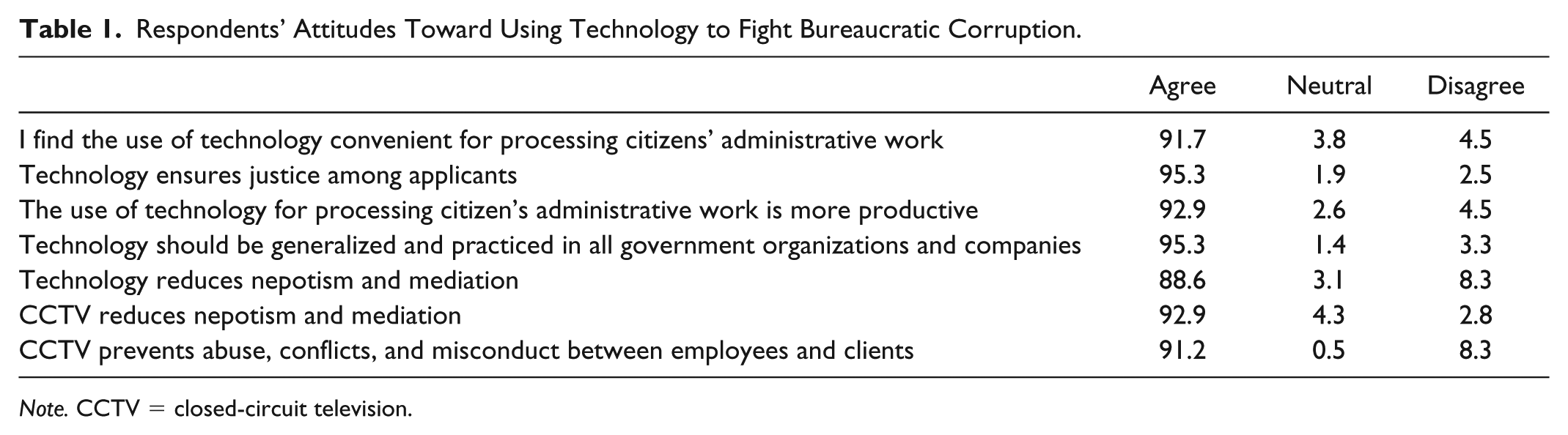
Note. CCTV = closed-circuit television.
The KRG is heavily involved in widespread bureaucratic corruption. This study reveals that three major factors are associated with this issue. The first factor is the lack of accountability. The KRG has a reputation for being biased, employing people on the basis of their political beliefs and affiliations. The two political parties, the KDP and the PUK, have been ruling the KRG since 1991, completely dominating the important government sectors (Bali & Abdullah, 2017). These two parties in power interfere negatively in government policies and do not leave any decision to the government organizations. They recruited more staff based on how close they were affiliated to their parties rather than on their expertise or on what they could deliver. This created a net of corruption—headed by high-ranking officials (Bali, 2016b). For example, chief executives, who were appointed by one of the ruling parties, used their authority to employ friends and relatives which has led to rampant favoritism, nepotism, political patronage, and corruption. These chief executives surround themselves with employees who support them in case of corruption accusations against them despite the fact that many of them are never even subjected to investigations. This claim is proved correct by the fact that in Iraqi Kurdistan, there are many cases that are still not prosecuted for favoritism, nepotism, or patronage. In this regard, a disgruntled client in a government department stated that he was rejected to be served properly and was confronted by an employee saying “We don’t care whom you complaint to!” (personal communication, September 15, 2016). These employees are never given verbal/written warning by their managers, and they blind themselves to their manager’s corruption acts in return.
The second factor of bureaucratic corruption relates to cultural perspectives. Some citizens believe that they have to be granted the privilege of having their administrative/clerical work done before others or being provided with better services by their relatives in government organizations at the expense of others. In the context of Kurdish culture in which Kurds highly appreciate and place a great emphasis on collectivism (Sofi-Karim, 2015), employees are under pressure to treat their relative differently with more consideration and respect than others, otherwise it may negatively affect their social lives. However, some employees do so to gain considerable prestige, to win their favor, or in hopes that a favor will be returned in the future. This research discovered that the organization that used technology left almost no chance to these kinds of people because the employees did not have much interaction person-to-person with their clients. So technology can play a significant role in employee satisfaction, reducing bureaucratic corruption, and fading negative cultural perspectives when new rules come into force.
And last but not least, the third factor of bureaucratic corruption relates to personal values. Despite the fact that according to Kurdish people’s values, it is looked down upon and considered dishonorable to offer or accept bribes, some people resort to favoritism because they are uncertain about having their administrative/clerical work done normally. This has created a misconception that, surprisingly, bureaucratic corruption is considered somewhat acceptable by the government employees’ values because they do not do it for payment. However, seldom does bribery occur in the KRG’s organizations unlike the Iraqi’s organizations where bribery is moderately common.
Obstacles to Expanding the Use of Technology
This section examines the third research question, which focuses on expanding technology in administrative communication. During the data collection, it was observed that the obstacles are related to three factors. First, there are a significant number of people, especially the older generation, who are illiterate and cannot fill out applications online. However, this issue can be resolved by assigning some employees to help this demographic, along with gaining the assistance by their families. In Iraqi Kurdistan, most routine administrative applications are filled out manually. A process of online application reduces the cost, yet this system still has not been implemented; on top of that, people also cannot deal with their paperwork throughout a postal service because there is no postal system in Iraqi Kurdistan. The second factor is the lack of Internet service—the Internet is unavailable in the majority of the government departments, and its quality is very poor and inconvenient. The third factor is the lack of professional employees who can successfully manage technology and deal with people’s administrative/clerical work. However, there are many graduates, with qualifications in administration and information technology, who will not be employed because the KRG has halted employment since 2010, whereas the two political parties in power, the KDP and the PUK, committed to mass employments during 2003-2010, employing thousands of people to buy votes and stay in power (Bali, 2016b; Bali, Karim, & Rached, 2018), yet most of the people appointed were not qualified. This problematic policy led to this current fragile government. In spite of the obstacles that are presented, most respondents have a positive perspective, 91.7%, about applying technology in administrative communication, and this suggests that technology can be expanded, as 95.3% of the respondents agreed upon expanding and standardizing technology in other departments. This indication is an important one to be taken into account by the KRG.
Results of Hypotheses
Profession Differences and Perceptions About Technology
This section examines the first hypothesis, which predicted that people’s professions do not have influence on how they perceive the role of technologies in ensuring satisfaction, justice, productivity, reducing nepotism, and reducing misconduct, along with extending and generalizing technology. Table 2 provides evidence that the majority of the elements presented as criteria of this hypothesis are true and the profession differences were statistically significant at the p = .047 level, justice at the p = .001 level, productive at the p = .375 level, reducing nepotism at the p = .021 level, reducing misconduct at p = .001 level, and extending and generalizing technology at the p = .022 level (see Table 2). This indicates that the respondents statistically did not have different perceptions about the role of technology to increase productivity, which is at the p = .375 level (see Table 2). This means that the respondents whether clients or employees in public or private sectors believe that services will be more productive through technology, where the mean of clients is 1.12, employees in public sectors are at M = 1.10, and employees in private sectors are at M = 1.00 level (see Table 2). However, people generally do not have experience about the role of technology particularly in relation to increasing services. Table 2 demonstrates a small difference between respondents’ perceptions about the productivity of utilizing technology across the organizations. This proves people’s positive perception about technology and increasing service productivity.
One-Way ANOVA Model Reports People’s Perceptions on Technology, to Fight Corruption, on the Basis of Their Workplace.

Note. Values Sig refers to one-way ANOVA model and it is significant at p ⩽ .05. CCTV = closed-circuit television.
People’s Perceptions on Technology, to Fight Corruption, on the Basis of Their Educational Backgrounds
This section tests the second hypothesis, which looks at the educational backgrounds of the respondents and their perceptions about the role of technology in fighting bureaucratic corruption. Table 2 indicates that this hypothesis is true because it does not show significant differences in the perceptions of the respondents on the role of technology in reducing nepotism at p = .923, and the claim of expanding and generalizing technology at p = .701. There are statistical differences between educational background and other elements: obtaining satisfaction significant at p = .000, justice at p = .000, and productivity and reducing misconducts at p = .000 (see Table 3). There is also a general assumption arguing that people who are educated are more comfortable with technology than those who are not. Nevertheless, this does not mean that people who are not educated cannot adapt to new technology. Moreover, the data collected in the interviews and the observation process provide evidence that those who are not educated were pleased about utilizing technology by the organizations. More importantly, the respondents, regardless of their educational background, claimed that technology should be expanded and generalized, and there is no statistical difference at p = .701 as the mean of the category who are educated is 1.0 and not educated is 1.1 (see Table 2); this indicator, which should be highly considered by the KRG, proves that technology will be widely accepted as the respondents generally prefer it and claim that technology should be expanded and generalized with 95.3% agreed, 1.4% neutral, and only 3.3% disagreed (see Table 1).
The t Test Model Reports People’s Perceptions on Technology, to Fight Corruption, on the Basis of Their Educational Backgrounds.

Note. Values Sig refers to t test model, and it is significant at p ⩽ .05. CCTV = closed-circuit television.
People’s Perceptions on Technology on the Basis of Their Age Differences
The third hypothesis predicted that the perception of the respondents about the role of technology would differ according to ages. Table 2 indicates that this hypothesis is true by a small margin. There were significant differences in the respondents about the role of technology in creating satisfaction, reducing nepotism at p = .000, and expanding and generalizing technology at p = .009 (see Table 4). By contrast, the age variable had no significant role in the respondents’ perceptions on technology in particular relation to the other elements of the third hypotheses such as ensuring justice at p = .490, productivity at p = .275, and safeguarding against abuse between employees and clients at p = .208. This refers to the fact that the respondents, aside from their ages, believe that technological tools make a significant contribution to ensuring justice, where Table 1 reports that the respondents have positive perceptions about the role of technology in providing justice, 95.3%; productivity, 92.9%; and preventing abuse between employees and clients, 91.2%.
One-Way ANOVA Model Reports People’s Perceptions, on Technological Tools in Fighting Bureaucratic Corruption, on the Basis of Their Age Differences.

Note. Values Sig refers to one-way ANOVA model and it is significant at p ⩽ .05. CCTV = closed-circuit television.
Conclusion
The findings of this study provide a new insight into the role of technology in reducing bureaucratic corruption, particularly in developing countries or in countries that are not well-developed such as Iraqi Kurdistan, Iraq in general, and developing countries. Technologies used in administrative communication allow developed countries to improve the quality of service, especially in terms of providing services quickly at the lowest possible cost. Alongside this remarkable contribution, technology is a powerful tool in reducing corruption by providing standardized and objective services to all clients. The results found that the majority of employees are under immense psychological pressure to favor certain individuals, particularly relatives. Furthermore, nepotism and favoritism in Kurdistan have not socially entrenched and institutionalized yet. Both clients and employees claimed that they desire an equal chance of providing and receiving services. The problematic element here is that the use of technology is limited and the government has not introduced technology in all organizations, regardless of its benefits. Introducing and generalizing technology in the whole departments requires a decent Internet service and quality employees with technical expertise to offer a wide range of services. These highlighted issues have become most noticeable in the organizations of Iraqi Kurdistan, which have caused poor administration, bureaucratic corruption, and substandard services. Therefore, this study recommends that Iraqi Kurdistan and developing countries effectively employ technology to enhance the governments’ reputations in terms of management information systems, quality services, and the eradication of bureaucratic corruption. To put the policy into action, the KRG must establish technological tools, improve the Internet service, and employ graduates with high skills in information technology, as a subset of information and communications technology, to fill the skills gap of older generation employees that hinder the development of administration systems. The current employees in the government organizations should be engaged with activities to adapt to the new technologies that will be introduced in the administration systems because applying a new system requires robust electronic system as well as skillful human resources.
Establishing electronic systems by the KRG is a necessity and will be a crucial turning point in a campaign against bureaucratic corruption. Throughout these systems, the government can operate more successfully, and consequently, the public can do their administrative work electronically which causes the efficiency of the public services, productivity, and justice. Another major contribution of an online system for processing people’s application forms is that the employees and clients do not need to interact one-on-one and thus prevent mismanagement, favoritism, and biasing. Despite the important financial, administrative, and cultural advantages of technology, using technology requires some average skills; this can be a problem, especially for clients in Iraqi Kurdistan, who have a high level of illiteracy. This study recommends that the government should assign some employees to work with this category until they adapt to the changes. This issue has been taken into consideration as we assumed the educational level would have a role in determining the perceptions of the respondents toward technology. By contrast, the findings suggested that the respondents’ perceptions about the role of technology to reduce nepotism (at p = .895) were not influenced by educational backgrounds, the same for expanding and generalizing technologies in the whole department at p = .701 (see Table 3). These findings show that applying technology will not be a considerable problem for those who are not educated due to their positive perceptions about the contribution of technology, particularly in eliminating nepotism, which heavily represents bureaucratic corruption. Regarding people’s perceptions according to their workplace, the results suggest that there are differences in the majority of elements presented to test technologies. This is because the workplace variable comprised those working in the government departments, the private sector, and ordinary people with different experience and knowledge about technology. Nevertheless, the respondents do not statistically differ in their perceptions of the role of technology in increasing productivity at p = .375 (see Table 2). Regarding the age variable associated with people’s perceptions on technology, the results suggest no significant differences in half of the elements presented to test technology. This represents a positive indicator because it is always predicted that the new generation are more comfortable with new technologies. Conversely, this study identified that respondents did not differ in their perceptions about using technology, particularly in elements such as ensuring justice at p = .490, productivity at p = .275, and the role of CCTV in reducing abuse and conflicts between employees and clients at p = .208 (see Table 4).
Footnotes
Declaration of Conflicting Interests
The author(s) declared no potential conflicts of interest with respect to the research, authorship, and/or publication of this article.
Funding
The author(s) disclosed receipt of the following financial support for the research, authorship, and/or publication of this article: This research was funded by the Kurdistan National Research Council - Ministry of Higher Education and Scientific Research - Kurdistan Regional Government.