




Abstract
For nearly 7 years, universities in the Iraqi Kurdistan Region (IKR) have been implementing the Bologna Process (BP) under the Ministry of Higher Education and Scientific Research (MOHESR), yet its implementation lacks comprehensive academic evaluation. This study investigates the applicability of the BP in IKR English departments, focusing on challenges faced by instructors and administrative staff. Using a qualitative approach, semi-structured interviews were conducted with nine instructors, five administrators from four universities (University of Sulaimani, University of Halabja, Charmo University, and Soran University), and three members of the Higher Committee for Implementing the BP. Thematic analysis identified key challenges, including large class sizes, inadequate infrastructure, and difficulties adapting student-centred learning within the European Credit Transfer System (ECTS) framework. Other issues include workload pressures, time constraints, centralised directives, staff shortages, limited autonomy, and financial concerns. To address these, the study proposes a multi-pronged approach involving formal registration of IKR with the European Higher Education Area, adoption of new quality assurance standards, and increased government support. These measures aim to enhance transparency, award diploma supplements, and align with international standards, promoting graduate employability and international recognition of qualifications. This study contributes to improving the BP implementation in IKR English departments.
Plain language summary
For nearly 7 years, universities in the Iraqi Kurdistan Region (IKR) have been working on a new university system called the Bologna Process (BP), but there has not been enough review to see how well it is working. This study looks at how well the BP is being used in English departments in IKR universities, focusing on the problems faced by teachers and staff. The research involved interviews with nine teachers, five administrators, and three officials from the Higher Committee for the Bologna Process at four universities. The study found several challenges, including large classes, poor facilities, and difficulties using student-centred learning methods required by the Bologna system. Other issues included heavy workloads, time limits, lack of local control, staff shortages, and financial problems. The study suggests solutions like officially registering IKR with the European Higher Education Area, adopting new standards for quality, and increasing government support. These changes aim to make the education system more transparent, improve the value of degrees, and help graduates find better jobs internationally. This study aims to improve how the Bologna Process is implemented in English departments at universities in IKR.
Introduction
Universities, as Gayef and Hurdag (2014) claim, are the cornerstones of a nation, shaping the minds of future generations. Graduates of higher education (HE) are expected to possess a broad range of skills that enable them to contribute meaningfully to society. Furthermore, we believe that university instructors in the English Department (ED), along with administrative staff, play a crucial role in ensuring diverse representation and aligning research objectives with institutional goals.
In Iraqi Kurdistan, universities traditionally follow an annual system, consisting of a full academic year without breaks. This approach emphasises a broader range of subjects, with exams held at the end of each year (Akhund, 2021). Recognising the limitations of this system, the Ministry of Higher Education and Scientific Research (MOHESR) in the Iraqi Kurdistan Region (IKR) has identified the need for updates and institutional reforms. Stakeholders have opted to implement the Bologna Process (BP) in some IKR universities, based on their belief that the BP can enhance educational quality, as it has for institutions within the European Higher Education Area (EHEA). Furthermore, the BP facilitates curriculum reform in line with contemporary and modern standards (UNIMED, 2024).
Our study fills this research gap by exploring the BP from the perspectives of Kurdish EFL instructors, administrative staff in ED, and members of the Higher Committee for Implementing the BP at four universities in the IKR. As a first attempt, we focus on the challenges and experiences of these key stakeholders. The aim is to explore the challenges they face and to provide recommendations for addressing these obstacles, which will ultimately contribute to enhancing the employability of ED graduates. Understanding this topic can lead to improved practices, policies, and a higher level of implementation, ultimately enhancing the employability of ED graduates in the labour market. Moreover, participants for this research will be drawn from public universities and selected based on their geographical location and level of involvement in implementing the BP. The study seeks to answer the following research questions:
What challenges do university instructors encounter while teaching within the framework of the BP?
What difficulties do administrative staff face during the implementation of the BP?
How applicable is the BP to ED in universities in the IKR?
What potential solutions exist to address the challenges associated with implementation?
Finally, BP has become an emerging area of research in many universities in the IKR, with a considerable amount of research being conducted on the topic. Our study uniquely addresses the challenges of implementing the BP from the perspectives of university instructors, administrative staff, and stakeholders at the MOHSER in Kurdish universities—an area that has not been adequately explored in previous research. As the first investigation of its kind in the IKR, this study is crucial, as the BP is a new concept in national universities. It provides updated insights into the challenges of implementing the BP at the ED in the IKR.
A Concise Account of the BP
The BP is a key intergovernmental initiative aimed at creating a unified and harmonised HE system across Europe (Bartelse & Huisman, 2008). This reform seeks to enhance consistency, accessibility, and global competitiveness within the EHEA. The BP promotes coherence and standardisation in HE, aiming to establish the EHEA by 2010 (Brøgger, 2019; European Higher Education Area & Bologna Process, 1998; 1999; Gayef & Hurdag, 2014). Initially adopted by nearly 20 countries, it now includes 49 members. However, as of the BFUG Meeting in April 2022, the Russian Federation and Belarus were suspended, leaving 48 active members (European Higher Education Area & Bologna Process, 2022).
In the Bergen Communiqué, held on May 19 to 20, 2005, HE ministers agreed on the criteria for joining the BP. First, for full membership, countries must either be parties to the European Cultural Convention or demonstrate their willingness to promote and implement the BP’s objectives and action lines (European Higher Education Area & Bologna Process, 2005). Second, in the Prague Communiqué, which took place on May 19, 2001, the BFUG ministers agreed to include organisations, such as UNESCO-CEPES (European Higher Education Area & Bologna Process, 2001), which were later referred to as consultative members in the Berlin Communiqué, held on September 19, 2003 (European Higher Education Area & Bologna Process, 2003). Third, during its meeting in Mondorf on March 1 to 2, 2005, the BFUG established explicit requirements for consultative membership and BFUG partners. As part of their application, countries must clarify how they will implement the BP’s objectives. The decision to admit new members, consultative members, or BFUG partners to the EHEA is made by the HE ministers responsible for the BP (BFUG, 2005). As discussed earlier, the MOHESR in the IKR has shown its willingness to promote the objectives of the BP.
The BP Action Lines
The BP initiated a dynamic reform agenda to harmonise HE systems across Europe rather than setting fixed objectives. A key feature is its systematic monitoring mechanism, which includes biennial ministerial meetings, benchmarking, and target-setting, supported by a permanent follow-up committee that guides and evaluates progress. Initially, only national ministers attended the 1999 Bologna meeting, but by 2001, higher education institutions (HEIs), students, and social stakeholders were also involved, enriching the reform process.
The BP’s action lines evolved with European HE goals. The first action line promotes a system of easily readable and comparable degrees to enhance transparency and recognition. The second action line requires a two-cycle degree structure (bachelor’s and master’s). The third action line establishes a credit system, such as the ECTS, to promote student mobility and programme compatibility (European Higher Education Area & Bologna Process, 1999).
Other action lines encourage mobility of students and staff, European cooperation in quality assurance, and promotion of a European dimension through curricula and institutional partnerships (European Higher Education Area & Bologna Process, 1999). Lifelong learning, the active role of HEIs and students, global attractiveness, and linking the EHEA with the European Research Area (ERA) are also emphasised (European Higher Education Area & Bologna Process, 2001). The social dimension ensures equity, inclusion, and access across the HE system (European Higher Education Area & Bologna Process, 2003).
Previous Studies on the BP
The BP, initially a European reform, has influenced regions including Asia. It is widely researched globally. This study examines academic staff and administrators’ perspectives on its implementation in IKR universities and reviews previous studies on BP’s application in diverse contexts.
Several researchers have examined the challenges faced by students at universities in the IKR, offering various conclusions. For instance, Ade (2021) designed an online questionnaire distributed to 146 academic staff across multiple universities in the IKR, not limited to ED. His study compared three universities to identify challenges in implementing the BP. The findings revealed that most university staff doubted the effectiveness of BP implementation, highlighting inadequate university facilities and academic schedules as significant obstacles. While some progress has been made, the study concluded that more comprehensive planning and effort are necessary for successful BP adoption. Furthermore, Abdulrahman and Sharif (2022), who conducted their study across four universities in the IKR and surveyed 245 Kurdish EFL students, identified class overcrowding as a significant obstacle to active student engagement, which in turn undermines the student-centred learning (SCL) approach central to the BP framework. In contrast, Ameen and Ahmed (2024) focused on a single university in the IKR, surveying 102 students from various departments, not just English. They highlighted limited awareness and training about the BP, with most students having little exposure to relevant courses or conferences. Additionally, they pointed out the lack of adequate technological resources as a significant barrier to the successful implementation of the BP. These studies collectively highlight the challenges faced by students and academic staff in the implementation of the BP in IKR universities. However, none have thoroughly examined the perspectives of Kurdish EFL instructors, administrative staff in the ED, and policymakers involved in the BP implementation.
Outside the IKR, Titarenko and Zaslavskaya (2020) explored BP implementation in Armenia and Belarus through staff and student surveys and expert focus groups. Both countries improved access, mobility, and graduate employment and adopted two-cycle, competency-based systems. However, reform delays and weak state support hindered integration—Armenia remained only partially aligned with the EHEA, while Belarus retained national principles. Erdoğan (2015) examined Turkey’s experience via interviews with 20 stakeholders. Despite gains in mobility, curricula, and internationalisation, limited interest among key actors and resistance to moving beyond classroom-based credits slowed progress. Similarly, Todorescu et al. (2012) found that Romanian technical universities achieved over 92% compliance with BP mobility goals using a self-assessment tool.
This study is the first to examine BP implementation from Kurdish EFL university instructors’ and ED heads’ perspectives, offering current data on challenges in IKR universities. It includes interviews with instructors, administrators, and Higher Committee members. The findings reveal key challenges faced by these groups under the BP framework and suggest potential solutions, providing valuable insights into the ongoing reform process in the IKR HI context.
Timeline of BP Implementation in the IKR
Discussions on implementing the BP in the IKR began in 2015, led by the MOHESR, to internationalise HE and align it with global standards (UNIMED, 2024). The BP was launched in selected departments during the 2016 to 2017 academic year, initially focusing on EDs for their international orientation. It later expanded to eight public universities, including the University of Sulaimani, Salahaddin University-Erbil, and Soran University. In 2019, a Higher Committee for the BP was established to oversee implementation, emphasising ECTS, SCL, and updated assessment practices. The implementation timeline of the BP across IKR universities unfolded gradually, with each institution receiving authorisation from the MOHESR at different stages. The University of Zakho was the first to begin implementation on 27th September 2017, followed by the University of Sulaimani and the University of Duhok in September 2018. Other universities, such as the University of Halabja, Garmian University, and Charmo University, received official letters authorising the BP’s adoption in late 2018 and early 2019. Salahaddin University-Erbil and Soran University were among the later adopters, with formal authorisations in 2019 (Sharif, 2022).
Methodology
The current study aims to assess the applicability of the BP to the ED in terms of degree readability and comparability, degree structures, ECTS, SCL, mobility, quality assurance, student involvement in decision-making, lifelong learning, and social dimensions. Additionally, the research explores potential solutions to address these implementation challenges.
We conduct interviews to delve deeper into the challenges associated with implementing the BP. As Faryadi (2019) suggests, interviews offer flexibility, allowing the interviewer to explore various aspects of the topic in detail. We designed a semi-structured interview consisting of 10 items for the instructors, some of which were closed-ended, while others required participants to express their ideas or provide specific statements. The interviews were conducted face-to-face to foster a more interactive and engaging environment.
This study involved only interviews, a non-intrusive method posing no physical, psychological, or social harm. Participation was voluntary, with informed consent obtained through a detailed form outlining the study’s purpose, data use, and participant rights. Interviewees signed to confirm consent and could withdraw at any time. The study’s benefits, insights into the BP and its impact on HE in the IKR, outweighed any potential risks, contributing to improved educational policies. To address researcher bias, we sought peer feedback and interviewed a diverse range of participants across regions, age groups, and genders, involving multiple stakeholders for a comprehensive perspective.
Sampling
In this study, stratified sampling was used to ensure balanced representation across participant categories, providing a comprehensive understanding of BP implementation across institutions. Purposive sampling complemented this by selecting universities actively engaged in the BP, enhancing data relevance and depth. The institutions chosen included the University of Sulaimani, University of Halabja, Soran University, and Charmo University, the latter designated by MOHESR as a pilot site, making it valuable for studying early integration.
Targeted sampling was then employed to select participants directly involved in BP implementation. Interviews were conducted with nine instructors and five administrative staff from the EDs, including department heads and programme coordinators. Additionally, three members of the Higher Committee for the BP contributed insights on strategic and policy issues. This multi-level participant selection enhanced the validity and depth of the findings. Finally, in line with research ethics protocols (Floyd & Arthur, 2012), we safeguarded participant anonymity by referring to interviewees as University Instructors (UI 1, UI 2, UI 3), Administrative Staff (Admins 1, Admins 2, Admins 3), and the Higher Committee Members for Implementing the BP (HCM-BP 1, HCM-BP 2, HCM-BP 3). Figures 1 and 2 present the distribution of interview participants by percentage and the percentage of university instructors interviewed, respectively.

Distribution of interview participants by percentage.

Percentage of university instructors interviewed.
Thematic Coding Process
To analyse the interview findings, we employed thematic analysis as a systematic approach to data interpretation (Alhojailan, 2012). This method involved an inductive process to identify recurring themes, consistent with the approach outlined by Hayes (2000). Thematic analysis followed Corbin and Strauss’s (2008) three-stage coding scheme: open, axial, and selective coding. Open coding involved close readings of transcripts to identify meaningful segments, which were descriptively coded. Axial coding grouped these codes into categories based on their relationships. In selective coding, categories were refined, merged, or discarded to ensure clarity and strong evidence. Themes retained offered deep insights into participants’ experiences. This iterative process enhanced the credibility and trustworthiness of the findings and allowed the researchers to construct a well-supported narrative highlighting the real-world challenges and implications of BP implementation in HE reform.
To ensure consistency and reliability, inter-coder reliability was assessed by double-coding 20% of the interview transcripts, selected to represent UIs, Admins, and HCM-BP members. A second researcher independently coded the sample using the established framework. The resulting codes were compared, and agreement levels were calculated to evaluate coding consistency. This process enhanced the transparency and credibility of the thematic analysis, supporting the robustness and trustworthiness of the findings.
Data Analysis and Results
As mentioned previously, we explore the BP implementation from the perspectives of UIs, Admins, and HCM-BP, analysing their views in the following sections.
University Instructors’ Interview
The instructors’ interview addresses various aspects of the BP. Their responses are organised into subsections, presenting their perspectives on different elements of the implementation process.
Participation in Training Courses
According to the interview results, training courses are one of the issues encountered by UIs. Eighty per cent of UIs reported that they have never participated in any training related to the BP, while only 20% find this issue less challenging, as they had a 2-week training before BP implementation. The lack of training courses creates difficulties, as UI 8 mentioned: “I find it challenging not to have broad training. There have been some seminars at our university, and I participated in some of them.” Furthermore, UI 1 concurred with the need for more training, stating: “Although I attended a two-week training before the BP implementation, I still lack a broad understanding of BP because the programme covered numerous topics in a short period.” This suggests that even those who participated in a training course feel the need for more comprehensive training to better address the challenges instructors face.
Each department has a member on the BP committee, with some university committee members having received overseas training and participated in various sessions. These members have experienced the foreign version of the BP. However, seven UIs reported receiving little to no answers from the BP members, while only two felt they received responses most of the time. Most instructors believe that BP members are less helpful than expected. As UI 5 stated: “The Bologna committee members are selected based on personal relationships. They have the privilege of attending national and international trainings, conferences and making decisions about ECTS, curricula, and student workloads. Yet sometimes they cannot answer basic questions about how to calculate the ECTS.” UI 5’s perspective suggests committee members may be selected based on personal relationships, not merit, raising concerns about fairness and transparency. This highlights gaps in their privileges and knowledge of the ECTS system, and questions the effectiveness of their decision-making processes and training.
Student-Centred Learning
It is important to note that the SCL approach requires UIs to give students an active and productive role in learning, which poses a challenge confirmed by all UIs. For instance, UI 4 expressed: “This university is not ready for student-centred learning. We have 55 students in one group, and the classroom setup remains traditional, with rows of desks side by side. This setup forces me to use a teacher-centred method as it’s uncomfortable for both instructors and students to move around due to limited space. I even must shout for them to hear me.” Similarly, UI 6 expressed concern about the recommended teaching approach: “We have packed rooms, maybe 60 students in one room, which makes it impossible to implement the student-centred method.” The two statements reflect concerns about the practicality of implementing an SCL approach due to overcrowded classrooms. With nearly 60 students packed into a single room, it becomes challenging to create an interactive and flexible environment necessary for SCL. This highlights logistical barriers, such as space limitations and class size, that hinder the application of progressive teaching methodologies, emphasising the need for structural and organisational adjustments to facilitate effective SCL implementation. Furthermore, all UIs unanimously agree that the university infrastructure is inadequate for fully implementing the BP, and the physical environment of the ED is unsuitable for an SCL approach.
After implementing the BP and the new SCL approach, university instructors face additional responsibilities. All interviewees noted a shortage of teaching staff compared to the new BP requirements. They believe it is the responsibility of the MOHESR to address this issue by providing more staff. For example, UI 2 mentioned, “We don’t have enough staff in our department, but it’s essential to have a co-teacher when we have so much workload to assess.” The statement shows that the concerns of university instructors are not only about the shortage of staff but also about the importance of collaborative help in managing educational obligations. Insufficient assistance, they argue, may jeopardise the quality of teaching and evaluation.
During the interview, eight university instructors expressed concerns about students’ reluctance to engage in an SCL process. In contrast, only one instructor claimed that students are active and enjoy taking a central role in their learning. The majority of participants noted that students prefer the traditional approach, especially those who are competitive and aim to rank first. These students tend to favour learning from the instructor and are not enthusiastic about spending time on projects or seminars. UI 3 stated, “Students prefer the old way of learning: the instructor gives them the task, they memorise it, and then write it on the exam sheet. Students always complain about the workload.” Similarly, UI 9 emphasised, “We do not have students who are willing to be the centre of learning. That is the problem.” This suggests a challenge in transitioning to more modern, student-focused teaching methods, as students seem accustomed to and comfortable with traditional learning models, particularly those focused on memorisation and exam performance. Moreover, the instructors’ frustration reflects the difficulty of implementing SCL in an environment where students are not fully prepared or willing to embrace it.
One participant denies that instructors follow a teacher-centred role, while others confirm continuing this approach within the BP due to challenges like large class sizes. The following statements from respondents support this finding: UI 3 noted, “I have around 120 students in my syntax class, and it’s all about doing exercises, which is not feasible with such a large group. Seminars, reports, and quizzes are mostly assessed based on participation, and I don’t even recognise their names until the end of the semester.” UI 5 added, “The biggest challenge is the number of students. I teach ‘Listening and Speaking,’ and it’s very difficult to allow 45 students to speak in class. They cannot practice speaking effectively, and if I want to use group work, there’s not enough space in the classroom.” This demonstrates that despite the BP framework’s emphasis on SCL, the large class sizes are forcing many instructors to maintain a teacher-centred approach. In addition, the interviewees’ responses reveal the difficulties instructors encounter when attempting to provide individual attention and create an interactive learning environment. This highlights the gap between the ideal educational practices and the practical constraints instructors face in real-world classroom settings.
Student Workload
One of the key challenges highlighted by the interviewees is the overwhelming workload faced by university instructors because of the BP. To meet the required ECTS workloads, students must prepare seminars and projects, as well as complete regular quizzes, midterm exams, and final exams. During the interview, 100% of UIs expressed that student workloads have become their own. UI 1 shared their frustration, stating: “I do not like to complain, but with the Bologna Process, I feel like I’m constantly complaining due to the workload. For example, with 87 students in my third-year class, if I assign only four quizzes, how can I grade all of them, not to mention the seminars, projects, and the contact hours required for the subjects I’m teaching?” Besides, some instructors feel under pressure to follow the syllabus as their original plans often do not work. The BP demands a heavy workload, including seminars, quizzes, reports, pair work, group work, discussions, mid-term exams, and final exams. As a result, instructors find themselves overwhelmed with grading. UI 4 expressed this challenge: “With 90 students, and four quizzes, I would have to grade 360 papers. I had to adjust my plan and focus on just the mid-term exam.” Additionally, UI 7 highlighted the added burden: “My university runs three semesters simultaneously, and managing all the assignments is like teaching an extra hour. It’s exhausting.”
Large class sizes can lead to subjective and unfair assessments of students’ workloads. 88.8% of UIs express concerns about the fairness of evaluations and their inability to detect plagiarism, while only one instructor (11.1%) disagrees. UI 6 highlighted this issue: “One of the major challenges is plagiarism. I avoid online tests and assignments that require students to work from home because detecting plagiarism takes too much time. It was a nightmare the one time I tried it, so I now completely avoid it.” This highlights the difficulty instructors face in managing large numbers of assignments while maintaining academic integrity. To support the existence of this challenge, UI 9 mentioned: “Students submit their workloads, whether projects, seminars, or papers, all of which they often download from websites like SlideShare. When I assess their work and give them low marks for plagiarism, they challenge me by asking why and demanding proof. With over 60 students in one group, how can I possibly check all these assignments?” This highlights the significant challenges instructors face in managing and evaluating assignments for large groups of students. It also indicates the difficulty of detecting plagiarism, especially when students submit work sourced from websites. The instructor’s frustration with the process is evident, as the volume of assignments makes it nearly impossible to thoroughly check each one for academic integrity.
UIs Support
According to the European Commission, Directorate-General for Education, Youth, Sport and Culture (2015), UIs must be supported with a healthy, stress-free workplace to successfully fulfil their duties. However, all interviewees reported a lack of support in their working environment. In support of this, UI 9 elaborated: “What a supportive environment we have! The pressure of not receiving your salary is one of the smallest issues we face. One of my rights is to have my payment at the end of each month, but instead, I must strike and block roads to earn my privileges.” This statement highlights a significant lack of support for university instructors in their working environment. It emphasises the serious challenges they face, particularly regarding delayed payments. The reference to striking and blocking roads to claim their right to salary underlines the extreme measures taken by instructors to address their basic rights, demonstrating frustration with the inadequate support from the university and governmental bodies. It shows that the instructors’ fundamental needs, such as timely payment, are not being met.
Instruction and guidance were other challenges. When UIs were asked if they follow a specific guide or have clear instructions on managing workloads, counting ECTS, student assessments, and learning outcomes, 80% of them claimed there are no official guides, only some instructions. However, 20% of UIs confirmed having a booklet as a guide. In short, most UIs lack a reference for handling BP requirements, leading to ambiguity. As UI 3 asserted: “Although I have a booklet, it is inefficient, and instructions are mainly oral.” Moreover, in line with the lack of clarity surrounding the provisions of the BP, UI 9 expressed: “I read about the BP and try to figure things out to improve my understanding, although this is not my responsibility. The department should provide me with the necessary instructions, as I have many other tasks to handle.” The statement indicates that most instructors believe the responsibility for understanding the BP should lie with the department, not with individual instructors. Despite their efforts to learn about the BP independently, instructors believe the department should provide more formal guidance and support, especially considering their other duties. This reflects frustration with the lack of clear instructions and the additional burden placed on instructors to navigate the BP without sufficient resources.
Throughout the interview, the majority of UIs claimed that critical voices are seldom heard by university stakeholders, while a small minority disagreed. This indicates that most instructors face challenges, as they believe their feedback on the BP is ignored by university authorities. As UI 3 explained, “They never listen to either the university presidency, the BP board members, nor the Ministry of Higher Education and Scientific Research.” The statement reflects frustration from instructors who feel their concerns about the BP are ignored by university stakeholders, including the presidency, BP board members, and MOHESR, highlighting a communication gap and disconnect between implementers and those affected.
Infrastructure and Semester
Departments face challenges related to buildings, lecture halls, seating arrangements, internet access, and financial and human resources. Supporting this claim, UI 1 remarked: “This is a semi-BP; with these limited resources, it is not the Bologna Process.” UI 6 noted: “There are minimal resources. We have data projectors, but some do not work; we lack internet access and adequate classrooms.” Similarly, UI 5 highlighted: “Infrastructure is one of the biggest challenges we face. The projectors, air conditioners, heating systems, and internet services are either unavailable or inadequate. We are not providing students with essential resources, such as internet access, which is crucial during lectures.” The challenges presented by the UIs suggest that university stakeholders are attempting to implement a completely new process while relying on outdated resources. UIs argue that the infrastructure remains outdated, making the BP seem superficial. As UI 2 articulated: “We are still following the old system, but we call it the Bologna Process. The Bologna Process is just a makeup.”
According to the BP’s recommendations, each semester should span 15 weeks, including final exams. However, 77.7% of UIs reported having less than 13 weeks, which compromises the planned ECTS workload. Meanwhile, 22.2% stated that their semesters meet the 15-week standard. Most UIs highlighted that the first semester is particularly problematic, as freshmen often join late due to delays from MOHESR. UI 3, UI 4, UI 5, and UI 9 reported teaching only 7 to 10 weeks per semester. UI 7 explained: “We had less than seven weeks because our department was running three semesters that year to make up for a skipped semester during the COVID-19 pandemic.”
It is widely acknowledged that time constraints often impact the effectiveness of the teaching process, shifting the focus from quality to quantity. As a result, all UIs report having to skip significant amounts of material. UI 7 explained: “At the beginning of the semester, I plan my syllabus comprehensively, yet I often must skip many topics and activities due to unexpected events, such as student strikes or bad weather. These disruptions force me to teach only the outlines of the topics, which leads us to focus on quantity, as we need to cover enough material for the final exam.” This demonstrates that the shift from quality to quantity in teaching may compromise the depth of learning and student engagement, as instructors are forced to skip topics and activities to meet time constraints. This highlights the tension between the ideal educational process and the practical limitations faced in a university setting, ultimately affecting the comprehensive development of students.
Mobility Programmes
Mobility has been emphasised since the early publications of the Bologna Declaration. However, all UIs have declined participation in any internal or external mobility programmes since the implementation of BP, as UI 8 highlighted: “The mobility opportunity is limited to some people in my department.” Moreover, UI 2 and UI 4 explained, somewhat surprisingly, that this is the first time they have encountered information about the mobility initiative. They were unaware that such a programme existed until now. Since no one in their departments has had any form of mobility at the national or international level, UI6 and UI 7 indicated that mobility is reserved for the BP board. UI 7 stated, “No mobility for us; it is only for the Bologna board members.” The statement demonstrates a concern among UIs about inequality and limited access to mobility programmes within the BP framework. It suggests that mobility opportunities are perceived as being exclusive to certain groups, such as BP board members, rather than being accessible to all instructors. This highlights a potential barrier to the equitable implementation of BP initiatives, as UIs feel excluded from these opportunities.
Labour Market
The question of whether UIs consider labour market needs when designing their teaching materials was answered negatively by all UIs. This suggests a disconnect between education and societal needs. UI 7 stated, “Why should I consult the labour market? I am teaching literature; I do not need to do that.” This perspective suggests a reluctance to adapt teaching methods to meet evolving job market demands, potentially limiting students’ readiness for future careers. It highlights a disconnect between academic curricula and the changing needs of the workforce, illustrating the challenge of aligning theoretical knowledge with practical career skills. This gap may hinder students’ ability to transition smoothly from education to employment, as academic content fails to address the skills and knowledge that are increasingly in demand in the labour market. Furthermore, UI 9 stated, “How do I consult the labour market? This is new! I do not think this is my job.” This response reflects the belief that their role should be strictly limited to teaching. Such reluctance may arise from a lack of training or resources to understand how to incorporate labour market insights into their curriculum.
Students’ Assessment
Most UIs (88.8%) agreed that under the new assessment criteria, students can easily pass their semesters. However, one UI disagreed with this view. UI 3 explained: “In the annual system, we had final exams with first and second attempts. The exam papers were nameless to avoid bias. But now with FX, which I consider the most ridiculous thing introduced by the Bologna Process, students who fail a subject take the FX, and if they fail again, they blame the instructors.” This highlights the UIs’ concerns about the new assessment system under the BP, specifically the introduction of the FX grading. The instructors view the FX system as problematic, believing it undermines fairness and accountability. They express frustration with the change, noting that it allows students to fail repeatedly while shifting the blame to instructors. This reflects a dissatisfaction with the changes in assessment procedures and a perceived lack of responsibility or transparency in the process.
Student Engagement in Curriculum Design
All university instructors confirmed that students are not involved in any decisions related to curriculum design, assessment, workloads, or other changes within their departments. UI 2, UI 3, UI 4, UI 5, and UI 6 explained that the courses to be studied are decided by the department’s scientific committee, with some subjects determined by the BP board. Additionally, the syllabus is designed by the instructors, meaning that students’ needs and input are not considered in the process. UI 8 stated: “Courses are decided based on the speciality of the instructors. For example, in my department, there are many MA and PhD holders in English Literature, so the department’s timetable is filled with literary courses.” This highlights that the allocation of courses often reflects the specialities of the instructors, particularly when departments are staffed with experts in specific areas, such as English Literature. This indicates a top-down approach to curriculum design, with no room for student engagement or feedback.
The following table presents a clear summary of key findings, differentiating main themes and highlighting university instructors’ perspectives on BP implementation, thus enhancing readers’ comprehension of the study’s results (Table 1).
UIs’ Key Findings on the BP.

Administrative Staff Interview
Administrative staff (Admins) play a crucial role in the implementation of the BP at universities in the IKR, as they are among the first to encounter and experience its challenges. The following section presents their perspectives on the BP within the Kurdish EFL context.
Top-down Structure and Instructions
Due to their crucial role in managing and coordinating departments, Admins are frequently mentioned in every BP-related guidebook and conference. Regarding the BP implementation, all Admins confirmed that it was mandatory, with no option for rejection. This could be attributed to the centralised nature of the HE system. As Admin 2 explained: “It was an obligatory process, implemented as a direct order from the university presidency. They said, ‘We have permission from the MOHESR, so we will apply this process in all departments.’ Neither the department administration staff nor university instructors had the option to accept or refuse.” Admin 2’s statement highlights that the BP implementation was a top-down decision, reflecting the centralised nature of the HE system. Admins were mandated to adopt the BP without autonomy, revealing a lack of participatory decision-making.
Another significant issue highlighted by the Admins is the lack of clear instructions or official guidelines for implementing the BP. A minority of Admins reported having a booklet with some instructions, while the majority indicated they do not have any official guide, relying instead on verbal instructions. The following quotes illustrate this finding: Admins 1 stated, “No written instructions.” Similarly, Admins 5 mentioned, “We have a guide, more like a booklet, but it is still a draft. As for instructions, we do not have any official ones; they are conveyed orally by the Bologna member board.” Unexpectedly, Admins are tasked with implementing reforms but are left without sufficient guidance or resources to do so effectively. Additionally, these statements reveal a significant gap in the formal implementation of the BP within the ED. It also highlights the absence of official and standardised guidelines, which creates uncertainty and inconsistency in its application. Additionally, the reliance on verbal instructions underscores a lack of systematic support and transparency, which can hinder effective implementation and lead to varying interpretations of the BP framework.
Training and Responsibilities
Training courses are essential when implementing a new process or programme, as highlighted by 80% of the Admins. They reported that they had never participated in either local or international training courses. This means only one Admins (i.e., 20%) had attended a local training course, and none had experienced international training. Admins 1 commented, “It is very challenging to navigate the sea without knowing how to swim. This is what happened to me. Without training, it feels like sinking.” Furthermore, Admins 4, who participated in a training course, remarked, “I had a two-week training, but to be honest, this is not enough. I still find it challenging to make decisions on various aspects such as ECTS, workloads, and learning outcomes.” This indicates that despite the importance of training for successful BP implementation, the majority of Admins have never participated in any training courses. This gap in training, particularly for complex issues such as ECTS, workloads, and learning outcomes, underscores the difficulty of navigating the implementation process. Moreover, the views of Admins show a sense of being ill-prepared, which may hinder their ability to manage and support the BP in their departments.
Due to the new demands of the BP implementation, administrative staff are required to manage the complexities associated with ECTS. All interviewees confirmed that their responsibilities have increased since the BP was introduced. Admins 1 states: “I am very busy with my department, and I have had to neglect my academic development; I can’t even write or publish research.” Admins 4 adds: “The Bologna Process has increased my responsibilities…we handle mid-terms, finals, second terms, as well as FX. All these marks need to be recorded in databases, and preparing the results, printing out questions, and addressing student objections, without additional financial compensation, are all part of our duties.” The perspectives of Admins report a significant increase in their responsibilities since the introduction of the BP, which includes handling different related issues to ECTS, examination management, addressing students’ concerns, and administrative duties. All of these have led them to unwillingly neglect their academic development, especially publishing research. In addition, despite the increased workload, the Admins do not receive additional financial compensation.
Infrastructure and Finance
Academic institutions must meet the needs of their students, and each department should be provided with an adequate physical environment. Surprisingly, 80% of administrators report facing many challenges in fulfilling students’ needs within the physical environment. However, only one administrator (i.e., 20%) agrees that the department’s infrastructure is suitable. The following statements highlight this issue: Admin 5 states, “The infrastructure is suitable for the traditional teacher-centred approach, but we still lack internet access. Even in my office, I have problems with my internet connection. Logistically, we do not have a suitable library, and students need access to electronic libraries.” The views of Admins indicate that there are significant infrastructure challenges within the ED. Although administrators are aware of the necessity for an adequate physical environment to meet student needs, a large majority of them report difficulties in fulfilling those needs, especially regarding technological resources like internet access and libraries. This could impact the effectiveness of the teaching/learning and limit the ability to adapt to SCL approaches that require more technological support.
As outlined in the BP, financial and decision-making autonomy is expected from universities. According to the responses from 80% of the Admins, they do not have financial autonomy or significant decision-making power, which contradicts the BP guidelines. However, a small minority (20%) of administrators stated that they do have some decision-making autonomy, but not in financial matters. To support this, Admins 1 states: “Actually, we are not autonomous; we may need a quality assurance agency.” In the same manner, Admins 3 reports: “What autonomy! There are some subjects we are forced by the BP member board to be included in our modules, such as Physical Education, and when, as a head department objected, the university president called me to include this subject.” The administrators’ quotes further support the notion that they feel constrained in their ability to make independent decisions, with examples such as being forced to include certain subjects (e.g., Physical Education) in their courses despite objections. This highlights the gap between the theoretical framework of the BP and the practical challenges faced by Admins.
Student-Instructor Ratios
Under the BP guidelines, maintaining an appropriate balance between the number of instructors and students is essential. However, all Admins have expressed concerns about the lack of a logical relationship between the number of instructors and students. Admins 1 stated, “I have nearly 600 students and 30 teachers, while other departments have 200 students and 30 teachers.” Similarly, Admins 5 noted, “We have morning and evening classes, but only 12 teachers.” This disparity underscores the challenge of inadequate staffing relative to the student population, a concern that administrators are struggling to address. Unfortunately, this imbalance suggests a lack of equitable resource distribution within the IKR HE institutions, leading to overburdened UIs and Admins and potentially compromised educational quality.
Each ED, regardless of infrastructure, is overcrowded with students, as confirmed by all Admins. This is supported by the following statements. Admins 1 stated: “Most students prefer to join my department of English because of its location. Additionally, various pathways, such as parallel study, evening classes, and student transfers, contribute to the department being overloaded with students.” In the same way, Admins 4 shared: “As the head of the department, I also have teaching responsibilities for both morning and evening classes. The high number of students makes it extremely challenging to manage all these tasks. Sometimes, I cannot even focus on my professional development as a university instructor.” The ED’s popularity, combined with parallel studies, evening classes, and student transfers, leads to overcrowding, straining resources, and administrative duties, which impact both teaching effectiveness and students’ learning experiences.
Semester Duration
According to the BP, each semester should span 15 weeks. However, only one Admin supports this standard, while the other four Admins report varying semester lengths of 6 to 10 weeks. To address this issue, Admins 5 suggests utilising online platforms like Google Classroom to compensate for the lost weeks. Admins 2 explains: “We had only six weeks for the first semester since students joined classes in December. For the second through sixth semesters, we had less than nine weeks due to strikes by university instructors and students, weather conditions, and unexpected holidays.” Similarly, Admins 3 states: “This academic year, we were running three semesters with less than seven weeks each, compounded by unexpected holidays, political issues, and adverse weather conditions.” The statements from Admins reveal that the BP’s 15-week semester requirement is not met, with durations ranging from 6 to 10 weeks. Factors like strikes, political instability, weather, and holidays disrupt the academic calendar. Attempts to compensate using online platforms like Google Classroom highlight a reliance on technology, though practical effectiveness is uncertain, reflecting inconsistent institutional resources.
Staff Mobility
One of the key objectives of the BP is the mobility of staff. However, all Admins report that they have not participated in any national or international mobility programmes. Admin 2 explains: “There are some individuals who travel abroad, but these opportunities often go to certain figures, either with the help of political parties or through personal relationships. They are the ones chosen for everything, and no one else seems to be considered after them.” This highlights the lack of mobility among staff in the universities and touches upon the perceived inequality in opportunities, where only a select few are chosen for international or national programmes.
Student Participation in Decisions
According to the BP, students must actively participate in decisions related to curriculum design and assessment procedures. However, 100% of the study sample confirms that students remain passive in this regard. Admins 3 states, “So far, students are not involved.” Admins 4 adds, “It is a difficult task to involve students in choosing the curricula or types of activities; it would create chaos.” This suggests that, while students are supposed to be actively involved in fundamental decisions such as those related to curriculum and assessment, the reality is quite different. Instead of being actively engaged, students are largely excluded from these processes. All the administrators in the study confirm that students are not currently involved in these processes. The administrators’ statements suggest that there are barriers to student participation, with one administrator describing it as ‘a difficult task’ that could lead to chaos, implying a lack of structured engagement or concern about the feasibility of such involvement. Overall, this highlights a gap between the theoretical expectations of student involvement and the practical realities within the ED, signalling a potential area for improvement in the implementation of the BP.
The only process in which students actively participate is the quality assurance (QA) process, where they provide feedback to the QA Unit of the college to assess instructors’ performance. However, not all comments are considered. All Admins confirmed that instructors are assessed using student feedback, teachers’ portfolios, and continuous academic development. Student feedback accounts for one-third of the assessment, suggesting the need for revision to align with BP’s goals, as it is considered an outdated approach. In other words, both Admins and UIs are evaluated based on outdated QA methods, which should be revised in line with the BP requirements. All universities are expected to follow the ECG guidelines. Admin 2 noted, “It is still the old-fashioned way. With all these duties, we are assessed based on the old system.” Admin 5 added, “What do you mean by new quality assurance? We are monitored only by our portfolios, student feedback, and how many research papers and seminars we’ve completed or attended throughout the year. That’s it.” This reflects dissatisfaction with the current QA system, which is seen as outdated and insufficient. Moreover, it suggests a gap between current practices and potential improvements from adopting newer QA frameworks aligned with the BP, calling for more dynamic, transparent evaluation systems and signalling a need for reform to meet contemporary educational standards.
Admins in the IKR play a critical role in implementing the BP, yet they face multiple challenges that hinder its effective execution. These include a lack of clear guidelines, inadequate training opportunities, increased responsibilities without compensation, poor infrastructure, limited autonomy, and imbalanced student-instructor ratios. Additionally, issues such as shortened semesters, lack of staff mobility, and limited student involvement in decision-making highlight a significant gap between BP’s theoretical framework and its practical application. The following table presents a summary of these key findings to help readers navigate the results more easily (Table 2).
Admins’ Key Findings on the BP.

HCM-BP Interview
After the BP was implemented in IKR universities, the Higher Committee for Implementing the BP was established to oversee the curriculum, syllabus, ECTS, assessment practices, and related areas. This study interviews committee members, recognising their significant role in shaping academic decisions, particularly in the context of the BP implementation.
Signing the Bologna Declaration
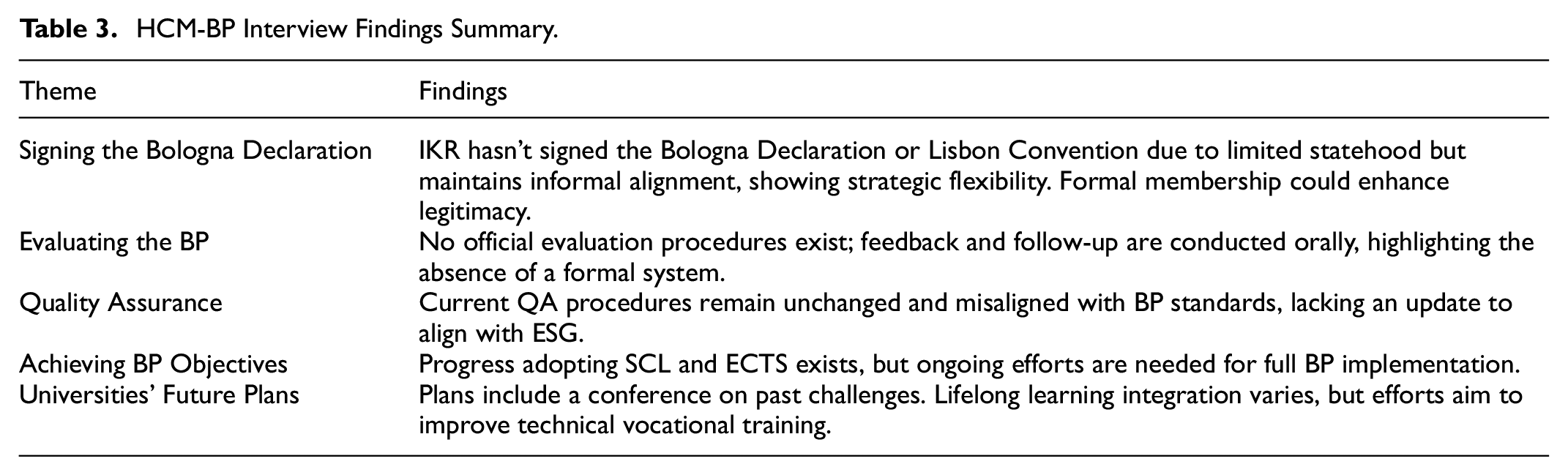
To join the EHEA and officially become a member of the BP, countries must sign the Bologna Declaration and the Lisbon Recognition Convention. According to all three HCM-BPs, the MOHESR in IKR has not signed these agreements. Their statements provide clarity on this issue: HCM-BP 1 and 3 indicated that IKR’s lack of independence as a country prevents it from applying for membership. Meanwhile, HCM-BP 2 added, “We do not need to sign anything to follow the Bologna Process.” The decision not to sign the agreement reflects a practical approach by the IKR. While the region’s lack of recognition as an independent state imposes certain limitations, its decision to align informally with the BP highlights strategic flexibility. Nonetheless, pursuing formal membership could offer greater legitimacy and unlock access to valuable resources, potentially enhancing the overall quality and competitiveness of IKR’s HE system in the long term.
Evaluating the BP
For any new change, a proper evaluation process is essential. However, all HCM-BPs confirmed that no official evaluations have been conducted thus far. HCM-BP 2 noted, “Actually, we always get some feedback from the presidency of the university orally, but nothing in writing.” Similarly, HCM-BP 3 stated, “As a Bologna member, we follow up orally, but there’s nothing official.” This reveals a lack of formal evaluation mechanisms in the implementation of the BP within the IKR universities, as feedback and follow-up seem to occur only informally. In other words, it draws attention to a critical gap in the implementation procedure. The stakeholders’ reliance on oral communication rather than official, documented assessments suggests gaps in systematic oversight and accountability. This highlights the need for a more robust evaluation framework to ensure alignment with BP standards and to measure the effectiveness of its implementation accurately.
Quality Assurance
BP member countries are required to follow the European Standards and Guidelines (ESG) (European Association for Quality Assurance in Higher Education, 2015); however, all HCM-BPs confirmed that the same QA procedures continue to be used. HCM-BP 1 noted, “We still work on the same QA procedures.” Similarly, HCM-BP 2 stated, “The Quality Assurance unit in the MOHESR monitors the quality of learning and teaching, and the same procedures are still followed.” While the BP requires member countries to follow the ESG for quality assurance, the current practice in the IKR appears to rely on outdated quality assurance procedures. HCM-BPs confirmed that no significant updates to the QA processes have been implemented. While the MOHESR monitors teaching and learning, the same procedures remain, showing a misalignment with BP. This gap between policy expectations and actual practices suggests that the QA framework must be updated to meet ESG standards for better integration.
Achieving the BP Objectives
All responses from the HCM-BPs indicate positive progress toward achieving the BP goals in IKR universities. HCM-BP 2 stated, “So far, we have made progress and achieved some significant goals, such as implementing student-centred learning and ECTS.” HCM-BP 2 suggests that progress has been made in implementing the BP goals in IKR universities, specifically in terms of adopting SCL and ECTS. The HCM-BP 2’s statement reflects a positive outlook on these efforts, indicating that certain milestones have been achieved, though there may still be further work required to fully implement the BP goals. To guarantee thorough adoption, however, ongoing efforts are required to build on these advancements and resolve any outstanding issues.
Universities’ Future Plans
There are plans to further develop the implementation of the BP, as acknowledged by all HCM-BPs during the interview. HCM-BP 1 and HCM-BP 2 mentioned that they are planning to organise a conference soon to examine the challenges and shortcomings from previous years and to identify appropriate solutions.
Only one HCM-BP confirmed the integration of lifelong learning into the HE system, while the other two held differing opinions. HCM-BP 3 noted that MOHESR plans to expand this concept by incorporating technical vocational training (TVT) into technical universities. As HCM-BP 3 stated, “The Ministry of Higher Education and Scientific Research plans to further develop this concept by incorporating technical vocational training into the curricula of technical universities.” This indicates that MOHESR in IKR is working towards expanding and enhancing the role of technical vocational training within technical universities. This shows a forward-thinking approach to diversifying and improving the educational offerings at these universities by incorporating practical, career-oriented programmes, which aligns with efforts to improve HE and make it more relevant to labour market needs. It also suggests that the MOHESR is recognising the importance of TVT as part of the BP and is likely considering ways to integrate it into the existing framework for HE. This effort could be a part of the broader strategy to make the HE system in IKR more adaptable and responsive to societal and economic demands. Finally, the different viewpoints on incorporating lifelong learning, however, show that stakeholders have different priorities. Technical universities’ focus on TVT is a good idea, but a more comprehensive, integrated approach that integrates lifelong learning within the framework of HE would be more in line with the ideals of the BP and guarantee holistic growth.
The following table summarises HCM-BP interview findings on BP implementation, evaluation, and future directions (Table 3).
HCM-BP Interview Findings Summary.
Discussion of the Results
Any new programme or process at the university level depends on the attitudes and behaviours of instructors and students. Based on the results of the interviews, several challenges related to the implementation of the BP were identified. Among the challenges related to the work environment is the need for training to improve job performance, which could lead to other positive changes such as greater innovation and enhanced tacit skills (Aguinis & Kraiger, 2009). The lack of training would add additional burdens to university instructors’ responsibilities. Furthermore, the BP introduces several new demands and concepts that need to be understood. Without specific guidelines, this could lead to confusion or inefficiencies. According to Aguinis and Kraiger (2009) and Jehanzeb and Bashir (2013), when employees feel comfortable in their work environment, they are more likely to contribute to the development of their departments. European Ministers of Education (1999) stipulates that HE institutions must be autonomous to achieve transparency; however, universities in IKR have achieved autonomy only to a minimal extent.
The interview results revealed additional challenges related to SCL, with Kurdish EFL instructors facing significant workloads within short timeframes. These challenges, combined with unsuitable physical environments, negatively impact students’ academic performance and force universities to rely on traditional teaching methods. Issues such as assessments, student plagiarism, an insufficient number of instructors, and time constraints shift the focus from teaching quality to teaching quantity. Consequently, the emphasis is placed on how much is taught rather than how well it is taught. This environment results in low-level working conditions for Kurdish EFL instructors, which is detrimental to effective SCL implementation.
Furthermore, several general challenges are faced by administrative staff. To begin with, MOHESR implemented the BP as a mandatory procedure. However, the implementation process has not included either internal or international training programmes. Key challenges include student responsibilities, time pressure, and inadequate infrastructure. As Aithal and Aithal (2019) point out, well-maintained physical infrastructure should include a variety of classrooms with comfortable seating, online study materials (e.g., e-books accessible via smartphones, tablets, and laptops), a digital library, and memberships for students. This would allow the university’s digital library to collaborate with both national and international libraries. The lack of necessary tools in the infrastructure of IKR universities increases the challenges faced by administrative staff.
In terms of degree structure, IKR universities are unable to award international qualifications or diploma supplements due to the lack of a formal agreement between IKR and the EHEA. This argument holds some validity, as the degree structure of IKR universities already follows a 4-year, part-time study model, which aligns with the Bologna Declaration recommendations. However, the system lacks a direct connection between the first cycle and the labour market. According to Abdulrahman and Sharif (2022), Kurdish EFL students have limited opportunities in this regard.
Although IKR universities implement the ECTS, workloads, and learning outcomes recommended by the BP, they have not done so successfully. As a result, student mobility is not yet feasible. To achieve mobility within the BP framework, several issues must be addressed. Furthermore, the QA units continue to follow outdated evaluation and monitoring practices, failing to align with the 2015 ESG (European Association for Quality Assurance in Higher Education, 2015). All EHEA signatories are encouraged to adopt these updated standards. Additionally, the IKR is not registered with the EHEA, which contributes to the challenges in implementing the BP. As a result, the BP implementation in IKR universities will not be monitored by these agencies, creating difficulties in recognising qualifications from these institutions.
Although many UIs and Admins have rejected the idea of student involvement in HE decision-making, the BP can still be applied in an EFL context. This is because each university has a student union, which can play various roles in supporting the goals of the BP. Moreover, student unions typically serve as the organised body through which students voice their concerns, suggest improvements, and advocate for their interests. By leveraging these unions, IKR universities could ensure that students have a formal avenue for contributing to decisions on curriculum design, assessment practices, and other academic matters. In IKR universities where student involvement in academic decision-making might not be fully institutionalised, student unions could serve as a vital bridge. Furthermore, these unions can help foster a collaborative environment where the voices of students are heard, despite broader institutional resistance.
Conclusions
MOHESR has acknowledged that the current education system is outdated and insufficient for meeting the demands of the 21st century. As a response, the BP has been implemented in the IKR universities to improve the education system. However, like any major reform, the implementation of the BP faces several challenges. Based on the findings of this study, several conclusions can be drawn regarding the applicability of the BP and the obstacles hindering its successful implementation.
The BP can be effectively applied once the existing challenges are addressed. These challenges include officially joining the EHEA, completing the necessary documentation, and implementing a top-down approach by the MOHESR. Joining the EHEA would align Kurdistan with international academic standards, enabling greater mobility for students and recognition of degrees. Previous studies have shown that full participation in the BP facilitates increased academic cooperation and improves the overall quality of HE. Furthermore, the establishment of a national and international qualification framework, the provision of diploma supplements to graduates, and adherence to the ESG for QA are essential steps. These measures will ensure that degrees are transparent, comparable, and facilitate student mobility across borders.
A key challenge identified in this study is the issue of large class sizes, which affects instructors, administrative staff, and students alike. For students, large classes reduce opportunities to meet learning outcomes and programme objectives, as active participation and practice are limited. For instructors and administrative staff, large class sizes result in an increased workload, further complicating the BP’s implementation. The difficulty of balancing the demands of class sizes with the goals of SCL is also compounded by insufficient transparency in curriculum design and assessment standards, which directly impacts students’ employability prospects.
Moreover, the implementation of BP is further hindered by a lack of financial support and the absence of clear, written guidelines for instructors and administrators. Issues such as unclear decisions regarding ECTS credits, workloads, and course distributions make it difficult for the university to fully align with BP’s standards. Without these resources and clear instructions, the full potential of the BP cannot be realised.
While this study provides valuable insights into the implementation of the BP, it is important to note that the sample size and the geographical scope were limited to certain universities in the IKR. Further research could explore a broader range of institutions or focus on specific disciplines to better understand the challenges faced in the wider academic community. Additionally, other factors, such as political considerations, could influence the successful implementation of the BP, which were not fully addressed in this study.
Overall, while the BP offers a promising framework for HE reform, significant steps must be taken to overcome these challenges and ensure its successful implementation in IKR universities.
Recommendations
Based on the findings of this study, several strategies are recommended to address the challenges identified. A key objective of implementing the BP is to enhance the performance of existing educational systems while also ensuring an equitable and efficient response to future changes. To achieve this, authorities in the IKR should support the MOHESR in signing the Bologna Declaration and the Lisbon Recognition Convention, which would enable the region to integrate into the EHEA, fostering international collaboration and improving the quality of HE in line with BP standards.
To ensure effective implementation, this process should be approached as a top-down change, where policies and decisions made at the national level are communicated and executed at the lower levels. This contrasts with the previous bottom-up approach, which has not been fully effective. Additionally, Kurdish EFL university students should also be given opportunities to participate in decision-making structures at the European, national, and institutional levels to ensure their needs are represented.
Authorities should carefully consider critical feedback from students, university instructors, and administrators to ensure that HE institutions have the necessary, as provided by public authorities. Effective coordination between the MOHESR and the Ministry of Education in IKR is essential for implementing changes that promote student autonomy, independent learning, and critical thinking skills. Various government stakeholders, including the Council of Ministers and the Ministry of Finance and Economy, must revise existing regulations to address the new demands of the BP, especially in EDs, which require financial support to enhance student mobility, promote SCL, and develop both physical and digital infrastructures.
Furthermore, to address international qualification frameworks, universities must align with the ESG for QA. Developing a national qualification framework is essential to resolve challenges related to mobility and recognition. Enhancing the role of student unions and encouraging student participation in decision-making processes are crucial steps. In addition, providing continuous professional development for university instructors and administrators, along with expanding mobility opportunities through programmes like Erasmus, will help equip Kurdish EFL university instructors with the knowledge and skills required to implement SCL. Curriculum reforms should also be conducted in close collaboration with the labour market to ensure that educational offerings align with both student needs and societal demands.
Finally, stakeholders within the MOHESR must engage in regular monitoring and evaluation of the implementation process, ensuring adherence to ESG. The results of these evaluations should be made publicly available through institutional databases. Moreover, establishing a fixed academic calendar and enhancing electronic or blended learning options will help mitigate disruptions caused by unforeseen events, fostering a more stable and resilient educational environment.
Suggestions for Future Research
While this study has provided important insights into the BP implementation in the IKR, several areas remain unexplored and warrant further investigation. Future studies could benefit from exploring the following topics:
Assessing if the ECTS workload (25–27 hr) ensures course completion.
Exploring the impact of the BP on student learning outcomes.
Assessing the inclusivity of BP implementation.
Investigating the impact of BP on the internationalisation of HE in the IKR
Investigating the implementation of the BP in other academic departments to see whether challenges are specific to certain disciplines.
Footnotes
Acknowledgements
We would like to thank the jurors from various universities in the Kurdistan Region of Iraq who reviewed the study instruments and enriched them with their valuable feedback. We would also like to express our gratitude to all the participants from different Departments of English in universities across the Kurdistan Region, as well as the members of the Higher Committee for the Bologna Process at the four universities where we collected data. Their participation in the study and the time they dedicated to interviews were invaluable to our research.

Ethical Considerations
This study was approved by the Ethics Committee of the College of Basic Education at the University of Sulaimani, Kurdistan Region of Iraq. Participation was entirely voluntary, and individuals were informed of their right to withdraw at any time without consequence. The study’s purpose and procedures were clearly explained before participation. The research posed minimal risk and was designed to avoid any physical, psychological, or social harm. All questions and tasks were non-intrusive and respectful of participants’ time and comfort. The potential benefits of this study, to enhance understanding of educational practices and inform policy development, outweigh any minimal risk. No identifying information was collected, and all data were securely stored and reported in aggregate to ensure full anonymity.
Author Contributions
Layla Tahir Sharif: Conducted the literature review, conceived, and designed the study tools, collected the data, performed data analysis, and wrote the first draft of the manuscript. Barham Sattar Abdulrahman: Assisted in designing the study tools, contributed to the data collection process, provided substantial revisions to the manuscript, contributed to the interpretation of data, and reviewed and wrote the final manuscript. Coordinated manuscript revisions and submission to the journal.
Funding
The authors received no financial support for the research, authorship, and/or publication of this article.
Declaration of Conflicting Interests
The authors declared no potential conflicts of interest with respect to the research, authorship, and/or publication of this article.
Data Availability Statement
The datasets used in this study are available from the corresponding author upon a reasonable request.