




Abstract
The current study aimed to examine differences and associations of physical activity (PA) levels, quality of life (QoL), motives for PA, and stages of change (SOC) between young and mid adults. A total of 208 participants in Malaysia completed an online survey which comprised of questionnaires about PA, motivational factors, QoL, and SOC in PA. Independent t-tests revealed that young adults engaged in more PA in general, as well as light PA. However, mid adults in general scored higher levels of QoL and its four domains (i.e., physical, psychological, social, and environmental). Moreover, young adults were significantly more motivated by appearance for PA. Pearson correlations revealed higher levels of vigorous PA linked to, higher social domain of QoL in both age groups, and, physical and psychological domain of QoL in mid adults. Vigorous PA also showed the strongest positive links with motivations in competence in both young and mid adults. Cross tabulations showed that both young and mid adults have highest frequency counts in contemplation stage for moderate and light PA and highest frequency counts in the maintenance stage for vigorous PA. This study is the first to show how young and mid adults differed in PA levels, QoL, motives behind PA engagements, and how they correlate differently. However, both age groups showed similar SOC patterns, indicating the likelihood of moderate and light PA engagements when they see the possibility of change but still lack commitment, whilst those engaged in vigorous PA are more likely to actively maintaining the change.
Physical activity (PA) is a powerful and inexpensive tool to prevent any kinds of disease, promote social interactions, and increase an individuals’ health and well-being (World Health Organization & Noncommunicable Diseases and Mental Health, 2003). Despite the benefits and positive outcome on one’s health through PA, sedentary behavior is still commonly seen around the world (Chan et al., 2017; Hallal et al., 2012), especially in the urban area (Alias et al., 2022; Wattelez et al., 2021). Physical inactiveness or sedentary lifestyle has shown to be an utmost risk factor for mobility and is linked to certain health risk such as developing cardiovascular disease, obesity, Type 2 diabetes, feelings of anxiety, and depression (Croezen et al., 2009; Rosqvist et al., 2009; Win et al., 2011). Therefore, it is crucial to scrutinize the underlying explanations in human behavior that has the potency to influence individuals to partake in PA and sustaining their healthy lifestyle.
Self-determination theory (SDT; Deci & Ryan, 1985) suggests that intrinsic motivation is a factor that drives an individual to engage in an activity for the sake of one’s interest, pleasure, and/or enjoyment. Intrinsic motivation is positively correlated with many benefits such as psychological well-being, persistent, and amusement (Deci & Ryan, 2008). In contrast, extrinsic motivation suggests that individuals engage in a task for outcomes such as rewards or avoid a punishment (Tranquillo & Stecker, 2016). Engagement and adherence to PA are affected by participation motives (Aaltonen et al., 2012; André & Dishman, 2012). The initial phases of PA are attributed to extrinsic motivation whilst intrinsically motivated actions are found at sustaining and maintaining PA (Ryan et al., 1997). Enjoyment/interest and competence reflect intrinsic motivation and are at the highest level of self-determination (Bebeley et al., 2017) whereas other motives such as fitness reflects extrinsic motivation (Ednie & Stibor, 2016). In the context of exercise, individuals display different types of motives behind PA engagements. According to Deci and Ryan (1985), persistence at a task as well as psychological health and well-being is associated with intrinsic motivation while Ednie and Stibor (2016) reported that extrinsic motivation is associated with a high level of fitness.
Some findings claimed that extrinsic motives are needed to begin a PA (Gavin et al., 2014) while the sustenance of PA is said to be more attributed to intrinsic motives (Markland & Tobin, 2010; McDonough & Crocker, 2007; Ryan et al., 1997; Thøgersen-Ntoumani & Ntoumanis, 2006). Furthermore, other studies claimed that extrinsic motives have no significant association or at least a weak correlation with adherence to practicing PA (Ingledew & Markland, 2008; Teixeira et al., 2012). In contrast, motivational factors such as appearance and competence are the predictor for strenuous PA (Król-Zielińska et al., 2018). Other studies have also found that the most motivating aspect underlying PA was enjoyment, appearance, and fitness (Aaltonen et al., 2012; Badau, Rachita, Sasu, & Clipa, 2018). Putting together, motives behind PA engagements remain inconclusive, hence, it is important to re-examine what motivations are needed to sustain PA behavior.
Another significant factor to look at one’s participation in PA is their motivational readiness for change. Marcus and Forsyth (2003) explained that any change of behaviors is a process whereby the intention, which is the first stage of change (SOC) advances to manifestation and continuity of the desired behavior. Based on the stages of motivational readiness for change model (i.e., transtheoretical model), a behavior is adopted and maintained when an individual progresses through a series of stages (Prochaska & DiClemente, 1983). This SOC model has been extensively used in a wide range of behavioral intervention including PA. It consists of five levels of readiness for change. The first stage is the pre-contemplation; an individual at this stage does not think and partake in any activities to become active. The second stage is contemplation which explains that individuals think of becoming active but still have not engaged in any PA consistently. The third stage is preparation, which describes that preparers are already active but does not reach the advisable level. The fourth stage is the action stage whereby preparers have been physically active for not more than 6 months. The last stage is the maintenance stage, which explains that individuals are actively engaged in PA for more than half of a year. At this last stage, active individuals adopt a healthy behavior or cease an undesired behavior. Marshall and Biddle (2001) reported that individuals progress to a higher SOC when PA levels increase.
In addition to studying the motives behind PA engagements and SOC, how PA is linked to quality of life (QoL) could be another motivator to sustain the behavior. Past studies have shown a positive relationship between physical activeness and QoL (Grant et al., 2009; Kokandi et al., 2019). It has been suggested that physical fitness can affect the brain functioning, emotional regulation, physical conditioning, and psychological well-being of a person (Talebpour et al., 2014). A study on Malaysian children reported a strong positive correlation between physical activeness (specifically moderate to vigorous exercise) and QoL (Wafa et al., 2016). Furthermore, PA plays an important role in reducing mental pressure or stress accumulated throughout daily activities nowadays, and positively correlated with both physical and mental QoL in college students (Talebpour et al., 2014). Individuals who are physically inactive had a higher level of declines in physical performance and at a higher risk of premature death (Klein et al., 2018). All these findings indicate beneficial associations between PA and physical and psychological QoL. Besides, it is also important to explore whether different PA levels linked to QoL and motives, as well as the SOC for different PA category.
In Malaysia, it was found that physical activeness declines with age (Tam et al., 2016), and Chan et al. (2019) reported that that older adults are becoming less physically active compared to younger adults. A recent study reported by Goh and Chen (2021) showed that vigorous PA is linked to higher anxiety in young adults but lower self-acceptance in mid adults. In the same study, moderate PA was also found to link with lower personal growth in young adults. Although this new finding has provided more insight into the different dimensions of psychological well-being between age groups in relation to PA intensity, it leads to further questioning of motivations behind PA engagement across age groups. Moreover, comparisons between young and mid adults in PA engagement and their links to physical, psychological, social, and environmental domain of life satisfaction have been scarce. This is particularly important as outlined in a nationwide effort to promote PA in the country, understanding psychological and environmental factors could be a key to improve and sustain behavior not just in an individual among young people but inclusivity of a wider age group (Khoo et al., 2020).
Therefore, this study also aimed to further examine how these variables might differ and correlate across age groups (i.e., young and mid adults) in Malaysia. We hypothesized that PA levels will differ between young and mid adults, and different levels of PA will correlate differently with QoL and its domains (i.e., physical, psychological, social, and environmental), as well as motives for PA across age groups. Moreover, the SOC is hypothesized to be distributed unevenly across PA levels.
Methods
The current study was approved by the Joint-Committee on Research and Ethics [BPS I-01-17(40)2019]. An informed consent was obtained from each participant before their participation. A cross-sectional survey design was employed in this study.
Participants
A total of 208 participants in Malaysia (108 young adults, aged 18–34 years; 100 mid adults, aged 35–55 years) completed an online survey through Google forms. Recruitment was based on word of mouth, opportunity sampling, and advertisement through social media. All participants were able to read, understand, and communicate in basic English, and has basic computer literacy. All questionnaires were self-administered and the whole survey took approximately 20 to 30 minutes to complete. All participants were also reimbursed with a token of appreciation (i.e., RM 5 Grab e-voucher) for their participation. To ensure one participant could only respond once and reimbursed with the token once, they were required to provide some basic demographic information and contact details (e.g., email address) as a record.
Measures
International Physical Activity Questionnaire—Short (IPAQ-short)
The IPAQ-short was developed by IPAQ Research Committee (2005) and consists of a total of seven questions that inquired about involvement in walking, moderate and vigorous PA that had been done in the past 7 days. The questions inquire the level of PA in terms of frequency (in days, hours, and minutes per day), as well as type of PA categorizing from vigorous (e.g., heavy lifting, digging, aerobics, or fast bicycling), moderate (e.g., carrying light loads, bicycling at a regular pace, or double tennis), to light (e.g., walking for recreation, sport, exercise, or leisure). The scores for the level of PA were converted into metabolic equivalent of task (MET). This questionnaire has been reported to have good psychometric properties across various countries (Chan et al., 2019). The IPAQ-short has demonstrated a high reliability, ranging from .66 to .88 (Lee et al., 2011).
World Health Organization Quality of Life Instrument, Short Form (WHOQOL-BREF)
This questionnaire was developed by Whoqol Group (1998) and consists of 26 items. The first two items in the questionnaire asked about an individual’s recognition of one’s standard of living and the perception of satisfaction with one’s health. It was then followed by 24 items that measured QoL based on four domains: physical health (e.g., “To what extent do you feel that physical pain prevents you from doing what you need to do?”); psychological (e.g., “To what extent do you feel your life to be meaningful?”); social relationships (e.g., “How satisfied are you with your personal relationships?”); and environment (e.g., “How healthy is your physical environment?”). The scores were measured in a 5-point Likert scale in each domain and the higher the score, the better life satisfaction. According to Harper et al. (1998), the Cronbach’s alpha internal consistency coefficients for each of the four domain scores ranged from .66 to .84. Besides, the domain scores were highly correlated (i.e., .90) with the WHOQOL-100 which is the original version of the assessment, indicating a high criterion validity (Harper et al., 1998).
Motives for Physical Activity Measure-Reviewed (MPAM-R)
MPAM-R (Frederick & Ryan, 1993) consists of 30 items to assess the strength of five motives for PA participation: interest/enjoyment (i.e., for fun, happiness, stimulation, and joy e.g., “Because I like the excitement of participation”), competence/challenge (i.e., for improvement and new skills acquisition, e.g., “Because I like engaging in activities that physically challenge me”), fitness (i.e., for physical health, strength, and energy, e.g., “Because I want to be physically fit”), appearance (i.e., for physical attractiveness, more defined muscles and better look, achieving or maintaining a desired weight, e.g., “Because I want to lose or maintain weight, so I look better”), and social (i.e., for being with friends and meeting new people, e.g., “Because I enjoy spending time with others doing this activity”). Exploratory Factor Analysis (EFA) and Cronbach’s alpha of the original scale showed acceptable psychometric properties ranging between .78 and .92. The subscales also showed high internal reliability: competence (.87); enjoyment (.88); appearance (.88); social (.75); fitness (.83).
Physical Activity Stages of Change Questionnaire (PASCQ)
PASCQ (Marcus & Simkin., 1993) consists of four-item to measure the stages of exercise behavior of individuals. The staging algorithm used was a single item followed by four questions to discriminate individuals in post-adoption stages from pre-adoption stages, indicating good concurrent validity (Sarkin et al., 2001). Participants were required to select either “yes” or “no” to each of these items: (1) “Do you currently engage in regular physical activity?”; (2) “Do you intend to engage in regular physical activity in the next 6 months?”; (3) “Do you intend to engage in regular physical activity in the next 30 days?”; (4) “Have you been regularly physically active for the past 6 months?”. For questions 1 and 2, a selection of “no” would be classified as a pre-contemplation stage. On the other hand, a selection of “no” to question 1 and 3 but a “yes” to question 2 would be classified as a contemplation stage. Meanwhile, a selection of “no” to question 1 but a “yes” to question 3 would be classified as a preparation stage. A selection of “yes” to question 1 but a “no” to question 4 would be classified as an action stage. However, a selection of “yes” to both question 1 and 4 would be classified as a maintenance stage. Both pre-contemplation and preparation stages were categorized as a pre-action stage in the current study.
Statistical Analysis
Data analyses were done using SPSS version 25 and 26. Independent t-test was used to compare PA levels, QoL, and motivational factors between young and mid adults. Pearson Correlation with an alpha level of .05 was used to examine the relationships between levels of PA, QoL, and motivational factors. Cross tabulations were used to count the frequency of SoC across PA levels.
Results
Table 1 summarizes the characteristics of overall respondents. Of all the 208 participants, the number for female and young adults, respectively, were slightly higher. Majority of the participants were of Malay and Chinese ethnicity. The mean of each age group was not obtained as participants were only given two age categories to select from, either 18 to 34 years or 35 to 55 years.
Summary of Participants’ Demographic Characteristics.

Age Group Comparisons for PA, QoL, and Motives
Table 2 shows the mean and standard deviation for MET, QoL, and motivational factors across PA levels and the comparison between young and mid adults. Our results showed that in general, young adults significantly engaged in more PA (i.e., MET) than mid adults, t(188.112) = 2.435, p = .016, Cohen’s d = 0.180. When comparisons were made based on PA category, only light PA showed a significant difference between the two groups, t(175.047) = 2.047, p = .042, Cohen’s d = 0.281, with young adults showed higher engagements. No significant differences were found for moderate and vigorous PA between the two groups, with all ps > .080. For QoL, mid adults significantly scored higher than young adults in totality, t(199.902) = −5.064, p < .001, Cohen’s d = 0.699, as well as for all four domains: physical, t(206) = -4.413, p < .001, Cohen’s d = 0.613, psychological, t(183.391) = −5.478, p < .001, Cohen’s d = 0.754, social, t(206) = −4.417, p < .001, Cohen’s d = 0.611, and environmental, t(200.917) = −3.070, p = .002, Cohen’s d = 0.424. As for motives for PA, only appearance showed a significant difference between the two groups, t(206) = 2.154, p = .032, Cohen’s d = 0.299, indicating that young adults were significantly more motivated by appearance to engage in PA than mid adults. All other motives did not show significant differences between the two groups, with al ps > .090.
Descriptive Statistics of the Participants’ PA Levels, QoL, Motives, and Their Comparisons between Age Groups.
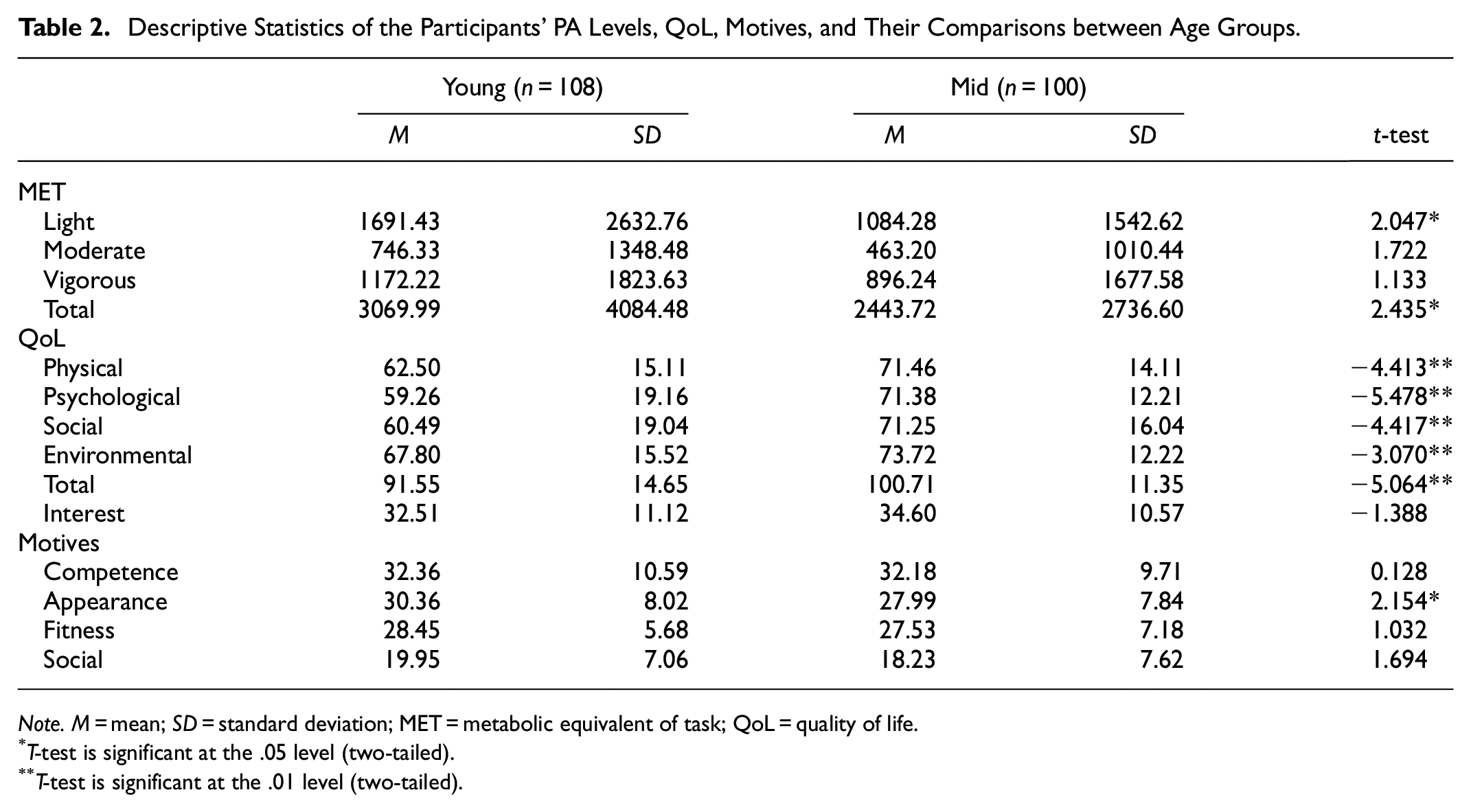
Note. M = mean; SD = standard deviation; MET = metabolic equivalent of task; QoL = quality of life.
T-test is significant at the .05 level (two-tailed).
T-test is significant at the .01 level (two-tailed).
Relationships Between PA, QoL, and Motives
Tables 3 shows the relationships between MET, QoL, and motivational factors across PA category for each age group.
Pearson Correlations (r) of PA Levels (in MET) with QoL, and Motives.

Correlation is significant at the .05 level (two-tailed).
Correlation is significant at the .01 level (two-tailed).
Young adults
For young adults, only social domain of QoL significantly correlated with vigorous PA, r(106) = .230, p = .017, indicating higher level of vigorous PA linked to higher QoL in the social domain. All other correlations were found not significant, with all ps > . 070. For relationships between PA and motivational factors, it was revealed that PA in general was correlated with interest [r(106) = .199, p = .039] and competence [r(106) = .267, p = .005]. Analysis based on PA category showed that a higher level of vigorous PA was significantly correlated with higher motivations in interest [r(106) = .276, p = .004], competence [r(106) = .287, p = .003], and fitness [r(106) = .234, p = .015]. On the other hand, a higher level of moderate PA was significantly correlated with higher motivations in competence [r(106) = .233, p = .015], appearance [r(106) = .224, p = .020], and social [r(106) = .227, p = .018]. Light PA was found not significantly correlated with any of the motivational factors in young adults, with all ps > .200.
Mid adults
For mid adults, a higher level of PA in general was significantly linked to a higher level of QoL, r(98) = .228, p = .023. Furthermore, PA in general also positively significantly correlated with physical [r(98) = .232, p = .020], and psychological [r(98) = .227, p = .023] domain of QoL. Particularly, a higher level of vigorous PA was significantly correlated with higher scores for physical [r(98) = .288, p = .004], psychological [r(98) = .241, p = .016], and social [r(98) = .273, p = .006] domain of QoL. None of the QoL domain was significantly correlated with moderate and light PA, with all ps > . 090. With regard to the relationship between PA and motivational factors, higher levels of PA in general significantly correlated with higher motivations in interest [r(98) = .344, p < .001], competence [r(98) = .363, p < .001], and social [r(98) = .272, p = .006]. Interestingly, a higher level of vigorous PA significantly correlated with higher motivations in interest [r(98) = .335, p = .001], competence [r(98) = .387, p < .001], fitness [r(98) = .239, p < .017], and social [r(98) = .280, p = .005]. Neither moderate nor light PA was significantly correlated with any of the motivational factors in mid adults, with all ps > .090.
SoC across PA Category
Young adults
Of the 108 young adults, higher rates were observed to be in contemplation (37.0%) and maintenance (33.3%) stage. For individuals in the contemplation stage, 42.5% fell under moderate and light PA category, respectively, with only 15% engaged in vigorous PA. For individuals in the maintenance stage, 66.7% fell under vigorous PA, and those engaged moderate and light PA were only 30.6% and 2.8%, respectively.
Mid adults
The observation for mid adults was of a similar pattern as young adults; higher rates were also observed to be in contemplation (33.0%) and maintenance (37.0%) stage. Mid adults who were in the contemplation stage showed equal rates (i.e., 48.5%) in moderate and light PA engagements, whilst only 3.0% engaged in vigorous PA. For the maintenance stage, more than half (i.e., 56.8%) engaged in vigorous PA, whilst 27.9% and 13.5% fell under moderate and light PA category, respectively. More frequency counts for other SoC across PA category are shown in Table 4.
Frequency Counts for SoC based on PA Category.

Note. SoC = stages of change.
Discussion
The current study aimed to investigate the differences of PA levels, QoL, and motives for PA between young and mid adults, and how these variables might correlate differently across the age groups. The SOC distributions across different PA category for age groups were also calculated in the current study.
Age Comparisons for PA, QoL, and Motives for PA
In general, young adults engaged more PA than mid adults, which is consistent with earlier report found in a Malaysian population (Tam et al., 2016). More particularly, a significant higher level of PA in young adults was only found in light PA but not in moderate or vigorous PA, showing inconsistency with what reported in Tam et al. (2016). This could be due to slightly more female (i.e., 54.3%) than male participants in the current study that might have contributed to a higher level of light PA engagement in general, which is also reflected in a previous report (Amagasa et al., 2017).
On the other hand, the current findings observed a reverse trend for QoL in age category. Mid adults not only showed a significant higher level of QoL in general, their four domains (i.e., physical, psychological, social, and environmental) of QoL also significantly higher compared to young adults. This study is the first to show that the QoL and it’s all domains in mid adults are significantly higher than that of young adults’ in Malaysia. The lower score in physical health domain of QoL in young adults is surprising as previous studies (e.g., Azman et al., 2003) have reported the opposite trend. In the current study, despite the higher level of PA engagement in young adults, their physical-health related QoL was lower than mid adults. However, it is worth pointing out that the data collection in the current study was conducted during the coronavirus disease 2019 (COVID-19) pandemic period and when the whole country was experiencing movement restrictions. As young adults are normally more physically active than mid adults, the movement restrictions (including outdoor exercise) might have jeopardized their perception towards physical health satisfactions, despite having higher levels of PA engagements in general as compared to mid adults. The higher scores in psychological, social, and environmental domain of QoL in mid adults could be attributed to better perception of meaning of life, more experienced in managing social relationships, and more stable financial stability to acquire better living environment. For young adults, especially university students or individuals who are in the process of gaining their qualifications, securing or maintaining a job, the realization of the meaning of life may not be in their bigger picture yet. Furthermore, they might experience relatively more challenges in handling relationships with others due to lacking life experiences, meanwhile trying to achieve better financial stability before they can acquire a better quality of living environment.
As for motives for PA, the only significant difference observed across the age group was appearance, with young adults more motivated by appearance for PA engagements. Although it has been previously reported that young adults were mainly motivated by interest, competence, and fitness for PA engagements (Badau et al., 2018), our study is the first to show that when comparing with mid adults, young adults were more motivated by appearance. This indicates the importance of underlying extrinsic motivations for PA engagements when age becomes a factor.
PA Levels Linked to QoL and Motivations
Young adults who showed higher engagements in vigorous PA reported higher QoL in the social domain. The same significant correlation was also observed in mid adults. As reported in Gill et al. (2013), social factor was a significant aspect that usually associated with the participation in PA. Social factors such as parents/peers’ involvement or encouragements significantly influenced the perceived benefits to engaging in vigorous PA (King et al., 2014). Individuals who engaged in higher levels of PA also reported more social integration with friends (Larsen et al., 2014). This may also explain the positive links between higher levels of PA (at least moderate level and above) and social motivation for PA in both age groups in the current study. The relationship between social domain of QoL and vigorous PA can be elucidated by the nature of activities. This might be due to the nature of vigorous PA is more competitive and fun. Playing sports in a competitive level suggested that greater effort is needed to achieve higher standards of achievement (Mendonça et al., 2014; VanKim & Nelson, 2013). This explanation could be integrated with the current findings that higher levels of PA were more motivated by interest/enjoyment and competence in both age groups. In addition, more vigorous PA engagements were also motivated by fitness in both age groups, corresponding to previous findings (Badau et al., 2018; King et al., 2014).
For mid adults, higher engagements in vigorous PA were also linked to higher QoL in physical health and psychological domain. This is interesting as in comparison to a Hispanic/Latino population reported in Vásquez et al. (2019), vigorous PA was found only correlated with better physical health but not psychological related QoL, but in our study using Malaysian samples within the similar age range, vigorous PA was positively linked to both domains, consistent to findings reported in some previous studies (Kokandi et al., 2019; Puciato et al., 2018). For young adults, neither physical health nor psychological domain was significantly correlated with any level of PA. These findings showed that how different levels of PA link to QoL (general or with its domains) can be varied by age category, indicating that mid adults achieved higher life satisfactions with a higher level of vigorous PA engagements.
Similar SoC Patterns Across PA in Both Age Groups
Our findings revealed that for both age groups, the highest counts were distributed to contemplation and maintenance stage. Similarly, in the contemplation stage, highest counts were observed in light and moderate PA in both age groups. As in the maintenance stage, there exists a similar pattern in both age groups as well, whereby highest counts were observed for vigorous PA, followed by moderate and light PA. The pattern of frequency counts across PA category for preparation and action stage was also similar in both age groups. However, in the pre-contemplation stage, the highest count was observed for moderate PA in young adults (i.e., 60%), while light PA occupied the highest count (i.e., 60%) in mid adults. These findings suggest that engagements in moderate and light PA are more probable if individuals are in the pre-adoption stages (i.e., pre-contemplation, contemplation, and preparation), particularly in the contemplation stage. As they progress to postadoption stages (i.e., action and maintenance), engagements in moderate PA are more probable to keep them remained active whilst vigorous PA are needed to sustain the behavior in long term.
Limitations and Future Research
Like many other studies, the current study is limited with sample size. With G*Power 3.1.9.1’s (Faul et al., 2007) post hoc calculations, we achieved approximately 89.0% and 86.5% power, respectively, for young and mid adults when a significant correlation of r = .30 (two-tailed) was detected. This makes it difficult to generalize our findings to the whole population. Besides, given the cross-sectional correlational design in the current study, the causal links between PA levels and QoL cannot be established as we could not tell whether PA engagements lead to better QoL or those who have higher satisfactions in life to begin with are more likely to engage in PA. Additionally, it has been suggested that links between PA and physical health-related QoL are more likely to be reported in cross-sectional studies whilst associations between PA and psychological-related QoL are more likely to be found in longitudinal studies (Wendel-Vos et al., 2004). Furthermore, data in the current study might have been influenced by the lockdown and social isolation due to COVID-19 pandemic. Future research may consider replicating this study and examine whether the same observations still exist when the pandemic is over and when people have gradually reverted to life as pre-pandemic or even the new lifestyle post-pandemic.
Conclusion
In conclusion, our study is the first to compare how PA levels, QoL, and motives for PA can differ between young and mid adults. Although young and mid adults are at one stage difference in the human life span, their levels of PA engagements, QoL, and motives for PA can differ. It is also found that young adults are significantly more active than mid adults in light PA. However, mid adults are significantly more satisfied with their QoL in general, as well as in physical health, psychological, social, and environmental domain. Moreover, young adults are more likely to be motivated by appearance for PA engagements. Our findings are also the first to show that, how PA levels correlate with QoL and motives for PA can differ between young and mid adults. In general, higher levels of vigorous PA in mid adults are more likely to link to better life satisfactions in all domains except for environmental QoL. On the other hand, only social domain of QoL is linked to higher levels of vigorous PA in young adults, suggesting the importance of social life among the younger generation. For mid adults, vigorous PA is most significantly motivated by interest and competence whilst the same category of PA is mostly motivated by competence in young adults, indicating the importance of the nature of sports (e.g., competitiveness/challenging) for the younger generation. Lastly, our findings showed that individuals who are in the contemplation stage are more likely to engage in light and moderate PA, whereby those in the maintenance stage are more likely to engage in vigorous PA to sustain the behavior. This may also indicate the importance of doing something strenuous to continuously commit to physical exercise, at least for young and mid adults.
Footnotes
Declaration of Conflicting Interests
The author(s) declared no potential conflicts of interest with respect to the research, authorship, and/or publication of this article.
Funding
The author(s) disclosed receipt of the following financial support for the research, authorship, and/or publication of this article: The study was funded by the Institute for Research, Development and Innovation, International Medical University (Malaysia) and approved by the Joint-Committee on Research and Ethics [BPS I-01-17(40)2019].
