




Abstract
This study examined how overall quality and within-day consistency in fifth graders’ teacher-student interactions related to feelings about, engagement, and academic performance in school. Participants were 956 children in a national study. Students who experienced higher quality interactions reported more positive feelings about school, were more engaged, performed better in math and reading, and had more closeness and less conflict with teachers. Independent of overall interaction quality, students who experienced less consistency in their interactions with teachers, whether it was with the same teacher or across teachers, were less engaged and had more teacher-reported conflict. Findings emphasize the separate contributions of both high quality and consistency of teacher–student interactions to students’ success.
Introduction
Students who experience caring and supportive interpersonal relationships with teachers also report more positive academic attitudes (Crosnoe, Johnson, & Elder, 2004; Ryan & Deci, 2000; Wentzel, Battle, Russell, & Looney, 2010), satisfaction with school (Solomon, Battistich, Watson, Schaps, & Lewis, 2000), and show greater engagement in academic work (Ryan & Patrick, 2001; Solomon et al., 2000). Experiencing supportive teacher–student relationships may be particularly important in early adolescence as they can buffer well-documented drops in motivation, engagement, and academic performance typically associated with this period of development (Carbonaro & Gamoran, 2002; Crosnoe et al., 2004; Eccles, Wigfield, & Schiefele, 1998; Niehaus, Rudasill, & Rakes, 2012; Roeser, 2005; Way, Reddy, & Rhodes, 2007). To date, much of this research has relied on informant report, either by the teacher or the student (Davis, 2003). Although this method has been useful in advancing research, the use of observational measures of how teachers and student interact to foster such supportive relationships has emerged as a valid and reliable approach to assess unique aspects of classroom processes that contribute to youth development (Pianta & Allen, 2008). Specifically, observational assessments can capture specific instances or issues within teacher–student interactions not provided in self-reports of relationships and can also aid in clarifying the nature of such supports (Ladd, Birch, & Buhs, 1999; Pianta, La Paro, & Hamre, 2008).
Furthermore, most research on the possible benefits of students’ interactions with teachers is drawn from studies based on experiences with a single teacher at one time point. Little is known, however, concerning the extent to which consistency of interactions across the day or across teachers affects students, even though most students interact with a wider variety of teachers throughout the day starting in fourth or fifth grade (Anderman & Midgley, 1997). The nature and effects on student outcomes of daily variation in students’ experiences could be yet another facet of school with significant implications for positive youth development. The current study, then, aims to address the gap in the literature by examining the extent to which the observed level and consistency of fifth graders’ relational interactions with their teachers relate to their feelings about, engagement in, and academic performance at school.
Supportive Teacher–Student Relationships and Youth Development
Ecological models of development posit that relationships between teachers and students serve as critical proximal processes that impact short-term and long-term development (Pianta, 1999). Evidence of the positive outcomes associated with supportive relationships is prevalent from early childhood to adolescence. For example, in a longitudinal study of teacher–child relationships, Pianta and Stuhlman (2004) found significant associations between teachers’ ratings of both conflict and closeness in their relationships with students in preschool and students’ social and academic skills in first grade. Similarly, O’Connor and McCartney (2006) found positive associations between the quality of teacher–child relationships from preschool through third grade and third-grade achievement.
Among adolescents, positive student–teacher relationships have been associated with gains in engagement across the school year (Furrer & Skinner, 2003; Hughes, 2011; Wu, Hughes, & Kwok, 2010), increased learning motivation (Roeser, Eccles, & Sameroff, 2000), greater academic achievement (Crosnoe et al., 2004; Hughes, 2011), and fewer reported risky behavior (Rudasill, Reio, Stipanovic, & Taylor, 2010). In addition, middle-school and high-school students who feel connected in school have shown higher achievement scores, greater student engagement, and more positive academic attitudes (Connell & Wellborn, 1991; Crosnoe et al., 2004; Ryan & Deci, 2000; Wallace, Kelcey, & Ruzek, 2016; Way et al., 2007; Wentzel et al., 2010).
Research on relational supports suggests that although teacher–student relationships decrease in overall quality as children move through elementary school (e.g., O’Connor, 2010), these relationships continue to be positively associated with important student outcomes (Baker, 2006; Entwisle & Hayduk, 1988; Henricsson & Rydell, 2004; Howes, 2000; Mantzicopoulos, 2005). In an early study, Connell and Wellborn (1991) found that third through sixth grade students’ ratings of relatedness with teachers were associated with motivation and task engagement in school. Klem and Connell (2004) found that the association between engagement and academic performance became nearly twice as strong in middle school compared with elementary, suggesting that the relational supports that increase engagement may serve as a protective factor from poor outcomes. This pattern of results was also evident in Murray and Greenberg’s (2000) study of fifth and sixth graders, where children who perceived teachers as emotionally supportive and responsive felt safe in school and showed better social and emotional adjustment. Similarly, declines in students’ perceptions of teacher support across sixth grade were associated with lower year-end grades in a sample of students from high poverty neighborhoods (Niehaus et al., 2012). In sum, these studies suggest that supportive and caring teacher–student relationships are important for positive student outcomes at any age, but that they may be particularly important during early adolescence.
Utilizing Observations of Teacher–Student Interactions to Advance the Field
As noted in the studies presented above, much research on relationships has relied on informant report, either by the teacher or by the student (Davis, 2003). Although this method has been useful in advancing research, conclusions that have been drawn could be enhanced through the use of observational measures of interactions between teachers and students that convey such support. Observational assessments aid in clarifying the nature of relational supports, including capturing the interactional nature of the relationship rather than only one person’s perspective and provide opportunities to confirm and expand on results from informant reports (Howes, Matheson, & Hamilton, 1994; Ladd et al., 1999; Pianta et al., 2008). In addition, observational assessments can capture specific instances of teacher–student interactions not provided in global reports of relational quality and are less tainted by rater bias (Pianta & Allen, 2008). Finally, observational assessment of interactions between teachers and students provides an opportunity to gauge the potential impact of variation of students’ experiences over time, settings, and teachers in a typical school day.
Supportive teacher–student interactions are characterized by behaviors that reflect a warm and positive emotional climate, support students’ autonomy, and perspectives and show sensitivity to students’ needs (Pianta et al., 2008). Observations of supportive teacher–student interactions have been related to both students’ academic and social–emotional competence (Pianta, Belsky, Houts, Morrison, & NICHD ECCRN, 2007) and are particularly beneficial for students at risk for poor school performance (Hamre & Pianta 2005; Rudasill, Gallagher, & White, 2010). Specifically, Hamre and Pianta (2005) and Rudasill, Gallagher, and White (2010) examined associations between observed supportive teacher–student interactions and students’ academic achievement with first-grade (Hamre & Pianta, 2005) and third-grade (Rudasill, Gallagher, & White, 2010) students in the NICHD Study of Early Child Care and Youth Development. In both studies, for students with risk characteristics (such as low attention or behavior problems), more positive teacher–student interactions predicted better academic outcomes. Ruzek and colleagues (2016) observed similar patterns with adolescents, finding that when teachers showed higher levels of emotional support in the beginning of the school year, adolescents reported increases in their behavioral engagement and mastery motivation. Thus, by using observation to clarify the types of supportive behaviors teachers provide to students that enhance their development, the field can then be more systematic in using them.
Consistency of Supportive Interactions
Developmental and parenting literature shows that students benefit from consistently high-quality, supportive interactions (Henry, Grimm, & Pianta, 2010; Landry, Smith, Swank, Assel, & Vellet, 2001). Recent work in the education field suggests that consistency in interactions matter in the classroom as well. For example, research examining consistency across school years suggests that consistently high-quality school experiences enhance students’ academic trajectories (Henry et al., 2010; Landry et al., 2001; Sanders & Horn, 1998). Evidence indicates, however, that students almost never have the same quality experiences from year to year (La Paro et al., 2009; Pianta et al., 2007).
As noted in the studies reported above, work on consistency in schooling has focused on year to year classroom quality as opposed to day-to-day or within-day variation in experience (Kern & Clemens, 2007). Given the advances of observational work applied in early childhood classrooms, however, some insights are emerging. For example, results from multiple observational studies examining consistency of teacher–child interactions in preschool show that students do experience a range of variability (Curby, Grimm, & Pianta, 2010) and that more variability predicts poorer developmental outcomes (Brock & Curby, 2014; Curby et al., 2010; Zinsser et al., 2013). For example, observed teacher–child interaction consistency moderated the associations between conflict and closeness and teacher reports of students’ problem behaviors and social competence (Brock & Curby, 2014). In addition, even after accounting for mean levels of observed teacher–student interactions, Curby, Brock, and Hamre (2013) found that consistency of interaction quality predicted social and academic outcomes. Similarly, Zinsser and colleagues (2013) found that, even when teachers provided on average, high levels of emotional support, students were more aggressive in classrooms when teachers were inconsistent. Findings from these studies suggest two things: (a) observations of teacher–child interactions provide additional explanatory information about children’s classroom experiences than simply the teacher report of relationships and (b) to maximize the benefits of school for students, both high levels of support and consistency of support are needed.
Although similar work examining observed variability of classroom interactions with adolescents is scant, research on students’ perception of the classroom environment suggests variability in their experiences is worth exploring further. For example, using data from the Measures of Effective Teaching Project, Schweig (2016) identified that minimal variation in teacher instructional practices across students’ report was associated with higher levels of teacher effectiveness. In addition, in examining data from the Michigan Study of Adolescent and Life Transitions, Schenke, Ruzek, Lam, Karabenick, and Eccles (2017) found that classroom-level heterogeneity of students’ perceptions of the classroom climate was negatively associated with students’ mathematics achievement. Thus, variation in classroom experiences, as reported by adolescents in these examples, seems to be related to their experience of and benefit in particular classrooms.
Although these studies highlight the importance of examining mean levels and variation in the quality of classroom interactions together, they are limited to the study of very young students and their experiences within only one classroom or, in the case of adolescents, only examine variation in student report. As students move up from one grade to the next, they also begin to encounter multiple teachers throughout the day, introducing another opportunity to experience variation in teacher–child interactions. This shift typically begins in early adolescence (i.e., late elementary or at the start of middle school). Thus, this study expands on previous within-day consistency research by examining the observed mean level of quality as well as consistency of teacher–student interactions for a particular student across a full fifth grade day. Furthermore, this study explores the extent to which these differences play a role in students’ school experience and performance.
The Current Study
This study provides a unique window into students’ experiences: observations conducted in regular cycles throughout one school day that capture both how different students vary in their interactions with their teachers and how the interactions of a given student–teacher dyad vary throughout the day. This study examines (a) associations between the observed fifth graders’ teacher–student interactions on a typical school day and their feelings about, engagement in, and academic performance at school and (b) the extent to which within-day variation in these interactions accounts for variance in students’ feelings about, engagement in, and academic performance in school above and beyond the average effect. The findings will further our understanding of the links between supportive teacher–student interactions and students’ outcomes by examining consistency in observed teacher–student interactions at a time when students typically experience an increase in the number of teachers with whom they interact in a typical day.
Method
Participants
Students in the present study were part of the NICHD Study of Early Child Care and Youth Development (NICHD SECCYD), a prospective, longitudinal study that recruited participants through hospitals across 10 sites in the United States: Boston, MA; Charlottesville, VA; Irvine, CA; Lawrence, KS; Little Rock, AK; Madison, WI; Morganton, NC; Philadelphia, PA; Pittsburgh, PA; and Seattle, WA. The study began with research staff visiting mothers who gave birth in these hospitals in 1991. Of the 8,986 mothers visited, 5,416 met eligibility criteria and were randomly selected for the study. The final sample included 1,364 families with healthy newborns (see NICHD ECCRN, 1993 for extensive study details).
Data for this study comes from Phase III and includes 1,014 children. Of those, 956 students in 805 schools had observational data throughout a single day of their sixth year of school, which for most students is fifth grade and in elementary school. Because observations of teacher–student interactions were the primary focus of the present study, only the 956 participants with these data were included. Analyses comparing the entire sample with the group indicated that, compared with students who began the study, White students and those whose mothers had higher levels of education were more likely to still be in the study and have classroom observational data in fifth grade.
Half of this sample comprised male participants. The average maternal education among this group was 14.43 years of school (SD: 2.43, range: 7-21 years). The majority of the students were White (n = 781), with the remaining participants being African American (n = 112), Hispanic (n = 46), and Other (n = 17). Similar to other studies using NICHD data, this sample is largely a low risk sample but, because of the depth of the data collection, has and continues to provide critical information regarding youth development.
Student Demographics
Parents completed a survey asking about parent and student demographic information. For this study, Gender and Maternal Education were included as demographic variables of interest. In addition, whether the student’s school was considered fully public or privately funded was included in subsequent analyses.
Teacher–Student Interactions—Quality and Consistency
Participants were observed across one whole school day with the Classroom Observation System–Grade 5 (COS; NICHD ECCRN, 2003) in the spring of fifth grade to capture the quality of their interactions with teachers. Numerous past studies have provided evidence of the predictive validity of the COS in previous grades with regard to students’ academic and social outcomes (NICHD & ECCRN, 2002, 2003, 2005, 2006; Hamre & Pianta, 2005). Students were observed for one day, across the full day. This resulted in eight consecutive observations per student. As noted in Table 1, 69% of students changed teachers during the observation, with more than 10% changing teachers three or more times during the observation time period. The observations therefore represent the students’ relational interactions across a typical day.
Descriptive Statistics for Student Characteristics, Teacher–Student Interactions, and Outcomes.

Observers rated teacher–student interactions using a set of 7-point rating scales. A rating of 1 was assigned when that code was uncharacteristic of the classroom, a 3 was assigned when the description was minimally characteristic, a 5 was assigned when the description of the code was very characteristic, and a 7 was assigned under circumstances in which the code was extremely characteristic. For this study, we used four scales: positive classroom climate, chaos, child–teacher relationships, and teacher sensitivity. Positive classroom climate reflects the overall emotional and social tone of the classroom, where students demonstrate that they feel they are in a safe and respectful environment. Chaos (reversed) reflects how the teacher manages students and the extent of disruption, goofing off, aggression, and inattention in the classroom. Child–teacher relationship assesses the positive social connection between the study child and the primary teacher. Teacher sensitivity reflects the extent to which the teacher is attuned to students’ needs, moods, interest, and capabilities and the extent to which this awareness guides interactions with each child.
Observers trained on practice videotapes using the COS manual that provided extensive descriptions of codes as described above. First, observers trained from videotaped observations. Then, they attended a training workshop. Following the in-person training, observers returned to their sites, practiced observations, and utilized one or two more videotaped cases to further their skills. Observers passed a videotaped reliability test prior to data collection. Passing criteria included an 80% match (within 1 scale point) to a master code on the global rating scales. Coders were not allowed to conduct observations in the field until they passed at these levels on a reliability test.
From these observations, we calculated four different composite measures to represent the quality of students’ interactions with their teachers. First, we calculated the mean of the eight observations to obtain a measure of the overall teacher–student interaction quality (α = .74). Second, we calculated the variance of the quality ratings over the eight observations to obtain a measure of the overall variability in the quality of the students’ interactions with their teachers for each individual student.
This variability can be divided into two parts: between-class variability (representing the extent to which the different teachers had different quality interactions) and within-class variability (representing the extent to which the interactions differed across multiple observations within the same class). The overall variance is a direct function of the between-class and within-class variability values, so we did not include the variance and the mean squares in the same analyses. Interaction quality and interaction variance were negatively correlated (r = −.35, p < .05), indicating that higher quality was also characterized by more stability (i.e., less variability) in these interactions.
Student Outcomes
Feelings about school
Students’ feelings about school were assessed by the What I Think about School (R. L. Simons, Johnson, Conger, & Elder, 1998) questionnaire, consisting of 20 items that assess feelings about school, homework, teachers, and conduct at school. Students reported on items such as “in general, I like school a lot” with a four-point scale. A total mean score was computed, with higher scores indicating more positive feelings about school. Although NICHD documentation does not provide an alpha for scale items in this study, past studies reported acceptable reliability, with Cronbach’s alpha > .80 (Perdue, Manzeske, & Estell, 2009; L. G. Simons & Conger, 2007).
Engagement
Students’ engagement was assessed via observations of the study child throughout 32 intervals in a teacher-sanctioned academic activity. Procedures for training the live observers were described above. Individual interval scores were aggregated across observations throughout the day, and the engagement score reflects how many times the given behavior occurred in 60 observed intervals. Per NICHD documentation, the estimates from the Pearson correlation scales were modest to high. For this study, we used a single variable indicating the percent of time the student was engaged.
Teacher reports of relationship quality
The teacher identified as the primary teacher for the student completed the Student–Teacher Relationship Scale–Short Form (Pianta, 2001), a 15-item rating scale that assesses teachers’ view of their relationship with a particular student. This scale has been regularly used in studies (e.g., Birch & Ladd, 1997, 1998; Hamre & Pianta, 2001; Howes & Matheson, 1992). For this study, we used the Closeness and Conflict subscale. The closeness scale is a measure of the extent to which the teacher sees his or her relationship with a child as warm and respectful. It contains items such as “I share an affectionate, warm relationship with this child.” The conflict scale assesses the level of negative emotions and interactions between the teacher and child and contains items such as “This child easily becomes angry at me.” The Cronbach’s alpha in this sample for the closeness scale was .86 and conflict was .93.
Academic achievement
Students’ achievement in fifth grade was assessed with the Woodcock–Johnson Psycho-educational Battery–Revised (WJ-R; Woodcock & Johnson, 1989), a wide-range, comprehensive set of individually administered tests. This testing battery has been used in numerous longitudinal studies of students’ learning (e.g., Best, Miller, & Naglieri, 2011; Burchinal et al., 2011; Crosnoe, Leventhal, Wirth, Pierce, & Pianta, 2010). The WJ-R consists of two major parts: the Tests of Cognitive Ability (WJ-R COG) and the Tests of Achievement (WJ-R ACH; Woodcock & Johnson, 1989), measuring Broad Reading and Math. Internal consistency ranged from .91 to .96 for the WJ-R COG and .94 to .98 for the WJ-R ACH, whereas concurrent validity correlations with other tests of cognitive ability ranged from .60 to .70 (McGrew, Werder, & Woodcock, 1991).
Analysis
As noted above, the focus of this study is the student and his or hers individual experience across the school day. Meaning, there is no clustering of students within classrooms, though we did account for the random effects of site. Thus, the analyses presented involve normal multivariate regressions. Table 1 provides descriptive information on the variables used in the analyses. To address the independent contribution of teacher–student interaction quality to the prediction of student outcomes, we used Mplus version 6.11 to simultaneously estimate regression equations, each predicting one of the six outcome variables from the mean teacher–student interaction quality and the variance in quality after controlling for gender, mother’s education, whether the student attended a public school, and the number of different classes the student had during the day. We considered also including previous measures of the outcomes as a covariate but faced varying conceptual and methodological challenges across each one. For example, not all measures included a previous assessment, and sometimes when there was one (i.e., Woodcock–Johnson), the assessment was 2 years prior. Thus, for parsimony, we chose not to include previous measures of the outcomes and acknowledge this as a study limitation.
Results
We used full information maximum likelihood estimation to address any missing data, which has been identified as one of the optimal ways to handle missingness (Peugh & Enders, 2004). The standardized coefficients from this analysis are presented in Table 2. In addition to the coefficients, the tables include a delta r-square. These values are the difference in the r-square for the full model with all of the predictors to the r-square for a model that had all of the predictors except for the one being tested on that row. The r-square difference value represents the proportion of the variance in the outcome that can be uniquely explained by the predictor of interest, after controlling for all of the other predictors in the model. The mean teacher–student interaction quality was significantly related to all of the outcomes in the expected direction: Higher teacher–student interaction quality was associated with higher reading, math, closeness, engagement, and positive feelings about school, and lower conflict. Greater variance in teacher–student interaction quality was associated with greater feelings about school, greater conflict, and lower engagement.
Association of Fifth Graders’ Observed Teacher–Student Interaction Quality Mean and Variance and Their Feelings, Engagement, and School Performance.

p < .05. **p < .01. ***p < .001.
Given that students in our analysis changed classes throughout the day, we wanted to determine the independent effects of between-class variability and within-class variability on our student outcomes. We therefore examined a second set of regression equations, each predicting one of the six outcome variables from the mean of teacher–student interaction quality, the between-class mean square error in teacher–student interaction quality, and the within-classroom mean square error in teacher–student interaction quality after controlling for gender, mother’s education, whether the student attended a public school, and the number of different classes the student had during the day. We examined these in a model without the overall variance in teacher–student interaction quality because the overall variance is directly a function of the between-class and within-class mean squares. We again allowed the outcomes to freely covary, and again used full information maximum likelihood estimation to address the minimal missing data described previously. The standardized coefficients from this analysis are presented in Table 3. The mean teacher–student interaction quality was significantly related to all of the outcomes in the expected direction: Higher teacher–student interaction quality was associated with higher reading, math, closeness, engagement, and positive feelings about school and with lower conflict. Greater between-class variance was associated with greater conflict and lower engagement. Greater within-class variance was associated with more positive feelings about school and closeness. However, the bivariate correlations were not significant, so this finding is at least partly caused by multicollinearity and represents a suppression effect. Given that this suppression effect is inconsistent with the bivariate relation, we refrain from making a direct interpretation of this effect.
Association of Fifth Graders Overall Teacher–Student Interaction Mean Quality, Between-Class Variability, and Within-Class Variability and Their Feelings, Engagement, and School Performance.
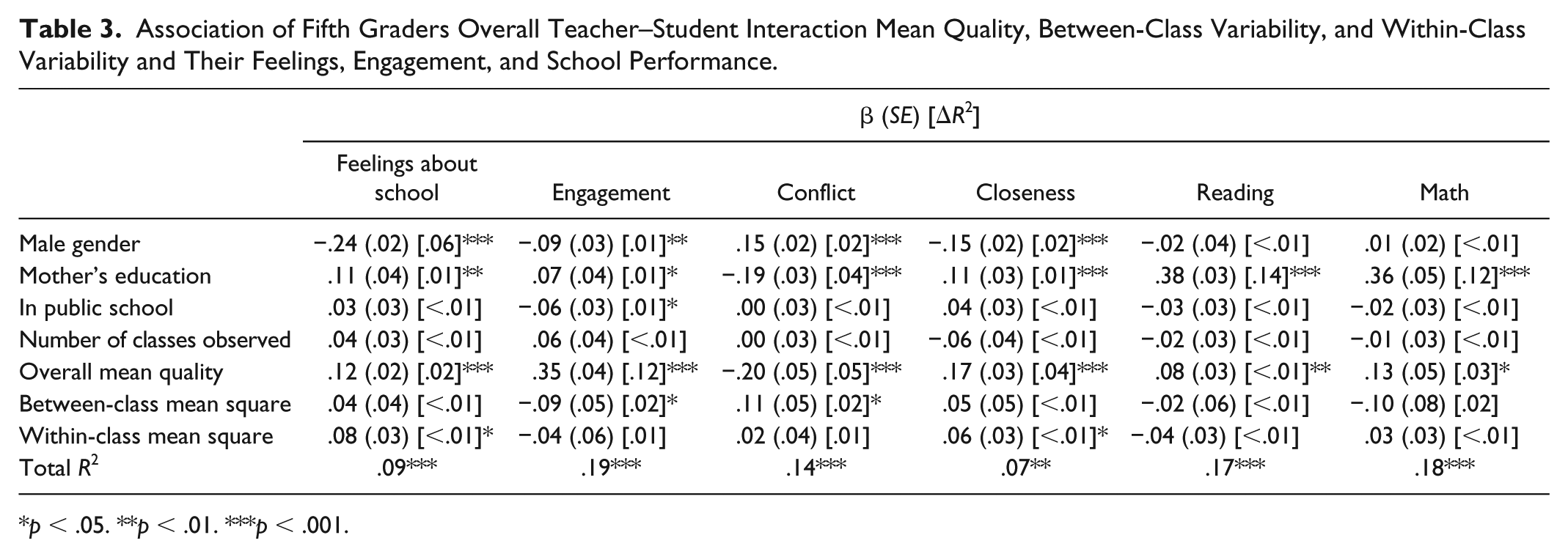
p < .05. **p < .01. ***p < .001.
Discussion
Results from the present study provide empirical support for links between observed classroom teacher–student interactions and learning in early adolescent students. When students had classroom experiences with teachers who showed greater sensitivity, responsiveness, predictability, and emotional warmth in their interactions, students reported greater motivation, were observed as more engaged, had more teacher-reported closeness and less conflict, and performed at higher levels on mathematics assessments. In addition to associations with the overall quality of teacher–student interactions, results also suggest that variability in these interactions had an influence. When students had more variability in the quality of their teacher–student interactions throughout the school day, teachers reported more conflict and the students were observed to be less engaged, suggesting that the consistency of exposure to supportive interactions may also serve as a key feature of the early adolescent student experience. Taken together with other studies (Pianta & Allen, 2008; Reyes, Brackett, Rivers, White, & Salovey, 2012; Roeser et al., 2000; Rudasill et al., 2010; Way et al., 2007; Wentzel et al., 2010), our results suggest that, especially, as students’ school experiences become more divided across teachers, paying special attention to maintaining consistent, supportive relationships across these settings is critical to students’ development and learning.
The present study adds to a growing literature identifying the value of supportive school relationships by expanding on its role in early adolescence in particular (Baker, 2006; Connell & Wellborn, 1991; Klem & Connell, 2004; Niehaus et al., 2012; Ruzek et al., 2016; Wentzel, 2002) and by identifying observable teacher behaviors that characterize these relationships and are related to student outcomes. The influence of classroom interactions with teachers and peers are dominant during this time, acting as social processes that can either enhance or distract students from achieving academic success (Baker, 2006; Wentzel, 2003). Given that moving up in school is often associated with declines in motivation, self-esteem, class preparation, and performance (Eccles & Midgley, 1989; Seidman, Allen, Aber, Mitchell, & Feinman, 1994), these results provide an empirical basis for efforts focused on understanding and potentially improving the quality of teachers’ interactions with students (Anderson, Christenson, Sinclair, & Lehr, 2004; Pianta & Allen, 2008).
In this study, observations of students’ classroom interactions with teachers allowed for a direct and independent assessment of the quality and variation happening throughout a school day. Above and beyond the overall effect of the teacher–student interaction quality, findings from this study suggest that consistency may also play a contributing role to student development and success. This builds on student report data showing that variation is important and shows us the kind of teaching behavior that reflects what students actually experience (Schenke et al., 2017; Schweig, 2016). Specifically, the results suggest that the observed variability in teacher–student interactions is associated with students’ engagement in the classroom and conflict reported by the teacher and support the notion that consistency in interactions may remain important beyond early childhood.
Of note, however, is that, after accounting for overall quality more variability actually predicted teacher-reported closeness. Since closeness can serve as a protective factor, it is interesting to consider under what circumstances might some variation be good to experience, as long as the overall quality remains high. Thus, similar to Curby, Grimm, and Pianta’s (2010) study, our findings indicate that examining both overall quality and consistency of classroom interactions within and across classroom settings provides valuable information about the potential influences of classroom processes on development.
In addition, by using observation data throughout the full day, this study pulled apart the variation of teacher–student interaction quality between and within classrooms for an individual student. Resultant findings indicate that the variation a student experiences between teachers (versus with a single teacher) is most strongly associated with the students’ lower engagement and higher teacher-reported conflict. One reason for the difference in associations could be that familiarity with one teacher’s supports, routines, and expectations ameliorates the variability within a teacher–student dyad, resulting in less conflict and uncertainty about what to do in the classroom. This explanation is consistent with research conducted in countries where students remain with the same teacher for multiple years (e.g., Norway) showing a tendency for teachers (and students) to report lower levels of conflict and social problems in the classroom than in the United States (Munthe & Thuen, 2009).
Limitations
The results of the present study should be interpreted with caution as several limitations are worth noting. First, there are multiple sources of variance in observational data that may be attributable to other factors. It is possible that at least part of the variability that is being attributed to the different interactions students have with teachers throughout the day could be due to factors such as day of the week or time of day that the observations occurred (Raudenbush, Martinez, Bloom, Zhu, & Lin, 2011). However, a key strength of this study is that the same rater coded interactions throughout the day, and all the observations started and ended at approximately the same time, minimizing these sources of error. Studies that continue to seek ways to reduce error to better understand the role of observation variance would be helpful to further refine this work.
An additional limitation is that the study is correlational in nature, leaving the questions of causality and directionality unaddressed. Teachers’ interactions with students are partly dependent on the students. Although we examined the relations between the observed teacher–student interaction quality and consistency as they relate to student outcomes, it could be that students who like school, are engaged, and perform well are able to foster more positive and stable relationships with their teachers (Rimm-Kaufman, & Kagan, 2005; Rudasill & Rimm-Kaufman, 2009). It is similarly possible that disruptive and unmotivated students may influence the classroom interactions as captured in the observational measures. Multiyear studies following teachers, collecting data throughout the year, and gathering more information about the students’ behavior may begin to address this issue.
Finally, an additional limitation is the timing of the data collection. Although there are many advantages to using this comprehensive, longitudinal database to address questions related to students’ experiences in school, it is important to note that classroom processes examined here occurred approximately 10 years ago. Given the growing attention in the literature to the importance of high-quality interactions between teachers and students, it is possible that students’ typical experiences in classrooms today have changed qualitatively since 2003. Furthermore, there were measurement issues that prevented us from testing the classroom processes on development. Thus, engaging in new developmental studies that use consistent measurement over time would allow further refinement of understanding the classroom processes that support or inhibit development.
Conclusion
Despite these limitations, this study provides further evidence that teacher–student interactions are important to students’ school outcome trajectories. In particular, the characteristics of teacher–student interactions provided to students (both on average and how they vary across the day) were related not only to student motivation and engagement but also to academic performance in math. The findings have relevance for current policies related to assessment of teacher performance (National Council for Accreditation of Teacher Education [NCATE], 2010) and efforts to improve teacher performance and student outcomes through focus on teachers’ classroom behaviors (Pianta et al., 2008). That the social and relational nature of the classroom was important for student math performance should also be of interest in the context of concerns about student outcomes in that domain (United States Department of Education [USDOE] & President’s Council of Advisors on Science and Technology, 2010). This further supports the developmental notion that the relational supports provided to students, particularly as they age, have an important association with academic outcomes that cannot be ignored.
Footnotes
Declaration of Conflicting Interests
The author(s) declared no potential conflicts of interest with respect to the research, authorship, and/or publication of this article.
Funding
The author(s) received no financial support for the research, authorship, and/or publication of this article.