




Abstract
The contemporary school environment in England has been identified as stressful for both staff and pupils. School-based interventions aimed at improving well-being and mental health have shown mixed results. The Principle Based Model (PBM) of Mind, Consciousness, and Thought is an untried intervention in English schools and as a working model there is a paucity of research into its potential. The aim of this mixed-methods pilot study was to investigate the effectiveness of the PBM as a means of increasing the psychological well-being of staff and pupils. The study was a 16-week pre, post, and follow-up study using the Friedman Well-Being Scale (FWBS) as a measure of psychological well-being, and analyzed using matched sample t tests and repeated measures ANOVA. The study was carried out in a high school in the east of England with 10 staff and nine pupils. The staff and pupils involved received the PBM as a psychoeducational program. During the follow-up period, six members of staff and one pupil were interviewed and the transcripts analyzed using Thematic Analysis. The pre to post total FWBS scores showed an increase in psychological well-being for both staff and pupils but only the change for pupils was statistically significant. Post to follow-up total FWBS scores for both staff and pupils showed no significant change. This study provides some initial evidence to suggest that the PBM may be a useful tool for schools to utilize in attempting to increase psychological well-being.
Keywords
Introduction
School-based interventions aimed at improving staff and, mainly, pupil mental health, self-esteem, and well-being have become a feature of the English education system as they intuitively have considerable reach into the adolescent population. Previous governments have invested in large-scale programs aimed at enhancing pupils’ social and emotional well-being, especially through the Social and Emotional Aspects of Learning (SEAL) program, which was explicitly linked to learning, behavior, and attendance The SEAL program was extensively evaluated with mixed results (Hallam, 2009; Humphrey, Lendrum, & Wigelsworth, 2010). The introduction of the new national curriculum under the coalition government sidelined SEAL although schools have been able to keep aspects of it.
This article reports on a small, mixed-methods pilot study of an intervention aimed to improve the well-being of both staff and pupils through the use of the Principle Based Model (PBM; described below). Although there are overlaps with SEAL especially in SEAL’s relationship with self and relationship with others part of the framework (Garner & Gains, 1996), PBM comes with a broader purpose and is not constrained to furthering school aims.
The heavy cost to the system of stress, depression, and anxiety has been highlighted by Troman (2000). The Association of Teachers and Lecturers has also shown concerns over the increasing number of youth committing or attempting to commit suicide, suggesting that academic demands placed on pupils alongside peer pressure are contributing toward this dramatic increase (Kelley, 2004). Since 1999, education has been a devolved responsibility in the United Kingdom. Therefore, the Scottish Parliament and the Assemblies of Wales and Northern Ireland have been able to set their own education policies. This study was conducted in England and, thus, the context concentrates on previous research in English schools.
A recent classroom-based, depression prevention, cognitive behavioural therapy (CBT) program for pupils in England was rigorously assessed using a randomized control trial design and found that the intervention did not reduce depressive symptoms in adolescents at high-risk for depression compared to usual school provision (Stallard et al., 2013, 2012). The authors caution that further classroom-based interventions should not be undertaken without further research. A qualitative evaluation of the same program indicated that although the program had some good features such as relevance of material, especially for younger pupils, there were issues with the lack of flexibility and consistency of quality (Taylor et al., 2014). An earlier geographically broader review concluded that targeted interventions, as opposed to universal ones, had great efficacy, that most school-based interventions used a CBT structure, and overall the results were mixed with only half the studies reporting improvements at posttest or follow-up (Calear & Christensen, 2010). Regardless of these findings, the case for supporting adolescents during school had generally been made and most of the discussions are about how to provide such services and if teachers are the most appropriate ones to deliver such programs (Dewhirst et al., 2014; Kidger, Donovan, Biddle, Campbell, & Gunnell, 2009; Kidger, Gunnell, Biddle, Campbell, & Donovan, 2010). However, the current government has reduced the emphasis on pupils’ emotional well-being in the English education system (Salter-Jones, 2012).
Teachers’ occupational stress has been the subject of much research with well-established factors (Salter-Jones, 2012; Travers & Cooper, 1996; Troman, 2000), and U.K. teachers have been shown to have worse psychological well-being than their European counterparts (Griva & Joekes, 2003). Despite the amount of empirical evidence on teachers’ stress and psychological well-being, they have not been the subject of interventions designed to help with some small-scale exceptions (Annan & Moore, 2012; Troman, 2003)
From the perspective of the PBM, the negative behaviors and symptoms displayed within the school environment could be alleviated if people were given the opportunity to understand their own part in the psychological construction of their feelings. Pransky and McMillen (2013) explained that at the core of the PBM, the focus is not on what we think about, but the power of thought through which we all experience life.
The PBM
The three principles in the PBM are as follows: Mind, the source of all intelligence; Consciousness, which allows us to be aware of our existence; and Thought, which guides us through the world we live in as free-thinking agents. Banks (1998) explained it this way, “[w]hen you start to see the power of Thought and its relationship to your way of observing life, you will better understand yourself and the world in which you live” (p. 52). The PBM has been known by a number of names: Psychology of Mind, Innate Health, and as Health Realization or simply “Principle-Based.” Fuller descriptions and background to the PBM have been presented in this and other forums (e.g., Kelley, 2003a; Kelley, Mills, & Shuford, 2005). R. C. Mills (1995) proposed how the PBM could be administered by looking toward the health in clients rather than illness and that once an individual begins to understand what role thought plays in the creation of their lives, they have more of a tendency to use thinking more efficiently. Furthermore, once people begin to see the role of thought, the end result is generally a quieter, less busy mind, which ultimately leads to a calmer and more positive state, without the need to attempt the removal of so-called negative thinking. In other words, seeing thought as the defining factor in how we see life, leads to a freeing up of the energy more commonly expended in the endeavor to deal with life’s ups and downs.
The primary focus of the PBM is the health of the individual and not the details of their individual lives or their self perceived problems and difficulties. Thus, it becomes not a way to reduce stress or anxiety directly, or to attempt to fix individual thoughts or problems, but as a solution to all of life’s ups and downs by seeing their source as coming from perception of life via personal thinking.
Kelley (2003a) charted the course of research using the PBM, the vast majority being conducted in the United States. First, the focus was on using the model as a therapeutic approach for adults with, usually, depression. Then the model began to be used in community empowerment programs; notably Modello and Homestead Gardens (Pransky, 1998) and Avalon Gardens (Borg, 2002). These community-based, mainly qualitative, studies produced impressive results for reductions in crime and increased attendance and achievement in the local schools. Kelley’s own research has applied the PBM to the issue of school violence (Kelley, 2003b; Kelley et al., 2005) and in the police and correctional services professions (Kelley, 2005). Furthermore, the PBM has been shown to have comparable results to a 12-step program in a female drug treatment program (Banerjee, Howard, Mansheim, & Beattie, 2007) and has been used as the basis for an intervention to improve coping and well-being in refugee women (Halcón, Robertson, & Monsen, 2010; Halcón, Robertson, Monsen, & Claypatch, 2007).
No previous research has been published on the PBM in schools outside the United States and using pre- and postintervention, individual measures of well-being. In this study, we hypothesize that the PBM intervention will result in increased well-being for both staff and pupils.
Method
This study was a quantitative/qualitative (QUANT + qual) (Morgan, 1998), single-group, pre, post, and follow-up design study (Figure 1), collecting primary data using the Friedman Well-Being Scale (FWBS). Post study in-depth interviews were carried out at the conclusion of the project, transcribed, entered into Max QDA 2, coded, and examined for themes using Thematic Analysis (Bryman, 2004). Written consent was obtained from all participants, including parental consent for the pupils. The school head teacher gave permission for the study and the University of Essex granted research ethics approval.

Study design and sample numbers.
Setting/Location
The study was carried out at a high school in the east of England with an average Ofsted report record. The school was in a central town setting with a wide catchment area taking children from both rural and urban homes. The school also had a relatively high proportion of ethnic minority group pupils in comparison with other local schools. In addition, a proportion of children came from socially deprived backgrounds as the town has three of the top 13 most deprived council wards in England.
Recruitment
The recruitment process began with a series of discussions with the head teacher of the school, followed by a presentation about the study to the entire teaching staff.
After the presentation, all interested staff were given a handout detailing the outline and time requirements for the study along with a consent form. For pupils, an information letter and consent forms were sent home to parents of all Year Ten pupils. The pupils who volunteered were given a simplified outline sheet for their information and a consent form.
Sample
Upon recruitment, 10 staff and nine pupils volunteered to participate in the study. The sample of both staff and pupils was self-selected following the open recruitment messages at the school. Two staff members did not complete the follow-up data collection and one pupil withdrew from the study during the intervention phase, leaving eight staff members and eight pupils who completed all stages. At recruitment, the 10 staff consisted of six males and four females with an average age of 46 years. The pupil sample consisted of six males and three females and all pupils were either 14 or 15 years of age.
Intervention
The PBM sessions were facilitated by D.R.-E. and a colleague, who are both trained PBM practitioners, over an 8-week period with both groups. The pupils’ intervention took place over two extended evenings at the school, and for the staff, the study began with a 2-day intervention at an offsite location. During the first 2 days, both the pupils and staff were introduced to philosophy of the Three Principles, especially focusing on the idea of Thought, as a principle, creating individual reality.
The staff and pupil sessions had a similar loose structure, and much of the same material was covered in both. However, with the pupils, more of an emphasis was placed on understanding self-esteem, via the power of Thought. In addition, it was explained to both groups how the feelings of empowerment or disempowerment are usually a direct result of how we view the world and how we view the situations that we find ourselves in, via the power of Thought.
One important aspect of the training for the pupils was the examination of seeing past the impersonal nature of interactions with other people, that is, beginning to recognize that the mood level of teachers, parents, siblings, or peers was simply a result of the other persons thinking, and nothing personal to them, despite the fact that it appeared that way sometimes.
Both groups were encouraged to see this understanding of the power of Thought as a generalization, that is, that this recognition of how Thought plays a contingent part of what we can potentially take for granted as coming from the outside (i.e., objective pressure). Contrasted with seeing pressure as coming from within, from Thought, and therefore each person has some control over this process when they become aware of it.
FWBS
The FWBS (Friedman, 1994) contains 20 bipolar adjectives, and is a simple questionnaire that is easy to score. We used it as a general measure of well-being, using all 20 items in the ‘Friedman Well-Being Composite’ (FWBC) and five subscales: emotional stability (FES); self-esteem/self-confidence (FSES); joviality (FJOV); sociability (FSOC); and happiness (FHAPP) all using the raw to standard score conversion table. The FWBS was used in two previous PBM studies (Department of Alcohol and Drugs Services, 2003; A. C. Mills, 2005). Participants completed the FWBS either in school time in a separate classroom (pupils) or at the intervention location (staff). In this study, the FWBC had good internal reliability with Cronbach’s alpha values of .83 (pre), .87 (post), and .91 (follow-up) for the combined sample.
Data Analysis
This study looked at related samples comparisons, from the pre, post, and follow-up FWBS data using paired sample t tests and repeated measures ANOVA, separately for staff and pupils. Statistical significance is set at p < .05, two-tailed tests. Effect sizes were estimated by Cohen’s d for the paired t tests and Cohen’s f2 (Cohen, 1988) using Stata 13. Reliable change statistics followed Jacobsen and Truax (1991) with test–retest information from Friedman (1994). The semistructured interviews were transcribed and coded using Max QDA 2 software, and the transcripts were evaluated using Thematic Analysis.
Results
The FWBS results are presented in two parts below, the first (Table 1 and Figure 2) is the FWBC scores for staff and pupils, and Table 2 presents the FWBS subscale results for staff and pupils.
Friedman Well-Being Scale Total Standard Scores for Staff and Pupils.

Note. Degrees of freedom in brackets. ITT = intention-to-treat analysis; d = effect size by Cohen’s d.
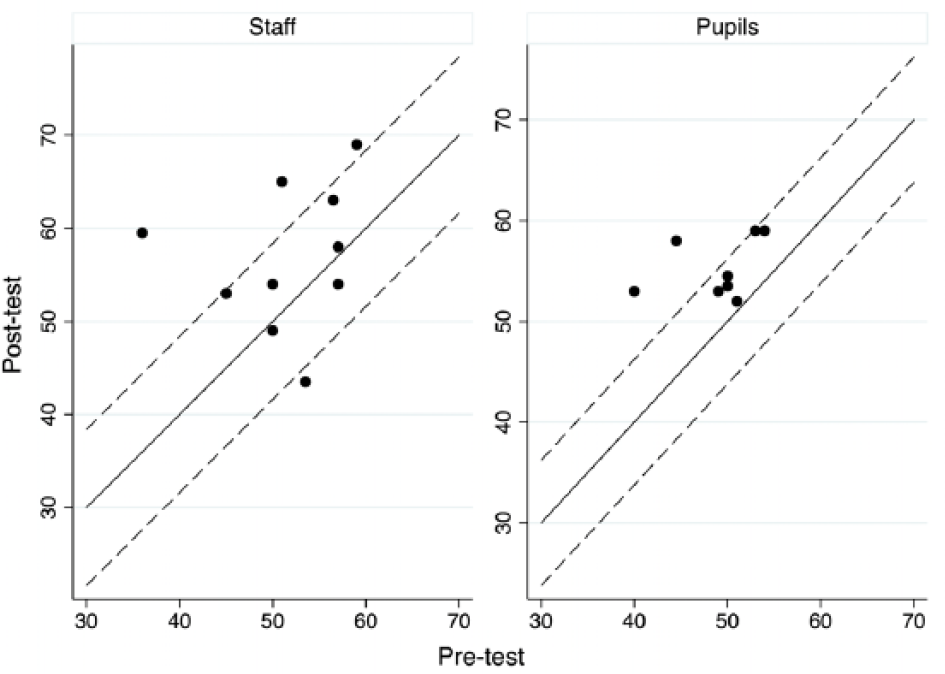
Dot plot of FWBC scores for staff and pupils.
FWBS Subscale Scores for Staff and Pupils.

Note. Subscales: FWBS = Friedman Well-Being Scale; FES = emotional stability; FSES = self-esteem/self-confidence; FJOV = joviality; FSOC = sociability; FHAPP = happiness.
Paired t test p < .05 from pre score (Intention-to-Treat analysis on multi-item subscales).
Figure 2 shows a dot plot of the pre and post FWBC scores for staff and pupils along with lines of no change (solid) and lines of reliable change (dotted). For staff, post scores are more dispersed and three staff recorded lower scores than their pretest—one of which exceeded the reliable change indicator. Three staff recorded increased FWBC scores that exceeded the reliable change indicator. All pupils increased their FWBC post scores but only two increases exceeded the reliable change indicator.
In Table 1, for staff, there is an increase in FWBC scores at post and follow-up compared to pre. These changes are not statistically significant but the effect sizes (d = 0.724 and 0.787, respectively) are medium sized. The repeated measures ANOVA resulted in a nonsignificant result, F(2, 18) = 2.97, p = .077, Cohen’s f2 = 0.137, supporting the results of the paired t tests and an overall small effect size.
For pupils, the pre to post increase is statistically significant and the effect size (d = 1.448) is large. This group’s scores decreased from post to follow-up resulting in the difference from pre being nonsignificant but still with a moderate sized effect (d = 0.699). The repeated measures ANOVA resulted in a significant difference across the three time points, F(2, 16) = 6.30, p = .010, Cohen’s f2 = 0.285, supporting the results of the paired t tests and an overall moderate effect size.
For the FWBS subscales (Table 2), staff showed only one statistically significant change from pre to follow-up on the Joviality (FJOV) subscale. Pupils showed statistically significant increases from pre to post on three of the five subscales, the exceptions being Self-esteem/Self-confidence (FSES) and Joviality (FJOV). However, only the Emotional Stability (FES) subscale managed to remain significantly different at follow-up (compared to pre). In the repeated measures ANOVA tests, none of the subscales were statistically significant for the Staff group. For pupils, two of the subscales had statistically significant repeated ANOVA results: Emotional stability (FES): F(2, 16) = 5.727, p = .013, Cohen’s f2 = 0.325 (moderate); and Sociability (FSOC): F(2, 16) = 5.722, p = .013, Cohen’s f2 = 0.174 (small).
Thematic Analysis
Semistructured interviews were carried out with six members of staff and one pupil using an interview guide (Table 3). These interviews were conducted to attempt rapprochement (Bryman, 2001) and enhance the findings of the quantitative data analysis, thus creating the opportunity to elucidate some of the personal experiences that participants had gone through in light of the training. The transcribed data from the interviews were open coded into ten main codes: (1) Expectations and motives; (2) Personal changes; (3) Well-being; (4) Simplicity; (5) What other people think; (6) Effecting others; (7) Reduced stress; (8) Changes in others; (9) Increased awareness; and (10) Potential of the Principles.
Semistructured Interview Guide.

Out of these 10 codes, three main themes emerged that of (A) Expectations and motives; (B) Personal changes; and (C) Reduced stress. With the remaining coded segments being either collapsed into subthemes to the main coded texts, or being dropped. Exploring these themes using extracts taken from the transcripts, it was possible to create a picture of change of the individuals.
Theme A: Expectations and Motives
Most staff participants attended simply out of general curiosity or interest and thought that the training would be more interactive like other training days they had attended as teachers, and as such some were surprised by the differences:
I was a bit nervous about that cause (you know) I didn’t know what you’d expect us to do, I didn’t know whether we’d have to (you know) enter role-play type activities, or sit around in groups and bare ourselves to each other. (Interview 3)
Those who had a motive to take part other than simply general interest seemed to have had an experience born out of a more open mind, and as such potentially gained more from the experience. At least two of the teachers who volunteered had definite reasons for attending, one explained,
I went on the course to find out if I could do a high-pressured job, be a Mum to very young children and not feel so stressed after being so ill. (Interview 6)
A second disclosed,
No, I did have a motive, I think after losing [her husband] and going through bereavement I was on tranquillizers, and all sorts, so I wanted to kind of find something to help me. (Interview 1)
Theme B: Personal Changes
The changes that some staff expressed during the interviews appeared to be a reflection of a personal knowing. As if they intuitively recognized that their life as a teacher, and its effect upon the pupils could open up in a calmer way and that the training had led to an increased awareness to this fact:
I have noticed, well, I’ve been more aware, I’ve become increasingly aware of the children at school, of how they are affected, you know, about what’s going on . . . I know all of this, of course I know, I’ve always known this, but I’m more sensitive to it. (Interview 4)
Another participant pointed out that although it was not the results they might have hoped for it was still a step forward. They put it this way,
Definitely, not [an] earth moving, life changing, earth shattering moment. But little things that have made my work and my life better—not all the time, because I forget sometimes, but in certain situations definitely things have been a lot better. (Interview 2)
Some staff spoke of the ways in which they were responding to conditions at school or home and how it had become markedly different. One participant spoke of having been in a cycle of being stressed at work, invariably feeling tired, going home, staying up late, not wanting to go to bed, watching television, and having no desire to “think about anything.” Followed by,
Definitely, I mean at work now, I don’t get tired when I go home, I’ve got more motivation, I’ve got more patience with all the pupils and students, and I’ve seen a difference there, I’m not so sharp or quick to jump on them. And that’s been really good . . . so yeah, I do feel a lot better. And not so tired, you know I still go to bed late, but I’m rested (more restful sleep). (Interview 1)
Several staff members explained how they had witnessed sometimes subtle and occasionally more obvious transformations in themselves:
I feel calmer, I don’t disrupt the school and it’s just a little bit more a professional and easier way to work, somehow. That’s a kind of big change for me . . . really, cause I used to be quite famous for going off on one, and then coming down straight away, cause it’s all just an act, but that was maybe not a very good act to have in a way. (Interview 2)
This sense of feeling calmer at school was a revelation to some staff as it was assumed by most that teaching by its very nature must be stressful. The distinction between pressure (objective tangible workloads) and stress (as being created by our personal thinking about the pressure) was explored during the interviews. There appeared to be a great deal of objective pressure on the teachers with considerable other duties and obligations outside of classroom teaching (Troman, 2000).
The pupil who volunteered to be interviewed seemed certain of the changes that had taken place for them, and spoke with great clarity of their transformations, enumerating them:
Well, I used to get angry really easily, like just little things would make me really, really angry, and errrm . . . I had a really, really short attention span, and . . . just . . . Like—I was quite sociable but, you know, like in a different kind of way—I would see people but not try and meet new people, but now, it’s just all different really, all three things have changed . . . Because I’ve learnt how to (like) interact more and, (don’t know) just, what other people think, because people have the same feelings as me and so, I can . . . just realize that (approach), easier really. (Interview 7)
Theme C: Reduced Stress
In many of the interviews, staff pointed toward a reduction in their levels of stress. One explained,
I think with work I really noticed it last week, when we were being [Ofsted] inspected, . . . everyone, all the staff were getting stressed, . . . and I must admit I had no stress at all. I stayed up the night before, done my lesson plans, but not stressful, put them on the pen [drive] . . . I know what I’m going to teach. And I just went in, and so it didn’t stress me at all. But I did see quite a lot of teachers really stressed, and even the two days after [people] were going off sick and you could see the stress that they had. And I had none of that which was lovely. (Interview 1)
One member of staff explained how they had the iniquitous task of dealing with pupils for discipline reasons. Often these pupils would be very rude and challenging, arriving in a state of great disharmony, but this teacher found that feeling calmer had made the whole process easier for all involved. They describe how the pupils
. . . just come and [I] do the paperwork and move on, next one. I’ve been doing that really since the course [PBM]. Now, I could do it before, but I find I’m much more methodical in my calm approach to those sort of situations now, because it’s better for everybody. (Interview 2)
The same teacher continued to explain their previous stress and its perceived personal negative effect upon the school, prior to the training:
I must have destroyed whole lessons as I’m shouting and yelling in the corridor—cause it interferes with everybody’s learning—doesn’t do any good, might have made me feel better in the short-term, but . . . still have a little go at home at the kids sometimes, but I’ve got better at that as well, cause that was one of my main aims, wasn’t it, that I wouldn’t take the pressure from work home and take it out on the kids. (Interview 2)
This sense of finding a more relaxed way of working within familiar circumstances seems to point toward the PBM theory that each individual has within them what is termed “innate health”; that it is a return to a neutral and natural state that takes place from an understanding of the Three Principles, not learning new coping strategies. One participant talked of a shift in their thinking had and that they had come to realize that the content of their thinking about circumstances is what drives stress home or, conversely, away:
Yeah, but I think a lot more about it since that course [PBM], about the fact that thought is just a thought. (Interview 3)
The subject of “Thought” and it being the cause of stress led to much discussion during the training, and the distinction between the content of our everyday thinking, and “Thought” as a guiding principle was suggested as a reason for these differences. Participants were not always completely comfortable or relaxed during the training, as one recalls,
I think people are innately suspicious of anything which is [or] could be branded as alternative. And also people are very suspicious of anything that involves them doing something rather than them thinking through things, people are quite uncomfortable, that was one of my observations, people are quite uncomfortable doing what they perceive as nothing. Again that’s part of our conditioning, we’re used to being force-fed fast dances. (Interview 2)
Discussion
The aim of this study was to test the efficacy of the PBM as a way of increasing the psychological well-being of staff and pupils in a school. The total pre to post scores demonstrated an increase in psychological well-being for both staff and pupils and with moderate to large effect sizes, but with only the pupil group being statistically significant. Reliable change analysis indicates that two pupils and three staff members’ change in FWBC score was marked—although one staff member did decline in excess of the reliable change indicator. This tentatively suggests that PBM has a positive effect on pupils’ well-being. Post to follow-up scores for both groups showed no significant change.
The primary limitation of this pilot study was the shortness of its length for both the intervention and the follow-up period. Future research would benefit enormously if it was carried out over a longer period of time. Another limitation was the lack of a control group. The single group design allowed us to investigate the possible impact of the PBM on the staff and pupils at this school but without a control group, we do not know if the changes may have occurred without the intervention. Furthermore, the small numbers of staff and pupils and the self-selecting nature of the sample make generalization unreasonable but the exploratory nature of this pilot study is primarily designed to inform and/or generate further research.
Research has shown how the psychological and emotional state of a child dictates their ability to learn, because it is emotions that sit behind motivation and the drive to access education. Additionally, it has been suggested that education has not fully taken up the responsibility of addressing the connection between stimulating positive emotions in the classroom and psychological well-being of staff and pupils working together (Sylwester, 1994). This study shows the possibility for some pupils to increase their level of psychological well-being and thus to potentially recover the incentive to engage in education more positively.
One of the features of this study was the focus on the health of the individuals during the intervention as opposed to attempting to trouble shoot or offer solutions for existing problems that the school or individuals might be dealing with. Borg (2002) suggested in his community renewal study that illness, as it appears in a community in general, is not just organic in nature but also social, and where there is a social element to suffering, the solution lies in the community understanding each other at a deeper level, and then the solution arises quite naturally from within the community, along with the Modello Community renewal project (Pransky, 1998).
The qualitative interviews show how individuals, once they begin to become more aware of their own innate health begin to see it in others and thus treat peers and pupils with more respect and care and ultimately become more effective and productive in what they do. This, as one participant noted, can only be better for the school as a whole.
It is important to note that understanding the power of Thought is not the same as simply thinking positively. Understanding how thought works aids the development of a deeper awareness of the power behind thought itself. Put another way, recognizing that all thought is neutral until it is given life by the thinker and the direction and focus that people as individuals choose to orient themselves.
One final note about the PBM in general and its application is that the PBM has been applied in many different settings, including community and education applications. It would seem from the evidence available that once individuals begin to see how the Principles operate in their lives, this process has the potential to shift their perspective away from focusing on the things they do not want in their lives and toward the things they do want, that is, happier states of being. It would seem that developing a deeper awareness of feeling states helps individuals to understand that a mood shift down into a lower state of consciousness is not something to become worried about or even something that necessarily requires any action, although it may. Once individuals begin to understand the source of mood changes their lives have the potential to change positively.
This study provides some evidence to suggest that where social, psychological, and emotional improvements are being sought in education, the PBM may be a useful tool for schools to utilize in creating greater levels of psychological well-being and a reduction in stress, with a corresponding increase in calmness and stability, thus creating a more harmonious place of work for adults to work, and children to learn in. However, a limitation (and possible benefit) of the PBM is that it is partially “reactive” to the group dynamic and cannot be designed into a protocol. The lack of flexibility in delivering CBT-based interventions has been previously commented on (Taylor et al., 2014) and the flexibility of the PBM, in the hands of trained facilitator, may be one of its benefits.
The findings of this study tentatively suggest the potential for staff to work in a more relaxed and resilient way, reconnecting with a more common sense and intuitive approach to their relationships with peers, senior management, and the pupils with which they work. As the PBM uses a nontechnique-based approach, it is potentially easier for staff to connect with an understanding of the Three Principles, as having meaning for them in their lives, rather than having to rely on techniques from the outside, something which often requires memorization and application. Using the PBM uncovers resilience within themselves.
The conclusions taken from this study are important as they show some promising possibilities for further research, and correspond with the hypotheses that an exposure to the PBM does indeed lead to a greater experience and level of well-being for people. They add to the growing body of studies that are exploring an understanding of the human experience and of resilience and positive psychological health. This study is in line with previous research projects carried out within similar settings and offers great potential hope to the ever-increasing problems within the education system.
Footnotes
Declaration of Conflicting Interests
The author(s) declared no potential conflicts of interest with respect to the research, authorship, and/or publication of this article.
Funding
The author(s) received no financial support for the research, authorship, and/or publication of this article.