




Abstract
This study explores the ability of Jordanian learners of English as a foreign language (EFL) to comprehend metaphorical expressions in English and investigates whether the use of their first language (L1) conceptual and linguistic knowledge may facilitate the comprehension of these expressions. For this purpose, the study adopts a contrastive model developed by Charteris-Black, which consists of six types of metaphor to compare and contrast in both English and Arabic. On the basis of this model, the researcher designed a multiple-choice test to assess the participants’ recognition of English metaphorical expressions. The results reveal that the participants’ receptive knowledge of metaphors varied on the basis of the six types of metaphor. The study provides evidence of the possibility that EFL learners display general conceptualizing capacity regardless of their language, which hints, possibly, at the potential universality of conceptual metaphor. It also proposes some pedagogical implications that may assist EFL learners in acquiring metaphorical expressions in English.
Keywords
Introduction
Due to their pervasiveness in everyday interaction, metaphorical expressions have begun to draw considerable attention in recent years. Many scholars have investigated various types of figurative language expressions in different languages based on Conceptual Metaphor Theory (Boers, 2000 [Dutch and French]; Cameron & Deignan, 2006; Charteris-Black, 2001 [Spanish], 2002 [Malay]; Deignan, Gabyrs, & Solska, 1997 [Polish]; El Refaie, 2015; Gibbs & Matlock, 2008; Kövecses & Szabó, 1996 [Hungarian]; Yu, 1995, 2015 [Chinese], Zibin & Hamdan, 2014, etc.). The importance of mastering the use of metaphors by learners of English as a foreign language (EFL) stems from their significant role in communicative interactions (Littlemore & Low, 2006). However, their acquisition has always been seen as a stumbling block for EFL learners around the world. Most importantly, EFL learners may fail to realize where first language (L1) and second language (L2) meet and where they diverge. Charteris-Black (2002) stated that conceptual fluency could be defined as the means by which the concepts of a language are metaphorically coded. Thus, conceptual transfer from the L1 to the target language can be a source of error facing many EFL learners. This study aims to (a) investigate Jordanian EFL learners’ ability to comprehend metaphorical expressions in English and whether using their conceptual and linguistic knowledge of their L1 (i.e., Jordanian Spoken Arabic [JSA]) would assist them in comprehending metaphorical expressions in English, and (b) illustrate the similarities and differences between English and Arabic in terms of conceptual and linguistic metaphors.
Theoretical Framework
The nature of metaphor assumes a distinction between literal and figurative language (Lakoff, 1987; Lakoff & Johnson, 2003). Thus, senses of words that are thought to be different from their primary and basic senses can be used to refer to figurative language use (Charteris-Black, 2002). In contrast, literal language is concerned with the basic word meaning that is related to physical experiences in the world. Lakoff and Johnson (2003) argued that metaphors are devices that are omnipresent in all walks of life. They indicated that, basically, the ordinary conceptual system of humans is metaphorically structured and for this reason, it is not possible for us to live without metaphor. Lakoff (cited in Deignan et al., 1997) proposed that the term conceptual metaphor is used to refer to a connection between “two semantic areas at the level of thought such as the metaphorical connection between anger and fire for speakers of many languages” (p. 352). This type of metaphor can be represented as follows: CONCEPTUAL DOMAIN (A) IS CONCEPTUAL DOMAIN (B). This means that Domain (A) is comprehended through Domain (B). This comprehension is based on a set of mappings (i.e., systematic correspondences) that exist between elements of A and elements of B (Kövecses, 2002). When written, in the relevant literature, conceptual metaphors are designated, using upper case such as ANGER IS FIRE. Spoken or written realizations of conceptual metaphors are referred to as linguistic metaphors, such that, examples of linguistic realizations of the conceptual metaphor ANGER IS FIRE could be seen below as described by Lakoff (1987):
• Those are inflammatory remarks. • He was breathing fire. (p. 388)
In Lakoff and Johnson’s view, metaphors are seen as a matter of cognition; they can be understood as mappings between two conceptual domains: the “source” domain and the “target” domain (Lakoff, 1993, p. 1; Lakoff & Johnson, 2003, p. 252). For instance, we usually conceive of LOVE as a JOURNEY where JOURNEY is the source domain and LOVE is the target domain. Thus, when we hear a couple describing their relationship as traveling on a bumpy road, we understand that they are not talking about the physical obstacles on the way but about the difficulties they experience in their relationship (Kövecses, 2002). Charteris-Black (2002) posited that words in source domains have normal or unmarked senses, whereas words in target domains have less usual or marked senses. Source domains are the objects from which some features are borrowed, to be ascribed to the object being referred to (i.e., target domains). An important feature of the mappings between source and target domains is the fact that they are only partial, not complete. In other words, “only a part of concept B is mapped onto target A and only a part of target A is involved in the mappings from B” (Kövecses, 2002, p. 79). According to Lakoff and Johnson (2003), metaphors “provide coherent structure, highlighting some things and hiding others” (p. 139). If a concept possesses several aspects, the metaphor emphasizes one or maybe two or three aspects; the other aspects will be hidden. For instance, in THEORIES ARE BUILDINGS, the metaphor focuses on the aspects of the construction of the theory and its strength. Other aspects of buildings, such as their architectural style, their location, whether they are occupied or not, and so forth, remain hidden or unutilized (Kövecses, 2002).
Concerning the cognitive processing of L2 metaphors, Littlemore (2003) argued that when L2 learners encounter gaps in their target language lexis, they usually employ certain strategies to process metaphors in the target language. For instance, L2 learners may compare the target item with another object in an analogical (using like) or a metaphorical way (not using like). The former type of comparison is original; however, in conventional comparison, EFL learners utilize their knowledge of L1 or L2 to find a similarity between the target item and another item they already know (Littlemore, 2003). This type of comparison is considered metaphorical, rather than literal, as the two items under scrutiny do not belong to the same semantic domain. Non-metaphorical or literal comparison is employed when the two items belong to the same semantic domain (Littlemore, 2003).
Similarly, Cooper (1999) suggested that research on L2 comprehension of idioms showed that L2 learners used their knowledge of L1 to process idioms in L2. Specifically, the idioms that are identical in both languages were the easiest to comprehend and produce, whereas those idioms that are different in both languages (i.e., English and Spanish) produced a high number of incorrect answers (Irujo, 1986). In the current study, the researcher argues that L2 learners may transfer their conceptual and linguistic knowledge of L1 into L2; the transfer is positive if the two languages share the same conceptual and linguistic metaphors, whereas the transfer is negative when the conceptual and linguistic metaphors are not shared in both languages. The current study focuses on the use of L1 conceptual and linguistic knowledge to comprehend metaphors in L2. The next section provides an overview of some empirical studies on the acquisition of metaphor.
Empirical Studies
Boers (2000) argued that many figurative language expressions that are used in daily speech can be traced back to a common source domain. For instance, to let off steam, she was fuming, he got all steamed up, she erupted, and so forth reflect the metaphorical theme ANGER IS HEAT. Boers discussed three EFL experiments, indicating that if a lexical field is identified along these domains, it would make it easier for EFL learners to learn unfamiliar figurative expressions and maximize their retention. For example, the metaphorical expressions derived from the conceptual metaphor ANGER IS HEAT may be more obvious than the expression, to sell someone down the river. This can be due to the fact that the latter metaphor does not belong to a set of expressions that reflect a metaphorical theme. Thus, the metaphors whose source domains belong to the same field are easier to learn. The students who participated in the experiments were intermediate learners of English, whose L1 was either Dutch or French. The results reveal that enhanced metaphor awareness greatly develops language learners’ lexical resources. Hence, the students exhibited superior retention. Based on the results of the study, Boers (2000) encouraged classroom activities that attempt to improve students’ knowledge of metaphorical expressions. Such activities should focus on the following:
Recognition of metaphor as a common ingredient of everyday language.
Recognition of metaphorical themes behind many figurative expressions.
Recognition of the non-arbitrary nature of many figurative expressions.
Recognition of many possible cross-cultural differences in metaphorical themes.
Recognition of crosslinguistic variety in figurative expressions.
According to Al-Jumah (2007), researchers have started to show keen interest in the study of conceptual metaphors recently. In his study, Al-Jumah compared conceptual and linguistic metaphor in English and Arabic. He focused on the similarities and differences of Arab learners of English as a second language (ESL) responses when asked to interpret metaphors in both Arabic and English in business discourse, bearing in mind the cultural differences between the two languages. Al-Jumah adopted a holistic approach that consisted of textual analysis, conversation meetings, students’ writings, and questionnaires. His study, however, focused on metaphorical expressions that are concerned with the theme of business only. In particular, it aims at enhancing Arab ESL learners’ comprehension of business-related metaphors. The study paid special attention to Arab ESL learners who were studying in the United States at the time of the study. In contrast, the study reported here does not focus on one theme only. It deals with different types of conceptual and linguistic metaphors, belonging to different themes (see conceptual metaphors in Appendices A-F). The current study delves deeper into the conceptual knowledge of the two languages, attempting to show the similarities and differences; hence, it sheds light on the universality of conceptual metaphors.
Objectives of the Study
Generally, the current study tests the commonly-held belief that learners demonstrate general conceptualizing capacity even though they have different languages (Charteris-Black, 2002). It is based on the belief that comparing the similarities and differences of metaphorical expressions between two different languages may provide an important glimpse into the conceptual and linguistic knowledge of these languages. In addition, it provides some pedagogical implications for teaching metaphorical expressions to EFL learners. The study seeks answers to the following research questions:
Method
Sample
One hundred advanced Jordanian EFL learners, fourth-year students majoring in English language and literature at the University of Jordan, participated in the study. Their mean age was 22 years. All were native speakers of JSA, who had a working knowledge of Modern Standard Arabic (MSA). It should be noted that the participants were mostly female (85 females and 15 males); the majority of students who specialize in English language and literature at the University of Jordan are females, at least at the time of the study. The researcher did not consider gender as an independent variable in the current study as the sample of male participants is non-representative. The selection of this group of advanced EFL learners was based on the researcher’s belief that at this age and proficiency level in English, the students would be equipped with the metalanguage necessary for the multiple-choice test that is going to be administered as this type of test is intellectually demanding. Students of low or intermediate level of proficiency may not be suitable for this study. At the time of data collection (i.e., the second semester of the academic year 2012-2013), the participants had completed at least 80 to 90 credit hours of advanced English courses such as Novel, Drama, Poetry, Translation, Shakespeare, Syntax, Poetry, and Linguistics.
Data Collection
Twenty-four English metaphorical expressions were selected from McGraw-Hill’s American Idioms Dictionary (Spears, 2007) and 24 Arabic metaphorical expressions were collected from A Comprehensive Dictionary of English Idioms: English-Arabic (Adel, 1997). The selection of items was based on the correspondence or the lack of correspondence of both (a) the conceptual metaphors and (b) the linguistic expressions of JSA and English metaphorical expressions (see Appendices A-F). The conceptual metaphor is identified on the basis of the linguistic expression. For instance, there is a proof of the conceptual metaphor: IDEAS ARE FOOD in English expressions such as “there are too many facts here for me to digest them all, I just can’t swallow that claim, that argument smells fishy, etc.” (Lakoff & Johnson, 2003, p. 47). The same conceptual metaphor also exists in JSA, as in
1. talk-his no has taste Lit. his speech is tasteless “His speech is meaningless”
The underlying conceptual metaphor (i.e., IDEAS ARE FOOD) explains the relatedness of the linguistic expressions in both languages. The selected metaphors in English were then checked with reference to a corpus to ascertain their occurrence and frequency in contemporary speech. The English metaphors were checked in The Corpus of Contemporary American English (COCA; n.d.). With regard to the Arabic metaphors, the researcher conducted a pilot study in which 12 native speakers of JSA were asked to provide the meaning of the JSA metaphorical expressions used in this study. The purpose of this procedure was to ascertain the occurrence of these metaphorical expressions in contemporary JSA speech. The researcher included in the final version of the test only those metaphorical expressions that received similar answers from 80% and above of the JSA native speakers. In addition, to ensure the validity of the test, an earlier version of it was given to 10 native speakers of English (American, British, and Australian) before the test took place. The researcher included in the final version of the test the sentences that received similar responses from 80% and above of the English native speakers. No minimum frequency level for English metaphorical expressions in COCA (n.d.) was set. However, the frequency is taken into account in the discussion of the results.
The metaphorical expressions were then analyzed and compared according to the similarity and the difference between the conceptual metaphors and linguistic expressions in both English and JSA. This comparison aims at anticipating the participants’ responses in the test based on their metaphorical knowledge of L1.
Test
A 24-item multiple-choice test, containing short contexts, taken with minor modifications from COCA (n.d.), was administered to test the participants’ ability to recognize metaphorical expressions in English (see Appendix G). The test consisted of four instances of each type of metaphorical expressions. The participants were asked to choose the answer that gives the correct meaning of the metaphorical expression. The multiple-choice options that followed each test item were designed (with some modifications) following the model originally proposed by Charteris-Black (2002) as follows: one correct answer, a primary distracter (that hinted at the literal meaning of the metaphorical expression), a secondary distracter (which was either an antonym of the metaphorical expression or had something to do with the context), and one I don’t know option. The last option is used to reduce the influence of chance, because “it would introduce a random probability factor that would be too high given that there would be a 25 per cent probability of selecting the correct item by chance” (Charteris-Black, 2002, p. 119). The six types of metaphorical expressions are explained below:
Type 1
This type deals with metaphorical expressions that have an equivalent conceptual basis (i.e., metaphor) and equivalent linguistic expression in both English and JSA (see Appendix A). For instance, it is expected that as JSA has an equivalent conceptual metaphor and an equivalent linguistic expression of the English metaphorical expression an iron fist, the participants would be able to access L1 conceptual knowledge to process this L2 metaphorical expression. They could even resort to the literal translation of this L2 metaphorical expression.
Type 2
In this type, metaphorical expressions have equivalent conceptual basis and similar linguistic expression in both English and JSA (see Appendix B). It is worth noting that “similar” means that part of the expression is equivalent in both languages while other parts are not. As a result, if the participants used literal translation of the metaphorical expression, they would partially arrive at the correct meaning. The participants would have to change a word or more to arrive at the correct English metaphorical expression with an equivalent sense. Therefore, it is expected that Type 2 would be easy to figure out by the participants as they can use partial literal translation to arrive at the correct meaning but not as easy as Type 1.
Type 3
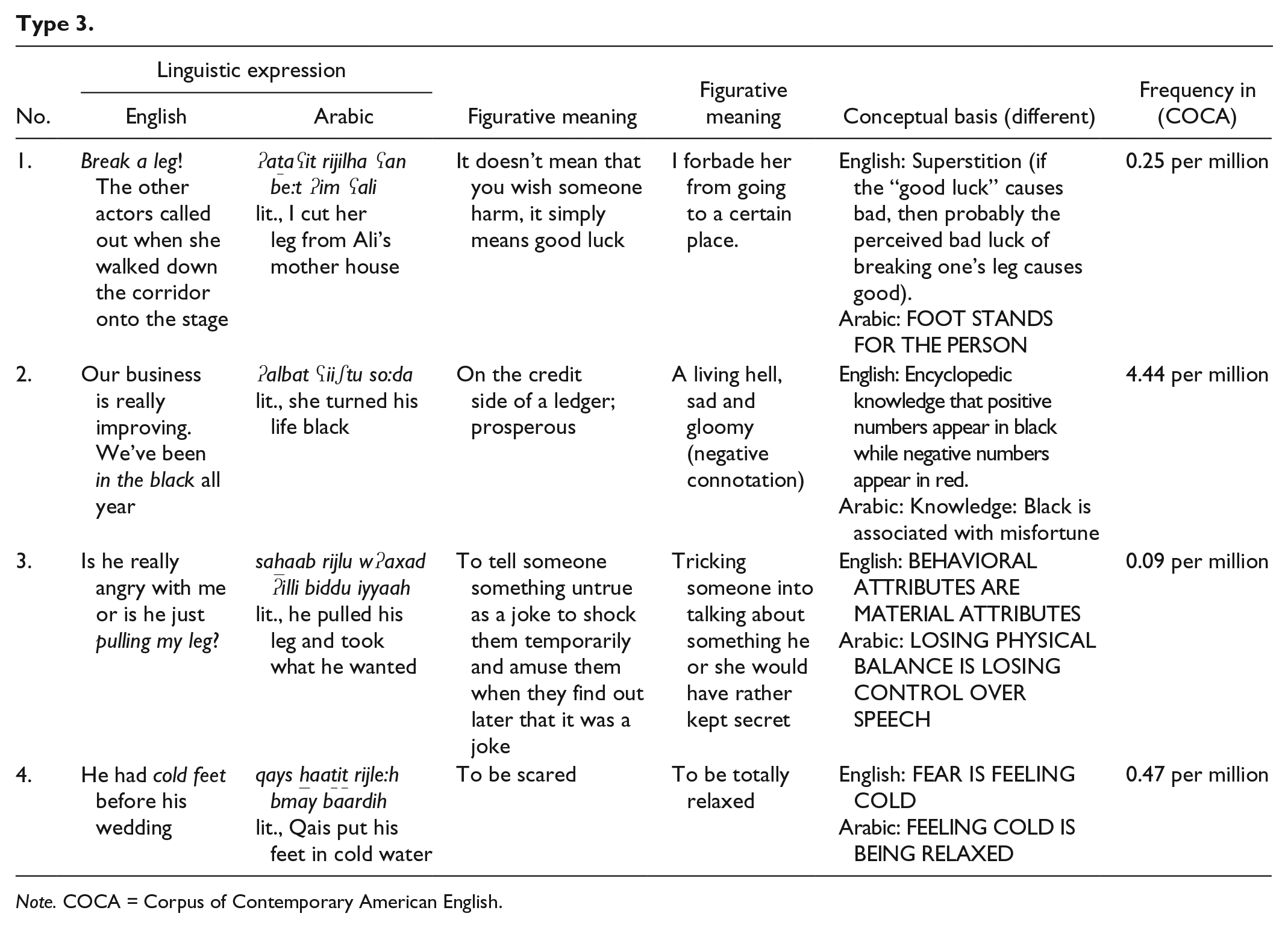
Type 3 metaphorical expressions are those that have completely different conceptual basis in both English and JSA but similar linguistic expression (see Appendix C). It is assumed that the participants may encounter difficulties with Type 3, because the similarity of the linguistic expression between the two languages may encourage negative transfer of L1 meaning. This may be due to the fact that L1 metaphorical knowledge can be used in understanding L2 metaphorical expressions. Therefore, at least one of the two distracters for this type is more related to the Arabic meaning, rather than to the English meaning. The reason for this proximity is to introduce the possibility of transfer from L1.
Type 4
Type 4 deals with metaphorical expressions that have equivalent conceptual basis in English and JSA but completely different linguistic expressions in both languages (see Appendix D). In this type, literal translation of the metaphorical expression is not an option as the linguistic expressions are completely different. However, if L1 metaphorical knowledge is employed in comprehending L2 meaning, then it can be argued that this type would be easier than Type 3. Nevertheless, learners may not be able to access L1 conceptual basis as the linguistic expressions in both languages are different unless the differences were explained to them. In this type of metaphor, learners should be assisted to encourage positive transfer from L1 conceptual knowledge.
Type 5
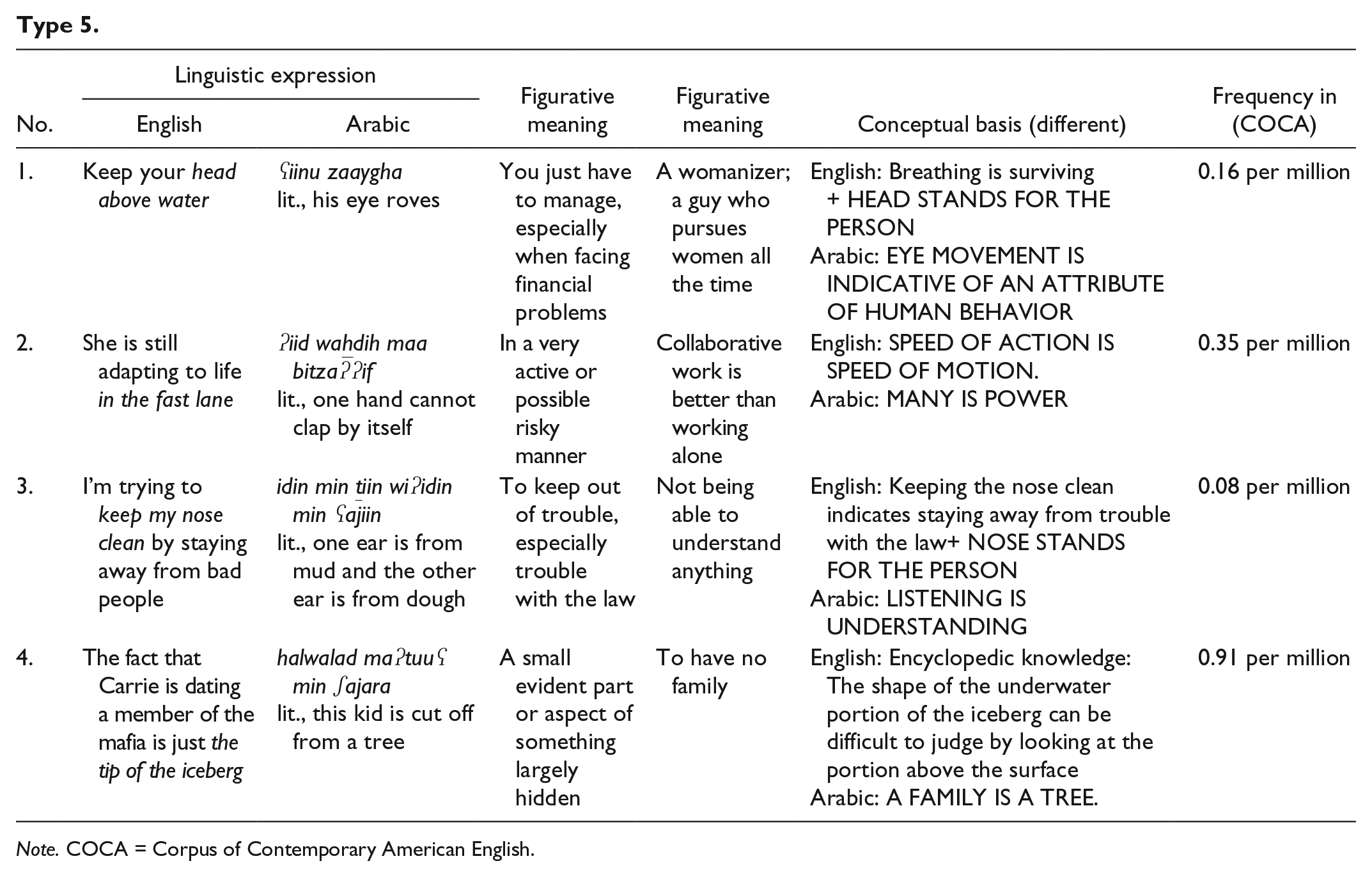
Type 5 metaphorical expressions are those that have completely different conceptual basis and completely different linguistic expression in English and JSA. Nonetheless, the metaphorical expressions may be transparent because they are readily accessible on the basis of knowledge that is culturally neutral (see Appendix E). It is suggested, however, that students should be made aware of this type of metaphorical expressions before these units can become transparent to them.
Type 6
Type 6 metaphorical expressions are those that have completely different conceptual basis and completely different linguistic expression in English and JSA. Moreover, the metaphorical expressions are opaque as the conceptual basis reflects the encoding of a culture-specific meaning (see Appendix F). It can be argued that Type 6 may pose problems to the participants as the conceptual bases and the linguistic expressions are completely different in both languages. In addition, the metaphorical expressions reflect culture-specific senses.
Statistical Analysis
To establish whether there were any statistically significant differences in the scores concerning the six different types of metaphorical expressions used in the test, one-way ANOVA (SPSS Version 18) was used to compare the means of the six different types. ANOVA was chosen as a statistical test, because it makes it possible “to compare whether or not the variation between the scores for different types of figurative units (i.e., Types 1-6) is significantly different from that of items within each of these types” (Charteris-Black, 2002, p. 121). The researcher then used post hoc Tukey test to see between which types the significant differences existed via analyzing the participants’ scores on the items within the six different types.
Results and Discussion
Table 1 presents a summary of percentages, means, and standard deviations of accurate responses on the six types of metaphorical expression on the test:
Percentages, Means, and Standard Deviations of Accurate Responses on the Six Types of Metaphorical Expression on the Test.
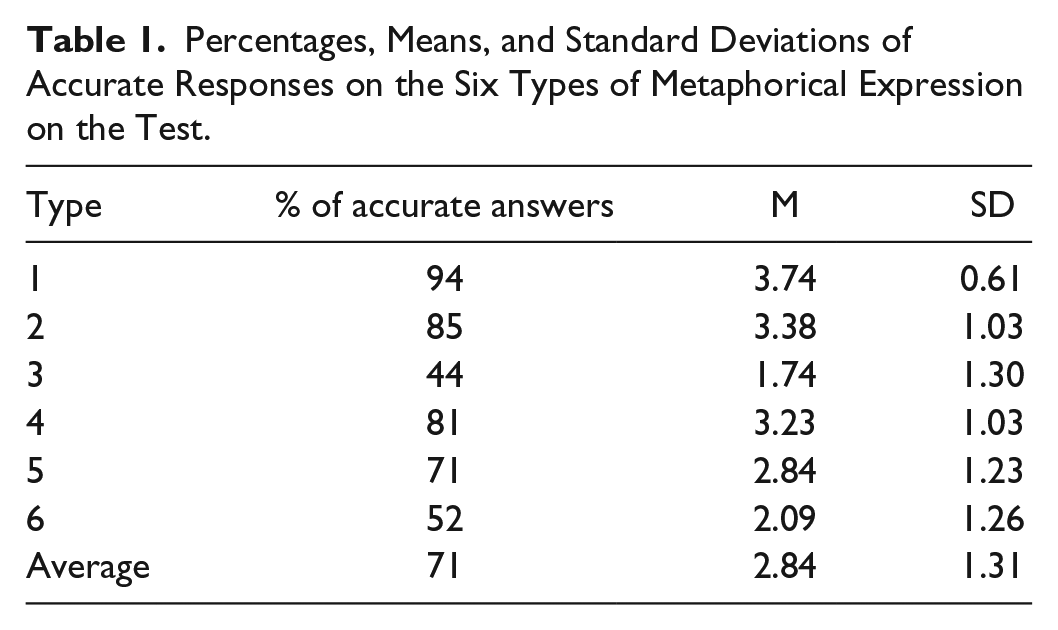
A thorough examination of Table 1 shows differences in the percentages, means, and standard deviations of accurate responses on each of the six types of metaphorical expression on the test. To establish whether there are statistically significant differences between the six types of metaphorical expression on the test, I used one-wayANOVA followed by a post hoc Tukey. Table 2 shows the results of the ANOVA followed by Table 3, which reports the results of the post hoc Tukey:
One-Way ANOVA: Comparison of the Six Types of Metaphorical Expression on the Test.

Post Hoc Tukey.

p < .05.
An examination of Table 2 shows that there are statistically significant differences between the six types of metaphorical expressions on the test (p < .05). The post hoc Tukey displayed in Table 3 was conducted to see between which types the significant differences existed via analyzing the participants’ scores on the items within the six different types. Based on Table 1, it may be seen that there are three levels of difficulty, starting from the least difficult to the most difficult as follows:
Type 1 (94%) and Type 2 (85%).
Type 4 (81%) and Type 5 (71%).
Type 3 (44%) and Type 6 (52%).
Type 1
Table 4 below presents the participants’ overall outstanding achievement (94%). The highest percentage of correct responses was 95%, while the lowest was 91%. The ease with which the participants were able to choose the correct meaning of the English metaphorical expressions of this type may be due to the equivalence of the conceptual basis and the linguistic expression in both languages (see Appendix A).
Type 1: Correct Responses on Each Test Item on the Test.

Even if the participants had translated the metaphorical expression literally from JSA, they would still have arrived at the correct meaning. It may be seen that positive transfer here had a big role to play in the participants’ correct answers. One may argue that the participants found Type 1 easy to answer because the conceptual bases and linguistic expressions are equivalent in both L1 and L2. Thus, it may be claimed that they are equally transparent in both languages. In fact, Deignan (2003) argued that some shared conceptual metaphors across languages may draw on the same source domain. For instance, the conceptual basis of the metaphorical expression blood boil is ANGER IS A HOT FLUID IN A CONTAINER (Boers, 2000). The source domain (i.e., A HOT FLUID IN A CONTAINER) exists in Arabic, English, and other languages (i.e., it has a tendency towards universality) although some details pertinent to this domain may differ culturally. Hence, it may be claimed that this source domain is equally unmarked in both English and JSA. As a result, the participants faced no difficulty in activating an already existing conceptual knowledge and related linguistic expressions to recognize the correct meaning.
The fact that the two metaphorical expressions iron hand (95%) and put your finger on (91%) involve embodiment, “uses of the human body and closely associated experience and behaviour” may have actually assisted the participants in recognizing the meaning of the metaphorical expressions with ease (Littlemore & Low, 2006, p. 284). The reason behind this may be that these expressions are based on somewhat universal or unmarked bodily concepts that exist in many languages (Boers, 2003). Iron hand is based on the conceptual metaphor CONTROL IS HOLDING SOMETHING IN THE HAND and put your finger on is based on the conceptual metaphor TO TOUCH IS TO LOCATE. These two metaphorical expressions are based on human physical experience in the world. Therefore, the participants recognized them with no trouble. Furthermore, both madly in love and majnuun fiiha lit., “mad in her,” are based on the conceptual metaphor LOVE IS MADNESS. Hence, one may argue that the source domain (i.e., MADNESS) on which the conceptual metaphor is based is unmarked as it exists in both languages and other languages as well. Thus, 95% of the participants were able to recognize it on the test.
It may be inferred that students need to be encouraged to use L1 as a resource to comprehend L2 metaphorical expressions when the conceptual bases in both languages are equivalent. For example, students may be encouraged to group metaphorical expressions under a particular conceptual basis that is equivalent in both languages to help them relate the metaphorical expressions to the conceptual basis and thus remember these expressions. It was suggested by Boers (2000) that metaphorical expressions that belong to a particular conceptual basis (i.e., “metaphorical theme”) tend to be more transparent than the “isolated” ones (p. 563). Thus, if L2 teachers made students aware of these conceptual bases and the metaphorical expressions related to them, the comprehension of these metaphorical expressions may become easier.
Type 2
Table 5 below clearly indicates that the percentage of correct answers was high (85%). The highest score was 90% for fight tooth and nail while the lowest was 72% for at a snail’s pace. These high scores may be attributed to the equivalence of conceptual bases and the similarity of linguistic expressions of the metaphorical expressions in both English and JSA (see Appendix B).
Type 2: Correct Responses on Each Test Item on the Test.

For instance, the metaphorical expression my heart skipped a beat and its similar counterpart in JSA, ʔalbi nxa
Encyclopedic knowledge of the world and the creatures that live within it may account for the participants’ correct responses to the two metaphorical expressions, fight tooth and nail for (90%) and at a snail’s pace (72%). These two metaphorical expressions are based on the conceptual metaphor HUMAN BEHAVIOR IS ANIMAL BEHAVIOR (Kövecses, 2002). One may suggest that the participants exuded confidence in their recognition of these two metaphorical expressions based on two pieces of information. First, they know that predatory animals usually attack enemies or defend themselves using their teeth and claws. Second, they perceive that snails move slowly. Added to that is their awareness that humans’ BEHAVIOR may be compared with animals’ BEHAVIOR on different occasions and to describe common characteristics between them. These pieces of information possibly made it less difficult for the participants to recognize the correct meanings of the two metaphorical expressions. Once again, it may be seen that the source domain of the conceptual metaphors of this type, for example, ANIMAL BEHAVIOR is unmarked in the sense that it exists in both languages and probably other languages as well. In addition, the linguistic expressions in both languages are similar. Hence, the participants were able to recognize the metaphorical expressions on the test with ease.
In addition, 88% correct answers were received for the metaphorical expression, fan the flames, which is based on the conceptual metaphor ANGER IS HEAT. It may be argued that the general theme on which the metaphorical expressions in both languages are based is unmarked, which may have facilitated the comprehension of the metaphorical expression, fan the flames.
The participants’ ability to recognize metaphorical expressions of this type on the test (85%) may indicate that they had no trouble with conceptual knowledge. However, it may suggest that more focus needs to be given by L2 teachers to the linguistic expression and vocabulary with respect to this type as they are not totally the same in both languages. Also, it may be argued that at least the conceptual metaphors that are based on universal bodily experience and emotions may be near-universal or potentially universal (cf. Boers, 2003).
Type 3
Table 6 below shows that the participants faced considerable difficulty with Type 3 (44%). The highest score on this type was 57% for break a leg, while the lowest score was 34% for pulling my leg. The similarity of linguistic expressions in English and JSA may have encouraged the participants to transfer L1 conceptual knowledge along with them, and thus supply wrong answers.
Type 3: Correct Responses on Each Test Item on the Test.

As the conceptual bases are different in both languages, it may be argued that literal translation of the similar metaphorical expressions may have tempted the participants to transfer L1 conceptual bases so that they arrived at the wrong answer. In fact, the researcher anticipated that the participants would choose the answer that is more related to the JSA meaning. Thus, the researcher designed the distracters for this type in a way that at least one of them was related to the meaning of the metaphorical expression in JSA to determine whether the participants would choose it or not.
While 57% selected the correct answer for break a leg, 43% circled a wrong answer. Nineteen percent of the participants chose option (b), forbid someone from going to a certain place. This distracter represents the meaning of the JSA metaphorical expression, ʔa
In addition, 36% recognized the correct meaning of the item in the black, while 64% chose a wrong answer. A total of 26% opted for option (a), heading toward bankruptcy, which is the exact opposite of the correct meaning of the metaphorical expression in the black. Option (a) hints at the negative connotation associated with the color black in JSA, that instead of succeeding in business, it is losing and heading toward bankruptcy.
According to Table 6, 34% of the participants circled the correct answer of the metaphorical expression, pulling my leg, whereas 66% chose a wrong answer. Thirty-five percent of the participants who circled the wrong answer picked option (b), tricking somebody to talk about something he or she would have rather kept secret. This option represents the meaning of the JSA metaphorical expression, sa
Finally, 47% of the participants circled the correct answer of the metaphorical expression cold feet, while 53% selected a wrong answer. Twenty-nine percent of those who circled the wrong answer on the test opted for option (a), relaxed and calm, which, again, represents the meaning of the JSA metaphorical expression,
Type 4
As illustrated in Table 7 below, type 4 elicited a high percentage of correct answers (81%). In fact, the participants’ score on Type 4 was the third highest after Type 1 (94%) and Type 2 (85%), respectively (see Table 1). The highest score on Type 4 was 90% for add insult to injury, whereas the lowest score was 73% for head over heels. This result was anticipated as the metaphorical expressions of this type share the same conceptual bases in English and JSA. Thus, the similarity between the two languages may have contributed positively to the participants’ high performance on the test.
Type 4: Correct Responses on Each Test Item on Test.

Add insult to injury and its JSA counterpart, zaad
Furthermore, the cold shoulder and its JSA counterpart kaanat tʕaamilni min wara
Another reason that may account for the participants’ good performance is the high frequency of some of these expressions in the English language. For instance, head over heels occurs 45 times every 100 million words in the COCA (n.d.). Hence, 73% of the participants were able to circle the correct answer.
Type 5
Table 8 below indicates that the participants did well on the test (71%). The highest score was 86% for keep your head above water, whereas the lowest score was 62% for in the fast lane. Despite the fact that this type deals with metaphorical expressions that have completely different conceptual bases and linguistic expressions in English and JSA, most of the participants were able to recognize the correct meaning of the English metaphorical expressions. This may be accounted for by the fact that these metaphorical expressions are based on cultural neutral knowledge that may be inferred by the participants in context (see Appendix E).
Type 5: Correct Responses on Each Test Item on the Test.

Keep your head above water is based on general knowledge of the position of body parts. Regardless of culture, keeping the head above water implies an act of survival in some way. It is culturally-neutral knowledge that may be used to guess the meaning of metaphorical expression (cf. Boers, 2003). Hence, 86% of the participants were able to circle the correct answer. Seventy-three percent of the participants were able to circle the correct meaning of keep his nose clean. Keeping one’s nose clean indicates that one should stay out of trouble with the law. In JSA, keeping one’s nose out of people’s business indicates that one should not interfere in what is none of his or her business. Thus, the participants found the metaphorical expression keep his nose clean easy to comprehend.
Moreover, 63% of the participants were able to recognize the correct meaning of tip of the iceberg. This metaphorical expression is based on the encyclopedic knowledge that the shape of the underwater portion of the iceberg can be difficult to judge by looking at the portion above the surface. Although this expression does not exist in JSA, many of the participants answered it correctly. Still another reason may be that tip of the iceberg occurs 91 times every 100 million words in (COCA, n.d.).
Type 6
Table 9 below shows that only 52% of the participants were able to choose the correct answers of Type 6. The highest score was 70% for blue blood, while the lowest score was 31% for white-collar. In fact, Type 6 was the second most difficult type after Type 3 (44%). Type 6 deals with metaphorical expressions that have completely different linguistic expressions in both languages. One may argue that Type 6 was difficult to the participants because these expressions reflect culture-specific or marked knowledge that does not exist in JSA (see Appendix F).
Type 6: Correct Responses on Each Test Item on the Test.

This markedness may have contributed to the participants’ wrong answers. Eckman (1985) suggested that L2 more marked areas will be difficult. For instance, only 31% of the participants were able to recognize the correct meaning of white-collar. This metaphorical expression is based on the conceptual metaphor COLOR OF CLOTHES FOR STATUS. Historically, workers, who had the higher paying and salaried positions, used to wear white shirts, whereas manual laborers who were paid per hour usually wore blue shirts. The connotations associated with the color of clothes (i.e., white) are culture specific. The poor performance of many students with regard to this item may suggest that it is alien to them. Thus, one may argue that the fact that this conceptual metaphor conveys marked connotations contributed to the participants’ wrong answers (cf. Altakhaineh & Zibin, 2014).
Even though off the hook occurs 244 times every 100 million words in (COCA, n.d.), only 45% of the participants recognized it. It can be argued that the participants may not have come by this metaphorical expression in their studies. 1 The purpose behind the inclusion of culture-specific metaphorical expressions in the test was to determine whether cultural differences play a role in the participants’ ability to recognize the correct meaning of these metaphorical expressions. The metaphorical expression off the hook is based on knowledge pertinent to fishing. It is well-known that when a fish flips out of the hook, it goes back into the water. However, the geography of Jordan does not permit fishing except in one city (i.e., Aqaba), which may have contributed to the participants’ inability to relate the metaphorical expression off the hook to fishing (cf. Emanatian, 1995). Kövecses (2010) posited that regional dimensions may give rise to variation in metaphorical conceptualization across cultures.
In light of these results, L2 teachers need to concentrate more on the cultural differences when dealing with metaphorical expressions of this type.
Conclusion and Pedagogical Implications
The results provide evidence that the participants’ receptive knowledge of metaphorical expressions in English varies based on the type of metaphor. Type 1 (94%) and Type 2 (85%) were the easiest to recognize by the participants on the test. This result was expected as Type 1 metaphorical expressions have the same conceptual bases and linguistic expressions in English and JSA. In addition, Type 2 metaphorical expressions have the same conceptual bases and similar linguistic expressions in both languages. Type 3 was the most difficult for the participants. It was suggested that the similarity of linguistic expression between the two languages may have encouraged the participants to transfer their L1 conceptual knowledge while answering this type. Type 4 was also easy to answer by the participants (81%). This is possibly due to the equivalence of conceptual bases in English and JSA, which may have played a positive role in the participants’ correct answers. Type 5 elicited a good number of correct answers (71%). Even though this type deals with metaphorical expressions that have different conceptual bases and linguistic expressions in English and JSA, the conceptual bases are culturally neutral. This may have made it easier for the participants to recognize the correct meaning of these expressions. Type 6 elicited significantly low number of correct answers (52%). These low results may be attributable to the fact that this type deals with metaphorical expressions that are totally different conceptually and linguistically in the two languages. Based on the data analysis, the researcher suggests some pedagogical implications to L2 teachers:
L2 teachers need to explain that metaphors are not mere rhetoric devices used exclusively by poets and writers to enhance the quality of literary texts. Students need to be aware that metaphors are devices used in all walks of life by everyone.
L2 teachers need to encourage students to use L1 as a resource to comprehend L2 metaphorical expressions when the two languages have equivalent conceptual bases (i.e., Types 1, 2, and 4). These similarities would make it easier for EFL learners to read and understand metaphorical expressions in English (Charteris-Black, 2001; Deignan et al., 1997).
Raising students’ awareness of the differences of conceptual metaphors between L2 and L1 may be very beneficial to facilitate their comprehension of L2 conceptual metaphors. In addition, students should be made aware of the differences in expressing conceptual metaphors between L1 and L2 (i.e., Types 2, 3, 4, 5, and 6) to reduce the risk of negative transfer. These differences should be taken into consideration as they may contribute to the production of marked and non-native expressions by L2 learners and translators (Charteris-Black, 2001). In addition, more attention needs to be given by L2 teachers to the differences in linguistic expressions in L1 and L2, especially when the conceptual bases are the same in both languages (e.g., Types 1, 2, and 4).
Teaching students to group metaphorical expressions under a particular metaphorical conceptual basis or theme may also be helpful as it may “provide a framework for lexical organization” (Boers, 2000, p. 563). Teachers could devise special exercises for this purpose.
L2 teachers need to give more attention to collocations in English and give students exercises that could assist them in understanding the way they are used in English.
It could be also useful to encourage students to produce their own metaphors to enhance their ability to recognize and translate metaphors in L2.
It may be beneficial to raise students’ cultural awareness of L2 metaphorical expressions as it may contribute considerably to the development of their communicative competence in L2.
In sum, the study provides evidence of the possibility that students display general conceptualizing capacity regardless of their language. Moreover, it supports the claim that comparing and contrasting metaphorical expressions between two different languages may provide an important glimpse into the conceptual and linguistic knowledge of these languages. Thus, further large-scale exploration of the correspondences and the differences of conceptual metaphors and linguistic expressions in other languages is an area worthy of further investigation.
Footnotes
Appendix A
Type 1.

| No. | Linguistic expression |
Figurative meaning (equivalent) | Conceptual basis (equivalent) | Frequency in (COCA) | |
|---|---|---|---|---|---|
| English | Arabic | ||||
| 1. | He is madly in love with her | majnuun fiiha
lit., he is mad in her |
He loves her so much | LOVE IS MADNESS + STATES ARE LOCATIONS | 0.58 per million |
| 2. | She rules the office with an iron fist/hand | lit., she rules the office with an iron fist |
To rule using rigorous or ruthless control | CONTROL IS HOLDING | 0.43 per million |
| 3. | He is making my blood boil with his indifference | fawwar dammi
lit., he made my blood boil |
To be very angry | ANGER IS A HOT FLUID IN A CONTAINER + THE BODY IS A CONTAINER FOR THE EMOTIONS | 0.13 per million |
| 4. | You have certainly put your finger on the problem | bittaʔkiid lit., you have certainly put your finger on the problem |
To identify and state the essence of something | TO TOUCH IS TO LOCATE | 0.30 per million |
Note. COCA = Corpus of Contemporary American English.
Appendix B
Type 2.

| No. | Linguistic expression |
Figurative meaning (similar) | Conceptual basis (similar) | Frequency in (COCA) | |
|---|---|---|---|---|---|
| English | Arabic | ||||
| 1. | My heart skipped a beat when I saw him | ʔalbi nxa lit., my heart shook violently when I saw him |
When one is startled or excited from surprise, joy, or fright | THE STATE OF THE FEELINGS IS THE MATERIAL STATE OF A VITAL ORGAN | 0.17 per million |
| 2. | He fought for her tooth and nail | qaatluuhum bisnaanku wʔa lit. fight them with your teeth and nails |
To use a lot of effort to achieve something | HUMAN BEHAVIOR IS ANIMAL BEHAVIOR | 0.36 per million |
| 3. | He warned that this will fan the flames of racism | maa kaan laazim yʔaʔʔil/ ywalliʔ ʔil muʔkilih
lit., he should not have made the fire blaze |
Make the situation worse | ANGER IS HEAT + MAINTAINING INTENSITY OF CONFLICT IS MAINTAINING HEAT (OF FIRE) | 0.12 per million |
| 4. | I am moving at a snail’s pace in my proposal | laylaa btimʔi bsurʔit issul lit., Layla walks at a turtle’s pace |
To move very slowly | SPEED OF ACTION IS SPEED OF MOVEMENT + HUMAN BEHAVIOR IS ANIMAL BEHAVIOR | 0.18 per million |
Note. COCA = Corpus of Contemporary American English.
Appendix C
Type 3.
| No. | Linguistic expression |
Figurative meaning | Figurative meaning | Conceptual basis (different) | Frequency in (COCA) | |
|---|---|---|---|---|---|---|
| English | Arabic | |||||
| 1. | Break a leg! The other actors called out when she walked down the corridor onto the stage | ʔa lit., I cut her leg from Ali’s mother house |
It doesn’t mean that you wish someone harm, it simply means good luck | I forbade her from going to a certain place. | English: Superstition (if the “good luck” causes bad, then probably the perceived bad luck of breaking one’s leg causes good). Arabic: FOOT STANDS FOR THE PERSON |
0.25 per million |
| 2. | Our business is really improving. We’ve been in the black all year | ʔalbat ʕiiʃtu so:da
lit., she turned his life black |
On the credit side of a ledger; prosperous | A living hell, sad and gloomy (negative connotation) | English: Encyclopedic knowledge that positive numbers appear in black while negative numbers appear in red. Arabic: Knowledge: Black is associated with misfortune |
4.44 per million |
| 3. | Is he really angry with me or is he just pulling my leg? | sa lit., he pulled his leg and took what he wanted |
To tell someone something untrue as a joke to shock them temporarily and amuse them when they find out later that it was a joke | Tricking someone into talking about something he or she would have rather kept secret | English: BEHAVIORAL ATTRIBUTES ARE MATERIAL ATTRIBUTES Arabic: LOSING PHYSICAL BALANCE IS LOSING CONTROL OVER SPEECH |
0.09 per million |
| 4. | He had cold feet before his wedding | qays lit., Qais put his feet in cold water |
To be scared | To be totally relaxed | English: FEAR IS FEELING COLD Arabic: FEELING COLD IS BEING RELAXED |
0.47 per million |
Note. COCA = Corpus of Contemporary American English.
Appendix D
Type 4.

| No. | Linguistic expression |
Figurative meaning | Conceptual basis (equivalent) | Frequency in (COCA) | |
|---|---|---|---|---|---|
| English | Arabic | ||||
| 1. | She is a gold-digger | bturku lit., she runs after money |
A woman who uses her sexual attractions to accumulate gifts | WEALTH IS A HIDDEN OBJECT | 0.22 per million |
| 2. | I got fired today and to add insult to injury, I fell down the stairs and broke my arm | wʔifit saaʕa ʔastanna sayyara biduun faaydih willi zaad lit., I waited 1 hr for a car with no use and what added more water to the mud is that it started raining |
To make a bad situation worse | BEHAVIORAL ATTRIBUTES ARE EQUAL TO MATERIAL ATTRIBUTES | 0.24 per million |
| 3. | She gave me the cold shoulder all night long | kaanat tʕaamilni min wara lit., she was treating me from behind her back all day long |
Treat someone with indifference | REJECTING IS AVOIDING EYE CONTACT + INDIFFERENCE IS COLDNESS | 0.21 per million |
| 4. | He fell head over heels for her | gharʔaan fiiha laʃuuʃtu
lit., he drowned in her up to his ears |
To be completely in love | FALLING IN LOVE IS PHYSICAL FALLING | 0.45 per million |
Note. COCA = Corpus of Contemporary American English.
Appendix E
Type 5.
| No. | Linguistic expression |
Figurative meaning | Figurative meaning | Conceptual basis (different) | Frequency in (COCA) | |
|---|---|---|---|---|---|---|
| English | Arabic | |||||
| 1. | Keep your head above water | ʕiinu zaaygha
lit., his eye roves |
You just have to manage, especially when facing financial problems | A womanizer; a guy who pursues women all the time | English: Breathing is surviving + HEAD STANDS FOR THE PERSON Arabic: EYE MOVEMENT IS INDICATIVE OF AN ATTRIBUTE OF HUMAN BEHAVIOR |
0.16 per million |
| 2. | She is still adapting to life in the fast lane | ʔiid wa lit., one hand cannot clap by itself |
In a very active or possible risky manner | Collaborative work is better than working alone | English: SPEED OF ACTION IS SPEED OF MOTION. Arabic: MANY IS POWER |
0.35 per million |
| 3. | I’m trying to keep my nose clean by staying away from bad people | idin min lit., one ear is from mud and the other ear is from dough |
To keep out of trouble, especially trouble with the law | Not being able to understand anything | English: Keeping the nose clean indicates staying away from trouble with the law+ NOSE STANDS FOR THE PERSON Arabic: LISTENING IS UNDERSTANDING |
0.08 per million |
| 4. | The fact that Carrie is dating a member of the mafia is just the tip of the iceberg | halwalad maʔtuuʕ min ʃajara
lit., this kid is cut off from a tree |
A small evident part or aspect of something largely hidden | To have no family | English: Encyclopedic knowledge: The shape of the underwater portion of the iceberg can be difficult to judge by looking at the portion above the surface Arabic: A FAMILY IS A TREE. |
0.91 per million |
Note. COCA = Corpus of Contemporary American English.
Appendix F
Type 6.

| No. | Linguistic expression |
Figurative meaning | Figurative meaning | Conceptual basis (different) | Frequency in (COCA) | |
|---|---|---|---|---|---|---|
| English | Arabic | |||||
| 1. | Princess Diana had blue blood | dammu xafiif
lit., his blood is light |
She is of a noble family; aristocratic ancestry | He has a sense of humor | English: BLOOD FOR STATUS Arabic: BLOOD FOR PERSONALITY |
0.14 per million |
| 2. | He was very brave but fear of spiders was his Achilles’ heel | buʔtul ʔil ʔatiil wbimʃii fi janaaztuh
lit., he kills the man and then walks in his funeral |
A weak point or fault in someone or something otherwise perfect | To harm somebody or cause trouble for him then offer to help him | English: HEEL FOR THE PERSON + story of Achilles Arabic: BEHAVIORAL ATTRIBUTES ARE MATERIAL ATTRIBUTES |
0.32 per million |
| 3. | Let me off the hook with a mild reprimand | rijilha xaaffih halʔayyam
lit., her foot is light these days |
Freed, as from blame or a vexatious obligation | She doesn’t come to a certain place as often as she used to | English: Knowledge: When a fish flips out of the hook, it goes back in the water Arabic: FOOT STANDS FOR THE PERSON |
2.44 per million |
| 4. | His parents were both white-collar employees and had good paying jobs | zay ʔil ʔatraʃ fizzaffih
lit., like a deaf person in a wedding |
Of or relating to workers whose work usually does not involve manual labor and who are often expected to dress with a degree of formality | Unable to understand anything | English: COLOR OF CLOTHES FOR STATUS Arabic: LISTENING IS UNDERSTANDING |
0.78 per million |
Note. COCA = Corpus of Contemporary American English.
Appendix G
Declaration of Conflicting Interests
The author(s) declared no potential conflicts of interest with respect to the research, authorship, and/or publication of this article.
Funding
The author(s) received no financial support for the research and/or authorship of this article.
1.
Even though the participants have been exposed to metaphorical expressions in the target language explicitly, the kind of instruction students usually have in literature courses (especially poetry) does not introduce metaphors as conceptual tools used by all speakers of a language to talk about their daily-life experiences, their culture, and the world they live in. Students perceive of metaphors as mere rhetoric devices used to enhance the quality of literary texts.