




Abstract
The majority of body image research has failed to measure what occurs beyond the immediate presentation of a body image threat, or after a body image threat is no longer present. This is particularly true for physiological outcomes. The present study examined psychological and cortisol responses to, and recovery from, a body composition assessment as a social-evaluative body image threat. Women (N = 64) were randomized into either a control or threat group. Participants completed a measure of social physique anxiety and provided a sample of saliva (to assess cortisol) at baseline, and immediately following and 20 min following their condition. The threat group reported higher social physique anxiety following the threat in comparison with both baseline levels and recovery levels. Cortisol was higher immediately following the threat in comparison with baseline levels. Findings support the inclusion of a recovery time point in body image research to provide a more complete picture of the psychobiology of body image experiences.
Body image is an individual’s internal representation of his or her outer self (Thompson, Heinberg, Altabe, & Tantleff-Dunn, 1999). Body image concerns are associated with a number of negative outcomes including lower self-esteem, increased risk of depression, social anxiety, and eating pathologies (Kostanski & Gullone, 1998; Levine & Smolak, 2002; McCaulay, Mintz, & Glenn, 1988; Stice, 2002). Given the potential negative implications of body image concerns, identifying situations or the contextual factors of situations in which these concerns arise is important. Examples of specific situations that exacerbate body image concerns include being seen in a bathing suit, being next to someone with an attractive/ideal physique, or having body composition assessed (Carron & Prapavessis, 1997; Hart, Leary, & Rejeski, 1989).
Qualitative research has explored situations of heightened body image concerns (Bain, Wilson, & Chaikind, 1989; Lamarche, Kerr, Faulkner, Gammage, & Klentrou, 2012; Myers & Rosen, 1999). For example, in their qualitative study, Lamarche and colleagues (2012) examined comfortable and uncomfortable body experiences in young adult women. These authors found that the situations described were social-evaluative in nature and included an element of body exposure. Furthermore, coping mechanisms such as avoidance or concealing behaviors were initiated to manage those uncomfortable situations. Experimental studies have also shown that situations that maximize social evaluation of one’s body elicit body image concerns (Cloudt, Lamarche, & Gammage, 2014; Gammage, Martin Ginis, & Hall, 2004; Hart et al., 1989; Van Raalte, Cunningham, Cornelius, & Brewer, 2004). In addition, situations in which body image concerns are elicited (i.e., viewing media images of the thin ideal, situations of heightened self-objectification) have been shown to have lingering effects (Hausenblas, Janelle, Gardner, & Hagan, 2003; Quinn, Kallen, & Cathey, 2006).
Recently, physiological measures have been incorporated into body image research to gain an understanding of the psychobiology of body image (Anderson, Shapiro, Lundgren, Spataro, & Frye, 2002; Cloudt et al., 2014; Lamarche, Bailey, & Gammage, 2015; Lamarche, Gammage, Kerr, Faulkner, & Klentrou, 2014; Martin Ginis, Strong, Arent, & Bray, 2012; McLean, Barr, & Prior, 2001; Putterman & Linden, 2006; Sabiston, Castonguay, Barnett, O’Loughlin, & Lambert, 2009). The most commonly assessed in this recent literature is cortisol (a stress hormone thought to represent hypothalamic-pituitary-adrenal axis activation; Sapolsky, 2003).
Given this recent interest in physiological variables in a body image context, social self-preservation theory (SSPT; Dickerson, Gruenewald, & Kemeny, 2004), in contrast to other theories of body image, may be particularly useful in the examination of responses to social-evaluative body image threats. SSPT suggests that when a social-evaluative threat is present, negative self-conscious emotions and physiological responses are elicited concurrently (Dickerson, Gruenewald, & Kemeny, 2004). Shame and cortisol are particularly responsive to such threats, although other psychological (i.e., guilt) and physiological (heart rate, proinflammatory cytokines) outcomes have been examined within SSPT (Dickerson, Gable, Irwin, Aziz, & Kemeny, 2009; Dickerson, Kemeny, Aziz, Kim, & Fahey, 2004). Generally, research has supported the contentions of SSPT by examining psychobiological responses to the Trier Social Stress Test, a performance-based social-evaluative task (Kirschbaum, Pirke, & Hellhammer, 1993). Recently, SSPT has been applied to a body image context (Bailey, Lamarche, & Gammage, 2014; Cloudt et al., 2014; Lamarche et al., 2015; Lamarche et al., 2014; Lamarche et al., 2012; Martin Ginis et al., 2012).
Martin Ginis et al. (2012) provided the first empirical support of a cortisol response to a social-evaluative body image threat. In the first experiment, women thought they would be exercising in a high social-evaluative threatening setting (in a public, mirrored exercise facility while wearing revealing exercise attire) or a low social-evaluative threatening setting (alone, in a private, non-mirrored room while wearing non-revealing exercise attire). In their second experiment, participants were asked to go behind a screen into a changing area to try on exercise clothing and complete a questionnaire rating the exercise clothing (e.g., color, fabric). In the high social-evaluative condition, participants were led to believe that after completing the questionnaire, a video camera would record the participant in the clothing so that a panel of judges could evaluate how well the clothing fit at a later date. Participants in the low social-evaluative condition were instructed to change into the exercise clothing behind the screen and complete the same questionnaire package; however, they were told that no one would see them. Across both experiments the results indicated that cortisol levels were higher post-manipulation for those in the high versus low social-evaluative condition.
Although these authors were the first to provide evidence of a cortisol response to a social-evaluative body image threat, they noted significant limitations regarding their threat. Given their ethics board guidelines, they were unable to actually expose participants to the social-evaluative body image threat. They predicted that cortisol responses would have been greater had participants actually faced the threat and emphasized that “actual threat exposure in an ethical and ecologically valid manner is necessary to test this hypothesis” (Martin Ginis et al., 2012, p. 1004). Lamarche et al. (2015) examined psychological and heart rate responses to an imagined social-evaluative body image threat. Findings showed that the highest levels of body shame and social physique anxiety were reported in the social-evaluative compared with the non-social-evaluative body image condition. However, no differences in heart rate were found between groups. In agreement with Martin Ginis et al. (2012), it was noted that actual threat exposure may be necessary to capture more robust physiological changes under social-evaluative body image threat, and fully understand the psychobiology of body image.
The implications of the potential differences in responses to anticipating and actually facing a threat are important. For example, responses to the mere anticipation of a threatening situation particularly negative may cause people to avoid engaging in specific body-related situations (e.g., swimming, having sex, exercising); however, if such responses can be overcome, some people may feel that the situation was not as bad (or threatening) as originally believed (Lamarche et al., 2012; Mills, Fuller-Tyszkiewicz, & Holmes, 2014).
One recent study developed a novel weight stigma paradigm in which participants were actually exposed to an interpersonal rejection based on weight stigma (Himmelstein, Belsky, & Tomiyama, 2015). Specifically, the authors manipulated weight stigma to examine its impact on cortisol reactivity. In addition, body mass index (BMI) and self-perceived weight were examined as potential moderators of the relationship between stigma and cortisol reactivity. These authors found that the weight stigma situation elicited changes in cortisol, and that those who perceived themselves as “heavy” (regardless of their actual BMI) exhibited higher cortisol in response to the weight stigma situation compared with those who perceived themselves as average weight.
Although growing evidence suggests that cortisol may be elicited under body-related threats, the majority of the body image literature has examined only immediate responses to such threats and still ignores what occurs after the body image threat is removed. Recent evidence examining responses to a social-evaluative non-body image threat suggests that failing to examine a recovery phase may lead to erroneous conclusions regarding the distress of the individual (Juster, Perna, Marin, Sindi, & Lupien, 2012). Furthermore, there is some, albeit limited, evidence of the lingering negative effects of body-related situations (Hausenblas et al., 2003; Quinn et al., 2006). Thus, to gain a more complete picture of the response-recovery profile to a body image threat, the current study measured outcomes immediately following the threat and after a rest period in which the threat was no longer present.
The threat used in the present study was a three-site skinfold assessment while wearing a two-piece bathing suit. This threat was selected for several theoretical and methodological reasons. First, this threat is based on characteristics under which perceptions of, and responses to, social-evaluative threatening situations are most likely to occur as supported by SSPT (Rohleder, Beilen, Chen, Wolf, & Kirschbaum, 2007). Specifically, it involves a social-evaluative element (i.e., evaluates body composition by a trained technician and assistant), involves a domain of importance (i.e., body fat is an important characteristic associated with the North American thin ideal), and the potential loss of social acceptance from a negative evaluation (i.e., a poor body composition may serve as a reminder that one does not meet the thin ideal standard). Second, a qualitative study framed within SSPT identified being seen in a bathing suit by others as the most uncomfortable situation (Lamarche et al., 2012)—being in a bathing suit or increasing the level of body exposure has been an important aspect of manipulations designed to elicit body image concerns (Carron & Prapavessis, 1997; Gammage et al., 2004; Hart et al., 1989; Martin Ginis et al., 2012). Third, anticipation of this specific threat has been shown to elicit social physique anxiety and body shame responses (Cloudt et al., 2014; Lamarche et al., 2014), thus it is possible that actually exposing an individual to this threat would also elicit a cortisol response, similar to responses to a weight stigma situation (Himmelstein et al., 2015). Fourth, a skinfold assessment was originally used to validate a questionnaire measuring social physique anxiety (Hart et al., 1989). Fifth, a body composition assessment through skinfold measurements is commonly used in clinical and research settings, making it acceptable to the research ethics boards. Finally, as reported by Lamarche et al. (2014), self-rating of perceived evaluative threat in anticipation of this exact situation was significantly higher than a control group in a similar sample of women compared with the present study.
Specifically, the purpose of the current study was to examine psychobiological responses to, and recovery from, actually undergoing (i.e., facing) a body image threat in women. Based on the findings of Gammage et al. (2004) and Hart et al. (1989), and the work of Martin Ginis et al. (2012) with respect to cortisol changes from a body image threat, it was hypothesized that the body image threat would elicit increased social physique anxiety and cortisol and that these variables would not return to baseline levels after the threat was removed (i.e., levels would remain significantly higher than baseline levels). The hypothesis with respect to the recovery of variables is based on Quinn et al.’s (2006) finding of the lingering effects of body-related thoughts after being exposed to a situation designed to heighten body image concerns. It was also hypothesized that participants in the control condition would report no differences in body image variables or cortisol levels across their testing visit.
Method
Participants
Upon institutional ethics clearance, participants were recruited through posters placed around a university campus and announcements made in undergraduate classes. To disguise the true purpose of the study, the recruitment materials indicated the study was examining the relationship between self-perceptions, anthropometric measurements, and cortisol. Furthermore, the reason given to participants regarding the required clothing for the research session (described below) was that it was standard clothing used in the laboratory for anthropometric tests. The estimated required sample size of 60 was based on Martin Ginis et al. (2012) showing large effects of social-evaluative body image threats on cortisol in women (Cohen’s d = 0.81-1.16; Cohen, 1992). After data screening (detailed below), the final sample consisted of 64 healthy, young adult women attending university (see Table 1 for sample characteristics). It should be noted that all but one participant were Caucasian. Varsity athletes, smokers, individuals with a history of a clinical eating disorder, or those on medications that influence cortisol secretion (e.g., corticosteroids) were excluded from participation. Participants were also excluded if they ate, drank, or participated in physical activity within 1 hr prior to testing.
Means (and SDs), Maximum and Minimum Values for Age, Body Mass, Height, Percent Body Fat, BMI, and Exercise Frequency for Final Sample.
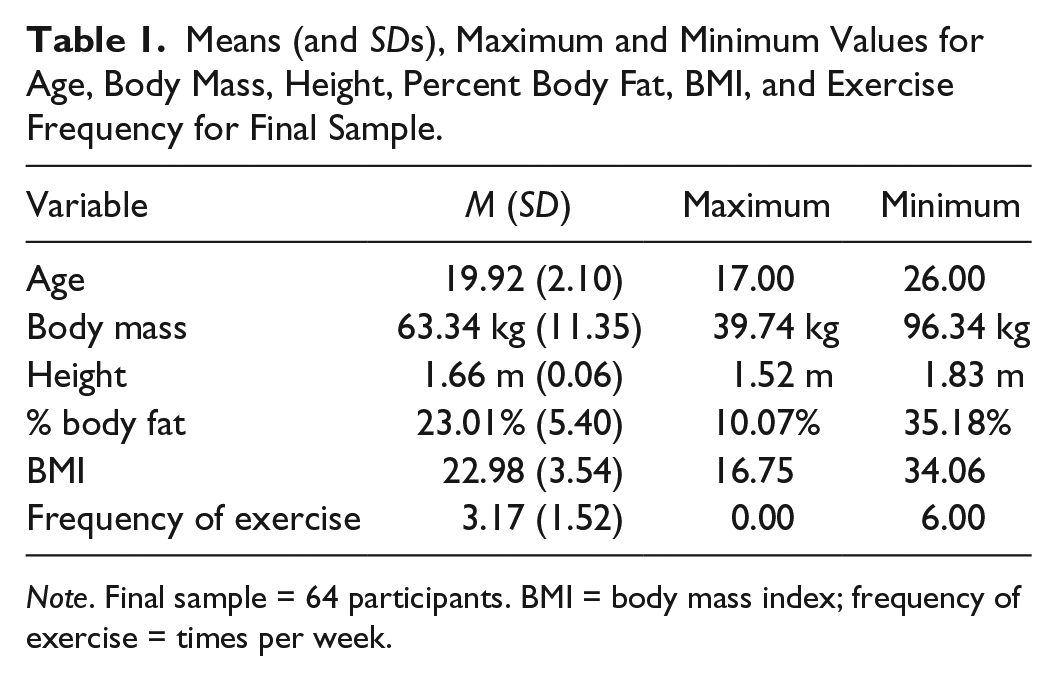
Note. Final sample = 64 participants. BMI = body mass index; frequency of exercise = times per week.
Measures
Participants completed demographic information (age, frequency of exercise) and answered a series of questions ensuring that they had complied with study requirements with respect to food, drink, and physical activity participation. Next, a measure of state social physique anxiety was administered (see description below).
Social physique anxiety
The nine-item State Social Physique Anxiety Scale (SPAS; Kruisselbrink, Dodge, Swanburg, & MacLeod, 2004) assessed anxiety associated with others’ evaluations of one’s body. The items were measured on a 5-point scale ranging from 1 (not at all characteristic of me) to 5 (extremely characteristic of me). Participants were instructed to respond to each item by indicating how they felt at that moment. A sample item is “Unattractive features of my physique/figure make me nervous in this setting.” This questionnaire has demonstrated satisfactory reliability and validity in young adult women in past research
Salivary cortisol
Measuring cortisol in saliva is a reliable, stress-free, non-invasive technique that does not require a trained technician (Vinning, McGinley, Maksvytis, & Ho, 1983). Several studies have used salivary cortisol in their protocols (e.g., Dickerson & Kemeny, 2004; Martin Ginis et al., 2012; Rohleder et al., 2007). Saliva was collected using salivettes specific for cortisol measurement (Sarstedt, Germany). Participants placed the dental cotton piece in their mouths and left it there for 1 min, then placed the cotton back into the test tube and sealed it. Samples were centrifuged immediately and then placed in a −80 °C freezer until being assayed. Salivary cortisol concentration was measured in duplicate by commercial enzyme-linked immunosorbent assay kits according to the manufacturer’s instructions (Salimetrics, 2010). The inter-assay and intra-assay coefficients of variability were calculated and deemed acceptable (<15% and <10%, respectively).
Procedures
Interested participants contacted the principal investigator and a mutually convenient time for participation was set. After confirming a test session, participants were randomly assigned to either the control or threat group by drawing a number out of a hat. Participants assigned to the control group were asked to bring shorts and a t-shirt to their visit, whereas participants in the threat group were asked to bring a two-piece bathing suit. Participants in both groups were told that this clothing was standard laboratory attire to allow for the accuracy of anthropometric measures, which would be completed during the testing session. Upon arrival at the laboratory, participants provided informed consent and completed demographic information. Next, participants completed a measure of state social physique anxiety. This time served as a baseline rest period prior to cortisol collection. Participants then provided a baseline saliva sample.
Next, participants completed the threat/control condition, depending on their group assignment. Participants in the control condition were asked to sit quietly alone for 15 min. Quiet rest served as a control condition to be consistent with past research measuring cortisol responses to a social-evaluative threat in the non-body image literature (Kirschbaum et al., 1993; Nater et al., 2007). Those in the threat condition faced the social-evaluative body image threat (see description below). Participants were then asked to sit while they completed the same measure of state social physique anxiety and provided another saliva sample (response measures). The response saliva sample was completed approximately 25 min after the onset of the threat/quiet rest, capturing the peak cortisol response (Dickerson & Kemeny, 2004). Participants in the threat group then changed back into their street clothes. After completing their condition (i.e., quiet rest or threat), participants sat quietly for 15 more minutes (i.e., threat was no longer present), and then completed the same measure of state social physique anxiety followed by a final saliva sample (recovery measures). The recovery saliva sample was completed approximately 50 min following the onset of the threat/quiet rest (Dickerson & Kemeny, 2004). Upon completion of all questionnaires and saliva samples, objective measures of height, weight, and body composition were taken for participants in the control group using the same standard protocol described below, except that participants wore shorts and a t-shirt for the body composition assessment and only the technician was present. Participants were debriefed as to the true purpose of the study and given US$10.00 as compensation for their time. Given the circadian rhythm of cortisol, all data collection took place at the same time of day (15:00-18:00) when levels are relatively constant (Dickerson & Kemeny, 2004; Vinning et al., 1983).
Social-evaluative body image threat
A body composition assessment completed while participants wore a two-piece bathing suit was selected as the social-evaluative body image threat. Specifically, a standard three-site (triceps, iliac crest, thigh) skinfold measurement was performed to assess percent body fat (Jackson, Pollack, & Ward, 1980). The same trained technician read measurements aloud to the same research assistant, who verbally repeated each value, then recorded it, thus allowing participants’ body composition to be evaluated by the researchers. The presence of the assistant who recorded the values ensured there was an evaluative audience, aside from the technician, increasing the likelihood that a threat would be induced. This body image threat maximized body exposure and evaluation of the body, but was also acceptable to the research ethics board as these anthropometric measures are typically taken for research, clinical, athletic performance assessment, and educational purposes. Furthermore, instructions for participants about clothing (particularly the bathing suit) were also considered realistic, as some body composition testing done at the university requires participants to bring a bathing suit with them.
Results
Nine participants (all randomized into the threat group) who confirmed their eligibility, scheduled a testing appointment and had knowledge of the clothing needed for participation, did not attend their appointment. Of the 71 participants who completed the study, five participants were removed for not complying with study requirements or for feeling unwell. Independent t tests showed no significant differences between participants removed and the final sample on key variables (all ps > .05). Data for cortisol were positively skewed so values were log-transformed for all analyses, similar to previous studies investigating cortisol responses to social-evaluative body image threats (Cloudt et al., 2014; Lamarche et al., 2014; Martin Ginis et al., 2012). For cortisol data, non-transformed data are provided for ease of interpretation. Two participants were removed as outliers due to implausible cortisol levels (>82.77 nmol/L; Salimetrics, 2010). Thus, the final data set included 64 participants.
Some research has demonstrated a relationship between measures of body composition and social physique anxiety (Hart et al., 1989), thus bivariate correlations were conducted to examine BMI, weight, and percent body fat as potential covariates for analyses. No relationship was found (p > .05). To investigate baseline group differences on demographic variables and state social physique anxiety and cortisol at baseline, a series of t tests were conducted. The results indicated no significant between-group differences on demographic variables or baseline variables (all ps > .05). Relationships between social physique anxiety and cortisol at all three time points were also examined. Results indicated a significant positive relationship between state social physique anxiety and cortisol at the response time point (r = .25, p < .05) and between cortisol at response and state social physique anxiety at the recovery time point (r = .28, p < .05).
State Social Physique Anxiety
To compare the responses with, and recovery from, a social-evaluative body image threat, a 2 (group: control, threat) × 3 (time: baseline, response, recovery) repeated-measures ANOVA was conducted for social physique anxiety. There was a significant group-by-time interaction, F(2, 61) = 4.36, p = .017, ηp2 = .13. To examine the nature of the time effects within each group, three sets of paired t tests were conducted (baseline vs. response, response vs. recovery, baseline vs. recovery). A Bonferroni correction factor was applied for follow-up analyses such that a p value < .017 would be deemed significant. No differences were found within the control group. Comparisons made within the threat group showed that the level of social physique anxiety at response was significantly higher than both baseline, t(30) = −3.64, p = .001 (Cohen’s d = .29; Cohen, 1992) and recovery levels, t(30) = 3.70, p = .001 (Cohen’s d = .34; Cohen, 1992). Levels of social physique anxiety were not different between baseline and recovery time points, t(30) = −1.27, p = .22. There were no significant time, F(2, 61) = 2.14, p = .126, ηp2 = .07 or group main effects, F(1, 62) = .36, p = .549, ηp2 = .01. See Table 2 for means and standard deviations for social physique anxiety.
Means (and SDs) for SPA and Cortisol by Group.

Note. SPA = social physique anxiety, ranges 1 to 5, higher scores represent higher SPA; cortisol = untransformed cortisol values, nmol/L.
Cortisol
To compare the cortisol response with, and recovery from, a social-evaluative body image threat, a 2 (group: control, threat) × 3 (time: baseline, response, recovery) repeated-measures ANOVA was conducted with log-transformed cortisol as the dependent variable. A Bonferroni correction factor was applied for follow-up analyses. The Mauchly’s test of sphericity was significant; therefore, the Huynh–Feldt correction for degrees of freedom is reported. There was a significant group-by-time interaction, F(2, 108) = 6.78, p < .01, ηp2 = .10. To examine the nature of the time effects within each group, three sets of paired t tests were conducted (baseline vs. response, response vs. recovery, baseline vs. recovery). Comparisons made within the control group showed that there was a significant difference in levels of cortisol between baseline and recovery time points, t(32) = 2.93, p = .006 (Cohen’s d = .18; Cohen, 1992), indicating a decrease in cortisol from baseline to recovery time points. There was no significant change in cortisol levels from baseline to response, t(32) = 1.79, p = .084 or response to recovery, t(32) = 2.33, p = .026 in the control group. In the threat group, comparisons showed that there was a significant increase in cortisol from baseline to response time point, t(30) = −2.58, p = .015 (Cohen’s d = .18; Cohen, 1992). No differences were found in cortisol levels between response and recovery, t(30) = −.02, p = .986 time points or baseline and recovery, t(30) = −1.46, p = .155 time points. There were no significant main effects for time, F(2, 108) = .69,p = .485, ηp2 = .01 or group, F(1, 62) = .01, p = .907, ηp2 < .001. See Table 2 for means and standard deviations for cortisol. 1
In addition, area under the curve with respect to increase (AUCi) was also calculated for each group (Pruessner, Kirschbaum, Meinlschmid, & Hellhammer, 2003). AUCi assesses baseline-corrected cortisol responses and accounts for the difference between single measurements from each other or the change over time (Pruessner et al., 2003). It should be noted that a negative value represents an index of decrease rather than an area under the curve. To examine whether a social-evaluative body image threat elicited a cortisol response, a one-way ANOVA was conducted using group as the independent variable (control, threat) and AUCi as the dependent variable. The results showed a significant group difference for AUCi, F(1, 62) = 11.03, p < .01, ηp2 = .15. Inspection of means indicated that the control group showed an overall decrease (index of decrease) of −.09 (SD = 0.22), whereas the threat group showed an overall increase in cortisol of .08 (SD = 0.18).
Discussion
This study compared psychobiological responses with, and recovery from, actual exposure to a social-evaluative body image threat in women. Significant increases in social physique anxiety scores were found in the threat group, with scores highest immediately following the body composition assessment. By contrast, the control group showed no changes in social physique anxiety. Our findings also showed a significant group-by-time interaction for cortisol and a significant group difference in AUCi indicating that the threat elicited a cortisol response. These findings are consistent with our hypotheses that a social-evaluative body image threat would lead to increased social physique anxiety and cortisol. Contrary to our hypotheses, social physique anxiety and cortisol returned to baseline levels after the threat was removed; no significant differences were found between recovery and baseline levels of social physique anxiety and cortisol.
Implications for Research
Arguably the most significant implication of the present study is support for examining not only the responses to social-evaluative body image threats, but also the recovery from such threats to provide a more complete picture of the psychobiology of body image experiences. Furthermore, it should be highlighted that a skinfold assessment elicited a psychobiological response consistent with SSPT. The findings from the present study complement those of Himmelstein et al. (2015) from which future research questions can build and test tenets of SSPT. In agreement with Martin Ginis et al. (2012), we highlight the challenges of designing an ethical threat that can be tested in a laboratory setting. Despite the fact that some information regarding the study was required to be included in the consent material, we still found significant differences in psychobiological outcomes.
Contributions to Body Image Literature
The present findings contribute to the body image literature in two significant ways. First, they complement those of Martin Ginis et al. (2012) who found that women who anticipated a body image threat had higher cortisol levels post-manipulation than women in a non-social-evaluative threat condition. Our findings, in agreement with Himmelstein et al. (2015), show that actual exposure to a threat resulted in small but significant increases in cortisol.
More important, to our knowledge, the present study is the first to measure psychobiological outcomes after the social-evaluative threat is removed, highlighting the second contribution to the body image literature. Findings show that, when faced with a social-evaluative body image threat, women report an immediate increase in social physique anxiety and have higher cortisol, but perhaps more important, social physique anxiety and cortisol return to baseline levels when the threat is no longer present. This is an important and encouraging finding that extends what we currently know about situations that elicit body image concerns. For example, the negative effects of viewing media images of the thin ideal, a non-social-evaluative body image threat, have been found to persist 1 to 2 hr after viewing (Hausenblas et al., 2003). In addition, unlike a self-objectifying situation after which body-related thoughts persist (Quinn et al., 2006), quick recovery from a social-evaluative body image threat as shown in the present study is possible. Although the reasons for these differences can only be speculated, this finding could be considered positive for two reasons. First, outcomes returning to baseline levels after 15 min from a laboratory-based threat may indicate that women are capable of recovering from a similar acute threat in real life, although psychobiological responses to a real life body image threat have yet to be examined. Second, quick, efficient psychobiological responses are adaptive (Gruenewald, Dickerson, & Kemeny, 2007). Recent evidence examining responses to a social-evaluative non-body image threat suggests that failing to examine a recovery phase may lead to erroneous conclusions regarding the distress of the individual (Juster et al., 2012). In the present study, the quick reactivity and recovery of social physique anxiety and cortisol may have acted as a key signaling emotion to make the participant aware that a social-evaluative threat existed and then passed. However, caution should be taken in drawing any conclusion about the temporal quality of this type of response. More research is needed examining what occurs when the threat is removed. In addition, potential moderators and mediators of responses and recovery need to be explored. For example, Himmelstein et al. (2015) found that perceived weight (regardless of their actual BMI) was a moderator of cortisol responses to the weight stigma situation. Findings suggest that perceptions (and not objective variables) have potential moderating effects. Variables such as body image coping or body image investment may be important variables to examine, particularly with respect to efficient recovery.
Limitations
Several limitations to this study should be noted. Results can only generalize to healthy, young Caucasian adult women. Furthermore, all but two participants fell within “normal/recommended” ranges for BMI and percent body fat. As some examples, results in men or individuals who have a clinical eating disorder may display different responses as they have different body image concerns. Second, it is important to note that individuals volunteered for this study, and that all participants in the threat group went through with the body composition assessment indicating they were comfortable enough to have their percent body fat measured. This may present the issue of demand characteristics within the sample. We can only speculate why those nine participants randomized into the threat group did not show up to their testing appointment. However, it should be emphasized that even though the sample was comfortable enough to complete a body composition assessment, we still found a significant increase in social physique anxiety and cortisol in response to the threat. Future research could minimize self-selection by withholding study details in recruitment materials although restrictions do apply based on ethical considerations. Third, our group was relatively active. Research has provided evidence that exercisers generally have a more positive body image than non-exercisers (Hausenblas & Fallon, 2006), yet we were able to elicit a response including higher social physique anxiety similar to findings reported by Gammage et al. (2004) in a similar sample.
Also, given that it is not possible to discern which of the factors of the manipulation was associated with the increase in cortisol, future research could explore specific contextual factors and their sole and additive effects on the psychobiology of body image experiences. Finally, although timing of the cortisol measurements in the present study was based on meta-analytic evidence, it should be noted that this support comes from studies examining the response to, and recovery from, a performance-based (and not body image-related) social-evaluative threat (Dickerson & Kemeny, 2004); thus, timing of the peak response and full recovery may not be the same across all types of social-evaluative threats.
Another limitation that should be noted relates to the design of the control group. This challenge is illustrated by the findings of a significant group-by-time interaction for cortisol and a significant group difference in AUCi. However, visual inspection of the mean cortisol values at the response time point shows that the control group had a higher cortisol level (although not significantly) than the threat group. We used a control group to represent a non-threatening condition with respect to the body, similar to Himmelstein et al. (2015; rejection but not for weight-related reasons) and to past studies examining cortisol responses to a social-evaluative non-body image threat (Kirschbaum et al., 1993; Nater et al., 2007); however, it was not matched on body image content. Martin Ginis et al. (2012) noted the difficulty in designing an equivalent control group when examining cortisol responses to body image threats. In their second experiment, these authors had control participants believe they would try on exercise attire alone, in private. The control and experimental conditions were matched with respect to content of the manipulation (about the body), but differed on social evaluation (alone, in private vs. evaluated on fit of clothing by another person). Objectification theory (Fredrickson & Roberts, 1997) may highlight the difficulty in designing a suitable control group in studies comparing groups’ varying level of social-evaluative threat in body image—any study about body image may initiate self-objectification, leading to heightened self-conscious outcomes (i.e., body shame). Research framed in objectification theory has found that women trying on a swimsuit in front of a mirror (with no one else present) reported body shame (Fredrickson, Roberts, Noll, Quinn, & Twenge, 1998). Similarly, Martin Ginis et al. (2012) noted that trying on clothing may initiate the social comparison process (which Dickerson & Kemeny, 2004, reported as one characteristic increasing social evaluation) to societal body image standards and, therefore, serve as a form of social evaluation itself leading to slight increases in cortisol responses. In turn, this makes it more difficult to detect differences between the control and threat groups at the response time point. Although we acknowledge the design of our control group as a limitation, it should be noted that the present study did find a significant increase in cortisol, even with the control group knowing their anthropometric measurements would be taken eventually while wearing shorts and a t-shirt. Nevertheless, this limitation highlights the challenges in designing an equivalent body image control condition void of social evaluation in a research topic with inherent tendencies for social comparison and/or self-objectification.
Conclusion
The present findings contribute to the body image literature by providing a more complete understanding of the psychobiological aspects of body image. The findings also highlight the importance of measuring outcomes beyond the time point immediately after the body image threat is removed to evaluate any lingering effects on psychobiological outcomes. Furthermore, they emphasize the need to study both anticipation of a body image threat and actually facing such threats; it is possible that negative responses that occur in anticipation of these threats are actually decreased when actually experiencing such threats (Lamarche et al., 2012; Mills et al., 2014).
Footnotes
Acknowledgements
Thanks to Jenn Romero and Izabella Ludwa for help with data collection and analysis.
Declaration of Conflicting Interests
The author(s) declared no potential conflicts of interest with respect to the research, authorship, and/or publication of this article.
Funding
The author(s) disclosed receipt of the following financial support for the research and/or authorship of this article: Funding for the researcher was provided by the Social Sciences and Humanities Research Council of Canada and a grant from the North American Society for the Psychology of Sport and Physical Activity.