




Abstract
The protests against the Dakota Access Pipeline at Standing Rock in North Dakota created a dynamic landscape consisting of a wide-range of interwoven visual and textual narratives and political performances. In this article, I engage in participatory activism research to analyze how the Standing Rock Sioux Tribe and indigenous grass root leaders deployed digital media platforms to mobilize individuals from diverse geographical locations and diverse social, racial, political, and economic backgrounds to share their artistic expression and to stand in solidarity with The Standing Rock Sioux Tribe. In examining the complex visual landscape of cultural production in the form of political posters at the Native Nations Rise March in Washington D.C., I demonstrate how protest organizers produced injustice frames that mobilized individual acts of artistic expression, which politically align indigenous and non-indigenous protestors together in affective solidarity and artful resistance.
Keywords
“We Stand With Standing Rock”—The Narrative
Donald Trump’s inauguration as the 45th president of the United States prompted a wave of grass root protest activity among diverse groups of peoples from across the United States demanding their voices be heard in the shaping of American democracy and environmental platforms. One such protest was the NODAPL movement, which arose in March 2016 in response to Energy Transfer Partners, L.P US$3.8 billion construction of the Dakota Access Pipeline, which proposes to stretch 1,100 miles from North Dakota to a river port in Illinois. Standing Rock Tribal leaders oppose the pipeline because they believe it poses serious dangers to their sustainable water sources and, in addition, to their ancient burial grounds. The resistance to the Dakota Access Pipeline is deeply rooted in a historical trajectory of U.S. land grabbing policies, which dispossess indigenous peoples from their traditional lands during colonization processes.
In protest of the pipeline, in April of 2017, Standing Rock Sioux Tribe elder LaDonna Brave Bull Allard established a camp of indigenous preservation on Standing Rock Reservation, which mobilized assemblies of indigenous people from over 90 tribes from across the United States and Canada. The camp grew exponentially and protesters, activists, and indigenous rights defenders extended their camp across the river onto land titled to the Army Corps of Engineers. Tribal leaders confirm that the Standing Rock Camp at Cannonball was one of the largest gatherings since Little Big Horn in 1877. Indigenous leaders and environmental activists employed social Internet platforms to mobilize non-indigenous peoples. By late November 2016, “cloud” protesters from all walks of life, abandoned their clicktivistic activities to join the camp resistance on the ground. The camp grew exponentially prompting the police to deploy cannons on protesters in freezing weather. U.S. veterans promptly volunteered to support, shield, and protect the water protectors from imminent eviction against seemingly militarized paramilitary. On December 4, 2016, the U.S. Army Corps of Engineers, under President Obama’s administration, blocked a construction easement under the Missouri River. After his January 24, 2017 Presidential Inauguration, Donald Trump did an about face and gave the US$3.8 billion pipeline project a go ahead under “terms and conditions to be negotiated” (Mufson, 2017). On February 7, 2017, President Trump ordered a directive to the U.S. Army Corps of Engineers and to the Department of the Army to grant all easements to cross Federal lands including all adjacent lands of Lake Oahe, North Dakota (Mufson, 2017).
Participatory Ethnographic Praxis
I did not camp at Cannonball; logistics prevented me from doing so. My own social Internet community motivated my participatory social activism with the Standing Rock Movement. Although indigenous activists were mobilizing at Cannonball, I was in Colombia standing in solidarity with peace activists for the October 2016 plebiscite vote. I was, however, a digital media like-clicking activist because members of my social Internet community supported the Standing Rock Movement. It was not until Trump’s inauguration and his political disregard for indigenous rights, and environmental protection of our sacred and native lands that I joined the protest march movement in Los Angeles and Washington D.C. Influenced by Jeffrey Juris (2008), my research trajectory embraces an “engaged and embodied ethnographic praxis,” which includes a necessary acknowledgment of how I engaged in participatory social media action research and visual ethnography to examine the complicated audiovisual cultural production of the Standing Rock Protest movement (p. 61). It is from this individuated political position that I left the protest cloud to join the “connected” others on the street to demonstrate against the destruction of our ecological biodiversity and threats to the sustainable livelihoods of indigenous communities.
On January 21, I marched at the Los Angeles Women’s Right March and on February 15, 2017, I protested alongside others against Trump’s Immigration Ban at Tom Bradley International airport. I made posters, chanted, and posted photos and videos on social media. As a participatory activist, I chanted, “Nasty as we wanna be,” “Love, not hate makes America Great!” It is at this juncture that I became to understand that I was marching alongside other social media comrades, 99.9% of whom I have never met in person. The power of social media frames to mobilize individual cultural production and to create collective and connective action began to intrigue me. During the Los Angeles February 15 cycle of NODAPL protests, I began to take photos of the posters and record the chants, “datifying” the cultural expressions of posters and performances. At this point, I had realized the power of digital and visual ethnography and wanted to dig deeper into social media campaigns.
Let me make this clear, I am/was an active participant/observer and believe in the cause. Although I try not to be biased in my findings, my position needs to be understood. I made my own tacky posters from neon cardboard and colored markers. I chanted alongside fellow protestors: “This is what Democracy Looks Like,” and “You Can’t Drink Oil, Keep it in the soil.” My daughter accompanied me in the Los Angeles NODAPL march carrying her Dylanesque self-constructed sign: “If you don’t stand for something, you’ll fall for anything.” On March 10, 2017, I accompanied the Native Nations Rise March in Washington DC standing in solidarity with The Standing Rock Sioux Tribe and indigenous grassroots leaders, to protect our water and Unci Maka (Grandmother Earth). I carried a sign and joined in a protest performance to the White House all the while video recording “Mni Wiconi,” “Mni Wiconi,” “Keep it in the soil,” “Fuck white supremacy” and “D-A-P-L, Army Corps can go to hell,” “Dump Trump,” and “From Standing Rock to Palestine, occupation is a crime!” among others chants. I photographed hundreds of posters and several performances of the protestors.
I engaged, participated, observed, recorded, and interviewed. At the Los Angeles NODAPL March, I recorded 50 different photos of protest signs and seven protest videos of the choreography and performative aspects of the event. At this time, I was still uncertain as to what I was going to do with the cultural representations. My findings at the Los Angeles March enabled me to hone my investigation and armor myself with existing research (Benford & Snow, 2000; Dencik & Leistert, 2015; Doerr & Milman, 2014; Pink, 2001; Pink et al., 2016; Schechner, 1986; V. Turner, 1987). At the March 10, 2017, DC March, I used on the “ground techniques,” interviewing 40 protestors and recording over 200 photos and 10 protest videos. I joined every Facebook NODAPL, STANDING ROCK, WATER PROTECOR community and became friends. I captured an abundance of visual representations and began the arduous task of documenting them using Atlas.ti to identify and code different frames and features. At both protest events, individuals joined in collective solidarity touched by a deep sense of “moral visions of about how we should act in the world” (Jasper, 1997; Pilger, 2011). I realized that as an individual researcher it would be impossible for me to focus on two protest events and decided to concentrate on the visually rich data of the Natives Nation Rise March in Washington.
The collection of audiovisual images at the Native Nations Rise March motivated my theoretical framework about the nature of social movement theory and digital engagement. I discovered that on the ground face-to-face interaction not only enhances other forms of social media communication, but provides avenues for political participation as well as kinetic understanding of the sociopolitical processes at play (Boulainne, 2009; Casteneda, 2012; Jenkins, 2006; Melucci, 1996; Tilly, 2004; V. Turner, 1987). Ethnographic participation is more than “cognizing the connections”: for meaning is not “cognitive hindsight, but something existentially emergent,” which actively embraces the “representative actors” in a politics of solidarity and concern (V. Turner, 1987, p. 33). At the DC March, individual social movement actors formed a collective network of “communicative action,” which enabled them to engage in identity formation and loose networks of coordinated action (Carty, 2010, p. 24). In this contentious political space, actors engaged in both the politics of identity and the politics of visibility, creating a strategic protest platform to engage a wider public in the protection of indigenous lands and resources (Davis, 2012; Fisher, 1994; O’Faircheallaigh, 2012).
This participatory case study hopes to contribute to the literature of how affective alignment in protest movements acts as a key mobilizing strategy that produces stronger political impact and political pressure to influence policy makers and legislators (Condori, 2010; Earle, 2009; Fisher, 1994; Graham & Penny, 2014; Hanna, Langdon, & Vanclay, 2016; Kirsch, 2007). The mobilization of social media networks augmented the urgent message of Standing Rock Sioux Nation and increased negotiation and dialogue. This study shows the extent to which the cultural production of on the ground protestors and demonstrators was aligned with Sioux Standing Rock leaders and Water Protectors’ social movement organizations (SMOs). Moreover, it hopes to contribute to the growing scholarship on visual ethnography and indigenous resistance movements by providing important evidence of how indigenous activists formulate strategic narratives frames of political resistance capable of mobilizing diverse individuals to move from the virtual protest cloud to the streets and back in a dynamic dialect of affective solidarity, shared meaning, and creative cultural expression.
Affective Organizational Solidarity
Integral to this case study is the recognition of the “affective turn” in scholarship, which is a reaction to capital’s invasion to almost every aspect of human existence (Hennessy, 2013, p. 37). Employing a historical materialist framework, I inquire into how the cultural production from the Native Nations Rise March on Washington D.C. reflects how neoliberal policies and global capitalism have exploited indigenous populations, their land and resources becoming contentious sites of exploitation. The affective concern and struggle for Native American Indian cultural preservation extended to people of different ethnic, racial, socioeconomic, and gender backgrounds calling on individuals to communicate, organize, accompany, and resist across borders and boundaries. Social movement scholars, as well as anthropologists and ethnographers, believe that the relational systems that produced an affective circuit of solidarity need to be interrogated.
Indeed, social activists are aware of the affective dimension of protest mobilization as first seen in the Zapatista movement against NAFTA in Chiapas, Mexico, in January 1994 when Subcommandante Marcos adeptly employed the affective digital dimension to share and disperse his message across the globe (Dencik & Leistert, 2015). Inspired by Louis Althusser, Marcos’s “insurrection by internet” demonstrated the power of the Internet to globalize social movements by creating an interconnected affect culture of individuals and social groups standing in solidarity and support both on the ground and on the Internet (Dencik & Leistert, 2015, p. 14). Indigenous demonstrations and strategic campaigns (marches, sit-ins, protests, rallies) are commanding approaches for indigenous peoples to gain regional, national, and global attention (Hanna et al., 2016; O’Faircheallaigh, 2012).
Similar mobilization techniques were seen during the Arab Spring Movement (December 2010), the Occupy Movement (September 2011), and the Indignados Movement (May 2011). In addition to the NODAPL Movement, Trump’s presidency brought with it a resurgence of political resistance and performative critique against his political agenda beginning with the Women’s March on Washington (January 2017), The Immigration Protests (February 2017), The March for Science Protest (April 2017), and March for Our Lives (2018). At these events, protestors became politically conscious and developed their own personal meaning and metanarratives through their active involvement and participation as comembers, witnesses, and agents of social change.
Most scholarship has focused on the interrelationship between the social media platforms and mobilization processes (Costanza-Chock, 2012; Gamson & Sifry, 2013; Hassan, 2004; Howard & Hussain, 2013; Tufekci & Wilson, 2012). Examination of the emotional interplay of affect culture can be seen in the work of Ruth Behar (1996), Hester Ehrenreich and Hochschild (2003), Arlie Hochschild (1983), Jeffrey Juris (2008), Silvia Federici (2012), Margaret Randall (2004) among others. Arlie Russel Hochschild theorizes “emotional labor” requires “the coordination of mind and feeling” (p. 7). Hochschild warns of the “social engineering” of “emotional labor” (p. 8). In Global Woman, Hochschild joined with Barbara Ehrenreich to examine how “feelings are distributable resources” that can be mobilized in support of a social position” to create crucial alliances (p. 23). Ruth Behar’s Vulnerable Observer contributes an anthropological perspective on the significance of emotions to ethnographic work and their affective significance (p.18). According to Jeffrey Juris (2008), “Rather than incidental to political protest, such affective dynamics provide a reservoir of emotional resources which activists can draw on as they work to build grassroots movements for political and social change” (p. 80). It is no wonder that social activists have used social media connectivity such as Facebook, Meetup, Foursquare, Snapchat, Twitter, and others to connect, harness, and mobilize a community of affective solidarity and resistance.
In the Standing Rock Protests affect culture operated as ideological counter-discourse through the broadcast of emotional, logical, and ethical appeals to “Stand with Standing Rock” and “Protect our Waters” (Figure 1). This proposes that the injustice frames used in the campaign appeared to have an affective emotional component able to traverse multifaceted sociogeographical terrains and galvanize individuals toward a collective cause. Native Peoples throughout the world have identified with the evolving “Indigenous category” to generate solidarity across political borders (Graham & Penny, 2014, p. 5). With the legal and juridical construction of Indigeneity as a protected category, “Indigenous” “cultural performance and display became essential to its articulation, even its substantiation” (Graham & Penny, 2014, p. 2). Affective indigenous resistance produced by shared visions creates powerful affective ties between individuals placing them side by side in a “broader communicative context” (Ketelaars, Walgrave, & Wouters, 2017, p. 4). According to Habermas (1984, 1993), “communicative action” empowers individuals to form their identities in relation to others.
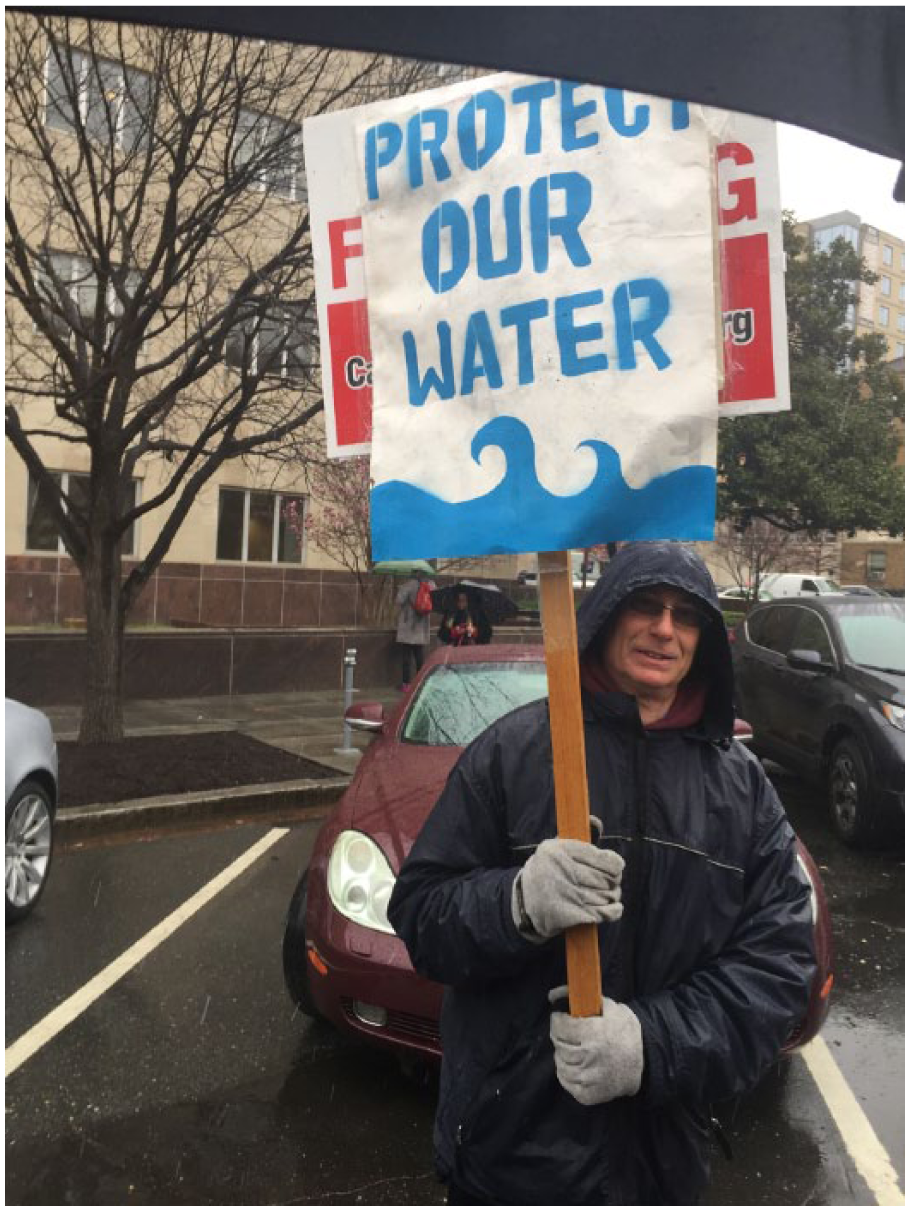
Man from Maryland holding handmade poster advocating water protection.
At the DC March, we witnessed cultural performance and performativity through the circulation of contextually situated cultural expression, which were sites of struggle encoding the histories of power relations and challenging those narratives that subjugate and marginalize indigenous people and their sustainable livelihoods (Hanna & Vanclay, 2013). The ability to disseminate an affective narrative element of the campaign and expand political and creative opportunities “adds a very emotional element to social movements’ mobilization tools” (Haunss, 2015, p. 27). The narrative parade of posters that flooded the streets during the NODAPL movement reclaimed the handmade poster as a rhetorical art form of cultural expression, political communication, and affective solidarity. The posters carried metacommentaries and Bakhtin utterances playfully communicating with each other messages of subversion and political outrage in an expressive venue of “social and historical heteroglossia” and performative reflexivity (Bakhtin & Holquist, 1981, p. 272). 1 Sioux Nation organizers reflected on their 500 years of oppression and their trails of broken treaties and promises, employing “symbols, meanings, codes, roles, statuses, social structures, ethical and legal rules, and other sociocultural components” to educate and appeal to public support (V. Turner, 1987, p. 24).
Individual participation produced collective artistic expression, binding protesters together in what Guobin Yang (2000) refers to as “self-validating emotional experiences and expressions through active and creative pursuits” (p. 596). In these dynamic dimensions, we perceive what James M. Jasper refers to as the “view of life as artful” in its demonstration of affective resistance (Jasper, 1997, p. 13).
It is, therefore, imperative to understand the Standing Rock Protests in relation to its affect culture. Affect is a feature of social injustice frames, as the individual and the social community interact. Emotions are bound by social forces, which enable people to connect, resist, and survive (Hennessy, 2013). Affective mapping of individual cultural production establishes a terrain for understanding individual historical processes and the affective emotions that register to the oppressive conditions. According to Jonathan Flatley, affective mapping “enacts critical vigilance” as it “traces the paths, resting places, dead ends, and detours we share with others, including those who came before us” (qtd. in Hennessy, 2013, p. 79). Political posters are more than catchy rhetorical declarations and metaphorical images of resistance; each poster carries with it a history, a personal story in term of its origin, its maker, its design, and the meaning making behind the poster. These poster narratives are powerful not for the political messages that are conveyed, but because of the affectations that are transmitted and the connections and associations they encourage and foster. Synthesizing metaphor, symbols, synecdoche, metonymy, and other figurative strategies, the metasocial commentaries become commanding tools for transformative change. As evidenced in this cultural production, mapping the collective experiences is a powerful affective strategy enabling activists to listen, share meaning, and testify to social injustice.
Social movement scholars recognize the significance of affect culture and in individual and collective micro-interactions between indigenous and non-indigenous actors (Goodwin, Jasper, & Poletta, 2001; Graham & Penny, 2014; Jasper, 1997; Juris, 2008; Melucci, 1996). The Internet has become a digital neighborhood capable of generating meaningful interpersonal interaction and political mobilization (Clemens & Minkoff, 2004; Dencik & Leistert, 2015; Melucci, 1996). Randall Collins (2004) refers to this type of emotive character as “a mechanism of mutually focused emotion and attention producing a momentarily shared reality, which thereby generates solidarity and symbols of group membership” (p.7). 2
In the 1970s, I had the fortune to study under Barbara Myerhoff whose life work always focused on the act of making meaning and the interrelationship between the anthropologist and the representative peoples and cultural groups. Myerhoff (1980) observes that “cultural performances are reflective in the sense of showing ourselves to ourselves” and awakening “our consciousness of ourselves as we see ourselves” (p. 7) Indeed, there are many case studies involving research activists who use photographic images and narrative to construct meaning. According to Barbara Harrison (2002), the act of making meaning is an “act of construction, which involves the interpreter as much as the maker of the representation” (p. 867). Certainly, more participatory activist research is needed to examine the affect culture of social media sites and their ability to raise people from the couch to the streets. Specifically, what sociopolitical message resonated with indigenous and non-indigenous individuals to join a movement and how did individuals interpret the movement from their position and express it in their political performance?
Method
I am informed by Norman Fairclough’s (1992) three-dimensional model of discourse analysis in formulating my approach to the data collection as well as Victor Turner’s (1987) anthropology of performance. Fairclough contends that texts are linked in a vigorously powerful interconnection “with larger social context in which it is produced and consumed, and that the discourses are thus socially embedded” (Lindekilde, 2014, p. 204). Visual representations and their discursive repertories are articulated, rearticulated, and dearticulated by existing hegemonic discourses (Lindekilde, 2014; Snow & Soule, 2010). Through interdiscursivity, the sampling and integration of dominant texts in innovative ways, and intertexuality, deploying existing texts in unconventional ways, protest movement actors can “destabilize or stabilize social, political, and cultural structures and power structure” (Lindekilde, 2014, p. 205). Victor Turner (1987) and Richard Bauman and Charles Briggs (1990) provided the theoretical background to examine how the Sioux Nation reconstructed their historical injustices into verbal art and metasocial media platforms of dynamic social action. In the following sections, I specifically examine the trajectory of political posters and performances to interrogate how this affective dimension of the protest march mobilized individuals to collectively stand in solidarity with the Standing Rock Sioux Nation.
Data collection was iterative and performed in two phases. I photographed and collected photographs of 200 posters and 10 performance videos interviewing 40 of the protesters. The direct purpose of the poster interviews was to inquire how their posters fit into the dominant discursive frames implemented by the protest organizers. Through personal engagement with my own poster, I was able to bridge the conversational gap between researcher and participant (Chaplin, 1994; Harris & Guillemin, 2011; Hurworth, 2003; Pink, 2001). 3 I then recorded direct response narratives to the following structured questions within seconds after the photos were shot. 4 The photographs of the posters and individuals were then logged on Atlas.ti to interrogate the dominant inquiry of this research: How are individual poster narratives shaped and mediated by the existing discourse proffered by indigenous media activists and leaders? The poster photographs were coded and grouped into two data sets: photographs with interview data and photographs with no data.
Initial coding was accomplished after the data were collected integrating elements of content and visual analysis to code, sort, and map the data (White, Bushin, Carpena-Méndez, & Laoire, 2010). The photos were uploaded into Atlas.ti where different sections of the image were highlighted and initially coded. As more images were uploaded, more initial codes were established in response to the varying data. Once all the data were uploaded and coded, I determined several classifications and metapatterns, “the metaphorical borders within which the facts of experience can be viewed, reflected upon and evaluated” to sort out the rhetoric of political intention and improvised messages (V. Turner, 1987, p. 103). I identified four major indicative groupings of political perspective: “Standing Rock Sioux Nation,” “Mni Wiconi,” “Water is Life,” and “Indigenous Resistance and Solidarity.” 5 As photographs were coded and grouped, new subcategories were identified and created accordingly. Photographs were then recoded and subcoded according to the generation of new frames.
These processes were further informed by Gillian Rose’s (2007) work on the processes of coconstruction of photographic meaning in terms of production, image, and audience (p. 19). Indeed, the photographs of the political posters and ideological visual images are embedded in a wider contentious political culture that challenges Trump’s directive for the Army Corps of Engineers to proceed with the Dakota Access Pipeline (Doerr & Milman, 2014).
Political Posters
The adoption of the 2007 United Nations Declaration on the Rights of Indigenous Peoples (UNDRIP) provided Native Nations Rise March organizers a common international nonlegally binding platform for reaching out to other indigenous groups facing similar threats to their cultural integrity and environmental sustainability. Articles 26 to 30, and 32 of UNDRIP specifically addresses indigenous rights, conservation, and protection of traditional lands and territories. 6 UNDRIP successfully fueled The Native Nations Rise March in Washington DC on March 10, 2017, rallying indigenous leaders and indigenous and non-indigenous grassroots supporters from across the nation (Figure 2) to stand in solidarity for the protection of “indigenous knowledge, cultures and traditional practices” and “sustainable and equitable development and proper management of the environment” (UN General Assembly, 2007, p. 5). The political posters became choreographed sites of political performance and persuasion in which Sioux Nation leaders and supporters publicly proclaimed their condemnation of the construction of the Dakota Pipeline scheduled to run underneath Lake Oahe adjacent to the Standing Rock Sioux Reservation reservoir.

Native Women joining together to protest Dakota Access Pipeline.
Amid drum beats and moving prayer circles, the march commenced at the Army Corps of Engineers at 10 a.m. west of Union Station where thousands headed on route through downtown to join the choreography of protestors at Trump International Hotel on Pennsylvania Avenue. In spite of facing snow flurried freezing temperatures, the protestors created a moving public sphere of grassroots activists from diverse public spheres carrying an array of colorful posters that directly challenged governmental discourse. They further maintained a similar nonviolent commitment to the halting of construction of the Dakota Access Pipeline. As one protestor Waniya Locke (2017) who voiced her feelings live on video on Facebook said, Remember three weeks ago, Trump said that he has never received a phone call from anybody stating that they didn’t want Dakota Access Pipeline? Well guess what, Trump. We’re here in D.C. and we’re ready to march in opposition of Dakota Access.
The posters themselves contained commanding verbal art and vernacular rhetoric of solidarity and resistance that turned the streets into storied places of interactive emotional engagement. The artful expression of language in the posters emphasized the interconnectivity between Mother Earth and Native American Indian culture as well as the need to protect sacred land and its resources for future generations. As consistent with other indigenous protest movements, many of these posters deployed cultural markers of feathers, arrows, Native American Indian figures and narratives in the framing of their political rhetoric (Conklin, 1997, 2006). The literary, visual, and narrative technique brought protestors into the resistance helping to shape and produce meaning and content. Although there were many manufactured posters from the event sponsors, handmade posters using ordinary household materials (Figure 3) were proudly displayed in abundance to reflect concerns of the Standing Rock Sioux Nation. Many of these handmade signs showed an esthetic sense of craftsmanship while at the same time proffering strong arguments, which were “congruent and “complementary” to organizer’s “goals and ideologies” (Snow, Rochford, Worden, & Benford, 1986, p. 464). This congruence of messages suggests that Standing Rock Sioux Nation controlled the rhetoric and representation of their message to the larger public (Conklin, 2006; Graham & Penny, 2014). The Native Nations Rise March organizers focused their injustice frames on solidarity and protection. Although personal rhetorical improvisation of the messages occurred, my research identifies four major framing devices, which united the discourses: (a) Standing Rock Sioux Nation; (b) Mni Wiconi, Water is Life; (c) Indigenous Resistance and Solidarity; and (d) NODAPL.

Vermont couple with cardboard sign stating people over pipelines.
The “Stand with Standing Rock” posters were both manufactured and homemade. Messages of solidarity with Standing Rock were simple, straightforward, and flooded the streets. Posters proclaiming personal proclamations of “I Stand with Standing Rock,” walked alongside imperative rhetoric “Stand with Standing Rock.” Inclusive third person plural signs of “We Stand with Standing Rock,” accompanied expressions of regional solidarity: “Philly with Standing Rock,” “Brooklyn Stands with Standing Rock,” among other local supporters (Figure 4). The articulation and rearticulation through Facebook, Twitter, Snapchat, Instragram, and other social media networks produced an intricate circuit of sociopolitical agency and power relations linking both the public and private sphere (Silverstone, Hirsch, & Morley, 1992).
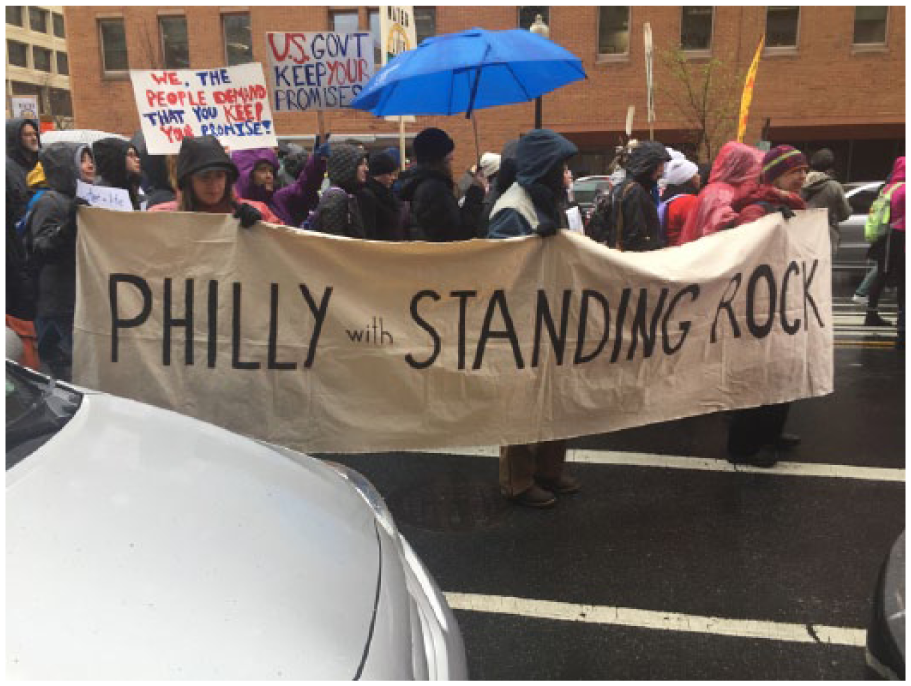
One of the many city alliances that stand with Standing Rock.
Other posters took the Standing Rock concept and added verbal twists with the declarations to encourage new ecological and political directions. One such poster “Standing Rock Starts a (Re) NEW (able) ENERGY ERA” (Figure 5), referenced the need for renewable energy platforms. This poster is an individual “interpretive” variation on the solidarity frame calling for a renaissance of Native American Indian ideology. Moreover, it proffers a direct call to arms to protect the Environmental Protection Agency, which is under aggressive attack by the Trump Administration to roll back Obama Era Clean Water Act protections for American rivers and streams.

Sioux Indian from North Dakota holding handmade sign commenting on the ERA and the need for renewable energy.
“Mni Wiconi, Water is Life,” was one of the most popular collective action frames, which “intended to mobilize adherents and constituents to garner bystander support, and to mobilizes antagonists” (Snow & Benford, 1988, p.198). One manufactured posters combined the idea that “We are here to Protect” with the belief that “Water is Life.” The deductive logic to this is that “oil” is not “life” and as it cannot be consumed, it must be “kept in the soil.” Hence, one of the most commanding chants was “You can’t drink oil. Keep it in the Soil.” The vernacular rhetoric created a common performance even though each individual carried a different interpretation of the theme. The chant acted as a “form of critical education that works toward grassroots change” by admonishing spectators on the severity of ignoring animistic ideology (Garlough, 2011, p. 365).
The syntactical declarations and variations on the “Water is Life” metaphor offer alternative relations to land, water, and each community. These were complemented by images of rolling ocean waves emphasizing Native American tradition and culture. Indians in native dress, buffalos, mothers with babies, tear drops, cross bows, teepees, and dream catchers. Images of the “nobel” Native American Indian and his or her spiritual and ecological ties to Mother Earth are often used as both cultural and political symbols to reinforce solidarity and engage a broader audience (Conklin, 1997; Conklin & Graham, 1995; Hanna et al., 2016). Although personally expressed, the framing device bridged indigenous and non-indigenous individuals with the Standing Rock community and a congruently negotiated sense of “shared meaning” and collective action on the importance of saving our environment (Benford & Snow, 2000).
One of the most clever-storied posters was on a black and white figure sketching of an elder tribesman, which read, “Only When the Last Tree Has Been Cut Down, the Last Fish Been Caught, And the Last Stream Poisoned, Will We Realize We Cannot Eat Money.” Here, the metaphor that water is life extended to the trees, and the fish swimming in the lakes and streams. The metaphorical imagery employs the subjunctive didactic connection of will and desire to relate cause to human actions, the effect of which is to reinforce Native American Indian ideology that human life cannot survive on money. It is, therefore, imperative to protect Mother Earth and her ecosystems, which provide the resources for human survival and sustainability.
By drawing links between Spanish Colonization and conquest throughout the Americas and U.S. government policies regarding Native Americans in 1890, a wider net of indigenous advocacy was activated. Indigenous peoples once marginalized and “othered” by virtual extermination and continued threats to sovereignty joined to promote a counter discourse declaring, “We Exist. We Resist. We Rise” in spite of a “disproportionate social deprivation and lack of opportunities” for Native American Indians (Spirling, 2011, p. 22). Of the more than 500 negotiated treaties negotiated by the U.S. Federal Government with Native American Indian Tribes, 500 of these were also broken prompting a “congruent” and “complementary” flow of cultural production of historical facts and responses (Snow et al., 1986, p. 464). These included “Honor Our Treaties,” “Indigenous Women Rise” (Figure 2), “Native Lives Matter” (Figure 6), “Honor the Treaties: No Trophy Killing the Sacred,” “We the People,” “Indigenous Rights: Protect all Relations” among others.

Sioux Nation Elders advocating that “Native Lives Matter.”
The most memorable was a banner held by three Standing Rock Sioux Tribe youth with a quote from Sitting Bull (Tatanka Iyotake, 1831-1890), which read, “If We Must Die, We Die Defending our Rights” (Figure 7). In this context, the memory of Sitting Bull unifies a trajectory of early historical struggles on the North American Great Plains. The historical allusion that if “We must die, we die defending” references the 1876 Battle of Little Bighorn and Sitting Bull’s final surrender and murder at the age of 59 years in 1890 by Indian Agency Police at Standing Rock Reservation. Connecting present struggles at Standing Rock to historical struggles for indigenous sovereignty and jurisdiction bridges hundreds of years of dispossession and displacement in the name of the Doctrine of Discovery and privileged capitalist accumulation (Ostler, 2004).

Sioux Nation Youth quoting Sitting Bull. “If we must die, we die defending our rights.”
One elder tribesman wore a blanket embroidered with “We Remember Wounded Knee,” signifying the 1890 Wounded Knee Massacre and the 1973 occupation of Wounded Knee. The clash between Native American Indians and governmental officials has been an ongoing conflict of governmental control and indigenous activism and resistance. The gathering of historical memories fostered a willingness to look back at difficult truths and unite them with present circumstances to further substantiate the NODAPL cause. This sentiment is captured in a popular manufactured poster with an Elder Native American Indian dressed in a bright red shirt who holds his fist in the air in knowing defiance. The poster reads, “We the Resilient Have Been Here Before.”
The most significant slogan to rally people around the world together to rhetorically fight the Dakota Access Pipeline is the juxtaposition of a hashtag, and a NO with the acronym DAPL for Dakota Access Pipleline. The #NODAPL captures persistent domination and structural oppression by government and corporate interests at the expense of indigenous livelihoods. Out of the hundreds of NODAPL Facebook pages associated with Standing Rock, there are more than one million members. NODAPL drew support from local, regional, national, and international followers. Most pages were created to honor the water protectors at Standing Rock and demonstrate a global shifting in the recognition of the need to protect earth’s resources against capitalist development projects. Facebook groups popped up all over the world from Australia to Ireland and in hyper-local places such as South Pasadena and Grand Junction all claiming to raise awareness, support, and contribute to the NODAPL movement. The Facebook network altered the way in which individuals participated in the NODAPL movement by creating and sharing political narratives about the event and mobilizing democratic participation in the creation of resistance rhetoric and political movements. The environmental injustice frame signifies 500 years of domination and structural oppression and identifies one of the most dangerous extraction projects facing indigenous groups around the world. According to Linda Black Elk, an ethnobotanist from the Catawba nation: It [pipelines, dams and fracking] almost always tends to be centrally located very close to where indigenous people live or where indigenous people have lived for a very long time or where there are poor communities living. . . you don’t see them trying to frack Beverly Hills or wealthy communities in any state, right? (Nabong & Leffler, 2016)
Many of the protestors I interviewed belong to one or more NODAPL Facebook groups and came to the DC march because of their social media connections demonstrating the decentralized nature of the movement as well as what Tomlinson (2007) refers to as the “distantiated” identities that formed the collective movement. Although joined by loosely articulated groups, people came together as individual advocates capable of interpreting matters and voicing congruent political agendas. Although the majority of DC protestors and water protectors never met each other before and probably would never meet again, they sensed the urgency to share their stories with other protestors. A shared sense of meaning and purpose at the DC march established a collective sense of embedded place base community.
One Vermont couple I interviewed, who joined the movement on social media, created a handmade sign out of a cardboard box and colorful paint to proffer: “People Over Pipelines. NODAPL” (Figure 8). Another group of three young individuals painted a white bed sheet in red, yellow, and black lettering, which read “WE ARE HERE FOR PEACE YOU ARE HERE FOR PROFIT. NO DAPL! BE NICE.” These colorful rhetorical displays of verbal art show how meaning “emerges” in events and places of “mutual understanding” (Michelfelder & Palmer, 1989). They further support Ketelaars et al. (2017) research that indicates, “frame alignment is about more than strategic framing or frame characteristics, and is connected to features of individuals, organizations and the broader context in which the protest takes place” (p. 20).

Young couple from Massachusetts with homemade signs.
In addition, uncanny metaphors were drawn between the pipeline and the black snack as water protectors and protestors chanted “Kill the Black Snake” and carried signs which read “No Black Snake on Lakota Land. NO DAPL. RESPECT EXISTENCE odds ratio (OR) EXPECT RESISTANCE.” The black snake alludes to a dark Lakota prophecy that the dangerous and powerful black snake will bring unwelcomed violence and destruction to the earth and its creatures. Other signs were more rhetorically succinct, but visually and symbolically complicated: One read, “Keep the Black Snake off Sacred Land. NODAPL.” In this poster, the visual imagery of a gray snake with black stripes coils itself twice around a brown buffalo with a colorful headdress. The snake’s head then aggressively rises up to the sky spilling poisonous venom into the landscape.
The black snake was also part of the performance choreography of the march as a black nylon 40-foot black snake carried by protestors made its way through the streets. On its side in white lettering it read, “Kill the Black Snake.” The choreography of the black snake created an educational discursive space to generate visual meaning to the protest movement by interweaving traditional narratives and creating a dynamic role in the cultural production. The black snake trope subverts Western capitalist ideas, ideologies, institutions, and structures that privilege development and consumerism over sustainable livelihoods and ecosystems.
Other symbolic representations involved a staged performance in which Sioux Indian youth constructed a Teepee to the sound of beating drums in front of Trump International Hotel on Pennsylvania Avenue—a privileged space of capitalist tourism and entrepreneurship. The significant choreography of cultural and sociopolitical production combines political elements of past and present demonstrating the complicated processes of how power struggles have played out over time. Having established their territory, Sioux Youth and elder tribesmen held hands in a circle to protect it from dispossession (Figure 9). The interplay of sensory historical codes “heightened and deepened consciousness of participants” and non-participants (V. Turner, 1987, p. 70). Choreographic performances of historical circumstances established the real dialectical tensions of the Standing Rock Protest in which real lives continue to be disrupted and displaced by powerful political structures that undermine Native Nations Sovereignty. The choreographic performances of symbolic representation operate to portray the dynamic interplay of resistance, agency, and political power.

Sioux youth construct a Teepee and hold hands in front of Trump International Hotel on Pennsylvania Avenue.
Final Thoughts
In the Native Nations Rise March, we witnessed how micronarratives interacted with the cultural production of resistance narratives fashioned by the Standing Rock Sioux Nation and her Water Protectors to produce a powerful interplay of collective performance and rhetorical challenges. Synthesizing indigenous performance theory, social media theory, and affective alignment theory, I examined how The Standing Rock Sioux Tribe effectively integrated on the ground protest performance rhetoric and social media venues to share their sociopolitical resistance against the construction of the Dakota Access Pipeline in North Dakota (Bauman & Briggs, 1990; Condori, 2010; Earle, 2009; Fisher, 1994; Graham & Penny, 2014; Kirsch, 2007; O’Faircheallaigh, 2012; V. Turner, 1987). I contend that synthesizing visual and indigenous performance analysis of The Natives Nations Rise March offers a critical place to examine the dialectic between indigenous performance, political sovereignty, and self-determination. By engaging in participatory action research on the ground and in social media, I documented the complex chain of interactions of the political narratives in their larger context, both locally and globally (Graham & Penny, 2014; Hanna et al., 2016; Ruano, 2013; T. Turner, 2002). Protest leaders drew upon Native American Indian “ethos,” cultural traditions, and folklore to successfully rally indigenous and non-indigenous peoples to forge connections and linkages to promote a renegotiation of power. The engagement of unifying themes enabled protestors to join in political solidarity in support of the NODAPL movement.
I further demonstrated how the interpretation and reproduction of manufactured posters inspired a “congruent and complementary” array of parallel posters and a “democratization” of certain images and ideas in a dynamic interchange of political discourse (Snow et al., 1986, p. 464). Through the creative expression of posters at play on the streets and the use of mobile devices to re-articulate political messages on Facebook, Snapchat, Twitter, Instagram individuals, friends, communities, and other sectors of the social media became part of the “connective action” (Bennett & Segerberg, 2012) of “networked individuals” (Rainie & Wellman, 2012). The rhetorical dance of posters then circulated to the masses through tweets and retweets flickering back and forth to each other in a virtual house of mirrors to directly challenge narratives of capitalist production.
Although it can be argued that the photographs of the posters were taken and sent mainly to family and friends via digital photos, instant messaging, and other social media, the networked terrain that received the messages cannot be devalued because of the personalized connections. The old age adage, the personal is political created what Sherry Turkle (2011) refers to as the “collaborative self” inspiring multitudes to unite in “networked” solidarity with Standing Rock. Social media platforms allowed individuals of all ages, races, ethnicities, social classes, and creeds to “actively network,” “forge alliances” and be privy to the discourse and processes of mobilization that challenges structural injustices and inequitable distribution of land and resources (Rainie & Wellman, 2012, p. 9).
This article hopes to contribute to an understanding of how individual political posters and ideological visual images at the Native Nations Rise protest in Washington D.C. are embedded in a wider contentious political culture that challenges capitalist consumption of resources at the expense of indigenous traditional livelihoods. The construction of discursive injustice frames of “Standing Rock Sioux Nation,” “Mni Wiconi,” “Water is Life,” and “Indigenous Resistance and Solidarity,” established a dominant narrative of key political issues, which inspired indigenous and nonindigenous individuals to mobilize and to participate in supporting the Standing Rock Sioux Nation campaign of resistance.
On a personal note, with the construction of the Dakota Access Pipeline, I have been asked whether resistance marches and protests have any positive political impact for indigenous peoples fighting to protect their native lands and sustainable ways of living in the world. I do believe that protest venues create important spaces for ethical and political listening and communicating, which are necessary components of indigenous rights and justice. Chief Arvol Looking Horse (2018) said it best: “Standing Rock has marked the beginning of an international movement that will continue to work peacefully, purposefully, and tirelessly for the protection of water along all areas of poisonous oil pipelines and across all of Mother Earth.”
Footnotes
Declaration of Conflicting Interests
The author(s) declared no potential conflicts of interest with respect to the research, authorship, and/or publication of this article.
Funding
The author(s) received no financial support for the research, authorship, and/or publication of this article.
Notes
Author Biography
 where she researches the impact of globalization on indigenous populations.