



Abstract
Although mobile social networking sites have successfully penetrated into individual’s various aspects of everyday lives, few empirical studies have investigated important antecedents of civic involvement in the WeChat context from a network capital perspective. The principal aims of the research are to systematically explore the underlying associations between mobile social media use, network heterogeneity, network capital, and civic participation among young people. The data was collected in an online survey of 1,208 young people in mainland China. Structural equation modeling analysis was carried out to examine the corresponding hypotheses. Findings revealed that informational WeChat use could positively impact young people’s network heterogeneity, which subsequently contributes to increased degrees of civic involvement. Additionally, the results demonstrated that network heterogeneity and network capital on WeChat are positively associated with civic involvement. Furthermore, network heterogeneity and network capital could mediate the association between WeChat use for information and individual’s civic activities. These obtained outcomes underlined the vital role of mobile social media communication in facilitating democratic engagement of young citizens in contemporary mobile media-saturated society.
Introduction
In recent years, the progressive diffusion of mobile phones and ubiquitous penetration of wireless web technologies have raised urgent issues about the vital role of mobile social networking sites (SNS) in individuals’ engagement in civic life (Atusingwize et al., 2022; Park & Zúñiga, 2019; Yu et al., 2023). Social media are defined as web-based sites and technologies that enable users to generate a public or semi-public profile via which they share, communicate, and interact with others and permit them to navigate through social networks of content (Hwang & Shah, 2019; Zhong, 2014). Equipped with unique functions and user-friendly interface, mobile social media devices have offered innovative and excellent avenue for citizens to conveniently seek mobilizing online information, browsing present daily news, sustain interpersonal connectedness, as well as disseminate real-time messages on virtual spaces (Cheng et al., 2015; Wei et al., 2018; Yang & Men, 2020). Even though a series of globally popular mobile SNSs, consisting of Facebook, Twitter, and YouTube have been blocked, users in mainland China could remain access to indigenous mobile social platforms especially WeChat (WeiXin in Chinese; Y. Chen, 2017; Li et al., 2016; Pang, 2020). According to the latest relevant statistics, the total number of WeChat active users every month has reached roughly 1 billion in the end of February 2018, and a large number of users accessed WeChat through smartphones (X. Chen et al., 2020). Youth adults is a significant component of WeChat users and they spend plenty of time and energy using the platform (Fang & Gong, 2020; Hou et al., 2021). Considering young people are recognized as the hopeful future for the whole country and will become the principal actors of democratic process (J. Chen, 2017; Y. Kim & Kim, 2022; Zhong, 2014), it is clearly crucial to investigate how young people’ uses of WeChat are closely intertwined with their civic participation and the underlying mechanism behind these linkages.
Since its launch in late 2011, WeChat has grown into an all-in-one application that integrates social networking interaction, ordinary online payments, micro-commerce activities, public services, as well as a service programming interface for various apps (X. Chen et al., 2020; Hou et al., 2021; G. Wang et al., 2019). Owing to its general and peculiar features, WeChat has tremendously encouraged users’ interpersonal communication, and even rendered such interaction more convenient and efficient. Similar to WhatsApp, WeChat allows users to transmit messages in a variety of formats (e.g., text, image, and real-time voice) to others and make both audio and video phone calls (Pang, 2020; Z. Wen et al., 2016). Unlike WhatsApp, WeChat permits users to convey text files, pictures, network emoticons, and video clips within their friend circles (i.e., Moments) and leave likes or comments on other individuals’ posts (Y. Chen, 2017; Hou et al., 2021; Hwang & Shah, 2019). Furthermore, WeChat offers additional services including conducting online transactions, distributing red packets, playing games, and accessing to related public services. Notably, in comparison with parasocial communications between strangers in cyber space, the majority of WeChat “friends” have already recognized each others in the real life (G. Wang et al., 2019; C.-B. Zhang et al., 2017).
With the swift extension of interpersonal communication via mobile media, researchers have begun to devote attention to the possible influences of mobile media on civic and political engagement, particularly mobile-mediated communication (Guidetti et al., 2016; Nah & Yamamoto, 2018; Park & Zúñiga, 2019). Surprisingly, despite the recent growing popularity of mobile social media (Yu et al., 2023; L. Zhang & Jung, 2023), literature has rarely explored the use of WeChat and its potential influence on young people’s network capital and civic engagement in light of the unique features of WeChat. In addition, while a few studies have investigated the relationship between mobile social media and individual’s civic behaviors (Brundidge, 2010; Li & Chan, 2017; Zhu et al., 2019), they have mainly focused on the direct impact of mobile social media on consequence variables such as civic involvement while neglecting the indirect impact of mobile social media adoption on citizens’ participatory behaviors. Prior empirical investigations on the political implications of SNSs on civic participation have asserted that mobile SNSs adoption would encourage people’s involvement in civic affairs through the mediating mechanisms (Jennings et al., 2021; Park & Zúñiga, 2019; Zhong, 2014). Therefore, the current study could extend this current line of related work by proposing a hypothetical model to determine by which WeChat interaction would facilitate individuals’ civic engagement through broadening network heterogeneity and increasing network capital among individuals. Furthermore, extant research claims that diverse mobile social services positively influence civic attitudes and involvement in both democratic and non-democratic countries (Y. Kim & Chen, 2015; Y. Kim et al., 2020; Nah & Yamamoto, 2018; Tang & Lee, 2013). However, the majority of empirical evidence of the association between mobile social media use and civic participation has been derived from investigations that were conducted in the western societies, especially in the US and Europe (Mosca & Quaranta, 2016; Nah & Yamamoto, 2018; Song & Eveland, 2015). For instance, Nah and Yamamoto found that integrated news usage, or the degree to which diverse mobile media services are combined for news consumption, is significantly correlated with civic involvement among US citizens (Nah & Yamamoto, 2018). Mosca and Quaranta (2016) discovered that frequent Twitter use is positively associated with various forms of civic engagement among Italian, German, and British citizens. Only recently have there been efforts to study explicitly the effects of social media use on network heterogeneity, network capital, and civic behaviors in contemporary Chinese society (Guo & Chen, 2022).
So as to address the above questions and fulfill research gaps, the principal purpose of this article is to investigate whether and how different uses of WeChat can increase communication network heterogeneity and network capital among young people and promote democratically desirable civic behaviors when younger generation apply the burgeoning communication technology in an evolving media environment. Moreover, the study strives to further discover whether network capital and heterogeneity could mediate the effects of WeChat use on civic involvement in the mobile media-saturated environment. Thus, the following research questions are put forward:
RQ1: Does WeChat usage facilitate young people’s civic engagement in mainland China?
RQ2: Which aspects of WeChat usage could facilitate young people’s civic engagement?
RQ3: What are the mechanisms underlying distinct aspects of WeChat use, network heterogeneity, network capital, and civic engagement among young people in mainland China?
More specifically, based on the previous studies, this research assumes that utilizing WeChat could promote chances to discuss issues with diverse individuals and increase network capital on WeChat, and ultimately this would foster young people’s engagement in civic actions. The study chose network heterogeneity, network capital, and civic engagement as main variables because they could represent principal signposts of healthy and functioning democracies (Gil de Zúñiga et al., 2012; Y. Kim et al., 2013). To summarize, the findings of this study can constitute a vital contribution to further understanding of the significant role of emerging mobile SNS as the resourceful platform in increasing young people’s heterogeneous discussion networks and involvement in civic affairs. Theoretically, it will broaden the scope of social capital theory by taking into account the role of network heterogeneity and network capital in the association between WeChat use and subsequent civic behavior of adopting this new medium. Practically, it will assist people to comprehend how this newly mobile social tool is socially shaped in the given social setting, through gathering first-hand data on civic bahaviors among younger generation in contemporary Chinese society.
Literature Review and Research Hypotheses
The Influence of Mobile Social Media Use on Civic Involvement
Conceptually, civic involvement as a multifaceted construct refers to various individual or collective behaviors of citizens in addressing particular public affairs (Boulianne & Theocharis, 2018; Warren et al., 2014). Broadly interpreted, the definition involves a wide spectrum of voluntary actions regarding societal, community-based, and nonpolitical behaviors, such as raising funds for local charities, participating neighborhood conferences, working or volunteering for nonpolitical organizations, as well as solving community problems (J. Chen, 2017; Y. Kim et al., 2013; Park & Zúñiga, 2019). This research highlights citizens’ involvement in public affairs toward the greater community and thus defines civic engagement as various individual or collective behaviors of citizens concerning particular public affairs. Plenty of researchers have increasingly devoted efforts to investigate whether Internet could foster individuals’ participatory behaviors (Campbell & Kwak, 2011; Hsieh & Li, 2014; Lenzi et al., 2015). Some scholars claimed that time spent online results in less time spent involving in civic and political activities, and that those who utilize wireless Internet as an additional service for political participation are those who already showed more general interest in political issues and events (Brundidge, 2010; Valkenburg & Peter, 2007). Nevertheless, other scholars argued for the positive impact of Internet use on civic engagement by revealing that computer-mediated communication could encourage inactive individuals to engage in civic or political actions (J. Chen, 2017; Lenzi et al., 2015).
With the rapid diffusion of mobile SNS, the association between mobile SNS adoption and citizens’ civic activities has garnered considerable amount of scholarly attention. The positive linkage between mobile SNS usage, especially Facebook, YouTube, and WeChat, and civic involvement has been consistently demonstrated in prior empirical studies (Cheng et al., 2015; Park & Zúñiga, 2019; Wei et al., 2018). Some studies concentrated on specific patterns of mobile SNS use and probed its impact on civic engagement (Gil de Zúñiga et al., 2012; Lenzi et al., 2015; Park & Zúñiga, 2019). Uses and gratifications theory postulates that individuals are goal-oriented, insofar as they utilize certain media to meet their inner demands (Y. Chen, 2017; Gil de Zúñiga et al., 2012). The uses and gratifications methodology has proven to be a significant path in comprehending motivations for media consumption, particularly the social and psychological foundations of demands that build anticipation of media usage result in various outcomes (Lenzi et al., 2015; Tang & Lee, 2013). This approach has been extensively used to investigate various types of mobile media consumption. Guided by the uses and gratifications theoretical framework, a handful of studies have further discovered that the impact of social media on network capital and engagement depends on people’s psychological motives for utilizing media (J. Chen, 2017; Lenzi et al., 2015; Zhong, 2014). According to Cheng et al.’s (2015) classic typology, individual’s motivations for mobile SNS use can be divided into information motives, affection motives, fashion or status, accessibility, recognition motives, as well as entertainment motives. Recent studies have offered evidence that utilizing mobile social media for information and recognition needs are positively correlated with generation of citizens’ social capital and their engagement in civic behaviors (Yamamoto & Nah, 2018; Yang & Men, 2020), whilst types of usage related to personal amusement and diversion exert the negative or muted impact. Thus, it is necessary to distinguish different WeChat communication practices when probing the influence of WeChat use on civic involvement.
Additionally, a stream of new media studies suggest that interpersonal communication on mobile social media, total time spent, and frequency of use are positively and significantly related to greater civic behaviors (Y. Kim et al., 2013; G. Wang et al., 2019; You & Hon, 2019). It might be that mobile SNSs offer individuals with public news and unofficial content and platforms for young people to exchange personal viewpoints, which subsequently could promote online mobilization. More importantly, owing to young people’s social circles and connectedness within mobile social media depend on human relations, they might be more concerned about news and information, consisting of public issues and political events, that their peers convey and repost on the cyber space and thereby be motivated to participate in public affairs or civic actions (Hou et al., 2021; G. Wang et al., 2019; Z. Wen et al., 2016). Since new communication technologies offer individuals with large amount of information on civic issue to render them feel they could make participatory decisions, whether to repost related messages in the friend circles, or give some comments regarding a civic issue. Thus, the study hypothesizes that informational WeChat use and general WeChat use could predict young people’s civic engagement. Building upon above theoretical explanations and accumulated empirical results, the following hypothesis is thereby posited:
The Influence of Mobile Social Media Use on Network Heterogeneity
Contrasting to communication via conventional media services such as radio, television, and printed newspaper, interaction through Internet and new media exhibits more interactivity. In essence, the attribute of interactivity as mutual interpersonal interaction is a remarkable characteristic of SNSs due to the permit people to communicate with diverse others who share common hobbies and activities beyond different cultural, political, and geographical borders (Atusingwize et al., 2022; H.-T. Chen & Li, 2017; Pang, 2020). For instance, the unique affordances of mobile SNSs such as reposts, comments, and liking would bring out more interactivity among different users. Prior research has yielded meaningful conclusions in terms of the association between mobile social platforms usage and network heterogeneity. Some scholars suggested that exposure to different views is theorized as central for generating an idealized and democratic society (Guidetti et al., 2016; Yang & Men, 2020). It encourages people to seek for information more comprehensively and to check problems and alternatives under close scrutiny (X. Chen et al., 2020; Y. Kim & Chen, 2015). Moreover, exposure to diversity also assists people to understand the fundamental principles and motives of distinct opinions, which promotes mutual comprehending and tolerance (C.-B. Zhang et al., 2017; L. Zhang & Jung, 2023).
Various mobile social media platforms might increase individuals’ tendency toward dissonance reduction by permitting citizens to avoid non-likeminded individuals from the web-based networks (Choi & Lee, 2015; Y. Kim et al., 2020). A substantial body of studies have asserted that new media context renders people unwilling to participate in selective exposure, emphasizing that individuals incline to inadvertently expose them to distinct and heterogeneous thoughts and viewpoints (Jennings et al., 2021; Y. Kim & Chen, 2016; Park & Zúñiga, 2019). According to Choi and Lee (2015), digital media is not merely a singular pattern of interaction, but a much more diverse and convenient channels for communication that could be used to foster networking with distinct others. Further, online communication could substantially decrease the costs of sustaining a larger amount of interpersonal relationship (H.-T. Chen & Li, 2017). Considering that the expansion of network scale contributes to an increase in the heterogeneity of social network (Y. Kim & Chen, 2016; Pang, 2019), the fundamental cause lay in the truth that time spend on SNSs and subsequent increased numbers of friends therefore could enlarge individuals’ heterogeneity networks. Additionally, enlarged network scale might be associated with more weak ties, which would undoubtedly make people exposure to innovative and diverse viewpoints (Hwang & Shah, 2019; Yu et al., 2023). Structure of web-based social network inclines to not only comprises a small cluster of closely linked social circles, but also includes a larger loosely knit groups of individuals (Atusingwize et al., 2022; Deng & Fei, 2023).
Many scholars have suggested that new media technologies usage could facilitate people’s network heterogeneity (Choi & Lee, 2015; Y. Kim et al., 2020; L. Zhang & Jung, 2023). For instance, Y. Kim et al. (2013) confirmed that mobile social media users can possess various opportunities to expose themselves to different views and messages because inadvertency and the construction of SNSs such as heterogeneity of social media users, the properties of hyperlinks, as well as powerful interactivity functions. Similarity, Choi and Lee (2015) demonstrated that social media news use could contribute to heterogeneity of one’s discussion networks and civic participation. Recent empirical studies have also offered strong evidence that news sharing on mobile social media for news could promote individuals’ level of network heterogeneity in the online environment (Deng & Fei, 2023; Hwang & Shah, 2019; Y. Kim et al., 2020). Therefore, mobile social media establish an environment where people can be exposed to various perspectives and messages that otherwise may not be available. In addition, interpersonal connection via mobile social media could turn into more heterogeneous when individuals establish and expand their loose ties by using these platforms (Y. Kim & Chen, 2015; Y.-J. Lee, 2022). Considering that the positive association between mobile SNS usage and individuals’ network heterogeneity has been revealed in previous studies (Y.-J. Lee, 2022; Yu et al., 2023), the mechanism might also be relevant in the correlation between young people’s WeChat adoption and interaction network heterogeneity in their daily lives. Building on prior findings, the following hypotheses are therefore proposed as following:
The Influence of Mobile Social Media Use on Network Capital
Broadly defined, the concept of social capital is the set of actual and possible resources accumulated through interpersonal linkages (H. J. Lee et al., 2019; N. Wang et al., 2022; Zhong, 2014). According to some scholars, it may facilitate individual mutual coordination and collaboration for reciprocal interests (Wu et al., 2022). Currently several studies discovered that social capital has both individual and collective aspects (Hwang & Shah, 2019; Y.-H. Lee et al., 2021; Wu et al., 2022). In particular, individual or network capital was defined as how individuals obtain and utilize resources embedded in social relations to accomplish individual aims (Lenzi et al., 2015). Social media platforms could decrease the cost of sustaining pre-existing interpersonal networks and enable individuals to build up new social bonds (Ellison et al., 2014; Y.-H. Lee et al., 2021). Several researchers claimed that directly interacting with online friends through social media could contribute to the increased network capital (Atusingwize et al., 2022; Chang & Hsu, 2016). On the one hand, one-on-one information exchange and dissemination offered rich information, bolstered reciprocal self-dispresentation and promoted mutual trustiness, which may help acquire supportive resources (H.-T. Chen & Li, 2017). On the other hand, characteristics of directed interaction consisting of recency, length of time, closeness, and total amount could predict the strength of social ties (J. Chen, 2017; Park & Zúñiga, 2019; You & Hon, 2019). With the exponential increasing of digital media technologies, a stream of researchers have been interested in the potential implications of the new media communication on individua’s network capital (Deng & Fei, 2023; N. Wang et al., 2022).
Scholars have discovered that mobile social media use has been positively associated with network capital as it assists people surmount the obstacles to establish personal relationships (H.-T. Chen & Li, 2017; Y.-H. Lee et al., 2021; Park & Zúñiga, 2019). For individuals, mobile-mediated networks provide access to diverse weak bonds due to mobile SNS could expand the scope of interaction possibilities through spanning space-time boundary, leaping over threshold of social classes, as well as rendering users with distinct backgrounds but common interest to assemble within the cyberspace (Strauß et al., 2020; Wu et al., 2022). Meanwhile, it could be utilized to enhance intimate bonds and coordinate public lives, such as meeting acquaintances or friends and planning collective activities (Y.-J. Lee, 2022; Wei et al., 2018). The majority of mobile social media allow users to glance over private profiles of complete strangers and activate this mode of latent links, turning them into weak bonds that are related to bridging capital (Ellison et al., 2014). More importantly, as social media services are embedded in the mobile services, they excel in fostering weak bonds and augmenting social relations to cultivate bridging network capital at any time and everywhere availability (Pang, 2020; Yamamoto & Nah, 2018). Furthermore, mobile SNSs consist of multiple services such as text communication, real-time voice, and video calling so that individuals could maintain close relations utilizing these applications in the manner they used mobile phones before.
A body of recent empirical studies have documented that mobile social media such as Facebook or YouTube could offer an efficient infrastructure to sustain and solidify pre-existing relationships (J. Chen, 2017; X. Chen et al., 2020; Y. Kim & Kim, 2022; You & Hon, 2019). For instance, based on a two-wave panel survey in Hong Kong, H.-T. Chen and Li (2017) discovered that communicative use and self-disclosure via mobile SNS were positively associated with bonding and bridging patterns of network capital and psychological well-being. Later, N. Wen (2020) suggested that information seeking behaviors on mobile social platform is positively and directly correlated with Chinese people’s production of network capital. More recently, Y. Kim and Kim (2022) claimed that mobile SNS make young adults take notice of the news and their friend updates, which would facilitate reciprocal understanding and reinforce the relations between existing interpersonal networks. Thus, the research investigates whether and to what extent the two patterns of WeChat use (i.e., informational use and general use) associate with young people’s network capital by proposing the following hypotheses:
The Association Between Network Heterogeneity, Network Capital, and Civic Involvement
Traditionally, political theoretical paradigm has supported the anticipation that heterogeneous discussion networks could positively predict citizens’ democratic engagement (Campbell & Kwak, 2011; Y. Kim & Chen, 2016). Actually, the extent to which individuals are exposed to different views and ideas determine the possibility of public opinion expression and participatory democracy (Choi & Lee, 2015; Strauß et al., 2020). Exposure to distinct viewpoints has been discovered to promote citizens’ political interest, foster their expression of their personal political aspirations, as well as encourage a clearer comprehending of civic events (Choi & Lee, 2015; Gil de Zúñiga et al., 2012). Moreover, scholars have claimed that individuals engage in political and civic activities due to they are required and encouraged by others with whom they possess the interpersonal relationships (Y. Kim & Kim, 2022; L. Zhang & Jung, 2023). Discussion networks and network capital have become the central concerns in scholarship on the democratic process due to they could impact a wide variety aspect of civic life, especially engagement levels. Along with the uptake of mobile social media, a great deal of researchers have begun to investigate possible associations between network heterogeneity, network capital and their relationship to civic participation (Deng & Fei, 2023; Park & Zúñiga, 2019; Yang & Men, 2020).
As some scholars suggested, discussion network heterogeneity could be significantly associated with civic involvement by arousing citizens’ demands for related public news and content (Choi et al., 2017; Hsieh & Li, 2014). Previous studies have confirmed that communications with heterogeneous others directly or indirectly impact political and civic engagement in a positive way (Y. Kim et al., 2020; Y.-J. Lee, 2022; Lenzi et al., 2015). The reason can be attributed to the fact that discussion network heterogeneity could exert the positive influences on civic involvement by triggering people’s psychological motivations for seeking a wide range of mobilizing information about civic issues (Y. Kim & Kim, 2022; Park & Zúñiga, 2019). Exposure to conflicting messages the result of diversity of views encountered in a diverse network impels people to continuous communication with others to understand some social concerns and to reconsider their views and ideas (Li & Chan, 2017; Wu et al., 2022). Much research has noted that information-seeking need could stimulate people’s cognitive behaviors and awareness of important social events and problems, which subsequently would lead to greater levels of civic involvement (Boulianne & Theocharis, 2018; X. Chen et al., 2020; Park & Zúñiga, 2019). Moreover, citizens who establish and sustain relations with other users on mobile SNSs can acquire large amount of information and messages about diverse public affairs when discussing about civic events with other individuals, thereby advancing the opportunities to participate in civic behaviors (Cheng et al., 2015; Choi et al., 2017; B. Kim et al., 2020). Therefore, network heterogeneity could positively predict individuals’ civic involvement.
Focusing on the relationship between network capital and civic consequences, a growing body of research asserted that network capital could play an important role in eliciting citizens’ civic involvement in civil society (Atusingwize et al., 2022; Jennings et al., 2021). Previous studies have supported this perspective by demonstrating that network capital makes it easier for peoples to link their personal identities and interests with those of communities, and thereby assists them to defeat difficulties of collective action and facilitate civic behaviors (Deng & Fei, 2023; Y. Kim & Chen, 2015; Park & Zúñiga, 2019). For instance, Zhong found that network capital would play a positive role in impacting civic participation in the social media context (Zhong, 2014). Ferrucci et al. (2020) also documented those self-reported measures of bonded capital and ideological extremity associated with general online citizen participation. Recently, Y.-J. Lee (2022) discovered that Twitter users’ online social ties are positively related to their civic participation on Twitter To conclude, people with multiple social bonds prefer to engage in civic activities due to trustiness and social bonds in networks with others create virtuous circle of network capital that may generate the setting for collective action for social problems (Y.-J. Lee, 2022; L. Zhang & Jung, 2023). Combined with previous research on the positive influence of mobile SNS usage on network heterogeneity, network capital and civic participation, this study anticipates network heterogeneity and network capital on WeChat could predict civic involvement. Thus, the study proposes the following hypothesis:
Methodology
Research Model
The current article probes the relationships among the main variables shown in Figure 1. Specifically, this research mainly concentrates two aspects of WeChat use: informational use and general use. Despite these are not by any means the only potential uses of WeChat, they are anticipated to play significant roles on the basis of the line of existing literature (J. Chen, 2017; N. Wen, 2020; Zhong, 2014). The respective roles they play in the conceptual research model are summarized by the framework illustrated in Figure 1. Therefore, the study hypotheses that informational or general WeChat use could influence young people’s network heterogeneity and network capital, which subsequently increase degrees of civic involvement. Additionally, considering that previous scholars have concentrated on the direct impacts of mobile SNS on network heterogeneity (Strauß et al., 2020; Tang & Lee, 2013) and network capital (X. Chen et al., 2020; Chua & Wellman, 2015) and only a few have probed the mediating mechanism in the WeChat context (Yang & Men, 2020), investigating the mediating role of network heterogeneity and network capital in the impacts of mobile SNS use on civic engagement might be a crucial contribution of this research to the current literature. The research model incorporating developmental literature thus illustrates that this indirect influence of WeChat use on young people’s civic involvement could be mediated by network heterogeneity and network capital on the new communication technology (Figure 2).

The conceptual research model.

Path model results for the research.
Data and Sample
This present research relies on original web-based survey to uncover the influence of WeChat use on network heterogeneity, network capital and civic involvement in mainland China. An electronic questionnaire was developed to gather statistical data from August 20, 2020, to September 20, 2020, via a professional survey website, namely, www.sojump.com. All respondents were notified that their answers were voluntary and anonymous, and could be utilized just for the aim of this study. To further confirm the validity of this online questionnaire, a pilot test was carried out on 50 WeChat users at the beginning of the large-scale survey. According to feedback of these experimenters, the research made some modifications to improve the clarity and comprehensibility of the online questionnaire. The language of questionnaire was designed in Chinese, and respondents aged 14 to 33 years old were selected utilizing snowball sampling method. To be specific, such nonprobability methodology began with posting the web link of online questionnaire consistently on dominant mobile social media such as Weibo and WeChat among Chinese young people for one month. After that, participants were invited to send the Internet address to their friends or peers who are WeChat users. The study used snowball sampling because it had the advantages to offer a more accurate representation of mobile social media population has been confirmed by prior studies. Finally, a total of 1,276 qualified members replied. After abandoning 68 samples with questionable or incomplete responses, the numbers of valid observations were 1,208. The appropriate sample size for this research was determined based on a power analysis. The power analysis was conducted according to an alpha error level of .05, a power of 0.99, and an anticipated effect size of 0.5 for sample size assessment.
Common Method Bias
As suggested by some scholars, if the variables in one research all load on single component or if there is single component that can explain most of the total variance, common method bias will thus become a concern (Lo & Peng, 2022). Harman’s one factor analysis was carried out to examine the influence of common method bias. According to the results of this analysis, five significant factors could load for 72% of the variance, and the first unrotated factor could load for lower than 50% of the variance. The results indicate that the data might be not interpreted by one single common method factor. Therefore, there is no serious issue with common method bias in this study.
Measurements
Informational WeChat Use
In the online survey, participants were required to assess to what extent they utilized WeChat for news and information (Cheng et al., 2015; Y.-J. Lee, 2022). On the bases of a 5-point rating scale from never to very frequently, they indicated how frequently they adopt such mobile social platform for “obtaining or posting messages,”“news,” as well as “participating in present civic affairs and events.” These three items were subsequently computed to form an index of informational WeChat (Cronbach’s α = .86, M = 2.38, SD = 1.67).
General WeChat Use
The measurement of general WeChat use was adapted from previous literature (Atusingwize et al., 2022). The construct was gauged with three questions asking participants to report how many times they used WeChat to “share updates about themselves”, “see updates about other users,” and “posting some contents’’ in the previous three months. Participants answered according to a 7-point scale ranging from ‘‘never’’ to ‘‘more than ten times a day’’ (Cronbach’s α = .89, M = 3.53, SD = 1.31).
Network Heterogeneity
According to previous measurement of the conceptation of network heterogeneity (Choi et al., 2017; Y. Kim et al., 2020), the scale of network heterogeneity was assessed by requiring respondents to indicate how often they discussed about social and public affairs on WeChat with “individuals who do not share their age, socio-economic position, and sex,”“individuals who disagree with their viewpoints,” as well as “individuals who agree with their viewpoints.” Answers to “individuals who agree with their viewpoints” were reverse-coded. A five-point scale (1 = never to 5 = always) was utilized to rate the frequency of discussion network heterogeneity on WeChat. The three statements were summarized to establish the index of network heterogeneity (Cronbach’s α = .92, M = 3.36, SD = 0.59).
Network Capital
The items in this assessment were adapted from previous studies (H. J. Lee et al., 2019). According to previous operationalization of the definition of network capital, three questions assessing distinct characteristics of participants’ network capital were included, such as “There are special people who could help me”, “There are special people who make me feel comfortable”, and “There are people around to share happiness and sadness”. Participants answered on the basis of a five-point scale (1 = strongly disagree to 5 = strongly agree) to every statement. Individual score of every statement was then averaged to generate an index of network capital (Cronbach’s α = .91, M = 3.38, SD = 0.85).
Civic Involvement
The study adapted six statements from previous assessment scales to evaluate participants’ civic involvement (Y. Kim & Chen, 2015; Zhong, 2014). Participants were required to evaluate on a five-point scale (1 = never to 5 = very frequently) how frequently they participated in the following civic activities: “raising funds for charities”“engaging in social activities, such as for environmental affairs,”“working or doing volunteer work for local organizations,”“talking about local issues,”“joining conferences to address neighborhood problems,” and “concerning about local communities or neighbors.” Scores of every question were then averaged to generate an index of civic involvement (Cronbach’s α = .93, M = 3.94, SD = 0.59).
Socio-Demographic Variables
Considering set of socio-demographic variables such as users’ gender, age, educational background, and monthly income may influence their WeChat use and civic involvement, the study included aforementioned demographic variables as control variables.
Statistical Analysis
In this present study, IBM SPSS 23.0 and IBM AMOS 25.0 were utilized for statistical data analysis. Initially, cleaning and processing of data were conducted in Microsoft Excel in order to remove inadequate responses. Next, SPSS 23.0 is employed to conduct descriptive statistical analysis and the assessment of common method variance (CMV) in this research. Finally, the structural equation modeling (SEM) methodology is applied in AMOS 25.0 to validate the suggested hypotheses. The two-step procedure can improve the meaning and reliability of the results: to test the study model (including overall model fit, construct reliability, and validity), a confirmatory factor analysis (CFA) is used, followed by SEM to verify the structural linkages (Hou et al., 2021; Zhu et al., 2019). This structural equation model is suited for the current study since it can take a confirmatory method for the analysis of questionnaire responses by asserting specific connections between the key parameters. Furthermore, by elucidating the extent to which it is likely to assess identical conceptions and components, SEM allows the researchers to gauge the factorial validity of the research questions that compose chosen constructs (Hwang & Shah, 2019; Wu et al., 2022).
Results
Descriptive Results
Of the 1,208 valid subjects, 658 (54.5%) were men, and 550 (45.5%) were women. The respondents were between 14 and 33 years old (M = 2.51; SD = 0.94), with more than two thirds (67.5%) being between 19 and 28 years old. Regarding educational background level, 534 (44.2%) have Bachelor degree followed by Master degree with 27.6 percent. Only a few respondents (9.9%) who have PhD degree. In addition, 41.6% of the users’ have monthly incomes of 3,000 RMB or less, 21.3% have incomes between 3,000 RMB and 6,000 RMB, and 16.6% have incomes between 6,000 RMB and 9,000 RMB. Only 8.8% have monthly incomes more than 12,000 RMB. Table 1 illustrates a summary of the descriptive information of for survey subjects with respect to gender, age, education, and income.
Descriptive Information for Survey Subjects (N = 1,208).

Measurement Model
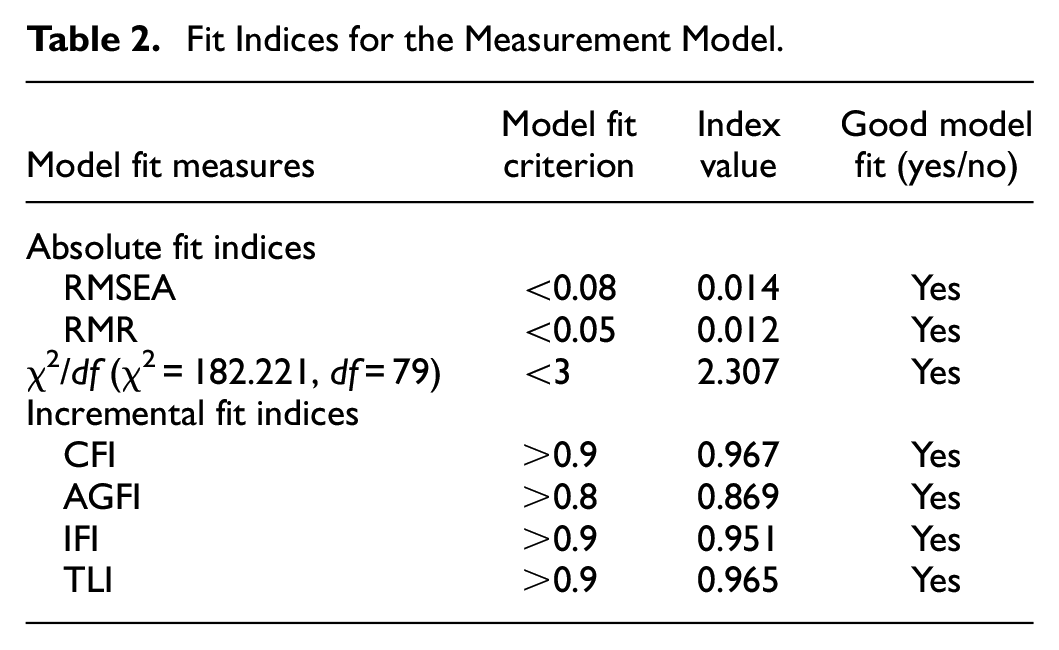
Confirmatory factor analysis (CFA) is initially utilized for evaluating a conceptual model, employing AMOS 25.0 to examine a measurement model consisted of overall model fit, construct reliability, and validity. Subsequently, structural equation modeling (SEM) is carried out to explicitly examine linkages. We selected a two-step technique for assessing the suggested model and the link between study variables since it ensures assessment reliability and validity and renders the conclusions more significant than usually utilizing a single methodology (Deutrom et al., 2022; Nasiri et al., 2020). The first step in the process is to analyze the measurement model, and the second step is to explore at the structural links between all variables. The model is assessed by absolute fit indices (χ2/df = 2.307; RMSEA = 0.014; RMR = 0.012) and the incremental fit indices (CFI = 0.967; AGFI = 0.869; IFI = 0.951; TLI = 0.965).
Table 2 displays the information and demonstrates an acceptable model fit. Cronbach’s alpha and composite reliability (CR) are indicators used to verify structure’s internal consistency. All Cronbach’s alpha and CR values surpass the threshold for acceptability (Cronbach’s alpha >.70, CR >.70), indicating commendable reliability. Additionally, average variance extracted (AVE), squared multiple correlations (SMC), and component loadings were used to determine convergent validity (Lai et al., 2005; Nasiri et al., 2020). The high loading on the component confirms the excellent convergent validity of the possible construct (Hwang & Shah, 2019; Pang, 2020). The loading values, which range from 0.738 to 0.892 and are greater than 0.7, indicate strong convergent validity. Every construct’s AVE exceeds .5, indicating acceptable convergence. The suggested measurement model’s convergent validity is indicated by SMC values greater than 0.5. Table 3 presents some statistical findings on confirmatory factor analysis. Each AVE (diagonal terms) in Table 4 is higher than the associated squared correlation coefficients (off-diagonal terms), indicating excellent discriminant validity (Y.-H. Lee et al., 2021). Therefore, the measurement model utilized in this study demonstrates adequate model data fitting, excellent reliability, and abundant convergent and discriminant validity.
Fit Indices for the Measurement Model.
Statistical Results of Confirmatory Factor Analysis.

Note. SMC = squared multiple correlations; CR = construct reliability; AVE = average variance extracted.
Discriminant Validity.

Note. Diagonal elements (bold) represent AVE. Off-diagonal elements represent squared correlations between variables.
**p < .01.
Structural Model
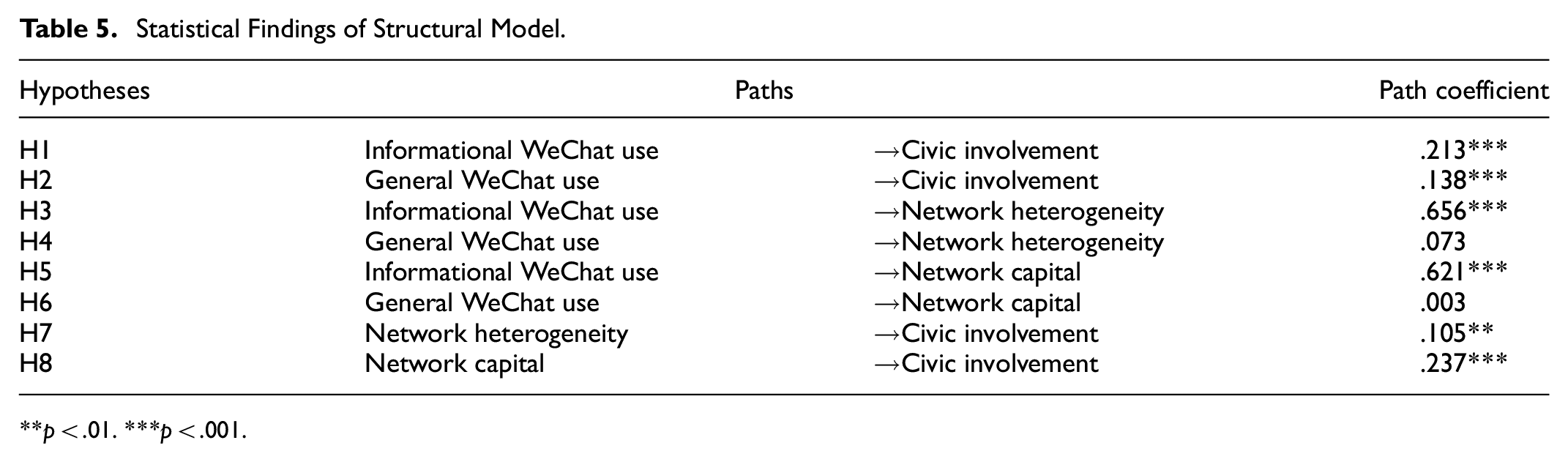
The hypothesized structural model is entered into AMOS 25.0, and the final model fit indices (χ2/df = 2.066 < 3; RMSEA = 0.005 < 0.08; RMR = 0.004 < 0.05; CFI =0.998 > 0.9; AGFI = 0.879 > 0.8; IFI = 0.964 > 0.9; TLI = 0.978 > 0.9) reveal a satisfactory model fit. As hypothesized, informational WeChat use exerts significant influences on network heterogeneity (β = .656, p < .001) and network capital (β = .621, p < .001). Thus, H3 and H5 are statistically confirmed. On the other hand, network heterogeneity (β = .105, p < .01) and network capital (β = .237, p < .001) have significant influences on civic engagement. Network heterogeneity has significant effect on network capital (β = .255, p < .001). Thus, H7 and H8 are supported. Moreover, general WeChat use exerts significant influences on informational WeChat use (β = .312, p < .001). However, general WeChat use has no significant effect on network heterogeneity (β = .073, p > .5) or network capital (β = .003, p > .5), indicating that H8 and H6 are not supported. Furthermore, the study proposed an indirect effect mechanism by which informational WeChat use influences civic involvement through network heterogeneity and network capital. This work therefore explored the mediating effects of network heterogeneity and network capital between informational WeChat use and civic behaviors. The bootstrapping results demonstrate that network heterogeneity could mediate the association between informational WeChat use and civic engagement (β = .03, SE = 0.01, 95% bootstrapping CI [0.02, 0.07]). Likewise, the relationship between informational WeChat use and civic engagement is also could be mediated by network capital (β = .04, SE = 0.02, 95% bootstrapping CI [0.02, 0.08]). The outcome underlines the significant role of network heterogeneity and network capital in mediating the relationship between informational WeChat use and civic involvement. Table 5 summarizes the statistical findings of structural model.
Statistical Findings of Structural Model.
**p < .01. ***p < .001.
Discussion
Summary of Main Outcomes
Along with mobile social media are increasingly penetrated into many aspects of common life, scholars have explored the potential impact of the newly emerging communication technology on individuals’ civic life (Boulianne & Theocharis, 2018; Jennings et al., 2021; Y. Kim & Kim, 2022). Previous investigations have demonstrated that mobile social platform use is correlated with people’s network capital and civic participatory behaviors (Y.-J. Lee, 2022; Nah & Yamamoto, 2018). This article strives to expand this line of previous literature by probing the vital role of WeChat in contributing to bolstering young people’s network heterogeneity, network capital, and civic involvement. Furthermore, this study assessed a theoretical research model that examined two patterns of WeChat use (i.e., informational use and general use) and emphasized the mediating role of network heterogeneity and network capital in the relationship between mobile SNS interaction and civic engagement. It not only provides fresh insight to network heterogeneity and network capital theories, but also presents first-hand evidence of the status quo of civic involvement in Mainland China.
Firstly, the study discovered that informational WeChat use could predict both network heterogeneity and network capital. This indicates that using mobile social media for news or information might enlarge young people’s discussion network heterogeneity and supportive capital. Therefore, this results are broadly consistent with previous investigation that have documented a positive association between mobile SNS interaction and individuals’ discussion network heterogeneity in daily life (Choi et al., 2017; Guidetti et al., 2016; Y. Kim et al., 2020). Additionally, mobile SNS communication has largely substituted for the affordances of texting on a mobile service and voice interaction via online callings in that individuals enable to utilize multiple avenues for timely feedback and peer acceptance, which have been discovered to be associated with the production of network capital (Boulianne & Theocharis, 2018; Pang, 2019). In particular, increased information exchange among web-based group users assists to establish trustworthy relationships with others, further promoting the possibility of WeChat to promote network capital (Gil de Zúñiga et al., 2012; Hou et al., 2021; Wei et al., 2018). Thus, by rendering individuals feel connected to communities and increasing personal knowledge of others, WeChat could bolster norms of reciprocity and trustiness and, thereby, generate opportunities for discussion about public event and increase network capital.
Contrary to expectations, the study found that general WeChat use for was unrelated to network heterogeneity and network capital. This result is inconsistent with previous studies outcomes of the positive relationships (J. Chen, 2017; Pang, 2020; Zhong, 2014). Perhaps this is due to the truth that the long time spend on mobile SNS may be not the sufficient condition for high degrees of network heterogeneity and network capital (Bhagat & Kim, 2023; Boulianne & Theocharis, 2018). Other psychological and political factors such as personality traits and political interest are also necessary to network heterogeneity and network capital (Choi & Lee, 2015; Y. Kim et al., 2013). Consistent with the time displacement hypothesis (Aziz, 2022; Yang & Men, 2020), another interpretation of the findings may be that more time spent on WeChat would distract people from social activities and involvement in the communities, which make people have less time spent on socializing and working for civic or political causes. Owing to mobile SNS communication is lowly cost, rapid and convenient, people may get accustomed to the manner of mobile-mediated interaction and are thereby less motivated to improve their network heterogeneity and increase network capital in the online environment. This may lend support to the notion that certain types use of mobile social media (i.e, news or informational) would have more to do with respect these features of the network heterogeneity than overall time of SNS usage (Bhagat & Kim, 2023).
Secondly, network heterogeneity and network capital are demonstrated to be positively related to civic involvement. These obtained results are especially significant given concerns over the probability that younger generation may experience more contact with like-minded others and thus neglect distinct aspects within mobile-mediated setting as well as concerns about declining interest in terms of civic actions (Gil de Zúñiga et al., 2012; Y. Kim & Chen, 2016; Park & Zúñiga, 2019). Actually, WeChat has offered a completely different conversation atmosphere in which young people could exchange latest news and talk about civic topic freely and such pattern of discussion would generate common interest, encourage mutual trust and foster social norms, which are vital for civic mobilization (Y. Chen, 2017; You & Hon, 2019). The usage of mobile SNS is promising for the development of heterogeneous social networks and network capital that encourage active citizenship (Bhagat & Kim, 2023; Yang & Men, 2020). Particularly, the outcomes indicate that network heterogeneity and network capital would contribute to the deliberative democracy as well as citizen participation by offering a positive pathway toward civic involvement.
Thirdly, the findings of this research lend support for the hypothesized model, confirming that heterogeneity in people’s social network and obtained network capital could mediate the association between WeChat use for news or information and young people’s civic activities. This may be one of the theoretically noteworthy linkages illustrated in the present research, due to the results extend the line of literature on the underlying mechanisms of mobile SNS impacts on individuals’ participatory behaviors, moving beyond investigation the direct linkages between mobile SNS interaction and civic engagement through offering evidence of the mediating roles of network heterogeneity and network capital on the relatively new technology. The current studies on mobile SNSs has identified that mobile SNS use could exert the positive impact on people’s civic activities and network heterogeneity, but the majority of those studies concentrated on the separate direct impacts on civic engagement, network capital, or network heterogeneity (Deng & Fei, 2023; Nah & Yamamoto, 2018; Song & Eveland, 2015). In this article, empirical evidence was found for the proposed mechanism by which WeChat use could indirectly influence civic involvement through network heterogeneity and network capital.
Theoretical and Practical Implications
For theoretical implications, these aforementioned results provide several theoretical contributions to the existing academic literature. Firstly, this research uncovers the significant antecedents of civic involvement in the mobile social media from a network capital theoretical perspective. Prior research in this field has primarily concentrated on users’ psychological motives or usage satisfaction, while neglecting the impact of network capital on civic participation (Li & Chan, 2017; Z. Wen et al., 2016). To the best of our knowledge, this study represents one of the few investigations that employed network capital framework in the emerging context of WeChat platform. Secondly, this research investigated a theoretical model that emphasized the mediating role of network heterogeneity and network capital in the relationship between informational WeChat use and civic involvement. Scholars have mainly probed how mobile social media communication is directly related to civic involvement (J. Chen, 2017; Yang & Men, 2020), only a few have assessed a mediating association among WeChat use, network heterogeneity, network capital, and civic engagement. Consequently, this research will contribute to a deeper understanding of the nature and significance of network features on WeChat in encouraging civic engagement in the setting of mainland China, and lay the groundwork for additional research of this kind. Thirdly, this study proposes a conceptual model and paints a more comprehensive picture of the relationships between WeChat interaction, network heterogeneity, network capital, and civic engagement. Thus, the outcomes and model presented in this study may provide new insight into the differentiated modes of mobile social media use and promote the theoretical understanding of the positive effects of these burgeoning communications technologies on youth civic engagement in a mobile-mediated environment.
For practical implications, this research may provide recommendations for mobile social media designers, managers, government, and society. Firstly, the informational WeChat use is also identified as a significant driver of network heterogeneity and network capital. Accordingly, platform designers and managers encompass additional interaction modules and improve the mobile social platform’s information communication environment. Secondly, the research findings suggest that network heterogeneity and network capital are beneficial to enhance young people’s civic engagement in the mobile social platform. Thus, the operators and administers should devote more attention to the establishment of communication venues through digital media such as official online pages and feeds via which people could communicate with diverse persons about various public events (Yu et al., 2023; Zhu et al., 2019). Thirdly, the research findings suggest that WeChat informational use could influence civic engagement through network heterogeneity and network capital. Accordingly, government should provide more interaction opportunities through diverse emerging mobile social media platforms especially WeChat to ensure the dissemination and reception of information, and to guarantee individuals’ personal interactivities with other users. Furthermore, the government and society should genuinely care about the public interest and then successively utilize various mobile social media platforms to facilitate citizens’ civic engagement in the mode of reposts, comments, and likes continuously.
Limitations and Directions for Future Research
Nevertheless, the results need to be explained cautiously because of several caveats in the scope and methodology. First, this article investigated merely two patterns WeChat use behaviors, although the relative new platforms could afford various functions, consisting participation online groups and following others. It is possible that using mobile social media for other purposes may generate disparate outcomes. Therefore, future investigations should also take consideration of the use of various technological features and their related civil impact. As some scholars claims, the use of these and other multimodal dimensions of the communication service may have pivotal ramifications for civic society (Campbell & Kwak, 2011; Park & Zúñiga, 2019; L. Zhang & Jung, 2023). Second, this research encompassed a variety of civic activities on WeChat as a whole and investigated the influence of WeChat use, network capital, and network heterogeneity on civic activities. Nonetheless, the outcomes for various forms of civic involvement may vary. In further research, civic involvement on mobile social media may be investigated in more depth, such as by categorizing the conception into supportive and non-supportive group. Finally, this article utilized the cross-sectional survey data, which maybe not well-suited to probe cause-effect associations. The outcomes, thereby, may not eliminate reverse causality among WeChat usage for information, network heterogeneity, network capital, and civic involvement. In the following research, two-wave panel data would offer a quantitative quantitate basis for testifying causal linkages. Future scholars could consider evaluating the proposed model in longitudinal research using a two-wave panel that is performed over a longer period of time to track changes and trends in civic involvement.
Conclusion
Despite the aforementioned limitations, the article offers a suggested pathway of how specific types of WeChat interactions could ultimately improve young people’s network characteristics and civic behaviors. The hypothesized model confirms a path structure for WeChat informational use to impact civic engagement through network heterogeneity and network capital, especially in the mainland China, where mobile social media services are highly adopted. This research contributes to the existing literature on political communication in the contemporary media environment by disclosing certain types of WeChat use and relevant civic consequences as well as probing the association between network heterogeneity and civic involvement. As one of the first attempts in this line of research, the results of this research offer meaningful insights and reveal intriguing implications for a deeper comprehension of how the mobile social media environment and user behavior impact civic behaviors of individuals.
Footnotes
Acknowledgements
We acknowledge support by the OpenAccess Publication Fund of Freie Universität Berlin.
Declaration of Conflicting Interests
The author(s) declared no potential conflicts of interest with respect to the research, authorship, and/or publication of this article.
Funding
The author(s) disclosed receipt of the following financial support for the research, authorship, and/or publication of this article: This work was supported by the National Social Science Fund of China [grant number 19CXW035].

Data Availability Statement
Data will be made available on request.