




Abstract
The present study was undertaken to explore the practicality and the effect of dynamic assessment on L2 writing ability of Iranian English as a foreign language (EFL) learners. To this end, 17 EFL learners divided into two groups, participated in this article. Then, dynamic assessment procedure was done in three steps, topic-choice, idea-generation, and macro-revising. All these steps ran with the mediation of the teacher and also the learners together. The results of the study indicated that dynamic assessment significantly influenced participants’ scores, enhanced their writing ability, and illustrated that experimental group’s dynamic assessment scores were generally higher than the control group’s scores. The results of the learners’ interview assured that dynamic assessment could improve the learners’ EFL process writing and their writing confidence. It also elevated their motivation in their writing ability.
Introduction
In the last three decades, we observed salient changes and shifts in the way we assess students. Based on Lubbe’s concept (2004), educational psychological testing is affected mainly by a shift from isolated psychological testing toward a more dynamic assessment. Dynamic assessment is a new approach to psychological and educational assessment (Haywood & Lidz, 2007). It is defined as “an interactive approach to conducting assessments within the domains of psychology, language or education that focus on the ability of the learner to respond to intervention” (www.dynamicassessmet.com).
Dynamic assessment is basically defined as an approach to understand individual differences and implications of this understanding for instruction. It is an assessment that embeds intervention within the testing procedures. The focus in dynamic assessment is on the process rather than product of learning (Lidz & Gindis, 2003). Dynamic assessment is an implication of sociocultural theory utilized by Feurestein, though Vygotsky is its theoretical pioneer, whose notion of the ZPD (the zone of proximal development) is one of the key concepts in this theory. With the manifestation of constructivism school of thought, Vygotsky, the early constructivist, focused on the importance of social interaction in the meaning-making process (Brown, 2007). In addition, according to the sociocultural theory that was mainly practiced by Feuerstein, human learning is a mediated learning. Human cognition is developed by mediation that leads to more self-regulation (completion of a given task independently) than an other-regulation environment (Wu, 2011). Therefore, dynamic assessment is assumed as an integration model of assessment and instruction, which causes moving toward an emergent future.
Some researchers such as Sternberg and Grigorenko (2002) differentiate between sandwich format and cake format of dynamic assessment. The former includes distributing a measure like pretest, which should be completed in an unassisted way. According to the learner’s response, plausible structures are made, which leads to the human’s specified strengths and weaknesses. Ultimately, posttest as another form of original test is made. By analyzing the psychological issues that eventuated out of the “gain scores,” the difference between the scores of pretest and posttest, the posttest scores are considered more logical. In the latter format, when learners are presented with a series of items, assistance and problems in cognition are made simultaneously. When the problems are resolved, the next item is presented. A predetermined hierarchy of hints can standardize the offered assistance.
In comparison with the standardized test, dynamic assessment is connected to the intelligence evaluation field and its debates inevitably (Murphy & Maree, 2006). As Woods and Farrell (2006) asserted, there has been noticeable argumentation in the appropriateness of cognitive psychological assessment as a part of the whole psychological assessment process.
The term standardized or static refers to the test in which the rater demonstrates questions to the learner and rates his or her response without any intervention to make changes, conduction, or improvement of learner’s performance (Tzuriel, 2001). Although standardized tests provide useful information on learners’ current ability, they could not provide the kind of information gained in dynamic assessment processes such as potential of learning, learning procedures, unique learning functions, and mediation strategies (Tzuriel, 2001). Besides, the most significant criticism against the standardized test is that they are not suitable representatives of learner’s cognitive capacity especially the minority who are not from “mainstream” groups of society, such as social, cultural, and economic groups (Tzuriel, 2001; Utley, Haywood, & Masters, 1992).
Elliott (2003) subscribes to a comprehensive educational process that characterizes the resources for learners with special requirements and it is closely related to educational ability and performance. In addition, the individualized target-setting process for learners with specific requirements has resulted in adoption pressure of an interventionist role for many educational psychologists. Some educational psychologists “highlight widespread recognition that dynamic assessment can assist in collaborating with teachers to plan educational interventions” (Elliott, 2003, p. 22). However, most advocates of dynamic assessment do not agree with replacing standardized tests with the dynamic assessment approach entirely like Tzuriel (2001).
English as a foreign language (EFL) writing as a difficult comprehensive activity consists of many abilities that could not be obtained by standardized intellectual dispatch in an isolated situation or by giving a topic once in a while or correcting methodology, but it can be gained by possibilities of dynamic mediation (Xiaoxiao & Yan, 2010).
Elliott (2000b) suggested the dynamic assessment procedural framework as a practicable approach to consult the dynamic nature of process writing and to simplify the cognitive progress of second language learners. According to what Elliott believed, this procedural framework consists of the three-step cycle of pretest–teach–posttest. The teacher should elaborate on the main target of writing before pretest, which demonstrates what learners should do. Then, the first step is pretest, in which the learners’ aim is to write about the chosen topic and the teacher monitors the learners carefully to find their problems and weak points. The second step is teaching; here, the teacher applies some mediation and consultation to solve the current problems and to improve learners’ writing performance. The final step is posttest, in which the learners write about the topic for the second time based on the teacher’s intervention, and the teacher evaluates learners’ writing performance and improvement.
The purpose of Elliott’s procedural framework of dynamic assessment for EFL process writing is for receiving feedback from the learners’ writing, and also, it is suitable for improving learners’ writing ability based on the teacher’s feedback significantly. Therefore, this framework contributes more to writing instruction rather than writing assessment.
The dynamic assessment framework, based on Elliott and what Xiaoxiao and Yan (2010) designed in their investigation named Dynamic Mediation Process, focuses on stages such as topic-choice stage, idea-generation, and structuring stage and macro-revising stage. Each of the above stages has been designed in three steps: (a) pre-task, (b) mediation, and (c) post-task.
Pre-task is the task done before mediation, to determine the learners’ ZPD, and can increase their willingness to get assistance. By giving “mediation” to learners, internal improvement would appear. Post-task, the imitation of externally obtained skills or knowledge, can contribute to an obvious improvement, which subsequently would become part of learners’ independent developmental ability in their work.
In topic-choice stage, the teacher prepares a general topic in a situation that learners have enough freedom to concentrate on it and to write something based on their self-interests. After the learners’ attempt for writing a suitable topic as pre-task, the teacher provides some hints, main questions, suggestions, and feedback about the topic through mediation. Learners can also revise their topics as a post-task based on the teacher and their peers’ mediations.
In idea-generation and structuring step, at first, the teacher provides some salient strategies for idea-generation such as branching, and techniques for structuring such as scratching. Then, learners proceed to a task again to gather more ideas and rewrite the writing aim. Finally, they should prepare outlines for their writings based on the new writing aim. In dynamic assessment framework, the attempt of idea-generation and structuring serves as a pre-task, and then mediation is designed immediately. As a mediator, the teacher can observe, review, if necessary, and discuss individual overall frameworks with the learners. Peers also can review other learners’ outlines.
When learners bring their drafts in the next session, it is time for macro-revising. The drafting task, which is done independently outside the classroom, had some lessons for the learners to understand both their strengths and weaknesses in writing, and helped them become more curious about analyzing peers’ or others’ writings and to get help from the teacher. After the mediation, improvement in writing becomes a motivational activity for the learners. Salient achievement will appear in this post-task activity.
Consequently, the present study attempts to find answers to the following questions:
Review of Literature
The ideas of assessment of processes rather than products in learning have been suggested in the beginning of the 20th century. With the manifestation of dynamic assessment, Tzuriel (2001) asserted that “it emerged from both theoretical conceptions about human cognitive plasticity and practical needs to find novel diagnostic measures for individuals who for various reasons do not reveal their capacities in conventional static tasks” (p. 5). Tzuriel (2001) also argues that dynamic assessment has been flourished because the static tasks were not adequate enough in providing spacious information about the differences between individuals’ learning processes, how they change ideas to actions, and also assigning them to appropriate educational contexts.
The most famous theorist in dynamic assessment is Vygotsky, the Russian psychologist (Lidz, 1995). His work has offered a major assistance to understanding the main effect of learning procedures on society and the basic concepts of dynamic assessment (Tzuriel, 2001). Vygotsky (1978) explained the drawbacks of just assessing what children can do to perform independently and also the limitations of the observed performance on “decontextualized” tasks (Harré, 2006). According to him, children’s functions in learning could not be comprehended completely without the cognition of both the real and future improvement in performance (Lidz, 2003).
Vygotsky believed that children differ in ways that can be elicited by interactional rather than static procedures (Lidz, 1995). This is referred to as scaffolding, which means what the kid can do in partnership with other peers today, he or she can handle independently in future (Benjamin, 2008). This is like Vygotsky’s assumption of the ZPD and internalization.
The concept of the ZPD is “probably one of the most used and least understood constructs to appear in contemporary educational literatures” (Palinscar, 1998, p. 370). ZPD’s main viewpoint is that learners become individuated by “what they are already able to perform independently and how they function with the help of a more expert collaborator” (Lidz, 1995, p. 148). ZPD is made by the function of interaction, “a meeting place for the scientific concepts of the adult and the spontaneous concepts of the child” (Lidz, 1995, p. 148). The results, improvement of children mental process from the internalization of the biological and cultural features, made only the framework of the internalization capacity of the kid (Tzuriel, 2001). By the internalization mechanism, the potential improvement leads to the actual improvement, which means they become part of the child’s advanced and independent achievement (Tzuriel, 2001).
As Burgess asserted, the next great revolution in educational psychology of the 20th century is in Feuerstein’s Structural Cognitive Modifiability (SCM), Instrumental Enrichment (IE) program, Learning Propensity Assessment Device (LPAD), and Medicated Learning Experience, maximum likelihood estimator/estimate (MLE; Burgess, 2000). According to Tzuriel (2001) and other researchers (such as Elliott, 2000b, 2003; Lidz, 2003; Lidz, 1987), Feuerstein’s MLE theory is connected to the ideas of Vygotsky, as they both believed in the importance of the medication in a cognitive environment.
Feuerstein saw individuals’ minds as open systems that have the ability to change, learn, and improve. Like Vygotsky, he criticized the S-O-R model (the organism (O) processes have a bearing on stimuli (S) and consequently produces a specific response (R)) of Piaget for “not taking into account individual differences deriving from factors that are related to parent–child mediations and interactional patterns in the family” (Tzuriel, 2001, p. 30). Feuerstein and Vygotsky consented to introduce mediation in humans as a critical factor that determines intellectual development. The aim of mediation is to change the person style in responding; therefore, “problem solution will find proper and efficient external expression” (Tzuriel, 2001, p. 29).
The SCM theories of Feuerstein have effects on many aspects, such as historical, political, social, and cultural contexts (Tzuriel, 2001). As he decided to develop assessment measures that could analyze the cultural diversity of the learners with the one he communicated and would allow the fulfillment of their learning capacity, his theories and methods in assessment differ from behaviorism (Burgess, 2001; Tzuriel, 2001). Feuerstein focused on the significance of testing modifiability, which means learning potential, whereas behaviorists are dealt with what they comprehend to be relatively learner’s consistent abilities (Boeyens, 1989).
A number of researchers in various branches of education have analyzed the use and effect of dynamic assessment on various participants’ learning achievement such as children, teenager, young by Lidz and Elliott (2000), adults and elderly, patients with brain damage by Haywood (2008), university students by Murphy and Maree (2006), preschool and young children by Lidz (2003), and psychopathology by Haywood and Lidz (2007).
Dynamic assessment also has been recommended to be used in psychoanalysis and counseling fields (Cornfield, 2001; Falik, 2000; Haywood & Lidz, 2007) and the advanced psychological educational practice, where assessment and intervention are connected together (Bosma & Resing, 2008; Burden, 2000; Elliott, 2000a, 2003; Greenberg, 2000; Hymer, Michel, &Todd, 2002; Lidz & Elliott, 2000; Yeomans, 2008). Another field of research is neuropsychology, which is the evaluation of cultural differences and cognitive programs (Haywood & Tzuriel, 1992). Besides, “the potential of using computers to provide systematic assessment and feedback, contingent on the child’s response, is also being explored” (Elliott, 2000a, p. 63).
Recently a large number of studies have been done on dynamic assessment and its different approaches and formats in the first language context. Calero, Belen, and Robles (2011) illustrated dynamic assessment techniques as a method for revealing the potential capacity in different groups, independent of the IQ they presented.
In second language context, different studies have been concluded using the same framework but with different approaches to dynamic assessment. The most usual approach is a pretest, intervention, and posttest, and the differences between two tests can be used as an indicator of the individual’s ZPD (Haywood & Lidz, 2007). Research on dynamic assessment in second language context focuses on the classroom, the interaction between learner and mediator, and finally how this interaction functions to understand and improve learner’s proficiency (Lantolf & Poehner, 2011). On the other hand, Caffrey argued that special kinds of dynamic assessment are much more adaptable according to the current attitude to empiricism in educational study and modern standards of severity (2006). Caffrey provided two kinds of dynamic assessment, treatment-oriented, like Feuerstein’s LPAD and assessment-oriented like graduated prompts of Campione and Brown. Assessment-oriented approaches are used in current educational standards both in research and practice. They evaluated standardization of protocols, reliability of measurement, fidelity of testing procedures, efficiency, and finally utility on a broad scale. In comparison with the assessment-oriented approaches, treatment-oriented approaches are not generalizable to a broader population and are less concerned with standardization, reliability, and fidelity (Caffrey, 2006).
Assessment-oriented approaches do not necessarily provide a direct benefit to the child during testing while dynamic assessment approaches are designed to do that and also provide immediate change in the child’s cognitive or educational functioning. Therefore, dynamic assessment is a measurement tool to estimate current ability, predict future academic ability, and design interventions (Caffrey, 2006).
In assessing the effect of dynamic assessment accompanied by technology in our country, Birjandi and Ebadi (2012) carried out a web-based qualitative inquiry in the synchronous computer-mediated communication (SCMC) via Web 2.0. Mardani and Tavakoli (2011) used an interactionist approach in the sandwich format to group dynamic assessment to study the effect of adding a dynamic assessment to EFL reading comprehension. Sadeghi and Khanahmadi (2011) conducted a research on 60 Iranian male and female intermediate EFL learners to assess the viability of dynamic assessment used as an instructional adjunct in the development of Iranian EFL learners’ grammar.
A few researchers, Ghahremani and Azarizad (2013), Shrestha and Coffin (2012), and Xiaoxiao and Yan (2010) have conducted studies on the effects of dynamic assessment on process writing.
Method
Participants
Participants of the study were 17 male and female intermediate EFL learners whose age range was from 20 to 35, seven learners in control group and 10 in experimental. All of them were native speakers of Persian who had the experience of learning English before and intended to participate in the International English Language Testing System (IELTS) courses. None of them had attended IELTS classes before.
Instruments
Two written tasks, based on the general version of IELTS standards in Task 2, were used as pre- and post-tests for each group. Teacher observation was another instrument because it was a key element for evaluating learners and their problem solving. Then, participants were interviewed on the effectiveness and usefulness of dynamic assessment procedures to see whether this approach had any constructive influence on them.
Procedures of Data Collection and Analysis
Control group
In the control group, first, learners were given five general topics that came from the Cambridge IELTS 4 and the Cambridge IELTS 5 books. They chose one topic from among those five based on their interest. Thus, the most favorite topic was chosen to write a composition on. These compositions were considered as the pretests to assess participants’ level of proficiency in writing. Then, the learners were taught the IELTS general rules and standards in writing such as how to write introduction, body, and conclusion in one session. Finally, they were asked to write about the predetermined topic in the following session without revising or even drafting. In the end, the teacher evaluated and scored the second writing, and these scores were represented as learners’ writing ability and posttest scores.
Experimental group
To assess the effect of dynamic assessment on process writing in the experimental group, a treatment was coming out in three stages, topic-choice, idea-generation, and finally revising. In this group, the same as the control group, learners had to choose one topic from among five topics to write on. The scores of the evaluation of these writings were considered as learners’ pretest scores.
The aim of the topic-choice stage is for the teacher to help learners with choosing a topic that leads to valuable writing. The first consideration in task assignment is the value of the task. The criteria for choosing topics were their being authentic, relevant, interesting, and challenging. Therefore, the choice of a suitable topic is the first consideration in this research.
The topic of this stage was My Hometown, and the audience was supposed to be the learners’ foreign peers who wanted to become familiar with the culture of the learners by reading their articles.
Teacher: Today we are going to write an essay about your hometown. Let the foreign peers know what your hometown is like. You have to write about your hometown’s customs, food, clothes, special product, building, and so on. In a word, you can choose any aspect that you think is worth writing, of course, worth reading.
Then, learners began to choose their own writing aspects and their own writing topics from the broad ones. When they were deciding on their topics, the teacher went through the learners with the aim of finding problems and provided some clues to some learners. Here are the examples of the discussion between the teacher and learners.
Teacher: (says to Learner A [LA], since it seemed she had some problems with her topic) Is this your topic? Tourist Areas in My Hometown?
Yes.
I think it’s a little broad, what’s your idea?
You mean that Tourist Areas should include many kinds?
What do you think?
Well, we have many kinds of these areas such as religious places, historical places, gardens, and so on. Ok, I suggest Historical Places in My Hometown.
Better because it becomes unique. The topic of Historical Places is somehow general. Do you think it can be really interesting for the reader?
You mean it should be more concrete?
Hmm, historical places include many places each of which needs information different from the others.
Ok, what if I choose one of them and write about it?
Great, now you can choose the more familiar one.
(after several seconds) Yes, I’ll choose Vakil Bazar, the one that I really adore.
Good idea! Then what is your writing topic?
(thinking for a few seconds) Being Interested in Historical Places in Shiraz, Go and Visit Vakil Bazar!
Well done.
After mediating and concluding the existing problems of learners’ writing topics, the teacher gave some hints to the whole class.
Based on the hints and mediation, learners revised their topics independently first, and then reviewed their topics mutually to improve their writing topics. Learner B (LB) revised her topic to The Attractive and Strange Customs in My Hometown on Spring instead of The Strange Customs in My Hometown, then to The Traditional Customs Surplus From Past in Shiraz on Spring. When LB’s topic was read by LA, the following discussion occurred:
2. LA: Well, I think your topic is a little strange. “Surplus from past,” doesn’t have negative meaning?
You mean I should choose another adjective for it, yes?
Yeah, for example, immortal.
Let me change it completely. (After a few seconds) What about this? The Memorable Customs Shirazi People Have on Spring?
Great, then your topic will be fantastic.
LB, as shown above, has filled the gap between her base level and higher level of comprehending “topic-choice” by the teacher’s and her peers’ interventions.
Idea-generation and structuring stage is the main point in assisting learners to produce organized content and structure in the writing process. This stage contributes to the learners to think about writing ideas, though high quality content has some prerequisites such as pre-reading and collecting some facts. It also needs some techniques, such as brainstorming, branching, clustering, debating, free writing, and searching the previous ideas about the topic.
“Branching” was used in this stage to show how dynamic assessment is carried out. Learners should design a tree that has the stem, branches, and branch lets. Then, they have to use stem for topic, and branches and branch lets for ideas and their relations. Finally, the teacher took The Most Famous Iranian Fast Food as an example to show learners how to design a tree:
After learning branching techniques by the contribution of teacher and peers, and based on teacher’s advices on this stage, learners began to make their own trees. In this process, the teacher was ready to contribute to the learners as a mediator. There is a model of a learner’s branching as an example. The draft of LB’s tree is like the following:
3. Teacher: May I see your tree?
(happy) Yes, of course! Why not?!
Your first layer of tree includes Traditional Ceremonies, History and Dates of Customs. Your topic is about customs. Now there are many customs with different ceremonies. What do you think about putting them in the same level? Do you think it is logical?
(think deeply) Uh . . . You mean that I should put them in different categories?
Don’t you think so?
And other categories should become their subcategories?
Yes, fantastic! You understand very well. OK, name the categories.
(think for a while) Nowrouz-Day, sizdeh-Bedar, and Shiraz-Day?
(smile) Correct your tree.
After the discussion, LB changed her tree with the help of the teacher in a following tree.
In the process of evaluating learners’ tree, the teacher pointed to some problems and gave some idea-gathering structures to the whole class. Learners had developed their abilities of gathering their preliminary ideas by this endeavor at the first stage, teacher’s kindly intervention, and negotiation with others, which finally lead to transforming their own thinking process as a psychological tool (in Vygotsky’s concept).
In the macro-revising stage, the teacher showed the criteria for a good essay in a macro way to guide learners to be effective writers and effective assessors. “Macro” refers to “large” originally; consequently, macro-revision means analyzing the whole writing process in terms of different factors such as topic, readers, and aim of the writing, identifying salient problems and solving them to have developmental writing. For this purpose, the teacher shared a writing sample with the whole class and explained the reasons of being nice in terms of content and organization. Following Feuerstein et al. (1988), three Mediated Learning Experience components were used in this study: Intentionality, Reciprocity, and Transcendence.
Intentionality
Choosing clear aims and activities by the teacher are the main feature of this element, and the teacher should match the level of this activity to the learners’ ZPD. In this case, aims and activities should be like the following:
Aims: The organization criteria and content of a good description should be comprehended for learners. In other words, the teacher should make learners to fertilize their drafts in content and enrich their organization.
Activity: Analyzing a sample of composition by learners to understand the objective.
The teacher chose one of the upper grade learner’s article to simplify the difficulty level of the sample article. Content also should be chosen from the same writing activity of foreign peers to switch to other cultures about “My hometown.”
Reciprocity
The key elements in this component is interaction. The teacher should interact and negotiate the meaning with the learner as a mediator. There are some questions in the following that the teacher used as the mediation to analyze the learner’s process of writing (Xiaoxiao & Yan, 2010):
When you have analyzed the writing, what is your general opinion about the article? If the content is rich, why do you think so? And in what aspects?
What is your idea about its organization?
What is your idea about its clear central idea (thesis)?
Is the central idea well supported and reinforced?
What is your idea about the connection between paragraphs? Is each paragraph clearly related to the central idea? Is the topic sentence of each paragraph explained well by the relevant and sufficient details?
Is the sequence of paragraphs well arranged in the logical way?
What is the difference between its content and yours?
Transcendence
Transcendence is a goal-related element that focuses on the effect of the activity to go beyond the “here-and-now” consideration and extend it to the future. The most significant responsibility of the teacher was to guide learners to write a rich content that organized well, independently. In this part, the teacher had to summarize the whole instruction and according to Mercer (1995), this summary should have three steps:
The use of “We” statements, which are utilized when the teacher tries to illustrate the past experience to the present.
Literal review, which is the summary of immediate objective.
Reconstruction review, which illustrates the transcendence of learning.
The criterion for a good writing based on the macro-revising standards is shown in Table 1.
Standards of Macro-Revision.
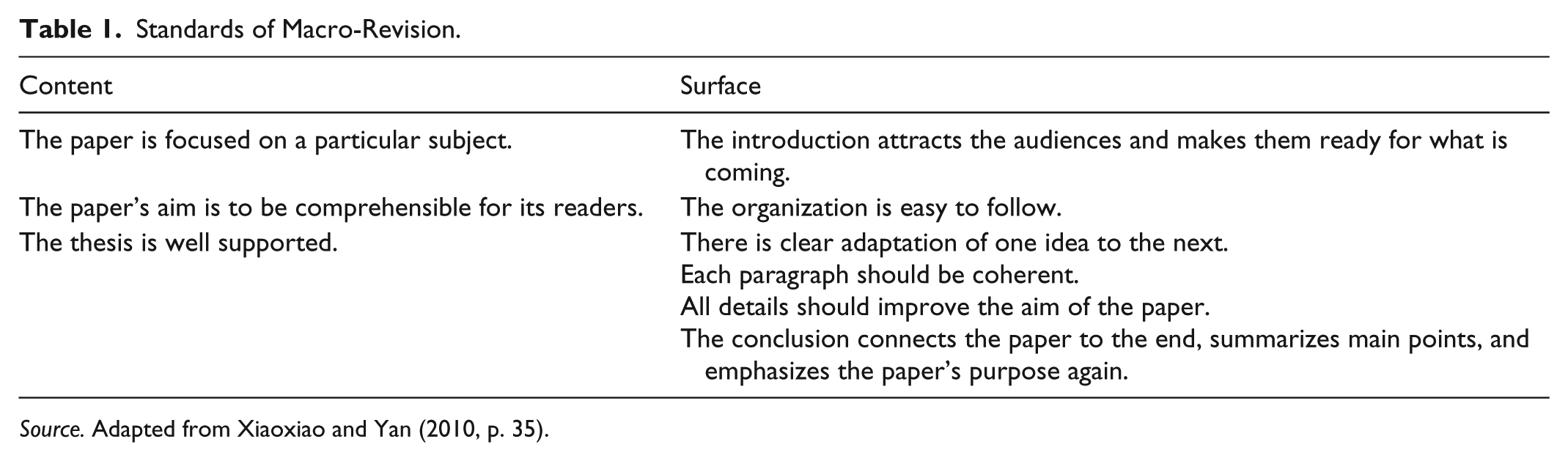
Source. Adapted from Xiaoxiao and Yan (2010, p. 35).
This study was mixed-method, applying qualitative and quantitative approaches to conduct the process used in the experimental group and to illustrate its results. The reason for this is that “the product of development can be better portrayed using quantitative measures whereas the process of development can be mainly captured through a qualitative analysis” (Ableeva, 2010, p. 201).
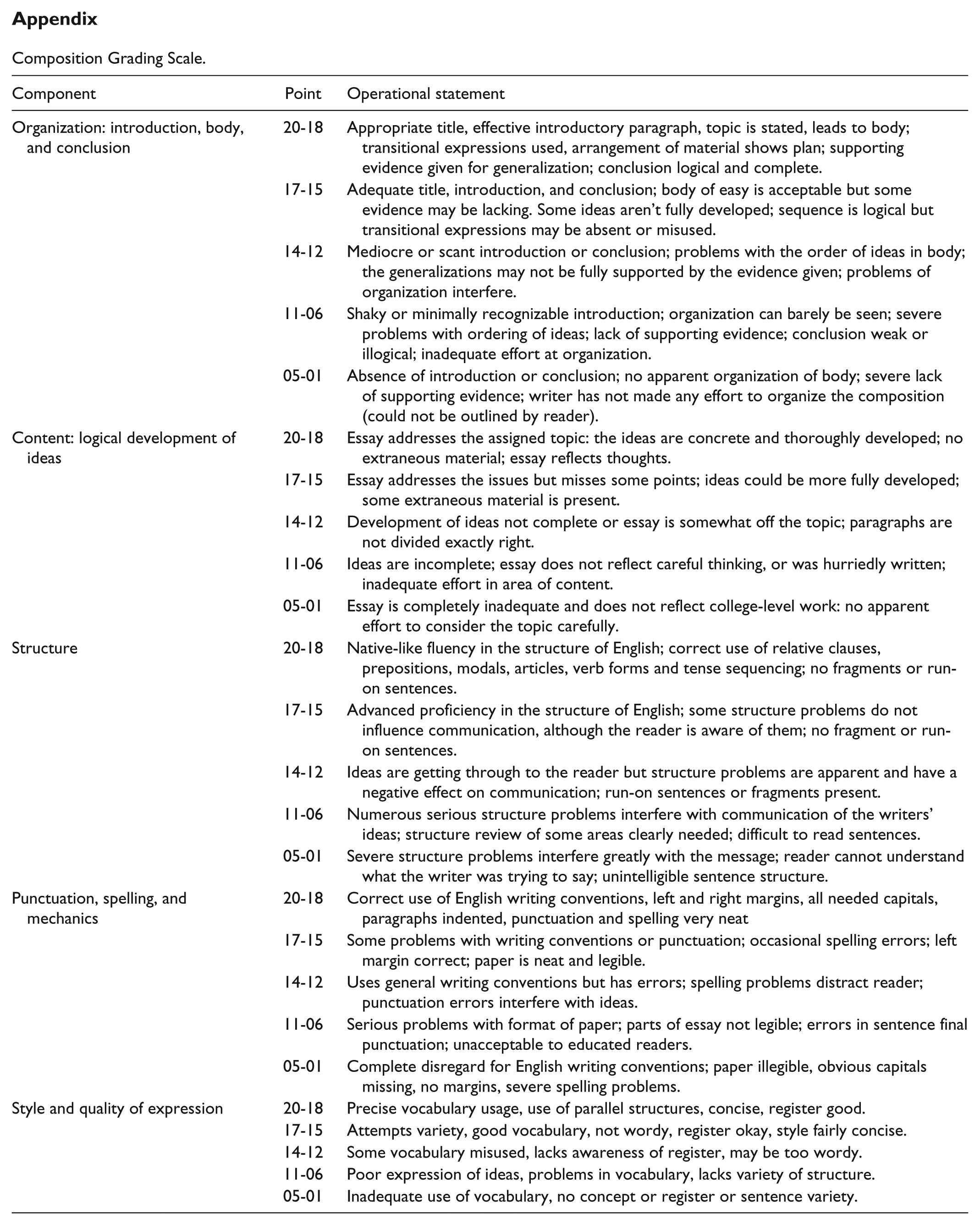
To prevent any subjectivity in rating, learners’ compositions were evaluated based on the Composition Grading Scale chart (Farhady, Jafarpoor, & Birjandi, 1994). For the quantitative part, two sorts of t-tests were utilized to assess the results. The first research question was answered by the paired-sample t-test to match the pretest and posttest results with one another in every cluster one by one to assess the utility of dynamic assessment in process writing. The second research question was answered by an independent samples t-test to match the posttest results of the two groups with one another to assess the results of the dynamic assessment in process writing.
For the qualitative part, the two writing tasks were compared with each other by the teacher based on two criteria, content and organization. According to the learners’ gain scores, the teacher reported the variations between these two. Learners additionally were interviewed to find their views concerning dynamic assessment. This interview also provided information about the learners’ experience of dynamic assessment and their expectation of dynamic assessment.
Results
RQ1: Is Dynamic Assessment Useful for Foreign Language Learners’ Process Writing?
To answer this question, a set of paired-sample t-tests was used to compare each pretest and posttest in each group separately to find any significant difference in their performance before and after the study. The results of statistical analysis can be seen in Tables 2 and 3.
Paired-Sample t-Test Statistics for Experimental Group.

Paired-Sample t-Test for Experimental Group.

A paired-sample t-test was conducted to evaluate the impact of the dynamic assessment on the EFL learners’ process writing tasks. There was a statistically significant increase in writing scores from pretest (M = 22.7000, SD = 6.21915) to posttest (M = 37.0000, SD = 2.58199), t(9) = −11.461, p < .005 = 0.000 (two-tailed). The mean increase in writing scores was 14.3 with a 95% confidence interval. The eta squared statistic (.93) indicated a very large effect size.
As can be seen in Tables 2 and 3, there is a significant difference between pre- and posttest of the experimental group, and the comparison of tests’ means demonstrates that the scores obtained during posttest were remarkably higher than those during the pretest. This dramatic increase means learners had a better performance in the dynamic assessment session compared with their pretest scores.
The results of the control group can be seen in Tables 4 and 5.
Paired-Sample t-Test Statistics for Control Group.

Paired-Sample t-Test for Control Group.

Another paired-sample t-test was conducted to evaluate the impact of the standardized assessment on the EFL learners’ process writing tasks. There was not a statistically significant increase in writing scores from pretest (M = 22.8571, SD = 4.84522) to posttest (M = 23.2857, SD = 4.78589), t(6) = −2.121, p > .005 = 0.078 (two-tailed). The mean increase in writing scores was 0.42857 with a 95% confidence interval. The eta squared statistic (.42) indicated a moderate effect size.
As shown in Tables 4 and 5, there is not a significant difference between pre- and posttest of the control group, which means the scores obtained during posttest were approximately equal to those during the pretest.
According to the obtained results, learners improved more in dynamic assessment in comparison with their nondynamic assessment counterparts. Thus, dynamic assessment was a useful and effective approach. The findings of this part were in line with the findings of some similar previous studies such as Elliott and Lidz (2000), Bosma and Resing (2008), Yeomans (2008), Hymer et al. (2002), Greenberg (2000), Elliott (2003), Lidz and Elliott (2000), Burden (2000), Ableeva (2010), Poehner (2005), and Shrestha and Coffin (2012).
RQ2: What Is the Effect of Dynamic Assessment if It Is a Useful Way for Assessing EFL Learners’ Process Writing?
To answer this question, an independent sample t-test was used to compare the results for the two groups. For this purpose, the posttests of both groups were compared with each other. The results of statistical analysis appear in Tables 6 and 7.
Groups Statistics.

Independent Samples t-Test.

According to Tables 6 and 7, there was a significant difference between scores for the experimental group (M = 37.0000, SD = 2.58199) and the control group (M = 23.2857, SD = 4.78589), t(15) = 7.671, p = .00 < 0.05. The mean difference in writing scores was 13.71429 with a 95% confidence interval. The eta squared statistic (.78) indicated a large effect size.
The results indicated that participants had better scores in dynamic assessment posttest in comparison with those participants in the standardized posttest. The results of the study indicated a significant difference between dynamic and nondynamic assessment of writing ability in favor of dynamic assessment. The study proved that the dynamic assessment group had better performance than the nondynamic assessment one in improving writing ability of the learners.
The findings were in line with the findings of some similar previous studies such as Ableeva (2010), Poehner (2005), Alavi, Kaivanpanah, and Shabani (2012), Mahmoudikia (2013), Xiaoxiao and Yan (2010), Ghahramani and Azarizad (2013), Shrestha and Coffin (2012), and Mardani and Tavakoli (2011).
RQ3: How Do the Participants of the Study View Dynamic Assessment Process?
The following leading question was asked from learners at the end of the dynamic assessment process.
Is dynamic assessment useful for improving your EFL writing abilities? If yes, how?
Seven out of 10 learners claimed that they became satisfied since they could write an organized composition finally. They believed that this approach, especially the mediation of the teacher, helped them organize what they had in their mind perfectly and contribute to reflect their ideas in the best ways on their papers. One of those seven learners also claimed that he never liked to write an English composition, and he never finished one completely, but in this method, finally, he could handle the writing. Two out of 10 learners claimed that this approach was a bit difficult for them. They asserted that although they could write in an organized way, it was a bit challenging. Only one learner, the one with high performance, believed that this approach did not have any effect on her motivation because she adores writing and does not need any motivation, though she claimed that with this approach, she could write exclusively.
According to the results of the final interview, 70 percent of participants viewed dynamic assessment as a new approach that helped them to organize what they had in their minds and led to improvement in their writing abilities.
The findings of the study were in line with the findings of some similar previous studies especially in the theoretical framework of dynamic assessment such as Stringer, Elliott, and Lauchlan (1996); Tzuriel (2001); Elliott (2000b); Hamers and Resing (1993); Day, Engelhardt, Maxwell, and Bolig (1997); Greenberg (2000); Feuerstein, Klein, and Tannenbaum (1995); and Lantolf and Poehner (2011).
RQ4: What Is the Effect of Dynamic Assessment on the Topic-Choice Stage of Writing Development?
All 10 learners cooperated very well in this stage. They were satisfied to have responsibility to choose their own topic. Choosing a suitable topic is one of the most important parts of the process writing. The right topic can inspire both curiosity and enthusiasm that will lead learners to write a well-written, intellectual, and interesting composition. Therefore, the skills of choosing the topic and writing the topic sentences are essential to successful essay writing.
According to Chastain (1976), the first consideration in writing assignment is to motivate the learners. The writer who is the learner here is motivated in the real world, and the teacher should try to make some points of realistic motivation into the writing assignment. The complexity of this part illustrates the necessity of reducing learners’ reluctance and developing their interest.
RQ5: What Is the Effect of Dynamic Assessment on the Idea-Generation Stage of Writing Development?
The learners experienced a new method in branching stage (Figures 1, 2, and 3). It means that just few of them heard of it, and none of them had done it before. At first, they were confused and just looked at each other, but after the teacher’s guidance, they began to draw their own trees. In this stage, they contributed to each other more and learned how to handle the stage with peers’ help (Figure 3).

A sample of tree.

Learner B’s draft.

Lerner B’s revised tree.
Learners were involved in two processes in the idea-generation stage, thinking and revising. They made a clear and concise tree for their topics, and they were satisfied since this stage became a kind of hobby for them and just one of them claimed that she preferred not to involve in such stages.
Giving some motivation, interest, and intended audience, learners still need time and information to prepare their writing assignment (Chastain, 1976). By the dynamic assessment framework, the teacher provides sufficient knowledge in a form of mediation. Therefore, learners can express themselves more clearly and, finally, they will obtain a better grade on their writing. In this study, learners claimed that although they experienced a new method, branching, they could achieve the aims of this stage perfectly through the mediation and guidance of the teacher.
RQ6: What Is the Effect of Dynamic Assessment on the Macro-Revising Stage of Writing Development?
Based on the aim of this study, changes in the learners’ compositions fell into two categories of organization and content through revision, content, and organization. According to Farhady et al. (1994), organization refers to appropriate title, effective introductory paragraph, arrangement of materials in body, and finally logical and complete conclusion. Content refers to logical development of ideas. The full chart is available in the appendix. In each category of improvement, more classifications of changes were made, which are shown in classifications in Table 8.
Classifications of Categories.

Comparing all the learners’ drafts and their revised versions, the researcher understood that the revised versions were much more logical than their drafts, both in content and organization. The following part shows the results that were obtained from analyzing each part separately.
In organization, there was no change in the Appropriate Title part, because all learners had chosen their topic in the first stage concisely and logically. For the Effective Introductory Paragraph, all learners wrote only one or two sentences without any object in their drafts, whereas according to Cambridge IELTS books, this paragraph should include three sentences that are motivator, topic sentence, and blue print. Motivator is a statement that points to the topic indirectly but is relevant to it. Topic sentence is a statement that paraphrases the key words of topic plus added words. Blue print is a gist of what is supposed to be pointed out in the body. Based on this resource, all learners wrote these three sentences, which were motivator, topic sentence, and blue print for their introductions in their revised versions.
Transitional Expressions are words and short phrases that guide the reader throughout the writing. They allow for smooth progression from sentence to sentence and paragraph to paragraph and help the reader to make certain connections among ideas (Farhady et al., 1994). The revised versions were much richer than the drafts. The rate of change in this part was about 15%, which means learners made progress in using such expressions.
In terms of Arrangement of Materials in Body, there were few changes in the revised versions, since by drawing the tree in the second stage, most of the learners understood how to organize the materials and ideas in the body, and only two learners made it better in their revised versions. However, in terms of Supporting Evidence, the revised versions were much more productive, and the amount of changes in this part was about 13%.
Finally, in the last part of organization, Logical Conclusion, most of the learners did not have any paragraph or a sentence as conclusion, and only three of them wrote a sentence imperfectly in the last part of their drafts. However, all of them had a logical short paragraph in their revised versions for conclusion and finished their writing in a more sensible way. In content, there were not any changes in Addressing the Assigned Topic since learners could write in a way that they addressed the topic easily in both drafts and revised versions based on the activities they had done in the first and second stages, especially drawing a tree.
By Concrete Ideas, we meant how to state ideas so that others could understand them easily. In this part, again, like Addressing the Assigned Topic, there were few changes, not any salient ones, because most of the learners’ problems were in arranging the ideas, not in the ideas themselves.
In terms of Developed Ideas, since learners learned to support their ideas by some pieces of evidence in their revised versions, there was a considerable improvement in this part. The ideas were thoroughly developed in comparison with their drafts. In terms of Extraneous Materials, most of the learners expanded their writing too much by verbosity in their ideas because they had thought that more lines got higher scores. Nevertheless, they corrected and omitted some extraneous materials in the revised versions; therefore, they were much more concise.
Finally, in terms of Reflecting the Thoughts, since learners cooperated very well in the previous stages, they could reflect their thoughts more easily in the revised versions without any shortening or verbosity, and everything became more unique.
All the explanations mentioned earlier illustrated that the salient advantage learners got from dynamic assessment framework in process writing was related to the organization improvement rather than content improvement. In addition, learners’ reflection showed that they got more progress in organizational parts such as introductory, body, and conclusion paragraphs.
According to Ferris (2002), students learn more (i.e., make fewer errors on subsequent writing) from finding their own errors or making their own corrections, rather than receiving corrections from the teacher. In this study, through reading and revising the compositions of their peers, many learners claimed that they had the same kinds of problems and mistakes as their peers. Some of them acknowledged that they had limited knowledge in comparison with other learners and should gather some information about their writing topics. Some of them asserted that they should change the order of their body paragraphs to have better reflections. Consequently, they asserted that revising their peers’ drafts expanded their views in writing, and they learned more from their revising rather than teacher’s feedback-free revising. The findings of this part were in line with Lalande’s (1982) study of American college learners of German as a Second Language and with Ferris and Roberts’ (2001) and Leki’s (1991) studies of English as a Second Language (ESL) students’ preferences in their own revising rather than teacher’s revising.
Conclusion
The dynamic assessment framework considered in this study was one of the most important approaches that accentuated the whole process of writing practices, especially those three steps, topic-choice, idea-generation, and macro-revising and the activities related to them that are usually neglected in EFL contexts. In the process-based instructions done in this study, the attempt made for improving the learners’ writing and motivation were not a fixed, unrelated and unilateral effort for either the teacher or the learner; rather it was a dynamic, continuous, and mutual effort for both the teacher and the learner.
Normative assessments, designed to evaluate the current level of learners’ performance, provided feedback for the teacher to set future learners’ study or even sometimes diagnosed the place for substitution in a correct place based on the learners’ knowledge. Unlike normative assessments, the ultimate and final goals of dynamic assessment were promoting development and providing learners’ motivation. After pretest at the current level of learners’ performance, mediation was made through the interactions between mediators who were the teachers and learners by language tools such as dialogues and discussions or other meditational tools. The mediations were made based on the most salient concept of ZPD, developed by Vygotsky. The learners made remarkable improvements.
In conclusion, it can be said that dynamic assessment with its predictable nature tries to recognize that learners are struggling. It also provides suitable information about the problem source, development, and transcendence ability of learners to help teachers in designing more efficient remedial courses, which, based on Ajideh, Farrokhi, and Nourdad (2012), is the ultimate purpose of education.
Footnotes
Appendix
Composition Grading Scale.
| Component | Point | Operational statement |
|---|---|---|
| Organization: introduction, body, and conclusion | 20-18 | Appropriate title, effective introductory paragraph, topic is stated, leads to body; transitional expressions used, arrangement of material shows plan; supporting evidence given for generalization; conclusion logical and complete. |
| 17-15 | Adequate title, introduction, and conclusion; body of easy is acceptable but some evidence may be lacking. Some ideas aren’t fully developed; sequence is logical but transitional expressions may be absent or misused. | |
| 14-12 | Mediocre or scant introduction or conclusion; problems with the order of ideas in body; the generalizations may not be fully supported by the evidence given; problems of organization interfere. | |
| 11-06 | Shaky or minimally recognizable introduction; organization can barely be seen; severe problems with ordering of ideas; lack of supporting evidence; conclusion weak or illogical; inadequate effort at organization. | |
| 05-01 | Absence of introduction or conclusion; no apparent organization of body; severe lack of supporting evidence; writer has not made any effort to organize the composition (could not be outlined by reader). | |
| Content: logical development of ideas | 20-18 | Essay addresses the assigned topic: the ideas are concrete and thoroughly developed; no extraneous material; essay reflects thoughts. |
| 17-15 | Essay addresses the issues but misses some points; ideas could be more fully developed; some extraneous material is present. | |
| 14-12 | Development of ideas not complete or essay is somewhat off the topic; paragraphs are not divided exactly right. | |
| 11-06 | Ideas are incomplete; essay does not reflect careful thinking, or was hurriedly written; inadequate effort in area of content. | |
| 05-01 | Essay is completely inadequate and does not reflect college-level work: no apparent effort to consider the topic carefully. | |
| Structure | 20-18 | Native-like fluency in the structure of English; correct use of relative clauses, prepositions, modals, articles, verb forms and tense sequencing; no fragments or run-on sentences. |
| 17-15 | Advanced proficiency in the structure of English; some structure problems do not influence communication, although the reader is aware of them; no fragment or run-on sentences. | |
| 14-12 | Ideas are getting through to the reader but structure problems are apparent and have a negative effect on communication; run-on sentences or fragments present. | |
| 11-06 | Numerous serious structure problems interfere with communication of the writers’ ideas; structure review of some areas clearly needed; difficult to read sentences. | |
| 05-01 | Severe structure problems interfere greatly with the message; reader cannot understand what the writer was trying to say; unintelligible sentence structure. | |
| Punctuation, spelling, and mechanics | 20-18 | Correct use of English writing conventions, left and right margins, all needed capitals, paragraphs indented, punctuation and spelling very neat |
| 17-15 | Some problems with writing conventions or punctuation; occasional spelling errors; left margin correct; paper is neat and legible. | |
| 14-12 | Uses general writing conventions but has errors; spelling problems distract reader; punctuation errors interfere with ideas. | |
| 11-06 | Serious problems with format of paper; parts of essay not legible; errors in sentence final punctuation; unacceptable to educated readers. | |
| 05-01 | Complete disregard for English writing conventions; paper illegible, obvious capitals missing, no margins, severe spelling problems. | |
| Style and quality of expression | 20-18 | Precise vocabulary usage, use of parallel structures, concise, register good. |
| 17-15 | Attempts variety, good vocabulary, not wordy, register okay, style fairly concise. | |
| 14-12 | Some vocabulary misused, lacks awareness of register, may be too wordy. | |
| 11-06 | Poor expression of ideas, problems in vocabulary, lacks variety of structure. | |
| 05-01 | Inadequate use of vocabulary, no concept or register or sentence variety. |
Declaration of Conflicting Interests
The author(s) declared no potential conflicts of interest with respect to the research, authorship, and/or publication of this article.
Funding
The author(s) received no financial support for the research, authorship, and/or publication of this article.