




Abstract
Cross-cultural collaborative learning has been paid more and more attention in recent years. To promote productive cross-cultural collaborative learning, idea generation and improvement, and socially shared regulation is crucial. The study aimed to identify the differences in idea generation and improvement as well as socially shared regulation between high- and low-performance groups in cross-cultural online collaborative learning. In this study, 24 culturally diverse university students composed of eight groups conducted cross-cultural online collaborative learning to solve problems collaboratively. Epistemic network analysis and lag sequential analysis methods were employed to analyze data quantitatively and qualitatively. The results revealed that different strategies shape different learning performances. High-performance groups adopted more cognitive, social, and regulation processes than low-performance groups. The results extend the existing literature by indicating that idea elaboration, refining or building on ideas, and appraisal is strongly connected to new ideas. In addition, transitions from monitoring and controlling to adapting metacognition in collaborative learning activities are the main difference in socially shared regulation between high-performance and low-performance groups. This study shed light on how to engage culturally diverse students to generate and improve ideas as well as jointly regulate collaborative learning.
Keywords
Introduction
In the globalized world, information and communication technologies have enabled online learning possible and promising. Online learning is becoming more and more essential means of education in recent years since learning has gradually been shifting from individual learning to learning with and in a group (Järvelä et al., 2015). One of the well-studied strategies for effective online learning is online collaborative learning, a method that encourages learners to learn together at anytime and anywhere. Online collaborative learning supported by computer technologies creates a learning environment that enables students from different cultural backgrounds to learn together irrespective of distance termed cross-cultural collaborative learning. One of the aims of online collaborative learning is to promote 21st-century skills such as collaboration skills, cross-cultural competences, and ICT skills (Child et al., 2016; Laal et al., 2012; Larson et al., 2011). Furthermore, online collaborative learning emphasizes shared goals, shared tasks, and shared strategies in a shared environment with the support of technology (Collis, 2004; Jeong et al., 2019; Jeong & Hmelo-Silver, 2016). Online collaborative learning groups vary from small to large group sizes (Kumi-Yeboah, 2018; von Davier & Halpin, 2013).
According to Yamazaki and Kayes (2004), instructors and educators need to view cross-cultural collaborative learning as a means of building relationships with others through interaction, valuing individuals from different cultures, listening and observing the host culture, and making sense of complex information and translating personal thoughts into the host culture. During collaborative learning, individuals share ideas to build on their knowledge through social interaction and communication (Zheng, 2017). However, knowledge building does not evolve easily during collaborative learning (Kuhn, 2015). For an effective learning process and outcomes, team members’ ability to regulate their processes to accomplish a given task is important (Ucan & Webb, 2015). Hence, scholars (such as Iiskala et al., 2015; Khosa & Volet, 2014) have investigated how collaborative learning groups regulate their discussion to build on their knowledge.
Although there are numerous studies on socially shared regulation and idea generation and improvement in online collaborative learning, there is a lack of studies on how learners generate and improve ideas as well as conduct socially shared regulation in cross-cultural collaborative learning context. Therefore, understanding how cross-cultural groups regulate online collaborative learning to accomplish group tasks will significantly contribute to the study area. This study aims to investigate how learners jointly regulate cross-cultural collaborative learning as well as generate and improve ideas to build on their knowledge in a cross-cultural online collaborative learning context.
Literature Review
Cross-Cultural Collaborative Learning
Culture could be viewed as an influence on learning perception and knowledge construction, where an individual’s country and educational background can shape their strategies and presentation of ideas (Dai, 2019). A lack of understanding of each other’s cultures is likely to result in conflict (Hofstede, 1986). Culture plays a significant role in how people think, behave, and interact with others from a different culture (Gyasi et al., 2021). According to White (2002), cultures evolve through social interaction and shared knowledge but, differences in culture might lead to different patterns of learning, use of learning activities (Marambe et al., 2012), and learning behaviors. Task understanding and English language proficiency could be a challenge as a result of cultural background (Jeannin, 2013).
Several studies confirm the effectiveness of the application of different instructional strategies on learners in a cross-cultural collaborative learning setting. For instance, Spires et al. (2019) conducted a study on cross-cultural collaborative inquiry between Chinese and U.S. high school students. They found that it promoted learning and engagement. Similarly, Herlache et al. (2018) adopted a role-play strategy to increase students’ knowledge, negotiation skills, attitude, and confidence in cross-cultural collaborative learning. However, cross-cultural groups face challenges which have motivated scholars to adopt different strategies to curb these challenges. For instance, students from individualistic cultures tend to focus on completing tasks while students from collectivist cultures usually focus on building relationships (Liu & Chen, 2020). Therefore, Kirchner and Razmerita (2015) involved 75 students from Denmark and Germany in their study with different technology tools such as MOODLE, Skype, Facebook, Prezi, Dropbox, WhatsApp, Email, and GoogleDocs/Drive to support collaborative learning. Similarly, Spires et al. (2018) engaged American and Chinese high school participants to utilize problem-based inquiry to promote cross-cultural collaborative learning.
Furthermore, other studies also examined differences in learning performance by comparing cultural backgrounds. For example, Popov et al. (2014) engaged students with individualistic and collectivist backgrounds in paired collaborative learning and found that individualistic students performed better than collectivist students. In addition, several cross-cultural studies focused on students’ perception (Lee & Markey, 2014; Lin & Gao, 2020; MacLeod et al., 2017) or a cross-cultural competence (Liu, 2007; Puteh et al., 2020; Su, 2008; Syzenko & Diachkova, 2020). Other studies also focused on the steps to design cross-cultural collaborative learning (Kumi-Yeboah, 2018; Yang et al., 2014). These studies have contributed immensely to the research domain, however, there are still aspects to discover. For instance, the differences between high and low performing groups during cross-cultural collaborative learning still remain lacking. Previous studies explored the impact of culture and effects of intervention on students’ behaviors and perception (Lee & Markey, 2014; Su, 2008). For instance, S.-J. Chen et al. (2006) investigated the cultural influences on students’ online learning and social behaviors and their perceptions. Other studies that analyzed students’ group discussion data and investigated students’ behaviors among cross-cultural groups (e.g., Iiskala et al., 2015). However, previous studies have not investigated how learners generate and improve ideas in cross-cultural collaborative learning context. Hence, there is a need to further explore the ideation processes of cross-cultural groups in collaborative learning activities that could promote learning performance.
Connectivism
Connectivism as a theory was first introduced by Siemens (2004), as a model that views learning as knowledge distributed within a network that is socially and technology enhanced with the ability to recognize and interpret patterns. It is one of the prominent learning theories that has gained recognition in the e-learning research domain (Goldie, 2016). Knowledge is viewed as a distributive process that is dynamic and can be retrieved from interactions with individuals, technologies, and communities. Connectivism asserts learning as a process of pattern recognition and knowledge as a network (Apostolidou, 2022). Thus, knowledge is a network formed by actions and experiences (Tham et al., 2021). Connectivism is one of the theoretical basis for digital learning where connections between the learner, learning resources, and digital information are promoted by technologies (Saadatmand et al., 2012). Connectivists views knowledge as something that is emergent and comes through interactivity rather than content (Downes, 2019). Therefore, engaging learners from diverse cultural background connected digitally to each other to share and improve ideas will shed more light not only in the area of cross-cultural collaborative learning domain but also the ideation research domain.
Idea Generation and Idea Improvement
Collaborative learning activities engage students in tasks that allow for idea generation and improvement (Lam, 2019). Idea generation and improvement involves cognitive, metacognitive, and social processes. Interactional perspective-taking behaviors such as questioning, elaboration, and defending ideas are productive for idea generation (IG) whereas perspective taking through mutual recognition bridges social cultural background issues, resulting to idea generation (Hawlina et al., 2017).
Idea generation is a cognitive process that involves knowledge retrieval from long-term memory and integration into the working memory through the moderation of social and motivational factors (Nijstad & Stroebe, 2006; Paulus & Brown, 2007). Idea generation involves setting an environment and implementing creativity techniques that will help students produce, express, and merge ideas (Escandon-Quintanilla et al., 2015). Cognitive and metacognitive skills are significant thinking processes that enables students to think divergently and solve problems (Kelley, 2008). Research on group learning have indicated that social interaction among peers promote cognitive activities through which learning takes place (O’Donnell & King, 1999). Accordingly, there are tasks such as comprehension require recall and application of concepts, however, tasks such as problem solving require high order thinking (King, 2002).
Furthermore, metacognitive processes enables team members to select, evaluate, and correct ideas which are significant for creative ideas (Jia, 2019). Metacognition can be referred to as an individual’s ability to be aware by knowledge and control their cognitive processes (Nelson & Narens, 1990). According to Ellamil et al. (2020), metacognition is likely to play different roles in idea generation and improvement such that a low level metacognition could make individuals process more information and consequently construct new ideas. It involves regulation of cognitive processes by planning, monitoring and controlling, and evaluate cognition.
Moreover, generating ideas involves social process as previous studies have found that through collaboration among group members innovative works and ideas were birthed (Glăveanu, 2018; Kay Siu, 2012). Some group communication patterns such as giving attention to shared ideas, taking mutual perspective, refining, and building on ideas lead to effective and productive team work (Paulus et al., 2010). When students collaborate in an online learning environment, it is significant to examine idea generation and improvement to reveal how students’ performance is influenced by CL (Ng et al., 2022). According to Breen (2015), it is a democratic process were team members share different perspectives based on experiences and individual observations. Previous studies have focused on the various techniques for improving creativity and performance. For instance, Acar et al. (2019) explored the constraints and mechanisms that inhibits the generation of creative ideas. Wang (2019) focused on developing a taxonomy for idea generation techniques that promote creativity. According to Scardamalia (2002), idea improvement is a principle that directs students and teachers’ effort in knowledge building activities. In knowledge building process, team members engage in idea sharing, giving appraisals about important ideas, and further searching for new information to improve ideas (Kawakubo et al., 2021). Previous studies found a difference in knowledge building processes among high and low-performance groups (Scardamalia, 2002; Zheng et al., 2021). A recent study investigated how high school students generate ideas in a scientific task and discovered that high-performance groups applied divergent thinking and regulation to plan and monitor their ideation processes (Sun et al., 2022). Sun et al. (2022) found that high performing groups applied cognition and regulation strategies more than the low-performing groups. Therefore, investigating idea generation and improvement processes among university students would add more knowledge to existing literature. However, very few studies examined idea generation and idea improvement strategies in cross-cultural collaborative learning context. That is, how cross-cultural groups generate and improve ideas to build on knowledge is still understudied. Moreover, the cognitive, metacognition, and communication processes of cross-cultural collaborative groups remain unclear. Therefore, investigating how students apply these strategies to generate and improve ideas would contribute to adding existing knowledge.
Socially Shared Regulation
Regulation of collaborative learning as a social activity is a meta-cognitive goal-oriented action where collaborative teams apply different strategies to monitor and control their behaviors, emotions, direction of the discussion, and meta-cognition through interactions (Hadwin et al., 2019; Miller & Hadwin, 2015). Socially shared regulation refers to the processes that team members monitor and control, reflect and evaluate their collaborative learning activity (Järvelä et al., 2015). Socially shared regulation of learning (SSRL) occurs at a group level where learning is negotiated by learners with control during the collaborative learning process (Isohätälä et al., 2017). An individual’s ability to regulate self-learning and group-learning is a significant 21st century skill (Järvelä et al., 2015). Hence, scholars have explored different significant aspects of social regulation in collaborative learning. For example, Malmberg et al. (2015) explored how groups progress in SSRL in a computer-supported collaborative learning environment. The findings suggested that the SSRL focus shifted from regulating external challenges such as time management toward the cognitive and motivational aspects such as task completion. Furthermore, another study compared the differences in regulation between same cultural groups and mixed cultural groups, thus Canadian, Chinese, and Canadian and Chinese pairs (Shi et al., 2013). Their findings indicated that Canadian pairs generated high self-regulation behaviors which was similar to the mixed pairs. In addition, Zheng et al. (2017) developed a tool that supports the social regulation of collaborative learning to promote goal setting, planning, and knowledge building. A minimal number of studies have visually analyzed socially shared regulation (Isohätälä et al., 2017) among high and low performing cross-cultural groups during collaborative learning. Moreover, very few studies have investigated the SSR behavioral patterns of cross-cultural groups in relation to idea generation and improvement processes.
High and Low Performance Groups
Research in the field of collaborative learning have identified differences between the high and low performing groups. Team members from diverse backgrounds use different approaches during collaboration. For instance, in a problem-solving group activity, Lau et al. (2021) identified high occurrences of task related keywords and behaviors such as spending more time on problem solving, followed by personal learning and last collaboration among top 5 teams. Whereas, the bottom five performing teams focused on collaboration, personal learning, and last problem-solving. Sampson and Clark (2011) identified high-performance groups voiced more content-related ideas, discussed, and attended to team member’s ideas before accepting or rejecting, challenged each other’s ideas more than seeking for information, adopted scientific strategies for justifying evaluated ideas, and utilized provided resources to guided and evaluate their written arguments compared to the low-performance groups. Wang and Kuo (2016) identified differences in cognitive styles (visual and verbal) between the high and low-performance groups and they found that groups with verbal cognitive styles showed better annotation behaviors and quality had high performance compared with the groups with visual cognitive styles. Furthermore, high performing teams displayed more confusion and frustration which transforms into delight and neutral emotions whiles low performing teams displayed more boredom based on facial expressions (Sharma et al., 2021).
To identify group performance in collaborative learning activities, scholarly studies used group products, group discussion transcripts or recordings for tasks and social related activities or post-test (Janssen et al., 2005; Liu & Chen, 2020; Popov et al., 2019). To illustrate, Zhang et al. (2022) used the discourse data of students to evaluate their problem solving competencies and processes with ENA, which revealed that both high and low performance groups maintained positive communication, but the high performance groups begun with positive communication and ended by negotiating ideas whiles the low performance groups begun with sharing resources or ideas and ended with regulating problem solving activities. Therefore, to evaluate group performance, measurement are required based on what is being evaluated.
Research Purposes and Questions
Generating and improving ideas involves multiple processes in different dimensions during collaborative learning. First, idea generation is a cognitive process of sharing and merging of ideas (Escandon-Quintanilla et al., 2015). Second, idea generation involves social communication processes as it promotes idea sharing and social interaction (Paulus et al., 2010). Third, the metacognitive processes of groups may lead to information processing and building on ideas (Ellamil et al., 2020). In cross-cultural collaborative learning context, research on how students’ complete problem-solving tasks through social communication processes to generate and improve ideas is underdeveloped. To the best of our knowledge, there are no studies that have investigated both cross-cultural collaborative learning ideation processes and socially shared regulated behaviors. Therefore, there is a need to explore the features of idea generation and improvement processes that could promote good performance in cross-cultural collaborative learning. Discovering the differences in socially shared regulation behaviors of cross-cultural groups as they generate and improve ideas would be an up-to-date contribution to the research domain. Therefore, this study aimed to explore whether the high-performing cross-cultural groups differ from the low-performing groups in idea generation and improvement and socially shared regulation behaviors. In addition, it was deemed appropriate to further examine how these groups collectively regulate cross-cultural collaborative learning to achieve learning objectives. Therefore, the research questions were addressed as follows:
(1) How do learners to generate and improve ideas during cross-cultural online collaborative learning?
(2) Do high- and low-performance groups differ in idea generation and improvement processes during cross-cultural online collaborative learning? If so, what are the variations in their strategies?
(3) Do high- and low-performance groups differ in socially shared regulation behaviors during cross-cultural online collaborative learning?
Method
Participants
This study was conducted with international students enrolled in a university in Beijing, China. The participants were 24 masters and PhD students constituting 11 females and 13 males. Participants were nationals of Pakistan, Canada, Turkmenistan, Ghana, Cameroon, Guinea, Uganda, Tanzania, Botswana, South Africa, and Senegal. All participants were enrolled in an English-taught program. Participants had no prior experience in cross-cultural collaborative learning in an online or social media platform. They were randomly assigned into eight groups with three members per group in this study. All participants gave their consent to participate in this study without compulsion and were assured that their personal information such as names will be anonymized.
Procedure
The procedure of this study included three phases. The first phase is to conduct pre-test online to examine the prior knowledge of participants which lasted for 30 minutes. The second phase is to conduct cross-cultural online collaborative learning through a social media software, namely WeChat that is very popular in China. The cross-cultural online collaborative learning lasted for 2 weeks during which cross-cultural online collaborative learning of eight groups took place on different dates. Before the collaborative learning activity commenced, the first author introduced the activity for 25 minutes. Each collaborative discussion lasted for 3 hours. The cross-cultural online collaborative learning task for each group was to discuss the aspects of instructional design (such as instructional goals, instructional strategies, instructional delivery process, and assessment methods) and design an instructional design plan for English teaching for grade 7 students. The group products were the instructional design plan of each group. The last phase was to conduct the post-test online for 30 minutes after each group submitted their group products.
Instruments
The instruments of this study include pre-test and post-test. In terms of pre-test with a perfect score of 100, there are 10 multiple-choice questions and 5 short answer questions. The post-test a perfect score of 100 also included another 10 multiple-choice questions and another 5 short answer questions. In addition, online discussion transcripts of each group were downloaded from WeChat to Microsoft Excel for coding of the idea generation and improvement analysis, and socially shared regulation analysis. The GSEQ 5.1 software was utilized for the socially shared regulation behaviors of cross-cultural groups. Whereas the Epistemic network analysis (ENA) web tool by Shaffer (2016) was adopted for the visualization of idea generation analysis. Furthermore, all the codes and scoring measures were considered by both authors based on students’ online discussion transcripts and group products. To determine the task performance, a 100 points rubric for the scoring group product (lesson plan) and post-test quiz were designed by the authors. Scores for each group was summed up used to determine groups performance which were categorized into high or low performance groups. The mean score was used to determine high and low performance groups.
Data Analysis Methods
To analyze the collaborative learning data, content analysis, and network analysis methods were deemed appropriate for this study. The coding scheme for idea generation and improvement was adopted from previous studies by Sun et al., (2022) and Zhu, Moreno, et al. (2019), but modified for the purpose of this study which is presented in Table 1. Moreover, the coding scheme for socially shared regulation behavior proposed by Zheng (2017) was adopted for coding each group’s online discussion transcript as illustrated in Table 2. Each group’s product (lesson plan) was scored to determine their performance based on the criteria of Table 3 (Zheng et al., 2019).
Coding Scheme for Idea Generation and Idea Improvement.

Socially-Shared Regulation Coding Scheme.

The Criterion for Scoring the Lesson Plan.

Then, lag sequential analysis (Gottman et al., 1977) was conducted with the GSEQ 5.1., to analyze the socially shared regulated behaviors of cross-cultural groups. Epistemic Network Analysis (ENA) was applied to examine idea generation and improvement with the ENA Web Tool version 1.7.0 (Marquart et al., 2018; Shaffer, 2016; Swiecki & Shaffer, 2020). Our ENA model included the following codes: Regulation, Paraphrase/Appraisal/Claim (PAC), Elaborating ideas (EI), Question, Argument, Agreement, Refine/Build on Ideas (RBoI), and New idea (NI). We defined conversations as all lines of data associated with a single value of comments.
Results
RQ1: How Do Students Generate and Improve Ideas in Cross-Cultural Collaborative Learning To?
ENA was used to visualize how students generates and improve ideas during cross-cultural collaborative learning. All the categories from the eight groups’ conversations were used to generate a mean network graph displayed in Figure 1. As displayed in Figure 1, regulation was strongly related to new idea, elaborating ideas, agreement, and paraphrase/appraisal/claims. Similarly, agreement was strongly connected to questions, new idea, and elaborating ideas. In terms of idea generation and idea improvement, Figure 1 shows new idea was highly linked to regulation, agreement, elaborating ideas and refining, or building on ideas. This revealed that regulation was a mechanism to monitor and control their online collaborative learning to inspire new ideas, elaborate of ideas, and agree to proceed or support an idea. Agreement was also found to be directly connected to questions and by tracing back to the conversations, it discovered that agreement was direct response to regulatory utterances. For instance, in group 1, L1 posed a question (“How will you achieve this please?”) to L3 who responded (“Commonly there are four types of learners Visual, Auditory, Read/Write, and Kinesthetic Learner”) with explanations and L1 reverted with a response of agreement (“Okay, …Agree”).

The mean network of all group idea generation and improvement conversations.
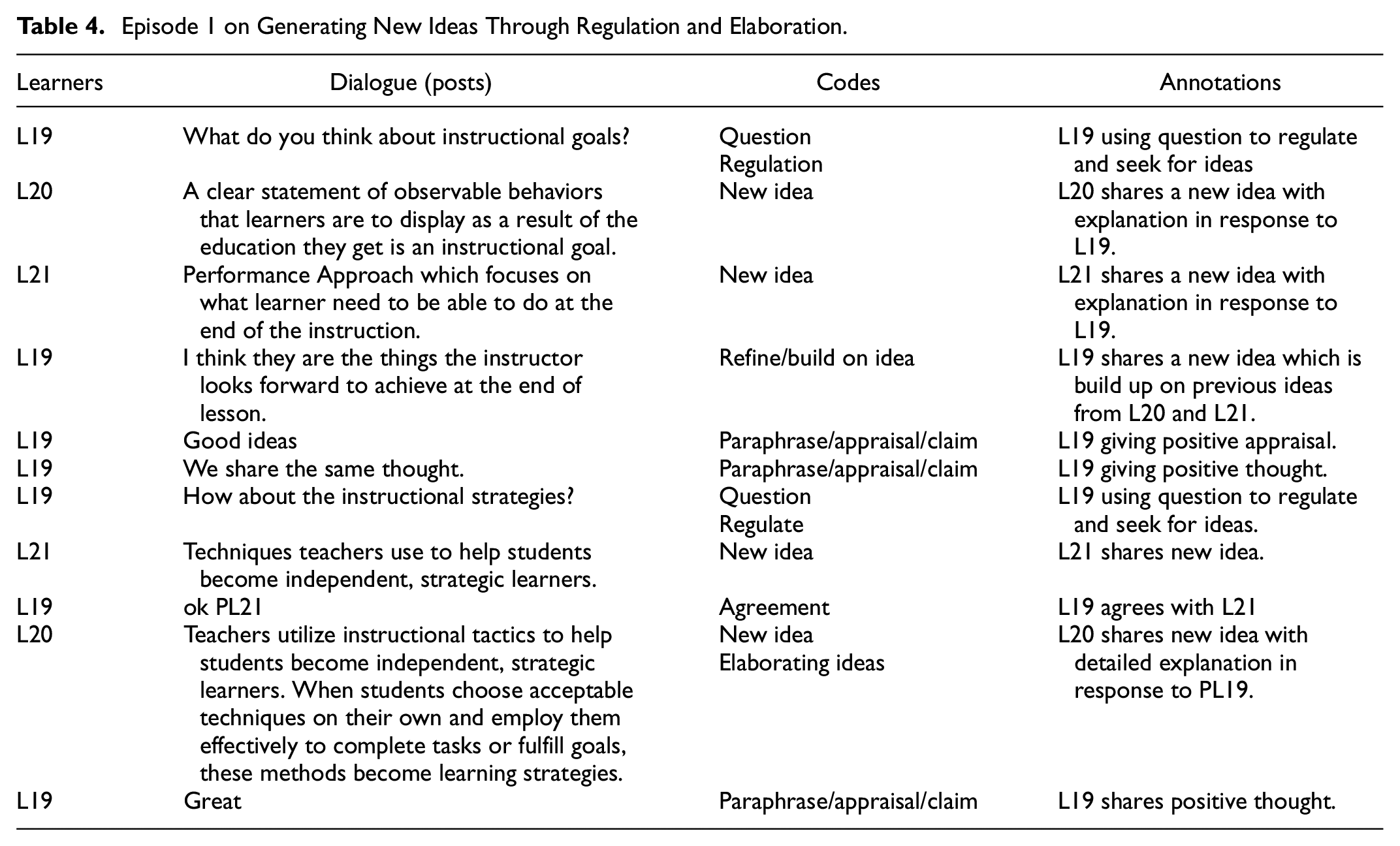
To illustrate a connection of the model in Figure 1 back to the discussion transcripts, the excerpts below are presented in Tables 4 and 5. The extracts illustrate how one of the groups discussed to generate and improve on their knowledge. Episode 1 in Table 4 illustrates how students elicited for ideas through regulation. L19 employed questions as a strategy to elicit for ideas and also regulate the discussion. L20 and L21 shared their ideas in response to the questions asked. After sharing their ideas, L19 harmonized their ideas to generate new ideas.
Episode 1 on Generating New Ideas Through Regulation and Elaboration.
Episode 2 on Idea Improvement Through Collaboration.
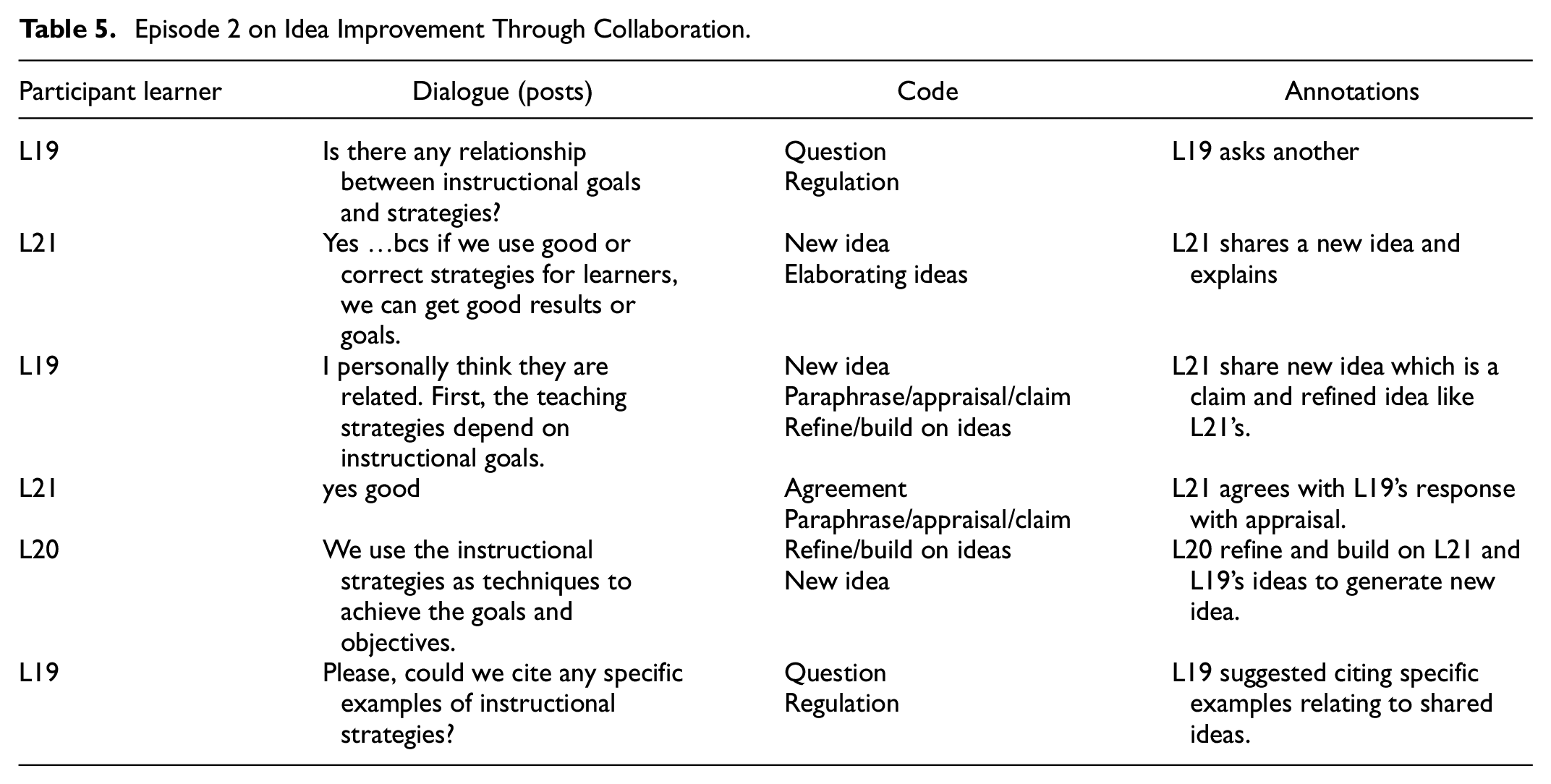
From Episode 2 illustrated in Table 5, L19 posed a question to seek for ideas on whether there is a difference between two topics discussed previously. The question encouraged L20 and L21 to brainstorm by comparing which resulted to them generating new ideas based on their previous contributions. L19 then refined the ideas shared by L20 and L21. An interesting aspect of the episode was that group members encouraged each other by making positive remarks such as “great ideas.” Accordingly, Figure 1 shows a connection between regulation, new ideas, paraphrase/appraisal/claim, and questions.
RQ2: Do High- and Low-Performance Groups Differ in Their Idea Generation and Improvement Process in Cross-Cultural Online Collaborative Learning?
Analysis of group performance
The top four scores for group product and post-test quiz were selected as the high-performance group (HPG) and least four scores were considered as the low performance group (LPG). The results show that there were four groups being HPG1, HPG2, HPG3, and HPG4 achieved high scores whiles four groups being LPG1, LPG2, LPG3, and LPG4 achieved scores less than the mean score of the high-performance groups as presented in Table 6. According to Table 6, high-performance groups surpassed the low-performance groups in group product (Mh = 92.50, Ml = 80.25) with a slight difference. The post-test quiz scores also indicated the HPGs outperformed the LPGs based on the mean score (Mh = 75, Ml = 58.13). Furthermore, an independent sample t-test confirmed the statistically significant difference in group product scores between the high-performance and low-performance groups (t = 5.68, p = .001). There was a significant difference in post-test scores (t = 3.63, p = .011).
The Results of High and Low-Performance Groups.

Differences in categories for group discussions
A comparison network of the different categories of idea generation and improvement in group conversations was conducted to illustrate whether there is a significant difference. The network of each discourse in ENA can be represented as a point in two-dimensional area over X-axis and Y-axis. Figure 2 shows a plotted point graph for HPGs (blue dots) located on the left and LPGs (red dots) located on the right and each dot represents a group. Accordingly, Figure 2 shows that the high performance groups (blue dots) were strongly connected among few social communication (e.g., elaborating ideas and refining/building on ideas) categories and high metacognition (regulation) categories, whiles the low performance groups were strongly connected among social communication categories (such as question, agreement, and new idea). The small blue square represents the mean location of the network for all HPG groups whereas small red square represents the mean location of LPGs. In addition, the boxes surrounding the means represent 95% of intervals for the means location. A two-sample t-test revealed a statistically significant difference between the high- and low-performance groups (t = 4.00; p = .01; Cohen’s d = 2.83). In comparison, Figure 2 corresponds to Figure 1 which shows elaborating ideas, refining or building on ideas, and regulation on the left side.
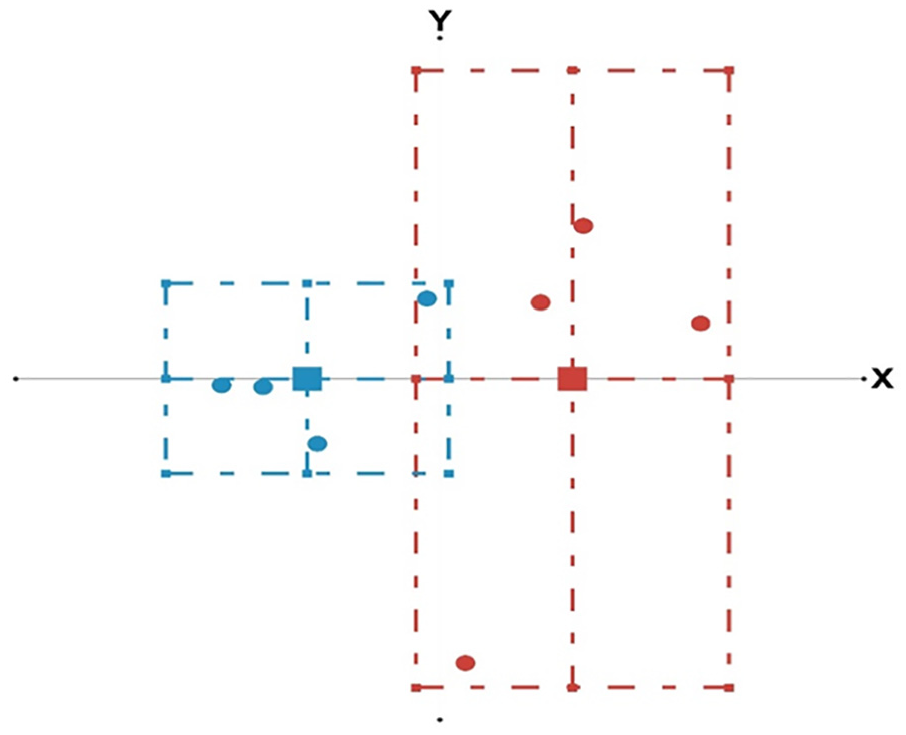
Plotted graph of group conversations for LPGs (red) on right and HPGs on left (blue).
Comparison of idea generation and improvement processes
The network of conversations displaying the connections between categories in the high-performance groups and that of low performance groups is presented in Figure 3 showing the differences among the groups. The blue lines depicted a strong relationship between two categories in the HPGs whiles the red lines depicted strong relationship between two categories in the LPGs. For the HPGs, there were strong connections between six categories (new idea, regulation, elaborating ideas, question, refine or build on ideas, and paraphrase/appraisal/claims). Similarly, six categories were strongly connected (new idea, regulation, agreement, question, paraphrase/appraisal/claims, and elaborating ideas) within the LPG conversations. The idea generation and improvement strategies among LPGs mostly involved social and metacognitive processes whiles the HPGs mostly involved cognitive, social, and metacognitive processes. First, refining/building on ideas had strong connection with three categories (elaborating ideas, new idea, and paraphrase/appraisal/claim) as shown in Figure 3. Comparably, this pattern was more frequent among the HPGs than the LPGs, indicating that the HPGs had more utterances of cognitive processes than the LPGs. Second, regulation was strongly connected to three categories (paraphrase/appraisal/claims, questions, and refining/building on ideas) within the HPG groups and two other categories (agreement and new idea) in the LPGs. It should be noted that regulation utterances were more among the LPG groups. A cross examination of the utterances indicated that, among LPGs, utterances of regulatory strategies were used to elicit new ideas and upon agreement, they proceeded to the next topic of discussion. In contrast, the HPGs used regulatory strategies to seek for information, give opinions, or judgments about shared ideas and through this process refine and build on shared ideas. Last, question was found to be more connected to agree in the LPGs utterances, whiles it was more connected to regulation among the HPGs utterances. According to the comparison network in Figure 3 and group conversation data, new ideas were mostly elaborated and refined, or built on by the HPGs than the LPGs. This finding indicated that the high-performance groups were able to build on their ideas through elaboration and giving appraisal and opinions about individual ideas. Whereas, the low performing groups mostly agreed on shared ideas without questions. Comparing to the discussion transcript, it was found that agreement was mostly related to questions such as “can we move to the next task?” and “what do you think?” especially among the LPGs.

Comparison network of idea generation and improvement among high (blue) and low-performance (red) groups.
RQ3: Do High- and Low-Performance Groups Differ in Their Socially Shared Regulation Behaviors in Cross-Cultural Online Collaborative Learning?
To determine the sequential differences in socially shared regulation behaviors for low and high performing groups, the adjusted residuals for high-performance and low-performance groups were calculated separately with GSEQ 5.1. First, the frequency distribution of all the identified behaviors at the first level dimension were calculated and presented in Table 7 to give the general behavior patterns of different performance groups. The LSA approach suggests a z-score above 1.96 indicates a sequence has obtained the level of significance (Gottman et al., 1977; Pohl et al., 2016). As presented in Table 7, higher proportion of socially shared behaviors occurred in the low-performance group compared to high-performance groups. However, a breakdown of the SSR behaviors show that the high-performance groups exhibited more regulatory strategies with higher proportions of orienting goals (OG), monitoring and controlling (MC), and adapting metacognition (AM) behaviors. In addition, within the high-performance groups the most occurring behavior was MC, followed by AM, then evaluation and reflection (ER), OG, making plan (MP), and last enacting strategies (ES). Whereas the low-performance groups exhibited higher proportions of enacting strategies (ES), evaluation and reflection (ER), and making plans (MP). Within the low-performance groups, ES was the most occurring behavior, followed by ER, MC, then MP, OG, and last AM. Furthermore, the adjusted residuals of the behavioral sequences for the high-performance groups were presented in Tables 8 and 9 displays that of the low-performance group.
Distribution of SSR Behaviors.

Adjusted Residuals for High Performance Group.
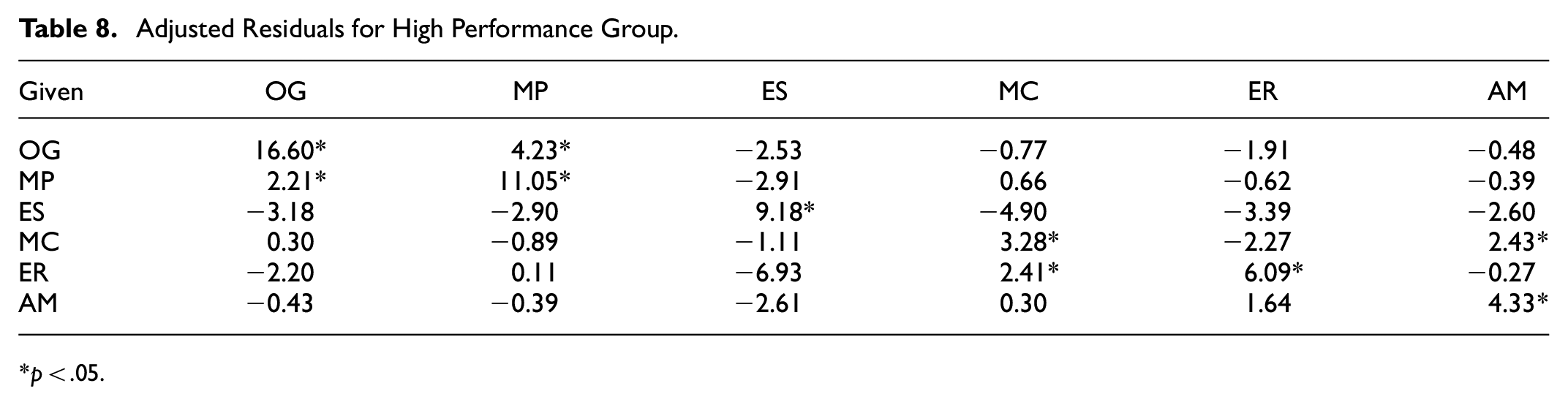
p < .05.
Adjusted Residuals for Low Performance Group.

p < .05.
The difference in SSR behaviors between the high-performance and low-performance groups were examined through the Chi-square test (α = .05). The results indicated that there were significant differences among the SSR categories between the high performance groups and low performance groups. The proportions of orienting goal behaviors by HPGs and LPGs indicated that they differed significantly (χ2 = 28.0, p < .001). HPGs and LPGs significantly differ in ES behaviors (χ2 = 187.8, p < .001). There were significant differences among the MC behaviors of between HPGs and LPGs (χ2 = 32.6, p < .001). More so, the ER behavior of LPGs significantly differed from HPGs (χ2 = 36.9, p < .001). However, the high and low performance groups did not differ in AM behaviors (χ2 = 1.4, p = .223). There was a difference among MC behaviors of HPGs and LPGs (χ2 = 11.4, p = .001).
Figures 4 and 5 display the visualized significant behavioral transitions of high and low-performance groups. The nodes denote the behavioral categories, the arrows denote the transition direction, the numbers are the Z-value for the sequence, and the thickness depicts the level of significance. The socially shared regulated behavioral paths revealed in Figure 4 indicated 10 statistically significant behavioral paths occurred in among the high-performance groups which were OG → OG, OG → MP, ES → ES, MC → MC, MC → AM, ER → MC, ER → ER, AM → AM, MP → OG, MP → MP. While in Figure 5, nine significant SSR behavioral paths were identified among the low performance group OG → OG, OG → MP, MP → MP, ES → ES, MC → MC, ER → MC, ER → ER, ER → AM, and AM → AM.

The behavioral transitions of the high-performance group.

The behavioral transitions of low-performance groups.
Furthermore, it was found that the high-performance groups demonstrated behavioral paths different from the low-achievement groups. The initial behavioral transition in high-performance groups was OG → OG followed by OG → MP while OG → MP was the first path followed by OG → OG in the low-performance groups. This indicated that the high-performance groups discussed and understood the tasks and the group goals before proceeding to make plans to achieve these goals such as assigning roles. Whereas the low-performance groups begun with making plans before discussing the group goals. Next, the high-performance groups could straight away proceed to the main tasks and explaining solutions after making plans ES → ES while the low-performance returned to making plans again MP → MP. A major difference in path between the two groups found was that, the fifth path (MC → AM) in the high-performance groups did not occur in the low-performance groups. This instance suggested that after explaining solutions the high-performance groups could monitor and control their group’s process, claim partial understanding, and detect errors before adapting metacognition while the low performance group did not. Lastly, after applying metacognition, the paths revealed that the high-performance groups evaluated and reflected on their solution to the tasks, applied metacognition and again check their progress in terms of plan and goals (MP → OG, MP → MP) toward the end of the discussion. On the other hand, after the low-performance groups evaluated and reflected, they proceeded to apply metacognition (ER → AM, AM → AM) toward the end of the discussion.
Discussion
This study investigated how collaborative groups generated and improved ideas in a cross-cultural setting. The findings in this study indicated that cross-cultural collaborative learning promoted idea generation and improvement. Furthermore, cross-cultural groups exhibited different patterns of regulation behaviors and conversations patterns to generate ideas and improve their ideas.
Concerning the first research question on how cross-cultural groups generated and improved ideas, different cognitive, metacognitive, and social processes were used by groups during collaborative learning. It was discovered that the discussions pivoted on metacognitive processes which engaged group members to share ideas. To regulate the discussion, group members who assumed the role of group leader often used questions to seek for ideas and also to prompt idea generators to elaborate their ideas. Idea improvement occurred when ideas generated by individuals within a group was further examined or synthesized by group members collaboratively. This created the opportunity for team members to seek consensus or build on their knowledge (W. Chen & Tan, 2021). Tolerance and mutual recognition of ideas shared by giving positive evaluations were behaviors that was discovered to also have a direct connection with idea elaboration and improvement. This agrees with previous studies that although diversity could hinder interaction, perspective taking without negative judgements, but an atmosphere of mutual understanding and tolerance fosters idea generation (Gonçalves et al., 2020; Hawlina et al., 2017; Tlili et al., 2021). This research finding sheds more light and contributes to scholarly studies based on the connectivism theory revealing that sequential discussions with the most connects online collaborative platform has positive impact on collaborative activity (Yousef et al., 2020). Expressing agreement to ideas was also found to relate new ideas, elaborating ideas, and building on ideas. This revealed that during a process of knowledge building discourse, cross-cultural groups in this study with or without consensus seeking stated their agreement with ideas shared, which sometimes lead to building or modifying the shared idea. The reason for the weak connection between agreement and idea improvement might be that most of the agreement expressions shown were direct response to regulation. This finding builds on van Aalst (2012) on the view that the agreement on ideas are not modified as it revealed that agreement without prior perspective taking and appraisal on ideas hinders idea improvement.
Concerning the difference in idea generation and improvement transitions between HPGs and LPGs, the findings showed that there was statistical difference in idea generation and improvement processes. First, utterances of agreement on shared ideas without attempts to refine or improve generated ideas was frequent among LPGs. A reason could be social factors such as friendship (Cavagnetto et al., 2022) or avoiding to offend the idea generator which might have prevented new insights. Next, utterances of paraphrasing, appraisal and opinions about shared ideas, elaborating ideas, and building on ideas were more frequent in the HPGs. This could be the reason for high idea elaboration and improvement among HPGs. This supports the claim that giving attention to other team members viewpoints improve creativity and performance (Hoever et al., 2012). Perspective taking behaviors such as frequent questioning without mutual understanding yielded low performance. The findings indicated that regulation, questioning, elaborating ideas, refining or building on ideas with evaluation, and perspective-taking corresponded to idea improvement. Lastly, the analysis indicated that high frequency of idea sharing and regulation did not correspond to idea improvement and knowledge building in the context of cross-cultural collaborative learning context. On the other hand, higher engagement of elaborating ideas, refining, and building on ideas with perspective taking promoted learning. This indicated that both cognitive strategies (new idea and refine/build on idea), metacognitive strategies (such as monitoring and controlling, and adapting metacognition) strategies and high socio-communication strategies such as elaborating ideas, paraphrase/appraisal/claim, and question were critical for learning performance.
Concerning the third research question on whether there was a difference in SSR behaviors between high and low-performance groups in cross-cultural collaborative learning. Establishing goals and planning were found as initial stage for all the groups and however, the end stage according to the findings differed. All groups elaborated more on goal setting at the beginning of their discussion. This result was consistent with Hoek et al. (2018) that clear elaboration of group goals helps to disperse uncertainty about team goals and increase shared understanding which concerns the expected outcome. The high-performance groups from the middle to the end exhibited monitoring and evaluation of goals and plan, which is confirmed by Quackenbush and Bol (2020). Whereas the low-performance groups mostly ended with adapting metacognition. HPGs kept an eye on their goals and plans (Hogenkamp et al., 2021) at the end while low-performance groups did not. This could be as a result of unclear goals and uncertainty among the (Zhu et al., 2019). A reason could be that the LPGs paid more attention to completing the task and regulation of the collaborative process. However, in collaboration, both task performance and regulation of collaborative process are significant for achieving goals (Saab, 2012). Furthermore, a unique SSR behavior pattern that was found within the HPGs was monitoring and controlling to adapting metacognition in the middle stage of collaboration process. This denoted that halfway into their discussions, HPGs established behaviors of scrutinizing and re-strategized their plans toward achieving group goals. This could be a significant SSR behavioral transition for cross-cultural collaborative groups to improve and apply knowledge gained. These findings serve as up-to-date evidence that supports literature on the fact that collaborative groups’ online interaction patterns affect their performance (Huang et al., 2019).
Conclusions
This study discovered socially shared regulation behavioral patterns and epistemic association of utterances that lead to idea improvement through analysis of cross-cultural groups discourse with LSA and ENA. Regulation of discourse with questions encourages idea generation and idea elaboration leads to idea improvement by refining and building other members ideas. Most significantly, the findings discovered that sharing more ideas without perspective taking on shared ideas to refine and improve them could affect learning performance. Monitoring and controlling online collaborative learning and adapting metacognition behaviors in the middle of the discussion align with current research and this study extends socially shared regulation to idea improvement and knowledge-building. This study revealed that idea generation and improvement was related to appraisal. Moreover, frequent contribution of ideas without metacognitive strategies could affect learning performance.
In addition, this study has implications for implementing cross-cultural collaborative learning idea generations. First, cross-cultural groups could thrive amidst challenges that come with working with culturally diverse individuals through SSR, mutual recognition of ideas, idea elaboration, and synthesizing ideas. Second, it was important to identify the idea generation processes and SSR transitions such as transitioning from monitoring and controlling to adapting metacognition in the middle of a discussion could promote knowledge-building. To achieve this, it is significant to visualize and statistically analyze group conversations. Third, groups should be trained on how to respond to ideas, make, and accept criticism during group discussions. Last, advanced technological solution to intervene during idea generation processes would be rewarding. To achieve this, learning analytics approach would be beneficial for collaborative learning support strategies such as feedforwarding and automatic feedback.
This study had some limitations with sample size. As a result, the findings cannot be generalized. Therefore, it is recommended that future studies should examine more groups with intervention on how to improve perspective-taking and mutual understanding among cross-cultural collaborative learning. Moreover, the extent to which agreement and appraisal could influence idea generation and improvement in a cross-cultural collaborative learning setting should be investigated further. Based on the findings of this study, it is recommended that future studies engage more participants to compare differences in idea generation patterns and socially shared regulation behaviors between the high performance and low performance groups. Moreover, investigating how large cross-cultural groups generate and improve ideas in an online collaborative learning setting will shed more light in the area of study. Most importantly, future studies should delve into the extent to which SSR behavioral transitions are likely to affect learning. Last, this study lasted for a short period of time and future studies will engage students for a more extended period of time and investigate whether cultural orientations matter with regards to idea generation and improvement and socially shared regulation behaviors.
Footnotes
Declaration of Conflicting Interests
The author(s) declared no potential conflicts of interest with respect to the research, authorship, and/or publication of this article.
Funding
The author(s) disclosed receipt of the following financial support for the research, authorship, and/or publication of this article: This study is funded by the International Joint Research Project of Huiyan International College, Faclty of Education, Beijing Normal University (ICER202101).
Ethical Approval
All participants in this study agreed to participate in this study by giving verbal and written consent. Furthermore, all ethical guidelines were kept.
