



Abstract
This quasi-experimental study compared the effects of Computer-assisted Hybrid Dynamic Assessment (HDA) and Interventionist Dynamic Assessment (IDA) on the development of organizational writing skills in L2, aiming to improve both assessment and instruction within Chinese EFL context. A total of 85 first-year university students in China participated in the study, divided into two groups: HDA (n = 42) and IDA (n = 43). The Mediational Moves, representing DA scaffolded support (prompts), were implemented through both computer-assisted and instructor-mediated interventions, facilitating DA implementation in large classes. The HDA group received a combination of computer-assisted and instructor-mediated prompts, while the IDA group was solely exposed to computer-assisted prompts. They completed three tests (pre-test, DA test, and delayed posttest) under different experimental conditions to assess macro-level organizational writing skills. Differences in Mediational Moves, Mediational Efficiency, and Learning Potential Scores (LPS) were examined, along with how Mediational Efficiency influenced the relationship between Mediational Moves and LPS. The results demonstrated that both groups improved their organizational skills, with the HDA group showing greater advancements. The HDA group exhibited more effective Mediational Moves, leading to higher LPS, and better Mediational Efficiency, emphasizing the benefits of integrating computer-assisted and instructor-mediated prompts. Mediation analysis revealed that Mediational Efficiency significantly reversed the negative direct effect of Mediational Moves on LPS, turning it into a positive effect and emphasizing its crucial role in improving learning outcomes. The results suggested that HDA offers considerable potential for improving EFL writing skills, particularly in large classroom settings.
Keywords
Introduction
Writing is a crucial yet often challenging skill in the process of foreign language acquisition. Learners have difficulties in developing ideas and mastering both micro-level and macro-level writing components (Kılınç & Yüksel, 2024). In EFL contexts, systematic feedback from instructors plays an essential role in enhancing writing skills, empathizing learning as a continuous process (Rad & Mirzaei, 2024; Sardarianpour & Kolahi, 2021). Process-based approaches, emphasize scaffolded support, and learning as a social practice, also highlight the critical role of feedback (Beck et al., 2020). Effective feedback helps EFL learners identify and develop learners’ Zone of Proximal Development (ZPD), thereby supporting the acquisition of writing skills and strengthening overall written communications in L2 (Panahi et al., 2013).
In education, assessment and feedback are closely connected and complement one another (MacKay et al., 2019; Winstone & Boud, 2022). Assessment provides data on learning outcomes, while feedback analyzes this data to guide both learners and instructors for further improvement. Besides, feedback is central to formative assessment which fosters self-regulated learning strategies and techniques (Russell et al., 2022). This interaction creates a platform conducive to constructive learning, and continuous progress (Carless, 2022). Effective instruction requires assessment, particularly in evaluating what an individual can accomplish independently when completing a task (Sharafi & Sardareh, 2016). The rise of constructivist approaches has shifted educational focus from merely analyzing learning outcomes to prioritizing process-based learning (Arega & Hunde, 2025; Blangsinga et al., 2019). Deeply rooted in the Vygotsky’s sociocultural theory (SCT) which prioritizes the development of learners’ emerging abilities (Lantolf & Poehner, 2014), dynamic assessment (DA) revolutionizes traditional methods by integrating assessment and instruction as unified process (Poehner, 2008).
DA studies cover various approaches, including interventionist DA (Ahmadi & Barabadi, 2017; Hidri, 2019; Vakili & Ebadi, 2022; Zarbafian et al., 2020; Zhang, 2013), and interactionist DA (Afshari et al., 2020; Ahmadi & Barabadi, 2017; Antón, 2018). These studies revealed that both interventionist and interactionist DA approaches have consistently outperformed non-dynamic assessment in various contexts. Recently, DA has evolved into a more inclusive form, named Hybrid Dynamic assessment (HDA; Sadek, 2015), which integrates aspects of both interactionist and interventionist DA. It was found effective in improving EFL learners’ descriptive writing in both teacher-mediated (Roohani & Shafiee Rad, 2019) and mobile-mediated modes (Rad, 2021).
However, those DA approaches have notable drawbacks. Interactionist dynamic approaches, though labor-intensive, offer unique insights into psychological processes in small classrooms (Poehner & Lantolf, 2005). Conversely, interventionist procedures are more efficient for large-scale assessments (Poehner, 2007). With computer-administered DA showing promise for improving efficiency, DA mediations have been explored for their impact on EFL writing skills across various educational contexts, the efficiency of these mediations, referred to as instructional efficiency, has been overlooked. Moreover, existing DA studies on L2 writing (e.g., Antón, 2009; Bahrami Qalenoee & Rahemi, 2022; P. Shrestha & Coffin, 2012) have mainly focused on micro-level aspects such as sentence formation, and grammatical competence often neglecting broader aspects of textual competence including cohesion and rhetorical structuring (Yumin, 2021), which may weaken the social function of written discourse. These broader aspects are areas where the majority of L2 writers grapple with (Fairooz, 2023; Nassaji et al., 2021). Prior studies have shown that learners prefer feedback on both micro-level aspects (e.g., sentence formation, vocabulary, grammar) and macro-level aspects (e.g., overall organization and coherence) of their writing (e.g., Cohen & Cavalcanti, 1990; Ferris, 2011). Therefore, further research is needed to explore these macro-level aspects of EFL learners’ writing ability in depth. The purpose of this study is to explore the overall impact of two different types of mediational moves on macro-level writing skills, as reflected in mediational efficiency. This efficiency, also referred to as instructional efficiency, is examined alongside learners’ potential for growth throughout the DA process.
Literature Review
Sociocultural Theory, DA, and Writing
Sociocultural theory, as developed by Vygotsky (1978), emphasizes the fundamental role of social interaction and cultural context at the center of cognitive development. This theory posits that learning is inherently a social process, where individuals acquire knowledge through collaborative interactions with more knowledgeable others, such as teachers, peers, or parents. The key concept in his theory is ZPD, which identifies the gap between what a learner can achieve independently and what they can achieve with support. This zone highlights the potential for cognitive growth through social support and scaffolding, which is gradually reduced as the learner gains competence (Ebadi & Saeedian, 2019; Lantolf & Poehner, 2011). Moreover, SCT stresses the importance of cultural tools, including language, symbols, and practices, in shaping thinking processes. Language, in particular, serves as a powerful mediator for cognitive development, allowing individuals to internalize complex ideas and engage in higher-order thinking (Vygotsky, 1978). Through dialogue and social interaction, learners develop not only their knowledge but also critical thinking and problem-solving skills. This theoretical framework has deeply influenced educational practices, promoting for collaborative learning environments guided by cultural and social context that shape their cognitive development.
Grounded in Vygotskyan theory, DA aligns closely with several aspects of SCT, particularly in the concepts of mediation, ZPD, and scaffolding. SCT suggests that the human mind can be mediated, modified, and reorganized into higher cognitive abilities through social interaction. In this context, DA offers learners a “mediated learning experience” (Lidz, 1991, p. 199), where teacher-student interaction provides continuous feedback and scaffolding, helping learners achieve their potential. Research on DA indicates that detailed oral and written feedback are among the most effective mediation tools in learning (Ebadi & Asakereh, 2017; Poehner & Yu, 2022).
Next, the ZPD acts as the bridge connecting concept between SCT and DA. DA integrates assessment and instruction, providing a pathway for learners to reach their potential (Luria, 1961; Sternberg & Grigorenko, 2002). Scaffolding is another crucial concept within SCT linked to DA. It involves a knowledgeable person (e.g., teacher) creating supportive conditions which allow a less experienced learner to strengthen their skills and to achieve higher levels of understanding (Donato, 1994; Sheen, 2010). The mediating process of DA closely relies on the concept of scaffolding as learners working through complex learning tasks. In summary, working within the SCT framework, DA aims to diagnose, intervene, and enhance learners’ ability while documenting the learning process (Lidz, 1991; Panahi et al., 2013). DA reflects the social and interactive aspects of SCT (Lidz & Elliott, 2000). Thus, integrating DA into the learning process could be highly beneficial in educational settings.
Writing, from an SCT perspective, is not just a cognitive activity but also a social and cultural practice (Clark & Ivanic, 2013; Graham, 2018). In the similar vein, Hayes (1996, p. 5) contends that writing could be social because it is a social artifact and is carried out in a social setting. Similarly, Weigle (2002, p. 177) emphasizes that real-world writing often involves interactions with other people. DA improves writing skills by providing support and feedback directly into the learners’ writing process, making it an interactive and dynamic activity. As learners engage in writing, they benefit from continuous feedback, allowing them to refine their writing skills, develop critical thinking, and express their ideas in culturally meaningful ways. This connection highlights the importance of both social interaction and cognitive development in improving their writing.
Since writing is a social activity, macro writing skills involving topic building, global coherence, and local coherence (Bachman & Palmer, 1996) can be linked to SCT and DA (Rashidi & Bahadori Nejad, 2018; P. N. Shrestha, 2020). SCT emphasizes that learning occurs through social interaction, where writing skills such as coherence and topic development are shaped by cultural context and audience expectations. DA focuses on understanding a learner’s potential for development by offering support during the writing process (P. N. Shrestha, 2020). In this context, DA helps identify how students can improve their writing through targeted feedback, guiding them to build topics, maintain global coherence, and create local connections in their texts. Both SCT and DA highlight the importance of social interaction in developing writing skills.
Main Approaches of DA
As a result of the connection between STC and DA, DA-based research on L2 abilities has gained increasing attention in recent years. Scholars such as Nassaji and Swain (2000), Poehner (2008), and P. Shrestha and Coffin (2012) have made significant contributions to this field. In the realm of writing research, studies on DA can be categorized into either interventionist DA (e.g., Hidri, 2019; Vakili & Ebadi, 2022; Zarbafian et al., 2020; Zhang, 2013), or interactionist DA (e.g., Afshari et al., 2020; Ahmadi & Barabadi, 2017), and a comparative study of different DAs (Barabadi et al., 2018; Ritonga et al., 2022). Lantolf and Poehner (2011) claimed that these DAs only differ in ways of mediation that is designed to reduce the students’ learning challenges. In all these studies, the DA approach has been found to outperform non-DA approaches. Extensive research has been conducted on the nature of DA and its practical applications in the classrooms. P. Shrestha and Coffin (2012) used DA to examine its mediating effect on undergraduate students’ academic writing. They found that DA helps instructors identify and address the students’ writing difficulties, then improve their writing skills.
The interventionist method of DA is more akin to standard psychometric evaluation. It is characterized that learners are required to follow a set of highly rigid pre-scripted mediation in which all prompts (e.g., teachers’ assistance), or hints are arranged in a hierarchical order (Poehner, 2008, pp. 44–45). Poehner and Lantolf (2013) state that the interventionist approach reduces both effort and time, while simultaneously providing assessors the opportunity to administer DA to multiple learners. However, one of the key limitations in interventionist DA is a lack of teacher-student interactions, which limits the opportunity for more personalized and responsive feedback and guidance.
One of the typical models of interventionist DA was devised by Campione and Brown (1987), which is known as graduated prompts (GP) approach. This approach is based on the quantitative interpretation of ZPD and emphasizes the “difference score” (pp. 82–115). This difference score refers to the gap between test takers’ mediated performance with guidance and their independent performance. This difference is assessed statistically and seen as an indicator of the learner’s future development potential, providing insight into how much support they need to achieve higher levels of cognitive ability. The GP approach includes a transfer task, based on the notion that an individual’s performance evolves not only through repeated tasks but also by engaging with varied or more challenging tasks (Poehner, 2008, p. 51). Conversely, the interactionist DA approach is more dynamic and interactive, which favors qualitative approach to investigating the mental development of learners. In the interactionist method, problems are negotiated rather than predicted due to the interaction between the learner and the mediator (Lantolf & Poehner, 2004). Mediators (e.g., instructors or more knowledgeable peers) have a great deal of flexibility to tailor their support to the needs of the learners as they work through the task guided by the emergent perspective on interaction in the problem-solving process. The interactionist approach has some inherent shortcomings. Firstly, mediators could reach inconsistent interpretation of learners’ cognitive changes during flexible interactions, which impedes accurate comparisons between learners (Kozulin & Garb, 2002). Further, one-on-one interactions are time-consuming and labor-intensive, making it difficult for mediators to engage with the entire class simultaneously. This limitation can reduce the overall efficiency of DA in larger educational settings.
Several studies have compared the effect of interactionist and interventionist DA models on the writing skills of EFL or ESL learners (Khodabakhsh et al., 2018; Thouësny, 2010). Thouësny (2010) used a web-based tool to evaluate French language learners’ written language using both methods. However, utilizing elements from both DA models led some students to find the process tedious and unnecessary, with varying attitudes toward mediation. This indicates that combining two types of DA calls for optimization for large-scale assessments. In contrast, Khodabakhsh et al. (2018) tried to enhance EFL learners’ language awareness and metacognitive strategy use in writing instruction by utilizing both DA models. Their mixed-methods study showed that both experimental groups demonstrated higher levels of language awareness compared to the control group though there was not significant mean difference in the learners’ use of metacognitive strategies. Some empirical research suggests that learners using the interventionist approach tended to outperform those using the interactionist approach. (e.g., N. Kazemi & Tavassoli, 2020; Sarabi Asl et al., 2024). In contrast, Khoshsima et al. (2016) investigated the effect of interactionist DA on the explanatory writing abilities of Iranian intermediate learners. They discovered that learners’ writing performance improved significantly under the interactionist paradigm. Obviously, the effectiveness of both DA models remains controversial and warrants further investigation.
Hybrid DA (HDA) is designed to incorporate elements from both the interventionist and interactionist DA approaches (Roohani & Shafiee Rad, 2019). HDA, as a relatively new form of DA, has been introduced and applied into research of DA (Sadek, 2011, 2015). Sadek’s research findings showed the HDA model improved various aspects of writing, including language, content, and organization, among six L2 students, who also expressed favorable attitude toward HDA. Roohani and Shafiee Rad (2019) further evaluated the effectiveness of the HDA approach in assisting L2 learners to improve their descriptive writings. Their study concluded that the HDA approach facilitated the development of L2 learners’ descriptive writing skills. Rad (2021) examined the efficacy of a mobile-mediated HDA technique in improving EFL learners’ descriptive writing abilities. The study aimed to determine whether this innovative assessment approach can enhance EFL students’ capacity to produce descriptive writing. The findings revealed that the mobile-mediated HDA effectively improved learners’ descriptive writing skills with personalized and interactive components supporting their growth and engagement.
A closer examination of early research on HDA revealed several notable limitations that should be taken into account. Notably, the mediation tools such as an email (Sadek, 2015) and a mobile device (Rad, 2021) provided a slow-paced mediation and corrective feedback mechanism, thereby limiting the practical implementation of HDA mainly to smaller class sizes. As a result, scaling the HDA technique for larger classes presents challenges to its effectiveness. Rad (2021) suggested that the asynchronous and occasionally synchronous nature of computer-assisted language learning became essential to effectively support pedagogical DA, allowing learners to access quick feedback from the computer-assisted mediation tool (e.g., Yang & Qian, 2017).
Organizational Skills in Writing
Organizational skills are the manifestation of organizational competence in practice (Benton & Kiewra, 1986). Organizational competence, a vital aspect of communicative competence, enhances coherence, cohesion, and the overall flow of texts, serving as a cornerstone in mastering academic writing (Bachman & Palmer, 1996; Widdowson, 2015). Within the communicative language paradigm, Bachman and Palmer (1996) defined two forms of language competence: organizational competence and pragmatic competence. Organizational competence includes both grammatical competence (vocabulary, syntax, and phonology/graphology) and textual competence (cohesion and
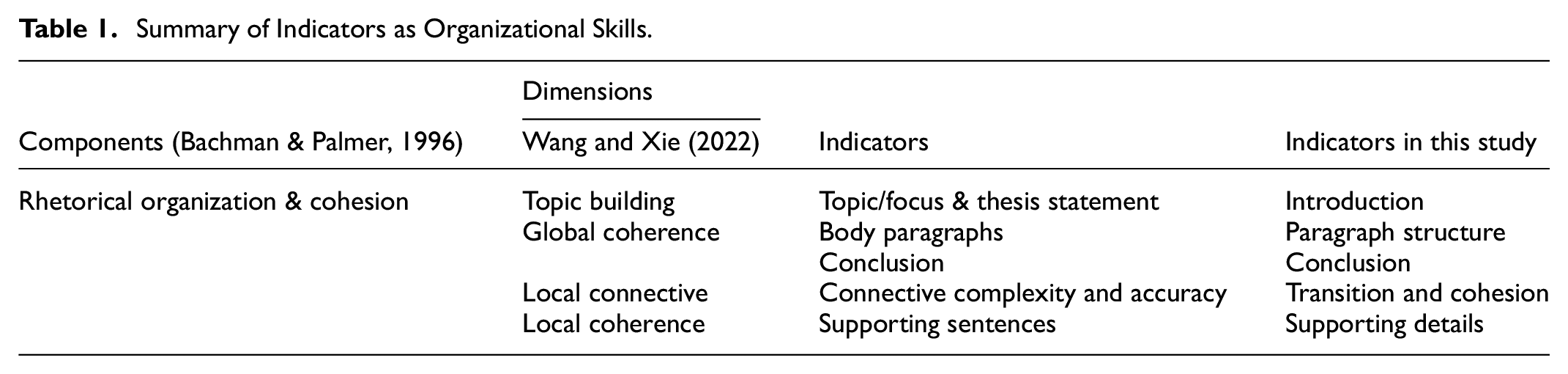
As shown in Table 1, the constructs of organizational skills have been adapted from Bachman and Palmer (1996), and Wang and Xie (2022), each providing a fundamental framework for mediating organizational skills in writing instruction. These indicators were originally derived from Jacobs (1981). The constructs used in the analysis include introduction, paragraph structure, conclusion, transition and cohesion, and supporting details (Appendix 1 for details).
Summary of Indicators as Organizational Skills.
Key Concepts of DA
Grounded in the STC, several core components shape the foundation of DA procedure. These include ZPD (Vygotsky, 1978), mediation, Mediational Moves, Learning Potential Score (LPS), and transfer (transcendence). In this study, the concept of Mediational Efficiency was incorporated into the conceptual framework, aligning with Poehner’s (2007) emphasis on the effectiveness of mediation.
ZPD
According to Vygotsky (1978), the ZAD refers to the current and actual achievement, while the ZPD is “the difference between a person’s actual development level as assessed by solving problems on their own and their prospective development level as assessed by solving problems with the help of more experienced peers or under adult supervision” (Vygotsky, 1978, p. 86). It is crucial to emphasize students’ ZPD rather than merely their ZAD (Zone of Actual Development) because development involves transforming emerging abilities into fully developed skills. In educational contexts, the ZPD has been applied as a means to truly identify the ongoing cognitive development of an individual (Poehner et al., 2015). Numerous studies on L2 acquisition that focus on identifying learners’ present and emerging capacities, and guiding learner progress with appropriate support, have discovered several applications for the concepts of ZAD and ZPD (e.g., Shabani, 2012; van Compernolle & Zhang, 2014).
Mediational Moves as Scaffolded Support
Mediation, a core concept in Vygotsky’s sociocultural theory, emphasizes the role of cultural tools, language, and social interactions in shaping cognitive development. According to Vygotsky, learning occurs within the ZPD, the range between what learners can achieve independently and what they can accomplish with guidance (Vygotsky, 1978, p. 86). Mediation bridges this gap by providing the necessary support or scaffolding through tools, signs, or interactions with more knowledgeable others, such as teachers or peers. Language plays a pivotal role as the primary mediational tool, enabling learners to internalize knowledge and develop higher-order thinking skills. This process transforms social interactions into personal understanding, highlighting the dynamic interplay between individual cognition and the social environment (Poehner, 2005). Vygotsky’s emphasis on mediation underscores the importance of tailored, responsive teaching strategies that align with learners’ developmental needs, fostering both immediate learning outcomes and long-term cognitive growth.
In the context of DA, mediation refers to the reciprocal relationship between a learner and a more knowledgeable party (e.g., a teacher, a peer, or AI), where the latter considers the learner’s ZPD to provide scaffolded support that fosters learning. According to Poehner (2005), “Mediational Moves” (p. 170) are methods or forms of support, either explicit or implicit, and provided to a mediatee (a learner) to help improve their skills. Documenting the type and frequency of these Mediational Moves used by the mediator in DA offers valuable insights into learners’ developmental progress. Mediation tools can be conceptualized into two ways: through the use of instruments or signs, and through interactions. Importantly, “mediators” do not need to be human; computers and written work can serve this purpose (Grigorenko, 2009). Computer-mediated/-assisted tools are now regarded as an efficient source of support (Vakili & Ebadi, 2022). Hence, this current study employed computer-based mediation to provide feedback and enhance mediational efficiency.
Learning Potential Score (LPS)
Sternberg and Grigorenko (2002) suggested that evaluating learners’ cognitive development becomes significant when the contrast between their dependent and independent scores is highlighted. LPS is a concept derived from Feuerstein et al.’s (1991) Mediated Learning Experience (a type of learning where a teacher helps guide and shape the learning process) and Budoff’s (1987) Learning Potential Assessment (p. 176; It focuses on how well a student can develop new skills or knowledge with the right support, rather than just measuring what they already know). Based on Budoff and Feuerstein et al.’s concept of learning potential, Kozulin and Garb (2002) introduced a formula to measure each learner’s progress during DA. According to this formula, the LPS focuses on measuring the effectiveness of mediation (Ebadi & Saeedian, 2019; Poehner & Lantolf, 2013; van Compernolle & Zhang, 2014). This score is calculated by subtracting the number of prompts used by learners from the total score. In the current study, mediated score is the writing score with accumulation of assistance in the form of prompts, or Mediational Moves that learners utilize to gain knowledge of specific writing skills. LPS was calculated using the formula devised by Kozulin and Garb (2002):

Transfer Tasks
The concept of transfer is crucial in DA, as it reflects the long-term impact of interactions (Feuerstein et al., 1991) and tracks learners’ progress over time (Poehner, 2008). According to the concept of transfer, introducing more complex assessment tasks based on earlier principles shows whether learners have internalized previous mediation and apply their knowledge to new tasks (Jeltova et al., 2007; Poehner, 2007). In the current DA design, transfer was defined as the ability to master a new argumentative writing development pattern in the delayed posttest.
Mediational Efficiency
The concept of Mediational Efficiency is rooted in the broader principle of instructional efficiency, as mediation itself serves as a method of instruction. In education, Mediational Efficiency refers to the extent to which a mediator, such as a teacher or learning material, facilitates student learning by providing explanations, enhancing understanding, and improving learning outcomes. By examining how the mediator performs in these areas, researchers can determine how effective the mediation approach is and make any needed improvements. In DA, mediation is a type of instruction but more effective due to its ongoing, interactive educational process with the goal of facilitating learning and development. Thus, Mediational Efficiency takes the place of instructional efficiency in this research related to DA.
Roelle et al. (2014) had found that prompts that encourage careful thinking can help students learn more deeply, making it easier and faster to understand information from lessons. Students’ learning potential, or their ability to grasp, apply, and expand upon new concepts, is greatly influenced by the Mediational Moves. Efficient instructional approaches provide the right level of challenge and support, allowing learners to reach their full potential (Moore, 2014). This emphasizes the importance of effective instruction that is both responsive and flexible. By refining Mediational Moves and enhancing Mediational Efficiency, teachers can create a dynamic learning environment that promotes greater academic success and cognitive growth. In this research, we hypothesized that Mediational Efficiency mediates the relationship between Mediational Moves and LPS. Mediational Efficiency was calculated using likelihood model (Hoffman & Schraw, 2010) which focuses on the effort-to-performance ratio. The performance refers to students’ organizational skills demonstrated in the DA test, while effort refers to the Mediational Moves they use to reach their ZPD.

The key DA concepts and their connections are illustrated in Figure 1.

ZPD and scaffolding.
Purpose of the Study and Research Questions
The purpose of this study was to investigate the development of EFL learners’ organizational skills over time, specifically comparing the improvement between the IDA and HDA groups. Additionally, the study aims to explore the differences in Mediational Moves, Mediational Efficiency, and LPS related to macro-writing skills between these two experimental groups. Furthermore, investigating the interplay among Mediational Moves, Mediational Efficiency, and LPS provides a holistic view of teaching and learning dynamics, showing how tailored interventions enhance learning potential while optimizing teacher effort. Understanding these relationships may guide effective, efficient teaching strategies, extends scaffolding theories, and refines educational models to improve outcomes and resource allocation. This research seeks to answer the following questions:
Is there any significant improvement in the organizational skills for the HDA and IDA groups over time?
Is there any significant difference in Mediational Moves, Mediational Efficiency, and LPS in the improvement of macro-writing skills between the HDA and IDA groups?
How does Mediational Efficiency influence the relationship between Mediational Moves and LPS?
Methodology
Research Context
This quasi-experimental study took place at a private university in northeast China, where the College English Writing course is typically taught in large classes, making it challenging for instructors to provide individualized support to each learner. In addition, summative assessment (SA) remains widely used, emphasizing heavily on outcomes while neglecting the writing process (Tang & Ma, 2023; Yang & Deng, 2015).
The current study adapted a research design commonly used in previous DA studies conducted in various contexts, including SLA (e.g., Antón, 2009; Vakili & Ebadi, 2022). These studies typically followed three main stages: beginning with a pre-test as a baseline, applying a DA model to specific organizational skills with DA test (as immediate posttest), and concluding with a delayed posttest, referred to as the “transfer test” in DA. During the experiment, this study minimized harm by using a supportive, non-invasive assessment to enhance L2 learners’ writing skills. The benefits outweighed risks, as participants improved academically while contributing to L2 research. Informed consent was obtained by clearly explaining the study’s purpose, procedures, and minimal risks, ensuring voluntary participation with the right to withdraw anytime.
Participants
The sampling method used in this study were nonprobability sampling (Ary et al., 2018). A total of 85 EFL freshmen from two classes were recruited based on their willingness to participate during the fall semester of 2023. The demographic information, as presented in Table 2 showed that 32 participants (37.65%) were male and 53 (62.35%) were female. Regarding their majors, 42 participants (49.41%) were finance majors, while 43 (50.59%) were accounting majors. The average age of the participants 19.6. The language proficiency of the participants was assessed using the Oxford Quick Placement Test (OQPT), which categorized them according to CEFR (Common European Framework of Reference for Languages, which outlines a progressive mastery of language skills across a six-level scale: Beginner, Pre-intermediate, Intermediate, Upper-Intermediate, Advanced, and Mastery) proficiency levels. Based on the test results, 27 (31.76%) participants were classified at the upper-intermediate level, 32 (37.64%) at the intermediate level, and 26 (30.59%) at the pre-intermediate level.
Participants Profiles.

The adapted OQPT, which has a maximum score of 90, were used to classify participants into different proficiency levels: Upper-Intermediate (scores ranging from 46 to 60; Intermediate, 36 to 45, and Pre-Intermediate, 20 to 35). The participants with varying language proficiency levels and gender were evenly assigned between the two experimental groups to enhance the comparability and validity of the study’s outcomes and minimize the potential influence of extraneous variables, such as proficiency imbalances, on the findings (Table 3).
Language Proficiency Levels in Two Groups.

In addition, two instructors participated in the study, serving as mediators by conducting all the tests and DA process, while assessing the participants’ writing tasks with a focus on organizational skills. Both instructors had over 10 years of teaching experience—one being the researcher with Ph.D degree and the other an experienced instructor.
Instruments and Procedures
Writing Tasks
Of the three writing tasks, the first essay (pretest) asked participants to discuss whether businesses offer discounts in exchange for customers reviews. The second (DA test) focused on exploring the benefits and drawbacks of peer pressure on college students’ behavior and decision-making. The third writing task (delayed posttest) invited participants to express their views on “crowd crossing,” where people cross the road by following others without considering traffic lights. In both the pretest and DA test, participants were instructed to write an argumentative style (Wyrick, 2016, p. 291). For the delayed posttest, participants were required to use a more complex argumentative structure (Wyrick, 2016, p. 292), which maintained the core elements with the initial style, incorporated additional components to achieve greater depth. Participants were expected to reorganize the argumentative structure they had learned in the DA test for this final delayed test.
Computer-Assisted and Instructor’s Mediational Moves
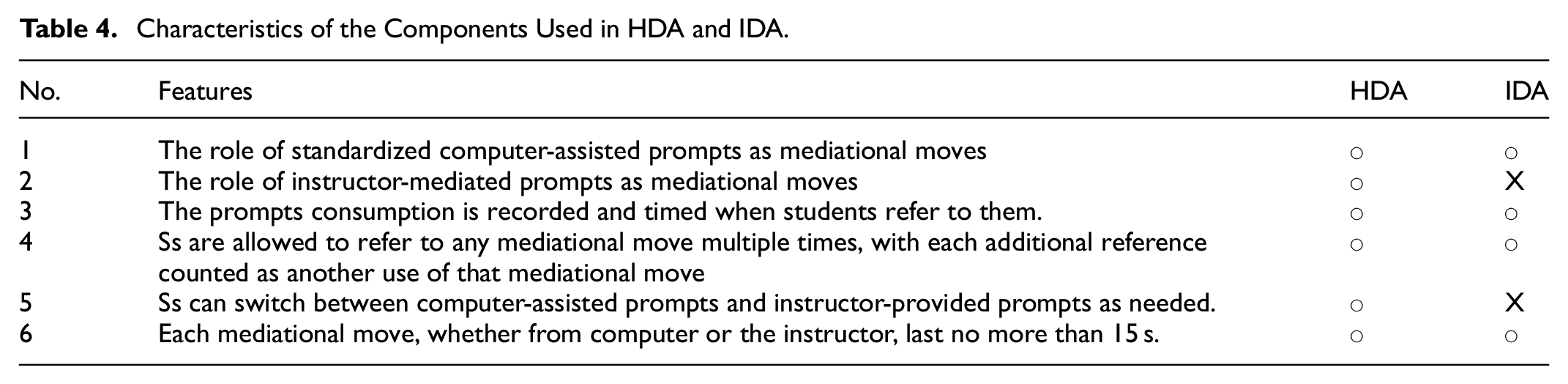
In this research, both the HDA and IDA groups adhered to the interventionist approach of DA, which utilizes standardized mediating prompts provided by computer. In the HDA group, the interventionist approach was mixed with the interactionist (Poehner, 2005) approach. This means that when the learners were using the standardized prompts on the computer, they could pause and interact with the mediator. Overall, there are six graduated prompts for each indicator in EFL writing, progressing from implicit to explicit prompt (see Appendix 2 for details). In this group, the mediator’s prompts during interactions with the learners were categorized into four types, adapted from Poehner and Lantolf’s (2005), progressing from implicit to explicit: Identifying Specific Errors, Confirming a Right Response, Metalinguistic Clues, and Providing Example (Appendix 3 for details). Each Mediational Move was limited to 15 s, matching the time allotted for each computer-prompt. Table 4 provided an overview of the components used in the two experimental groups.
Characteristics of the Components Used in HDA and IDA.
Data Collection Procedure and Data Analysis
Figure 2 illustrates the data collection procedure. First, they completed an initial writing task online independently to establish baseline writing skills. An automatic diagnostic tool (known as Udig) evaluated their responses and generated a list of weaknesses or errors, which instructors used to target areas for improvement. During subsequent DA sessions, participants completed a second writing task and received feedback on their performance. Both DA groups received individualized support through Mediational Moves tailored to their diagnostic reports. The Mediational Moves in IDA and HDA groups were compared to identify learners’ LPS. Three weeks after the DA session, participants were given a third writing task (delayed posttest), which featured a different argumentative structure but included the same elements as the pretest and DA test.

Data collection procedure.
Regarding macro-level organizational skills, two instructors assessed learners’ performance using analytic score criteria based on five key aspects: Introduction, Paragraph Structure, Transitions and Cohesion, Supporting Details, and Conclusion. The analytic rubric was devised by Weigle (2002) and validated by Ma et al. (2022) and Yu and Poehner (2023). The use of these indicators demonstrated strong internal reliability, as validated by Ma et al. (2022). To ensure the reliability of the outcomes, inter-rater reliability was calculated and yielded a Cohen’s Kappa of 0.896. In case of score discrepancies, discussions were held, and if no agreement was reached, a third rater was counted to finalize the scores. To minimize potential rater bias, the collected writings were randomized and anonymized before being rated by the instructor, thereby reducing both instructor and rating biases.
After collecting three sets of scores—the pretest score, the DA score, and the delayed posttest score, then an additional set of derived scores was calculated based on these initial scores. These include the gain score (DA score minus pretest score), the Mediational Move score, Mediational Efficiency, and LPS. The Mediational Move scores, which measure a learner’s utilization of computer-assisted prompts (for both IDA and HDA groups) and instructor-mediated prompts (for the HDA group only), were automatically recorded by the computer system. Mediational efficiency was calculated using the likelihood model (Hoffman & Schraw, 2010), which focuses on the effort-to-performance ratio. In this study, effort refers to the number of mediational moves students utilized in reaching their ZPD, which is reflected in their actual performance.
Ethical Considerations
Ethical approval for this study was obtained from the Institutional Review Board of Jilin International Studies University. Participants were fully informed about the study’s purpose and procedures and assured of their right to voluntarily participate or withdraw at any time. Confidentiality was maintained through anonymization and coding.
Data Analysis
To examine writing improvement over time, repeated measures ANOVA was employed for each group (RQ1). The influence of Mediational Moves on macro-level organizational skill improvement, LPS, and Mediational Efficiency between the IDA and HDA groups was analyzed using ANOVA (RQ2). Additionally, the role of Mediational Efficiency in the relationship between Mediational Moves and LPS was investigated through mediation analysis in SPSSAU (RQ3).
Results
Improvement in the Organizational Skills Over Time
Table 5 presents descriptive statistics of organizational skills assessed in two groups. The HDA group showed a significant increase in total scores, rising from 14.55 (SD = 2.42) in the pretest to 24.10 (SD = 2.30) in the DA test, with a slight decrease to 23.43 (SD = 1.94) in the delayed posttest. Improvements were evident across all skill areas, with minor declines in the delayed posttest. Similarly, the IDA group saw an increase in total scores from 14.28 (SD = 2.23) to 22.02 (SD = 1.98) in the DA test, followed by a slight drop to 21.58 (SD = 1.83) in the delayed posttest. Although the IDA group showed progress, their gains were smaller, and they experienced slightly smaller declines in the delayed posttest compared to the HDA group.
Descriptive Statistics of the Organizational Skills Over Time.

The HDA group consistently outperformed the IDA group in both the DA test and delayed posttest across all organizational skill areas, with greater improvements in Introduction (IN), Paragraph Structure (PS), and Conclusion (CO). Additionally, the HDA group demonstrated better retention of skills in the delayed posttest, indicating that the HDA approach, combining computer-assisted and instructor-mediated prompts, was more effective in fostering and maintaining improvements in writing skills. Though the IDA group made significant progress, their overall scores and retention were lower than the HDA group, particularly in Conclusion (CO) and Transitions and Cohesion (TC). The purely computer-based intervention in the IDA group appeared less effective in sustaining long-term organizational skill improvements, as seen in the IDA group.
Figure 3 below presents a graphical representation of the descriptive analysis for the two groups.

Organizational skill development over time.
Table 6 presents the multivariate tests of organizational scores over time. For the time effect, Wilks’ Lambda was 0.049, indicating significant changes in organizational skill scores over time (F = 796.307, p < .000), with a large effect size (η2 = 0.951). This suggested that time had a substantial influence on the improvement of organizational skills in both groups. For the interaction effect between Time × Group, Wilks’ Lambda was 0.832, indicating significant differences in how the two groups changed over time (F = 8.271, p < .001), with a moderate effect size (η2 = 0.168). These results indicated that both groups improved over time, the patterns of improvement differed between the experimental conditions of the two groups. This suggested that the type of intervention influenced the rate and nature of the progress in organizational skills.
Multivariate Tests of Organizational Skill Scores in Two Groups.

p < .001.
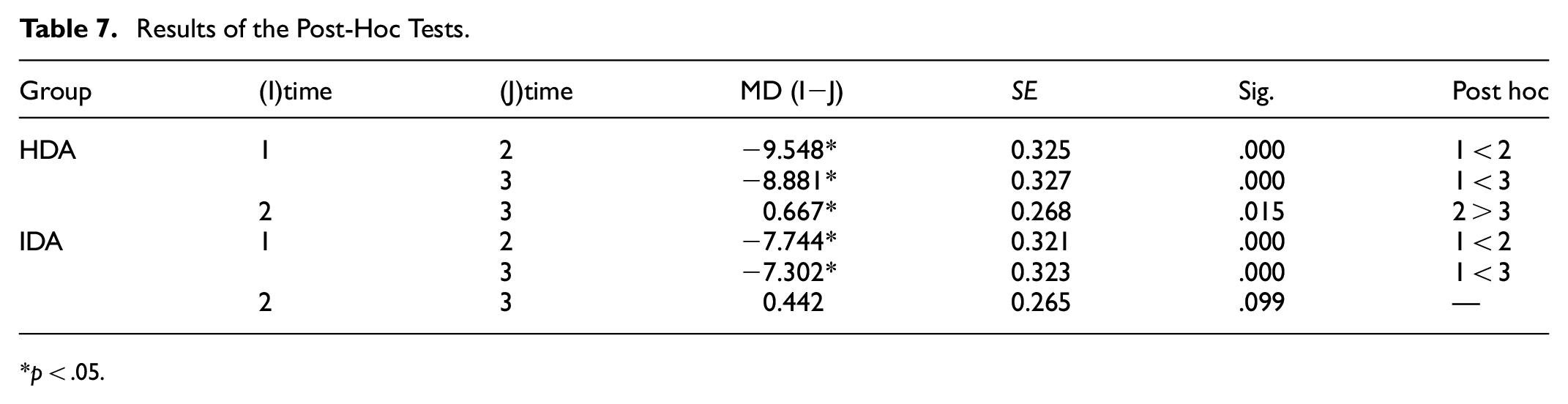
The post-hoc tests in Table 7 revealed that both the HDA and IDA groups showed significant improvements in organizational skill scores over time.
Results of the Post-Hoc Tests.
p < .05.
The HDA group experienced substantial gains from the pretest to the DA test and from the pretest to the delayed posttest, but a small decrease occurred between the DA test and delayed posttest. In the IDA group, similar significant improvements were observed from the pretest to both the DA test and delayed posttest, but no significant change was found between the DA test and delayed posttest, suggesting a plateau in improvement after the DA test for this group. In summary, the HDA group showed significant improvements in organizational skills over time, with greater gains and better retention than the IDA group, particularly in areas like Introduction, Paragraph Structure, and Conclusion. While both groups improved, the HDA group’s combined computer-assisted and instructor-mediated approach proved more effective than the purely computer-based intervention in the IDA group.
Difference in Mediational Moves, LPS, and Mediational Efficiency
An ANOVA was conducted to examine the differing influence of Mediational Moves on gain (ZPD), LPS, and Mediational Efficiency between the HDA and IDA groups. In Table 8 presents a descriptive analysis along with the ANOVA results for the set of scores, including subsequent scores such as Gain Score, Mediational Move Score (MMS), LPS, and Mediational Efficiency.
Descriptive Analysis and ANOVA Result of Score Sets.

p < .05. **p < .001.
Table 8 shows the descriptive analysis and ANOVA results comparing organizational skills between the HDA and IDA groups. In the pretest, no significant difference was found between the two groups. However, in the DA test, the HDA group (M = 24.10 (2.30)) significantly outperformed the IDA group (M = 22.02, SD = 2.30) with F(2, 84) = 19.788, p < .000. Similar trends were observed in the delayed posttest, where the HDA group (M = 23.43 (1.94)) again outperformed the IDA group (M = 21.58, SD = 1.94) with F(2, 84) = 20.414, p < .000).
For gain scores, the HDA group (M = 9.55, SD = 2.17) showed a significant advantage over the IDA group (M = 7.74, SD = 2.17) with F(2, 84) = 15.561, p < .000. There was no significant difference in MMS scores between the two groups. However, in terms of LPS, the HDA group (M = 1.12, SD = 0.13) performed significantly better than the IDA group (M = 0.99, SD = 0.13) with F(2, 84) = 24.899, p < .000. Mediation Efficiency also showed significant differences, with the HDA group (M = 0.89, SD = 0.15) outperforming the IDA group (M = 0.81, SD = 0.14) with F(2, 84) = 7.086, p < .005.
Figure 4 illustrates how Mediational Moves facilitate ZPD in both groups. ZPD (Gain) is notably larger in the HDA group compared to the IDA group, with the same Zone of Actual Development (ZAD, which refers to pretest), consequently students in HDA group achieve a higher potential level. In sum, the HDA group consistently demonstrated higher LPS, Gain, and Mediational Efficiency in organization skills despite both groups benefiting from similar levels of Mediational Moves, whether through computer-assisted or instructor-mediated prompts. These results indicated that the HDA conditions are more effective in fostering organizational skills.
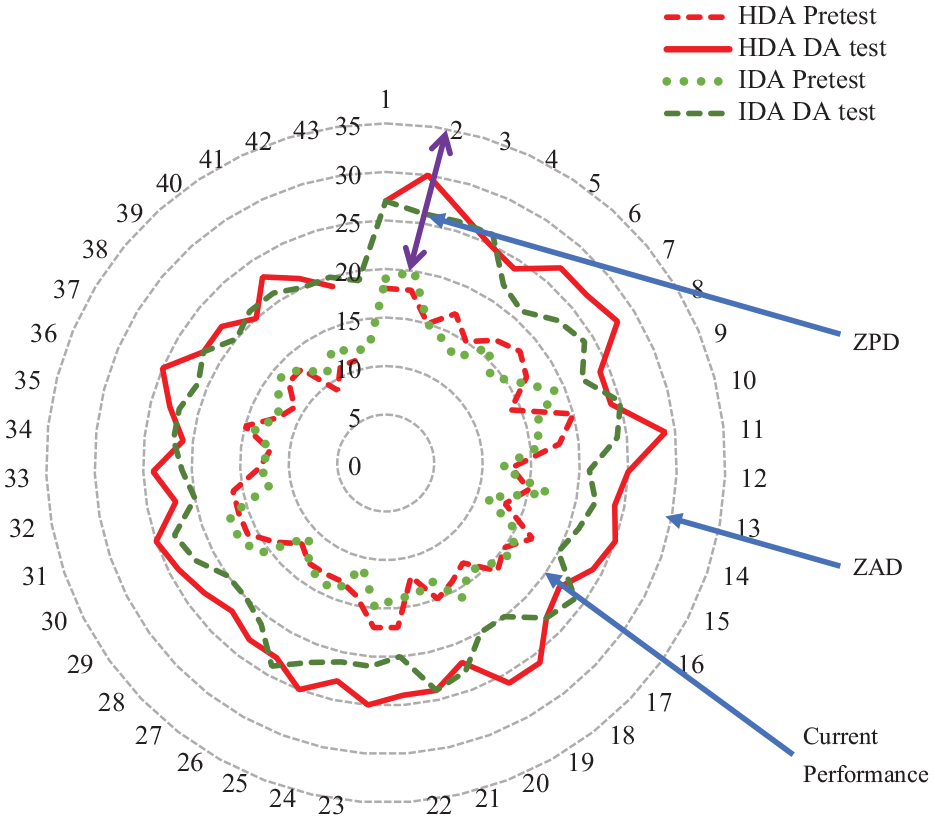
ZPD in HDA and IDA groups.
Role of Mediational Efficiency in Mediational Moves and LPS
A mediation analysis was conducted to examine the role of Mediational Efficiency in the relationship between Mediational Moves and LPS, involving three models as outlined in Table 9. This analysis aimed to determine how Mediational Efficiency influenced the impact of Mediational Moves on LPS, providing insights into the mechanisms that drive learning improvements.
The Results of Mediation Effect Analysis.

p < .05. **p < .001.
In the first model, students’ LPS in organizational skills is predicted by Mediational Moves, represented by the equation:

This suggests a significant negative direct effect of Mediational Moves on LPS (β = −.013, t = −2.915, p < .005) with F(1, 83) = 8.498, p < .005. The results indicate that, without consideration of mediation, an increase in Mediational Moves is associated with a decrease in LPS.
The second model explores the relationship between Mediational Moves and Mediational Efficiency, represented by the equation:

This indicates that Mediational Moves significantly predict Mediational Efficiency (β = −.041, t = −13.86, p < .001) with F(1, 83) = 192.091, p < .001, highlighting a strong inverse relationship between the two variables.
The third model incorporates Mediational Efficiency to predict LPS, resulting in the following equation:

In this model, Mediational Efficiency has a strong positive effect on LPS (β = 1.241, t = 12.975, p < .001), demonstrating that it mediates the relationship between Mediational Moves and LPS. This mediation effectively converts the negative direct effect of Mediational Moves into a positive indirect effect (B = 0.037, t = 8.061, p < .001). The R2 values show that Mediational Moves alone explain 9.3% of the variance in LPS, while incorporating Mediational Efficiency increases the explained variance to 70.3%. The F-tests confirm the significance of the full model, including Mediational Efficiency with F(2, 82) = 96.985, p < .001. These results underscored the critical role of Mediational Efficiency in mediating the relationship between Mediational Moves and LPS, transforming what would otherwise be a negative influence into a positive one. Table 10 summarizes the mediation effect analysis for the relationship between Mediational Moves, Mediational Efficiency, and LPS.
Summary of Mediation Effect Test.

Note. According to the provided criteria, a suppression effect occurs when both paths a and b, as well as the direct effect cc′, are significant, and the indirect effect a × b has the opposite sign to the direct effect c′. Bootstrap Type: Percentile Bootstrap Method.
p < .01.
The analysis revealed that while the total effect of Mediational Moves on LPS is negative and significant (c = −0.013, p < .01), the mediation effect (a × b) is negative (−0.05) but not statistically significant, with a 95% confidence interval (CI) ranging from −1.430 to −1.004. This indicates that the indirect effect through Mediational Efficiency is not significant. However, the direct effect of Mediational Moves on LPS, after accounting for Mediational Efficiency, is positive and significant (c′ = 0.037, p < .01). This suggests a suppression effect, where the negative total effect is reversed into a positive direct effect due to the mediation, as visualized in Figure 5.

Mediational efficiency, mediational moves, and LPS.
The mediation analysis concluded that Mediational Efficiency significantly transformed the negative direct effect of Mediational Moves on LPS into a positive effect. This suppression effect highlights the essential role of Mediational Efficiency in enhancing the impact of Mediational Moves, ultimately improving learning outcomes.
Discussion
Improvement in the Organizational Skills Over Time
Participants in the IDA, and HDA groups showed consistent and significant improvement in organizational writing skills. The successful transfer aligns with previous studies by Afshari et al., 2020) and Ahmadi and Besharati (2017), who also found significant improvement in students’ writing skills on both DA test and delayed post-test (transfer test). This study confirmed that transfer is possible after mediation in DA test.
Though both DA groups performed well on the more challenging transfer tasks (delayed posttest), their mean organization scores decreased slightly, indicating minor regression. It was slightly noticeable in the HDA group. The lower performance on the transfer tasks could be due to the participants’ lack of practice with the argumentation style and different structure of the transfer test, which made it more difficult (Ahmadi & Besharati, 2017). Rahmani et al. (2020) also noted that writing development, including complexity, correctness, and fluency, does not follow a linear path, and that DA techniques can support their progress.
The noticeable regression observed in the HDA group may highlight a limitation of explicit instruction, which, although initially effective, my lead to relatively superficial mastery of organizational skill. In contrast, the single-mode of computer mediation in the IDA group may have encouraged deeper cognitive thinking, resulting in a smaller decrease in transfer scores (Vakili & Ebadi, 2022).
From the perspective of SCT, cognitive development is an ongoing process involving both progression and regression, which together contribute to overall growth (Vygotsky, 1978). Thus, the observed regression should be viewed as part of the developmental process rather than failure. The decline in writing performance emphasizes the need for more sustained instructional intervention within the DA framework (Yu & Poehner, 2023). Poehner et al. (2018) noted that while a single DA session can determine a learner’s ZPD and diagnose developing skills, long-term development requires DA to be paired with extended instructional interventions (see also Sternberg & Grigorenko, 2002).
Impact of Mediational Moves as Scaffolded Support
The advantages of instructor-mediated prompts in the HDA, represented through the interaction between instructor and participants, have been indirectly confirmed in prior DA studies (Andujar, 2016; Andujar & Salaberri-Ramiro, 2021). While the individual dialogic interactions in the IDA group also yielded positive results, the HDA approach emphasized the social aspect of writing underscores the importance of teacher-student interaction in the HDA approach which scholars such as Weigle (2002) and Graham (2018) describe as a social, cultural, cognitive, and linguistic act.
This research applied the social dimension of feedback in the HDA group, which positively impacted learners’ performance. The flexible interaction between instructors and students in the HDA group also influenced affective factors (Carless & Winstone, 2023), such as confidence (Roohani & Shafiee Rad, 2019), engagement (Yuan, 2024; Zhou, 2023) and motivation (Cho & Cho, 2014). These factors are closely related to language learning benefits, including boosting motivation (Getie, 2020; A. Kazemi et al., 2020; Ritonga et al., 2022), reducing the anxiety level (Estaji & Farahanynia, 2019; Ritonga et al., 2022; Sanaeifar & Nafari, 2018; Sohrabi & Ahmadi Safa, 2020), and fostering higher self-efficacy (Ayllón et al., 2019; Constantine et al., 2019).
In summary, in HDA settings, with its prompt and tailored feedback from the instructor, may create a positive environment that enhances both learners’ writing skills and their confidence. The varying impacts of Mediational Moves as scaffolded support demonstrated the effectiveness of the HDA approach in improving organizational skills. This study is in consistent with the findings of Ebadi and Saeedian (2019), Kozulin and Garb (2002), Poehner et al. (2015), and Teo (2012), showing that learners starting from the similar pretest baseline may achieve much higher DA test scores, due to differences in mediation between HDA and IDA. Despite starting from similar pretest scores, the HDA group outperformed the IDA group because of the tailored interventions. The DA processes thus improved the participants’ writing abilities, with their potential not fully predicted by the pre-test alone, consistent with Vygotsky’s (2012) assertion that the ZPD cannot be determined by independent performance.
However, caution is needed in interpreting LPS as a fixed measure of learning capability. Poehner and Lantolf (2013) argue that LPS should not be seen as static and other instructional approaches may benefit learners with lower LPS scores. A low LPS may simply indicate that the mediation provided during DA test was not suitable for the learner at that time. In different contexts, they might respond better to other forms of support, such as dialogically negotiated or open-ended mediation. In sum, from the perspective of SCT, the HDA approach, combining interventionist and interactionist DA, may provide a more comprehensive scaffolding method. This approach optimizes learners’ ZPD, leading to better performance and creating a more supportive and engaging learning environment.
Role of Mediational Efficiency in Mediational Moves and LPS
Mediational Efficiency plays a key role in transforming the initially negative total effect of Mediational Moves on LPS into a positive direct effect through mediation. These findings highlight the importance of Mediational Efficiency in shaping the relationship between Mediational Moves which serve as scaffolded support, and LPS. Mediational efficiency, reflecting the instructors’ ability to effectively implement instructional strategies, significantly impacts how learners progress toward their ZPD. While Mediational Moves are strategies used to guide and support learners, without efficient mediation, these moves may not achieve the desired outcomes. Mediational Efficiency enhances the effectiveness of these strategies by ensuring that they are tailored to learners’ specific needs and learning levels, which is essential for helping learners reach their ZPD.
Schools and teachers should adopt strategies to enhance learning efficiency by supporting students’ effective learning within their ZPD and improving instructional practices through mediational efficiency. This includes developing better learning materials, adjusting instructional pacing to cover more content in less time, and ensuring tasks align with students’ ZPD for optimal learning (Valli & Buese, 2007). Emphasizing mediational efficiency, where effort-to-performance ratios are balanced, will boost educational productivity (López, 2007) by maximizing resources through thoughtful curriculum planning and pedagogy. Addressing the trend of rapid content delivery, known as “drive-by teaching” (Valli & Buese, 2007, p. 545), can improve learning outcomes by enabling effective mediation and promoting deeper student engagement.
Conclusion
This study aimed to compare the effectiveness of computer-assisted HDA and IDA approaches in improving organizational skills in L2 writing among Chinese EFL learners. The analysis of differential scores and total organizational scores highlighted the advantages of the HDA approach over the IDA approach. Both DA test and delayed posttest (transfer) scores were significantly higher than the pretest scores, demonstrating the effectiveness of both DA approaches. Although both groups showed a slight regression in the delayed posttest, this still indicates a successful transfer of writing abilities, particularly in macro-level organizational skills. Notably, significant differences were found between the two groups, with the HDA group consistently outperforming the IDA group across several measures, including Gain Scores, LPS, MMS, and Mediational Efficiency. Mediation analysis revealed that while the number of Mediational Moves initially had a negative effect on LPS, this was reversed to a positive effect through the mediation of Mediational Efficiency. The findings suggest that Mediational Efficiency plays a critical role in transforming the negative impact of Mediational Moves into a positive outcome for LPS, highlighting its importance in enhancing learning outcomes.
The findings of this study provide valuable practical insights for teaching pedagogy and assessment practices, with broad implications for the application of SCT in educational contexts. First, this study highlights the benefits of HDA and IDA approaches for improving organizational writing skills. These methods overcome the limitations of traditional DA approaches, such as being time-consuming and labor-intensive, making them suitable for large-scale classes. While both approaches are effective, HDA offers greater advantages due to its flexible and tailored mediation. Instructors should focus on enhancing Mediational Efficiency by adapting instructional strategies to learners’ needs, ensuring continued scaffolded support and targeted mediation to help learners transfer their writing skills over time. Second, for L2 learners, both HDA and IDA improve organizational skills, with HDA providing more personalized and interactive feedback that leads to better learning outcomes. The HDA mediation not only improves writing abilities but also might boost learner motivation and confidence. Engaging with HDA equips learners to handle complex writing tasks, supporting long-term skill development and sustained improvement. Additionally, this research suggests that incorporating Mediational Efficiency into assessment practices could provide more accurate measures of students’ learning progress and potential for growth.
This study faces several limitations that should be considered when interpreting the findings. A major challenge is the difficulty in measuring Mediational Moves in both computer-mediated and teacher-mediated contexts in a clear, linear sequence. It is not easy to separate the effects of these two types of mediation, which complicates the task of identifying their specific impacts on learners’ writing performance. Additionally, the relatively short duration of the quasi-experimental study may not have been sufficient to fully capture the long-term benefits of the HDA approach on writing performance. Extending the study duration with ongoing mediation could provide more comprehensive insights into how the HDA approach supports the long-term development of macro-level writing skills in L2 learners. The final limitation of this research lies in the use of a nonprobability sampling technique, which may restrict the generalizability of the findings. As the sample was not randomly selected, it may not fully represent the larger population, potentially affecting the extent to which the results can be applied to different groups or settings. Future research could address this limitation by using a probability sampling method, which would enhance the representativeness of the sample and allow for more robust generalizations.
Thus, future studies should explore more robust methods to differentiate between computer-mediated and teacher-mediated Mediational Moves. This could involve developing more detailed observation tools or using advanced data collection techniques to better track and distinguish mediation patterns. Additionally, it would be valuable to replicate the study across diverse contexts or populations to assess the consistency of the findings and improve their broader applicability. By doing so, researchers will be able to more clearly understand the distinct impact of each mediation type on learners’ writing performance.
Footnotes
Appendix
Instructor-Mediated Prompt.

| Type of teacher’s prompt | Definition | Explanation | Example (focused on organizational skills) |
|---|---|---|---|
| Identifying specific errors | Helps students identify specific organizational issues in their writing. | The teacher highlights structural problems in the essay, guiding students to recognize and revise the organizational flow. | “Your introduction is missing a thesis statement. Can you add a sentence that clearly states the main argument of your essay?” |
| Confirming a right response | Confirms when students have structured their writing correctly. | The teacher reassures the student that their organizational approach is correct, encouraging confidence in their structuring choices. | “Yes, your paragraph starts with a strong topic sentence and the supporting details follow logically. Well done!” |
| Metalinguistic clues | Provides hints related to the organization of the writing, such as paragraph structure or transitions. | The teacher gives clues about organizational elements, such as the need for transitions or clearer topic sentences, without providing direct corrections. | “Your paragraphs are well-developed, but how can you make the transition between the second and third paragraph smoother? Think about adding a transition phrase.” |
| Providing example | Gives explicit examples to clarify concepts or rules related to organization. | The teacher offers a concrete example of how to structure writing elements, such as introductions, body paragraphs, or conclusions. | “Here’s an example of a strong thesis statement for your introduction: ‘The rise of online education has transformed the learning experience by improving accessibility, flexibility, and engagement.’” |
Acknowledgements
We would like to express our sincere gratitude to Jilin University of International Studies for their continued support and resources. We also extend our heartfelt thanks to the Education Department of Jilin Province for funding this research through the Scientific Research Project. Their assistance has been invaluable in the completion of this study.

Ethical Considerations
This ethical approval statement confirms that the research project has undergone a thorough review by the institutional ethics committee at Jilin International Studies University. The project has been approved in accordance with the ethical guidelines and standards established by the university, as well as the relevant academic and research ethical principles.
Consent to Participate
Informed consent was obtained from all participants involved in the study, who participated voluntarily.
Author Contributions
Conceptualization, Wei Sun and Yousun Shin; methodology, Wei Sun; software, Wei Sun; validation, Yousun Shin and Wei Sun; formal analysis, Wei Sun; investigation, Wei Sun; resources, Yousun Shin; data curation, Wei Sun; writing—original draft preparation, Wei Sun; writing—review and editing, Wei Sun; visualization, Wei Sun; supervision, Yousun Shin; project administration, Wei Sun; funding acquisition, Wei Sun and Yousun Shin. Both authors have read and agreed to the published version of the manuscript.
Funding
The author(s) disclosed receipt of the following financial support for the research, authorship, and/or publication of this article: This research was funded by the Scientific Research Project from the Education Department of Jilin Province (Grant No.: JJKH20251489SK).
Declaration of Conflicting Interests
The author(s) declared no potential conflicts of interest with respect to the research, authorship, and/or publication of this article.
Data Availability Statement
The data supporting the findings of this study are available from the corresponding author upon reasonable request.