




Abstract
The purpose of this study was to investigate the relationship between group learning and interpersonal skills, with emphasis on the mediating role of emotional intelligence among high school students in Tehran. This research is a descriptive correlation type that was implemented using structural equation modeling method. The statistical population of this study includes 1,800 high school students. The sample was 316 subjects, using simple random sampling and Cochran formula. The data-gathering tools in this research were Matson’s Interpersonal Communication Skills Questionnaire, Bradberry-Greave’s Emotional Intelligence Questionnaire, and Lauren-Nemeth’s Group Learning Questionnaire with a reliability of 0.81, 0.87, and 0.71, respectively, achieved. For data analysis, structural equation modeling and PLS software were used. The research results indicate that group learning also directly affects interpersonal skills and emotional intelligence and indirectly affects interpersonal skills through emotional intelligence.
Introduction
Everyone is equipped with some tools for getting along with the community and confronting various situations and individuals (culturally and economically); these personal tools can be considered as psychological structures of the person which assist him in facing life events. These psychological structures are mutually affected by various factors, such as family, community, peer group, and so forth. Thus, researchers have focused on the effects of these psychological components on various aspects of life, of which the effect on career, academics, and social performance can be cited. One of the greatest goals of today’s education systems is to develop and change teaching methods for learners to create conditions for them to access information and knowledge through research rather than direct transfer of information (Bayraktar, 2011).
Many educational thinkers believe that students’ intellectual poverty is the result of the rule of traditional teaching methods at schools (Vinzi, Chin, & HenselerJ Wang, 2010). Therefore, most advanced educational systems in the world have abandoned traditional approaches to education, such as teacher-centered methods and teaching methods such as lecturing, and turned to new teaching-learning methods. Indeed, active learning encourages students to conduct meaningful learning activities and reflect on what they are doing (Prince, 2004). What has been widely proposed in various texts is the use of active forms against passive or traditional methods, in which learners are involved in the learning process (Chi, 2011). Students’ education is aimed at their educational progress, and the study of the factors affecting academic achievement is a complex issue as it is a multidimensional element, and is associated with the physical, social, cognitive, and emotional development of the student in a subtle way. Many previous researchers emphasized on the impact of cognitive and intellectual abilities on academic achievement (Feizi, 2014; Goleman, 2006). The studies found that high emotional intelligence gave an added advantage to individuals, be it in educational pursuits or career development (Chew, Zain, & Hassan, 2013; Joshi, Srivastava, & Raychaudhuri, 2012). Despite the necessity to pay attention to the importance of social-emotional skills in education, experience, and research show that improving the emotional and social skills of students is the “missing link” in the efforts to achieve goals for improving schools around the world. Historically schools have always focused on education in the fields of the “basics” of education, strengthening students’ skills in reading, writing, and mathematics. It is assumed that successful acquisition of these skills provide a promising personal future for students, so, the focus of policymakers, officials, and educators has been on final tests. Most student groupings are based on the cognitive abilities, and the processes of evaluation only involve evaluating the results of final tests (Goleman, 2006). One of the active methods of interest to educators and a good alternative to improving the quality of education is group-learning approach. By studying various educational methods, researchers from the UNICEF Study Center found that the best practices to effectively maintain the relationship between teachers, students, and the curriculum include group learning, direct teaching, independent or informal learning, or combined teaching. Selecting any of these methods depends on the student’s satisfaction and the ability of proper implementation of the curriculum by the teachers, and the best criterion for identifying the failure or success of the project is the efficiency of the work and the learning of the students. Group learning is possible by grouping learners into small groups, establishing communication between individuals of a group and relationship with the teacher, therefore ensuring accurate learning of the teachings possible. If one or more people in the group do the bulk of the work, while others simply observe, then group learning has not occurred (Slavin, Hurley & Chamberlain, 2003). Interpersonal communication is the basis of human identity and perfection forming the basis of its connection with others. Effective communication boosts individuals and improves the quality of relationships, whereas ineffective communication blocks human prosperity and even destroys relationships—The people engage in communication to find identity and connect with others. Interpersonal communication is a process by which we distribute our information and feelings through verbal and nonverbal messages to others. It enables us to make our relationship warm and intimate and procure mental and social health more than ever before, and leads to eliminating unhealthy relationships. Maintaining positive interpersonal relationships with group members requires the appropriate use of interpersonal skills (Notari, Baumgartner, & Herzog, 2013). Interpersonal skills are often conceptualized in terms of conflict resolution skills, consensual decision-making skills, leadership skills, dialogue and discussion skills, team-building skills, and empathic skills (J. N. Parker & Hackett, 2012; Wooley, Chabris, Pentland, Hashmi, & Malone, 2010). Keenan & Show (2003) believes that the socialization of children increases with the acquisition of communication skills and the individual blends with the community more, and naturally receives more social confirmation. Children and teenagers grow more with healthy communication skills and enjoy more supportive-emotional resources. Sensitivity, agility, and self-esteem disappear and thereby, they gain more value and credibility. Here, the school is the main institution of interaction after the family, in which the individual’s social life is formed. Schools are the first and most important learning place where competencies and abilities form, but unfortunately, schools have become so commonplace in our lives that we easily ignore their extraordinary role. Moreover, effective learning and teaching occurs when proper interaction is made between schoolchildren (Soleimani, 2005). According to many experts, emotional intelligence is one of the latest developments and innovations in understanding the relationship between thought and emotion (Wong & Law, 2002).
Hence, in a number of ways, one can pinpoint the necessity of this research:
With this research, preuniversity educators can identify the barriers to group learning in educational settings and provide the necessary measures to improve it.
With this research, educational unit managers can learn more about interpersonal skills and improve them.
The results of the present evaluation and research are useful as a valuable tool for both the education system’s managers and the teachers employed in this system, and other researchers interested in the study in this area.
Literature Review
In his research titled “The Role of Teachers’ Teaching Styles on Students’ Indiscipline,” Mesrabadi (2014) concluded that according to teachers, the degree of indiscipline in the classes of authoritarian teachers is significantly less than that of lenient teachers. In a review study on the effects of learning methods in small groups on the progress of student statistics, Prince (2004) concluded that most studies focused on the effects of collaborative, cooperative, and research-based learning methods on the progress of students in the statistics courses. Their results also showed that collaborative and cooperative learning approaches support the effectiveness of learning in small groups, in improving academic achievement, whereas the effectiveness of research-based methods was close to zero. In a meta-analysis study, Puzio and Colby (2013) investigated the effectiveness of collaborative learning on reading and writing literacy among students. Their research included studies that used standard tools to report the progress of reading, vocabulary, and understanding of students. Their results showed that the average effects size was in the range of 0.16 to 0.22, which was statistically significant. They suggested that grouping based on collaborative learning is central to the effectiveness of reading and writing literacy interventions, especially at elementary levels. Kyndt et al. (2013) reviewed studies that focused on the effectiveness of collaborative learning in performance gains, attitudes, and perceptions of learners. Their results revealed positive effect of collaborative learning on progress and attitude. In addition, their results showed that in the study area, age and culture of students act as a moderating variable for academic achievement. The results of the study by Saklofske, Austin, Mastoras, Beaton, and Osborne (2012) showed that people with high emotional intelligence experience less stress and thereby can have high academic achievement.
Trentacosta and Fine (2010) found a significant relationship between emotional knowledge and socialization. Therefore, it is likely that a greater degree of understanding one’s and others’ emotions will be associated with higher academic success as learning will be more effective with interactions.
Based on the findings on 144 psychology students in Spain, Ortega, Sánchez-Manzanares, Gil, and Rico (2010) indicated that group-learning behaviors have a positive and significant relationship with the effectiveness of the group. The results indicated the middle effect of group-learning behaviors on the relationship between beliefs about the interpersonal context and the effectiveness of the group. In a study on elementary school students, Chalmers (2009) showed that organizational factors (such as team roles, team skills, and conflict management skills) and metacognitive strategies help groups develop and shape a common understanding and reflect and improve their collective problem solving. In a study that compared the collaborative and traditional learning method, Whicher and Nunnery (2008) showed that collaborative learning increases self-esteem, concentration on tasks, classroom and school enjoyment, and love for learning and decreases teacher dependence.
In a study on 650 people with a mean age of 16.5 years, Petrides, Chamoro-Premuzic, Frederickson, and Furnham (2005) found that emotional intelligence could modify the relationship between cognitive intelligence and academic performance. Self-respect, especially for adolescents, is considered a major contributor to emotional and social adjustment, which is directly related to their social network, activities, and things they hear about themselves. In addition, Gillies (2003) conducted research on the effects of collaborative learning on third-grade high school students during the time of learning in small groups. The results showed that students in structured groups were more likely to work on assigned tasks, and in comparison with unstructured groups, they tended to help each other and worked together more. Moreover, as they had more opportunity to work together, they had a better understanding of solidarity and social responsibility for each other. Johnson and Johnson (2002) combined studies on the impact of collaborative learning methods on academic achievement of learners. The results showed that all eight different collaborative learning methods used in empirical studies had a positive and significant effect on students’ academic achievement. In comparing collaborative learning with individual and competitive learning methods, group research and structured discussion had the greatest impact on academic achievement of students. McMaster and Fuchs (2002) reviewed studies on the effectiveness of collaborative learning in the academic achievement of students with learning disabilities. Their results showed that collaborative learning strategies, combining individual responsibility and group rewards, would most likely improve the performance of students with learning disabilities.
Research Hypotheses
Conceptual Model
The following conceptual model was developed through a review of literature and research questionnaires developed.
Research Methodology
The present study was conducted to investigate group learning and interpersonal skills with the mediator role of emotional intelligence among preuniversity students in District 18 of Tehran. The study is a descriptive (nonexperimental) type conducted through correlation, using structural equations modeling. Structural equation analysis is a method for multivariate correlation analysis. This method is the most appropriate method for analyzing the quantitative part of this study because it can be used to analyze and test theoretical models. SPSS software and descriptive statistical methods as well as structural equation method were used for data analysis using PLS software. The population of the study was all preuniversity students studying in the 2016-2017 academic year in District 18 of Tehran, numbering 1,800 people. Simple random sampling method was used in the study. Through Cochran formula, the sample size was estimated to be 316 people. Data collection tools included Interpersonal Communication Skills Questionnaire by Matson et al. (1995) consisting of 19 questions; Bradberry-Greaves’s Emotional Intelligence Questionnaire (2009), which has 28 items divided into five scales: general emotional intelligence, self-awareness, self-management, social awareness, and relationship management; and Lauren-Nemeth Group Learning Questionnaire including 12 questions. Table 1 shows the reliability of the questionnaire.
Cronbach’s Alpha Values Table for Research Variables.

Communality and R2 of the Variables.

Findings
First, the adequacy of the research model was investigated.
R2 Criterion
R2 criterion is related to latent endogenous (dependent) variables of the model. R2 is a criterion that indicates the effect of an exogenous variable on an endogenous variable, and three values of .19, .33, and .67 were considered as the criterion value for weak, moderate, and strong values of R2. According to Figure 1, R2 value for the endogenous emotional intelligence structures was .427 and that for interpersonal communication skills was .360, given the standard value, the appropriateness of fitting of the structural model was confirmed .

Conceptual model.
Q2 Criterion
Q2 criterion determines the prediction power of the model, and if its value in the case of an endogenous structure takes three values of 0.02, 0.15, and 0.35, respectively, it indicates weak, moderate, and strong predictive power of exogenous structures related to it. Q2 value for endogenous constructs of emotional intelligence was 0.391 and interpersonal communication skills was 0.563, which indicated the proper predictive power of the model for endogenous structures of the research and appropriate fit of the structural model was confirmed.
Goodness of Fit (GOF) Criterion
Another index is the general index of GOF obtained by calculating the average geometric mean of communality and R2 as follows.

This index acts like Lisrel fit model and is between zero and one, with values close to one representing the quality of the model. It should be noted, however, that this index, like chi-square-based indices in Lisrel models, does not consider the fit of the theoretical model with the data collected. It examines the overall prediction ability of the model and considers whether the tested model is successful in predicting the endogenic latent variables.

GOF value for the research model was 0.496 in accordance with Tables 1 to 4, which indicates the proper power of the model in predicting the model’s endogenous latent variable.
After examining the adequacy of the research model, the graphical output (Figures 2 and 3) of this model is as follows:
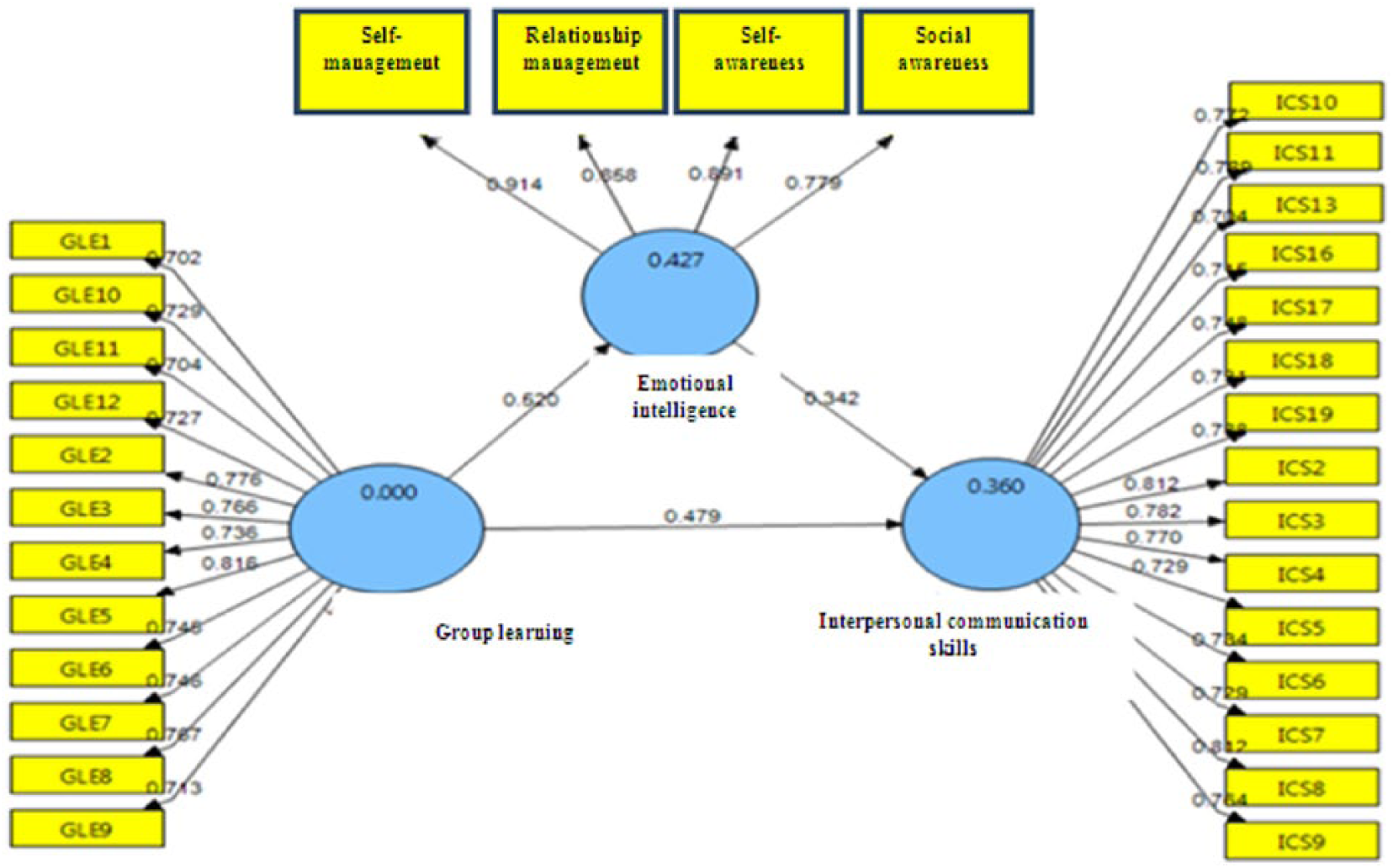
The Standard path coefficient of the conceptual model.

Student’s t test results to examine the path coefficients.
The numbers written on the paths represent the path coefficients. To test the significance of path coefficients, using bootstrapping, the Student’s t test values were calculated. If Student’s t test value is greater than 1.96, path coefficient is significant at .05 levels.
Software output was used to test the hypotheses and test the significance of path coefficients between variables. Path coefficients and their meaningful results are given in Table 3.
The Results of Structural Model Evaluation for Research Hypotheses.

Given the output of the conceptual model of the research, the research hypothesis will be examined.
The output of structural equations was used to investigate the mediator role of emotional intelligence. Table 4 shows calculation of the direct, indirect, and total effect of group learning on interpersonal communication skills.
Direct, Indirect, and Total Effect Between Group Learning and Interpersonal Communication Skills.

As shown in Table 4, the direct effect of group learning on interpersonal communication skills was 0.479, and the indirect effect of the competition between group learning and interpersonal communication skills with the effect of the mediating variable, emotional intelligence, was equal to 0.178.
Sobel test is used to investigate the mediating role of emotional intelligence in the effectiveness of group learning in interpersonal communication skills and to measure the effect of a mediator variable on the relationship between the two other variables. In Sobel test, Z value is obtained by the following formula; if this value is more than 1.96, at 95% confidence level, the mediating role of a variable can be confirmed.

where a is the value of the path coefficient between the independent variable and the mediator, b is the value of the path coefficient between the mediator and dependent variables, Sa is the standard error of the path between the independent variable and the mediator, and Sb is the standard error of the path between the mediator and dependent variables.
So we have,

As shown, z value obtained from the Sobel test was 4.975, and because it is higher than 1.96, one can state that at the 95% confidence level, the effect of the mediating variable, emotional intelligence, on the effectiveness of group learning in communication skills was significant. Therefore, the fourth hypothesis of the research was confirmed.
In addition to Sobel test, to determine the severity of the indirect effect through the mediator variable, Variance Accounted For (VAF) statistic that takes a value between 0 and 1 was used, and the closer this is to one, the stronger the effect of the mediating variable. In fact, this value measures the ratio of indirect to total effect.
VAF value is calculated by the following formula:

where a is the value of path coefficient between the independent variable and the mediator, b is the value of the path coefficient between the mediator and dependent variables, and c is the value of the path coefficient between independent and dependent variables.

This means that 27.1% of the total effect of group learning and interpersonal communication skills is indirectly explained by the mediator variable, emotional intelligence.
There is a relationship between group learning and interpersonal skills of preuniversity students in District 18 of Tehran.
As shown in Table 3, significance statistic between the group learning variable and interpersonal communication skills was 5.370, which is higher than 1.96, indicating that the relationship between group learning and interpersonal communication skills was statistically significant at 95% level of confidence. In addition, path coefficient between these two variables was 0.479, showing the positive effect of group learning variable on interpersonal communication skills. In other words, with 1 unit change in group learning, there would be 0.479 units increase in interpersonal communication skills. This means that group learning has a direct relationship with the interpersonal communication skills of students. Therefore, the first hypothesis of the research was confirmed.
There is a relationship between group learning and emotional intelligence of preuniversity students in District 18 of Tehran.
As shown in Table 3, a meaningful statistic between the group learning variable and emotional intelligence was equal to 7.744, which is higher than 1.96, indicating that the relationship between group learning and emotional intelligence at the level of confidence 95% was significant. The path coefficient between these two variables was 0.520, showing the positive effect of group learning variable on emotional intelligence. In other words, with 1 unit change in group learning, there was an increase of 0.520 units in emotional intelligence. This means that group learning had a direct relationship with students’ emotional intelligence. Therefore, the second hypothesis of the research was confirmed.
There is a relationship between emotional intelligence and interpersonal communication skills of preuniversity students in District 18 of Tehran.
As shown in Table 3, the meaningful statistic between emotional intelligence and interpersonal communication skills was 4.214, which is higher than 1.96, indicating that the relationship between emotional intelligence and interpersonal communication skills at the level of confidence 95% was significant. The path coefficient between these two variables was 0.342, showing the positive effect of emotional intelligence on interpersonal communication skills. In other words, with 1 unit change in emotional intelligence, there is an increase of 0.342 units in interpersonal communication skills. This means that emotional intelligence has a direct relationship with students’ interpersonal communication skills. Therefore, the third hypothesis of the research was confirmed.
Discussion and Conclusion
The purpose of this study was to investigate the relationship between group learning and interpersonal skills with emphasis on the mediator role of emotional intelligence (Case study: high school students in District 18 of Tehran [preuniversity education]). Findings of the research on the main hypothesis indicated that the direct effect of group learning on interpersonal communication skills was 0.479. Furthermore, the indirect effect of the competition between group learning and interpersonal communication skills with the effect of the mediating emotional intelligence was 0.178. The findings of this study are consistent with the results of previous studies by Trentacosta and Fine (2010), Ortega et al. (2010), Chalmers (2009), Johnson and Johnson (2002), McMaster and Fuchs (2002), Kyndt et al. (2013), and Puzio and Colby (2013). In a study titled “The Study of the Relationship Between Emotional Intelligence and Communication Skills of High School Students in Hamedan Based on Social Support Theory,” Nouri, Moeini, Karimi-Shahanjarini, Faradmal, Ghaleiha & Asnaashari (2014) concluded that there was a significant relationship between emotional intelligence and students’ communication skills. The level of communication skills of the students who participated in this study was moderate and the present study showed overall superiority of the scores of communication skills, emotional intelligence, and social support (except evaluation support) in the girls’ group as compared with the boys’ group. Moreover, there was a significant relationship between emotional intelligence and communication skills with social support tools. Many researchers assume a relationship between emotional intelligence and effective performance in accordance with the daily requirements of life (Dehshiri, 2006). Besides, the findings of Ahmadnejad, Hasani, and Pourmand (2014) showed that emotional intelligence, as compared with organizational intelligence, is more predictive of teachers’ organizational citizenship behavior. Findings of the first hypothesis of this study showed a statistically significant relationship between group learning and interpersonal communication skills (8.930), greater than 1.96, indicating that the relationship between group learning and interpersonal communication skills was statistically significant at confidence level of 95%. In addition, path coefficient between these two variables was 0.479, showing the positive effect of group learning on interpersonal communication skills. In other words, with 1 unit change in group learning, there is an increase of 0.479 units in interpersonal communication skills. This means that group learning has a direct relationship with the interpersonal communication skills of students. Findings of the second hypothesis showed a statistically significant relationship between group learning and emotional intelligence, 10.106 higher than 1.96, indicating that the relationship between group learning and emotional intelligence is significant at 95% level of confidence. Path coefficient between these two variables, 0.520, shows the positive effect of group learning on emotional intelligence. In other words, with 1 unit change in group learning, there is an increase of 0.520 units in emotional intelligence. This means that group learning has a direct relationship with students’ emotional intelligence. The findings of the last hypothesis also showed a statistically significant relationship between emotional intelligence and interpersonal communication skills (5.726), greater than 1.96, indicating a significant relationship between emotional intelligence and interpersonal communication skills at 95% confidence level. In addition, path coefficient between these two variables was 0.342, showing a positive effect of emotional intelligence on interpersonal communication skills. In other words, with 1 unit change in emotional intelligence, there is an increase of 0.342 in interpersonal communication skills. This means that emotional intelligence is directly related to interpersonal communication skills of students.
The findings of the present study confirmed the results of previous studies. Emotional intelligence is an effective and decisive factor in real-life outcomes such as success in school and education, occupations and interpersonal relationships, and general-health issues (Siroochi, Forgas & Mayer, 2005). J. D. A. Parker et al. (2004) found that high emotional intelligence correlates with high general health and has a negative relationship with risk behaviors, as well as being a very important variable in health and lifestyle activations. In explaining this result, one can state that emotional intelligence involves recognizing and controlling emotions. One who is emotional and with high emotional intelligence integrates three components of emotions—cognitive, physiological, and behavioral components—properly and practically. Emotional intelligence is an effective and determinant factor in real life, such as school, educational and job successes, interpersonal relationships, and overall health performance. Emotional intelligence can be defined as the ability to use one’s own or others’ emotions in individual and group behavior to obtain maximum results with maximum satisfaction. In addition, J. D. A. Parker, Hogan, Eastabrook, Oke, and Wood (2006) studied the dropout rate among students and found that continuing education was significantly related to the high level of emotional and social competence of students. Having high emotional intelligence predicts positive educational and social outcomes in students (Eisenberg, Fabes, Guthrie, & Reiser, 2000).
In explaining this result, one can argue that emotional intelligence together with group learning can reinforce interpersonal skills among students. Emotional intelligence is mainly defined as one’s ability to rethink his or her and others’ emotions, to distinguish between emotions and the use of emotional information in problem solving and behavioral ordering (Mayer & Salovey, 1990). Austin, Saklofske, Rohr, and Andrews (2007) believe that emotional intelligence is a combination of interpersonal and intrapersonal capacities useful for people with high emotional intelligence. Emotional intelligence is an important factor in determining the success of life and mental health because it affects the ability of individuals to cope effectively with environmental pressures and demands.
Footnotes
Declaration of Conflicting Interests
The author(s) declared no potential conflicts of interest with respect to the research, authorship, and/or publication of this article.
Funding
The author(s) received no financial support for the research, authorship, and/or publication of this article.