




Abstract
Mindfulness can be defined as the process of maintaining attention in the present, without judgment or expectations. Recent advances in sports sciences suggest that mindfulness meditation may have a positive effect on performance. The present article hypothesized that those improvements are associated with increasing levels of attentional control. Altogether, participants of the study are 40 elite football players who were followed longitudinally for 4 months during off-season control, and experimental groups were paired based on field position. Mindfulness skills and attentional control were measured. Results showed that participants from the experimental group kept the same levels of mindfulness skills and attentional control throughout the whole period of intervention, whereas the control group presented decrease after the third month in both psychological variables. The results lead to the conclusion that mindfulness meditation does not improve attentional control or mindfulness skills; however, it prevents those variables to show decrease among elite football players.
Introduction
Mindfulness can be defined as the cognitive procedure of intentionally maintaining attention in the present moment, with no judgment to the experience and expectations to what happens next (Kabat-Zinn, 1990, 2003). Bishop et al. (2004) suggested a two-component model of mindfulness: (a) Self-regulation of attention entails maintaining attention in the immediate experience, whereas (b) orienting of attention that involves experience with the orientation of curiosity, openness, and acceptance. Accordingly, Thera (1962) claimed the “Way of Mindfulness” should be called “the heart of Buddhist meditation,” as the author pointed out that the most simple and effective way of practicing mindfulness is still the way that Buddha taught: “mind’s own unshakable deliverance from Greed, Hatred and Delusion.”
Regardless, mindfulness research has expanded rapidly in the last 30 years, increasing from less than 80 in the decade of 1990 to over than 600 in 2006 (Brown, Ryan, & Creswell, 2007). Evidence-based practices of mindfulness procedures raised the interest of a number of clinicians to adopting those techniques into their therapeutic interventions (M. Allen et al., 2012; N. B. Allen et al., 2006; de Frias & Whyne, 2014; Desrosiers, Vine, Klemanski, & Nolen-Hoeksema, 2013). Indeed, N. B. Allen et al. (2006) claimed that, although teaching mindfulness to a group may be complex in some aspects, it also brings out some advantages that do not exist in individual therapy.
In the same extent of Western psychotherapy, mindfulness meditation was developed with focus to reduce psychological suffering (Germer, Siegel, & Fulton, 2016; Harrington & Dunne, 2015; Nunes, Jaques, Almeida, & Heineck, 2010). Group mindfulness-based interventions are also a good option to reach a larger number of individuals (King et al., 2013). There are many ways of practicing mindfulness for different goals, and different programs within psychotherapy, such as mindfulness-based stress reduction (MBSR; Eberth & Sedlmeier, 2012; Kabat-Zinn, 1990), mindfulness-based cognitive therapy for depression (MBCT; Klainin-Yobas, Cho, & Creedy, 2012; Segal, Williams, & Teasdale, 2002; van Aalderen et al., 2012), and dialectical behavior therapy (DBT), focused on treatment for “complex, difficult-to-treat mental disorders” (Dimeff & Linehan, 2001) and acceptance and commitment therapy (ACT; Hayes, Pistorello, & Levin, 2012; Hayes, Strosahl, & Wilson, 1999; Twohig, 2012). Those practices are so broad that evidence suggests efficiency of mindfulness-based practices either with or without meditation (Germer et al., 2016; Semple, 2010).
Garland, Gaylord, and Fredrickson (2011) presented evidence pointing out that increasing dispositional (trait; repeatedly engaged practice) mindfulness may increase positive cognitive reappraisal and benefit stress reduction. Likewise, Ma and Teasdale (2004) have showed MBCT is much effective in preventing depression relapses. Furthermore, in a research of Hölzel et al. (2007), brain activation in the rostral anterior cingulate cortex (ACC)—an area accounted for its pivotal role in the neural network involved in processing of emotional information (Bush, Luu, & Posner, 2000)—proposes that practice of meditation may cause greater emotional regulation during mindfulness rather than other dialectic therapies.
Attention is supposed to be sustained intentionally by every moment on determined object in mindfulness meditation, the most usual object is breathing (Smith & Novak, 2004) and its related sensations (Lutz, Slagter, Dunne, & Davidson, 2008). Lutz et al. (2008) suggested that during practice, if one notices that attentional focus shifted to another object, one must let the distraction go and then return the focus to the initial object. According to the literature (Barinaga, 2003; Creswell, 2016; Mrazek, Franklin, Phillips, Baird, & Schooler, 2013; Semple, 2010; Valentine & Sweet, 1999; Zeidan, Johnson, Diamond, David, & Goolkasian, 2010), practicing mindfulness meditation may develop one’s sustained attention, and distractions have lower effect during this procedure in daily routine than they tend to have among nonpractitioners (Hölzel et al., 2011). In addition, mindfulness meditation seems to be connected to cognitive and emotional regulation (M. Allen et al., 2012; de Frias & Whyne, 2014; Desrosiers et al., 2013; Gu, Strauss, Bond, & Cavanagh, 2015; Khoury, Sharma, Rush, & Fournier, 2015; Mrazek et al., 2013; Prakash, Hussain, & Schirda, 2015). There is also results in several studies suggesting that participants show improvement in perceived ability to shift one’s mood, cognitive flexibility (Hayes & Feldman, 2004; Khoury et al., 2013; Strauss, Cavanagh, Oliver, & Pettman, 2014; Tang, Hölzel, & Posner, 2015; Troy, Shallcross, Davis, & Mauss, 2013), working memory (Chiesa, Calati, & Serretti, 2011; Zeidan et al., 2010), visuospatial processing, and executive functioning (Ainsworth, Eddershaw, Meron, Baldwin, & Garner, 2013; Zeidan et al., 2010).
Attentional control is defined as a group of mental skills needed to manage attentional resources (Derryberry & Reed, 2002; Filgueiras et al., 2015). Basically, it is divided in two domains: sustained and divided attention. Sustained attention is the ability to keep in mind one task or one stimulus, only ignoring all other distractors. Divided attention entails both separating attentional resources to two or more stimuli at the same time and/or shift attention to another aspect of one stimulus in a way that it changes one’s perspective of the object (Derryberry & Reed, 2002). Filgueiras et al. (2015) suggests that attentional control is the main key for executive functioning. In fact, levels of attentional control strongly predicted performance in working memory, inhibitory control, and decision-making tasks which supports those claims.
There is also some evidence suggesting that executive functions are linked to athletic performance. Vestberger, Gustafson, Maurex, Ingvar, and Petrovic (2012) presented findings that indicated executive functions as good predictors of number of goals and level of performance among 47 elite football players. Also, Jacobson and Matthaeus (2014) supported the notion of association between executive functions and performance by testing inhibitory control and problem solving among swimmers and footballers. Results indicated that swimmers scored significantly higher in inhibitory control because they practiced their whole lives to inhibit outside distractors, whereas football players scored significantly higher in problem solving due to demands of fast decision making in football, according to authors.
Mindfulness-Based Practices in Sports
Regarding sports, mindfulness-based interventions focused in athletes’ performance still in its infancy. Gardner and Moore’s (2004) study pointed out the importance of the effects mindfulness-based interventions in acceptance and commitment of athletes’ own physiology, clarification of goals, and higher attentional control toward external stimuli. Indeed, Birrer, Röthlin, and Morgan (2012) drew theoretical outlines regarding the possible outcomes of psychological skills training (PST) considering both dispositional and practice of mindfulness among athletes. According to these authors, dispositional mindfulness among athletes can collaborate with three major aspects of PST: intention, attention, and attitude. Then, mindfulness is able to influence quite a wide range of psychological skills and athletes’ ability to train them. Beyond PST, Gardner and Moore (2012) provide evidence that suggests that mindfulness interventions among sportsmen and sportswomen, suggesting increase levels of global flow, self-awareness, ability to take action, and improvement in acceptance during self-talk. Although, this review supports mindfulness-based practices for athletes, it still lacks scientific evidence based on controlled experimental designs.
Accordingly, Scott-Hamilton, Schutte, and Brown (2016) and Kee and Wang (2008) also found benefits of mindfulness-based practices among athletes. Scott-Hamilton et al. (2016) investigated a 27-cyclists group aiming to study the influence of an 8-week mindfulness-based intervention over athletes’ mindfulness daily experiences, flow experience, and sport-specific anxiety. Results indicated statistical differences between pre- and postintervention, which suggests that mindfulness-based practices contribute to enhance daily mindfulness experiences to increase the frequency of flow experiences and to reduce sport-specific anxiety among sportspersons. Kee and Wang’s (2008) hypothesized that mindfulness practices correlates to attentional control among athletes: Participants who presented high dispositional mindfulness (i.e., athletes who already implemented mindfulness practices in their sports’ routines regardless of previous interventions) showed statistically higher scores in the test of performance strategies than participants with low dispositional mindfulness.
In fact, there is plenty of evidence suggesting that mindfulness-based interventions are linked to athletic performance. In a recent review of 19 papers (Sappington & Longshore, 2015), it was found that mindfulness meditation practice increases levels of flow state, attachment and commitment to goal-directed behaviors, and levels of attention and motivation during practices and competitions. However, only 4 among those 19 studies were randomized controlled trials, which impair the level of confidence of those findings and mindfulness practice to enhance athletic performance overall.
Afonso, Garganta, and Mesquita (2012) suggested that attention is one of the pivotal components in decision making among athletes. Moreover, Memmert (2007, 2011) proposes that improvement of attention-broadening team sports training may cause teammates’ creative performance, a psychological construct linked to executive functioning. It seems that attentional control benefits to mindfulness-based practices; however, whether mindfulness meditation only can lead to improvement of athletes’ attentional control is still a question to be answered in sport psychology. Accordingly, Gardner and Moore (2012) and Sappington and Longshore (2015) highlight the lack of controlled experimental designs in mindfulness-based intervention studies. The present study aims to address this question by identifying whether there are significant differences between mindfulness intervention and control condition toward attentional control through time in a randomized sample of elite football players.
Method
Participants
Altogether, 40 elite football players of the same professional team (i.e., American football or gridiron) aged between 18 and 39 years (M = 23.6; SD = 1.4) participated in the present experiment. Participants were randomly separated in two groups: an experimental group (Group 1) and a control group (Group 2), according to field position. There is evidence suggesting that field positions infer different cognitive demands (Lovell & Collins, 1998), for example, it is expected that a quarterback shows higher problem-solving skills, whereas a defensive tackle presents higher inhibitory control. The present study tried to divide athletes in groups randomly based on representation of their positions in the field (e.g., if 1 quarterback goes to Group 1, then another quarterback goes to Group 2, and so forth). To execute that, players were listed by position, alphabetic order, and ordinal number; in the first position, odd ordinal number went to Group 1, whereas even ordinal number went to Group 2, in the second position the process were reversed, and so on. Group 1 (N = 20; age average: M1 = 23.8; SD1 = 2.8) had athletes playing in the following positions (number of participants): center (1), cornerback (1), defensive end (2), defensive tackle (1), fullback (1), linebacker (2), quarterback (2), running back (2), offensive guard (2), offensive tackle (2), safety (1), tight end (1), wide receiver (2), whereas Group 2 (N = 20; age average: M2 = 23.3; SD2 = 4.9) had those field positions (number of players): center (1), cornerback (1), defensive end (2), defensive tackle (2), fullback (1), linebacker (1), quarterback (2), offensive guard (2), offensive tackle (1), running back (2), safety (2), tight end (1), and wide receiver (2).
Measures
Two instruments were used to assess athletes’ attentional control and mindfulness skills: the Brazilian-adapted version of Attentional Control Scale (ACS; Derryberry & Reed, 2002; Filgueiras et al., 2015) and the short version of Kentucky Inventory of Mindfulness Skills (KIMSs-Short).
ACS (Derryberry & Reed, 2002)
The ACS is an instrument developed with 20 items to be completed on a Likert-type scale with four categories of answer: 1 = “almost never”; 2 = “sometimes”; 3 = “often”; and 4 = “always.” It aims to measure one’s attentional focus control and divided attention. Examples of items are “My concentration is good even if there is music in the room around me” or “I can quickly switch from one task to another.” Filgueiras et al. (2015) presented a translated and semantically adapted version of ACS to Brazil used in the present study.
KIMSs-Short (Höfling, Ströhle, Michalak, & Heidenreich, 2011)
The KIMSs are a measure developed by Baer, Smith, and Allen (2004) that assess basic mindfulness skills. Its short version (Höfling et al., 2011) has 20 items and five categories of answer in a Likert-type scale: 1 = “never or very rarely true”; 2 = “rarely true”; 3 = “sometimes true”; 4 = “often true”; and 5 = “very often or always true.” This inventory goal is to quantify four mindfulness skills: observing, describing, acting with awareness, and accepting without judgment. Examples of items are “I pay attention to whether my muscles are tense or relaxed” or “I get completely absorbed in what I’m doing, so that all my attention is focused on it.” To conduct the present research, translation and semantic adaption of KIMSs-Short for the Brazilian context were developed following the International Test Commission (ITC) guidelines for translating tests (ITC, 2010).
Procedure
Participants were recruited in their practice environment by one of the main authors (Y.C.B.). The research objective was explained, and volunteers were informed that experimental and control groups should complete the two questionnaires above-mentioned once in every month and in a period of 5 months, respectively. One baseline assessment (both instruments) occurred at the end of the championship season, and monthly, the questionnaires were sent by e-mail to be filled until 30 days after interruption of the procedure. It went through the whole off-season and was interrupted when they went back to practice.
According to the orientations of Lutz et al. (2008) and Smith and Novak (2004), the following steps of mindfulness meditation were instructed to the experimental group: Sit down in a comfortable place and rest your hands over your knees. Close your eyes. Breath in deeply and slowly using your diaphragm. Hold your breath for 3 seconds and then breath out slowly, focusing your entire attention in your own body; do it for 10 minutes. If somehow you lose your focus during the meditation, let the distraction come, understand it, gently let it go and refocus your attention to your breathing.
This text was recorded in a computer by one of the authors (A.F.) and a website was designed with data of participants for this experiment. Participants were asked to login the website and hear the recorded audio file at least three times a week. The experimental group had to proceed with their meditation, whereas the control group only had to login the same three times a week without any task or agenda related to psychological interventions, that is, they logged in and then went to do anything on the Internet or even turn off the computer if they wanted. After the period of 3 months, experimental group was asked to stop their meditation practices. A final assessment took place 30 days after participants were asked to stop their mindfulness meditation
An informed consent form was sign by all volunteers. Participants were free to quit the experiment whenever they decided. The research was approved by the Ethics Committee of the Rio de Janeiro State University, Brazil, protocol 016.780/2016.
Statistical Analyses
Descriptive statistics of ACS’s and KIMSs’s total scores were calculated. Mean and standard deviation for baseline assessment, 30 days after baseline (first month), 60 days after baseline (second month), 90 days after baseline (third month), and 30 days after the interruption of mindfulness meditation practice follow-up are presented.
Mean total scores for ACS and KIMSs of experimental and control groups were compared using student’s t test for each moment when assessment took place. Effect size of the five results of t test was measured by Cohen’s d and thumb rule was used to interpret those values: between 0.2 and 0.5, the effect size is small; between 0.5 and 0.8, the effect size is medium; and effect size above 0.8 is large (Rice & Harris, 2005). A repeated measures ANOVA was also conducted to compare variance of ACS and KIMSs according to moment of assessment (five levels: pre-intervention, 30 days of intervention, 60 days of intervention, 90 days of intervention, and follow-up of 30 days, within-participants) and groups (two levels: intervention and control, between-participants). Results are presented for those two independent variables (moment and group) and their possible interaction. A Bonferroni post hoc test was performed to pairwise comparison. Power of the test was calculated using post hoc procedure provided in G-Power software (Faul, Erdfelder, Buchner, & Lang, 2009). Effect size of repeated measure ANOVA was performed using generalized eta squared (
Results
Mean and standard deviation are depicted in Table 1. Inferential statistics to compare ACS and KIMSs pairwise between groups are also present. No statistical difference (p < .05) was found between groups until the follow-up assessment in both scales: ACS and KIMSs. However, effect size as measured by Cohen’s d raised from low (baseline and first month) to moderated (second and third months) and reached high effect size in the last assessment for both total scores. In the last assessment, follow-up experimental group showed higher total scores in attentional control and mindfulness skills when compared with the control group. Statistical power ranged between 0.09 and 0.96, with only 2 t tests presenting power below 0.60.
Mean, Standard Deviation, Student’s t Test Results, Statistical Power (Power) and Cohen’s d for Effect Size of Both Scales Divided by Moment (Time) and Group (Control and Experimental).
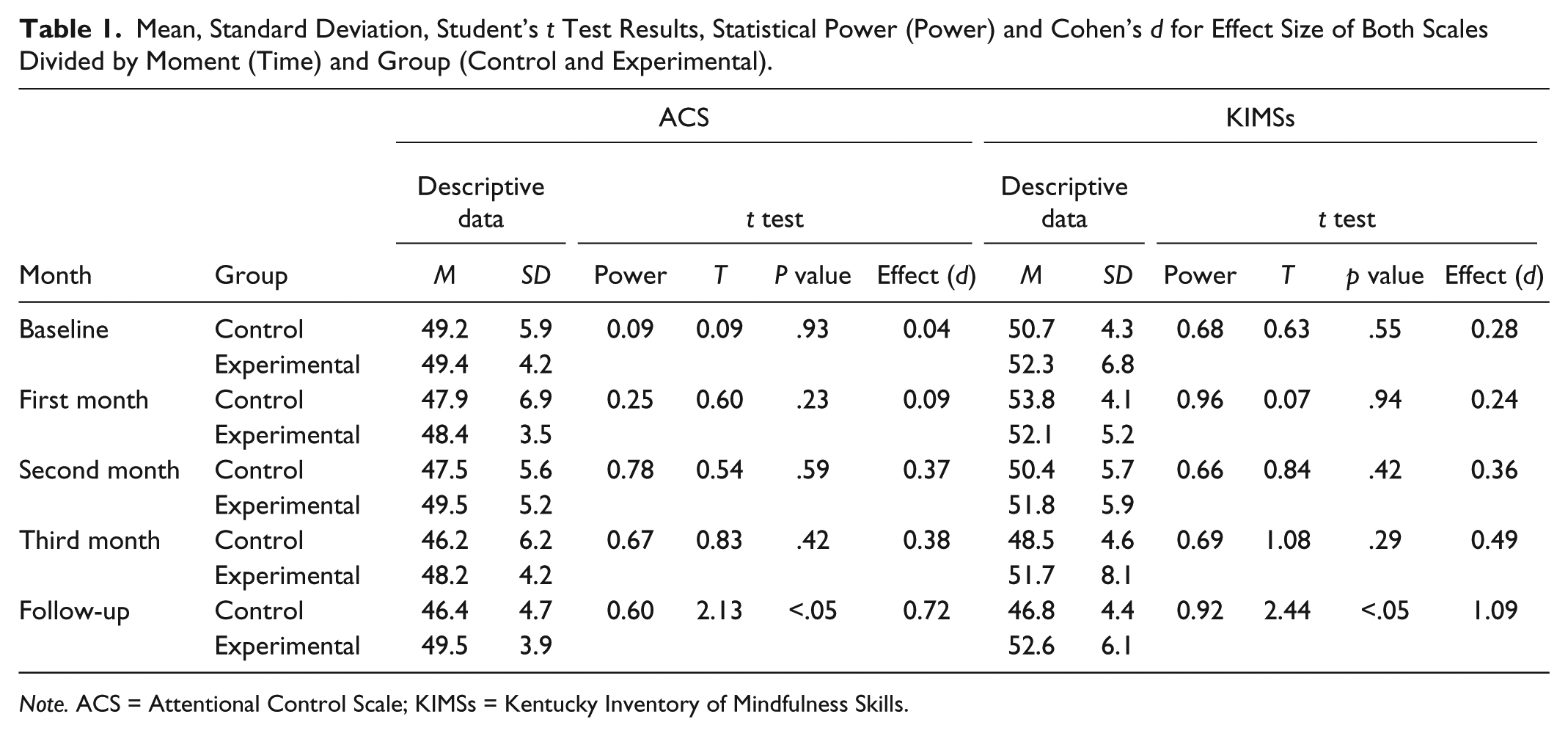
Note. ACS = Attentional Control Scale; KIMSs = Kentucky Inventory of Mindfulness Skills.
Repeated measures ANOVA results are presented in Table 2. The first independent variable: time, or moment when the assessment took place, showed significant differences (p < .05) in both assessment measures, whereas effect size was moderate (0.10 <
Repeated Measures ANOVA Results Giving F Value, Degree of Freedom (df), p Value, Statistical Power, and Effect Size as Measured by Generalized Eta Squared (

Note. KIMSs = Kentucky Inventory of Mindfulness Skills; ACS = Attentional Control Scale.
Finally, interaction between independent variables showed statistical significance in both ACS and KIMSs, with high effect size (
Discussion
The present experiment aimed to understand whether mindfulness meditation practices during off-season would affect in attentional control of football players. Results did not fully corroborate with the hypothesis initially raised by the present study for two reasons: first, medium effect size only appeared 60 days after baseline and second, means of total scores did not increase in the experimental group, they actually decreased in the control group. That evidence suggests distinct things that are going to be addressed here. Regardless, this research showed that time of mindfulness practices indeed influences in attentional control and mindfulness skills among athletes, however, the effect only strengthened after 60 days of intervention—leading to a statistical difference 120 days after baseline—suggesting that mindfulness-based interventions are not brief strategies to be used once or twice, rather than that, it requires a long-term strategy of practice. Indeed, Thera’s (1962) proposition is based on mindfulness as a way of life, not just a technique to be used whenever convenient. Bishop et al. (2004) argue that self-regulation is a daily practice and mindfulness helps the individual to keep the focus of attention in the present moment, but it also demands years of training. Hölzel et al. (2011) and Hölzel et al. (2007) suggest that mindfulness meditation leads to development of consciousness and attention to the present, however, this enterprise takes long time due to structural modifications in neural networks of the brain.
The present research seems to have found a minimum time to mindfulness-based meditation to be efficient: 60 days, based on effect size of the t test, and this results remained for the rest of evaluations. Nevertheless, the effect of this practice seems to keep up even after its interruption, which means that there is a tendency of intensification as days go by. Interestingly, attentional control presented the same results as mindfulness skills. Those results suggest a relationship between those variables. It corroborates with findings of Ainsworth et al. (2013), Chiesa et al. (2011), Hayes and Feldman (2004), and Zeidan et al. (2010) that links attentional control to executive functions and mindfulness practices. In fact, findings of the present article provide for the first time evidence of this relationship among elite athletes. Kee and Wang (2008) already had highlighted the impact of mindfulness-based interventions in overall attention. In fact, the results of this article corroborate with those authors’ evidence, suggesting that mindfulness does affect positively in the ability of a participant to control his or her attention. Nonetheless, this ability takes time to be developed, and, only after 60 days of intervention, the experimental group was able to show medium effect size when compared with the control group.
Regarding total scores means, a very interesting phenomenon had occurred: participants of the experimental group started showing the same levels in both mindfulness skills and attention control than the control group; however, as the experiment went on, means of the control group decreased, whereas means of the experimental group remained the same. The time to significantly improve KIMSs scores is probably greater than 90 days, so the present results suggest that mindfulness-based interventions take more than 3 months to expect any significant change. To explain those results, Garland et al. (2011) suggests that there is a dispositional factor of mindfulness, thus, some individuals present basic levels of mindfulness skills higher than others. It seems that sportspersons of a game such as football are predisposal to show attentional control already high when compared with other studies with samples of nonathletes (Derryberry & Reed, 2002). Indeed, elite athletes tend to show higher mean scores in attentional and visuospatial tasks when compared with controls (Afonso et al., 2012; Scott-Hamilton et al., 2016). A combination of dispositional mindfulness (Garland et al., 2011) and the cognitive training indirectly involved in sports practice (Afonso et al., 2012) may explain that both experimental and control groups showed high levels of attentional control and mindfulness skills. It is imperative to highlight that the present experiment began in the end of a season, thus, athletes were near their peak performance, it could be the explanation why controls showed a decrease in their mean scores through off-season
Altogether, the results presented in this research points to two separate things: first, elite athletes can benefit from mindfulness meditation practices corroborating with previous findings (Kee & Wang, 2008; Scott-Hamilton et al., 2016); however, it takes at least 3 to 4 months to show any effect. Perhaps, interventions combining meditation and other mindfulness techniques (Memmert, 2011; Tang et al., 2015; Troy et al., 2013) may show themselves more efficient than only mindfulness meditation as used in the present experiment. Second, elite athletes are likely to show high levels of attentional control and mindfulness skills due to their already cognitive-demanding sports practices (Afonso et al., 2012); although, during off-season they tend to present a decrease in those psychological constructs. In this aspect, the present study provides evidence that a mindfulness-based practice during off-season can help athletes to keep their minds in a better level of cognitive performance, then becoming ready faster to the beginning of championship seasons.
Limitations of the Study
The present study aimed to understand how a mindfulness meditation intervention would influence mindfulness skills and attentional control among elite football athletes. The first issue was to follow athletes in their practices every day. Despite of having a website and a recorded guide, there is no way to be sure all participants were in fact doing their mediation. Other issue is that both ACS and KIMSs are self-reported measures, so participants would be free to answer whatever they wanted even if they were asked to respond as honest as possible.
Regarding statistical analyses, two problems were faced during this study: small sample size and null hypothesis testing. A small sample size, regardless of normal distribution tests, always tends to limit findings due to its large variance. A larger variance means smaller chance of significant differences based on null hypothesis tests p values. Because of that, the present article adopted Cohen’s d effect size as its main statistical index. However, Rice and Harris (2005) raised concerns about the thumb rule of 0.2, 0.5, and 0.8 because they do not correspond to correlation of 0.1, 0.3, and 0.5 as argued by Cohen in any empirical article. So, even this criterion is questionable.
The other method adopted to understand whether results of present study were reliable was statistical power. Power above 0.80 is desired because it would represent the assumption of 80% of the time it will not make a Type 2 error or a false negative decision. A large number of statistical results showed power below 0.80; however, the main results: differences between groups in KIMSs and ACS through time showed high power, so generally, the study suffers because of its small sample size although some findings are reliable, mainly when it shows significant statistical differences. However, psychology and human sciences lack more reliable statistical procedures, and the present article trusts in the power of longitudinal randomized experimental design rather than statistics itself.
Footnotes
Acknowledgements
The authors thank the valuable contributions of Taís Brasil and Bruno Barreto for their insights to the present research.
Declaration of Conflicting Interests
The author(s) declared no potential conflicts of interest with respect to the research, authorship, and/or publication of this article.
Funding
The author(s) disclosed receipt of the following financial support for the research, authorship, and/or publication of this article: The present research was possible because of the Grant INST 211.250/2016 from FAPERJ, Brazil.
