




Abstract
Fear of retaliation poses a significant barrier to workers exercising their employment rights and claiming statutory benefits. This study of 2000 workers in the western Canadian province of Alberta found modest overall levels of worker fear (16%) of retaliation. Much higher fear levels (>40%) are reported in the most dangerous workplaces. Fear levels also escalated as the exercise of rights became more active, concrete, and potentially costly and disruptive for the employer. Workers who did not claim workers’ compensation benefits or refuse unsafe work flagged fear of retaliation as a significant factor. These findings raise serious questions about the effectiveness of making workers primarily responsible for triggering the enforcement of employment rights.
Introduction
This study quantifies the presence and experience among workers of fear of retaliation for claiming statutory employment rights in the Canadian province of Alberta. As in other North American jurisdictions, workers filing complaints and claims is the main enforcement trigger for employment rights in Alberta. The 2015 election of the left-leaning New Democratic Party (NDP) as the government of Alberta resulted in a significant 2017 extension of statutory employment rights to closely mirror those in other Canadian provinces. Nevertheless, Alberta continues to rely upon worker complaints to trigger enforcement and there has been little change in the scope and manner of enforcement. Complaint- and claims-based enforcement of employment rights assumes workers are willing and able to pursue their rights. Prior research has revealed that there is a significant level of under-claiming of benefits for workplace injuries (Barnetson, Foster, & Matsunaga-Turnbull, 2018; Shannon & Lowe, 2002). This study examines fear of retaliation as a potential explanation for workers’ reluctance to exercise various statutory employment rights by establishing baseline levels of worker fear levels around exercising 14 employment rights.
While Canada and the United States share many linguistic and cultural similarities, there are important differences in employment law. Provincial or territorial governments set most statutory Canadian employment law and these laws attenuate freedom of contract. For example, employment in Canada is presumed to be indefinite rather than at will. Furthermore, entitlements rarely vary by employee type (e.g., there is no difference between being a salaried and a waged employee) and most disputes are settled by administrative tribunals, rather than proceeding to court. Canada’s laws around unionization and collective bargaining, although superficially similar to U.S. laws, have resulted in much higher levels of unionization and enjoy constitutional protection (Doorey, 2016). That said, employers and the state have made a concerted effort to rollback such rights since the 1980s (Yates & Coles, 2014). Despite these differences, this study will be of interest to U.S. readers as the level and pattern of employee fear identified are likely to also be found in jurisdictions with less expansive statutory regimes.
Workplace Rights in Canada
Beginning in the early 20th century, the basic framework of modern Canadian labor rights began to emerge in the form of factory acts, minimum wage laws, and workers’ compensation systems (Tucker, 1991). The contemporary framework regulating unionization and collective bargaining took until mid-century to crystallize (Fudge & Tucker, 2001). Governments began enacting laws aimed at reducing employment discrimination following the Second World War, but progress has been slow (Jeffrey, 2016). Modern health and safety laws emerged only in the early 1970s (Foster & Barnetson, 2016).
Canada is a federal system wherein its 10 provinces and three territories are responsible for regulating approximately 90% of employment relationships. The western province of Alberta has a workforce of approximately 1.9 million nonmanagerial employees (Alberta Labour, 2017b). The long-standing social and fiscal conservatism of Alberta’s government prior to 2015 gave rise to a labor relations climate similar to that experienced by many American workers. For example, Alberta’s private-sector unionization rate was approximately 10.8% in 2016, whereas, bolstered by high levels of public-sector unionization, the overall unionization rate was 23.5% (Alberta, 2016). Over time, Alberta’s legislature enacted a typical suite of statutory rights and obligations regulating employment relationships:
The Employment Standards Code prescribes minimum terms and conditions of employment related to wages, hours of work, and vacations.
The Occupational Health and Safety Act requires employers to identify and control workplace hazards and provides workers with three safety rights (to know, participate, and refuse) common to the internal responsibility system (IRS).
The Labour Relations Code regulates unionization and collective bargaining.
The Human Rights Act prohibits discrimination on various enumerated grounds.
The Workers’ Compensation Act creates an employer-funded system of benefits for workers who sustain a workplace injury.
Across Canada, civil servants administer and enforce statutory rights and obligations. In Alberta, enforcement efforts are minimal. For example, Alberta’s occupational health and safety staff conducted over 7,600 inspections in 2016 (Alberta Labour, 2017d). While this is a large absolute number of inspections, it is important to note that these inspections affected only 4,261 employers (<2%). Enforcement activities focused on writing compliance orders (approximately 7,000) with only 12 employers formally charged under the Occupational Health and Safety (OHS) Act, seven employers receiving an administrative penalty (ranging from Can$2,500 to Can$42,500), and a small number of low-value tickets issued to both employers and workers (Alberta Labour, 2017a, 2017c, 2017e). Elsewhere, Foster (2011) and Barnetson (2015) have argued there is evidence of regulator capture by industry, wherein employer groups have acquired a disproportionate influence over the direction of employment regulation and enforcement. Alberta’s modest enforcement efforts may help to explain Alberta’s high rate of occupational injury (Morassaei et al., 2013).
All statutory employment law provides mechanism for workers to make claims when their rights are violated. Sometimes (e.g., when faced with unsafe work), the expectation is that the worker will first direct concerns to the employer. This approach is consistent with the “up the ladder” approach to whistle-blowing under the common law. Employers are consistently prohibited from retaliatory action against workers who advance concerns or, subsequently, file complaints with the government through statutory processes. The process of adjudicating retaliation complaints varies by jurisdiction but the consequences for retaliation tend to be modest (McEvoy, 2016).
Indeed, workers’ voice is fundamental to the operation of employment legislation. For example, the IRS that forms the basis of government injury-prevention legislation requires workers to help employers identify and control hazards and, when employers fail to control hazards, to refuse unsafe work and/or complain to government to trigger inspections. Workers must also report injuries to gain workers’ compensation benefits and report unpaid wages or other violations of employment standards to trigger remediation. Workers’ whose associational rights have been violated must file (often through their union) unfair labor practice complaints with the Labour Relations Board. Indeed, the majority of enforcement activity in Alberta is complaint or claims driven. For example, in 2016/2017, there were 5,853 complaints about employment standards violations registered with Alberta Labour. Of these, employees filed 5,373 complaints and the remaining 480 were triggered by anonymous tips. By contrast, Alberta Labour (2017e) initiated only 679 employment standards inspections (mostly directed at employers of youth and migrant workers).
Requiring employees to take pro-active steps to exercise their rights comes with the risk that employers will seek to reduce claims and complaints. Most Canadian labor and employment legislation prohibits employers from interfering with or retaliating when workers exercise their rights. For example, Alberta’s Labour Relations Code reads, 149(1) No employer or employers’ organization and no person acting on behalf of an employer or employers’ organization shall (a) refuse to employ or to continue to employ any person or discriminate against any person in regard to employment or any term or condition of employment because the person (viii) has exercised any right under this Act; (c) seek by intimidation, dismissal, threat of dismissal or any other kind of threat, by the imposition of a pecuniary or other penalty or by any other means, to compel an employee to refrain from becoming or to cease to be a member, officer or representative of a trade union;
The existence of anti-retaliation provisions reflects that some employers use their greater power in the workplace to intimidate workers in order evade statutory obligations or the sanctions that may flow from violating them. While there are numerous potential explanations for such employer behavior, a recurring one is that statutory employment rights and obligations increase employer costs. For example, overtime provisions directly increase costs by requiring employers to either pay a wage premium or hire more employees. Another example might be the use of a lockout process before workers clear a machinery jam, which indirectly increases costs by slowing production. As set out below, research suggests that fear of retaliation can influence workers’ willingness to claim rights and entitlements.
Voice, Silence, Fear, and Retaliation
Building on Hirschman (1970), Rusbult and Lowery (1985) categorized worker responses to deteriorating working conditions as exit, voice, loyalty, and neglect (EVLN). Exit culminates in the termination of the employment relationship. Voice is suggesting and acting in a way that workers hope will lead to improvement. Loyalty (sometimes called patience) reflects a decision to wait out a difficult period (sometimes silently), although such a choice does not always indicate passivity (Leck & Saunders, 1992). Neglect entails workers giving up on trying to make things better and can manifest itself as noncompliance, obstruction, or disengagement. Research suggests that workers’ select among these options based upon their level of satisfaction with, investment in, and alternatives to their current job (Farrell & Rusbult, 1992; Withey & Cooper, 1989). The way that workers move among these categories appears idiosyncratic and it is possible to respond in multiple ways simultaneously, such as a noisy exit (i.e., voice plus exit). The EVLN model has been applied to understanding workplace health and safety behavior (Barling, Kelloway, & Iverson, 2003; Cree & Kelloway, 1997; Tucker & Turner, 2011, 2013) as well as grievance-filing behavior (Boroff & Lewin, 1997).
Given that the operation of statutory employment law is predicated, at least in part, on worker participation, it is useful to consider further what voice and silence entail. Mowbray, Wilkinson, and Tse (2015) argue that scholars in human resource management/employee relations and organizational behavior conceptualize employee voice differently. A key difference is the tendency of organizational-behavior scholarship to define voice as a prosocial behavior (with benefits accruing to the organization), thereby avoiding dissatisfaction as a motive for voice (wherein benefits more likely accrue to the workers). Mowbray et al. (2015) suggest there are numerous commonalities between these approaches that are emerging and propose an integrated model focusing on what motivates voice, the content and target of voice, and the mechanisms and channels available for employees.
Van Dyne, Ang, and Botero (2003) helpfully note that silence and voice are not opposite ends of a single behavioral continuum, but rather are separate and multidimensional concepts. In this view, there are different types (i.e., acquiescent, defensive, and prosocial) of both voice and silence. Knoll and van Dick (2013) also suggest silence can also be opportunistic. What distinguishes each type of voice and silence is a worker’s motive for withholding or expressing information, ideas, or opinions. For example, silence can be motivated by resignation, fear, loyalty, cooperation, malevolence, and greed. These motives can give rise to neglect, loyalty, or voice responses in the EVLN model (but do not map neatly onto the EVLN framework) and there is significant possibility for observers to incorrectly infer the motives of others.
There are many ways and venues in which workers can voice concerns in and about the workplace and voice is often mooted to provide important organizational benefits (Gollan & Wilkinson, 2007). One form of voice is expressing a concern or a complaint to a supervisor, employer, or regulatory body. There is significant evidence that workers often refrain from such action (Galizzi, Miesmaa, Punnett, & Slatin, 2010; Milliken, Morrison, & Hewlin, 2003; Morrison & Milliken, 2000; Salin, Teniälä, Roberge, & Berdahl, 2014) due, in part, to fear of consequences for speaking out. Gullone (2000) asserts fear is a normal reaction to real or imagined threats. Fear has utility for individuals in that it can signal danger and motivate a response. For example, fear of challenging authority (i.e., more powerful individuals or groups) is commonplace, perhaps reflecting that this behavior conferred (or confers) an evolutionary advantage (Milliken et al., 2003). Fear can also be used as a tool to shape worker behavior. An extreme example might be the use of bullying as a management strategy to increase productivity and suppress dissent (Beale & Hoel, 2011).
Kish-Gephart, Detent, Kelbe Trevino, and Edmondson (2009) assert that the nature of fear-induced workplace silence may differ depending upon the (potentially inter-related) circumstances of the moment (e.g., intensity and immediacy of fear, with whom the worker is dealing). Research by Salin et al. (2014) supports this assertion, noting that even relatively high-status workers who experience mistreatment often behave less assertively than they might wish to, with their responses varying based upon severity of mistreatment, the coping strategy selected, the relative organizational statuses of those involved, and victim gender. In the workplace context, taking no action (i.e., reflexive silence) can be a response that workers may choose unconsciously. Workers may also use schemas or implicit theories (Detert & Edmondson, 2011) to relate situational cues to past experiences (e.g., the last worker to complain got laid off) and thereby trigger reflexive silence. Silence may also be deliberative—a thought-through and rational choice to avoid potentially dangerous situations or retaliation (Salin et al., 2014). Over time, silence may become habituated behavior, particularly if it is reinforced through some combination of rewards and sanctions. Such conditioning can be overcome by anger (e.g., at mistreatment or injustice) and/or developing a belief in the efficacy of using voice to remediate problems.
Given this, it is striking that governments so heavily rely upon workers’ complaints and claims to trigger enforcement or benefit payments. One explanation for this policy choice is that relying on worker complaints and claims is designed to direct public resources to problem employers. There is fairly compelling evidence that this expectation is unrealistic. In examining enforcement of employment law in 2008 for low-wage, front-line workers in the three largest cities in the United States, Alexander and Prasad (2014) demonstrate that workers (a) do not have adequate knowledge to identify violations and trigger enforcement, and (b) are reluctant to make complaints (either to their employer or, much less frequently, a government agency).
Workers’ reluctance to file complaints stems, in part, from their fear of retaliation. This fear is justified given that 43% of complainants in Alexander and Prasad’s (2014) study reported experiencing retaliation, whereas another 14% witnessed retaliation against a coworker who complained. A second barrier to workers voicing complaints is skepticism about the efficacy of doing so. Again, workers’ experience validates this perception with only 15% of complainants having their employer address or promise to address their concern (Alexander & Prasad, 2014). These issues are most acute for traditionally vulnerable populations (e.g., workers who are one or more of female, undocumented, low-wage, and nonunionized) who face potentially great economic hardship if they are retaliated against for making a complaint (Lola, 2017). While Canadian laws around workplace harassment (particularly in the provinces of Quebec and Alberta) tend to provide greater protection than comparable U.S. laws, both unionized and nonunionized workers must still cope with lengthy waiting periods and only partial remedies (Doorey, 2016). These barriers suggest that paradoxically, worker-driven, complaint-based system may direct enforcement resources away from the workers most in need of state protection.
Other researchers have found similar dynamics around fear of retaliation in health and safety, employment standards, and unionization (Boroff & Lewin, 1997; Fiorito & Bozeman, 1996; Lewchuk, 2013; Tucker & Turner, 2013; Walters & Haines, 1988; Weil & Pyles, 2005). Research (mostly into union-organizing campaigns) suggests such fear of retaliation for exercising rights is well founded (Bentham, 2002; Gall, 2009). Tucker and Turner’s (2011) study of young workers’ safety-behaviors found few formal refusals of unsafe working, giving credence to Gray’s (2002) assertion that workers will often avoid formally exercising their safety rights in favor of other, less effective, informal strategies. Overall, workers appear to weigh the consequences of voicing a claim or complaint against the costs and benefits of other options (loyalty, neglect, or exit), a calculation that may be shaped by their fear of retaliation (Salin et al., 2014). Based upon this and using Lewchuk’s (2013) study as a starting point, we developed three research questions:
Method
The data for this study were collected by means of an online poll conducted between March 24 and April 5, 2017 on behalf of the researchers by a commercial polling firm. The respondents comprised 2,000 Albertans who engaged in paid, nonmanagerial employment in Alberta in the previous 12 months. Respondents were randomly selected by the polling firm selected from a list of over 1 million Canadian adults (18+ years) who had volunteered to participate in online polls maintained by a separate national polling firm. This pool of potential respondents broadly matched the overall composition of the Canadian population. Consistent with the principles of nonprobability sampling (Vehovar et al., 2016), the researchers confirmed that the age and gender distribution of the respondents completing the poll broadly matched those of Statistics Canada’s Labour Force Survey (Statistics Canada, 2017) and respondents’ industry distribution also broadly matched the distribution reported by Alberta Labour (2017f). As there is no population data that exactly matches the parameters of the poll, it was not possible to weight the data. Online polling was selected over a telephone survey using a probability sample to maximize the sample size. This decision reflects that the researchers expected that a large sample was required to generate an adequate number of respondents who experienced relatively low-frequency events, such as retaliations for work refusals
Respondents completed a 39-item questionnaire that included demographic information (see Table 2) and their workplace fixed-answer questions about their experiences of injury and unsafe work (see Tables 4, 5, and 6). Respondents were also asked how often they were exposed to 15 common safety hazards on a 5-point scale ranging from never to all of the time. We were unable to locate a universally applicable list of workplace hazards suitable for survey work. Lewchuk’s (2013) survey inquired into four kinds of hazards (uncomfortable temperatures, poor air noise, and toxic substances). Drawing upon our experiences (Foster & Barnetson, 2016) and a prior (unpublished) survey of Alberta workers, we developed a list of 15 hazards we believed that employees would be able to identify through simple observation of their workplace. The list of hazards was repetitive motions or procedures, dusts, working alone, noise, heavy equipment or machinery, lifting/pushing/pulling heavy loads, extended shifts/overtime/long work hours, bodily fluids, extreme heat or cold, inadequate lighting, chemicals/fumes/mists, violent/abusive people, slippery floors/hazardous surfaces, working at heights, and unsafe equipment/work stations. Respondents who reported exposure always or most of the time were recorded as routinely exposed. Other responses were classified as not routinely exposed. A hazard-exposure scale was created by totaling the number of hazards to which respondents were routinely exposure. The scale ranges from 0 (no routine exposure) to 15 (routinely exposed to all hazards).
Finally, respondents were presented with a list of 14 rights-claiming scenarios (set out in Table 1). For each scenario, they were asked if they feared negative consequences from their employer if they took such action (yes/no). We operationalized this fear as fear of retaliation because retaliation is (a) commonplace, (b) statutorily prohibited, and (c) a broad but reasonably concrete outcome that we believed workers could assess the likelihood of occurring. These scenarios were loosely based upon prior research by Wayne Lewchuk (2013) into Ontario workers’ perceptions of the outcome of exercising statutory rights. We extended Lewchuk’s list of questions based upon our respective experiences as researchers, OHS practitioners, worker advocates, and government bureaucrats to provide a more fulsome picture of the statutory employment rights possessed by Alberta workers. These scenarios were divided into five statutory domains (see Table 1). Some of the domains contained more than one item, representing an expected escalation in the degree of employer resistance to workers exercising that right. To aid in data analysis, respondent’s answers to the 14 scenarios were compiled to generate a fear scale. The scale, ranging from 0 (never reported fear) to 14 (reported fear in all scenarios) is used in the analysis as a measure of how generalized were respondents’ reported fears. The full questionnaire and data set is available from the authors upon request.
Expectation of Negative Consequences (%).

The key limitation of this study is that it is based upon a nonprobability sample. Previous academic criticism of the accuracy and consistency of online, nonprobability polls (e.g., Yeager et al. 2011) has been demonstrated by recent research to be overstated. A recent comparison of nine online polls found polls with more elaborate sampling and weighting schemes yielding more accurate results (Kennedy et al., 2016). Other studies note that the response patterns and relationships among variables generated by online panels broadly mirror those found in conventional probability samples (Martinsson et al., 2013; Walter et al., 2016). Criticism of error rates in nonprobability samples often ignore the question of whether slightly lower margins of error found in probability sampling warrant the significant (e.g., 10×) additional cost of probability sampling given how end users will use the data (Goel et al. 2015). There are three additional limitations to this study. First, there is the potential for respondent memory decay. To minimize the risk or memory decay, respondents were asked about their personal experiences and views over the prior 12 months. Second, there is the use of a nonvalidated survey instrument. There was no way to mitigate this limitation, although (as discussed below) the results of the survey are broadly similar with other, similar studies. Third, the election of an NDP government may have affected the perceptions of respondents about the potential risks of reporting statutory violations, although, given their short tenure, this is unlikely.
Results
Workers were asked whether they thought each of 14 scenarios would have a negative effect on the way they were treated by their supervisor or employer. We subjected this data to two analyses that respectively examined:
the level of specific fears among different groups of workers,
the overall level of fear for different groups of workers.
We also queried workers who did not file an injury report or refuse unsafe work about their reasons for not doing so.
Specific Fears of Retaliation
Table 1 reports respondents’ fear of retaliation in each scenario based upon specific worker characteristics. Overall, across the 14 scenarios, an average of 16% of respondents reported that taking action would have a negative effect on their employment. Worker fear levels tended to increase as the scenario became more active, concrete, and potentially costly and disruptive for the employer. For example, 10% of workers expressed fear about asking for health and safety information. This rose to 12% for raising a health and safety concern, 18% for refusing unsafe work, and 23% for reporting unsafe working conditions to government inspectors. Fear levels were highest (averaging 22.5%) when the actions involved making a complaint to a regulatory body.
Some groups of workers reported a greater-than-average fear of retaliation. Most notably respondents who reported routine exposure to seven or more hazards at work consistently expressed levels of fear that were two to four times higher than average. Workers in these high-hazard industries were also almost twice as likely to be injured than average. That workers who are most likely to be injured also report the highest levels of fear (>40%) about exercising their safety rights suggests that complaint-based safety enforcement may be weakest in precisely the workplaces that need it most. Interestingly, these workers are also very fearful about exercising other workplace rights, including reporting their injuries.
Younger workers also report higher levels of fear than older workers, with workers aged 25 to 34 years reporting the highest levels of fear. It is unclear what causes this effect. It may be related to job tenure (fear also decreases as job tenure increases). It may also be related to hazard exposure as workers under 35 years are noticeably more likely to report greater exposure to hazards. Workers who self-identified as being members of a visible minority identified greater levels of fear of exercising their rights in their workplaces in most of the 14 scenarios.
Workers in some industries consistently reported higher than average levels of fear. Workers in the manufacturing and processing sector consistently reported the highest levels of fear particularly around unionization, safety, and injury reporting behaviors. This may reflect an industry-wide culture of accepting the risk of injury as part of the job. Workers in the tourism/food services sector reported among the highest levels of fear around issues of wages, missing shifts, and refusing unsafe work. Workers in the retail sector also reported high levels of such concern. This pattern makes sense given that these sectors tend to offer precarious jobs and prioritize minimizing labor costs and service delivery interruptions.
Different groups of workers also expressed fear about different issues. The authors conducted z-tests and the results reported below were found to be statistically significant (p < .01) For example, while there were only modest gender differences in overall fear levels, what men and women feared differed. Men were more likely than women (20% vs. 16%) to fear discussing a union, whereas women were more likely than men to fear reporting harassment (19% vs. 15%). Full-time workers were more likely than part-timers to report fear of filing a report with government over unpaid wages (23% vs. 18%) and about unsafe work (25% vs. 18%). Interestingly, unionized workers were more likely than nonunionized workers to report fear of refusing unsafe work (22% vs. 16%), reporting harassment (23% vs. 15%), asking for modified work (19% vs. 14%), and health and safety information (13% vs. 9%), and reporting an injury (12% vs. 9%). These results for full-time and unionized workers were unexpected. Additional, likely qualitative, research would be required to determine what explains these outcomes.
Worker Characteristics and Degrees of Fear
Different groups of workers also exhibited different depths of fear of retaliation. That is to say, some types of workers reported overall greater levels fear and, therefore, experienced a more generalized fear of retaliation. Depth of fear was deemed analytically important because it affect the willingness of these groups of workers to speak out. Table 2 reports the correlation matrix that revealed that younger workers, workers who identify as being members of a visible minority, part-time workers, and workers with shorter job tenure all reported greater depth of fear than their counterparts.
Worker Characteristics Correlation Matrix.

p < .05. **p < .01.
Surprisingly, unionized workers were also more likely to report generalized fear. Furthermore, workers exposed to greater numbers of hazards and workers who reported being injured in the past 12 months reported greater depth of fear of reprisal. For the most part, industry is not significant, although workers in education and government and public administration were less likely to report fear. However, private-sector workers were more likely to report fear than public or nonprofit sector workers. Gender, country of birth, and other employment characteristics were statistically insignificant.
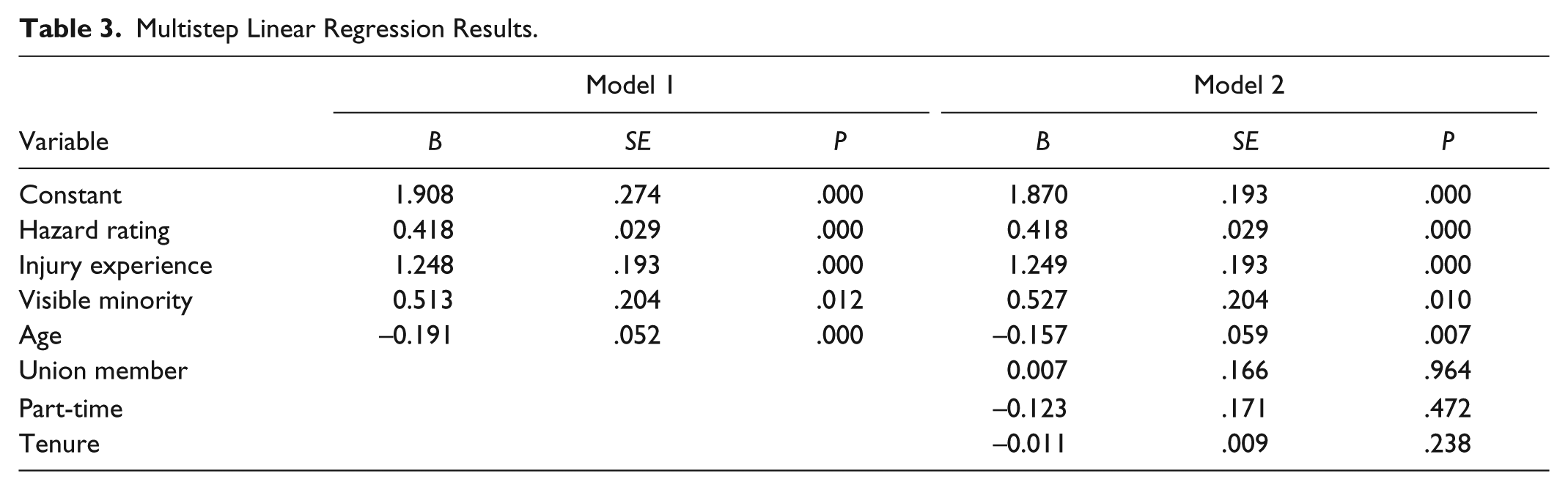
The significant factors were put into a multi-step linear regression. The result (set out in Table 3) found that union membership, job tenure, and part-time employment are fully mediated by other factors included in the model. A model including the remaining variables—hazard exposure, injury experience, age, visible minority—was significant, F(4, 1994) = 109.564, p < .001, with an R2 of .180. Within the model, the strongest predictor of depth of fear is hazard exposure. In short, workers with the highest level of hazard exposure also report the greatest depth of fear.
Multistep Linear Regression Results.
Why Workers Don’t Report and Refuse
Alberta requires workers and employers to report serious injuries (i.e., injuries that mean the worker cannot go to work the next day or requires modified work) to the workers’ compensation board (WCB). Alberta makes reporting such injuries administratively easy. Yet, prior analysis of this data set found that 69.1% of serious injuries are not reported to the WCB (Barnetson et al., 2018). We queried why nonreporters did not file a claim with the WCB and the results are summarized in Table 4.
Reasons for Not Reporting a Disabling Injury.

Note. Workers could select more than one answer, so percentages add to >100%. WCB = workers’ compensation board.
The most common reason for nonreporting (53.9%) was that the nonreporter viewed the injury as not serious enough to file a claim. This may suggest that workers did not believe filing the claim would improve their situation. Previous anecdotal reports from injured workers suggest that respondents (and perhaps respondents’ employers) may seek to manage the injury in the workplace using a combination of modified duties and/or time off from work (presumably using short-term illness leave). Such behavior prevents claims costs from accruing to employer’s WCB accounts and increasing their premiums. Our data set does not allow us to determine if this is the case.
The second most common reason cited for nonreporting was ignorance of the reporting requirement. The percentage of workers citing fear of retaliation as a reason for not filing a claim was 16.5%, which was very close to the 14% of all workers in Table 1 who indicated they feared negative consequences for filing a claim. Workers in industries where they were regularly exposed to seven or more hazards reported higher levels of concern about punishment (39%), again closely approximating the 43% of all workers in high-hazard industries that expressed fear of filing a claim set out in Table 1. These findings suggest that workers’ fears can have an impact upon their behavior once they are injured.
We also examined the experiences of workers facing unsafe work. Of the 16.3% of workers who indicated they faced unsafe work in the prior 12 months, 33.6% reported refusing their most recent exposure. Work refusals were selected for analysis because refusals were expected to be high-fear events for workers (representing a form of defiance) with significant potential to trigger retaliation by employers.
Table 5 presents the reasons nonrefusers did not refuse unsafe work. Notably, 32% of nonrefusers indicated they want to be known as a troublemaker and 14% indicated they specifically feared punishment for refusing unsafe work. Supervisor and coworker pressure to keep working was cited by 16% and 14% of nonrefusers, respectively. Much like the prior examination of nonreporter motives above, this finding suggests that workers’ fear of retaliation for refusing can affect their behavior.
Reasons for Not Refusing.
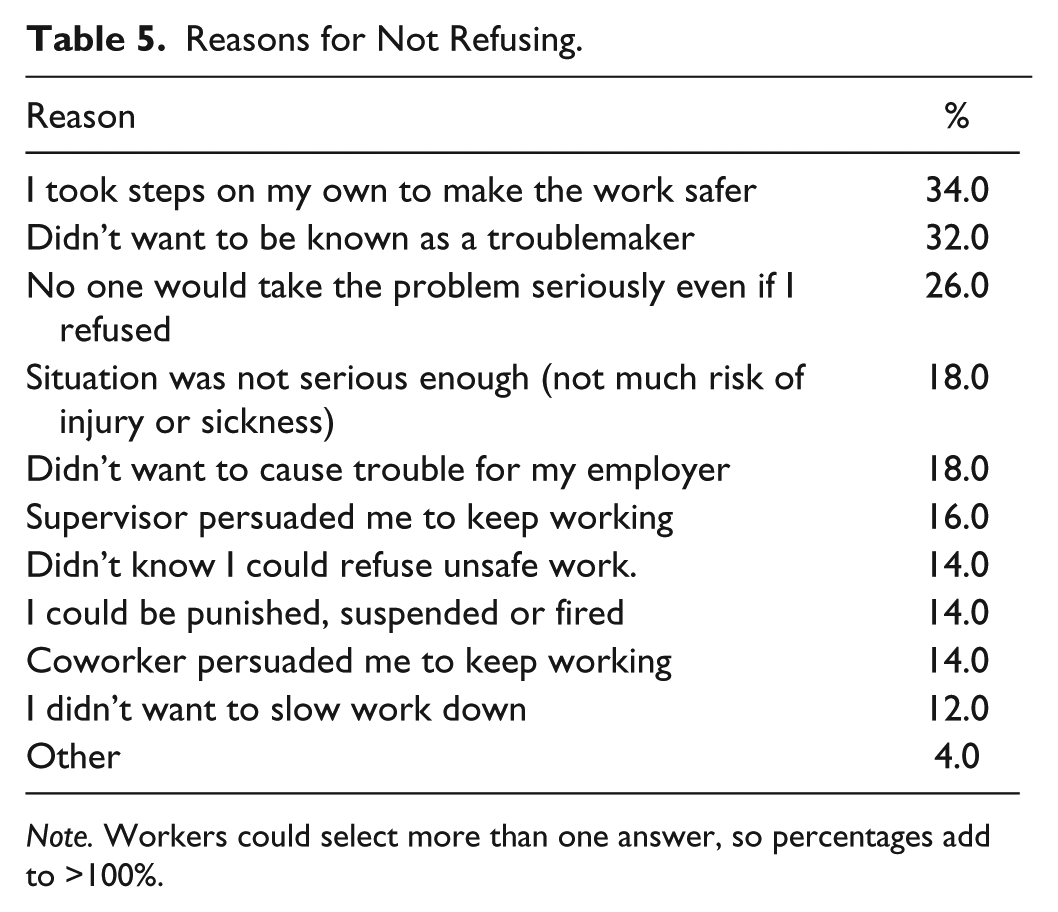
Note. Workers could select more than one answer, so percentages add to >100%.
When refusers were asked what happened when they refused (see Table 6), the most common response was that the worker took steps themselves to make their work safer. This finding provides empirical support for Gray’s (2002) assertion that workers may respond to unsafe work in a variety of ways. These responses include making the work safer themselves (43.1%) or doing the work, although it remained unsafe (33.9%). Table 6 also provides support for Gray’s assertion that employers may evade the policy intention of a refusal by simply asking someone else to do the work (13.8%). It is important to note that the refusal made the work safer for only 23.8% of workers. Even in these cases, it is possible (as Gray suggests) that the employer made the work safer but still not safe (the data does not allow us to determine this).
Outcomes of Refusal.
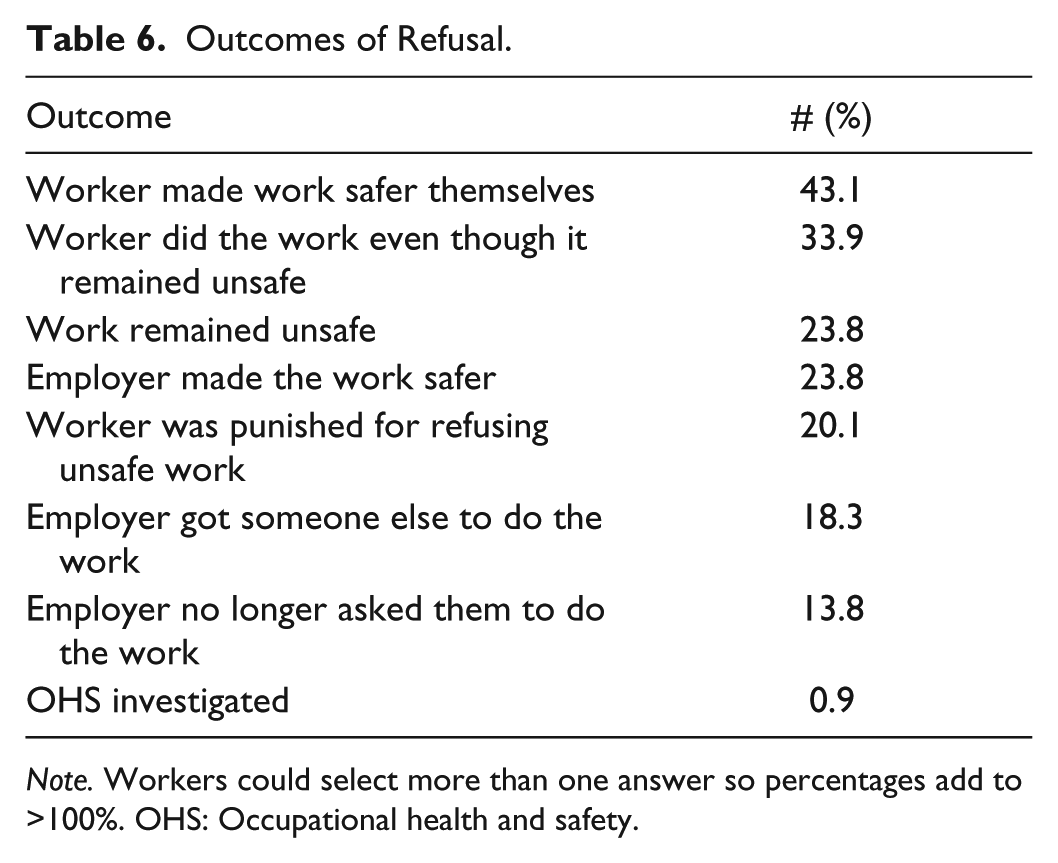
Note. Workers could select more than one answer so percentages add to >100%. OHS: Occupational health and safety.
Discussion
This study found relatively low overall rates of respondent fear of retaliation for exercising statutory employment rights, averaging 16%. That said, fear levels increased as the exercise of workplace rights became more active, concrete, and potentially costly and disruptive for their employer. Fear levels were highest (averaging 22.5%) when respondents were asked about making a complaint to a government agency. That respondents’ risk estimates rise as the expected impact on the employer increases may suggest respondents believe that employers apply a cost–benefit approach to workers’ statutory rights, increasingly resisting rights as the cost of respecting the right increases. Additional research would be needed to validate this assumption.
Specific respondent populations reported much higher levels of fear for using specific rights. Most notable were respondents who were routinely exposed to seven or more hazards in their workplace and reported levels of fear of retaliation that were two to four times higher than average (i.e., >40%). These respondents are also the most likely to report work-related injuries. This pattern suggests fear of exercising safety rights is highest in the workplaces where workers are most likely to need to exercise those rights. And the greatest level of fear centers on reporting unsafe work to the government. This finding is broadly consistent with Lewchuk’s (2013) findings and is also consistent with the level of retaliation documented by Alexander and Prasad (2014). It adds support to the growing literature suggesting complaint-based enforcement of employment rights is not an effective strategy because it directs inspections away from the very workers who most need them (Alexander & Prasad, 2014; Lewchuk, 2013; Weil & Pyles, 2005). This same group of respondents also reported high levels of fear of filing workers’ compensation claims for workplace injuries. Under-reporting reduces the validity of claims data. Consequently, the use of claims data by governments to target employers for inspections may well direct attention away from the workplaces where workers are most likely to be injured. This potential misdirection of targeted enforcement efforts appears to reinforce the misdirection caused by relying upon complaints to trigger enforcement (Weil, 2010).
More speculatively, that these same workers also reported a significantly heightened fear of exercising nonsafety rights hints that this nonclaiming dynamic may operate in other domains of employment rights, such as employment standards or unionization. As this study did not ascertain the level of nonsafety rights violations experienced by respondents, the data does not support making any claim around a relationship between fear of exercising nonsafety rights and the prevalence of nonsafety violations. Yet, the possibility of such a relationship is also suggested in U.S. research (e.g., Alexander & Prasad, 2014) and is an intriguing area for further study.
This study also documents that some categories of workers—specifically young workers and workers who identify as belong to a visible minority—also reported higher levels of fear for exercising some rights. Together with injured workers and workers in high-hazard workplaces, these workers also reported greater overall levels of fear of exercising their rights. Further study would be needed to more clearly understand how (and the degree to which) specific and generalized fear affects workers’ decision-making and behavior around rights and entitlement claiming. To the degree that these fears negatively affect workers’ willingness to exercise their statutory rights, this pattern makes already vulnerable populations even more vulnerable. An important population that is invisible in this sample are foreign migrant workers whose precarious employment and citizenship status tend to make them both particularly vulnerable to exploitation and unlikely to exercise their rights.
The findings do lend support to the argument that basing the enforcement of worker rights on a complaint-driven model is not the most effective approach for ensuring those rights are protected (Weil, 2010; Weil & Pyles, 2005). Governments should consider shifting resources to more pro-active models of enforcement, such as targeted inspections of high-risk employers, random inspections to detect violations, and a more formalized role for citizen complaints. Heightening the penalties for retaliation and increasing the number and visibility of prosecutions of employers for such behavior may also reduce the attractiveness of complaint suppression to employers. Additional investigation and prosecution of retaliation should be focused on high-hazard industries because this is where fear levels are highest.
This study provides support for earlier research that the right to refuse unsafe work does not typically operate as designed. Workers refused unsafe work only 33.6% of the time. When there was a refusal, employers only make the work safer 23.8% of the time. The most common outcome of the refusal was workers trying to make the work safer themselves. This is contrary to the legislative intention, which places responsibility on employers for making work safer. Other pathways included the worker doing the unsafe work, the employer re-assigning the still unsafe work to another workers, or having the employer partially remediate the hazard such that the worker would do the work (even though it remained unsafe). This finding provides support for Gray’s (2002) ethnographic research about work-refusals as well as estimates the prevalence of such outcomes. It also confirms the earlier research (Harcourt & Harcourt, 2000; Hilgert, 2013; Walters & Denton, 1990; Walters & Haines, 1988) that the right to refuse is a weak right in practice, in part because workers fear the consequences of exercising it. Identifying ways that demonstrably strengthen workers’ ability and willingness to refuse unsafe work is an important area for future research.
One pathway forward may be seeking to bolster inspection through the use of civil society groups, such as community agencies, workers centers, and unions. Of particular interest (given Alberta’s low level of unionization) are community agencies and worker centers that already have trusting relationships with workers who are most fearful of exercising their rights (e.g., visible minorities, immigrants, migrant workers, youth). These agencies and centers often have extensive contacts among these worker groups and regularly receive reports of statutory violations. Fine and Gordon (2010) and Fine (2014) suggest that funding and empowering such groups to undertake inspections would significantly increase the number of workplace inspections and improve the targeting of so-called bad-actor employers. The discovery of violations by a civil society group (or an employer refusal to cooperate with such a group) would then trigger a complaint to government inspectors. Such arrangements are expected to reduce the risk associated with individual workers filing complaints by placing the civil society group between the worker and the employer. Increased inspections may also help normalize the complaint and inspection process (which, at the moment is an exceptional event) for workers and employers.
Finally, high levels of injury, low levels of reporting, and an undercurrent of fear raise profound questions about the effectiveness of the IRS. The IRS assumes workplace parties are (a) best placed to identify and control hazards and (b) share an interest in doing so. There is significant literature suggesting these assumptions are not always true (Dorman, 2000; Genn, 1993; Grabe, 1991; Hart, 2002, 2010). This study’s finding of employer inaction on unsafe work supports the critique that employer and worker interests do not always align. Furthermore, the finding of pervasive fear in the most dangerous workplaces provides supports the critique that workers are not well engaged with the hazard control process due to the power differential between employers and workers. Additional data would be needed to conclude that the IRS is ineffective but this study does highlight a need to seek remedies of structural conflicts of interest and power differentials.
Conclusion
The study found that a significant minority of workers report fear of retaliation if they were to exercise their rights of voice in the workplace. These workers tend to be more vulnerable and are exposed to more safety hazards, a possible proxy for bad workplace conditions. Furthermore, expressing fear of retaliation has tangible consequences for those workers’ willingness to use their right of voice such as reporting concerns or workplace incidents. These results will be of interest of researchers in other jurisdictions because the high rate of worker fear discovered in a jurisdiction with relatively good employment protections suggests even higher rates will be found in jurisdictions with lesser protections.
These results offer additional evidence that complaint-based employment rights enforcement systems do not necessarily protect workers’ statutory employment rights. Fear of retaliation interferes with workers’ willingness to report injuries and violations, suggesting enforcement resources are not being targeted where they are most needed. Furthermore, workers’ lack of faith in the system’s ability to correct an unsafe or unfair work situation undermines the credibility of the enforcement system. Additional, likely qualitative, research should examine the underlying causes of workers’ fear of retaliation and more accurately ascertain the accuracy of those fears. As well, research should examine possible alternatives to complaint-based enforcement that will be more effective at ensuring workers’ statutory rights are protected.
In viewing these conclusions, it is important to keep in mind the following limitations. First, this study used a nonprobability sample, which creates a risk of selection bias despite the sample matching the demographic characteristics of the population. Second, the study used a nonvalidated instrument, which creates the risk of invalid or unreliable data, although the results of this study broadly confirm with similar studies in Canada and the United States. Third, it is possible (albeit unlikely) that the significant electoral change that took place 2 years before the survey was completed had some (unknown) effect on respondents’ perceptions of risk of retaliation for exercising their statutory rights. Together, these limitations suggest viewing these results with caution until such time as they have been replicated.
Footnotes
Declaration of Conflicting Interests
The author(s) declared no potential conflicts of interest with respect to the research, authorship, and/or publication of this article.
Funding
The author(s) disclosed receipt of the following financial support for the research, authorship, and/or publication of this article: Data collection was funded by the Government of Alberta’s OHS Futures Grant.