




Abstract
A study of the dynamics of building collapse in Ghana is lacking, notwithstanding the fact that several buildings have collapsed in recent times. This study analyzes the supervisory role and challenges of building inspectors in Kumasi to assess Ghana’s progress toward minimal or zero incidence of building collapse. It adopts the stratified random sampling technique to select 27 out of 35 building inspectors of the Kumasi Metropolitan Assembly (KMA), and a semistructured interview guide to gather data from same. Data gathered were presented and analyzed through tables and direct quotations. Findings revealed that, despite the legal requirement of notification by the developer, building inspectors are compelled to visit building sites to check on developers who may have begun development without notifying them. Many developers violate the legal provisions because of ignorance, delays in acquiring building permits, and the burden of transporting building inspectors at all stages of construction. Notably, building inspectors in Kumasi have not been able to control the rate of building collapse because of constraints such as inadequate logistics and manpower, and excessive political interference. In the current climate, the built environment will continue to pose a threat to human life and property investment. Although unpleasant to contemplate, the study concludes that Ghana may witness more building collapses in the near future, if the aforesaid challenges are not addressed. To avert this, it is recommended that building inspectors in Kumasi and Ghana be equipped and empowered by the state.
Introduction
In recent years, there has been increasing awareness of the devastating consequences that “unexpected” building collapses inflict on cities around the world. Undoubtedly, the cost of building collapses in terms of loss of human lives, permanent and temporary injuries, and loss of investments, jobs, and income cannot be overemphasized (Babatunde, 2013; Ede, 2010a). Several families remain traumatized and many have been rendered homeless. Although the public expectation is that buildings are safe for habitation and business, several media accounts continue to report of the incidence of building collapse worldwide. The recent building collapses in the cities of Naples (in July 2017; Sharman, 2017), Mumbai (in August 2017; Raj & Ramzy, 2017), Accra (in November 2012; “Melcom Shop Collapsed in Ghana,” 2012); and Dhaka (in April 2013; Manik & Yardley, 2013), which have claimed tens of thousands of lives, are just a few among many tragic events. Importantly, the issue at stake is not just the consequences of building collapse alone but a whole spectrum of underlying factors that lead to its occurrence in the first place. While in many locations around the world, building collapses have been caused by terrorist attacks, gas leak explosions, earthquakes, and global environment changes (World Bank, 2015), in Africa and in many developing countries, they have been attributed to weak foundations, substandard constructional materials, poor material mixing by construction workers, excessive load on strength of buildings, and poor testing of building strength (Fernandez, 2014; “Five Reasons Why,” 2016). To make matters worse, the institutional mechanisms and capacity that have been established to prevent the collapse of buildings are extremely weak. It is clear that to reduce the incidence of building collapse in Africa, governments must move beyond knee-jerk reactions (Osam, 2015) to equipping development control institutions to enforce legal provisions. If not, thousands of dangerously weak buildings will be constructed, and millions of city residents will live under the continuous threat of building collapse (Fernandez, 2014).
Review of existing literature has revealed an emerging scholarship on building collapse in the global north, although largely monopolized by structural and mechanical engineers (see, for instance, Fu, 2009, 2010; The Institution of Structural Engineers, 2010; Izzuddin, Vlassis, Elghazouli, & Nethercot, 2008; Kwasniewski, 2010) and forensic scientists (Campobasso, Falamingo, & Vinci, 2003), whose analyses are difficult to comprehend from a social science perspective. In Africa, Nigerian scholars have been the main actors pushing research in this area (Ayuba, Olagunju, & Akande, 2012; Ede, 2010a, 2010b; Fakere, Fadairo, & Fakere, 2012; Oloyede, Omoogun, & Akinjare, 2010; Windapo & Rotimi, 2012), although there have been some studies in other African countries (Fernandez, 2014; Tchamba & Bikoko, 2016). Their findings point to the fact that building collapses are caused by the use of unskilled labor in construction, corruption, lawlessness, and shoddy construction works inter alia while the consequences have been evidenced mainly in the high rate of death and loss of investment. Amid the many causes, scholars have also taken interest in discovering strategies that would reduce the occurrence of building collapse in developing countries (Fernandez, 2014). It is time for African countries to begin to take measures to control the incidence of building collapse.
However, in Ghana, development control scholars have not taken particular interest in building collapses that have occurred in various cities. Rather, their focus has largely been on the challenges of building permit acquisition in Ghana (Ahmed & Dinye, 2011; Boamah, Gyimah, & Nelson, 2012; Botchway, Afram, & Ankrah, 2014), the processes involved in obtaining building permit and its effect on activities at the pre-construction stage (Kpamma & Adjei-Kumi, 2013), causes of unauthorized buildings (Somiah, 2014), and the factors hindering the implementation of the National Building Regulations, 1996 (Legislative Instrument [L.I.] 1630) (Ametepey, Ansah, & Edu-Buandoh, 2015). These Ghanaian studies indicate that the challenges of the Development Control Division (DCD) of Metropolitan, Municipal and District Assemblies (MMDAs) are mainly inadequate logistics and manpower as well as excessive political interference (Adarkwa & Owusu-Akyaw, 2001; Korah, Cobinnah, Nunbogu, & Gyogluu, 2016). Nevertheless, there has been little attempt at comprehensively exploring the connection between these challenges and building collapse. Clearly, this article’s contribution differs from existing studies, as it examines how the supervisory role of the DCD in reducing building collapse is impeded by the challenges associated with its core function. By so doing, it extends knowledge beyond just understanding the challenges of DCD to appreciating how they manifest in the context of recent building collapses in the Kumasi city. More broadly, this study reveals whether or not recent events of building collapse across Ghana have prompted successive governments to equip and empower the DCD to enforce the provisions in the local government law and building regulations.
The rest of the article is organized as follows. The “Understanding the Dynamics of Building Collapse in Developing Countries” section reviews literature on the dynamics of building collapse in developing countries as well as Ghana’s construction industry and the challenges of development control institutions. “Study Area and Methods” section describes the study area and methods. “Empirical Findings” section presents and analyses the data gathered. The conclusion and policy implications of findings are presented in the “Discussion, Conclusion and Policy Implication of Findings” section.
Understanding the Dynamics of Building Collapse in Developing Countries
Building collapses may have occurred in different parts of the world (Fu, 2009, 2010; Izzuddin et al., 2008; Kwasniewski, 2010), but it has been argued that the frequency of occurrence and its associated consequences has been more devastating in developing countries (Babatunde, 2013; Fagbenle & Oluwunmi, 2010; Fernandez, 2014). In Nigeria, there have been several studies targeted at identifying the causes and consequences of building collapses (Ayuba et al., 2012; Ede, 2010b; Fakere et al., 2012; Oloyede et al., 2010b). These studies have attributed building collapses in Nigeria to a number of natural and man-made causes. Nevertheless, as Windapo and Rotimi (2012) have pointed out, the majority of building collapses in Nigeria are traceable to human activity or inactivity, including mainly structural failure, poor supervision and workmanship, and the use of substandard building materials. They also found other causes such as faulty design, disregard for approved drawings, and rainstorm/natural causes. In the same vein, Oloyede et al. (2010) found that non-compliance with building specifications and regulations by developers, recruitment of incompetent contractors and laborers, and the use of substandard materials and equipment are the main causes of building collapse in Nigeria. In addition to these causes, Dimuna (2010) believed other key causes of building collapse in Nigeria are the absence of soil testing before construction, absence of coordination between professional bodies and town planning authorities, and inadequate enforcement of existing laws regulating physical development. This implies that building collapses in Nigeria are caused by human, construction, and institutional failures.
Apart from Nigeria, other African countries have also witnessed building collapse, although largely documented in media reports. Muhumuza (2013) remarked that collapsed buildings are a growing problem in East Africa, where many buildings in the region’s major cities are under construction or renovation. As indicated by Fernandez (2014) in Table 1, Kenya has probably suffered the most building collapses in the last decade. In one of those instances, Wachira (2015) remarked that although the developer was served with a stoppage order due to violation of construction regulation and huge cracks that had developed in the said building, work continued and hence the collapse. Another Kenyan study revealed that most collapsed buildings were constructed with low-quality building materials and incompetent craftsmen and that there was a lack of political will to enforce existing building codes (Kuta & Nyaanga, 2014). Just as in Nigeria, building collapses in Kenya have been caused by poor construction quality and regulatory challenges. More to the point, Kwera (2008) found that the collapse of a five-story building in Kampala in January 2008 was attributed to use of substandard materials. In West Africa’s Cameroun, Tchamba and Bikoko (2016) reported a number of building collapses between the period 2010 and 2014, which were caused by inadequate preliminary works, adoption of wrong foundations, low-quality sandcrete blocks, poor concrete mix ratio, and neglect of design and building approval procedures, among others. These findings show that the underlying factors of building collapse in African countries are similar in many respects. Nevertheless, it must be emphasized that these problems are not necessarily limited to Africa.
Incidence and Consequence of Building Collapse in Kenya.

Source. Fernandez (2014).
In recent years, some Asian countries have also experienced devastating building collapses. In 2013, an eight-story factory building in Bangladesh collapsed, killing more than 150 persons, with about 1,000 more injured. A few days later, Ker Than (2013) of the National Geographic News reported that the collapse was caused by shoddy construction. In Latin America, it was reported by the BBC in October 2013 that a 24-story apartment building had collapsed in Medellin, Columbia, killing at least 11 people and injuring many more (“Brazil: Sao Paulo Building,” 2013). An interview with the officials of the company that constructed the building revealed that cracks had appeared in the building a few months after construction, and in the process of repairing the flaw, the building collapsed (“Brazil: Sao Paulo Building,” 2013).
From the foregoing, it seems unarguable that building collapse in developing countries is generally caused by poor workmanship, use of substandard building materials, and non-compliance with building regulations, among many others. In the next paragraph and ensuing sections, this article situates Ghana within the context of building collapse in developing countries.
In the last decade, Ghanaians have also witnessed a number of building collapses. Like elsewhere in Africa, Asia, and Latin America, these building collapses, per media reports, have been attributed to failure on the part of developers to adhere to legislation that regulates physical development, usage of substandard building materials, and recruitment of cheap labor, who are supervised by developers themselves or by people with little or no background in building construction. Recent building collapses include the collapse of a three-story building at Cantonment, the six-story Melcom Shopping Center in Achimota, and the seven-story uncompleted building at Nii Boi Town, all in Accra. In the Melcom case, for instance, the impact was so severe that national activities, such as campaign tours of presidential candidates, came to a halt (Botchway et al., 2014) and attention of the international community was arrested to the extent that a team of disaster management experts from Israel were brought in to help rescue persons trapped under the rubble (Osam, 2015).
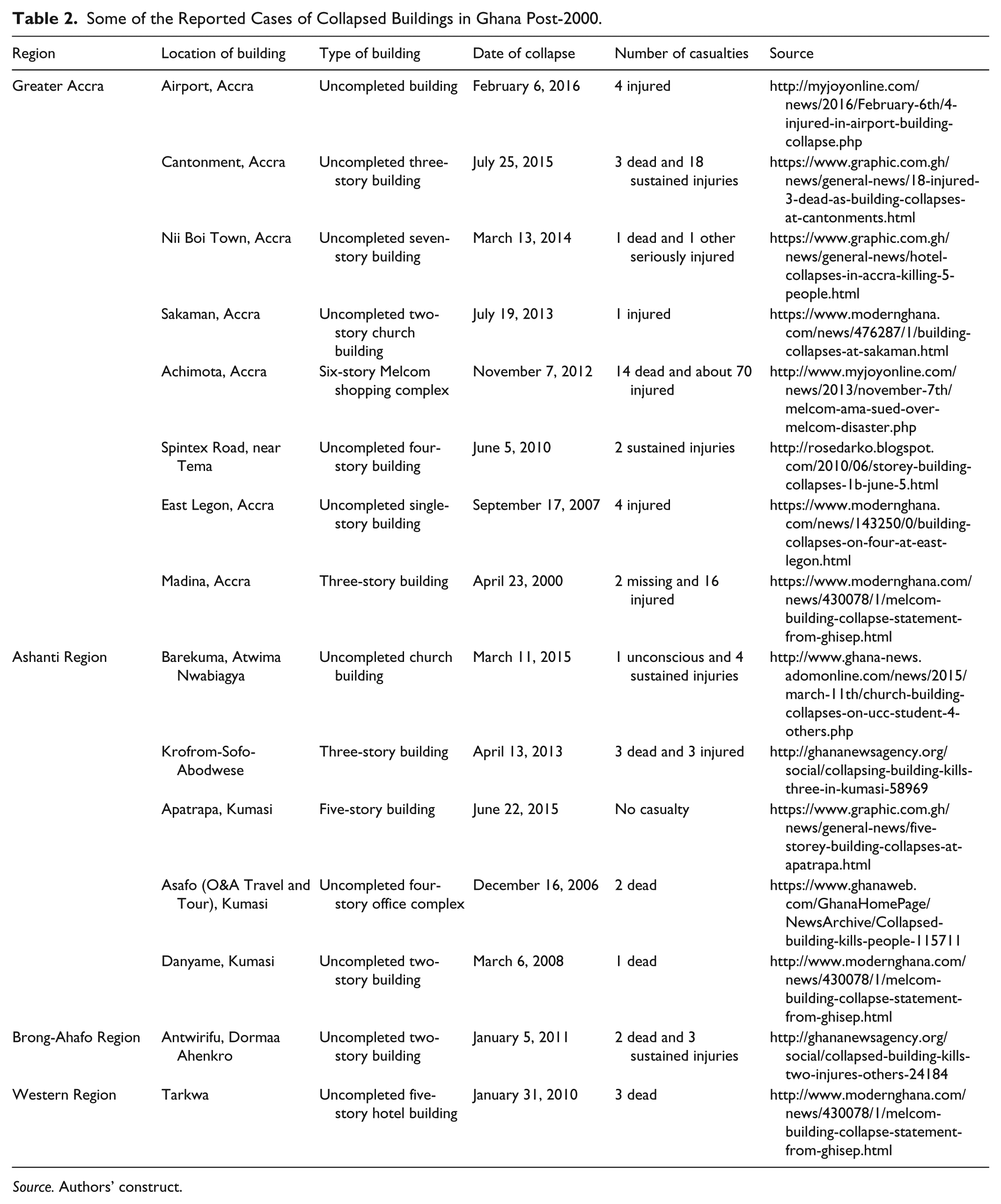
In this article, we compile some reported cases of building collapses in Ghana in the 21st century (post-2000). As indicated in Table 2, the data include the geographical location of the collapse, type of collapsed building, the date of collapse, and the number of casualties. Table 2 reveals that low and mid-rise buildings collapsed more frequently than single-story buildings. This corroborates the findings of Wardhana and Hadiprono (2003) in the United States which showed that building collapses plagued more low-rise buildings than one-story buildings. It is also observed that most of the buildings that collapsed were under construction, implying that most of them may not have been inspected by building inspectors as required by L.I. 1630. It can also be deduced from Table 2 that commercial buildings (office complex, retail stores, and shopping complexes) collapsed more often than residential and other buildings. Perhaps this is due to the fact that these kinds of building are mostly high-rise. However, this contrasts with the Nigerian case, where Windapo and Rotimi (2012) found that residential buildings recorded the highest number of collapses. Geographically, Accra and Kumasi have recorded the highest share of building collapse in Ghana. This is due to the fact that approximately 85% of all new buildings in Ghana have been constructed in these two major cities (Arku, 2009) and because they are the major commercial hubs of Ghana. To cap it all, the number of lives lost and persons injured in building collapses gives an indication of the severity of the problem in Ghana (Windapo & Rotimi, 2012). For instance, in Table 2, an estimated total of 30 lives were lost and over 100 persons were injured in the reported cases of building collapse in the last decade. This article is premised on the fact that, notwithstanding the frequent building collapses in Ghana as indicated in Table 1, published empirical research on building collapse in Ghana is virtually non-existent.
Some of the Reported Cases of Collapsed Buildings in Ghana Post-2000.
Source. Authors’ construct.
Ghana’s Construction Industry and the Challenges of Development Control Agencies
Ahadzie (2009) and Ofori (2012) have argued that the construction industry holds the key to economic growth and development around the globe. This is because that industry provides the infrastructure required for many sectors of the economy, including schools for education; industries, shops, and offices for commercial and business activities; houses for shelter; and hospitals and clinics for health care inter alia (Ahadzie, 2009). Similarly, Ofori (2012) indicated that the building industry contributes to national socio-economic development by providing the buildings which are used in the production of all goods and services in the economy. According to Ahadzie (2009), many developed and developing economies have successfully exploited physical assets toward achieving and sustaining the requisite socio-economic development. As in other countries, Ghana’s construction industry has several players, including individual developers, real estate development companies, and public and private institutions. Apart from the institutional developers who can afford to pay up-front the cost of carrying out building activities, the majority of buildings in Ghana are delivered by individual developers through an incremental building process, which takes between 5 and 15 years (Asante, Gavu, Quansah, & Osei Tutu, 2017; Boamah, 2014). The increasing cost of construction, caused by inflation and other economic factors, has compelled developers of all kinds to cut down costs by using substandard building materials and/or contracting low-skilled artisans to carry out the construction of their building. However, it must be acknowledged that some developers engage building professionals throughout the building process, notwithstanding the high cost of engaging such professionals. Whether they engage high-skilled professionals or low-skilled artisans, developers (both individual and institutional) rarely notify the DCD of the MMDAs to inspect their building construction activities, as required by the Local Government Act, 1993 (Act 462) and National Building Regulation, 1996 (L.I. 1630).
To put this into context, Sections 49 and 64 of Act 462 make it mandatory for all developers in Ghana to acquire a building permit prior to the commencement of any physical development and in such permit shall be the necessary conditions required for physical development. One of such conditions is contained in Section 10(1) of L.I. 1630, which mandates developers to notify the DCD of the dates on which it is intended to begin construction and of the dates on which every stage of the construction will be ready for inspection. In other words, the DCD has been established to oversee and inspect the construction of buildings from the demarcation of site and siting of buildings through fixing of reinforced steel in position to the covering of the roof framework. Furthermore, L.I. 1630 stresses in Section 10(2) that no construction work shall be covered until it is inspected and approved by the DCD. To deter developers from flouting the regulations, L.I. 1630 in Section 10(6) states that any developer who flouts these regulations may be served a notice by the DCD requiring him or her to cut into, lay open, or pull down as much of the building works as shall be necessary to ascertain whether any of the provisions have been complied with; if the developer ignores the notice, the DCD may apply to the court nearest the location of the building to compel the developer to allow the sanctions to be carried out and to charge the cost incurred to the developer. By way of evidence of compliance with Section 10(1), Section 10(7) states that a developer shall be issued a certificate of completion for habitation in respect of a building completed to the satisfaction of the DCD. However, previous studies have demonstrated that these provisions of L.I. 1630 have been flouted by many developers in Ghana, as they build without notifying the DCD and without recourse to building regulations.
To ensure the enforcement of these provisions above, Sections 12(1) and 46(1) of Act 462 have designated the MMDAs as the planning authority for their jurisdiction and mandated these institutions to perform planning functions assigned to them under any enactment. Therefore, these MMDAs are responsible for the preparation and implementation of development schemes and the enforcement of development control in their area of authority (Boamah et al., 2012). Within every MMDA are two planning departments, namely the Town and Country Planning Department (TCPD) and the DCD. The TCPD provides the building permit and the DCD ensures the developers comply with the conditions of the permit. In this article, our interest lies in the latter. Ahmed and Dinye (2011) and Botchway et al. (2014) found that the DCD is poorly resourced in terms of manpower and logistics, thereby rendering it handicapped in enforcing its mandated functions. As if this were not enough, Boamah et al. (2012) have indicated that there is excessive political interference in the activities of the DCD. Owusu-Ansah and Braimah (2013) similarly pointed to the lack of political will to back up planning officials to effectively discharge their functions. Other challenges include corruption and the lack of public awareness of the existence of building regulations (Somiah, 2014). The Ghanaian culture of building in “secrecy” or without recourse to checks by the DCD also compounds the problem. In this article, we show how these challenges have negatively affected the ability of the DCD to control the incidence of building collapse in Kumasi.
Study Area and Methods
Kumasi is the second most populous city in Ghana (next to Accra, the national capital) and the only metropolis in the Ashanti Region (Ghana Statistical Service, 2014). The population of Kumasi is approximately 2,035,064 (Ghana Statistical Service, 2012). The total land size of the Kumasi metropolis is about 254 sq/km and approximately 10 km in radius (Kumasi Metropolitan Assembly [KMA], 2013). Kumasi is approximately 270 km from Accra (Ghana Statistical Service, 2014). It must also be indicated that the Kumasi Metropolis is not entirely urban; it is estimated that 48%, 46%, and 6% of the metropolis are urban, peri-urban, and rural, respectively (KMA, 2013). Kumasi metropolis is a suitable study area because it has witnessed a considerable number of building collapses, as indicated in Table 2 above. More so, Arku (2006) argued that approximately 85% of all new construction of buildings have occurred in cities. Figure 1 shows an extended map of Kumasi Metropolitan Area.

An extended map of the Kumasi Metropolitan Assembly.
This study uses a qualitative approach to understand the role and challenges of the DCD in supervising construction of buildings in Kumasi. There are nine submetros in the KMA constituting Asokwa, Bantama, Kwadaso, Manhyia, Nhyiaeso, Oforikrom, Suame, Subin, and Tafo. There are a total of 35 building inspectors (scattered across all nine submetros) at the DCD of the KMA. All 35 were potential study participants.
This study was conducted between March and May 2016. Stratified random technique was adopted to select 27 building inspectors from the nine submetros in the Kumasi metropolis. In line with the qualitative nature of this research, a semistructured interview guide was used in gathering the required data for this study. Interviews were gathered with the use of a recorder and were later transcribed. On average, each interview lasted for 45 min. This data collection technique gave a great deal of freedom to probe various areas and to raise specific queries during the course of the interview (Saunders, Lewis, & Thornhill, 2009). The objective of the interviews was to obtain professional insight on the interviewees’ operations and challenges in supervising construction in the metropolis (Owusu-Ansah & Braimah, 2013). Due to the lack of studies on building collapse in Ghana, most of the secondary data were gathered from websites of media outlets in Ghana in addition to a few journal articles. Direct quotations from the study participants provided the context for qualitative analysis. Like Arku, Luginaah, and Mkandawire (2012), the building inspectors were identified by pseudonyms to maintain confidentiality. The abbreviation (BI = Building Inspector) was adopted to identify the respondents. In addition to the abbreviations, the number of years the building inspector has worked with KMA was used.
Empirical Findings
General Characteristics of Respondents
Table 3 provides a summary of the personal data obtained from a total of 27 building inspectors at the DCD of KMA. Initial questions posed to the building inspectors related to their age, gender, qualification, and years of experience. Table 2 shows that 70% of the building inspectors are between the ages of 18 and 39, implying a youthful majority at the DCD of KMA. It can also be seen in Table 3 that 96% of the building inspectors at the KMA are male, with the remaining 4% being female. This suggests that there is gender imbalance in the recruitment of staff for the DCD in Kumasi. We found that the majority (48%) of the building inspectors hold a Higher National Diploma (HND) in Building Technology. A considerable number (33%) of the building inspectors also have a qualification as Construction Technician II while the remaining (19%) hold a BSc/BTech in Building Technology. This corroborates Section 186 of L.I. 1630, which states that a building inspector shall be any person who has undergone an approved training in building and is versed in the construction of buildings, structural design and analysis, building maintenance, law related to building, principles of town planning, and design principles. According to one of the building inspectors, irrespective of the qualification, every building inspector must be able to interpret layout and have good knowledge of buildings (specifically the different types of columns, beams and foundations), surveying, building quantities and structural detailing. (BI, 6 years)
Characteristics of Building Inspectors in the Kumasi Metropolitan Assembly.

Source. Field Survey (2016), Authors’ construct.
Note. HND = Higher National Diploma.
It can be deduced from Table 3 that 74% of the building inspectors have worked with the DCD in Kumasi for at least 6 years and were considered to be in a good position to provide the needed data for this study.
Modus Operandi of Building Inspectors in Kumasi
L.I. 1630 is quite clear on the supervisory role of building inspectors in the construction of buildings in Ghana. As earlier indicated, the DCD has been mandated to oversee and inspect the construction of buildings which have been granted a building permit by the TCPD. They are to ensure that “developers abide by the conditions of the building permit that they have been granted” (BI, 15 years). One building inspector remarked that their core function is “to inspect buildings at site and write reports on the supervision that has been undertaken” (BI, 4 years). As earlier indicated, Section 10(1) mandates all developers in Ghana to give at least 48-hr notice in writing to the DCD indicating the date on which it is intended to commence work and the dates on which every stage of construction will be ready for inspection. Going by the letter of the law (L.I. 1630), “notification by developer” should precede “inspection by building inspectors.” In other words, the onus is on the developer to notify building inspectors of his construction activities for subsequent inspection by these officials. However, the building inspectors were quick to say that this has not been the case. A building inspector commented that “majority of developers in Kumasi either start or complete their buildings without notifying our outfit” (BI, 11 years). We probed further to find out why this has been the case in Kumasi.
First, the building inspectors believe that “developers do not intentionally violate the law, but it is because they do not know of the existence of the L.I. 1630” (BI, 5 years). It is in this regard that Ahmed and Dinye (2011) and Somiah (2014) have suggested that there is the need for development control agencies to intensify and strengthen education through community awareness-raising programs and sensitization sessions. To the contrary, however, Boamah et al. (2012) believe that there is a high awareness level of the laws governing physical development in Ghana; rather, the majority of developers who flout these laws are conscious of their actions and the consequence of such violations. In a nutshell, whether developers are aware of L.I. 1630 or not, both Ahmed and Dinye (2011) and Boamah et al. (2012) agree that the level of compliance is minimal. While public education may be crucial, ignorance of the law cannot be an excuse for non-compliance.
Second, the building inspectors admitted that the delay in acquiring a building permit is responsible for developers’ inability to comply with Section 10(1) of L.I. 1630. Nonetheless, they have little control over this because building permits are issued by the TCPD. According to Section 8(1) of L.I. 1630, the TCPDs of the MMDAs are required to notify an applicant developer, within a period of 3 months, of whether his application is granted or refused; the developer, having waited for a period of 3 months without any such notice, is empowered by Section 8(2) to commence development on the assumption that his application has been granted. Kpamma and Adjei-Kumi (2013) found that very few developers obtain their permit within 3 months; most applications take as long as a year or even more. For fear of losing undeveloped lands to encroachers, or of possible re-entry by grantors due to delay in developing the land granted (for instance, current provisions in allocation notes mandate allottees to develop within 2 to 5 years post-allocation; Mireku, Kuusaana, & Kidido, 2016) coupled with the increasing prices of building materials, most developers proceed to build without waiting to be notified, by the TCPD, of the decision regarding their application (Botchway et al., 2014). Therefore, by the time a decision is made on a building permit application, the developer could be half way through constructing the structure, by which time he or she is in violation of Sections 10(1) and (2) of L.I. 1630.
Owing to non-compliance arising from the above reasons and many others, a building inspector noted that “we are compelled to go out on monitoring exercise to identify and inspect ongoing construction in our jurisdiction” (BI, 5 years). The implication is that there would be virtually no work to do if buildings inspectors were to wait to be notified before they embarked on inspection. Perhaps this calls for the building inspectors to be more proactive in the discharge of their responsibilities. But whether the DCD is notified prior to the start of construction, or they embark on monitoring and inspection of their own volition, building inspectors look out for certain requirements when they visit any construction site. These include the building permit, architectural drawings, structural drawings (where the building is two stories or more), the quality and quantity of building materials, and the labor strength engaged for the construction, among other things. Immediate action is taken where the developer fails to meet any of these requirements. One of the building inspectors remarked that if the developer is unable to produce a building permit or is building contrary to the conditions of the permit, such a developer is made to stop construction. (BI, 7 years).
Where the developer is not available at the time of inspection, the building inspectors would write the inscription “Stop Work, Produce Permit” on the wall of the building, implying the developer can only continue construction after producing a building permit issued by the TCPD. If the developer ignores this notice and carries on building, Section 10(6) of L.I. 1630, which allows the DCD to pull down part of the building, is activated. However, in circumstances where the developer goes contrary to any one condition and which does not affect the structural stability of the building, we advise the developer to observe that particular condition. (BI, 4 years)
Failure to observe this condition at the next inspection of the building inspectors would result in stoppage of work. It should be noted at this point that not all developers flout one or more conditions of their building permit. As commented by one building inspector, where the developer has acquired a building permit and abides by its conditions, we approve and allow the developer to continue construction. (BI, 11 years)
Furthermore, for the few developers who give prior notification to the DCD, the building inspectors are able to visit their construction sites within a week or a little more. According to a building inspector, “but for the inadequate logistics, we should be able to inspect buildings in less than a week” (BI, 6 years). It was also gathered generally from the respondents that most of the developers in Kumasi, after having their buildings visited for the first time, do not consistently notify the DCD to inspect the other stages of construction. (BI, 15 years)
One of the building inspectors said that failure on the part of developers to consistently engage the DCD from foundation to finish had led to some building collapse in Kumasi. He shared an experience where a developer got a permit to develop a three-storey building on a piece of land at Santase in Kumasi. The developer built the building to up to two-storey and stopped construction due to shortage of funds. He, however, managed to complete the two flats in the two storeys and let them out. The floor of the third storey doubled as the ceiling and roof of the building. With time, water began to seep through the ceiling whenever it rained. All complaints by the tenants to the developer fell on deaf ears. About 8 years after he stopped construction, the developer resumed construction. One of the tenants reported the issue to our outfit. We visited the site and advised the developer to carry out some works on the building because some cracks had developed in the mass concrete. He ignored the advice and continued development. About three months after he resumed construction, the building caved in. (BI, 7 years)
Nevertheless, it would be unfair to put the blame at the doorstep of developers alone. Although developers incur no cost for the inspection service provided by building inspectors, “developers are sometimes compelled to transport building inspectors to and from the construction site” (BI, 7 years). This discourages most developers as it can be expensive depending on the distance between the DCD’s office and the location of the building to be inspected. If developers have to bear such transportation costs at every stage of construction, it is not surprising that only a few developers are able to consistently engage building inspectors throughout the construction.
Challenges of the DCD of KMA: A Bad Picture
The literature (Ahmed & Dinye, 2011; Ametepey et al., 2015; Boamah et al., 2012; Botchway et al., 2014) has noted that the key constraints of the DCD include inadequate logistics, inadequate manpower, and excessive political interference. In the context of building collapse in Kumasi, these challenges, from the point of view of one of the building inspectors, “are the same problems that confront our outfit today” (BI, 8 years). Frustrated, one of the building inspectors said, “nothing has changed” (BI, 4 years).
To begin with, a building inspector commented that “though our work is field-related, the inadequate logistics has limited us to the office” (BI, 5 years). The DCD of KMA has been assigned only one vehicle for their field activities. For an institution that inspects construction activities in nine submetros, and considering the delicate nature of their work, this is not encouraging. To make matters worse, at the time of data collection, a building inspector remarked that “the vehicle in question had broken down for weeks and was yet to be repaired” (BI, 9 years). Therefore, they pointed out that “even when we do go out for inspection and/or monitoring, we are only able to inspect few buildings” (BI, 5 years). Although the building inspectors would not mention the number of buildings they inspect within a period, they admitted that “it is so embarrassing to mention, considering the extent of our jurisdiction” (BI, 4 years). Botchway et al. (2014), in a recent study, found that the highest number of buildings inspected by building inspectors in a month averaged less than 40 for the entire Kumasi metropolis, a number they consider abysmal. This study also found that apart from a lack of vehicles, which building inspectors consider their most pressing need, there are inadequate numbers of computers, digital cameras, Global Positioning Systems (GPS), and personal protective equipment (PPE). These inadequacies, the building inspectors stress, affect the quality of field reports they present to the office. For instance, during the data collection, it was observed that none of the building inspectors had a computer on their table, and hence, all field reports were recorded solely on paper. In the event of any fire outbreak or some other unforeseen circumstances, such data may be lost. The inadequate logistics has indeed crippled the DCD in its quest to control the incidence of building collapse in Kumasi.
Aside from the inadequate logistics, the manpower strength of the DCD also poses some challenge to the work of the building inspectors. It was observed that there are about 35 building inspectors for the whole of the Kumasi metropolis, implying an average of four for each of the nine submetros. For the respondents, “this is seriously inadequate” (BI, 5 years). They proposed that an average of 10 building inspectors per submetro would improve their inspection activities. However, DCD, like other government bodies or departments, has not been able to recruit additional building inspectors due to the embargo on employment in the public sector in Ghana.
Moreover, one of the biggest constraints to the supervisory role of DCD is the excessive political interference, which is a huge source of frustration to building inspectors (Boamah et al., 2012; Owusu-Ansah & Braimah, 2013). According to one of the respondents, in accordance with section 10(6) of L.I. 1630, we have, on a number of occasions, ordered the demolition of whole or part of certain buildings in Kumasi but we have received an order from our “boss” or a politician to stop the demolition. (BI, 6 years)
They added that “in most cases, the building either belongs to the politician in question or his associate” (BI, 5 years). This implies that the building inspectors are unable to enforce Section 10(6) of L.I. 1630, which allows them to order the demolition of buildings that have not been inspected. The respondents are mindful of the consequences of ignoring the orders from politicians or their superiors. One of the respondents cited an instance where “one of my colleagues lost his job because he ignored an order from a politician” (BI, 4 years). With such an experience, a building inspector said he “prefers to respect the order than to lose my job” (BI, 8 years). The building inspectors are particularly unsurprised at some of the building collapses that Kumasi has witnessed because “they were earmarked for demolition and due to some political interference, the developer was allowed to continue construction” (BI, 7 years). It was unpleasant to hear from one of the building inspectors that “there are still a number of ongoing and completed buildings, especially in the central business district, that are death traps of some sort” (BI, 9 years).
Discussion, Conclusion, and Policy Implication of Findings
The Kumasi city, and more broadly Ghana, has experienced many building collapses just like its peers across the African continent and beyond. The findings of this research have revealed that these building collapses in Kumasi are generally caused by the failure of developers to comply with Ghana’s building regulation, which mandates them to notify the DCD of the date on which they intend to commence construction of their building and the dates on which every stage of the construction will be ready for inspection. This is consistent with the findings of Oloyede et al. (2010), Wachira (2015), and Tchamba and Bikoko (2016) who indicated that building collapse in Nigerian, Kenyan, and Camerounian cities were caused by non-compliance with building specifications or regulations by developers. We contend that non-compliance with building regulations is the single and most important factor causing building collapses in Africa. Many other factors such as poor workmanship, use of substandard building materials, faulty design, and recruitment of incompetent contractors and artisans among others (Kuta & Nyaanga, 2014; Windapo & Rotimi, 2012) are all traceable to non-compliance with building regulations. This is because building regulations specify approved building materials, design, and craftsmen to use in the construction of every building. All other things being equal, developers who comply strictly with building regulations experience low incidence of building collapse.
While these previous studies have not critically investigated the underlying causes of non-compliance of building regulations, we found in Kumasi that this is attributed to low awareness of building regulations, delay in processing building permit applications, failure of developers to read the conditions of building permits, and the burden of transporting building inspectors to and from construction sites at every stage of construction. In their quest to be proactive, building inspectors in Kumasi are compelled to embark on regular and random inspection of building sites rather than wait for developers to inform them, as stipulated in Ghana’s building regulation. Sadly, the building inspectors in Kumasi are unable to inspect most buildings in their jurisdiction and subsequently enforce building regulations due to challenges such as excessive political interference, inadequate manpower, and inadequate logistics such as vehicles, computers, digital cameras, GPS systems, and PPEs. These challenges are not limited to Kumasi. In Sekondi-Takoradi and Wa, Somiah (2014) and Boamah et al. (2012), respectively, indicated the DCD are poorly resourced. Kuta and Nyaanga (2014), for instance, argued that the lack of political will to enforce building codes in Kenya is largely responsible for many of the building collapses that Kenya has witnessed in recent times.
Having regard to the non-compliance with building regulations by developers in Kumasi coupled with the challenges of DCD, we conclude that Ghana is still far behind in its efforts to reduce the incidence of building collapse. The Melcom incident and other similar cases in urban Ghana have exemplified building collapse as one of the single largest causes of human deaths and economic losses. L.I. 1630, which has been enacted to reduce these losses, has been consistently neglected by government and developers alike and is thus becoming dysfunctional (Moullier, 2014). This has rendered the DCD, the institution that has been established to ensure compliance of L.I. 1630, handicapped and unable to fully discharge its responsibilities.
It is recommended that the government prioritize resourcing of the DCD to enable it to ensure effective implementation of the regulations in L.I. 1630. Providing the DCD with means of transportation in the form of motor bikes, which are relatively cheaper than cars or trucks, will aid faster inspection by building inspectors (Botchway et al., 2014). Furthermore, the provision of GPS, digital cameras, laptop computers, and PPE will make building inspectors more effective and efficient in implementing building regulations, facilitate the process of development control, and enhance the monitoring role of the DCD as well as improve its image (Boamah et al., 2012). Government must also give the necessary “employment clearance” for the MMDAs to recruit more building inspectors to augment the existing low staff strength of the DCD, not forgetting that priority should be given to female applicants. This will enable the DCD to increase the number of buildings inspected in a month. Public education to create awareness of L.I. 1630 is an inevitable necessity, but the emphasis should be placed on the sanctions for violation of building regulations in Ghana. The DCD should be allowed to enforce these sanctions without any political interference. The DCD should be empowered to sue any person, of whatever status in society, who interferes in the discharge of its legally mandated responsibilities. Further research should focus on understanding which building regulation(s) is most flouted by developers in Kumasi or Ghana. This will entail interviewing the developers and the building professionals who work for them.
Footnotes
Declaration of Conflicting Interests
The author(s) declared no potential conflicts of interest with respect to the research, authorship, and/or publication of this article.
Funding
The author(s) received no financial support for the research, authorship, and/or publication of this article.