




Abstract
The aim of this study was to develop a screening tool to screen children for development problems in a low-income setting. Childhood development problems are a major health issue faced by low-income countries. A validated screening tool is needed for early identification of developmental delays. This article contains the first phase of a study that established a relatively simple tool to screen children for developmental problems. The aim of the first phase was to define a set of development indicators for the period of 2 to 12 months of life. The study methodology consisted of an extensive literature review, to develop a set of indicators to measure child development in infancy. The indicators were placed within a framework developed and used by experts in other countries. It consists of major domains, subdomains, specific aspects, and standards of development. This was followed by content validation of the indicators. Following review of literature, 171 indicators were compiled under the framework. At the end of content validation, 125 indicators were retained in the framework. These were pretested, and another 26 were removed following pretesting. The study developed a framework of indicators that could be used as a development tool following a reference-based validation. The second phase of the study that included the assessment of psychometric characteristics and reference-based validation would be published in a separate article.
Introduction
Childhood developmental delays and their sequelae are a major public health concern for low-income countries. Grantham-McGregor and colleagues (2007) state that many children in developing countries are exposed to multiple risks for poor development including poverty, poor health, and nutrition. The conservative estimate is that more than 200 million children below 5 years of age in developing countries are not developing to their full potential.
Developmental problems affect both developed and developing countries. For example, in the United Kingdom, an analysis of a cross-sectional survey of 16,000 children aged 0 to 18 years revealed that 7.3% of children were reported as having a developmental disability (Blackburn, Read, & Spencer, 2010). In a comprehensive review done of studies on disability covering intellectual, hearing, speech, vision, motor, and neurologic impairment in low- and middle-income countries (Maulik & Darmstadt, 2007), a 12% overall disability rate was reported among 2- to 9-year-old children from one community-based study in India (n = 640).
Early identification of delays by screening is vital, as interventions could make a big difference to the individual and family, and place less demand on health expenditure (Grantham-McGregor et al., 2007). Development screening of a child is currently measured by a range of developmental screening tests (Frankenburg et al., 1996). Developing countries face a big obstacle in systematic screening due to three factors:
Established development screening tools need to be validated to a country before being used.
Trained people are needed to administer them.
To identify developmental problems, a large number of apparently normal children have to be examined. These three factors require considerable expertise, money, and time, all rare attributes in a developing setup.
To overcome these obstacles, middle- and low-income countries need instruments that could be used in the field by a primary health care worker or caregiver. Normative development standards for young children called Early Child Development Standards (ECDS) could serve this purpose. Standards are statements that specify an expectation for achievement of skills or knowledge that may be used as a basis of comparison in measuring or judging capacity, quality, value, or quantity (Kagan & Britto, 2008).
The age at which development skills appear can be given as a range. These ranges can be considered as age percentiles. A percentile of a development indicator is the age a particular skill is achievable by a percentage of children. Based on the percentiles, norms can be defined. These norms can be used to make relative assessment of children in relation to their level or status of development (Fernald, Kariger, Engle, & Raikes, 2009).
Development of ECDS therefore consists of two components:
development of a tool where early developmental indicators are initially defined and placed in a development framework, and
age validation of the tool to obtain ECDS.
The methods adopted to develop ECDS were recommended in two global workshops held in Shanghai, China, and Kathmandu, Nepal (Kagan & Britto, 2008), in collaboration with the United Nations Children’s Educational Fund (UNICEF).
Aim
This report gives the first component of a study where a series of early developmental indicators for children in second to 12th months of life were defined and adapted to ensure their content and cultural appropriateness.
Method
Development tools generally use a three- to four-domain approach in categorizing the items. For example, the Bayley’s scale uses a three-domain approach (Motor, Cognitive, and Language) in the main scale (Bayley, 2005). The Denver Developmental Screening Test (Frankenburg et al., 1996) uses a three-domain method as well. These scales do not further subdivide the items. The present study further subdivides the items and uses a hierarchy to place the items (refer to Table 1). This hierarchy has been used by countries that have addressed ECDS (Tennesse Department of Education. (2013). In this, there are four domains of development, their subdomains, specific aspects, standards, and indicators. The four major subdomains were utilized as all major development scales used this categorization. The items under the major domains conformed to the placement of items found in widely used scales such as the Bayley’s and Denver Developmental Tool. The subdomains are broad areas of the domain. The specific aspects are the main components of those subdomains. The standards are the expected skills that depict the specific aspects. Standards are measured by the final indicators. The indicators are very specific statements that can be actually measured.
Framework of Domains, Subdomains, Specific Aspects, Standards, and Indicators.
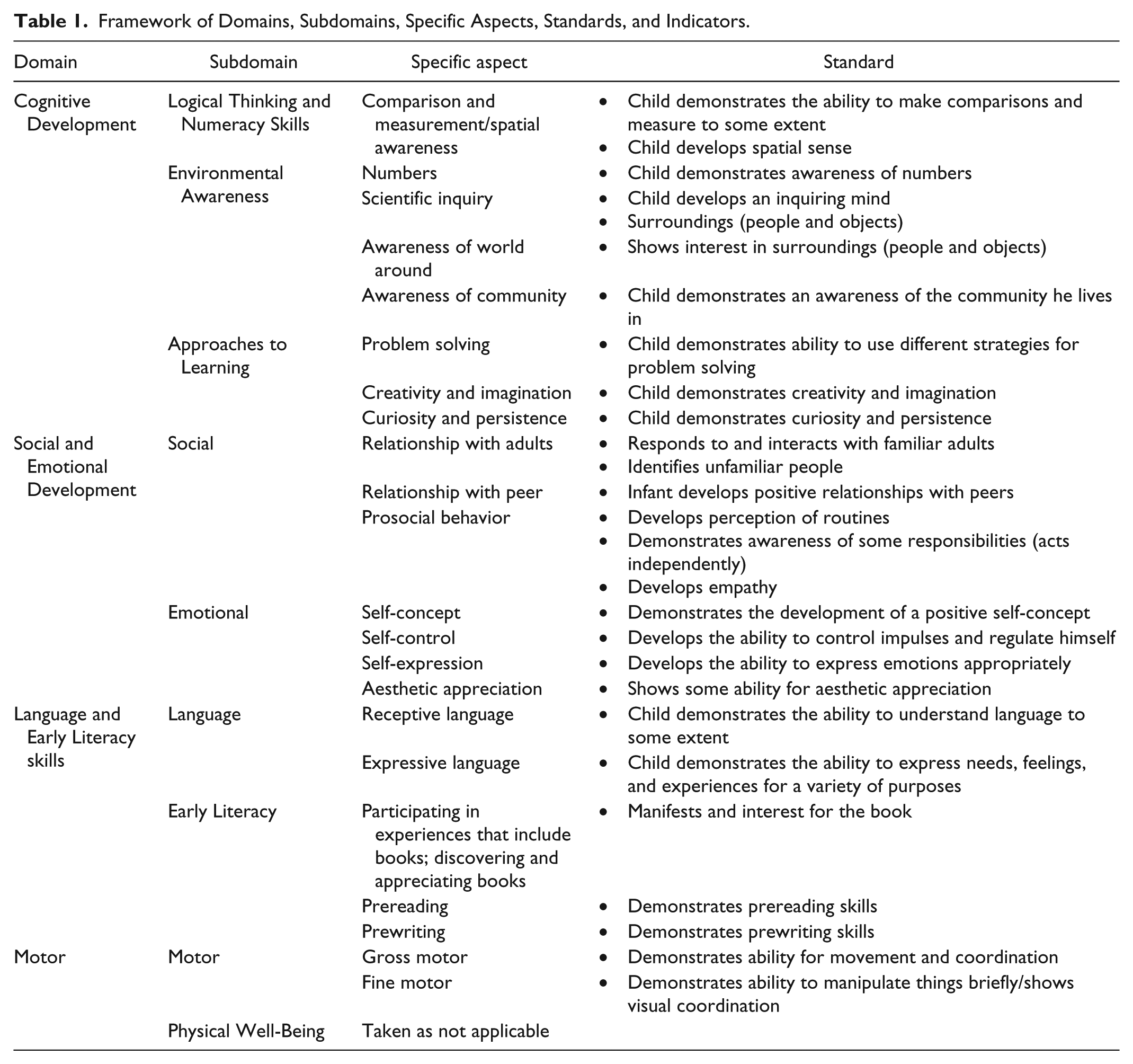
Once the skills are defined, they are made measurable by converting them to indicators; hence, the final hierarchy of a domain is given in Figure 1.
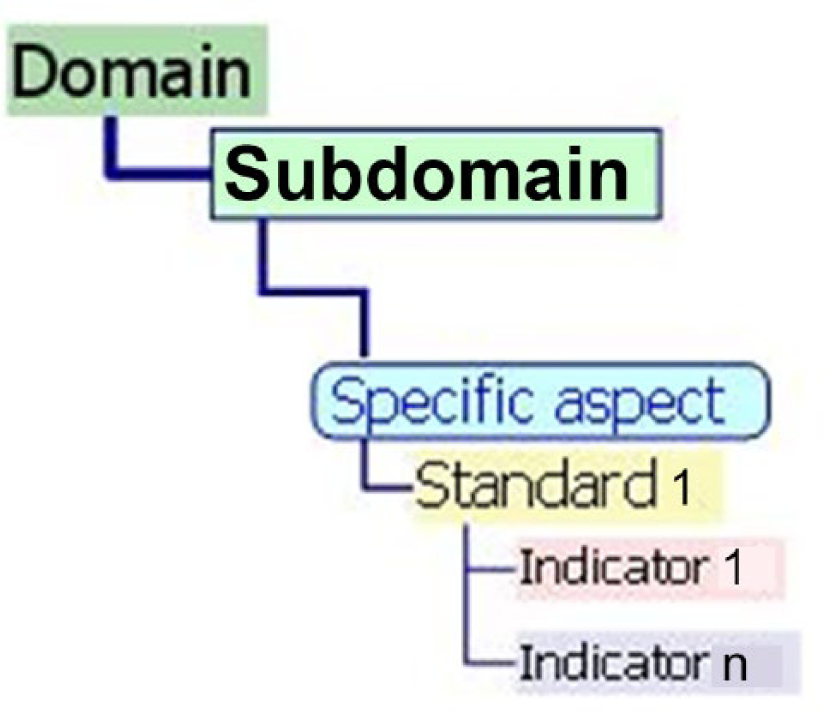
Hierarchy of a domain.
There are several steps involved in developing and validating an instrument. As the first step, an extensive review of literature is needed to operationalize the construct to be measured (Benson & Clarke, 1982). When the construct is operationalized, the items that can measure the construct as accurately as possible are identified. The team that developed the Denver Developmental Tool identified 336 items initially as the components needed to measure development (Frankenburg et al., 1996). In development of the Canadian Early Development Index (EDI), the items for the EDI were derived from existing instruments, key informant interviews, and focus groups (Janus & Offord, 2007). Content validation is the next step where the items and the table of specifications are given to a panel of experts who are asked to place the items in the suitable grids within the table of specifications. When absolute agreement is not reached, the item is revised until a consensus on its placement is reached. Cronbach and Meehl (1955) state that content validity is established by showing that the test items are a sample of a universe in which the investigator is interested.
Development tools can either use an a priori structure to categorize their indicators or an empirically driven method. An empirically driven structure will decide on the categories where the items will be placed following a mathematical evaluation like factor analysis. Most of the widely used scales like Bayley’s scale have not used an empirically driven method but utilized an a priori structure method. The Bayley Scales of Infant Development II (BSID II) has been subjected to factor analysis to explore the factor structure. For example, one such study is the analysis carried out by Thompson and others (Thompson et al., 1994). The authors conclude that at a second-order factor analysis, the mental and motor components emerge as discrete constructs. Countries developing ECDS have all used an a priori structure method. The present study uses this method as well. The authors are of the view that as the hierarchy used in the present study consists of numerous categories, it would render it unfeasible to do a construct validity at all levels. But a factor analysis at the topmost category that has the four domains of development could certainly be attempted.
Thus, the first phase of the study is comprised of two components:
desk review to generate a tentative list of relevant indicators and
qualitative study to carry out content and cultural validation of the above.
Component A: Desk Review to Generate a Tentative List of Relevant Indicators
The purpose of the desk review was to gather the generic list of expectations on what children should know and be able to do at a given age during the period of 2 to 12 months of their life and to define indicators to reflect them. Therefore, the data items included a comprehensive list of indicators that reflected a particular child’s developmental performance pertaining to each developmental domain (Motor, Socio-emotional, Cognitive, and Language domains). These indicators were finally organized into the hierarchy. The data for the desk review were gathered after review of several sources. These included review of textbooks on child development, existing developmental standards, and developmental scales.
Textbooks reviewed were Child Development by John W. Santrock (2001), Child Psychology: A Contemporary Viewpoint by Hetherington and Parke (1999), The Development of Children by Cole and Cole (1989), Child Development Principles and Perspectives by Cook and Cook (2009) and Psychology: The Science of Behavior by Neil R. Carlson (1984).
Subsequent to this, a review of articles on ECDS in the form of an electronic search was done to cover the standards and indicators already developed in the world. The articles were the following:
“South Africa National Early Learning and Development Standards for children birth to four years. Department of Basic Education, Pretoria, South Africa” (Department of Basic Education, Pretoria, 2009).
“Revised Tennesse Early Learning Developmental Standards” (Tennesse Department of Education, 2013)
Ohio’s infant and toddler guidelines (U.S. Department of Health and Human Services, National Infant & Toddler Child Care Initiative, Child Care Bureau, Office of Family Assistance, Administration for Children and Families, 2006).
“Washington state early learning and development guidelines.” (Washington State Department of Early Learning, 2011)
“Macedonia Early Learning and Development Standards from 0-6 years” (Damovska, Janeva, Palcevska, Panova, & Shaehu, 2006).
Searches in Medline (1970 to present), PsycINFO (1960 to present), and Embase (1960 to present) did not yield any additional information. The search terms used were “development,” “child,” and “standards.” A keyword search and a title search were done.
Next, scales of development commonly in use were reviewed. These were the Bayley Scales of Infant and Toddler Development (Bayley, 2005), the Denver Developmental Screening Tool (Frankenburg et al., 1996), the Parents’ Evaluation of Development Status (Glascoe, 1997), and the Ten Questions Screening Interview (Landers & Kagitcibasi, 1990).
Additional items appearing in these instruments which did not include highly specified test material and items that were not too complex so that it would be understood by the average caregiver were included.
Finally, a comprehensive list of items was obtained, and they were assigned to the domain, subdomain, specific aspect, and standard hierarchy. They were placed in the relevant age groups reflecting the ages of 2 to 3 months, 3 to 6 months, 6 to 9 months, and 9 to 12 months.
The indicators chosen had the following characteristics:
Reflecting only a single skill or activity
Being specific for a particular skill
Having the ability to capture the performance as the skill advances
Qualitative Study to Carry Out Content and Cultural Validation
This was to assess whether the indicators were comprehensive in covering the domains, were actually reflecting the domain under which they were included, and were actually reflecting the specific aspects and standards given. Modified Delphi technique was used for this process. For this, six experts comprising of three local consultant pediatricians (two qualified in developmental pediatrics), two psychologists, and a consultant child psychiatrist were utilized.
They were requested to go through each indicator with regard to the following and give their verdict:
Comprehensiveness of the standards and indicators in covering all aspects of the domain.
Adequacy in reflecting the scope of the domain.
Reflection of the standard, specific aspect, subdomain, and domain under which they were included.
Representation of domains in comparatively equal distribution.
Observability and measurability.
Are a reflection of what children in the age group are expected to know and be able to do.
After the initial round, the comments were analyzed for each item. If four or more out of six agreed on an indicator, it was taken as valid and included in the final instrument. If four or more experts disagreed, they were removed from the list. If three agreed, those indicators were again presented to all six experts. After completion of the second round, if the disagreement still stood at 50% (three disagreeing), the item was removed.
The finalized list of indicators at the end of this phase was transformed into measurable items with the help of a pediatrician involved in development assessment of children. This was brought about by laying out specific instructions to elicit a skill. To maintain uniformity in testing, a testing procedure had to be explained precisely so that the data collectors could conform to the procedure. The Bayley Scales of Infant and Toddler Development was consulted to decide on the positions, objects, and distance that items should be held when testing was done.
Next, a focus group discussion (FGD) of parents was held to gather information required to fine-tune the indicators to ensure their cultural appropriateness. Four FGDs were held on four different occasions, each consisting of eight parents. The indicators were then pretested. Pretesting was done using 10 children from age category. All the indicators in the age group were administered and assessed whether any difficulty arose to their observability.
Results
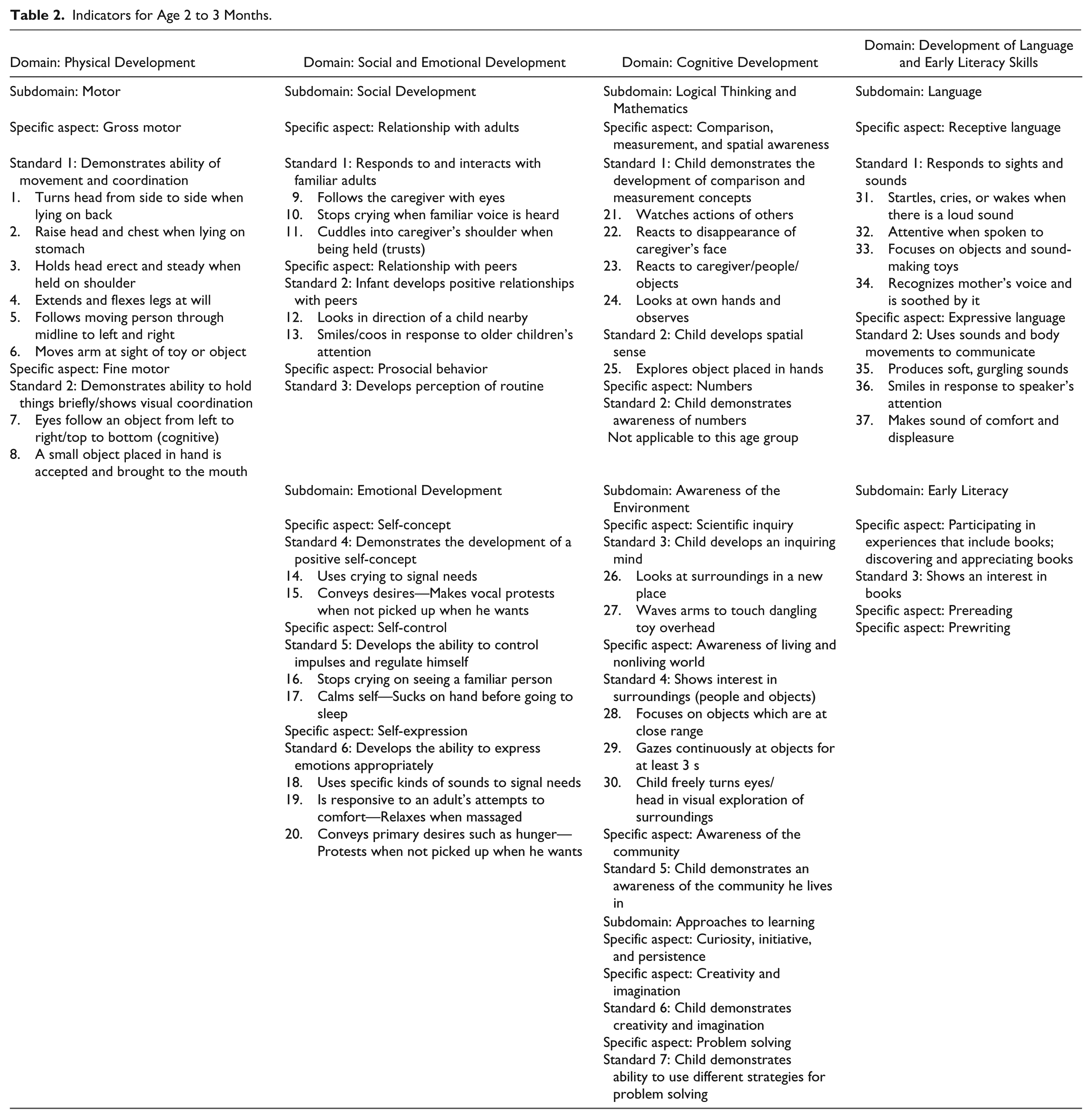
Following the first component which was the desk review, 171 indicators were compiled under the framework. They were organized under 25 standards which reflected 23 specific aspects in four main domains of development. Table 1 gives the framework of domains, subdomains, specific aspects, and standards.
Tables 2-5 give the 171 indicators arranged in the framework. Some indicators appeared in more than one age group as the indicators which suited the best age group could be selected once they were age validated.
Indicators for Age 2 to 3 Months.
Indicators for 3 Plus to 6 Months.

Indicators for 6 Plus to 9 Months.

Indicators for 9 Plus to 12 months.

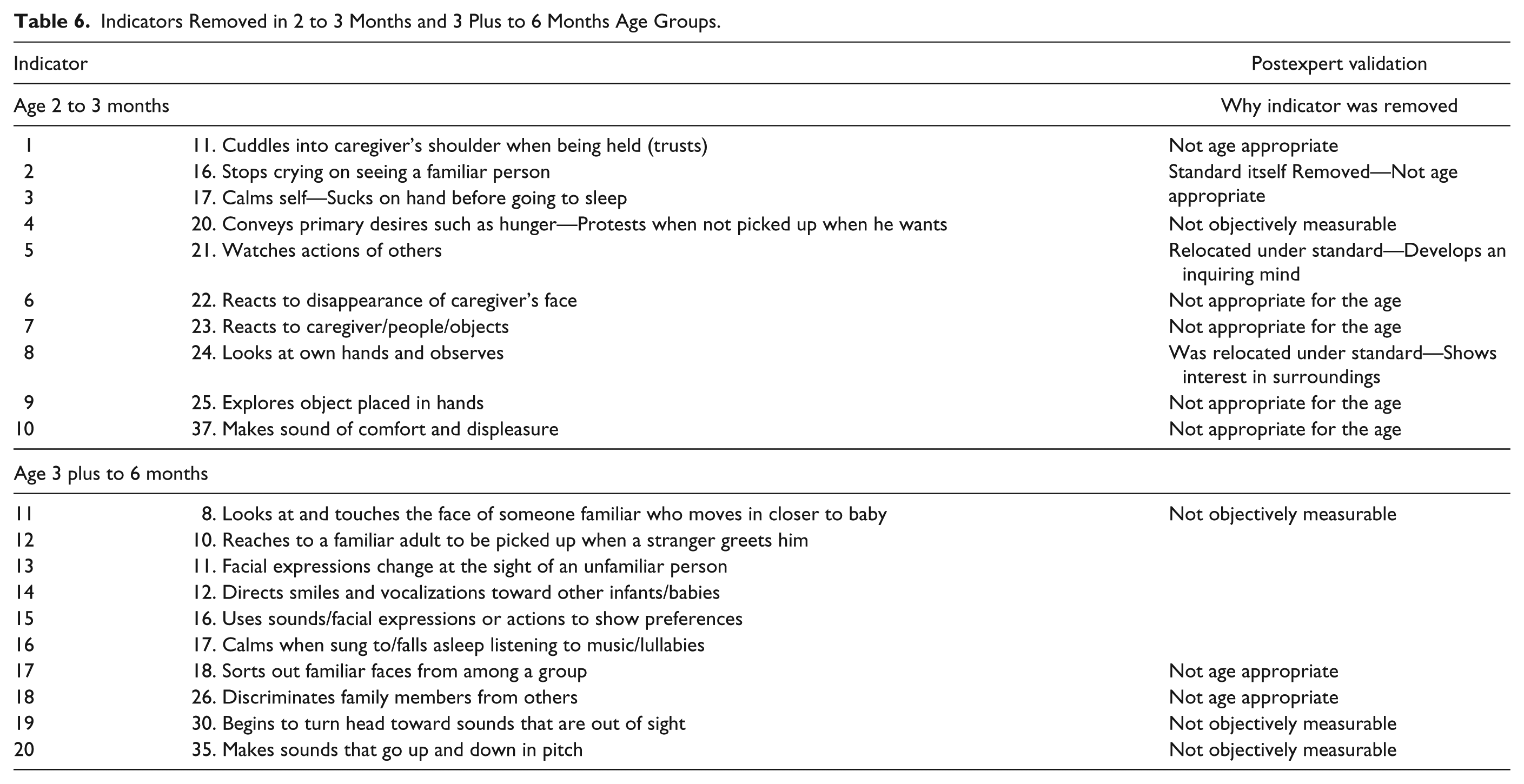
Out of the 171 indicators, 46 indicators were removed at the end of content validation. Tables 6 and 7 summarize how these indicators were reduced during content validation.
Indicators Removed in 2 to 3 Months and 3 Plus to 6 Months Age Groups.
Indicators Removed in 6 Plus to 9 Months and 9 Plus to 12 Months Age Groups.

As 46 indicators were removed at the end of content validation, 125 indicators proceeded to the next step of the study which was the FGD with parents to ensure cultural appropriateness. Although removal of 48 indicators is shown, in actuality, only 46 indicators were removed as two were relocated elsewhere. No major modifications were needed following the FGDs.
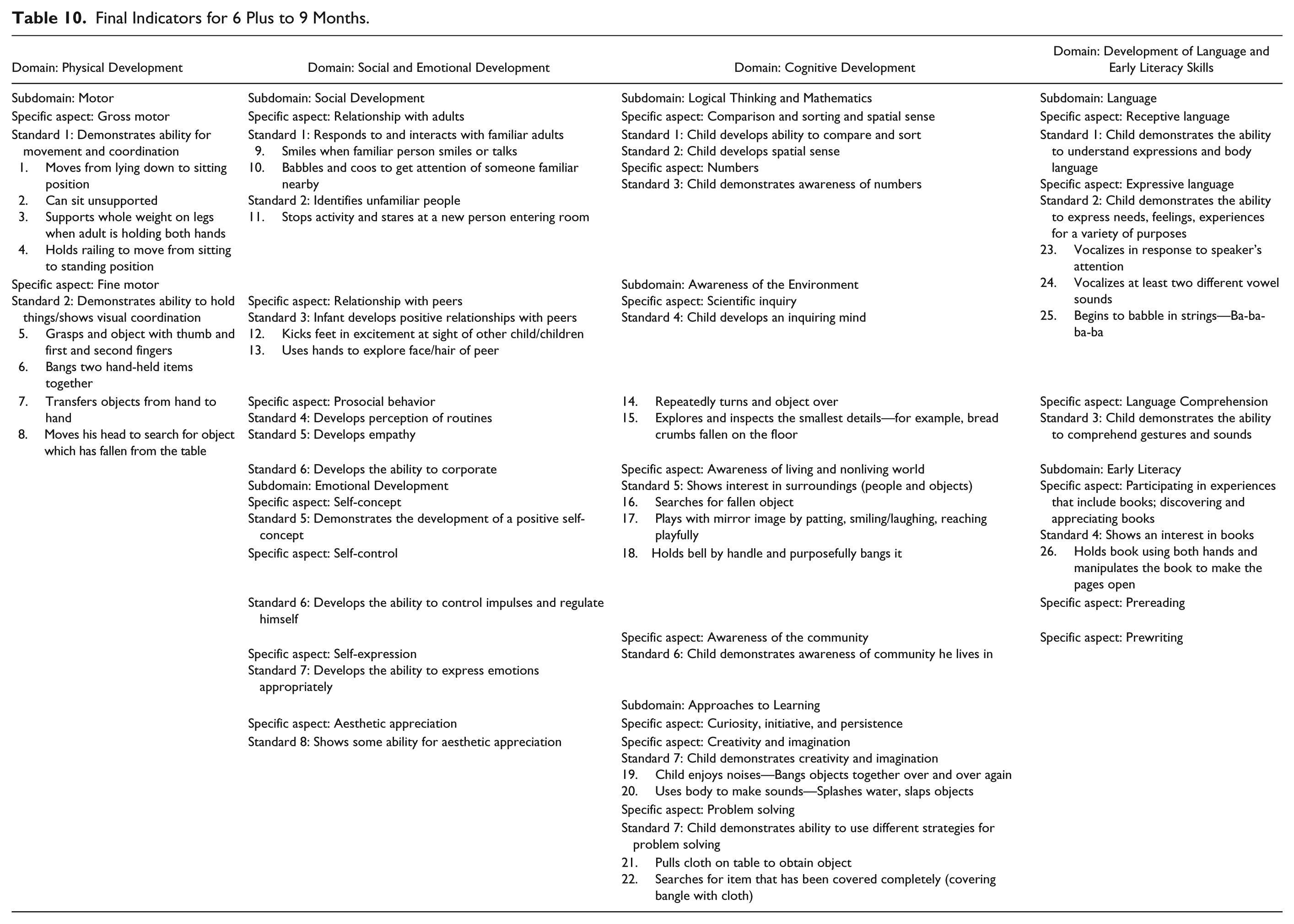
The development framework with the 125 indicators is given in Tables 8-11
Final Indicators for Age 2-3 Months.

Final Indicators for 3 Plus to 6 Months.

Final Indicators for 6 Plus to 9 Months.
Final Indicators for 9 Plus to 12 Months.

Next, the indicators were pretested. Following pretesting, 26 indicators had to be removed due to issues in measurability. Table 12 gives the indicators removed following pretesting.
List of Indicators Removed Following Pretesting.

Discussion
Due to lack of trained personnel and funds, developing countries are not in a position to hold a regular development screening program. Recognizing this fact, several countries have developed ECDS. The ECDS developed in this study was used as a pilot to develop national standards for child development in Sri Lanka. The first objective of the study was to define a set of tentative indicators to reflect the development in the four domains of development. This took the form of a desk review that generated a tentative list of indicators. The indicators were placed in the development framework described in the methodology. The main issue faced by the researchers was that most literature on child development gives indicators only under the four main domains. Fitting these indicators into the framework was a complicated task. The dearth of measurable indicators in the social and cognitive domains was another issue.
During content validation, the domain in which the most number of indicators was removed was the socio-emotional domain. Twenty-four were removed as they were not observable, and three were removed as they were too advanced for the given age groups in which the indicator would be tested. The reason for this is that social and emotional skills depict an unquantifiable aspect of a person and therefore are more qualitative than quantitative. Development scales like the Bayley Scales of Infant and Toddler Development therefore do not include socio-emotional skills in their scoring component (Bayley, 2005). Indicators for social development skills taken from Western literature tend to cause issues when used in a non-Western setup. In a preliminary survey done for the Malawi Developmental Assessment Tool, it was found that a significant amount of social indicators taken from Western literature had to be discarded as they did not qualify following a logistic regression analysis to obtain population norms (Gladstone et al., 2010).
The Cognitive domain had altogether 14 indicators removed. Eight of these indicators were initially placed under the two standards: (a) comparison and sorting and (b) spatial awareness which were in the subdomain Logical Thinking and Mathematics in the Cognitive domain. The issue arose as to whether these standards were applicable in infancy. Although it is said that mathematical skills operate even in early infancy, there is a problem in including it in an instrument for two reasons. First, it cannot be accurately said that functions like comparison and sorting operate in very early life. Although research has found that even newborns have rudimentary mathematical knowledge (Cook & Cook, 2009), there is not enough evidence to include these skills in a document such as this.
In the Language domain, four indicators were removed as they overlapped with other indicators in measuring the standard.
In the Motor domain, only one indicator was removed as it was not objectively measurable. This domain shows indicators that are less complicated and have fewer aspects than other domains. This could be the reason that indicators belonging to this domain form the bulk in assessment systems of child development in the first half of the 20th century (Gessel & Amatruda, 1947). Improvements in psychometrics in the latter half of the century have made it possible to measure less straightforward aspects in development like socio-emotional components.
Conclusion
The development indicators in the framework could be used as a tool to screen children for development delays after undergoing a reference-based validation. The second part of the study (to be included in a separate article) describes the assessment of psychometric properties of the tool along with reference-based validation. The tool utilizes simple equipment and does not need highly specialized training. This allows it to be used in a low-income setting.
Footnotes
Declaration of Conflicting Interests
The author(s) declared no potential conflicts of interest with respect to the research, authorship, and/or publication of this article.
Funding
The author(s) received no financial support for the research and/or authorship of this article.