




Abstract
Interpersonal communication between transgender/gender-diverse and cisgender people is an understudied area within the fields of communication studies and gender studies; studies on Canadian and Polish interpersonal communication dynamics involving these demographic groups are even rarer. The purpose of this research project therefore was two-fold. On an applied level, this study sought to document and analyze interpersonal communication dynamics between transgender/gender-diverse and cisgender people in Poland and Canada, respectively. On a theoretical level, this study sought to extend interpersonal transgender communication theory. Based on in-depth interviews conducted with 44 participants in Canada and Poland, the authors identified common positive and negative interpersonal communication experiences between transgender/gender-diverse and cisgender people within each nation. The thematic analysis uncovered similarities and differences; quotations from the interviews allowed for identification of concrete moments in interpersonal communication encounters. Findings were analyzed from the perspective of recent articulations of communication accommodation theory (CAT) with particular emphasis on the role of accommodation and nonaccommodation, affective motives, and skills training. The relevance of accommodative communication behavior and the significance of perceived communicative intent emerged as key findings.
Plain Language Summary
This study draws on in-depth interviews conducted with 44 people in Canada and Poland. Participants included transgender/gender-diverse and cisgender people, who spoke about their experiences in communicating with cisgender/transgender or gender-diverse people, respectively. The study identified common positive and negative interpersonal communication experiences between transgender/gender-diverse and cisgender people within each nation, generating suggestions for further study and for applied training.
Keywords
Introduction
This research project sought to document and analyze interpersonal communication dynamics between transgender/gender-diverse and cisgender people in Poland and Canada, respectively. Interpersonal communication between transgender/gender-diverse and cisgender people is an understudied area within the fields of communication studies and gender studies (heinz, 2018); studies on Canadian and especially Polish interpersonal communication dynamics involving these demographic groups are even rarer (heinz, 2015; Kłonkowska & Dynarski, 2020). Such work, however, is warranted by the increasing amount of empirical data identifying communication challenges involving people with differing gender identities across cultures. Large-scale surveys of transgender people identify disproportionate experiences of isolation, loneliness, depression, and anxiety (James et al., 2016; Levitt & Ippolito, 2014); effective positive interpersonal communication, however, has a documented positive effect on psychological well-being for gender diverse people (Gamarel et al., 2019; Kelleher, 2009; Kosenko et al., 2015). At the same time, research on cisgender allyship has surfaced a desire for recommended communication strategies (Chong & Mohr, 2020; Norwood, 2012; Shlasko, 2017).
Spencer and Capuzza’s (2015) Transgender Communication Studies was instrumental in moving forward the development of a designated field of transgender communication by co-presenting work from the areas of human communication, media, and public and rhetorical communication. The section on human communication consists of five chapters on health, organizational, interpersonal, family, and intercultural communication, each of which refers to communication strategies. For example, Norwood and Lannutti (2015) recommended the development of “specific communication strategies” in the context of family communication (p. 80); Dixon (2015) called for attention to the ways in which “instructor communication during diversity training sessions can be improved” (p. 45), and Kosenko et al. (2015) highlighted the importance of nonverbal immediacy cues (p. 32). Transgender interpersonal communication has mostly been studied via relational dialectics theory (Scharp & Thomas, 2022) and communication theory of identity (Hecht & Phillips, 2022; Nuru, 2014) but rarely through the lenses of other interpersonal communication theories that are clearly relevant, such as communication accommodation theory (Soliz et al., 2022), uncertainty reduction theory (Berger & Calabrese, 1975), communication privacy management theory (Petronio et al., 2022), or expectancy violations theory (White, 2022). For this study, Communication Accommodation Theory (CAT) was selected as an explanatory lens, building on applications of this theory to family communication with gay and lesbian members (i.e., Soliz et al., 2010).
CAT transformed from a 1970s theory on linguistic accommodation into a comprehensive theory that “explains how and why people adapt their communication, as well as the consequences and outcomes of adjustment across a variety of relational domains” (Soliz et al., 2022, p. 130). Today, CAT is considered “one of the most well-developed, widely recognized, and influential theories of interpersonal adjustment” (Gasiorek, 2019, p. 19). As a behavioral theory, it seeks to explain the role of social and personal identity in dyadic and group communication encounters (Dragojevic & Giles, 2014; Pines et al., 2021; Soliz & Giles, 2014). The notion of interpersonal distance is key to this theoretical framework, which focuses on “the adjustments individuals make to create, maintain, or decrease social distance in interaction” (Giles & Ogay, p. 293). Key theoretical principles identified by Giles and Ogay (2007) include the acknowledgment of the “socio-historical context” of the interaction (p. 294), the fluid and interactive nature of group membership during interactions, and interactants’ expectations about “optimal levels of accommodation” (p. 294). Key constructs include accommodation (including non, under-, and overaccommodation), convergence, and divergence. In its simplest terms, accommodation refers to the “constant movement toward and away from others, by changing one’s communicative behavior” (Giles & Ogay, 2007, p. 295). Convergence is an accommodative communication strategy in which interactants adjust communication to become or appear more similar to their conversational partner(s), such as matching rate of speed, or adjusting one’s accent (Giles & Ogay, 2007). Divergence, then, is an accommodative communication strategy in which interactants adjust communication to become or appear more different from their conversational partner(s) (Giles & Ogay, 2007).
Dragojevic et al. (2016, p. 51) formulated seven CAT principles to streamline increasingly complex articulations of the theory. These principles state that communication accommodation serves to “facilitate coherent interaction” and to “manage social distance” (Principle 1), is governed by contextual expectations (Principle 2), is subject to motivation and ability (Principle 3), will increase over time if desired (Principle 4), “enhances interactional satisfaction” if less social distance is desired (Principle 5), will decrease over time if further distancing is sought (Principle 6), and that increased non-accommodation “diminishes interactional satisfaction” (Dragojevic et al., 2016, p. 51). Significant to the present study is CAT’s ability to consider interpersonal and intergroup processes simultaneously.
In this qualitative study, we use CAT as an explanatory lens (Facey et al., 2018). Although CAT has been widely used as a predictive model and an applied training framework, our approach is in line with recent “more textually flowing nonpropositional” applications of the theory (Giles & Ogay, 2007, p. 294), or as Soliz et al. (2022) describe it, use of CAT as a “sensitizing framework for interpretive studies using qualitative methods” (p. 131).
By selecting CAT, we also hoped to help extend interpersonal communication studies at large. Manning and Adams (2022) argued “that it is essential to queer “traditional” interpersonal communication theories – especially theories involving relationships or sexuality – in the sense that most were developed without much, if any, consideration of diverse genders and sexualities” (p. 292). To contribute to the emerging scholarship in this area this exploratory study examined three research questions:
RQ1: Which aspects of communication with transgender (cisgender) people do cisgender (transgender) people experience as positive?
RQ2: Which aspects of communication with transgender (cisgender) people do cisgender (transgender) people experience as negative?
RQ3: How do participants’ observations align with core principles and constructs of Communication Accommodation Theory?
Methods
Using snowball and convenience sampling 7 transgender/gender-diverse and 7 cisgender participants in Canada and 15 transgender/gender-diverse and 15 cisgender participants in Poland were recruited and interviewed. Language describing sexual orientation and gender identity is localized and in constant flux, and the authors’ emphasis lies on honoring individual’s self-identifications. All participants volunteered as either “transgender” or “cisgender” participants per the invitation to join the research project; however, several of the “transgender” participants self-described as genderqueer, gender-fluid, or non-binary during the interview process. To capture this phenomenon, we use “transgender/gender-diverse” throughout and an individual’s particular identity as warranted. Interviews took place between 2018 and 2020. Cisgender participants had to have knowingly experienced communication with transgender people. The project received approval of the respective research ethics overview bodies. All participants gave informed consent to contribute to the project. The use of snowball and convenience sampling remains a commonly accepted practice in research with sexual and gender minorities (Semlyen & Hagger-Johnson, 2017); its obvious drawback is a highly limited degree of transferability (Roller & Lavrakas, 2015). In this study, using snowball and convenience sampling implied that participants likely held positive attitudes about the topic because they were interested in participating. The criterion of having to have experienced communication with transgender/gender-diverse people was significant in that the experience of knowing a transgender person in and of itself has an attitudinal effect. In the context of a 2016 survey of public attitudes on transgender rights in Poland, Brown (2017) wrote: Few people in Poland are estimated to know a transgender person. (…) A majority of participants (65.8%) indicated they did not know transgender people, that they either rarely or never encountered transgender people or had seen but did not know any transgender people personally. (p. 2)
The self-selection dynamic at play here suggests that the findings are specific to individuals who are interested in communicating effectively across gender diverse groups. The Canadian interviews were conducted in English; the Polish interviews were conducted in Polish and quotations translated into English. The interview questions were checked for semantic equivalency by the second co-author, who is fluently bilingual, lives in Poland, and frequently publishes in both languages in this topic area. The interviews lasted between 1 and 2 hours and were audio-recorded.
The interview guide employed accessible language in either Polish or English. The guide contained 25 questions that asked participants to reflect on past interactions with transgender/gender-diverse or cisgender people, respectively. Key questions asked participants to recall and analyze interaction that “turned out well” and one that “did not turn out well.” Follow-up questions explored general attitudes about interactions with transgender/gender-diverse or cisgender people, perceived and enacted intent, and general expectations for communication with transgender/gender-diverse or cisgender people and solicited participants’ assessment of positive and negative communication strategies.
A research assistant recruited the Canadian participants, interviewed them using the interview guide, and transcribed the interviews. The first author listened to the interview recordings and checked the transcription. The Polish participants were expected to have heightened concerns about confidentiality due to the current political and social climate in Poland. ILGA-Europe ranks Poland the lowest in terms of laws and policies of each EU country that impact the lives of LGBT people (ILGA, 2020). Therefore, the co-author collected and transcribed each of the interviews herself.
After transcription, the original recordings were destroyed, and the transcripts analyzed for common themes. The Polish and Canadian interview data were first analyzed independently of each other and then in comparison. Canadian participants selected a first name to be identified in this study; Polish participants were randomly assigned names matching the gender they experienced. The responses to the interview questions were thematically analyzed via multiple readings following the procedures articulated by Braun and Clarke (2006), Clarke and Braun (2017), and Kiger and Varpio (2020). Each theme was illustrated by at least one quotation. These quotations were selected by the first co-author from the Canadian data and by the second co-author from the Polish data. Such quotations were selected because they appeared to best represent similar perspectives, capture a divergent perspective, bring life to the research description, and increase transparency and trustworthiness of the research process (Creswell, 2012; Lochmiller, 2021; White et al., 2014; Yin, 2010). As specified by the research ethics and consent processes, demographic details were only provided in conjunction with quotations if deemed essential to the understanding of the context. The themes are presented, within each participant group, in order of descending dominance in the data.
The data analysis for this study thus consisted of both inductive and deductive techniques. Once the themes had inductively emerged from the data, a deductive analysis of the themes was conducted, following Braithwaite, Schrodt and Phillips’s (2022) observation that “for interpretive researchers, the goal is not to test a theory in a specific situation, but rather to engage the theory in conversation with the emergent observations and interpretations that flow from the [participants’] experiences” (p. 9). The inductive analysis served to answer the first two research questions; the deductive analysis served to answer the third research question. This analytic process followed the hybrid process employed by Ando et al. (2022).
Participants
Canadian Sample
The Canadian participants ranged from ages 22 to 56 years with a median age of 33.6 years. These participants identified as gay (4), queer (3), bisexual (2), pansexual (2), straight (2), and lesbian (1). Seven were cisgender; the other seven were transgender or non-binary. All participants self-described as white, with two participants identifying as white and Indigenous/Native American. The cisgender participants ranged from 22 to 56 years of age. Four were women; three were men. Six of the seven cisgender participants were white; one was white and Native American. One identified as straight, two as pansexual, two as bisexual, and two as queer. All of the cisgender participants said they generally enjoy being among people and interacting with others, with two noting that they also need time alone to refuel. All of the cisgender participants said they communicate with transgender people, ranging from infrequently (2) to weekly (3) to almost daily (2). The transgender/gender-diverse participants ranged from 26 to 52 years of age. Six of these seven participants were white, and one was white and Indigenous. One identified as gay, one as lesbian, one as straight, and four as queer. Three were men/male/transmasculine, two were women; two were genderqueer/gender-fluid. These participants answered the question whether they like being among people and interacting with others quite differently from the cisgender participants. Two participants said they generally enjoy interacting with others; two participants said they generally don’t enjoy interacting with others; and three participants said that their enjoyment of interactions was entirely dependent upon the context.
Polish Sample
The Polish interviewees ranged from ages 20 to 52 years with a median age of 34.9 years. All Polish participants self-described as white. These participants identified as: straight (13), lesbian (4), gay (3), asexual (3), bisexual (2), pansexual (2), and demisexual (1). The remaining interviewees (2) weren’t sure how to identify themselves. Fifteen participants were cisgender; the other 15 were transgender/gender-diverse.
The cisgender participants ranged from 23 to 50 years of age. Ten were women; five were men. Seven cisgender participants identified as straight, two as lesbian, two as gay, two as bisexual, one as pansexual, and one person wasn’t sure whether they should identify as straight or bisexual. The cisgender participants said they generally enjoy being among people and interacting with others, with seven persons noting a need to spend some time alone. Four said they prefer to spend time with people whom they know well or those who share their interests and/or political opinions. All of the cisgender participants said they communicate with transgender people, ranging from infrequently (4), approximately weekly or biweekly (4), to almost daily (3), and daily (4).
The transgender/gender diverse participants ranged from 20 to 52 years of age. Seven were women/ transfeminine, four were men/transmasculine; two were non-binary masculine, and two were gender-fluid. (The Polish language does not offer gender neutral pronouns. In addition to pronouns, other parts of speech such as nouns, verbs, adjectives, and numeral forms are gendered and express the gender of the person speaking as well as the person addressed. Thus, most non-binary persons choose either a masculine or feminine grammatical form—with only some people trying to use male and female forms alternately. Therefore, some people declare identities such as non-binary masculine or non-binary feminine.) Six participants identified as straight, three as asexual, two as lesbians, one as gay, one as pansexual, one as demisexual, and one genderfluid person described themselves as “being into women.” All Polish transgender/gender-diverse participants—except for one—also declared that they like being among people and interacting with others. However, two interviewees said that this has not always been so, and that they started to enjoy other people’s company only upon coming out and transitioning. Additionally, four participants said they prefer being in company of people they already know, rather than meeting new people.
Table 1 summarizes participant characteristics.
Participant Gender Identity and Sexual Orientation.

Findings
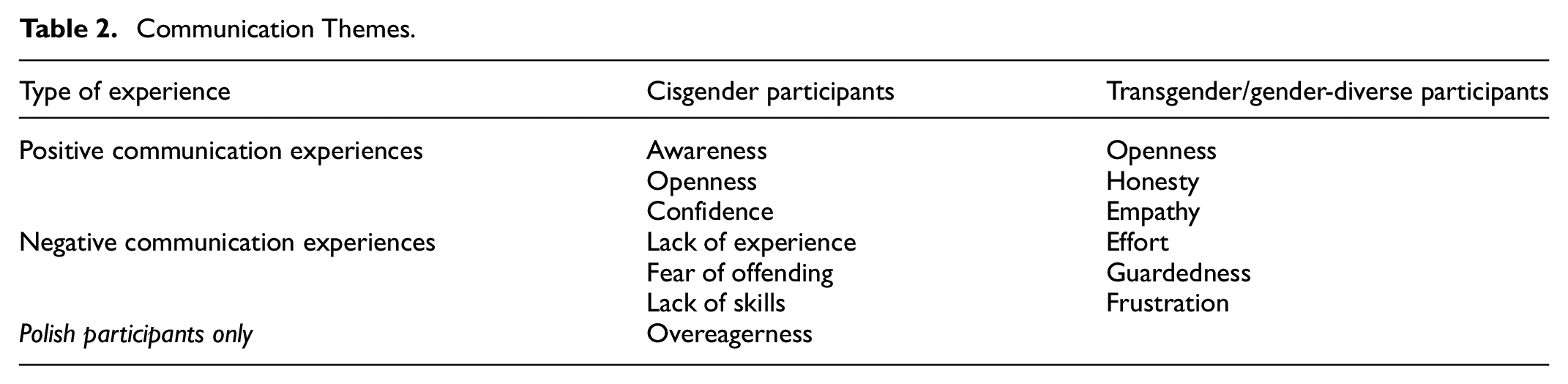
In the inductive round of analysis, we identified 12 themes emerging from the participants’ recollections. Only one theme, honesty, emerged as a theme for both cisgender and transgender/gender-diverse participants. One theme, overeagerness, emerged from the Polish cisgender participants’ data only.
Positive Interpersonal Communication Experiences
The first research question inquired about positive interpersonal communication experiences between transgender/gender-diverse and cisgender people. All Canadian and Polish cisgender participants asserted that there are no settings in which they would rather avoid communicating with transgender people. Each of the cisgender participants was able to recall positive interactions with transgender people.
Cisgender Participants
Three themes emerged from the Canadian and Polish cisgender participants’ responses to questions about positive communication experiences between them and transgender people: Awareness, Openness, and Confidence.
Awareness
Among the Canadian participants, four cisgender participants said there were no differences between their communication with transgender people compared to communication with other cisgender people. Three participants described the role of awareness in detail. One participant said mostly, they were not aware of differences but that sometimes, a first meeting with a transgender person might prompt a spontaneous processing response that has to be overridden. Meghan said “(…) even if you don’t want to it categorizes people as different and so sometimes there might be a ‘oh how do I handle this’ situation that I have to sort of be like, okay, no, you don’t have to handle it any different. But it comes up sometimes regardless.” Two participants said they would likely be more conscious of language use. Five Polish participants said there were no differences between their communication with transgender people and their communication with other cisgender people if the transgender person was someone close to them. Three among those participants were life partners of a transgender person, one was a mother of a transgender teenager, and one was a relative of a transgender person. Five Polish participants expressed an awareness of differences in communication with transgender people other than their close ones. Two cisgender participants reported that their attitudes toward communication with transgender persons changed over time. Seven cisgender interviewees said they were clearly aware of differences between their communication with transgender and cisgender people.
Participants said they avoided some gender-specific topics in communication with transgender individuals and paid closer attention to their own communication once a conversational partner was known to be transgender person. Only one Polish interviewee said that his communication with transgender people does not differ at all from communication with cisgender people.
Openness
Canadian cisgender participants stressed the need for open, transparent interactions. Mary said her neighbor was assigned female at birth and transitioned at age 5 years. “I interact with him all the time, just as a neighbor and a family friend,” she said. Mary, who used to babysit the individual, said it was a very positive experience to see the child change from being quiet and reserved to outgoing and interactive. Interactions with her neighbor are positive, she says, because they are marked by being “completely open and just only care about what is making the other person happy and feel comfortable and safe.” Meaghan recalled a series of interactions with a classmate in a study group who had missed classes due to transition-related surgery. She had been able to attend those classes and was able to help the classmate catch up. “We’d never actually talked before. We really got to know each other, and they were very open about surgery and everything they were going through.” Being in a safe, public space at a university both attended and knowing other members of the study group fostered positive communication between the two of them, she said. Another participant recalled a text exchange with her best friend over a social media application. Her friend came out as non-binary to her. “It was just an immense moment of love between us, and it was really, really special.”
Brian offered disclosure of transgender identity as an example of a positive interaction. Fifteen years ago, he and his husband met a lesbian couple. One of the women talked about her transgender identity with them. It was the first time he knowingly met a transgender person. “And I guess just the positive thing about it was that they felt comfortable enough to tell me about themselves. And it wasn’t just me; it was my husband as well. I felt kind of privileged in a way,” Brian said, to have someone “confiding something very private, and kind of potentially dangerous.” The interaction occurred in a rural area, in a community that Brian described as “fairly religious” and “close-minded.” He and his partner had experienced both positive and negative interactions with other community members due to their sexual orientation. The interaction went well, Brian said, because he and his partner are “open to people of all kinds of different ways of being and backgrounds.”
Openness was also stressed by the Polish participants. Tadeusz, a general practitioner doctor, remembers when a trans woman visited his office as a new patient. Having a trans feminine person among close relatives, he was already well acquainted with the medical, legal and social aspects of male-to-female transition. He recounted seeing his patient’s obvious distress with having to undress for examination and noticing that the person’s male personal data did not match her feminine gender expression. He then politely sent away a nurse who was staring at the patient and said: “I am a physician, and I am aware that women have all kinds of bodies, and I know that sometimes people are given a wrong name.” As he recalled: “And that was it. Just this one thing I told her simply saved the day.”
Barbara, a university instructor, recalled a situation when a student approached her before a lecture. During the first class, when students are asked to introduce themselves, the student let her know that he was a trans person. “And then there were no presuppositions: what is going on, why he has female personal data, and so on.” Communication with the student remained good and open, she said. Barbara said that reciprocal openness made their communication mutually respectful.
Confidence
Canadian cisgender participants cited the relevance of confidence, both their own and the confidence of their interactional partner, as a positive factor. One participant emphasized that her interactions with people, regardless of gender, tend to be positive. She cited successful flirting with trans people as an example of effective interpersonal communication. “I went into it with confidence, and I was reacted to, also with confidence coming back at me,” she said. Carl recounted the public transition of an executive in his industry. “I had a chance to work with them before and continued to work with them after their transition. (…) I did not change my interaction with them in any way.” This likely made the individual more comfortable working with him, he said. “After that we wound up talking more,” he said, which strengthened not just their working relationship but also their personal relationship. “That whole kind of experience of continuing to work with them after a very public transition was, was a really positive one,” Carl said. Carl attributes the positive outcome of this experience to the way the individual approached their transition, which was “with kind of just a lot of confidence and willingness to just take whatever was gonna happen.”
Ariel said her best friend’s disclosure of being non-binary was an expression of confidence in their relationship. “Being best friends for many years and sharing an interest in queer theory and social justice made this interaction easy,” she said. “You know they’ve said that’s made it that much easier for them to approach me. To tell me. To have me be the second person they told, right? Because they knew it would go well.”
The importance of confidence also emerged as a theme in the Polish cisgender responses. Józef commented that “if you act as if you were ashamed of something, as if you had some dark secret, then whatever this is – people will see it exactly this way.” Polish participants also commented on the reciprocal effects of displays of confidence. Wanda, whose ex-spouse had transitioned, recalled how her confidence encouraged a transgender adolescent to have no fear in coming out to her. (According to the legal regulations in Poland, people who wish to transition and have their legal gender markers changed are forced to divorce—even if both parties wish to stay in the relationship—before undertaking further transition-related steps.) She said that transgender people often assume that cisgender people hold negative attitudes, but that this is a generalization that doesn’t necessarily hold true. She recounted how she approached the transgender son of a friend: I had an impression, that he tried to hide somehow. You know, that he is no longer a girl, and still is afraid to admit to the world that he is a boy. And even though he is this boy, he tries to hide in corners.. (…) And only after I approached him – it was me who approached him – (…) then suddenly it occurred to him, that the whole situation was different. That not only I accept him, but I may even be helpful. And that I have no problem with this, and that this problem was in his assumptions only.
In Daria’s case, it was the opposite: her teenage child’s confidence while coming out, and their trust in her unconditional acceptance, mitigated all her doubts and fears: I heard a wonderful thing from my child: ‘Mom, you are the brain of this family, so you know that we always come to you, whatever. I know that you will always have my back and try to help me. So, with this [transition], I just know that whatever I will decide, you will support me.’
She did not have to think twice about how to respond, she said, because it is crucial for a mother to support her child, whether trans or not.
Transgender/Gender-Diverse Participants
Three themes emerged from the Canadian and Polish transgender/gender-diverse participants’ responses to questions about positive communication experiences between them and cisgender people: Openness, Honesty, and Empathy. Every participant was able to recall positive interactions with cisgender people.
Openness
Openness, in the Canadian participants’ experiences, referred to both the degree of comfort they felt in being open and to the ways in which the cisgender participants signaled openness to not making assumptions and genuinely seeking understanding. “It is important for cisgender people to not make assumptions,” Grove said.
Chris recounted an experience he had on a dating app with a male cisgender person who expressed curiosity “about FtM like, men.” Chris explained to him that he did not identify with the term “FtM.” And I remember that interaction as actually positive because (…) he was willing to listen and he sort of, um, changed his approach.. (…) And like, um, while that’s still obviously fetishization, on some level, I like also, I appreciate somebody more who’s like upfront about (…) what they are curious about, or what their intentions are, than somebody who’s like trying to hide it.
Sookie described a workshop co-facilitation that resulted in a participant switching to their trans sibling’s appropriate pronouns. “I felt really good about that interaction because, like, I don’t think she wanted to be hurting her brother, and I don’t think she understood that she had been doing so.” The workshop was successful in improving the participant’s communication skills because of its non-judgmental approach, Sookie said. “There would absolutely be, like, no judgment in the space around what we don’t know, because we don’t know what we don’t know. (…) I always tell folks that I would much rather they, like, ask the question wrong and use language that isn’t appropriate (…) so that we can like help them do better moving forward.” Grove hoped to only obtain health care from non-cisgender providers but that did not turn out to be feasible. However, Grove’s cisgender acupuncturist has been very supportive, Grove said, continuing: Part of what made that work well was (…) she had some amount of knowledge and had done her own homework, um, so had some awareness. But also, left space for curiosity and finding out who I am, instead of making assumptions, asking questions, um, and having enough knowledge to ask thoughtful questions. um. But I suppose that’s kind of the thing that makes a difference (…)
Polish participants also highlighted openness on part of cisgender people as well as their own. They described their own openness to coming out to cisgender people; they described cisgender people’s openness to the ways in which they received their coming out disclosures. Andrzej said coming out in front of his colleagues has been a positive experience overall. “Even when I assumed that it would be OK, it always turned out to be even better than I expected,” he said. In particular, he recalled an interaction with an acquaintance who stopped him before class one day. Her behavior revealed that she was not sure how her question would be received and whether she would cause discomfort. So, she said that she noticed that I had changed my name on Facebook and asked if I wanted to be addressed as ‘Andrzej.’ I said yes, and then she asked also about the grammatical form. And since that moment, all the time, she consequently holds on to the male form, and addresses me as ‘Andrzej’. And that was great. That was very surprising for me in this way, that we didn’t really have much contact before. And now I spend more time with her.
As with observations about the reciprocity of confidence, Polish participants noticed that an open attitude toward cisgender interlocutors was very likely to cause a similar reaction. Franciszek said: “If you are open when you talk about it, and don’t make it a big issue, people are more likely to be the same. (…) You know, expecting negative reactions attracts them [such reactions]. Or people just withdraw if someone is too uneasy and problematic.”
Honesty
Canadian participants raised honesty as a key value, but also cautioned about the need to balance honesty with empathy. Honesty, communication, and empathy are key to positive interaction experiences, Steven said. When conversations turn to gender identities and the conversation is generally positive, Steven often discloses their gender fluidity, “and then that’s sort of when the conversation becomes [even] more positive.” Mindy also noted the importance of honesty but said honesty needs to be balanced by empathy and respect. “It doesn’t help if the person you’re talking to is (…) honest about how uncomfortable they are around transwomen,” she said.
Most Polish participants appreciated the honesty of cisgender people, even if it meant a reaction that was “not bookishly correct,” Monika said. Before her transition, Gertruda made friends with a few cisgender men. According to her, they are good company, however, they tend make sarcastic jokes. When she transitioned, she also came out to this group of friends. They responded with crude sarcasm, but Gertruda said she appreciated the fact that not only they did not change their attitudes toward her, but that they reacted honestly and in their usual manner. This meant that her coming out didn’t cause any artificiality in their relations, as her friends didn’t feel obliged to change the way they used to interact with each other within the company: One of the funniest reactions that I’ve heard was: “You know, I always knew that there was something wrong with you, but I thought that you were simply a gay.” Another one said: “But you are way too logical for a woman!” That’s their typical sarcastic jokes, I took it with humor.
Empathy
All Canadian participants said positive interactions with family, friends, or strangers were marked by the noticeable effort to be respectful, to understand, and to offer support. Chris, who is originally from Germany, described various interactions involved in coming out to his family as transgender. He had been anxious about these conversations, but his family members turned out to be supportive, as did his friends, who mostly belong to the queer community.
Empathy also emerged as a theme among the Polish participants. Anastazja recalled encountering an unanticipated emphatic response at the hospital when she had surgery: (…) there were two very curious nurses. And we talked for a really long time, and one of them said this: “Well, for us it was like – a woman comes here, in her documents there is a female name, but the surgery is typical for men. So, what the heck is going on here, right?” And then she says this – she said this by herself: “What one needs is just a little bit of empathy. Ok, this is a woman, and she needs this kind of help. That’s it.” And I said: “Such a simple conclusion, how come more people don’t get it?” Well, this really surprised me in a very positive, really great way.
Negative Interpersonal Communication Experiences
Cisgender Participants
Three themes emerged from the Polish and Canadian participants’ responses to questions about negative communication experiences between them and transgender people: Lack of Experience, Fear of Offending, and Lack of Skills. For Polish cisgender participants a fourth theme, Overeagerness, surfaced.
Lack of Experience
Canadian participant Colt, who works for a community health organization for gay/bisexual/men who have sex with men, said his most negative interaction with a transgender person occurred at work. His colleague was an out transgender man, and when the two of them went on a work-related trip, it was Colt’s first opportunity to speak with a transgender man who was open to questions. I was viewing this interaction as a professional learning opportunity as I was spending so much time with someone who could answer my questions. In my excitement and haste, I asked them about their surgeries, specifically bottom surgery. At the time I felt that I had overstepped but my colleague didn’t let on just how much that incident impacted him. Little did I know I had effectively put up a major wall between us. This incident actually shaped our relationship for the first year of our working together and we struggled (…) it wasn’t until our manager intervened and attempted some mediation between us (…) that my colleague shared just how much that one interaction had impacted him and our relationship. I think that this incident has strongly shaped how I interact not only with trans folks but people in general. And I strive hard to be better than I was.
Colt said the interaction had such strong repercussions because his conversational partner “went right into protection mode. I was not safe to this person, and this caused them to guard and protect themselves.” The transgender interactionist should not have acted differently, Colt said, adding “while I would like to say that I wish this person would have spoken up in the moment that is not my place. I know that years of these kinds of questions take a toll on an individual.” Today, Colt said, he would never ask another human that question.
Polish participant Małgorzata still feels embarrassed when she recalls an interaction she had years ago, which was caused by her lack of experience: I made this faux pas, when I first came to a support group, as my friend’s accompanying person. And people asked me if I was transgender. I answered that I was normal. (…) And so, I went there, and it didn’t even come to my mind that… it was the stage when I didn’t even think twice if a word ‘normal’ was assigned something more… I meant at that moment that… well, I didn’t know the word ‘cisgender’. So many people don’t know this word. And now, when I sometimes say that ‘I’m straight and cis’– people just ask me ‘what the hell does it mean?’. And at that time, what first came to my mind was to say that I’m within what people describe as a norm, that I’m socially normative – that’s why I said this. And only then, when people lowered their gaze and told me ‘We are also normal’, I felt that… I think that I put more pressure on myself than they actually did, because it was like: ‘we are also normal’– with smiles on their faces. I never ever said anything like that again. Well, this was something that many people could have perceived as offensive, even though I really had good intentions at that moment.
Lack of Skills
Canadian participant Meghan described a situation in which she meant to compliment a musician on their performance but realized that she had used an incorrect pronoun: I believe the conversation went something along the lines of me saying “Oh I saw you playing music at this certain place, and I’m pretty sure it was you” and they said “yes”, and then I said, “Oh I just wanted to say like, she has an amazing voice,” and then when they heard me say “she”, I realized that it was … did not .. it really didn’t make them feel good. And then we kind of parted ways.
Meghan said the interaction made her feel “stupid” and “just bad.” In hindsight, Meghan said, she likely wasn’t sufficiently prepared to talk to people with gender diverse identities. The pronoun, she said, “came out before I was even able to like, reassess, sort of.” The failed interaction, which was meant to compliment the musician, had Meghan thinking about it for days afterwards. “I’ve seen the person afterwards and I don’t engage with them, but every time I do (see them), I am kind of reminded to be careful. Or just, not even be careful but just more respectful and put the time in to think about it.”
Polish participant Barbara recalled that her lack of skills in communication prevented her from recognizing a non-binary person, which troubled her: A situation, when some acquaintances visited me, and later it turned out that one person identifies as non-binary. I had two dogs at that time, and I used some expression to my dogs, that ‘I leave you in a male company’ or something like that. Later I criticized myself for this, that this was so binary, and gender-determining. Those persons laughed. And I wasn’t aware at that time that this person was non-binary. But I’m sure that this person felt hurt, and I felt guilty. People expect more from me, because I’m engaged in activism, and all the time I try to perfect the language I use.
Fear of Offending
Three Canadian participants said they feel nervous or worried about accidentally using a wrong pronoun or gendered term and thereby causing offense. Mary said she was not aware of having had a negative interaction with a transgender person, but she might have misgendered transgender people accidentally in conversations with other people because she knew the transgender person before their transition. She said she felt “uncomfortable” and “bad” about using an incorrect pronoun afterwards. “I get nervous about accidentally using the wrong pronoun so it’s good to continue to think about that,” she said, adding: It’s just about being more mindful and taking a step back, but at the same time I don’t wanna overthink things and make myself nervous about those situations because in the end it should just be a more natural interaction, but it just made me think about being more mindful in that way.
Polish participants also voiced such concerns. Jarek spoke of acquaintances who are transitioning to male gender identities noting that he intends to acknowledge their gender identities but is nervous. “And I am afraid all the time that I will say a wrong name, that I will misbehave. (…) all the time I am afraid that I will use a wrong grammatical form,” Jarek said.
Mirosława says that the fear of offending makes her avoid interactions with people whom she might unintentionally insult. She recalled an interaction in which an individual let her know that her comments were hurtful. And I wasn’t aware of this at all. Generally, whatever I would do then, this person still felt hurt, and this was so unpleasant. I am very sensitive towards other people, and I felt so bad in that situation. I know how hard it is for trans people, so the last thing I want is that they would get hurt also by me. When this person took my intentions wrong, I tried to explain myself so hard… I tried to approach them with concern. At first this worked out, but later they would always bring this up. I think to myself that maybe it’s simply one of those people who take everything so personally and are oversensitive, so I prefer to withdraw from any interactions with them.
Overeagerness
Several Polish participants identified a tendency to display overzealous support or other overly supportive communication behavior. Jerzy recounts that he was in the company of his girlfriend and her colleague (who is a trans man) when he spontaneously said that he just heard that his other friend dates a trans girl. Jerzy expressed his happiness with that fact. At that moment his girlfriend and her colleague gave him a deprecating look, and later he learned that his reaction was out of line, as he probably would not express excitement about the news that one of his friends is dating a cisgender person.
It is also important to note that although Canadian and Polish participants were asked the same questions, the Canadian cisgender participants focused on their own challenges whereas the Polish participants also expressed challenges originating from transgender/gender-diverse participants, such as insecurity and distrust brought to interactions, presupposing an interlocutor’s malicious intent, and demanding or judgmental attitudes. Three of the Polish participants did not recall any incidents of failed communication with transgender or gender-diverse individuals. All of them claimed that if such situations occurred, it had nothing to do with their interlocutor being transgender, more with their personality. Przemysław commented: I’m not aware of any, but if there has ever been a situation like that, it was not a matter whether this person was transgender or not. It was more about the person’s character. If someone gets easily offended, they will feel offended anyway.
Transgender/Gender-Diverse Participants
Three themes emerged from the Canadian and Polish participants’ responses to questions about negative communication experiences between them and cisgender people: Effort, Guardedness, and Frustration. All transgender/gender-diverse participants noted that they generally have positive relationships with cisgender people.
Effort
Talking to cisgender people, particularly those one does not know, or not know well, takes a considerable amount of effort, which can be taxing, the participants said. The lack of shared experiences, understanding, and vocabulary means that transgender/gender-diverse people often have to do most of the interactional work in sharing personal information and educating others, they said. All transgender/gender-diverse participants said their interpersonal communication enjoyment varies depending on whether they are in the company of trans- or cisgender people.
Canadian participants Grove, Sookie and Chris said they find it easier to talk to other trans people because of shared experiences. Chris said talking with cisgender people requires more work: Cisgender people have a certain privilege when it comes to like moving around in the world in their body and in their gender (…) It can be exhausting to like, have to explain certain things, like, especially if you have to explain them over and over.
Grove said the amount of work required for simple interactions depends on the other person’s standpoint, with cisgender straight groups requiring the most amount of effort and queer and trans people requiring the least amount of effort. Sookie said blatantly negative and harmful interactions are much rarer than positive interactions, but these still demand “energy to have things explained but like, not doing so from a place of intentionally doing harm.” Mindy and Gus, however, differentiated between the amounts of work involved in communicating with people they trust versus unknown individuals, regardless of gender identity. “It’s easier if I’m around transgender or cisgender people that I know and who are OK with me. It’s harder to be around cisgender people I don’t know, and sometimes that also applies to trans or non-binary people,” Mindy said.
For most Polish participants, effort was associated with educating people who lack knowledge about gender diversity. Bogusław/Nikola, a gender-fluid person who presents as cisgender male in their work environment, started educating people upon coming out to Mirosława—their cisgender life partner. Now, whenever I hear someone saying something like this [i.e., transphobic] I comment on it. Before, I used to keep it for myself, or even join them, just not to be recognized. Now I instruct. And they listen to me, because a lot of harmful foolishness comes from a lack of knowledge.
Guardedness
The transgender/gender-diverse participants said that while they do not generally avoid communication with cisgender people, the context sometimes warrants avoidance. Canadian participant Grove noted being more guarded, alert, and attentive during interactions, including bracing “for the possibility of uncomfortable interactions.” Gus said he might avoid interactions with cisgender people not because of being trans but “because those people are already, like, behaving in some sort of threatening or aggressive or hostile way.” Such situations make Gus feel stressed, exhausted, resentful, and angry, and sometimes sad and depressed, he said. Certain topics can be uncomfortable to talk about, Steven said, when people lack the vocabulary to describe non-binary genders: So, if it’s like a news story or it’s like a show, or it’s like some sort of narrative that talks about trans people, when, or gender non-conforming people, when cis people are talking about it, it can be really ignorant and that can come off as violent or just sort of innocuous.
For Polish participant Monika, guardedness meant being careful about personal safety: A group of guys, I guess they were ‘under the influence’ [of alcohol], started picking on me. There was a girl with them, and she was trying to tell them to let it go, but they wouldn’t listen, pushed her back. And I only had this gas-gun which really looked like a real thing, I guess even though I was all shaking with fear – this scared them away. Maybe they wouldn’t beat me up or anything, I don’t know, but I no longer walk by myself in this area.
Frustration
Each of the Canadian and Polish participants recalled more than one interaction in which they were frustrated, shocked, negatively surprised, or hurt at the level of assumptions their interactional partner made, at the invasion of privacy, and at crude stereotypes. One Canadian participant recalled using a women’s washroom pre-transition at work and encountering a woman who turned to them and said: “Does my make-up make me look like a transvestite?” The participant said, “I don’t think that’s an OK term,” and the woman responded, “Oh, I didn’t know that” and then the participant walked out, feeling very uncomfortable. Mindy said everyday interactions with cisgender people in settings such as banks or grocery stores are frustrating because people “can always tell” that she is transgender, she said. “It’s frustrating that it’s always a part of any interaction. I can feel the other person thinking about it.” Another participant recalled a moment when a cisgender straight white male school board member attending a workshop on creating safe spaces for LGTBQ students said: “So, just like hypothetically, what if I’m like a teenage boy and I decide that I’m gonna pretend to be trans so that I can like go into the women’s washroom and like, do violence to female students?” The participant recalled her feelings the following way: And so, in this moment I’m supposed to like do my soft eyes, remain calm, and this person has no perception that they are like personally attacking me, my co-facilitator, many of our loved ones at this moment.
Charlie said many interactions with his mother over the last 20 years have been marked by transphobia and the assumptions his mother has made about his gender identity, which lead to frequent interactions in which his mother dismisses his identity. These interactions leave Charlie feeling angry, hurt, invisible and frustrated, he said.
Polish participants also expressed their frustration with cisgender people’s lack of tact in asking inappropriate questions that invade one’s privacy. Some interviewees mentioned that a lack of acceptance experienced from members of other minority groups—gay men and lesbians in particular—is the most frustrating, as one would expect more understanding from those who also experience social stigmatization. For many Polish participants, language constituted a specific source of frustration. Andrzej recalled an instance when he went to a police station for a business matter: And - using male forms – I told them that I wanted to talk about my practice here. And a police officer - even though he heard me using a male form – he addressed me all the time in female form. Maybe that was because my voice was female, I don’t know. And I kept on using the male form, and really clearly. I don’t know if that man just didn’t get it, or was focused on the sound of my voice, or… I don’t know, I have no idea.
Arkadiusz said that excessive attention to correct language use sometimes causes frustration for all parties and expressed a desire for other transgender people to not overreact. Nowadays there is this paranoia about language and every moment I learn that this or that word is no longer ok to be used. (…) Even if a word doesn’t have any wrong connotations in Polish. (…) You have to let people save face if they make unintended mistakes, instead of attacking them! Cause the outcomes may be opposite to the purpose, especially that quite often people oversensitive about their group don’t have this sensitivity for other groups
Themes identified by the participants are summarized in Table 2.
Communication Themes.
In the second, deductive round of analysis, we reviewed the results of the thematic analysis from the theoretical perspective of Communication Accommodation Theory to answer the third research question.
The first two research questions, as well as the interview questions, used the common, simplistic language of “positive” and “negative” communication encounters. These are not precise social science constructs, of course, but these terms reflect (in both Canadian English and Polish) how people experience and think about communication encounters. They also reflect how leading CAT scholars describe humans’ qualitative assessments of communication encounters. Soliz et al. (2022) describe the overall approach to accommodation as one that “refers to adjustments concerned with how we can facilitate positive interactions between people” (p. 133).
Given our focus on Communication Accommodation Theory, we looked for presence or absence of each of the seven principles identified by Dragojevic et al. (2016, p. 51) and for examples of accommodation, convergence, and divergence processes. The participants’ recollections and observations reflect presence of all seven principles, and the quotations selected to illustrate the themes present evidence thereof.
Accommodation
All participants disclosed a high degree of thinking about and adjusting their communication behavior during interpersonal communication encounters between cisgender and transgender/gender-diverse interactants, which would be considered intergroup communication in the context of CAT. The volunteer convenience sample recruited for this study drew cisgender participants who not only had knowingly experienced communication with transgender/gender-diverse people but who also had an interest in making such communication a positive experience for both interactants. In social psychological literature, the ability to monitor and adjust one’s communication behavior is described in the construct of self-monitoring (Snyder, 1974, 1987), which is conceptualized as a personality trait. Although likely the participants in this study exhibited different personality traits in regard to self-monitoring overall (Muir et al., 2016), what is noteworthy here is that all participants described engaging in this cognitive process. For example, among the Canadian cisgender respondents, four participants said there were no differences between their communication with transgender people compared to communication with other cisgender people, but the responses of all seven participants indicated awareness of differences, whether this manifested as awareness of increased cognitive self-monitoring, increased monitoring of the other’s communicative responses, or heightened awareness of one’s emotions.All participants in this study expressed awareness that they needed to adjust their communication behavior to create a positive communication climate, which would be considered communication accommodation in the CAT framework. It is therefore not surprising that reduction of perceived interpersonal distance was frequently raised as an interactional goal by cisgender participants, which is consistent with Giles and Ogay’s (2007) articulation of the CAT framework. Most cisgender participants also expressed a desire to see their interactional partner also seek to accommodate. These dynamics are reflected in the many convergence strategies participants discussed in the context of positive communication experiences.
Transgender/gender-diverse participants deemed openness, honesty, and empathy as vital for positive interactions with cisgender people. These findings are aligned with scholarship that shows that accommodative communication behaviors have been shown to increase empathy (Chevalier et al., 2017) and that honesty is related to positive accommodation (Sparks et al., 2012). Cisgender participants deemed awareness, openness, and confidence as vital for positive interactions with transgender/gender-diverse people. For both transgender/gender-diverse and cisgender participants, these findings are aligned with scholarship that shows that openness is of prime importance to successful accommodation (Willemyns et al., 2003). For cisgender participants, the theme of awareness reflected the CAT construct of intergroup communication, emphasizing that initial or emerging awareness that their conversational partner was transgender/gender-diverse shifted participants’ approach to their interactions. The theme of confidence, which emerged for cisgender participants in the context of positive interactions, also speaks to intergroup dynamics.
Convergence
Convergence strategies, in this gender-identity specific context, refer to the appropriate use of names and pronouns, the ability to use language appropriately, the desire to signal openness, the expression of empathy, and the use of techniques to overcome communication errors. In essence, the participants stated that they sought ways to communicate with each other as human beings first and gendered beings second, while acknowledging that gendered representation matters. For cisgender participants, such convergence consisted of looking for cues about gender identity and being responsive to them as well as declaring their own pronoun usage to signal openness, feeling out which gender-related topics were palatable, and expressing general support and interest in gender diversity issues; for transgender/gender-diverse people, such convergence consisted of signaling one’s gender identity to facilitate appropriate communication (i.e., aiming for gender-specific vocal production, wearing gender-specific dress, asking other interactants to use appropriate and inclusive language, using symbols to signal trans identity, and declaring pronoun and name usage) and signaling tolerance for occasional mistakes in language usage. In their own words, Canadian and Polish participants expressed a desire to meet one another, across gender identity boundaries, in the ways that Buber (2010/1937) characterized as the I-Thou relationship—as whole beings; they expressed frustration with the obstacles posed by linguistic and cognitive processing in their own and their interactional partner’s intra- and interpersonal communication.
Transgender/gender-diverse participants voiced frustration at the increased effort required in such interactions and at the frequent need to manage intentional or unintentional nonaccommodation. Cisgender participants voiced a need to acquire communication skills to navigate linguistic challenges or unknown situations.
Divergence
Frustration, fear, and guardedness emerged as themes for negative communication encounters. For the cisgender participants in this study, speech production that could be interpreted as an intentional divergent strategy (e.g., use of a former name and use of an incorrect pronoun) emerged as a stressor that had them wish for more experience. For transgender/gender-diverse participants, dealing with direct, intentional nonaccommodation led to guardedness and topic avoidance. The need to determine the intent and motive of nonaccommodative behavior also increased the amount of effort required to interact with cisgender people, as did the need to educate cisgender participants about gender diversity.
Discussion
Open interpersonal communication orientation was highlighted as an effective interpersonal communication approach by cisgender and transgender/non-binary participants in Canada and Poland. Awareness of transgender/non-binary realities and confidence were considered instrumental to positive interpersonal communication by cisgender participants; for transgender/gender-diverse participants, honesty and empathy were crucial. Cisgender and transgender/gender-diverse participants diverged in their assessment of negative aspects of interpersonal communication. For cisgender participants, a lack of experience and skills, combined with the fear to offend, constituted the most significant challenge. For transgender/non-binary individuals, the amount of effort, guardedness, and frustration emerged as the most important challenges. The results demonstrate substantial commonality in the communication experiences of Canadian and Polish cisgender and transgender/gender-diverse participants. Although the interviews reflect the concrete and divergent experiences of living in nations with different political, legal, religious, cultural, and linguistic frameworks, day to day interactions among cisgender and transgender people appear marked by similar dynamics.
CAT offers a rich theoretical foundation for further theoretical and applied research in the area of gender identity and interpersonal communication. The participants’ explicit and implicit observations about the amount of work required to create positive interpersonal communication encounters reflects the cognitive, linguistic and nonverbal degree of effort to accommodate. The production, whether intentional or not, of divergent communication patterns (dismissing cues, using incorrect pronouns, using pre-transition names) increases social distance between the interactants and, as these participants report, leads to unsatisfactory communication encounters.
Effective communication strategies can be taught in as far as they can become part of one’s communication repertoire. In English, the ability to comfortably use “they” as a singular, gender-neutral pronoun constitutes such an example of accommodation. But situational and contextual factors complicate the application of strategies, and four particular communication constructs engaged by the participants appear highly salient: self-monitoring, self-disclosure, topic avoidance, and language. Language was raised by the Polish participants within each theme, as participants talked about the extra effort required to speak about gender issues, to stay current with changing Polish and English-influenced vocabularies, and to navigate a linguistic system that is highly binary gender-specific. Topic avoidance emerged as a convergence strategy in some of the participants’ observations, but topic avoidance also inhibits self-disclosure, requires additional self-monitoring, and complicates authentic interpersonal communication, as demonstrated by Soliz et al. (2010).
In terms of this study’s contribution to the CAT framework, each of the themes emerging from participants’ descriptions of negative communication encounters can be linked to two concepts that have been identified as critical to furthering understanding of nonaccommodation, which is “communication behavior that is perceived or experienced as inappropriately adjusted by one or more people in a conversation” (Soliz et al., 2022, p. 133). These two concepts are lack of skills and affective motives. It is here that our study makes its most relevant contribution to current work on CAT. In CAT terms, affective motives describe human desire to “manage our social relationships through communication” (Soliz et al., 2022, p. 131). In 2013, Giles and Gasiorek proposed a refinement to the framework of CAT that consisted of integrating three key factors (intentionality/motive, perspective taking, and initial orientation) and their effect on interactants’ perceptions of perceived nonaccommodation and thereby relational development. In short, Giles and Gasiorek (2013) argued that when an interactant perceives nonaccommodation, they make judgments about the intentionality and then the motives driving this perceived nonaccommodation. These judgments affect how the interactant assesses the encounter and the likelihood of engaging in future interactions. Both cisgender and transgender/gender-diverse participants described how they assessed nonaccommodation (e.g., use of an incorrect pronoun or name) and how they attributed particular motives to such nonaccommodation. Cisgender participants further described their anticipation of their interactant’s evaluation of their communicative behavior. For all participants, these dynamics were illustrated in the negative communication experience themes of fear of offending, guardedness, overeagerness, and frustration.
Related to the participants’ awareness of the role of affective motives was the emergence of skills as a key theme. Transgender/gender-diverse participants noted the effort required to engage in conversations with cisgender people; cisgender people noted their lack of experience and (explicitly) lack of skills. This lends credence to recent theoretical CAT extensions that consider whether one should “conceptualize accommodation as a skill” (Soliz et al., 2022, p. 139) to be used in training and therapy. Finally, recent CAT research suggests that the indirect effects of nonaccommodation can have long-term consequences for interpersonal relationships (Soliz et al., 2022) and wonders about the development of accommodation training programs for marital relationships (Soliz et al., 2022). The potential applicability of such communication training programs to communication across gender identities seems evident.
Footnotes
Acknowledgements
The authors wish to thank Research Assistant Samuel Salvati for recruiting and interviewing Canadian participants.
Declaration of Conflicting Interests
The author(s) declared no potential conflicts of interest with respect to the research, authorship, and/or publication of this article.
Funding
The author(s) disclosed receipt of the following financial support for the research, authorship, and/or publication of this article: The author(s) received financial support from Royal Roads University for the publication fees of this article.

Ethical Approval
This research project was approved by the Royal Roads University Research Ethics Board (Reference #HEINZ/8/10/2018).