




Abstract
This article examines the sources of funding for public university education in Tanzania. The article also examines the trends in Other Charges and Capital Development funding for selected public universities in Tanzania taking a leap of years from 2010/2011 to 2015/2016 and their implications for quality issues in the provision of higher education. Results indicate that the sources of financing for public universities in Tanzania are unreliable and unsustainable. The findings further show that government approval rates for budgetary requests from universities decreased over the 6 years. At the same time, the proportion of government-approved funds and those released to universities decreased during the period under review. This article argues that given the unreliability of sources of higher education funding and decreasing budget approval rate and disbursed funds, the fate of quality higher education in the Country is questionable should the trend continue. Based on the findings, conclusions are drawn and recommendations made in light of the weaknesses identified and the review of the system of public university education funding in Tanzania.
Introduction
The education financing system at any level of education invariably requires a set of effective mechanisms for generating education revenue and fund allocation formulae, which are actually methods of allocating funds (Galabawa, 2005; World Bank, 2010). In achieving this, policy principles are critical. These principles must match economy-wide policy issues such as access, efficiency, fiscal equalization, macro-economic stability, and accountability (Galabawa, 2005; Nitume, 2011; Teferra, 2014). It is also argued that the amount of financial resources a system of education can mobilize is a fundamental element of any effective education policy (Mingat, 2003). However, African higher education funding is at a crossroads; many studies indicate that there has been an acute cut in higher education budgets in recent years not only in universities in the developing world but also in those in the developed world (Ishengoma, 2013; Teferra, 2014; World Bank, 2010). These higher education budget cuts are also driven by a belief that higher education has low economic returns especially in terms of its contribution to poverty reduction, compared with other levels of education. This has obliged international organizations such as the World Bank to cut their spending on the higher education subsector (Sall & Oanda, 2014; Teferra, 2014).
Unlike in the developed world, in Africa, while the enrollment of students in higher education is dramatically increasing, the allocated funding in relation to requests or demand is decreasing. That is to say, there is a mismatch between student enrollment and budgetary allocations. This is the case in several African countries including Tanzania (Ishengoma, 2013; World Bank, 2010). Studies show, for example, that from 1985 to 1989, 17% of the World Bank’s worldwide education sector spending was on higher education, whereas from 1995 to 1999, the proportion allocated to the higher education subsector by this financing institution declined to just 7% (Teferra, 2014, as cited in Bloom, Canning, & Chan, 2006). This decline mirrors similar trends in individual countries’ government allocations to the higher education subsector. For example, in Tanzania, the budgetary requests of the University of Dar es Salaam, the country’s flagship university, increased from TSh 26.97 billion (US$50.62 million) in 2000/2001 to TSh 131.9 billion (US$222.82 million) in 2009/2010, an increase of 79.5%. Conversely, government approval rates declined from 82.6% to 37% during the same period (Ishengoma, 2013). Notwithstanding the decline in government approval of subventions to higher education, the amount of funding has actually increased (Ishengoma, 2013). In Kenya, the situation is more or less similar to that of Tanzania. For example, while in 2010/2011 the Kenyan government allocated KSh 48 billion (US$564.7 million) to public universities, this amount was reduced to KSh 44 billion (US$517.6 million) in 2011/2012 (GOK 2011 in Oanda, 2013).
In Sub-Saharan Africa countries, funding of the higher education subsector is a critical issue. This is due to inadequate and unsustainable financing sources and mechanisms for financing the higher education subsector. In the case of Tanzania, this has been exacerbated by changes in the mechanisms for financing Higher Education (HE) introduced in the past two decades. According to Ishengoma (2004) and Nitume (2011), the financing mechanisms for the higher education subsector are lopsided and not sustainable, and they have led to the abolition of free education and the introduction of a user fee policy in Tanzania, whereby potential consumers of higher education are required to pay for their tuition fees and other charges. The new financing mechanism has also affected the quality of education in higher education institutions (World Bank, 2010). These financing reforms have also been the subject of disagreement and deliberation among scholars in Tanzania and elsewhere in recent years (Cooley, 2015; Nisar, 2015; Teferra, 2013; World Bank, 2010: Empirical evidence shows that the economic inability in most African countries has been the stumbling block to adequate funding for higher education (Galabawa, 2005; Tilak, 2015; Woodhull, 2007; World Bank, 2010). Therefore, unless financing mechanisms are changed from the current reliance on state funding to other reliable sources, the development of higher education will not be achieved as expected.
This article, therefore, analyses the paradox in funding public universities in Tanzania and the fate of the quality of education provided. It assesses funding trends for three public universities taking a leap of 6 years from the 2010/2011 to the 2015/2016 financial years. These universities are the University of Dar es Salaam, Ardhi University, and Mkwawa University College of Education. The article compares the university budgetary requests, the government-approved budget, and the released funds. The article also highlights the funding challenges facing the universities management in achieving their institutional vision and mission, which include the quality of education. Finally, it makes recommendations for improvement taking into account the existing sources of funding, the trend in budget allocation, and the models of funding public higher education that have worked in other countries with a similar educational history and environment to that of Tanzania. In doing so, the article attempts to contribute to a growing body of knowledge in the area by presenting more, and the most current, empirical evidence from the Tanzanian context. The article is organized as follows: Following this introduction, the “Method” section describes the methodology applied in this the article; the “Funding Public Universities” section briefly discusses the funding of higher education in Africa and Tanzania, while the “Results and Discussion” presents and discusses the results. The article ends with conclusions and recommendations.
Method
The content analysis research method was used in collecting and analyzing data on the financing of higher education in Tanzania and its implications for the quality of education. With regard to content analysis, some scholars argue that content analysis is a research technique in social science research used to make replicable and valid inferences by interpreting and coding textual material (Duriau, Reger, & Pfarrer, 2007; Thomas, 2009). In the present article, audited reports, approved budget reports and other documents related to planning and budgeting were systematically evaluated. The collected information was then systematically analyzed to determine the financing resources for universities and the funding trend for the past 6 years for the universities studied. In fact, content analysis of the existing data helped in answering the research question.
Three public universities were sampled in this study out of 13 public universities in existence as of November 2016. In terms of generalizability, this number was thought to be adequate because it constituted about 23% of the total public universities in the country. These universities were purposively selected on the basis of their being representative of a mixture of different sizes and ages. They included the University of Dar es Salaam (UDSM), a fully-fledged university and the country’s flagship university. The University of Dar es Salaam was established in 1970 after detaching from East African University, which comprised Makerere University and Nairobi (Matonya, 2016). The UDSM is the oldest and second largest public university in Tanzania after the University of Dodoma. The university is fully financed by the Government of the United Republic of Tanzania (URT). Currently, it has 25,449 students admitted for both undergraduate and postgraduate studies (Bujulu & Malangwa, 2017).
Ardhi University, on the contrary, was included on the basis of its being representative of the universities whose degree programs focus on land use and earth sciences. It was established in 2007 and had an enrollment of more than 4,107 students as of January 2017 (Ardhi University, 2016).
Mkwawa University College was purposively selected to represent university colleges that focus on education offering, which has been the country’s focus in recent years to curb the shortage of teachers in the country. In view of the type of data, the analysis was based on institutional financial reports in relation to the sources of funds and funding trends. These institutional reports were collected primarily after research clearance was obtained from relevant authorities. Their analysis helped in determining the impact of the government’s move to fund higher education through the existing modalities and principles. This was done with the understanding that there were several sources of financing higher education, but that the focus was on higher education financing sources and trend.
The trend of approved funds from the state and those released to higher education institutions and its relation to the quality of education were examined by looking at the amount released and the volume of activities budgeted through government funding. This was done with the understanding that there are several indicators of quality education, which can be categorized into context, input, process, and output/outcomes indicators (Barnett, 1992; Levy, 2007; Scheerens, 2011). However, given the research approach used, it was not possible to obtain data for all indicators. Therefore, the present research examined some aspects of the input and process indicators for which data were available, concentrating on the adequacy of the funds approved and those released for two obvious reasons: Data on that is readily available, and it is a basic input indicator affecting the teaching and learning process and of how well prepared the output (i.e., graduates, in terms of their knowledge and skills) would be. By looking at the funds released from the state and the reliability of sources, it was easier to deduce the impact of existing financing systems on the quality of education in public universities and university colleges in Tanzania.
Funding Public Universities: An Overview
The landscape of higher education funding in Africa has been a challenge for many years. Higher education institutions globally, even in the developed world, face fiscal problems, but the degree of these problems is far greater in Africa than anywhere else. However, in Sub-Saharan Africa, higher education institutions are the most financially challenged in the world (Teferra, 2005, 2015). This is due to the inability of these countries to fund social services, including education at all levels. Despite government inability to fund education institutions, the role of higher education subsector funding in Africa and Sub-Saharan Africa in particular has remained the responsibility of the state (Ishengoma, 2004, 2013; Kossey & Ishengoma, 2017). This state of the art is not only the case in Africa, but it has been the case in some countries in Asia, Europe, and America. For instance, in German, higher education is free and all costs are borne by the state (Alfonso, 2008). Whether or not the availed funds to universities are adequate or not, is not a remit of this article to interrogate the statistics in detail, hence needs a separate study.
In Thailand, for example, the government initiated higher education reforms to cut public spending and to stimulate university–industry cooperation as a means to obtain additional university income (Schiller & Liefner, 2006). Similarly, in Europe, universities which were publicly funded by the state and traditionally specializing in both teaching and research are said to be under pressure to review their missions as a coping strategy to financial austerity in all public-sector services (Pierson, 2001). For instance, some research-intensive universities are perceived as capable of generating their own additional income through, for example, various forms of entrepreneurialism and third-mission activities or cost-sharing mechanisms where fees are legally possible. Paradoxically, public entrepreneurial universities are more successful financially (Schiller & Liefner, 2006). This trend has affected many countries and has been a significant fall even in advanced countries such as the United Kingdom, Australia, and New Zealand, although evidences suggest that higher education in high-income countries has not suffered much compared with developing countries such as Botswana, Jamaica, Hungary, and Tanzania (Tilak, 2015).
Generally, European universities have established explicitly policy imperatives for universities, industry, and business cooperation as a third-stream income generating activity against financial austerity (Koryakina, Teixeira, & Sarrico, 2015). In fact, the current debate on financing higher education has two major views, one side proposing that financing of higher education be a shared responsibility because it has a duo benefit to both the state and society, but on the contrary, there are those who argue that financing of higher education should remain to be the sole responsibility of the state (Brada, Bienkowski, & Kuboniwa, 2015; Carnoy, Froumin, Loyalka, & Tilak, 2014; Johnstone, 2010; Teferra, 2014). This group believes that the economic returns to the state are higher than that which goes to the society. Such a debate has an implication on the sources of funding to universities, and to a large extent determines how much should be collected by universities from students as tuition fees. Available literature indicates that the dominance of state funding in higher education in Africa is the result of the post-independence development movement, which started off with a fervent commitment, energy, and determination aimed at placing higher education at a central location of national and regional progress (Teferra, 2014). As a result, nations provided dedicated support and unmitigated leadership to higher education development. However, the landscape and climate of funding higher education in Africa changed due to several reasons including changes in the direction and climate of international financial institutions, pressures of expansion and massification, and the economic problems facing most African countries, all of which make it hard, if not impossible, to provide increased funding to higher education. For instance, in South Africa, funding constraints, significant increase in students’ enrollment, and globalization called for universities to move from a traditional form of organization funding to a more entrepreneurial funding model (Mignot, 2003).
Funding Public Universities in Tanzania
Studies conducted in Tanzania indicated that about 50% of Tanzania’s higher education budget is spent to facilitate the issuance of student loans by the Higher Education Students Loans Board (HESLB), with universities normally receiving about 20 to 30 of their annual budget request (Fusy, 2017; Kossey & Ishengoma, 2017; URT 2014). Despite this short fall in terms of allocation, the funding of universities and university colleges has been declining, but studies show that this decline is a consequence of the decline in the percent of funds that are set aside for higher education budget from the state budget (Galabawa, 2005; Ishengoma, 2004, 2013; Mgaya & Lokina, 2010). As a result, this has brought fiscal pressures and continued funding constraints (Ishengoma, 2004, 2013). In view of this, the government has for many years been adapting different systems of financing for the higher education subsector for its development within the limited available financial resources. For instance, since independence, higher education in Tanzania has made remarkable progress in terms of the number of institutions, student enrollment, and increased access especially in the last two decades. In 2009/2010, the total enrollment in Higher Education Institutions (HEIs) in Tanzania stood at 117,057 as compared with only 13 students enrolled in 1961. Between 1961 and 2015, the number of Universities increased from 1 to 62 fully fledged universities and university colleges (consisting of both public and private universities). Among these, 12 are fully fledged public universities and two are public university colleges (TCU, 2015). Moreover, all public universities are currently funded by the government, at least for their Other Charges (OC) and Capital Development (CD) needs.
While more than 90% of the costs of operating public university education in Tanzania are borne by the state, the trend reveals that there have been persistent budgetary cuts to the higher education sector in general (Ishengoma, 2013). In this regard, there have been competing needs in the midst of decreasing budgetary allocation and increased student enrollments. Due to this, from the mid-1980s, the government decided to abolish fee-free higher education and started to admit students on a fee charging basis. The aim was to supplement the inadequate and unreliable grants from the state. However, the charges focused mainly on foreign students and institutionally supported students. Despite these initiatives, yet universities have been running at the midst of financial austerity. The criticality of this problem has tempted some universities to invite Public Private Partnerships (PPPs) in form of research cooperation and contracts as a copying strategy to financial austerity in public higher education (Mgaiwa & Poncian, 2016). A study by Ishengoma (2016) for instance has clearly indicated that universities in Tanzania has been in South–North partnership for grabbing research and development funds to their partners as a strategy for mitigating financial constraints as a result of state underfunding. It has been noted with concern that the government, despite its declining ability to fund public university, has also been financing private institutions (Ishengoma, 2004; Johnstone, 2010). As noted elsewhere in this article, the funding of the education sector in Tanzania depends solely on the education tax revenue base, the policy principles governing the financing of education, and the economic health of the respective country. While Tanzania has remained government funding as a major source of funding higher education, in Europe there has been a policy shift from that of state funding to university–industry and business cooperation as well as establishment of Education Investment Fund (EIF) for dealing with declining funding from the state (Fussy, 2017; Koryakina et al., 2015).
Fund Allocation to Universities in Tanzania
Available literatures confirm that countries have different ways on how they allocate funds to their universities. However, evidences indicate that the level, extent, and share of funding to a large extent are shaped by countries’ policies on funding their universities and other government institutions (Bailey, Cloete, & Pillay, 2010; UNESCO, 2011). For instance, for most Western universities, allocation of funds to universities sometimes is a negotiation between the state and higher education institutions and allocation is made based on performance measure or calculated through a formula (Kyvik & Lepori, 2010; Strehl, 2007). The state of the art in Tanzania is different from Western countries. In Tanzania, fund allocation to all government agencies including universities is governed by the Public Financial Management Reform Program (PFMRP) since 1998. The focus of PFMRP is to enhance public financial management, accountability, and transparency (URT, 2013). However, the allocation of funds to institutions is made based on macroeconomic performance and projections; priority sector Medium Term Expenditure Frameworks (MTEFs); vote expenditure ceilings based on resource availability; and the budget framework (URT, 2013). Based on the aforesaid criteria, the government uses mainly a block funding method, wherein a lump sum allocation is given to the country’s public universities based on the number of students enrolled multiplying a student unit cost by the total number of students within a given university (Fussy, 2017) Conversely, universities normally prepare a tentative budget against their rolling strategic plans and seek approval of their governing councils or boards as per their chatters. After approval by their governing councils, institutions present their budget to the parental ministry for justification according to the funds allocated to the parental Ministry which then submit to the Ministry of Finance and Economic Affairs as ministerial budget. However, due to unpredictability of the revenue collection from the government-identified sources, countries’ economic performance, little funds are disbursed by the government to its institutions including universities (Fussy, 2017; Ishengoma, 2010; Mgaya & Lokina, 2010). Although there is little evidence to support this claim, the problem of approving less than what institutions request and disbursing less than what was approved by the government might prompt institutions to over budget knowing that the budget will be reviewed by the government.
Theoretical Framework
This article is confined within the Resource Dependence Theory (RDT), so as to understand how external resources affect the behavior of public universities in Tanzania. The author decided to use this theory because it best explains how organizations including universities are dependent to external resources for its survival or existence. The theory further specifies that resources one organization desires are in most cases scarce and in possession by other organizations. Based on this argument, organizations therefore depend to each other for resources. The organizational resources are what make institutional power and the two are directly interwoven (Hillman, Withers, & Collins, 2009; Sharif & Yeoh, 2014). Available evidences indicate that meta-analytic studies have put the dependence theory under scrutiny in which they propose for forming interlocks, alliances, joint ventures, and mergers and acquisitions, to overcome dependencies and improve an organizational autonomy and legitimacy (Davis & Cobb, 2010; Drees & Heugens, 2013; Hillman et al., 2009; Sharif & Yeoh, 2014). The nature of financing higher education in Tanzania can be well explained by the RDT. The sources of financing higher education in Tanzania to a large extent are dependent on external organizations. The major source of funding is the government with exception to tuition fees, consultancies, and contracts which have confirmed to have insignificant contribution to the total budget of institutions. To address dependence of organizations, RDT offers a solution thereby suggesting integration, joint ventures, and other interorganizational relationships, political actions, and executive succession (Hillman et al., 2009).
Results and Discussion
Sources of Financing Public Universities in Tanzania
As noted elsewhere in this article, the sources of funds to finance education at any level in most countries, both developed and developing, are determined by the tax base, political systems, and policy principles of financing education. The tax base constitutes the main source of revenue for the government, and thus for the universities, after state collection of taxes. In view of this, universities in Tanzania depend on several sources of funds as discussed in the foregoing subsections.
Direct subvention from the central government
One of the major sources of funding for universities in Tanzania is direct government subvention or grant, which includes personnel emoluments, OC and CD, to all public universities and colleges in the country (Ishengoma, 2004; Mgaya & Lokina, 2010). Available evidences show that in 2010, the University of Dar es Salaam, for example, received 66% of its funding from government (Bailey et al., 2010). Grants or subventions from government depend much on levy collection such as general tax, property taxes, salaries taxes, tariffs, and fine charges (Kossey & Ishengoma, 2017; Nitume, 2011). Therefore, poor economic health and the competing needs of the country may affect the budgetary allocation to education. As a result, inadequate funds may be committed to finance higher education and, consequently, the public universities as part and parcel of the higher education subsector.
Mgaya and Lokina (2010), argue that at an institutional level like a university, government subventions have to be correlated with the number and type of activities within institutions and the rate of internally generated funds within institutions. However, in practice this is not happening. For example, Mkwawa University College of Education (MUCE), has been receiving quite merger funds from the state despite having a larger volume of activities (MUCE, 2015) due to its infancy. Evidence shows that various financing strategies developed by the state have authenticated that funding for higher education is insufficient (Ishengoma, 2013; Mgaiwa & Poncian, 2016; Mgaya & Lokina, 2010; UDSM, 2008). This situation causes institutions to suffer in terms of teaching facilities, educational infrastructure, research, and innovations as well as quality improvement due to the poor funding mechanism that causes financial unsustainability. Nevertheless, this source has two major weaknesses as identified by scholars. One is that the government has a lot of competing needs such as health, social security, infrastructure, and education at the midst of merger financial resources. Second, the country’s major sources to fund all other government activities depend on tax base; therefore, whatever shock in the tax collection by the state, educational sector and others which solely depend on tax collection are directly affected (Galabawa, 2005; Ishengoma, 2013).
Institutional self-generated funds
The second source of funding consists of income generated by higher institutions themselves. Higher education institutions generate internal funds that vary depending on the complexities of the institutions. This is not the case only in Tanzanian universities, but it has been the case for years now even in the developed countries such as Japan, the United Kingdom, and the United States (Brada et al., 2015). This situation has compelled some universities in these countries to turn to other sources of funding such as higher tuition fees, research cooperation with the business sector, and philanthropy to make up the difference. Internally generated funds range from collected tuition fees, professional profits, outlay incomes, and net revenues from research activities, training and public services, cooperative project endeavors, and fund-raising initiatives (Brada et al., 2015; Mgaya & Lokina, 2010; UDSM, 2008). This has been part of the decentralization element that exists even in typical centralized systems to make individual institutions at the local level fund their institutional educational activities. Given that state funding has been declining over the years, a close examination of internally generated funds is critical, and these funds need to be strengthened so as to complement the underfunding from the state (Mgaya & Lokina, 2010).
However, the problem with this source of funding is that funds generated by institutions may lead to attention being diverted from the core business of a university. This can result from relying too much on generating income and forgetting the key university functions of teaching, research, and consultancy. For example, lecturers may concentrate on moonlighting activities to earn more privately and forget the university mission. This is because when there are no funds for research, it is obvious that lecturers will seek other activities for private earning instead. There are also no reliable and realistic sources of funding that can be sought to support such activities as recurrent and development expenditures. The sum generated internally is relatively small and is insufficient to cover institutional operational costs.
Direct joint and multifaceted funding from development partners
The third source is direct joint and multifaceted funding from development partners. This normally funds specific institutional programs or projects for a specified period of time. This kind of funding depends on long established collaboration between the funded institution and the development partners. For quite some years, international development partners or donors have been providing financial support to the higher education subsector in Tanzania (Ishengoma, 2010; Mgaya & Lokina, 2010). Examples of these donors’ funding in the universities examined in the present study include SIDA-SAREC, Rockefeller, the World Bank, and DAAD. For example, in 2010, the Association of Universities and Colleges of Canada (AUCC) in collaboration with the Association of African Universities (AAU) established a partnership program known as Strengthening Higher Education Stakeholder Relations in Africa (SHESRA) which resulted in the formation of 27 new university–industry partnerships in Africa and Canada (Ishengoma, 2016).
It is also clear that funding higher education policies and practices in African countries for several decades has been meritoriously and aggressively shaped by multilateral agencies such as the World Bank (Damane & Molutsi, 2013). Much of their support has been seen in infrastructure development, human resource capacity building, and research projects. For example, the available data show that from the year 2000 to 2010, the university of Dar es Salaam received 20 grants with a value of US$15,672,891 from the Partnership for Higher Education in Africa, while Sokoine University of Agriculture received five grants with a value of US$1,127,424 (Lewis, Friedman, & Schoneboom, 2010). Empirical evidences further indicate that in 2010, the University of Dar es Salaam, for example, received 29% of its budget from external donors (Bailey et al., 2010). Available evidences suggest that despite the decline in donor funding to higher education institutions in Tanzania, their financial contribution to these institutions is significant (Fischel, 2008; Ishengoma, 2010).
The case study institutions in this article, like many other Public Higher Education Institutions in Tanzania, are conscious of the fact that such funding is not reliable and sustainable as it depends on the willingness of the donors, and it is always said to be competitive. Financing higher education through external donor support, however, is an ineffective and inefficient strategy as donor assistance is always unsustainable and unpredictable because sometimes funding depends on the economic health or stability of the donor countries or agencies. Experience has indicated that sometimes donors may not give the support they pledged, which may lead to poor budget execution and ineffective financing of higher education. For example, any economic crisis or recession in the donor countries will have an impact on the country recipients of funds in financing education. Such weaknesses of donor funding university in the umbrella of partnership has been said to operate within neocolonial structures, which have perpetuated resource dependence of African universities to capitalist countries (Ishengoma, 2016). This situation undoubtedly indicates that donor support cannot be a dependable and sustainable source of financing for an important sector like education.
Direct local funding from government institutions
The fourth source of funding is direct local funding from particular institutions such as the Tanzania Education Authority (TEA). It is a publicly funded institution which gets annual allocations from the state and can raise additional funding from individuals and foundations. Available evidences indicate that TEA was established under the government Act No. 8 of 2001 and charged with a responsibility of financing education at all levels through loans and grants (Bailey et al., 2010). Therefore, it has an obligation to mobilize funds from government, donors, agencies, and the community through voluntary contributions, then distribute the funds as grant and loans to the education institutions in need as the authority may deem appropriate. However, in fulfilling this obligation the Government contributes to the fund such sum not exceeding 2% (2%) of the annual government recurrent budget less the amount payable in defraying the national debt (URT, 2001). Evidences further indicates that up to July 2005, TEA had disbursed grants totaling TZS 10.9 billion (about US$7.2 million) and TZS 5.1 billion (US$3.3 million) in soft loans to 34 private educational institutions (including private universities and university colleges) and 62 public educational institutions (Ishengoma, 2010).
Trends in Government Funding for Surveyed Universities Over a Period of 6 Years
This section presents the trends in state funding for the three case study universities in Tanzania in the 6 years from 2010/2011 to 2015/2016. The analysis is made on an institutional basis as cases.
Mkwawa University College of Education
During the analysis of the college financial and audited reports, it was noted that there was a sharp decline in funds from the state over the 6 years, despite the increase of college activities and commitments caused by an increase in the number of students in recent years. Table 1 indicates the trend in approved budgets by the College Governing Board (GB) versus the Government-Approved Budget over the 6 years from 2010/2011 to 2015/2016.
Governing Board-Approved Budget vs. Government-Approved Budget for MUCE in US$, 2010/2011-2015/2016.

Source: Data Collection December 2016.
Note. MUCE = Mkwawaniversity College of Education; OC = Other Charges; CD = Capital Development.
Table 1 indicates that funds requested by the college (as approved by the GB) for OC or recurrent expenditure increased from US$2.6 million in the 2010/2011 financial year to US$5.6 million in the 2014/2015 financial year, while that for development expenditure (CD) remained relatively stable. Indeed, the government increasingly approved just a fraction of what the college requested as a budget for the period under review. For instance, the government approved only 19.9 % of requested OC funds in the financial year 2010/2011 and only 46% in the financial year 2014/2015. Moreover, the government approved only 45.6% of requested CD funds in the financial year 2010/2011, and only 8.7% of the requested CD in the financial year 2014/2015. This situation is similar to that of Zimbabwe, in which the current major problem facing universities is underfunding (Mpofu, Chimhenga, & Mafa, 2013). Similarly, in Botswana, a country that is said to have attained a middle-income status although its higher education system is funded through the traditional ad hoc method, the allocated amounts often depend on how well institutions are able to lobby (Damane & Molutsi, 2013). This decline in financing education has not only affected developing countries, it has also affected the developed countries. For instance in the United States where education is financed locally by states, evidences show that the proportion of funding has declined from 83.2% in 1920 to 43.2% in 2000 (Hammack, 2010). All this shows the interplay between available resources and funding mechanisms. Table 2 provides a snapshot of the experience of MUCE for the 6 years.
Government-Approved OC Funds Versus Government-Released OC Funds in US$, 2010/2010-2015/2016.

Source: Data Collection December 2016.
Note. OC = Other Charges.
Table 2 indicates that of the government’s approved funds in the year 2014/2015, only 30.2% of OC funds were released. The situation was even worse in 2013/2014, when the government released only 10.3% of the approved OC budget for the college. This is further presented graphically in Figure 1. Based on the trend in government funding to the college clearly suggests that government funding is not a reliable and sustainable source of education financing. This calls for a serious college strategy for alternative sources of funds and control of its sources of funding so that it can continue with its planned commitments as per the Rolling Strategic Plan (RSP). However, despite the fact that the government approved only a small proportion of the budget requested by the college during the 6 years, it did not release all the funds that it approved as a college budget. Figure 1 indicates the government-approved budget for the college against the funds released for the 6 years from 2010/2011 to 2015/2016.

Graphical representation of the trend of government-released OC funds for MUCE from 2010/2011 to 2015/2016.
Table 2 and Figure 1 show that funds for OC released by the government decreased significantly in the 6 years from 2010/2011 to 2015/2016, and more so in the last 3 years from 2013/2014 to 2015/2016. The college was also requesting funds for CD activities from the central government during this period. A similar trend can also be said of the CD grants approved and released by the government; it released inadequate funds for CD as indicated in Table 2 and Figure 2. Some studies have shown that when universities are underfunded, it is difficult to maintain adequate student–teacher ratios, lecture halls are overcrowded, buildings fall into disrepair, teaching equipment is not replaced, and investment in research and in training new instructors is insufficient (World Bank, 2010). Based on this evidence and the trend of declining funding presented in this article, there is a likelihood of the quality of Tanzanian universities being adversely affected. Figure 2 presents the government-approved CD funds versus the government-released CD funds in US dollars for the 6 years.

Graphical representation of government-approved CD funds versus government-released CD funds in US$ from 2010/2010-2015/2016.
As shown in Figure 2, the trend in government-approved CD funds versus government CD funds declined during the period under study. In 2013/2014 and 2014/2015, the situation was even worse as there was no single cent released from the government for CD. Data in Table 1 and 2 as well as Figure 1 and 2 therefore imply that the pattern of public funding for the college and the trend in government fund disbursements decreased annually. Given this reality, it is obvious that college plans, activities, realization of its vision and mission, and the quality of education services may have been to a large extent affected. Academic activities like research and teaching might have been affected in one way or another given the little funds approved and those released by the government. Findings further confirm that there is serious problem of funding education by depending on subvention or grants from government, which have been very few. This is due to the inadequate government budget resource envelope, as a result of which only a small proportion of the institutional budget requested was approved by the government. For instance, in 2006/2007, only 38% of the total requested funds were approved. This underfunding hinders the budget execution and stipulated aims and goals of the institution, and diminishes the quality of education offered in the institution as well. The literature clearly shows that research-intensive institutions like universities are mostly dependent on financial resource allocations (Bisias, Lo, & Watkins, 2012; Gomez, Ghaffarzadegan, & Larson, 2012; Teitelbaum, 2008). Similarly, the funding level has an effect on developing a new research workforce and on grant success rates in an institution.
For example, a research by Ishengoma (2016), indicated that among other challenges facing public universities include shortages of academic staff with doctorates and academics in the professorial ranks as a result of lack of funding to support training of academics to PhD level. Lack of research funding also affect academics to acquire higher academic rank upon through research and publications. As the SARUA 2012 data indicate, only 49.3% of the academics in eight public universities in Tanzania had doctorates (Ishengoma, 2016). Mkwawa University College of Education is now adopting a cost containment strategy as a long-term approach to address regular annual budgetary cuts by the state. However, cost-cutting strategies cannot solve the problem, which might be caused by a lack of funds and, in particular, cannot support core university activities such as research, teaching, and so forth that focus on quality improvement. Indeed, the above situation of unsustainable funding is exacerbated by government financial constraints. This calls for a new financing mechanism for the education sector and the higher education subsector in particular.
The University of Dar es Salaam
Table 3 indicates a clear picture of what the University of Dar es Salaam (UDSM) requested from the government versus what the government approved for both OC and CD funds during the 6 years from 2010/2011 to 2015/2016. The trend shows that government approval of OC and CD funds for the University of Dar es Salaam decreased significantly during the 6 years. The government approved just a fraction of what was requested by the university: between 5.2% and 17.4% for OC and between 2.6% and 19.4% for CD funds. Despite the government approving only a fraction of the requested funds for OC and CD, not only was the amount of funds released after government approval small, but it also decreased significantly in the period under study. For example, in the financial year 2010/2011, the government released only 7.7% of the approved CD funds. The situation was even worse in the 2014/2015 and 2015/2016 financial years, during which time the government did not release any funds for CD despite the noticeable increase in the number of students that demanded the expansion of educational infrastructure such as laboratories, lecture theaters, and ICT facilities. Similarly, the released funds for OC decreased significantly during the 6 years. For example, the government-released OC funds decreased from 77.1% in 2010/2011 to 26.0% in 2015/2016. Figure 3 shows the trend in OC and CD funding in terms of government-approved funds and government-released funds.
Council-Approved OC and CD Funds Versus Government-Approved OC and CD Funds in US$ for the University of Dar es Salaam From 2010/2010-2015/2016.

Source. Data Collection December (2016).
Note. OC = Other Charges; CD = Capital Development.

Trend of government-approved OC funds versus government-released OC funds for the University of Dar es Salaam from 2010/2011 to 2015/2016.
Data in Figure 3 clearly indicate a sharp decline in both approved and released OC funds for UDSM in the 6 years from 2010/2011 to 2015/2016. While state funding declined during this period, the number of students at the University of Dar es Salaam increased—for example, student enrollment increased from 17,197 in 2010/2011 to 19,986 in 2013/2014 (UDSM, 2014). This is an increase of 2,789 students, which is equivalent to a 16% increase. This suggests that educational services in universities are likely to be affected because expansion of infrastructure is not funded on a scale that commensurate with the increase in the number of students. For example, with student enrollment increasing and funding decreasing, it is obvious that the quality of the learning environment for students is increasingly becoming unfavorable as a result of the increase in the number of students. Nevertheless, studies have shown that with significantly reduced funding to institutions, it is even more difficult to maintain existing equipment, buildings, and service infrastructure, which exacerbates poor learning conditions and eventually the quality of education provided (Ishengoma, 2013; Oanda, 2013; World Bank, 2010).
Data in Figure 4 indicate the trend in government-approved CD funds versus government-released funds. It is clear that the trend in CD funding is similar to that of OC funding at the University of Dar es Salaam. It appears that despite the government’s insignificant approval of funds for CD, the actual release of funds remained just a fraction of the approved funds for the respective financial years, as depicted in Figure 4. This fluctuating trend in university funding in Tanzania is more or less similar to the African regional trend. For example, Africa is the only region in the world that has experienced a decrease in the volume of current public expenditure per student by 30% in the last 15 years (World Bank, 2010). Should this situation continue, it is obvious that the university core activities of teaching, research, and public service will be adversely affected. This is because to carry out these activities, adequate funding is required, a lack of which compromises the quest for quality education. This situation indeed suggests that universities in Africa might fail to take competitive edge in research with other universities from the developed world. The studies have consistently indicated that financing is critical for quality education as it can make available basic input and support educational processes, which together are important determinants of educational outcomes (Johnstone, 2004; Teferra, 2013; UNESCO, 2011).
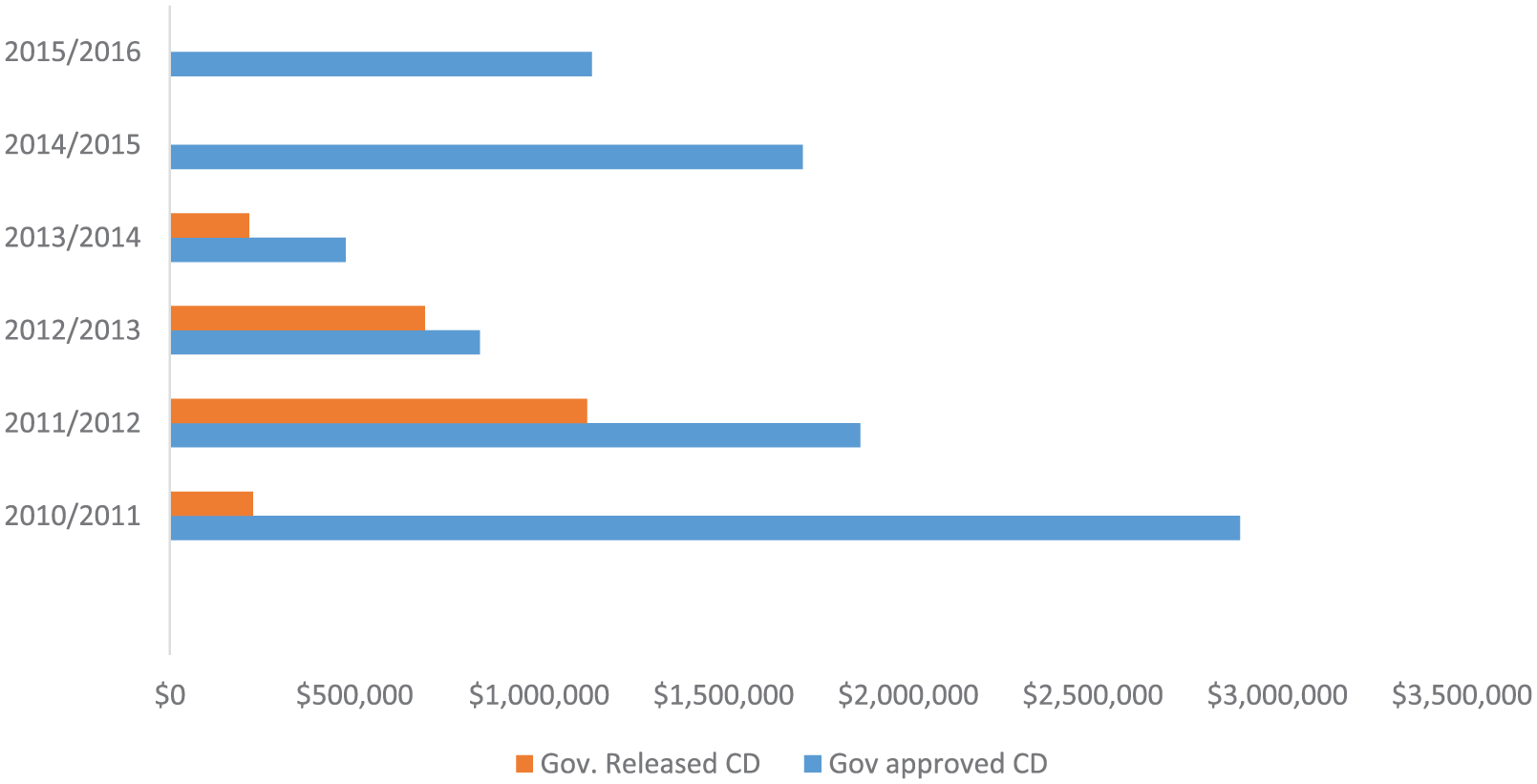
Government-approved CD funds versus government-released CD funds for the University of Dar es Salaam from 2010/2011 to 2015/2016.
Ardhi University
Ardhi University (ARU) is one of the public universities in Tanzania and was established in 2007 as a nonprofit public higher education institution after detaching from the University of Dar es Salaam, of which it was a constituent college. As of January 2017, ARU had an enrollment ranging from 3,000 to 3,999 students. Similar financial sources and mechanisms to those of many other public universities in Tanzania are used to finance this institution. Nevertheless, its funding trend is more or less the same as that of the University of Dar es Salaam and Mkwawa University College of Education. Table 4 indicates the trend in university council-approved (requested budget) budgets versus government-approved budgets in the 6 years from 2010/2011 to 2015/2016.
Council-Approved Budget Versus Government-Approved Budget for OC and CD in US$ for Ardhi University From 2010/2011 to 2015/2016.

Source. Data Collection December (2016).
Note. OC = Other Charges; CD = Capital Development.
As Table 4 shows, the trend in both OC and CD funding showed a significant decrease in the 6 years. These data suggest that Ardhi University has been underfinanced by the state, which has affected effective implementation of its core functions. This implies that the university council, which is the highest supervisory body, cannot achieve the institutional vision and mission due to financial constraints. For example, during the 6 years, the budgetary approval for CD never exceeded 10% of the total budget request by the university council. Similarly, the government-approved OC funds also declined over time. For the period under study, the government never approved more than 15% of OC funding requested by the university council. Given this situation of inadequate funding, it is clear that university activities such as teaching, research, and public service will be compromised. This is because if the university, for example, has to procure reagents for laboratories, pay electricity bills, water bills, and other services directly linked to teaching and research, these activities will not be of the required quality or standard. This suggests that the quality of education with respect to university programs will be compromised. In addition to few OC and CD funds being approved by the government, the actual amounts released not only varied significantly from the budget approved by the government but also declined annually. Figure 5 indicates the trend in government-approved OC budgets versus OC funds released by the state to ARU for the 6 years in US dollars.

Trend in government-approved OC budgets versus government-released OC funds for ARU for the past 6 years in US dollars.
Figure 5 shows that the trend in OC funding approved by the state versus the actual funds received by the university declined significantly over the 6 years. It further indicates that the government was not effective in releasing funds it approves for this institution. This therefore suggests that university activities including teaching and research, whose funding sources depend on OC funds from the state, were adversely affected. This is contrary to what studies have suggested for decades, that maintaining the quality of higher education requires an acceptable and sufficient level of resources below which the quality of education provided is called into question (Adelabu & Akinwumi, 2008; Allais, 2009; Levy, 2007; Materu, 2007; World Bank, 2010). In this regard, the general impression that can be had from data presented in the three institutional cases is that the government is still the source of funding for public universities in Tanzania. As such, the academic debate about trends in higher education funding in Sub-Saharan African countries would be incomplete without alluding to the economic trajectories of Tanzania (Johnstone & Teferra, 2004; Oanda, 2013). However, to improve the state of the art, it is imperative that the government rethink about the weakness of current funding mechanisms and funding sources, thereby adopting reliable, sufficient, and sustainable funding sources.
Government Funding, Student Enrollment, and the Quality of Higher Education
From the foregoing discussion, it is clear that the state (government) is the major source of funding for public universities in Tanzania. The findings also establish that government funding of public universities in Tanzania is neither reliable nor sustainable. This is reflected in a declining trend in funding despite the fact that university needs have been increasing in the same period as a result of many factors including inflation and an increase in student admissions and enrollment. The findings further clearly indicate a lack of a clear relationship between student enrollment and budgetary allocations. Table 5 shows the trend in student enrollment in the universities under study.
Student Enrollment for UDSM, MUCE, and ARU From the 2010/2011 Academic Year to the 2015/2016 Academic Year.

Source. Data Collection, 2016.
Note. UDSM = University of Dar es Salaam; MUCE = Mkwawa University College of Education; ARU = Ardhi University.
While the funding trend and, in particular, the government approval rate declined over the 6 years, student enrollments increase over the same period. For example, student enrollment for the University of Dar es Salaam increased from 19,883 in the year 2010/2011 to 25,449 in the 2015/2016 academic year, a 21.9% increase. On the contrary, MUCE’s student enrollment increased from 2,050 in the 2010/2011 academic year to 3,882 in the 2015/2016 academic year. This accounts for 47.1% increase in student enrollment. Similarly, at ARU, from the 2010/2011 year to the 2015/2016 academic year, the number of students increased from 2,806 to 4,107, constituting a 31.7% increase, while the funding approval rate declined during the same period. The presented enrollment data show that there was a significant expansion of student enrollment over the 6 years. It is obvious that a declining funding trend will affect the input that needs to be procured and subsequently the quality of services offered by these universities.
The World Bank has alarmed to the fact that decreasing university funding while student enrollment is increasing affects the quality of lectures, laboratory practical, research and workshop activities (World & Bank, 2008a, 2008b). Other scholars argue that ensuring the quality of education at any level has its cost implications because many of the material aspects that can be used in assuring quality need to be procured (Ishengoma, 2007; Mgaiwa & Ishengoma, 2017; Teferra & Altbach, 2004). In the case of universities in Tanzania, patterns of subsidy that were introduced when higher education (HE) admissions were extremely limited proved unsustainable as enrollment expanded. This situation has heightened pressure over educational infrastructures, laboratory facilities, stationary, research, and many other academic services. Mgaiwa and Ishengoma (2017) argue that it is important for universities to make efficient use of the financial resources they have and to adequately fund academic services in universities. This is also supported by Materu (2007), who argues that without adequate funding the credibility and integrity of academic services such as institutional quality assurance processes are threatened. There are empirical evidences which also show that most of the public universities in Tanzania have outdated infrastructure, learning and teaching materials, and other facilities and are not repaired due to underfunding (Abeli, 2010). This suggests that quality of lectures and teaching in general might suffer given the constrained educational infrastructure and facilities. In the ongoing debate of the world-class universities for 21st century, scholars argue that ceaseless search for funding to support research and innovation are crucial elements in this appeal of a world-class university (Deem, Mok, & Lucas, 2008). Available evidences suggest that lack of funding had had an effect on research output which is an important indicator of quality of higher education. For example, the number of journal articles published by the university of Dar es Salaam academic staff has slightly declined from 309 (2008/2009) to 298 in 2010/2011(Ishengoma, 2014, 2016).
Similarly, when universities are not adequately funded, important university plans such as staff training are adversely affected. Studies indicate that quality of staffing is one of the critical indicators of quality and excellence in education (Mosha, 2006). Available data show that underfunding has curtailed staff training and is one of the major challenges facing public universities in Tanzanioa. For example, in 2012, only 49.3% of the academic staff in eight public universities in Tanzania had doctorates (Ishengoma, 2016). Consequently, staff profiles remain low suggesting the poor quality of a given university because staff qualification is one of the parameters used to determine the credibility of universities. Indeed, research by staff depends solely on the funding level of a respective institution. In developed countries, funding of research is given priority given the fact that research outputs make important and indeed critical contributions to national development.
Conclusion
This article examined the sources of funding and funding trends for three public universities in Tanzania and their implications for the quality of education provided. Given the funding state of the art in the three Tanzanian universities under study, it can be concluded that the financing capabilities of the state are limited; the implication might be that the lack of financial resources may lead to a severe decline in the quality of instruction and in the capacity to reorient focus and to innovate. It is also worth concluding further that the sources of financing for public higher education institutions in Tanzania are not reliable and sustainable for an important higher education subsector for economic development in 21st century. That is to say, these unreliable and unsustainable sources prevent universities in Tanzania from having a competitive advantage in the current world where innovation, science, and technology are taking the lead.
Funding sources and mechanisms for higher education in Tanzania are lopsided and too weak to finance higher education sustainably and reliably. Therefore, there is a need for the government to establish effective financing modalities that can also involve the private sector because they are the major beneficiaries of the products of higher education. There has been a serious decline in the government approval rate in relation to university budgetary requests and also a sharp decrease in released government subventions and grants in relation to what the government approved in the first place. This call for the government to rethink about the position of higher education especially in research agenda and development and therefore sets a priority in its financing.
Recommendations
Based on the findings and conclusions concerning the funding of university education in Tanzania, the following recommendations are put forward:
The most important and critical issues that has been pressing in funding higher education in Tanzania is dependence of higher education institutions to other institutions in terms of financing. This call for application of RDT to solve this issue by mergers/vertical integration, joint ventures, and other interorganizational relationships, political actions, and executive succession (Hillman et al., 2009). On top of that, the current financing modalities suggest Tanzania to put in place a National financing philosophy of education that commits the government to equitable and quality education. Given the importance of higher education in research and its impact on social, economic, and technological development, higher education is supposed to be at the government’s top priorities in budgeting and fund disbursement. This also needs to go hand in hand with clear policy that is in consonance with the national philosophy, which will further be guided by an education financing act that makes education financing legally binding.
To have sustainable and reliable sources of funds, public higher education institutions (universities) need to find ways to diversify their income streams so as to reduce their dependence on public funds, which are often tied to economic and political factors. In Tanzania, this can be done by universities coming up with strategies for income generation aimed at diversifying their income through grants and contracts, alumni contributions, and partnerships with corporate organizations. The government and other education stake holders need to establish a culture of giving back to education especially in supporting innovation, research, and growth. Any strong economy in the world today is built with the support of education. Therefore, it is worth recommending that a culture of giving back to education is critical in African countries including Tanzania, where the culture of giving back to education is given little attention. Given the fact that donors support has indicated success elsewhere, it is therefore recommended that universities should try to win potential donors by providing information about their key accomplishments, success stories, and milestones in fund raising. Expansion of a domestic tax revenues and the introduction of a skills development levy are recommended given the current government budgetary constraints. This will help to expand the education budget envelop. Certainly, to have sustainable education funds, education budgets need to be ring fenced.
Efficient use of the available limited financial resources, such as MUCE’s cost-cutting strategy presented in this article, is another option for the universities to curb the problem of dwindling government funding. Public universities in most developing countries are said to be inefficient in the use of their resources. Paradoxically, Mohamedbhai (2011) noted that public spending per higher education student in Africa is much higher than in other developed countries. This suggests that African universities are overspending per student, and therefore, they are inefficient in the use of resources—something that needs the attention of the leadership in African universities. To curb the problem of the underfunding of public universities, one policy option is to build capacity and help universities operate as business institutions to generate financial resources that are enough for their effective operation. Despite the fact that the government is the major source of financing for higher education, there is a need for the government to increase the budget as a percentage of GDP in education as developed countries do with their education systems by setting higher budgets for education, up to 7% of GDP.
Footnotes
Declaration of Conflicting Interests
The author(s) declared no potential conflicts of interest with respect to the research, authorship, and/or publication of this article.
Funding
The author(s) received no financial support for the research, authorship, and/or publication of this article.