




Abstract
Since the first case of COVID-19 in Turkey, there has been a lingering question as elsewhere in the world: “When will or should the government impose severe restrictions to protect public health?” From a public health perspective, there is value in developing a model to support proactive implementation of social policies. This study aimed to show the benefits of using a novel econometric test (the Generalized Supremum Augmented Dickey-Fuller Test) to detect explosive behavior (bubbles) in Turkey’s daily COVID-19 cases and deaths. Results from the analysis demonstrated a link between identified explosive episodes and critical public health decisions, especially in the case of daily new deaths. They also showed a negative relationship between the formation of exuberant behavior during the pandemic and the vaccination rate. Public health policymakers can incorporate this method into their arsenal to evaluate the overall health situation in combating the pandemic and respond accordingly. Furthermore, among the lessons learned from the Turkish experience is the importance of having a coronavirus scientific advisory board in the decision-making process and the ability to promptly implement policy measures.
Plain Language Summary
Since the first COVID-19 case in Turkey, a crucial question has been when the government should enforce strict measures to safeguard public health. This study aimed to use an advanced statistical test to identify unusual patterns (bubbles) in Turkey’s daily COVID-19 cases and deaths. The results revealed a connection between these patterns and critical health decisions, especially regarding daily new deaths. Interestingly, there was a negative link between excessive behavior during the pandemic and the vaccination rate. This method could help public health policymakers assess the overall situation and respond effectively. The study also highlighted the importance of a scientific advisory board in decision-making and the swift implementation of policy measures based on lessons from the Turkish experience.
Keywords
Introduction
Turkey reported its first COVID-19 case 1 day before the World Health Organization’s declaration of the COVID-19 outbreak as a pandemic. The Turkish government subsequently introduced and lifted curfews at different times, such as imposing restrictions for specific age groups or prohibiting mass gatherings. However, the number of COVID-19 cases and deaths continued to follow a fluctuating pattern. One question remained open: When would lockdown measures come back again? Put differently, is it possible to detect the episodes during which the pandemic displays explosive behavior and eventually necessitates more strict restrictions?
While making decisions about public health emergencies like COVID-19, governments heavily rely on accurate information (Pearce et al., 2020). Governments worldwide have reacted to the pandemic in various ways, including disseminating information and urging people to take precautions. Nonetheless, the rapid influx of information in today’s digital environment can be overwhelming and may contribute to the propagation of erroneous information (Gabarron et al., 2021). Policymakers have learned from COVID-19 that people’s social behaviors should be understood thoroughly before taking any actions.
Social and behavioral theories such as the Social Cognitive Theory (SCT; Bandura, 1998), offer a relevant framework for comprehending health management in pandemic circumstances (Bavel et al., 2020). They highlight that a comprehensive approach to health promotion should not just concentrate on altering people’s habits but also address the social system practices that have pervasive adverse effects on health. Personal factors such as views, attitudes, and values concerning the disease and knowledge of preventive procedures impact how people behave in pandemic situations (Prieler, 2020). Influential determinants, including governmental regulations, social norms, and peer pressure, can also significantly impact people’s pandemic-related behavior. The early data shortage during COVID-19 pandemic made it difficult for authorities to understand people’s actions and devise policies accordingly. It is crucial for governments to comprehend how the virus spreads in order to disseminate accurate and helpful information.
There has been a significant amount of research conducted on various aspects of COVID-19 by scholars worldwide. Mathematical models have been utilized to help understand the spread of the virus. Some studies have used real-time data to develop models for the spread of the virus, including Gudbjartsson et al. (2020), Marcel et al. (2020), and Rafiq et al. (2020) The partial identification approach has also been used to study the boundaries of the virus (Toulis, 2021). The ARIMA model, which analyzes time series data with lags to make predictions about future values, has also been found helpful in estimating the spread of COVID-19 (Dehesh et al., 2020; Shi & Fang, 2020).
In addition to mathematical models, machine learning and deep learning techniques (Chimmula & Zhang, 2020; Hirschprung & Hajaj, 2021) as well as time series analysis (Kınacı et al., 2021; Li & Linton, 2021) have been used in forecasting COVID-19. SIR (Acemoglu et al., 2021), SEIR (Berger et al., 2020), and SEIRD (Korolev, 2021) models have also been used to model COVID-19 infections. However, these methodologies have not yet provided a comprehensive understanding of the evolution of COVID-19 or the ability to make implications for similar situations in the future.
A simple observation of the time series properties of Coronavirus cases/deaths at the initial stages suggests that they are not stationary, which is also considered in previous studies modeling disease outbreaks via time series methods (Bahmani-Oskooee et al., 2021; Brooks et al., 2015; Cai et al., 2015; Kandula et al., 2018). From a statistical perspective, this implies that the mean and variance of these series change over time (i.e., unit root; Maleki et al., 2020). Consequently, it becomes essential to uncover the periods of movements that deviate from the typical martingale behavior (e.g., random walk theory). Furthermore, it is crucial to investigate whether they represent standard unit roots (i.e., stochastic shocks with permanent effects and with the processes not mean-reverting) or explosive processes.
Nonstationary processes in time series analysis can take many forms and require different analytical techniques. Conventional unit root tests, for example, test the null hypothesis of a unit root against the alternative hypothesis of stationarity, trend stationarity, or explosive root, depending on the specific test being used. However, as Bahmani-Oskooee et al. (2021) show, conventional unit root tests fail to reach a consensus on the stochastic properties (the persistency degree) of the daily COVID-19 cases due to structural breaks or nonnormality in the series. On the other hand, explosive autoregressive unit root tests, such as the GSADF test, can detect explosive dynamics and provide a consistent real-time dating strategy by accounting for their nonlinearity (Homm & Breitung, 2012). They can model the time series of the expansionary phase during the explosive period as a mildly explosive process. Theoretically, the analysis of explosive (bubbles) behavior is, in a sense, closely linked to the concept of faster-than exponential growths in the series, drawing inspiration from the Log Periodic Power Law (Sornette et al., 1996) in the physics academic literature. In this framework, a bubble is modeled as a power law with a finite-time singularity, decorated by oscillations that display an increasing frequency increasing over time. More importantly, these tests allow for the presence of multiple structural breaks within the sample period.
Accordingly, this short paper aims to fill this gap by introducing Generalized Supremum Augmented Dickey-Fuller (hereafter GSADF), a more robust version of unit root tests, into COVID-19 forecasting, enablinga comparison of the exuberant (explosive) behaviors in the number of daily cases and deaths with the actual measures taken.
The present study makes two main contributions. First, it aims to identify explosive periods (i.e., when the extreme ups and downs occur and burst) in COVID-19-associated deaths and cases in Turkey (between March 11, 2020 and September 15, 2021—the peak periods of COVID-19, n = 554) by employing the state of the art econometric/statistical methods. These techniques not only offer ex-post identification schemes but also meet the need for ongoing surveillance. We document that even the aggregate time series analysis can help us better understand and predict the possible course of an outbreak in an environment where the data and research issues are challenging. Second, we relate these bubble dynamics to the policy measures implemented by the Turkish government, drawing lessons for public health policymakers.
The rest of the paper is organized as follows: The following section provides a literary review of policy responses and the timeline of COVID-19 curfews in Turkey. We explain the methodology in Section 3. Then, we present the results and discuss empirical findings. The last section concludes.
Literature Review
Policy Responses and Pre-Emptive Measures
With its unprecedented pace, the COVID-19 pandemic put heavy pressure on governments to enforce strict measures. Most of these measures were in the form of lockdowns and restrictions on social mobility (Fakir & Bharati, 2021; Thomson & Ip, 2020; Ullah et al., 2020). In an effort to stop the spread of the virus and safeguard public health, China has put in place a variety of unique COVID-19 countermeasures, including tight lockdowns, mass testing, and contact tracking (Wu et al., 2021). Nonetheless, there have been reports of opposition and criticism, especially from some sectors, who express worries about apparent violations of individual liberties, human rights, and transparency issues relating to the Chinese government’s response to the pandemic.
In a similar vein, the UK has introduced several COVID-19 measures such as lockdowns and vaccination programs, to curb the spread of the virus and preserve public health (Zhou & Kan, 2021). However, certain community segments have expressed opposition to these restrictions, voicing worries about their potential effects on their freedoms, mental health as well as the economy. In this sense, the UK government had to balance social, economic, and cognitive health concerns and public health factors, when deciding on COVID-19 measures.
Germany, on the other hand, have implemented tailored COVID-19 measures to accommodate the unique requirements and difficulties faced by particular populations, including enterprises, healthcare providers, and vulnerable groups (Desson et al., 2020). This reflected a proactive strategy for managing the pandemic with targeted interventions, including financial support programs, priority vaccination efforts, and adapted guidelines for high-risk situations. Germany, like many other nations, has encountered difficulties and received criticism for efficiently controlling the pandemic while simultaneously addressing the concerns and balancing the requirements of various stakeholders.
Developing countries, in particular, found difficulties in preventing the expansion of the pandemic and stabilizing their economies, which caused breakdowns in global supply chains that affected the well-being of the whole world (Bargain & Aminjonov, 2020). Some of these countries strived to balance public health and economic activities. Turkey, for example, began with imposing lockdowns during weekends and public holidays, along with implementing bans and restrictions on mass gatherings, with the intention of alleviating the spread of COVID-19. Notably, the pandemic created an opportunity for Turkey’s presidential system to make swift decisions by taking into account scientific advice from experts, which is esoteric in this style of government (Bakir, 2020). Despite variations in their methods, many developing countries used daily COVID-19 cases and deaths as key indicators to protect public health. In this regard, it is essential for policymakers to elaborate on prediction methods and develop action plans to increase the efficiency of public health policy responses.
The term “cases” in the context of COVID-19 refers to those who have been identified as having the illness caused by the brand-new coronavirus, SARS-CoV-2. Public health authorities often publish the number of cases to track the progression of the disease and guide public health policy decisions. The overall number of people who have passed away due to COVID-19 is referred to as “the number of deaths.” The number of deaths is frequently reported by officials and is used to track the impact of the disease on individuals and society as a whole.
There have been various attempts to detect or predict abnormal conditions in the time series of daily cases and deaths due to COVID-19. Hirschprung and Hajaj (2021) attempted to incorporate data mining and machine learning techniques into regression to introduce the concept of the center of the infection mass. Massey et al. (2021) analyzed the excess death of black people compared with white people, using linear regression. Modig and Ebeling (2020) measured excess Covid deaths via a bootstrap procedure to estimate age-specific mortality rates. However, Schöley (2020) stated that most methods estimating excess deaths rely solely on regression-based approaches and identified bias at some levels. The present study offers the implementation of an econometric methodology into health management, in an effort to enhance the health policy performance of countries in the face of pandemics by using the concept of rational bubbles or explosive/exuberant behavior, a topic widely discussed in the realms of finance and economics.
Turkey’s COVID-19 Curfew Timeline
After the first cases in China emerged, the Turkish government suspended flights from China and Iran. However, the entry of the infection into the country could not be prevented. Turkey confirmed its first case of COVID-19 on March 11, 2020, and its first COVID-19-related death occurred on March 15. Most of these people were those who had recently traveled to European countries such as Italy.
It is important to note that before observing the first case, Turkey had established the Turkish Scientific Committee within the Health Ministry in response to the COVID-19 pandemic. The committee was made up of a team of professionals who were tasked with advising the Turkish government on various matters about COVID-19. These professionals included virologists, epidemiologists, and public health experts. The committee’s primary responsibility was to recommend public health measures to stop the spread of COVID-19 and to monitor and assess how effectively these measures worked. The committee played an essential role in organizing the nation’s reaction to the pandemic and ensuring the public received accurate information. By processing data, providing advice, and coordinating the government’s pandemic response, the Turkish Scientific Committee was crucial in directing the nation’s response.
On March 16, 2020, the Ministry of Internal Affairs imposed the first restrictions and prohibited indoor activities. The curfews were expanded on March 21. Starting in May, the Turkish government gradually lifted the restrictions and entered a normalization period on June 1. This process led to the reopening of businesses and touristic activities. However, as Table 1 and Figure 1 demonstrate, a rapid rise in the number of cases forced the Turkish officials to reintroduce restrictions after the summer period. Large gatherings were banned on October 2, followed by a lockdown decision for people over 65 years and those under 20 years, in addition to the closure of indoor activities on November 17, with its implementation starting on November 21. To fight against the coronavirus effectively, the government began vaccinating people over 65 on January 14, 2021. However, the UK variant of the virus entered the country the same month, leading to a second surge in the numbers. On April 14, a new wave of curfews was announced and put into effect immediately. This process continued until June 1, 2021, which marked the second reopening in the country.
Key Dates Concerning COVID-19 in Turkey.

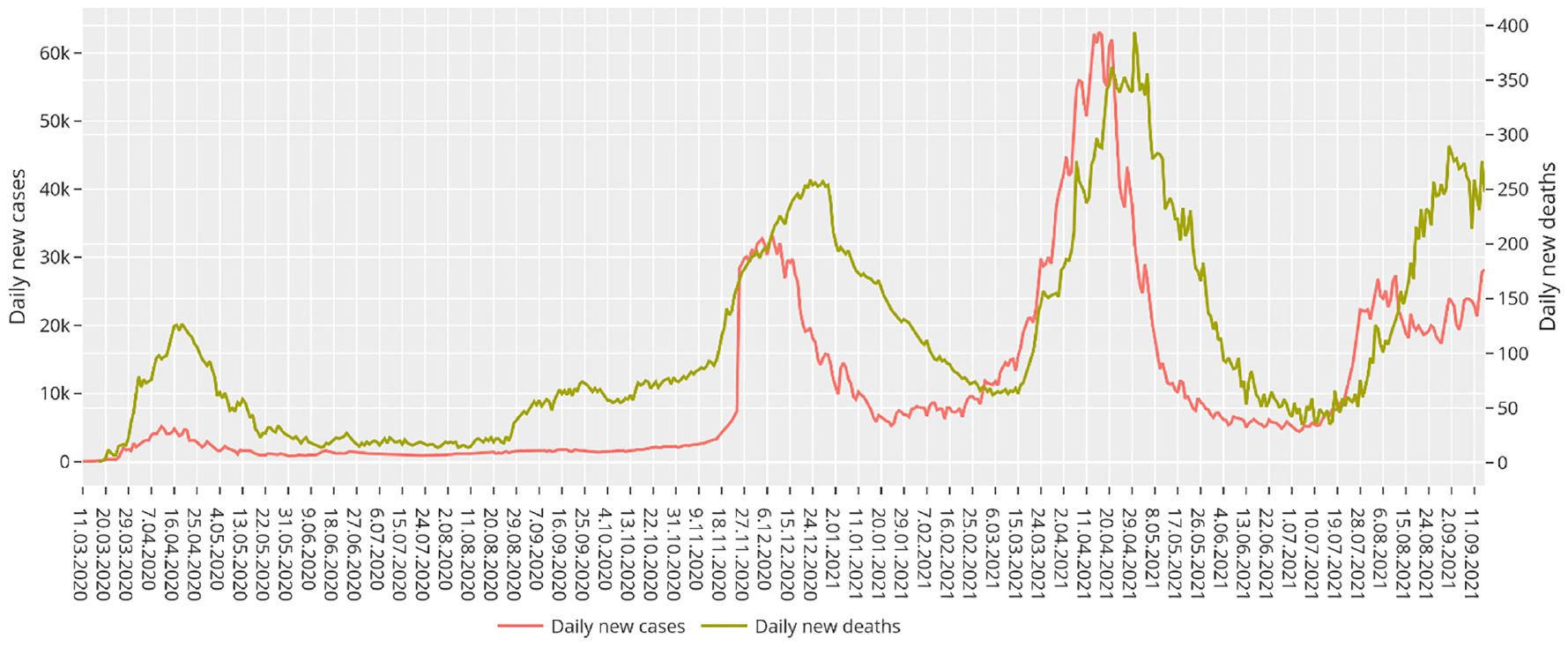
Daily new cases and deaths in Turkey during the study period.
Turkey entered this period with an increasing vaccination rate. The Turkish government has aimed to achieve herd immunity through a mass vaccination campaign. This whole process indicated that it is necessary to monitor excessive behavior in the statistical data of COVID-19 to take the measures required. Such an endeavor would help mitigate unforeseen situations that can hurt the public health system and the domestic economy.
Methodology
The present study employed the Generalized Supremum Augmented Dickey-Fuller (GSADF) test to analyze the exuberant behaviors in the daily number of new COVID-19 cases and deaths in Turkey. We used the obtained results as a benchmark for comparing them with the actual actions taken by the Turkish government. The GSADF test is a right-tailed unit root test that performs recursive augmented Dickey-Fuller regressions to identify episodes in which the data-generating process of a series is regarded as explosive behavior. This test is particularly desirable for the purposes of this study because it also allows the date-stamping of explosive periods (bubbles) where the related series display explosive dynamics (i.e., single or multiple break or waves)
Unlike previous empirical applications that mostly employed standard Augmented Dickey-Fuller (ADF) tests (Dickey & Fuller, 1979), recent methodologies are more robust and have high power, especially in cases where time series processes suffer from extreme ups and downs. Two such popular methods in econometric time series are the Supremum ADF (SADF) test of Phillips, Wu, and Yu (Phillips et al., 2011; PWY, hereafter) and the Generalized Supremum ADF (GSADF) test of Phillips, Shi, and Yu (Phillips et al., 2015; PSY, hereafter). These methods have become increasingly popular in detecting explosive behaviors within various markets such as commodity, oil, and financial markets. They constitute right-tailed unit root tests that perform recursive ADF regressions to detect episodes where the data-generating process of a variable is considered as explosive behavior.
The SADF method employs an expanding forward window to sequentially test for explosive dynamics. In contrast, its expansion, the GSADF test, examines extreme upward movements (exuberance) by considering all feasible subsamples of a time series, with a minimum window size specified by the user. The GSADF is a valuable tool as it enables precise identification of the specific periods during which the analyzed time series exhibits explosive dynamics, removing the reliance on subjective judgments. It is important to note that both the SADF and GSADF tests are built upon the foundation of the ADF regression methodology. In this context, we built our model based on the regression below:

Where Δ is the first difference operator, COVID-19 denotes the daily number of coronavirus deaths or the daily number of new coronavirus cases at time t from March 11, 2020, to September 15, 2021, the data for which was obtained from the website of the Ministry of National Health (2021). COVID-19 is our time series of interest at time t, where k represents the number of lags of the dependent variable, COVID-19. The expressions
The null and alternative hypotheses are as below:


To examine the null hypothesis H0, the ADF t-values are employed for subsamples ranging from r1 to r2, with r1 and r2 satisfying the following rule:

In this sample, the initial window width used in the rolling ADF regressions takes the default value of


The BSDAF statistic is linked to the GSDAF statistics by using the equation below:

When we examine how the GSDAF test works, it is evident that it works not only on the entire sample but also on the flexible subsamples. Unit root is tested by the null hypothesis, and exuberant (explosive) periods are tested in the time series. Following the selection of subsamples, a maximum value is determined. If any values exceed this limit, the null hypothesis is ruled invalid. This is a standard econometric analysis method for testing hypotheses and drawing conclusions based on subsample data. For these procedures, the formulas below (Phillips et al., 2011, 2015) are used where


In this equation,
The GSADF test, different from the SADF test, has different starting points for bubbles. Therefore, it has broader sample and subsample spans. When the GSADF test determines bubbles, chronological data is created based on the BSADF test. When


To circumvent the limitations of the ADF test, we also used the sup-ADF test, which is based on a rolling window approach, and its critical values are computed using Monte Carlo simulations. Table 2 provides information on the critical values. We employed STATA 16 SE radf module (Otero & Baum, 2021) on data obtained from the Turkish Ministry of Health to detect bubbles and checked its consistency using the exuber library of R Software (Vasilopoulos et al., 2018).
Time Series Tests of Explosive Behavior in COVID-19 Deaths and Cases.

Note. The table shows results from the right-tailed Augmented Dickey-Fuller (ADF), SADF, and GSADF tests for unit roots against the alternative hypothesis that the series is explosive. Tabulated critical values for 90, 95, and 99 confidence levels are from Vasilopoulos et al. (2018). The time period for the sample is between 3/11/2020 and 9/15/2021. Significance levels for the test are as follows: *p < .10. **p < .05. ***p < .01.
Results
Table 2 presents a summary of our results. The SADF and GSADF test results show that the null hypothesis of unit root (or nonstationarity) is rejected for coronavirus deaths and cases. That is, both series are characterized by explosive behavior. Moreover, we give special consideration to the GSADF test as it is more sensitive to detecting multiple bubbles. In fact, Figure 2 illustrates multiple episodes for both series, where periods exceeding the critical values indicate explosive behavior (see Table 2 for details). When short intervals of explosiveness lasting less than a week in early September are omitted it appears that there are three long explosive intervals in the case of daily new cases and two long intervals in the case of daily deaths. According to the results of the date-stamping procedure, the first explosive episode in daily new cases lasted over 3 weeks from November 13, 2020, to December 5, 2020. The second interval spans from March 18, 2021, to April 21, 2021, lasting about 5 weeks. The last explosive episode starts on July 24, 2021 and ends on July 8, 2021. In terms of daily deaths, the first explosive interval begins on November 18, 2020, and ends on January 1, 2021, amounting to a duration of one and a half months. The second major interval extends from March 24, 2021, to May 5, 2021, with a total of 33 explosive days. Furthermore, as expected, there are explosive episodes where new cases and deaths overlap. Overlapping periods last 20 and 25 days in the first and second episodes, respectively.

Date-stamping explosive behavior of COVID-19 deaths and cases: BSADF test.
Discussion
As expected, a timeline of events from the corresponding dating procedure suggests that explosive behavior in deaths follows those in new cases (see Figure 2). In this regard, our results reveal two exceptional periods. Firstly, there were oddly no preceding periods of explosiveness in the daily number of new cases, whereas an episode of explosive behavior in deaths was observed in early September 2020, albeit lasting for only 5 days. One possible explanation has to do with the quality of measurement and the potential issue of underreporting. After all, it took time to adopt a reliable test to detect COVID-19 cases following the outbreak. In this context, like certain other countries, Turkey has been criticized for underreporting the new cases (Kisa & Kisa, 2020; San et al., 2020). In fact, in late July 2020, Turkey acknowledged that the daily tally of new cases only accounted for those who tested positive for COVID-19 through a polymerase chain reaction (PCR) test and showed symptoms, excluding those who tested positive but did not show any symptoms. Regarding the second exceptional period, the explosive dynamics of the coronavirus cases in late July and early August 2021 were not followed by a consequent spike in the death toll. This finding aligns with the expectations that vaccination has effectively reduced the number of deaths. Indeed, Turkey has vaccinated more than 61% of the country’s population as of September 2021 (See Figure 3). As in the case with other major developing countries, Turkey initially experienced vaccine hesitancy among its population (Pitel, 2020). However, the country has then successfully accelerated vaccination effectively convinced the public about the necessary policy measures. This has been achieved through evidence-informed policy analysis and advice to elite decision-makers for policy design and implementation. In that regard, the establishment of the Coronavirus Scientific Advisory Board and the exercise of discretionary autonomy by the healthcare bureaucracy played a crucial role during this extraordinary time (Bakir, 2020).

Explosive periods in COVID-19 and policy implementations.
Moreover, there appears a link between the Turkish authorities’ policy decisions and the explosive episodes identified in this study. The Turkish government seems to have taken critical lockdown measures by considering the explosive dynamics of coronavirus, especially the explosive periods in daily deaths. For instance, a curfew for people over 65 years and under 20 years was announced on November 20, 2020, corresponding to the initial days of a long explosive episode in daily deaths. In this vein, a 2-week nationwide curfew was declared on April 14, 2021, after the explosiveness observed in daily deaths on April 13, 2021. When the explosiveness in daily deaths ended on May 5, 2021, Turkey entered a gradual normalization process by easing curfew restrictions on May 17 and lifting them entirely in June 2021. It did not implement any lockdown measures during the summer or in September 2021, even though there were explosive episodes in the number of daily new cases in late July and early August.
Last but not least, it should be noted that we took into account Oxford’s Government Response Stringency Index, which records the strictness of lockdown-style policies, and indicates how quickly the governments responded to the pandemic (Hale et al., 2021). It is calculated based on nine policy categories, including school closures, workplace closures, and travel controls, and assigns a score between 0 and 100 for each category. The scores are then combined to give an overall stringency score for the country, with a higher score indicating more stringent policy measures (Hale et al., 2022). The index is updated regularly as policy measures change. In this respect, Turkey introduced more stringent measures to combat the pandemic as soon as COVID-19 deaths surged in early September 2020. The stringency index in Figure 3 shows that the government kept stricter lockdown measures, especially during episodes of high death tolls, and eased them more later, coinciding with an increase in the vaccination rate.
Conclusion
Estimating explosive behavior in infectious diseases is of utmost importance because abrupt increases can threaten health management systems and increase human and financial costs. In this study, we employed a state-of-the-art econometric technique, namely the GSADF test of Phillips et al. (2015), to identify the explosive episodes of COVID-19 deaths and cases in Turkey. We found three long explosive periods in the case of daily new cases and two long intervals in the case of daily deaths.
Results showed that the Turkish authorities responded mainly to the explosive dynamics in coronavirus deaths with stringent lockdown measures over time. Although they were reluctant to disseminate overall statistics and were relatively slow in implementing curfews during the first wave of the pandemic, Turkey’s presidential system and the establishment of an expert-led scientific board enabled quick and compelling responses to pressing policy issues once they were rightly diagnosed. The Turkish experience highlights the importance of considering scientific advice from experts in the decision-making process and the ability to implement policy measures without delay. We also witnessed a negative relationship between the formation of explosive behavior during the pandemic and the vaccination rate, suggesting vaccination’s crucial role in the fight against the pandemic.
One thing is that policymakers would continue to balance a trade-off between health benefits and economic costs during the pandemic. Even so, the GSADF test can be helpful for them not only in identifying the past explosive dynamics but, more importantly, in real-time monitoring of COVID-19 deaths and cases. This technique meets the need for ongoing surveillance of excessive dynamics in the coronavirus disease, similar to the case for certain asset prices, including foreign exchange rates, stock prices, and commodity prices.
However, we acknowledge that forecasting explosive behavior in a pandemic/epidemic is quite challenging given that the initial stages are marked by limited data and a lack of good understanding of the transmissibility and death rates. Nevertheless, COVID-19 cases and deaths are good indicators for examining the trajectory of the pandemic at the aggregate level. The approach employed here, just like several statistical or mathematical methods suggested in the literature, can be helpful in providing early information to service providers and policymakers, allowing them to intervene and slow down the transmission rate.
It is critical to persist in efforts to enhance our understanding of information processing for future pandemics. While methodologies like the one we presented here might help authorities make decisions, addressing the social dimensions of health management is equally necessary. Thus, future studies should incorporate health innovation frameworks to advance these efforts. For example, according to the mindsponge theory (Q.-H. Vuong, 2022; Q. H. Vuong & Napier, 2015), healthcare innovation management consists of three stages: information absorption and misinformation filtering, creative processing, and innovative outcome. Integrating models like this will help academics better understand how information is processed during pandemics and how healthcare innovation can be managed efficiently (Q. H. Vuong et al., 2022). Future research can help educate decision-making and ultimately lead to more effective pandemic management by taking social aspects into account and using novel frameworks.
Footnotes
Author Contributions
All authors listed have significantly contributed to the development and the writing of this article.
Additional Information
No additional information is available for this paper.
Declaration of Conflicting Interests
The author(s) declared no potential conflicts of interest with respect to the research, authorship, and/or publication of this article.
Funding
The author(s) received no financial support for the research, authorship, and/or publication of this article.
Data Availability Statement
Data associated with this study can be reached at: https://turcovid19.com/acikveri/ and 