




Abstract
Widespread communication tools such as Facebook and Twitter have become vital channels of public diplomacy. Today, policymakers must implement a successful Facebook diplomacy to enhance their nation’s branding, lobbying, and culture exchange and to expand and build good relationships. This article evaluates how Facebook has been used as a tool of public diplomacy by both the U.S. Consulate General in Erbil and the Kurdistan Regional Government (KRG) Representation in Washington by performing a quantitative content analysis of their posts and the responses of their users. The results of the content analysis suggest that the United States more successfully utilizes Facebook as a public diplomacy tool to communicate than does the KRG. This article presents a theoretical argument that assumes that public diplomacy can be practiced by nonstate actors and states. The Kurds are considered and targeted by the U.S. public diplomacy program across Facebook, and this helps the Kurds develop their relationship with the United States as a supporter of potential Kurdish statehood. This research also strongly recommends that the KRG improves its Facebook webpage and highlights the values of internationally promoting the KRG as a brand.
Introduction
Over the last century, countries have used traditional media broadcasting, such as cinema, radio, and television, to promote their nations and to inform foreign publics of their national politics (Gilboa, 2001). This communication model is essentially a one-way communication model and works under the press agentry model of propaganda (Iyer, 2002; Nicholas, O’Malley, & Williams, 2013). Social media has allowed for the transition from one-way communication to two-way communication, enabling nations to attract and engage the foreign public more effectively (Hartig, 2015). Bjola and Holmes (2015) argue that “the application of social media to the field of diplomacy has failed as a transformative development of international politics” (p. 71). Social media enable diplomats to directly communicate and interact with foreign publics and institutions and conversely. Public diplomacy refers to the planned efforts of the nation’s actors, such as governmental institutions, nongovernmental organizations, officials, public figures, and ordinary people, to foster favorable opinions and a positive image among the general public (d’Hooghe, 2014; Harris, 2013).
Over the 20th century, public diplomacy was mostly used as a state-based tool by foreign ministries and other governmental institutions to engage, persuade, and influence foreign publics, and such behaviors support foreign policy (Sharp & Wiseman, 2012). The United States has a long history of using public diplomacy and media, which have played a vital role in shaping American public diplomacy. For example, Voice of America (VOA) first started radio broadcasting in 1942 in 45 languages and to over 100 million listeners worldwide (Cox & Stokes, 2012). Public diplomacy has been practiced from before the time it emerged as a distinct concept, and it has become the hub of diplomatic functions. In Obama’s administration, public diplomacy was linked with diplomacy and, organizationally, became an activity within the Department of State (Gregory, 2011; Sharp & Wiseman, 2012; Wiseman, 2015). However, this designation does not mean that public diplomacy is limited to states. In this respect, Sharp and Wiseman (2012) argue that public diplomacy “today has become an instrument used by associations of states, sub-state and non-state actors to understand cultures, attitude, and behavior; to build and manage relationships; and to influence thoughts which eventually advance their interests and values” (p. 119). This provides an effective platform for political entities that are not states, such as the Kurdistan Region, to play diplomatic roles because this mechanism allows the traditional approach to diplomacies such that the diplomats in consulates and embassies can act as diplomats. The development of communication technology has created an international space where the public and politicians in different countries are globally linked more than ever. Thus, diplomats, politicians, activists, and even ordinary people can play the role of diplomats regardless of where they are located. In this regard, Facebook and other social media sites have become effective tools utilized by public diplomacy practitioners. From this perspective, the current research seeks to evaluate how successfully the U.S. Consulate in Erbil and the Kurdistan Regional Government (KRG) Representation office, which is viewed by the Kurdish people as a consulate or embassy of Kurdistan in Washington, use Facebook as a public diplomacy tool.
Conceptual Framework
Despite scholars’ interest in and the academic study of the role and influence of media technology in the field of public diplomacy, there is a lack of empirical research on this topic (Fisher, 2010). Gregory (2011) identifies another major problem in conducting research in this field: the “lack of agreement amongst public diplomacy practitioners and scholars on analytical boundaries” (p. 335). Thus, most research in the public diplomacy context has focused on Western countries, China, and Japan, which vary in their political systems, economies, and cultural structures. As a consequence, where countries can use public diplomacy based on their strategies and resources is a contested issue among public diplomacy theorists and practitioners. Several factors control public diplomacies, such as tools, methods, organizational structure and the culture, identity, and experience of public diplomacy practitioners, which fundamentally affect the successful of public diplomacy maneuvers. Despite the dispute among scholars and practitioners on the use of public diplomacy, both groups allege that public diplomacy can be used by small, medium, and large states as well as by substate and nonstate actors regardless of their political, cultural, or structural backgrounds (Gregory, 2011).
To overcome the limitations of the theoretical framework, it is important to identify the research aims. Using a comparative analysis method, this study examines how the U.S. Consulate in Erbil and the KRG Representation in Washington use Facebook as a public diplomacy tool. These two actors have different sources, types of power, tactics, and mechanisms of using public diplomacy. Nevertheless, they can both use public diplomacy to set their agendas, as their priorities differ as well. Another reason that this study examines the U.S. Consulate and the Kurdish Representation in Washington is to compare and to identify the criteria for analyses. This study assumes that the U.S. Consulate is successful in implementing public diplomacy via Facebook because the United States has considerable experience with public diplomacy, which is in contrast to the KRG’s experience. The United States’s approach can be used as a standard guideline to evaluate the contents of two Facebook pages.
Consequently, the evaluation of the United States per se allows us to understand the position of the Kurdistan region in promoting the priorities and perspectives that also concern the United States. Based on the research objectives, several models of the impact of Facebook and other social media on public diplomacy will be considered.
Networking Diplomacy Across Facebook
The development of communication technology has removed traditional borders between countries and created an international space. Such technology also provides a platform to facilitate collaboration between states and nonstate actors, creating a growing global culture and increasing the interest of the foreign public. Specifically, the Internet in general and social media in particular has enabled officials and diplomats to communicate and exchange their ideas with foreign publics, states, and nonstate organizations. This communication approach has been described as “network diplomacy” by Marie Slaughter (Bjola & Holmes, 2015). In this regard, Goof (2013) argues that “network diplomacy” is a transformative stage in club diplomacy, which is a significant shift in modern diplomacy. With this new phenomenon, diplomats can better fulfill their functions of (a) representing their countries in host countries, (b) negotiating issues on behalf of their home countries, (c) reporting, and (d) protecting the interests of their home countries, including citizens’ interests in host countries (Aneek, 2010). The term “club diplomacy” is used to express “traditional diplomacy” (Cooper, Heine, & Thakur, 2013). On this subject, Thakur (2007) differentiates between network diplomacy and club diplomacy in terms of diplomacy players and forms of communication:
Network diplomacy has more players than club diplomacy, is flat rather than hierarchical, engages in multiple forms of communication beyond merely the written, is more transparent than confidential, and its “consummation” takes the form of increased bilateral flows—of tourists, students, labor, credits, investments, technology, and goods and services—instead of formal signing ceremonies. (pp. 49-50)
In line with this statement, network diplomacy allows governments and diplomats to create new communities and build relationships with the foreign public and foreign institutions, both governmental and nongovernmental, particularly across social media (Buckle, 2012; Dale, 2009; Park & Lim, 2014). Thus, this connection will build and enlarge the relationships between a country’s public, the foreign public, and foreign governmental and nongovernmental organizations beyond physical barriers such as international borders (Park & Lim, 2014). From this perspective, of all social media websites, Facebook is the most popular network among the Kurds and the Americans.
In addition to all the above benefits of network diplomacy, Facebook can provide significant opportunities for Kurdish politicians to create a solid symbiotic relationship with the foreign public, politicians, and international organizations to gain their support and to raise Kurdistan’s national profile internationally, eventually leading to Kurdistan’s independence.
Nation Branding and Public Diplomacy
“Nation branding,” as a term, was first used in 1996, and it is attributed to Simon Anholt, a British scholar and consultant (Kaneva, 2011). Anholt determines nation branding according to people’s perceptions of a country across the following six areas of competence: “tourism, exports, governance, investment and immigration, culture and heritage, and people” (Renken, 2014, p. 7). Additional terms that represent nation brandings include “national images, national stereotypes, national identity, and national brand identity; and today these tend to be replaced by the term national branding” (Surowiec, 2016, p. 20). Surowiec also refers to applying branding and marketing communication techniques and to branding a nation to represent and promote the nation as a brand. According to this concept, any country is viewed as a specific brand in people’s minds. Then, the question of the benefits of branding a nation arises. Nation branding competition has grown increasingly because a positive national brand identity promotes tourism, immigration, international investment, exports, and currency stability. These developments also restore international credibility and investor confidence. Nation branding can also boost international political influence; secure international partnerships; and advance nation building, particularly in the globalized economy, through “nourishing confidence, pride, harmony, ambition, (and) national resolve” (Dinnie, 2015, pp. 17-18).
As aforementioned, countries compete to raise their positions to a higher positive level and higher valuable brand ranking; to attract several aspects, such as people’s sentiments, tourism, exports, and investments; and to strengthen their profiles and positions in the international space. A country’s power, political system, and economic needs are crucial to its ability to take advantage of these aspects. How can a small country win in this tough international competition? Širvinskytė (2016) argues that smaller, less developed, or emerging nations can play a major role in nation branding because the Internet has provided a significant opportunity to promote any brand.
“Nation Branding” is a new term in public diplomacy, and public diplomacy relies on the nation branding strategy (Fitzpatrick, 2009; Szondi, 2008). In this respect, van Ham (2008) argues that both concepts use the same tools to achieve the same goals. Nation branding, however, is more complex and wider and implements more effort, sources, and strategies. From the system theory perspective, public diplomacy is an interdisciplinary conception that functions as a communication mechanism within a state to achieve long-term diplomacy. In other words, public diplomacy relates to several branches of knowledge and fields within a foreign policy and international communication (Gregory, 2011). Joseph Nye, an American political scholar, claims that public diplomacy is a tool of “soft power” and is the best approach to achieving foreign policy goals, while hard power does not function as effectively (Renken, 2014). Since September 11, the United States has been taking public diplomacy seriously (Hayden, 2012). The United States’s image became more negative and iniquitous from the Arab and Muslim world’s perspective, particularly after the United States’s occupation of Iraq in 2003. Nevertheless, the Kurds are one of the actors who welcomed the American military operation to remove Saddam’s regime because the Kurds suffered grievously under his regime and were subjected to ethnic cleansing, chemical attacks, bombardments, and the demolition of their dwellings.
The United States began to restore its image, particularly in the Middle East, through a campaign called “the shared value.” The campaign utilized media power to change people’s perceptions. For example, the campaign established Sawa Radio in 2002 and the Al-Hurra TV channel in 2005, both of which focused heavily on Iraq. Moreover, the U.S. embassy funded Nawa Radio, which was the first private, political radio station established in Iraqi Kurdistan that focused on Kurdistan and broadcasted in the Kurdish language. The United States targeted the Kurds through a specific strategy, and the Kurds claim that they are friends with only America and Israel. This stated friendship is because of America’s intervention against the Saddam regime in favor of the Kurds’ interests in 1991 and because, recently, the United States immediately conducted airstrikes as Islamic State of Iraq and Syria (ISIS) was about to take over Erbil, the capital city of the Kurdistan region.
Under the Obama administration, public diplomacy efforts have improved (Nakamura, 2010). This administration emphasized “the shared value,” which is “rooted in the U.S. ideal values: Freedom, Equality, Democracy and Human Rights” (Gregory, 2011, p. 362). In this regard, social media played a significant role in the Obama administration’s public diplomacy efforts and nation branding of the United States (Gregory, 2011; Harris, 2013), and Facebook is a central, forceful tool implemented by the U.S. Consulate in Erbil.
Social Media’s Contribution to Public Diplomacy
As a tool of public diplomacy, social media have significant effects in this context. In this respect, Bjola, Jiang, and Holmes (2015) suggest a model to describe and evaluate social media’s impacts on public diplomacy, and this model consists of a three-dimensional framework: “agenda-setting, presence expansion, engagement and conversion generating” (pp. 7-9). The current research considers and utilizes this framework because these three dimensions largely describe the role of social media in a new public diplomacy context.
Agenda-Setting
The first dimension of social media’s contribution is agenda-setting theory, which is a significant theory for determining media’s influence, including social media’s influence, on people’s perceptions. This theory focuses on the role of media ownership and those who drive the media’s strategies to choose and cover certain issues for the sake of predicted impacts on the target audience (Scheufele & Tewksbury, 2007; Weaver, 2007). From this standpoint, the task of public diplomacy is to disseminate information about what should be cultivated among the foreign public. In public diplomacy, the information provided via social media should meet the mutual interests of the diplomats, the foreign public, and the institutions such that discussions are held via two-way communication. In connection with this point, Facebook and other social media function as a vital tool that allows diplomats to set agendas to foster a positive image of their countries (nation branding) in the mind of the target audience. The following essential questions must be answered: What are the themes and values does the United States focus on? What efforts should be made by the Kurdistan public diplomacy in the United States? Public diplomacy is only an approach in the practice of foreign policy; thus, the use of public diplomacy is based on the countries’ objectives. This requires applying political, economic, and communicative strategy sources in public diplomatic operations while emphasizing core common values and interests within the host country or within international society.
Corresponding to U.S. public diplomacy, this research aims to evaluate Kurdistan public diplomacy and to offer some suggestions for Kurdistan public diplomacy. According to Kurdish political discourse, the proclamation of the independence of the Kurdistan region, as a national right, was the main goal throughout World War I (WWI) and Iraq’s regimes. The agenda of Kurdistan’s public diplomacy focuses on the following valuable actions: (a) exporting oil and natural gas to secure the world’s energy; (b) highlighting democratic practices, which seems unique among the countries in the Middle East; (c) fighting terrorist groups through the Kurdish Peshmerga, who are appreciated internationally, especially for fighting ISIS successfully; (d) providing humanitarian help to people displaced across Iraq and accommodating Syrian refugees; and (e) promoting religious equality. These concepts represent the Kurds’ respect for human values and desire to avoid building a nation based on religious and racial identity, as this basis for nation building has been creating conflicts in Iraq for several decades.
Presence Expansion
In both traditional diplomacy and public diplomacy, diplomats always need to make their voice heard (Reynolds, 2002; Goof, 2013). In traditional diplomacy, diplomats’ participation in cultural, educational, political, and trade events are the central means through which they can disseminate their comments and views. In this regard, Facebook greatly amplifies diplomats’ voices and gives them greater influence. Thus, Facebook and other social media sites expand diplomatic efforts among the foreign public, officials, and activities of nongovernmental organizations, which broadens relationships and partnerships to serve national interests and intentions. Accordingly, this approach can help Kurdish diplomacy achieve global support for many issues given that the Kurds complain about not receiving sufficient international attention regarding some issue such as the acknowledgment of the Kurds’ right to have their own nation state and the acknowledgment of the Anfal genocide operated by Saddam’s regime in 1998. If “presence expansion” is successful, the third Facebook dimensional impact of “generating conversational engagement” will be achieved.
Engagement and Conversation Generating
Facebook allows diplomats to engage in two-way and multidirectional communication to create dialogues with the foreign public, which includes different stakeholders. This interactive communication across Facebook greatly increases the possibility of engaging a large target audience in a public diplomacy program. In addition, it offers sustained conversations between diplomats and the foreign public; these advantages provide a mutual understanding and support diplomats’ ability to change their messages, if required, in light of the audience’s response or to continue effective messages and approaches. Together, these actions will affect foreign public opinion and foster favorable opinions of a state’s image and national brand.
Research Questions
Based on the theoretical framework and research objectives, the following research questions are presented:
Method 1
A quantitative content analysis was performed to explore the research questions. Posts published on the Facebook accounts of both the American Consulate in Erbil and the KRG Representation in Washington over a 2-month period were selected as the sample. The data collection period was November and December 2016, which allows us to examine the agendas and the values of the blogs. A total of 135 posts were selected for the sample. Of these posts, 121 were on the Facebook of the U.S. Consulate and 14 were on the Facebook of the KRG Representation office. The analysis categories and coding procedure were identified based on the agendas and values of the posts; the number of likes, comments, and shares; and the language of the posts—English, Kurdish, or English and Kurdish.
The agendas of the posts were classified into nine categories, which essentially represent the agendas of public diplomacy on Facebook: (a) informing the country’s own people in the host country, (b) informing the local people, (c) informing the local public about the different activities of the mission, (d) spreading the country’s culture, (e) informing the local public about the country’s policy, (f) commemorating international days, (g) creating dialogue with the local public, (h) covering help programs provided, and (i) promoting investment. The values of the posts were identified according to terms related to the United States’s identity, freedom, equality, democracy, and human rights, and according to some actions planned by the KRG, as follows: (a) exporting oil and natural gas to secure the world’s energy; (b) highlighting democracy which seems unique among countries in the Middle East (c) successfully fighting terrorist groups such as ISIS through the Kurdish Peshmerga, whose efforts are appreciated internationally; (d) providing humanitarian aid to people displaced across Iraq and accommodating Syrian refugees; and (e) promoting religious equality.
Results
Examining the research questions, the current research found significant results, which are discussed in the following four sections.
The United States and the KRG Public Diplomacy’s Use of Facebook to Present and Build Relationships
This section traces the first research question and examines the use of Facebook to present and build relationships within the public diplomacy efforts of the U.S. Consulate in Erbil and the KRG Representation office in Washington. Table 1 indicates that the U.S. Facebook published more posts (121 posts = 89.6%) than the KRG Facebook (14 blogs = 10.4%). This is a large difference in disseminating posts, which indicates that the KRG Representation office does not rely on Facebook to present its values and to set the KRG’s agendas in the United States. The above argument is based on the finding that the Facebook of the KRG Representation published only 14 posts during 2 months, which is equivalent to less than one post per 4 days. Table 1 provides evidence that the U.S. Consulate is more successful in building relationships via Facebook. As the results show, through the data collection date, the number of U.S. Consulate followers, reached 270,740, which represents 93.2% of the followers. By contrast, the Facebook of the KRG Representation had only 19,824 followers, which represents 6.8% of the followers. The data illustrate that the U.S. Consulate was more effective in targeting the Kurdish people than was the Kurdish office, particularly in terms of building relationships and creating allies within the public of the host country. For example, the number U.S. consulate Facebook followers equaled 6% of the Kurdish population, whereas the number of the followers of the Kurdish representation in the United States was not comparable to the U.S population. Table 2 indicates that the U.S. Consulate Facebook used both English and Kurdish languages in the posts—Kurdish and English 77.9%, Kurdish 16.9%, and English 5.2%. These outcomes indicate that the United States considers respecting its language, which is a part of promoting American culture, and using Kurdish language to target the Kurdish people, whereas the Kurdish Representation office used only English in the posts. Of course, arguably, it is not easy to advocate that the American people should learn the Kurdish language. Nevertheless, the Kurdish people in the United States should also be targeted in their own language on the Facebook of their representation office.
Posts and Follows on the Facebook Accounts of the United States and the KRG.

Note. KRG = Kurdistan Regional Government.
Language Used to Write the Posts of the United States and the KRG.
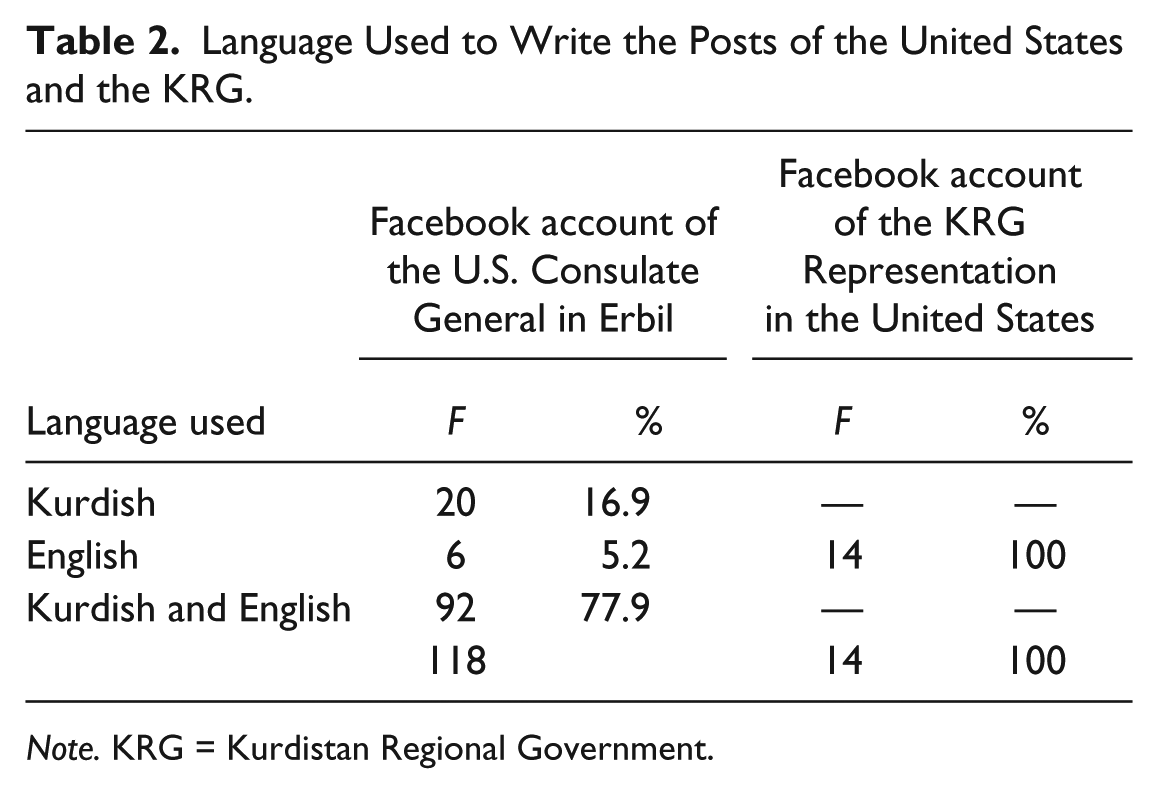
Note. KRG = Kurdistan Regional Government.
The United States and the KRG Public Diplomacy’s Use of Facebook to Generate Discussion and Involvement
Table 3 answers the second research question, which analyzed the role of the Facebook accounts of the representations of the United States and the KRG to generate discussion and engage people in the host country. The results indicate that the U.S. consulate’s Facebook account received more comments and feedbacks—51,838 likes, 2,789 comments, and 712 shares—than the Facebook account of the KRG Representation in Washington—61 likes, 100 comments, and two shares. This result implies a large gap between the endeavors of the two organizations, and the data express the United States’s greater enterprise and success in using Facebook, compared with those of the KRG, to engage the Kurdish people. The score of the KRG Facebook shows that the Kurdish representation does not believe in employing Facebook as a unique platform and an effective network communication approach to help the diplomacy mission meet its goals in the public diplomacy area. Table 4 indicates that the majority of the posts published by the Kurdish representation were not prepared successfully; they were mostly texts without photos or photos without text—seven texts, three photos, and four text-photos. The U.S. Facebook, in comparison, published most of their posts with both texts and photos—one text, two photos, and 118 text-photos. In relation to public diplomacy’s principles, postings should be at a high technical level to engage and fascinate the foreign public. Such postings are filled with diplomatic missions representing political angles, cultural events, and activities. In this respect, the U.S. Facebook attracted their foreign users through the use of different languages and effective text and photo posts.
Likes, Comments, and Shares Across Facebook Accounts of the U.S. Consulate General in Erbil and the KRG Representation in Washington.

Note. KRG = Kurdistan Regional Government.
Type of Posts—Text, Photo, and Text and Photo—Across Facebook Accounts of the U.S. Consulate General in Erbil and the KRG Representation in Washington.

Note. KRG = Kurdistan Regional Government.
The Agendas of the Posts Published on Facebook by the United States and KRG
This section examines the third research question and evaluates the agenda-setting of posts disseminated by the two organizations. Table 5 indicates that the United States devoted 38 posts (32.2%) to informing the local public in the host country, whereas the KRG devoted only one blog (7.1%) to this purpose. This result shows that the United States targeted the Kurdish people in its agenda-setting and that the U.S. Facebook is much more active than the KRG Facebook. The KRG Facebook devoted four posts to informing the foreign public about its own policy, while the U.S. Facebook devoted 14 posts to the same purpose. Informing Americans of the development of democracy in Kurdistan and strengthening their coalition to fight terrorism is very important to the KRG. Although additional events and news were published in the Kurdish local media, the KRG Facebook did not republish them.
Post Agendas on the Facebook Accounts of the United States and the KRG.

Note. KRG = Kurdistan Regional Government.
The second area, aid programs provided for Kurdish people and the KRG, was covered by 24 posts of the U.S. Consulate Facebook, that is, 20.3% of the posts. By contrast, the KRG Facebook devoted only three posts to that domain (21.4%). In addition, the U.S. Facebook created more posts about all areas except for “promoting investments.” These data are illustrated in Table 5.
Essentially, the U.S. Facebook produced 120 posts; simultaneously, the KRG Facebook produced only 14 posts. These results illustrate that the KRG Facebook did not publish any posts about crucial areas such as spreading the country’s culture, commemorating international days, creating dialogue with the local public, and informing the local public about the different activities of the mission.
Values of the Posts Published on the Facebook Accounts of the United States and KRG
This section analyzes the final research question, which investigated the values of the posts on the Facebook accounts of the two selected actors. Table 6 indicates that the U.S. Facebook created 59 posts (49.1%) about “others,” whereas the KRG Facebook created eight such posts (57.1%). The category “others” represents general themes such as activities, historical places, meeting with local people, weather, and local and global news. The U.S. Facebook gave priority to equality, with 18 posts (15%); human rights, with 16 posts (13.3%); and humanitarian aid, with 16 posts (13.3%). These themes represent American values. The KRG Facebook, by contrast, disseminated only eight posts on the values presented in Table 6—four posts (25%) on fighting terrorist groups, two posts (12.5%) on humanitarian aid, and two posts (12.5%) on human rights. Furthermore, Table 6 indicates that the U.S. Facebook prioritized the United States’s ideal values—one post (0.7%) on freedom, 18 posts (13.3%) on equality, two posts (1.4%) on democracy, and 16 posts (13.3%) on human rights, whereas the KRG Facebook did not offer any posts to promote the four values of promoting religious equality, highlighting democracy, exporting oil and natural gas, and practicing democracy.
Values of the Posts on the Facebook Accounts of the United States and the KRG.

Note. KRG = Kurdistan Regional Government.
Conclusion
An analysis was performed to compare the public diplomacy and nation branding efforts of the U.S. Consulate in Erbil and the KRG Representation in Washington on Facebook and to identify how the United States communicates with the Kurdish people in Iraq and how the KRG Representation in the United States uses Facebook to build relationships to serve the Kurdish statehood in the future. The results revealed that the United States employs Facebook more successfully than the KRG. The U.S. Facebook disseminated more posts and received more likes and comments. In addition, more foreign people became involved with the U.S. posts. Furthermore, the U.S. Facebook was followed by a larger number of people than the KRG Facebook. The results also showed that the KRG did not consider Facebook as a major effective platform to pursue its agendas and to communicate with Americans or with the Kurdish communities in the United States. This argument was proven by the inadequate, ineffective attempts to post only 14 blogs within 2 months and with a small number of followers. Although numerous materials and news stories of the Kurdish media could have been reposted by the KRG Facebook to enhance Kurdish public diplomacy and to enrich the KRG image, KRG Facebook did not utilize these materials. In addition, the lack of postings on their Facebook revealed that the Kurdish missions in the United States are not active; otherwise, they would have published their activities on their Facebook. In spite of the few posts of the KRG Facebook in contrast to the U.S. Facebook, the majority of the posts were either photos or texts—there were very few photo-text combinations. Furthermore, most of the texts were written only in English, while the U.S. Facebook used both Kurdish and English simultaneously. These weaknesses indicate the KRG Representation’s mismanagement of Facebook in promoting the KRG as a brand. From this standpoint, we strongly recommend that the KRG employ professional staff as public diplomacy practitioners to expand its activities across the United States and to cover all activities and updates on the Facebook of the KRG Representation in the United States.
Considering the values on the posts to serve the KRG as a brand, the values of practicing democracy and promoting religious equality were not highlighted. In addition, the KRG did not prioritize the agendas of the themes particularly related to the people in the host country and the Kurdish communities there. The tasks of building relationships and expanding the network require intensive public diplomacy (Bjola & Holmes, 2015; Goof, 2013; Park & Lim, 2014).
Interestingly, the U.S. Facebook’s use of the Kurdish language instead of Arabic can be analyzed through two perspectives. First, the KRG appears to be important to the United States, which will help the Kurds develop a symbiotic relationship with the United States to secure support in building a Kurdish statehood—if statehood is realized. Second, it validates the theoretical perspective claiming that public diplomacy can be practiced by nonstate actors (d’Hooghe, 2014; Harris, 2013; Sharp & Wiseman, 2012). In addition, this research has significantly proven that public diplomacy can be practiced between a state (the United States) and a nonstate (the Kurdistan region) regardless of the balance of their power in terms of experience, sources, and organizational structure, which are viewed as crucial elements in public diplomacy contexts (Gregory, 2011).
Footnotes
Declaration of Conflicting Interests
The author(s) declared no potential conflicts of interest with respect to the research, authorship, and/or publication of this article.
Funding
The author(s) received no financial support for the research, authorship, and/or publication of this article.