




Abstract
This article examines the academic performance of secondary school students from the perspectives of grit and mindset through a detailed review of the literature. What makes a learner resilient? Persistent? Willing to take on academic challenges? The research on grit and mindset provides an understanding of why many secondary students struggle academically. Whereas Duckworth discusses persistence and resilience, Dweck compares fixed versus growth mindsets, the willingness to take on academic challenges and belief in oneself as a learner. Teaching strategies and materials that can help students increase persistence and build a growth mindset are presented as keys to successfully affecting academic performance.
Setting the Context
The secondary school years are quite turbulent for most adolescents, regardless of their families’ socioeconomic status or home neighborhood. Adolescence is a time for identity formation or individuation away from family of origin while moving toward increased conformity with peers (Erikson, 1968). These two phenomena, individuation and conformity with peers, often contribute to the confusion associated with adolescence, a phenomenon conceptualized by Erikson as “Identity Versus Role Confusion.” On one hand, the adolescent wants to establish himself or herself as an independent entity from his or her parents, often pushing against family, community, and religious rules and norms. Changes in appearance, style of dress, music preference, and choice of friends characterize this individuation. On the other hand, these same changes become the basis for seeking acceptance from and conformity with the adolescent’s peer group.
Conformity or “fitting in” with peers, sometimes termed collective identity, takes on enormous significance at adolescence; being different or standing out in any way is seen as problematic. “Fitting in” can also have an effect on academic achievement; peer acceptance typically translates into average academic performance at best. According to Forham and Ogbu (1986), academic success, especially for racial and ethnic minority students, may be viewed as “selling out” to the dominant racial or cultural group. In other words, being smart as an adolescent may “not be cool,” and for racial and ethnic minority children, may be seen as trying to gain acceptance by the dominant race or cultural group.
Achievement gap data between White and minority students have been well documented, and these gaps have persisted and widened over time (National Center for Educational Statistics [NCES], 2015). According to the NCES (2015), the percentage of 12th-grade students who were proficient in reading was 37% and for math was 25%. In reading, the gap in proficiency was 34% between White and Black students and 11% between White and Hispanic students. In math, the gap in proficiency was 25% between White and Black students and 20% between White and Hispanic students. These persistent gaps in academic achievement between Whites and racial and ethnic minorities evident nationally across all 12th-grade students have significant implications for post–high school study and vocational training. Many of these students who apply to 2- and 4-year colleges often find themselves taking remedial courses during their first year of college attendance, needing to demonstrate proficiency before being permitted to take credit-bearing courses. Poor proficiency in reading and math may derail college dreams, and can result in students having to pay loans for college costs without moving beyond the “remediation phase” and never having earned a degree. Similarly, these students will be challenged as well when enrolling in vocational training programs, which require competence in reading and mathematics. Have you ever met an auto mechanic who cannot read the manual or a carpenter who cannot measure precisely or convert fractions as needed?
In looking at factors contributing to poor student performance at the secondary level, achievement data from fourth grade and eighth grade are significant data points. As reported by National Center for Educational Statistics (2015), the percentage of students proficient in reading at the fourth-grade level was 36% and at the eighth-grade level was 34%. Similarly, the percentage of students proficient in math at the fourth-grade level was 40% and at the eighth-grade level was 33%. In both, reading and math, student performance at the fourth- and eighth-grade levels was not significantly different from scores previously demonstrated in 2013. This is consistent with the findings of Rockoff and Lockwood (2010) on the decline in performance from early grades (K-5) to later grades (6-8) and the persistence of these gaps through eighth grade.
There is a convergence of several events when adolescents transition to middle school during sixth grade. These events, which include psychological and physiological changes as well as normative declines in motivation and academic achievement, make sixth grade an exceptionally important year for the future success of at-risk students. (Saunders, 2014, p. 4)
During the period of young adolescence when it may be “not cool to be smart,” students who are bright and have strong skills already developed, may choose to be passive learners, not demonstrating their abilities and often concealing their academic strengths for fear of garnering recognition.
In high school, many of these adolescents are able to redefine the group to which they want to belong, choosing a more proacademic identity. Because high schools are typically larger and have students drawn from a wider catchment area, these students have an opportunity to redefine themselves in high school by making new friends and joining many new clubs and activities. For them, they have been able to negotiate the early adolescent years with little lasting negative outcomes. They seem to have matured sufficiently and are more able to accept academic challenges as part of the overall learning experience. However, for the group of young adolescent middle school students who are typically close to failing, the “not cool to be smart” style of operation may have a significant negative effect on academic performance and opportunities over time. “Much less attention has been paid to understanding the magnitude of student disengagement in high-poverty middle-grades schools, its impact on student achievement, and ultimately the role it plays in driving the nations’ graduation rate crisis” (Balfanz, Herzog, & Mac Iver, 2007, p. 223).
Grit and Mindset
Carol Dweck’s (2007) work on mindset offers good insight into understanding students who seem relatively closed as learners, unwilling to take on academic challenges, in comparison with others who are open to learning new concepts and willing to take risks, even as the academic content increases in complexity. Students who are willing to struggle with new ideas and concepts are those who Dweck refers to as having a “growth mindset.” These are the students who are ready to challenge the “not cool to be smart” perspective and are ready to let people see that they may have to struggle to learn a new concept or task. What is important to this group of students is the belief that, through hard work, they will ultimately be able to master what seems so difficult for them to learn at any given point. In the face of academic challenges, they persevere, embodying an implicit theory (Dweck, 1996) that they will eventually master the new material. Duckworth, Peterson, Matthews and Kelly (2007) call this persistence in the face of challenge “grit.” Students who are successful, able to sustain their effort, and ultimately reach their targeted goal over time are gritty. According to Hochanadel and Finamore (2015), “It appears that when teachers teach students how to persist, a growth mindset develops, thus improving grit to overcome any challenges” (p. 49). Whether a growth mindset is a function of grit, or whether grit is a function of growth mindset remains open to debate, but clearly these ideas are closely intertwined and can offer a valuable lens into how adolescents may operate when challenged academically.
For those adolescents who are not willing to take on academic challenges and who choose instead to be among those who believe “smart is not cool,” Dweck (2007) refers to them as having a fixed mindset. The fixed mindset is best viewed as an implicit theory about oneself that is defensive, not wanting anyone to see into one’s real academic abilities or lack thereof. It may always be better to be viewed as problematic in terms of one’s behavior, rather than to be seen as a struggling learner. These students, unlike their counterparts with growth mindsets, do not see intelligence as a factor that can grow and change in relation to hard work. Instead, they believe that that intelligence is static: They have reached the end of their ability or smarts and there is nothing they can do about it; for such students, avoidance might be a more rational option, because if they don’t try to do something they feel is beyond them, they can kid themselves that they have not failed. (Mawer, 2014, p. 50)
According to Saunders (2014), “at-risk students who adopt a fixed mindset may become trapped in a recursive pattern of low achievement, low motivation, and low effort” (p. 4). The long-term impact of having a fixed mindset can be damaging to future opportunities after high school. So, the real question for teachers is, how do we develop gritty students who can approach tasks with growth mindsets? What strategies can facilitate persistence, resilience, increased academic achievement, and foster a sense of self-efficacy that goes beyond the limits of conformity?
Teaching Strategies That Can Help Develop a Growth Mindset
Learning Stories
Simply telling a student that he or she is bright and can surely learn what is being presented is not a successful strategy; belief in oneself as a learner must come from within. One strategy related to the development of self-efficacy involves the use of “learning stories” that capture the narratives of students who are empowered as learners and who yearn for meaningful learning experiences (Pride, 2014). Learning stories typically include (a) a discussion of a problem or project, (b) the learning challenges and the degree of difficulty the problem/project presents, (c) the actions the student chose that kept him or her engaged and working in the face of difficulty, (d) the way success with this problem/project was assessed, and (e) the extent to which the student was successful (Carr, May, & Podmore, 1998). Creating these learning stories over time, from students who are diverse by race, gender, ethnicity, and academic background, can serve as an excellent resource to help adolescents relate to others like themselves who have been able to embrace a growth mindset. The digital learning stories approach has been successfully employed at the University of Texas at Austin for incoming freshman about to enroll in rigorous science courses (Tough, 2014). In this article, written by Paul Tough, a case example is provided that involved minority students discussing how they felt when they first entered these rigorous science courses, how they had little confidence, and what strategies they used to help them be successful in their studies. The stories that were most effective either had a “belonging” message or a “mindset” message. In the “belonging” message, students talked about their fears at first of not fitting in, of not being smart enough to succeed, and what things they did that made them feel more like they belonged. In the stories that focused on “mindset,” students read and discussed an article that focused on how the brain was changeable and, through practice, could foster increased connections, challenging the conscious or unconscious belief that intelligence is static. The outcome of this work at University of Texas at Austin, was that these messages worked; more disadvantaged first-year freshmen students were retained and completed more credits after viewing these digital stories than did their comparison students.
What was unique here is the emphasis on developing self-efficacy in freshmen by using digital learning stories told by upper classmen who were representative of the same backgrounds and neighborhoods where many of the incoming freshmen lived. The connections that were made by the new incoming freshmen to these “belonging” stories gave them the courage to face the academic challenges presented by the rigorous STEM (science, technology, engineering and mathematics) curriculum and to embrace a core belief, an implicit theory, that they too could be successful. Relating to stories from individuals of similar backgrounds helped to strengthen a growth mindset in these new freshmen and fostered a sense of belonging and perseverance that could be what Duckworth et al. (2007) referred to as grit.
This article, written by Tough about the program at the University of Texas at Austin, connects with a book he authored in 2012, titled How Children Succeed: Grit, Curiosity and the Hidden Power of Character, and to a more recent book authored in 2016, titled Helping Children Succeed: What Works and Why? In both these texts, Tough argues that overcoming the problems associated with growing up poor requires that students learn the skills associated with character including grit, curiosity, and an embrace of challenges that are linked with opportunities. In essence, developing grit and mindset can lead to success and increased opportunities; teachers need to create classroom environments that provide children with chances to see themselves differently as learners who can be successful.
Adolescent Literature
Like digital learning stories that contribute to students developing self-efficacy with respect to themselves as learners, characters from adolescent literature can effectively help students to begin to challenge and change their mindsets from fixed to growth and to begin to see themselves as resilient (Elish-Piper, 2014). According to Connors (2014), stories about adolescents and young adults can become “a vehicle for imagining other worlds . . . to inhabit other subject’s positions and experiences, circumstances and emotions other than their own” (p. 33). In particular, the use of biographies can offer some insight into “gritty” characters that struggle, persist, demonstrate resilience, and ultimately succeed. “Salt in His Shoes: Michael Jordan in Pursuit of a Dream (Jordan & Jordan, 2003) highlights the challenges Michael Jordan faced and how he developed patience, determination, and a commitment to hard work” (Elish-Piper, 2014, p. 62). Biographies of individuals who have overcome significant challenges may be very impactful for young adolescents, especially if the highlighted individual is someone who comes from a similar circumstance and background. Kaufman and Libby (2012) provide evidence that beliefs and behaviors can be changed through an imaginative “experience taking” process based on fictional narratives and first-person stories. Similarly, Tough (2012) discusses the “power of character” and both digital learning stories and biographies of individuals who have succeeded in the face of considerable challenges are good illustrations of this concept.
The Choice Map
Embedded in the journeys that characters take in adolescent literature are the “moment by moment” choices they make along the ongoing paths of the narrative. Adolescents need to understand that these same kinds of choices are made every day by themselves and others in their world, and that these very choices can have profound effects on the outcomes of their lives. Making choices and understanding the resultant outcomes of those choices is a big part of helping students to “grow up.” According to Marilee Adams (2013), these choices emanate from either a “learner mindset” or a “judger mindset,” and can be depicted graphically in the “Choice Map.” In Adams’ paradigm, the “learner mindset” path is typically filled with choices, whereas the “judger mindset” path is typically filled with self-deprecating comments. Adams notes the importance of the “switch” where a person can change his or her path, or mindset, from judger to learner. The “Choice Map” provides a graphic approach to following decisions and feelings that students themselves, or people they know, or characters they have read about, may experience. This approach helps students to understand the consequences that result from decisions, and the actions that can be taken to “switch” from one path to another, from a mindset that is limiting to another that provides many options. Recognizing that one can overcome the judgmental, negative, and self-deprecating comments that often compete with positive feelings and actions can be life altering! How often do students with fixed mindsets experience the negative and self-deprecating thoughts that Adams’ map depicts and how can teachers help these students literally find the switch to a growth (learner) mindset?
The Brainology Program
A software program geared for students in fifth grade to ninth grade, developed by Mindset Works, Inc. (2017) (https://www.mindsetworks.com/kid/programDescription) is designed specifically to increase academic performance by helping students to develop the self-efficacy or mindset necessary for success. Underlying this self-efficacy or mindset is a belief that intelligence can be developed in the same way a muscle of the body can be developed through hard work and practice. “Brainology makes this happen by teaching students how the brain functions, learns and remembers, and how it changes in a physical way when we exercise it” (mindsetworks.com). This software program applies the physical exercise metaphor to understanding specific skills and strategies for addressing learning tasks and concepts. To implement the program requires anywhere from 7 to 12 hr and the training can be done over a 5- to 16-week period. The program consists of an online training module that addresses four instructional units and is followed by up to 10 hr of classroom activities.
One research study (Saunders, 2014) was conducted to assess the impact of Brainology on the reading performance of low-achieving sixth graders on the cusp of failing. Whereas this study did not find a treatment effect for changes in the target behavior, focus group interviews did find that students believed the Brainology program (n.d.) had affected their understanding of intelligence. Another study by Wilkins (2014) examined the impact of the Brainology program on young adolescents and found no difference in academic or self-efficacy measures, but noted improvement in the content engagement and increased motivation. Clearly, more studies need to be conducted to determine the efficacy of this program on developing both grit and growth mindsets, but fostering increased engagement, motivation, and a better understanding of intelligence may be valuable in helping to change a student’s implicit theory about himself or herself as a learner.
The 7 Mindsets: Ultimate Life Summit Program
This program developed by Shickler and Waller (2011), based on their book titled The 7 Mindsets, provides direct instruction in mindsets and highlights the importance of grit and resilience for students in Grades 5 to 9 during a 7-day summer camp experience. The seven mindsets that this program focuses on include “Everything is Possible, Passion First, We Are Connected, 100% Accountable, Attitude of Gratitude, Live to Give, and The Time is Now” (Gamel, 2014, pp. 11-12). This program helps students recognize that success in the future begins within themselves, in the big dreams they create that grow out of a passion or a talent they possess. Moreover, the program teaches that students are accountable for their actions and choices; they are the makers of their own fates and create their own happiness. Connectedness is another focus of this program; students are asked to explore what they give and what they get from relationships, how relationships are often untapped resources, and the importance of making positive connections with, and contributions to, the community and the larger world. Finally, the last mindset, “the Time is Now” addresses seizing the moment to begin to make changes in one’s life that can enhance one’s current path or lead to a new path, giving life purpose and direction. In this last mindset, taking action and possibly changing one’s path, not only with respect to school success but also more broadly to success as a person in the world, help students learn about empowerment.
Gamel (2014) employed this model as a means of studying grit and resilience building in 45 predominantly older adolescents drawn from an international sample of students. As a consequence of training, the sampled students were better able to understand resilience in themselves and had a better appreciation of openness to possibilities, passions, and accountability in the future. Students were asked to develop a life plan for their future as part of the training. Having students focus on how they might shape their own future requires a growth mindset, goal setting, and lots of resilience to plan how to address roadblocks and pitfalls that have the potential to derail meeting their goals in the future.
Behavioral and Cognitive Approaches
There are several behavioral and cognitive approaches that can be employed in the classroom that will contribute to the development of a growth mindset for adolescents who lack the resilience and the grit to persevere in completing tasks that are getting progressively more challenging. These approaches include peer tutoring, self-evaluation, and verbal self-instruction. Even though all these approaches employ contingent reinforcement, they do so in the context of learning to meet academic challenges, monitoring one’s own performance, and learning how to persist in the face of self-defeating thoughts and behaviors. As Yeager and Dweck (2012) point out, “we should not praise children for being ‘smart’ when they do well, but rather, to promote resilience, praise them for the process they engaged in—their effort, their strategies, their focus, or their persistence” (p. 311).
Peer tutoring
Peer tutoring is a well-documented technique that has been used over 30 years to increase the academic performance and sometimes the social/behavioral performance of both tutors and tutees alike. Peer tutoring has been implemented in various formats including reciprocal peer tutoring, cross-age and cross-grade peer tutoring, and class-wide peer tutoring.
Wexler, Reed, Pyle, Mitchell and Barton (2015) synthesized the literature published between 2001 and 2012 related to peer-mediated reading and math interventions for secondary struggling learners and found that it was a moderately to highly effective intervention for struggling learners at the secondary level. (Alzahrani & Leko, 2017, p. 34)
“The success of peer tutoring for both tutors and tutees is likely from incorporated instructional features such as frequent opportunities to respond, increased time on-task, and regular and immediate feedback” (Bowman-Perrott et al., 2013, p. 39).
Students who have a fixed mindset and diminished confidence in themselves as learners can be specifically selected and trained to be tutors, to either work with younger students who have weaker skill sets or to work with same-age peers, and dispense verbal praise to tutees who are on-task and making progress toward successful completion of assignments. In other words, students do not have to tutor academic skills; students can be trained to tutor on-task behaviors rather than academic content. The act of serving as a tutor can result in enhancement of one’s social status with peers, while garnering reinforcement from the teacher or teachers who have established the tutoring program for their effectiveness in dispensing praise to tutees for remaining on-task to complete assignment requirements. By engaging in this process, the tutors themselves learn the rules of persistence to task completion and this learning can generalize to the tutor’s own performance in his or her academic classes (Greer & Polirstok, 1982; Paterson & Elliott, 2006; Polirstok & Greer, 1986; Sutherland & Synder, 2007). One of the features of verbal praise is that it is reciprocal; the recipient of the praise typically acknowledges its receipt, either by commenting verbally or by using head nods, smiles, and so forth. As a consequence of dispensing verbal approval, the tutors are likely to receive increased reinforcement from the tutees via their verbal and nonverbal acknowledgments. Beyond the increased social status that serving as a tutor may provide, the additional reinforcement and the act of tutoring itself help the tutors to better understand persistence and the positive outcomes that are derived from increased time on-task. Taken together, increased social status and increased time on-task can contribute to increased self-efficacy, and over time, changes in mindset can emerge.
Self-evaluation
Self-evaluation training, sometimes referred to as self-management or self-monitoring is one type of metacognitive activity that can enhance both academic and social performance (Ardoin & Martens, 2004). Self-evaluation training for adolescents who typically do not persist in meeting academic task demands teaches them to recognize the criteria that will be used for evaluation in a given setting and the perspective of the significant other(s) in the environment who will serve as raters of their performance (Polirstok, 1987, 1989). In self-evaluation, adolescents can be taught by teachers to monitor specific academic or social behaviors that detract from academic performance by providing the adolescent with feedback concerning the frequency, accuracy, appropriateness, and completion of assigned tasks and how they were rated by the teacher. Amato-Zech, Hoff, and Doepke (2006) successfully increased student on-task time by more than 50% using a cueing procedure and reinforcers as part of a self-monitoring program. Interventions using self-monitoring have been widely reported as useful in strengthening proacademic and prosocial behaviors. However, these interventions are not typically generalized across settings and over time because they are seen as situation specific. In contrast, self-monitoring or self-evaluation procedures can be trained so that they will generalize across settings and time by building in a matching ratings procedure. When the adolescent has come to understand the rating criteria, he or she then rates his or her own performance independently and matches those ratings to those collected simultaneously by the teacher. This matching component is extremely valuable in helping the adolescent to understand the teacher’s perspective. Bonus points or other reinforcers can be earned for the degree of match between the adolescent and the teacher, thereby increasing the motivation to evaluate one’s own performance by taking on the teacher’s perspective. Over time, once the degree of match between ratings is high, the adolescent can then rate his or her own performance independently and even self-reward as well, if the teacher has empowered the student to self-determine reinforcers and self-consequate when goals are met. What is potent about this intervention is that the adolescent learns to view his or her behavior like the teacher, thinking in school settings “How is the teacher viewing my behavior—the quality of my assignment? My time on-task? My degree of compliance with rules?” These questions and the process of determining how the teacher views the adolescent’s behavior becomes what is portable about this intervention. As the adolescent uses this procedure, it will facilitate generalization to other classroom settings, vocational sites, or the home environment. Most recently, a new app for cell phones called “Score It” provides an automatic cue for recording one or more behaviors over a given observation period. This app also has the ability to build in the matching component for the teacher. The use of cell phone technology can enhance a student’s thinking about this self-evaluation process, making it more “user friendly.”
Self-evaluation can be a useful tool for adolescents who lack the ability to persist through task completion and who operate with a fixed mindset. By giving an adolescent a structured approach that will help him or her stay on-task to completion, he or she is likely to discover that increased time on-task can improve the quality and accuracy of that completed task. As a consequence, the adolescent learns persistence and builds self-efficacy. Self-evaluation can help the adolescent begin to think differently about himself or herself as a learner, moving toward a more open or growth mindset. “Beliefs of personal competence ultimately become habits of thinking that serve [students] throughout their lives” (Pajares, 2003, p. 153, as cited by Margolis & McCabe, 2006, p. 226).
Verbal self-instruction
Another approach used by teachers to help adolescents learn to manage their time on-task and/or limit their own self-defeating thoughts around academic performance is termed “verbal self-instruction,” a form of “self-talk” (Graybill, Jamison, & Swerdlik, 1984; Kunzendorf, McGlone, & Hulihan, 2004). Margolis and McCabe (2006) suggest that to increase self-efficacy in students, the teacher needs to use verbal persuasion to convince them that they are competent and can succeed if they employ a particular strategy. In other words, the goal is to determine “. . . what to say to strengthen struggling learners’ beliefs in their academic abilities and how to increase their willingness to engage in academic tasks” (p. 218). Teachers can provide students with key phrases and/or questions that can be trained through active rehearsal. The “self-talk” can serve to diffuse self-defeating thoughts and or lessen the need for task avoidance.
Adolescents can be trained to first recognize specific self-defeating thoughts and the accompanying feelings they experience. A series of questions that will help to guide the students to make more appropriate choices about the task at hand can be trained via rehearsal. For example, given an assignment that the adolescent views as problematic can prompt the following “self-talk” questions: “What am I getting upset about?” “Maybe I need to read this again?” “What don’t I understand?” “What assignment is this like that I recently completed successfully?” “Who can I ask for help in a quiet way that won’t call too much attention to me?” Through this “self-talk” process, the adolescent can better manage his or her feelings and behaviors and identify resources in the environment that can be helpful.
Adolescents need to learn “fix-up” strategies related to academic performance; monitoring what one does not understand and learning how to get the assistance one needs are specific skills that can be taught. Learning how to recruit assistance in the environment is a skill that can help adolescents move from a learner who is not engaged, to a more resilient learner willing to work through academic challenges. Self-evaluation and “self-talk” strategies are important for adolescent learners to acquire because these strategies have great potential for generalization and maintenance, fostering increased academic performance in school, home, and community settings.
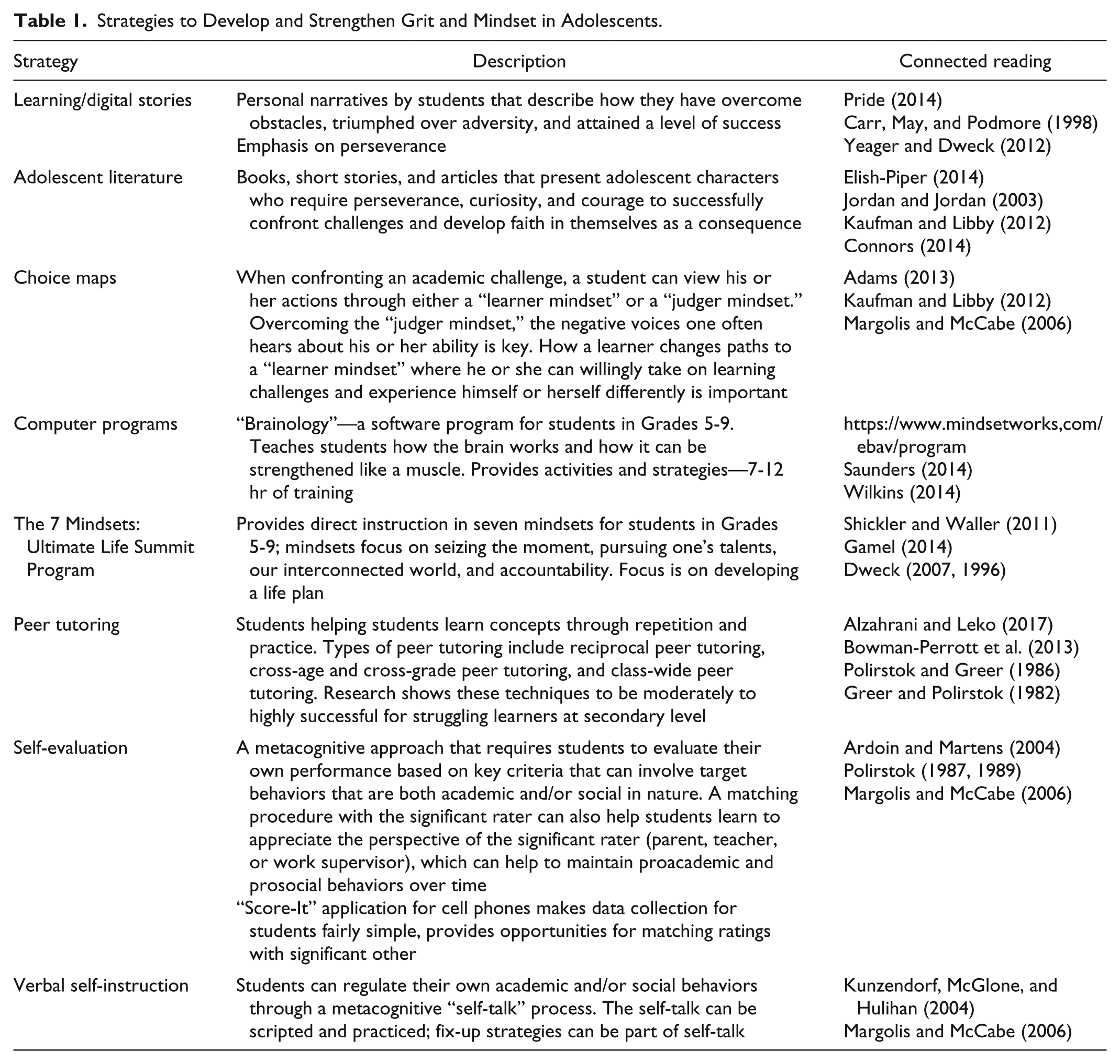
A summary of the various strategies discussed to strengthen grit and mindset can be found in Table 1.
Strategies to Develop and Strengthen Grit and Mindset in Adolescents.
Conclusion
Grit and mindset are important concepts for learners at any age. However, for adolescents, being gritty and having a growth mindset can significantly affect their futures. That is why secondary school teachers need to be able to employ some of the strategies discussed to help students improve their performance and willingness to take on risks academically (for a complete listing of all the strategies presented and how to access additional information, see Table 1). Teachers need to help students focus on building persistence and engaging in a process that leads to accomplishing goals and fostering success. When students believe that they can be successful as learners, and that their personal narratives can be similar to those of older students who have persevered, their trajectories with respect to postsecondary school and career choices can be dramatically changed!
This article has discussed a wide array of cognitive, technological, and behavioral strategies that teachers can implement to develop and strengthen the implicit theory students have about themselves as learners. The strategies that teachers select to use, be they learning stories, characters and situations from adolescent literature, choice maps, mindset building programs, computer software programs, peer tutoring, self-evaluation, or verbal self-instruction, are flexible, capable of being customized, and often used in tandem to address specific student needs. Understanding adolescent development, the culture of secondary schools, and the strategies that can develop grit and growth mindset are keys to successfully teaching adolescents, especially those on the cusp of failure.
Footnotes
Declaration of Conflicting Interests
The author(s) declared no potential conflicts of interest with respect to the research, authorship, and/or publication of this article.
Funding
The author(s) received no financial support for the research, authorship, and/or publication of this article.