




Abstract
We tested the hypothesis that, either through training or selection, military personnel is more resilient to stress than civilians, as indicated by several subjective and physiological measures. In addition, we examined the effect of stress on the perceived trustworthiness of faces in these two groups. Stress was induced in 45 civilian participants and 45 army participants through the Sing-a-Song Stress Test (SSST). In this paradigm seven neutral sentences are presented, each followed by a 60-s interval. An eighth sentence asks participants to sing a song aloud after the next (eighth or stress) interval. Participants rated the trustworthiness of five neutral faces, both before and after the SSST. Pupil size, heart rate, and skin conductance were adopted as physiological stress correlates. Stress response was calculated as the difference between the mean values over the last neutral interval and the stress interval. Subjective stress ratings were obtained before and after the SSST. The baseline levels of all physiological and subjective measures were the same in the army and civilian groups, while all measures showed a significant increase following the stressor. However, compared with the civilian group, army participants reported significantly less stress and showed significantly attenuated heart rate and skin conductance responses to the SSST. These results indicate higher stress resilience in the army compared with the civilian group. In addition, we found that perceived facial trustworthiness decreased after presentation of the stressor, suggesting that the effect of a stressor can influence in principle unrelated social judgments based on facial information.
Introduction
Military personnel needs to be able to function well after and under highly stressful and complex conditions. It is typically assumed that, through selection, training or experience, military personnel is more resilient to stress than civilians and that their judgment is less affected by stress. However, until now, this hypothesis has not been tested.
An important type of judgment that army personnel needs to make is the threat posed by the individuals they encounter (Becker et al., 2011). It is known that people typically base their initial rapid assessment of the intentions of “the other” on facial trustworthiness judgments (Klapper, Dotsch, van Rooij, & Wigboldus, 2016). The neural mechanisms that are involved in these judgments also mediate stress reactions (van Marle, Hermans, Qin, & Fernández, 2009). Because acute stress typically induces negative affect, it is likely to negatively modulate (bias) facial trustworthiness judgments. Especially in stressful peace keeping operations involving regular social contact with civilians (i.e., people who do not directly take part in the conflict), military should at all times maintain their ability to make unbiased social judgments. If stress should compromise this capability (with potentially serious and even deadly consequences), this would indicate the need for stress awareness training or inoculation programs.
In this study, we investigate acute stress in civilians and army personnel, using both subjective and objective (physiological) stress response measures. For both groups, we examine the effect of the stressor on facial trustworthiness judgments and the association between stress and facial judgment. We hypothesize that (Hypothesis 1 [H1]) army personnel is more resilient against acute stress than civilians, that (Hypothesis 2 [H2]) acute stress negatively biases facial trustworthiness judgments, and that (Hypothesis 3 [H3]) this effect is weaker in army personnel than in civilians.
In the next sections, we discuss factors that modulate susceptibility to stress and that are potentially relevant for our topic of research, like personality and experience, and the effects of stress on facial trustworthiness measurements.
Stress and Personality
The ability to react promptly to adverse conditions or events that threaten homeostasis is essential for survival (McEwen, 2007; Selye, 1955). Stimuli (environmental, social, or cognitive) that are appraised as threatening and unmanageable (stressors) typically elicit a psychological state commonly referred to as stress and trigger a cascade of behavioral and physiological activation systems that strive to maintain homeostasis (de Kloet, Joels, & Holsboer, 2005; Lazarus, 1999; Lazarus & Folkman, 1984; Mobbs, Hagan, Dalgleish, Silston, & Prévost, 2015).
Closely associated with stress response and recovery is the concept of resilience, a broad term defining the process of coping with or overcoming exposure to adversity or stress. Typical coping styles that people use to deal with the adverse effects of stress are either active (problem- or emotion-focused) or passive (avoidant; Afshar et al., 2015). Both the vulnerability to stress and the preference for a certain coping strategy depend on a person’s personality traits (Afshar et al., 2015; Schneider, Rench, Lyons, & Riffle, 2012; Vollrath & Torgersen, 2000). People with adaptive personality traits (e.g., high extraversion and conscientiousness) are less susceptible to stress and prefer active coping styles while people with maladaptive personality traits (neuroticism) are more vulnerable to stress and prefer avoidance coping. Depending on their coping style, people perceive a stressor either as a challenge or a threat (Blascovich, Mendes, Vanman, & Dickerson, 2011; Delahaij & Van Dam, 2017; Seery, 2013). Challenge is considered an adaptive response which occurs when evaluated personal resources meet or exceed perceived situational demands, whereas threat is seen as a maladaptive response that occurs when the perceived demands exceed the personal resources. Simply framing a task as either a challenge or a threat (without altering the perceive task demands) can significantly affect a person’s stress reactivity (Turner, Jones, Sheffield, Barker, & Coffee, 2014). Challenges are typically associated with positive affect while threats are typically associated with negative affect (Turner, Jones, Sheffield, & Cross, 2012).
In the current study, we investigate whether military personnel, who are typically expected and trained to be adaptive and to view their task as a challenge rather than a threat, show lower subjective and physiological stress responses than civilians to a negative stressor that is well-controlled, easy to administer, and social in nature.
Stress and Experience
Susceptibility to stress depends not only on personality but also on previous experiences. Subjective levels of anxiety and stress are found to be lower in experienced people than in novices for stressful tasks like shooting under pressure (Landman, Nieuwenhuys, & Oudejans, 2016) or skydiving (Breivik, Roth, & Erik Jørgensen, 1998; Hare, Wetherell, & Smith, 2013; Meyer et al., 2015; Roth, Breivik, Jørgensen, & Hofmann, 1996). Physiological markers have been found to indicate lower levels of stress in experienced people than in novices as well. Pre-jump levels of heart rate (HR) were lower for experienced skydivers than for inexperienced ones (Breivik et al., 1998; Roth et al., 1996), as were levels of respiration (Roth et al., 1996) and cortisol (Meyer et al., 2015). In these skydiving studies, effects of a stressor on subjective and physiological measures of stress were compared between participants who were either experienced or not on that specific stressor.
In the current study, we investigate the hypothesis that military personnel, being more experienced in dealing with stressful situations in general, show lower subjective and physiological stress responses than civilians to a negative stressor.
Stress and Facial Trustworthiness Judgments
Trust judgments are of primary relevance to human social perception (Fiske, Cuddy, & Glick, 2007). This probably reflects the result of evolutionary pressures: On encountering strangers, people must quickly determine whether the intentions of the “other” are good or bad. Perceptions of trustworthiness are largely based on facial features (Oosterhof & Todorov, 2008). People routinely evaluate facial expressions to infer each other’s specific behavioral or interaction intentions. Especially under time pressure and in complex situations, these judgments are often made spontaneously (Klapper et al., 2016; Todorov & Uleman, 2002, 2003), rapidly (Marzi, Righi, Ottonello, Cincotta, & Viggiano, 2012), and largely nonconscious (Ballew & Todorov, 2007; Olivola & Todorov, 2010; Todorov, 2011; Todorov, Mandisodza, Goren, & Hall, 2005; Todorov, Pakrashi, & Oosterhof, 2009; Todorov & Uleman, 2003; Tracy & Robins, 2008; Willis & Todorov, 2006), well before relevant information has been retrieved from memory (Rudoy & Paller, 2009). Rapid personality judgments based only on facial appearance influence various social outcomes, ranging from the willingness to cooperate (van’t Wout & Sanfey, 2008) to political voting behavior and criminal sentencing decisions (Ballew & Todorov, 2007; Blair, Judd, & Chapleau, 2004; Hassin & Trope, 2000; Little, Burriss, Jones, & Roberts, 2007; Marzi et al., 2012; Montepare & Zebrowitz, 1998; Porter, ten Brinke, & Gustaw, 2010; Todorov et al., 2005).
Our social judgments are known to be affected by our own (preexisting) affective state (e.g., Forgas, 1994, 1995). In other words, people have a tendency to base their judgments on their current mental state. As a result, affect elicited by one event may infuse (bias) social judgments of unrelated targets (the “Affect Infusion Model”: Forgas, 1994, 1995). Affect infusion is most likely to occur in situations with high uncertainty and time pressure when people resort to heuristic processing strategies (Forgas, 1994, 1995). In case of trust judgments, affect may bias the assessment since people need to rely on heuristic information processing when judging unfamiliar persons. Dunn and Schweitzer (2005) found that emotions (happiness, sadness, anger, guilt, and gratitude) typically bias trust judgments in the direction of the emotion’s valence. Also, neutral faces are perceived as more negative in negative self-related contexts (Wieser et al., 2014), while socially anxious individuals interpret neutral faces as more threatening (Schwarz, Wieser, Gerdes, Mühlberger, & Pauli, 2013; Yoon & Zinbarg, 2007, 2008). A recent study found that higher state anxiety causes a bias toward identifying anger in ambiguous facial expressions (Attwood et al., 2017).
Neuropsychological studies have shown that our ability to constrain the spillover of affect from one context into the next critically depends on the functioning of our lateral prefrontal cortex. It appears that even mild acute uncontrollable stress can rapidly and significantly inhibit prefrontal cognitive functions (Arnsten, 2009), resulting in a biased evaluation of novel neutral faces (Lapate et al., 2017).
In this study, we examine whether neutral faces are judged as less trustworthy after the occurrence of a personally relevant negative stressor (whose effectiveness is examined using other variables). If there is indeed a stress-related bias of facial trustworthiness ratings, it is not a priori evident that stress resilience may reduce this bias (over and above the reduced level of stress). This will be examined here as well.
Current Study
To summarize, in this study, we tested the hypothesis that (either through training or selection) army personnel is more resilient to stress than civilians (as indicated by several subjective and physiological measures). In addition, we investigated whether stress differentially affects perceived facial trustworthiness in these two groups. While a military realistic stressor may be considered the most suitable stimulus for this purpose, its use is evidently not desirable from a practical and ethical point of view. We therefore used an acute social stressor in this study (the Sing-a-Song Stress Test or SSST: Brouwer & Hogervorst, 2014) assuming that subjective and physiological stress responses to, for example, physical and body threatening stressors generalize to other types of stressors.
Methods and Material
Participants
The participant sample was comprised of 45 male civilian participants and 45 male army participants. The civilian participants, aged from 18 to 53 years (M = 22.5, SD = 5.4), were students recruited at Utrecht University (Utrecht, The Netherlands). The army participants, aged from 24 to 49 years (M = 31.4, SD = 6.9), were recruited at the “Oranjekazerne” army base (Schaarsbergen, The Netherlands). For final analysis, we excluded 15 civilian and 14 army participants with missing or unreliable data in one or more of the data streams (pupil size [PS], electrocardiograph [ECG], no cursor movement in response to the trustworthiness questions for the entire experiment), to maintain exactly the same group of individuals for each variable. As a result, the final analysis included 30 civilian participants, aged from 18 to 53 years (M = 22.1, SD = 6.3), and 31 army participants, aged from 24 to 49 years (M = 31.2, SD = 6.6).
The experimental protocol was reviewed and approved by the TNO Internal Review Board on experiments with human participants (Ethical Application Ref: TNO-IRB-2016-15-1) and was in accordance with the Helsinki Declaration of 1975, as revised in 2013 (World Medical Association, 2013) and the ethical guidelines of the American Psychological Association. All participants gave their written consent prior to the experiment.
Stress Induction
The validated SSST (Brouwer & Hogervorst, 2014) was used to induce acute stress. In the SSST paradigm, participants are instructed to sit still in front of a computer screen and read some neutral sentences that are consecutively presented, each followed by a 60-s countdown interval (the neutral intervals). The final sentence announces that the participant should sing a song aloud after the next countdown interval (the stress interval). It has been shown that the anticipation of singing reliably induces an acute stress response at levels that are comparable to that induced by the more elaborate Trier Social Stress Task, where the SSST paradigm controls for motor activity and perceptual input (Brouwer & Hogervorst, 2014). In this study, we used seven neutral Dutch phrases that were presented for 5 s each and followed by a timer counting down from 60 to 0 s. The eighth sentence was (translated from Dutch): “Task: Start singing a song aloud when the counter reaches zero. Keep sitting still until that moment.” This eighth stress sentence was similar in length and structure to the previous seven neutral sentences. An example of a (translated) neutral sentence is “Sentence: The first vacuum cleaner was constructed by Sweep Company. This was in 1907 and the device was called Hoover.” A confederate (posing as an additional participant waiting for his turn) was present during the entire experiment. The confederate and the experimenter together formed the audience that served to increase the social stress experienced by the participant (Harris, 2001). The version of the SSST used in this study was shortened and simplified compared with the original version as described by Brouwer and Hogervorst (2014) in that we used seven rather than nine neutral sentences, and that we used one confederate and the experimenter rather than two “participant” confederates.
Subjective Measurements
Perceived stress
The participants reported their perceived stress level by positioning a mouse controlled slider along a Visual Analog Scale (VAS; Aitken, 1969; Bond & Lader, 1974) labeled from 0 or “no stress at all” to a 100 or “a lot of stress.” This VAS was administered before the SSST (asking for their currently experienced stress level) and after the SSST (asking for their stress level in the countdown interval just before singing).
Facial trustworthiness
To measure facial trustworthiness, we selected 10 male faces from the validated Princeton Faces Database that are classified as neutral on the Trustworthiness dimension (Figure 1: the images with identifiers fi_000_tw3.bmp - fi_009_tw3.bmp, available from http://tlab.princeton.edu/databases/25-maximally-distinct-identities-trustworthiness; see also Oosterhof & Todorov, 2008; Todorov, Dotsch, Porter, Oosterhof, & Falvello, 2013). We selected faces that were neutral on Trustworthiness as their affective appraisal is most likely to be influenced by the emotional state of the observer because of their ambiguous nature (Cooney, Atlas, Joormann, Eugène, & Gotlib, 2006; Yoon & Zinbarg, 2008) while they minimize the risk of facial trustworthiness adaptation (Wincenciak, Dzhelyova, Perrett, & Barraclough, 2013). We only used Caucasian male faces to eliminate sex- and race contingent face aftereffects (Anthony C (Little, DeBruine, & Jones, 2005; Webster, Kaping, Mizokami, & Duhamel, 2004). Five randomly selected faces from the total set of 10 were shown during the prestress induction interval of the SSST. The remaining five faces were presented during the poststress induction interval. Their order of presentation was randomized across the participants. Hence, each face was shown only once to each of the participants. Participants were asked to rate the Trustworthiness of each face “on their gut feeling” by moving a cursor along a VAS on the computer screen that was labeled from 0 or “absolutely not trustworthy” to a 100 or “absolutely trustworthy.” No time limit was imposed for the rating task.

Ten face images from the Princeton Faces Database that are classified as neutral on the Trustworthiness dimension.
Physiological Measurements
HR, skin conductance level (SCL), and PS were registered to monitor the participant’s physical response during the experiment. HR (Brouwer, Van Wouwe, Muehl, van Erp, & Toet, 2013; Mandrick, Peysakhovich, Rémy, Lepron, & Causse, 2016; Mandryk, Inkpen, & Calvert, 2006), SCL (Brouwer et al., 2013; Lang, 1995), and PS (Mandrick et al., 2016; Pedrotti et al., 2014; Ren et al., 2014) are all known to reflect stress or arousal response and expected to increase following the stressor in this case. For each of these three physiological parameters, we define the stress response as the difference between their mean values over, respectively, the SSST stress interval (the eighth and last 60-s countdown interval following the sing-a-song assignment) and the last neutral SSST countdown interval (the seventh 60-s countdown interval following the last neutral sentence).
HR and skin conductance
The SCL and HR signals were digitized with a BioSemi ActiveTwo AD-box (www.biosemi.com) and stored on a Dell Optiplex 960 computer running LabVIEW graphical software (www.ni.com) for data inspection and acquisition.
HR was determined from an ECG signal. The ECG channel electrode was placed at the sixth left intercostal space (midclavicular line). The reference electrode was placed at the first right intercostal space below the right clavicular bone (midclavicular line). From the ECG data, the mean time period between two consecutive heart beats was determined (the interbeat interval or IBI in ms) over the two countdown intervals of interest. The mean IBI value was then converted to beats per minute or HR.
Skin conductance was recorded with two Nihon Kohden electrodes which induced an oscillator signal synchronized with the sample rate. The electrodes were applied to the tips of, respectively, the forefinger and the middle finger of the left hand of the participant (the hand not used to respond in the experiment). The skin conductance signal was filtered by a 30-Hz low-pass two-sided Butterworth filter, and mean SCL was determined for the two countdown intervals of interest.
PS
Left and right PS (in pixels) was sampled at 30 Hz using an EyeTribe tracker system (theeyetribe.com; see also Ooms, Dupont, Lapon, & Popelka, 2015) that was located directly underneath the monitor on which the visual stimuli (faces) were presented. Before each run, participants performed a 9-point calibration procedure. The data from the EyeTribe were collected using the PyGaze plugin (Dalmaijer, Mathôt, & Van der Stigchel, 2014) for OpenSesame (Mathôt, Schreij, & Theeuwes, 2012). Samples in which pupil diameter was recorded as 0.0 (reflecting eye blinks) were dropped from the analysis, as were values in which pupil diameter changed by more than 1 pixel between consecutive samples. The left–right average pupil diameter for each system was used, and averages were determined for the two countdown intervals of interest.
Procedure
The experiment took place either at Utrecht University (The Netherlands) for the civilian group or the Oranjekazerne army base (Schaarsbergen, The Netherlands) for the military group. After their arrival at the experimental location, the participant and the confederate “participant” were welcomed by the experimenter and guided to the experimental room. At both locations, the windows in the experimental rooms were blinded (to exclude direct sunlight), and only artificial lighting was used. A notebook computer was used to present the visual stimuli (VAS scales, the SSST sentences and counters, and the facial images), generate time stamps, and record the eye tracking data. The same experimental setup was used at both locations. The experimenter explained the participants that their task was to sit still in front of a laptop screen and read the different messages that would be presented, each followed by a counter counting down from 60 to 0 s. They were told that one of the messages could entail a task that they were required to carry out after the subsequent counter had reached 0. The participants were not informed about the exact nature of the experiment or that it involved singing out loud. Subsequently, the participant and the confederate both filled out an informed consent form and the demographic questionnaire. The experimental leader then appointed the real participant as the one to start (since he “happened” to have the lowest participant number on his informed consent form), seated him in front of the laptop and attached the physiological sensors. The confederate was asked to wait for his turn and was seated on a chair visible from the participant’s periphery. Then the electrodes for the ECG and skin conductance signals were attached to the participant. Participants used a chin rest such that their eyes were at a distance of 43 cm from the center of the stimulus display. The eyetracker was calibrated, and the experimental leader sat down behind the participant.
Then the actual experiment started. First, the participant reported his current stress level. Next, he rated the trustworthiness of five consecutively presented male faces. The five faces were randomly picked from the total set of 10 neutral faces selected for this study, and presented on the screen until the participant entered his response. Then the SSST started by presenting seven neutral sentences in random order for 5 s each, followed by a countdown interval from 60 to 0 s. The eighth sentence stated the request to sing a song aloud after the following countdown interval. At the end of that interval, the message “Please start singing” appeared. After 10 s, this message was replaced by the message “You can stop singing now.” Immediately after the singing interval, the participant was asked to rate the trustworthiness of five neutral male faces (different from the ones shown before the SSST), and the stress experienced during the final (eighth) countdown interval of the SSST (just before singing). During the entire experiment, both the experimental leader and confederate sat quietly on their designated places.
In the debriefing, the researcher explained the aim of the experiment and asked the participant whether he had suspected that the other participant was a confederate. In total, 84 out of 89 participants stated that they had actually believed that the confederate participant was a genuine participant.
Data Analysis
For all statistical analyses, a probability level of p < .05 was considered to be statistically significant. The dependent variables of this study were as follows: the physiological measurements of HR, SCL, and PS; the facial trustworthiness measurements; and the perceived stress levels. For each of these dependent variables, we tested whether there was a pre- versus poststressor difference (i.e., a within-participants test of stress response) and whether these differences were the same for both groups of participants (between-participants test). We also tested whether the baselines (i.e., prestressor values) and poststressor values differed between groups.
Results
Perceived Stress
Figure 2 shows the mean subjective stress level for the civilian and army participants, as experienced before the SSST and during the SSST stress interval. Paired t tests showed that the perceived stress levels were indeed significantly higher during the SSST stress interval than before the SSST, both for civilians, t(29) = −4.35, p = .000, d = .82, and for military, t(30)= −5.67, p = .000, d = 1.05. An independent t test showed that the mean perceived stress level before the SSST did not differ significantly between the army and civilian groups, t(59) = −1.31, p = .19, d = .34. However, the mean perceived stress level during the stress interval was significantly lower in the army group than in the civilian group, t(59) = −2.67, p = .00, d = .70. This result supports our hypothesis (H1) that army personnel is more resilient against acute stress than civilians. Due to the trend of a lower stress level before the SSST in the army group, an independent t test on the subjective stress response to the SSST (i.e., the increase of stress) between civilian and army participants failed to reach significance, t(59) = 1.67, p = .10, d = .43. Thus, the significantly lower perceived stress level during the SSST as reported by army participants compared with civilians seems to reflect a combination of lower overall subjective stress levels and a smaller stress response.

Mean perceived stress level for the civilian and army participants, before the SSST and during the SSST stress interval.
Facial Trustworthiness Judgments
Figure 3 shows the mean facial trustworthiness ratings (on a VAS scale ranging from 0 to 100) for the civilian and army participants, both before and after the SSST. Paired t tests showed that mean perceived facial trustworthiness was significantly lower after the SSST than before, both for civiliansm, t(29) = 2.78, p = .01, d = .53, and for military, t(30) = 2.21, p = .03, d = .41. This result supports our hypothesis (H2) that acute social stress negatively biases facial trustworthiness judgments. An independent t test showed that mean perceived facial trustworthiness did not differ significantly between the army and civilian groups, both before the SSST, t(59) = −0.96, p = .33, d = .25, and after the SSST, t(59) = −0.60, p = .55, d = .16. Also, the pre–post difference was the same between the groups, t(59) = .15, p = .88, d = .10. Hence, our present results do not support our hypothesis (H3) that army personnel is less susceptible than civilians for stress-related negative bias in facial trustworthiness judgments.

Mean facial trustworthiness ratings for the civilian and army participants, before and after the SSST.
HR
Figure 4a shows the mean HR (in beats/min) over each of the eight 60-s countdown intervals of the SSST, for civilian and army participants separately. Paired t tests showed that the mean HR during the SSST stress (eighth) countdown interval was significantly higher than the mean HR during the preceding last (seventh) neutral countdown interval, both for civilians, t(29) = −7.25, p = .000, d = 1.68, and for military, t(30) = −5.67, p = .000, d = 1.35. This indicates that the SSST successfully induced stress in both groups. An independent t test showed that the mean HR during the last neutral SSST interval did not differ significantly between the army and civilian groups, t(59) = −0.69, p = .49, d = .18. However, the army group had a significantly lower mean HR than the civilian group during the SSST stress interval, t(59) = −2.44, p = .01, d = .64. To compare the HR response with the SSST between civilian and army participants, we computed for both groups the difference between the mean HR values over the SSST stress interval and the last neutral SSST countdown interval. An independent t test showed that the increase in HR in response to the SSST was significantly lower for army participants than for civilian participants, t(59) = 2.56, p = 0.01, d = .67, supporting our hypothesis (H1) that army personnel is more resilient against acute stress than civilians.
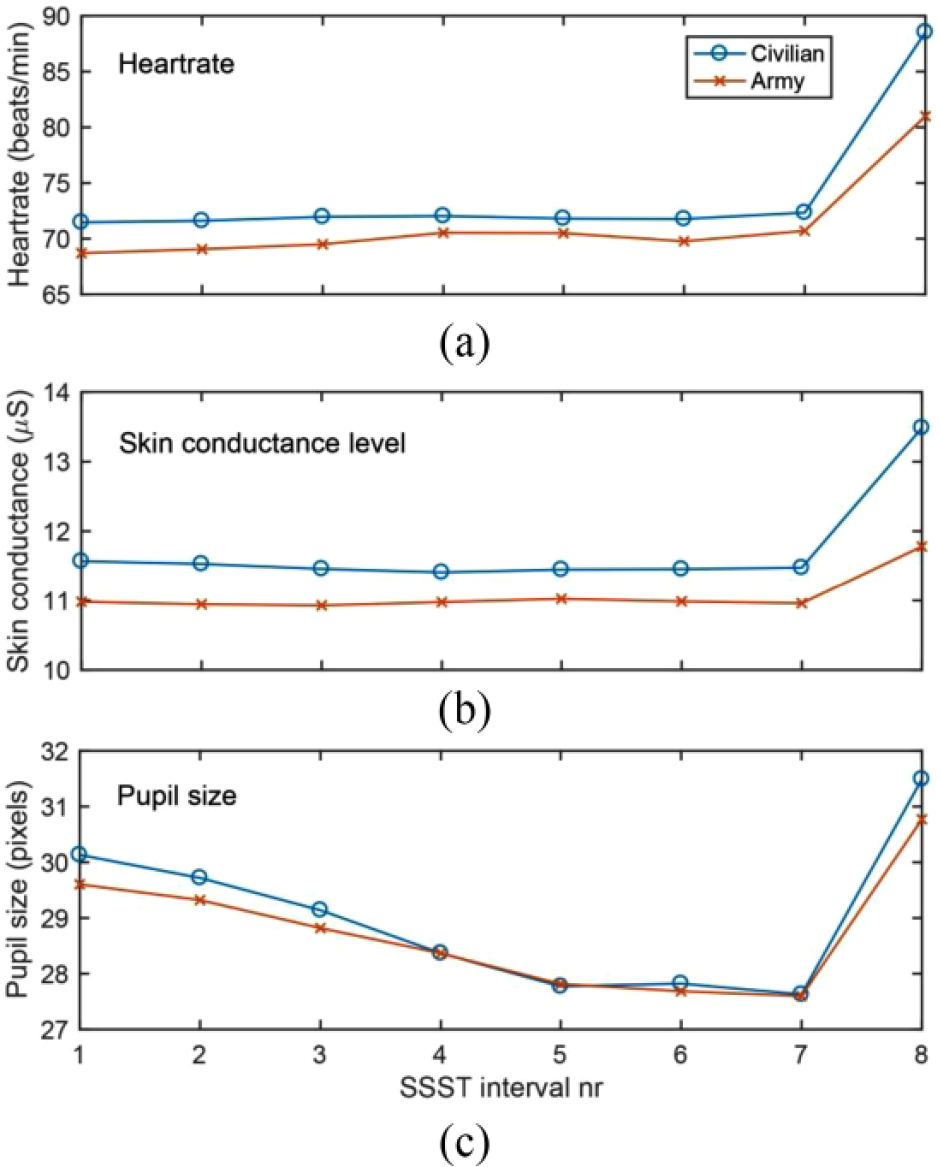
Mean heart rate (a), skin conductance level (b), and pupil size (c) over each of the eight 60-s countdown intervals of the SSST, for both the civilian and army participants.
Skin Conductance
Figure 4b shows the mean SCL (in µS) over each of the eight 60-s countdown intervals of the SSST, for both civilian and army participants. Paired t tests showed that the mean SCL during the SSST stress (eighth) countdown interval was significantly higher than the mean SCL during the preceding last (seventh) neutral countdown interval, both for civilians, t(29) = −7.93, p = .00, d = 1.50, and for military, t(30) = −4.68, p = .000, d = .87, consistent with stress in both groups. An independent t test showed that the mean SCL did not differ significantly between the army and civilian groups, both during the last neutral SSST interval, t(59) = −0.51, p = .61, d = .13, and during the SSST stress interval, t(59) = −1.44, p = .15, d = .38. An independent t test showed that that the increase in SCL in response to the SSST was significantly lower for army participants than for civilian participants, t(59) = 14.13, p = .00, d = 3.68. Note that the latter test is less sensitive for the large variations between participants usually found in SCL. This finding supports our hypothesis (H1) that army personnel is more resilient against acute stress than civilians.
PS
Figure 4c shows the mean PS (in pixels) over each of the eight 60-s countdown intervals of the SSST, for both civilian and army participants. Paired t tests showed that the mean PS during the SSST stress (eighth) countdown interval was significantly larger than the mean PS during the preceding last (seventh) neutral countdown interval, both for civilians, t(29) = −8.28, p = .00, d = 1.56, and for military, t(30) = −9.01, p = .000, d = 1.67, again indicating stress in both groups. An independent t test showed that the mean PS did not differ significantly between the army and civilian groups, both during the last neutral SSST interval, t(59) = −0.02, p = .97, d = .01, and during the SSST stress interval, t(59) = −0.82, p = .41, d = .21. An independent t test on the increase in the mean PS in response to the SSST also did not differ significantly between civilian and army participants, t(59) = 1.18, p = .24, d = .31. However, and as shown in Figure 4c, there is a trend for larger poststress PS values and larger increases from the last neutral countdown interval to the stress interval for civilians compared with army participants. These trends reached significance when all participants with valid PS data (37 civilian and 38 army participants) were included. Thus, although the mean PS results of the currently examined selection do not support our hypothesis (H1) that army personnel is more resilient against acute stress than civilians, incorporating more participants leads to findings that agree with this hypothesis.
Relation Between Facial Trustworthiness and Stress Response
We also investigated whether any of the stress response measures in this study (HR, SCL, PS, and subjective stress responses) were associated with the decrease in perceived facial trustworthiness, using Pearson’s product–moment correlation coefficient. The results are listed in Table 1. For civilians, there was a significant negative correlation between HR response and facial trustworthiness: A larger increase in HR was associated with a stronger decrease in perceived facial trustworthiness. All other correlations were not significant.
Pearson’s Correlation Between Facial Trustworthiness and the Physiological (HR, SCL, and PS) and Subjective (VAS Scores) Stress Measures.
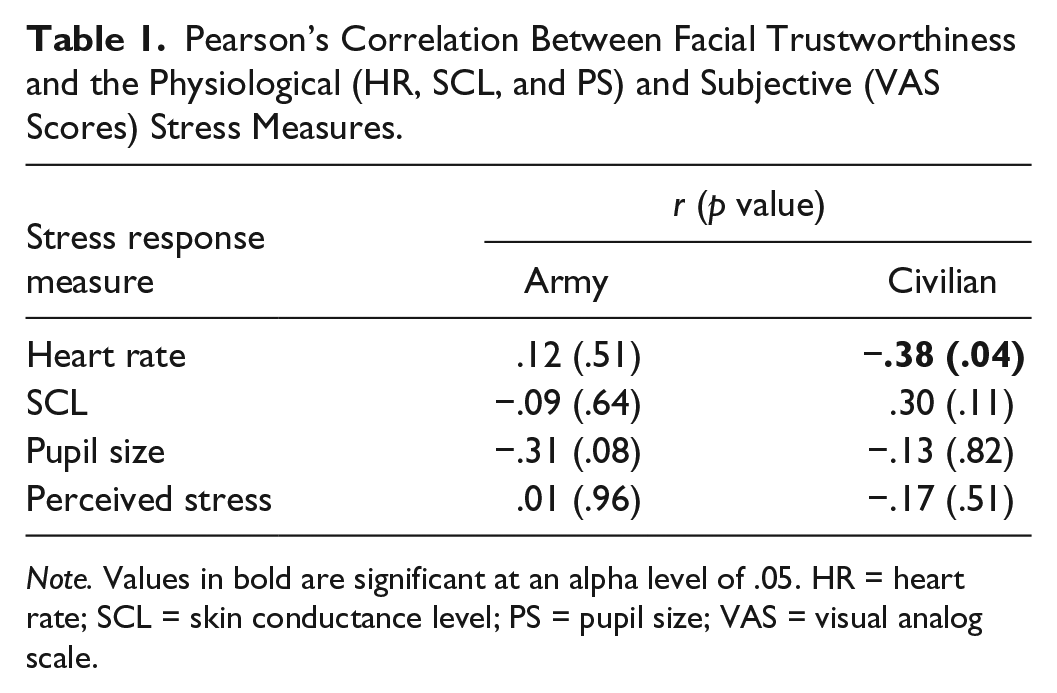
Note. Values in bold are significant at an alpha level of .05. HR = heart rate; SCL = skin conductance level; PS = pupil size; VAS = visual analog scale.
Relation Between Age and Stress Response
Our military participants were somewhat older than our civilian participants. To test whether age predicts any of the stress response correlates measured in this study, we computed Pearson’s product–moment correlation coefficient between age and each of the physiological (HR, SCL, and PS) and subjective (VAS scores) stress responses. The results (listed in Table 2) showed that none of the correlations were significant. This suggests that the stronger stress responses we found for the civilian than for the military group cannot be attributed to the difference in age between both groups.
Pearson’s Correlation Between Age and the Physiological (HR, SCL, and PS) and Subjective (VAS Scores) Stress Measures.

Note. HR = heart rate; SCL = skin conductance level; PS = pupil size; VAS = visual analog scale.
Discussion and Conclusion
Stress Response
In this study, we tested the hypothesis (H1) that (either through training or selection) army personnel is more resilient to stress than civilians. We thereto measured the subjective and physiological response of army and military participants to acute social stress.
We used a slightly modified version of the SSST procedure to induce acute stress. The results show that the levels of perceived stress, HR, SCL, and PS were all significantly raised during the SSST stress interval compared with their baseline levels as measured over the last neutral SSST interval, both for civilian and army participants. This indicates that the modified SSST successfully induced stress in all participants.
The baseline levels of all physiological and subjective measures were statistically the same for the army and civilian groups. However, compared with the civilian group, army participants reported significantly less perceived stress during the SSST, and showed significantly attenuated HR and SCL responses to the SSST. There was no significant difference between both groups in their PS response to the SSST when the current selection of participants was considered, but the trend for an attenuated stress response in PS for the army group became significant when including more participants. Overall, our results support our hypothesis (H1) that army personnel is more resilient to stress, both subjectively and physiologically. The fact that these results were found using a social stressor with little resemblance to a common military stressor suggests that the observed stress resilience is quite general.
Our current finding that the physiological (HR, SCL, and PS) response to the SSST of the military was attenuated with respect to the response of the civilian participants agrees with a study by of Li, Duan, and Guo (2017). They found that HR and blood pressure of people with high- and low character strength varied in a similar way in response to a TSST, which is another social stressor, involving preparing and giving a speech for an unsupportive audience. Thus, it appears that resilience or character strength dampens the response to a stressor but does not completely suppress it.
Facial Trustworthiness
Our results show that both army and civilian participants rated the perceived facial trustworthiness of neutral faces significantly lower after experiencing the SSST. Thus, the present results support our hypothesis (H2) that acute social stress negatively biases facial trustworthiness judgments. This agrees with the recent finding that higher state anxiety can cause a negative bias in judging ambiguous facial expressions (Attwood et al., 2017). The effect of the stressor on mean perceived facial trustworthiness did not differ significantly between the army and civilian groups. Hence, this finding does not support our hypothesis (H3) that army personnel is less susceptible than civilians for stress-related negative bias in facial trustworthiness judgments.
It appears surprising that both groups showed a similar decrease in facial trustworthiness in response to the social stressor, although they experienced different levels of stress as indicated by the physiological and subjective measures. In accordance with this, we only found a modest link between the stress response and the decrease in facial trustworthiness through the correlational analyses—there was only a correlation between the decrease in facial trustworthiness and the increase in HR for civilians. This may be caused by the fact that the faces were judged only after the stress interval had ended. This was done to not reduce the stress through a double task and not to confound the physiological measures of stress with body movement related to the judging. However, the downside of this methodological decision is that at the time of judgment, stress may have already partially passed resulting in a less clear relation between stress and trustworthiness judgments, and a weaker effect of stress on trustworthiness rating in general. Another possible reason for the modest link between stress response and decrease trustworthiness rating is related to the observation that even mild acute uncontrollable stress can rapidly and significantly inhibit prefrontal cognitive functions (Arnsten, 2009), resulting in a biased evaluation of neutral faces (Lapate et al., 2017). If even a mild amount of stress suffices to compromise facial trustworthiness judgments, this could explain our present finding that acute stress reduced the perceived facial trustworthiness of neutral faces to a similar degree for both military and civilians. Moreover, this suggests that stressful experiences in general may negatively bias facial trustworthiness judgments, independent of their intensity. Follow-up research is required to investigate whether stress affects trustworthiness in such an all or none way, or whether our finding is related to the fact that trustworthiness judgment and the stress peak did not exactly coincide in time.
Future Directions
Our subjective and physiological results indicate that the army group was more resilient to stress than the civilian group. However, this study does not answer the question whether the observed differences are due to preexisting personality characteristics between civilians and army personnel or to military training and experience. Thus, future studies will need to examine, using within-subjects designs, individuals prior to and after military training.
Neutral faces are probably more profoundly evaluated in self-related contexts than in contexts that have no direct personal relevance (Schwarz et al., 2013). Hence, the effects observed here may become more evident when the faces that are to be judged have a direct relation with the observer.
We did not measure personality factors like trait anxiety (State-Trait Anxiety Inventory [STAI]: Spielberger, Gorsuch, & Lushene, 1970). However, previous studies found that experience is a more powerful predictor of stress response than psychological traits (Breivik et al., 1998; Roth et al., 1996).
Further studies may also focus on mitigating effects of stress on social judgments. It is known that the salience of an emotion’s source mitigates the effects of incidental emotions on trust (Dunn & Schweitzer, 2005). Hence, individuals may curtail the influence of stress on their social judgments by heightening their awareness of the source of their stress.
Our current finding that there appears to be a robust spillover of stress on facial trustworthiness judgments suggests the need to develop a combined social training and stress awareness program (possibly integrated with biofeedback) for the military (and other people working in stressful conditions, such as police, firefighters, and first responders) to mitigate these undesired side effects.
Summary
Compared with civilians, army participants reported significantly less stress and showed significantly attenuated HR, skin conductance, and a trend of PS responses to a social stressor. These results indicate higher stress resilience in the army compared with the civilian group. For both groups, perceived facial trustworthiness decreased after experiencing the stressor, suggesting that a stressor can influence in principle unrelated social judgments based on facial information. These findings suggest that an integrated social training and stress awareness program (possibly with biofeedback) for people who need to maintain social contact while working in stressful conditions might be beneficial.
Footnotes
Declaration of Conflicting Interests
The author(s) declared no potential conflicts of interest with respect to the research, authorship, and/or publication of this article.
Funding
The author(s) received no financial support for the research, authorship, and/or publication of this article.