




Abstract
Political polarization has intensified in the United States since the 1970s. The present research concerned adult attachment style as a potential explanation for ideological divisions. Few studies have examined this, mainly in college student samples, and their results conflict. The present research contributes to the literature because it is the first one to focus on the relationship of adult attachment to ideology in general population samples. Ideology was measured by self-placement on a 7-point scale. Attachment was measured by Carver’s 14-item self-reported Measure of Attachment Qualities (MAQ). Structural equation models were estimated for path analyses. The results for the direct effect of secure attachment style on ideology were mixed and indicated that both liberals and conservatives can have secure attachments. Results also underscored the potential importance of higher socioeconomic status for secure relational attachment style. Higher religiosity and lower trust in mass media contributed to conservatism.
Introduction
Scholars of political ideology are increasingly interested in adult attachment theory to understand better the role of ideology in thought processes and behaviors from childhood to adulthood (Fraley, Griffin, Belsky, & Roisman, 2012; Huddy, Feldman, & Weber, 2007; Koleva & Rip, 2009). Different attachment styles may condition different ideological worldviews (Buck, 2014; Roccato, Russo, & Senestro, 2013; Thornhill & Fincher, 2007; Weber & Federico, 2007). Only a few studies have examined the relationship of adult attachment relational styles to ideology, mainly in college student samples in the United States, 1 and their results differ (Dunkel & Decker, 2012; Gillath & Hart, 2010; Koleva & Rip, 2009; Thornhill & Fincher, 2007; Weber & Federico, 2007; Weise et al., 2008). The objective of the present research was to study ideology and attachment in general population samples.
Ideological divisions have deepened in the United States in the past 40 years, making it increasingly difficult for partisan groups to agree or compromise on policy and legislation (Abramowitz, 2010; Abramowitz & Saunders, 2005; Gauchat, 2012). Well-educated citizens tend to be the most politically involved and the most likely to identify with an ideological stance (Abramowitz, 2010; Pew Research Center, 2016). Among other factors contributing to the increasing ideological impasse are intensifying differences among the generations (Pew Research Center, 2016) and increasing divides between the highly religious and the nonreligious (Twenge, Sherman, Exline, & Grubbs, 2016). Being religious is often related to being conservative (Brossard, Scheufele, Kim, & Lewenstein, 2009; Gauchat, 2012; Roccato, 2008). Another factor is citizens’ growing preferences for information sources associated with an ideological orientation. Conservatives tend to view mainstream news media with distrust and to prefer outlets that share their views; liberals are disposed to trust news media, particularly those perceived as congruent with their positions (Center for Political Communication, 2012; Diercks & Landreville, 2017; Gaziano, 2014; Hindman & Yan, 2015; Jamieson & Cappella, 2009; Johansen & Joslyn, 2008; Lee, 2010; Morris, 2005).
The Current Research
The goal was to explore the relationship of attachment and ideology in the context of variables identified as important to trends shaping polarization: formal education, income, age, religiosity, and trust in mass media. Adult attachment was conceptualized as an independent variable because it derives theoretically from infant attachment, a process occurring in the first few years of life. Gender was also considered an independent variable because it is determined before birth.
The earliest relationships that humans know influence their perceptions of power and authority (Ainsworth, Blehar, Waters, & Wall, 1978; Barker & Tinnick, 2006; Feldman & Stenner, 1997; Grossman, Grossmann, & Waters, 2005; Lakoff, 2002; Mikulincer & Shaver, 2003). Political ideological orientations, in part, are based in attitudes toward power and authorities.
Independent Variable: Attachment Theory
Infant attachment
Adult attachment conceptualizations build on infant attachment theory, although there are many differences between these areas. Infant attachment is a process that provides “internal working models” for relationships throughout life and for development of cognitive skills, trust, confidence, and motivation to learn as the child matures (Bowlby, 1969/1982; de Ruiter & van IJzendoorn, 1993; Fraley, 2002; Mikulincer, 1998).
The attachment process develops from the interaction pattern of the primary caregiver and the infant and is defined by how well the caregiver can respond to the emotional needs of the infant. Parents who consistently provide comfort from anxiety and distress tend to foster secure attachments in their babies. Those parents who do not respond to their infants’ emotional needs with dependable regularity are likely to promote insecure attachments. Securely attached infants learn to trust their caregiver as a safe base from which to explore their world (Ainsworth, 1991; Sroufe & Waters, 1977). Insecurely attached children have learned not to trust that their caregiver will comfort their anxieties and provide safety; they tend to feel powerless, have low self-esteem, and approach relationships with trepidation.
Types of attachment
Attachments, therefore, may be secure or insecure, and insecure attachments are divided into three main categories: anxious-ambivalent, anxious-avoidant (Ainsworth et al., 1978), and disorganized (Main & Solomon, 1986). The latter type has seldom been studied in adults and is not discussed here. Ambivalence is characterized by hyperactive attachment behavior in search of security: fear of abandonment, high anxiety, and desire to merge with other people (Ainsworth et al., 1978; Cassidy & Kobak, 1988; Main, 1990). Carver (1997) further distinguished between two anxious-ambivalent styles (ambivalent-worry, or tendency to worry about loss, and ambivalent-merger, or desire for closeness). Avoidance involves lowering anxiety by deactivating the attachment system, restricting close relationships and emotional connections with others, relying on the self, and seeking control over others (Brennan, Clark, & Shaver, 1998; Griffin & Bartholomew, 1994; Mikulincer, 1998).
Research on adult attachment and ideology
Studies of adult attachment as a psychological aspect of political ideology in college students, either in experiments or surveys in the United States, yield conflicting results (Dunkel & Decker, 2012; Gillath & Hart, 2010; Koleva & Rip, 2009; Thornhill & Fincher, 2007; Weber & Federico, 2007; Weise et al., 2008). Student samples diverge enough from nonstudent samples in political interest and knowledge and other characteristics that general population samples should be preferred when studying such constructs (Koleva & Rip, 2009). Peterson (2001) also raised the question of differences found between college student samples and the general population in effect sizes and directionality.
Four student studies of adult attachment style and ideology measured ideology as conservatism/liberalism (Dunkel & Decker, 2012; Thornhill & Fincher, 2007; Weber & Federico, 2007; Weise et al., 2008). Three also included social dominance orientation (SDO) and/or right-wing authoritarianism (RWA), concepts not part of the present research (Thornhill & Fincher, 2007; Weber & Federico, 2007; Weise et al., 2008). A fifth inquiry into these relationships (Gillath & Hart, 2010) looked solely at priming effects, and two analyses (Weber & Federico, 2007; Weise et al., 2008) included primes as part of their research. Primes were unrelated to liberalism/conservativism and are not discussed further. Dunkel and Decker (2012) found that ambivalent and avoidant attachments were related to liberalism, and Thornhill and Fincher (2007) observed that secure attachments were associated with an indicator of conservatism, C-Scale scores. In contrast, Weise et al. (2008) reported that security of attachment was associated with liberal ideology. Weber and Federico (2007) reported a significant positive indirect effect of anxious attachment on left-right placement (a scale combining ideology and partisanship, where high scores indicated greater conservativism/Republicanism), through RWA and a tendency to view the world as dangerous.
Measurement of adult attachment
The student studies varied in how they operationalized attachment. Two relied on the Adult Attachment Questionnaire (AAQ; Dunkel & Decker, 2012; Thornhill & Fincher, 2007), one used the Experiences in Close Relationships (ECR) measure (Weber & Federico, 2007), and one used the Relationship Scales Questionnaire (RSQ; Weise et al., 2008).
The current study used another gauge, the Measure of Attachment Qualities (MAQ; Carver, 1997), selected as the most appropriate measure in a general population survey because it is much shorter than the RSQ or ECR and a little shorter than the AAQ. Brevity was important because the questionnaires were limited to 50 questions. It has been used effectively in previous research (Carver, 1997; Hollist & Miller, 2005; Kim & Carver, 2007; Kim, Carver, Deci, & Kasser, 2008; Roccato, 2008; Roccato & Ricolfi, 2005; Roccato et al., 2013; Segal, Needham, & Coolidge, 2009).
Dependent Variable: Ideology
Jost (2006) defined ideology, following Tedin (1987), as “an interrelated set of moral and political attitudes” that organize people’s values and beliefs, guide and explain political behavior, and are relatively stable over time (p. 653). Conservatives tend to support traditional attitudes and values, maintain caution in innovation or change, and emphasize respect for authority, obedience, and self-discipline in child-rearing. Liberals tend to be more open to social and political change, to support social equality, and to favor self-fulfillment, empathy, and nurturance in child-rearing (Jost, Glaser, Kruglanski, & Sulloway, 2003a; Koleva & Rip, 2009; Lakoff, 2002). 2
The present research concerns a liberal–conservative scale of political views that has been a staple of American public opinion polls and related research. The majority of studies of adult attachment relational style and ideology analyzed by Koleva and Rip (2009) measured ideology on a unidimensional scale anchored at each end by liberalism and conservatism.
Various scales measure ideological dimensions, such as RWA (Altemeyer, 1981, 1998), and SDO (Sidanius & Pratto, 1999). According to Jost (2006), however,
Most treatments of political ideology have focused on the left–right (or, especially in the United States, the liberalism–conservatism) distinction (Jost et al.,2003a, 2003b; Knight, 1990). . . Although the left–right distinction is by no means airtight, it has been the single most useful and parsimonious way to classify political attitudes for more than 200 years. (p. 654)
A check of questions measuring political ideology during the past 40 years or more used by major organizations such as the American National Election Studies (ANES), the National Opinion Research Center, the Pew Research Center, and the Roper Center supports this conclusion.
Intervening Variables
Variables that may influence the relationship between attachment and ideology were measured. These included trust in mass media reporting, two other related types of trust, interest in news and public affairs, religiosity, and demographics.
Trust in mass media and other trust
Three types of trust appear in much political and mass communication research: trust in media to report news accurately and fairly, trust in people, and trust in government to act fairly and democratically. Trust in people and trust in government are vital antecedents to political participation (Moy & Scheufele, 2000). If social segments and news media are segregated ideologically, then media distrust impedes the political process because widespread publication of news is essential in a democratic society (Jones, 2004).
Public affairs interest
This variable was included in initial analyses because attachment in infants sets the course for interest in new experiences and ideas, deriving from a sense of agency and competence (Ainsworth et al., 1978; Suess, Grossmann, & Sroufe, 1992). It may also be connected to adults’ interest in public affairs. Public affairs interest is related to political knowledge and participation (Eveland & Scheufele, 2000; Gaziano, 1997; Liu & Eveland, 2005; Viswanath & Finnegan, 1996).
Religiosity
Several studies demonstrate that people comprehend complicated or controversial issues such as abortion or global warming using their value predispositions, many of which tend to be religious values or heuristic cues from news media, religious institutions, political elites, and other sources (Brossard et al., 2009; Diercks & Landreville, 2017; Hindman, 2009; Ho, Brossard, & Scheufele, 2008). Many researchers operationalize religiosity as evaluation of the importance of religion in respondents’ lives and their frequency of attending religious services (Brossard et al., 2009; Gauchat, 2012; Ho et al., 2008; Malka & Lelkes, 2010; Roccato, 2008; Roccato & Ricolfi, 2005).
Demographics
Education, in particular, as well as household income, age, gender, and race are indicators of ideological divides (Abramowitz, 2010; Diercks & Landreville, 2017; Gauchat, 2012; Gaziano, 2013, 2014, 2017; Hindman, 2009, 2012; Hindman & Yan, 2015; Pew Research Center, 2016; Veenstra, Hossain, & Lyons, 2014).
Study 1
Method
Participants
A random national general population sample in the United States (N = 330) was obtained from SurveyMonkey at www.surveymonkey.com between September 27 and October 1, 2013. The response rate was 35.1% of individuals invited to participate. The 50-question survey, “Opinions About Topics in the News, Interpersonal, and Social Issues,” took about 10 min to complete. Two additional samples were drawn in 2014 and are reported later. SurveyMonkey is an online survey site that maintains a large, diverse, national panel of people who have completed a profile survey and have agreed to respond to surveys commissioned by SurveyMonkey customers. The company reports that it maintains regular benchmarking surveys to help ensure that panel members are representative of the population. SurveyMonkey audiences do not receive money. They receive credits toward donations to charitable organizations and sweepstakes entries. SurveyMonkey removes any information identifying respondents before the data are given to investigators. Advantages of an Internet survey are cost-effectiveness and speed. Disadvantages are that American adults with Internet access tend to be of higher socioeconomic status (SES) than those who lack access and may be different in other ways from non-Internet samples (see, for example, Zickuhr & Rainie, 2013).
Independent variables
Adult attachment
The MAQ is a self-report measure of adult attachment containing 14 items with four Likert-type categories, ranging from “disagree with the statement a lot” to “agree with the statement a lot” (Carver, 1997; Kim & Carver, 2007). Four subscales containing three to five items assess secure, avoidant, ambivalent-worry, and ambivalent-merger patterns. Examples of items are “It feels relaxing and good to be close to someone” and “I prefer not to be too close to others.” 3 Responses to the four subscales were summed according to Carver’s directions. The subscales had adequate internal consistency: security, α = .71; avoidant, α = .80; ambivalent-worry, α = .77; and ambivalent-merger, α = .75. Summary statistics for variables are in the appendix. Because the numbers of statements for each type of attachment were unequal, responses were averaged.
Gender
This is described under “Demographics” section below.
Dependent variable: Ideology
Respondents were asked, “Here is a 7-point scale on which the political views that people might hold are arranged from extremely liberal to extremely conservative. Where would you place yourself on this scale?” Participants also were asked which political party described their views the best on a 7-point scale ranging from “strong Republican” to “strong Democrat,” recoded so that high meant strong Republican; however, party identification was not used in the present analysis because it was highly correlated with ideology (r = .70, p < .001).
Intervening variables
Trust in government, media, and people
The questions were (a) “How much of the time do you think you can trust the federal government in Washington to make decisions in a fair way?” (b) “How much of the time do you think you can trust the media to report the news fairly?” (c) “Generally speaking, how often can you trust other people?” The questions used 5-point scales and were separated in the questionnaire. Answer categories were always, most of the time, about half the time, once in a while, and never (recoded so that high scores denoted high trust).
Interest in public affairs
People were asked how interested they were in what was going on in government and public affairs on a 5-point scale anchored by “extremely interested” and “not interested at all” (recoded so that high scores signified high interest).
Religiosity
Participants rated the importance of religion in their lives and their frequency of attending religious services on 5-point scales. The end points were “extremely important” and “not important at all” for the first measure and “every week” to “never” for the second. Responses were combined to form a religiosity score, averaged, and recoded so that high scores meant highly religious (Cronbach’s α = .86).
Demographics
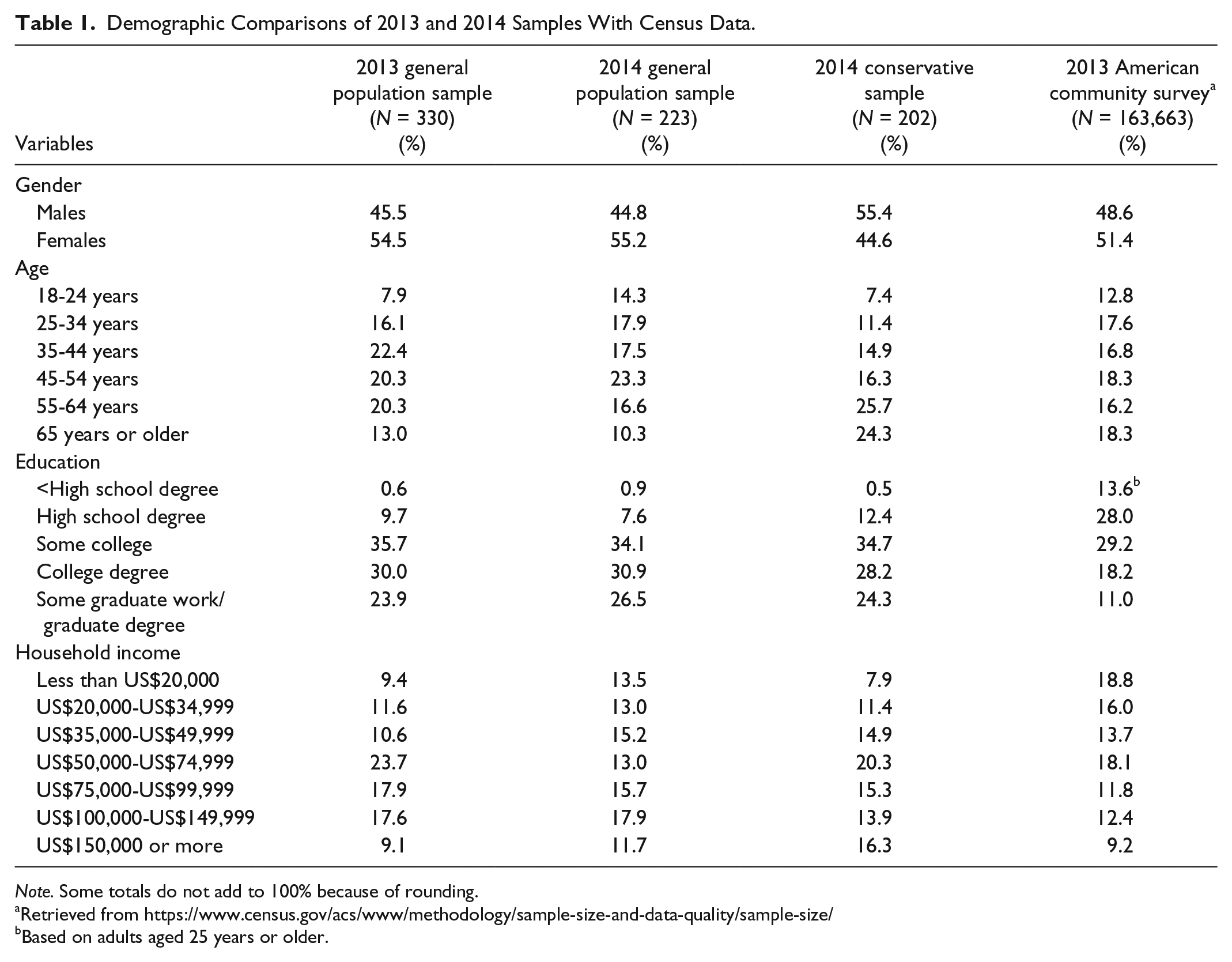
Participants were asked the year they were born, the last grade they completed in school, household income, gender, and race. Age was measured as continuous, and the others were measured as categories. Compared with census data (Table 1), the sample overrepresented women, the middle-aged, and people with higher education and household incomes. Minority racial groups were not well represented, and race was discarded from additional analysis. A t-test comparison of the sample mean and the mean of a sample from the ANES 4 in 2012 using the identical question about ideology showed that the present study significantly overrepresented liberals (t = 3.95, df = 1,565, p < .001, two-tailed). Table 1 shows two additional 2014 samples, to be discussed later as Study 2.
Demographic Comparisons of 2013 and 2014 Samples With Census Data.
Note. Some totals do not add to 100% because of rounding.
Based on adults aged 25 years or older.
Analytical method
Causal modeling with path analysis in a structural equation model with maximum likelihood estimation in AMOS 23.0 was selected to evaluate the potential relationships with attachment and to estimate how well these variables fit the model for each of the three samples. Path analysis allows the consideration of both direct and indirect effects of exogenous variables on dependent variables. Causality is inferred for gender and security of adult attachment, the observed exogenous variables, as those variables precede the others in time order. Observed endogenous variables were trust in mass media to report news fairly, trust in the government to make fair decisions, religiosity, public affairs interest, respondents’ age, education, household income, and ideology. Unobserved exogenous variables were error variances that cause response variation in the observed endogenous variables. Structural equation modeling permits multiple pathways through intervening variables. Figure 1 presents the conceptual model.
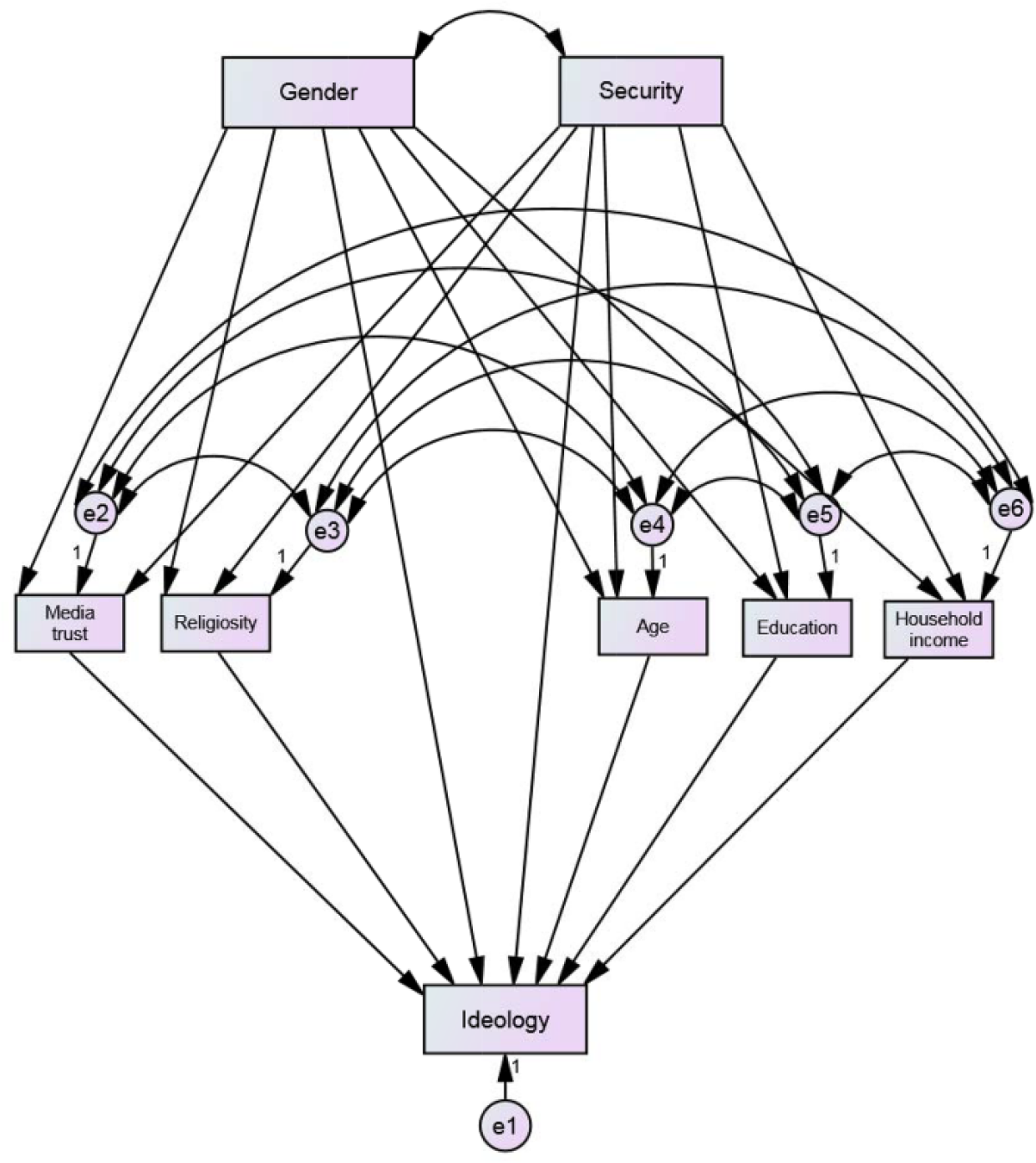
The theoretical model.
Figures 2 to 4, below, report standardized regression coefficients that attained statistical significance. Standardized regression coefficients (β) range from +1.0 to −1.0 and allow direct comparisons of the relative strength of each predictor in a model and comparisons of results across the figures.

The sample in 2013 with significant paths shown except for the correlation between gender and attachment security (ns).
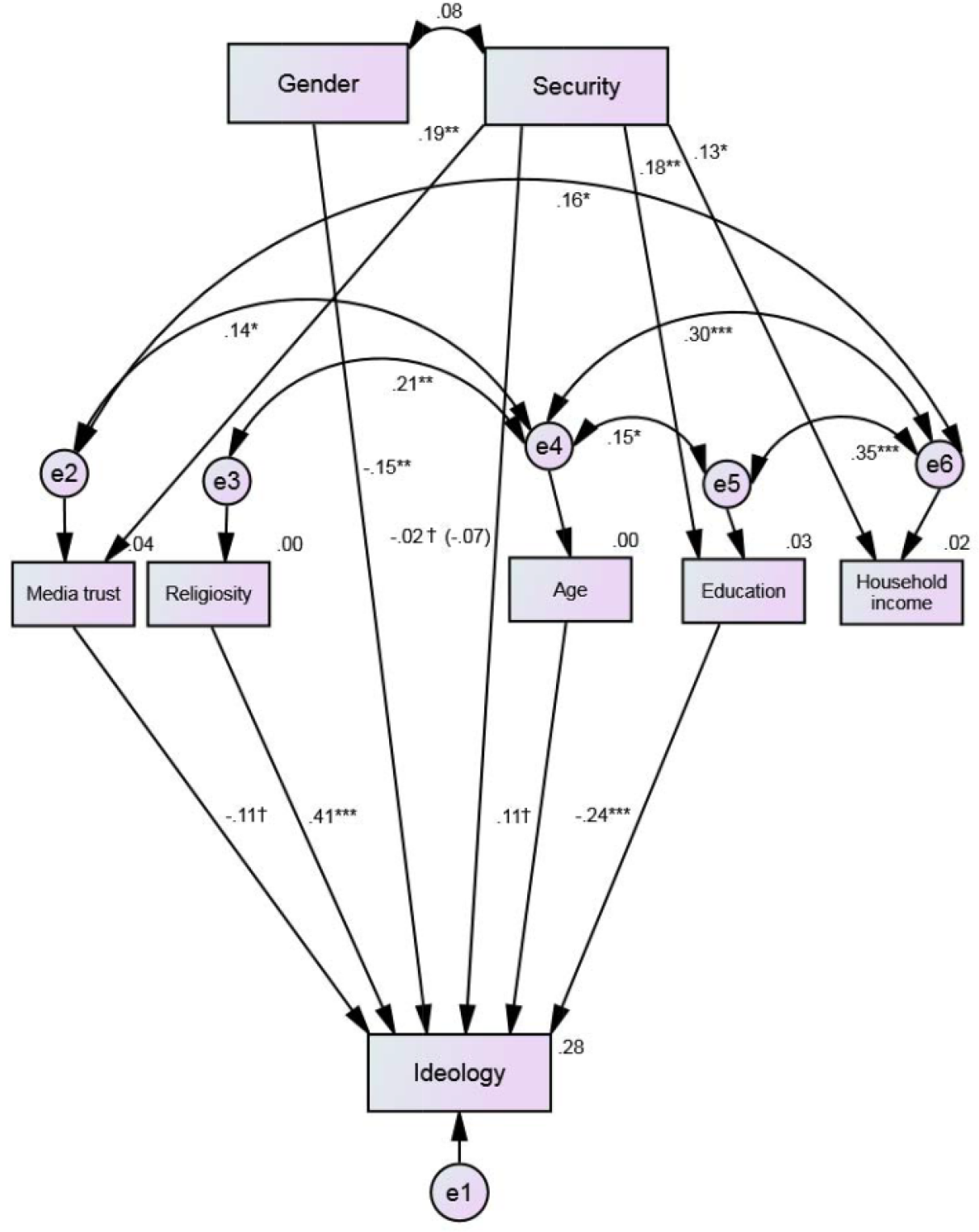
General population sample in 2014 with significant paths shown except for the link between gender and attachment security (ns).

Conservative sample in 2014 with significant paths shown except for the correlation between gender and attachment security (ns).
Study 1 Results
Table 2 provides the correlations among ideology, the four attachment variables, religiosity, the three trust items, public affairs interest, and three demographic variables. Among the attachment measures, highest relationship was between security and avoidance (negative) and between ambivalent-worry and ambivalent-merger (positive). These results were similar to previous reports (Carver, 1997; Kim & Carver, 2007; Kim et al., 2008). Correlations among the other attachment variables were moderate. Security was significantly and negatively related to ideology and was the only attachment item retained for further analysis. (Worry was related to ideology only at r = .10, p < .10, and initial testing in a path model showed that the relationship decreased markedly when other variables were taken into account.) Ideology was significantly and positively correlated with religiosity and significantly and negatively correlated with media trust and government trust but unrelated to trust in people. Media trust was uncorrelated with religiosity, though it might have been expected to be associated because Golan and Day (2010) reported mixed evidence of a relationship in their investigation of media credibility and religiosity. Public affairs interest was not related to any of the other variables at .05 or less, and it was discarded from further tests as was trust in people.
Pearson Correlations for Main Variables in 2013 Survey of General Population (N = 330).
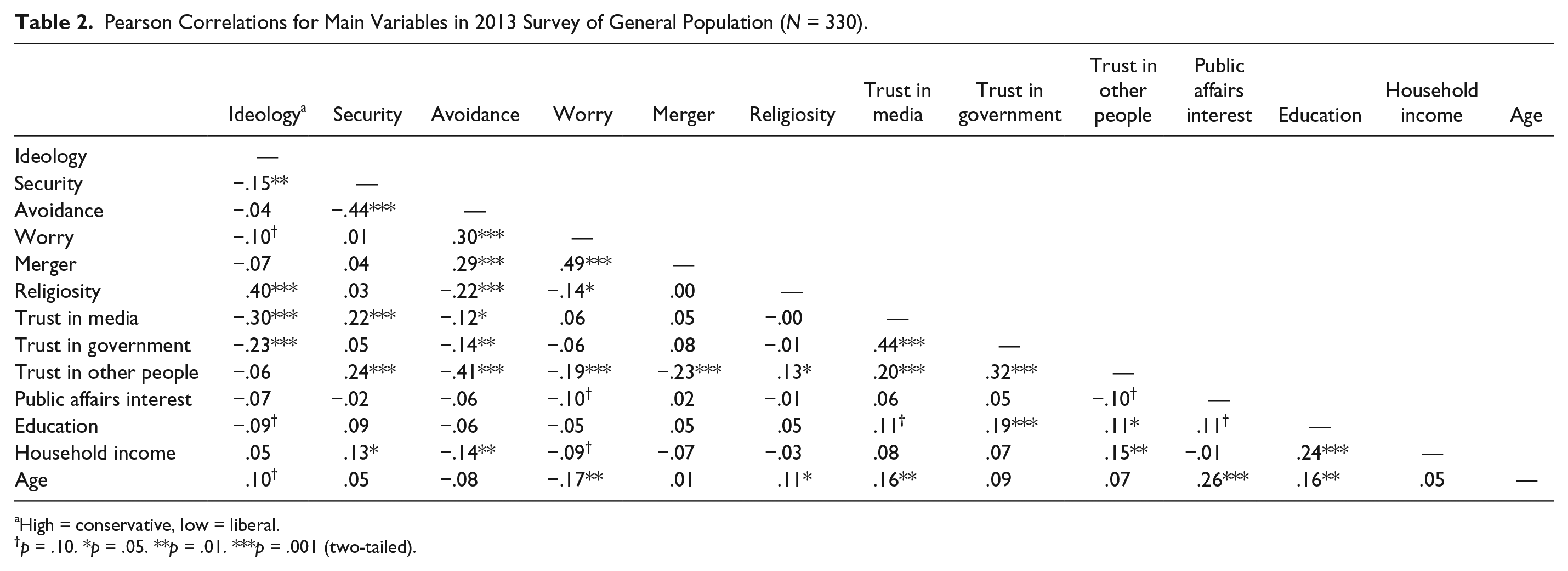
High = conservative, low = liberal.
p = .10. *p = .05. **p = .01. ***p = .001 (two-tailed).
A structural equation model was estimated for hypothesis testing in a path analysis in which attachment security and gender were exogenous variables and were allowed to have direct effects on religiosity, media trust, government trust, age, education, household incomes, and ideology. Then religiosity, trust in media reporting, trust in government, age, education, and income were permitted to have direct effects on ideology.
The resulting path model is given in Figure 2, showing standardized coefficients. The model was a good fit to the data: χ 2 = 18.866, 19 df, p = .465 (45 distinct sample moments, 26 distinct parameters to be estimated), N = 330, CMIN/df = .993 (chi-square statistic that is the minimum value of the discrepancy between the model and the data, divided by its degrees of freedom), Bentler’s comparative fit index (CFI) = 1.0, Tucker–Lewis Index (TLI) = 1.001, and the root mean square error of approximation (RMSEA) = .001. The criteria considered desirable for goodness of fit statistics were the following: a nonsignificant chi-square, RMSEA less than .05, CFI and TLI of .95 or higher, and CMIN/df of less than 2 (Hox & Bechger, 1998; Hu & Bentler, 1995). The results fit the hypothesized model well.
The first research question asked if adult attachment was related to political ideology. Figure 2 shows that security of attachment had a direct effect of β = –.12 (p < .05) on ideology. In addition, the standardized coefficient for an indirect effect was β = –.03, for a standardized total effect of β = –.15. The negative sign indicated that liberals were higher in security than conservatives. The second research question concerned which other variables were related to adult attachment and how they might relate to each other. Secure attachment also was a significant predictor of trust in media reporting and possessing higher household incomes. Gender had no direct effect on ideology, and its indirect effect was negligible. The only effect of gender was on household income, β = –.12 (p < .05), indicating that men tended more than women to have higher household incomes. Distrust of government and distrust of media were significantly related to conservatism, as were being older, less educated, and having higher household incomes. Religiosity was a significant predictor of conservative ideology at β = .40 (p < .001) and was the most related to ideology, among all the variables.
Discussion
Inspired by a desire to untangle the relations between adult attachment and ideology because of mixed results in previous research, the present study sought to explore this relationship in a general population sample. The primary finding was that secure attachment was a significant predictor of liberal ideology. No known previous research on ideological orientation and attachment style has included media trust or government trust. Secure adult attachment led to trust in media, and media trust predicted liberalism. Security was not significantly related to trust in government, but government trust was correlated with media trust and also predicted liberalism.
Importance of religion predicted conservatism, consonant with other research (Gaziano, 2014). Religion was not a significant predictor in Thornhill and Fincher’s (2007) work, but their operational definition of religiosity may have been too simple to achieve predictive ability. It was a variable coded as “1 = religion” and “0 = no religion.”
Older age, lower education, and higher household incomes also predicted conservatism. Previous research has found conservatives tending to have lower education than liberals but tending to have higher household incomes than liberals (Diercks & Landreville, 2017 5 ; Gaziano, 2014; Hindman & Yan, 2015).
Study 2
Method
Participants
A national random sample of U.S. adults 18 years or older (N = 223) and a separate national random sample of relatively conservative adults 18 years or older (N = 202) to improve representation of conservatives in the study were drawn on September 23 to 24, 2014, through SurveyMonkey. The 2014 general population sample and the 2013 general population sample were not significantly different in ideology (t = 1.59, df = 551, p < .11, two-tailed). The 2014 general population sample, however, was significantly more liberal than the ANES 2012 general population sample (t = 5.44, df = 1,458, p < .001, two-tailed).
Dependent variable: Ideology
Ten questions comprising an Ideological Consistency Scale (ICS) used by the Pew Research Center (2014) were included as a check on the validity of the 7-point scale measuring ideology, and a high correlation between them increased confidence in the liberal–conservative scale. Respondents chose the one statement in a pair of statements that came closer to their views, where one statement represented a conservative point of view, and one represented a liberal stance. For example, “Government regulation of business usually does more harm than good” (conservative) OR “Government regulation of business is necessary to protect the public interest” (liberal). Conservative responses were scored “+1,” and liberal responses were scored “–1.” Don’t know/refused/volunteered responses counted as “0.” Responses were summed to form the scale (Cronbach’s α = .78, general population sample; .58, conservative sample). In the general population sample, ideology and the ICS were highly related (r = .75, p < .001), as were the ICS and party identification (r = .71, p < .001), and ideology and partisanship (r = .77, p < .001). Among the conservatives, results were r = .24, ICS and ideology; r = .48, ICS and party identification; and r = .33, ideology and partisanship, all significant at .001.
Independent variable: Adult attachment style
The measures of security, avoidance, ambivalent-worry, and ambivalent-merger were constructed as in Study 1. The internal consistency for the general population sample was security, α = .68; avoidant, α = .83; ambivalent-worry, α = .73; and ambivalent-merger, α = .75, comparable with the 2013 results. Among the conservative sample, results were, respectively, .73, .78, .70, and .75.
Intervening variables
Religiosity
The scale for religiosity was created as in Study 1 with Cronbach’s α = .88, general population sample, and .78, conservative sample. The conservative sample surpassed the general population sample significantly in how religious they were.
Media trust
The general population sample significantly exceeded in trusting the media, compared with the conservative sample. Trust in the government to make good decisions and trust in people were not asked in Study 2.
Demographics
As Table 1 shows, all the samples considerably overrepresented higher SES groups. As with the 2013 sample, the two 2014 samples were significantly more likely to be White and non-Hispanic than the general public. Like the 2013 sample, the 2014 general population sample slightly underrepresented men. The 2014 sample of conservatives was significantly more likely to be male and older than the 2014 and 2013 general population samples. Their SES differences were not significant.
Study 2 Results
Tables 3 and 4 present the intercorrelations for the same measures as used in Study 1. Table 3 shows that in the 2014 general population sample, security correlated inversely and substantially with avoidance at –.53 (p < .001), and security was related to worry at .08 (ns) and merger at .16 (p < .05). Avoidance was associated with worry and with merger both at .20 (p < .01). Worry and merger correlated at .60 (p < .001). In the 2014 conservative sample, results were similar, except that security and worry correlated at –.25 (p < .001) and security and merger showed no significant relationship (Table 4). Ideology and security were inversely related but not significant in the general population sample. Contrary to these results, in the conservative sample, ideology and security were positively and significantly correlated.
Pearson Correlations for Main Variables in 2014 Survey of General Population (N = 223).
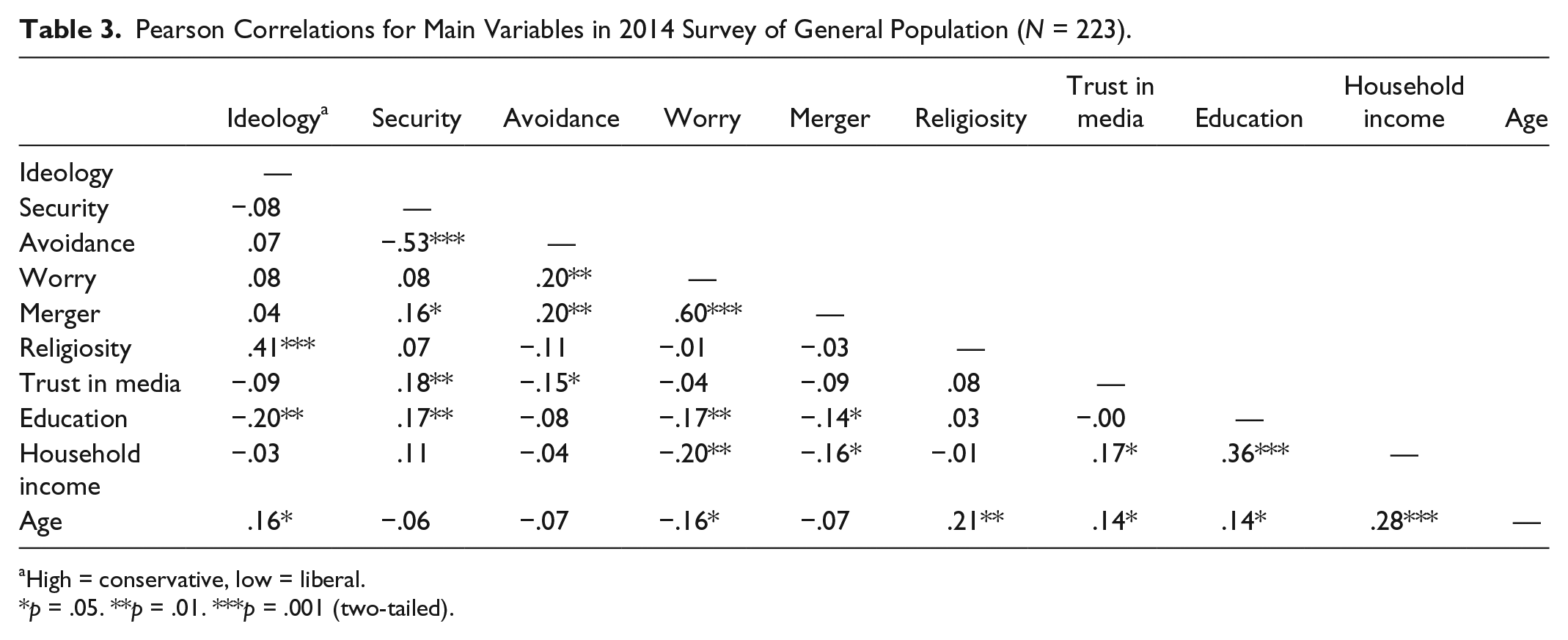
High = conservative, low = liberal.
p = .05. **p = .01. ***p = .001 (two-tailed).
Pearson Correlations for Main Variables in 2014 Survey of Conservatives (N = 202).

High = conservative, low = liberal.
p = .10. *p = .05. **p = .01. ***p = .001 (two-tailed).
Figure 3 illustrates the results of the path analysis in the population at large in 2014, including the same variables as in Figure 2, except for government trust. It had an adequate model fit with χ2 = 10.432, df = 12 (36 distinct sample moments, 24 distinct parameters), p = .578, n = 223, CMIN/df = .869, CFI = 1.000, TLI = 1.027, RMSEA = .001. Although the standardized direct effect of security on ideology was –.024, the standardized indirect effect was –.065 for a total standardized effect of –.089. Despite being small and not significant, the direction of relationship mirrored that in the 2013 sample, that is, that security was related to liberalism.
Gender directly affected ideology in a significant negative pattern, indicating that men were more conservative than women. This result was not observed in Figure 2.
The patterns of the relationships of media trust, religiosity, age, and education to ideology were similar to those in Study 1. Media trust was negatively related to conservative ideology, β = –.11 (but only p < .10), and religiosity was positively correlated with conservative ideology, β = .41 (p < .001). The direct effect of security of attachment on income was similarly positive and significant, β = .13 (p < .05). Security also directly affected education (β = .18, p < .01). Age affected ideology as in Study 1, but only at p < .10.
Figure 4 depicts the results for the conservative sample. The model achieved a satisfactory fit to the hypothesized model with χ2 = 6.758, df = 8 (21 distinct sample moments, 13 distinct parameters), p = .563, N = 202, CMIN/df = .845, CFI = 1.000, TLI = 1.08, and RMSEA = .001.
Here, secure style of attachment was directly, positively, and significantly related to ideology (β = .14, p < .05), with no indirect effect. The direction of this relationship was opposite of that found in Figures 2 and 3. Security maintained the positive direction of effect on household income, however, β = .18 (p < .01), consistent with results in Figures 2 and 3, but it had no direct effect on education as it had in Figure 3 for the 2014 general population sample. Women tended more than men to have faith in fairness of media reporting, a pattern that did not occur in the other two samples. The conservative sample differed from the general population sample in 2014 in the lack of relationships between security and media trust or between gender and ideology. It was like the other two samples in the relation of low media trust and high religiousness to conservatism.
Limitations
The Internet samples were of significantly higher SES and differed somewhat in age from census data from the 2013 American Community Survey. The 2013 and 2014 general population samples underrepresented men, and the 2014 conservative sample overrepresented men. Both of the general population samples in 2013 and 2014 were significantly more liberal than the 2012 ANES, although a third sample of conservatives was drawn for balance. These differences weaken the ability of this study to generalize to the population at large. Ideally, the research should be repeated with larger, more representative samples. Because the present research and the four previous reports on college students’ ideology and attachment have been with samples in the United States, such work should be carried out in other parts of the globe among different kinds of populations.
In addition, ideology in the present research was measured as self-placement on a single 7-point self-report item. Although numerous polls and surveys have found this type of measure to be reliable and valid, other measures of liberalism and conservatism could be used for a more multidimensional examination of ideology. In 2014, results for ideology were compared with a measure of ideological consistency known to be a valid and reliable indicator of political philosophy over time (Pew Research Center, 2014), increasing confidence that the self-placement question is a justifiable gauge of political orientation. Interest in news of government and public affairs was not a predictor, but it may have been too general. Interest levels tended to be similarly high among liberals and conservatives and lagged among independents. The relation of ideology and interest in specific politically contested public affairs and science issues could be investigated further.
Not including government trust in the 2014 studies can be criticized as this variable was useful in the 2013 research. It could be included in future work.
Discussion and Conclusion
Political polarization is of increasing concern in the United States because it has intensified since the 1970s. The present research concerned adult relational attachment style as a potential contributor to ideological divisions. Only a few studies have examined this, primarily in college student samples, and their results differ. The present research contributes to the literature because it is the first one to focus on the relationship of adult attachment to ideology in general population samples. The main findings are as follows.
Study 1: General Population Sample
Liberals scored significantly higher than conservatives in secure attachment relational style. Secure attachment was significantly related to trust in media reporting and also to having higher household incomes. As would be expected, conservatives were significantly more likely than liberals to be religious and to distrust both government and mass media. Other significant predictors of conservatism were being older and less educated but possessing higher household incomes. Religiosity and media trust were uncorrelated. Gender, conceptualized as an independent variable, made no difference in ideology and was associated significantly only with household income, meaning that men had higher incomes.
Study 2: General Population Sample
Secure attachment was unrelated to ideology, although the combined direct and indirect effects appeared similar to the result in Study 1. The other independent variable, gender, however, was significantly and negatively related to ideology, meaning that men were more conservative than women. Gender had no effects on other variables. Security was positively and significantly associated with education and incomes. Conservatism was linked to lower trust in media but only at p < .10. It was strongly related to religiosity, as well as to lower education. There was a positive association with age, only at p < .10. Again, religiosity and media trust were unrelated.
Study 2: Conservative Sample
Secure attachment style was a significant and positive predictor of conservatism, contrary to the positive relationship in Study 1 and the lack of significant relationship in the Study 2 general population sample. As in Study 1 and Study 2 general population groups, security and household incomes were positively and significantly correlated. Consistent with the other two sample results, being religious was highly related to conservatism. Also congruent with the other two groups’ results, media trust was not connected to being religious. Lack of trust in media fairness of reporting and being religious independently had significant direct impacts on ideology. Neither education nor income had an effect on political ideology. Gender had a positive, significant effect on media trust, meaning that women were more trusting of media, and it was negatively linked to household incomes, meaning that men’s incomes were higher.
Security and ideology
Although most findings were relatively consistent in the three samples, the relationships of secure attachment style and ideology clearly were different in each one. Results for the previous studies of college student samples were mixed, also. These results, taken together, demonstrate that both liberals and conservatives can have secure attachments.
Security and SES
Security was consistently positively and significantly linked to household income in all three samples, and security positively and directly affected education in the 2014 sample of the general public. All the previous studies of college students and the present study concerned primarily more advantaged social groups. Perhaps greater SES promotes more secure attachments, regardless of political leanings.
Ideology and SES
Household income was significantly and positively connected to ideology only in 2013, but education was negatively and significantly related to ideology in both the general population samples. The finding of lower education directly influencing conservatism is consistent with other research that has reported lower education characterizing conservatives (Adorno, Frenkel-Brunswik, Levinson, & Sanford, 1950; Hindman & Yan, 2015; McCutcheon, 1985; Stone, Lederer, & Christie, 1993/2011; Stubager, 2008). It is not unusual to find that conservatives, especially if better educated, have higher household incomes than well-educated liberals, even though conservatives tend to be less well educated overall (Diercks & Landreville, 2017; Gaziano, 2014; Hindman & Yan, 2015). Well-educated liberals tended to be younger and in earlier stages of the life cycle than well-educated conservatives in Gaziano (2014). Better educated liberals were more likely than better educated conservatives to have advanced degrees.
Future Research
At least four areas of future study come to mind. These include analyses of adult attachment relational style in lower SES groups, attachment style and types of information environments, the relationship of attachment style and further elaboration of the models of nurturant parent and strict parent families, and examination of attachment styles in groups with extreme political attitudes. As most of the research so far has been done in the United States, research should be carried out in other countries, as well. Although the models did well enough in this study, they could be refined further and new concepts tested.
First, the results suggest that future research should emphasize the relationship of ideology to attachment in population segments with lower education and incomes. While the current project found security to be more relevant to ideological orientation than avoidance or anxiety, future researchers should concentrate more on forms of insecure attachment in lower SES groups with regard to a range of social and economic issues. The 2016 U.S. election points up the need to better understand the needs and concerns of White working class population segments, as well as other lower and working class ethnic and racial segments. For White working class groups, declining economic and job opportunities was a primary element in their vote decisions (Wan, 2017). Related elements were rising rates of mortality and morbidity among these groups (Achenbach & Keating, 2017; Case & Deaton, 2017). They also were more likely than higher SES groups to feel like strangers in their own country (Cox, Lienesch, & Jones, 2017). In general, voters of various SES groups who supported Donald J. Trump for president tended to support racist attitudes (Wood, 2017), to accept false information and untruths that support one’s views (Sykes, 2017), and to defend vulgarity, crude behavior, and bullying (Martin, 2017). The social conditions that foster such beliefs and attitudes could be delved into with an eye to addressing solutions to these issues.
Factors that promote less secure attachment styles among lower SES groups may help to explain attitudes and beliefs in these groups. Complicating factors in the links between lower SES and insecure attachment is that lower SES families are vulnerable to multiple stresses of poverty, such as poorer health, lack of stable employment, teen parent and/or single-parent status, and living in more crowded conditions, which can drain parents physically and emotionally and consequently constrain their ability to parent as well as they would wish (Bakermans-Kranenburg, van IJzendoorn, & Bradley, 2005; Bavolek, 2001; Conger, Patterson, & Ge, 1995; Hackman, Farah, & Meaney, 2010; Lynch, Kaplan, & Shema, 1997).
Second, security of attachment style and types of information channels may yield insights into the consequences of fragmented media environments and insular discussion networks as political polarization increases. These processes may have implications for knowledge and belief gaps, flows of inaccurate information, and tolerance of differing viewpoints (Duca & Saving, 2017; Garrett, Weeks, & Neo, 2016). Numbers and types of information networks can be explored. Researchers have revealed sociological fault lines in the dissemination of information in mainstream and partisan news sources and ideological blogs (Eveland & Dylko, 2007; Hindman & Yan, 2015; Jamieson & Cappella, 2009). Fragmentation can lead to decreased understanding of conflicting views and diminished tolerance for diversity, particularly among more partisan groups who may be among the easiest to mobilize to support political candidates for office (Baum & Groeling, 2008; Dilliplane, 2011; Iyengar & Hahn, 2009; Shapiro & Bloch-Elkon, 2008; Tewksbury, 2005).
Third, attachment styles could be studied further within the framework of nurturant parent and strict parent families, and further insights could be gained by refining the conceptualization of liberals as coming from nurturant parent families versus conservatives as coming from strict parent families (Barker & Tinnick, 2006; Feldman & Stenner, 1997; Lakoff, 2002). These conceptualizations currently may be too simplistic. One avenue for future research in adults is retrospective recall of perceived parenting styles or longitudinal studies from childhood or adolescence through adulthood. One approach could be contrasting parental demandingness, or control, with parental responsiveness, or warmth (see, for example, Baumrind, 1971, 1996; Maccoby & Martin, 1983; Murray & Mulvaney, 2012). Other insights could be gained from comparing family communication patterns and attachment (Gaziano, 2001).
Fourth, attachment and extreme ideologies should be studied more. An interesting example is that of Roccato and Ricolfi (2005), who examined six nonstudent right-wing and left-wing political militant groups in Turin and Palermo, Italy. While avoidantly attached participants were far less religious than securely attached participants in the present study, the Italian study described one group of activists who were the most overtly antidemocratic, right-wing, and avoidant in attachment style, yet who were also among the most religious of the militants. This suggests that additional insights into attachment and ideology may be gained by studying politically active groups of different types.
Footnotes
Appendix
Descriptive Statistics.
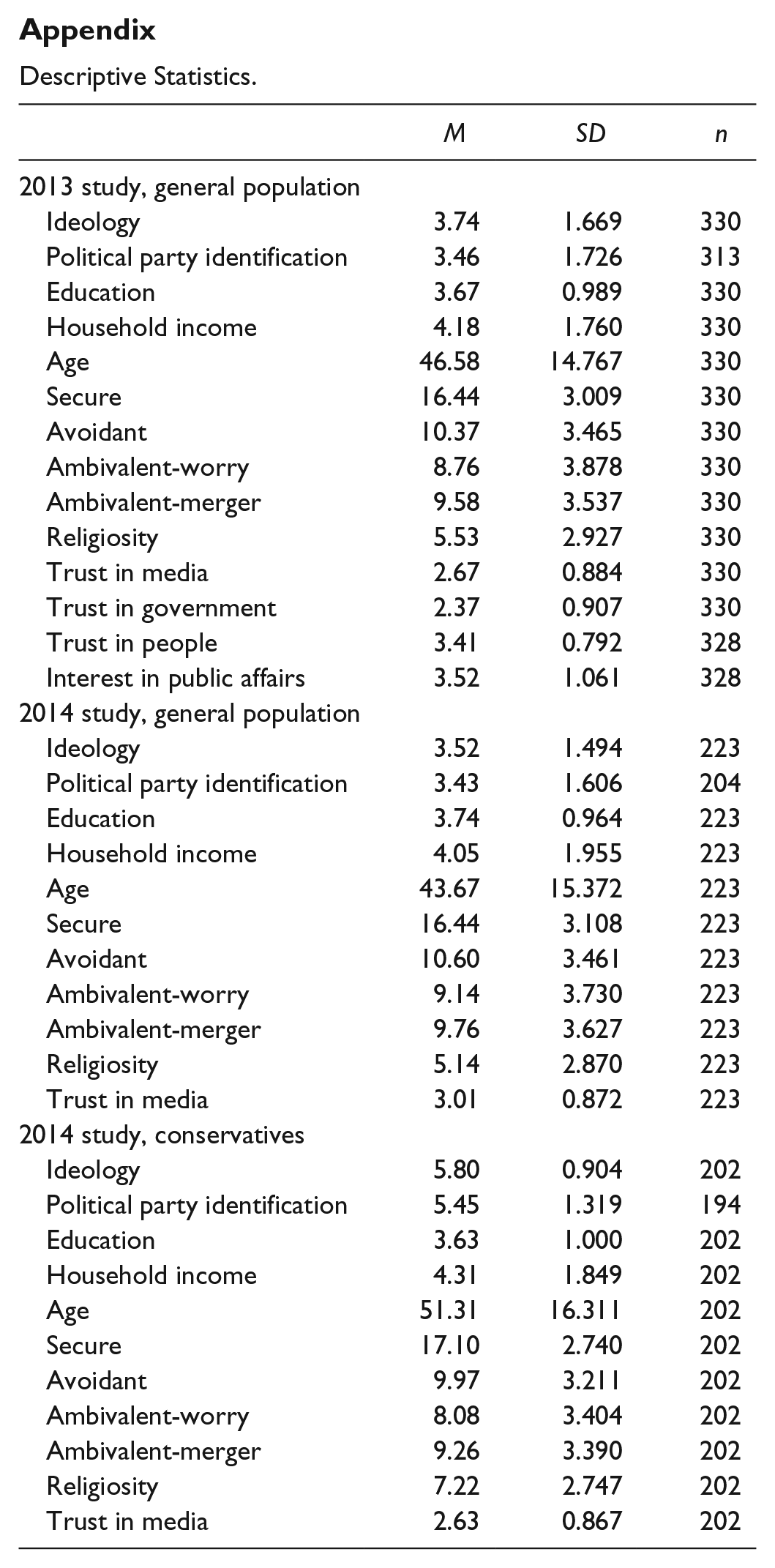
| M | SD | n | |
|---|---|---|---|
| 2013 study, general population | |||
| Ideology | 3.74 | 1.669 | 330 |
| Political party identification | 3.46 | 1.726 | 313 |
| Education | 3.67 | 0.989 | 330 |
| Household income | 4.18 | 1.760 | 330 |
| Age | 46.58 | 14.767 | 330 |
| Secure | 16.44 | 3.009 | 330 |
| Avoidant | 10.37 | 3.465 | 330 |
| Ambivalent-worry | 8.76 | 3.878 | 330 |
| Ambivalent-merger | 9.58 | 3.537 | 330 |
| Religiosity | 5.53 | 2.927 | 330 |
| Trust in media | 2.67 | 0.884 | 330 |
| Trust in government | 2.37 | 0.907 | 330 |
| Trust in people | 3.41 | 0.792 | 328 |
| Interest in public affairs | 3.52 | 1.061 | 328 |
| 2014 study, general population | |||
| Ideology | 3.52 | 1.494 | 223 |
| Political party identification | 3.43 | 1.606 | 204 |
| Education | 3.74 | 0.964 | 223 |
| Household income | 4.05 | 1.955 | 223 |
| Age | 43.67 | 15.372 | 223 |
| Secure | 16.44 | 3.108 | 223 |
| Avoidant | 10.60 | 3.461 | 223 |
| Ambivalent-worry | 9.14 | 3.730 | 223 |
| Ambivalent-merger | 9.76 | 3.627 | 223 |
| Religiosity | 5.14 | 2.870 | 223 |
| Trust in media | 3.01 | 0.872 | 223 |
| 2014 study, conservatives | |||
| Ideology | 5.80 | 0.904 | 202 |
| Political party identification | 5.45 | 1.319 | 194 |
| Education | 3.63 | 1.000 | 202 |
| Household income | 4.31 | 1.849 | 202 |
| Age | 51.31 | 16.311 | 202 |
| Secure | 17.10 | 2.740 | 202 |
| Avoidant | 9.97 | 3.211 | 202 |
| Ambivalent-worry | 8.08 | 3.404 | 202 |
| Ambivalent-merger | 9.26 | 3.390 | 202 |
| Religiosity | 7.22 | 2.747 | 202 |
| Trust in media | 2.63 | 0.867 | 202 |
Declaration of Conflicting Interests
The author(s) declared no potential conflicts of interest with respect to the research, authorship, and/or publication of this article.
Funding
The author(s) received no financial support for the research, authorship, and/or publication of this article.