




Abstract
This study sought to investigate whether there are differences among EFL instructors of various intelligence types in terms of the types of activities that they implement in their classes. It also sought to investigate teachers’ perceptions about the theory of multiple intelligences. To this end, 30 male and female EFL instructors teaching the same textbook with the same method of teaching participated in the present study. To gather the data, three successive sessions of each class were observed and the class activities were recorded through an observation schedule. Semistructured interviews were also carried out to explore the teachers’ perceptions of multiple intelligences. And finally, teachers’ dominant type of intelligence was determined by Multiple Intelligences Checklist. The results of one-way ANOVA and post hoc test revealed that only teachers of logical-mathematical type were influenced by their dominant intelligence type and other intelligence types did not exert a significant influence on the types of activities being implemented in the classes. The results of this study can be a fillip at least for teachers with logical-mathematical intelligence to be careful about their dominant intelligence type, not allowing it to affect their teaching and to compel them to use activities in line with their dominant intelligence.
Introduction
Intelligence, which is known as a key factor in learning and academic outcomes, was first considered as a single entity with which one is born and that cannot be changed. This view about intelligence can be seen, for example, in IQ (Intelligence Quotient) theory in which intelligence determines “people’s ability to learn, to achieve academically and therefore to take on leading roles in society” (Muijs & Reynolds, 2011, p. 16). It was Howard Gardner (1983) who proposed a new understanding of the construct of multiple intelligences (MI) in his book, Frames of Mind. Gardner proposed that each person has different capabilities and tendencies in different areas and that each individual has several types of intelligences that are intermingled in different ways (Gardner, 1983). According to Macleod (2002), the model proposed by Gardner pluralized the concept of intelligence because it considered several different kinds of intelligence.
Gardner’s innovative proposal had strong effects on various fields including education and in particular language learning. Today, teachers are expected to provide MI-inspired instruction (Gunst, 2004; Koksal & Yel, 2007; Ozdemir, Guneysu, & Tekkaya, 2006), which means a type of instruction that taps all intelligence types. On the contrary, what teachers bring to the teaching-learning process is an important question to be explored, and English as a Foreign Language (EFL) teachers are themselves human beings who may be more developed in some of the intelligences and less developed in others. Moreover, the fact that they are stronger in one specific intelligence may lead them to use exercises and activities that tap that specific intelligence because of their strength in that intelligence. Gunst (2004) who conducted a research on Catholic elementary school also stated,
Teachers tend to use teaching strategies that are aligned with their self-reported multiple intelligence. However, teachers need to be able to move beyond their strongest intelligence and incorporate several approaches in classrooms where students have varying abilities, interests, and aptitudes. (p. 189)
For a teacher to stimulate intellectual competences in her or his students, it is significant to provide activities that encompass all types of intelligence. As Yalmanci and Gozum (2013) stated, Gardner’s MI theory has two important advantages in education. First, it paves the ways for planning the education program in a way that students realize their potentials and move toward their desires. Second, it makes it possible for us to reach students who are more active because learning would be more attractive in a condition that learners are trained through the use of these intelligences. This happens when the teacher’s lesson plan includes a variety of activities that are related to various types of intelligences (Carlin, Salazar, & Cortes, 2013). Therefore, it is important to reveal to what extent a teacher’s own preferences, for example, her or his dominant type of intelligence is interfering with the fact that they should use MI-inspired instruction. On the contrary, EFL teachers’ degree of awareness of the MI theory should also be identified. If the teacher considers these types of intelligence and arranges classroom activities and daily plans according to them, some problems about learning such as inattentiveness, unwanted behaviors, alienation of a lesson, and perception of lack of success may disappear (Yenice & Aktamis, 2010).
The present study investigated the differences among EFL instructors of various intelligence types in terms of the types of the activities/techniques that they implement in the classes; that is, it was to be explored whether or not teachers selected the activities that they were better in. Therefore, this study aimed at discovering one of the possible causes that may prevent teachers from providing MI-inspired instruction in their language classes. What is considered here is the techniques used by teachers which are defined by Brown (2001) as “any of wide exercises, activities, or tasks used in the language classroom” (p. 16). These activities are used to realize lesson objectives. Teachers’ perceptions of the MI theory are also investigated in this study.
Literature Review
This part reviews the studies on MI-inspired instruction in learning and especially in foreign language learning, thus, highlighting the role of MI theory in education. The literature on teachers’ perceptions about the MI theory and the relationship between their MI and their classroom practices is also reviewed.
Educational Implications of the MI Theory
As one of the popular theories of intelligence, Gardner’s theory which suggests several distinct forms of intelligence (logical-mathematical intelligence, visual-spatial intelligence, verbal-linguistic intelligence, musical-rhythmic intelligence, bodily-kinesthetic intelligence, interpersonal intelligence, intrapersonal intelligence, and naturalist intelligence) has led to a mode of instruction, that is, MI-inspired instruction for which many studies have been done to prove its effectiveness in education. Many researches have shown its positive effectiveness on instruction and its superiority over traditional teaching, especially in terms of students’ achievement (Hanafin, 2014; Kaya, Doğan, Gökçek, Kılıç, & Kılıç, 2007; Xie & Lin, 2009; Yalmanci & Gozum, 2013).
For example, Yalmanci and Gozum (2013) explored the effects of MI teaching approach on students’ degree of achievement and their knowledge retention. For this study, two groups of science students were formed as the experimental and control groups, and MI-instruction was implemented for the experimental group. Although no significant difference was found between the two groups in the pretest results, concerning their information level about the subject under investigation, after the experiment, there was a significant difference between the groups in favor of the students who received MI-inspired instruction. Thus, the researchers concluded that the MI theory is effective in learning. Furthermore, a retention test was administered after three weeks from the research date and it was found that students from the experimental group could remember the information significantly better than those from the control group, and this led to the conclusion that MI-inspired instruction also has positive effects on the retention of information.
There have also been specific studies in the area of English language teaching to prove the effectiveness of the integration of MI theory into language classes (Abdi & Rostami, 2012; Ghamrawi, 2014; Pourmohammadi, Zainol Abidin, & Yang Ahmad, 2012; Saeidipour & Taheri Otaghsara, 2014; Tahriri & Yamini, 2010).
As an example, Ghamrawi (2014) examined teacher’s application of MI theory into their classes and its relationship with students’ vocabulary acquisition during English as a Second Language (ESL) classes in Lebanon. Observation, teacher surveys, and students’ interviews were used to obtain the data. One of the findings showed that the participants learned new vocabulary faster through the use of traditional methods of teaching, but their vocabulary retention was significantly weaker than that of the MI-inspired classes. The study emphasized the significance of using MI in ESL classes, especially in the instruction and learning of vocabulary items.
In Iranian EFL context, Tahriri and Yamini (2010) carried out a quasi-experimental study on a group of 10 intermediate female students. The participants’ MI profiles and their level of proficiency in English were determined at the beginning of the study. The participants received MI-poor instruction during the control phase and MI-inspired instruction during the experimental phase. The results showed a significantly better performance after the experimental phase, which showed at least partial effectiveness of using MI-inspired instruction.
Studies on Teachers’ MI
Gunst (2004) was among the first researchers who looked at the MI theory by investigating teachers’ MI. He believed that “teachers are expected to provide instruction to a myriad of students who have different interests, strength, and needs” (p. 9). He condemned the extra value given to verbal-linguistic and logical-mathematical intelligence at schools, and asserted that teachers can ensure success for most students by admitting the existence of various types of intelligence and designing activities to develop all types of intelligence. He carried out a nonexperimental, descriptive research to discover the relationship between teachers’ strongest type of intelligence and teaching strategies they use in their classrooms. Using a representative sample, the researcher used three instruments to collect the data: Intelligence Survey, Teaching Strategies to measure different aspects of MI, and a demographic survey to collect information on the personal and professional characteristics of the teachers. In this study, according to the results, the majority of teachers (81.4%) reported that they made use of the MI theory in their classrooms. Moreover, they had the tendency to employ strategies in the classroom that corresponded to their self-reported intelligence. In the research conducted by Serin, Serin, Yavuz, and Muhammedzade (2009), the same results were obtained about the relationship between instructors’ MI and their teaching strategies.
Ghamrawi (2014), who examined the application of the MI theory in classes and its effect on students’ vocabulary acquisition, also checked the relationship between the MI profile of teachers and the type of intelligences they more frequently address in their classes. The research was conducted in an ESL context. Eight teachers with at least 11 years of experience participated in the study. The data were gathered through observation and surveying. The classes were videotaped while the researcher attended all classrooms during videotaping. Therefore, this research compared with researches described earlier (Gunst, 2004; Serin et al., 2009) took an important step toward more reliable results by using observation as a technique. According to the results,
Teachers showed a tendency to address the intelligences that were their personal predominant intelligences. Thus, these findings suggest that there is an important relationship between the teaching style of teachers who use MI theory and their personal MI profiles when freedom of choice of teaching activities is left up to them. (pp. 39-40)
On the other hand, the researcher emphasized that with the size of sample in this study (only eight teachers), further research should be done with more teachers to support this finding. “However, these findings suggest that teachers should be aware of the influence of their personal MI profile and their possible inclination to resort to this during their teaching” (p. 40).
One research in the area of teachers’ perceptions of the MI theory was conducted by Savas in 2012. The results showed that almost all teachers who participated in the study (97%) perceived all intelligence types as helpful and significant in the process of foreign language learning. The participants also believed that only verbal-linguistic intelligence could not help language learners to be successful. During the action research project done by Hanafin (2014), similar results were found about teachers’ perceptions of the MI theory. Teachers in this study considered the project a challenge. In their view, the experiment was worthwhile and could trigger drastic changes in their professional practice and thinking.
In a similar study, Kumlu and Yurttas (2012) investigated science and technology teachers’ perceptions about the MI theory and considering it in project and performance tasks. Unlike the results from other studies, the teachers in this study did not have enough information about the theory and they did not consider it in their instruction. Moreover, they thought it would cause them some problems if they consider students’ intelligences, such as shortage of time.
Research Questions and Hypothesis
The research that has so far been done on the relationship between EFL teachers’ intelligence types and their class activities in an EFL context like Iran is not sufficient. This study tries to address the gap to see if teachers’ MI can act as a barrier in the implementation of MI-inspired instruction. It also checks EFL teachers’ perceptions of the MI theory as an important aspect in teachers’ practice. Thus, it finds the answers to these questions:
In line with the first research question, the following null hypothesis was tested:
Method
This study utilized a mixed-methods design to gather both quantitative and qualitative data. To this end, both surveys and observation were employed to gather the data. Teachers’ intelligence types and their classroom practice were the independent variables that were explored in this study. The context of the study (English language institutes) and the coursebook used in the classes were the control variables.
Participants
Based on convenience sampling, the participants of this study were selected. The participants were 30 Iranian female and male EFL teachers who were teaching English in private language institutes and used the same textbook in their classes. There were 26 (87%) female and four (13%) male EFL teachers in the study. The age range of most of the teachers was between 25 and 29 with the mean age of 28.17. Most of the teachers (about 47%) who participated in the study had 1 to 3 years of experience in the field. More experienced teachers were fewer in the sample. Concerning the educational level of these teachers, 19 teachers had bachelor’s degree and 10 teachers had master’s degree. One of the participants did not belong to these two groups.
The textbook that was used was American English File, which according to the existing literature pays a more balanced attention to various intelligence types (Oliveira, 2009). The teachers were expected to use communicative language teaching (CLT) in their language classes based on the requirements of the textbook and the institutes under study.
Instrumentation
The data needed for this study were gathered through three different instruments (Dolati, Tahriri, & Danaye Tous, 2016): structured observation, oral interview, and an intelligence survey.
Structured observation
Nonparticipant structured observation was utilized in this study. The participants’ classes were observed for three successive sessions and the activities that the EFL teachers used in their instruction were documented. The classes were also recorded. Each unit of the textbook used in these classes was covered approximately in three successive sessions. On the contrary, each unit contained the same set of activities. Therefore, observing three successive sessions would give a balanced view of the activities covered by the textbook in the classes which were observed. An observational schedule or observation scheme was also prepared to trace the participants’ classroom practice (see Appendix A). For the observation, event sampling was used to come up with an accurate description of the overall frequency of the observed events. The activities that were included in the observation form were taken from and categorized according to various sources based on Gardner’s definitions of various types of intelligences (Beare, n. d.; Budden, 2005; Dueñas Macías, 2013; Heming, 2008; Kartiah, Rahman, Rahman, & Jabu, 2014; Larsen-Freeman & Anderson, 2011; Lunenburg & Lunenburg, 2014; Oliveira, 2009; Palmberg, 2011; Solmundardottir, 2008; Yeh, 2014). For example, logical-mathematical intelligence is defined as the ability that deals with effective use of numbers, seeing abstract patterns, and reasoning well. Thus, techniques such as logic puzzle, calculation and quantification, and matching activities were categorized under logical-mathematical activities. To check the interrater reliability, the recordings were transcribed and the transcriptions were handed to a second rater to fill in the MI observation form. The forms filled in by the first and second rater were compared and interrater reliability was ensured. Furthermore, to check intrarater reliability, the first rater completed the form for the second time, using the transcriptions after one month. The forms filled in by the first rater were compared; as a result, intrarater reliability was ensured as well.
Oral interview
The participating EFL teachers were interviewed to obtain information about their perceptions of MI. There were semistructured interviews; that is, an interview guide was developed and used (see Appendix B). The researchers reviewed the interview guides of similar studies (Botelho, 2003; Ghamrawi, 2014; Gunst, 2004; Heming, 2008; Macleod, 2002; Madkour, 2009), and devised the interview guide based on the literature and in accordance with the research questions. Finally, two experts in the field checked the interview guide to see whether it was consistent, complete, and appropriate. There was a list of questions and topics that needed to be covered during the interviews and in particular order. The interviewer followed the guide, but deviations were acceptable when they were appropriate. The interview guide consisted of two sections. The first section contained questions related to teachers’ age, gender, educational level, and experience. The other section was devoted to some questions directly related to the study, that is, the teachers’ perceptions of the MI theory.
MI Checklist
Finally, the dominant type of intelligence among the teachers being studied was determined by an intelligence survey. MI Checklist by Thomas Armstrong (1993) was used to this end. The checklist contains 80 statements. The participants had to check any items that applied to them and they could check as many items that seemed to be relevant. Next, the numbers that were checked by the participants on the checklist had to be circled on MI tally sheet that was provided. The circles in each column were counted and the column with the highest number showed the strongest type of intelligence. This survey was piloted first to ensure it was appropriate, reliable, and valid. It was given to 15 EFL teachers with almost the same characteristics as the final participants in the study. Their dominant types of intelligences were determined through the first administration. After 2 weeks, the checklist was administered for the second time. The results of the first and second administrations were compared with each other. The first dominant intelligence changed only in two cases (13%) over the two administrations. It means only two teachers out of 15 teachers marked the checklist in a way that changed what was established as their dominant intelligence type by the first administration of the MI checklist. However, most changes happened in the second and third intelligences, which were, in fact, due to two or three items left unmarked or additionally marked in the second administration. In other words, the order of strength in intelligences changed in some cases, but it did not affect the most dominant intelligence type, except for the two teachers.
Procedure
To gather the data required to answer the research questions, three successive sessions of 30 English classes were observed based on an event sampling procedure (see Dolati et al., 2016). Overall, 90 sessions were observed in this study. The activities that were implemented in the classes were jotted down and recorded based on the observational schedule in a way that each activity fitted one type of intelligence. The class recordings were transcribed later and interrater and intrarater reliability were ensured. Then, the teachers who expressed their familiarity with the MI theory were interviewed to explore their opinions about the theory. The interviews were carried out according to an interview guide and pre-specified questions, but they were redirected whenever necessary. Finally, MI Checklist (Armstrong, 1993) was distributed among the EFL teachers who were the intended participants of this study (Dolati et al., 2016). After the data were gathered, they were subjected to the relevant analysis.
Data Analysis
After collecting the data, teachers’ strongest type of intelligence was determined according to the instructions of MI Checklist. Based on the observational schedule, the frequencies of specific events, that is, the activities that were used by the participants in the classroom were computed. Descriptive statistics were run to describe the collected data. To analyze the data gathered through observation, each occurrence of a class activity was considered as a unit. These units were added up to calculate the extent of activities that were implemented in classes and were attributed to each intelligence type. A set of one-way ANOVAs were run using SPSS (version 23) to find out the possible differences among the participants in terms of the activities that were used in English classes. The data gathered from the interviews were also analyzed qualitatively.
Results
Teachers’ Dominant Intelligence Type and Their Classroom Activities
The participants were classified according to their dominant intelligence type (see Table 1):
Frequency and Percentage of the Participants With Respect to Their Dominant Intelligence Type.
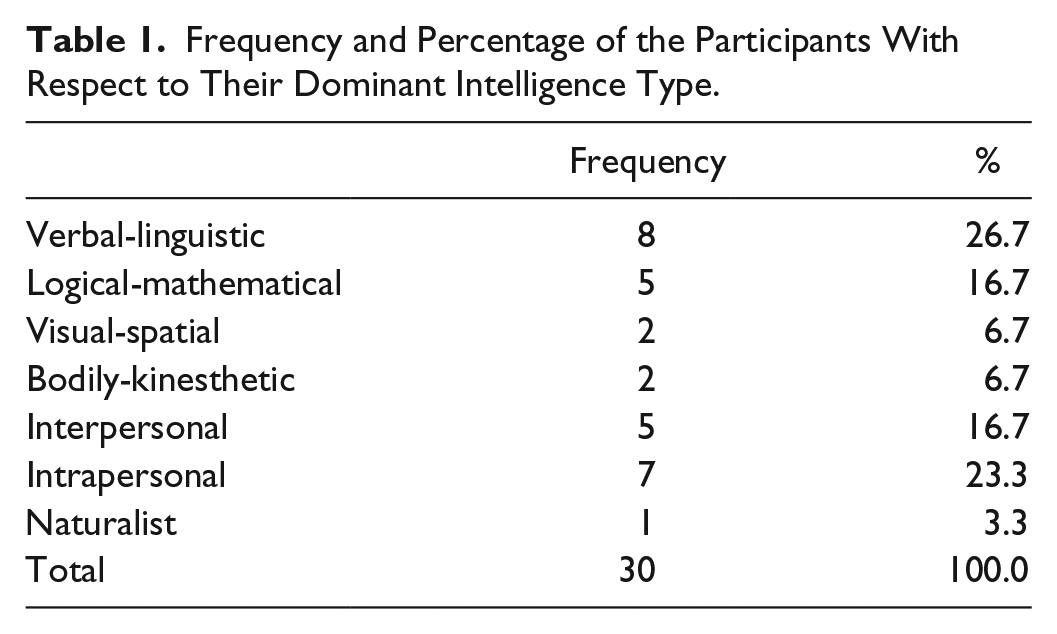
The activities of the same category (e.g., verbal-linguistic activities) implemented by teachers with the same dominant intelligence type were added up to compute the total frequency of these activities and then divided by the number of teachers of that specific intelligence type to come up with the average frequencies (see Table 2).
Statistics for the Type of Dominant Intelligence and Activities Implemented by the Instructors.

Tests of Homogeneity of Variances
The data were first analyzed in terms of the homogeneity of variances (see Table 3):
Homogeneity of Variances.

As Table 3 shows, based on Levene’s test statistics, the p values were not statistically significant (p > .05). As such, the sample could be argued to be homogenous.
The Results of ANOVA Tests
To provide an answer to the first research question, statistics were computed for every type of intelligence and the differences among EFL instructors of various intelligence types in terms of the specific activities implemented by the instructors was examined through running one-way ANOVA. The results are given below:
As Table 4 shows, the differences among the EFL instructors in terms of the implementation of verbal-linguistic activities are not statistically significant, F(6, 23) = 1.132, p = .375.
ANOVA: Verbal-Linguistic Activities.

As Table 5 shows, the differences among the EFL instructors in terms of the implementation of visual-spatial activities are not statistically significant, F(6, 23) = 0.884, p = .522.
ANOVA: Visual-Spatial Activities.

As Table 6 shows, the differences among the EFL instructors in terms of the implementation of musical-rhythmic activities are statistically significant, F(6, 23) = 5.518, p = .001. As Table 6 shows, p value (p = .001) is less than .05 and it is statistically significant.
ANOVA: Logical-Mathematical Activities.

As Table 7 shows, the differences among the EFL instructors in terms of the implementation of musical-rhythmic activities are not statistically significant, F(6, 23) = 0.771, p = .601.
ANOVA: Musical-Rhythmic Activities.

As Table 8 shows, the differences among the EFL instructors in terms of the implementation of interpersonal activities are not statistically significant, F(6, 23) = 0.764, p = .606.
ANOVA: Interpersonal Activities.

As Table 9 shows, the differences among the EFL instructors in terms of the implementation of naturalist activities are not statistically significant, F(6, 23) = 0.460, p = .830.
ANOVA: Naturalist Activities.

As Table 10 shows, the differences among the EFL instructors in terms of the implementation of intrapersonal activities are not statistically significant, F(6, 23) = 0.683, p = .665.
ANOVA: Intrapersonal Activities.

As Table 11 shows, the differences among the EFL instructors in terms of the implementation of bodily-kinesthetic activities are not statistically significant, F(6, 23) = 1.634, p = .183.
ANOVA: Bodily-Kinesthetic Activities.

Considering the statistically significant difference among teachers of various intelligence types in terms of logical-mathematical activities, Tukey Honestly Significant Difference (HSD) post hoc test was run to determine which groups were different. To run the test, the data related to the teacher with naturalist intelligence was excluded because there was only one teacher with this intelligence type and it impeded running the test (see Table 12).
Multiple Comparisons: Dependent Variable—Logical-Mathematical Activities (Tukey HSD).

Note. CI = confidence interval; HSD = honestly significant difference.
The mean difference is significant at the .05 level.
In Table 12, the teachers of various intelligence types are compared with each other in terms of logical-mathematical activities. When the p value is lower than .05 (level of significance), there is a statistically significant difference between the two intelligence types being compared with each other. As shown in the table, the differences between logical-mathematical intelligence and all other intelligence types are statistically significant.
The Results of Oral Interview
In this study, first the participants were interviewed to obtain their personal information. Then, they were asked whether they were familiar with the MI theory or not. The teachers who declared their familiarity with the MI theory (n = 8) by answering to a Likert-type question (see Appendix B) were further interviewed to check their perception of the theory. If the teachers had no familiarity with the theory, the interviewer did not continue the interview as, to answer other questions, the teachers needed to know about the theory.
In defining the theory, most of these participants mentioned the different strengths and abilities in human beings which help them solve problems and progress in various domains and also realize the world through them. Most of the teachers in this group (n = 5) did not have any education at the university level about the MI theory. Other teachers (n = 3) only gained the general idea of MI theory in their teaching courses at the university. This may show that we need to pay more attention to the MI theory in teaching courses at universities.
Most of the participants held a positive view toward the MI theory. They declared that communication and interaction would be easier between teacher and students by knowing each individual’s type of intelligence. Students would enjoy the classes and this leads them to act satisfactorily in activities when these activities are designed to fit their intelligences. On the contrary, there were teachers who believed in general intelligence rather than the one defined by Gardner. These teachers believed that some students are faster in learning and some are slower, not depending upon the mode of instruction.
Concerning the application of the MI theory, about half of the teachers believed that it can be applied in classrooms but it needs more facilities, more time, and more energy. In this way, it can also be motivating. But the other half believed that it is not ideally applicable to language classes, and considered it as a gap between theory and practice.
The participants also enumerated the following items as barriers to practicing the MI theory in the classroom:
Lack of enough knowledge and practice
Lack of time and time management problems
Lack of training and motivation for teachers
Lack of facilities
Lack of support from the institutions
Few resources for MI activities
Lack of MI-based textbooks
Discussion
This study intended to find the possible differences among EFL instructors of various intelligence types in terms of the types of activities they use in their classrooms. The authors also tried to investigate EFL instructors’ perception of the MI theory. Thus, structured observations of teachers’ classes and teachers’ interviews were used to probe their activities and perceptions of the MI theory and MI Checklist was administered to determine their dominant intelligence type. The findings of the study showed that only teachers of logical-mathematical type were influenced by their dominant intelligence type and other intelligence types did not play a significant role in selecting the types of activities being implemented in classes. Teachers with logical-mathematical intelligence type implemented techniques such as logical sequential presentation, classification and categorization, grammar rules study, grammar practice, matching activities, and word order activities repeatedly and for longer periods of time compared with teachers having other intelligence types. For example, in a vocabulary exercise about verbs, Teacher X with logical-mathematical intelligence asked the students to match the verbs with pictures that showed their meaning. While in a similar situation, Teacher Y with verbal-linguistic intelligence asked students to check the meaning of the verbs in the dictionary, and Teacher Z with bodily-kinesthetic intelligence used pantomime to denote the meaning of the verbs.
Previous studies on teachers’ MI and its relationship with their classroom practices had general looks over the matter and thus found a general relationship between these two variables (Ghamrawi, 2014; Gunst, 2004; Serin et al., 2009). Although the present study has considered the interrelationship between intelligence types and activity types, only the relationship between logical-mathematical intelligence type and teachers’ activities is revealed to be significant. In this study, each intelligence type is compared by all eight types of activities one by one, which has not been considered in the previous studies. Some factors may be at work such as the few number of participants with some intelligence types such as visual-spatial, bodily-kinesthetic, and naturalist types or the fact that textbooks have few numbers of activities of certain intelligences like naturalist activities. An obvious fact is that as English language classes are observed, most of the class time and energy is devoted to verbal-linguistic activities.
Considering teachers’ perceptions about the MI theory, the findings of the present study are in line with those of Kumlu and Yurttas (2012) who investigated science and technology teachers’ perceptions about the MI theory and its use in project and performance tasks. The teachers who participated in this study did not have adequate information about the MI theory and did not make an attempt to implement it in their classes. Furthermore, they thought it would cause them some problems such as shortage of time. Having enough knowledge about the MI theory may not guarantee teachers’ success in bringing various activities in line with all intelligence types to the class. But it is an important factor in the process of MI-based teaching that should be considered. Approaching it from a different angle, we should bear in mind that it is not probable that teachers with no knowledge about MI bring activities to the class to tap all the intelligence types.
Conclusion
Accepting Gardner’s theories means a radical departure from the traditional educational systems. Diversified instruction can ensure that students with different intelligence profiles are given an opportunity to benefit from this variety. Furthermore, it helps EFL learners to learn the lessons more effectively through multiple modes of instruction (Dolati et al., 2016). This is what is meant by MI-inspired instruction for which many studies have been done to prove its effectiveness in education. As Sulaiman, Abdurahman, and Abdurahim (2010) asserted, “Multiple intelligences theory provides a platform and guidance to teachers to use integrated strategies and instructional activities to cater to the different needs of students in terms of intelligence profiles, learning styles and leaning preferences.” In addition, “the awareness of the different intelligences and the different teaching strategies can optimize learning motivation and enhance memory in accelerating the learning process” (p. 517).
This study sought to investigate EFL teachers’ perceptions of the MI theory and to explore whether EFL instructors significantly vary in terms of their implementation of the class activities. To put it in other words, the study looked for any obstacles created by teachers’ dominant intelligence type to achieving MI-based instruction because they prefer to use activities and strategies that correspond to their own dominant intelligence. The findings of the study revealed that the majority of the participants did not know about the MI theory and consequently did not try to implement it in their English classes. Furthermore, it was proved that teachers of logical-mathematical type had the tendency to use activities in line with their dominant type of intelligence.
This negligence about providing MI-based instruction may cause learners harm, as they will not be provided with modes of instruction in which they learn faster and better. Also, they will not gain the opportunity to nurture different intelligences. In addition, the results of this study can be a fillip at least for teachers with logical-mathematical intelligence to be careful about their dominant intelligence type while teaching and consider all types of intelligences. As for MI-based instruction, teaching activities should be designed to develop students’ different intelligences, improve their strengths, and rectify their weaknesses. To this end, teachers have to put aside their dominant intelligence, their interests, and preferences and integrate a variety of activities in their classrooms. They would better keep this point in mind that their bias toward specific intelligences might be boring and less fruitful. This study highlights the importance of paying further attention to the individual differences, providing more appropriate curricula, and more MI-inspired materials accordingly.
Suggestion for Further Research
Further research is required to shed light on the nature of the relationship between teachers’ MI and their classroom practice especially in EFL context. For example, the research can be done with more participants of a certain intelligence type to focus the research on that intelligence type and achieve results that are more reliable. To create a more trustable context to do the research, providing truly MI-inspired materials would also be helpful. Another suggestion for further research is to compare male and female or experienced and inexperienced instructors in terms of their tendency to do class activities in line with their dominant intelligence type.
Footnotes
Appendix A
Appendix B
Declaration of Conflicting Interests
The author(s) declared no potential conflicts of interest with respect to the research, authorship, and/or publication of this article.
Funding
The author(s) received no financial support for the research, authorship, and/or publication of this article.