




Abstract
Concepts, theories, and findings of race and racial identity development were reviewed and conceptualized into a single model based on principles of complexity and chaos. This article proposes race can be understood as a complex adaptive system and conceptualized as an attractor landscape. In this model, trajectories represent racial identity development or progression through an attractor landscape comprised of racial categories. Although this works well as a conceptual model, the modeling of racial identity development within an attractor landscape is affected by practical constraints related to data collection and many of the same limitations of existing racial identity development theories. The proposed model also creates additional challenges because of its interdisciplinary nature.
We expressly do not equate physical systems with psychological systems, nor do we derive psychological phenomena from physical phenomena. Instead we juxtapose the phenomenology of each, the patterns or events in the respective system behaviors. We stay close to the surface of the respective phenomena and draw analogies based on how physicists talk about . . . phenomena. With luck, the analogy can re-present or reconstitute the psychological phenomenon from a different and we hope useful point of view. To the scientist, the universality of physical laws makes the cosmos a marvelously simple place. By comparison, human nature—the psychologist’s domain—is infinitely more daunting.
Researchers have debated for centuries over the character, reality, and usefulness of race with the prevailing opinion that it is a social construct and not real in a biological sense (McChesney, 2015; Omi & Winant, 2015; Smedley & Smedley, 2005). Even though race is arguably not tangible or real, belief in the validity and utility of race has produced an extended and dynamic history of racial differentiation, identification, and discrimination (Duncan, 2000; Omi & Winant, 2015; Smedley & Smedley, 2005). As a result, “race essentializes and stereotypes people, their social statuses, their social behaviors, and their social ranking” (Smedley & Smedley, 2005, p. 22). However, with multiple indicators of racial progress, increased variation in racial self-identification, and the contradictions of living in an allegedly postracial world, how individuals think of themselves and others as racial beings is possibly in a more pronounced state of flux than ever before (Ikuenobe, 2013; Masuoka, 2011; Stevenson & Wolfers, 2012). Therefore, a modern examination of race and racial identity development requires frameworks and perspectives that can account for its dynamic and complex nature (Brittian, 2012; Dill & Zambrana, 2009). Over the past few decades, there has been a proliferation of such perspectives and frameworks. Among these perspectives are complexity, chaos, and systems theory. These frameworks have contributed to a more nuanced understanding of several different types of race-related phenomena including cross-cultural communication, culture, cultural identity, ethnic identity, racial segregation, divergent racial conditions and outcomes, and adolescent identity development (Brittian, 2012; Chao & Moon, 2005; Menendian & Watt, 2008; Remer, 2007; Schelling, 2006; Spencer, Dupree, & Hartmann, 1997; Torres Rivera, 2005; Thommen & Wettstein, 2010). This article proposes an attractor landscape based on principles of complexity and chaos can describe, explain, and unify divergent perspectives of race and racial identity development.
Understanding Complex Adaptive Systems, Attractor Landscapes, and Attractor Dynamics
Johnson (2009) defined complexity (science) as “the study of the phenomena which emerge from a collection of interacting objects” (pp. 3-4). Although this is a straightforward definition, it is more useful to identify the conditions of a complex system. Page (2011) identified three basic conditions for a system to be considered complex: diversity, interaction, and interdependence. Each of these conditions applies to racial phenomena. Diversity refers to differences within type, between types, or in reference to composition. Racial categorization is an example of typing. However, racial categorization, such as social categorization in general, is flawed because it is based on perspective and history, plagued by transcategorical movement, and the act of categorization itself affects the categories (Gillespie, Howarth, & Cornish, 2012). Race is also sometimes treated as a natural or master category, which gives it a supervenient quality or projects essence onto it (Miller & Perino, 2007; Omi & Winant, 2015; Wagner, Holtz, & Kashima, 2009). Interaction indicates entities or agents interact within a specific space or network (e.g., geographic location or shared computer network). Interdependence means actions taken by one entity affects other entities. It is in this sense that a racial first by someone in a racial minority group can alter the perception of individuals in that racial category; or a single act of discrimination or defiance can set off a nationwide protest (Torre & Gagne, 2012; Westcott, 2015). For a system to be considered as a complex adaptive system, adaptation must occur based on individuals or types (Page, 2011). Race is adaptive as perceptions of self and what it means to be in a racial category change over time and space (Masuoka, 2011; Omi & Winant, 2015; Wong, 2002; Zhou, 2004).
Complex relationships and dynamics can be presented using landscape models (Miller & Page, 2007). In particular, attractor landscapes have been used to model brain function, cultural complexity, adolescent development, and schizophrenia (Lichtwarck-Aschoff & van Geert, 2004; Morris, Whitacre, Ross, & Ulieru, 2011; van Beveren & de Haan, 2008; van Dijk, Kerkhofs, van Rooij, & Haselager, 2008). Within an attractor landscape,
attractors are often represented topographically as valleys on a dynamic landscape. The deeper and wider the attractor, the more likely it is that behavior falls into and remains there, and the more resistant it is to small changes in the environment. (Granic & Hollenstein, 2003, pp. 644-645; see Figure 1)
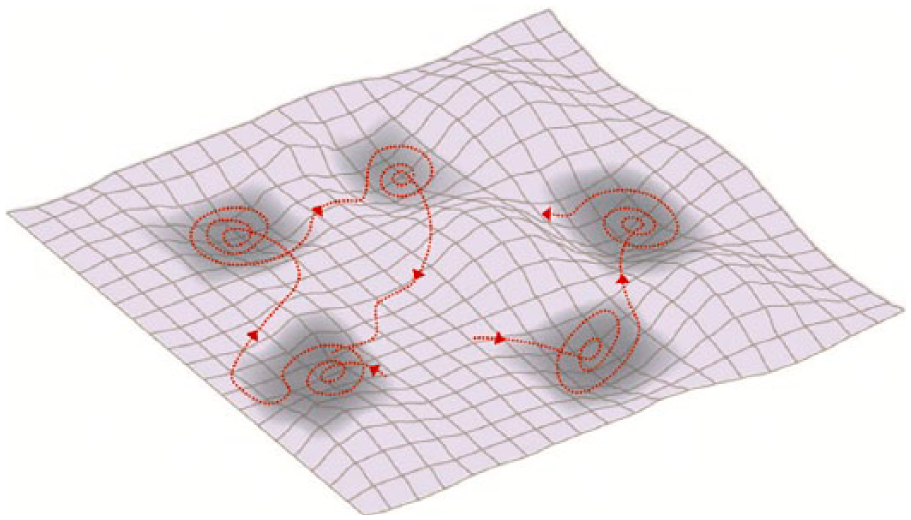
A hypothetical attractor landscape with trajectories.
Attractors intrinsically “capture the interplay between structure and dynamics in a complex system and thus are useful for framing the tension between stability and change in psychological processes” (Nowak, Vallacher, & Zochowski, 2005, p. 352).
Attractors come in different forms—each possessing different patterns of behavior (Guastello & Liebovitch, 2009; Thelen & Smith, 2006). There are four types of attractors: fixed point (or point), limit-cycle (or cyclic or periodic or oscillating), toroidal (or quasiperiodic), and chaotic (or strange) (Barton, 1994; Guastello & Liebovitch, 2009; see Figure 2). As the name indicates, a trajectory is attracted to a fixed point in a fixed-point attractor. Nowak et al. (2005) framed fixed-point attractors as the psychological equivalent of “equilibrium or homeostasis” (p. 354). An individual may have a repertoire of fixed patterns of behavior that may be wanted or unwanted, or even contradictory (Nowak et al., 2005). These patterns invariably become an individual’s “go-to” patterns of thinking and behaving across situations. If an individual progresses through patterns in regular intervals, this represents a limit-cycle attractor. In a limit-cycle (or cyclical or periodic or oscillating) attractor, a trajectory displays cyclical, oscillating, or orbit-like patterns (Guastello & Liebovitch, 2009). The movement of a pendulum is an example of a limit-cycle. “A toroidal attractor is the result of a limit-cycle that is cycling along two axes rather than one” (Guastello & Liebovitch, 2009, p. 11). The name of this attractor comes from its shape as torus or bagel when shown as a visual model (Nowak & Lewenstein, 1994). Psychologically, this represents irregular oscillation between different goals, states, or attitudes (Nowak & Lewenstein, 1994). Toroidal attractors can develop because of bifurcations, which are unstable patterns observed before a system changes (Nowak & Lewenstein, 1994). The significance of bifurcations is they can push a system into chaos when they develop in succession (Guastello & Liebovitch, 2009). These peculiar characteristics are why toroidal attractors are sometimes mistaken for chaotic attractors (Guastello & Liebovitch, 2009). The most familiar attractor may be the chaotic or strange attractor (Mackenzie, 2005). A physics-based definition of a strange attractor is “a stable, nonperiodic state or behavior exhibited by some dynamic systems, especially turbulent ones, that can be represented as a nonrepeating pattern in the system’s phase space” (Strange Attractor, n.d.). A chaotic attractor describes attitudes or behavior that are within limits but become unpredictable and irregular over time because of differences in initial conditions, errors in measurement, and constant changes in the system (Barton, 1994; Duke, 1994).

Types of attractors typically found in nonlinear systems: (A) fixed-point (or point) attractor, (B) limit-cycle (or cyclic or periodic or oscillating) attractor, (C) toroidal (or quasiperiodic) attractor, and (D) chaotic (or strange) attractor.
Transformations known as phase transitions occur because of altered parameters within attractors and attractor landscapes (Granic & Hollenstein, 2003; Hollenstein, 2007; Ott, 2002). These transitions, which are varyingly referred to as crises, catastrophes, or bifurcations based on particular dynamics, result in changes to the shape, size, location, or type of an attractor (Hollenstein, 2007). Transitions can also lead to the creation, destruction, merging, or splitting of an attractor (Hardy, 1998; Ott, 2002). During a (phase) transition, systems are especially sensitive to perturbation as the trajectory may move to a different area within an attractor or to a different attractor (Granic & Hollenstein, 2003). After a period of crisis or transition, a system may display even deeper level erratic behavior, known as intermittencies or transients. During this time, trajectories switch between new and old regions before settling into the new region or a toroidal attractor may temporarily appear (Grebogi, Ott, & Yorke, 1983; Guastello & Liebovitch, 2009; Ott, 2002).
The author proposes racial identity development theories can be reframed using the properties and dynamics of chaotic attractors. Although these theories are employed within social, developmental, and counseling psychology, this article primarily utilizes theories from counseling psychology (Ponterotto & Park-Taylor, 2007). Racial identity development theories are valued in counseling psychology because they acknowledge the influence of racism on identity development and serve as diagnostic tools during counseling (Sue & Sue, 2013). Their theoretical focus on stages/statuses as an individual progresses through the complexities of racial identification parallels the various states observed as trajectories move through attractors in a complex system. On a macro level, racism acts as the ideological foundation of this complex system through the institutionalization of racial difference (Markus, 2008). This process of institutionalization, including the creation of racial attractors, occurs through several different mechanisms. Although Nowak et al. (2005) primarily focused on interpersonal synchronization and self-organization as forces in shaping personality, they clarified these forces
are [not] the only means by which experience engraves attractors in people’s cognitive-affective systems. Theory and research in personality science have identified a host of other plausible mechanisms of personality development and maintenance, including direct reinforcement, social learning and modeling, labeling and self-fulfilling prophecies, identification, and guilt induction. (p. 379)
Each of these mechanisms aligns with Markus’s (2008) conceptualization of race as a social and relational process; and contributes to the persistence of racial differences even as actions or events occur that run counter to the system.
In applying the language of attractors to racial identity development, unique trajectories (i.e., racial identity) in the perceived attractor basins (i.e., racial categories) represent how an individual traverses the various characteristics, behaviors, attitudes, and preferences associated with a given racial category or categories in correspondence with situational and identity variables. Transitions in the proposed model result from changes in self-perception, environmental cues, and/or the perceived constitution of at least one racial category (and possibly the entire system). These transitions then cause instability and variability in an individual’s perceived fit and trajectory within a racial category (or categories). Consistent with this conceptualization, the autopoietic nature of complex systems, and the prescriptive nature of racial–ethnic self-schemas, identity is not something that we hold or have, but more accurately something we continually perceive, reify, and modify through our behaviors in coordination with the environment (Luhmann, 1995; Markus & Wurf, 1987; Markus, 2008; Oyserman, 2008). This also corresponds with agent fitness as a theme of complex adaptive systems (Dooley, 1997; Guastello, 2009). Guastello (2009) labeled agent fitness as “not the same as a performance rating, but something closer to a person-job fit” (p. 407). Race is related to agent fitness as one’s name, appearance, behaviors, thoughts, location, status, and skill set affect how an individual identifies with, and is perceived to be a member of, a particular racial group (AhnAllen, Suyemoto, & Carter, 2006; Ben-Zeev, Dennehy, Goodrich, Kolarik, & Geisler, 2014; Brown, 2004; Celious & Oyserman, 2001; Cross, 2012; Duncan, 2000; Herman, 2004; Kahn, Goff, Lee, & Motamed, 2016; Maddox, 2004; Omi & Winant, 2015; Penner & Saperstein, 2008; Rockquemore, Brunsma, & Delgado, 2009; Sodowsky, Kwan, & Pannu, 1995; Spencer & Markstrom-Adams, 1990). (Fit and the idea of attraction are both similarly addressed in Chao & Moon’s, 2005, cultural mosaic.) Spencer and Markstrom-Adams’s (1990) view of ethnic identity also supports the concept of fitness, which they described as having “the potential of providing a conceptual framework for interpreting the ongoing experience or ‘fit’ between self and the environment” (p. 292).
Reframing Existing Theories and Constructs of Race and Racial Identity Development With an Attractor Landscape
Cross (1971) developed one of the earliest theories of racial identity development to describe the developmental patterns of African Americans. Since the publication of Cross’s theory, similar stage- and status-based models were developed to describe the identity development of individuals in other racial groups and social categories—with the newer theories being more explicitly ecological and nonlinear (Hardiman & Jackson, 1992, 1997; Helms, 1990, 1995, 1996; Jackson, 1976; Kim, 2012; Parham, 1989; Poston, 1990; Renn, 2000, 2003; Rockquemore & Brunsma, 2002; Root, 1990, 1996; Sodowsky, 1996; Sue & Sue, 2013). The ecological nature of these theories position them as qualitatively close to chaotic as imbalances of positive and negative feedback can push an ecological system into chaos (Berryman & Millstein, 1989). In a complex system based on racism, feedback comes in the form of behaviors and attitudes that support or contradict racism, such as racial socialization and racial discrimination (Buckley, 1998; Hunter & Lewis-Coles, 2004; Menendian & Watt, 2008; Myrdal, 1944; Spencer et al., 1997). The proposed model also aligns with other theories that focus on the dynamic, historical, recurring, social, situated, and restraining aspects of racial identity (see Cross, 2012; Omi & Winant, 2015; Root, 2002; Spencer et al., 1997; Verkuyten, 2016; Wijeyesinghe, 2012). Most notably, the metaphysical essence and language of attractors is seemingly imbued within Omi and Winant’s (2015) definition of racial formation as “the sociohistorical process by which racial categories are created, lived out, transformed, and destroyed” (p. 109).
Racial identity development theories exhibit patterns that correspond with the framing of development as a progression of states within a complex system (Smith & Thelen, 2003; Thelen & Smith, 2006). In addition, transitions within these theories parallel dynamics displayed by attractors in crisis or transition (van Geert, 2009). This includes the general stage-related trends found in the racial identity development theories cited in the preceding paragraph: preawareness or preattraction to a racial identity, attraction toward a majority identity, attraction toward a minority identity, fluctuating periods of attraction to majority and minority identities, development of a new identity, rejection (or destruction) of a racial identity, merging of racial identities, and a dynamic pattern that switches between all of the above identities. Similar to connections and comparisons that are noted with Chao and Moon’s (2005) cultural mosaic, these patterns and trends account for statuses described in Phinney’s (1989) stages of ethnic identity development; Sodowsky, Kwan, and Pannu’s (1995) four ethnic identity orientations; and Roccas and Brewer’s (2002) models of multiple in-group representation. (The proposed model shares commonalities with Chao & Moon’s, 2005, cultural mosaic. Both have an explicit focus and usage of concepts in complexity and chaos. However, the model proposed here utilizes a deeper theoretical examination and application of attractor types and properties, a more narrow focus on race, and increased integration with theories, concepts, and research on racial identity development. In addition, the cultural mosaic frames attractors as tiles, which relate to different aspects of identity.)
An understanding of the properties of chaotic attractors and complex adaptive systems also elucidates paradoxical views on the cyclical and nonlinear nature of racial identity development. Racial identity development theories describe moving into deeper or less explored facets of racial categories over the course of an individual’s lifetime (Cross & Fhagen-Smith, 2001; Parham, 1989). This combined dynamic of oscillating between categories and moving more deeply into them over time is reminiscent of the Lorenz attractor with its lemniscate shape and entrancing pattern between two basins of attraction (Lorenz, 1963; see Figure 2D). Wing and Rifkin (2001) intuitively perceived and captured this dynamic in attractor-like detail in their discussion of Hardiman and Jackson’s (1997) social identity development theory. They proposed the theory can be viewed as
a series of different lenses through which people may view the world. A person may tend to use a lens reflecting a particular stage and after a time may use the next lens in the developmental sequence most frequently. And while people may move from one stage to another in what appears to be a linear fashion, as they experience further oppression or develop a deeper understanding of oppression and/or identity, they may instead move more deeply into what would appear to be an “earlier” stage. In effect, we can see this model as a spiral of movement, like the peeling of an onion, rather than a solely linear process. An example of this might occur when a person moves more deeply into an “earlier” stage after experiencing identity-related violence. (Wing & Rifkin, 2001, p. 185, quotations in original)
A similar property is found in complex adaptive systems. Dooley (1997) identified irreversibility as one of the key principles of complex adaptive systems. As described by Guastello (2009), even if previous states or conditions are reestablished, “the effect is not the same because of the history that accumulated, events that occurred, and time that has elapsed” (p. 406). In combination, these properties invalidate theoretical perspectives that support the absolute (re)cycling of attitudes or linear progression of racial identity development. These properties are also why normal racial identity development should be described as chaotic. A racial identity that progresses like a fixed, limit-cycle, or toroidal attractor could be considered pathological, indicative of identity stagnation, or evidence of deeply entrenched and cyclical racial dynamics (Blackman, 2005; Parham, 1989; Wachtel, 2014). Individuals should display some degree of identity complexity and variability over time and in different situations. (Reluctance to frame development as chaotic is in part because of the conflation of the colloquial understanding of chaos with the scientific meaning of the term. Carver and Scheier, 1999, stated, “using words such as turbulence, static, or chaos . . . is in a way very misleading. These periods may not feel subjectively like turbulence at all because their occurrence is quite familiar. The chaos may feel instead like ‘implicit decision making,’” p. 71, italics and quotations in original). Framing racial identity development within chaotic attractors also accounts for Cross’s (2012) belief that “what changes, from situation to situation, is not identity but the manner in which identity is expressed” (p. 194; see also Helms, 1996). Accordingly, a core racial identity would provide some predictability and stability, whereas the expression of the identity may be somewhat unpredictable based on incomplete information, interaction effects, and situational variables.
Reinforcement, perturbation, stabilization, and reconfiguration of racial identity (i.e., trajectories) and racial categories (i.e., attractors) are rooted in exposure to different types of racially associated phenomena or events. Among these phenomena are racial socialization, racial discrimination, racial firsts (or something that is considered atypical for someone in a particular racial group), racial realizations, and racially tinged environments, or anything that is perceived as a threat to one’s racial identity (Branscombe, Ellemers, Spears, & Doosje, 1999; Helms, 1995; Hogg & Hornsey, 2006; Jaspal & Cinnirella, 2012; Spencer et al., 1997; Wing & Rifkin, 2001). In addition, each of these phenomena interacts with the others and generates feedback loops resulting in nonlinear, correlational, or moderating effects. For example, there are different outcomes based on the types of racial socialization messages that are received and the identity of the individual when racial discrimination is experienced. Variance in these factors contributed to differences in the perception and effects of racial discrimination, identity outcomes, and the psychological tools an individual has to cope with racial discrimination (Branscombe, Schmitt, & Harvey, 1999; Harrell, 2000; Helms, 1995; Herman, 2004; Lee & Ahn, 2013; Sellers & Shelton, 2003; Stevenson & Arrington, 2009; Yip, Gee, & Takeuchi, 2008). The power of feedback is also apparent via reactions to behaviors that introduce novelty into the system, such as counterstereotypical or unexpected behavior (Holland, 1995). Individuals may become uncomfortable attempting or even observing actions or behaviors that are not typically associated with individuals of a given racial background. Reactions to these “inappropriate” actions included racial discrimination, threat responses, and stereotypical behaviors (Mendes, Blascovich, Hunter, Lickel, & Jost, 2007; Phelan & Rudman, 2010). To further complicate the understanding of the interrelatedness of race-related phenomena, it should be noted that the distinction between stabilization and perturbation may be imprecise. Although racial discrimination experiences would typically be thought of as incidents that only perturb identity toward a different state, both microaggressions and some racial socialization messages could be viewed as “tiny perturbations . . . to stabilize regular dynamics behaviours and to direct chaotic trajectories rapidly to a desired state” (Shinbrot, Grebogi, Ott, & Yorke, 1993, p. 411). This is insofar as the intention of both phenomena (at least from the perspective of the agent or system) may be to reinforce a racial status quo or way of thinking (Hughes et al., 2006; Sue et al., 2007). Stabilization and moderation of racial identity also occurs through coping or buffering strategies to counter the effects of perspective-shifting stimuli or to (re-)establish a sense of order among racial categories (e.g., Blanz, Mummendey, Mielke, & Klink, 1998; Brondolo, Brady, Pencille, Beatty, & Contrada, 2009; Cross, 2012; Helms, 1995).
Other dynamics and trends are also supported. In most racial identity development theories, an individual displays an initial preference toward the dominant racial category regardless of race (after the development of some awareness and understanding of race). However, an initial preference could be focused on a nondominant racial category depending on the degree of exposure to the dominant racial category and an individual’s immediate environmental racial influences. Either situation is consistent with Granic and Hollenstein’s (2003) claim that “contextual constraints probabilistically guide behavior toward the dominant attractor at any given moment in time” (p. 645). A single attractor may separate in multiple attractors. For example, there are differing views and mental representations of the terms Black and African American (Hall, Phillips, & Townsend, 2015; Larkey, Hecht, & Martin, 1993; Philogène, 2004). The discovery of latent attractors (e.g., discovery of racial categories or options that were not noticed by an individual) is an alternate explanation for new categories (Vallacher & Nowak, 2009). In many cases, so-called “new” attractors or categories are not newly created but simply newly discovered. For example, a biracial identity may not have been perceived as an option in an individual’s home neighborhood, but becomes a new option when exposed to other individuals in a college setting who identify as biracial (Renn, 2000). Changing from being drawn to a category to being repelled by it (i.e., effectively changing from an attractor to a repeller) is supported in theory and research, and applies to race (Cross & Fhagen-Smith, 2001; Renn, 2000, 2003; Vallacher & Nowak, 2009). Way, Hernández, Rogers, and Hughes (2013) found minority adolescents used racial stereotypes as both guides for behaviors to follow and avoid. An attractor-based model also supports multistabilities and multiple simultaneous crises (Nowak et al., 2005). Individuals can display concurrent attraction to multiple racial categories or experience multiple racial crises (Chao & Moon, 2005; Helms, 1995; Oyserman, 2008; Poston, 1990; Renn, 2000, 2003; Root, 1990, 1996; Sanchez, Shih, & Garcia, 2009). This multiplicity extends to feedback. Because of simultaneous attraction and crisis, conflicting positions within identities, and competing situational cues, there is bipolar feedback. Sabelli (2005) referred to bipolar feedback as coexisting negative and positive feedback, which results in “synergistic and antagonistic interaction” (p. vi). The combination of multiplicities forms a theoretical foundation for the psychological equivalent of intermittencies and transients, as an individual who is the victim of racial discrimination and/or develops race-related cognitive dissonance may experience psychological distress or a crisis of racial identity (Lee & Ahn, 2013; Rowe, Bennett, & Atkinson, 1994; Yip et al., 2008). This uncomfortable state then contributes to increased sensitivity to bipolar feedback and, ultimately, deeper level erratic thinking and behavior (see Grebogi et al., 1983; Ott, 2002). These multiplicities, along with uncertainties about the strength, relationships, and directionalities of these racially associated variables, are why the author believes the proposed model can alternatively be described as an interaction-dominant dynamical system (IDDS). In an IDDS, “mutual and reciprocal interactions . . . constitute a complex system of multidirectional constraint that operates at both fast and slow timescales to dynamically order and reorder behavior during the ongoing realization of behavioral goals” (Eiler, Kallen, Harrison, & Richardson, 2013, p. 318).
Discussion
As an exercise in interdisciplinary research, the proposed model is an attempt to provide consilience to disparate theories and concepts of race and racial identity development, and to connect these theories to deeper level and more universal scientific principles. Although interdisciplinary research can be valuable, the author acknowledges this type of research poses a unique set of challenges including the possibility of theoretical misunderstandings, problematic syntheses, insignificant gains, and the need for shifts in thinking (Pedersen, 2016). In addition, there are conflicting positions on the metaphorical, analogical, and practical usage of complexity, chaos, and attractors (Ayers, 1997; Carver & Scheier, 1999; Mackenzie, 2005; Sawyer, 2005; Vallacher & Nowak, 2007). Notwithstanding, the author believes this conceptualization of a unified understanding of race and racial identity development is in agreement with Van Orden, Kello, and Holden’s (2010) sentiment shared in the first epigraph.
Racial identification is only part of an individual’s identity and experiences, so it can be said that the proposed conceptualization is too simplistic. In addition, as identity is continuous and dynamic, an identity status (or stage) is a simplified description of an attractor state at a discrete moment (Brittian, 2012; Hollenstein, 2007; van Geert, 2009). The author understands there is an incomprehensibly high level of complexity to the human and social experience. The author also understands there are many places where language, ethnicity, and nationality are the primary means of categorizing people instead of race (Nsamenang, 2013; Okonofua, 2013). However, when situations relate to racial identity, race becomes a more important part of one’s identity, which justifies the existence of this and other theories that focus primarily on race (Benjamin, Choi, & Strickland, 2010; Shelton & Sellers, 2000).
In addition to the disagreements on the relative importance of race, there are competing definitions and constructs of race and ethnicity (Casas, 1984; Cokley, 2005; Cook & Helms, 1988; Helms & Talleyrand, 1997; Phinney, 1996; Ponterotto & Park-Taylor, 2007; Umaña-Taylor et al., 2014). Helms and Talleyrand (1997) argued individuals receive differential treatment based on physical appearance not culture. Alternately, Phinney (1996) believed race is the less clear concept because of a lack of consensus on usage and meaning, and that ethnicity includes race. Some researchers have proposed these concepts should be combined (especially when describing non-White groups) because of the convergence of race and ethnicity in lived experience (Casas, 1984; Cook & Helms, 1988; Umaña-Taylor et al., 2014). The combined terms include racial/ethnic minority, ethnic and racial identity (ERI), and visible racial/ethnic group (VREG). (The author acknowledges it may be more accurate to use the terms race/ethnicity and ethnic/racial identity development throughout this article based on these perspectives.) There are also differing views on whether racial identity is primarily driven by interracial or intraracial experiences (Chávez & Guido-DiBrito, 1999; Quintana, 2007). These dilemmas are compounded by a collection of measures that focus on different aspects of racial and ethnic identity (Cokley, 2007, 2005; Helms, 2007; Ponterotto & Park-Taylor, 2007). Identity measures generally focus on processes that contribute to identity development (e.g., attitudes about different racial groups and one’s relative place in them), the contents or characteristics of a developed identity (e.g., views on the importance of race), or both (Schwartz et al., 2014). These narrowly defined perspectives of racial identity are then used to infer an individual’s identity status. The measurement of racial identity is further obfuscated by an overreliance on survey data, limited and conflicting views of self and others, cross-cultural differences, the underreporting of racial information, reluctance to self-categorize, and social desirability effects (Abrams & Trusty, 2004; Burrell, Winston, & Freeman, 2013; Cokley, 2007; Delgado-Romero, Galván, Maschino, & Rowland, 2005; Helms, 1996; Jones, Torres, & Arminio, 2006; Townsend, Markus, & Bergsieker, 2009).
The proposed model could move us closer to modeling and predicting racial identity patterns and development, and understanding which types of situations can lead to identity variability and crisis—even though the complete prediction of thoughts and behavior will remain out of reach. The paradox is summed up in Edward Lorenz’s definition of chaos (as cited in Danforth, 2013): “when the present determines the future, but the approximate present does not approximately determine the future.” This paradox, along with the questionable validity and ambivalence of categories such as race, is why racial identity development theories and virtually any effort to reduce individuals to racial categories is of somewhat limited use and will display weak statistical power (Carter & Fenton, 2009; Markus, 2008). Although there are statistical measures specifically designed for analyzing systems influenced by nonlinear and attractor dynamics (e.g., Brittian, 2012; Granic & Hollenstein, 2003; Guastello & Gregson, 2010), one of the initial challenges of modeling racial identity as attractor states involves determining the best choices among various race-related constructs and measures (and possibly fragmenting them into subcategories for optimal coding). The next harrowing task is deciding on (and fulfilling) the necessary frequency, conditions, and methods of measurement to accurately portray the multiplicity of states exhibited across situations and timescales (Ayers, 1997; Carter, 1996; Fogel, 2011). Put simply, if racial identity is truly continuous, dynamic, situational, and often subtle, identity parameters should be measured continuously to understand racial identity fully and completely—especially as memory is fallible and biased toward confirmatory information (Brittian, 2012; Cokley, 2007; Gushue & Carter, 2000; Quintana, 2007). As this deconstruction extends to the proposed model, an attractor landscape model of race and racial identity development likely demonstrates the same limitations as the theories it attempts to build on and unify because of shared epistemological and ontological constraints, which also affect the examination of culture and ethnicity (Betancourt & López, 1993; Cauce, 2011; Gone, 2011). This is complicated by the difficulties associated with understanding and analyzing the macro–micro reality and intersubjectivity of social phenomena such as race or ethnicity (see Gillespie & Cornish, 2010; Jaspal & Cinnirella, 2012; Morçöl, 2012; Sawyer, 2005; Törrönen, 2014). Even newer research techniques, such as agent-based modeling, are insufficient for gaining a complete understanding of complex racial dynamics because of innumerous perceptions and countless interactions among personal characteristics and the environment (Abdelal, Herrera, Johnston, & McDermott, 2006; Bednar & Page, 2007; Harrell, 2000; Smaldino, Pickett, Sherman, & Schank, 2012; Spencer et al., 1997). These difficulties and limitations collectively lend credence to Tyson’s (2017) aphorism in the second epigraph. Therefore, this model may, at best, be described as only a conceptual model that uses the laws of physics and nonlinear dynamics as a metaphor for the structure and process of race and racial identity development.
There is also some uncertainty on what would be considered an optimal racial identity dynamic. Low levels of self-complexity may be problematic because of excessive rigidity, and high levels of self-complexity may reflect disorder (Guastello, 2015). As noted earlier, a fixed or rigid racial identity may be pathological or stagnant as one’s internal positions should demonstrate flexibility (Blackman, 2005; Parham, 1989). Conversely, although many racial identity theories present a dynamic identity as an optimal outcome, Sanchez et al. (2009) found malleable racial identity was associated with decreased psychological health and well-being in multiracial individuals. Research should be completed to more clearly understand to what extent and how a dynamic identity is healthy and should be internally or externally controlled, and to what extent and in what types of situations a fixed racial identity is a sign of strength versus being maladaptive or a possible indication of psychopathology.
Future research could frame other identity categories, such as gender, sexuality, class, and sexual orientation, as attractor landscapes based on dynamics, rationales, and constructs similar to those identified in this article. However, this research enterprise raises the same issues identified with the modeling and measuring of racial identity across states and timescales. The final research goal then becomes modeling interactions between these various identity landscapes. Possible guides to this synthesis include theoretical models informed by ecological, intersectional, cross-disciplinary, and complex systems approaches to social identities (e.g., Abes, Jones, & McEwen, 2007; Chao & Moon, 2005; Holvino, 2012; Kertész, Török, Muraze, Jo, & Kaski, 2016; McCall, 2005; Walby, 2007; Winker & Degele, 2011).
Finally, game theory, like chaos and complexity, has also unified and explained diverse fields (Gintis, 2009; Guastello, 2009; Varoufakis, 2008). This included examining segregation based on social identity (Rubí-Barceló, 2013). Combining game theory, chaos, and complexity provides a potentially powerful statistical means of modeling and analyzing social phenomena. Significant progress has been made toward theoretical unification of these perspectives by Akiyama and Kaneko (2000, 2002) in a framework they call dynamical systems game theory. Within dynamical systems game theory, as is the case with race, “the game itself can change due to the influence of players’ behaviors and states” (Akiyama & Kaneko, 2000, p. 221). Other approaches to game theory are also possible. Greenberg’s (1990) theory of social situations is a game-theoretic approach that frames individuals in a social environment where they understand recommended behaviors, choose what is perceived to be the best action, and consider the consequences. Similarly, in a game-theoretic framework proposed by Bednar and Page (2007), culture emerges through an ensemble of games played by agents. Although it is impossible to determine every conceivable action, it may be reasonable to model racial identification and categorical preferences in situations that prime thinking and behavior associated with race.
Footnotes
Acknowledgements
Special thanks to Louise M. Jett for creating the image of the attractor landscape. I also wish to thank individuals who provided feedback at conference presentations, and those who were patient and gracious enough to review previous drafts of this article. I am most deeply indebted to the Winter Chaos Conference community (also known as “Snowflakers”) for their support and friendship.
Declaration of Conflicting Interests
The author(s) declared no potential conflicts of interest with respect to the research, authorship, and/or publication of this article.
Funding
The author(s) received no financial support for the research, authorship, and/or publication of this article.