




Abstract
Adopting systemic functional linguistics (hereafter SFL) as the main theoretical framework, this study as part of a larger research project, aimed to examine how the language of textbooks deployed in teaching English as a foreign language (EFL) in the Vietnamese context shifted across levels in a book series. In order to do this, this research analyzed three linguistic features namely, lexical density, nominalization, and grammatical metaphor of 24 reading texts in the chosen textbooks. The findings show that overall textbook texts grew complex when their levels advanced. In specific, mean scores of nominalization and grammatical metaphor increased in accordance with the textbook levels from elementary to intermediate, leading to high density in chosen written texts. Nevertheless, the mean scores of the three selected language features in the upper mediate textbook were not the highest among the four books. This finding suggests that in selecting EFL textbooks, educators not only look at textbook levels proposed by textbook writers but also examine its linguistic features to determine most appropriate choice.
Introduction
English textbooks play a crucial role in education in developing countries. They are often used as the guiding teaching material in the curriculum and effectively contribute to the quality of education (Besser, Stone, & Luan, 1999). Determining suitable teaching materials for the curriculum is crucial to a language education program. However, in the textbook market, it is getting harder to choose an appropriate English textbook for a course (Minoo & Nikan, 2012). Although extensive research in light of systemic functional linguistics (SFL) has been carried out to investigate the language of government-approved English textbooks in schools in Australia and worldwide, the language of international textbooks chosen for teaching specific English skills in universities and language centers in non-English speaking countries has still been under research.
With the diversity and availability of English as a foreign language (EFL) textbooks in the book market, a question raised is that what criteria do English language educators and teachers in non-English speaking nations based on to choose EFL texts and textbooks for their students and language teaching curriculum, and how appropriate they are? It is supposed that there are a number of factors that educators and teachers can rely on when choosing EFL textbooks to teach general English to second language learners (L2Ls) such as content orientation, pedagogical principles, text types, and linguistic complexity. However, with reference to the context of teaching EFL in Vietnam, it seems that there are no unified and consistent criteria for education policy makers and educators to choose EFL textbooks for the language teaching curriculum in universities or language centers.
It is not uncommon to see that Vietnamese educators and teachers of English choose texts and textbooks for their students based on the book levels proposed by textbook writers. For instance, after students sit in a placement test, depending on the results, they will be placed in classes of different levels including elementary, low intermediate, intermediate, and upper intermediate (Anderson, 2003a, 2003b, 2003c, 2003d). Then, educators will choose a series of books consisting of four equivalent levels proposed by the writers as the course textbooks. As a result, students who sit in the elementary class will study the textbook written for elementary level in general. Likewise, the students who sit in intermediate class will study the textbook written for overall intermediate students. One of the reasons for this practice is due to a general assumption that textbook texts grow more complex when their levels advance; thus, educators assume that a textbook level proposed by the textbook writer will suit the level of English class which students are supposed to learn.
This is problematic as there is no guarantee that the chosen textbooks are appropriate, especially in the context that a number of universities and language centers in Vietnam are not internationally recognized and that evaluation of the effectiveness of the chosen EFL textbooks in the language education curriculum in Vietnam is still under-investigated. In addition, whether there is a gradual shift in the use of EFL textbook texts in a book series has not been statistically proved in the literature. One may question that whether the texts in the upper intermediate book can be used for learners who are placed in the intermediate class and vice versus? This research clarifies these questions by examining the language of reading texts in four books in a book series that are set for elementary, low intermediate, intermediate, and upper intermediate levels (Anderson, 2003a, 2003b, 2003c, 2003d).
This study employed SFL (Halliday, 1985a, 1994; Halliday & Matthiessen, 2004, 2014) as the main theoretical framework to explore the complexity of language in the four books, with a focus on examining lexical density (Halliday, 1985b, 1993b, 2008), nominalization (Banks, 2005; Halliday, 1993a, 1998, 2004; Halliday & Martin, 1993; Halliday & Matthiessen, 2004; J. K. Martin, 2008; J. R. Martin, 1993), and grammatical metaphor (Banks, 2003; Derewianka, 2003; Halliday, 1985a, 1993b, 1994, 1998, 2004, 2008; Halliday & Martin, 1993; Halliday & Matthiessen, 1999, 2004; J. K. Martin, 2008; J. R. Martin, 1992, 1993; Ravelli, 1999). Three main reasons for choosing these three concepts are that: (a) they are considered typical complexity of written language from an SFL perspective as shown in extensive research on these concepts by functional linguists (see Banks, 2003, 2005; Derewianka, 2003; Halliday, 1985a, 1985b, 1993a, 1993b, 1998, 2004, 2008; Halliday & Martin, 1993; Halliday & Matthiessen, 2004; J. K. Martin, 2008; J. R. Martin, 1992, 1993; Ravelli, 1999; To, Lê, & Lê, 2015); (b) research into linguistic complexity in second language learning in the literature failed to look at linguistic complexity using the SFL complexity concepts (see Dahl, 2004, 2008, 2009; Kusters, 2008; Lia & Zeynep, 2016; Miestamo, 2008, 2009; Nichols, 2009; Putra & Lukmana, 2017; Sheehan, Flor, Napolitano, & Ramineni, 2015; Vettorel, 2018); and (c) from the literature review, although there are studies on linguistic complexity using the chosen SFL concepts (lexical density, nominalization, and grammatical metaphors) in other areas, research on linguistic complexity in English textbooks using these SFL concepts in developing countries is still under-investigated. The three concepts will be discussed in greater details in the background section.
In the background section, this article initially discusses the concept of linguistic complexity and explains the choice of SFL as the theoretical framework. It then explains how complexity is measured in the view of SFL with particular reference to the three linguistic features mentioned. In the method section, chosen texts and textbooks as well as methods adopted to data analysis are described in detail, followed by a sample analysis. Results of quantitative data analysis are presented in the findings section, which are illustrated by examples from the data. Following that, the significance of the results is discussed together with the study limitations. The article ends with a summary of key findings and implications for text and textbook choice and writing.
Research Background
Linguistic Complexity
Halliday (2008) states that complexity, particularly linguistic complexity, is itself a complex concept. However, J. R. Martin and Rose (2003) posit that “despite the complexity of language in social contexts, the basic principles developed in SFL for managing it are relatively simple” (p. 3). SFL provides a good model to examine linguistic complexity as it helps understand complexity at three levels of language (i.e., grammar, discourse, and context; J. R. Martin & Rose, 2003), and its three social metafunctions (i.e., ideational, interpersonal, and textual; J. R. Martin & Rose, 2003). Borrowing these principles and well-established linguistic measures from SFL, this study aimed to explore the complexity of language in reading texts in EFL textbooks across textbook levels, which has still been under-investigated in second language learning (see Benedikt & Bernd, 2009; Dahl, 2008; Fred, 2009; Hendrikse & Van Zweel, 2010; Kuiken & Vedder, 2007; Miestamo, 2009; Ortega, 2003; Patrick, 2008; Szmrecsanyi & Kortmann, 2012). The focus of the research was to investigate three linguistic features, specifically, lexical density, nominalization, and grammatical metaphor, which are typical features of complexity in written language (Halliday, 1985a, 1985b). Before introducing the three linguistic concepts chosen for the examination of linguistic complexity in this study and explain how these linguistic concepts relate to three strata and metafunctions of language, an overview of SFL theory is presented.
SFL
SFL is a linguistic approach that views language as a system of social semiotics and a resource for making meaning (Halliday & Matthiessen, 2004). It deals with language use in real contexts (Halliday & Matthiessen, 2004). From an SFL perspective, language is comprised of four levels, including context, discourse semantic, lexicogrammar, and grapho-phonology (Halliday & Matthiessen, 2004).
At the context level, there are cultural context and situational context (Eggins, 1994) and at this level, genre and register are realized. Genre is concerned with the context of culture as J. R. Martin (2001) defines “[Genre is] a staged, goal-oriented, purposeful activity in which speakers engage as members of our culture” (p. 155). Genre is realized through register and register as Eggins (1994) defines is “the immediate situational context in which the text was produced” (p. 26). Therefore, register is the context of situation.
At the discourse semantic level, there are three register variables namely, field, tenor, and mode. Field involves the ideational metafunction (or meaning) of language, tenor deals with the interpersonal metafunction, and mode is all about textual metafunction (Halliday & Matthiessen, 2004). The ideational metafunction is people’s knowledge about the world around them and their experience or the use of language; the interpersonal metafunction involves the relationship between users of language; and the textual metafunction of language deals with the organization of ideational meaning and interpersonal meaning into cohesive and coherent texts (J. R. Martin & Rose, 2003).
At the lexicogrammar level, meaning is realized by the organization of words, word groups, and clauses (Halliday & Matthiessen, 2004). Lexical and grammatical choices determine the ideational meaning, while mood, modality, and evaluative language determine the interpersonal meaning and thematic and information structure (Halliday & Matthiessen, 2004), and text periodicity (J. R. Martin & Rose, 2003) are related to the textual meaning. While discourse semantics and lexicogrammar belong to the content plan; at the level of grapho-phonology, phonetics, phonology, and spelling are the expression of language and the first and foremost basic linguistic resources to make meaning (Halliday & Matthiessen, 2004).
Three Focus Concepts
Lexical density
Halliday and Martin (1993) define lexical density as “the density of information in any passage of text, according to how tightly the lexical items (content words) have been packed into the grammatical structure” (p. 76). From Halliday’s point of view, lexical items include nouns, verbs, adjectives, and adverbs, while grammatical items consist of pronouns, determiners, finite verbs, and some classes of adverbs (Halliday, 1985b). He stated that lexical density is the ratio of lexical items to ranking clauses (Halliday, 1985b). Thus, at the level of lexicogrammar, lexical density helps understand the packing or scattering of lexical items in clauses. Because lexical density involves the density of meaning in a grammatical structure, the adoption of lexical items represents meaning or experience about the world realized as register variable of field that determines the ideational metafunction of language. The variation in density of lexical meaning over clauses reflects the organization of the message, which relates to register variable of mode concerning the textual metafunction (Halliday, 1985b; Ravelli, 1999). Particularly, it has been shown that written texts have higher density values in comparison with spoken texts (Eggins, 1994; Halliday, 1985b; Ravelli, 1999).
To analyze lexical density, clear categorizations of lexical items and grammatical items, and that of ranking clauses and embedded clauses are important. However, clear distinctions between those categories sometimes are problematic as lexis and grammar are complementary, so some words might fall on the borderline between them (Halliday, 1985b, 2008), which include prepositions and certain classes of adverb such as always and perhaps (Halliday, 1985b). Similarly, it is not always easy to distinguish between hypotaxis (i.e., dependent clauses) and embedded clauses as traditionally these two types of clauses are treated as subordination (Ravelli, 1999). However, Halliday (1985b) argues that “it does not matter exactly where we draw the line provided we do it consistently” (p. 63). In the “Method” section, how to classify lexical items, grammatical items, ranking clauses (i.e., independent and dependent clauses) and embedded clauses will be discussed in greater detail.
Nominalization
Nominalization defined by functional linguists is the process of transforming a verb, an adjective, a conjunctions, or an adverb into a noun, or a clause into a nominal group (Eggins, 1994; J .K. Martin, 2008; Thomson & Droga, 2012). For instance, education for educate, importance for important, “a bomb explosion” for “a bomb exploded.” As such, nominalization turns an action process into a thing (Bloor & Bloor, 1995). For example, the action “investigate” becomes a thing “investigation.” As nominalization is a kind of lexical items, it contributes to lexical density. Two main functions of nominalization are to build knowledge and organize the text (Halliday, 1993a; J. K. Martin, 2008). With regard to building knowledge, nominalization helps build the field of discourse that relates to the ideational metafunction. Regarding to the organization of text, nominalization helps condense meaning and connect ideas to create a coherent and cohesive text (Halliday, 1993a; Humphrey, Droga, & Feez, 2012; J .K. Martin, 2008). This function of nominalization is known as the textual metafunction of language, involving register variable of mode, particularly the written mode.
Grammatical metaphor
Grammatical metaphor is considered having interrelated relationship with lexical density and nominalization. Nominalization is “the single most powerful resource for creating grammatical metaphor” (Halliday & Matthiessen, 2004, p. 656), resulting in high lexical density. By definition, grammatical metaphor originally proposed by Halliday (1994) is “a substitution of one grammatical class, or one grammatical structure by another” (p. 79). In terms of classification, grammatical metaphor consists of ideational metaphor and interpersonal metaphor. Ideational metaphor is the metaphor of transitivity realized by six process types, which involves nominalization (Halliday, 1994). Ideational metaphor includes two kinds namely, experiential metaphor and logical metaphor (J. R. Martin, 1992). Experiential metaphor is realized by construing processes as things (explode–explosion) or qualities as things (free–freedom). Logical metaphor is realized by construing causal relationship by a verb (cause) instead of a conjunction (because; J. R. Martin, 1992). Regarding interpersonal metaphor, it expresses the interpersonal relationships between the speaker and the listener and includes mood and modality metaphors (Halliday, 1994). As nominalization is a type of grammatical metaphor, a clear distinction between them is momentous in data analysis in this study, and this will be clarified in the “Method” section.
Method
Research Design
This research followed quantitative research design. Descriptive statistics described values of lexical density, nominalization, and grammatical metaphor in the data across textbook levels. Inferential statistics regarding correlational analysis revealed the relationships among linguistic features investigated.
Research Question
How does the language of these textbooks change over the various levels in a book series?
Selection of Texts
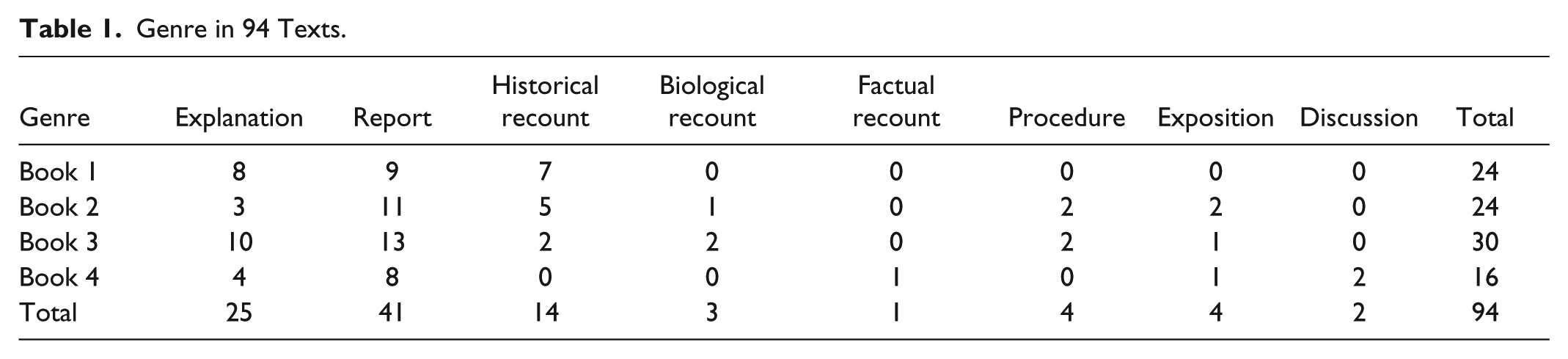
This study analyzed linguistic complexity of a series of English textbooks namely, Active Skills for Reading (Anderson, 2003a, 2003b, 2003c, 2003d). These textbooks are written for teaching English reading skills to EFL learners and have been widely used in the language education programs in Vietnam since 2007. The book series includes four books designed for EFL learners of elementary, low intermediate, intermediate, and upper intermediate levels, respectively (Anderson, 2003a, 2003b, 2003c, 2003d). Each book includes 32 reading texts of various topics and genres. Totally, there are 128 reading texts in four textbooks. The selection of texts included three main steps. The first step involved screening all the 32 reading passages in each book, and eliminating the texts that are conversations, questions and answers, interviews, personal recounts, and narratives. Two reasons for this limitation are as follows: First, conversations and interviews belong to spoken language which is not aligned with the purpose of investigating written texts in this study and second, personal recounts and narratives are about storytelling that contains personal elements which are typical of spoken language (Humphrey et al., 2012; J. R. Martin & Rose, 2008; Rose & Martin, 2012); thus, these types of text were excluded from the analysis. Specifically, there are eight conversations/interviews in Book 1, six conversations/interviews and two personal recounts in Book 2, two interviews in Book 3, and six conversations/interviews and 10 personal recounts/narratives in Book 4. Totally, 34 texts were omitted, and the numbers of texts chosen for the second stage of text categorizing were 94 texts including 24 texts in Book 1, 24 texts in Book 2, 30 texts in Book 3, and 16 texts in Book 4. These 94 texts were marked to distinguish them from 34 texts that were already omitted in the scanning stage. The second step was to decide genre of 94 chosen texts, which was based on genre analysis (Humphrey et al., 2012; J. R. Martin & Rose, 2008; Rose & Martin, 2012).
As narratives and personal recounts were already eliminated at Stage 1, this step involved identifying other genres such as description, explanation, report, historical recount, procedure, exposition, and discussion. The result of genre analysis of 94 texts in this study is shown in Table 1. The final step in selecting texts was to choose the dominant genres in four books for the research. As indicated in Table 1, Explanations and Reports were common genres in the four books across levels, they were chosen for the analysis. As the minimum number of Explanation texts was three, to make a fair comparison in terms of quantity of texts across levels, three Explanations and Reports in each book were selected for the examination. The corpus included 24 texts in total.
Genre in 94 Texts.
Data Analysis
Lexical density analysis
This study used the measure of lexical density as proposed by Halliday (1985b), which is the proportion of lexical items per ranking clauses. The classification of lexical items and grammatical is crucial to the analysis of lexical density. However, some of these items have been determined differently in literature (see Castello, 2008; Halliday, 1985b; O’Loughlin, 1995; Stubbs, 1986; Ure, 1971). As Halliday (1985b) mentions, it does not matter where we draw the line between those items, the most important thing is to do the analysis consistently. Thus, in this study, lexical items include all nouns, all lexical verbs except the verb be, all adjectives, adverbs of manner (e.g., slowly, eagerly), and sentence adverbs (e.g., luckily, happily); while grammatical items include all pronouns; all determiners; all finite verbs consisting of be, do, have and modal verbs; setting adverbs (e.g., here, there); degree adverbs (e.g., so, extremely); negative and interrogative adverbs (e.g., not, never); all conjunctions (e.g., but, nevertheless,); and all prepositions (e.g., on, upon, above) (See To, Fan, & Lê, 2016).
Regarding clauses, only ranking clauses comprising of parataxis and hypotaxis (Halliday, 1985b) are included in the lexical density analysis, while embedded clauses are not counted. The reason for this is that the measures of density necessarily involve the relationship between clauses as this is related to the density or scattering of lexical items in clauses. There are two factors that influence the relationship between ranking clauses in clause complex are taxis and logico-semantics systems (Halliday & Matthiessen, 2004). Taxis deal with two degrees of interdependency between clauses including parataxis (i.e., independent clauses) and hypotaxis (i.e., dependent clauses; Halliday & Matthiessen, 2004). Halliday and Matthiessen (2004) states that parataxis or independent clause is “the relation between two like elements of equal status, one initiating and the other continuing” (p. 374), while hypotaxis is “the relation between a dependent element and its dominant, the element on which it is dependent” (p. 374). Regarding logico-semantic relations, it includes two kinds: expansion and projection (Halliday & Matthiessen, 2004). By contrast, embedded clause means the clause is embedded to something else (Lukin, 2013); thus, embedded clauses are at a lower rank than clauses. Ravelli (1999) argues that in case embedded clauses are connected by means of interdependencies and logical semantic relations, “the relationships formed are between parts of clause, not between whole clauses” (p. 44). For this reason, embedded clauses are excluded from the analysis of density and intricacy (Ravelli, 1999).
Paratactic clauses are finite clauses which can be a simple clause itself or a number of simple clauses joined by coordinating conjunctions (e.g., and, so, therefore, however) which are of equal status. Hypotactic clauses are finite or non-finite clauses which have unequal relations with the paratactic clauses in the logical dependency. (To, 2017, p. 133)
Thus, hypotaxis includes idea projection, nondefining relative clauses, finite hypotactic clauses connected by subordinating conjunctions (e.g., if, when, although). “An embedded clause can be a nominal group itself, a defining relative clause, a nominal group of a prepositional phrase, an adverbial group, or a non-finite clause” (To et al., 2016, p. 347).
Nominalization analysis
As one of the purposes of the study was to look at the relationship among linguistic features illustrating complexity, specifically between nominalization and grammatical metaphor, this study examined two common types of nominalization that have the potential for producing ideational metaphor. The investigated kinds of nominalization are verbal nominalization (e.g., operate–operation) and adjectival nominalization (e.g., dense–density), which are summarized in Figure 1.

Forms of nominalization investigated (Thomas & To, 2016, p. 13).
Grammatical metaphor analysis
This study examined the complexity of written language in EFL textbooks, particularly how the ideational content is packed in ranking clauses by means of lexical items, nominalization, and grammatical metaphor. Thus, restricted by its research scope, only ideational metaphor which helps construe the ideational meaning was investigated, interpersonal metaphor was not taken into consideration at this stage. Therefore, the term grammatical metaphor used in this article refers to ideational metaphor. The analysis of ideational metaphor in this study was well-grounded on the distinction between nominalization and ideational metaphor. Nominalization and grammatical metaphor are different in terms of strata of language. While nominalization is realized at the level of grammar, extending the lexical resources of a language, grammatical metaphor interfaces grammar with discourse semantics, extending a language’s meaning potential (J. K. Martin, 2008). As proposed by Halliday and Matthiessen (2004), nominalization “is the single most powerful resource for creating grammatical metaphor” (p. 656). Through this device, process linguistically realized as verb and quality linguistically realized as adjective are reworded metaphorically as nouns referring to things or entities in another processes, enabling an informational dense discourse (Halliday & Matthiessen, 2004). However, not all nominalization involves grammatical metaphor. If a nominalization can be unpacked to the congruent form, it is an ideational metaphor; if a nominalization cannot be unpacked to the congruent alternative, it is just a form of transcategorization (Christie & Derewianka, 2008). For example,
Example 1:
There are two instances of nominalization in the example: numerology and predictions. However, while numerology cannot be unpacked to the congruent alternative, predictions can be unpacked to its congruent form to become predict. Thus, only predictions involves grammatical metaphor. The example, therefore, can be rewritten in the nonmetaphorical form as follows.
Frequency of ideational metaphor was determined by the ratio of its instances per ranking clauses.
Sample analysis
Below is a sample analysis showing how the linguistic features investigated in this study were analyzed. Explanations of notational conventions in SFL, and how lexical items, nominalization, and grammatical metaphor recognized in the analysis were provided. The sample text analysis was provided in Box 1 and result of the sample analysis was provided in Table 2.
||| clause complex boundary
|| ranking clause boundary
α, β, . . . hypotactic structure
1, 2, . . . paratactic structure
A Sample Analysis of Linguistic Features.

Result of the Sample Analysis.

Results of the Analysis
First, descriptive statistics on lexical density, nominalization, and grammatical metaphor was presented. Next, a one-way analysis of variance (ANOVA) was conducted to determine whether the three linguistic features were different for different levels of books: elementary (n = 6), pre-intermediate (n = 6), intermediate (n = 6), and upper intermediate (n = 6). If the significant different was found between groups, Tukey post hoc test was performed to find out which group was statistically significantly different from one another. Finally, the correlations between linguistic features were examined.
Lexical Density, Nominalization, and Grammatical Metaphor Across Levels
Table 3 displays descriptive statistics of lexical density, nominalization, and grammatical metaphor in four books. As it can be seen, lexical density demonstrated an increasing trend from the low to the high level of textbooks. Specifically, lexical density in the elementary book ranging from 3.54 to 4.71 displayed an average number of 3.99 lexical items per ranking clause. This mean score rose gradually to 4.43 and 5.15 in the pre-intermediate and intermediate books respectively before slightly dropped to 5.06 in the upper intermediate book. As expected, grammatical metaphor demonstrated a similar trend with lexical density when it stared at 0.15 in the elementary book, increased by 0.07 in the pre-intermediate book, 0.09 in the intermediate book, and 0.03 in the upper intermediate book. These figures indicated that, on average, there was 0.15 instance of grammatical metaphor per ranking clause in elementary texts; the number was 0.22 in pre-intermediate texts, 0.31 in intermediate, and 0.34 in upper intermediate texts. As predicted, nominalization demonstrated a similar trend with grammatical metaphor and lexical density from Book 1 to Book 4. Particularly, as shown in Table 3, Book 1 displayed an average mean score of 0.27 instances of nominalization per ranking clause, while these numbers were 0.5, 0.78, and 0.74 in the latter level books, respectively.
Descriptive Statistics on Language Features Across Levels.

Differences of Lexical Density, Nominalization, and Grammatical Metaphor Across Levels
Result obtained from the comparison of means of lexical density among textbook levels assessed by one-way ANOVA in Table 4 reveals that the lexical density scores were statistically significantly different between different levels of textbooks as F(3, 20) = 3.704 and p = .03 < .05. The effect size score ω2 = 0.24 is believed to be a small effect size. Tukey post hoc test was performed to find out which group were statistically significantly different from one another. The analysis revealed that the increase of Lexical Density score from elementary level to intermediate level (–1.155, 95% confidence interval [CI] = [–2.28, –0.03]) was statistically significant (p = .042 < .05), but no other group differences were statistically significant. The similar results can be interpreted for the analysis of nominalization revealed by one-way ANOVA. The nominalization scores were statistically significantly different between different levels of textbooks as F(3, 20) = 5.830 and p = .05. The effect size figure ω2 = 0.38 is considered as having little effect size. Turkey post hoc analysis revealed that the increase of Nominalization scores from elementary level to intermediate level (–.510, 95% CI = [–0.90, –0.12]) was statistically significant (p = .007 < .05). Turkey post hoc analysis also found that the increase of Nominalization scores from elementary level to upper intermediate level (–.472, 95% CI = [–0.86, –0.08]) was statistically significant (p = .014 < .05), but no other group differences were statistically significant. Comparisons of means of nominalization between levels are presented in Table 4. Turkey post hoc test result is shown in Table 5. The similar method, a one-way ANOVA, was used to determine whether grammatical metaphor was different for different levels of books. However, the grammatical metaphor scores were not statistically significant between different levels of textbooks as F(3, 20) = 1.731 and p = .193 as can be seen in Table 4.
One-Way ANOVA Test on the Differences of Language Features Between Levels.
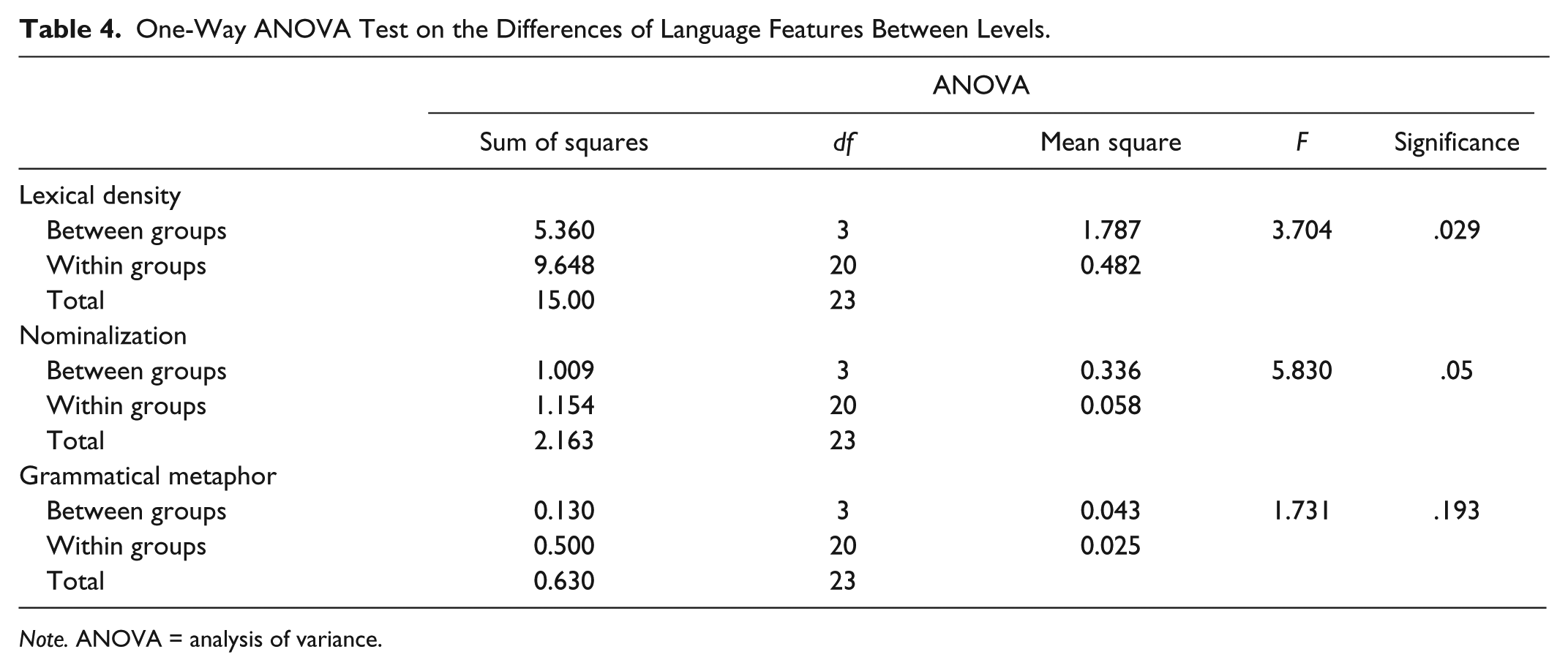
Note. ANOVA = analysis of variance.
Turkey HSD Test on Comparisons of Language Features Between Levels.

Note. HSD = honestly significant difference.
The mean difference is significant at the .05 level.
Correlations of Grammatical Metaphor, Nominalization, and Lexical Density
Using Kolmogorov–Smirnov test, the raw data of lexical density, nominalization, and grammatical metaphor showed normal distributions. Thus, Pearson correlation was applied to obtain the correlation coefficients among variables. The results was presented in Table 6.
Pearson’s Correlations Among Language Features.

Correlation is significant at the .05 level (two-tailed). **Correlation is significant at the .01 level (two-tailed).
Correlation Between Grammatical Metaphor and Lexical Density
As stated by Halliday and Matthiessen (2004), the employment of grammatical metaphor results in high lexical density value. However, high lexical density may not necessarily involve grammatical metaphor. The use of strings of lexical items only can also lead to lexically dense texts (Halliday, 1993b). Examples can be seen from the following sentences taken from the data.
Example 2: A
Example 3:
Examples 2 and 3 have the same number of eight lexical items per ranking clause. However, there are two instances of grammatical metaphor (e.g., changes and distribution) in Example 2 while there is none of these found in Example 3.
Based on Halliday’s studies, two hypotheses regarding the relationship between grammatical metaphor and lexical density in this study were formulated as follows.
Result of the correlational analysis in Table 6 shows that the significance level (p value) was .01. This was smaller than .05; thus, we rejected the null hypothesis H0. This means that grammatical metaphor and lexical density demonstrated a relatively strong positive relationship with the correlation coefficient r = .62.
Correlation Between Nominalization and Lexical density
Nominalization is one of the lexical items that conveys the lexical meaning; thus, it has the potential of contributing to the text’s high density. For instance, in Example 4, there are seven lexical items in two ranking clauses, giving the lexical density at 3.5 according to Halliday’s method. However, in Example 5, with the employment of nominalization “care” and “loss,” two ranking clauses in Example 4 are combined into one clause as seen in Example 5. As a result, lexical density goes up higher with the density value of six lexical items per clause.
Example 4:
Example 5:
Two hypotheses regarding the relationship between nominalization and lexical density were tested in this study as follows.
As displayed in Table 6, the significance level (p value) was .01 < .05; thus, we rejected the null hypothesis H0. This means nominalization and lexical density in this study were strongly associated with the positive correlation coefficient r = .74.
Correlation Between Grammatical Metaphor and Nominalization
Nominalization is the powerful resources for producing grammatical metaphor (Halliday, 1985a, 1994, 2004). An example can be seen in Example 6. There are three instances of nominalization that function as ideational grammatical metaphor at the same time.
Example 6:
Thus, to see how strong the relationship between these two features was in the data, two following hypotheses were formulated.
As observed in Table 6, the significance level (p value) was .01 < .05; thus, we rejected the null hypothesis H0, accepting the alternative hypothesis H1. This means nominalization and grammatical metaphor were strongly and positively associated with the positive correlation coefficient r = .8.
Discussion of the Results
Rigorous research on complexity of written language in general and in scientific discourse in particular from the functional grammar perspective has been done by Halliday (1985b, 1993a, 1993b, 1998, 2004, 2008), the father of SFL theory and well-known functional and educational linguists (Banks, 2003, 2005; J. K. Martin, 2008; J .R. Martin, 1993; Ravelli, 1999). In fact, SFL has produced well-established measures toward linguistic complexity despite its real complexity in social contexts (J. R. Martin & Rose, 2003). Looking at complexity through the lens of SFL provides useful insights into language and the fuller picture of it regarding how complexity works and why it works in the way it does at the levels of grammar, discourse, and context. In addition, it does help explain the functions of language in social contexts. The modest contribution of this small-scale study is that it expands prior research by examining complexity of language in a set of international textbooks used for teaching EFL within the current context that research on EFL textbooks in light of SFL has still been under-investigated. Although there is a general assumption that textbooks, of course, grow more complex when their levels advance, this study has statistically proved that by using SFL principles. As predicted, it has been demonstrated that complexity which is realized in density, nominalization, and grammatical metaphor increased from low to high levels of books. This might not be a surprise as displaying a gradual increase of complexity across book levels might be one of the writer’s purposes in writing books for different levels. It is worth noting that Books 1, 2, and 3 in the corpus were written by one author; thus, this may be a good reason to explain why complexity was well-controlled across the first three levels of textbooks. Regarding Books 3 and 4, the descriptive statistics of linguistic features between them were relatively similar.
This finding also supports Halliday’s studies when the strong positive correlations among lexical density, nominalization, and grammatical metaphor were found. This means that when nominalization rose in accordance with the book levels, this entailed the increase of grammatical metaphor and lexical density. The strong association between nominalization and grammatical metaphor (r = .8) also confirms that nominalization is the powerful resource for producing grammatical metaphor or the main form of grammatical metaphor is nominalization (Halliday & Matthiessen, 2004, 2014). This is a logical result as this study investigated two types of nominalization realized at the level of lexicogrammar, including nominalization of verbs and nominalization of adjectives. Semantically and congruently, verbs are realized as processes and adjectives realized as quality. However, when grammatical metaphor involves, processes and quality are metaphorically realized as things in another process. This means that the ideational content which is congruently expressed in clauses is densely packed in nominal groups when grammatical metaphor occurs. This explains why grammatical metaphor often follows high lexical density (Halliday & Matthiessen, 2004). The relatively strong correlation between grammatical metaphor and density in this study (r = .62) confirms this. However, grammatical metaphor does not always necessarily involve lexically dense texts, as the lexical meaning or ideational content can also be densely packed in strings of lexical items (involving nominalization). That says, nominalization is significantly associated with lexical density. The coefficient correlation between nominalization and density in this study (r = .74) illustrated this. This confirms that nominalization, grammatical metaphor, and lexical density are interrelated linguistic features, characterizing linguistic complexity in textbooks across levels. It is worth mentioning that while this study identified the overall trend of complexity across levels based on the mean scores of linguistic features investigated, the standard deviation, minimum, and maximum values of each book indicate that a few specific texts in high-level textbooks had relatively similar complexity values compared with the other ones in lower level textbooks. An example might be found in Book 4 with the minimum score of lexical density of 3.81, while it was 3.6 in Book 1. Another example can be seen in the use of grammatical metaphor. A low-level text may employ the same amount of grammatical metaphor as it does in the higher level text. Maximum values of grammatical metaphor in Book 1 and Book 3 are two illustrations. Although these cases were not many in the data, the result is also important as it indicates that to choose appropriate texts or textbooks suiting the leaner levels and teaching purposes, detailed examination of particular texts might be essential in addition to the whole book.
This research is worthwhile as recent research on linguistic complexity in SLA literature seemed to neglect to look at how complexity realized in international textbooks from Halliday’s functional grammar approach (see Benedikt & Bernd, 2009; Dahl, 2008; Fred, 2009; Hendrikse & Van Zweel, 2010; Kuiken & Vedder, 2007; Miestamo, 2009; Ortega, 2003; Patrick, 2008; Szmrecsanyi & Kortmann, 2012). Our research has filled that gap and confirmed that SFL is a good model to examine linguistic complexity, as it allows us to look at complexity at three levels and social functions of language. Examining complexity from the SFL perspective also helps identify the interrelated relationships among linguistic features characterizing complexity; thus, it provides appropriate and convincing explanations of complexity.
As explained previously, grammatical metaphor is considered as having interrelated relationship with lexical density and nominalization (Halliday, 1985a, 1994; Halliday & Matthiessen, 2004). Halliday and Matthiessen (2004) state that nominalization is “the single most powerful resource for creating grammatical metaphor” (p. 656), resulting in high lexical density. Nominalization and grammatical metaphors are language features of academic texts at a higher level. Lower level texts may not use a high amount of nominalization and grammatical metaphors, leading to less dense texts. This finding of the study provides a number of practical implications for understanding reading and writing development of students as well as for the teaching of reading and writing and curriculum design. Two studies by To and Thomas (2017) and Thomas and To (2016) in Australian writing texts show that even high scoring middle primary school students were able to use nominalization and different types of grammatical metaphors of modality in their writing, though this nominalization is formally introduced in the Australian curriculum: English in Year 8. This suggests that lower grade or level students are able to acquire these language resources if they are explicitily taught. The extent to which they use the advanced linguistic features like nominalization and grammatical metaphor helps understand their writing development. In curricular in secondary school education in English-speaking contries like Australia, texts are full of nominalization and grammatical metaphors. Being able to understand these concepts will enable students to be successful with their reading and writing. In the teaching of reading, teachers can unpack nominalization and grammatical metaphors for students to understand the texts more easily and then repack them so that they can have access to abstraction and technicality which are typical in secondary natural science and humanity subjects.
It is also important to note that the purpose of this research was not evaluating the books Active Skills for Reading as a whole, as an evaluation of textbooks necessarily involves a variety of factors in which linguistic complexity is just one of those. Besides, this research did not investigate all the genres in four textbooks chosen; consequently, the conclusions on linguistic complexity drawn from the findings in this study should be understood within its research scope. Regardless, further research on linguistic complexity in EFL textbooks and in SLA can be expanded based on this study.
Conclusion
This research investigated four EFL textbooks at four different levels to quantify complexity to draw a conclusion about the relationship between complexity and textbook levels. The findings show that linguistic complexity increased when the level of textbook advanced from elementary to upper intermediate. However, the highest level of textbooks, upper intermediate, did not demonstrate the peak of complexity among four levels. There were strong relationships among nominalization, grammatical metaphor, and lexical density in the data. Across four levels of textbooks, on average, texts at higher level displayed higher density and frequency of nominalization and grammatical metaphor. These findings recommend that for text choice, to choose appropriate texts suiting the learner level, an examination of the complexity of the text language is necessary. For textbook choice, it is helpful to look at textbook levels proposed by textbook writers, but it would also be useful to examine specific texts in those books. As for compiling textbook in general, thinking of teaching purposes, L2L levels, linguistic complexity, fields, and genres of texts will help writers deploy appropriate linguistic resources to fulfill their aims in textbook writing.
Footnotes
Declaration of Conflicting Interests
The author(s) declared no potential conflicts of interest with respect to the research, authorship, and/or publication of this article.
Funding
The author(s) disclosed receipt of the following financial support for the research, authorship, and/or publication of this article: This paper is part of a PhD research project fully funded by the University of Tasmania, Australia.