




Abstract
This study evaluated effects of Positive Action (PA), a school-based social-emotional and character development program, on self-esteem levels and processes among minority, low-income, urban youth. A matched-pair, cluster-randomized controlled trial was conducted in 14 Chicago Public Schools with outcomes assessed longitudinally for a cohort of youth followed from Grades 3 to 8. A total of 1,170 students participated in the study (53% female, 48% African American, and 27% Hispanic). Students in PA schools had more favorable change and endpoint scores on indices of self-esteem in the domains of peer and school and use of both adaptive and (to a lesser extent) maladaptive processes for developing and maintaining self-esteem. These results align with areas of emphasis within the PA program and illustrate how important areas of impact on self-esteem-related outcomes may be overlooked without differentiated assessments of both self-esteem levels and processes.
Keywords
Self-esteem, typically defined as overall feelings of self-worth (Harter, 2015), is widely viewed as important for positive adaptation and well-being throughout the life course (Guerra & Bradshaw, 2008). Consistent with this perspective, available evidence indicates that, among developing children and adolescents, higher levels of self-esteem can make significant contributions to health and well-being, and conversely, that a relative lack of feelings of self-worth can increase susceptibility to a range of negative outcomes such as mental health problems, substance use, aggression, and delinquency (for reviews, see DuBois & Tevendale, 1999; Swann, Chang-Schneider, & McClarty, 2007; for illustrative prospective studies, see Donnellan, Trzesniewski, Robins, Moffitt, & Caspi, 2005; Orth, Robins, Trzesniewski, Maes, & Schmitt, 2009; Trzesniewski et al., 2006).
Self-Esteem
Self-esteem can be viewed as one element within the larger category of self-views and is generally distinguished from self-concept (a descriptive evaluation of the self; Hattie, 2014) as having a more affective or evaluative component that involves an appraisal of one’s self-worth (Brown, 2014; Harter, 2015). Self-efficacy, in contrast, refers to a person’s belief in his or her ability to successfully complete a task or accomplish a goal (Bandura, 1977, 1986). Self-beliefs are most commonly assessed via self-report measures in which people are asked to rate their agreement with how much a particular statement reflects their own perception of themselves.
Developmentally, there are shifts in overall levels of self-esteem as children progress through elementary school into the middle school/adolescent years. A review of research on developmental trends in self-esteem (Robins & Trzesniewski, 2005) noted a general decline in self-esteem from childhood through adolescence. In this review, it was noted that while young children have relatively high self-esteem on average, cognitive development in childhood enables children to base their self-evaluations on social comparisons and feedback from others, leading to a more accurate appraisal of the self, which has a net effect of a drop in self-esteem levels as they move through the elementary school years. This decline continues in adolescence, attributed in part to the physical changes of puberty, the development of abstract thinking, and the transition to high school, which can be more challenging both academically and socially (Robins & Trzesniewski, 2005).
A criticism of perspectives that have argued for the importance of self-esteem to positive adjustment and development is that effects of self-esteem on positive outcomes, when evident, tend to be relatively modest in size (Baumeister, Campbell, Krueger, & Vohs, 2003; Boden, Fergusson, & Horwood, 2008). These critiques have been concerned primarily with the adaptive implications of self-esteem at the global level (Swann et al., 2007). This is an important consideration because both evidence and theory suggest that the adaptive implications of more circumscribed, domain-specific self-evaluations, such as those tied to different areas of a young person’s development (e.g., peer relations, body image), may be more pronounced and consistent. This appears to be particularly the case when such self-evaluations are examined in relation to adaptive outcomes within the same domain (DuBois, Flay, & Fagen, 2009; Swann et al., 2007). Illustratively, in a meta-analysis of prospective studies of the relation between self-beliefs and academic achievement (Valentine, DuBois, & Cooper, 2004), results indicated that self-beliefs tied to the academic domain were stronger contributors to academic achievement than were global self-beliefs. Such findings suggest that it is important to also measure specific domains of self-esteem among developing youth rather than limiting research solely to global measures (Harter, 2015).
A further important consideration is that prior studies of the role of self-esteem in youth development have been focused nearly exclusively on levels of self-esteem (i.e., whether self-evaluations are relatively low or high). One concern in this regard is that some evidence has tied higher levels of self-esteem to less favorable outcomes. For instance, some research (e.g., Bushman & Baumeister, 2002) indicates that reports of high self-esteem may be implicated in aggressive behavior if such feelings are based on self-views that are inflated (i.e., unrealistic or based in views of superiority toward others) and these are challenged. Research with adolescents, for example, indicated that youth with this type of “defensive” high self-esteem were more likely to be nominated as bullies by their peers (Salmivalli, Kaukiainen, Kaistaniemi, & Lagerspetz, 1999). Twenge and colleagues have also found evidence that global self-esteem has increased across age cohorts (across a time span of up to four decades) for middle school, high school, and college students (Gentile, Twenge, & Campbell, 2010; Twenge & Campbell, 2001), but without evidence of significant corresponding improvements in indicators of adjustment such as academic competence and reduced risk-taking behavior.
In line with such findings, several theorists have argued that the processes involved in the formation and maintenance of self-esteem among developing youth can have important implications for their levels of adjustment in different areas independent of whether resulting levels of self-esteem are low or high (DuBois & Flay, 2004; Harter, 2015; Kaplan, 2006). Drawing on available theory and evidence from areas such as social and clinical psychology, self-esteem enhancement theory (SET; DuBois et al., 2009) posits that strategies for obtaining or sustaining self-esteem (which may be cognitive, behavioral, and affective in nature) can have direct implications for outcomes in areas such as health, well-being, and academic achievement. In this model, the outcome of these strategies forms a feedback loop. When efforts to achieve self-esteem (regardless of whether they are adaptive or maladaptive) result in success (i.e., feelings of worth), the reinforcing nature of the experience increases the likelihood of these behaviors being repeated. If the efforts are not successful in resulting in feelings of worth, these efforts would be expected to be adjusted to better meet the needs for self-esteem.
Adaptive strategies more likely to lead to healthier outcomes include the development of personal competencies and supportive relationships with others. Maladaptive strategies may include self-protective attitudes and behaviors such as the aforementioned tendencies to harbor inflated self-views and defend against challenges to them with aggression. Other possibilities include devaluing the importance of an area that is important for immediate or long-term functioning or both (such as school), seeking less challenging activities, or engaging support from deviant peers. As noted by DuBois et al. (2009), while some of the strategies that might be considered maladaptive (e.g., self-enhancing responses) may have some positive benefits, for example, in terms of coping with stress, there is also evidence that there are several negative implications for well-being that can result from the use of these strategies.
Self-Esteem Interventions
Even with the foregoing concerns that have been raised regarding the strength and direction of the adaptive implications of self-esteem, there has been considerable and seemingly largely sustained interest in using interventions to strengthen self-esteem among youth. In a meta-analysis of 116 studies of programs for children and adolescents with self-esteem or self-concept as an outcome variable, Haney and Durlak (1998) found an overall favorable, but modest effect on self-esteem (Cohen’s d = 0.27); the effect size (ES), however, was notably larger (d = 0.57) for programs that explicitly targeted self-esteem or self-concept as opposed to other outcomes (e.g., social skills). Furthermore, programs with a rationale derived from prior research findings or from theory also were associated with larger program effects, a finding that aligns with the broader base of evidence to support the use of theory in design of health promotion interventions (Glanz & Bishop, 2010). A second meta-analysis of self-esteem interventions for children (O’Mara, Marsh, Craven, & Debus, 2006) similarly found a significant effect of interventions on self-esteem and self-concept outcomes (d = 0.51). Findings also indicated greater effects (d = 1.16) for interventions that targeted specific domains of self-esteem and measured outcomes within the same domains. This latter finding is important in view of research suggesting that linkages between self-esteem and other adjustment outcomes may be revealed when assessments are expanded to include more circumscribed, domain-specific facets of self-esteem (DuBois et al., 2009; Swann et al., 2007).
In summary, available evidence indicates that programs for youth can result in improvements to self-esteem, especially when such interventions are informed by theory, have self-esteem enhancement as a goal, and target self-evaluations in relevant domains. There are, however, at least two important limitations to the current body of literature. First, to our knowledge, few, if any, programs receiving rigorous evaluation to date have incorporated all of these features. For example, most programs have targeted and assessed self-esteem only at a global level (e.g., Haney & Durlak, 1998). Or, if domain-specific self-evaluations have been a focus, interventions have not necessarily had a strong grounding in theory. Evaluations of specific programs that incorporate all features suggested to be important in the most rigorous available syntheses of existing evidence would thus be useful in advancing the current knowledge base regarding approaches to self-esteem enhancement for youth.
A second concern relates to adopting levels of self-esteem alone (i.e., whether self-evaluations are relatively low or high) as a target for intervention. Theoretically, interventions may be able to promote more adaptive self-esteem processes by teaching youth to use strategies that build a healthy foundation for their sense of self-worth and by providing supports and reinforcement for utilizing these types of strategies (DuBois et al., 2009). At present, however, there are no studies to our knowledge that have explicitly evaluated the impact that interventions using these types of approaches may have on the use of adaptive processes of self-esteem formation and maintenance.
The Present Study
The present study addresses the issues identified above using data from a cluster-randomized controlled trial of the Positive Action program (PA; http://www.positiveaction.net; Flay & Allred, 2010). PA is a comprehensive, schoolwide, social-emotional, and character development (SECD; Elias, 2009) program grounded in theories of self-concept (Purkey, 1970; Purkey & Novak, 1970). A range of ecological supports (e.g., school climate development, family classes) provide social reinforcement and validation for engaging in positive behaviors in both school and nonschool settings. By virtue of being implemented in the school context, recurring use of school-related examples in the program’s curriculum, and directly seeking to teach behaviors conducive to learning and intellectual development, the PA program is well suited to strengthening self-evaluations in the area of school. The program is similarly oriented to fostering positive self-evaluations in the area of peer relations through its emphasis on promoting positive school climate, use of interactive small group activities within the curriculum, and a unit dedicated to social relationships (“Getting along with others”). Although self-evaluations in other areas (e.g., family) are also addressed through different aspects of the program (e.g., family classes), these receive relatively less emphasis.
Importantly, PA is also oriented strongly toward cultivating adaptive and healthy ways of developing and sustaining self-esteem, consistent with the SET model (DuBois et al., 2009). The first unit of the curriculum, for example, teaches the philosophy of the program and the Thoughts–Actions–Feelings about Self Circle; in doing so, students are sensitized to the motivation to feel good about oneself and the potential to attempt to achieve such feelings through not only positive, but also negative behaviors. Later units build on this idea by emphasizing the importance of self-honesty (thus encouraging accurate self-appraisals) and continual self-improvement. Also noteworthy are the environmental supports and reinforcement provided for students to engage in behaviors that are aligned with these goals (DuBois et al., 2009).
Previous experimental evaluations and analyses from the Chicago Trial of PA that is the focus of the current research have indicated favorable effects of the intervention on a range of outcomes including academic achievement (Bavarian et al., 2013; Flay, Allred, & Ordway, 2001; Snyder et al., 2010), school attendance (Bavarian et al., 2013; Flay & Allred, 2010; Snyder et al., 2010), indicators of positive youth development (Lewis et al., 2016), emotional health (Lewis, DuBois, et al., 2013), and problem behavior in areas such as violence and substance use (Beets et al., 2009; Lewis et al., 2012; Lewis, Schure, et al., 2013; Li et al., 2011). There is more limited evidence, however, for the impact of PA on self-esteem outcomes. Two earlier reports indicated positive effects of PA on self-esteem and self-concept (Waggoner-Weir, 1991; West, 1997); these results, however, were from unpublished reports using small samples and did not include measurement of domain-specific self-esteem or self-esteem processes. More recently, a quasi-experimental longitudinal evaluation of PA in two rural school districts found that implementation of the PA program was associated with positive gains in global self-esteem relative to the comparison school district (Guo et al., 2015). These findings are consistent with results of a recent meta-analysis of the impact of school-based social and emotional learning programs (Durlak, Weissberg, Dymnicki, Taylor, & Schellinger, 2011) that indicated a significant positive effect (ES = 0.23) on outcomes in the category of “attitudes towards self and others,” which included self-esteem combined with a range of other attitudinal variables.
The present research is the first comprehensive evaluation of effects of PA on self-esteem outcomes using a randomized design. Measures assess levels of both overall self-esteem and self-evaluations within several specific domains (e.g., school, peers, family). Furthermore, processes of self-esteem development and maintenance are also assessed. Longitudinal growth-curve models are used to test the hypotheses that students in PA schools will have more favorable trajectories during the time period of the intervention in both (a) their reported levels of self-esteem (global and domain-specific) and (b) reported use of adaptive and maladaptive processes for self-esteem formation and maintenance
Method
Participants
Schools participating in the study were drawn from 483 K-6 and K-8 Chicago Public Schools. Sixty-eight schools met study eligibility criteria, which included enrollment between 50 and 140 students per grade, student mobility below 40%, more than 50% of students from low-income backgrounds, and less than 50% of students meeting or exceeding criteria for the state achievement test (Ji, DuBois, Flay, & Brechling, 2008). Of this group, 18 schools agreed to participate, and the seven (the limit funding would support) best matched pairs were selected for participation (Ji et al., 2008; Schochet & Novak, 2003). A series of t tests revealed that the PA and control schools were not significantly different from each other on any of the matching variables (which included, among others, the proportion of students across different racial and ethnic groups, the percentage of students receiving free or reduced lunch, and student attendance and truancy rates) and that the seven pairs of schools did not significantly differ from the remainder of the 68 schools eligible for the study (Ji et al., 2008).
The trial was longitudinal at the school level with a place-focused intent-to-treat design at the cohort level (Vuchinich, Flay, Aber, & Bickman, 2012). Specifically, a cohort of students in the seven matched pairs of schools was followed, beginning in Grade 3 (fall 2004), and at seven additional times (waves) over 6 years: spring 2005, fall 2005, spring 2006, spring 2007, fall 2008, spring 2009, and spring 2010 (end of Grade 8). Throughout the 6 years of the study, 100% of schools were retained.
Parental consent was required for study participation. Parents of 79% of students in the cohort provided consent at baseline. Students joining the study at later waves were consented at that time (65% to 78% consent rate for Waves 2-5). All students were reconsented for the second phase of funding at Wave 6 (beginning of Grade 7); consent rates were lower at Waves 6 through 8 (58% to 64%) than Waves 1 through 5 (65% to 78%), which is consistent with other studies (Ji, Pokorny, & Jason, 2004; Thompson, 1984).
The total number of students enrolled in the study across all eight waves was 1,170, of whom approximately 53% were female; approximately 48% were African American, 27% Hispanic, 7% White, and 12% other (e.g., Asian, Native American, and “Other”). The original cohort (students in Grade 3 at the beginning of the trial) included 624 students; by Wave 8 (end of Grade 8), the sample size was 363 students (58% of the original sample size); this group in Wave 8 included 131 (21%) of the original cohort students. This reflects the high mobility by low-income urban students, a pattern that has been documented with this population (Tobler & Komro, 2011). With respect to maintenance of the baseline sample size, 363 students were present at Wave 8 (i.e., approximately 58% of the Wave 1 sample size). The decrease in N over time is consistent with the trend among Chicago Public Schools to decrease in size during the study period and the above noted lower consent rates in the later waves of the study.
Program Description
The PA program consists of a K-12 curriculum, of which the K-8 portion was used for the present study. The program is implemented predominantly by teachers directly in the classroom. The sequenced classroom curriculum consists of over 140 fifteen-to-twenty-minute age-appropriate lessons taught 4 days per week for Grades K-6, and 70 20-minute lessons taught 2 days per week for Grades 7 and 8. Although the emphasis in the study was placed on implementation of the classroom curriculum for the targeted cohort group, program schools were provided with curriculum materials for all grade levels in the school and training and implementation support was provided to all classroom teachers. The core curriculum consists of the following six units: (a) Self-Concept (introducing the concept and model), (b) Positive actions for your body and mind, (c) Managing yourself responsibly, (d) Treating others the way you like to be treated, (e) Telling yourself the truth, and (f) Improving yourself continually. In addition to the classroom curriculum, the PA program also includes teacher training, counselor, family, and community training, and schoolwide climate development, all of which are organized around the six units of the core curriculum. The community training component was not implemented as part of the current study. More detailed information can be obtained from the program website, http://www.postiveaction.net.
Measures
Self-esteem
The Self-Esteem Questionnaire (SEQ) is a multidimensional measure of self-esteem previously validated for use with youth between 10 and 15 years of age (DuBois, Felner, Brand, Phillips, & Lease, 1996). Items consist of statements about evaluations of the self in various domains as well as overall feelings of self-worth. The present research used an adapted short form of the original 42-item measure of 28 items that were selected based on likely appropriateness for third-grade students and a reliability analysis conducted on pilot data that included this age group. Items were dropped from the original full version based on having low item-total alpha correlations in the reliability analysis, and the subscales were tested using a confirmatory factor analysis. Although a 4-choice response scale was retained, the response choice labels were adapted from agree-disagree language to be appropriate for younger children (NO! no, yes, and YES!). The measure yields separate scores for Global Self-Esteem (e.g., “I am happy with myself as a person”) as well as five self-esteem domains: Peer (e.g., “I am as well liked by other kids as I want to be”), School (e.g., “I feel OK about how good of a student I am”), Family (e.g., “I get along as well as I’d like to with my family”), Appearance (e.g., “I wish I looked a lot different”), and Sports (e.g., “I participate in as many different kinds of sports/physical activities as I want to”). Internal consistency reliability estimates were consistently acceptable for all subscales, which each consisted of four items (α = .70 to .82 across Grades 3-8) with the exception of the School and Appearance subscales in Grade 3, which had estimates of .68 and .66, respectively. Test–retest reliability estimates over a 2-week interval, obtained at Grade 5 for a subset of 62 students (two classes each from one intervention and one control school) were also in the acceptable range (rs = .74 to .87).
Processes for self-esteem formation and maintenance
The Self-Esteem Formation and Maintenance Questionnaire is a 21-item measure developed for the present research for the purpose of assessing attitudes and behaviors exhibited by youth that may be adaptive or maladaptive strategies for satisfying motivation to feel good about themselves. Items were selected from an initial pool of items, informed by judgments of likely appropriateness for third-grade students and findings of a reliability analysis conducted on the above referenced pilot data. The measure yields separate scores for students’ use of processes for self-esteem formation and maintenance that are adaptive (seven items; for example, “I am good at figuring out what I need to do to improve myself”) and maladaptive (14 items; for example, “I put others down so I can feel better about myself”), respectively. All items use a 4-choice response scale (NONE of the time, SOME of the time, MOST of the time, ALL of the time). Internal consistency reliability estimates were acceptable for both subscales (adaptive: α = .74 to .79, maladaptive: α = .78 to .81). Test–retest reliability estimates were .81 and .53 for the maladaptive and adaptive subscales, respectively.
Analysis
Multilevel (observations nested within students nested within schools) random-intercept growth-curve models were performed using Stata’s (Version 12) “xtmixed” (for normally distributed outcomes) and “xttobit” (for outcomes with a skewed distribution) commands to account for all observations and to model school differences (Rabe-Hesketh & Skrondal, 2008). This approach allows for a more complete analysis of the multiple waves of available data and takes into account the pattern of change over time. The “xttobit” command was used for the majority of the outcomes because the scores generally followed a normal distribution, but had excess frequencies of the highest scores (i.e., ceiling effects). This pattern typically indicates that a normal distribution of scores would be possible with the inclusion of more extreme response item choices, but the higher scores were censored due to the response options available for the particular items on the scale.
For the growth-curve analysis of each measure, we first fit a full random-intercept model including condition (i.e., PA or non-PA school), time (measured as years of exposure to PA), condition by time (Condition × Time), and quadratic terms for time and the interaction of condition by time (Time2 and Condition × Time2). Higher order terms lacking statistical significance were then dropped from the model for parsimony in a stepwise fashion, until a reduced model was achieved. Analyses were run using both the fully reduced random-intercept and random-coefficients models (when possible within Stata’s statistical capabilities). As the former model is nested within the latter model, a likelihood ratio test was performed to determine which model was a better fit for the data (Rabe-Hesketh & Skrondal, 2008); model estimates for the better fitting model are reported in the appropriate tables. Effect sizes (representing standardized mean differences) were calculated using estimated means at baseline (Wave 1) and study endpoint (Wave 8) from fitted models and observed standard deviations (Lipsey & Wilson, 2001).
Supplementary Analyses
We performed supplementary analyses to assess the robustness of results from the primary analyses. One approach (when possible within the Stata program’s statistical capabilities) involved including a “pairs” variable as an additional, highest level in each of the best fitting models to determine whether adding an additional level would affect findings. To provide a more conservative test of program effects for each outcome, the test statistics provided by Stata (which assume a large sample size) in the primary analyses (which included 14 schools) were also compared with the critical value of 2.18, the critical value for a two-tailed t distribution with 12 degrees of freedom at a 95% confidence level.
Finally, we also tested for possible moderating effects of gender and time in study. First, we examined whether program effects across time differed by gender. Next, we examined the effect of time in study (i.e., length and timing of exposure to the PA intervention for students in PA schools and study duration for students in non-PA schools) using results from a latent class analysis (Lewis et al., 2016) in which a five-class solution was found to be the most appropriate fit for the data. This solution included five groups: (a) stayers (average study duration of 5.72 years, N = 158), (b) temporary participants (present for Grade 4 and/or 5 only; average study duration of 1.30 years; N = 196), (c) late joiners (average study duration of 1.38 years; N = 308), (d) early leavers (average study duration of 0.94 years; N = 263), and (e) late leavers (average study duration of 3.23 years; N = 287); stayers served as the reference group.
Results
Table 1 shows the correlations at Waves 1 (beginning of Grade 3) and 8 (end of Grade 8); growth-curve analyses results are presented in Table 2. Table 3 shows the estimated means for PA and control schools at study baseline and endpoint along with estimated ESs at endpoint.
Correlations of Measures at Wave 1 (N = 586; Below Diagonal) and Wave 8 (N = 333; Above Diagonal).

Note. All correlations are significant at p < .05 unless noted as ns.
Growth-Curve Analyses Results for Self-Esteem Measures (N = 1,170 at Student Level; N = 14 at School Level).

Note. Random intercept models were estimated for the following self-esteem outcomes: Peer, school, family, appearance, sports, adaptive, and motivation. Random coefficient models were estimated for the following self-esteem outcomes: Global and maladaptive self-esteem processes.
For all estimated models, the coefficient for the intercept was significant at the p < .001 level.
Baseline means for maladaptive self-esteem significantly favored the PA condition.
p < .10. *p < .05. **p < .01. ***p < .001.
Estimated Means for Self-Esteem Measures.

Note. For censored measures (School Self-Esteem and Family Self-Esteem), the predicted mean may fall outside of the range of the scale because of the nature of the estimator. PA = positive action.
Growth-curve analyses revealed significant evidence of effects of the PA program on change over time, in the form of a significant Time × Condition interaction, for four of the eight measures. Specifically, students in schools that received PA showed more positive change over time on the measures of peer self-esteem (B = 0.04, p = .01; ES = 0.37), school self-esteem (B = 0.04, p = .003; ES = 0.46), and use of adaptive self-esteem formation and maintenance strategies (B = 0.03, p = .046; ES = 0.31). As can be seen in Figures 1 and 2, for peer and school self-esteem as well as adaptive self-esteem processes, the pattern was for students in PA schools to show a less marked decline in scores on the measure over time relative to those in control schools. The net result of this differential change was a difference at study endpoint favoring students in PA schools on each measure.
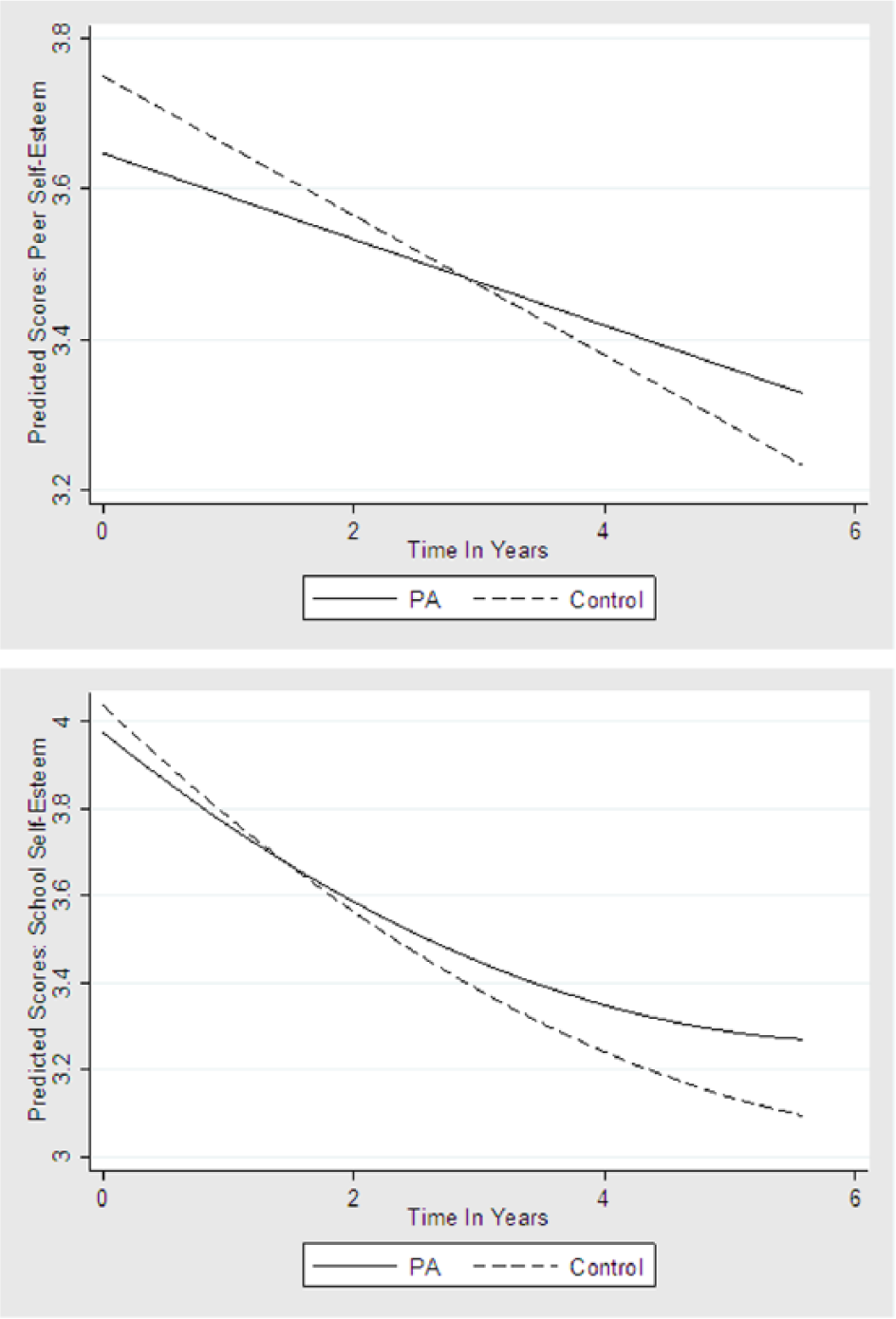
Growth-curve graph of effect of PA on the self-esteem domains of peers (top) and school (bottom).

Growth-curve graph of effect of PA on positive self-esteem processes (top) and negative self-esteem processes (bottom).
Maladaptive self-esteem processes showed a more complex pattern, with a significant Linear time × Condition interaction (B = −0.07, p = .038) and a Quadratic condition × Time interaction (B =.01, p = .054). As can be seen in Figure 2, students in both PA and control schools showed an overall pattern of decline in reported use of maladaptive self-esteem processes, with PA students showing a slight increase toward the study endpoint. The resulting group difference at the final wave, however, was small in magnitude (ES = −.09).
The findings reported above remained significant in the pair-level sensitivity analysis and the sensitivity analyses using the adjusted degrees of freedom (with the exception of maladaptive self-esteem; results not shown).
Supplementary Analyses
Moderation by gender was observed for one measure, sports self-esteem—Condition × Time × Gender (1 = male, 0 = female) interaction B = −0.09, p = .036. The pattern of the interaction showed evidence of a positive effect of PA on change over time on sports self-esteem for girls (ES = 0.45) but a negative effect for boys (ES = −0.39). Moderation by mobility class (i.e., time in study) was not observed for any of the outcomes.
Discussion
Initial study hypotheses were partially supported. Students in PA schools were found to have higher self-esteem in the domains of school and peers, but the remaining domains, as well as global self-esteem, showed no group differences. Similarly, students in PA schools reported greater use of adaptive (but not maladaptive) processes of self-esteem formation and maintenance. Although the ESs, when significant, were relatively small, they were comparable to those found in prior meta-analyses of the impact of youth interventions on self-esteem outcomes (e.g., Haney & Durlak, 1998; O’Mara et al., 2006). While not a self-esteem intervention per se, in that PA is targeted at a broader range of outcomes, building a more positive sense of self through conscious effort is a fundamental part of the PA philosophy. The first unit of the program, for example, focuses on the formation and importance of self-concept (Flay & Allred, 2010).
The self-esteem domains showed moderate correlations with each other, as well as with global self-esteem at both Waves 1 and 8, with correlations being slightly higher at the last Wave (when the students were in Grade 8 as compared with Grade 3 at the start of the study). While relatively substantial, the intercorrelation among these scales is consistent with the initial research on the measure (DuBois et al., 1996) in which additional analyses also supported the validity of these self-esteem dimensions as distinct measures (e.g., in structural equation modeling [SEM] analysis, all of the self-esteem domains made significant and unique contributions to global self-esteem).
The domains where PA had a specific self-esteem impact were for school and peers (but not for global self-esteem), a finding that is not surprising given the nature of the program. As an intervention grounded in the school setting, PA curriculum addresses thoughts, actions, and feelings in the academic realm (e.g., Unit 2 focuses in part on the intellectual component of self-concept and positive actions to build a healthy sense of self in this domain), while also focusing on skills for relating positively with peers (e.g., Unit 4 is focused on using social and emotional positive actions to improve interpersonal relationships).
Results of the current study are consistent with prior findings showing a decline in self-esteem levels during the elementary and middle school years (Robins & Trzesniewski, 2005). This pattern of decline is often attributed to young people becoming more discriminating reporters with age (Wigelsworth, Humphrey, Kalambouka, & Lendrum, 2010). Results of the present study indicate that PA attenuated these negative developmental trajectories, but did not reverse them. It may be that the range of factors contributing to patterns of global self-esteem change in adolescence (Greene & Way, 2005) is more complex than can be reasonably addressed by broad social-emotional and character development programs such as PA. Alternatively, a more modest decline in self-esteem may in fact represent a healthy process whereby children, as they age, develop more realistic self-conceptions (Brown, 2014; Trzesniewski, Donnellan, & Robins, 2013).
The current study also built on the prior literature on both the effectiveness of the PA program and the impact of youth interventions on self-esteem by considering the additional outcomes of the processes (adaptive or maladaptive) used in the formation and maintenance of self-esteem, as well as the motivation to seek and maintain positive self-esteem. Given prior criticisms that have identified some negative aspects of high self-esteem (e.g., through links with narcissism or risks of problem behavior), broadening the measurement of self-esteem to include these additional outcomes provides support to the argument that the consideration of how self-esteem is developed and sustained is important, and that interventions that aim to increase self-esteem can do so by encouraging self-esteem processes that are positive and less likely to be associated with other maladaptive behaviors.
Where PA was found to have a significant impact, results were in the expected direction. Students in PA schools reported using more adaptive self-esteem strategies, as well as having greater motivation to maintain self-esteem. Both of these findings can be considered in the context of the core PA philosophy and thoughts–actions–feelings circle: Thoughts lead to actions, which lead to feelings about ourselves, which lead to more thoughts (which can be either positive or negative). The lessons in the PA curriculum emphasize making positive behavioral choices and are designed to continually reinforce the foundational concept that positive self-feelings arise from choosing positive actions. Thus, lessons of PA focus on making behavioral choices that are adaptive in nature and also emphasize the effortful nature of self-improvement.
Gender was found to moderate the effect of PA on only one outcome, sports self-esteem. Specifically, the program had a positive effect for girls in that it appeared to attenuate somewhat a decline in sports self-esteem (girls in PA schools decreased in score from 3.72 at Wave 1 to 3.16 at Wave 8 in comparison with girls in control schools who decreased from 3.83 to 2.99), but showed the reverse pattern for boys (who, in PA schools, declined from 3.99 to 3.48 in comparison with those in control schools, whose scores declined from 3.97 to 3.69). Given the finding that girls often decrease their athletic involvement, particularly during the transition to adolescence (Slater & Tiggemann, 2011), this is an encouraging result. With regards to boys, the finding of decreased sports self-esteem for boys in PA schools may in part reflect the emphasis placed in the program in being honest about one’s strengths and weaknesses. A potential result of this focus on honest self-assessment may lead boys in program schools to be more accurate reporters of their feelings related to their sense of sports-related ability.
An as-yet unanswered question regarding the findings of the effects of PA on self-esteem outcomes is whether or not self-esteem serves as a mediator of program effects on other outcomes (e.g., fewer psychological symptoms, problem behaviors, and school discipline referrals; higher levels of academic performance). Encouragingly, prior analyses using this data have shown direct program effects on many of these outcomes (e.g., emotional health, problem behavior). The pattern of results (PA showing positive effects on self-esteem but not an increase in negative outcomes) is consistent with other research also demonstrating that self-esteem can be increased without negative behavioral outcomes (Kafka et al., 2012). Future analyses using data from the Chicago Trial of PA will need to address the potential role of self-esteem in mediating program effects on these other outcomes.
Limitations and Directions for Future Research
The findings of this study should be viewed in the context of several limitations. Student outcomes were measured by student self-report, potentially leading to a method bias (Podsakoff, MacKenzie, Lee, & Podsakoff, 2003), which can inflate the observed relationships between the variables. Self-report also lends to the problem of social desirability, such that students may overestimate their positive thoughts, feelings, and behaviors or underestimate their negative thoughts, feelings, and behaviors to feel as if they “fit in” with their peers and society. In addition, it is possible that students in PA schools, due to the program’s emphasis on both self-honesty and acknowledgment of both strengths and weaknesses, could become more accurate reporters of their behavior than students not exposed to the program, which could result in lower social desirability in responding for this particular group. The measure of the processes of self-esteem formation (use of adaptive and maladaptive self-esteem processes) was developed for use in the current study and therefore the validity of the measure has yet to be demonstrated. With respect to external validity, the findings are generalizable only to schools that would self-select to participate in a trial of this nature. With respect to internal validity, the small number of pairs (i.e., seven) and schools (i.e., 14) could influence the statistical power; however, that significant findings were found in spite of this limitation suggests that our findings may be robust. In addition, as has been seen in other studies within low-income, urban school settings (Tobler & Komro, 2011), student mobility led to high turnover of students. We used latent class analysis to address this issue (Lewis et al., 2016). One final limitation is that the sample size at each wave decreased sequentially; nonetheless, no schools left the study.
The present study has several strengths. The longitudinal nature of this randomized controlled trial allowed examination of children across elementary and middle school grades. The sensitivity analyses serve to further support the study findings. The use of latent class analysis to examine the differences in study duration (and program exposure for students in PA schools) due to the high mobility of the student population is an additional strength of the study. This article included new measures that have not been previously assessed, allowing a more nuanced assessment of the impact of the PA program on specific elements of self-esteem that align with the theory underlying the program curriculum, with significant effects across a range of these outcomes. This measure could prove useful in other studies assessing self-esteem, particularly in the context of intervention programs. Moreover, this study involved a sample of students in a high-risk setting; generating improvements can be particularly difficult in urban areas facing rising poverty rates (DeNavas-Walt, Proctor, & Smith, 2009), health disparities (Braveman & Egerter, 2008), and cuts in social and educational programs (Johnson, Oliff, & Williams, 2010), making the identification of program effects in an urban school setting particularly encouraging.
In summary, the present study indicates that the PA program had positive effects as hypothesized on some measures of self-esteem, specifically in the school and peer domain, and in the greater use of adaptive processes for self-esteem formation and maintenance. This provides some initial evidence for the model hypothesized in SET (DuBois et al., 2009), that interventions that explicitly encourage the pursuit of self-esteem by the use of adaptive strategies can have a positive impact on relevant self-esteem outcomes, although the effect is small in magnitude.
Footnotes
Acknowledgements
The authors would like to express their thanks to Robert Duncan and Margaret Malloy for their additional input regarding methodological issues addressed in the article. We are grateful to the support of the Chicago Public Schools involved in the study along with their principals and teachers, as well as the participating students and their parents/guardians.
Authors’ Note
The Social and Character Development (SACD) research program included a multisite evaluation data collected by Mathematica Policy Research (MPR), and complementary research data collected by each grantee up to Grade 5. The findings reported here are based on both multisite and local data from the Chicago site up to Grade 8. These findings (which are based on preliminary analyses) may differ from the results reported (only up to Grade 5) for the SACD national evaluation study. The findings and conclusions in this article are those of the authors and do not necessarily reflect the official position of the Institute of Education Sciences, Centers for Disease Control and Prevention (CDC), MPR, or every Consortium member, nor does mention of trade names, commercial products, or organizations imply endorsement by the U.S. government.
Declaration of Conflicting Interests
The author(s) declared the following potential conflicts of interest with respect to the research, authorship, and/or publication of this article: The research described herein was conducted using the program, the training, and technical support of Positive Action, Inc. in which Brian R. Flay’s spouse holds a significant financial interest. Issues regarding conflict of interest were reported to the relevant institutions and appropriately managed following the institutional guidelines.
Funding
The author(s) disclosed receipt of the following financial support for the research, authorship, and/or publication of this article: This project was funded by grants from the Institute of Education Sciences (IES), U.S. Department of Education: R305L030072, R305L030004, and R305A080253 to the University of Illinois, Chicago (2003-2005) and Oregon State University (2005-2012). The initial phase (R305L030072), a component of the Social and Character Development (SACD) Research Consortium, was a collaboration among IES, the Centers for Disease Control and Prevention’s (CDC) Division of Violence Prevention, Mathematica Policy Research Inc. (MPR), and awardees of SACD cooperative agreements (Children’s Institute, New York University, Oregon State University, University at Buffalo–SUNY, University of Maryland, University of North Carolina–Chapel Hill, and Vanderbilt University).