




Abstract
In this study, we investigated the possible development of threat-related attentional bias due to the work as a police officer. For this purpose, we compared four groups, differing with regard to their experience in policing and martial arts: (a) police officers with no experience in martial arts (n = 74), (b) martial artists (n = 50), (c) police officers with martial arts experience (n = 33), and (d) a control group (n = 48). Participants completed the Dot Probe Task, the Emotional Stroop Task, and the State-Trait Anxiety Inventory. The results on the Dot Probe and the Emotional Stroop Task showed that the groups did not differ with regard to threat-related attentional biases. However, the control group showed higher measures of trait anxiety compared with the other groups. The results are discussed in the light of police use of force and martial arts training, as well as with regard to optimizing psychological measures to capture functional threat-related attentional bias.
Keywords
Introduction
Police officers are regularly confronted with threatening situations in the line of duty (Ellrich, 2016). Making situationally adequate decisions requires them generate and maintain situational awareness (SA), which refers to the cognitive processes that are involved in perceiving and comprehending the meaning of a given situation (Endsley, 1995; Endsley & Robertson, 2000; Klein, 2000; Saus et al., 2006). A critical component of SA is the fundamental perception of the elements of a particular environment (Saus et al., 2006). In this context, the allocation of attention to potential threat cues is a fundamental skill for any police officer, as identifying real threats can result in the prevention of harm (College of Policing, 2013; Füllgrabe, 2014).
Regarding human survival in general, the perception of biologically relevant stimuli, particularly life-threatening ones, is essential. The threat-related monitoring of an environment allows for efficient and accurate detection of and behavioral responses to potential threats. It involves the continuous balancing of various cognitive resources and response patterns (Adolphs, 2013; Davis & Whalen, 2001; Liddell et al., 2005; Naim et al., 2015; Pessoa & Adolphs, 2010; Zald, 2003), in which the amygdalae play a central role (Gur et al., 2002; Hariri, Bookheimer, & Mazziotta, 2000; Morris et al., 1996; Phillips et al., 1998; L. M. Williams et al., 2001). Healthy adaptation requires the individual to allocate attention to genuine threats while ignoring similar but nonthreatening stimuli (Naim et al., 2015). This delicate balance can be disrupted by traumatic events and give rise to threat avoidance and threat-related hypervigilance, which are often referred to as “clinical symptoms” (Das et al., 2005; Ehlers & Clark, 2000). For example, cognitive biases such as threat-related attentional biases have been identified as one of the most consistently demonstrated cognitive correlates of anxiety disorders (Bar-Haim, Lamy, Pergamin, Bakermans-Kranenburg, & van IJzendoorn, 2007; Naim et al., 2015; Yiend, 2010). However, cognitive biases have been demonstrated to exist in populations that are exposed to life-threatening dangers on a regular basis (Bar-Haim et al., 2010; Todd et al., 2015). Therefore, the valence of cognitive bias per se is neutral. Depending on the environment and the tasks individuals have to fulfill on a regular basis, the development of cognitive biases can be functional (i.e., normal defensive behavior) or dysfunctional (i.e., psychological disorder; Stein & Nesse, 2011). Compared with other professions, the proper allocation of attention to such threats on a regular basis is unique to the work of police (and military) personnel, as the effective and proportionate responding of officers requires the rapid and efficient detection of lethal threats in police–citizen encounters. As such, it represents an adaptive (functional) use of “genetically hardwired” structures involved in human defensive behavior, coupled with experiences of the environment that individuals operate in. On the contrary, if people inhabit environments that are mostly free of lethal threats, the tendency to interpret ambiguous stimuli as potentially life-threatening no longer serves the adaptive use that it once did. Cognitive resources that have been previously used for the constant assessment of threat have been freed, which allows for their reallocation to other aspects of cognition (Cisler & Koster, 2010; M. W. Eysenck, Derakshan, Santos, & Calvo, 2007; M. W. Eysenck, Payne, & Derakshan, 2005). This, in turn, reflects an adaptive development. As a consequence, constant feelings of uneasiness and danger in environments that are mostly free of lethal threats are nowadays considered to be a pathological trait (Bishop, 2008a).
In the context of policing, little is known about the potential development of cognitive biases stemming from routine exposure to potentially life-threatening situations. In this study, we aim to assess whether police officers develop threat-related attentional bias as a result of their professional experience.
Threat-Related Attentional Bias
There are three observable components of the threat-related attentional bias: (a) an attentional bias toward threat, (b) an attentional bias away from threat, or (c) difficulties in the disengagement from threatening stimuli (Cisler & Koster, 2010). An attentional bias toward threat refers to the tendency to allocate more attention toward threatening stimuli relative to neutral stimuli (Bar-Haim et al., 2007; Cisler & Koster, 2010; H. J. Eysenck, 1992; MacLeod, Mathews, & Tata, 1986; Mogg & Bradley, 1998). A vast amount of research demonstrates that anxious individuals show an attentional bias toward threatening sources of information, whereas this effect is less consistent or not observed in nonanxious individuals (Bar-Haim et al., 2010; Bar-Haim et al., 2007; (Mogg & Bradley, 1998; Shechner et al., 2012; J. M. G. Williams, Mathews, & MacLeod, 1996). As anxiety serves the function of threat anticipation (J. M. G. Williams, Watts, MacLeod, & Mathews, 1997), the threat-related attentional bias has mostly been observed in relation to differing levels of pathology (Bar-Haim et al., 2007; Beck & Clark, 1997; Blanchette & Richards, 2010; Cisler & Koster, 2010; H. J. Eysenck, 1992). According to these findings, highly anxious individuals are oversensitive in the detection of threat—a phenomenon referred to as hypervigilance (Bar-Haim et al., 2007; Koster, Crombez, Verschuere, & De Houwer, 2004; Naim et al., 2015; Sheppes, Luria, Fukuda, & Gross, 2013).
Although most studies find attentional bias toward threat in anxiety disorders, results from laboratory-based research show that acute stress can also lead anxious individuals to shift their attention away from threats (Amir et al., 1996; Garner, Mogg, & Bradley, 2006; Helfinstein, White, Bar-Haim, & Fox, 2008; Mansell, Clark, Ehlers, & Chen, 1999; Mathews & Sebastian, 2008). Similar results have been shown in combat veterans with posttraumatic stress disorder (Constans, McCloskey, Vasterling, Brailey, & Mathews, 2004; Sipos, Bar-Haim, Abend, Adler, & Bliese, 2014; Wald, Lubin, et al., 2011; Wald, Shechner, et al., 2011), and also in civilians who are regularly exposed to life-threatening danger (Bar-Haim et al., 2010). A third characteristic of threat-related attentional bias is the difficulty in disengagement (i.e., it is harder to disengage attention from a threat stimulus relative to a neutral stimulus; Cisler & Olatunji, 2010; Mogg, Holmes, Garner, & Bradley, 2008; Salemink, van den Hout, & Kindt, 2007).
Reviewing evidence regarding the three layers of attentional bias (observable bias, mediating mechanisms, information processing), Cisler and Koster (2010) concluded that interactions between the mediating mechanisms and attentional components seem to be relatively well supported, although the interaction between the stage of information processing, mediating mechanism, and attentional components remains unclear. Research investigating the relationship between facilitated attention and disengagement showed that, on one hand, difficulties in disengagement can be observed without facilitated attention (Amir, Elias, Klumpp, & Przeworski, 2003; E. E. Fox, Russo, Bowles, & Dutton, 2001; Fox, Russo, & Dutton, 2002; Rinck, Becker, Kellermann, & Roth, 2003; Rinck, Reinecke, Ellwart, Heuer, & Becker, 2005; Yiend & Mathews, 2001), On the other hand, facilitated attention almost regularly occurs with difficulty in disengagement (Byrne & Eysenck, 1995; Gilboa-Schechtman, Foa, & Amir, 1999; Koster, Crombez, Van Damme, Verschuere, & De Houwer, 2005; Koster, Verschuere, Crombez, & Van Damme, 2005; Miltner, Krieschel, Hecht, Trippe, & Weiss, 2004; Rinck et al., 2003; Rinck et al., 2005; Van Damme, Crombez, Hermans, Koster, & Eccleston, 2006). Whereas difficulties in disengagement are linked with higher order control mechanisms, the evidence supports the claim that facilitated attention is linked to automatic stages of processing (Bishop, 2008b; Bishop, Duncan, Brett, & Lawrence, 2004). Correspondingly, it seems reasonable to conclude that when both occur together, facilitated attention precedes difficulty in disengagement (Cisler & Koster, 2010). A temporal structure of attentional biases seems to be supported by the vigilance-avoidance hypothesis (e.g., Mogg, Bradley, Miles, & Dixon, 2004), which proposes that anxious individuals first demonstrate facilitated attention to threat before avoiding the threat stimulus.
Several cognitive theories have been put forward to explain the relationship between attentional bias and fear or anxiety (Bar-Haim et al., 2007; Beck & Clark, 1997; M. W. Eysenck, 1992, 1997; Mogg & Bradley, 1998; J. M. G. Williams et al., 1997; J. M. G. Williams, Williams, Watts, MacLeod, & Mathews, 1988). However, in the context of policing, threat-related attentional bias may be the result of prior learning (Öhman, 1996; Öhman & Wiens, 2004). According to Öhman (1996), a feature-detection model of attention to threat serves as an evolutionarily adaptive process that sensitizes the expectancy system of the individual to specific stimuli based on emotional memories. Hence, if a person regularly encounters threats in his or her typical environment, attentional biases would be expected to develop as a function of experiential learning. As police officers are regularly exposed to situations that have the potential for harmful or life-threatening events in comparison with civilians, threat-related attentional bias may develop. This study tries to assess whether individuals who are routinely exposed to potentially life-threatening scenarios would display similar attentional biases to those found in anxious populations in the absence of significant anxiety, which is typically not found in police officers (Evans, Coman, & Stanley, 1992).
Studies examining the time course of attentional biases show a typical vigilance-avoidance pattern, in which earlier processing is connected to orientation, whereas motivational processes are responsible for maintenance of attention (Zvielli, Bernstein, & Koster, 2014). It has been proposed that separate neural subsystems underlie these different cognitive operations of attentional shifting and maintenance (M. Field, Mogg, Zetteler, & Bradley, 2004; LaBerge, 1995). Initial shifting is a subconscious effort and only measurable through paradigms that present stimuli at very brief exposures (M. Field, Mogg, Zetteler, et al., 2004). For instance, Stormark, Field, Hugdahl, and Horowitz (1997) found an attentional bias for alcohol-related words in abstinent alcoholics, when the stimuli were presented for 100 ms. This suggests that attentional biases can be demonstrated for very briefly presented stimuli. On the contrary, abstinent alcohol-dependent participants showed, after treatment, bias to avoid alcohol-related cues, as shown by faster reaction times (RTs) to targets, invalidly cued by alcohol-related words at a 500 ms interval presentation. This seems to represent a bias in maintained attention that is more likely to be revealed when stimuli are presented for longer durations (M. Field, Mogg, Zetteler, et al., 2004). Most studies investigating threat-related attentional bias involve clearly visible stimuli that are presented for at least 500 ms, to allow for conscious processing (Bar-Haim et al., 2007). Results of recent studies using longer exposure times found attentional bias toward and/or away from threat stimuli (Bar-Haim et al., 2010; Naim et al., 2015; Zvielli et al., 2014), which is in line with the vigilance-avoidance pattern. Yet, the finding of an attentional bias in response to a stimulus that is presented for a longer duration (i.e., supraliminal exposure) does not allow for the distinction between the contributions of a preconscious bias to the threatening stimulus and a bias that requires awareness of that stimulus. The exposure of stimuli for very brief durations (i.e., subliminal exposure) prevents the stimuli from reaching awareness (Di Lollo, Enns, & Rensick, 2000), allowing for the investigation of early automatic rather than later conscious processing of threat-related stimuli. Finding a bias using subliminal exposure of the stimuli can be accounted for only by an early preconscious bias (Bar-Haim et al., 2007).
Hypotheses
We hypothesized that regular exposure to threat as a police officer will lead to the development of a (functional) threat-related attentional bias that is not a result of anxiety. More specifically, police officers will demonstrate a threat-related attentional bias, both subliminally and supraliminally, as shown by significant levels of attentional vigilance and difficulties in disengaging from threatening stimuli (Hypothesis 1). Furthermore, we hypothesized that the state and trait anxiety of police officers will not be higher than the controls (Hypothesis 2). To account for the effects of regular exposure to threats in training settings, and viewing that some police officers may have martial arts experience, a group of martial artists (without policing experience) was also incorporated in this study.
Method
Participants
A total of 205 participants from Germany (n = 155) and the United Kingdom (n = 50) took part in this study. Police officers were recruited through an opportunistic sampling method. Martial artists and the control group were recruited via social media (e.g., Facebook). Participants were asked about their experience as police officers and martial arts and were subsequently assigned to different groups for the study. These groups consisted of (a) police officers (n = 74) with no experience in martial arts, except for police use of force training; (b) martial artists (n = 50), who that had regular training experience in martial arts, but were not part of a police force; (c) police officers with additional martial arts experience (n = 33); and (d) a control group (n = 48) with no experience in the policing sector and no experience in any martial arts or combat sports. The demographic data of the participants are shown in Table 1. Two cases of missing data occurred in the Dot Probe Task, leaving the final sample at 203 participants in this task.
Demographical Data of Participants.

Materials
State-Trait Anxiety Inventory
State and trait anxiety were measured using the State-Trait Anxiety Inventory (STAI, Spielberger, Gorsuch, & Lushene, 1970; for the German version see Laux, Glanzmann, Schaffner, & Spielberger, 1981). The STAI measures stable tendencies of anxiety (trait anxiety) and feelings of anxiety at the time of the testing (state anxiety). The STAI consists of two parts, each containing 20 items, which require participants to rate how they feel on a 4-point Likert-type scale in terms of “right now” (state) and “in general” (trait). The scale has been shown to be high in convergence and discriminant validity (Spielberger, Gorsuch, Lushene, Vagg, & Jacobs, 1983) and demonstrates a high level of internal consistency (Grös, Antony, Simms, & McCabe, 2007).
Dot Probe Task
The Dot Probe Task was used as a measure of subliminal attentional bias. The task was programmed according to MacLeod, Soong, Rutherford, and Campbell (2007) using Inquisit (“Inquisit 4.0.5.0.,” 2014) allowing for the measurement of response times with millisecond accuracy (De Clercq, Crombez, Buysse, & Roeyers, 2003). The task was configured to deliver 96 trials of stimulus word pairs, each containing one threatening and one neutral word that were matched on length and frequency (Kučera & Francis, 1967; MacLeod, Rutherford, Campbell, Ebsworthy, & Holker, 2002). For the German version of the Dot Probe Task, words were translated from English to German and then back-translated by a separate party using structured guidelines (Brislin, 1970; Geisinger, 1994). The words used with the UK and the German samples are displayed in the appendix.
The mechanism responsible for the initial shift of gaze is a rapid procedure that can only be assessed when stimuli are presented at brief exposure times (M. Field, Mogg, & Bradley, 2004). As it is difficult to disentangle the effect of initial orientation and cognitive-emotional processes, two exposure times of the stimulus word pair (50 and 200 ms) were used to measure different levels of subliminal attention.
Participants were presented with a fixation cross (500 ms), followed by the simultaneously presented stimuli (word pair) for the duration of the set exposure time (50 or 200 ms). Across these trials, threat word position (upper vs. lower screen) and probe type (“<” vs. “>”) were balanced in a way that after every eight participants, each word pair was presented once under each unique experimental condition. The order of trial presentation was randomized for each participant. Participants were instructed to indicate whether a “<” or “>” probe was presented by pressing either the left arrow or the right arrow key. Furthermore, responses had to be as quickly but as accurately as possible. Participants were told to place their fingers on the two response keys to allow for quick responses. After each trial, the fixation cross of the next trial was presented on the screen. On incongruent trials (IT), the probe appeared in the location of the neutral stimulus, whereas in congruent trails (CT) the probe appeared in the location of the threat stimulus (Zvielli et al., 2014). The dependent measure was the response latency for IT and CT, which was timed from the appearance of each probe until detection of the associated response. Bias scores were computed by subtracting mean response times of CT from mean response times of IT (Bar-Haim et al., 2007; Zvielli et al., 2014). This bias score was computed per participant for the 50 and 200 ms conditions. A positive bias score indicates attentional vigilance toward threat as response times are shorter on CT, whereas negative scores indicate an attentional avoidance of threat as attention must be focused back to the vicinity of the threat, increasing the response times (MacLeod et al., 2007). Reaction time outliers were dealt with using an upper cut-off of two standard deviations above the mean (Mansell et al., 1999; Mogg, Bradley, & Williams, 1995) and a lower cut-off of 250 ms (Ratcliff, 1993).
Emotional Stroop Task
The Emotional Stroop Task, as described by Smith and Waterman (2005), was used as a measure of supraliminal attention. The task consisted of 125 experimental trials: 25 aggression-related words, 25 positive emotion–related words, 25 negative emotion–related words, 25 neutral words, and 25 color words (see the appendix). The color words were always incongruent with the color presented to the participants. As the participants were English or German, the Emotional Stroop task was presented in the respective language of the participants. The words used were translated from English to German and then back-translated by a separate party using structured guidelines (Brislin, 1970; Geisinger, 1994).
Participants were given 10 practice trials. In each trial, a fixation cross appeared for 500 ms in the center of the screen. Participants were asked to ignore the word and press a key assigned to a specific color (red, green, blue, or yellow). They were instructed to keep their fingers rested on the key to allow for faster RTs. Measures produced by the task show RT for a correct response. RT outliers were dealt with using an upper cut-off of two standard deviations above the mean (Mansell et al., 1999; Mogg et al., 1995) and a lower cut-off of 250 ms (Ratcliff, 1993). Bias scores are calculated by subtracting the mean RT (MRT) to neutral word presentations from each of the MRT to stimulus words (aggression, positive, negative, and color), producing four bias scores for each participant (Smith & Waterman, 2003). Higher semantic interference on emotional or color trials is reflected by higher RTs in these conditions compared with the neutral condition. Hence, higher bias scores indicate a higher amount of interference on color naming caused by the processing of the semantic meaning of the stimulus word.
Procedure
Participants accessed a website (hosted on www.millisecond.com), which outlined information regarding the experiment and issued a consent form. If accepted, the Inquisit web software (“Inquisit 4.0.5.0.,” 2014) was downloaded and screen resolution was automatically set to 800 × 600. Before testing began, participants were informed that the test would take approximately 40 min and should be completed in a quiet setting. The order of the tasks was (a) Dot Probe (50 ms), (b) Emotional Stroop, and (c) Dot Probe (200 ms). It was constant across all participants. After the tasks were finished, participants were directed to a website (hosted on www.soscisurvey.de), which recorded demographic information and any experience on a police force or martial arts group. The STAI was then completed and participants were thanked for their time and presented with debrief information.
Analytic Strategy
Normality of the data sets were checked using Shapiro–Wilk’s test (Razali & Wah, 2011; Shapiro & Wilk, 1965) and a visual inspection of histograms, normal Q-Q plots, and box plots (Doane & Seward, 2011). Results showed that the STAI scores were sufficiently normally distributed, allowing for parametric analysis. Scores from the Dot Probe and the Emotional Stroop Task were not normally distributed. After transformation procedures, the data sets were still not normally distributed. Hence, robust statistical analysis based on ranked data was performed on these data sets (Wilcox, 2012). Differences between groups on STAI scores was assessed using separate one-way ANOVAs. Significant results were followed up using Bonferroni-corrected post hoc comparisons. Mean RTs of the Dot Probe Task were subjected to a 4 × 2 mixed ANOVA (group vs. location of the probe) on 20% trimmed means with repeated measures on the second factor using the bwtrim-function, implemented in R (A. Field, Miles, & Field, 2012; Wilcox, 2012). Group was the between-subjects factor, whereas the location of the probe (congruent trial, incongruent trial) was accounted for as a repeated within-subjects factor. Threat bias scores were calculated as mean RT for targets in neutral word locations (incongruent trial, IT) minus mean RT for targets in threat word locations (congruent trial, CT) to simplify presentation. Mean RTs of the Emotional Stroop Task were entered into a 4 × 2 mixed ANOVA (group vs. theme) on 20% trimmed means with repeated measures on the second factor. Results were computed using the bwtrim-function, implemented in R (A. Field et al., 2012; Wilcox, 2012). Group was the between-subjects factor, comprising of four levels. The second factor was the repeated measures, comprising of the RT of neutral words versus mean RT of the emotionally themed word under investigation. Four separate ANOVAs, one for each word class (aggression-themed, color-themed, negative-themed, positive-themed), were computed. Bias scores were calculated as mean RT for emotionally labeled words minus mean RT for neutrally labeled words to simplify presentation. Statistical analyses were conducted using IBM SPSS Statistics version 24.0 and R for Mac OS X Version 3.1.1. A significance level of p < .05 was set.
Results
State-Trait Anxiety Inventory
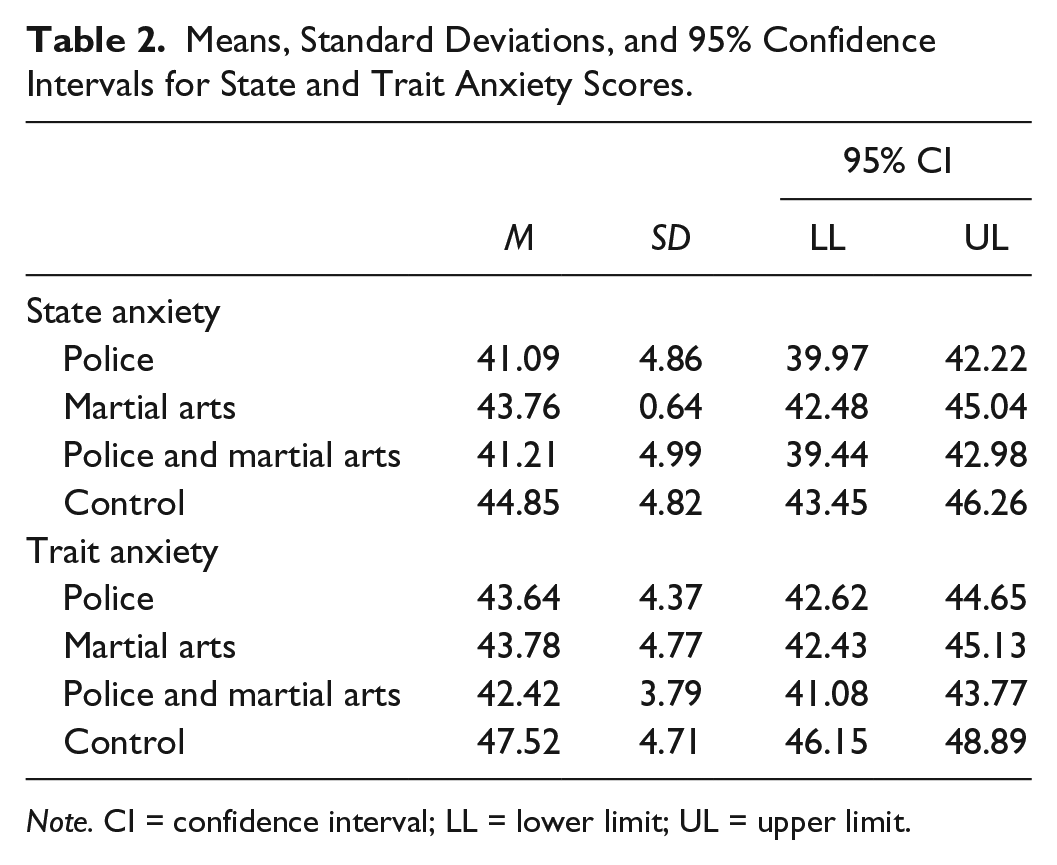
Participant scores for both state and trait anxiety scores of the STAI are displayed in Table 2.
Means, Standard Deviations, and 95% Confidence Intervals for State and Trait Anxiety Scores.
Note. CI = confidence interval; LL = lower limit; UL = upper limit.
Results of separate one-way ANOVAs on STAI scores revealed a significant effect of group on state anxiety, F(3,204) = 7.88, p < .001, η2 = .105, and on trait anxiety, F(3,204) = 11.00, p < .001, η2 = .141. Bonferroni-corrected post hoc comparisons showed that all of the police and martial arts groups had significantly lower scores on state anxiety than the control group, p = .006. The police group without martial arts experience reported significantly less state anxiety than the control group, p < .001, and the martial arts group, p = .016. For trait anxiety, the control group had significantly higher scores than the police and martial arts group, p < .001; the police group, p < .001; and the martial arts group, p < .001. Means and 95% confidence intervals around the STAI scores across all groups are depicted in Figure 1. Due to variations between groups, state and trait anxiety scores will not be treated as covariates in subsequent analysis (A. Field, 2013; Lord, 1967, 1969; Miller & Chapman, 2001; Wildt & Ahtola, 1978).
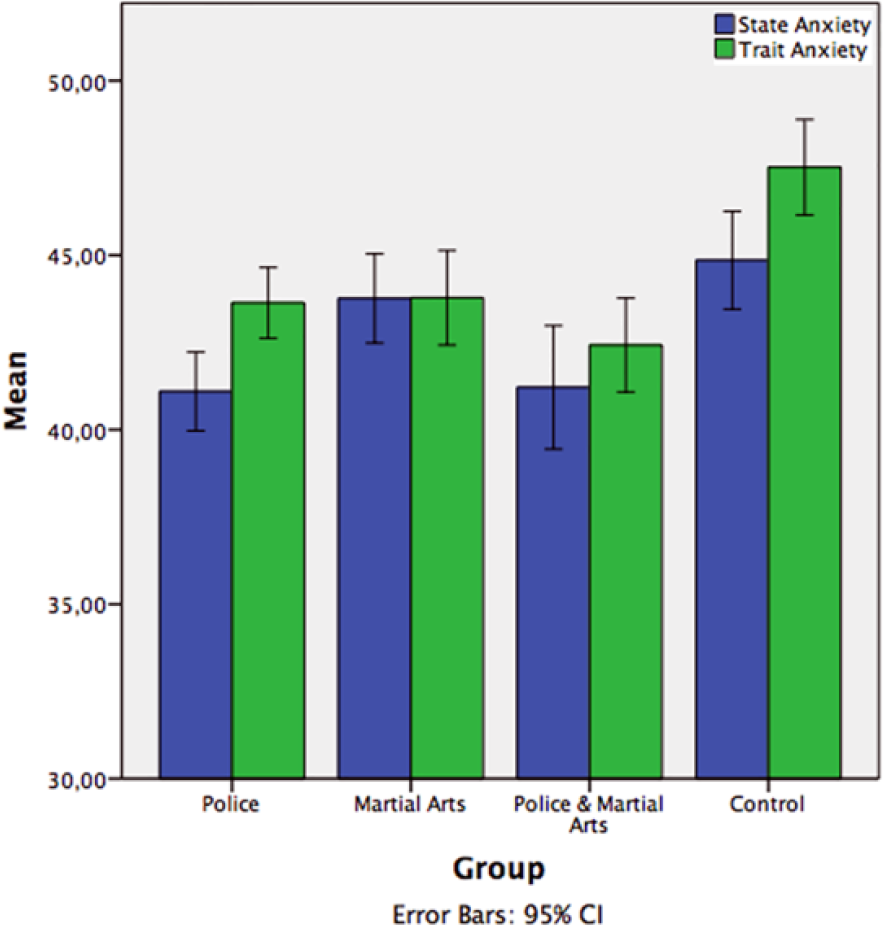
Means and 95% confidence intervals of state and trait anxiety scores across all groups.
Dot Probe Task
Summary data, including means, standard deviations, and 95% confidence intervals, for Dot Probe Tasks across all groups are shown in Table 3.
Summary Data of 50 and 200 ms Dot Probe Task Scores.

Note. BCa = bias corrected and accelerated; CT = congruent trail; CI = confidence interval; IT = incongruent trial; LL = lower limit; LQ = lower quartile; RT = reaction time; UL = upper limit; UQ = upper quartile.
Results of the robust 4 × 2 mixed ANOVA (on 20% trimmed means) yielded the following results: At 50 ms exposure time, there was no significant main effect of group on RT, Q = 0.45, p = .716; no significant main effect of location of the probe, Q = 0.33, p = .569; and no significant interaction effect (group × target location of the probe) on RT, Q = 1.86, p = .141. At 200 ms exposure times, RT performance yielded no significant main effect of group, Q = 0.99, p = .400; no significant main effect of the target location of the probe, Q = 0.37, p = .546; and no significant interaction effect between group and the target location of the probe, Q = 0.93, p = .430.
Emotional Stroop Task
Participants’ scores of the Emotional Stroop Task across the different groups are shown in Table 4.
Summary Data of Emotional Stroop Task Scores.

Note. CI = confidence interval; LL = lower limit; LQ = lower quartile; RT = reaction time; UL = upper limit; UQ = upper quartile.
Results of the robust 4 × 2 mixed ANOVA (on 20% trimmed means) showed that for aggression-themed words, mean RTs were not significantly affected by the group, Q = 0.41, p = .746; by the difference between the emotional value of the words, Q = 0.02, p = .885; or by the interaction between group status and emotional value of the words, Q = 0.95, p = .421. For color words, results showed no significant main effect for group status, Q = 0.85, p = .469; no significant main effect for the emotional value of the words, Q = 1.87, p = .174; and no significant Group × Emotional value interaction effect, Q = 0.07, p = .975 on RT. For words with negative value, results yielded no significant main effect for group status, Q = 0.70, p = .556; no significant main effect for the emotional value of the words, Q = 0.00, p = .966; and no significant interaction effect (Group × Emotional value), Q = 0.58, p = .629 on RT. For positive words, RTs were not significantly affected by group status, Q = 0.62, p = .597; by the emotional value of the words, Q = 2.73, p = .100; or by the interaction between group status and the emotional value of negative words compared with neutral ones, Q = 0.61, p = .61
Discussion
This study investigated the effects of job-related threat exposure on threat-related attentional bias. Specifically, it investigated whether regular exposure to real threats, which is typical of police officers, or regular exposure to threats in training settings leads to the development of threat-related attentional bias. The study demonstrated two main results: First, neither police officers nor martial arts practitioners showed a threat-related attentional bias as indicated by the Dot Probe Task at 50 and 200 ms exposure times, respectively, and the Emotional Stroop Task. Thus, Hypothesis 1 was refuted. Second, individuals who deal with threats on a regular basis, either in real (police officers) or in training settings (martial artists), showed less trait anxiety than the control group, disconfirming Hypothesis 2.
Threat-Related Attentional Bias in Police Officers
There are two main possible interpretations of failure to find a threat-related attentional bias in this sample: Either regular exposure to threat does not lead to any attentional bias or regular exposure does lead to attentional bias, but this experiment did not document the effect.
The findings contradict claims made by Öhman and colleagues (Öhman, 1996; Öhman & Mineka, 2001; Öhman & Wiens, 2004), according to whom threat-related attentional bias develops as a result of survival relevance and that it is a conditioned response to decrease the likelihood of harm that is caused by these threats. In line with this, Bar-Haim and colleagues (2010) presented data of the impact of war-related stress on RTs, gathered during ongoing rocket attacks in the Dot Probe Task. Their results clearly indicate that individuals who are exposed to severe life-threatening risks manifest threat-related attentional bias, specifically, a bias away rather than toward the threat at exposure times of 1,000 ms. Likewise, Todd and colleagues (2015) showed (using an attentional blink task) that combat veterans (who served in Afghanistan), both with and without posttraumatic stress disorder, demonstrated attentional bias toward combat-related words. Again, this suggests that exposure to life-threatening situations facilitates the development of cognitive biases toward threat. In the described cases (inhabitants of areas that are regularly attacked by rockets and combat-experienced soldiers), a threat-related attentional bias can be considered to be functional.
In this study, the sample under investigation consisted of police officers. Exposure to regular threats was assumed due to the experience in routine activity as a police officer. Even though studies have confirmed that police officers are at risk of being victims of violence (Bochenek & Staller, 2014; Ellrich & Baier, 2014, 2016; Ellrich, Baier, & Pfeiffer, 2010), experience as a police officer does not necessarily account for experience with violent confrontations and the associated competencies (Schmalzl, 2008). Hence, officers in this study had a mean of 9.28 years of work experience (7.35 years for the police officer and martial arts group), which does not necessarily reflect the amount of exposure to violent threats. With regard to martial artists, to our knowledge, no studies have looked at the prevalence of engagement in violent confrontations in this population. In sum, a lack of regular exposure to life-threatening situations may serve as a possible explanation for the results. Future research should seek to ascertain the exact level of exposure to threat in the participants.
Furthermore, the simulation of violent situations as conducted in police use of force training and martial arts classes has not led to the development of threat-related attentional bias either. This could be explained by (a) a lack of representativeness in the training settings and/or (b) the amount of time that individuals have been exposed to such situations. Various researchers and practitioners in the martial arts and police use of force domains have pointed out that training for real-world encounters has to be more representative (Norris & Wollert, 2011; Renden, Nieuwenhuys, Savelsbergh, & Oudejans, 2015; Staller & Zaiser, 2015), implying that current practices are not representative enough to foster the acquisition of skills that are needed for dealing with violent encounters.
Furthermore, it may be possible that individuals did not spend enough time in representative learning environments that allow for the functional development of threat-related attentional bias. This may be due to the low amount of practice activities within a given training setting or due to the low number of occasions in which the individual participates. For example, a recent study investigating self-defense systems in Germany showed that martial arts schools advertising self-defense practices do not regularly incorporate representative training activities (Staller, Bertram, Althaus, Heil, & Klemmer, 2016). In the context of policing, the amount of practice, and exposure to simulated violent encounters, is limited by agencies’ policies.
Another reason for the failure to observe threat-related attentional bias in police officers may lie in the words used in the Dot Probe Task and Emotional Stroop Task. Threat-related words in the Dot Probe Task were taken from MacLeod and colleagues (2007). The word set included words such as “ panicky,” “confused,” embarrassed,” as well as words such as “assault,” “attack,” and “strangled.” The latter ones are clearly more combat-related than the former ones. The same is true for the Emotional Stroop Task, which was used as described by Smith and Waterman (2005): Aggression-themed words included words such as “temper,” “guilt,” or “annoyed” as well as more combat-related words such as “kick,” “slash,” or “kill.” In terms of a functional development of a threat-related attentional bias, it may be possible that the words used were too unspecific in the context of violent encounters. To foster optimal decision making, the learner in any context has to be provided with the correct cues (Maran & Glavin, 2003; Staller & Abraham, 2016). If the development of threat-related attentional bias in police officers is considered as functional, then “training” cues are only valid as long as they reflect “real-world” ones (i.e., cues that are present during a violent encounter). Therefore, a functional threat-related attentional bias may not be elicited because of the lack of representativeness in the psychological tests used. This line of argument is supported by the results of Todd and colleagues (2015), who used combat-related words and subsequently found a threat-related attentional bias in combat-experienced personnel. This suggests that an individual’s experience in potentially life-threatening environments creates threat-related attentional bias.
At the bottomline, the results of this study indicate that the groups did not show dysfunctional threat-related attentional bias, and thus any symptoms of a disorder of the defensive system (i.e., an anxiety disorder). Yet, they did not show any functional threat-related attentional bias either, calling for further research to examine the influence of (a) training practices in police and martial arts training, (b) exposure to real threats of police officers, and (c) optimization of the Dot Probe and Emotional Stroop Task, to account for more specific threats for violent encounters.
Differences in State and Trait Anxiety
Trait anxiety was significantly higher in the control group than in all the other tested groups, which disproved Hypothesis 2. A possible moderator of this effect could be the training participants take part in. Martial arts training has been shown to be capable of reducing anxiety in participants (Fuller, 1988; Trulson, 1986). As police use of force training also contains “hand-to-hand” combat techniques, it may be possible that the perceived improvement in self-protection skills may lead to reduced anxiety. However, several studies investigating state and trait anxiety of officers compared with adult normative samples (Newman & LeeAnne Rucker-Reed, 2004; Storch & Panzarella, 1996) showed no differences between the groups. Hence, the findings from this study contradict those from earlier works.
Furthermore, it is noteworthy that Newman and LeeAnne Rucker-Reed (2004) found a trait anxiety mean of 32.94 in U.S. marshals, compared with a mean of 35.55 in the norms for working males aged 19 to 39 (Spielberger et al., 1983), whereas the mean trait anxiety of police officers in this study was 43.64, compared with the control group with a mean of 47.52. With these scores, the police officers are in the upper 20% of the German norms for working males aged 30 to 59. The scores of the control group in this study reflect the upper 10% of the same normative sample. Taken together, the groups in this study display much higher trait anxiety than the normative sample, even if the police officers and martial artists demonstrate significantly lower scores than the control group of this study. A possible explanation for the difference between police officers (and martial artists) and the control group has been presented above. The difference between the groups in this study and the normative sample cannot be explained easily. As all tests were administered the same way, and therefore, the STAI was filled out after threat-related attentional bias and risk-taking were measured, future studies should measure STAI at the beginning of the test battery, to account for possible priming effects.
Limitations
There are several limitations that have to be acknowledged. First, as various locations were used for testing, a standardized environment could not be established. This has been discussed as being a potential confound, especially when relating to measures of attention and RTs (Birnbaum, 2004). Second, it may be possible that the words used in the Dot Probe Task and the Emotional Stroop Task do not account for functional threat-related attentional bias in the context of violent confrontations. Future studies should consider the use of combat-related words (Todd et al., 2015) to capture possible effects. Third, the actual exposure to real life-threatening situations of the participants was not measured. Similarly, participants were only asked about their years of experience in martial arts training, which did not account for the kind of practices or how often they engaged in it. Therefore, future research on this topic should include data about the exposure to real-life threats and the amount and the representativeness of combat training (martial arts and police use of force training). Fourth, threat-related attentional measures in this study measured cognitive biases toward and away from threat. However, variability within each session was not accounted for. As attentional bias variability is suggested to be a useful marker of attentional impairment with regard to posttraumatic stress disorder (Iacoviello et al., 2014), future studies should incorporate threat-related attentional bias variability (Naim et al., 2015; Zvielli et al., 2014). Finally, as some of the participants completed the testing battery at home via the Internet and given that the whole session took about 40 min, there is the possibility of distractions during testing. Although participants were asked to make sure that they will not get distracted, this cannot be controlled for (Birnbaum, 2004).
Conclusion
Despite the limitations of this study, we provide evidence that there are no differences between police officers, martial artists, and controls for threat-related attentional bias, indicating no signs of a functional development of a cognitive bias. However, in conjunction with previous research on combat-related attentional bias, it may be possible that a possible functional attentional bias toward combat-related cues was not detected. Furthermore, our results showed lower trait anxiety in police officers and martial artists than in the control group. This may account for a lowering effect of police use of force and martial arts training on anxiety.
Footnotes
Appendix
Words Used in the Emotional Stroop Task.

| Aggression-themed words |
Positive emotion words |
Negative emotion words |
Neutral words |
Color words |
|||||
|---|---|---|---|---|---|---|---|---|---|
| English | German | English | German | English | German | English | German | English | German |
| rage | Wut | devotion | Hingabe” | abandoned | verlassen | door | Tür | purple | lila |
| anger | Zorn | affection | Zuneigung | abused | missbraucht | group | Gruppe | gray | grau |
| tear | zerreißen | admire | bewundern | afraid | ängstlich | chair | Stuhl | flesh | fleischfarben |
| assault | Angriff | euphoric | euphorisch | aggressive | aggressiv | telephone | Telefon | pink | pink |
| kick | Tritt | fond | zärtlich | agony | Qual | dog | Hund | orange | orange |
| shout | Schrei | grateful | dankbar | angry | wütend | coat | Mantel | scarlet | scharlachrot |
| punch | Schlag | tolerant | tolerant | arrogant | arrogant | sofa | Sofa | maroon | kastanienbraun |
| hate | Hass | affectionate | herzlich | bad | schlecht | bag | Tasche | crimson | purpurrot |
| argue | streiten | amused | amüsiert | bitchy | gehässig | diary | Tagebuch | white | weiß |
| temper | Wut | love | Liebe | crazy | verrückt | newspaper | Zeitung | lack | schwar |
| fight | Kampf | joy | Freude | cruelty | Grausamkeit | eat | essen | cyan | cyanblau |
| kill | töten | proud | stolz | detest | verabscheuen | oven | Ofen | brown | braun |
| punish | bestrafen | fond | liebevoll | envy | Neid | floor | Boden | tin | zinnfarben |
| annoyed | verärgert | funny | lustig | fear | Angst | shopping | einkaufen | bronze | bronze |
| guilt | Schuld | glad | froh | frightened | erschrocken | umbrella | Regenschirm | mauve | malvenfarben |
| lust | Verlangen | comfortable | komfortabel | fury | Zorn | windy | windig | gold | golden |
| crush | vernichten | beloved | geliebte | glum | bedrückt | radio | Radio | silver | silbern |
| slash | Hieb | calm | Ruhe | greed | Gier | painting | Gemälde | jade | jadegrün |
| rape | Vergewaltigung | peace | Frieden | hateful | abscheulich | milk | Milch | topaz | topazfarben |
| cut | Schnitt | daring | Kühnheit | spiteful | boshaft | school | Schule | emerald | smaragdgrün |
| wound | Wunde | cheerful | heiter | suspicious | verdächtig | ball | Ball | purple | lila |
| injure | verletzen | warm | warm | rage | böse | pencil | Bleistift | gray | grau |
| threaten | bedrohen | protective | schätzend | pain | Schmerz | cigarette | Zigarette | flesh | fleischfarben |
| knife | Messer | hope | Hoffnung | lose | verlieren | football | Fußball | pink | pink |
| slap | Ohrfeige | lively | lebhaft | misery | Elend | shoe | Schuh | orange” | orange |
Declaration of Conflicting Interests
The author(s) declared no potential conflicts of interest with respect to the research, authorship, and/or publication of this article.
Funding
The author(s) received no financial support for the research, authorship, and/or publication of this article.