




Abstract
Drawing upon organizational foci theory and market transition theory, this study examined social networks in the workplace in postreform urban China. Specifically, this study assessed the association between employment sector and employees’ social ties with coworkers and its differentials association by regions with varying levels of market economy development. Data from the Chinese General Social Survey 2003 were analyzed using negative binomial regressions. Results showed that state/collective sector workers reported more coworker ties than private sector workers, which was more prominent in less marketized regions. Moreover, sectoral differences in coworker ties were partially explained by highly constraining organizational foci embedded in the danwei system. These findings highlight the role market transition plays in restructuring social space and relations in urban China.
Introduction
Given increasing hours spent at work, research showed that social ties with coworkers are increasingly prevalent (Dahlin, Kelly, & Moen, 2008; Jacob & Gerson, 2004). If almost every domain of life was bounded by one’s workplace, what would our personal networks look like, then? It is an intuitive idea that the workplace can be a primary arena for the development of social ties because social relationships arise out of shared activities in common physical space. Past research on social networks has well documented the influence of social structure on personal networks and interactions in various social domains (e.g., Blau & Schwartz, 1984; Feld, 1981, 1982) For example, organizational foci theory proposed that people’s choice of personal network be frequently constrained by social contexts, that is, foci of activities (e.g., families, churches, and neighborhoods) because foci activities operate like imposed organizational structures (Feld, 1981, 1982).The structural approach has paid attention to the importance of organizations in generating social interactions. Furthermore, from the perspective of institutional embeddedness, personal networks are shaped by the institutional environment (Lin, 2001).
Nevertheless, previous research has largely focused on individual characteristics such as employment, marital status, and work characteristics to predict who is more likely to have friendships based in the workplace (Dahlin et al., 2008; Jacob & Gerson, 2004; Wellman, 1985). Less is known about how intuitional environments shape personal networks. If employment sector served as the principal social institution and was characterized by the highly constraining foci, workplace can be viewed as a key to understanding differential social ties among employees in society.
The present study examines the impact of employment sector on personal networks, with a particular focus on work unit (danwei in Chinese) in postreform urban China. Work unit established under state socialism was one of the long-standing institutional arrangements in urban China in the sense that it represents urban workers’ and their families’ social, economic, and political life (Xie, Lai, &Wu, 2010). However, socialist danwei system has declined during China’s economic reform, resulting in a series of changes to urban space and residents’ life (Liu & Chai, 2012). Furthermore, as the employment share of private sector increased, danwei types have differentiated in postreform urban China. Unlike state sector, work units in private sector do not provide guaranteed lifetime job security and extensive fringe benefits (Wu, 2013; Xie et al., 2010). In other words, the life among private sector workers may be less constrained by their workplace than their counterparts in the state sector. With massive social and institutional transformation, contemporary China provides an interesting case to gauge the role that employment sector as the imposed organizational structure plays in shaping individual’s personal ties.
Explained in greater detail below, work units in the state sector were predominantly implemented during the Maoist era (1949-1976), and remains in the postreform era, albeit being declined somewhat over the course of economic reform. Accordingly, scholarship on social networks in contemporary China attributed their observations on prevalent coworker ties among urban Chinese employees primarily to such centralized multiple institutions as danwei (e.g., Ruan, 1993; Ruan, Freeman, Dai, Pan, & Zhang, 1997). Even though shedding important and interesting insights into the impact of institutional arrangement on the social space and social network patterns, empirical test and theoretical accounts for whether and how such institutional arrangement contributes to the patterns of Chinese personal relationships are still lacking. Furthermore, few studies have explicitly explored the implications of market economic reform for understanding personal networks. In this light, a focus on coworker ties among urban employees in postreform China can extend the literature on Chinese market transition.
In the market transition literature, the work unit has been of particular interest to scholars almost exclusively in accounting for economic inequality, such as income and housing (Song & Xie, 2014; Wu, 2002; Xie & Wu, 2008). However, its effect on personal networks has been understudied, despite the dominant role of the work unit in structuring daily life and social interactions of Chinese citizens. Danwei system was an institutional legacy from socialist planned economy and has remained predominantly in the redistributive sector (e.g., state sector) in comparison with the newly emerged market economy sector (e.g., private sector; Xie, Lai, & Wu, 2009; Xie & Wu, 2008). Thus, a comparison of coworker ties between employments would aid in understanding the effect of danwei on Chinese social networks.
This study addresses three questions. First, do workers’ social ties with coworkers differ by employment sector? Second, if so, what work unit’s attributes can explain the observed sectoral differences in coworker ties? In light of organizational foci theory developed by Feld (1981), the work unit in the state sector is viewed as an imposed organizational structure because it carried out multiple social, political, and economic functions (Naughton, 1997). Therefore, three mediators are considered in the present study—the Communist Party membership (political foci), work unit residential communities (social foci), and welfare benefits (economic foci). Finally, given the regionally uneven market economic reform, this article investigates whether the association between employment sector and coworkers ties varies by regional levels of marketization. Employment sector and geographic region in postreform China represent varying degrees of marketization (Xie & Hannum, 1996; Xie et al., 2009; Xie & Wu, 2008). This study thus contributes to our understanding of the impact of economic reform on Chinese urban society.
Work Unit (Danwei) as Highly Constraining Foci
During the Maoist era (1949-1976), the state (the Communist Party and the government) dominated almost all livelihood resources with a developmental strategy of revolutionary socialism, mainly via danwei, 1 and thereby exercised all-pervading control over individuals’ lives (White, 1983). Not only did the work unit carry out a wide range of social-political and welfare functions, but it also determined one’s social status (Bian, 1994; Lin & Bian, 1991). This approach led the employed to greatly rely on their work units for their life (F. Lu, 1989; Walder, 1986; Whyte & Parish, 1984). In the light of encompassing functions, Walder (1986) described the work unit as an “institutional system of organized dependence.”
Under the state socialist system, Chinese workers and their families resided on land occupied by the work unit and therefore danwei as the core unit of urban society became a community. In prereform, almost 95% of the urban workforce were danwei employees, and most lived in danwei compounds that constituted their daily life circles (Bray, 2005; Chai, 2014). Accordingly, the majority of their neighbors were also fellow workers (Walder, 1986, 1989); Similarly, Guo (2003) specifically depicted that “many work units were compounds, with half of the space used for work and the other half for residences” (p. 110). As to the political function, each danwei established the party organization in which there is unified leadership, exercising power to determine employee’s promotion and salaries to maintain and promote worker’s political loyalty with rewards and punishments (Guo, 2003). Another noteworthy feature of the danwei under socialism was that it was required for an employee to have work unit’s permission when one wanted to transfer to another work unit. As a result, there was a very limited job and residential mobility (Bian, 1994; Davis, 1990, 2003; Walder, 1992) and residential homogeneity particularly in the socialist era (Huang, 2006). Taken together, the workplace in urban China was a social institution on which Chinese employees were socially, economically, and politically dependent, rather than an economic enterprise (Walder, 1986). Beyond the dominant view of danwei as an institutional formation, Bray (2005) maintains that danwei provides its members with identity and social belonging because it harbors collective groups and social relationship centered on work and extending to living spaces and everyday practices.
Extant research on Chinese social networks has consistently shown that social ties with coworkers occupy an important role in the Chinese personal network as Chinese seek social support from coworkers (Freeman & Ruan, 1997; Ruan, 1993; Ruan et al., 1997). For example, it was evident in more prevalent and extensive coworker ties among Chinese than American workers (Ruan, 1993). Ruan (1993) argued that the danwei accounts for the differences between the pattern of social networks in the United States and China in that people in urban China tend to rely on coworkers for various types of support in times of need. Another interesting finding of previous studies is that more coworker ties were observed in higher ranked work units (Ruan, 1993). In Chinese society, hierarchically ranked work units indicated the extent to which the resources were provided to their employees. In other words, higher ranked work units would provide more benefits for their employees (Bian, 1994; Li & Wang, 1996). Given differential patterns of coworker ties across the ranks of work units, Ruan (1993) suggested that employment benefit were directly associated with the opportunity structure for a social association. Specifically, stronger social ties were more likely to form in the workplace where greater fringe benefits were available and offered to employees. This finding provides useful insights into potential mediators linking between employment sector and social ties with coworkers.
Though previous studies contributed to the understanding of Chinese social network, they have lacked a proper theoretical focus. Consequently, little is known about mediators linking work unit and coworker ties. Drawing from Feld’s (1981) focused organization of social ties framework, this article attempts to account for any differences in coworker ties by employment sector. According to the organizational foci theory (Feld, 1981), organizational structures significantly shape the composition of individual social networks. In the context of urban China, social ties would be derived from the highly constraining focus of the work unit. Very few alternative sources of foci were available for Chinese urbanites under the socialist regime (e.g., almost no voluntary associations). External foci were essentially organized by work unit, including housing, recreational activities, schooling for children, and health care, among others. These seemingly external foci were regulated by the higher order grouping of the work organization in urban China.
To summarize, the features of the work unit (danwei) in urban China (i.e., highly constraining focus) and social networks (i.e., prevalent coworker ties) call for theoretical and empirical analysis of the linkage between employment sector and social ties in postreform urban China.
Danwei System, Coworker Ties, and Marketization
As the market economy has gradually replaced socialist planned economy, a series of institutional and structural changes has occurred in urban China, including reform of state-owned enterprises, housing reform, and community construction. In 1998, the State Council issued a directive that forced work units in the state sector to discontinue constructing any new publicly owned housing units for the employees (Pan, 2000). It led to a weakening of the traditional danwei system and spatial integrity, which was reflected in a more individualized and diversified activity space for Chinese citizens in reform-era China (Chai, 2014).
It should be noted that the decline of the danwei system can be regarded as the result of marketization. Market transition theory proposed that economic reform would lead to a decline of redistributive power and the increasing significance of market power (e.g., human capital) in determining socioeconomic attainments (Nee, 1989). In the body of marketization literature, danwei types were utilized to represent redistributive determinants and to examine its changing effect over the course of market transition (Song & Xie, 2014). In light of market transition theory, the role of danwei system in shaping personal networks may also weaken during economic reform. Furthermore, according to the perspective of institutional embeddedness, Zhao (2013) explicitly stated that “when institutional environments transform, the patterns of social networks are expected to change accordingly” (p. 109). In short, the institutional perspective suggested that the extent of market transition would affect the pattern of personal networks.
Extant literature has documented the changing structure of social networks in postreform urban China. Analyzing 1986 and 1993 surveys of adult residents in the City of Tianjin (the third largest city after Beijing and Shanghai), the study revealed that coworker ties had weakened during the Chinese economic reform. However, the significance of coworker ties remains in a postreform Chinese society (Ruan et al., 1997). Although this longitudinal approach highlighted the implication of market economic reform on the pattern of social relationship in urban workers, there was a lack of explanation for the observed change. The present study proposes a sectoral comparison of coworker ties because a state sector and private sector coexists in postreform urban China, which in turn contributes to differentiated social ties among urban workers.
After the 1990s, the private sector became China’s main job creator. Employment among both self-employed and private enterprises has registered high growth rates, whereas jobs in the state sector have decreased (M. Lu, Fan, Liu, & Yan, 2002). However, this structural transformation might not be directly translated into weakening coworker ties among the general population because state sector represented redistributive institutions in postreform China and has retained its danwei system (Tang & Parish, 2000). Several studies empirically demonstrated that danwei continues to be an agent of social inequality, even amid market transformation (Wu, 2013; Xie et al., 2010). More recent studies revealed that workers in the state sector had better psychological well-being (e.g., happiness) compared with those in the private sector (Hu, 2012; Wang & Xie, 2015). Nevertheless, very little research has examined sectoral and regional differences in the patterns of social relationships in reform-era China. The present study attempts to investigate prevalent coworker ties observed in urban China, which is largely attributable to the Chinese danwei system, by testing the following hypotheses:
Previous studies on Chinese social networks have also observed differential patterns of coworker ties across regions in postreform China because of regional variations in marketization (Wang & Hu, 1999; Xie & Hannum, 1996). Ruan (2001) observed that Mainland Chinese relied more on coworkers for support than Taiwan Chinese. Similarly, a 2000 survey conducted in Beijing and Hong Kong reveals that residents in the socialist city of Beijing are more likely than residents in the capitalist city of Hong Kong to turn to coworkers for support (Lee, Ruan, & Lai, 2005). Whereas Ruan (1993) and Rual et al. (1996) showed strong coworker ties in Tianjin, Lai (2001) failed to find such patterns in Shanghai. Lai (2001) suggested that discrepant observations between two Chinese cities (Tianjin and Shanghai) be attributed to the regional level of marketization:
The pace of market reform in Shanghai is much faster than that in Tianjin. The state control via work units may thus be weaker in Shanghai than in Tianjin, leading to a decline in the reliance on work-units and work-related ties among Shanghai workers. (p. 83)
This empirical research indicated that regional contexts need to be accounted for when studying the pattern of personal networks in reform-era China.
Given substantial heterogeneity in the pace and consequences of China’s market reform across provinces (Wang & Hu, 1999; Xie & Hannum, 1996), regional context (i.e., marketization) directly or indirectly constrains patterns of personal interactions. Nevertheless, most previous studies have been confined to two cities with different levels of marketization and thus have failed to identify implications of market economy reform for social networks. The level of market economy shapes the extent to which work units are likely involved in an employee’s life, thereby modifying the association of the employment sector with coworker ties. Accordingly, a second hypothesis is proposed:
To summarize, the present study aims to compare social ties with coworkers by employment sector and to explore its mediators. Moreover, regional level of the market economy is also considered to fully account for differential coworker ties among Chinese workers in postreform China. The employment sector and regional level of the market economy as an institutional context represent segmentation approach and contextual approach to operationalizing marketization because of differential proximity to market forces and the development of market economy (Hauser & Xie, 2005; Xie & Hannum, 1996). This article proposes a conceptual model (see Figure 1) that displays how employment sector is associated with the extent to which employees’ activities are organized around the same focus (i.e., workplace) and how it is moderated by regional contexts.

Conceptual model.
Method
Data
Existing research on social networks in China was largely based on single or two-city samples; for example, Shanghai (Lai, 2001), Tianjin (Blau, Ruan, & Ardlt, 1991; Ruan, 1993; Ruan et al., 1997), Beijing and Hongkong (Lee et al., 2005), the northeastern region of China (Yan, 1996), and Hongkong (Lau,1981; Mitchell, 1969). Consequently, we know little about how regional differences in the experience of economic reform contribute to residents’ patterns of personal relationships. This article utilizes the 2003 Chinese General Social Survey (CGSS) that covers an extensive range of China’s urban areas. Thus, this data set is particularly useful in examining how regional differences in marketization are associated with resident’s coworker ties. Furthermore, it provides historical perspectives on social ties in transitional economies where the market economy and state socialism coexists.
The CGSS used a multiple-stage stratified sample scheme. The survey collected data via face-to-face interviews, which were conducted in 559 neighborhood committees and 5,894 households. The overall response rate was 77%. The CGSS 2003 contained a module for egocentric networks of individuals in addition to scholarly themes of social stratification and occupational mobility. In this study, working sample was restricted to adults currently working in urban areas. For missing cases on variables, a list-wise deletion method was used, leaving 2,264 cases with complete data on all measures.
Measures
The present study focuses on the people with whom respondents reported having discussed important matters, labeling these as strong social ties. The dependent variable was obtained from a survey question that asked, “Most people often discuss important matters with others. In the past six months, with who did you discuss any matter important?” Respondents were then asked more specific questions about the first five persons mentioned. Respondents also were asked to specify five people who were the most important to them as well as the kind of relationship they had with each person named. Six relationships were distinguished: family, relative, neighbor, friend, colleague, and other. Using the responses to the question above, coworker ties were measured by a total number of coworkers placed in one’s discussion network (see Dahlin et al., 2008).
Work units were dichotomized into those in the state (i.e., party, government or government agency or office, state-owned enterprise, and state-owned institution) and collective sectors (collective-owned institutions or enterprises) as traditional types of work units in socialist Chinese society and those in the private or other partially private sector as newly emerged types of danwei (i.e., individually operated enterprise, private institution or enterprise, foreign investment enterprise, another type of ownership). Three mediators were included to explain hypothesized different coworker ties between sectors: type of residence, welfare benefits level, and Communist Party membership, representing social, economic, and political foci, respectively. These three were identified in consideration of theoretical points of view (mainly Feld’s theory of organizational foci) and features of the Chinese danwei system, and expected to explain a portion of the relationship between employment sector and coworker ties. For the type of residential community and party membership, I created dummy variables: Whether respondents currently resided in work unit community (danwei shequ; 1 = yes) and being a Communist Party member (1 = yes). For welfare benefits provided by one’s workplace, I constructed an index by summing 1 = available, 0 = unavailable on each of the following seven items, health care, health insurance (basic and supplementary), pension (basic and supplementary), unemployment insurance, and housing or housing subsidiary, thus the index score ranged from 0 to 7.
Being interested in estimating contextual effects on the association at the regional level, the provincial level of marketization is measured by the proportion of employed persons in the private sector in the province in 2003. Following previous literature on regional variations and marketization, as well as recently developed marketization index (Fan, Wang, & Zhu, 2007; Shu, 2005; Wang & Hu, 1999; Xie & Hannum, 1996; Yu, 2008), the province is employed as the geographic scale. Although alternative geographic scales such as cities/towns can be used, provinces are diverse regarding geographical location, size, and the level of economic development and contain sufficient sample size (Fan et al., 2007). Because having permission to engage in private ownership is a fundamental element of market transition in formerly state socialist countries, the extent to which private enterprises dominated a regional economy signifies how far along the region has transited to a market economy (Shu, 2005; Yu, 2008). For the proportion of urban workers in private enterprises, calculations are derived from China Statistical Yearbook 2004 published by National Bureau of Statistics of China.
To accurately gauge the relationship between structural conditions (i.e., employment sector and regional level of marketization) and coworker ties, sociodemographic and work-related characteristics were controlled: age (respondent’s age in years), sex (male = 1, female = 0), education (primary school or below, junior high school, and high school; reference = college or above), marital status (currently married = 1), work status (full-time worker = 1), and job tenure (the number of years employed in the respondent’s current work unit), which are coded as three dummy variables (less than 5 years, 5 years-9 years, 10 years-14 years; reference = 15 years or greater ). Even with these individual characteristics included in the model, there are other unmeasured traits that may well affect sociability in contemporary Chinese workplaces. Therefore, total network size the respondents reported, serving as a proxy for one’s degree of friendliness, and overall sociability (see Dahlin et al., 2008). Finally, firm size was a dummy variable, indicating whether workplace has 81 or more employees. Approximately, 50% (50.35%) of the cases in this sample fall within 80 employees or less. Descriptive statistics of variables are shown in Table 1.
Descriptive Statistics of All Variables in the Analyses: CGSS 2003 (N = 2,264).

Note. CGSS = Chinese General Social Survey.
Analysis
In the first step of the analysis, descriptive statistics were conducted to examine intimacy with coworkers whom respondents placed in their discussion networks and distribution of mediators across sectors, and then multivariate regression analyses were performed. For the multivariate regression analyses, count models were utilized because the dependent variable of coworker ties, measured by the total number of social ties with coworkers, was a nonnegative number. First, overdispersion of the dependent variable was scrutized. Specifically, it is important to check whether the dependent variable was overdispersed as the majority of respondents in this sample indicated no ties to coworkers (53.53% of respondents do not place any coworker in their discussion networks), which resulted in a distribution that was highly skewed to the right. Accordingly, a likelihood test between regular Poisson regression models and negative binomial models was performed, showing that the distribution of a number of coworker ties was overly dispersed. Therefore, the dependent variable, the number of coworker ties in one’s discussion network, was assumed to follow a negative binomial distribution with expected value µi and variance σ2
The likelihood test showed that the overdispersion parameter, alpha, was significantly different from zero and reinforced that the Poisson distribution is not appropriate. The negative binomial regression effectively handles the problem of overdispersion by including a stochastic component to the model (Allison, 1998; Long & Freese, 2003). Accordingly, a negative binomial regression analysis was performed in Stata 12.0 (StataCorp, 2010). Given the nonlinearity of the negative nominal model, the expected number of coworker ties was specified as a log-linear model where the estimated β coefficients were not directly interpretable. All coefficients were exponentiated (exp [β]), thus models were regarding incident rate ratios (IRR). For ease of interpretation, the expression 100 × (exp[β] –1) described the percent change in the outcome (i.e., number of coworker ties) associated with a one-unit increase in the predictor. Negative binomial regression analyses for coworker ties were estimated with the following specification:

where ln (µi) denotes the natural logarithm of the expected value of the dependent variable, a series of Xis denotes a matrix of covariates, and β represents the regression coefficients for the model. More specifically, E denotes employment sector, P denotes the Communist Party membership, B denotes level of benefits provided by work units, R denotes whether respondent resided in a work unit community, M denotes the level of marketization at a province where the individual resides, Ei × Mi indicates the interaction of employment sector-by-provincial level of marketization, Σβ represents the effects of k for individual attributes such as age, sex, and marital status that were included as a statistical control, and ε as an error term that allowed for unexplained randomness.
The purpose of this analysis was to identify the total effect of the employment sector on coworker ties and determine whether the effect of the employment sector reduces after introducing the organizational foci mechanisms into the model. A reduction in the effect of the employment sector on coworker ties indicates that the differential extent of organizational foci of state or collective and private sectors accounts for the sectoral differences in coworker ties. Then, the final step of analysis was to evaluate whether the employment sector differentially affected coworker ties in a province with varying levels of marketization. An interaction of employment sector with a provincial level of privatization was added to the full main effects model.
Results
Intimacy in Relationship With Coworkers as a Discussion Associate
The fiirst step of analysis was to examine the contents of discussion, the frequency of contacts, and degree of acquaintance with coworkers in one’s discussion network, providing insights into the intimacy of the relationship. Table 2 reports proportions of respondents who reported “discuss[ing] [an] emotional problem along with other aspects of life” and “various issues including emotional and specific matters to handle,” respectively. Furthermore, it also reports the frequency of contacts, “contact very often,” and “ very well aquatinted,” among those who included coworkers as a discussion partner in the first, second, third, fourth, and fifth places, respectively. For example, 54.13% in row 1 column 1 refers to those respondents who mentioned a coworker as a discussion partner in the first place. The issues that people discussed with their coworker were not limited to specific matters, thus, informing that social ties with coworkers can be characterized by a mixture of psychosocially and instrumentally defined relationships or instrumental and expressive ties.
Closeness Between Respondents and One’s Discussion Partner: Contents of Discussion, Frequency of Contacts, and Degree of Acquaintance With Coworkers in a Discussion Network, CGSS (2003).
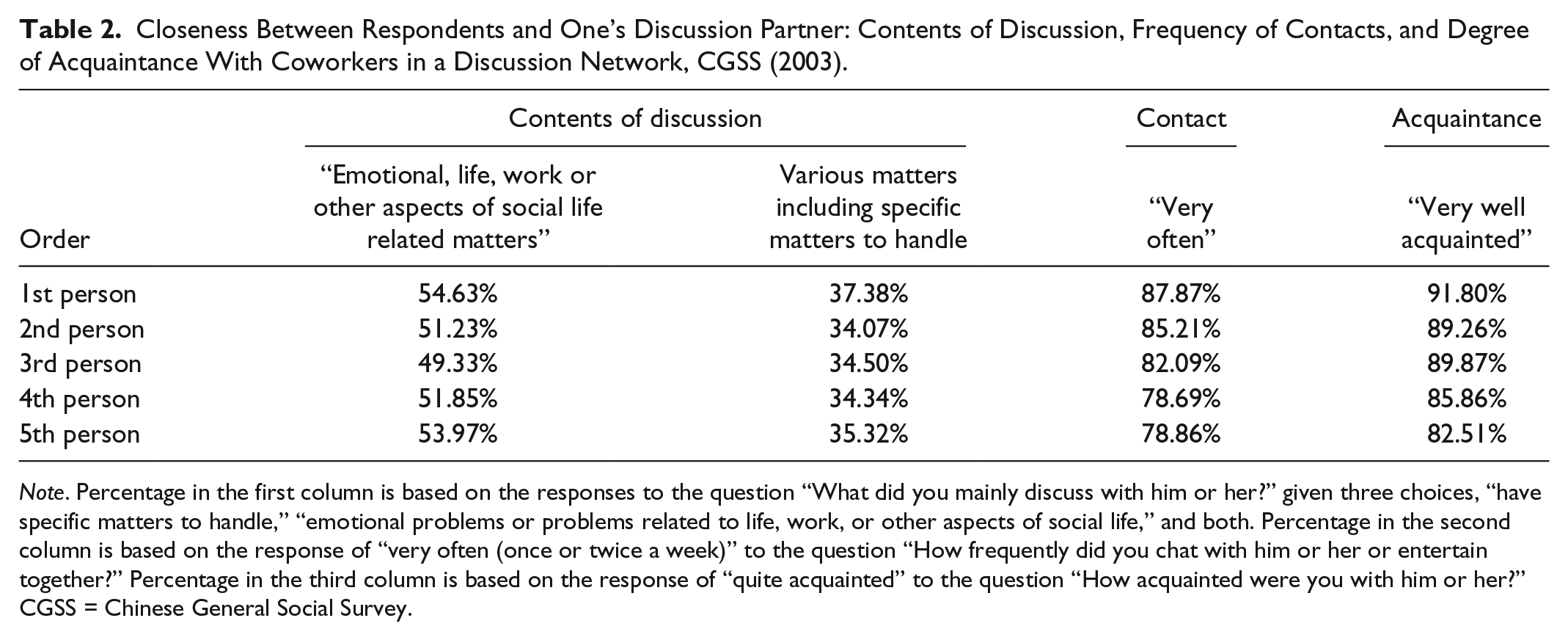
Note. Percentage in the first column is based on the responses to the question “What did you mainly discuss with him or her?” given three choices, “have specific matters to handle,” “emotional problems or problems related to life, work, or other aspects of social life,” and both. Percentage in the second column is based on the response of “very often (once or twice a week)” to the question “How frequently did you chat with him or her or entertain together?” Percentage in the third column is based on the response of “quite acquainted” to the question “How acquainted were you with him or her?” CGSS = Chinese General Social Survey.
In addition to the content of the discussion, most respondents also contacted these coworkers quite often and considered that they knew each other very well. Not surprisingly, respondents demonstrated relatively weak relationships with the fifth-mentioned coworkers, showing the significance of this relationship was somewhat evident in the order where respondents mentioned coworkers. Overall, those who included one or more coworkers in their discussion networks tended to maintain an intimate relationship with that coworker.
Sectoral Differences in Party membership, Welfare Benefits, Work Unit Community, and Coworker Ties
Three mediators, welfare benefits level, Communist Party membership, and type of residential community as organizational foci were considered to explain the link between employment sector and coworker ties. Therefore, it needs to find systematic differences in the distribution of these three factors between sectors. Table 3 reports that welfare benefits were better for employees in the state/collective sector (mean of welfare benefits level = 3.25) than for those in the private sector (mean of welfare benefits level = .83). Fifty-four percent of employees in the state/collective sector reside in danwei’s community, while 30% of those in the private sectors resided in work unit communities. Finally, employees of Communist Party membership were more likely to be placed in the state or collective sector (28%) than in the private sector (10%).
Potential Intermediaries to Link Between Employment Sectors and Coworker Ties in a Discussion Network: CGSS (2003).

Note. Standard deviations in parentheses. CGSS = Chinese General Social Survey.
I summed seven items of employment benefits that are then set as no benefit = 0, 1 ≤ somewhat favorable benefits ≤ 3, 4 ≤ favorable benefits.
The state/collective sector was significantly different from other sectors at p < .05 (two-tailed test), chi-square was significant at p <.01 (two-tailed test).
t test significance at p < .01.
Concerning the overall distribution of coworker ties and employment sector, Table 3 shows that employees in the state or collective sector tended to report more coworker ties than did those in the private sector. Overall, the distribution of mediators between sectors revealed distinctive structural conditions of each sector in which patterns of social relationship with coworkers took place.
Explaining the Association Between Employment Sector and Coworker Ties
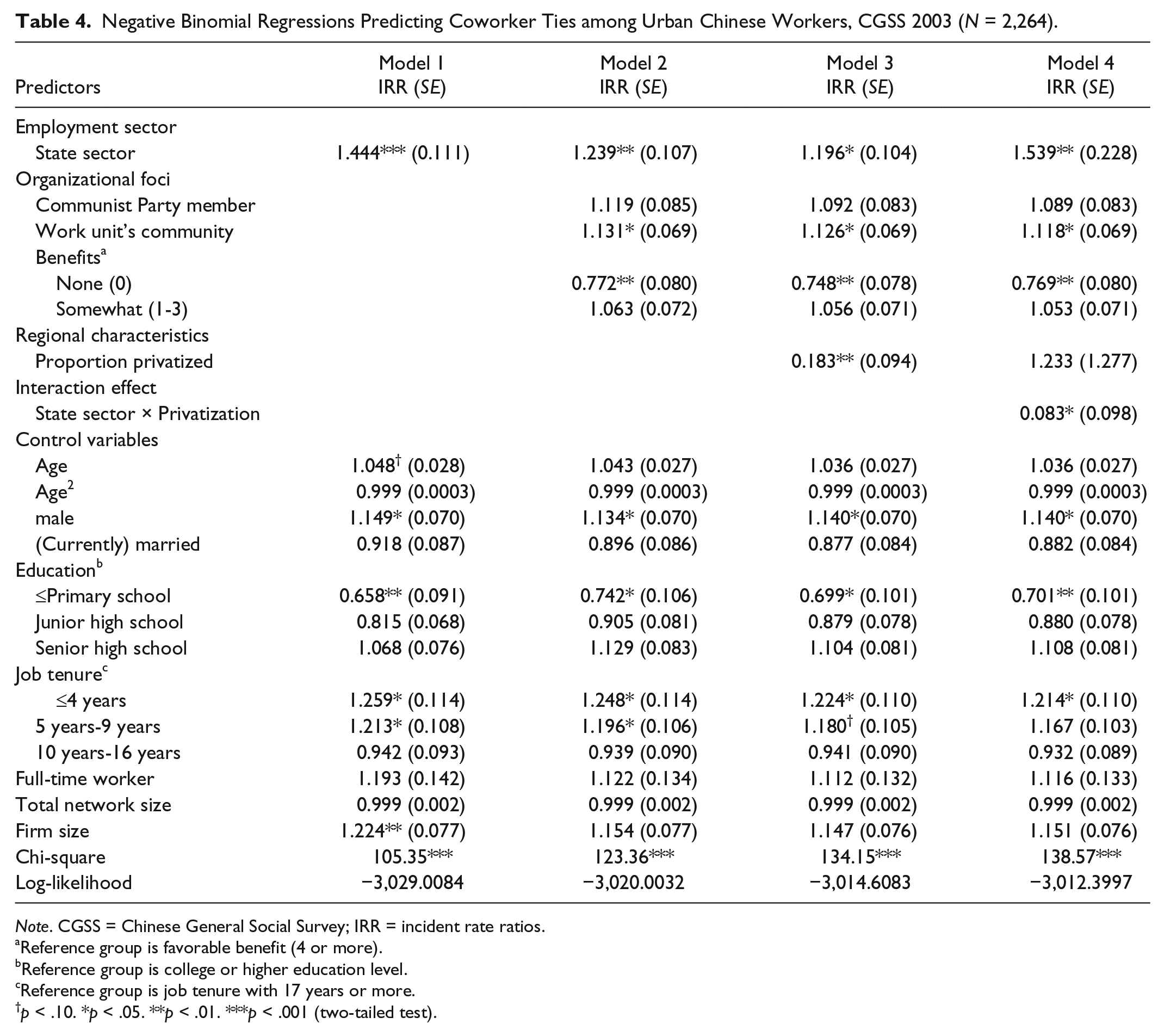
Table 4 presents the results from a series of negative binomial regression models to predict how many of five potential discussion partners come from one’s workplace. Model 1 includes a type of employment sector, thereby showing the basic relationship between the main independent variable and the dependent variable while adjusting for sociodemographic and other possible confounding factors. Model 1 also showed the total effect of the employment sector on coworker ties. As such, being employed in the state or collective sector increased the expected number of coworker ties by 44.4% ([exp (.367) –1] × 100). This finding indicates that coworkers likely serve more as a source of significant relationships for employees in the state or collective sector than those in the private sector.
Negative Binomial Regressions Predicting Coworker Ties among Urban Chinese Workers, CGSS 2003 (N = 2,264).
Note. CGSS = Chinese General Social Survey; IRR = incident rate ratios.
Reference group is favorable benefit (4 or more).
Reference group is college or higher education level.
Reference group is job tenure with 17 years or more.
p < .10. *p < .05. **p < .01. ***p < .001 (two-tailed test).
Next, Model 2 attempts to explain sectoral differences in coworker ties by introducing three mediators, welfare benefits level, the Communist Party membership, and residing in a work unit community. With the addition of these mediators, IRR for employment decreased by 14% ([1.444 − 1.239]/1.444 = .14). Furthermore, this set of explanatory factors led to the improvement of model-fits based on a log of likelihood ratio test (significant at .01 level). However, it should be noted that each mediator differentially contributed to the observed association between employment sector and coworker ties. Therefore, more welfare benefits and residing in a work unit community mainly contributed to sectoral differences in coworker ties, while the contribution of Communist Party membership was inconsequential. Specifically, for a worker who resided in a work unit community, the expected number of coworker ties increased by 13.1 % ([exp (.123 ) –1] × 100). The analysis from Model 2 also found that workers with no benefits from their workplaces had 22.7% ([1-exp (−.257)] × 100) fewer coworker ties than those with the highest benefits level (index for benefits level was 4 or greater). Finally, concerning the estimated effect of Communist Party membership, this factor increased the expected number of coworker ties by about 11.9% ([exp (.112 ) –1] × 100); however, this finding was not statistically significant.
Model 3 introduces the provincial level of marketization, measured by privatization (proportion of private sectors) as a structural condition. In Model 3, the association between employment sector and coworker ties remained significant. Another notable finding from Model 3 is that provincial level of marketization was negatively and significantly associated with coworker ties. Thus, the expected mean of coworker ties was smaller in more marketized regions, supporting the second hypothesis. Finally, Model 4 includes an interaction term of employment sector and provincial level of privatization, showing that the association in more marketized regions was .088 times the association in less marketized regions. In other words, differences in coworker ties between sectors were smaller in more marketized regions.
Three of the control variables, higher educational level, male, and shorter job tenure, were positively and significantly associated with coworker ties, providing insights into which employees were more likely to shape coworker ties. Such a gender effect on coworker ties is consistent with the previous research (e.g., Campbell, 1985; Dahlin et al., 2008; Fischer & Oliker, 1983; Moore, 1990). In addition, gender differences were explained by strong work identities among males (Hodson, 2004). The effect of job tenure was rather counterintuitive because employees with more than a 10-year tenure were less likely to shape coworker ties compared with those with less than a 5-year tenure. According to homophily principle, workers tended to form social ties with similar job tenure. Therefore, our findings can be explained by the relatively small proportion of employees with longer tenure in a workplace. Turning to the educational level, primary or lower educated workers were expected to have 29.9% fewer coworker ties than college or higher educated workers.
Discussion
This study examines coworker ties among employees in postreform urban China. Because of the coexistence of a redistributive (e.g., state sector) and market economy sector (e.g., private sector) and substantial regional variations in the speed and the process of economic reform, employment sector and regional level of marketization are considered key to understanding the pattern of personal networks. Drawing upon organizational foci theory and market transition theory, it is hypothesized that there would be more coworker ties among workers in the state/collective sector than those in the private sector, and these sectoral differences would be more pronounced in less marketized regions.
The negative binomial regression analysis of survey data from the 2003 Chinese Social Survey yielded three major findings. First, employees in the state/collective sector are more likely to place coworkers in their discussion networks than do those in the private sector, supporting Hypothesis 1a. Second, of the three hypothesized mediators, welfare benefits and residing in the work unit community partially explain sectoral differences in coworker ties, supporting Hypothesis 1b. However, it should be noted that the association between employment sector and coworker ties remained significant even after adjusting for mediators and all other covariates. Third, the association between employment sector and coworker ties varies at the provincial level of marketization, supporting Hypothesis 2. Taken together, results illuminate continued significance of coworker ties for employees in the state/collective sector mainly in less marketized regions. Overall, the findings highlight that danwei system accounts for differential coworker ties in reform-era urban China, and that Chinese economic reform may come to have unanticipated effects on the composition of social networks.
This study introduces three mediators to explain the association between employment sector and coworker ties, indicating organizational foci in the workplace. Work unit communities serve as an indicator of organizational constraint on and/or spatial forms for interaction patterns in the sense that it provides an opportunity for social associations with coworkers. Furthermore, the welfare benefits point to the extent of control of a work unit on an employee’s life and his or her family (see Ruan, 1993). Given extensive welfare benefits under the Chinese danwei system, a large body of literature has focused on instrumental aspects of workplace-based social ties and explained why coworker ties predominantly matter for Chinese workers. For instance, personal favors often play a critical role in distributing valuable resources (i.e., steady employment, housing, fringes, employment for their spouse and children, etc.) within the traditional Chinese danwei system (e.g., Lai, 1995; Lin & Lai, 1995; Ruan, 1993). Although the traditional redistributive sector such as state and collective sector become less significant in resource allocation as market economic reform proceeds (Nee, 1989), its importance in employing the working population has not significantly declined. It is because reliance on the units for the provision of welfare continues to exert tremendous stress on the work units (Dittmer & Lü, 1996). Thus, distribution of bonuses and other welfare benefits have become a major part of the internal politics within danwei, which may urge employees to maintain social ties in their workplaces. Finally, Communist Party membership fails to mediate the relationship between sector and coworker ties. In other words, coworker ties were not formed by politically organized foci. Compared with its other roles such as social and economic controls, danwei as an instrument of political control may have attenuated over the course of economic reform. It is consistent with the previous study that shows the gradual removal of political functions in danwei (Chai, 2016).
A significant contribution of residence in a work unit community and welfare benefits supported the proposition of focus theory—that is,
the more different foci that two individuals share, the more likely it is that they will be tied . . . if two persons are related to the same focus, the more constraining the focus, the more likely it is that they will be tied. (Feld, 1981, p. 1026)
Social life for employees in state/collective sector tended to be centered on their workplaces as their work units offered a gathering place as well as a nexus of social activity.
It should be noted that such highly constraining organizational foci as danwei system were not formed in a vacuum but in an institutional environment. Situated in the institutional transformation of China’s economic reform, this study reveals sectoral differences in coworker ties and further shows that such differences are more prominent in less marketized regions. The findings together suggest that differential coworker ties across employment sectors can be expected to decline as the Chinese market economic reform proceeds; future research should explore this possibility by using data sets with more time periods (i.e., longitudinal data and repeated cross-sectional data). As the market economy develops, the socialist danwei system has declined, which may lead the locus of urban life shift to more diverse spheres. Similarly, Bray (2005) stated that “. . . dominated by collectivized labor and communal consumption within the danwei compound . . . is now increasingly structured by an ethos of commodification and individual consumption . . .” (p. 191).
Presumably, an unexplained association between sectors and coworker ties may stem from unobserved characteristics of employees in each sector. For example, the long-standing and encompassing role of danwei in urban China possibly has Chinese workers as the primary base of social identity and conveys a sense of personal belonging within the workplace, which permeates their social relations. Future research should examine such speculation from sociopsychological and organizational psychology points of view.
As for the current study, a specific limitation was its single time point of the cross-sectional design. Future study should include and identify employees in a privatized sector displaced by the state or collective sector and layoff of workers from state-owned enterprises (xiagang) because those type of employees may have a major impact on social ties in reform-era China. Considering that China’s economic reform during the past two decades has indeed relaxed the control of urban employees via the danwei system, future studies need to track the changing role of danwei in shaping the pattern of social networks over time. Another limitation is about the mediators. Mediators included in the present study were too limited to capture all different dimensions of the entity and organizational foci. Therefore, future research should use other data sets that include measures of social-psychological factors and organizational characteristics to assess the relative importance of other potential explanations for the link between employment sector and coworker ties.
Despite limitations, this study raises implications for research on social networks and postsocialist societies. First, the findings make a compelling case for the significance of a social institution (danwei system) in understanding social networks in certain societies. Second, the present study contributes to the broader market transition literature. Sociologists of marketization in Chinese society have long focused on danwei and its importance in social stratification during the reform-era. This study extends the research scope of how the market transition may have affected social aspects of a person’s life to social ties and linked it to broad institutional transformations, market transition. An exclusive focus on socioeconomic outcomes without consideration of multidimensional aspects of life may result in an incomplete understanding of economic reform and its social implication. Furthermore, this study has yielded evidence in support of the crucial role of institutional environments, economic sector, and regional economic institutions in specific and market transition in general, in shaping personal networks. Thus, it strengthens the perspectives of institutional embeddedness. Finally, scholars of Chinese social networks have long speculated that the role of danwei is likely to be a key factor in explaining prevalent coworker ties among Chinese workers. However, little empirical research explicitly tests and provides evidence on such speculations. This study makes theoretical and empirical contributions to the literature on social networks and market transition in postreform urban China.
Footnotes
Declaration of Conflicting Interests
The author(s) declared no potential conflicts of interest with respect to the research, authorship, and/or publication of this article.
Funding
The author(s) received no financial support for the research, authorship, and/or publication of this article.
Notes
Author Biography
References
Supplementary Material
Please find the following supplemental material available below.
For Open Access articles published under a Creative Commons License, all supplemental material carries the same license as the article it is associated with.
For non-Open Access articles published, all supplemental material carries a non-exclusive license, and permission requests for re-use of supplemental material or any part of supplemental material shall be sent directly to the copyright owner as specified in the copyright notice associated with the article.
