




Abstract
Little is known about mentoring student cohorts from largely urban backgrounds doing practicum at one school, living alongside the community, and sharing residential facilities with teacher educators in a rural context. This article reports Bachelor of Education students’ and mentors’ school-based mentoring experiences during a 4-week residential practicum in a rural setting. Data generated through in-depth group discussions with students and mentors were analyzed using content analysis. Experiences revolved around professional support, lesson observations and feedback, collaboration, and modeling. Notwithstanding that mentors were a source of wisdom in practical knowledge for students, they gained valuable professional knowledge around teaching styles and learner engagement from students. Collaborations rejuvenated mentor practices and stimulated their reflection, enthusiasm, and passion for work. Nondevelopmental experiences related to poor mentor communication, lack of modeling lessons, and objectivity in feedback. Although the overall impression from participants was positive, there is evidence of unequal mentor–mentee relationships and failure to construct the mentoring process as a journey of initiation into the preservice teacher’s life role. I illustrate that in-school mentoring in the South African education context may be enhanced, if school-based teacher educators are exposed to mentoring practices and school-based supports through comprehensive ongoing training to better prepare them for supporting not only preservice teachers but also novice teachers.
Introduction
This article explores mentoring experiences of 17 mentors and 16 student teachers (herein called students) during a 4-week residential practicum in a rural South African school. The students were part of a Rural Teacher Education Project (RTEP) which set out to examine alternative models of Teaching Practice (TP) placement to service rural schools. By contrast to other rural preservice teacher placement, these students were placed at one school as a cohort, and shared residential facilities nearby the school in a community of teacher educators and peers.
Each student was attached to at least two mentors (one per subject) who provided on-the-spot subject specialization guidance and support. Mentors were expected to assume multifaceted roles: guiding, supervising, counseling, overseeing, modeling, supporting, critiquing, and instructing (Larkin, 2013). It is the experiences of students and mentors that are the subject of this article.
Much has been documented about mentoring students on TP in extant literature (Aderibigbe, 2013; Kaasila & Lauriala, 2010; Leshem, 2012). However, this literature is seemingly dominated by a focus on mentors and students’ experiences in isolation. Not much is known about mentoring experiences of students and mentors during TP while students reside alongside the community, sharing residential facilities with their peers and teacher educators in a rural context. Much less is known about how large student cohorts attached to one rural school and their respective mentors experience mentoring in such contexts. This makes the study distinctive.
Student mentoring during practicum constitutes a critical factor in their professional learning and development. Ingersoll and Strong (2011) point out that mentoring has a positive impact on commitment, classroom instructional practices, and student achievement. Larkin (2013) suggests practices for effective student teacher mentoring: not just leaving them alone, turning on the commentary track, 1 working jointly to find creative outlets, modeling lessons, modeling learning new content, joint planning and making time to talk, connecting the student to the larger school political world, and treating TP as a learning opportunity, not a performance. Ambrosetti and Dekkers (2010) add that mentoring is critical in enhancing students’ opportunities to learn to teach within teaching contexts. These authors also posit that such learning effectively occurs through lesson modeling and observations, critical and constructive lesson evaluation, providing and discussing feedback, team teaching, counseling and role modeling, critical friendship and equal partnering, and instructing and coaching. However, students view this process as the best way to acquire teacher professional knowledge and competence and it also provides a “protected” opportunity for experimentation and socialization within the profession (Leshem, 2012). Aderibigbe (2013) contends that the process assists preservice teachers to be proficient with pedagogical and management skills vital for effective lesson coordination. However, mentoring should help students not only to manage learning but also to explore, interpret, and explain the “how” and “why” of what happened which then flows into the next stage of the teaching cycle, (re)planning of the next lesson (du Plessis, 2013). Thus, mentoring makes for an effective catalyst for learning through reflection as students learn about the “self” in context.
Kaasila and Lauriala (2010) report that mentoring in teacher education benefits both the mentor and the mentee. Mentoring was found to rejuvenate mentors’ careers as it enabled them to assist and shape professional and personal development of mentees (Kaasila & Lauriala, 2010). Other mentor benefits include increased confidence and personal fulfillment. Despite this evidence, it is also believed that as learning is individualistic, good teachers can work individually to achieve education goals. This perhaps, justifies the argument that mentoring should be studied constantly within specific contexts (Aderibigbe, 2013). Against this backdrop, this article addresses the following research question:
There is quality inherent in rural schools and communities which should be preserved (Arnold, Newman, Gaddy, & Dean, 2005) such as contextual aptness for teacher preparation. Rurality in this study illustrates that these settings can be effective sites for student professional learning. Insights from the study may stimulate more research in rural education and also provide pointers to teacher educators and policy makers as they appraise and reconsider teacher development programs.
First, this article discusses specifics of the Rural Teacher Education Project (RTEP) and the research site which set the context for the study. The South African Rural context constitutes the next section, followed by a conceptual framework for the study. The data production strategies used are dealt with in the subsequent section, followed by presentation of findings. The last section concludes the article and highlights some implications for practice.
The RTEP
The RTEP, a rural school–university partnership project, was undertaken by the Faculty of Education, in collaboration with rural schools in districts approximately 150 km northwest of Durban in South Africa’s KwaZulu-Natal Province. Launched in 2007, the project emerged out of the need to address rural education, community development, and teacher preparation (Islam, 2012). Although the university teacher education programs did not discriminate against rural school TP placements, students were not expected to undertake practicum in such schools, but were required to experience TP in both resourced and underresourced settings. Consequently students sought placements in urban settings closer to transportation and accommodation. The RTEP emerged partly to counter this urban bias.
Broadly, the project focused on rural education by combining research, intervention, and teacher education strategies (Balfour, 2012). It tried to understand how learning and teaching can be a means of professional development through cooperation between in-service teachers in rural schools and cohorts of preservice teachers. The RTEP also tried to encourage preservice teachers, mentors, and education leaders to act as agents for social change in rural settings (Islam, 2012). From a methodological perspective, the RTEP intended to understand how schools could become resources for, and be located to stimulate and lead, broader processes of community development and rural transformation (Islam, Mitchell, De Lange, Balfour, & Combrink, 2011). Thus, it aimed to carefully reorient teacher education within the Education Faculty so that rural schools could be recognized as major learning sites for preservice teacher preparation (Balfour, 2012).
Student participation in the project was voluntary. The RTEP was widely publicized in the faculty, and students applied formally and were interviewed for selection. They had to express interest in rural school teaching; be in second, third, or fourth year of study; be in Senior Phase or Further Education and Training; and specializing in technology, management studies, English, computer studies, mathematics, or science. Students in the Foundation Phase who could communicate in isiZulu (local language) were also considered.
For effective coordination, the project team appointed at least two advisors/teacher educators for on-site leadership. Usually, at least one advisor had a PhD in Teacher Education. This is how I joined the RTEP in 2011. At the time, I was a resident postdoctorate with a PhD in Teacher Education. The advisors/teacher educators shared residential facilities with students approximately 3 kilometers from the school. They helped ferry students to and from school, typically remaining at the school site to provide immediate support to the preservice teachers, facilitating and attending to their activities and professional dimensions. Each day was accompanied by briefing and debriefing reflection sessions organized and led by advisors between 4:30 p.m. and 7:00 p.m. where students’ experiences of professional learning in a rural school were discussed and interrogated to make for a rigorous process of collaborative learning through reflection.
The South African Rural Context
The concept “rural” is complex and difficult to define. Defining it eludes those who attempt to understand it due to its ambiguity and the flawed comparisons with urban (Hlalele, 2012). Coladarci (2007) notes that there is no singular or multifaceted definition that would suffice to satisfy research, program, and policy groups that utilize this concept. This is due to the vagueness of the term and the subjective nature of distinctions with urban (du Plessis, 2013; Kline, White, & Lock, 2013). The situation is further compounded by the fact that scholars often overlook contextual differences between rural and urban as school curricula and practices are outstandingly similar (Howley, 1997).
Rural areas globally experience social ills and hindrances to quality student achievements: low learner attainments; poor financing and resourcing; a dearth of family social and cultural facilities and services; unfriendly policies; problems of “hard to staff, harder to stay” due to prevailing discourse of deficiency which regard rural school teaching as low-grade; schools distantly located and communities characterized by disease and poverty; scarce economic activities and opportunities; reduced population and literacy levels; family detachment and seclusion; and low self-esteem of those who live and work there (Arnold et al., 2005; Balfour, 2012; Hlalele, 2012; Kline et al., 2013; Lowe, 2006; McEwan, 1999; Moletsane, 2012; Redding & Walberg, 2012). Islam et al. (2011) add that rurality is concerned with space, isolation, community, poverty, disease, neglect, backwardness, marginalization, depopulation, conservatism, racism, resettlement, corruption, entropy, and exclusion. These obstacles adversely impact on education quality achievement, consequently giving rise to associating rurality with deficiencies and disadvantage (Gardiner, 2008; Hlalele, 2012; Moletsane, 2012).
Rurality in this study is understood synonymously with remote. The term remote area implies underclass models that describe conceptions of rurality in social development (Chikoko, 2008). Consequently rurality signifies social disadvantage on the people in question. Such people are often partly or fully socially discounted from active national mainstream sociopolitical participation. In South Africa, features of rurality also include low literacy levels among adults and poor education quality in schools (Gardiner, 2008).
Defining rural from a South Africa perspective, Wedekind (2005) reveals that during apartheid government, the Separate Development Act of 1936 and Group Areas’ Act of 1953 forced native Black South Africans to live in deep rural or homeland areas. Currently those former homelands are characterized by poor infrastructure and services/facilities, and portray village-style settlements or dense homesteads. Communities in the former homelands of KwaZulu-Natal, Eastern Cape, and Limpopo provinces today are the poorest and least developed South African rural areas where poverty and underdevelopment are evident in the poor education quality available there (Gardiner, 2008). Thus, most South African rural schools are generally deficient in learning and infrastructural resources and basic services/facilities as they were disregarded as sites for development for a long time. With these limitations, some rural areas are so deteriorated that they are disregarded as an attractive choice for a teaching career or for living (Islam et al., 2011). A thriving economy, adequate health facilities, and quality education are often nonexistent, contributing to poverty, illness, and lower literacy levels. The site for the present research was located in such contexts.
The South African government through many policy initiatives and the establishment of Rural Education Directorate acknowledges rural education as priority (Islam et al., 2011). However, Moletsane (2012) laments the many challenges that still plague rural education which Mukeredzi and Mandrona (2013) attribute to mismatches between policy implementation, rural realities, and government response. This is notwithstanding that many school-age children reside in rural settings. Statistics South Africa (2015) reports that 40% of the entire South African population resides in nonurban areas. KwaZulu-Natal province has approximately 54% of the population residing in rural areas with about 3,000 rural schools that accommodate more than 1,000,000 learners (Gardiner, 2008).
Kline et al. (2013) recommend the development of strong partnerships between institutions and rural schools for effective preservice teacher training, and support for rural school teaching appointments. Such partnerships could enable institutions and schools to engage in collaborative reflections, continuously evaluating and challenging existing practices and philosophies to generate theories aligned with contemporary South Africa. This could make teacher education more responsive to rural schools, while shaping perceptions and professional growth of a new crop of teachers (Islam, 2012). The RTEP viewed the cohort model as effective in promoting partnerships and teacher preparation for rural school postings. Haugalokken and Ramberg (2007) highlight two partnership models—where institutions control the cooperation—and a cooperative model with equal partnership between schools and institutions. The RTEP tried to establish the latter type of model.
The Research Site
The site for the RTEP in 2014 was Mxolo (Pseudonym) Catholic combined school. A combined school combines primary and secondary sectors under one principal, and often has classes from Grade R to Grade 12. Located centrally within rural village settlements, Mxolo school enrollment was approximately 1,450 with 39 staff. This was a big enrollment for a rural school, but given its central location, amid densely populated multiple villages and, without another school nearby, Mxolo inevitably serviced large enrollments. RTEP was attracted to Mxolo because of its combined structure which enabled placing all students under one “roof.” This was ideal for on-site support where teacher educators remained at one site as opposed to dividing time between sites. All participating students undertook practicum at this school. The school portrayed cleanliness, orderliness, good discipline, a calm and business-like atmosphere, and respectful, neatly dressed learners. The principal lamented underresourcing particularly for large classes; Grades 8 to 10 with 70 to 80 learners. Office space was inadequate, consequently the RTEP team used the school library as an office. This space promoted interaction among students and within the RTEP, but tended to create “borders” between students and schoolteachers.
Conceptual Framework
The study draws on (Awaya et al., 2003) conceptualization of mentoring. Awaya et al. identified five themes that inform effective mentoring: mentoring conceived as a journey, equality in the relationship, mentor as source of practical knowledge, mentor as source of moral support, and mentor provision of space for the mentee to prove their worth.
The mentor–mentee relationship conceived as a journey: Many searches are woven throughout the Odyssey of Homer story: Odysseus the father searching for his homeland, Telemachus the son searching for his father, and more profoundly, Telemachus’s journey of self-discovery striving to prove his worth as heir to his father’s throne (Awaya et al., 2003). From the Odyssey of Homer story, mentoring was understood from the apprenticeship model. The meaning of mentoring has since evolved and is now viewed as a process that facilitates career development and fosters an individual’s skill and professional growth (Leshem, 2012). In this study, drawing on the Odyssey of Homer story, the student teacher is on a professional journey of socialization and initiation into teaching, and they are seeking their role in life as a teacher (Allen, Evans, Ng, & DuBois, 2008). The student teacher is the seeker of professional knowledge and skills while the mentor symbolizes a source of knowledge and practical wisdom (Leshem, 2012).
Equality in the relationship: The term mentor is associated with “friendly care and assistance” which heightens the pivotal value of caring and friendship in mentoring (Awaya et al., 2003). In the Odyssey, Mentor signifies the king’s trusted servant and Telemachus is his son. In this study, the mentor’s authority is derived from their knowledge, skills, and experience as a teacher and not status or position in the school (Heeralal & Bayaga, 2011). Thus, the mentoring relationship is expected to be at a collegial echelon, based on shared values, goals, and understandings (Maphalala, 2013).
Mentor as guide to practical knowledge: Mentor symbolizes Telemachus’s advisor, acting as a mouthpiece of wisdom, offering practical advice and guidance, shielding from harm, and directing his steps while searching for his father. The mentor is expected to direct and guide the student teacher on their professional journey, offering them practical knowledge and guidance, targeting their immediate teaching activities not external viewpoints/premonitions, but addressing the student’s professional issues of “here” and “now” (Awaya et al., 2003). The mentor’s guiding roles include assisting the student teacher: in refining existing instructional strategies, introducing new strategies and concepts, engaging in conversations about their teaching; modeling lessons and professionalism, and providing overall support (Maphalala, 2013). Through such guidance, the student teacher can tackle problems and challenges, and begin to see new paths to solutions (Allen et al., 2008; Awaya et al., 2003).
Mentor as source of moral support: Mentor appropriately breathes vigor into Telemachus. The mentor is expected to urge the student teacher forward to confront new encounters without intervening directly in the student’s action but supporting them through wise counsel and encouragement, and continuously urging them into apt action (du Plessis, 2013). This according to Awaya et al. (2003) is “confidence building.”
Providing space for Telemachus to prove his worth: Although the mentor offers advice and wise counsel to the “protégé,” he knows when to stand back to let Telemachus show off his worth. As a measure of trust, mentor stands back from the action to let Telemachus “show his stuff” (Awaya et al., 2003, p. 50) without granting Telemachus victory, but only testing his strength. The student teacher must show what he or she is “made of,” portray a true version of himself or herself, and demonstrate appropriate capabilities to earn a good standing, without the intercession of the mentor (du Plessis, 2013; Maphalala, 2013). Mentors are expected to be aware of when to stand back, and the student teacher must be willing and prepared to tackle some tasks alone, displaying willingness to demonstrate that they are made of the “right material.” Leshem (2012) points out that student teachers often want to learn, and do so best when they feel free to express and choose their own direction and engage in experimentation. When mentors are able to do this, then they fulfill a dual role of teacher and learning facilitator. Thus, mentors must help student teachers to identify what direction learning should take and facilitate the best conditions for this to occur, while allowing the trainee to engage in trial and error.
Method
A qualitative approach was adopted to investigate mentoring experiences of 17 mentors and 16 students from their perspectives. Qualitative orientation views reality as constructed by individuals intersubjectively from socially and experientially developed meanings and understandings (Cohen, Manion, & Morrison, 2011). As this study sought to explore mentoring experiences of students and mentors, from their perspectives, a qualitative methodology was appropriate. Data were generated through in-depth group discussions with participants, in line with the qualitative naturalistic methods (interviews, observation, discussions, text analysis), which ensure adequate researcher-researched dialogue during the social construction of meaningful reality (Cohen et al., 2011).
There were 22 mentors in total for these students but five did not participate in the study. The mentors’ biographical details show diversity in gender, race, teaching experience, and subject specialization. Students were also diverse in gender, race, level of study, and subject specialization. Participants’ biographical details are reflected in Table 1.
Participants’ Biographical Data.
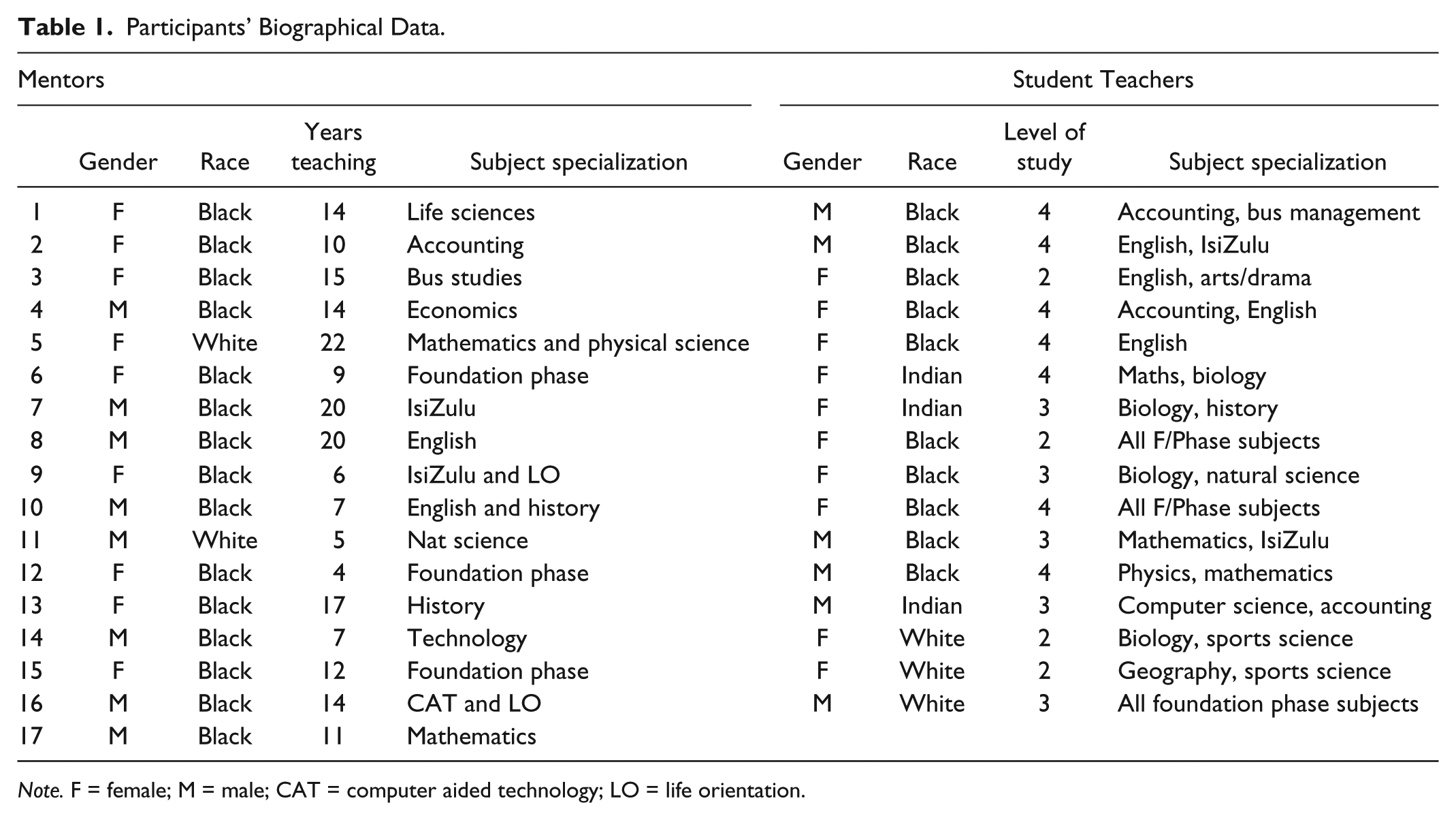
Note. F = female; M = male; CAT = computer aided technology; LO = life orientation.
Data were drawn from transcripts of group discussions and audio records of group reports. Mentors and students formed specialization groupings (five groups each) to make for discussions on common mentors/students. Data generation lasted 3 days: one day for mentors and two afternoons for students. Participants worked in groups providing detailed insights into their mentoring experiences. The activity had two sessions: group discussion and recording findings; and group reports which were audio-recorded. After an explanation of what participants were required to do, the groups embarked on intensive discussions before recording their experiences on flip chart for reporting back. Both audio records and written reports were transcribed verbatim.
Content analysis was used to unpack the data. The process involves systematically examining and interpreting data to identify patterns and themes (Cohen et al., 2011; Creswell, 2015; Plunkett & Dyson, 2011; Singleton & Straits, 1999). In this study, it involved reading transcripts and listening to audio-records several times, making brief notes of emerging important experiences in the margin, scrutinizing, categorizing and labeling the notes descriptively, linking related categories/themes, and recording them as major or minor categories/themes. This process was repeated with each transcript. Themes/categories were then reexamined for relevance to the research question. This was followed by a process to analyze and ensure that information had been categorized appropriately; scrutinizing all themes ascertaining whether or not some could be merged or subcategorized and finally returning to original transcripts to make sure that all information that needed categorization has been categorized. Cohen et al. (2011) suggest involvement of independent judges to verify categories of relevant meaning. Thus, I sent the data set to the RTEP leader to obtain a critical friend perspective, to identify errors and omissions. I then scrutinized the data determining how many mentor/student groups (MGs/SGs) had reported on particular themes and whether their experiences were developmental or nondevelopmental and entered in a table (Table 2). Subsequently, I reexamined data extracting quotes representative of each theme which would enhance description of mentors’ and students’ experiences in their words which Singleton and Straits (1999) call “. . . capturing in their language and letting them speak for themselves” (p. 349).
Number of Groups That Reflected Developmental and Non-developmental Experiences on Particular Themes.
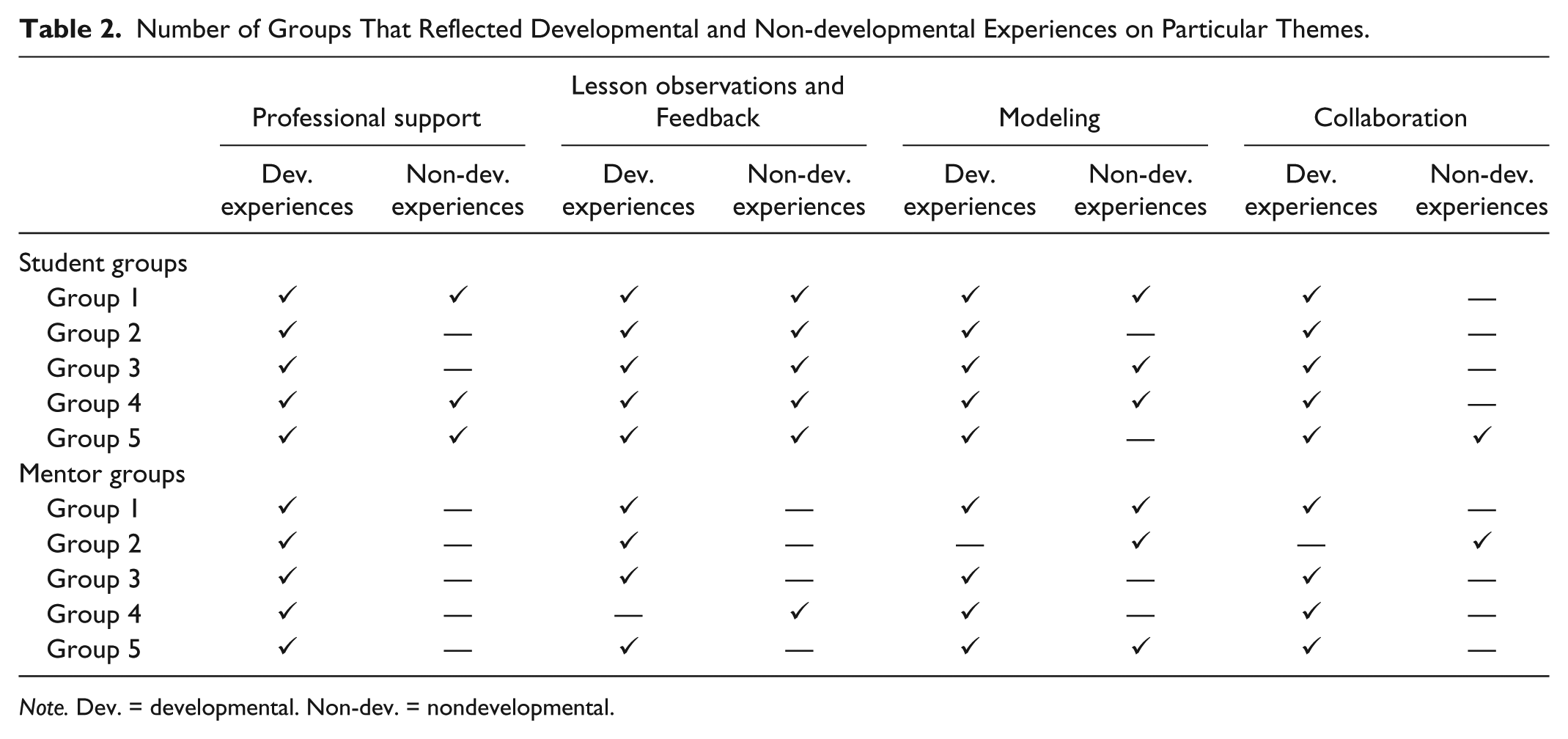
Note. Dev. = developmental. Non-dev. = nondevelopmental.
Involving the RTEP leader helped to establish credibility and trustworthiness. The University Higher Degrees and Ethics Committee granted Ethical Clearance to the RTEP.
Findings
The mentoring experiences of mentors and student teachers were evident in four themes: professional support; lesson observations and feedback; mentor modeling lessons; and collaboration. Table 2 illustrates the number that MGs and SGs reported developmental or nondevelopmental experiences related to particular themes.
Professional Support
All SGs reported experiences of the professional support that they received and the supportive role mentors played which positively influenced their TP. The mentors were found to be positive, always willing to assist, guide and offer valuable advice, and shared their skills and experiences with students. Some SGs mentioned specific needs that their mentors helped them to address and some mentors seemingly met their mentees’ expectations. SG4 quoted a mentor who instinctively understood the mentee’s concerns and responded to them:
It was as if she opened my mind and saw areas that I feared. I am there thinking, I must master them this final year. She discussed them calmly giving me sources, suggesting methods and learner activities. She shared her skills and experiences, always had valuable advice, helping me through, filling all my knowledge gaps.
Students’ descriptions of mentoring experiences were generally oriented toward pragmatics of classroom practice: micro classroom activities and teaching strategies, and immediate guiding action for “here” and “now” (Awaya et al., 2003). Students also gave examples of some teaching techniques which they had acquired through mentoring: “knowing how to explain; making teaching material relevant; raising learner curiosity using interesting and motivating strategies and aids; gained insights into organizing teaching material; learnt ways of relating to pupils; and how to build rapport.” In highlighting these developmental experiences, students acknowledged capabilities of their mentors describing them as knowledgeable and competent depicting sources of practical knowledge and wisdom (Awaya et al., 2003). However, three groups (SG1, SG4, and SG5) also included some nondevelopmental experiences. For example,
What dismayed me was that he introduced me as his assistant and told learners that I was a student like them . . . I can’t be like his learners, I am qualifying this year. (SG5) We met for daily planning and she said she wasn’t going to class, I should go. I had not planned, so I had to plan and teach there and then. Mentors are not communicating with us! They must communicate on teaching issues. (SG1) I was upset, he sent the class outside to play when I was supposed to teach. They don’t see the need to tell us because we are students, but communication is important. (SG4)
Remarks by SG5 may lead to students getting discouraged, feeling inadequate, and losing confidence in their ability to teach contrary to expectations by Awaya et al. (2003) where the mentor should offer moral support and breathe vigor into the mentee. What was seemingly underlying students’ concern for respect was the need for “acceptance” as colleagues. SG1 and SG4 indicate lack of communication. Preservice teachers are often excited to be part of a real school setting with open communication from their mentors, other staff and school management. The evidence above is contrary to these expectations.
All MGs reported positive mentoring experiences but portrayed a wider perspective of mentoring support, pointing out that they challenged students, imparted knowledge in motivating ways, and performed mentoring duties effectively. They generally indicated that they enjoyed working closely with students sharing ideas, skills, and plans. This seemingly confirmed understanding mentoring as a journey and mentors as sources of knowledge (Awaya et al., 2003). They highlighted that there was more to the experiences that was valuable as explained by MG1:
We got a different perspective to reflecting on what we did and why. When students, joined us, we already had schedules and lessons written. So we had to re-examine them critically knowing we would share with students. We learnt new ways of teaching, designing learner activities, assessments and discipline. We started critiquing our lessons: was it effective? Were instructions clear? All because of working with students.
Mentors became more reflective and critical of their pedagogical practices and learnt new strategies in the course of mentoring students. The description above lays emphasis on mentors learning rather than mentees. The very presence of the preservice teachers seemingly stimulated reflection-on-practice to provide a positive image to student teachers. MG4 added,
Students were enthusiastic and initiative which pushed us to reflect on our work. Their presence was an energy which propelled us; like more energy breathed into us. From nowhere we became enthusiastic, our morale and passion just grew.
Other MGs reported specific aspects in which they had realized growth from mentoring student teachers: “Having them made us more tolerant, more understanding, and supportive” (MG2). “Conversations with them helped us to understand our pedagogical procedures which improved our teaching” (MG5).
Lesson Observations and Feedback
With regard to lesson observations and feedback, what “stands” out in both mentors’ (four MGs) and students’ texts (five SGs) is the acknowledgment of feedback as crucial and a major source of teaching knowledge but with slightly different orientation. Mentors seemingly regarded feedback sessions as “intellectual dialogues” which stimulated students’ reflection and learning from their own practice while students saw it as something that helped them to develop the craft of teaching. Four MGs reported developmental experiences related to feedback. For example,
We point out students’ teaching characteristics. Although we aim at developing them into good, committed teachers, everyone is unique, with own background, character, and style. We give them frequent feedback, isolating strengths and weaknesses then assist them addressing the weak points. (MG1) We ask them to evaluate themselves, the problems they faced, the effectiveness of their teaching approaches, and what they will do to improve. This reflection makes them learn from their errors. We won’t tell them what they should have done, but make them see. Feedback is immediately after the lesson and does not only focus on theoretical levels but we also use our practical experiences. (MG3)
The evidence suggests working from the students’ own level of expertise, developing their abilities and strengths so that they sharpen their pedagogical skills. MG1 highlights regular feedback. Students should receive feedback for each lesson they have been observed teaching. Developing students into effective professionals drawing on their individualities tends to heighten the mentor’s role. MG3 rather gives weight to the mentors’ experiences and skills but again emphasizes practical knowledge. As well, leading students through reflection so that they develop answers to challenges implies guidance, urging them forward to see new paths to solutions (Awaya et al., 2003). MG3 highlights another crucial dimension of feedback: its immediacy. The longer the time gap between work completion and its feedback, the less effective that feedback becomes. Thus ideally, feedback should be provided within minutes of the task completion (immediately following the lesson). MG4, however, highlighted nondevelopmental experiences of feedback:
Sometimes we felt very insecure during feedback. We had to be selective on what to say to avoid hurting them. Many times we left out some of the comments we had recorded during the lesson.
Basically, feedback indicates performance in the efforts to reach a goal and is understood as one of the powerful influences on achievement. Hence, being honest and objective in feeding back places the student on the right path to their goal of professional proficiency. It is not what is said which hurts but how it is said. Thus, this calls for diplomacy and tact on the part of the mentor. The views above by MG4 contradict this value of feedback. They clearly did not view mentoring as a journey (Awaya et al., 2003).
All SGs (five) reported both developmental and nondevelopmental experiences of mentor lesson observations and feedback. Students generally portrayed feedback as having given them insights into lesson organization and presentation, class management, and learner motivation. They saw the feedback sessions as vital for receiving mentors’ practical guidance, knowledge, and wisdom, and obtaining encouragement which built their confidence (Awaya et al., 2003). SG4 said,
We discussed lessons, their complements encouraged and gave us confidence. Feedback is effective when the mentor is honest and objective. We need to know our strengths and weakness in order to maintain strengths and improve on the weaknesses.
SG3 added,
We gained in this TP because of strong, just, constructive criticism given in a compassionate way. Honest advice given gently is what we needed. It made us reflect and learn.
Mentees need knowledge of how well they are performing as knowledge of good performance gives them a sense of their worth which breathes vigor into them (Awaya et al., 2003). SG4 highlights honest, objective feedback. Similarly, students should know when they make mistakes so that they learn from them and take corrective measures. Although all SGs reported developmental experiences regarding feedback, they all also recorded some nondevelopmental experiences as some of their mentors did not offer constructive feedback. To illustrate, SG2 said,
She was lovely, wanted to be everybody’s mother, treating us like her children but didn’t tell us the things we were doing well or wrong yet other mentors were professional.
For three students (in different groups), feedback was extremely limited. Quoting one student SG1 said, “I was left in my own practice.” Another in SG3 reported overcritical and destructive feedback, “It’s not the content of feedback, it’s how they talk.” SG4 recorded a mentor as having said: “I’ve written a lot but very little is positive. I wanted to vanish.” Such criticism often destroys confidence in the student’s own ability, which may encourage conformity to their mentors’ suggestions, and ways of thinking and practice, contrary to Awaya et al.’s (2003) views of mentoring as “confidence building.” Notwithstanding the mentors’ “overly negative” attitudes, students expected mentors to be constructively critical, appraising them on what they needed to do differently or what required improvements. SG5 also reported one student who did not get any feedback from one mentor who only observed her lessons in the last week of TP.
I asked her many times to observe me but always said she was busy. She would promise but never pitched up until the last four days of TP as she had to complete university reports.
Mukeredzi (2009) coins this “compliance” mentoring, where mentoring duties are performed to fulfill university student TP assessment requirements. The university expected a stipulated number of lesson observations with developmental feedback. The behaviors reported above defeat the whole notion of mentoring as a journey, as initiation into one’s life role where the mentor guides and supports through encouragement, practical knowledge, and wisdom (Awaya et al., 2003).
Modeling
Both SGs (three SGs) and MGs (four MGs) talked about modeling but, with slightly different orientations. The MGs talked about modeling which included modeling lessons and professional traits as role models, whereas students focused on modeling lessons. Mentors emphasized that role modeling was a huge responsibility. Notwithstanding, they had to portray a positive image of a model to be emulated. MG1 commented,
The main task for students is to follow and tail a good teacher’s teaching. Following an effective mentor may become a lifelong benefit, but achieving it is a huge demanding responsibility. We had to be punctual, as students were always punctual. Dress code changed; you had to be presentable not scruffy, we became enthusiastic about our work. Being a model that students hope to become is difficult but, it made us prepare thoroughly. Knowing that you will be watched made you prepare and present lessons as best you could, interacting appropriately and managing the class well. (MG5)
Comments by MG1 portray an unequal mentor–mentee relationship. Indeed, the comments to “follow and tail” portray the mentor role as entailing presumptions of rank and a hierarchical relationship where the mentor assumes a dominant role and the mentee is relegated to a dependent position (Awaya et al., 2003). Mentoring is currently conceived as a process of growth for equal partners, coenquirers in the mentor–mentee journey. Although the comments also suggest professional qualities that are “staged” due to the presence of students, of importance, demonstrating appropriate qualities and rapport with learners can show mentees that these behaviors can facilitate learning. However, MG2 reported nondevelopmental experiences regarding modeling lessons:
Being observed and the whole idea of mentoring caused anxiety and fear. We didn’t have confidence, we feared that students might say we can’t teach or we have little content. It was also stressful because we had no time, we just forced time for mentoring.
Anxiety and fear around modeling lessons for students and limited time for mentoring have been documented elsewhere (see, for example, Hagger & McIntyre, 2006; Kiggundu & Nayimuli, 2009; Leshem, 2012; Mukeredzi & Mandrona, 2013).
Concomitantly, while all SGs had developmental experiences, SGs 1, 3, and 4 also reported nondevelopmental experiences citing among others limited mentor availability, and an awareness of the mentors’ lack of confidence and feelings of vulnerability as problematic. SG1 reported,
He kept on dodging playing hide and seek. He seemingly felt that he would be “judged” and was apologetic of his teaching. After one lesson that I observed he said: “That wasn’t my best performance, I wasn’t well prepared.”
SG3 also gave this example:
My NS mentor said she was nervous. I reassured her to relax and teach as she normally did, and I told her that I am only there to learn and not critique her teaching.
SG4 also pointed out that observing some mentor lessons provided knowledge of what not to do:
She was teaching isiZulu. I observed a discipline strategy that I will never use. Learners who didn’t do homework were sent outside then pinched under the arm as they re-entered one-by-one.
The above comments by SG1, SG3, and SG4 clearly illustrate once again that the mentor–mentee relationship was not constructed as a journey (Awaya et al., 2003). Notwithstanding the above nondevelopmental experiences, all SGs also recorded developmental experiences around demonstration lessons. The following excerpts illustrate,
She demonstrated word problems which excited them. Explanations were clear and questions posed to their level. Where learners gave wrong answers, she encouraged them to try. I saw that knowing and supporting learners and encouraging them gives them confidence to participate. (SG1) The lesson was lively and learner-centered. They all actively participated and he shared jokes here and there. I realized that relaxes learners, and also breaking down concepts helps learners to understand. (SG2) She wrote the day’s topic on the chalkboard, gave lesson objectives and then recapped the previous lesson. A few learners raised their hands and seeing this, she picked on those with hands down but amazingly their answers were correct. I learnt that all learners should be involved. (SG5)
The evidence above illustrates that students draw huge benefits from observing key examples of the art of teaching when it occurs in the real world. The mentor as a source of practical knowledge and wisdom can point to key elements during the preobservation conference, such as lesson structure, learner activities, discussion styles, and so on, which themes could form the basis of discussion in the postlesson observation conference.
Collaboration
Four MGs reported developmental experiences through collaboration which suggests mentoring constructed as a journey, and equality in the relationship (Awaya et al., 2003). Such relationships often offer students a more positive personal field experience. These MGs suggested that collaborative mentoring enabled them to encourage students to come forward with ideas, to prove their worth and demonstrate their capabilities at all stages of the journey while prompting them into trial and error to expand their knowledge and skills (Awaya et al., 2003). However, collaboration does benefit not only preservice teachers but also mentors. Mentors may know more about classroom procedures and operations, while students may have new teaching pedagogies which may offer mentors deeper insights into their own teaching through joint planning, teaching, and reflection. MG2 said,
Observing students gave me opportunities to watch other people teaching. I saw my learners who never participated actively engaging. During feedback we discussed ways to further encourage active learner involvement and participation. This would not have happened without me observing his lesson. We gained new knowledge on teaching styles. Meetings helped us learn from each other and the joint planning, materials development, teaching and marking made us more open-minded and willing to learn. We began to understand each other, what students knew or did not know so as to prepare interventions. (MG3) Having them made us professionally grow. Mentoring is more than one-time conversation, but on-going engagement in students’ professional growth, continuous support and encouragement in their activities, and withdrawing to see what they can do on their own. (MG4)
The mentors’ comments imply equality in the relationship, mutuality, and learning from each other, which is not based on the mentor’s rank or greater expertise, experience, and wisdom (Awaya et al., 2003). Jointly devising ways of active learner involvement reflects co-learning and enquiry-oriented collaboration. Comments by MG3 also portray students as sources of knowledge around teaching styles, and making mentors open-minded, understanding and willing to learn. MG4 highlights encouragement, breathing vigor into the mentee to forge into appropriate action, and urging them forward to meet new challenges without interfering directly in the action but standing back to let them demonstrate their capabilities which builds their confidence (Awaya et al., 2003).
Students’ (five SGs) reports of collaborative experiences reflect the value they placed on good relationships with their mentors. They stressed the importance of a supportive one-to-one relationship, being listened to and accepted. SG3 explained,
The best thing he did was to sit down and listen to me. He always made me feel that what I said was worthwhile. Our interactions were always fulfilling, he accepted my ideas and supported me in my trial and error with methods.
Other SG4 also commented,
We hold meetings daily to plan and also strategize for the following week but they expect us to have ideas or suggestions while they ask guiding questions. Jaah, we learn from each other not undermine one another.
Evidence generally shows mentor–mentee collaboration. The mentor is represented as offering emotional support and guidance on practical knowledge, portraying collaboration aimed at guiding action, urging them forward, and focusing on particular immediate student needs of the moment (Awaya et al., 2003). Students were supported to see and work through their challenges and consider new solutions to addressing them. Although, broadly, collaboration was developmental to both mentors and mentees, SG5 also reported nondevelopmental experiences. They gave this following example:
My Grade 9 mentor looked for me to teach but he was always dodging from being observed himself. I went in to teach that lesson and he came in and sat there playing with his cellphone, laughing and mocking me while I disciplined learners without even paying attention to give me advice afterwards.
Aderibigbe (2013), du Plessis (2013), and Heeralal and Bayaga (2011) report ineffective mentoring relations where mentors exhibited unprofessional behavior like taking advantage of students, not gainfully observing them, or modeling lessons for them to enhance their professional learning experiences. Such unprofessional behavior contradicts expected mentor responsibilities where mentoring is viewed as a professional journey; the mentor guiding, nurturing, and supporting mentee growth; offering them practical knowledge and wisdom (Awaya et al., 2003); appraising them on shortcomings and strengths; and encouraging them as they develop abilities to prepare and deliver effective lessons (Mukeredzi, 2009). In the absence of such supports, stressful and threatening situations often arise.
Discussion and Implications
The study investigated mentoring experiences of mentors and students in a cohort model of TP in a rural school. Results show experiences around four aspects: professional support, lesson observations and feedback, collaboration, and modeling. Although there were nondevelopmental experiences related to unequal relationships and lesson modeling, the overall impression given by both mentors and preservice teachers was positive.
With regard to professional support, students’ descriptions of mentoring experiences covered the pragmatics of classroom pedagogies. Mentors emerged as a source of wisdom being supportive, always willing to help and sharing their knowledge, skills, and experiences of professional practice. This suggests construction of mentor–entee relationship as a journey. Awaya et al. (2003) view a mentor as a guide to practical knowledge, a mouthpiece of wisdom, who points mentee in the right direction to realize new paths to solutions, while targeting immediate needs—the “here” and “now” issues. However, some students (four) were unhappy with the welcome and introductions, and lack of open communication by their mentors. These mentors introduced the students as their assistants who were like school students they were teaching. Such introductions clearly negated equality in the mentor–mentee relationship as advocated by Awaya et al. (2003). Mukeredzi (2009) establishes that students appreciated being respected, accepted, regarded as colleagues, and made to feel welcome in the school. Of importance to students in this study was seemingly the need to be accepted as a person, a teacher, and a part of the teaching profession. Stanulis and Russell (2000) note that students often feel “vulnerable” and “exposed” during placement. It is therefore vital that mentors are people whom they feel they can trust. Awaya et al. (2003) indicate that a mentor should act as a mentee advocate/mouthpiece, their source of moral support who offers encouragement, and not one who threatens their morale and diminishes their courage. Open conversations and communication in mentoring make the most significant and integral components in learning to teach as this enables “jumping in” (Stanulis & Russell, 2000). “Jumping in” is the willingness to take risks, to be involved and to immerse oneself in acts of teaching to maximize learning opportunities for the other person.
Mentors viewed mentoring broadly, expressing that working with students provided valuable developmental experiences. The very presence of students rejuvenated them and stimulated reflection on and enthusiasm in their practice. The term enthusiasm is used in instruction to connote a motivating, energetic, passionate, and dynamic teaching style (Zhang, 2014). Teacher enthusiasm is critical in holding learners’ attention, generating interest, and developing positive attitudes toward learning. Enthusiastic teachers reflect on their performance, are open to new learning to accommodate and further develop effective teaching and learning pedagogies (Zhang, 2014). They share their skills and knowledge and whenever they observe other teachers, they identify practices which are worth emulating (Zhang, 2014). All these crucial qualities were observed in some of the mentors in this study.
Both mentors and students acknowledged lesson observations and feedback sessions as a major source of teaching knowledge. Students revealed that they needed honest and objective feedback which highlighted how far they were getting “it” right or wrong so that they would uphold the “right” and address the “wrong.” Mentors regarded feedback sessions intellectual dialogues which promoted students’ reflection and learning from own practice. They reported provision of continuous and undifferentiated feedback, emphasizing immediacy and frequency in feeding-back drawing on preservice teachers’ individualities. The lesson observations and feedback meetings support Awaya et al.’s (2003) understanding of mentoring as a journey toward self-discovery and initiation into their life (teaching) role. Sessions promoted students’ reflection and learning through the practical knowledge and wisdom of their mentors. Mentors are well positioned to give critical developmental feedback due to their greater and more intimate knowledge of the relevant contextual factors (Hagger & McIntyre, 2006). As on-spot teacher educators, mentors can monitor on daily basis students’ skills development to praise improvements and reinforce attention to neglected aspects (Mukeredzi & Mandrona, 2013). However, one MG did not give objective and honest feedback. The MG revealed that they felt insecure in feeding-back and consequently discussed only strengths, overlooking weaknesses to avoid “hurting students.” Such mentoring practices contradict notions of mentoring as a journey of initiation into preservice teacher’s professional role in life as viewed by Awaya et al. (2003). Such mentoring insecurities, fears and a lack of mentoring confidence could be minimized or even dispelled by comprehensive and prolonged mentor training with follow-up and support. If mentor training is implemented effectively, it may eventually become a natural aspect of teachers’ repertoire of mentoring skills.
Pre-service teachers valued feedback for developing their classroom practice. They found it vital for understanding classroom pedagogies and obtaining guidance on how to improve their teaching performance. Some indicated development of confidence from positive comments and encouragement, but emphasized the need for honest and objective constructive feedback. From Awaya et al.’s (2003) perspective, such mentors would be providing wise counsel and encouragement, accelerating mentees into apt action—“confidence building.” Essentially, mentors should monitor students’ professional learning, giving them accurate and objective feedback. Again, weaknesses need tactful positive discussion as positively offered feedback not only provides more information than negatively expressed one but also strengthens a student’s motivation and self-esteem (Hagger & McIntyre, 2006).
However, five students experienced nondevelopmental feedback citing mentors who were “nice” without feeding-back, were overcritical and overly negative, or performed last moment technical compliance mentoring. All these behaviors are in contradiction of Awaya et al.’s (2003) themes that inform effective mentoring: mentor–mentee relationship as a journey, guiding mentee on practical knowledge, offering them moral support, and making for equality in the relationship. A number of issues may have been at play and I must acknowledge possible intersecting factors that may have contributed to the mentors’ behavior which probably influenced the mentoring process. For instance, students may not experience effective mentoring if mentors themselves experienced problematic mentoring, given that much of what teachers do or do not do is in response to early learning influences (Allender & Allender, 2006). Again, these teachers may not have taken up the mentoring role voluntarily. Mentor selection was done by the school, based on subject specializations, and some may not have fully comprehended the true nature of mentoring. Furthermore, these mentors were exposed to a 1-day university mentor training workshop which may have been inadequate given the complexity of knowledge exchange between mentors and mentees required for effective mentoring. However, ineffective mentoring noted in this study supports observations by the South African Department of Education (DoE) where ineffective in-school supervisory and mentoring support in the South African education context were hindering the success of on-site initial teacher education (DoE, 2006). Limited student mentoring in South African schools has also been observed (see, for example, Heeralal & Bayaga, 2011; Kiggundu & Nayimuli, 2009; Mukeredzi, 2009; Mukeredzi & Mandrona, 2013).
Ineffective mentoring as alluded to above could be minimized by long-term mentor training coupled with close monitoring, support, and some pressure and coercion. Monitoring will enable timely corrective measures and guidance. A combination of support and pressure is essential for continuing learning improvement (Ambrosetti & Dekkers, 2010). Support may allow those in problematic mentoring situations to tolerate the anxiety of those challenges through encouragement, motivation, and occasional nudging that many practitioners often require to persist in challenging tasks often inherent in mentoring. Pressure or coercion is often vital in initiating attitudinal shift among teachers whose self-impetus for change may be minimal.
Furthermore, addressing in-school supervisory and mentoring support requires a forum where all partnership members (university, school, and DoE) reexamine, rebuild/strengthen, or reconstitute and revitalize the partnership (Edwards & Mutton, 2007). This may enable reidentification of mutual goals which may include among others student teacher mentoring and promote creation of sustainable communication systems across all levels (e.g., between school and partners, with DoE and within the school). Such a process may rebuild/strengthen a sense of trust among all stakeholders, ensuring that all members of the partnership share a common vision. Again, this may give rise to developing strategies to offer mentors greater exposure to mentoring practices and school-based supports through comprehensive ongoing mentor training referred to above to better equip them to support not only student teachers but also novice teachers. The content of such training may include: equality in mentoring relationships, mentoring as a process; mentor roles and provision of mentee feedback, practical knowledge and moral support including ways of offering mentee space. This may optimize school-based education of preservice teachers, and promote school students’ learning outcomes while enhancing the professional growth of both school and university staff.
The lack of regular meetings, consultations, and frequent interactions of partnership stakeholders that was apparent in this study support findings by Brady (2002), Edwards and Mutton (2007), and Robinson (2016) who noted an absence of platforms to encourage stronger partnership relations, universities expecting schools to do more than they could manage, communication either nonexistent or tending to be procedural, and with almost no evidence of deeper dialogues. Until teacher educators, DoE, and schools engage in serious and committed discussions around student school-based professional supports, the possibility of significant improvements in this regard is unlikely.
Both mentors and students reported experiences around modeling. Most students (three SGs) commented that mentors modeled effective teaching and they viewed lesson modeling as a valuable experience. From Awaya et al.’s (2003) conception, lesson modeling relates to the mentor as guide to practical action and knowledge where the mentee observes live approaches to address issues and challenges, and also to realize new classroom strategies and solutions. Facilitating lesson observation opportunities for students is a vital and effective instructional strategy which often opens the mentor’s thought processes for the mentee to observe. In utilizing this instructional approach, mentors often engage trainees in the imitation of particular professional behaviors that encourage learning. However, role modeling was regarded a demanding responsibility if mentors “had to practice what they preach.” For some, the very presence of students improved their professional practice around lesson preparation and delivery as well as their deportment and punctuality. Mentors should portray role models of thoughtful, enquiring teachers, aware of implications of their actions, and who seek to further their own understanding of classroom pedagogies (du Plessis, 2013; Mukeredzi & Mandrona, 2013). In modeling good teaching, mentors make students “see” what is important, what could further be improved, and understand rationales involved (Hagger & McIntyre, 2006). Most mentors (four MGs) portrayed some of these qualities, while others, due to lack of confidence, deliberately avoided modeling lessons. Awaya et al. (2003) point out that mentors should share and demonstrate to the mentee conceptions of and aims for teaching, always striving to create supporting challenges that push—breathe vigor into the protégé.
Collaboration enhances both students’ and mentors’ professional development and significantly reduces a sense of isolation among teachers (du Plessis, 2013). In the current study, collaboration in lesson delivery offered mentors new teaching styles and effective ways of engaging learners. Mentors indicated that joint lesson preparation, teaching, and assessment created openness to learning and better knowledge of preservice teachers. From the MGs, it appears collaboration was based on friendship, mutuality, and equality in the relationship and co-learning, without foregrounding the mentor’s rank but greater experience and wisdom (Awaya et al., 2003). Two MGs foregrounded “confidence building” and an awareness of when to stand back and give the preservice teachers space to show off their capabilities. This aligns with what Awaya et al. (2003) regard as knowing when to provide space and let the protégé show off their worth, portraying their true version and exhibiting that they are made of the “right stuff.” Often the dynamic is knowing when to “jump in” and when to stand back. Mentors should guide without taking control of the mentee’s actions, but allow them space to show-off what they are made of.
From the SGs while there was mentor–mentee collaboration which was aimed at building what Awaya et al. (2003) call “equality in the relationship,” the preservice teachers’ comments generally portray the mentor’s dominant role, suggesting unequal relationships. Awaya et al. indicate that where there is equality, there is caring and friendship and, authority in the relationship is based on experience and wisdom notwithstanding mentor’s rank or organizational level. This was seemingly not the case. Effective mentoring exists in contexts where the relationship is underpinned by a partnership in which neither party holds power over the other or one disregards their position of power; where mutuality is a critical feature; and where equality can be achieved between all participants (Awaya et al., 2003). Three students did not experience collaboration with some of their mentors as those mentors did not make time for mentoring them. This behavior contradicts views of mentoring as a journey in which the mentor is a guide and a source of practical wisdom and support, who constantly and appropriately breathes vigor into their mentee, urging them frontward to face new situations, without direct interference in their action, but only encouragement into apt action—“confidence building” (Awaya et al., 2003). Mentor–mentee collaboration has been recognized as vital for developing teacher professional knowledge and skills (Aderibigbe, 2013; Hagger & McIntyre, 2006; Kiggundu & Nayimuli, 2009). Again, genuine collaboration also exists where all participants feel safe to reveal their vulnerabilities to enable learning, and is driven by honest and professionally supportive mentor–mentee interactions in an environment where even mentors also feel safe to put themselves “out there” to help preservice teachers to learn (Aderibigbe, 2013). It may be that for some mentors, the mentor–mentee environment was not conducive for revealing their vulnerabilities.
Conclusion
The study explored mentoring experiences of mentors and student teachers during a 4-week residential practicum. Experiences revolved around professional support, lesson observations and feedback, mentor modeling lessons, and collaboration. With regard to professional support, students’ descriptions of mentoring covered the pragmatics of classroom strategies. All, except three students who did not receive mentoring because their mentors did not make time for them, portrayed mentors as a source of practical knowledge and wisdom, who supported their classroom practice and were always willing to assist and share knowledge, skills, and experiences of professional practice. Notwithstanding the professional support, four students were dismayed by the way they were introduced to pupils and, the absence of open communicate with them suggesting some oversights on how we learn to become teachers.
Both mentors and students hailed lesson observations and feedback sessions as a key source of teaching knowledge. Preservice teachers viewed feedback as vital for understanding and developing the art of classroom pedagogies, and receiving guidance to foster their teaching performance. Some developed confidence from positive appraisal, encouragement, and constructive feedback. However, students revealed that they preferred truthful and impartial mentors who highlight both strengths and weaknesses so that they uphold strengths and work on weaknesses. Some of the mentors were “nice” without feeding-back, overcritical, and/or performed compliance mentoring. This type of behavior did not portray mentor–mentee relationship as a “journey of initiation into one’s life role, as a teacher.”
Mentors saw feedback conferences as intellectual interchanges which promoted preservice teacher reflection and learning from own practice. Mentors indicated that they were able to offer continuous and undifferentiated feedback, emphasizing propinquity and frequency in feeding-back drawing on students’ individualities. However, one MG confessed lack of objectivity in feeding-back highlighting fear and insecurity consequently, only discussing strengths, avoiding weaknesses as they would “hurt students.” Such practice contradicts the views of mentoring as a journey where the mentor provides guidance on practical knowledge, morally supporting their mentee, and urging them forward.
Concerning modeling, all SGs indicated that mentors modeled effective teaching which was beneficial and informative as they were exposed to key examples of the art of teaching “in the real world.” However, the other three SGs also reported nondevelopmental experiences citing among others mentor unavailability, lacking confidence, and portraying feelings of vulnerability. The MGs that modeled lessons revealed that it was demanding, but admitted that the very presence of students improved their professional practice, lesson preparation, and delivery behaviors as well as their professional deportment and punctuality in their efforts to make students “see” what is important. The one group that admitted failure to model lessons professed a lack of confidence and fear that students would view them as possessing inadequate subject content knowledge. These mentors did not regard mentoring as a journey into one’s professional role and did not understand the relationship as equal-collegial.
SGs valued collaboration and good relations with their mentors and further esteemed the supportive one-to-one relationship including specific professional needs that their mentors helped them address. Others indicated fulfillment from collaborations, being listened to, having their ideas accepted and enacted, and receiving encouragement for experimenting with pedagogies. Mentors testified that collaboration offered them opportunities to watch other people teach, from where they gained new knowledge on teaching styles and effective ways of learner engagement and discipline. They confirmed learning from each other which made them more understanding, open-minded, and willing to learn. Their enthusiasm, reflection-on-practice, morale, and passion for their work grew which improved their teaching and enhanced their professional growth. Mentors also confirmed that this would not have happened without mentor–mentee collaborations. The MG that did not speak highly about collaboration pointed out that the entire mentoring process was stressful and caused fear and anxiety as they were unable to make time for it.
On the overall, while most mentors in this study seemingly understood mentoring as a process, a journey of student teacher initiation into their professional life, the mentor–mentee relationship was not constructed as equal. Mentoring is not a natural activity, which requires making all aspects of teaching processes visible, breaking down all teaching approaches into step-by-step instruction for students (Mukeredzi & Mandrona, 2013). This implies a need for more time to focus on mentor–mentee practices, meetings, setting expectations and guidelines collaboratively, and addressing concerns of various aspects such as modeling and observing lessons.
Perhaps achievement of mentoring effectiveness may be enhanced through strengthening these school-university partnerships, addressing, for instance, issues around specific roles of the mentor, guidelines and expectations regarding mentoring time, and how the university, school, and DoE can collaboratively address these. The 1-day mentor training workshop was seemingly inadequate as there appeared to be a lack of clarity regarding mentor terms of reference. Again, there seemingly was no forum to discuss concerns and encourage/strengthen the partnership. There is need for the tripartite group to engage in serious and committed discussions around school-based supports for student teacher TP, otherwise significant change in this regard may not be possible as mentors may continue to pay lip-service to mentoring of preservice teachers.
Footnotes
Acknowledgements
I acknowledge the support by the Rural Teacher Education Project (RTEP) and the National Research Foundation of South Africa. I am grateful to the RTEP leaders for enabling me this invaluable opportunity; in particular, I am thankful to Professor Relebohile Moletsane, the J. L. Dube Chair on Rural Education, for her continued support and encouragement in my research and publication activities.
Declaration of Conflicting Interests
The author(s) declared no potential conflicts of interest with respect to the research, authorship, and/or publication of this article.
Funding
The author(s) received no financial support for the research, authorship, and/or publication of this article.