




Abstract
Education should encourage cognitive and emotional development in students with special educational needs, embracing how each student sees themselves. As such, mindfulness is a learning experience that entails significant emotional well-being, learning, and physical and mental health benefits for those who engage in this practice. The study analyzed perceptions of self-concept in students with compensatory education needs at primary school level (n = 26); this descriptive–correlational study was conducted by means of the “Multidimensional Self-Concept scale.” The respondents reported positive levels of self-concept in peer relations, physical appearance and physical ability, and academic self-concept in mathematics. Furthermore, correlations between the different factors of the scale were observed, thus favoring the subsequent design and implementation of a mindfulness intervention.
Introduction
The current education system proposes an education model focused not only on developing students’ cognitive capabilities but also their emotional skills. That said, and given that school is about equipping students with the skills, knowledge, and attitudes to facilitate their autonomy and inclusion in school and social settings, it should also contribute toward enhancing personality development. As such, education should embrace and protect students’ feelings, emotions, and self-esteem; widen the choices available to them; and acknowledge their uniqueness, collective identity, individual personality, and cultural specificities (Fernández & Terrén, 2008).
The importance of self-concept lies in the significant role it plays in character formation. According to Musitu, García, and Gutiérrez (1994), self-concept is understood as the notion an individual has of himself or herself, based on experiences with others and on how they evaluate their own behavior; this encompasses emotional, social, physical, family, and academic aspects. The characteristics associated with self-concept based on Shavelson, Hubner, and Stanton’s (1976) model are as follows:
It is multifaceted, as people categorize the vast amount of information they have about themselves, establishing relationships with peers.
It is organized hierarchically with perceptions of self across different subareas (academic self-concept in language, mathematics, etc.).
General self-concept is stable, but as one goes down the hierarchy, self-concept becomes increasingly more situation-specific and, as a result, less stable.
As people grow and develop, self-concept takes on a more complex, multifaceted structure.
Primary school years are of great importance when it comes to developing students’ self-concept, given that this is a time when children become aware of their academic achievements, their popularity among peers, and how teachers react to their gestures, attitudes, successes, and failures. Thus, the individual’s sense of identity increases, which in turn has an impact on self-acceptance, building character, and strengthening one’s self-esteem (Cardenal, 1999).
According to Lantieri, Nagier, Harnett, and Malkmus (2011), the growing recognition of socioemotional development is conducive to improved school and life achievements in children, focusing on self-awareness, self-management, social awareness, and relational skills based on cooperation and responsible decision-making. However, the study carried out by Naranjo (2007) has shown how students who think negatively about themselves impose greater limitations on their achievements, whereas De la Orden and González (2005) have found academic and social self-concept to be negatively correlated with poor school performance.
Students with compensatory education needs are defined as those who find themselves in socially disadvantaged situations, frequently coming from ethnic minorities, immigrant communities, or families experiencing severe financial hardship. These students have a significant curricular lag, educational inclusion difficulties, as well as support needs resulting from late entry into the education system, irregular schooling, and lack of knowledge of the language given that they come from other countries.
In the context of inclusive schooling, equal opportunities of access, retention, and promotion for all students should be guaranteed, regardless of their origin, personal, social, economic, and/or cultural situation and status. What is more, this environment is aimed at facilitating students’ social and educational integration, reinforcing attitudes of acceptance and mutual respect. Last, school should strive to provide an adequate and quality-driven educational response to students who find themselves in disadvantaged personal, social, economic, and cultural situations by adopting compensatory education approaches to ultimately help them achieve the goals and targets established in primary education.
In recent decades, Spain has undergone a series of profound changes that have affected the education sector, meaning that the nation must respond to the new needs and demands of its students. As such, Spain has gone from being a country of emigrants to one that now ranks among the preferred destinations of immigrants who leave their country in search of better living conditions. In addition, the economic downturn that Spain is currently experiencing has favored the emergence of economically disadvantaged families, thus resulting in school failure and dropout among students. To tackle this, the Spanish education system offers an educational response to this type of students, which aims to
Promote equal opportunities in education, with preference given to underprivileged sectors, based on establishing measures that effectively redress baseline inequalities;
Facilitate the social and educational inclusion and integration of all students by eliminating processes of social and cultural exclusion and by developing communicative attitudes and mutual respect among all, irrespective of their cultural, linguistic, and ethnic background;
Promote the enrichment afforded by different cultures and encourage the retention and dissemination of a minority group’s own language and culture;
Support the active participation of social agents and the education community to ensure equal opportunities, access to education, and the inclusion of immigrant families or those finding it difficult to integrate;
Drive forward coordination and collaboration efforts with different nonprofit organizations, administrative bodies, and institutions to develop compensatory education measures intended for groups who find themselves in socioculturally disadvantaged situations.
Hence, teachers must take into consideration these particular students’ social, economic, cultural, and personal circumstances given that, on many occasions, they pose problems of social maladjustment, lack of motivation toward one’s studies, school absenteeism, little parental control, and other factors. In the majority of cases, the social–affective dimension is deficient, as priority is given to receiving the students and following up on the teaching and learning process. For this reason, assessing, diagnosing, and treating the students’ educational needs becomes a complicated endeavor which, because of their generally lesser development and maturity—and limited language skills specifically—is frequently subject to obstacles (Navarro, Meléndez, Sales, & Sancerni, 2012).
Moreover, the more unstructured the pupil’s social–family environment is, the more likely they are to face personal disruption and/or maladjustment that hinder the process of adaptation to the social, school, and family domains (Farrington, 2005; Patterson & Yoerger, 2002). The fact that the student belongs to a socially disadvantaged group and/or is living in poverty, understood as the point where economic deficit and a situation of social exclusion meet, may have a negative impact on the shaping and expression of social skills (Segura, 2010). Meanwhile, ethnic-cultural discrimination is found to be negatively related to the following dimensions: self-esteem (Hunter, Durkin, Heim, Howe, & Bergin, 2010; Seaton & Yip, 2009); social adaptation, social competence, and inclusion (León, Felipe, Gómez, Gonzalo, & Latas, 2007); students’ well-being and building satisfactory interpersonal relationships (Eccles, Wong, & Peck, 2006); and pupils’ attitudes toward their center of learning (Dotterer, McHale, & Crouter, 2009).
Studies like those by Fernández, Gaete, and Terrén (2008) revealed significantly poorer classroom integration among immigrant students as opposed to native-born students, yielding higher rejection rates and lower acceptance levels among fellow pupils. In addition, Giró (2011) highlighted how immigrant students appear to have a narrower circle of friends than their Spanish peers; the first group needs to feel “surrounded” by people their own age as well as from the same culture who they can easily identify with. Consequently, immigrant students express lower levels of trust in their Spanish classmates who they consider circumstantial friends.
In contrast, Igbo, Onu, and Obiyo (2015) described how location and the socioeconomic context in which the school where the student studies at operates have a significant influence on academic performance, although not on self-concept. Furthermore, Trianes, Cardelle-Elawar, Blanca, and Muñoz (2003) have observed how adolescents from deprived areas display better self-reported social skills than others brought up in residential neighborhoods. Pegalajar and Colmenero (2013) have even shown how students with compensatory education needs usually feel good about themselves, accepting how they are physically and expressing satisfaction with their own actions. Other studies (Cohen, Esterkind, Betina, Caballero, & Martinengui, 2011; Lacunza, 2007; Lacunza & Contini, 2009) reveal how they possess the necessary social skills to perform effectively in the school context and in their interaction with others.
Moreover, and under certain circumstances, compensatory education students’ needs may go hand-in-hand with falling behind at school, learning difficulties, problems establishing harmony, and behavioral issues in the school setting. As such, it would be useful to analyze self-concept in students with disabilities—this being a critical variable—especially given that social comparison plays a fundamental role in these particular students’ self-esteem, exerting an influence on the basis of perceived significant limitations in the functioning of specific adaptive skills (Pérez & Garaigordobil, 2007). However, studies yield contradictory results: On one hand, authors such as Garaigordobil and Bernarás (2009) and Bolat, Doğangun, Yavuz, Demir, and Kayaalp (2011) posited that no significant differences in self-concept emerge between people with and without disabilities, on the other hand, other studies (Halder & Datta, 2012; López-Justicia, Fernández de Haro, Amezcua, & Pichardo, 2000; Polo & López-Justicia, 2012; Taleporos & McCabe, 2005; Weisel & Kamara, 2005) point to significantly lower differences in self-concept for young people with disabilities. Authors like Kavale and Forness (1996) have reported how children and adolescents with learning difficulties experience social problems, emotional difficulties, and behavior disorders due to deficits in the development of “social competence.” In contrast, research conducted by Obiakor and Stile (1990) has shown higher scores in self-concept for people living with disabilities.
From this perspective, and on the basis of preliminary assessment concerning the level of self-concept in students with compensatory education needs, it is possible to design learning experiences based on new conscious attention techniques, namely mindfulness. This is a particular way of paying attention, a basic and universal human capacity (Simón, 2007); it consists of looking deeply into one’s self and cultivating attitudes of acceptance, trust, patience, curiosity, equanimity, and nonjudgment (Kabat-Zinn, 2004). Acceptance of and attention to breathing, the senses, feelings, and the body, as well as detaching oneself from thoughts in the now, are the pillars of mindfulness (Snel, 2013).
Reviewed scientific literature on the practice of mindfulness has yielded relatively satisfactory results; its inclusion in the school context represents improved academic performance, creativity, emotion regulation in children with internalizing/externalizing problems, decreased anxiety, enhanced attention, aggressive behavior modification, improvements in perceived self-efficacy and in mood, and quality of sleep (Parra, Montañés, Montañés, & Bartolomé, 2012). Furthermore, mindfulness promotes emotional well-being, an individual’s capacity and potential for learning, and the physical and mental health of those who practice it (Burnett, 2011). According to Lavilla, Molina, and López (2008), psychoeducational programs based on mindfulness techniques can help minimize distractions; reduce anxiety, impulsivity, and suffering; increase concentration; and help us accept things for how they are, enjoy the present, and boost our self-awareness.
Various research also shows the positive effects of mindfulness-based programs on students with educational needs. For example, Semple, Reid, and Miller (2005) proved the effectiveness of mindfulness approaches in the work of students with anxiety disorders. For their part, Beauchemin, Hutchins, and Patterson (2008) carried out a study on these techniques among adolescents with learning disabilities, demonstrating the benefits to these students’ self-assessment of anxiety, social skills, and academic achievements. Similarly, Franco, Soriano, and Justo’s (2010) study involving Latin American students revealed how a psychoeducational program for developing mindfulness produces significant improvements in self-concept and academic performance.
Kuyken et al. (2013) assessed the efficacy and acceptability of a mindfulness-based intervention to enhance mental health and well-being by addressing factors such as taking on tasks without fear and enjoying them, self-esteem, and empathy. The participants who practiced mindfulness more often reported fewer depressive symptoms, lower stress, and greater well-being. Similarly, Franco, De la Fuente, and Salvador (2011) found this program to be a valid and appropriate instrument for improving personal growth and self-realization. Furthermore, this approach has garnered empirical support for its inclusion and use in education to improve the psychological and emotional well-being of immigrant adolescents (Soriano & Franco, 2010).
Focusing on students’ self-concept, the practice of mindfulness has the following positive effects: It enhances the development of skills needed when forging interpersonal relationships (Carson, Carson, Gil, & Baucom, 2004; Goleman, 2006); it increases empathetic responses (Shapiro, Schwartz, & Bonner, 1998); and it helps nurture self-compassion (Leary, Tate, Adams, & Hancock, 2007; Shapiro, Brown, & Biegel, 2007). What is more, the daily practice of mindfulness enables us to manage our personal energy to achieve good physical and mental health. This approach results in new functions related to emotional balance, response flexibility when faced with life’s myriad of situations, fear extinction, increased morality and intuition (Siegel, 2012) as well as the development of more satisfactory interpersonal relationships (Williams & Penman, 2010).
Meanwhile, Razza, Bergen-Cico, and Raymond (2013) revealed significant effects relative to self-regulation based on mindfulness practice, especially among children at a greater risk of self-regulation dysfunction. Without a doubt, this is a feasible and effective method of building resilience and self-esteem among the school population (Greenberg & Harris, 2012). And as pointed out by Arguís (2014), mindfulness in education can counteract daily stresses, whereby experiences are played out in a more attentive and mindful manner, making it possible to assimilate new information in a calmer, more relaxed fashion. As a result, learning improves, the risk of information overload is avoided, and some of the ingredients for personal and social development and well-being promotion in schools are provided, thus complementing academic learning approaches.
The starting point of this research was to analyze the perceptions of self-concept held by students with compensatory education needs, where the following questions were asked:
What concepts do students with compensatory education needs have about their academic activity and performance?
What are the perceptions that these particular students hold about their physical appearance and physical ability?
How do students with compensatory education needs view their relationships with peers and family?
How do these particular students generally see themselves?
Is there a correlation between how students with compensatory education needs perceive their academic performance, appearance and physical skills, self-criticism, and relationships with family and friends?
Method
The aim of this study was to analyze the level of self-concept in primary school students with compensatory education needs; that is, students who find themselves in disadvantaged personal, social, economic, and cultural situations. To this end, a descriptive–correlational methodology was used, conducting data collection by way of a questionnaire. Both the aim of the study and the characteristics of the sample group were taken into account to adapt the research process to the circumstances.
Sample
The study was carried out at a school of Infant and Primary Education (CEIP) in the province of Granada, which for a number of years now has been recognized by the education department as eligible for a “Compensatory Education Plan.” The aim is to develop initiatives designed to compensate for the curriculum gap faced by students with compensatory education needs, by appropriately planning and organizing spaces, schedules, and groups based on the pupils’ needs. Furthermore, activities that facilitate the integration of late-entry students or those who irregularly entered the education system, as well as pupils whose personal, social, economic, and other conditions mean they are at risk of early school leaving, are included. Last, this plan encompasses complementary and extra-curricular activities as well as measures aimed at improving relations among the different members of the education community and preventing school absenteeism.
In short, this is a compensatory measure aimed at students who, for whatever circumstances, find themselves at a disadvantage when it comes to entering, remaining, and progressing in the education system. To address this issue, state-run schools can draw up a Compensatory Education Plan that seeks to adapt the curriculum to the students’ needs and characteristics, and which requires approval from the education authority. The drawing-up stage of this plan is coordinated by the school’s management team; it encompasses the curricular, pedagogical, and methodological aspects put forward by the educational coordination team, signed off by teaching staff and informed by the school board.
Once the plan has been approved by the respective school, assessment of compensatory education needs and their inclusion in the plan is carried out by the students’ tutor, in collaboration with the compensatory education support teacher and the psycho-pedagogical and educational guidance team. As a result of the initial individual student evaluations, a report is drawn up which outlines the students’ curricular competence level in core areas and, in the case of immigrant students, their level of communicative proficiency. Furthermore, data concerning the schooling process and the most significant aspects of the corresponding social/family context are provided, as well as other data relevant to decision making about their schooling process. Upon completion of this initial assessment stage, the support measures and curricular accommodations deemed necessary are established.
In general terms, educational support given to students with compensatory education needs takes place in mainstream group settings at primary level by the school’s support teacher. However, to develop specific activities linked to acquiring communicative competence in the language of instruction and reinforcing basic learning skills, educational support can be provided in small groups outside of the regular classroom by the compensatory education support teacher for up to 8 hr a week. These groups should have no more than eight students and the list should be revised regularly.
The study sample comprised 31 primary school students with compensatory education needs; they attended a mainstream classroom, requiring only partial, specific educational attention, which meant that they received separate compensatory education classes for 2 to 3 hr a week. This type of students have a significant curricular lag (two or more courses of study between their actual competence level and the schooling level at which they are enrolled), educational inclusion difficulties, support needs resulting from late entry into the education system, irregular schooling and/or lack of knowledge of the language of instruction in the teaching–learning process in the case of immigrant students.
A convenience or accidental-type nonprobability sampling was used to obtain the results, with the final number of participating students coming to 26, having completed the questionnaire employed for this research. The teacher in charge of the compensatory education classroom was the only teacher to participate in the main study; it was up to this individual to help the students fill out the questionnaire.
Male subjects made up 65.4% of the study population and female subjects 34.6%. Their ages ranged from 9 to 10 years (second year) in 50% of all cases, 30.8% studying in primary three (11-12 years), and 19.2% in their first year (7-8 years). Furthermore, 57.7% of the sample were of Spanish nationality, whereas 42.3% belonged to immigrant communities (Moroccan and Lithuanian), these finding it difficult to properly adapt to the school system. Last, it is interesting to see how 69.2% were students with compensatory education needs who did not have a disability, compared with 30.8% who presented different types of disabilities (mild intellectual disability, borderline intellectual functioning, learning difficulties, or attention deficit hyperactivity disorder).
Measure
Self-concept is not a directly observable concept; its inference needs to be drawn from behavior or based on personal reports about what the individual thinks of himself or herself. One of the most frequently used techniques for analyzing self-concept is through the completion of questionnaires or scales, which assess the degree to which a person feels that a series of closed-end questions or statements may apply to them.
Taking into account the target population of this research, the data collection instrument of choice was the “Multidimensional Self-Concept scale” (A. García, 2001). This scale, based on the model proposed by Shavelson et al. (1976), defines self-concept as a person’s perceptions of himself or herself, formed through experience with and interpretations of what occurs in one’s environment.
The final form of the questionnaire, aimed at primary school students, comprised 64 items distributed across seven dimensions (academic self-concept in mathematics, language, general academic self-concept, physical ability, physical appearance, peer relations, and parent–child relations), and which was also accompanied by a general self-concept index and an independent self-criticism scale. The main advantage behind the version used is the ease with which students with educational needs can understand the different items, given the understandable vocabulary and the easy questions that elicit closed-ended dichotomous responses (0 = yes/1 = no).
The reliability index, which was calculated using the split-half procedure with the Spearman–Brown (0.92) and Kuder–Richardson (0.92) formulas, was highly adequate. When it came to testing the instrument’s validity, an exploratory factor analysis was performed; seven clearly defined dimensions were identified, explaining 62.1% of the total variance. Furthermore, a between-questionnaire correlation analysis (Piers & Harris, 1969; Spanish adaptation in Díaz-Aguado, Segura, & Royo, 1995) was conducted, where the correlation coefficient between the total scores of both questionnaires was highly significant (.80), as was the case between the general academic self-concept and intellectual self-concept dimensions (0.80) and between physical appearance self-concept and physical self-concept (0.71).
Procedure
Before the study could be conducted, the school’s management team and the teaching staff responsible for those students with compensatory education needs in the mainstream and compensatory education classrooms were contacted. Following this and once the students’ parents and/or legal guardians had given their consent, the aim of the research was explained to them as well as the possibility that a joint initiative (coworking) between both institutions might be undertaken to develop a mindfulness-based psychoeducational program aimed at students with specific educational needs.
Seven teachers from the school played a role in the study: six primary-level tutors for the mainstream classroom and the therapeutic pedagogy teacher responsible for the compensatory education class. The tutors’ participation was approved solely to make sure that students completed the questionnaire, whereas the teacher leading the compensatory education class was the main person involved in helping students with educational needs fill in the questionnaire. The person in charge voluntarily agreed to participate in the study, having received the necessary instructions for administering the questionnaire.
Before it could be filled in, everything was explained in detail to the students to ensure that they had a good understanding of the content of each item and how to proceed with completing the questionnaire. This was especially important in the case of first-year primary students, who were not accustomed to carrying out these types of activities, as well as immigrant students, owing to the fact that they did not know the meaning of certain concepts. The research team assured that the data collected would remain anonymous and would be kept strictly confidential at all times.
Data Analysis
Data analysis was performed using the statistical package SPSS version 21 for Windows, where a descriptive analysis was run for each of the dimensions featured in the questionnaire and for those items that yielded the most significant results. In addition, Pearson’s correlation coefficient was used to analyze the degree of correlation between the factors that make up the scale: general academic self-concept, academic self-concept in mathematics, language, physical ability, physical appearance, peer relations, parent–child relations, and self-criticism.
Results
The descriptive analysis for each of the dimensions included in the scale (Table 1) shows the most favorable outcomes to be associated with the dimension corresponding to “peer relations self-concept” (M = 0.34), “physical ability self-concept” (M = 0.44), “academic self-concept in mathematics” (M = 0.47) and “physical appearance self-concept” (M = 0.48).
Descriptive Analysis of the Different Factors in the Scale.

Furthermore, and focusing on students’ perceptions about their relationships with their peers, they report to get on well with their colleagues (M = 0.20) and have many friends (M = 0.31); they believe that their friends like them as they are (M = 0.31), choosing them to play with or practice some sport (M = 0.35). However, they are more reluctant to delve into the friendship they share with their peer group and question whether their classmates appreciate them (M = 0.55). As for physical ability, the students report a preference for taking part in races (M = 0.20), considering themselves a good athlete (M = 0.31) with quite a lot of physical strength (M = 0.36), obtaining good grades in physical education (M = 0.36). As for mathematics, the students believe that they are capable of passing this subject at the next assessment point (M = 0.27), as they thoroughly enjoy maths at school (M = 0.27), believing themselves to not be the worst at doing math exercises in class (M = 0.64). Last, regarding physical appearance self-concept, the students think that they have nice hands (M = 0.35) and eyes (M = 0.38), although they maintain that most of their friends are better looking than them (M = 0.42). As such, they do not view themselves as an ugly person (M = 0.65) nor do they wish to change any parts of their body (M = 0.64).
However, the analysis of means for each of the dimensions revealed less positive outcomes when analyzing students’ perceptions for “academic self-concept in language” (M = 0.50), “general academic self-concept” (M = 0.53) and “parent–child relations self-concept” (M = 0.56).
Focusing on the area of language, the students surveyed claim to be capable of passing this subject at the next assessment point (M = 0.27), showing preference toward reading (M = 0.35) and writing (M = 0.44), although they do not think that they have pretty handwriting (M = 0.65). In terms of general academic self-concept, the students claim to obtain good grades (M = 0.31), thus demonstrating their acceptance and contentment (M = 0.46). However, they are aware that their learning pace is slow (M = 0.85) and that learning is not good across most subjects (M = 0.56) due to the time it takes for them to complete the activities at hand (M = 0.56). Regarding parent–child relations, the students surveyed think that their parents love them a lot (M = 0.31) and that they are happy with what they do (M = 0.36). However, they showed negative attitudes by questioning their parents’ authority when it comes to the rules of the household and in terms of how much time they spend with their parents (M = 0.48); they do not find it difficult being able to talk to their mother (M = 0.77) nor do they believe they argue much with their parents (M = 0.73).
Last, the results reveal less than positive assessments for the “general self-concept scale” (M = 0.49) and the “self-criticism scale” (M = 0.55); the students report that they always tell the truth (M = 0.35) and that they like everyone they know (M = 0.42), although they sometimes get angry (M = 0.46) and they do not always know what to say (0.60). However, they believe that they never leave their tasks for another day (M = 0.96).
The relationship between the factors that classify the questionnaire items using Pearson’s r correlation (Table 2) is analyzed below. As was to be expected, the stronger correlations for the dimension “general self-concept scale” were linked to “physical appearance self-concept” (.691), “self-criticism scale” (.665), “academic self-concept in mathematics” (.583), “general academic self-concept” (.569), “peer relations self-concept” (.537) and “physical ability self-concept” (.449).
Correlations Between Factors in the Scale.
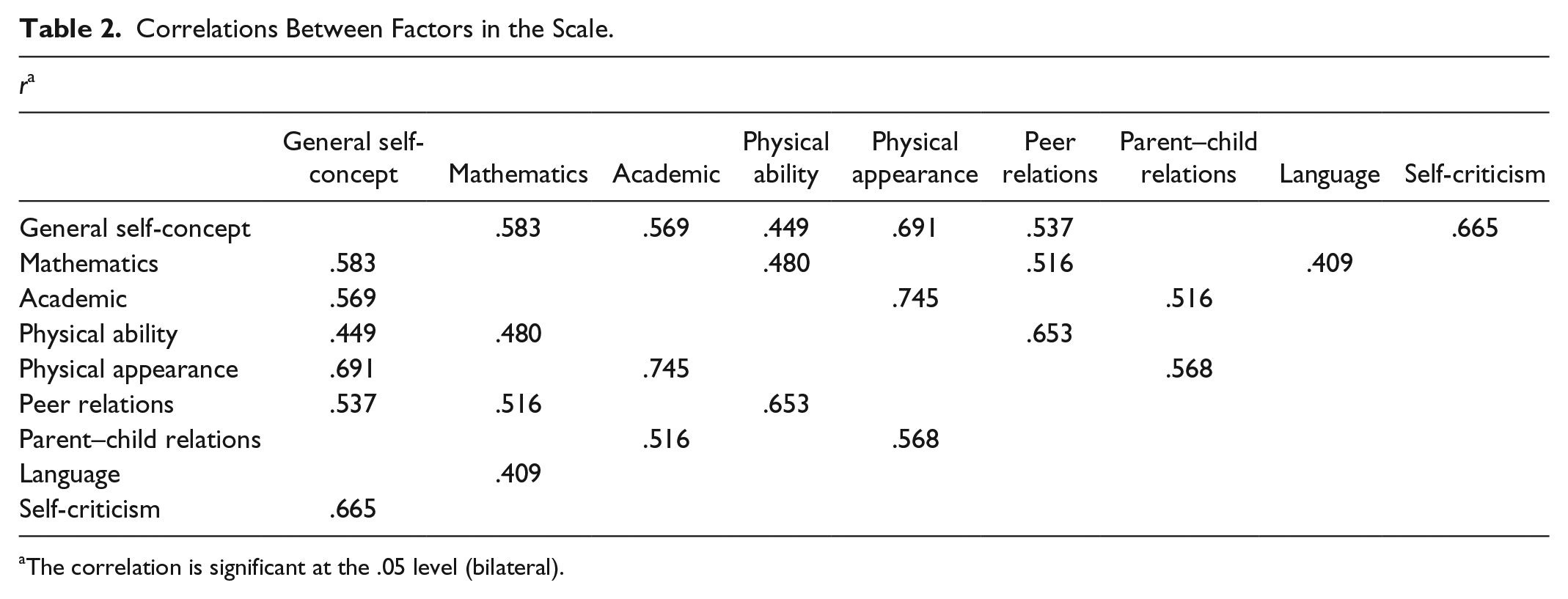
The correlation is significant at the .05 level (bilateral).
Furthermore, the scale associated with “general academic self-concept” yielded rather positive correlations with the scale “physical appearance self-concept” (.745), which leads one to consider that the general knowledge the student has of his or her self depends on how they view their body and their physical appearance. In addition, correlations with the scale “parent–child relations self-concept” (.516) were also observed, highlighting the important role played by the family when it comes to the development of a student’s social skills and competencies. The family institution also has a bearing on the results obtained for the “physical appearance self-concept” (.568) scale; the surveyed students revealed how the image they have of their physical makeup is shaped by the relationships they have with their peers and parents.
The results have also yielded positive correlations between the scales “physical ability self-concept” and “academic self-concept in mathematics” (.480) and “peer relations self-concept” (.653). These students with compensatory education needs state that how they view their own ability when performing a particular type of physical activity is determined first and foremost by the relationship they have with their peer group and the mathematical knowledge they possess.
The “academic self-concept in mathematics” scale yielded significant correlations with “peer relations self-concept” (.516) and “academic self-concept in language” (.409). This reflects the importance of students’ perceptions concerning their relationship with their peer group and the resulting effect on academic performance in core subjects (language and mathematics).
Discussion
This study has focused on the analysis of perceived self-concept in primary school students with compensatory education needs. It has enabled us to define the self-concept dimensions through which the participating pupils reveal a negative image of themselves as well as others associated with the students’ positive self-perceptions. From this perspective, it is possible to design a mindfulness program based on the needs and interests of the target group and which is capable of contributing toward improving the educational process, facilitating the inclusion and full autonomy of students in the school and social environment.
Generally speaking, positive outcomes have been observed in students’ perceptions of peer relations, physical appearance and physical ability, and academic self-concept in mathematics. The worst outcomes were associated with the assessments made by these students with compensatory education needs toward language, general academic self-concept, and parent–child relations. The students evaluate themselves positively and the relationships they hold with their classmates, albeit not equally as positive when it comes to family. In the academic arena, and despite the not so favorable assessments of general academic self-concept, differences were found according to whether we are dealing with mathematics or language.
Focusing on the social setting, it is important to analyze whether the student is satisfied with their social relations and the people around them. As such, those children lacking positive and appropriate social experiences find themselves rejected by their peers, and possibly in an at-risk situation; the fact that a child is accepted by the peer group means that their classmates actively seek out their company and friendship and that they appreciate, value, and love them, whereas ignorance and rejection show a lack of esteem, attractiveness and value, dislike and displeasure (García, Sureda, & Monjas, 2010). This contradicts the findings of Cohen et al. (2011) and Lacunza and Contini (2009), who reported how students with compensatory education needs have the social skills to effectively develop at school and in interactions with others. What is more, Trianes et al. (2003) have shown higher scores in self-reported social skills among students from depressed backgrounds as opposed to those from residential areas.
In terms of the family dynamic, particularly noteworthy is the correlation between how the student evaluates parent–child relations and their academic self-concept. Traditionally, the education community has felt that ethnic retention hinders a student’s academic success. This is supported by the consideration that the families of immigrant students do not share the same values of academic success as native families do: Immigrant parents fail to offer the academic support that their children need to succeed, and the fact that a different language is spoken at home stands in the way of making improvements in the language of the host country, thus impeding academic achievement (Rodríguez, 2010). Jordán (2009) highlighted some of the reasons that drive immigrant parents to participate less in their children’s schooling than their native counterparts: linguistic factors, lack of confidence in the professionalism of teachers, precarious social and employment conditions, and low concept of themselves as possible helpers in their children’s school work. What is more, in their minds there is a more or less real perception that, in the school context, they find themselves in an inferior or subordinate position in relation to those of Spanish descent and who exert influence, something akin to the feeling of greater or lesser perceived social exclusion.
Furthermore, this pupil presents generally low development and maturity levels, especially when it comes to language, owing to their unfamiliarity with the language of instruction. These findings are consistent with those obtained in other previous studies (Garrido & Cebolla, 2010; Ministry of Education, 2010; Rahona & Morales-Sequera, 2013), which report greater educational lags among immigrant students than among national students. Also, Poveda, Jociles, and Franzé (2009) revealed how the foreign student “is not successful,” having shown to experience serious problems in mathematical learning (López-Serentill, 2010). Thus, academic self-concept better explains the results obtained in academic performance and in mathematics in particular (Choi, 2005). Socially speaking, immigrant students show significantly poorer classroom integration compared with their native-born peers (Fernández et al., 2008), given that their circle of friends is smaller and the degree of trust among them is relatively low (Giró, 2011). In addition, ethnic-cultural discrimination negatively affects students’ self-esteem (Hunter et al., 2010; Seaton & Yip, 2009) and attempts to establish satisfactory interpersonal relationships (Eccles et al., 2006).
Negative social and academic self-concept is associated with poor academic performance (De la Orden & González, 2005), demonstrating a greater degree of limitations to what they can accomplish (Naranjo, 2007). In turn, other studies have reported how Latin American children, on the whole, do not exhibit weak academic paths (Serra, 2008; Trujillo, 2010; Vicente, 2006), and much of this depends on the years of schooling in Spain, which have proven to be sufficient for compensating any gaps and for integrating into the Spanish model. However, the education system does have different measures and initiatives in place (such as the Aulas Temporales de Adaptación Lingüística [Temporary Linguistic Adaptation Classrooms]) to promote social inclusion among students in the host country, thus avoiding situations involving school failure and dropout. As such, there is a close relationship between language knowledge and academic performance (Huguet, 2009). Various studies (Chireac, Serrat, & Huguet, 2011; Huguet, Navarro, Chireac, & Sansó, 2013; Oller & Vila, 2011) have concluded that immigrant students’ language knowledge is significantly lower than that of their native peers, becoming even more evident when the length of stay in the host location decreases.
Furthermore, compensatory education students’ needs may emerge in situations involving disability, which affects the image pupils have of themselves. Recent research has revealed how adolescents with disabilities obtain significantly lower scores than those who do not deviate from the “norm” (Halder & Datta, 2012; López-Justicia et al., 2000; Polo & López-Justicia, 2012; Taleporos & McCabe, 2005; Weisel & Kamara, 2005). However, other authors report no differences in self-concept between people with and without disabilities (Bolat et al., 2011; Garaigordobil & Bernarás, 2009) on one hand, and higher self-concept scores (Obiakor & Stile, 1990) on the other.
Regarding body image and, more specifically, the student’s physical appearance and ability, this should be understood as the assessment a person makes of their own physical makeup and health, reflecting their self-views of their competence, physical condition, and appearance. Furthermore, the data provided in this study show how the image a student has of his or her physical self is shaped by the relationships he or she forms with the peer group as well as the relationships within the family system.
Adolescence is a crucial developmental period for acquiring physical activity and sport habits (Kjonniksen, Anderssen, & Wold, 2009). Kimm et al. (2002) associated a decrease in physical–sport activity with the development of body image distortion and distorted self-perceptions; individuals who practice physical–sport activities regularly report better self-perceptions of physical ability and condition than those who do not practice these activities or practice less frequently (Biddle, Whitehead, O’Donovan, & Nevill, 2005). In addition, Ekeland, Heian, and Hagen (2005) supported the hypothesis that physical activity leads to an increase in short-term self-concept.
Based on this analysis, and in an educational context of a compensatory nature, the development of a mindfulness program ought to promote knowledge and improve students’ perceptions of family relations and language knowledge and generally improve their assessment of academic performance. The ongoing situation of school failure and poor academic performance has repeatedly led to the development of problems entailing social maladjustment, lack of motivation, and low self-concept. As stated by Arguís (2014), the practice of mindfulness in an educational setting can counteract the daily stresses in a way that allows us to experience things in a more attentive and conscious manner, enabling us to take in new information in a more serene and relaxed way, learning better and avoiding the risk of information overload, and providing the tools to enhance personal and social growth and cultivating well-being in schools, thus complementing more traditional academic learning approaches. As such, meditation or mindfulness produces self-knowledge, that is, it helps us to discriminate our own behavior (Káiser, 2013; Mañas, 2009).
However, and as possible limitations of this study, we must highlight the exclusive use of a self-report questionnaire to gather information, which can lead to social desirability and sincerity problems among the students participating in the research. In terms of the sample, the main limitations have been identified as its reduced size and heterogeneity (students with educational needs and socioculturally disadvantaged pupils), thus limiting the generalization of the data for other samples.
Because of this and looking toward future research, the aim would be to widen the sample pool by covering other stages of education, allowing us to even establish a comparison between students with compensatory education needs and those with other types of specific educational support needs, including but not limited to disabilities, behavior disorders, and learning difficulties.
Footnotes
Declaration of Conflicting Interests
The author(s) declared no potential conflicts of interest with respect to the research, authorship, and/or publication of this article.
Funding
The author(s) received no financial support for the research, authorship, and/or publication of this article.