




Abstract
In this research, we investigated the relationship between self-concept and academic performance, particularly focusing on students with learning difficulties and special educational needs. Conducted in an inclusive educational setting without the implementation of specific or external intervention programs, this this non-experimental longitudinal study involved 112 students from grades equivalent to third to fifth grade of primary school and first grade of Secondary Education. Academic performance was evaluated using a customized rubric, while self-concept was assessed with the AF-5 test. The results, analyzed through Student’s t-test, ANOVA, and Pearson correlation, revealed improvements in both academic performance and self-concept, especially among students with learning difficulties. Moreover, a significant correlation between different performance dimensions and academic self-concept was found. These findings highlight the potential of inclusive pedagogical environments and integrated classroom-based support in promoting academic achievement and socioemotional development, particularly in students with diverse educational needs.
Plain language summary
This study explored how students’ academic progress and how they see themselves as learners (their self-concept) are connected. It focused on children with learning difficulties or special educational needs, but included all students in the school. The research took place at a school that uses inclusive teaching methods. This means that all students, regardless of their difficulties, learn together in the same classrooms. Instead of using special programs from outside, the school has its own way of helping each student during regular lessons. Teachers work together to make sure all students are supported in both learning and emotional well-being. The study followed 112 students over two school years. It included children from different grade levels, roughly between ages 8 and 13. Researchers looked at how students performed in class and how they felt about their own learning abilities. Results showed that many students improved both in their academic work and in how they saw themselves as learners—especially those with learning difficulties. The study also found that when students have a more positive self-concept, they tend to do better in school. This research shows that teaching methods that include and support all students—not just academically, but also emotionally—can have a real positive impact. Helping students believe in themselves is just as important as helping them with schoolwork.
Introduction
The universalization of compulsory education in Spain has solidified the extension of schooling for at least the first 16 years for all individuals within that age range, including those facing difficulties in their school learning (Rebollo Espinosa, 2009). This phenomenon implies that both students and their families, as well as teaching staff, and educational institutions, are engaged in an inherent formative process characterized by encountering various barriers, which manifest in different forms and intensities. The fundamental aim of this process lies in adapting to the pace of school activities for each and every student.
In most classrooms, we encounter at least one or several students facing learning difficulties (hereinafter referred to as LD). These students often experience a slower pace of learning, attention problems and/or hyperactivity (ADHD), difficulties in processes related to reading and writing (such as dyslexia, dysgraphia, dysorthography), or numerical skills (such as dyscalculia). Additionally, they may present varying degrees of difficulty in communication and oral language, such as speech disorders, articulation disorders, or stuttering (Prior, 2022).
These characteristics lead to students with LD facing many difficulties in adapting to the conventional school system, which aims to achieve academic success within predefined levels, timelines, and normative conditions, establishing standards that educational institutions strive to meet (Tébar Belmonte, 2015). These difficulties primarily stem from the lack of support resources provided by the organization in the teaching and learning processes of their schools, without their intellectual capacity being the major obstacle to their academic development (World Health Organization, 1992).
In Spain, in the year 2022, the estimated percentage of students with learning problems is 9.3%. Of these, 69.5% are students with Special Educational Needs (SEN) and 30.5% are students with Special Educational Needs with Disabilities (SEND). Among SEN students, there are those with some form of learning disorder (38.1%), such as dyslexia or dysorthography; those associated with socio-educational disadvantage (26.3%); language and communication disorders (14.6%); intellectually gifted students (7.9%); those with limited knowledge of the language of instruction (5.6%), and those with developmental delays (4.1%; Ministerio de Educación y Formación Profesional, 2022). Therefore, students with LD are included among SEN students. SEND students include those who have severe behavioral disorders; physical, visual, auditory, mental, and/or autism spectrum disabilities.
On the other hand, the introduction of the principle of inclusive education (Harry Daniels, 2013) in the educational system has given rise to the need for a collective effort to create educational spaces and conditions that allow for overcoming barriers that could hinder a satisfactory learning process and the overcoming of obstacles for students with LD and SEND (Crisol Moya & Campos Soto, 2019; Krämer et al., 2021).
Inclusive education is increasingly understood not simply as the placement of students with disabilities in mainstream schools, but as a broader process aimed at recognizing and responding to the diverse needs of all learners. According to Ainscow (2005), inclusive education involves the continuous effort to identify and overcome barriers to presence, participation, and achievement for every student. It emphasizes the creation of learning environments that are flexible and supportive, promoting equity and social justice. From this perspective, inclusion becomes a dynamic process that enhances the quality of education for all students, not just those with identified special needs.
Inclusive education is also deeply rooted in principles of human rights and social justice, as emphasized in international frameworks such as the Salamanca Statement (UNESCO, 1994) and the United Nations Convention on the Rights of Persons with Disabilities (United Nations, 2006). These frameworks advocate for equitable access, participation, and achievement for all learners. The social model of disability further supports inclusive education by framing disability not as an individual deficit but as a societal construct that demands systemic change to eliminate barriers (Dueñas Buey, 2014; Ferrante, 2022). Inclusive education, thus, seeks to transform educational environments to accommodate the diversity of learners rather than expecting learners to adapt to pre-existing norms.
Despite its widespread acceptance as a global educational norm, inclusive education faces persistent challenges in practice. Variations in the interpretation of inclusion and the continued existence of segregated settings under the label of “inclusive education” highlight a gap between theory and practice (Powell, 2025; Schuelka & Lapham, 2019). Societal and political barriers, including deficit-oriented perceptions and limited intersectoral collaboration, further hinder effective implementation (Miškolci, 2024). Future efforts should focus on developing a deeper understanding of inclusive pedagogy and fostering collaboration among educators, policymakers, and communities (Moosa & Bekker, 2021; Sundeen & Banerjee, 2023).
The focus on key variables in this study provides a valuable opportunity to address fundamental aspects of inclusive education, both academically and emotionally (Cruz Zuluaga, 2016; Heaven & Ciarrochi, 2012; Plata Zanatta et al., 2014; Quílez-Robres et al., 2021). While the main factors associated with academic performance are capacity, cognitive and intellectual abilities, and interest in learning, there are other variables that also significantly influence the academic results that students achieve in their school life (Cruz Zuluaga, 2016; Quílez-Robres et al., 2021). One of these variables is self-concept, which plays a particularly relevant role when referring to students with some form of LD (Svetaz et al., 2000; Theron, 2004).
Considering the relevance of inclusive education, the challenges faced by students with learning difficulties (LD), and the role of self-concept as a key psychological variable for academic and emotional adjustment, it becomes necessary to examine whether inclusive pedagogical practices positively influence students’ academic and personal development. Therefore, this study aims to respond to the following research question:
Does an inclusive pedagogical approach influence students’ academic performance and self-concept, particularly for those with learning difficulties or special educational needs (SEN)?
This research question is grounded in the conceptualization of inclusive education as a process that must remove barriers to participation and learning (Crisol Moya & Campos Soto, 2019; Harry Daniels, 2013), and in the recognition that self-concept is a multidimensional construct influencing students’ academic engagement and emotional resilience (Bear et al., 2002; Lodi-Smith & DeMarree, 2017; Quílez-Robres et al., 2021). By addressing this question, this study contributes to a better understanding of how inclusive educational practices can foster both cognitive and emotional development among diverse student populations.
Self-Concept
International research (Svetaz et al., 2000; Theron, 2004; Westwood & Graham, 2003) suggests that there are risk and protective factors for the emotional well-being of students with LD. That is to say, some conditions may present an additional challenge or compensation in the school learning process of students with LD. Among these factors, self-concept stands out, which can act as a potential facilitator or an additional potential obstacle in the learning process of students, especially those with LD (Bear et al., 2002; Svetaz et al., 2000).
The construct known as self-concept has been approached with various subtleties and perspectives, leading to some ambiguity, confusion, and a lack of consensus regarding its conceptualization and the definition of its constituent factors or dimensions (Hattie, 2014; Lodi-Smith & DeMarree, 2017). As Gimeno Sacristán (1976) pointed out “Self-concept is something complex, difficult approach, as it forms the most intimate core of the human person” (p. 75).
Additionally, other terms such as self-image, self-perception, self-esteem, and self-efficacy have been employed, which, although not synonyms, contribute to creating a complex semantic field that is challenging to address, differentiate, and relate. Given the polysemy of this semantic field, it is necessary to generate a conceptual synthesis that allows for understanding and studying self-concept, thereby contributing to clarifying and establishing relationships among the concepts commonly employed in this area.
Since Rosenberg’s definition (Rosenberg, 1979), who described self-concept as a construct formed by a person’s feelings and thoughts about themselves, there has been significant evolution that implicitly incorporates the experiential and emotional aspects of the individual (Lodi-Smith & DeMarree, 2017). Shavelson et al. (1976) defined self-concept as “the perception that a person has of themselves created by their own experience, as well as by the interpretations they receive from their environment” (p. 410). In this way, self-concept seems to emerge from perceptions of the immediate environment and the emotional experiences of the individual in specific situations, organized according to their idiosyncrasy. In other words, self-concept appears as a personal construct that evolves throughout the development and growth of each individual, influenced by the experiences, situations, people, and actions that converge in their life and environment (Méndez-Giménez et al., 2013).
In this research, self-concept and self-esteem are understood as two distinct but closely related concepts. The term self-concept encompasses abstract descriptions of oneself that can be differentiated from self-esteem, which is defined as the result of the self-evaluation process and reflects the level of satisfaction a person has with themselves (Reina et al., 2017).
Furthermore, the concept of self-efficacy, as proposed by Bandura, is relevant in the academic/work dimension of self-concept, as it is related to a person’s confidence in their own ability to achieve desired outcomes. It is a fundamental aspect in exerting the effort required to carry out academic tasks and activities (Bandura, 1997). On the other hand, self-image is closely related to the physical dimension of self-concept (López Alonso, 2018).
Currently, there is some consensus in considering self-concept as a multidimensional and complex construct composed of five dimensions: academic/work, social, emotional, family, and physical (García & Musitu, 2014). It is a multidimensional construct distinguishable from other related concepts (Esnaola et al., 2008; McConnell & Strain, 2007).
Building on this multidimensional understanding, academic self-concept—students’ perception of their own academic abilities— has been shown to play a particularly crucial role in educational settings. A positive academic self-concept is associated with higher intrinsic motivation and improved academic performance (Guay et al., 2010; Kobal Grum et al., 2004; Sunu & Baidoo-Anu, 2024). According to Bandura’s social cognitive theory (1997), self-efficacy beliefs—a critical component of self-concept—significantly influence students’ motivation, perseverance, and learning outcomes. Research has shown that students who perceive themselves as capable and who are intrinsically motivated tend to achieve better academic results (Guay et al., 2010; Huang, 2011; Sunu & Baidoo-Anu, 2024). Furthermore, academic motivation can act as a mediator between self-concept and performance, suggesting that enhancing students’ self-perceptions can indirectly boost achievement by fostering motivation (Guay et al., 2010; Khalaila, 2015). Intervention programs that simultaneously target self-concept enhancement and academic skills development have been found to be more effective than those addressing only one dimension (Huang, 2011; Rinn & Crutchfield, 2021). Additionally, environmental factors such as class composition in terms of gender and ability have also been identified as influential variables affecting students’ academic self-concept and well-being (Belfi et al., 2012).
In comparing self-concept between students with LD and their peers without these difficulties, it is evident that those with LD tend to have a more negative perception of themselves, especially in the academic realm (Bear et al., 1993, 1998; Gans et al., 2003; González-Pienda et al., 2000). This trend is common among students with specific LD (Elbaum & Vaughn, 2003; Kloomok & Cosden, 1994; Vaughn et al., 1998), such as dyslexia (Burden, 2008) or ADHD (Bakker & Rubiales, 2012; Houck et al., 2011; McQuade et al., 2011), as well as those with SEND, such as intellectual disability or Down syndrome (Deakin et al., 2018; Winne et al., 1982).
Students with LD often attribute their failures to internal causes, such as feelings, skills, or attitudes, rather than external factors like family, friends, or teachers (McQuade et al., 2011). This tendency contributes to a decrease in their motivation and generates negative emotions toward academic work and themselves (Heath et al., 2013). Over time, this cycle of reciprocal interactions can lead students to develop a sense of learned helplessness. Additionally, they often feel less accountable for their successes. Consequently, they become demotivated in academic processes, often resulting in academic failure (Burden, 2008; Houck et al., 2011).
Some studies (Goldan et al., 2021; Heath et al., 2013) highlight that in educational environments that provide adequate support to students with LD and SEND, no significant differences are observed in self-concept compared to students without LD. In some cases, they even show higher levels. These findings confirm that a fundamental aspect to achieve academic success with this profile of students is for them to feel competent and capable of successfully facing the academic challenges presented to them.
Academic Performance
Academic performance is regarded as the standard to which students are held within the educational system, defining learning objectives for those considered without learning difficulties or who fall within the norm (Lavin, 1965). These students are often referred to as neurotypical, denoting individuals with a typical adaptive profile, average learning abilities, and no neurodevelopmental alterations that could impede learning (hereinafter referred to as normative students).
This academic performance is the outcome of students’ effort and work, reflected in assessments and grades based on written or oral tests, as well as tasks completed inside and outside the classroom, compared to established standards (Navarro, 2016). Therefore, its purpose is to measure the skills and competencies demonstrated by students, as well as the learning outcomes during a specified educational period (Jimerson et al., 2003).
Beyond individual effort and assessment practices, it is important to consider broader contextual factors influencing academic performance. Academic performance is not solely determined by individual cognitive abilities but is deeply influenced by contextual and environmental factors. According to international reports by the OECD (2005), equitable access to quality education and the provision of inclusive, supportive learning environments are critical determinants of students’ academic outcomes. Positive relationships with teachers significantly enhance academic achievement by providing emotional and instructional support (Redondo-Blasco et al., 2024). Similarly, peer integration and social support play a fundamental role; extroverted students who are more popular among peers tend to perform better academically due to psychosocial and professional support (Thiele et al., 2018). Moreover, the quality of the educational environment, including class size and institutional resources, strongly impacts academic outcomes, with overcrowded classrooms and limited support services posing significant obstacles (Kassaw et al., 2024).
Educational practices that actively remove barriers to participation and learning, rather than focusing solely on individual deficits, are more likely to foster academic success among students with diverse needs. The inclusive pedagogy model proposed by Florian and Black-Hawkins (2011) emphasizes the importance of designing flexible educational practices that accommodate variability among learners. Recent research further confirms that inclusive teaching practices contribute significantly to students’ academic performance, with student engagement and classroom environment acting as mediating factors (Amjad et al., 2025). Inclusive education not only enhances cognitive development but also promotes personal and social growth, reducing discrimination and fostering greater societal participation (Suárez López et al., 2024).
Furthermore, the success of inclusive education largely depends on teachers’ attitudes toward inclusion and their teaching efficacy. Effective teaching strategies and differentiated learning outcomes are key elements that influence teachers’ capacity to address diversity (Haigh, 2020). Nevertheless, implementing inclusive education remains a challenge, requiring teachers to be equipped with adequate tools and strategies to meet the diverse needs of their students and to design curricula that adapt to different learning styles without penalizing students for their differences (Jackson-Summers et al., 2024).
Often academic performance is socially reduced to a quantitative assessment, which classifies students in relation to their school group. This classification may lead many students to be considered part of a subgroup that does not meet established goals, commonly referred to as academic failure (Albán & Calero, 2017). Regardless of the level of performance, it can evoke feelings of success or disappointment in students, relative to their own expectations or those of their immediate environment (Tacilla Cardenas et al., 2020).
Qualitatively, the school realities associated with academic performance, especially for students with LD, focus on the achievement processes they undergo with adequate support. This allows them to approach the learning process in a more individualized manner and with less pressure than the normative group, providing them with more opportunities for growth and greater confidence in their ability to learn (Schwartz et al., 2021; Tébar Belmonte, 2015). In line with this idea, González and Tourón (1992) argue that humanistic environments, by fostering the development of self-concept, also lay the groundwork for greater student engagement in their learning process and, therefore, perform better.
Relationship Between Academic Performance and Self-Concept
The relationship between students’ self-concept and the quality of their academic performance has been widely supported by numerous authors and studies (González & Tourón, 1992; Herrera Torres et al., 2017; Huang, 2011; Marsh & Craven, 2006; Marsh & Martin, 2011; Sainz López & Serrada Gutiérrez, 2019).
In order to deepen the understanding of this relationship, it is important to consider theoretical models that explain the dynamic interplay between academic self-concept and academic achievement.
The relationship between academic self-concept and academic performance has been extensively explored through the Reciprocal Effects Model (REM) proposed by Marsh and Craven (2006). According to this model, academic self-concept and academic achievement are mutually reinforcing over time: improvements in one lead to enhancements in the other in a dynamic feedback loop. Students who develop a stronger academic self-concept tend to perform better academically, and higher academic achievement subsequently strengthens their self-concept. This reciprocal relationship has been consistently supported by longitudinal studies across different educational contexts (Groenewald et al., 2021; Huang, 2011; Marsh & Scalas, 2009).
A positive academic self-concept is strongly associated with higher intrinsic motivation, greater engagement in learning activities, and improved academic outcomes (Ghazvini, 2011; Pedraja-Rejas et al., 2025). Conversely, previous academic achievement also influences students’ self-concept, suggesting a bidirectional and cumulative effect (Huang, 2011; Marsh & Scalas, 2009). Intervention programs that simultaneously target the enhancement of self-concept and the development of academic skills have been found to be particularly effective in promoting academic success (Chen et al., 2015; Huang, 2011; Rinn & Crutchfield, 2021). Moreover, fostering positive, supportive learning environments that nurture students’ self-esteem and intrinsic motivation is essential for sustaining this virtuous cycle (Ghazvini, 2011; Pedraja-Rejas et al., 2025).
Understanding this dynamic interplay is crucial, particularly for students with learning difficulties, as positive changes in self-concept can initiate a cycle of improved motivation, resilience, engagement, and academic achievement (Gasparotto et al., 2018).
Therefore, the academic and socioemotional vulnerability of students with learning difficulties becomes particularly evident, as they tend to face academic challenges and lower levels of both academic performance and self-concept from an early age, both individually and within their familial, school, and social environments. Research has consistently shown that students with learning difficulties tend to exhibit lower levels of both academic performance and self-concept compared to their peers without such difficulties (Almahrag, 2022; Gómez Gutiérrez & Hernández de Mingo, 2022; Möller et al., 2009; Zheng et al., 2014).
Self-concept emerges as a fundamental variable in facilitating effective metacognitive processing (Gómez Gutiérrez & Hernández de Mingo, 2022; Núñez et al., 1998). Students’ active participation in their learning process and their willingness to exert effort increase when they feel competent and capable of addressing school tasks and activities, either independently or with appropriate support.
Results from previous research (Krämer et al., 2021; Möller et al., 2009; Zheng et al., 2014) suggest that students who receive education in inclusive environments tailored to their needs and personal development, achieve higher levels of self-concept and academic performance than expected compared to those in schools with standard programs and teaching staff. A study conducted by Kloomok and Cosden (1994) indicates that, thanks to a positive school experience that does not stigmatize them as candidates for academic failure, students with LD perceive learning development as attainable and feel sufficiently capable and supported to meet the daily goals set for their school life.
The willingness and innovative capacity of schools to actively collaborate with students with LD are crucial for their educational progress. This motivational involvement influences the cognitive and metacognitive strategies they employ, as well as the development of tasks and the self-regulation of effort, persistence, and consistency in the completion of complex activities (Núñez et al., 1998)
Therefore, the evidence support the idea that an appropriate pedagogical approach, tailored to the individual needs of students with LD, promotes a more positive appraisal of their learning potential, which in turn correlates with better academic performance compared to those students who do not receive the same level of support and understanding in less inclusive educational environment (Kloomok & Cosden, 1994; Möller et al., 2009).
Based on the theoretical framework outlined, and considering the potential influence of inclusive educational practices on both academic performance and self-concept, the following hypotheses are proposed:
-
-
-
Objectives
With the purpose of addressing this research, we aim to explore the impact of an inclusive methodology on students’ self-concept and academic performance.
This overarching goal is broken down into the following specific objectives:
- Identify the self-concept of students in an inclusive educational environment, with particular attention to students with LD and SEN.
- Understand the academic performance of students in an educational setting that employs formative assessment criteria in various areas (assigned tasks, collaborative work, interaction with adults, acquired knowledge, among others).
- Uncover the relationship between self-concept and academic performance of students participating in an inclusive educational program.
Materials and Methods
This study follows a non-experimental longitudinal design, with data collected at two points in time (Academic Year 2020–2021; Academic Year 2022–2023) to examine the natural progression of students’ academic performance and self-concept. No intervention or treatment was introduced or manipulated by the research team. Instead, the study analyzed the effects of an inclusive pedagogical environment already in place at the school, without implementing any external or specialized programs beyond those embedded in the school’s ordinary structure.
The pedagogical strategy evaluated is part of the school’s ongoing inclusive approach, which emphasizes personalized learning, interdisciplinary collaboration, and integrated classroom support, consistent with the Helix Model. Measures of academic performance and self-concept were taken simultaneously at both time points.
The dependent variables under study are academic performance and self-concept. The independent variables considered are (a) the temporal moment (2020–2021 vs. 2022–2023) and (b) the students’ learning profiles. For the latter, students were grouped into three categories: normative students (those without learning difficulties), students with learning difficulties (LD), and students with special educational needs (SEND).
Context
This research was conducted at (Brotmadrid) School, an educational institution funded with both public and private funds, located in Madrid (Spain). The selection of this school was based on the unique characteristics of its student body, its methodology, and its inclusive educational approach. Classified as an ordinary center catering to the general student population, this school offers various teaching modalities, including regular classrooms, integration support classrooms, and specific educational support classrooms. Additionally, this school exhibits an integrated approach across the educational stages of primary education, compulsory secondary education, and post-compulsory education, spanning students’ ages from 6 to 18 years old.
The pedagogical features that distinguish this center from others in mainstream education are diverse:
- Utilization of a teaching methodology focused on providing preferential attention to students with learning difficulties.
- Significant presence of teachers specialized in therapeutic pedagogy, with a ratio of one such teacher for every 25 students, in addition to the group tutor.
- Emphasis on inclusive education, ensuring that students with learning difficulties remain in their regular classrooms, receiving educational support without being excluded from their usual environment.
- Implementation of a program aimed at accompanying and reinforcing the academic, social, and emotional self-concept for all teachers, with the goal of fostering a learning environment that strengthens students’ self-image and self-efficacy.
The distribution of students in this school is as follows: 69% of students have learning difficulties (LD), 10% have special educational needs associated with disabilities (SEND), and 21% do not have learning difficulties. This indicates that approximately 79% of the student population requires some form of additional educational support.
The school’s pedagogical model centers around the idea that “children with LD benefit more from an approach that removes barriers and obstacles through a motivating, natural, and scientific learning method that adapts to all levels and needs” (p. 17; Arjona, 2022). This pedagogical approach provides students with an educational environment that acknowledges and understands their individual circumstances, allowing them to heal possible wounds, related to previous school experiences and reconcile with the learning process. Therefore, the distinctive characteristics of the school and its students body offer a highly interesting educational context for conducting this research.
The educational approach of the school is based on the Helix Model (Fundación Aprender, 2023), developed by Fundación Aprender and applied comprehensively at Colegio Brot Madrid. This model is characterized by its inclusive, personalized, and evidence-informed pedagogical framework, designed to support the holistic development of each student across cognitive, emotional, social, and personal dimensions. Rather than applying individualized intervention programs external to the curriculum, the Helix Model integrates support strategies directly into everyday classroom practices.
Core principles of the model include: (a) flexible methodological strategies that adapt to each student’s pace and learning profile; (b) interdisciplinary collaboration among teachers, educational psychologists, and therapeutic pedagogy specialists; (c) active promotion of students’ self-concept and socioemotional competencies as foundational to learning; and (d) the use of continuous formative assessment to personalize learning experiences.
Specific support classrooms (e.g., integration support and specialized support rooms) are part of the school’s regular inclusive structure and are not framed as external or remedial interventions. All students remain integrated in the general school community, and the presence of support staff aligns with inclusive education policies rather than individualized treatment plans. Therefore, although students with LD or SEN receive additional educational support, this support is embedded within the school’s inclusive educational philosophy and its daily pedagogical organization.
Participants
In this research, a sample of 112 students (63 males and 49 females) spanning Primary and Secondary Education stages was carefully selected. The distribution across educational levels includes 20 students from the third grade of Primary, 42 students from the fifth grade of Primary, and 50 students from first year of Secondary Education (seventh Grade).
Table 1 illustrates the distribution of participants by analysis group, academic grade, and gender. These details pertain to the educational level the participants were in during the 2020 to 2021 academic year and were reassessed again 2 years later.
Distribution of Participants by Group, Gender, and Grade.

Regarding the participants’ ages, noteworthy similarity exists among the three analysis groups: normative students (M = 10.67; SD = 1.47), students with LD (M = 10.70; SD = 1.63), and students with SEND (M = 10.91; SD = 1.45).
It is crucial to emphasize that this educational institution initiates schooling in third grade of Primary, with line 1 representing this grade, line 2 for the fifth grade of Primary, and line 3 for the first year of Secondary Education. The uneven distribution across educational levels stems from the fact that students often enroll in this institution after facing challenges in other traditional educational setting with conventional teaching methods.
Instruments
To assess the participants’ academic performance, a specific rubric (Appendix) used by the educational institution itself to assess students’ academic progress has been employed. This rubric analyzes various variables related to academic performance, and each variable is broken down into different evaluable criteria on a scale from 1 to 4, with 1 being the lowest score and 4 the highest. The variables evaluated using this academic performance rubric are as follows:
- Task Development (24 points): This variable assesses how students carry out various learning tasks performed in the classroom, including participation, content, organization, originality, creativity, precision, correctness, neatness, and accuracy (α = .927).
- Teamwork (12 points): This variable assesses various aspects of teamwork, including participation, contribution, responsibility, completion of assigned tasks, role performance, collaboration, and assistance (α = .864).
- Relationship with Adults (16 points): Aspects such as interactions with teachers, interactions with other adults (support staff), and relationships with their parents are evaluated in this case (α = .879).
- Product Assessment (28 points): This variable assesses aspects like content, organization, originality, creativity, precision, correctness, neatness, and accuracy (α = .922).
- And What Do You Know (WDYK; eight points): This section evaluates aspects related to written content assessment tests carried out in the classroom, considering comprehension of concepts and procedures, application of content to everyday situations, knowledge transfer, and more (α = .872).
The overall performance of the students is assessed by summing up the various analyzed variables, potentially reaching a final maximum score of 88 points(α = 0.968). As observed, with the performance rubric employed, each of the analyzed variables allows for reaching a distinct maximum value.
To facilitate the integration of the analyzed academic performance variables, which have been assessed with different scales, raw scores have been transformed into centesimal scores ranging from 0 to 100 points. This methodological adaptation eases result interpretation, promotes a more effective analysis, and provides a coherent and comparable presentation of the outcomes. Additionally, it enables a clearer assessment of the differences and similarities in student performance across each analyzed variable.
To assess participants’ self-concept, the AutoForma-5 Self-Concept Questionnaire (AF-5; α = .88), developed by García and Musitu (2014), was used. This questionnaire consists of 30 items distributed across five subscales: the academic-labor factor (items 1, 6, 11, 16, 21, and 26), the social factor (items 2, 7, 12, 17, 22, and 27), the emotional factor (items 3, 8, 13, 18, 23, and 28), the family factor (items 4, 9, 14, 19, 24, and 29), and the physical factor (items 5, 10, 15, 20, 25, and 30), with six items per scale. Participants rated each item on a quantitative scale from 1 to 99, where 1 indicates complete disagreement with the statement and 99 indicates complete agreement. Self-concept measures were also adapted to centesimal scores ranging from 0 to 100 points. Additionally, concerning the analysis of the instrument’s psychometric properties, it is noted that the AF-5 questionnaire offers reliability indices greater than 0.71.
Data Collection and Analysis
The data collection process for the study spanned the academic years 2020 to 2021 and 2022 to 2023. In each of these years (December 2020 and 2022), the educational institution provided data on academic performance obtained through the completion of the tailored rubric, specifically designed by the educational center to assess its students. Additionally, two measurements were taken with the AF-5 self-concept test simultaneously. The administration of assessment instruments, following a training session on the application, was conducted by teachers. The successful execution of this process required close collaboration between the educational institution and the research team.
In analyzing the results, our focus centered on these two academic years to evaluate changes in participants over the course of 2 years, encompassing both self-concept and academic performance. It is important to note that participants for whom any of the variables (self-concept or academic performance) was missing in any of the academic years (2020–2021 or 2022–2023) were excluded from the analysis, retaining only those participants for whom all necessary measures were available.
All data were processed in a coded manner, assigning an alphanumeric code to participants to ensure the confidentiality and anonymity of their responses. Moreover, families and students were presented with an informed consent form, detailing their willingness to participate in the research, adhering to the ethical criteria established by the committee of Universidad Francisco de Vitoria.
For the analysis of the results, descriptive and inferential statistical tests were applied, using the IBM SPSS Statistics program (version 29) for data analysis and Excel for table and graph generation. Parametric tests (related samples t-test, repeated measures ANOVA, and Pearson correlation) were applied after checking for normality and homoscedasticity assumptions to verify the research hypotheses. Additionally, effect sizes were calculated using Cohen’s d and partial eta squared.
Results
Self-Concept
First, for the variable self-concept, we analyzed the effect of the interaction between the academic year variables (2020–2021 and 2022–2023) and student group (normative, LD, and SEND) on the various types of self-concept evaluated. To do this, we applied a mixed-design ANOVA with repeated measures (2 × 3). The results presented in Table 2 indicate that there is no significant effect in the interaction between the temporal moment and the different student groups in any of the types of self-concept evaluated. In other words, statistically significant differences were not found in the different types of self-concept (academic, social, emotional, family, and physical) among the three student groups across the two time points analyzed (2020–2021 and 2022–2023). This suggests homogeneity in self-concept changes over time across all student groups.
Descriptive Statistics of Self-concept by Student Group and Academic Year.
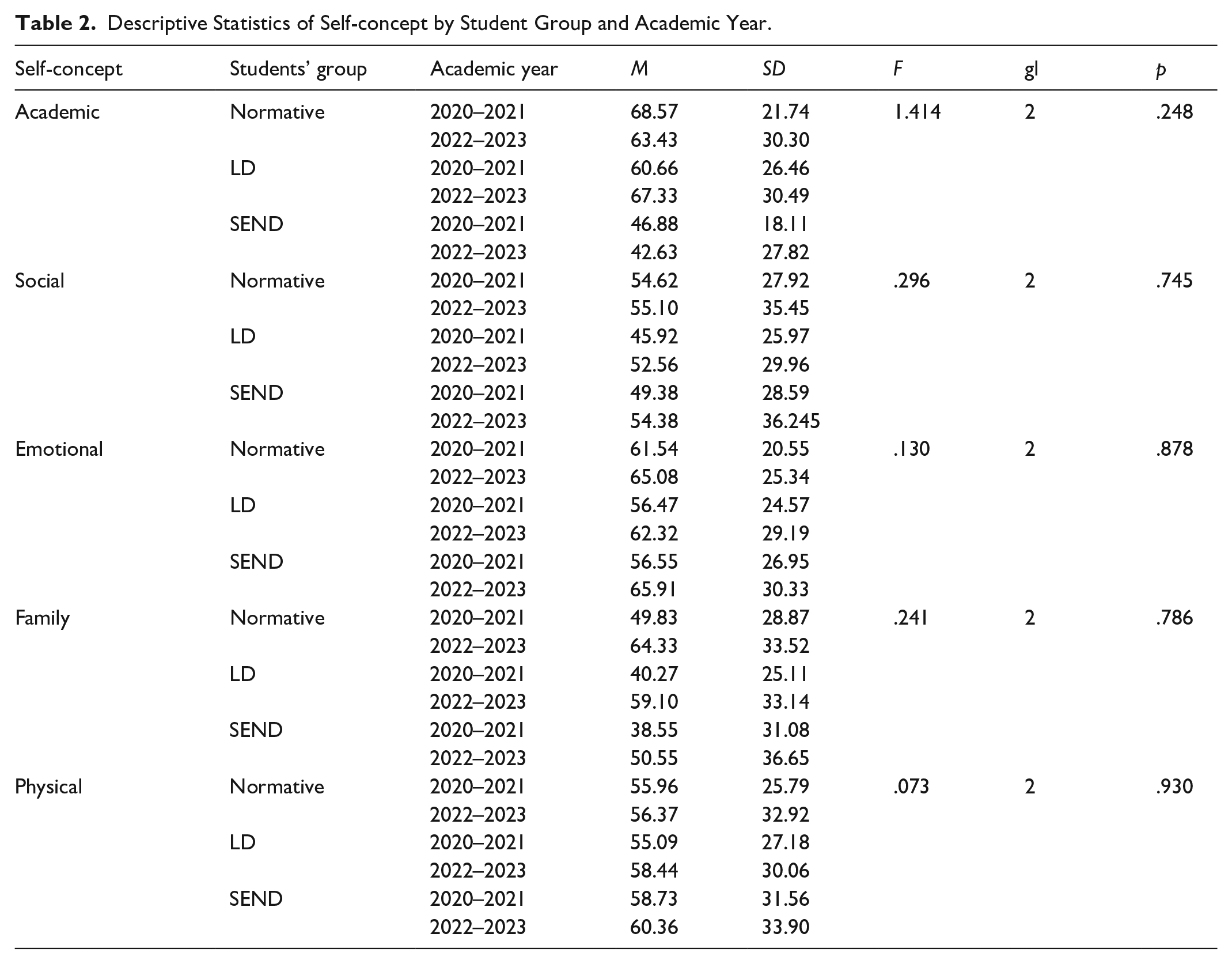
Interested in observing the effect that this educational center has on students’ self-concept, changes in their self-concept between the academic year 2020 to 2021 and the academic year 2022 to 2023 have been analyzed, considering all participants (n = 112).
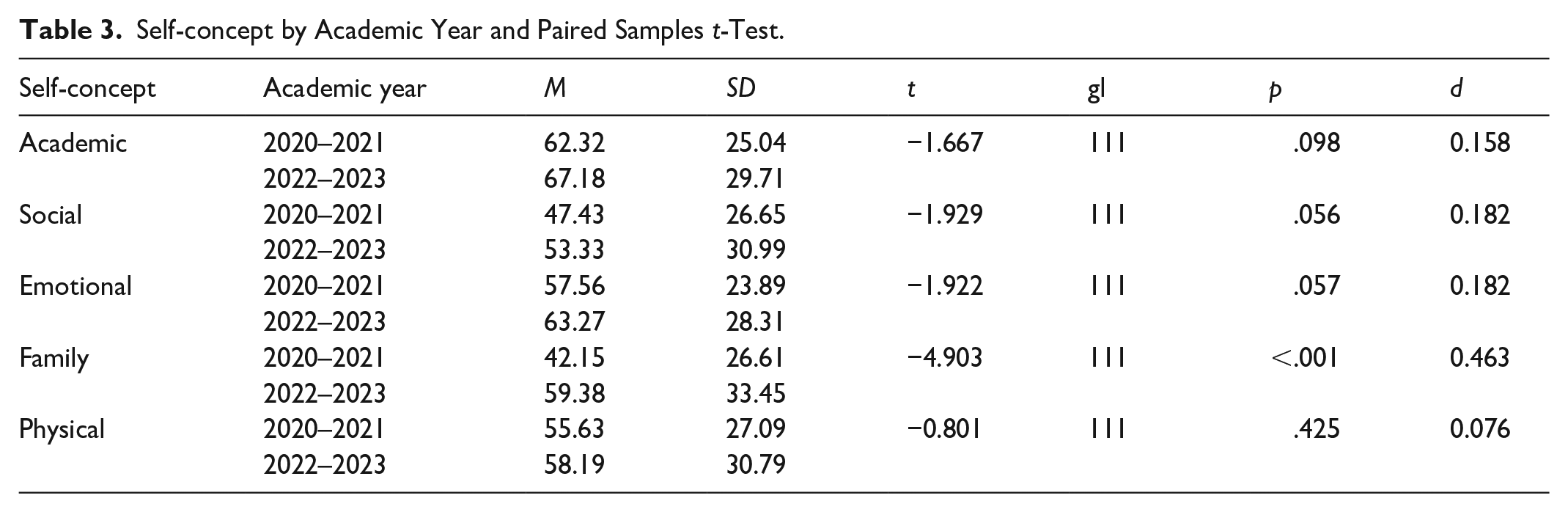
In the graph of Figure 1, changes in self-concept variable between the two academic years analyzed (2020–2021 and 2022–2023) can be observed for all study participants. It is noted that the mean scores in the academic year 2020 to 2021 in all areas of self-concept analyzed. However, upon applying the related samples t-test (Table 3), it is observed that these differences do not reach statistical significance in any of the self-concept types, except for family self-concept (p < .001).

Differences in self-concept by academic year.
Self-concept by Academic Year and Paired Samples t-Test.
Focused on the different groups of interest (normative students, LD, and SEND students), in Figure 2, the estimated mean scores in each group for the five types of self concept analyzed (academic, social, emotional, family, and physical) can be observed.
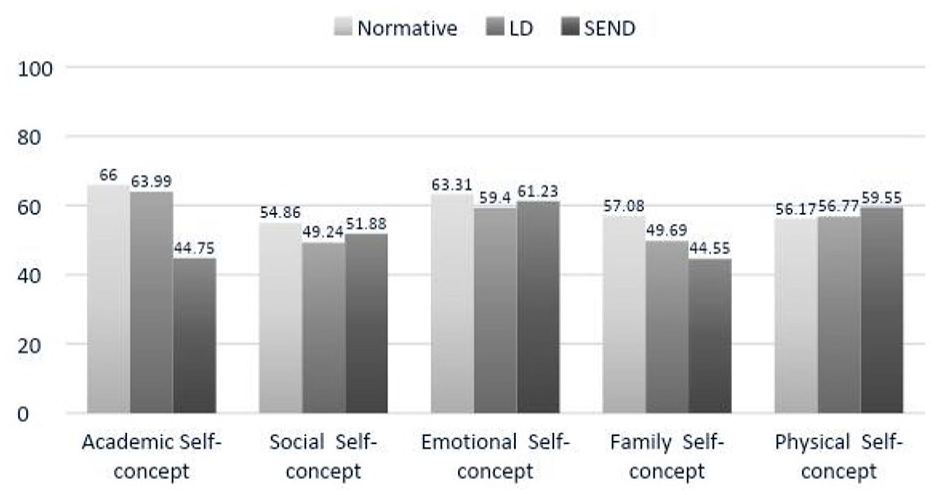
Differences in self-concept by group (Normative, LD and SEND students).
After applying the ANOVA test (Table 7), it is observed that the differences in self-concept are not statistically significant among the different groups of interest, as shown in the results of Table 4.
Self-concept by Group and ANOVA Test.

Academic Performance
Regarding the academic performance variable, firstly, the effect of the interaction between academic year and student typology variables was examined by applying a mixed-design ANOVA with repeated measures (2 × 3). Table 5 displays the results obtained for the various performance variables in each of the groups (normative, LD, and SEND) for the academic years 2020 to 2021 and 2022 to 2023. The results indicate that no significant effect is observed in the interaction between student group and academic year variables for any of the analyzed performance types (Task Development, Teamwork, Relationship with adults, Product Assessment, WDYK, and Total Performance). In other words, a consistent trend is identified in the performance changes between the academic years 2020 to 2021 and 2022 to 2023 across all groups of students (normative, LD, and SEND), suggesting that they can be considered a homogeneous group in terms of the experienced changes.
Descriptive Statistics of Performance by Student Group and Academic Year.

Considering all study participants (n = 112) to analyze changes in academic performance, it can be observed in the graph in Figure 3 that higher average scores were obtained in all dimensions of performance analyzed in the 2022 to 2023 academic year compared to the averages obtained in the 2020 to 2021 academic year.

Differences in performance by academic year.
After applying the t-student test for related samples (Table 6), it was observed that these differences were statistically significant in WDYK (p < .01), which evaluates content and knowledge, and in Total Performance (p < .05).
Performance by Academic Year and Paired Samples t-Test.

Focusing on the differences in academic performance among the various groups of interest (normative, students with learning difficulties, and students with special educational needs), the estimated means for each group have been analyzed across different performance variables. In the graph of Figure 4, we can observe a progression across all performance areas following the same trend, with higher scores in the normative group, followed by the average scores of students with LD, and lower average scores in SEND students.

Differences in performance by group (normative, LD and SEND students).
After applying the ANOVA test (Table 7), statistically significant differences were observed among the various analyzed academic performance variables, except in the Relationship with adults (p = .380). To specifically identify between which groups these differences occur, multiple comparisons with the Bonferroni statistic were conducted, yielding the following results:
- In Task Development, significant differences were found between the normative group and SEND students (p = .016).
- In Teamwork, statistically significant differences were observed between SEND students and those with learning difficulties (p = .043), as well as between SEND students and the normative group (p = .008).
- In Product Assessment, significant differences were found between the normative group and students with learning difficulties (p = .023), as well as between the normative group and SEND students (p < .001). Additionally, significant differences were observed between the group with learning difficulties and SEND students (p = .029).
- In the WDYK variable, which evaluates knowledge, significant differences were found between the normative group and students with LD (p = .003), as well as between the normative group and SEND students (p < .001).
- In Total Performance, statistically significant differences were observed between the normative group and SEND students (p = .003).
Performance by Group and ANOVA Test.

Relationship Between Self-Concept and Academic Performance
To explore the correlation between academic performance and academic self-concept, we conducted the Pearson Correlation Test. The sample utilized in these analyses included all participants in the study (n = 112), aiming to achieve a comprehensive understanding of the interplay between academic self-concept and performance across the entire study population.
The detailed outcomes of these correlations are presented in Table 8, illustrating the associations between various performance indicators (task development, teamwork, relationship with adults, product assessment, WDYK—“what do you know?” and total) and academic self-concept. It is crucial to emphasize that the intentional primary focus on academic self-concept was chosen due to its significant connection directly to academic performance.
Relationship Between Academic Performance and Self-Concept.

p < .05; **p < .01; ***p < .001.
This deliberate emphasis on academic self-concept enabled us to explore the nuanced connections between this specific aspect of self-concept and various academic performance metrics. Upon examining these relationships, a consistent and statistically significant correlation was identified between academic self-concept and all performance dimensions. However, the strength of these relationships shows moderate levels in task development (r = .409; p < .001), Teamwork (r = .409; p < .001), Relationship with adults (r = .357; p < .001), Product assessment (r = .363; p < .05), and Total Performance (r = .404; p < .001); and low levels of correlation in WDYK (r = .203; p < .001), thus being the lowest correlation observed between academic self-concept and content assessment.
Discussion and Conclusions
This research has examined the impact of an inclusive educational approach on students’ self-concept and academic performance, especially those with LD and SEND. The results obtained provide a detailed insight into the dynamics of these two key factors and their relationship in the context of an inclusive educational environment.
Firstly, the findings regarding self-concept indicate that while students with LD and SEND tend to have a more negative perception of themselves (Bear et al., 1993, 1998, 2002; Gans et al., 2003; González-Pienda et al., 2000), particularly in the academic domain, no statistically significant differences were found in self-concept among different groups of students at the two time points analyzed. This suggests homogeneity in changes in self-concept over time, regardless of the group to which students belong. Furthermore, statistically significant improvements in self-concept among students with an inclusive educational approach were not observed in the results, leading us to reject the first hypothesis of our study. However, the importance of providing a supportive environment, especially for students with LD and SEND (Goldan et al., 2021; Heath et al., 2013), is emphasized.
On the other hand, the results regarding academic performance show that in all evaluated dimensions (Task Development, Teamwork, Relationship with adults, Product Assessment, WDYK, and Total Performance), all groups of interest (normative, LD, and SEND) exhibit higher average scores in the academic year 2022 to 2023 compared to the academic year 2020 to 2021. These results lead us to interpret that the inclusive pedagogical approach used by the educational center provides students with the opportunity to improve in all areas of development, confirming the second hypothesis of our study. Additionally, these improvements are particularly noteworthy in the case of students with LD, who experienced significant increases in academic knowledge and overall performance, as shown in other previous research (Crisol Moya & Campos Soto, 2019; González & Tourón, 1992). Given that these students represent 69% of the population of this educational center, it demonstrates the success of the pedagogical practices implemented by the school.
These findings support the idea that an inclusive educational approach, tailored to the individual needs of students, can have a positive impact on their academic performance, providing them with greater opportunities for success (Krämer et al., 2021; Schwartz et al., 2021; Tébar Belmonte, 2015). Furthermore, after analyzing the reliability of the rubric used to assess academic performance, both globally and in its specific dimensions, it is confirmed to be a consistent and reliable tool for evaluating students’ performance.
Regarding the relationship between performance and academic self-concept, a significant correlation was identified in all evaluated dimensions, as observed in previous studies (Herrera Torres et al., 2017; Huang, 2011; Marsh & Craven, 2006; Marsh & Martin, 2011; Sainz López & Serrada Gutiérrez, 2019). These results lead us to confirm the third hypothesis of our study and suggest that a positive perception of oneself in the academic domain is associated with better performance in various academic areas. However, it is important to note that the strength of the correlations did not show very high values, leading us to interpret these results cautiously, with the need to reassess the relationship of these variables with larger samples.
As a future perspective of the study, a predictive analysis through a regression study is proposed to assess the extent to which self-concept indicators influence academic performance. This approach would allow for a deeper understanding of the relationship between self-concept and academic achievement, providing valuable insights into the specific contributions of each indicator to academic success.
Interpreting our findings presents challenges, especially regarding the small size of the normative group, which is the least representative in the population of this educational center. Additionally, we have not thoroughly addressed the possibility that the significant changes observed in students may be more related to natural biological maturation than to the educational environment. Therefore, we propose the need to address these limitations in future research and acknowledge the importance of conducting a comparative study with other educational centers that use different pedagogical approaches to control for the maturation variable. This way, a more solid understanding could be offered to determine whether the changes are inherently related to the educational context or simply attributable to the natural maturation process.
This research highlights the importance of inclusive educational approaches for improving students’ self-concept and academic performance, especially those with learning difficulties. Ultimately, this research provides valuable information for educators, school administrators, and other education professionals, emphasizing the importance of creating inclusive educational environments that promote positive student development and provide.
Footnotes
Ethical Considerations
This study was reviewed and approved by the Research Ethics Committee of Universidad Francisco de Vitoria (Spain), with a favorable opinion issued on January 12, 2023 (Reference: 41/2022). All procedures were conducted in accordance with the ethical standards outlined in the Declaration of Helsinki. Informed consent was obtained from all participants and their legal guardians.
Funding
The author(s) disclosed receipt of the following financial support for the research, authorship, and/or publication of this article: This research was conducted thanks to the funding received through the competitive research project “Impact Analysis of Self-Concept Improvement in Students with Learning Difficulties” (Ref. UFV2022-39), awarded under the 2023 Call for Research Project Grants by the Universidad Francisco de Vitoria. The project, led by Dr. J.L. Gómez, was funded for the period 01/2024 to 12/2025 with a total grant of €4,800. The authors would like to express their sincere gratitude to the Universidad Francisco de Vitoria for its support.
Declaration of Conflicting Interests
The author(s) declared no potential conflicts of interest with respect to the research, authorship, and/or publication of this article.
Data Availability Statement
The datasets generated and analyzed during the current study are available in the Zenodo repository and can be accessed at the following link:  . The recommended citation for this dataset is Sainz López, V. (2025). Dataset on student academic performance and self-concept (2021-2023) [Data set]. Zenodo. https://doi.org/10.5281/zenodo.14901891