




Abstract
Drug use in Spain is one of the most serious problems faced by society today, and is particularly relevant in adolescence. Practicing physical sport activity is considered one of the most representative habits of a healthy lifestyle, and can act as a preventive factor in drug use. The physical self-concept of the people who practice sport plays a key role in drug adherence. This study aims to analyze the relation and influence of physical self-concept in drug, tobacco, and cannabis use in a sample of 682 adolescent athletes (M = 15.85; SD = 1.404). The results suggest significant influences on the competition perceived in different drug uses. Some practical implications can be deduced for coaches and instructors to bear in mind for their athletes, who aim to acquire a more adaptive and self-determined behavior away from drug use.
Introduction
Drug use in Spain has significantly increased from the beginning of the 1990s to the present day, and is linked with a change in our society’s values and, likewise, social, health, and cultural consequences have also increased (Oliva, Parra, & Sánchez-Queija, 2006).
Nowadays, we know that both legal (alcohol, tobacco, tranquillizers, etc.) and illegal (marihuana, hashish, cocaine, synthetic drugs, hallucinogens, heroin, etc.) drug uses have a high drug use prevalence, a high impact on people’s health problems, and mortality is on the rise in young and adult users (Becoña, 2007).
These problems have led to not only social concern but also to profoundly and suitably transforming the structures, resources, and programs managed by public administrations to face requirements considered from several domains; for example, prevention, especially at young ages; controlling the offer of addictive substances; and/or social and health care. The economic, personal, familial, and social costs involved are vast, and directly affect people and their closest environment.
Thus, drugs are one of the most important problems that society faces today, and it is particularly worrying when drug use occurs in infant and juvenile populations, not only because of the immediate problems this habit causes, but also due to consolidated drug use, which commences at early ages (Fuentes, Alarcón, García, & Gracia, 2015; Fuentes, García, Gracia, & Lila, 2011b).
The Spanish National Drugs Plan (PNSD; Action Plan on Drugs 2009-2016, 2013) has confirmed that not only global drug use percentages have varied in recent years by significantly increasing in adolescents, but variations in the ages when drug uses start have changed. Alcohol, tobacco, and cannabis, in this order, are the most widely used drugs by Spanish adolescents. Another aspect to stress is that today’s drug users take not only one substance type, but frequently include others as part of their drug use patterns. For example, frequent cocaine users also drink alcohol and smoke tobacco, and take other illegal drugs like cannabis or hallucinogens. So, we face a complex situation in which a high percentage of drug users abuse not only one substance, but several, and at the same time.
Several studies have indicated a relatively high percentage of school pupils who have come into contact with different drugs, particularly alcohol, tobacco, and cannabis, which can serve as a form of access, or bridge, to using other substances, and some types lead to others (Dunn & Thomas, 2012; Goncy & Mrug, 2013).
Other recent works insist that this problem is complex because very different types of variables interact (Bravo, Echeburúa, & Aizpiri, 2008).
This doubtlessly reveals a genuinely worrying situation if we bear in mind the importance of adolescence in a person’s life. Adolescence is considered a vital period during which first contacts with addictive substances are established, which can result in establishing and consolidating stable drug use patterns, and even the early appearance of health-related, self-concept, self-esteem, and social adjustment problems, which can be a determining factor in adulthood (Gómez-Fraguela, Fernández, Romero, & Luengo, 2008).
Practicing physical sport activity is considered one of the most representative habits of healthy lifestyles. Different specialized sectors have stressed the role of suitable physical exercise in preventing most alterations caused by our society, which corroborates the beneficial physiological effects of practicing correct and systematized exercise regularly (Coelho, Marchante, & Jimerson, 2017; Cruz, Fernández, & González, 2007; Murgui, García, García, & García, 2012; Usán, Salavera, Mejías, & Murillo, 2018).
From this perspective, many research works have indicated that adolescents who usually practice sport/physical activity start taking recreational drugs at a later age and/or their drug use prevalences are lower compared with those who are not physically active (De et al., 2006; Usán, Salavera, Merino, & Jarie, 2018).
Nevertheless, other studies have encountered relations between practicing physical activity, and alcohol and tobacco uses (Vasters & Pillon, 2011).
One relevant aspect of practicing any physical sport activity is the self-concept of those who practice it as it can determine their adherence to and/or avoidance of leaving their sporting activities (Macarro, Romero, & Torres, 2008).
Physical self-concept is one of the main self-concept domains to be understood from a hierarchical and multidimensional model, where physical self-concept occupies a place in self-concept as general self-concept is composed of what is academic and not academic. The latter includes both social and physical self-concepts.
The tetradimensional physical self-concept model (Fox & Corbin, 1989) is currently the most widely accepted one, and includes the following dimensions: perceived competence (the dynamic reality that evolves in parallel with subject’s maturity, and with successful or failure experiences in achievement settings), physical strength (perceiving the capacity to generate muscular tension when faced with resistance), physical attraction (evaluating physical aspects), and self-confidence (estimating the psycho-physical performance capacity status). This model has been widely used in psychology to explain physical self-concept in sport contexts.
In this way, self-concept has been related with endless psycho-social variables, like physical activity among adolescents (Holgado, Soriano, & Navas, 2009), eating habits (Motl, McAuley, Birnbaum, & Lytle, 2006), psychological well-being (Merino & González, 2006), parenting styles (Calafat, García, Juan, Becoña, & Fernández-Hermida, 2014), self-esteem or sport motivation (Oriol, Amutio, Mendoza, Costa, & Miranda, 2016).
Notwithstanding, and in line with Moreno, González-Cutre, and Cervelló (2008), more studies are needed to ascertain the relations between practicing physical sport activity and drug use. The main objective of the present study was to analyze the relation and influence of physical self-concept in using alcohol, tobacco, and cannabis in adolescent athletes.
Method
Design
In accordance with Montero and León (2007), the present work consisted in an ex post facto prospective study of a simple descriptive design that used simple random sampling.
Sample
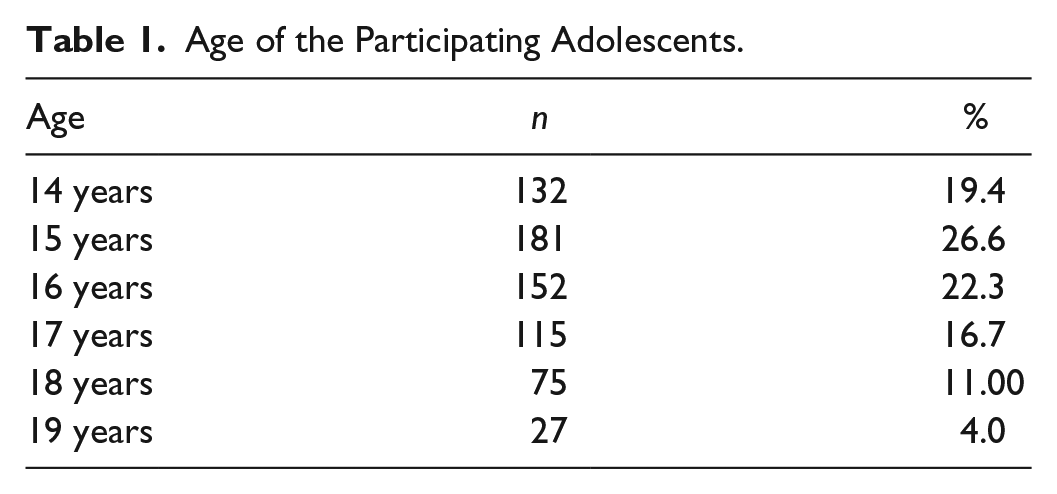
The study sample comprised 682 adolescent athletes who played with one of 15 football clubs in the province of Zaragoza (Spain), and were 14 to 19 years old (M = 15.85; SD = 1.404). They were all affiliated and actively played this sport (Table 1).
Age of the Participating Adolescents.
Evaluation Instruments
To collect information and to meet the set objective, two questionnaires were used.
For physical self-concept, the original version of the Physical Self-Questionnaire (C-PSQ) was used, specifically the version translated into Spanish by Moreno, Cervelló, Vera, and Ruiz (2007), which addresses youths. The reliability of the original instrument was .720 and the internal consistency for this study was α = .714. This instrument contains 27 items divided into four subvariables: perceived competence, 10 items (α = .72); physical attraction, 7 items (α = .69); physical strength, 6 items (α = .70); and self-confidence, 4 items (α = .71).
To identify adolescent football players’ uses, an adapted version of the State Survey in Drug Use in Secondary Education (Estudes, 2014) was used, promoted by the government delegation of the PNSD. The general categories of alcohol, tobacco, and cannabis uses were taken and had three response options for uses: regularly, occasionally, and never. Internal consistency was 7.68.
Procedure
To perform the work, approval from the football clubs was obtained as informed consent to participate in this research work. After agreeing on one week day, the questionnaire was completed by all the football clubs. After data collection, data were processed and analyzed by the IBM SPSS statistics software, v22.0. Finally, the AMOS v.24 statistical software was used to consider a structural equations model to be able to validate and quantify the relations between physical self-concept and substance use. All the subjects were previously informed about the nature of the study and participated voluntarily and anonymously.
Data Analysis
Descriptive statistics were done to obtain sociodemographic data and the arithmetic mean according to the different studied variates. Later correlations and ANOVAs were carried out between the physical self-concept and use variables. Finally with a cluster analysis, the study subjects were classified according to their specific characteristics into various groups, whose scores were significant compared with each other. The level of significance for all the operations was p ≤ .05.
Results
We now go on to provide the results obtained in the different studied variables:
Descriptive Variables
As seen in Table 2, physical self-concept, self-confidence, and perceived competence were the variables with the highest means.
Descriptives of the Self-Concept Variables.

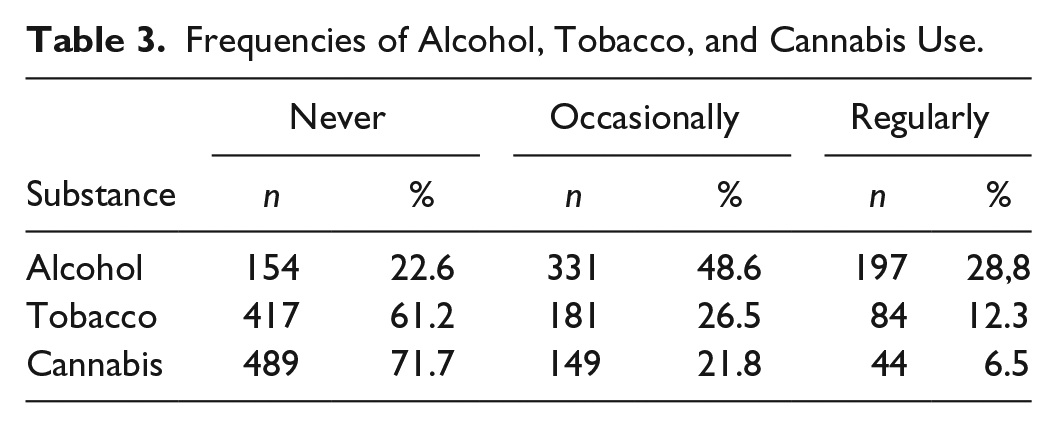
When examining uses, alcohol was found to be the most consumed substance among teenage football players for both habitual (n = 197; 28.8%) and occasional (n = 331; 48.6%) uses, followed by tobacco (see Table 3). Cannabis use was less marked than the previous two products, obtained low prevalences for habitual use (n = 44; 6.5%), and was absent in a considerable number of subjects (n = 489; 71.7%).
Frequencies of Alcohol, Tobacco, and Cannabis Use.
Relation Between Sport Variables and Use
When we analyzed the sport and use variables, significant correlations appeared among them (see Table 4). For physical self-concept, only perceived competence showed a significant relation with the uses of the three studied substances (alcohol, tobacco, and cannabis).
Relation Between Physical Self-Concept Dimensions and Substance Use.

Significant correlation at .05 (bilateral). **Significant correlation at .01 (bilateral).
Influence of Sport Variables on Use
The ANOVA demonstrated the influence of the sport variables on uses (see Table 5), and perceived competence stood out as it once again influenced the uses of all three psychoactive substances.
Influence of Sport Variables on Uses.

Significant correlation at .05 (bilateral). **Significant correlation at .01 (bilateral)
Behavioral Patterns Between Sport Variables and Use
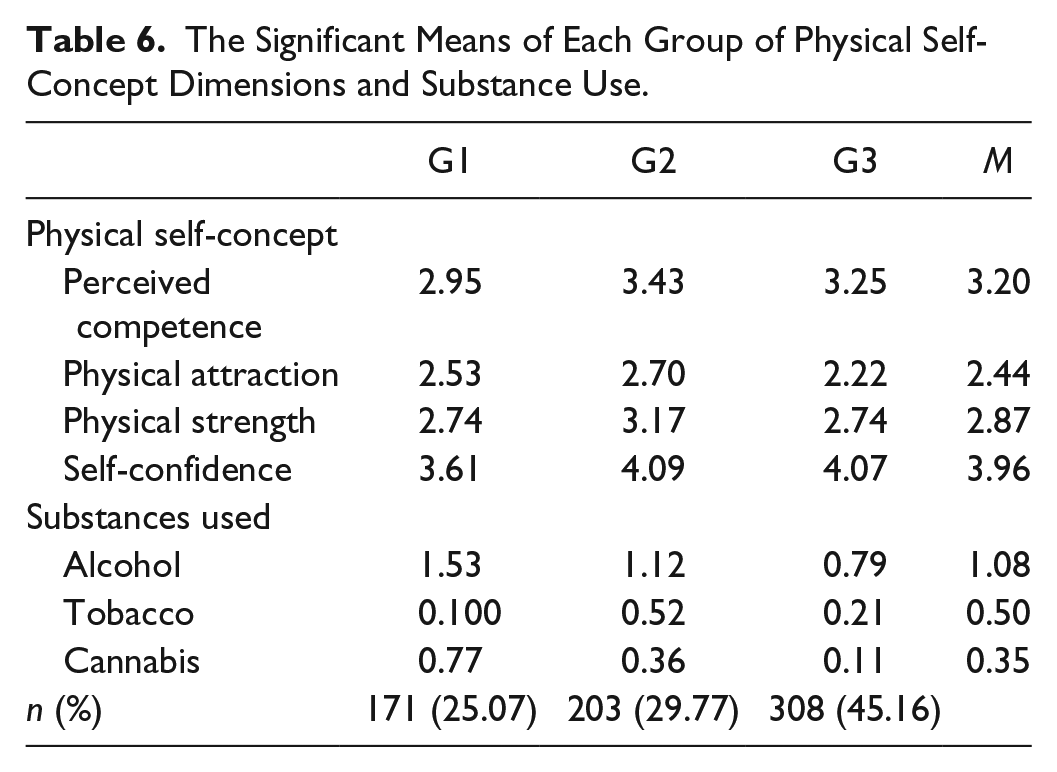
Finally, subjects were classified into homogeneous groups according to the physical self-concept dimensions and substance use by a cluster analysis, whose objective was to classify individuals into main groups. In this way, three main groups were formed according to their means.
Below, we specifically show the different means for each variable according to the three main groups above (Table 6).
Group 1 (n = 171; 25.07%): Characterized by less adaptive behaviors: Perceived competence and self-confidence were below the mean to the detriment of greater alcohol, tobacco, and cannabis use.
Group 2 (n = 203; 29.77%): Characterized by mixed conducts: The sport variables of self-concept were mainly over the mean, and prevalences were slightly above it for alcohol, tobacco, and cannabis use.
Group 3 (n = 308; 45.16%): Characterized by more adaptive behaviors: The means in perceived competence and self-confidence of this group were above the total mean. And this was accompanied by a considerable drop in the prevalences of uses of alcohol, tobacco, and cannabis for the teenage football players who made up this group.
The Significant Means of Each Group of Physical Self-Concept Dimensions and Substance Use.
Confirmatory Factor Analyses
Finally, an attempt was made to check the physical self-concept dimensions and substance use. Figure 1 depicts the result of the analysis done with structural equations by the maximum likelihood method, which confirms the appropriateness of the model composed of the constructs that the present study contemplates. After an initial confirmatory factor analysis, it was found that the adjustment indices were not appropriate. The modification indices indicated that they correlated the errors between the items that corresponded to consumption, and the indices of adjustments improved until considered adequate: χ2(10) = 57.988, p < .001; χ2/gl = 5.79; comparative fit index (CFI) = 0.93; normed fit index (NFI) = 0.92; Tucker–Lewis index (TLI) = 0.91; root mean square error of approximation (RMSEA) = 0.057, 95% confidence interval (CI) = [0.038, 0.074]. So it can be stated that the model proposed for the factorial structure among the factors was viable.
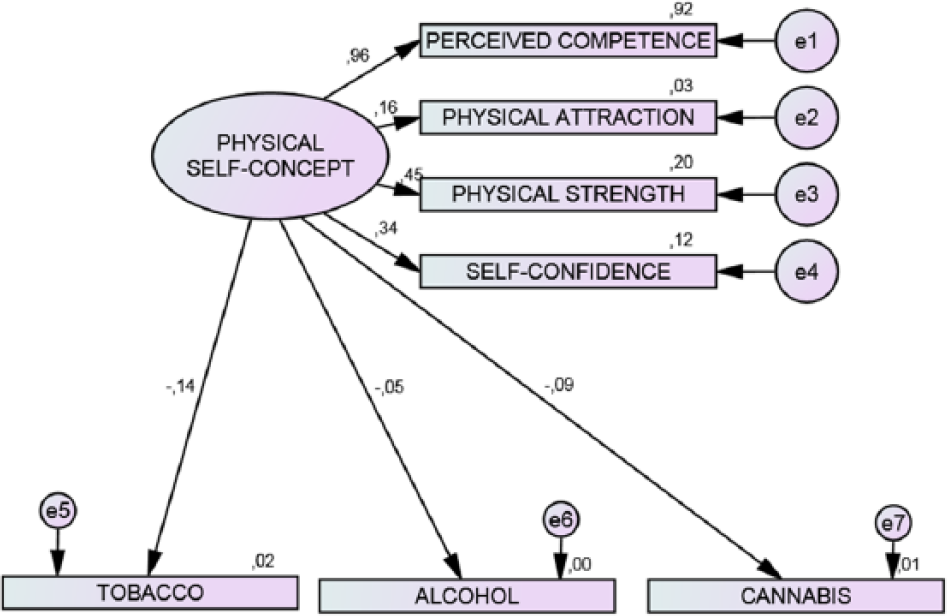
Model of the structural equations among physical self-concept and substance use.
Discussion
The substances use of the teenage football players recruited for the present study is in line with that found in many other works, and backs a hierarchy of uses headed by alcohol, followed by tobacco and cannabis (Danjoy, Ferreira, & Pillon, 2010).
Several studies have demonstrated the relation between self-concept, as a multidimensional construct, and substances use, a subject that has been thoroughly studied, especially in adolescence (Prado & Pantin, 2011) where low self-concept has been traditionally considered a classic risk factor for substances use (Lamb & Crano, 2014). Some authors have concluded that a low academic, social, or emotional self-concept is related with high levels of use (Kavas, 2009; Zamboaga, Schwartz, Jarvis, & Van Tyne, 2009), while others have found no such relation (Kokkevi, Richardson, Florescu, Kuzman, & Stergar, 2007). However, very few studies have directly related physical self-concept with substances use despite its importance as a liable estimator of a person’s well-being, particularly in adolescence and youth (Garaigordobil & Durá, 2006), although a positive relation was found between physical self-concept and a healthy lifestyle (Morsunbul, 2013; Tarbell & Li, 2013).
Our research results indicated the competence perceived was the scale that most influenced drug use by adolescent athlete students. Along this line, Duda and Ntoumanis (2003) showed for youths who practice sport outside school that practice that is set up by self-determination and by avoiding inadequate health habits such as substance use is related with a series of positive psychological consequences. These include improved physical self-concept, conceived as considering the perceived competence more, and persistence in practicing physical activities, among others. Lázaro (2011) discussed that the levels of physical condition related with adolescents’ health are one of the most important factors and act as a dissuasive element of consuming alcohol. Moreno, Moreno, and Cervelló (2009) reported positive relations among physical condition, strength, and perceived competence linked with non-smoking, but indicated that when smoking was present, it agreed with a sport person’s personal image and physical appeal in more maladjusted behaviors. Thus, the reverse relation is shown between suitable physical self-concept and substance use that harms health (Fuentes, García, Gracia, & Lila, 2011a). At the same time, physical sport practice predicts self-esteem in particular, and physical self-concept in general, so it should be assessed as an important factor for both physical and psychological health (Moreno et al., 2008; Rees & Sabia, 2010).
Other research works have highlighted the influence of self-concept in practicing physical sport activity. Along these lines, Duda and Ntoumanis (2003) have shown that youths who practice out-of-school sports, when more self-determined criteria are sought and unsuitable health habits like substances use are avoided, are related with a set of positive psychological consequences, which include physical self-concept improvements, and better consider perceived competence and persistence while practicing physical activities, among others. Lázaro (2011) has argued that physical condition levels related with adolescent health are one of the most important factors that help deter from drinking alcohol. Moreno et al. (2009) have reported positive relations among physical condition, strength, and perceived competence linked to absence of using tobacco. However, presence of smoking tobacco has been related with sportspeople’s personal image and physical attraction in more less adaptive behaviors. Thus, practicing physical sport activity predicts self-esteem in particular and physical self-concept in general, and has been found to be a highly relevant factor for physical and psychological health (Rees & Sabia, 2010).
Our research results indicate that physical self-concept aspects have an effect on, and play a key role in, consumption conducts (Rubak, Sandbaek, Lauritzen, & Christensen, 2005). Hence, it is essential to study them to make prevention and intervention of substance uses more efficacious in the interest of better adhering to and enjoying physical sport activity (Bartik, 2012; Hodge, Hargreaves, Gerrard, & Lonsdale, 2013).
The limitations of this study may lie in its cross-sectional design as it takes data at a given spatial time. In turn, the clubs surveyed in this study aleatorily responded about being included in the study, and no uniform sample was taken of all the city’s districts or areas. This could likewise affect any possible differences between their levels of sport and other social matters. In turn, prevalences of use and physical self-concept can vary from one year to another, or even in the same year, as adolescents move forward in adolescence.
This work could have practical implications that can lead to didactic strategies being used with adolescent athletes through coaches and sport monitors to address self-determined conduct, such as preventing drug use and promoting intrinsic motivations, perceived competence, self-confidence, and so on, which lead to practicing suitable physical sport activity.
Footnotes
Author Contributions
All authors contributed to the conception and design of the work, organized the sample collection and data preparation, and performed data collection, analysis, and interpretation. All authors critically reviewed its comprehensive content and finally approved the version to be submitted for publication.
Declaration of Conflicting Interests
The author(s) declared no potential conflicts of interest with respect to the research, authorship, and/or publication of this article.
Funding
The author(s) disclosed receipt of the following financial support for the research, authorship, and/or publication of this article: This study was performed by Research Group OPIICS, Universidad de Zaragoza (Zaragoza, Spain) and supported by research funds provided by the Department of Science and Technology of the Government of Aragón (Spain) and the European Social Fund.