




Abstract
This systematic review aims to identify the research trend and gap of strategy-based instruction research in second or foreign language domain from 2000 to 2021. The study involves both bibliometric and content analysis. To gain an overall understanding of the research on strategy-based instruction, this study employs keywords co-occurrence analysis to analyze data obtained from Web of Science and Scopus. The content analysis coded four themes: learning context, research objects, intervention framework, and indicators. The bibliometric findings offered analytical information on keywords, sources, and regions of selected documents, revealing the latest research focuses. The findings of content analysis further explored each document and provided in-depth data concerning learning contexts and research objects. The content analysis also indicates characteristics of successful SBI design by outlining the contexts and implementations of interventions. The results of this study can be useful resources to researchers intending to conduct research in SBI field, since the study discussed both what has been done (existing research focuses) and what needs to be done (research trends and research gap).
Keywords
Introduction
The research on language learning strategies initially emerged from studies that explored good language learners’ characteristics (Rubin, 1975; Rubin & Thompson, 1983). Strategies refer to language learners’ conscious thoughts and actions to develop language skills and achieve learning goals effectively (Wenden, 1987). A more specified definition was offered by a key scholar in the field of learning strategies: “learning strategies are specific actions taken by the learner to make learning easier, faster, more enjoyable, more self-directed, more effective, and more transferable to new situations” (Oxford, 1990, p. 8). Learners who can use strategies wisely are equipped with metacognitive knowledge about their learning styles, a thorough understanding of their learning goals, and the ability to match learning strategies with learning goals according to their capability (Chamot & Rubin, 1994). Oxford (2016) synthesized the existing definitions of language learning strategies and provided an overarching description of this notion (p. 48):
L2 learning strategies are complex, dynamic thoughts and actions, selected and used by learners with some degree of consciousness in specific contexts in order to regulate multiple aspects of themselves (such as cognitive, emotional, and social) for the purpose of (a) accomplishing language tasks; (b) improving language performance or use; and/or (c) enhancing long-term proficiency.
In practice, Cohen (2014) proposed that good language learners use strategies to accomplish “most advanced levels of target language performance” (p. 7). Language use can be considered to provide language learning opportunities (Norton, 1995; Spolsky, 1988; Wenden, 1986), and then the terms “strategy” or “strategies” is concerned with learners’ thoughts and actions in both learning and using a language. Scholars attempted to generalize strategies used by good language learners and suggested the application of these models in effective language teaching and learning (Oxford, 1990; Rubin, 1975; Rubin & Thompson, 1983). Strategy-based instruction (SBI) thus comes into being.
Strategy-based instruction refers to an approach that focuses on a form of language teaching and training learners learning language strategically (Cohen & Dornyei, 2002; Rubin et al., 2007). SBI aims to assist learners in becoming more effective in language learning and performing better in language production (Cohen & Weaver, 2005; Macaro, 2001), and it is widely argued that strategies can be taught (Chamot & Kupper, 1989; Oxford, 1990; Rubin & Thompson, 1983; Wenden, 1995). Teaching strategies in language classrooms can make learners more involved in their own language learning process, and integrate more efficient and individualized ways to learn and use languages (Chamot, 2004). SBI approach is usually developed through adjusting existing frameworks of language learning strategies to adapt to a specific education context. Oxford’s Taxonomy of Language Learning Strategies (Oxford, 1990) as one of the most popular categories has been widely applied by studies as treatments in general language teaching. Oxford’s Taxonomy consists of six aspects: memory, cognitive, compensation, metacognitive, affective and social strategies. Jurkovic (2013), for example, examined the effects of explicit SBI on learners’ achievement test scores and reported limited effects of cognitive, metacognitive and memory strategies instruction on students with high language competence. The Cognitive Academic Language Learning Approach (CALLA) by Chamot and O’Malley (1994) is another dominated model used in conducting SBI interventions. Chinpakdee and Gu (2021) investigated a SBI course based on CALLA and discussed how explicit SBI can be effectively implemented in second or foreign language classrooms.
Some studies focus on a specific language skill. Al-Jarrah et al.’s (2018) study, for instance, demonstrated the effectiveness of SBI concerning metacognitive strategies in improving learners’ writing competence. In addition to improving learners’ specific language skills, SBI also devotes to helping to develop learners’ beliefs that benefits their language learning. In a study by Kavani and Amjadiparvar (2018), learners’ motivation and self-regulated awareness were enhanced through SBI on reading comprehension. Teng and Zhang (2020) also found improvements in learners’ linguistic and performance self-efficacy after a self-regulated learning strategies-based writing intervention. Since SBI is a learner-centered and participatory teaching approach (Chamot, 2004; Chamot & Rubin, 1994), the effectiveness of SBI can depend on the characteristics of learners. Duman et al. (2021) explored working memory and language aptitude as variables in affecting learners’ listening SBI outcomes. Yildirim and Akcayoglu (2015) investigated young, gifted learners receiving SBI and concluded that SBI can “enhance their already established attitude to make their language learning quick, easy, effective and enjoyable” (p. 97).
The activities in second language and foreign language learning context are distinguished in terms of educational contexts and students’ backgrounds and needs (Bonnet & Siemund, 2018; Lightbown & Spada, 2013; Nunan & Carter, 2001). Second language activities were designed for a context where the target language is the prevalent language or an official language (Nunan & Carter, 2001). The idea that “second” and “foreign” can be differentiated according to learners’ surrounding environments is largely based on the theoretical perspectives connecting language learning achievements with learners’ opportunities to use the language in authentic communications (Lightbown & Spada, 2013). Second language learners are mostly immigrants of diverse nationalities and do not share a native language or a similar culture. Second language learners have a clear, practical need for the target language (such as for work or study) and plenty of opportunities to use the language in communications with native speakers inside or outside of the classroom. Students are exposed to target language -speaking community on a regular basis, however their knowledge may be restricted by their language abilities (Derwing et al., 2008). In that case, students’ major needs in an ESL classroom may be the acquisition of linguistic knowledge to allow their participation in communication with native speakers. Foreign language activities, however, refers to the teaching and learning of a language in a context where that language is not the prevalent or official language (Bonnet & Siemund, 2018). Foreign language learners are the major population of a region that speak the same local language and have the same culture. Foreign language learners have extremely little opportunities to use the target language outside of the classroom and learning that language may not have any clear practical benefits for them (Yamashita & Jiang, 2010). Foreign language learners, therefore, may need to acquire linguistic knowledge as well as cultural literacy to achieve communicative competence in the target language. In addition, a major task that Foreign language teaching needs to accomplish is to provide students with opportunities for authentic communication in classrooms, as there are few outside classrooms (Bonnet & Siemund, 2018). Considering that the acquisition and use of language learning strategies largely depend on students’ choice in interpreting contexts and producing output (Milla & Gutierrez-Mangado, 2019; Wharton, 2000), distinctions in educational contexts and students’ backgrounds and needs between second and foreign language teaching may require different pedagogical designs of SBI to respond correspondingly.
There are limited systematic reviews concerning with SBI in second or foreign language education. Plonsky (2011) conducted a quantitative measurement of the effects of SBI on learners’ learning achievements in second or foreign language education and described the relationship between SBI and the variables that influence its effectiveness. In Plonsky (2011)’s study, the type and number of strategies being taught, learning context (second vs. foreign language), and length of intervention are identified as moderators of SBI effectiveness. Ardasheva et al. (2017) further examined the effects of SBI on second or foreign language learning and self-regulated learning through meta-analysis. Ardasheva et al. (2017) considered context (e.g., educational level), and treatment (e.g., delivery agent) as variables that influence SBI effectiveness. This study also proposed the benefits of introducing self-regulated learning into SBI in second or foreign language classrooms. Despite of the timeliness concern, this study also intends to identify characteristics of successful SBI design, the following research questions are raised:
What are the most explored themes and topics in SBI research in second or foreign language teaching and learning?
What are the characteristics of successful SBI in second or foreign language teaching and learning?
What are the new trends in SBI research in second or foreign language teaching and learning?
Method
Publication Selection
This systematic review retrieves data from Web of Science (WoS) and Scopus. WoS, Scopus, and Google Scholar are the mainstream databases for systematic review (Martín-Martín et al., 2018). Though Google Scholar has advantages in covering larger citation sources, it fails to distinguish academic sources from non-academic ones, which can decrease the scholarly rigorous of systematic review (Zhang, 2020). Thus both Scopus and WoS are used to ensure both coverage and reliability. The time coverage (2000–2021) of this study is decided based on timeliness and allowing enough studies to meet bar for conducting bibliometric analysis (Rogers et al., 2020). The procedures of this study were developed based on the 27-item checklist from Preferred Reporting Items for Systematic Reviews and Meta-Analyses (PRISMA) (Page et al., 2021). The publication selection procedure is presented in Figure 1 and the inclusion and exclusion criteria in Figure 2. Publications that are not written in English were excluded from the selection procedure. 50 out of 94 studies documents were selected for this review.

Publication selection procedure.
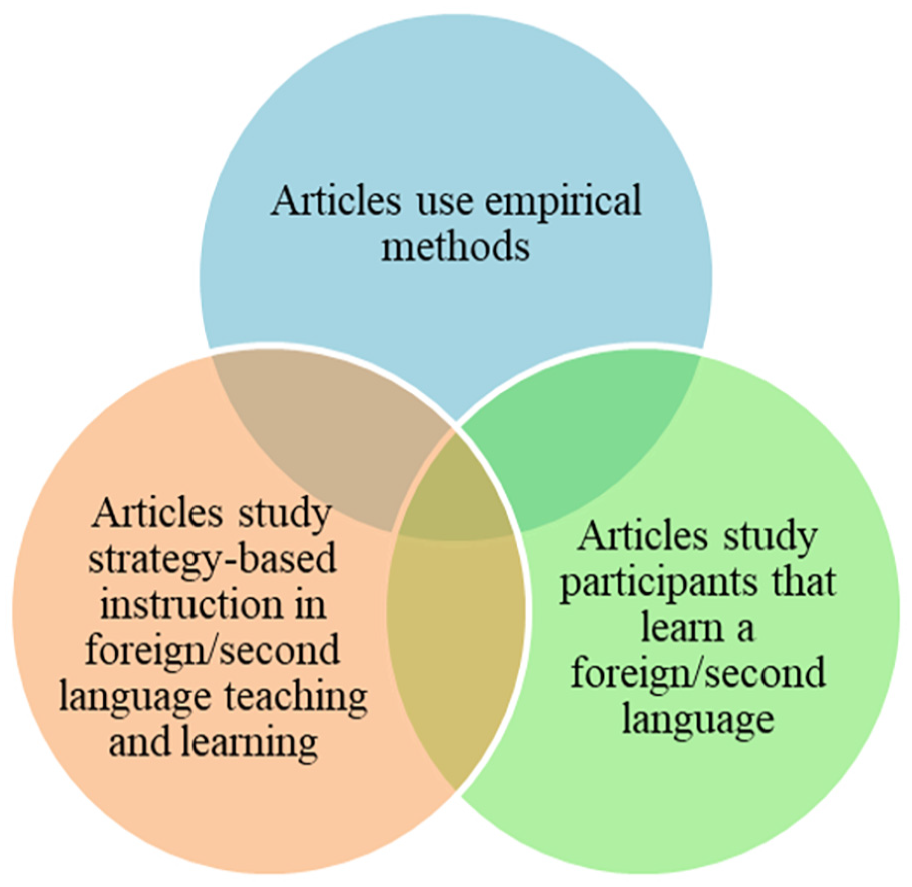
Inclusion and exclusion creteria.
Bibliometric Analysis
To gain an overall understanding of the research on strategy-based instruction, this study employs keywords co-occurrence analysis and citation analysis to analyze data obtained from WoS and Scopus. Keywords used in VOSviewer (van Eck & Waltman, 2010), which is a useful tool combining bibliometric review and visualization is used as the visualization tool for bibliometric analysis in this study. VOSviewer is especially powerful in generating network of research topics and trends, which is of interest in this study. For co-occurrence analysis, two different types of figures are presented, which are network and overlay visualization. Network visualizations are used to present relationships among clusters of emerged research topics, while overlay visualizations are to show how research trends changed over time.
Content Analysis
The content analysis is assisted by NVivo 12, which is a feasible research tool for classifying, sorting and modeling qualitative data (Jackson & Bazeley, 2019). The items in coding scheme were initially generated from the NVivo 12 through auto-coding. The coded scheme was further examined and developed by four researchers independently. The inter-rater reliability of four researchers’ coding over 31 items was 0.81.
In the learning context section, educational level and contexts diversity were included (Table 1). The educational level consisted of teachers and students from primary, secondary, junior, and tertiary schools. Two or more groups of participants’ educational levels examined in the studies were coded as mixed. Context diversity included the contexts where the studies conducted in, namely Vietnam, Ukraine, UAE, Slovenia, Indonesia, Bosnia and Herzegovina, Turkey, Jordan, Algeria, Thailand, Singapore, Canada, Greece, Japan, UK, and Iran.
Coding Scheme for the Use of SBI in EFL Learning.

The section of research objects was classified into seven coding items, included reading strategies, writing strategies, listening strategies, speaking strategies, motivation, and effectiveness of SBI intervention.
Results
Bibliometric Analysis Findings
Network and Overlay Visulization of Author Keywords
Figures 3 and 4 illustrate the network and overlay visualizations of author keywords. The minimum number of occurrences of keywords is set to 3, and the program provides 23 select keywords. The most used author keywords are: English (f = 11), comprehension (f = 9), reading comprehension (f = 6), EFL (f = 5), and metacognition (f = 5).
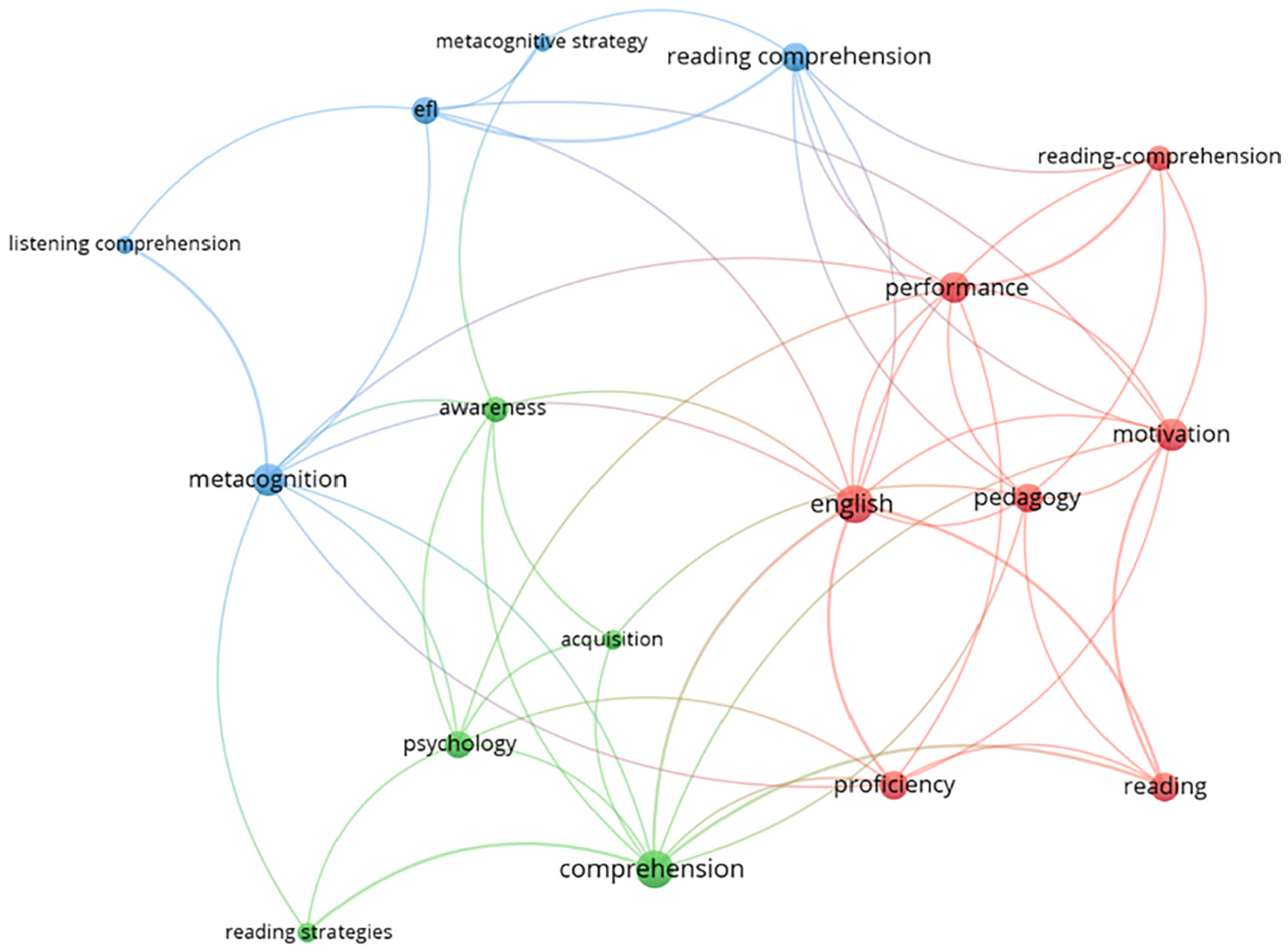
Network visulization of author keywords.

Overlay visulization of author keywords.
Based on Figure 4, the most recent research interests in strategy-based instruction area fall on “EFL,” “motivation,” and “reading.” The visualizations from the aspects of frequency and trend indicates that more studies are attempting to respond to practitioners’ needs in implementing SBI. There has been a migration of trending research focus from investigating students’ use of strategies (such as the keyword “performance”) to pursuing understanding of students’ internal cognitive process when using strategies (such as the keyword “motivation”).
Most Cited Journals in Citation Analysis
The most cited journals based on citation analysis are (Table 2): System (f = 46), Language Teaching Research (f = 28), Frontiers In Psychology (f = 23), Journal Of Asia Tefl (f = 19), and International Journal Of Listening (f = 15). As illustrated by the co-citation analysis, the major journals publishing research on SBI presented themslves in two clusters, one leaning to applied linguistics, another educational psychology and behaviors. Journals such as System and Tesol Quarterly that connect the two clusters suggest the interdisciplinarity of studies on SBI.
Five Most Cited Journals.

Major Regions Publishing Studies
Citation analysis were employed to illustrate the citation and publication features in terms of regions. Table 3. shows the top five regions ranked by publication numbers. Iran is the most productive region (publication number = 16), followed by China (publication number = 10). It can been known from the table that three out of five major regions (China, Iran, and Turkey) publishing studies are from foreign language teaching and learning contexts and two out of five second language teaching and learning contexts (Singapore and New Zealand). Though distinguished in educational contexts, studies in these two contexts do not seem to vary from each other in terms of rationale and design. However, whether it is safe for studies in these two contexts to replicate from each other may need further investigation, considering the dinstinctions in language use opportunities, language learning goals, and students’backgrounds.
Top Five Regions Ranked by Citation Number.

Content Analysis Findings
The Learning Context
Educational levels of participants in these 50 empirical studies can be seen in Figure 5. Except for three studies, the target language in 47 studies is English. Thus the following results also include comparison on cases in English as a foreign language (EFL) and English as a second language (ESL) contexts. The results show that SBI in English language learning have been investigated the most in higher education level and primary level, and the least at junior education stage. 52% of participants (26 studies) were in the tertiary education stage, followed by 12% (six studies) in primary education, and 8% (four studies) in secondary education. In this case, the category of “mixed” includes a combination of students and teachers, and students from mixed educational levels (10 studies). There were studies that investigated junior educational level (three studies) and middle-school teachers’ perceptions (one study) of using SBI in English language learning.

Educational levels of applying SBI.
The locations of studies conducting research about the uses of SBI in English language education, ESL and EFL educational context are shown in Figure 6. Studies investigated 10 context diversities about applying SBI, the most in Iran within 30% (15 studies), followed by China 12% (six studies) Thailand 6% (three studies). The uses of SBI in Jordan, and Algeria also attracted the attention of researchers within 4% (two studies) respectively. Each of Vietnam, Ukraine, Slovenia, Indonesia, and Bosnia, Japan, UAE and Herzegovina had one study exploring SBI in EFL education. Three contexts investigated SBI in ESL education, in terms of Singapore 6% (three studies), Turkey with 4% (two studies). Moreover, there were four contexts examined SBI in learning French as a second or foreign language where were in China, UK, Canada. In addition, there was a study investigated SBI in learning Chinese as a foreign language in the UK. It is worth to note that all of the studies focused on the ESL educational contexts (studies investigated in Singapore and Turkey) were investigated through the theoretical perspectives of ESL approaches. However, most studies investigated EFL educational contexts blended ESL and EFL theoretical perceptive to focus on the implication of SBI in English language teaching. The activities in ESL and EFL learning context are distinguished in accordance with educational contexts (Bonnet & Siemund, 2018; Lightbown & Spada, 2013; Nunan & Carter, 2001). In that case, the practice and theory of EFL and ESL teaching and learning should be differentiated for contexts. The pedagogic design related to SBI in English language learning should be adapted to educational contexts, instead of blending ESL and EFL approaches.

Contexts diversity of empirical studies.
Research Objects
64% of studies (32 studies) specialized the implementation of strategy instructions in subskills of Second or foreign language learning process, in terms of reading with 28% (14 studies), writing with 20% (10 studies), listening 14% (seven studies), and speaking 6% (three studies). Sixteen studies were found discussing reading comprehension. Some studies examined reading comprehension in multiple cases, such as both reading and writing skills. To investigate reading comprehension, 60% of reading studies (six studies) noted use reading comprehension tests to observe students’ reading performance. In addition, nearly 50% of cases (eight studies) investigate reading comprehension were conducted in tertiary educational level, two of them examined intermediate level students, three in secondary and one in primary level, and one study only investigated teachers’ perceptions of the use of SBI in second or foreign language reading process.
Nearly half of studies (with 28%, 14 studies) noticed the use of metacognitive skills in reading in second or foreign language learning. When discussing the implication of metacognitive skills, the most common framework of the studies (six studies) based on was the CALLA model by Chamot and O’Malley (1994). Indeed, as the CALLA model was mainly focusing on the combination of cognitive and metacognitive skills, these studies also examined the uses of cognitive skills in reading achievement with metacognitive skills. As the aims of explicit instructions were to develop learners’ metacognitive abilities, four of studies investigated the application of explicit instructions in developing students’ metacognitive skills in reading proficiency. Besides, all these four studies used the CALLA model as their framework to conduct the explicit instructions in their research. Considering the implementation of metacognitive skills, seven studies revealed the importance of metacognitive awareness in reading performance. In particular, study by Ghahari and Basanjideh (2015) showed that metacognitive awareness as a strong predictor of problem-solving ability and had a high positive impact on learners’ reading comprehension, and significance for learners’ reading achievement.
There were five studies that specified the impact of writing strategies on learners’ competence in second or foreign language learning. Indeed, the intervention such as text-generating, feedback handling, and revising can be treated as a significant role in promoting students’ writing competence and strategy use (Bai, 2015). Besides, three-fifths of these studies examined impact of explicit instructions in learners’ writing development, only one study investigated implicit instructions in teaching writing in second or foreign language classroom.
50% of studies (25 studies) showed the role of motivation in the use of SBI in second or foreign language learning. Six studies noted the influence of strategies-use in promoting learners’ motivation in reading process. Study by Kavani and Amjadiparvar (2018) particularly revealed that the use of SBI has significant impact on second or foreign language learners’ motivation, self-regulated learning and reading comprehension. Indeed, nine studies proved the role of motivation in the implication of SBI in second or foreign learning process.
Twenty-six studies used intervention to test the effectiveness of an existed or proposed SBI intervention. There are 22 studies (44%) reported positive impacts of conducting SBI while two mixed (4%) and two negative (4%). Among the 26 studies concerning intervention, 23 studies (46%) employed explicit SBI approach and three (6%) chose implicit one. Seventeen studies provided specific hours of intervention, and the average duration is 27.65 hr. In terms of the four studies that involve negative results, one implemented implicit SBI approach and three explicit. Two studies with negative results conducted interventions that are much shorter than the average duration (12 and 8 hr respectively), while that of the other two negative studies are much longer than average (75 and 180 hr respectively). However, it is noticeable that the 75-hr instruction was distributed in 50 sessions in two consecutive semesters, and the 180-hr one in 60 sessions in two academic years.
Discussions
Theoretical Implications
Studies reviewed are mainly supported by three theoretical frameworks, which are CALLA model, Taxonomy of Language Learning Strategies, and Self-Regulated Strategy Development (SRSD) model. The most frequent framework used by studies to investigate SBI in English language learning was CALLA created by Chamot and O’Malley (1994). Discussions in studies based on this framework tend to show strong interest in cognitive and metacognitive instructions on learners’ academic language learning progress and achievement. The research on CALLA model further examined the 5-step cycle worked by Chamot et al. (1999) to explain how teachers conducted SBI in second or foreign language learning, in terms of preparation, presentation, practice, self-evaluation and expansion. Studies on explicit instructions are more likely to follow the Reciprocal teaching approach worked by Palinscar and Brown (1984), Palincsar and Brown (1986). However, both of the two studies used Reciprocal teaching approach with other guidelines or approaches (such as CALLA, Transactional Strategy Instruction, etc.) to assist strategy use in English language learners’ reading comprehension, which may be due the strong cognitive feature of reading as a mind process.
Taxonomy of Language Learning Strategies by Oxford (1990) is more favored by studies on listening and writing. Studies that choose Oxford’s model mostly because its comprehensiveness for researchers to look at the use of indirect and direct strategies in language learning process. The SRSD model (Harris & Graham, 1996) is mainly connected with self-regulated learning strategies-based intervention on students’ writing proficiency in second language learning. Self-regulation as a personal variable was noticed by many studies, to focus on the reciprocal influence of second or foreign learners’ strategy use, behaviors, and environmental variables.
Practical Implications
Based on the review of 50 articles, there are mainly target five stakeholders in SBI research: teachers/instructors, curriculum/syllabus designers and policy makers, material developers, assessment designers, and teacher education/training program designers. Recommendations will be discussed in terms of teaching, curriculum design, material development, assessment, and teacher training.
For teaching, it is crucial for teachers to conduct needs analyze when implementing SBI in classroom process. Students’ awareness of strategy use can be raised through designing classroom task to enhance SBI, such as organize peer discussion on strategy use among students. Lastly, no matter how successful an approach/model may be in its application contexts, teachers should decide their choice of teaching method according to contexts and audience. In curriculum design, it can be seen from the reviewed studies with positive results that curriculum suits SBI should be able to allow enough time for teachers to do strategy instruction, as well as embed strategy in syllabus. In addition, SBI can be more effective when conducted in a differentiated instructions according to the different personalities of learners. As for material development, such as textbooks, supportive teaching materials, the importance of particularly designed materials is frequently addressed in reviewed studies, thus materials should be developed in line with strategy syllabus. Furthermore, to fully foreground the potential of materials, reference for teacher in lesson plan on SBI may be provided in these materials. Cooperations between researchers and teachers may be considered as opportunities for enhancing material development. Regarding assessment, as discussed above, SBI is more effective when conducted with a series of uniquely designed actions. Thus, assessment should be designed to particularly assess students’ learning of strategy and pre-diagnose before implementing SBI should be conducted to make SBI more efficient. Concerning teacher training, to support teachers in teaching SBI, teacher education/training programs need to equip teachers with knowledge of how to teach strategy, raise teachers’ awareness of integrating strategy instruction in classroom, as well as organize teacher training workshop on SBI.
Methodological Implications
In terms of research methodology, due to the experimental design in many reviewed studies, most cases focus on small-sized samples. Samples of large-size sample and diverse contexts may be needed (e.g. region, culture, and education level). Also, the duration of many studies is short, such as several weeks. The outcomes of SBI may be limited in short terms. Thus longitudinal research design may provide more insightful results. Besides, most studies employ quantitative methods solely. To increase rigor, future studies may use mixed research methods and the integration of qualitative methods, with data collection methods that can mirror real-life learning process of strategy, such as think aloud.
As for research objects, the effectiveness a model developed based on one subskill can be examined when applying to teaching other subskills. In addition, researchers may take personal differences (learners’ pre-existing language ability, language aptitude, motivation, gender, family background, and personality style) into consideration when measuring the effectiveness of SBI approach. Finally, teachers’ and learners’ perceptions can be considered as a basic for developing SBI that needs more research.
Conclusion
This systematic review aims to investigate research trends and identify research gaps of studies concerning SBI in ESL/EFL contexts from 2000 to 2021. Both bibliometric analysis and content analysis were employed. The bibliometric findings offered analytical information on keywords, sources, and regions of selected documents, revealing the latest research focuses. The findings of content analysis further explored each document and provided in-depth data concerning learning contexts (education level, contexts diversity), research objects, intervention framework, and indicators (practical implications, suggested future research). The content analysis also indicates characteristics (contexts, duration, target subskills, and frameworks) of successful SBI design through outlining the contexts and implementations of interventions.
The limitation of this study lies in that it only qualitatively examined the effectiveness of empirical studies involved. Further studies may conduct meta-analysis or use other quantitative methods to generate systematic description of successful SBI intervention designs. In addition, the number of documents eligible for this study is relatively small, which may reduce the generalizability. However, to narrow the focus of this study to SBI, studies that mention SBI but were not particularly designed for researching SBI were excluded in the searching stage. To obtain broader overview of SBI research, future research may consider involving both general databases and subject-specific databases such as Sociology Source Ultimate. Despite the limitations, the results of this study can be useful resources to researchers intend to conduct research in SBI field, since the study listed both what have been done (existed research focuses) and what needs to be done (research trends and research gap).
Footnotes
Declaration of Conflicting Interests
The author(s) declared no potential conflicts of interest with respect to the research, authorship, and/or publication of this article.
Funding
The author(s) disclosed receipt of the following financial support for the research, authorship, and/or publication of this article: This study was supported by the Guangdong Planning Office of Philosophy and Social Science (Grant No. GD21YJY14).
