




Abstract
Complementary afterimages are often modeled as illusory Hering opponent hues generated by the visual system as a result of adaptation. Yet, the empirical evidence suggests a different picture—Complementary afterimages are localized RGB filtered perception based on complementary color pairs. The article aims to bring to the fore an ongoing ambiguity about red/green afterimages and then to address all cases of complementary afterimages. A simple model of afterimages based both on empirical data and the available literature is reconsidered and discussed: The afterimage color A depends both on the color stimulus S and on the ensuing background color B as estimated by the relation, A = B – kS.
Keywords
Introduction
As of Hering’s time, complementary afterimages—afterimages 1 henceforth—have been modeled as illusory mental colors resulting from adaptation of the visual system (Bidwell, 1896; Goldstein, 2010; Jones, 1972; Palmer, 1999; Purves & Beau Lotto, 2002; Wilson & Brocklebank, 1955; Zaidi, Ennis, Cao, & Lee, 2012). Although several neural mechanisms have been suggested (Bidwell, 1897; Field et al., 2010; Hofer, Carroll, Neitz, Neitz, & Williams, 2005; Kelly & Martinez-Uriegas, 1993; van Boxtel, Tsuchiya, & Koch, 2010; Wheatstone, 1838; Williams & Macleod, 1979; Zaidi et al., 2012), the exact locus of such an adaptation is still vague (Bidwell, 1896; Craik, 1940; Frey & von Kries, 1881; Hering, 1878; Jones, 1972; Mach, 1897). Remarkably, scientists and philosophers have provided biased and imprecise reports based on color opponency (Byrne & Hilbert, 2003; Churchland, 2005; Goldstein, 2010; Hurvich, 1981; Jones, 1972; Lycan, 2002; Mach, 1897; Macpherson & Platchias, 2013; Palmer, 1999; Schwitzgebel, 2011; Werner & Bieber, 1997), and only a minority of accounts have considered the complementary nature of afterimages (Bidwell, 1897; Geisler, 1978; Livingstone, 2002; Livitz, Yazdanbakhsh, Eskew, & Mingolla, 2011; Pridmore, 2008; Wilson & Brocklebank, 1955; Zaidi et al., 2012). Finally, the notion of complementary color varies from author to author (Anstis, Vergeer, & van Lier, 2012; Goldstein, 2010; Hurvich, 1981; Livingstone & Hubel, 1987; Zaidi et al., 2012), and it is occasionally confused with that of opponent colors (Livingstone, 2002; Tsuchiya & Koch, 2005). Most of the debate has been based on red/green contrast and occasionally on yellow/blue. However, opponent colors blue and yellow (unlike green and red) are also true complementary colors, in the colorimetric sense—as opposites on a line through the white point in the Commission Internationale de l’Eclairage (CIE) chromaticity diagram (as defined in 1921 by the CIE). Therefore, as blue and yellow endorse both the complementary color model and the opponent color model, they are not relevant here. In contrast, red and green have been key.
This article provides empirical evidence that challenges current models of afterimages and backs up an account of afterimages as locally filtered RGB perception based on complementary colors. 2 It will not address positive afterimages which appear to be based on different neural mechanisms.
In perceptual neuroscience, a widespread model of afterimages—the opponent model henceforth—maintains that, in response to a prolonged colored stimulus, the visual system adapts and generates an illusory complementary hue (Bidwell, 1896; Gordon, 1991; Jones, 1972; Palmer, 1999; Wilson & Brocklebank, 1955) as predicted by Hering’s opponent color system (Churchland, 2005; Geisler, 1978; Goldstein, 2010; Kelly & Martinez-Uriegas, 1993; Macpherson & Platchias, 2013; Palmer, 1999, Table 5). In this regard, the neuroscientist Stephen Palmer (1999) summarized,
Each hue produces its complementary hue in the afterimage. The complement of a hue is the one located in the opposite direction with respect to the central point of [Hering’s opponent] color space. Thus green’s complement is red, black’s is white, and yellow’s is blue. (p. 106, emphasis added)
The opponent model articulates into three points:
Afterimage hues are predicted by Hering’s opponent color system.
Afterimage hues are a function of the stimulus only.
Afterimages are illusory additions generated by the visual system.
The opponent model of afterimages has never been universally accepted, but it has reached huge popularity—both in university textbooks and in philosophical and scientific articles (Brindley, 1963; Brown, 1965; Byrne & Hilbert, 2003; Churchland, 2005; Goldstein, 2010; Gordon, 1991; Hurvich, 1981; Johnston, 2004; Jones, 1972; Lycan, 2002; Macpherson & Platchias, 2013; Palmer, 1999; Robertson & Sagiv, 2005; Schiffman, 1996; Schwitzgebel, 2011; Tsuchiya & Koch, 2005; Werner & Bieber, 1997). The acceptance of the opponent model of afterimages is likely due to three factors that originate in the 1960s (Lang, 1987; Pridmore, 2011): Hurvich’s revival of Hering’s opponent color theory (Hering, 1964; Hurvich, 1981; Hurvich & Jameson, 1957; Jameson & Hurvich, 1961), the findings about the alleged neural underpinning of color opponency (Daw, 1967; De Valois, 1965; Svaetichin & MacNichol, 1958), and the popularity of multistage theory of color perception that combined RGB and color opponency (De Valois & De Valois, 1993; Solomon & Lennie, 2007). Some of these findings are currently under scrutiny (Pridmore, 2011; Romney, D’Andrade, & Indow, 2005; Stoughton & Conway, 2008; Valberg, 2001).
In fact, as early as von Helmholtz’s influential work, a model of color afterimages based on complementary color pairs has been put forward (Bidwell, 1896; Frey & von Kries, 1881; von Helmholtz, 1924): “A sharply defined negative after-image of the complementary colour will be seen then on the grey ground. Thus the after-image of red is blue-green [cyan]” (von Helmholtz, 1924, p. 254, emphasis added). Since then, several authors have emphasized the role of complementary colors as regards afterimages (Pridmore, 2008; Valberg, 2001; Wilson & Brocklebank, 1955), although their view has not gained the same popularity. In this spirit, here I present experimental results in contrast with all the above three points of the opponent model. Such an evidence will support a different model of afterimages—the subtractive model henceforth—to the effect that
afterimage hues take place in RGB space rather than in Hering’s color space;
afterimage hues depend both on the stimulus and on the background; and
afterimages are not illusory additions, but localized RGB filtered perception.
On the basis of such an evidence, a new model of afterimages is put to test. The key hypothesis is that the afterimage hue is estimated by the relation:
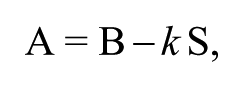
where S is the stimulus one stares at to induce chromatic adaptation, B is the background against which one sees the afterimage, and A is the color one afterimage. 3 A caveat: B is not the background surrounding the stimulus, but the background one stares at after the stimulus (like the gray ground in von Helmholtz’s text). All colors are expressed by RGB triplets. 4 The model suggests that, by modifying spectral sensitivity, in a stimulus-shaped local area, the visual system filters off the stimulus hue from the background, thereby revealing hues that would not be visible otherwise. The model predicts different afterimage hues from those predicted by the Hering-inspired standard model but consistent with complementary-based models (Pridmore, 2008; von Helmholtz, 1924; Wilson & Brocklebank, 1955).
Consider Figure 1, if S is saturated red (1,0,0), B is gray (½,½,½), and k is, say, ½, then the color one afterimage is A = (½,½,½) − ½ × (1,0,0) = (0,½,½), which is unsaturated cyan (cyanish gray). It is a prediction that conflicts with the opponent model, which predicts a green afterimage (C) rather than a cyan one (D). Such a difference allows us to contrast the two models.
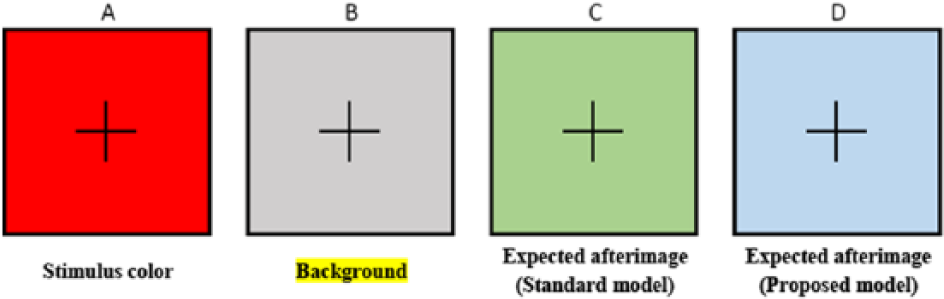
Red/green afterimages: The opponent model versus the proposed model.
Results
Experiment 1: Red–Green Versus Red–Cyan
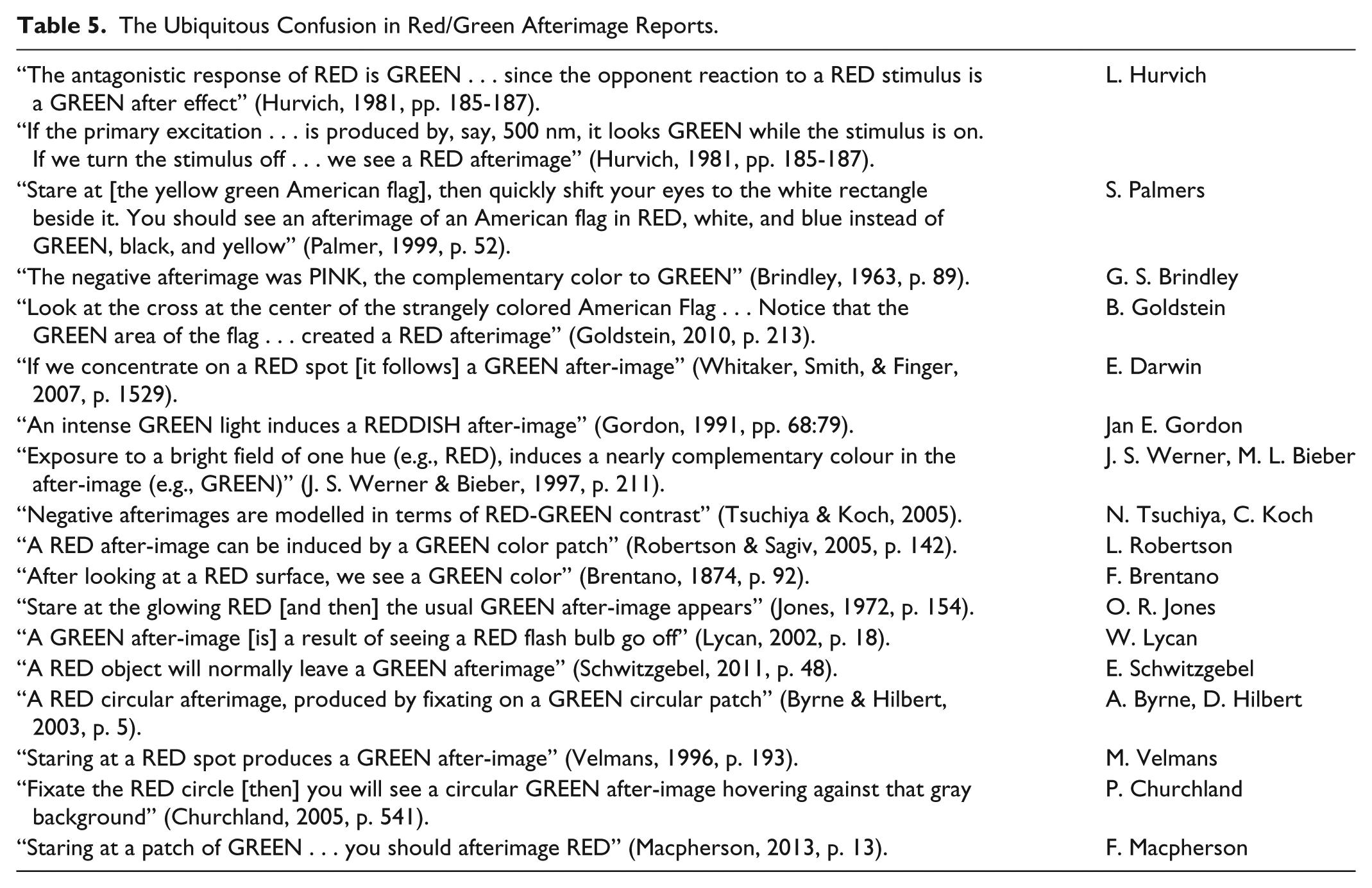
An entry way is the red/green complementary afterimage in which allegedly a red stimulus should produce a green afterimage and vice versa (see Table 5, and Figure 6a and 6b). Subjects stare at a red stimulus for 20 s and then afterimage a color against a gray background for 5 s. Immediately afterward, the subjects are shown a green and a cyan square side by side, and asked to assess which of the two hues is more similar to the previously experienced afterimage. In such circumstances, the opponent model predicts a green afterimage (Table 5), whereas the proposed model predicts a cyan afterimage. Remarkably, 99% of subjects reported a cyanish afterimage following a red stimulus, and 95% a magentish afterimage after a green stimulus (Table 1). Subjects’ reports contradict the standard Hering’s opponent color model and are consistent with the proposed model.
Standard Model Versus RGB Filtering: Experimental Results.

Note. The percentage expresses how many subjects were in agreement with the proposed model.
Experiment 2: Background Dependence
The previous experiment is consistent with the suggested subtractive relation (A = B − kS) as long as the background (B) is achromatic. What if the background is colored? To test the dependence on background hues, the previous setup has been applied to a number of combinations of color stimuli and colored backgrounds. The empirical outcomes are checked against both the Hering-inspired standard model and the proposed RGB filtering model (see Table 2 and Figure 2). While the opponent model predicts that a given stimulus should produce the same afterimage regardless of the background, the proposed RGB filtering model predicts that the afterimage color should depend both on the stimulus and on the background. The experimental results align well with the outcome predicted by the proposed RGB filtering model and conflict with the opponent model (Table 3). Remarkably, if different backgrounds ensue, the same stimulus leads to afterimage different hues.
Complementary Afterimages of Negative Images.

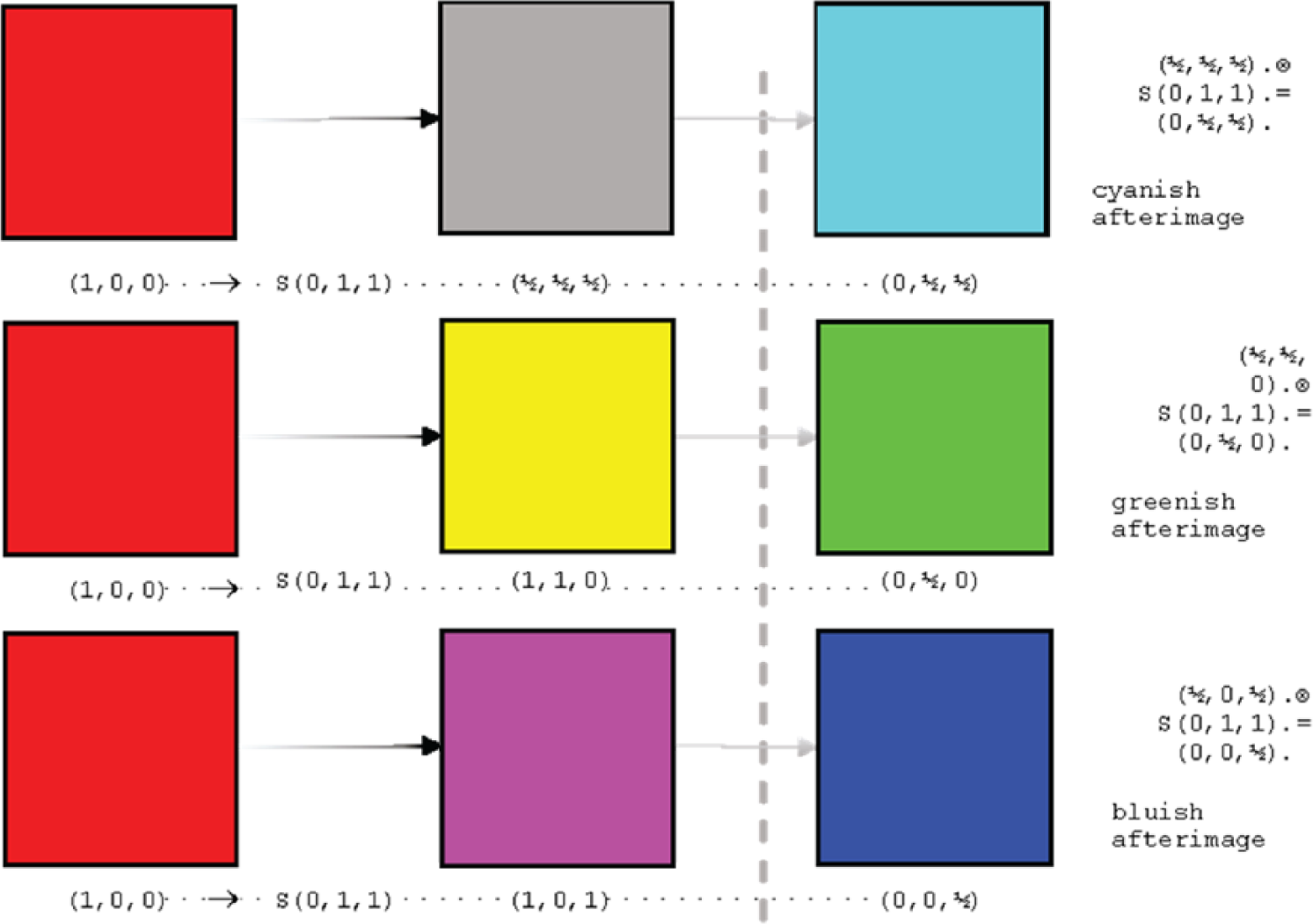
Given the same stimulus—for example, red—different backgrounds lead to one afterimaging different colors (cyan, green, and blue).
Afterimage Background Hue Dependence.

For example, after a red stimulus (Figure 2, bottom row), the opponent model predicts afterimaging green against a magenta background, and the subtractive model predicts afterimaging blue—96% of subjects reported afterimaging blue (Table 3).
Experiment 3: Complementary Afterimages of Negative Images
Complementary afterimages of negative images offer further empirical confirmation. I used a version of the Spanish Castle illusion in which viewing a hue-inverted image renders a subsequently shown achromatic version of the image in vivid color (Sadowsky, 2006). Consider the four images in Figure 3. P is the original picture; S is a negative version of P—Each RGB value is changed into its opposite; B is a grayscale version of P; BN is a false-color version of P. In this case, P provides value and saturation, and S provides the hue. 5

Negative images and colored afterimages.
If one stares at the negative image (S) and then shifts the gaze to the grayscale image (B), one will be bemused to temporarily see the colors of the original image (P). Is this a proof that one sees illusory hues the grayscale image does not have? Not necessarily. An alternative explanation is the following. While one stares at the negative image (S), the visual system adapts, that is, it becomes desensitized to S’s color components. Then, when the gaze shifts to the grayscale image (B), S’s colors are filtered off from B’s colors. The grayscale image (B) contains all color components in equal measure. As the negative of a negative is the original, the original image colors remain (P). Likewise, the complementary of the complementary of a color is the color itself. Thus, the grayscale image (B) contains the original positive image (P), and one perceives P’s colors thanks to localized RGB filtering. One does not see illusory colors that do not exist; rather, one sees P’s colors inside B because S’s color components are filtered off from B’s, and thus only P’s colors remain.
6
Computationally
As a further proof, consider the counterexample offered by the false-color background (BN). According to the opponent model, the background ought not to affect the presence or color composition of an afterimage. Here, the empirical evidence shows the opposite—If BN is the background, no afterimage occurs (96%, Figure 3). The availability of colors inside the background is a necessary condition for the occurrence of the afterimage. The proposed RGB filtering model predicts and explains why. In fact, BN’s colors have been chosen so as to lack the color components required to compose the hues of the original picture. As a result, the afterimage does not occur, no matter previous adaptation, because subtractive filtering cannot add any missing color (in this case, A = BN − kS → A = BN). If the opponent model were correct, one would see the original colors against both backgrounds (B and BN). This is not the case. One sees the original colors only against the grayscale background (B).
Experiment 4: No Light, No Afterimages
The last experiment is the most informal and the one that has been carried on the smallest sample. However, its results have been consistent with the proposed model. In brief, suppose the subject stares at a red square patch in a dark pitch room. All of a sudden, the stimulus disappears completely leaving the subject in pitch dark. Will the subject see any complementary afterimage floating over the pitch dark visual field? According to the opponent model of afterimages, the subject should see a green afterimage floating over the dark background. Yet, this does not happen. On the contrary, the subject does not experience anything. At most, they experience the persistence of a positive red afterimage that undergoes the usual hue shifting. However, the prevailing experience is just pitch dark; no afterimage ensues.
The same lack of afterimage happens even with a white stimulus. Consider the popular Jesus negative silhouette (Figure 4a). If one stares at it for 20 s and then stares at a white surface, one will see a positive silhouette of Jesus—that is, the negative of negative. Once again, the catch is that the background is a white surface: White surfaces and screens contain all color components. Due to local adaptation, the visual system filters off the most prominent components of the stimulus inside a stimulus-shaped area and a positive Jesus silhouette is seen.
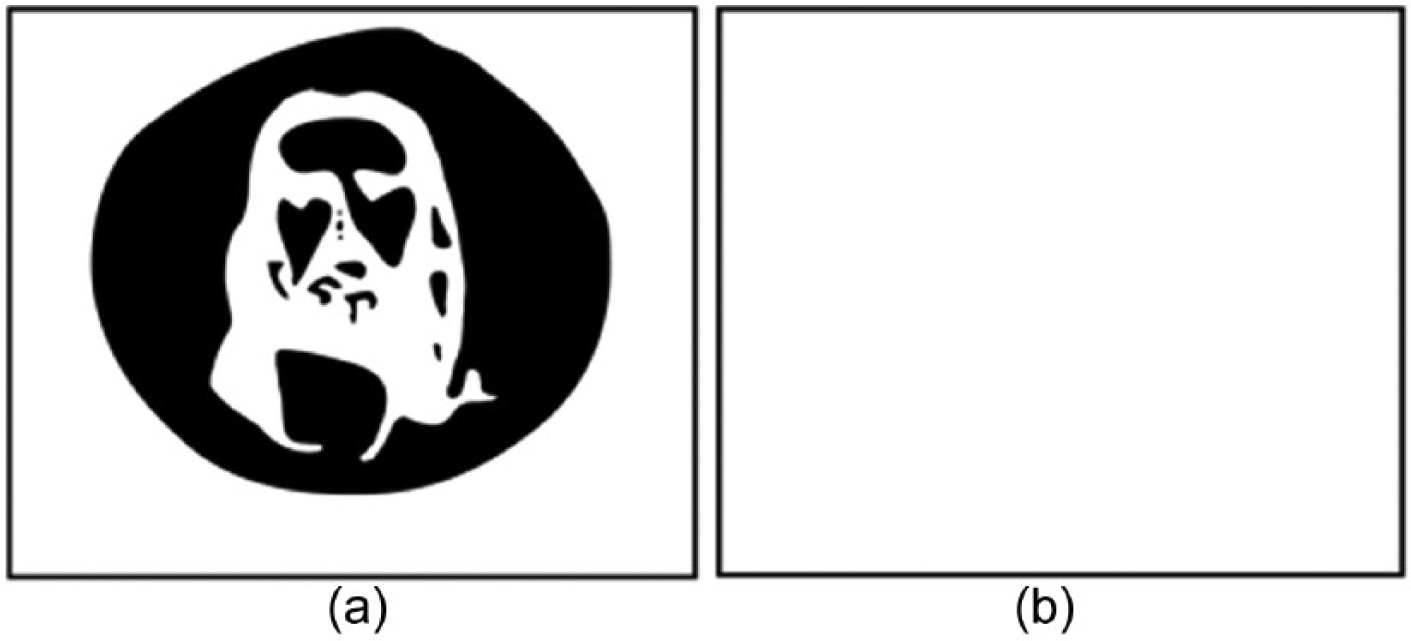
Complementary afterimages do not occur in total absence of light. Traditional negative afterimages (a) require a white background (b).
What if the background is pitch black? If the Jesus silhouette were a mental image concocted by the brain inside the visual system, it might well occur against a pitch black background. But it does not. If the experiment is repeated using a pitch dark background, the outcome was surprising—96% of subjects reported no complementary afterimage (Table 4).
Pitch Black Background.

The suggested explanation is that an afterimage is the carving resulting from subtracting locally selected color components to the external world. If there is no color to be filtered, as is the case with pitch black, nothing can be filtered out. Thus, nothing changes. By means of subtraction, a color that does not exist cannot be obtained.
It is worth noting that total absence of light is necessary for the afterimage failure. If one repeats the above experiment using a laptop, a computer screen, or even a printed black square, one will likely afterimage something. The reason is that, in all such cases, the alleged black is not pitch black. In normal conditions, sheets of paper and dark patches always reflect some residual light. When a computer screen displays a black picture, a faint glow always leaks out, and so forth. Therefore, an easy way to do the test properly is to stare at the stimulus on screen, at night, in a completely dark room, and then switch off the screen. If the room is completely dark, one will not see any complementary afterimage. 7
Method
In all experiments, off-the-shelf commercial LCDs were used at their maximum brightness. Occasionally, the test was performed using a video projector Epson EH-TW5300. Experiments 1 to 3 were performed in dim-lit indoor environments with all artificial lights switched off and the shades closed. Experiment 4 was carried out at night in pitch dark rooms with shutters closed.
Subjects were asked to self-assess their visual conditions. Only subjects that declared to be standard trichromats were included in the sample. A few unaware color-blind subjects might have participated in the experiment.
In all experiments, the RGB space was chosen because it is the most straightforward choice for off-the-shelf LCD screens. Of course, the RGB space approximates the amount of light frequencies trichromatic retinas pick up from the external world through S, M, and L cones (Frey & von Kries, 1881; Stockman & Sharpe, 1998; Stockman, Sharpe, & Fach, 1999; Zaidi et al., 2012). Yet, to a first assessment of the model, the RGB color is close enough to the actual physical quantities stimulating the cone system of the retina.
The experimental setups do not require any sophisticated technology. These tests may be performed easily by anyone with a computer, a dark room (the darker the better), and some spare time. In fact, readers are strongly encouraged to experience firsthand the difference between the prediction of the opponent model and the actual outcome 8 —The most convincing evidence is generated by performing the tests oneself.
All experiments followed standard ethical guidelines. Participants were free voluntary consent adults recruited among the student/teacher population of my institute.
Discussion
Perception Versus Illusion (Experiments 1, 2, 3, and 4)
According to the proposed model, afterimages are filtered perception rather than illusory visual concoctions (Figure 5). In fact, subjects do not report afterimage colors that are not contained inside background colors. Negative images (Experiment 3) and colored backgrounds (Experiment 2) are convincing cases. If afterimages were created inside the visual system, the visual system would be able to create any color, regardless of the background. On the contrary, all findings show that the background constrains what one afterimages (Experiments 1, 2, and 3).

Standard model (a) versus proposed RGB filtered model (b).
The collected data are consistent with the hypothesis that the colors one afterimages exist inside the background. Adaptation tunes the visual system so that it picks up the color components present in the background selectively. In normal circumstances, trichromats cannot see, say, the red inside a gray patch because it is masked by identical amounts of green and blue. However, if subjects were both blue and green blind because of adaptation, they would see the red hue. In fact, gray patches contain red which is neither illusory nor mental; it is as real as any color can be. Afterimages might well be filtered perception, but are perceptions nonetheless.
Background Dependence (Experiment 2)
Traditional afterimage reports employ surreptitiously two perceptual tricks that might have misled both researchers and laypeople (see below). First, experimental setups exploit achromatic backgrounds. Second, subjects’ gazes are kept fixed onto a predesigned region either by frames or by fixation points. Together, these two conditions guarantee that the filtering does not occur on any wrong part of the visual field—Background dependence can thus be neglected. It is no accident that experimenters invite onlookers to experience afterimages only while staring at a white or gray background: “against a neutral surface . . . A black background was used throughout” (Wilson & Brocklebank, 1955, p. 294, emphasis added); “look at a sheet of white paper . . . viewed against a white background . . . shift your eyes to the white rectangle” (Palmer, 1999, p. 106, emphasis added); “look at a white wall” (Jones, 1972, p. 154, emphasis added); “look at a piece of white paper” (Goldstein, 2010, p. 213, emphasis added); “hovering against that gray background” (Churchland, 2005, p. 541, emphasis added); “look at a small, not-too-bright achromatic surface” (Hurvich, 1981, pp. 185-187, emphasis added); “looking at a white wall” (Byrne & Hilbert, 2003, p. 5, emphasis added); “looking at a white wall” (Macpherson, 2013, p. 13, emphasis added); ”look at a blank sheet of white paper. You should see against the colorless background” (Brindley, 1963, p. 85, emphasis added); “stare at the white disc” (Gage, 1999, emphasis added). Asking the subject to afterimage against an achromatic—white or gray—background is a perceptual sleight of hand. By imposing an achromatic and homogeneous background, experimenters discreetly smuggled the complete color palette.
In the past, color models addressed the dependence from the background (Shevell, 1978; Shevell & Humanski, 1988; Shevell & Kingdom, 2008; Walraven, 1976; Werner & Walraven, 1982); a fact that has been noticed since von Helmholtz’s work. Such studies have stressed the influence of the background (and of the context) in terms of a two-stage model of color perception. However, this article focuses on the role of background as regards negative afterimages rather than as a tuning factor in color perception. Moreover, such studies consider the influence of the surrounding background rather than the background that ensues the stimulus perception. The point here is that the perceived afterimage colors are a subset of the background.
No Light, No Afterimage (Experiments 2 and 3)
If complementary afterimages are cases in which one sees existing colors, one will not ever afterimage colors that are not contained inside the background (Experiments 2 and 3). One can only filter off color components; one cannot add any. Suppose one stares at a red stimulus. Due to color adaptation, one becomes red blind. If one then stares at a white background, one will see the remaining hues, which are blue and green. Blue and green together make cyan. Thus, one will see cyan. However, if one stares at a cyan background (green or blue), no red will be available to be filtered off. Then, as the proposed model predicts, no afterimage will ensue. Cyan minus red is still cyan.
Shortcomings of the Notion of Complementary Color (Experiments 1, 2, and 3)
As regards afterimages, no a priori color space (Hering’s, Maxwell’s) can predict the right color one will afterimage following a given stimulus, because what one afterimages depends both on the stimulus and on the background. The traditional notion that “the hue of an after-image is determined solely by the hue of the stimulus color” (Wilson & Brocklebank, 1955, p. 299) as it has been already observed by many, not last by von Helmholtz himself and others (Kuehni, 2001; von Helmholtz, 1924) is ill-formulated. 9 Thus, the standard claim that one sees the complementary color of the stimulus is conceptually insufficient because it assumes that the afterimage color is a function of the stimulus color only. As is shown by data (see Figure 2, and Tables 1 and 3), given a stimulus, many possible afterimage colors can follow depending on the background color. As the color one afterimages depend on both the stimulus and the background, given a hue, there is no unique complementary color.
Conclusion
The entry way of the article has been a ubiquitous mistake in afterimage reports—that is, the belief that a red stimulus results in a green afterimage. On an achromatic surface, a red stimulus yields a cyan afterimage, and a green stimulus yields a magenta afterimage. The red–green mistake is impressive in that it has been made not only by laypeople but by color scientists and perception philosophers as well (Byrne & Hilbert, 2003; Churchland, 2005; Lycan, 2002). It is a remarkable error, because it has biased the way in which stimuli have been devised and outcomes have been interpreted without anyone noticing the discrepancy. Generations of college students have been trained to believe into a wrong notion. To demonstrate just how pervasive and deeply entrenched the red–green confusion has become in both scientific and philosophical accounts, a brief survey of the available literature regarding afterimages has been gathered (Table 5)—All reported statements are empirically wrong. The mistake is so pervasive that afterimage stimuli have been systematically drawn with the wrong colors even in the most popular cases (Figure 6a and 6b). A green/yellow American flag does not produce a red/blue flag, but a magenta/blue one. Excellent textbooks are not immune.
The Ubiquitous Confusion in Red/Green Afterimage Reports.

Flag-shaped stimuli: (a) Goldstein (Goldstein, 2010), (b) Palmer (Palmer, 1999), and (c) a cyan flag that produces a red afterimage.
In sum, the standard afterimage model survived unchallenged because reports have been biased both by the notion of “mental” colors and by the widespread use of Hering’s opponent color system. However, complementary afterimages are neither hallucinations, nor mental images, nor mental colors—They are not additions to the world one sees. Afterimages are a case of perception in which one perceives a subset of the colors available in the external world in a stimulus-shaped local area. Complementary afterimages are not illusory opponent hues but localized RGB filtered perception.
Footnotes
Declaration of Conflicting Interests
The author(s) declared no potential conflicts of interest with respect to the research, authorship, and/or publication of this article.
Funding
The author(s) received no financial support for the research and/or authorship of this article.