




Abstract
This article explores the possibility of incorporating traditional water management experiences into modern water management. After the literature review, two case studies are presented from Borana and Konso communities in southern Ethiopia. The study was conducted through interviews, discussions, and observations. The two cases were selected due to their long existence. Both communities have their own water source types, depending on local hydrogeological conditions. Borana is known for the so-called Ella (wells) and Konso for Harta (ponds), which have been managed for more than five centuries. All government and development partners strive to achieve sustainable services in water supply and sanitation. Therefore, they design various management packages to engage the communities and keep the systems sustainable. However, the management components are often designed with little attention to local customs and traditions. The cases in the two communities show that traditional knowledge is largely ignored when replaced by modern one. However, the concepts of cost recovery, ownership experience, equity, enforcement, integrity, and unity, which are highly pronounced in modern systems, can also be found in the traditional water managements of Borana and Konso. Naturally, one shoe never fits all. Borana and Konso experiences are working for their own community. This research implies that when we plan a project or a program for a particular community, the starting point should be the indigenous practices and thoughts on life.
Keywords
Introduction
Water has a strong tie to the physical and spiritual well-being of humankind. Regardless of the differences in religion, culture, and social norms, every person depends on water. Paganism, Christianism, Buddhism, Islam, and many other religions, all have strong connections with water as a spiritual component or a means of cleanliness before their Gods (Abrams, 2000; De Chatel, 2009; Chuvieco, 2012; Groenfedt, 2006; Schelwald-van der Kley, 2009). Teachings of religions and traditional institutions have a direct or indirect influence on ways of water management. Most religions have been exercising the concept of the dominion of man over natural resources. Even though religious or social institutions are all for protecting natural resources and sharing them reasonably, the efforts have not been fruitful in that resources are overexploited and polluted, and the future generations thus left without much consideration (Chuvieco, 2012; Schelwald-van der Kley, 2009).
These traditional and religious institutions have the potential to shape the ways of achieving sustainable environment through their informal rules and constraints. The informal constraints can often govern the success of formal constraints which are established by scientific merit (North, 1990). Informal constraints are the day-to-day activities of the societies, whereas governments or external agents introduce formal rules. Therefore, the end users in the case of development might think differently about the practices that they are familiar with and an introduced one. Thus, it is challenging to alter the societal thinking to a new paradigm overnight only by advocating new practices (Cleaver, 2012). No matter how useful they are, new ideologies usually face resistance as indigenous peoples are loyal to their traditional way of life. Therefore, for successful development and systems management, a gradual change and systematic approaches are required for balancing the loyalty to traditional customs.
The management approaches used by the national governments and partner organizations are considered in this article as modern or imported management (Schelwald-van der Kley, 2009). These modern systems are deemed to replace the traditional ones in search of sustainable services. In fact, the dynamism of management—which is influenced by various factors, including technology, climate change, population growth, and education level of the people in charge—requires flexible systems that are adaptable to different situations. However, striving to achieve sustainability by introducing new technologies and ignoring the existing local knowledge is of no use to the people who dominantly depend on traditional practices.
The communities which have long-served traditional management systems are not easily willing to work with the imported (modern) techniques if they have not been involved in the development of those systems, or if their social components are interpreted wrongly or even ignored. In such cases, traditional people prefer to remain observers rather than become involved as real participators. In consequence, modern water systems are used while the services are operational, but the communities return to unimproved sources after the services break down.
Development of advanced technologies and new approaches to sustain systems is worthwhile to accept, yet blending them with traditional knowledge that exists in target areas can make them more attractive and valuable for the intended purpose. Thus, successful management practices of societies should be investigated before introducing new technologies and management styles, because endeavors that ignore the local conditions are unlikely to succeed. The International Council for Science (ICSU) has enforced this idea, describing traditional knowledge as follows:
Traditional knowledge is a cumulative body of knowledge, know-how, practices and representations maintained and developed by peoples with extended histories of interaction with the natural environment. These sophisticated sets of understandings, interpretations and meanings are part and parcel of a cultural complex that encompasses language, naming and classification systems, resource use practices, spirituality and world-view. (ICSU, 2002)
The focus in the sector of water supply and sanitation is to improve development in a sustainable manner. Since the 1980s, the sustainability of water supply and sanitation has become a special concern of the developing countries and international donors. Since the decade of International Drinking Water and Sanitation (1981-1990), several approaches have been used in the sector to bring in sustainable services. Shifting from top-down to a bottom-up approach, the introduction of participatory approaches, vowing to community participation, provoking community management, and advertising community financing are ways to increase the sustainability of the systems. Yet the problems of water and sanitation still persist due to the complexity of the structure of communities and variation of traditional practices from place to place.
According to Arsano (2007), customary laws that have been practiced in isolated communities have proved to maintain equitable use of water and long-lasting services. Arsano has pointed out that the customary law of Borana’s deep wells has unique features of ownership, custodianship, user access, and management. Moreover, Konso is well known for its soil and water conservation practices, and recently became one of the communities recorded as a United Nations Educational, Scientific and Cultural Organization (UNESCO) Heritage Site for their landscape management (UNESCO, 2010). The Konso people are well known for their traditional engineering and collective actions. They work together to build attractive terracing landscapes and complex village compounds in addition to construction and protection of water systems. To strengthen their togetherness, they frequently use the proverb “Living together means sharing resources” (Garra, 2006). This social cohesion is the basic underlying factor in achieving sustainability even in modern management (Harvey & Reed, 2007).
The fundamental issues that motivate this study are (a) the need for service sustainability of water supply and sanitation, (b) lack of integration of modern management approaches with the local situation, and (c) the disparity of sustainability of the modern and the traditional systems. The case study deals with the traditional water management of Borana and Konso, Ethiopia. They have well-structured traditional institutions that have enabled their water systems to be sustained for centuries (Arsano, 2007; Coppock, 1994; UNESCO, 2010), and the introduced technologies fail to operate for long (B. Bulee, personal interview, April 10, 2014; K. Garra, personal interview, April 12, 2014).
Various reasons can be mentioned for the failure of modern schemes in the study areas, including financial, environmental, technical, and social aspects. However, the social aspects (norms, cultures, religions, and traditional administrations) make a significant contribution for Borana and Konso water system management (B. Bulee, personal interview, April 10, 2014; K. Garra, personal interview, April 12, 2014; A. Yoyo, personal interview, April 02, 2014). Therefore, this study focuses on the traditional water system management to take lessons for the modern implementation approaches from financing, user participation, and managing aspects of domestic water supply and irrigation systems. Thus, this article is to investigate the binding force of the communities for their solidarity in resources management and seek lessons for more sustainable practices.
Objective and Method
The research is based on case study. Even though, in comparison with other research approaches, a case study is assumed to be weak by many researchers, there are areas where it is crucial (Flyvbjerg, 2006; Gable, 1994). According to Gable, a case study has a high rate of discoverability. Moreover, a case study is an emerging approach to building theories (Eisenhardt, 2007). All research approaches, such as the survey, case study, and experiment, have their merits and demerits (Gable, 1994). The extent of research generalizability, replicability, and representability of a study depends on the approach used. However, it does not mean that the approaches with low replicability or generalizability, such as a case study, are useless in research (Flyvbjerg, 2006); they are vital for social work and community planning (Yin, 2003).
The objective of this article is to explore the good lessons of traditional water management in the two communities. Therefore, utilizing case study is indispensable to investigate the experiences and challenges of the targeted management practices. Borana and Konso were selected as case areas due to their long history of water system management practices and disparity in sustainability in the modern and traditional water supply systems. Moreover, this research is conducted to supplement the study conducted on Community Managed Project approach in Ethiopia to see possible lessons to share.
The materials for this case study were collected from April 2 to 18, 2014. The methods used were interviews, discussions, and observations. In both areas, community elders (n = 8) were interviewed on the historical background of their water systems; their water system administration rules; informal constraints; resources contribution for the initial investment, operation, and maintenance; and on their views toward modern development of water systems. The interviews were made at the water source—at wells and ponds of Borana and Konso, respectively.
Elders selected for the interview are well-known history tellers in their community (B. Bule, 2014; K. Garra, personal interview, April 12, 2014; R. Suyo, personal interview, April 04, 2014; A. Yoyo, personal interview, April 02, 2014). Moreover, the traditional custom of knowledge transfer in both communities is tale oriented. Families transfer wisdom to their children through language. Therefore, it was an opportunity for the study to find uniform information in a wide area related to the historical and contemporary nature of the traditional water systems development and management.
Traditional Water Management
Different traditional water technologies and management practices have been used in various parts of the world since time immemorial. The practices are actually dependant on the local situations. Some are linked with surface water and others with groundwater extraction and management. A typical example, which has been used for long and widely, is called Qanat. It is a traditional water extracting and transporting technique that is commonly used in Morocco, Spain, Syria, Iran, and Central and Eastern Asia. Qanat has different names in different countries: Khettara in Morocco, Qanat or Kārīz (Kāhrez) in Central and Eastern Asia including China, and galerias in Spain (Canavas, 2014; Mohsen, 2013). This system has been operating for centuries to extend the life of deserts (Canavas, 2014; Hartl, Beaumont, Bonine, & McLachlan, 1989).
The primary driver of traditional water management is water shortage and need for survival. Arid regions where rainfall is low have adopted Qanat as an only means of acquiring water for domestic and irrigation use (Mohsen, 2013) whereas dry-wet and semi-arid regions, which have average rainfall in erratic pattern, are stuck to rainwater-harvesting practices, either by constructing ponds, allowing the runoff percolate to sand reservoirs, or other techniques as mentioned by Ferrand and Cecunjanin (2014). These communities have been practiced such techniques for centuries to secure their well-being.
In the countries where Qanat has been practiced, the temperature is extremely high, thus making surface water to evaporate, and the groundwater table is deep up to 300 m (Canavas, 2014). Qanat is a technique of developing an underground network and has been developed for the transportation of water from hillside deep mother-wells to plain areas for domestic and irrigation purposes. The underground network can substantially reduce evaporation. To engineer the natural resources exploitation, one should either learn in a formal school or from life experiences. Both ways have their own merits, but the latter holds a strong link with societal customs and traditions. The theory of institutional change elaborates how informal rules are governing in changing the performance of formal rules (North, 1990). Striving to improve the existing systems is acceptable; however, meeting the goal of addressing the target community and getting their acceptance is a bottleneck. The level of acceptance is determined by the extent the process accommodates experiences and values of the indigenous communities. Otherwise, a stable institution to operate and manage systems cannot be achieved.
The traditional water systems are related to water sources which are accessible easily, including springs, rainwater, shallow wells, and exceptionally deep wells in Borana and Qanat systems. These sources of water supply exist in developing countries with often insignificant improvement, whereas developed countries are served by sophisticated modern water supply systems, making the traditional water systems history (Knutsson, 2014).
Many countries, including Finland and Sweden, had traditional beliefs related to water (Katko, 1997; Knutsson, 2014). Before the modern water supply in such countries, the sources of water were public wells and natural springs, and the management was also motivated by the local customs. However, through time it evolved into the modern management of today. Moreover, in the emerging economies, such as India and China, water-harvesting technologies have been used for 4,000 years to satisfy their water demand (Oweis, Hachum, & Bruggeman, 2004). Nevertheless, developing economies, particularly in sub-Saharan Africa, have not been able to either secure improved water supply to all population or utilize successfully traditional practices to boost efforts.
Background of the Study Area
The study was conducted in the case areas of Borana and Konso. As indicated in Figure 1, the study areas are located on the southern of Ethiopia, bordered by Kenya. The two communities have a close relation from their historical background in addition to being neighbors. Their traditional administration and line of development include similarities in their language (their languages are related to one another), and they share many attributes. The characteristic that makes them special for this study is the solidarity of the communities to respect their traditional law and practices to maintain their communal systems with traditional management practices for an extremely, long period. Moreover, the two communities are still practicing their traditional administration systems which they believe to be effective to maintain a level of communal resources.
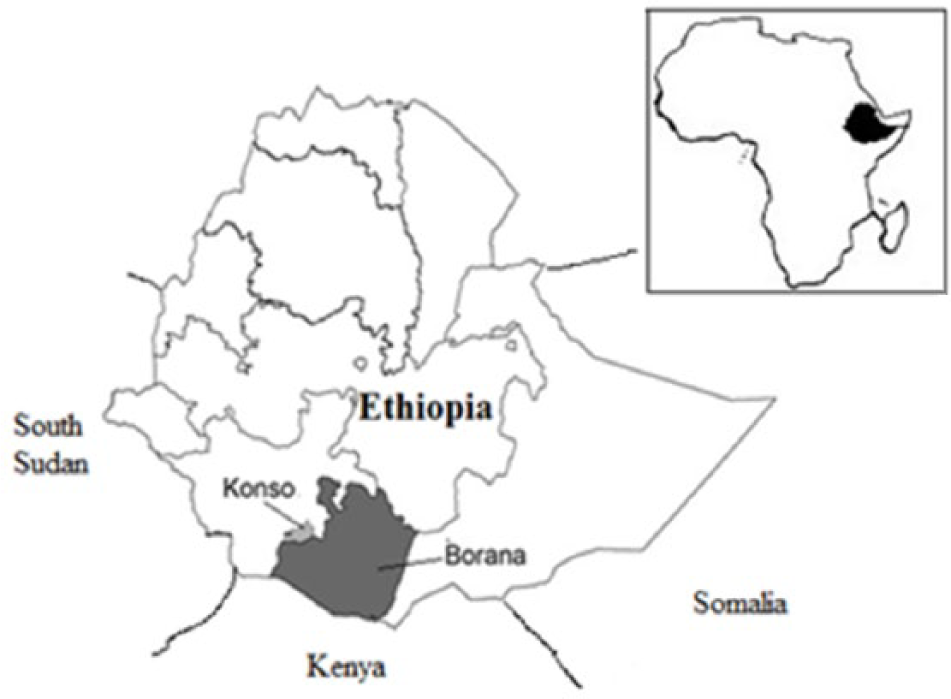
Map of the study areas.
Water Management Practices in Borana
The traditional administration system in Borana is known as Gedaa. It has also contributed to the water system management in Borana. The Gedaa system has a general assembly that meets every 8 years. In the assembly, every rule that was enacted in the previous years is evaluated from the angle of its challenges on the Borana community, and if there are weak features, modifications are made. Water has an important place on the agenda. Water management is considered in the assembly to evaluate the enactment of rules on water management in the community in general and the integration of wells management in particular. Abba Gedaa (the manager in chief of the Gedaa system) is responsible for the well-being of the Borana community, although water sources might belong to different communities.
In Borana, a well is owned by a distinct clan (tribe) and managed by the father of the water (Konfi). However, this does not mean that other clan is excluded from a particular water source (Helland, 1980). Any household or clan in Borana has a right to get water from the nearest source after making a formal request to the father of the water beforehand; as people move from place to place in search of grazing land, they should inform the receiving well council in advance to make proper arrangements. This process is a formality, as requests are not rejected unless someone has a problem with the rules of his original well (Helland, 1980). Participating in the operation and maintenance of the water systems is the responsibility of all users. There are three categories of well maintenance: (a) daily maintenance of removing dung, (b) seasonal maintenance to clean a sediment deposit after flood season, and (c) major well rehabilitation—extension of the depth of well following the depletion of a groundwater table (Coppock, 1994).
All members of Borana are loyal to the customary laws that are administered by the Gedaa system. The customary laws are participatory and impose responsibility based on individual’s capacity. In terms of well excavation and maintenance, all capable members of the community have a responsibility to contribute labor and cattle for festive (Legesse, 1973). In case one refuses to participate, he will get a strong warning from the well council (an assembly of the water users). If the deeds of disobedience persist, he will be totally banned from using wells and other communal water sources in Borana. As the administration of different wells is interconnected as shown in Figure 2, they have a fast information sharing mechanism. Thus, during migration, only those who obey the rules of their own system have a right to request services from other sources for any reason. The rules are strict, and the Borana people are very loyal and do not break them.

Water administration structure of Borana.
In Borana, the management of water system is organized into a group of five (Pälsson, 1990; A. Yoyo, personal interview, April 2, 2014). Every five neighboring wells are organized together to carry out well maintenance that is beyond the capacity of the owner communities. If the problems are still difficult, they will go to the central Geda level for a solution to be found.
The deep wells (Tula) in Borana are found in nine well fields—containing a number of wells in the same location. A clan representative or a person who leads the excavation of a well at the beginning owns the leadership of a well—The excavation is started with a blessing and slaughtering oxen to feed the workmanship in the course of well-digging. This head of the clan is called Father of the Water (Konfi). This power is inherited to children, grandchildren, and so on. The body that manages the system is organized by elders of the clans with the lead of the Konfi to form a well council (Chora ella) (Coppock, 1994; Helland, 1980). According to Helland, the well council is responsible for making an arrangement of the daily watering order and nomination of the Abba Herega. He is an officer who follows up on the daily watering order and maintenance. He is elected on the merit of managing capacity, respectfulness, and honesty. As shown in the Figure 2, Abba Guyaa and Gogessa are also part of the cascade of the management structure. In Borana, nobody is excluded from using water.
The management practice of Borana water wells has no formal committee that constitutes a chairperson, treasurer, and so on, which are commonly known in Water Supply, Sanitation and Hygiene (WASH) and water users associations in irrigation systems. The management in Borana is unique in its nature. The governing rule is the Gedaa system (Gedaa Institutional Arrangement). The management of the wells is male-dominant—Women are involved only in lifting water, but the arrangement in the chain is that they are placed at the bottom, just to manage the process in their own capacity. Konfi, Abba Herega, Abba Guyyaa, and Gogessa are responsible for managing the well of their own jurisdiction, so to speak.
Konfi
Konfi is the father of a water source. He is the guardian of the water and the power is inherited in the family. According to the interviewees (B. Bulee, personal interview, April 10, 2014; R. Suyo, personal interview, April 04, 2014; A. Yoyo, personal interview, April 02, 2014), a Konfi does not need to be physically capable or influential in the society; he simply had possessed power at the time of well construction as a leader of the group of construction and this authority remains with him and is passed to his elder son and grandson sequentially. Generally, his responsibility is to nominate Abba Herega and to give permission for water for guests and passers-by (Figure 2).
Well Council
This is an assembly of the water users that is led by the Konfi. Its role in the management is arbitration, mediation, enforcement, and water allocation (Helland, 1980; Homann, 2005). The well council has six to seven members (elders) as shown in Figure 2.
Abba Herega
Abba Herega is an officer of the management of the system, and he is responsible for arranging and following up the day-to-day activities of a water source. The well council assigns Abba Herega either from the members of the same clan or from other users. Unlike Konfi, his nomination is based on the ability to perform the duty, honesty, and impartiality in providing services. Moreover, Abba Herega is subjected to replacement when he fails to manage efficiently or shows partiality among the communities.
Abba Guyyaas are members of the community who are assigned to water the cattle on a specific day. In Borana, members have access to water in 3-day cycles. This means that each day is assigned to a different group of households, based on their contribution to the operation and maintenance activities. For instance, the Konfi waters his cattle on the first day, and the rest of the days are arranged based on their favors to the water system protection. The number of Abba Guyyaas depends on the size of the cattle and the amount of water in the well. They are assisted by Gogessa, men who line up to lift water from the well to a cattle trough. The number of the Gogessa depends on the depth of the water in the well. During the dry season when the water level is lower, more men or women are required in the chain to lift water.
Tariff and Contribution
In Borana, there is no direct cash contribution for the construction, maintenance, and operation of the water wells. The contribution is in providing labor and cattle. During the excavation of new wells or maintenance of existing systems, they usually contribute cattle. Well council estimates the requirement of labor and resources for the activity, and relative allocation is made for members based on their capacity and cattle owned, and supervised by Abba Herega. Likewise, the members of the well users act accordingly. People in Borana have never hesitated to discharge the responsibility that they are supposed to do. If a household were to refuse to take part in the maintenance or to slaughter the requested number of cattle, thus breaking the rule, they would be cast out of the community and never get water from other wells; just water from a river.
User involvement through contribution and participation during the implementation and management of water systems is key to attain sustainable services. Operation and maintenance of systems are also identified as a factor of keeping systems functional. However, recently developed systems failed to achieve functionality in the case areas. In Borana community, genuine involvement and true ownership have in fact been practiced already for 71 Gedaa of 8-year span each, which is approximately 5 centuries (Arsano, 2007; Coppock, 1994; B. Bulee, personal interview, April 10, 2014; A. Yoyo, personal interview, April 02, 2014).
The systems are maintained in three important occasions based on Coppock (1994) and the informants. First, the water sources are cleaned daily after collecting water and giving it to animals. Second, after each flooding season sediments deposited in the water sources are removed. Third, maintenance is practiced when needed, depending on the groundwater table and its level drawdown. This activity is performed typically once in a decade and sometimes more often depending on the groundwater table.
According to Homann (2005), the traditional administration has been interfered with by the modern governmental administration, and its management is deteriorating without significant attitude changes toward the modern management. B. Bule, one of the interviewees wished for the modern governmental administration let them room to employ the traditional management for sustainability of services in various aspects, including water management and conflict resolution.
On the whole, in Borana water management, the three major features can be identified as follows:
Some literature says the sources of solidarity in Borana are originated from water. Borana society itself believes that they are.
The problem of water in the area is chronic and thus not to abide by the common rule is not an option.
Customary rules (Addaa) and Borana’s traditional law are well distinguished in Borana and the system of Gedaa enables them to maintain common interests.
Water Sources Management in Konso
Konso, like Borana, has a traditional administration system that is governed by a generation. According to Konso’s community, one generation is 18 years (K. Garra, personal interview, April 12, 2014). The term of traditional administration is 9 years and a generation is allowed to govern two terms. This administration system is called Abba Dibe—Abba means father and Dibe mean drum. A dibe (drum) is kept with a person assigned to be the leader of the generation and the active generation will be responsible for maintaining the resources and security of the community. Accordingly, they work hard to manage their water systems, as it is scarce in the area.
Water sources in Konso are not uniformly distributed. To make the matter worse, they are gradually depleting, and some of them had to be abandoned. However, their settlement structure is depending on the availability of water sources and farming land. Where there is no natural spring, traditional ponds are provided to collect floodwater to secure water need in the dry season. Therefore, the people of Konso have adapted to deal with environmental changes.
In the settlement of villages, all households do not have equal access (in terms of distance) to the water sources. Some of them are living close to the water sources, while others travel from great distances. Users who live nearest to a water source are able to monitor what is happening with it. The Konso people take this into account and vest the ownership to the households who are closest to the water sources. The ownership in the Konso context means a responsibility to safeguard the water source from abuse. Moreover, they have a belief that each water source has a spirit, which usually communicates with the landowner while he is asleep (Garra, 2006). According to the interview with K. Garra (personal interview, April 12, 2014), the author of a book called Konso Water and Gods, the water spirits have likes and dislikes, and they talk to custodians of the water sources. In turn, the custodians report to the elders and the community what they heard from the spirits. In this regard, they immediately solve the water usage problem. Of course, the dislikes of the water spirits are related to sanitation.
Water spirits are the hidden forces that secure the water sources from misuse and pollution. In Konso, rules are very simple and respected by every member of the community as they are related to water spirits. For example, swimming in ponds is allowed only when there is plenty of water. In the dry season, a notice will be displayed to restrict swimming. Yet nobody is assigned for control at water sources, and rules are respected in Konso even in the absence of caretakers. Even a single kid cannot swim in a pond when it is against the rule of the land. Therefore, this exercise is something we can deal with to promote modern management rules through the elders of the community.
What if people fail to be governed by the rule of the land? Unlike Borana, in Konso such people are not restricted from using water, although they might not abide by the rule of the land. Rather, they are excluded from the social involvement. They will not able to buy Cheka (local beer); if someone from the family is sick, nobody helps to carry him or her to a clinic; other social sanctions will also be imposed. Practically, they say “water is God’s gift, so we cannot prevent others, even hyena, from drinking.”
Spirit of Water: The Hidden Power in Konso Water Management
As mentioned above, water spirit is the means to protect water sources from contamination and abuse. Moreover, they usually install a stick as a symbol of generation, known as Olahita. As shown in Figure 3, Olahita is a stick erected in the middle of the pond. It is believed to be a taboo to take any piece of the stick and an embarrassment for the generation to see the stick taken off. The local people could not tell everything openly concerning the real meaning of Olahita, but my informant told me that besides the stick having a spiritual meaning it is believed to protect the pond from evil.

“Olahita,” the symbol of a generation, spirit of water, and benchmark of maintenance.
The other, technical reason why they erect the stick in the middle of the pond is that the stick is placed at the bottom of the pond. In the next maintenance of the pond, the people need to reach the bottom of the stick to indicate the deepest point of the pond.
Management of water sources in Konso is very easy if it is related with water spirits. Almost all springs have their own spirits with certain kinds of likes and dislikes (K. Garra, personal interview, April 12, 2014). Most dislikes are related to sanitary aspects. According to Garra (2006; K. Garra, personal interview, April 12, 2014), menstruation and newly delivered women, plastic materials, and individuals who had sex a night before are some of the dislikes of the water spirits.
Natural Engineering Skill of Konso
The people of Konso are experts in activities that are related to resources conservation. Their landscape and forests are under their own control. They built kilometers of terracing to preserve soil and planted drought-resistant, multi-function trees. A drop of water that falls in Konso belongs to Konso, because they conserve it. They never allow runoff to flow out of their catchments. Their bench terraces, in the steep slope terrain of Konso, have been designed to infiltrate water. Moreover, the excess flood can be collected into ponds that have been constructed in appropriate locations for maximum harvest.
Selecting a site according to soil property and its potential to collect water is an expertise of the Konso people. Moreover, the engineering they practice to trap debris is amazing. Silt trap structuring in modern engineering could learn from Konso, and how to make such structuring from local materials. Through practice, they recognized that high velocity of water brings silt that could potentially threaten the life of ponds, and accordingly they provided structures to slow down the speed of the water well in advance before reaching ponds. Figure 4 shows how they protect their water system from human and animal interaction, and from silt.

(A) Wooden mesh to filter debris coming to the pond, (B) fenced pond, (C) outside terracing to protect silt from side of the pond, and (D) stilling basin that settles silt coming in with flood before entering the pond.
Water Harvesting in Ethiopia
From 2003 to 2005, the Ethiopian government had a water-harvesting campaign. That was to improve the agricultural productivity that was affected by erratic rainfall distribution. The technology used was household ponds to harvest water during the rainy season and to provide supplementary irrigation. The mass mobilization aimed at having the systems to every household over a period of a couple of years. Yet the approach used was not convincing to bring sustainable services. The government was mainly targeting on the achievement of figures—the number of ponds constructed. The first year of the program was not completely successful because the majority of the ponds were not holding water after the main rainy season due to excessive seepage and limited watersheds to collect water adequately.
In combating this problem, during the second year of the program a new technique was introduced to protect seepage by providing polyethylene sheet as shown in Figure 5. However, this option also failed to retain water in the pond due to rodents and imperfection of installation of the plastic in the ponds. Although the same strategy was used in the following year, the user-community refused to accept it and the program was finally halted. Moreover, the rural people used the plastic for other purposes, such as roof covering, floor sheet, and hive cover. Thus, the goal of water-harvesting strategy collapsed and the government stopped working on that after the period of years 2003 to 2005.
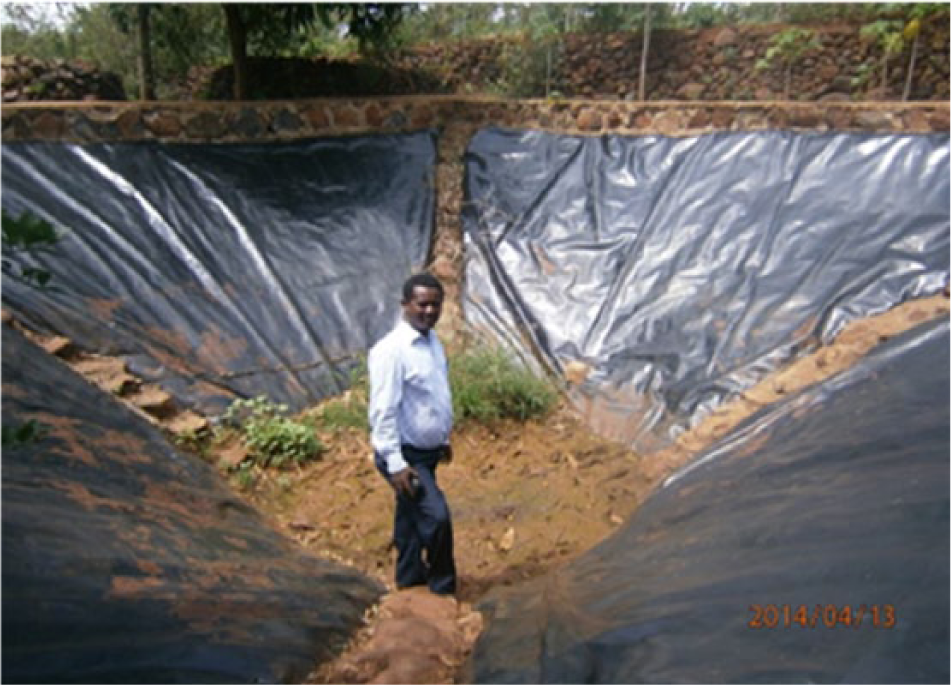
Non-productive water-harvesting pond and its plastic cover in Konso.
Despite the traditional knowledge of the Konso people in site selection and maintenance of ponds, the water-harvesting campaign failed. According to the agricultural office report, one third of the household ponds were functional at the time of the fieldwork in the Konso district. K. Garra (personal interview, April 12, 2014), the then head of Agricultural and Rural Development Office in the district and an informant of this study, explained that the campaign was not user-inclusive. The community was not given a chance to express their objections and recommendations on how to implement the technologies.
On the whole, in Konso water management, the major features can be identified as follows:
The traditional administration of Konso, already dominated by the governmental administration culture, has almost vanished.
Water spirits are a means to scare people to obey the rules.
Responsibility and high responsibility imposed onto a generation is a means to keep competent working force to safeguard the well-being of Konso.
The geographic and climatic situations of the area make the people work hard to adapt to environmental changes.
Introduced technologies were not user-inclusive.
Discussion
Developing countries such as Ethiopia are extremely heterogeneous in terms of their culture, religion, and educational level. These countries are the unserved parts of the world in terms of water supply and sanitation. Despite their heterogeneity and high population, external agents that assist in development are few compared with the number of service seekers. Moreover, the national governments, in the sub-Saharan Africa, are in shortage of funds to address water and sanitation issue and put suitable institutions in place to manage the implemented systems; the reason is due to the low and uncollectable tariff of such services (Foster & Briceño-Garmendia, 2010, cited by Hukka & Katko, 2015).
However, communities have their own traditional administration where members respect and protect their communal resources. Typically, people are patriotic when it comes to their own customary laws, and therefore, they hardly have any trust on introduced systems. Due to this fact, bringing a community from their traditional way of thinking is costly and difficult (Cleaver, 2012), as it takes finance and time to educate and upgrade the consciousness of the beneficiaries. This cannot be a solution for the chronic water supply problems that need urgent action. Therefore, utilizing local practices and traditional management systems will boost the coverage of services in the rural areas of the developing countries.
Resources management both in Borana and Konso are dominantly governed by the traditional administrations that they have lived with for centuries. These people have to sustain their resources for long periods, although there are certain problems that the communities have not realized, such as deteriorated water quality and resources optimization problems. Their traditional administrations that are concerned with the well-being of the entire people have a quality that retains their rules as respected across their territories. However, the modern management that differs from the traditional water management style reaped low respect in the areas. This is due to lack of contextualization of the imported managements with the local situation, as well as to poor consultation of the users. In Konso, 67% of the household ponds, constructed by the Ethiopian government in 2003-2004, have failed to serve for a decade, whereas the traditional water sources are giving service. Moreover, modern water schemes are not operated and maintained timely as has been done for the traditional water wells in Borana. Based on the interviewees, the failure and success of schemes can be pinned on the issue of ownership.
The sustainability of the traditional water management has been achieved in Borana and Konso due to the traditional administrations called Abba Gedaa and Tibe, respectively. On the whole, institutions are vital for long-lasting services. Similarly, both Borana and Konso have traditional institutions in which every member of the communities trusts and abides by. The astonishing dimension of the traditional institution, especially in Borana, is that the components of the institution are usually subject to modification every 8 years. Moreover, the base of the amendments of rules is the evaluation of the performance of the institution during the previous 8 years (Gedaa). In the general Assembly of Borana’s Gedaa, the performances of the past 8 years of enactments are passed from different sectors presented. They have “elites” with the position of ministerial equivalent who are responsible for different sectors and present to the general assembly every 8 years.
This article highly recommends those policy makers and actors in the sector who desire to put workable management directions and practices into place to understand the existing practices before imposing a modern one. This is true both in the global and local context. For example, Ethiopia has approximately 80 ethnic groups, which have different social values, norms, religion, and culture. Moreover, they have their ways of managing resources as described by Chuvieco (2012). These experiences can be an asset for the external agents, although the practice of exploiting the existing knowledge is weak in many cases, as can also be seen in the case of Borana and Konso.
Sense of ownership feeling and selecting proper systems are challenges of water services management. Often the users are not integrated to protect and run their own water supply system. Cost recovery (contribution to operation and maintenance) is not satisfactory; community representatives are usually not uniformly motivated to their work, and user communities feel that water services production and maintenance, including spare-parts supplies, bear on external agents. Therefore, the non-functionality and further abandoning of water supply systems before their service period is common in the rural areas of the developing countries. However, the key elements to sustain systems were observed to be practiced in different ways in the communities. Nevertheless, when it comes to the modern management, it can become incompatible with the local situation, and the communities remain observers, not actors in the system development and management.
Traditional water resources management has the capacity to create an astonishing feeling of ownership, equitable distribution, solid management practices, and consistent operation and maintenance. From the point of view of cost recovery, it is quite agreeable with the scientific demand. The communities are already involved in the implementation and maintenance of their systems by contributing labor, providing cattle, and other possible options in the area. Therefore, all users feel responsible based on their proportion of water consumption.
Conclusion
Every community has its own identity, lifestyle, and customs to value. These elements could be helpful as well as distractive. Whichever, we need to be careful in exploiting them. The harmful traditions that impose on some part of the community for the sake of the advantageous group require systematic approaches to educate and eradicate. However, a value that is respected by the community and has less likely any negative impacts should be up scaled and incorporated in the introduced project managements so as to catch the attention of the users.
The cases in Borana and Konso show that the traditional knowledge is largely ignored by the modern approaches. Here, we are not arguing that traditions should prevail, but we are saying that scientific knowledge should emanate from the local experience, especially in terms of resources management. The modern thinking should be wise enough to be accepted by the community for which it is designed. In addition, it would be beneficial to take into account the success stories of the old systems because they have sustained over time. Evidence shows that Borana and Konso have managed their water sources for more than five centuries. Besides, the two communities are very keen on operation and maintenance. Their traditional systems render ownership to all users. They contribute to operation and maintenance reasonably and have enforcement actions for members who refuse responsibilities.
The Borana and Konso communities are very talented in exploiting their resources and able to identify suitable well and pond sites. Besides, they have their own management structure within a system and across the systems. Although they are not meeting their water supply needs because of various factors (water quality, water scarcity, knowledge gaps, etc.), their management systems have characteristics others may learn from. Indeed, the concepts of cost recovery, ownership experience, equity, enforcement, integrity, and unity, which are highly pronounced in modern systems, can be found in the traditional water managements of Borana and Konso.
Naturally, one shoe never fits all. Experiences of Borana and Konso are working for their own communities. However, what we can learn from this research is that when we plan a project or a program for a particular community, the starting point should be their own experience and thoughts on life. That way, we can easily reach acceptance of the community and create a feeling of ownership to generate responsibility and successful management of systems during and after the project implementation.
Footnotes
Declaration of Conflicting Interests
The author(s) declared no potential conflicts of interest with respect to the research, authorship, and/or publication of this article.
Funding
The author(s) disclosed receipt of the following financial support for the research and/or authorship of this article: Scholarships from Maa- ja vesitekniikan tuki ry and Centre for International Mobility (CIMO) in Finland, logistical support from the Community-Led Accelerated WASH (COWASH) project in Ethiopia for fieldwork, and the support from the Academy of Finland (no. 288153) are gratefully acknowledged.
Author Biographies
 ).
).