




Abstract
The main objective of this study was to examine the integration of indigenous knowledge (IK) into the rapidly developing field of rural social work in China. The study demonstrated the incorporation of indigenous elements such as folkways, power structures, values, norms, traditions, and crafts into the practice through collaboration with the local community. The research employed purposive sampling, which included 4 agency directors, 1 head of a social work organization, 6 social workers, 21 social work students, 16 children and teenagers, 13 villagers, 1 folk writer, 5 local families, 3 teacher lecturers, and 6 government officers. Results showed that the integration process involves the identification, extraction, application, and evaluation of IK are closely linked to the indigenous environment, service recipients, and social workers. Nevertheless, further research is required to operationalize and evaluate the effectiveness of this integration. Findings would be important guidelines for policymakers, education and development experts, and service providers. The conclusions drawn from this study offer valuable insights into the effective integration of Indigenous Knowledge (IK) into social work practice. These insights hold significance for policymakers, education and development experts, as well as service providers not only in China but also in a broader international context.
In this study, we explore how indigenous knowledge (IK) is being included in rural social work in China. We found that local customs, values, traditions, and more are becoming part of social work by working closely with the local community. This integration involves steps like identifying, using, and evaluating IK, all connected to the local culture and the people getting help. However, more research is needed to make sure this integration works well. The findings of this study could guide policymakers, educators, and service providers to use IK effectively in social work. This information could help not only in China but also in other places.
Keywords
Introduction
The integration of indigenous knowledge (IK) into social work practice is an important aspect of cultural competence and effective service delivery (Danso, 2018; Harrison & Turner, 2010; Mlcek, 2014). However, the integration of IK into the rapidly developing field of rural social work in China is still in its nascent stages. This study seeks to bridge this gap by examining the integration of IK into rural social work practice in Ninghua, Fujian, China. The study is community-led, with a focus on collaboration with local community members to identify, extract, apply, and evaluate indigenous elements in social work practice. This study not only contributes to the literature on the integration of IK into social work practice but also provides a unique insight into the cultural nuances and community-driven approach to social work in China.
The central government in China emphasizes the role of rural social work as part of its Rural Revitalization (xiangcun zhenxing) Policy. The 2018 to 2022 Rural Revitalization Strategy Plan calls for bringing social work professionals to rural public management and service positions, and the Guidelines on Rural Revitalization emphasize the importance of proliferating social work services in rural areas. Town social work stations are becoming key players in local social governance, but they lack local practical knowledge and experience (Liu, 2020). The development of rural social work in China involves both the integration of Western social work principles and the promotion of the Rural Revitalization strategy, making it crucial to establish indigenous rural social work practices (Zhang, 2021a). Wang and Fei (2019) found that a tense strain exists between social work practice and indigenous context, and suggest integrating local practice experience into service approach or theoretical concepts to promote indigenous interventions.
The process of reintegration as a decolonization endeavor, contextualized within the dynamic interplay between Western paradigms and the distinct local contexts of specific countries, has garnered increasing prominence within the landscape of social work indigenization. This notable shift has been underscored by scholars such as Gray et al. (2016), Tamburro (2013), Razack (2009), and Coates (2006), whose works have contributed significantly to shedding light on this emerging phenomenon. Gray et al. (2016) stress the importance of activating indigenous, contextual, and decolonized research and knowledge production system in rural China, which faces issues arising from Chinese economic and social reforms. Meng et al. (2019) noted that despite the bulk of literature on rural social work practice in China, it still lacks communication with the global knowledge system and falls short of global social work standards. Research on social work practice in China must be bridged with international social work research and guided by an indigenous approach to its development.
The integration of IK into social work practice is crucial for promoting cultural competence and effective service delivery. Despite this, there is a lack of understanding and appreciation of IK within the rapidly developing field of rural social work in China. This knowledge gap can hinder the development of culturally responsive social work practices, resulting in ineffective and culturally inappropriate services. Furthermore, the failure to acknowledge and utilize IK can also perpetuate a power imbalance between social workers and service recipients, resulting in ineffective, non-collaborative, and disempowering service delivery.
The main objective of this study was to examine the integration of indigenous knowledge (IK) into the rapidly developing field of rural social work in China. The study demonstrated the incorporation of indigenous elements such as folkways, power structures, values, norms, traditions, and crafts into the practice through collaboration with the local community. This community-led study in Ninghua, Fujian, China aims to address this issue by exploring the integration of IK into rural social work practice through collaboration with the local community. The findings of this study have the potential to inform social work education and policy-making in China and other countries seeking to integrate IK into social work practice.
Literature Review
Indigenization of Social Work
Indigenization of social work refers to the process of integrating indigenous knowledge, values, and practices into social work theory, education, and practice (Gray & Coates, 2016). It recognizes and values the unique cultural perspectives and traditions of different communities and seeks to adapt social work to better serve the needs of diverse populations. This approach seeks to move away from the imposition of Western values and practices onto other cultures and instead promotes a more collaborative and culturally sensitive approach to social work (Gray et al., 2008). Indigenization of social work aims to empower individuals, families, and communities to take control of their own lives and to support their own self-determined goals. The indigenization of social work in rural China is an ongoing process that has gained increased attention in recent years (Niu & Haugen, 2019). Despite significant progress in urban areas, rural communities in China still face many challenges, including poverty, limited access to healthcare and education, and social inequality. In response to these challenges, social work has become increasingly important as a means of addressing the needs of rural populations. The current status of indigenization in rural China is characterized by a growing recognition of the importance of culturally responsive social work practices.
Instead of a growing trend of using the term “indigenization” (Meng et al., 2019; Yunong & Xiong, 2008), empirical research is scarce in social work that is inspired by indigenous concepts and methodologies. Xu (2009) argues that social work practice in rural China has been uncommon until now. However, due to the significant social changes taking place in rural areas and the rise of social work as a profession, there is a growing need for intervention in these communities, leading to an increased focus on rural social work practice and research. Presently, two types of rural social work practice are prevalent in contemporary China. The first is WanZai, while the second involves building capacity and assets, known as the “Strengths Perspective” (Xu, 2009).
Boddie et al. (2021) present a model for social work education that has emerged from a collaborative effort among scholars from China, Aotearoa New Zealand, and the United States. The model aims to adapt Western and Indigenous Māori theories and practices to the Chinese context. The article outlines the process of developing this model, which involves (a) identifying and comparing the challenges faced in China, Aotearoa New Zealand, and the United States, (b) summarizing the social work history and culture in each country, (c) outlining universal elements and examples of social work practices, and (d) identifying ways in which these countries can collaborate to support the development of a new social work education model for China’s rural vitalization strategy. The model draws on the Māori Whare Tapa Wha, which represents the “four cornerstones of health” and serves as a living expression of inter-ethnic health practice applied to social work in Aotearoa New Zealand. From the research point of view, Ku (2022) argues that in recent years, social work educators and practitioners in Mainland China have gradually accepted action research. While some have integrated it into social work education and practice, many only learn its form without upholding its spirit or understanding its mission of knowledge building. This article introduces participatory action research (PAR) and uses a rural social work project as an example to demonstrate how researchers collaborate with practitioners and local villagers to co-create knowledge for practical solutions in post-reform China.
Meng et al. (2019) mention that to speed up economic growth, the government has initiated a massive training program aimed at preparing 1.45 million professional social workers by 2020. While social work has made significant progress in major urban areas of Mainland China, rural regions have largely been overlooked. Wang et al. (2019) present a theoretical framework that advocates for the integration of scientific and IK to enhance community capacity for disaster risk reduction while considering the degree of social development. Through a case study of Haikou Village in China’s Ningxia Hui Autonomous Region, the study examines the crucial role of IK in the process. The results indicate that the integration of scientific and indigenous knowledge (ISIK) that is guided by the Haikou villagers’ indigenous knowledge, including management and organization, monitoring methods, information dissemination, and propaganda and education, can effectively address the inadequate understanding of local conditions among government officials and scientists.
Rural Social Work Practice and Indigenization in China
Rural social work practice in China (Meng et al., 2019) aims to deliver professional service to vulnerable groups but overlooks the unique economic and social challenges and pressing issues present in rural areas. Indigenization of social work in China should consider local culture and historical context (Tong & Xu, 2019). Recent research on rural social work indigenization examines the interaction between practice and local environment (Zhou & Li, 2020) and emphasizes the importance of localism and local heritage (Ge, 2019). Western social work theory has been integrated with local culture in some studies (Zhang & Yang, 2017), but there is a lack of exploration of specific indigenous systems and systematic production of IK. Liu (2017) suggests that social work practice in rural areas should be guided by local villages and focus on rural development. However, there is a lack of empirical research on participatory social work practice in rural areas to respond to local demands (Meng et al., 2019). The limitations of social work theory and practice contribute to the inability to address local community issues and ecological problems (Zhang, 2021b). A new perspective on rural social work indigenization that emphasizes community involvement and IK theory is needed.
The indigenization of social work in rural China is important because it helps to ensure that social work practices are culturally responsive and effective in addressing the unique needs and challenges of rural communities. By adapting Western social work practices to the cultural, historical, and social context of rural China, social workers can develop solutions that are relevant, effective, and sustainable. This leads to improved health and well-being for rural populations and helps to support the development of sustainable and inclusive communities. The indigenization of social work also plays a critical role in addressing social inequality and promoting social justice for rural populations in China. However, despite these advances, there are still significant challenges to the indigenization of social work in rural China. These include a lack of resources, including funding and staffing, to support the development and implementation of effective social work programs in rural areas. There is also a lack of coordination and collaboration between different stakeholders, including government agencies, community-based organizations, and local businesses, which can limit the effectiveness of social work interventions. In recent years, the Chinese government has taken steps to address these challenges and support the development of social work in rural areas. This has included the establishment of new programs and initiatives to support the professionalization of social work in rural areas, as well as increased investment in social work education and training.
Research Methods and Data
Location of the Study
The study was conducted in Ninghua, a mountainous region in Fujian, China. Known for its historical significance as a former revolutionary base and the starting point of the Red Army’s Long March, Ninghua is rich in Chinese folk culture, particularly Hakka customs. The area was selected as one of Fujian’s key counties for poverty alleviation and development in 2012, successfully eradicating poverty by 2019. Ninghua’s distinction as a pilot county for the township social work station purchase service project underscores its robust tradition of social work practice that integrates local Indigenous Knowledge, reflecting its unique cultural and historical context.
Research Design and Method
The study aimed to illuminate essential IK utilized in rural social work practice within Chinese communities. To achieve this, a qualitative research approach was adopted. The researcher employed a community-based participatory research (CBPR) method, where the active participation of both researchers and community members created a partnership to gain insights into the rural context. CBPR, particularly well-suited for qualitative research in social work and practical fields, was guided by the “Three Ps” (perspective, partnership, and participation)—a perspective that permeates the study. This study leveraged the researcher’s immersion into the daily lives of rural communities in Ninghua, China, using the CBPR method. CBPR, a collaborative approach, encouraged interaction and participation among all stakeholders.
Sampling and Respondents
The study used a purposive sampling involving 4 agency directors, 1 head of social work organization, 6 social workers, 21 social work students, 16 children and teenagers, 13 villagers, 1 folk writer, 5 local families, 3 teacher lecturers, and 6 government officers. While the sample size may appear relatively small, it was carefully determined to ensure depth and richness in the data collected. From a diverse range of participants, this study was justified by the need for comprehensive insights into various facets of rural social work practice and its integration with indigenous knowledge.
Data Collection Tools and Instruments
Multiple methods including fieldwork, participant observation, oral history, family visits, focus group interviews, student reports, and in-depth interviews were employed for data collection. Several sets of data collection instruments such as guidelines, checklists, and field notes were used as data collection instruments. The research included a diverse group of participants, such as agency directors, social workers, students, children and teenagers, villagers, folk writers, local families, teacher lecturers, and government officers. Various data types, like self-reports, assessments, records, pictures, videos, news, and local craft, were collected. In total, 25 interview transcriptions, 18 student reports, 16 needs assessment reports for children, 19 social work organization reports, and numerous pictures and videos were stored as research data. These records were transcribed and stored in different formats, such as documents, media files, and crafts, and managed using Nvivo software.
Data Analysis Techniques
For data analysis, thematic analysis was utilized to identify patterns, code co-occurrences, and visualize relationships among codes. Triangulation enhanced reliability and validity. The researcher reflected on potential biases and assumptions throughout the investigation. Triangulation was achieved, with a variety of sources including interview transcriptions, student reports, needs assessments, and organization reports stored in different formats using Nvivo software. The study was limited to one county, and language barriers were encountered with some elderly villagers.
Results
IK Applied in Social Work Practice in Rural Areas
At the initial stage of analysis, 38 rough themes related to IK were coded. Further coding revealed four major themes of IK in the data: indigenous folkways, power structure, values and norms, and tradition and craft. The results showed that social work practice in rural areas is intertwined with IK, emerging as an integral part of local culture.
Indigenous Folkways
Twelve out of 21 student reports suggest that integrating IK with social work practice, particularly combining Red Army Men’s stories with children’s education, is recommended. The local villagers’ belief systems, rituals, and ways of celebrating festivals are considered their indigenous folkways and are integrated into a variety of social work activities and resources. “Ganji,” which takes place on fixed days each month, is a significant event in the minds of older people, and everyone is expected to attend the town and participate in the festivities. Said a director S1, who is also in charge of the social work services in North Ninghua: Despite being octogenarians, some individuals still wake up at 6 a.m. and walk to the market for over an hour. They don’t purchase anything but enjoy socializing or feeling the hustle and bustle of the crowd. Since most people are at the market during these times, no activities are planned, and clients can be found and their situations can be followed up on while wandering around.
Following their folkways, social workers make full use of these days to gather the villagers together and collect more information about their needs and problems, to further evaluate their difficulties, in quite different ways compared to the casework processes implemented in Western countries. While implementing our social work project, we had the opportunity to participate in the annual big festival celebration in Pingshang Village. The village leaders invited theatrical troupes to perform songs and dances for 3 days and held religious ceremonies. During these celebrations, even those living outside the village should make an effort to return to their homeland, even if it means coming back on weekdays.
Famous festivals and important days are crucial to the planning and implementation of social work activities and resources in rural communities. As rural people have strong ties to their hometowns, successful individuals, government officers, and young people often invest in their community’s development. Therefore, social workers need to be familiar with local folkways and festivals to design community activities that align with these traditions. For instance, on the Double Ninth Festival, social workers may organize a Baisouyan (White Feast) to bring aged villagers together to enjoy a feast supported by the Xiangxian (county sage). During festivals such as Ching Ming, Mid-Autumn, Dragon Boat, Spring Festival, and temple ceremonies, villagers often donate money to support community building. The villagers reported that social workers encourage villagers to integrate their traditional practices into community events, such as dragon parades, festive lantern displays, dragon dances, and village feasts. These days, social workers can attract more villagers to join in the community participation and also activate the village’s vigor, especially encouraging those young people to rebuild their connections with the local community and family members, and also to promote that left-behinds well-being.
Indigenous Power Structure
Another type of IK is the indigenous power structure, including the interaction between social work practice with local and governmental leadership. Villagers, teachers, local families, and government officers mentioned that local leadership is key to rural social work programs, because the local leaders like the village head and village secretary are very important for social work practice promotion, as rural social work is still in the first stage to be seen and accepted. All social workers mentioned that social workers should build their relationships with local leaders because it was the first step to building mutual trust with villages and receiving information about IK. Once this stage goes smoothly, further social work practice may develop well. The East area manager S5 encountered difficulties in promoting social work because they were unable to establish a good relationship with the local leaders: The local community members are not familiar with the role of social workers, and thus, we require their assistance in collecting and organizing client information since they are from different villages and speak different dialects. However, asking for their help may make them feel that we are overburdening them. This is partly due to our previous colleague’s inability to foster positive relationships with local leaders, which has resulted in negative stereotypes of our role.
Despite their attempts to change their views, the project may still face suspension if it does not receive local support. Unlike the previous case, the social work project in the North has been successful, according to manager S1.
Our efforts to promote social work initiatives have been highly successful, thanks in part to the close relationship we have with the local community. Our social worker, who is the daughter-in-law of the village secretary and an indigenous individual, has a strong background in both administrative and front-line social work. She is well-known by our indigenous staff and has previously worked at the civil affairs bureau, so building trust with the villagers was a smooth process. This is a prime example of social work indigenization in China, as having prior relationships with the community enhances our ability to provide effective services.
Indigenous social workers have the advantage of being able to communicate with village leaders in the local dialect, enabling them to gather information in advance and respond promptly to urgent needs. With the guidance and support of local leaders, their social work efforts have been successful, and even small gifts are considered a crucial aspect of their practice. In addition to building connections with village leaders, establishing strong relationships with local leaders who possess a high level of skill and integrity is also beneficial in achieving success in social work. This approach, known as “getting twofold results with half the effort,” allows social workers to tap into the expertise of these leaders, who serve as interpreters of IK and guardians of indigenous resources, population, information, history, local problems, and traditional dispute resolution methods.
The teachers and government officers claimed that in rural social work practice in China, it is important to not only consider village leadership but also the larger governmental power structure. Before designing social work projects, it is necessary to study relevant policies and determine how they can be integrated into practice. For example, if the government prioritizes support for the elderly, social workers should also prioritize this area rather than focusing on other issues. This approach ensures that social work practice is grounded in a macroscopic understanding of the Chinese political context. Interactions with indigenous government structures occur in formal or informal ways to understand how policies are applied in the microcosmic indigenous context. As the saying goes, “shangyou zhengce, xiayou duice” (People can always find a way to cope with government policies). Integrating indigenous power structures with social work practice is an effective way for social workers to interpret and apply IK efficiently. This approach also helps social workers receive support from indigenous leaders, build trust with indigenous people, gain more indigenous resources, and conduct effective social work practices.
Indigenous Values and Norms
Regarding social work skills, indigenous values and norms are seen in integration with rural social work practice in China. G Social Work organization’s first project is a 2-year program about anti-domestic violence among rural women, indigenous values are found among these clients. These women who are suffering domestic violence have to struggle with indigenous values, wondering if they should divorce or not. Social worker S5 expressed: One of the constraints faced by women in this context is the need to care for their children, which can limit their options. In addition, these women often lack economic independence and may be unable to escape from situations of domestic violence. For those who have been divorced before, there may be a stigma attached to the idea of getting divorced again. They may worry that others will see them as abnormal or not good enough if they go through another divorce. Furthermore, their neighbors and family members may discuss their situation and not provide the necessary support. If a woman is older and her parents have passed away, her brothers and sisters may not have the responsibility to care for her because they have their own families. In such situations, she may feel trapped and unable to move forward. Unfortunately, in this community, divorced women are often judged harshly by their fellow villagers, which can add to the challenges they face.
The practice of anti-domestic violence social work in this community is rooted in indigenous values, such as “Don’t wash one’s dirty linen in public” (jiachou buke waiyang) and “Even an upright official finds it hard to settle a family quarrel” (qingguan nanduan jiawushi). These values can make it difficult for women to speak out about domestic violence, and they may not receive support even from indigenous officers, villagers, or relatives. Therefore, social workers must find ways to identify clients and build indigenous support systems that align with these cultural values. This approach ensures that women can access the help they need while preserving their dignity and privacy. Social workers can leverage the existing social structures in the community to identify women who may be experiencing domestic violence and work with trusted indigenous leaders and community members to create support networks that prioritize confidentiality and respect for cultural values.
In the process of building trust with clients, social workers may give small gifts such as bags of salt or soap during family visits or community activities. However, the location of these activities is important because villagers are scattered across different areas, even if they come from the same village. If social work activities are only held in one central location, some villagers may miss out on the gifts and feel inconvenienced by the distance, which can lead to disputes with indigenous leaders. To prevent such situations from arising, social workers and local leaders may have to modify their service provision in certain areas, prioritizing fairness and avoiding inequality.
Villagers may also hold certain attitudes and values, such as “wait, rely on, and want” (deng, kao, yao), which can hinder the implementation of social work practice. To address these values, social workers should take into account the local customs of “mutual assistance,” which play a crucial role in discovering and utilizing indigenous resources. By working with local leaders and building strong relationships with the community, social workers can better understand the needs and values of the indigenous population and promote effective social work practice. S4 is an MSW who interns at G social work organization, she said: Despite being the poorest area in the county, the villagers of Fangtian have a strong sense of community and generosity. Even before the establishment of the Happy House, the elderly were willing to share their food and vegetables with others in the village. When the Happy House was built, the tradition of sharing food continued, with the elderly villagers often bringing food to make communal dinners. The younger generation also contributes by buying food or ingredients for the communal meals, and the elderly are always willing to do their part by washing dishes and helping out in whatever way they can. This strong sense of community and mutual support is a valuable resource that can be leveraged in social work practice.
The construction of the Happy House in Fangtian village was a collaborative effort among the locals who used minimal resources. During our visit to Pingshang, we also observed the culture of mutual support and high levels of trust among the villagers. They generously shared their keys to provide us with access to the bathrooms, and they willingly contributed to the upkeep of the Happy House, including cooking and cleaning, as well as gardening. The head cook, P8, shared that they never felt the need to lock the doors since everyone knew and trusted each other, making it a safe and secure environment. Such values of cooperation and trust serve as the foundation for social work practice in rural areas, influencing factors such as service delivery trends, planning, location, resources, and forms.
Indigenous Tradition and Craft
Incorporating stories, songs, local culture, and traditions, as well as crafts, helps to bridge the generation gap and preserve cultural heritage. This is a crucial aspect of social work practice in rural areas, as it enhances the depth of service provided. S4, an intern, stressed the importance of focusing on Hakka culture during their service provision, which included setting up rural entertainment information sessions that combined modernization, environmental improvement, and family mediation with traditional Chinese opera, one of the favorite hobbies of the elderly villagers. The villagers enjoyed recalling old stories and revolutionary tales, and a local folk writer, W1, collected these resources to write several books, including stories of revolutionary martyrs. W1 was well-known among the local villagers and he published the books with his salary because he wanted history to be remembered and preserved.
In rural social work practices, volunteers are recruited based on their connection to local traditions. For instance, S7 connected volunteers who have expertise in traditional cooking, teaching Hakka culture, and performing cultural performances. The children in the community showed a keen interest in movable-type printing, an intangible cultural heritage of the region. In response, the head of the social work organization conducted online fundraising to provide movable-type printing as gifts and rewards to volunteers. Furthermore, the social work organization focused on promoting Hakka folk songs, which are often sung by local villagers, especially the elderly and women who have been left behind in the village. These efforts strengthen the link between social work practice and local traditions.
Incorporating the residents’ traditions into social work practices not only promotes cultural preservation but also enhances the depth of service by cultivating villagers’ organizations, facilitating mutual help, mediating disputes, and encouraging participation in social affairs. As the villagers show more interest in the activities, they become more willing to provide voluntary services, leading to more friends, relatives, and neighbors volunteering. This creates a positive cycle of community involvement and strengthens the social fabric of the village.
Indigenous traditions and crafts serve as connections among various community groups and are also considered an effective way to engage and inspire villagers. Social worker S6 expressed: We integrated movable-type printing and folk songs with our project designs. On the one hand, the aged villagers were more willing to join in because they liked these things, and were able to accomplish them easily, then their enthusiasm and engagement were improved. On the other hand, it is easier for us to show and promote our projects’ local features
Not taking indigenous tradition and craft into consideration while designing a project can lead to difficulties for social workers. For example, if they organize activities around modern songs rather than traditional folk songs, the villagers may resist and prefer to sing songs that hold personal memories and cultural significance. Additionally, in cases where disputes arise, those who know the village’s history and traditions may be better equipped to resolve the issue quickly and effectively.
Social workers need to recognize and value the indigenous traditions and crafts of local communities, as they can be used to build connections, promote cultural preservation, and enhance the depth of social work services. However, there may be instances where some social work projects do not incorporate these elements due to the subjective initiatives of the social workers. In some cases, social workers may lack interest or knowledge of these traditions, leading to neglect of valuable resources. Social workers need to recognize the importance of indigenous traditions and crafts in their practice and be willing to apply them to their projects to fully benefit the local communities.
Integrating IK With Rural Social Work Practice
From our field level different sources, we found that the integration of IK into rural social work practice in China is an important aspect of its development. As part of this development, group social work practice and community-based participatory research were implemented in villages, and it was found that there are four key steps to effectively integrate IK: identifying, extracting, applying, and evaluating IK. Social workers should be aware of the importance of indigenous knowledge, and they need to identify the components first.
The second step in the integration of IK into social work practice is extracting IK. This step involves extracting IK from traditional practices and knowledge systems, including identifying the relevant cultural resources, adapting them to the current situation, and developing new approaches to address the challenges. Social workers need to have the skills to extract and translate the knowledge and practices from the cultural context to adapt them to the current social work practice environment. This requires social workers to establish relationships with local communities, learn from community members, and work collaboratively to identify the most effective ways to apply IK in social work practice.
The third step is applying IK in social work practice. This step involves selecting and applying the most effective IK approaches to address the needs of service receivers. The effectiveness of the application of IK in social work practice is influenced by contextual factors, including the service receiver’s culture and socio-economic status, the social work practice environment, and the social worker’s own cultural background and competencies. Therefore, social workers need to be aware of the contextual factors that may affect the effectiveness of IK and work collaboratively with community members to apply the most appropriate IK approaches. The fourth step is evaluating the effectiveness of IK in social work practice. This step involves evaluating the impact. All these three steps are interconnected and rely on the social work practice environment, as well as the needs of those receiving and providing services.
Indigenous Environment—IK Context
The indigenous service receivers are rural residents, who have unique lifestyles, cultures, and values, therefore, the social work practice should be flexible and adaptable to their cultural differences and specific needs. Social workers should be able to communicate with rural residents, understand their needs, and offer services that meet their expectations. In addition, indigenous social workers play an important role in the integration of IK and social work practice, as they are familiar with the local culture, customs, and traditions, and have a deep understanding of the local community. The effectiveness of the integration of IK and social work practice depends on the interaction between the indigenous environment, service receivers, and social workers. Social work projects need to be designed and implemented based on the local context, taking into consideration the specific needs of rural residents and the indigenous culture.
On the other hand, the indigenous environment also refers to the larger political and policy setting in which social work operates. Social workers need to understand government policies and evaluate the priorities of local communities to access resources and establish partnerships for social work practices. These environments play a role in shaping both the delivery of services and the integration of IK into practice
Indigenous Service Receivers—IK Carrier
Social work practice should be rooted in the indigenous environment and service receivers, and rural social work is urged to be integrated into daily lives in rural areas in China. When designing and implementing social work projects, it is important to evaluate the demands and problems of clients. In rural China, the demographic features are unique, characterized by “hollow villages.” Unlike family migration in the West, families migrating from rural China are often due to the departure of young male adults for work in cities. As a result, the majority of the remaining population in rural areas are elderly, women, children, and the disabled. These individuals are both the service receivers and IK carriers in social work practice.
When addressing cases of domestic violence involving women in rural China, traditional Western approaches such as advocating for women’s rights or relying solely on legal systems may not be the most effective. This is because women in these situations are often subjected to criticism based on the “Victim guilt theory.” As a result, social workers are encouraged to explore IK and create interventions that align with local beliefs, customs, and cultural practices. In Africa, IK has proven successful in addressing sexual and reproductive health issues, leading to the conclusion that IK should be considered when global knowledge is unable to effectively tackle problems affecting people. By incorporating IK, social workers can build closer relationships with indigenous communities and bring a fresh perspective to their work practices.
Indigenous Social Workers’ Interpreter
Despite policies aimed at promoting social work in China, the shortage of rural social workers persists due to low salaries and demanding working conditions. As a result, social work organizations and stations prefer to hire local people who are familiar with the local language and culture. These local social workers have established relationships with the community and can quickly build trust with the indigenous people. They also have a strong connection to their hometown and are motivated to contribute to its development. Some of these front-line social workers are former Civil Affairs Department associates who have already formed connections with service receivers and use IK in their work.
The “have first then develop good” (xianyou houhao) paradigm, which prioritizes local indigenous social workers providing service before promoting their specialty, has arisen in underdeveloped areas of China due to the unequal supply and demand of social workers. However, this approach has resulted in challenges with professionalization and indigenization for these social workers. They may lack cultural sensitivity and adaptability to the local context, and struggle to deliver personalized social work services (“heart to heart”) rather than standardized services (“flow service”). These challenges may stem from a lack of recognition of the role of IK in rural social work practice in China, and an inability to effectively integrate it based on the specific needs of service receivers and contexts. For the detailed integration process (Figure 1).
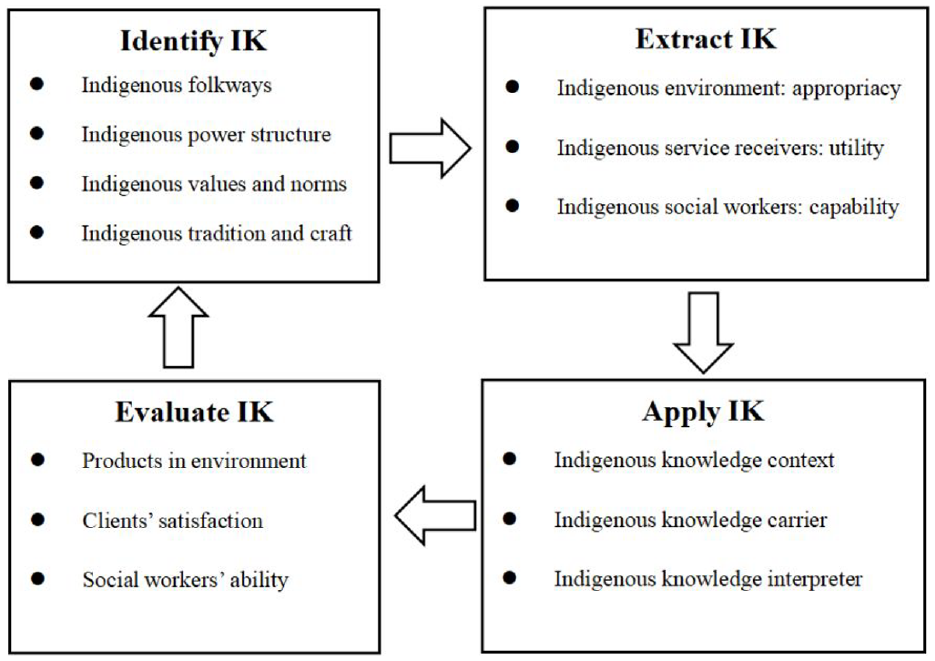
IK integration process.
The effectiveness of integrating IK into social work practice in rural areas in China is still unclear and requires further investigation. Evaluating the integration is not straightforward and must consider different types of knowledge and the process by which they are combined. This raises questions about how to measure the success of IK integration, for example, through the quality and quantity of products, client satisfaction, or the mastery of IK by social workers. These evaluations may turn IK into scientific knowledge, but further research is needed to understand the impact of IK in social work practice. The findings and discussions from this study can contribute to the exploration of rural social work practices and IK in developing and non-western countries.
Discussion
The findings of our study illuminate the intricate integration of IK into rural social work practice, where local beliefs, rituals, and festivals serve as foundational elements shaping the nature of engagements and connections with villagers. The pivotal importance of forging robust relationships with local leaders becomes evident, given that these affiliations serve as instrumental channels for the triumph of projects, facilitated by the profound bedrock of community connections. This aspect can be likened to a form of decolonization, a concept notably explored by scholars such as Gray and Coates (2016) and Gray et al. (2008). The indigenous social workers, leveraging their intimate familiarity with the local landscape, make substantial contributions to the efficacy of services, further accentuating the potency of this approach. Moreover, traditional values exert their influence on help-seeking patterns, reinforcing a sense of community support and cooperation that guides social workers in their role of identifying clients and cultivating rapport. The preservation of cultural heritage through mediums such as stories, songs, and crafts amplifies the impact of social work, a phenomenon further enriched by the involvement of volunteers with specialized traditional knowledge. However, the neglect of these critical aspects, as cautioned by Wang et al. (2019), can impede the successful design and execution of projects. The process of integrating IK into rural social work in China becomes a nuanced journey encompassing four essential steps: recognizing pertinent components of IK, extracting wisdom from traditional practices, adapting IK to address specific needs, and rigorously evaluating the influence of these practices. Such integration is not only reliant on a deep understanding of local culture and context, as expounded by scholars like Tong and Xu (2019), Ge (2019), Zhang and Yang (2017), Liu (2017), Meng et al. (2019), and Zhang (2021b), but also necessitates ongoing collaboration with communities and vigilant evaluation to ensure its efficacy. These insights underscore the centrality of indigenous culture and local needs in the integration of IK into rural social work practice in China.
Within the unique indigenous context, the significance of flexible and culturally sensitive social work practice is paramount in catering to the diverse needs of rural residents. This crucial adaptation is further facilitated by the pivotal role of indigenous social workers, acting as bridges between the profound IK and practical application. As illuminated by the insights of Tong and Xu (2019), the efficacy of integrating IK rests upon the intricate interplay between service receivers, social workers, and the intricate fabric of local culture. This symbiotic relationship underscores the necessity for the design of projects that are intricately tailored to specific contextual nuances. The influence of the broader political and policy landscape looms large, casting its impact on the trajectory of social work practice. This influence extends to shaping resource allocation, forging strategic partnerships, and determining the dynamics of service delivery. Consequently, it underscores the imperative of social workers’ grasp of government policies, which not only bolsters resource access but also underscores the need to align service priorities with the community’s immediate needs. This interplay between policies, government interventions, and community needs forms the crux of effective IK integration, accentuating the importance of contextual awareness and astute navigational skills to harmonize IK with the broader sociopolitical environment.
Within the distinct indigenous milieu, the foundation of rural social work practice must be deeply entrenched in the idiosyncratic requirements of service recipients. This assertion gains added significance in light of the distinctive demographic fabric of rural China, characterized prominently by an aging population, women, children, and individuals with disabilities, as underscored by the insights of Zhou and Li (2020). Remarkably, these demographic constituents play a dual role, serving as both beneficiaries of services and repositories of IK—a reservoir of traditional wisdom and cultural insights that can enrich social work practice. Notably, when addressing complex and sensitive issues such as domestic violence, the incorporation of IK and adherence to local customs emerge as imperatives. This arises due to the nuanced nature of cultural subtleties that often render traditional Western approaches inadequate in addressing indigenous concerns effectively. The infusion of IK offers a dynamic framework that bridges these gaps, not only fostering deeper relationships within indigenous communities but also introducing a fresh vantage point that redefines the parameters of social work practices. The utilization of IK is akin to opening a treasure trove of intergenerational wisdom that resonates profoundly with the indigenous populace, engendering a sense of trust, comfort, and cultural resonance. In essence, the integration of IK serves as a conduit for amplifying the authenticity and efficacy of social work practices while carving a pathway toward a more harmonious and impactful engagement with rural communities.
Indigenous social workers emerge as invaluable interpreters of IK, their intrinsic familiarity with local language and culture affording them the role of bridging traditional wisdom with contemporary social work practice. This notable discovery echoes the congruent findings observed in the research by Boddie et al. (2021) and Ku (2022), reinforcing the significance of this phenomenon. However, the landscape is not devoid of challenges; the “have first then develop good” paradigm, while facilitating local workforce integration, presents a potential pitfall by favoring rapid recruitment over the vital tenets of professionalization and cultural adaptability. This emphasis, if not adequately managed, holds the capacity to impede the delivery of personalized services that are quintessential for effective social work. The integration of IK into rural social work in China stands as an ongoing exploration, necessitating comprehensive investigation to gage its impact and efficacy. This evaluation is intricate, necessitating the consideration of diverse knowledge types and nuanced measurement methodologies. The insights gleaned from this study significantly enrich our comprehension of rural social work and the interplay of IK, particularly within the framework of developing and non-western contexts, adding depth to our understanding of the delicate balance between preserving cultural heritage and evolving professional practices.
Conclusion
The integration of IK into social work practice in rural China is still a developing area with many untapped aspects. The emphasis on IK is based on the history of social work development, the unique service environment, and the specific needs and issues of the indigenous community. While IK is suggested to be integrated into social work practice, it’s important to also recognize its different roles and eliminate any negative elements. While some may view IK as conflicting with modernity and causing a divide between urban and rural areas, this paper posits that IK can provide a bridge between history, present, and future. Rural social work practice should work to maximize the effectiveness of IK through community-led research.
The integration of IK and rural social work practice in China is crucial for improving social work services in underdeveloped rural areas. Despite the slow development of rural social work and the lack of professional social workers, IK has played a vital role in providing social work services to the local community. The “have first then develop good” paradigm has been adopted, which emphasizes the use of local indigenous social workers to provide social work services, but these workers face challenges in professionalization and indigenization. Further research is needed to evaluate the effectiveness of IK integration and to identify the negative elements that need to be addressed. The findings of this community-led study in Ninghua, Fujian, China, highlight the importance of IK in bridging the gap between history, present, and future and maximizing the effectiveness of rural social work practice. Community-engaged research should be conducted to explore ways to utilize IK positively and effectively. The findings of the study have the following policy implications in China:
Incorporation of indigenous wisdom into social work practices in rural areas of China.
Empowerment of rural communities and indigenous populations in the decision-making process.
Recognition of the unique cultural and social needs of rural communities.
Development of community-led initiatives that address local issues and challenges.
Integration of traditional knowledge and practices into social services and programs.
Collaboration between local government, social workers, and community members to create sustainable solutions.
Investment in education and training for social workers to understand and work with indigenous populations.
Encouragement of community-based research to inform policy and practice.
Footnotes
Acknowledgements
None.
Author Contributions
First author prepared research proposal, developed methodology, reviewed literature, conducted study and drafted the paper. Second author reviewed substantial literature, revised the whole manuscript and produced final version. Both authors read and approved the final manuscript.
Declaration of Conflicting Interests
The author(s) declared no potential conflicts of interest with respect to the research, authorship, and/or publication of this article.
Funding
The author(s) disclosed receipt of the following financial support for the research, authorship, and/or publication of this article: This article is a result of the Fujian Province Social Science Fund project, with approval number FJ2022C101, and is also supported by the National Fund Cultivation Program project SP2023006 at Jimei University.
Ethical Approval
Ethical approval was taken from the local Ethics Committee, all respondents were anonymous.
Informed Consent
Written informed consent was obtained from individual or guardian participants.

Data Availability Statement
Data sharing not applicable to this article as no datasets were generated or analyzed during the current study.