




Abstract
Today, the lecture class as a format for higher education is under attack more than ever. This article addresses the research question of how lectures can be modernized and revitalized through new uses of digital technology—in particular, video. Critics of lecturing have for a long time observed that lecture classes can be weak on student engagement and motivation to attend class. This article introduces one way to help modernize and revitalize the live lecture class session, a new conceptualization of the instructor-created video. Instructor-created videos are defined and distinguished from current hybrid and alternative forms of technology integration that are proliferating in higher education such as flipped and blended classrooms. Many, if not most, videos used in lectures are “third party videos” (made by others), whereas instructor-created videos are “first party videos.” The author develops and defines the concept of VIDS (Videos Instructor Designed and Starring). VIDS examples illustrate the concept from the author’s experience in a course with 158 students. Student feedback based on survey results is positive. Suggestions for making better videos are offered based on the implementation experience. The VIDS innovation is discussed within the context of the “crisis of the lecture” and offered as one tool to help modernize and revitalize the live lecture class.
We have all heard the criticism that lectures can be uninteresting and ineffective. One survey of students found “that 59% of students find their lectures boring half the time and 30% find most or all of their lectures to be boring” (Mann & Robinson, 2009, p. 253). Technological developments in recent years exacerbate this problem and so at this time arguably create the most serious “crisis of the lecture.” An article on “What College Will be Like in 2023” (Kahn, 2013) declares that “lecturing in an auditorium full of students . . . will be a thing of the past.” In response to the ultimate question “Can and should the live lecture class be saved from the extinction prophesized by its critics?” some academics believe the answer is “no.” There is increasing interest among academics and learning designers in moving lectures online and breaking down the barriers necessitating physical on-campus attendance, as exhibited by the proliferation of MOOCs (massive open online courses) or with the emergence of “flipped classrooms.” The former offers en-masse instruction generally free, from globally reputed tertiary institutions, across an array of topics (with more courses and students now than ever before according to Shah [2015]), while the latter reverses traditional teaching such that students ideally prepare themselves through readings and self-instructional lecture videos prior to attending lectures on-campus for interpersonal discussion with peers and teaching staff to further consolidate learning. Advocates of the flipped classroom such as Green (2015) suggest flipping the lecture out of the live session and onto online, while flipping into what was the lecture session an array of “active learning” activities such as group work or problem sets (activities that may have been done in the past in discussion sections or tutorial sessions). This article takes a contrarian perspective in the sense that it explores what can be done on the “yes” side to save the live lecture class. It does so not out of nostalgia or Luddite resistance to change, but by putting forward an example of how the same technologies that are being used to eliminate the live lecture can be used to enhance it. The fundamental research question that drives this article is, how can the lecture class begin to be modernized and revitalized through new uses of digital technology, and in particular, video? That is, how can the lecture class become more interesting and engaging so that students are keener to attend and are more engaged when they are on-campus, through new uses of digital technology that ameliorate the weaknesses of the traditional lecture and deliver more engagement and learning? These are the broader contextual issues that are discussed—then the article shows one way this can be done by introducing the concept of instructor-created, instructor prominent videos (VIDS, for short, Videos Instructor Designed and Starring). VIDS are defined through a set of defining properties encapsulated through this author’s ethnographic experimentation with VIDS in a postgraduate marketing class. Most basically, when contrasted to “third party videos” (those that are made by others), VIDS represent “first party videos” (i.e., those that are instructor created) as a special case of instructional video. Instructor created means that the videos can be customized so that they are engaging and provide focused lecture content strongly tailored for the learning objectives/outcomes of that lecture for your class. Example VIDS are then described to empirically illustrate the concept. Suggestions for lecturers regarding how to make better VIDS are presented. Feedback on VIDS benefits and best usage, collected from students in the form of in-class surveys, is reviewed. In sum, while we are all aware of videos as we are in the video age of YouTube and social media, there is actually very little empirical or conceptual discussion in the teaching innovation literature specific to instructor-created video for use during lecture class sessions in higher education contexts. This article introduces the VIDS concept as one new way forward.
Today’s Challenges for the Lecture Class: A Dying Art or a Rebirth Awaiting?
Recent developments create new challenges for the lecture class. Three broad categories of change are highlighted here. First, the digital technology revolution continues such that the availability, cost, functionality, and ease of use is better today, in particular for video. Second, students have changed. A survey of today’s students (McCoy, 2013) found they are bringing a smart mobile device (smart phone, tablet/iPad, laptop computer) to class and the vast majority admit that they get distracted during their on-campus lectures by using those devices for texting (86% of students), emailing (68%), social networking (66%), web surfing (38%), and even playing games (8%). Thus, for the lecturer, it is now more than ever a battle for students’ attention in class. Also, today’s digital learners prefer receiving information from multimedia (e.g., Jukes, McCain, & Crockett, 2010). They watch a lot of the “rich media narrative” of video, which spans either commercial video (e.g., TV shows and movies) that is now more easily accessible (e.g., Netflix, Hulu, Amazon Instant Video), or “home video” (e.g., YouTube). Simple media narratives (such as the traditional PowerPoint lecture) can struggle more today to hold their attention. Arising from this contextual development now is the suggestion that in general, today’s students know of, want, and are more engaged by rich media narrative. Many teachers understand this and are drawing on available online videos (e.g., Jung & Lee, 2015; Steffes & Duverger, 2012) in an attempt to address this issue. In sum, lecturers need to win the battle for students’ attention during the lecture class session. This article adopts the stance that rich narrative media is a tool that can do this and would likely be welcomed by students.
The problem of the traditional lecture class is compounded today by a third new development, the increasing availability of high-quality educational videos, such as the MOOC phenomenon. A popular song from 1919 that captures how new experiences change perceptions is “How are you going to keep them down on the farm (after they’ve seen Paree)?” (referring to returning American soldiers changed perception of farm life after seeing Paris during the World War I). Fast forwarding to today, the analogy to our context is “how are students going to be happy with a traditional PowerPoint lecture after they have become aware of or experienced a MOOC (or MOOC-like educational product)?” MOOCs are often seen as flagship courses for their (often elite) universities, so a lot of resources may be put into making these state of the art and highest quality. While the verdict is still out on MOOCs, how is the local university lecture course going to out-compete an elite university MOOC for students’ favor? A consequence of the advent of MOOCs will be changing students’ perceptions and expectations of the traditional lecture. That is, it changes students’ frame of reference for what university teaching actually is to what university teaching can potentially become. Once a student experiences or becomes aware of how a MOOC is taught, even briefly, then a traditional lecture, featuring only the instructor and PowerPoint slides in a relatively inflexible on-campus attendance mode, can begin to look old fashioned, low tech, and even less interesting. In sum, while there have been articles on “In defense of lecturing” (Burgan, 2006), this article highlights a new way forward in meeting and potentially even surpassing student expectations of their classroom experience. There have also been a great many articles with teaching innovations, including new uses of technology, but this article combines a teaching innovation for the live lecture class with a reflection on the big picture of the current situation for the live lecture class, which is presented at the end of the article.
Despite the challenges facing the lecture class, and indeed lecturers themselves, and increasing advocacy for online learning and other replacements for the live lecture, “a bias toward face-to-face delivery continues” among educators (Redpath, 2012). As such, there should be an audience among many educators for ways to revitalize and modernize the lecture class through new uses of digital technology in class. It is a very basic point, perhaps forgotten to some extent today, that an advantage of the lecture method is that it highlights the expertise of the instructor, and it is the expertise of the instructor that many students want access to. There are now many variations in the lecture class that involve various forms of activities to help make a lecture class session more engaging (e.g., break the class up into buzz groups during the lecture to discuss an issue). The next section introduces a new tool based on a new use of new technologies: VIDS.
VIDS
In response to the challenges facing the lecture class and contrasting to alternatives that eliminate the live lecture, there are proposals for new uses of new technologies to help make the lecture class session more engaging (e.g., classroom response systems, Garver & Roberts 2013; Malefyane et al., 2014; interactive whiteboards, Greene & Kirpalani, 2013; animations, Chan, 2013). The teaching innovation proposed in this article, VIDS, focuses on the “transmission” element of the lecture (didactic content from the lecturer to students)—how to make that more engaging and educationally effective for students. The VIDS technique adds another tool to the pedagogical toolkit and one which some lecturers may wish to consider to add, or adapt, to their current teaching style. In particular, the goal of VIDS is to increase student engagement with the lecture class and also increase students’ motivation to attend their lecture classes. Attendance may be higher earlier in the semester and then may decline over the semester. While mere attendance is a not the end-goal, it is an important first step for learning benefits from the lecture to be received.
Videos have been used in higher education teaching for some time; however, these have been mostly “third party videos.” Third-party videos are those that are not created by the instructor and as such do not include the same personalization, specialization, or interest as first-person instructor designed and starring videos (such as those which are the subjects of this article). Davis (2009) and McCabe and Meuter (2011) provide good overview advice on how instructors can use videos and reflect conventional views, including the use of “trigger” video clips (to trigger discussion), to match videos to learning objectives, to prepare students to see the video (by explaining why the video is being shown), to break up or re-arrange parts of the viewing (into smaller, more digestible bits), and finally, to conduct a follow-up activity (assessing the meaning of what they have seen). Jung and Lee (2015) and Steffes and Duverger (2012) specifically encourage the use of online videos such as from YouTube in the lecture class. The use of video proposed here in this article similarly follows these general guidelines, applying them to the use of VIDS. More general advice about making videos can be found in, for example, Stockman (2011) or Sweetow (2011), which is beyond the scope of this article to address. In sum, VIDS are a certain type of video: Videos Instructor Designed and Starring. The defining characteristics of VIDS are now set out and discussed in the following eight points.
1. Instructor created. Most fundamentally, VIDS are videos as teaching resources that are created by the instructor. The instructor is the writer, director, and producer of the video. This means the video is scripted by the instructor and specifically tailored to the needs of the instructor’s class. A video script should have a preface describing the cognitive objectives (what viewers should learn), affective objectives (what viewers should feel), personnel (actors, cameraperson, etc.), physical visual elements (location, props), digital visual elements (other images, video, audio, or text to be inserted), budget (time as well as money), and of course the linear sequence of action and dialogue. These are the elements the instructor plans before the recording commences.
Instructor created also means the instructor has edited the video. To edit a video means to take the raw footage and reduce it to the best moments, or to assemble the different video tracks into one video, or to insert text, graphics, other video, or other special effects. This requires the instructor to have at least a working knowledge of the use of basic video-editing software. As director of the video, the instructor is also responsible for the major editing decisions, as these strongly affect the nature of the video and how students will receive content. Help with minor editing, such as clean transitions, or inserting subtitles, may be provided by teaching assistants or multimedia support staff if the university provides these resources. Skilled assistants knowing the instructor’s intention may make the first cut. In sum, like auteur theory for cinema, the video strongly represents each lecturer’s distinct vision and style.
2. Instructor prominent. The second most fundamental and perhaps most distinguishing feature of VIDS is instructor prominence. This article takes the perspective that the instructor is the featured performer in his or her lecture class, and this should carry over into the video. Videos facilitate and amplify the performance the instructor can do in terms of bringing educational material to life in the form of a cinematic experience for students. The prominence of their instructor in the video provides an immediate personal connection between the student audience and the video, which can be a valuable aspect to increase engagement and learning. The instructor could simply voice the video (i.e., audio recorded speaking points over the visual images) and still be prominent, however, the suggestion here is for the instructor to also have some visual presence. The instructor’s image in the video assures the instructor’s strong identification with the video, and invests the video with the instructor’s credibility for quality and confidence for high fit to purpose of this class.
Although prominent in each video, this does not mean to say that the instructor is necessarily the dominant actor in every video. Rather, the suggestion here is that the instructor has a presence and plays a very real role throughout the video—even when not on camera. The video is a continuation of the instructor’s lecture, but via a different medium (video, rather than live)—this is an important point for consideration. Without instructor prominence, the video appears more like a third-party video, and students may find difficulty in seeing the distinction of VIDS from other alternative (third party) forms of digital media used to convey educational content. In sum, the instructor is not only writer, director, and producer but also in some way a star actor in the video. This is important as it strengthens that personal connection between the instructor and the students.
3. No (or very low) cash budget per video to the lecturer. A video camera of some kind and video-editing software are needed. Some universities provide multimedia support such as shared video cameras that can be borrowed from your department or faculty and also video-editing software for which the university has a site license. Some universities are now creating media rooms for video content creation. Alternatively, some smart phones today have significant video capabilities, and video-editing software (which is becoming easier to use) may be acquired at relatively low cost or even free for very basic programs. A supporting resource that may be required is for a teaching assistant to be the cameraperson; however, the actual filming does not take long if the scripting has been done carefully in advance. Also, some universities may provide support for video making in terms of learning designer assistant or IT/multimedia support. A reason effective VIDS can be made relatively cheaply is the next point.
4. Low/simple production level and high intellectual level. It may help to very briefly present a 2 × 2 table that classifies videos into four general types (Table 1). The first dimension of the matrix is the technical production level of the video, which may be high, as in a Hollywood movie, or low, as in a homemade video of someone’s dog acting crazy. Technical production level involves location, scene, props, cast, sound track, sound effect, lighting, and post-production. The second dimension of the matrix is the intellectual level, which may be high, as in a video of a Reith Lecture (“the BBC’s flagship annual lecture series”), or low, as in escapist entertainment TV shows. VIDS are low in technical production level but high in intellectual level. This combination works for the purposes of VIDS.
Types of Videos.

Note. MOOC = massive open online course; VIDS = Videos Instructor Designed and Starring.
Simple technical production levels are acceptable because today’s students know of low-budget videos, such as home videos made for YouTube that are highly popular and have a certain charm for many. The uniqueness of VIDS is the combination of a high intellectual level with the simple production level, along with being instructor created and having the instructor prominent—which in totality credibly categorizes VIDS as an educational video made by the instructor for the students in this course. In other words, educational authenticity may actually increase because the technical production budget is down. Students understand that university resources are limited, and they expect the focus should be on the content rather than the “eye candy” of big budget production.
5. Video technology enables doing something new or at least better than could be done live. Students are somewhat skeptical of educational technology for technology’s sake (McCabe et al., 2011). As experienced social media consumers, it is to be expected that many university students will be cynical if the video is just a “talking head” or video-recorded PowerPoint lecture that could have easily been done live in class. Students would not want to feel that the VIDS are just a gimmick and a waste of time for the instructor and the students. To guard against this prospect, recognize that the use of video is special, and students are looking for something special from it, something which cannot be conveyed to them via any other alternative means. The video should either enable something that literally cannot be done in the live lecture, or cannot be done as well in the live lecture. (Examples in the next section illustrate this point.)
6. Specially for your class. The video is designed for and shown in the instructor’s class during the lecture and is not available to other students or the general public. Placing the video on the public Internet, or otherwise allowing anyone to access it, means it loses its specialness for your course. Keep a strong, direct connection with the students, and make it a unique shared communal experience for the instructor and his or her students. A subtext message conveyed to students is that there is a special privilege/“reward” for them having made the effort of coming on-campus to attend their lecture class in person, which, besides the live interaction with their peers and teaching staff, is the shared experience of the VIDS made especially for them. Students appreciate the additional time and effort that their instructor has put into making the educational experience an enjoyable one.
7. Adds spice to the lecture class experience, but is not the main course. Students are delighted by variety during the lecture class (Gruber et al., 2012). Instructor-created videos are a good source of variety. The VIDS is intended as a supplement to the live lecture, or the spice. Traditional lecturing is still the meat of the course. Videos help break up the lecture session and the surprise of when and what from an unexpected medium adds spice.
8. Clear educational purpose for the video and its design. It is well known that a video shown during class should have an educational purpose (e.g., see Davis, 2009); however, this is so fundamental, it bears repeating because without it the point and purpose of VIDS can easily become lost. VIDS must be more than just entertaining. For that reason, this point is included as the culminating defining characteristic of the list of the eight defining properties that have been presented here. In sum, VIDS must be instructional, educational, thought-provoking, specialized to the content and cohort, and unique beyond any other educational material that students could otherwise access to incentivize engagement in-class and motivate attendance. VIDS helps the live lecture class transition from pejorative connotations toward a long-awaited re-imagining using new technology for innovative pedagogy.
Example VIDS: A 3-Hr Postgraduate Lecture Class
The concept of VIDS was implemented by developing five VIDS for a postgraduate course at a large urban research-intensive university. The course is strategic marketing and branding. Total enrolment is 158, with two sections of size 94 and (repeat lecture) 64. Each lecture class session lasts 3 hr, making it, along with the relatively large enrolment for a postgraduate course, a very challenging situation to keep students’ engaged throughout the long class session. The VIDS were typically saved until toward the middle of the class time, as that would be the greatest need for a change of pace. All five VIDS are briefly described in Table 2. For brevity, only two of the examples will be described in detail.
Summary and Overview of VIDS Examples.

Note. VIDS = Videos Instructor Designed and Starring.
VIDS 1: A Debate Where the Lecturer Plays Both Sides, Using Split Screen
Debates are a well-known teaching method, with one person arguing in support of one side and another person arguing for the other. However, what if the lecturer argued both sides using split screen? The advantages of a debate-style VIDS are as follows. First, the lecturer can select the strongest arguments for each side, equally clearly, and tailor these arguments to the context of the class (re-taking until the delivery is clear, strong, and engaging). A second advantage is that this form of instruction visually depicts the equivalence and equal treatment of both sides of the argument since the same (high credibility) person is arguing both sides. Third, the video was introduced as showing how one person in his or her own mind can consider different sides to an argument (but played out in video), which is a valuable lesson to students to fairly consider “both sides to the story.” Fourth, there is suspense about which argument is going to be better, because a simplistic favoritism based on who is presenting the side cannot be done, and reasons to choose must be found in the points made in the debate, which requires attention and engagement. When this VIDS was shown to the class and popped to the first split screen image of the lecturer on both sides, there were audible gasps of amazement among the class.
How was the video made? The lecturer scripted both sides of the debate. The video was recorded in a seminar room. The instructor sat at one side of the table and argued one side. A teaching assistant had the camera. We did a second take of that side (so the best deliveries from each take could be chosen). Then “reaction shots” were incorporated. The lecturer changed his shirt, put on a cap, sat on the other side of the table, and followed the same process for the second side of the argument. The video was edited and the two videos were merged into split screen, using reaction shot footage (e.g., looking like paying attention to the other side of the room) such that it looked like each was debating the other. The recording session took about 1 hr. Available video footage illustrating points related to the debate was edited into the overarching VID at appropriate times to avoid it being “just talking heads.” The debate closed with the instructor on both sides saying in unison the equivalent of “what are we to do now?” The video was prefaced by explaining at the start of the video that it would not close with a resolution, but instead students would discuss the issues in small groups and then there would be a class vote on which brand strategy would be best for this organization (to keep a positive focus) using an audience response system (where students vote using their mobile devices to access the voting website via the university’s wireless Internet).
VIDS 2: Office Visit and Interview
Everyone knows about the concept of the guest lecture by a guest speaker. This is a tried and tested way to add variety and a different perspective into the lecture class. This VIDS had the same purpose, but reversed the process whereby instead of the guest coming to our class (which can be difficult as our university is not near his office, and imposes additional constraints on the guest lecturer in the form of having to come twice, once for each section of the class, and having to write a PowerPoint lecture). However, the video allows the instructor to take the class, vicariously, to the guest’s office at a time of his convenience. The guest was the marketing manager at a medium-sized company. This VIDS started with a tour of the office guided by the guest, and then an interview in a company meeting room. This gave students an insider view of the guest lecturers’ “real-world,” all without leaving the classroom.
The script included the questions to be asked, the action plan (office tour then interview), and the strategy for handling the interview itself. Six broad questions were sent to the guest in advance, as he should be comfortable and not caught by surprise—and sending him the questions in advance allows him to think about them, facilitating better answers. For example, the first question is, “Tell us about your background and your role in the organization.” Terms of the video were also sent to the guest: Copyright remains with the instructor, but the video would only be used at the university for non-commercial educational purposes, would not be placed on the public Internet, and any use other than at the university would be with his written approval. His written agreement to these terms was obtained, which is essential. The resources involved were only the instructor, a video camera borrowed from the university, a teaching assistant holding the video camera, and video-editing software. Two hours of footage was recorded, which was edited to a 36-min VIDS (delivering, for example, more concentrated information and insights per minute than the original interview).
The instructor’s role during lecture is changed, becoming an interviewer, altering the professor’s “academic identity” and allowing students to view the instructor as more than just a stand-in-front-of-class lecturer. Academics with experience planning and facilitating student discussions or experienced with qualitative research can fairly easily develop the skill of interviewing.
One of the special benefits (over and above a typical guest lecture) is that many students have never before or have rarely seen the inside of an organizational office. Such video style enables taking students on a tour of the guest’s office. The rich narrative media transmits more information to students (e.g., the student can take in whether people in the office seemed happy—they did smile as the guest introduced his staff). Students are transported to another environment.
Inevitably, there are trade-offs. In informal feedback discussion with some students afterward, there was not only much praise that the video was “really interesting,” but also one student said “but I couldn’t ask questions.” That is, he was used to, in his student experience, having the possibility of asking a question of a guest speaker. Yet, it could be argued that the instructor should be able to ask questions of the guest at least as good, if not better than, questions from students in the class simply based on who raises his or her hand to ask with a thought of the moment. Indeed, the instructor could try to anticipate the likely questions students would have. After this VIDS (and VIDS 4 and 5), there was discussion about the content in the video, including questions from the class to the lecturer and also from the lecturer to the class.
Good VIDS Practice
It could seem risky to start making videos, so to encourage and aid take-up, the following are suggestions for the hands-on aspects of making better VIDS, based on experience so far. This section is addressed to “you”; an instructor who might want to make these videos.
Authentic and spontaneous. Be your natural self. Let your personality shine through. It should be the same you on the video as when you are speaking to the class, as if you had suddenly and seamlessly stepped into the video to continue the lecture from there. (A reason why you can risk to be spontaneous is the next point.)
If it does not work, edit it out. The power of video is that things that do not work can be edited out. Teachers can try things and then review the video to see if it works—things they might fear trying out live in class.
Teachers can be more expressive on video than live in lecture. When you watch your delivery on the recording, you can tell if your delivery was flat. This is harder to self-regulate live in lecture. Upon viewing the first take, if the delivery is under-expressive, then retake going for more expressiveness; if over-expressive (and looks silly), then retake to get the right level of expressiveness. In practice, this will usually only involve a few re-takes for some scenes.
Do not fear the occasional rough or unflattering image or sound. Students understand that time and resources are limited for instructor-created video, so they will not object to the occasional rough or unflattering image or sound. Indeed, the occasional rough spot signals the emphasis on intellectual content over technical presentation.
In general, we all come across better on VIDS than in real life. Video narrative can be polished communication, by providing concise, highlights-only communication, as well as being more expressive. It can rise above ordinary communication to the extraordinary (e.g., editing out the ordinary).
Preface the video at the beginning of the video. It is well known that the purpose of a video should be explained to the students (e.g., Davis, 2009), but this explanation can be included at the start of the video itself. This can be called “fore-fronting” the video in the video, or prefacing the main instructional content with a brief introduction. The instructor provides a live, very brief introduction to the video, and then the video begins with the instructor explaining in more detail the nature of the video.
Pacing and combinations. Pacing concerns when the video will be shown, such as planning to show the video after say 30 min of lecture for a change of pace. Combinations concern what to do in association with the video, such as classically having a whole-class discussion or breaking the class into smaller group-based discussions about the topic after the video. Synergies can be created with, for example, the triple combination of video, discussion, and then finally with a student vote on the different conclusions using an “audience response system,” thereby encouraging each student to think through the conclusions. This approach has been trialed with success by the author and is recommended when suitable.
A library of videos develops over time. Efficiency of VIDS is increased because videos can be re-used in the course in later semesters, such that an instructor can develop a library of VIDS.
Student Feedback
Student views and feedback were collected in several phases. In Phase 1, student views and preliminary feedback was collected through exploratory qualitative interviews during the semester. This was intended to provide background information, immediate feedback as to whether the VIDS were on the right track, and immediate “innovation correction” feedback if needed after the initial VIDS were shown. Six exploratory interviews were conducted by a teaching assistant to the questionnaire set by the instructor. Four exploratory questions were asked, focusing on (a) experience with videos in previous courses, (b) perceptions of the preliminary instructor videos already shown in class, (c) suggestions about what would be good to do for instructor-created videos, and (d) current reactions and attitudes toward instructor-created videos. Exploratory interview results suggested that videos were rarely used in students’ courses and that students had never seen anything like the proposed VIDS and were keen to see them.
In Phase 2, a survey was administered at the end of the semester to investigate the perceptions of students about the use of the instructor-created videos in class. The survey returned 112 completed questionnaires. Average age was 24.6 years old, gender was 62% female and 38% male. Questionnaires were anonymous, to encourage honest responses. Students were asked a series of questions about their experience with the use of instructor-created videos in the class. The statements included a mixture of items adopted from previous research (Bobbitt, Inks, Kemp, & Mayo, 2000; Ueltschy, 2001) and those designed exclusively for this study.
General Perceptions
A broad set of general perceptions on the use, attitudes, and learning outcomes of the instructor videos included the following items: (a) increased my enjoyment in learning, (b) helped me to learn, (c) was interesting, (d) I understand the purpose of showing this video, (e) provides a nice break, and (f) the instructor should keep making videos to show during the lecture. The specific questions and results on a 7-point Likert-type scale anchored from 1 = strongly disagree to 7 = strongly agree scale are presented in Table 3. All mean results are positive and nearly strongly agree (nearly 6 on a 1-7 scale). The modal response category is always either agree or strongly agree. Students believed the VIDS increased enjoyment in learning (M = 5.96, SD = 1.19), was interesting (engaging; M = 5.99, SD = 1.18), provided a nice break (variety) from lecture in a 3-hr class (M = 5.99, SD = 1.21), and helped learning (M = 5.74, SD = 1.2). An important scaffolding for these strong results may be students understanding the purpose of showing VIDS, as these students did (M = 5.91, SD = 1.04). To the “bottom line” question of whether the instructor should continue making VIDS, the modal response was strongly agree (M = 5.9, SD = 1.3).
Student General Perceptions of VIDS.

Note. Percentages rounded to the nearest whole number. VIDS = Videos Instructor Designed and Starring.
Attendance
The effect of the videos on attendance was measured using a 7-point Likert-type scale anchored from 1 = strongly disagree to 7 = strongly agree scale in response to the direct comparative action statement “I am more likely to come to class because there may be an instructor created short video.” The response was positive, a mean of 4.76 or about agree on a 1 to 7 Likert-type scale (SD = 1.44). This result is less strong than the overall perceptions, but the contextual explanation for this may be that attendance is fairly high in this particular course to begin with. Sixty-two students agreed or somewhat agreed, and 18 students expressed disagreed to some degree. Eight students responded with strongly agree, suggesting that this group could be at the margin of attending class on-campus versus not attending and VIDS has a large impact on their choice. In sum, VIDS were generally seen to be positive for likelihood to come to class. However, VIDS may be unlikely to be strong enough on their own to significantly increase attendance when a lecture class is seen as otherwise not interesting or valuable.
Frequency
The student survey also asked about how to use VIDS, in terms of frequency and combinations. To measure their perceptions about the desired frequency of use of VIDS, students were given six choices of frequency (from none to three or more videos in each class meeting). Figure 1 shows that the modal response for how frequently VIDS should be shown was one per class (35%). A perhaps surprising finding was that there can be too much of a good thing in this case, as the second largest response was once every other class (31%). Nevertheless, there was not a single response for no VIDS at all. One interpretation is that videos do provide the spice but not the meat of the course and adding too much spice at one time makes it lose its attractiveness. Students do recognize that the traditional lecture is the meat of the course and as such they do not want the in-lecture experience to be excessively interrupted or reduced by videos. This result shows that VIDS are complementary to the traditional lecture and not a replacement. At some point in the future, this frequency preference may reverse, and videos dominate the live class meeting—but the evidence here suggests we are far from that now. Also, in this case, the VIDS were tested with perhaps more serious-minded postgraduate students, so the frequency of VIDS desired by undergraduate students could well be higher.
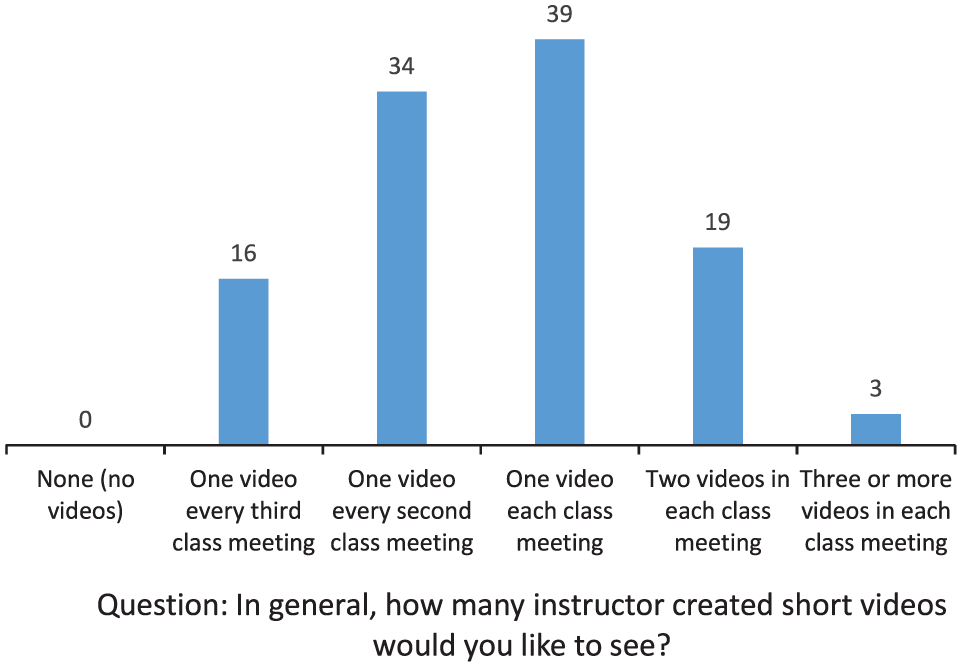
Frequency preference for VIDS.
Combinations
Student perceptions about which combinations of activities are best were assessed by measuring five possible combinations in answer to the question “Which combination of activities do you like best in class?” (see Figure 2). These were activities used in this course, so students would be familiar with them. The results highlight the importance of combinations. There is very clear consensus among the students that were surveyed on preferring not just a lecture (0% of the class want lectures only!); not just lecture and a video; not just lecture, video, and discussion; but lecture, video, discussion, and student vote using audience response system was the very clear favorite (69%). This suggests a powerful synergy from combinations of activities as a way to maximize student engagement and interest in their learning.
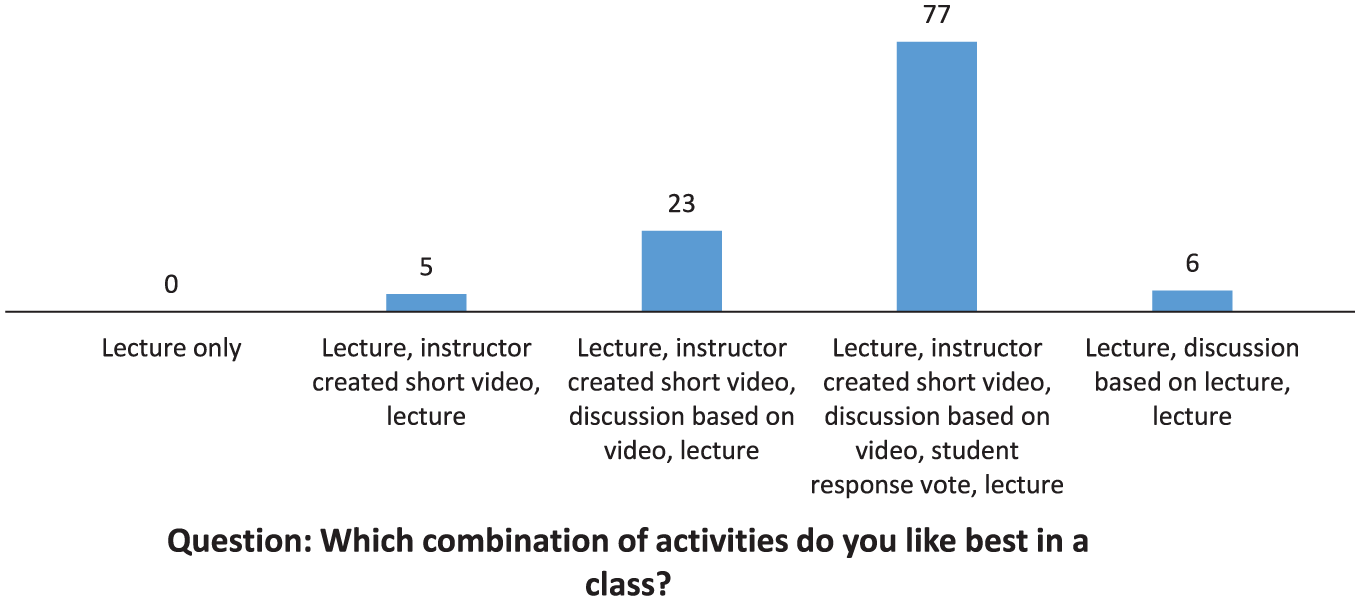
Combinations.
Another, this time indirect, source of student feedback is from the open-ended qualitative comments in the university’s standard end-of-semester course evaluation survey. Of the 89 surveys where students provided written comments (20 did not have any comments), 57 (64%) chose to mention VIDS in response to the question “What aspects of this teacher’s approach best helped your learning?” Only one student mentioned VIDS as a problem or a negative in response to the question “What would you have liked this teacher to have done differently?” (the weaknesses question). Thus, the summary valenced results, in terms of number of unprompted positive mentions of VIDS versus unprompted negative mentions of VIDS is a ratio of 57 to one (unprompted in the sense that nothing specific to this course is mentioned in the University standard teaching evaluation instrument, because it is administered in all courses across the University). While all the student data presented here are self-report data, there are multiple forms of data, including measures of key perceptions and affective experiences (e.g., interesting and enjoyable), comparative preferences (e.g., desired frequency and combinations), reported behavior impact (i.e., reported impact on attendance behavior), and also unprompted responses to open-ended questions in a separate questionnaire. All the student evidence was positive for the VIDS innovation.
Reflection on the Goals and Benefits of VIDS
There are several important goals that were in mind for the development of VIDS. These are goals that could be general for new uses of technology to revitalize the live lecture class session. The above sections were very practical; this section becomes more philosophical. In this section, the goals are justified and discussed in a general way, and then, a discussion is presented for how VIDS are thought to deliver on those goals (benefits).
1. Increase student engagement, which is the driving force to increase motivation to attend and reduce attendance declines. Increasing engagement can be thought of as making the moment more interesting, as interest is a driver of attention to the task in the class. Engagement is important enough to be a goal on its own (Coates, 2006). It may be defined as the “effort students themselves devote to educationally purposeful activities” (Hu & Kuh, 2002, p. 555). Engagement is one of the key drivers that teachers can manage for increasing student motivation, learning, and attendance. Increasing engagement increases deep learning (Coates, 2006).
It is useful to think differently about the increasingly popular buzzword “active learning.” According to Prince (2004), there is no one definition of active learning, however, “Active learning is generally defined as any instructional method that engages students in the learning process.” Prince notes, “Active learning is often contrasted to the traditional lecture where students passively receive information from the instructor.” However, it is argued here, from the definition of active learning, that active learning can occur during a lecture when students are engaged in the learning process. Thus, it is considered to be a mistake to treat the lecture format as inherently inactive, or rather passive, learning. The problem of the lecture occurs when student engagement is lost. This is common sense: It is when students are not paying attention and not allocating cognitive effort that they become passive with regard to the lecture and are not really learning. Active versus passive learning is therefore a state of mind. Active learning does not intrinsically require students physically doing anything beyond listening, such as group work on a problem. Active, engaged listening is also active learning. Discourse about the lecture should recognize this distinction. The driving factor for the solution is for the lecturer to maintain engagement during the live lecture class session. The different pathways to active learning complement each other and can be used in combination synergistically (as the evidence above on combinations shows). VIDS are highly engaging, because they are interesting, expressive, provide variety, and are a personal connection to the video for the student. In sum, the view “all lectures are bad and there should be no more lecture classes” would be a somewhat simplistic overgeneralization. A more nuanced view would be “unengaging lectures are bad.”
2. Increase student learning. Learning can be increased simply by increasing engagement in the lecture class (as the inattentive student does not learn from the lecture), as Coates (2006) argues. VIDS deliver increased learning through greater engagement, and also because VIDS are concentrated and provide polished teaching performances (allowing better phrasing, more expressiveness). The goal is for VIDS to have spillover effects that increase the general engagement level for students with the entire lecture class, and thereby has a positive spillover of increased learning throughout at least to some degree.
3. Increase motivation to attend class and reduce attendance declines. When there are learning benefits from attending class, more students attend then ultimately, more benefit. A more engaging lecture class should increase students’ motivation to attend. Furthermore, attendance is often highest at the beginning of the semester and then tends to decline over the semester, perhaps due to the perceived sameness that compounds over the semester. VIDS add variety that reduces this “sameness” effect and provides the incentive for students to attend to find out what kind of VIDS the instructor is going to come up with each time.
4. Make the lecture class “cool.” Too often educators ignore the affective (emotional) side of the student in-class experience. Steve Jobs is famous for trying to make Apple products not only functional but also “cool.” “Cool” is notoriously hard to define in words on the page (Dar-Nimrod et al., 2012), but in this article, whereas “interesting” is a cognitive evaluation, “cool” is conceptually considered to encompass heightened interest plus a positive affective reaction. “Cool” roughly is awesome, wow, neat, likable, and desirable. What theory can be used to conceptualize how “cool” works in the context of a lecture course? Branding theory conceptualizes cool as an association with the product/service (course and lecturer) in the mind of the customer (student, in this case)—see, for example, Kevin Keller’s (2013) influential customer-based brand equity model. In other words, according to branding theory the course and lecturer are brands to students, and “cool” (or not) could be an attribute of that brand (e.g., “this strategic management course is cool”). While “really cool” is extraordinarily difficult to achieve, if “cool” is thought of as a continuum, not an either/or, then a course could be a bit more “cool” by moving in the direction of the related constructs of fun, interesting, and engaging in a context of learning the course material. Note that fun without learning cannot be a “cool” course, it can only be an entertaining course. VIDS may be able to create and increase the brand attribute of “cool” for a lecture class.
5. Minimal cash cost. Limited support that costs resources is a key limiting factor of take-up of new technologies for mass use in higher education (as opposed to flagship MOOC use). VIDS were designed to be relatively efficient and minimize cash costs whilst still being seen as professional by students.
6. Most lecturers could do it. A digital technology teaching innovation should not be too technically demanding (along with no or minimal cash cost) so that every lecturer could conceivably do it. Furthermore, benefit/cost teaching efficiency makes a teaching innovation attractive (i.e., returning better teaching than the resources required). Teaching efficiency should be considered over the long run, not over the short run, as in the short run there can be a startup cost in terms of learning time. VIDS was designed to deliver a good long-run benefit/cost ratio, and provides a do-it-yourself approach that most instructors could follow to get started making videos (along with the examples and tips).
7. Unique experience and unique shared communal experience. For the university and instructor to build strong relationships with students, which is increasingly seen as important, it helps when a digital technology teaching innovation is perceived by students as a unique and special worthwhile experience just for them. By analogy, intercollegiate sport in the United States could be seen as “just sport”; however, the way it brings together the university community to support their team is special. Similarly, there is some affective connection value to students from a unique shared experience that is exclusive to the local live lecture experience of our class (such as VIDS).
8. Lecturer models use of new communication methods. The use of new digital communication media should not only provide students with the content-learning benefit of that method but also models for students how to use that media (e.g., Granitz & Pitt, 2011; Miller, Mangold, Roach, & Holmes, 2013). Students should see the use of new rich narrative media, such as animations or video, as a communication tool that can be used in a serious way (e.g., videos are not just something to be pulled off YouTube, but can be made for serious purpose such as VIDS).
9. Effective with large enrolments. Some new instructional techniques are great in small classes, but it is even better for the technique to be usable/scalable for larger enrolment lecture classes. The problem of MOOCs is that scaling a class to that size online just about loses any hope of interactivity with the instructor. VIDS scale with the size of the lecture class and retain the communal experience even for larger classes. Students in larger classes can still discuss the VIDS and ask questions of the instructor afterward, allowing for interactivity.
10. Instructor entirely directs and designs the overall, multi-dimensional, integrated, in-class student experience. One view is that the instructor should be able to compose and implement the class, analogous to planning the menu and cooking it, without the need for learning designers or video technology assistants telling the instructor what to do. That is, the lecturer would have a broader set of teaching tools to use for planning and delivering a high-quality student experience. The lecturer also would not just focus on information transmission. The “lecture class” is not “just a lecture” but instead is conceptualized as a multi-dimensional experience for students, and the instructor is manager of the overall student experience across the key dimensions such as learning, the related set of constructs of engagement/interest/attentiveness/cool, and motivation/inspiration to attend and learn. This is analogous to many organizations today that focus on the “planned customer experience” for what they want their customers to feel during the service experience to enhance customer-based brand equity (see, for example, Meyer & Schwager, 2007 or Schmitt, 2003). VIDS is another spice for the feast. This ties in with the importance of combinations of activities in the lecture class as has been previously discussed.
Conclusion
VIDS (Videos Instructor Developed and Starring) provide one way to begin to address today’s “crisis of the lecture” and modernize and revitalize the lecture class through a new use of digital technology in the lecture class session. Eight defining properties/characteristics are identified for VIDS. Two examples of VIDS developed for and shown to a postgraduate business course are described in detail, with three other examples briefly mentioned. These examples show how this type of video can be executed under real-world constraints (e.g., no or minimal cash budget per video to the lecturer, no special time allocation to the instructor from his or her department for making these videos), though these five examples are not intended to be the only possibilities for VIDS. Eight tips from the author’s experience are provided for helping other educators make better VIDS. Results from student feedback were positive on VIDS. Key results include that VIDS increases enjoyment in learning, helps students learn, and provides variety in the lecture class session. Students appear to crave variety, strongly preferring a combination of activities in the class session, with the most preferred of five combinations of activities being the one with the most variety over the class session: lecture, instructor-created short video, discussion based on video, student response vote, and lecture. Results show that the preferred frequency of instructor-created videos is once or twice per class session—too much “spice” (VIDS) in the session is actually undesirable. Furthermore, results suggest that VIDS can improve the likelihood of attendance for some students who are probably at the margin of attending or not attending. This article introduces VIDS and presents an overall assessment; future research should examine VIDS from more focused perspectives such as testing specific elements of VIDs. A limitation of the research is that it was conducted at one university with one student cohort and one set of VIDS; future research should be conducted at other universities and across different student cohorts and testing different VIDS.
While new uses of digital technology are creating alternatives to replace the traditional live local lecture class (e.g., MOOC and flipped classroom methods), at the same time, new uses of digital technology can be used in the lecture class itself. VIDS provide one such way to make lecture class sessions more engaging and even “cool,” and thereby increase attendance. This is not to suggest all instructors should make VIDS, or that VIDS are the only type of videos or that there are no other suggested new uses of digital technologies. Although the focus in this article is on the use of VIDS in the live lecture class, as that was the author’s goal, the same VIDS style of video could also be used as tips for how to make good videos to be used as out of class viewing as well. In sum, VIDS are one more tool for the modern educator’s toolkit to help modernize and revitalize the live lecture class.
Footnotes
Acknowledgements
The author thanks Teegan Green, PhD candidate at UQ Business School, for providing feedback on an earlier version of this manuscript.
Declaration of Conflicting Interests
The author(s) declared no potential conflicts of interest with respect to the research, authorship, and/or publication of this article.
Funding
The author(s) received no financial support for the research and/or authorship of this article.