




Abstract
Over the past few decades, “governing by numbers” in higher education has made significant strides. In this context, Chinese universities have actively responded to national policy demands, represented by the “New Quality Productive Force” (NQPF) strategies. Drawing on panel data from 30 Chinese provinces, municipalities, and autonomous regions from 2012 to 2022, this study employs two-way fixed-effects and mediation-effects models to empirically investigate the impact of university science and technology investment (USTI) on regional NQPF (RNQPF). The results demonstrate that USTI significantly promotes RNQPF, with basic research investment having the most pronounced effect. Mechanism analysis reveals that USTI facilitates RNQPF by promoting scientific research output, fostering high-tech industry supply and demand, and driving regional development. However, the mediating effects of talent cultivation, attracting high-level talent, and the transformation of scientific and technological achievements are not significant. This study posits that university functions are characterized by loosely coupled systems in the field of higher education; thus, quantifiable indicators only measure limited objectives of higher education development while overlooking more complex and latent functions. The findings suggest that increasing investment in basic research and optimizing technology resource allocation, focusing on scientific output and the cultivation of high-tech industries, can enhance RNQPF.
Keywords
Introduction
In a centralized higher education system, universities are profoundly influenced by national agendas that shape their goals, strategies, and governance structures. As open systems, universities continuously adapt to external pressures, such as political and economic forces, by realigning their internal structures and missions. This adaptability becomes particularly crucial when national agendas are clearly articulated, and resource allocation is tied to compliance with policy objectives (Papadimitriou & Boboc, 2021). In such systems, universities become more strategically oriented, refining their strategies as they respond to policy demands and strengthen their legitimacy (Krücken et al., 2025; Ramirez-Cardona & Calderón-Hernández, 2024). Chinese universities, in particular, are characterized by a highly centralized governance model, with substantial influence from the state and national agendas (Y. Wang et al., 2022).
The New Quality Productive Forces (NQPF), introduced by President Xi Jinping in 2023 and now a central element of China’s national agenda, has had a significant impact on university governance. Similar to policies like “Bidenomics” or the “New Washington Consensus” in the United States (Wei, 2023) and the European Union’s “Economic Security Strategy” (European Commission, 2023), the NQPF seeks to address the uncertainties surrounding future technological innovation needs. It emphasizes innovation-driven, advanced technological, high-efficiency, and high-quality production processes. By promoting industrial upgrades and optimizing resource allocation, it aims to transform discourse and create policy synergy, injecting new momentum into economic growth while ensuring national economic security (Z. Liu, 2024). A key pathway in this process is the Chinese government’s increased investment in university science and technology, leveraging the research strengths and talent cultivation capabilities of higher education institutions to rapidly advance the NQPF and drive sustainable economic development. Under the discourse of the NQPF, the fate of universities is closely linked to their ability to convert government investment into tangible advancements in NQPF.
While the NQPF has become increasingly formalized into a calculable policy framework, positioning it as an authoritative guide in higher education planning, its transformation warrants critical scrutiny. In the context of higher education’s integration into “governing by numbers,” such metrics are not merely neutral tools but become part of a broader power-knowledge complex (Madsen, 2022). The process of converting strategic concepts like NQPF into quantifiable targets risks reifying specific developmental logics while sidelining alternative visions of institutional purpose. As Piattoeva and Boden (2020) argue through the concept of “escaping numbers,” metrics initially designed as tools of control can detach from their original purposes, becoming self-referential and performative across different governance settings. When reduced to a system of indicators, NQPF may inadvertently direct universities down predetermined paths, reinforcing selective priorities, legitimizing narrow investment rationales, and generating unintended allocative consequences. Understanding the relationship between quantified national agendas and university science and technology investment (USTI) requires careful attention to the potential consequences of these measurement regimes.
Bring into consideration of the two highly cited and influential NQPF indexes (Lu et al., 2024; J. Wang & Rongji, 2024) by scholar communities as the dependent variable, and per capita USTI (the total USTI in a province divided by the full-time equivalent (FTE) number of research and development personnel in the province) as the core independent variable, along with other control variables, this study aims to explore the relationship between USTI and the regional NQPF(RNQPF), and thus reveal the above mentioned potential consequences of those quantified measurement regimes.
Literature Review and Hypothesis Proposal
Literature Review on the Relationship Between Higher Education and NQPF
NQPF signifies a qualitative leap from traditional productivity. The theoretical perspective of Marxism and the vision of China’s traditional culture form the theoretical logic for proposing NQPF. China’s economic development achievements and the technological revolution wave constitute the historical logic behind NQPF. NQPF, as a composite concept of “political concept, academic concept, and industry concept” (Zeng & Zeng, 2024), emerges from the interplay of theoretical, historical, and practical logic, distinguishing it from traditional productivity in three aspects. These aspects include high-quality workers characterized by knowledge-based, innovative, and autonomous attributes (Pu & Huang, 2023), natural objects and raw materials with increased technological elements accompanying new scientific discoveries, as well as non-material forms of “new materials” objects of labor (Z. Xie et al., 2024), and “new media” means of labor exemplified by high-precision equipment and digital tools (Shi & Ling, 2024).
Adapting and supporting high-quality development is a fundamental requirement for higher education (S. Wang & Yifei, 2023). The functions of talent cultivation, scientific research, and social services within modern higher education systems are closely linked to NQPF development. By establishing a talent cultivation system aligned with NQPF, strengthening basic research and original innovation, and promoting education evaluation system reform and organized scientific research, higher education can offer robust human resources and technological support for regional economic development (F. Xie, 2023). Huai (2024) emphasize the pivotal role of technological innovation and educational development in fostering NQPF, asserting that promoting NQPF development is a critical mission for higher education.
Research on the Impact of University Scientific and Technological Investment on Regional Economic Development
Scholars in economics and higher education have closely examined the impact of USTI on regional economic development. Feldman (1999) highlights the significance of geographical location on innovative activities, including industry clusters, urban scale economies, and diversified economic activities’ roles in promoting innovation. Feldman also emphasizes the geographical constraints on knowledge spillover, suggesting that knowledge and technology are more likely to be disseminated and applied within their region of origin or adjacent areas. Furthermore, Feldman underscores the role of individuals, particularly “star scientists,” in knowledge and skill transfer. Henrys (2008)“university-government-industry triple helix” model considers universities as economic growth entities parallel to government and enterprises, positing that these three entities together form the basic structure of innovation-driven economic growth. Guo et al. (2023) argue that higher education’s promotion of regional economic development is primarily reflected in human resources, scientific research achievements, infrastructure, and labor consumption. They identify factors hindering higher education’s promotion of high-quality regional economic development, including mismatches between professional settings and regional economic development, discrepancies between teaching staff and social service demands, and the need to optimize mechanisms for university-industry-research collaboration.
Existing empirical research predominantly examines the impact of university science and technology innovation on regional or urban economic development. Luo and Zhiqin (2022) discovered that most provincial universities did not achieve DEA efficiency in technology research and development, and technology achievement transformation stages. While university science and technology research and development have a positive yet insignificant impact on high-quality economic development, the transformation rate of university science and technology achievements significantly impacts economic development. S. Wang and Yifei, 2023, applying ecological thinking and the fsQCA method, identified two driving mechanisms for higher education supporting regional economic development: “talent - achievement transformation - opportunity support type” and “achievement transformation - opportunity - cooperation support type.” Educational achievement transformation and investment deficit were found to be the core conditions hindering higher education’s support for regional economic development. Y. Liu and Jiahui (2023), using natural fracture and spatial measurement methods, uncovered a significant spatial correlation between university science and technology innovation capabilities and high-quality economic development levels in various provinces. Differences were also observed in the basic conditions and innovation speeds of university science and technology innovation among cities in eastern and western regions.
The promotion of technological innovation in universities and colleges has varying effects on economic development depending on factors such as school type differences (Tan & Yibei, 2015), temporal differences (Leng, 2009), and time lags (Tan & Yibei, 2015), and is influenced by intermediary factors such as industrial structure. Nie (2024), using a DID model, found that the “Double First Class” initiative can promote urban economic development through knowledge spillover effects, and that the initiative has a greater impact on the economic development of cities in eastern regions, southern regions, and cities with superior industrial structures.
In conclusion, the emergence of NQPF is grounded in theoretical, historical, and practical logic, imposing new demands on labor, objects of labor, and means of labor. Higher education in this new era should prioritize NQPF development as a key mission, strengthening the nexus between scientific research, teaching, industry integration, and talent cultivation while leveraging universities’ role as primary drivers of basic research. Concurrently, government investment in science and technology, along with university innovation output, is subject to both a general “high input, high output” pattern and factors such as regional economic levels, industrial structures, and universities’ technological transformation capabilities. To optimize the allocation of higher education resources and effectively promote NQPF development, it is crucial to accurately assess the actual effects of regional USTI on science, technology innovation, and regional economic development levels. Moreover, clarifying the relationships between regional science and technology investment, university science and technology innovation, and regional economic development is essential in exploring potential mechanisms for USTI’s impact on RNQPF.
Research Hypotheses
University-based research fosters applied research, addressing economic and industrial challenges. Increased USTI funding allocates resources for basic and applied research, promoting technological advancements and innovation. This facilitates local access to cutting-edge scientific solutions, driving improvements in product innovation, process efficiency, and cost reduction, ultimately enhancing RNQPF. Given knowledge diffusion within and around the region of origin (Lin et al., 2025), USTI directly influence RNQPF. Considering this analysis, the following hypotheses are presented:
The human capital externality theory highlights significant positive externalities from labor factor agglomeration, particularly advanced labor factors (Glaeser & Lu, 2018). Empirical evidence from various countries shows a strong positive correlation between higher education expansion, notably graduate education, and the proportion of highly-educated individuals in a region. Increased USTI drives higher education expansion, as resources are allocated to improve education infrastructure, resources, and quality. By attracting students to engage in research and innovation through scholarships and expanded enrollment, universities provide vital human resource support for regional economic development. This results in a larger pool of advanced labor forces, thereby promoting RNQPF. Considering this analysis, the following hypothesis is proposed:
The triple helix theory asserts that local enterprises’ assimilation and application of universities’ research and technological achievements can enhance production efficiency and product quality, thereby elevating RNQPF levels. Augmenting USTI facilitate the creation of transformation platforms and service systems, enabling effective collaboration between scientific accomplishments and market demands, just like the application-oriented undergraduate institutions Shenzhen Polytechnic University and Nanjing Institute of Industry Technology are well intertwined with their collaborated enterprises (Zhang, 2025). This helps enterprises address technical challenges and fosters industrial innovation. Considering this analysis, the following hypothesis is proposed:
The new era demands drive the transformation toward high-tech industries, characterized by intellect, innovation, strategic significance, and low resource consumption. Unlike the “small science” era, the “big science” era requires substantial investment in research and development for high-tech industries. Adequate funding in science and technology is essential for their emergence and evolution. University investments in science and technology foster breakthroughs in fundamental innovation, creating solutions for significant practical problems, thereby fostering and strengthening high-tech industries (Zhao & Lilan, 2009). Considering this analysis, the following hypothesis is presented:
High-level talent is pivotal in promoting scientific innovation and industry advancement. Possessing extensive research experience, innovation capabilities, and leadership potential, these individuals achieve remarkable research accomplishments while guiding disciplinary development and industrial innovation. Attracting and nurturing high-level talent is vital for high-tech industry growth, requiring not only competitive salaries and research funding but also high-quality research equipment, platforms, and teams. These necessitate significant USTI. In view of this analysis, the following hypothesis is proposed:
Research Design
Variables and Data Sources
The variables used in this study primarily originate from the “Compilation of Science and Technology Statistics of Higher Education Institutions” by the Science and Technology Department of the Ministry of Education, the Social Science, Technology, and Cultural Industry Statistics Division of the National Bureau of Statistics, the “China High-tech Industry Statistical Yearbook” by the High-tech Industry Division of the National Development and Reform Commission, the “China Education Statistical Yearbook” by the Development Planning Division of the Ministry of Education, and the official websites of the National Natural Science Foundation of China, the Chinese Academy of Sciences, and the Chinese Academy of Engineering. The data used spans the years 2012 to 2022.
The dependent variable of this study is derived from the comprehensive evaluation index system of RNQPF, as calculated by J. Wang and Rongji (2024). Additionally, this study will use the NQPF index calculated by Lu et al. (2024) as an alternative dependent variable.
The core independent variable of this study is the per capita USTI. Due to differences in population, economy, and the scale of higher education across provinces, using a per capita indicator can control for differences in expenditure inputs caused by scale disparities, allowing for a fairer comparison of the efficiency of USTI between different regions. To further delve into the analysis, this study will also use per capita USTI on basic research, per capita USTI on applied research and experimental development, per capita government USTI, and per capita expenditures USTI by enterprises and institutions as alternative independent variables.
The influence of USTI on RNQPF may be affected by various external factors. Drawing on relevant literature, this study selects the following control variables: (1) the number of colleges and universities in the region; (2) the proportion of colleges and universities at the undergraduate level in the region; (3) the proportion of faculty members with senior professional titles in the region; (4) the total value of fixed assets in colleges and universities in the region. The operational definition of variables and data sources are shown in Table 1.
Operational Definition of Variables and Data Sources.

According to the hypotheses of this study, the following variables were selected as mediating variables: the number of postgraduate students, the quantity of scientific and technological academic papers, the quantity of scientific and technological academic papers in foreign and national publications, the number of technology transfer contracts, technology transfer income, the number of patent sales contracts, patent sales income, the main business income of high-tech industries, and the number of high-level talents. The names, definitions, and data sources of the variables in this study are shown in Table 1.
Model Design
To test

NPro is the dependent variable representing the RNQPF; IP is the independent variable denoting the per capita USTI; Control represents a series of control variables; Year and Area are fixed effect represent the fixed effects for the year and individual, respectively; ε is the random disturbance term; the subscripts i and t represent the province and year, respectively. In this study the individual fixed effects (area fixed effects) pertain to the fixed effects of the 31 provinces in China, which account for the unique characteristics and differences among these regions.
To test Hypotheses 2, 3, 4, 5, and 6, this study refers to Jiang’s (2022) discussion on mediating effect analysis and its testing, and constructs a mediating effect model (2):

MV represents the mediating variable. During the mediation effect regression analysis, the following variables are used as independent variables: postgraduate training scale (ST), scientific research achievements (TP, WP), scientific and technological achievements transformation (TR, TRI, SP, SPRI), regional high-tech industry income (HTI, HTP), and the number of high-level talents (HT). The dependent variable, fixed effect, random disturbance term, and subscripts in model (2) are consistent with model (1).
Empirical Analysis Results
Descriptive Statistics
Table 2 displays the descriptive statistics of the dependent variable. Between 2012 and 2022, the RNQPF remains on an upward trend, the average RNQPF across the country increased from 0.101 to 0.205, and the median increased from 0.091 to 0.165. In 2012, the maximum value of RNQPF was approximately 4.32 times the minimum value, 1.78 times the average value, and 1.98 times the median. In 2022, these gaps widened to 4.78, 2.48, and 3.10 times, respectively, indicating disparities in the RNQPF among different regions and an expansion of these disparities over the decade. Provinces with relatively high RNQPF in 2022 included Guangdong, Jiangsu, Zhejiang, Shanghai, Beijing, and Shandong, all of which are eastern provinces in China.
Descriptive Statistics of Dependent Variable.

Note. Due to space limitations, only the calculation results for provinces with higher levels of RQNP are displayed.
From 2012 to 2022, the total USTI across all provinces in China increased from 103 billion yuan to 282.9 billion yuan, representing an average annual increase of 17.9 billion yuan, with an average growth rate of approximately 17%. During this period, the per capita USTI grew from 3.19 million yuan to 5.46 million yuan, showing an average annual increase of 2.27 million yuan and an average growth rate of 7.12%. The median value of per capita USTI increased from 2.98 million yuan to 5.25 million yuan across all provinces. In 2012, the maximum value of per capita USTI was 7.63 times the minimum value, but this gap narrowed to 5.38 times in 2022. The average value of per capita USTI was 1.07 times the median value in 2012, and this difference reduced to 1.04 times in 2022. Based on the descriptive analysis of the independent and dependent variables, it is evident that over the past decades, there has been a widening gap in NQPF levels among various provinces, whereas the disparity in USTIs across colleges and universities has contracted.
Over all, the disparity in USTI among provinces in China has narrowed in recent years, with rapid increases in various types of USTI. Notably, the USTI for applied and experimental research, the government USTI have experienced relatively higher growth rates. The collinearity test results of the main variables show that the Variance Inflation Factor (VIF) values range from 1.27 to 4.44, indicating that there is no collinearity problem among the selected independent variables. The specific intermediary variables and their descriptive statistical results can be found in Table 3.
Descriptive Statistical Results for the Intermediary Variables Involved in This Analysis.

Benchmark Regression
As shown in Table 4, column (1) presents the direct regression results between per capita USTI (independent variable) and RNQPF (dependent variable); columns (2) and (3) represent the regression results after controlling fixed effects and adding control variables, respectively; and column (4) shows the regression results after simultaneously adding control variables and fixed effects. It can be observed that the coefficient of per capita USTI is significantly positive at the 1% level. Thus,
Benchmark Regression Analysis Results.

Note. The symbols +, *, **, and *** represent the 10%, 5%, 1%, and 0.1% significance levels, respectively. The numbers in parentheses are standard deviations.
Robustness Test
Replacing Dependent Variable
To validate the robustness of the findings, this study employs the NQPF index developed by Lu et al. (2024) as an alternative dependent variable. By employing Lu et al.’s NQPF index as the dependent variable in Model (1), the regression results, as shown in Table 5 column (1), demonstrate that the coefficient of per capita USTI is significantly positive at the 1% level. This indicates that per capita USTI still has a positive impact on RNQPF, and thus
Robustness Test Analysis Results (I).

Note. The symbols * and *** represent the 5% and 0.1% significance levels, respectively. The numbers in parentheses are standard deviations.
Replacing Independent Variables
To further investigate the impact of USTI from various sources and for different purposes on RNQPF, this study employs alternative independent variables. Per capita government USTI, per capita enterprise USTI, per capita basic research USTI, and per capita applied and experimental research USTI are utilized in Model (1) for regression analysis. The results in Table 6, column (1) indicates that both government and enterprise USTI contribute to enhancing RNQPF, with enterprise USTI having a larger promotional effect. The results in Table 6, column (2) suggest that per capita USTI, particularly basic research USTI, can effectively promote RNQPF, and all these imply that
Robustness Test Analysis Results (II).

Note. The symbols * and *** represent the 5% and 0.1% significance levels, respectively. The numbers in parentheses are standard deviations.
Exclusion of Outlier Years and Provinces Samples
Descriptive statistics indicate that the COVID-19 pandemic had a negative impact on USTI in 2020. To mitigate the potential influence of this outlier, data from the years 2020 to 2022 (3 years in total) were excluded, and Model (1) was re-estimated. As shown in Table 5, column (2), the coefficient of per capita USTI remained significantly positive at the 5% level. Due to the unique nature of USTI in certain provinces, four samples from Ningxia, Qinghai, Hainan, and Inner Mongolia were removed to minimize the influence of extreme outliers. Model (1) was re-estimated, and the results are presented in Table 5, column (3). The adjusted R-squared (R2) value improved from 0.674 in the original model (Table 5, column (4)) to 0.719, and the coefficient of per capita USTI remained significantly positive at the 0.1% level. Which means that
Endogeneity Test
This study employs an instrumental variable method to address endogeneity concerns. One-period and two-period lagged values of the independent variable are selected as instrumental variables. The rationale for using lagged values as instruments lies in their ability to resolve endogeneity issues by introducing a variable correlated with the independent variable but not with the error term. Lagged values of the independent variable are considered exogenous to the error term for the current period, as they are not influenced by current RNQPF. By employing lagged values as instrumental variables, the correlation between the independent variable and the error term is mitigated, yielding more accurate and robust estimation results.
Columns (1) and (2) of Table 7 present regression results using the one-period lagged independent variable as an instrumental variable, while columns (3) and (4) employ the two-period lagged independent variable as an instrumental variable. The first-stage regression results in columns (1) and (3) of Table 7 indicate that the coefficients of the chosen instrumental variables are positive and significant at the 0.1% level. The first-stage F-test values are greater than the critical value of 10, suggesting that the instrumental variables pass the exogeneity test. Furthermore, the instrumental variables also pass weak identification, under-identification, and overidentification tests, supporting the validity of the one-period and two-period lagged independent variables as effective instrumental variables. The second-stage regression results in columns (2) and (4) of Table 7 demonstrate that the coefficients of per capita USTI are significantly positive at the 0.1% level. This finding suggests that, even after considering the issue of endogeneity, USTI significantly promotes RNQPF.
Robustness Test Analysis Results (III).
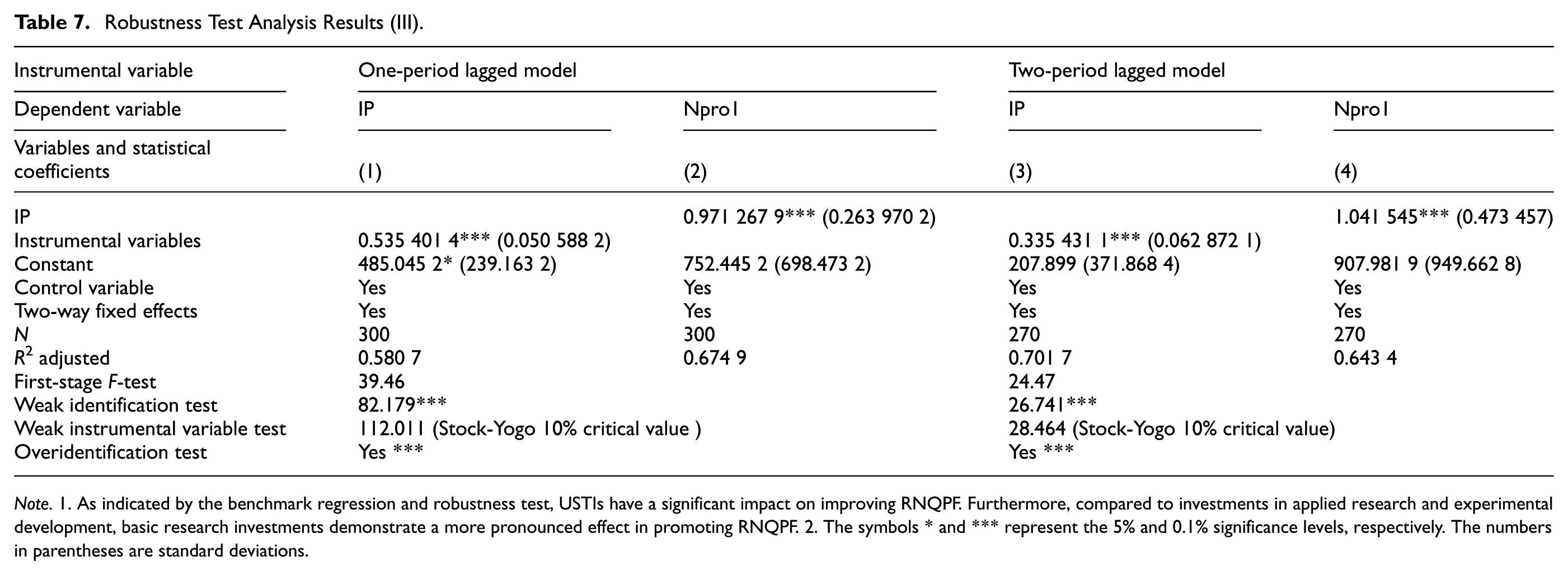
Note. 1. As indicated by the benchmark regression and robustness test, USTIs have a significant impact on improving RNQPF. Furthermore, compared to investments in applied research and experimental development, basic research investments demonstrate a more pronounced effect in promoting RNQPF. 2. The symbols * and *** represent the 5% and 0.1% significance levels, respectively. The numbers in parentheses are standard deviations.
Mechanism Study
USTIs Can Stimulate Output of Scientific Research, Thereby Improving RNQPF
Table 8, column (1) displays the results employing scientific and technological academic papers as a mediating variable. The findings reveal a significantly positive coefficient for per capita University Science and Technology Investment (USTI) at the 5% level, suggesting a potential mediating effect of scientific research publication in enhancing RNQPF. The Sobel test result (0.029) lends support to
Mediation Effect Analysis Results (I).

Note. The symbols +, *, and *** represent the 10%, 5%, and 0.1% significance levels, respectively. The numbers in parentheses are standard deviations.
Table 8, column (2) showcases the results utilizing high-level scientific research output (international and national scientific and technological academic papers) as a mediating variable. The results exhibit a significantly positive coefficient for per capita USTI at the 0.1% level, which passes the Sobel test, further substantiating
USTIs Can Expand the Scale of Talent Cultivation, But Not Necessarily Improving RNQPF
Table 8, column (3) shows the results using the number of postgraduates as a mediating variable. The results indicate that the coefficient of per capita USTI is significantly positive at the 10% level. However, the Sobel test result of 0.23 does not pass the test, rejecting
USTIs Can Promote Technology Transfer, But Not Necessarily Improving RNQPF
Table 8, column (4) presents the results using technology transfer contracts as a mediating variable. The findings show a positive, yet statistically insignificant, coefficient for per capita technological investment by universities. Furthermore, the Sobel test was not passed. Table 8, Column (5) displays the results with technology transfer income as a mediating variable. In this case, the coefficient for per capita technological investment by universities was positive and statistically significant at the 0.1% level but did not pass the Sobel test.
Table 9, column (1), (2) and (3) displays the regression model test results using the sale of patents by universities as mediating variables. The results show that when the number of patents sold, the total amount of patent contracts, and the actual income from patent sales are used as mediating variables, the coefficients for per capita investment in science and technology at universities are positive but fail to pass significance tests. Additionally, none of the results pass the Sobel test. Consequently, it can be concluded that
Mediation Effect Analysis Results (II).

Note. The symbol *** represent the 0.1% significance level. The numbers in parentheses are standard deviations.
Several factors may explain the lack of support for
Per Capita USTIs Can Foster the Creation of High-Tech Industries, Thereby Improving RNQPF
Table 9, columns (4) and (5) show the results using regional high-tech industry income as a mediating variable. The results indicate that when high-tech industry’s main business income and high-tech industry’s new product income are used as mediating variables, the coefficient of per capita USTIs is significantly positive at the 0.1% level and passes the Sobel test. This suggests that Hypothesis
Per Capita USTIs Can Attract High-Level Talents, But Not Necessarily Improving RNQPF
Table 9, column (6) shows the results using the number of high-level talents as a mediating variable. The results show that the coefficient of per capita USTI is positive but not significant at the 0.1%, 1%, 5%, and 10% level, and does not pass the Sobel test (0.82), Consequently, it can be concluded that
Discussions and Research Conclusions
Discussions
The introduction of the NQPF concept serves as China’s solution to address the slowing global economic growth. It establishes a discourse framework driven by technological innovation in China, guiding social entities such as universities and enterprises to adjust their behaviors and promote economic development and scientific and technological innovation. Despite its conversion into a calculable policy framework by scholars like Wang et al. (2024) and Lu et al. (2024), the NQPF indicators does not fully reflect the comprehensive connotations of NQPF and is not a neutral policy tool; instead, it forms part of a broader power-knowledge complex. This calculable policy framework, developed from an economic perspective, does not consider the functional complexity of higher education. The various measurable indicators selected in the field of higher education can measure only limited objectives of higher education development. Some quantifiable indicators, such as talent cultivation, the number of high-level talents, and the transformation of scientific and technological achievements, mentioned in the article, cannot fully support the role of USTI in promoting RNQPF.
In addition to the inherent conceptual limitations of the NQPF framework, internal complexities impacting the relationship between university innovation and regional development must be acknowledged. Universities are diverse, with their role as mediators being highly heterogeneous; thus, a leading research university in a tech hub contributes to NQPF differently than a regional university in a less-developed province due to variations in resources, missions, and local industrial needs. Quantifying long-term impacts of talent cultivation and commercialization on innovation is challenging, and common metrics such as patents often fail to capture the full extent of societal benefits. While rooted in China’s context, the core challenges NQPF presents are globally relevant as governments worldwide steer higher education toward national innovation and economic competitiveness. This tension between top-down, metric-driven policy frameworks and universities’ multifaceted roles is central to higher education policy debates in Europe and North America. Thus, China’s NQPF case study provides valuable insights for international scholars and policymakers examining the instrumentalization of universities for economic goals while emphasizing the importance of these aspects in higher education development.
Over the past few decades, quantification management in higher education has made substantial advancements. The prevalent use of calculable tools for NQPF serves as a compelling testament to this progress. Key research topics in quantification management within higher education focus on the life cycle of quantification and the regulatory nexus in the sector (Hillebrandt & Huber, 2020). Such management approaches often prioritize efficiency, emphasizing the transformation of resources into discernible outcomes by universities. During this transformation process, previously non-quantified indicators are quantified, and existing ones are further optimized to ensure comparability. However, decision-making in higher education, akin to other organizations, experiences an influx of numerical data (Miller, 2001), making it challenging to establish linear relationships between inputs and outputs, similar to those observed in corporate production settings. The diverse functions of higher education are characterized by loosely-coupled (Weick, 1976), interconnected within the broader context of the sector. Consequently, caution should be exercised when associating higher education functions with measurable indicators linked to NQPF assessment tools. In the current landscape, more sophisticated data collection methods encompass macro, meso, and micro levels data, and advanced generative artificial intelligence models such as Chat-GPT and Deepseek facilitate more rational and efficient data analysis. The prospect of suitable analytical tools in the future remains promising, with the expectation that they will offer robust decision-making data support for higher education management and policy decisions.
Research Conclusions
The first notable finding is that USTIs effectively influence RNQPF but with gaps in alignment with policy discourse expectations. Policymakers anticipate rapid, high-quality economic development through comprehensive, large-scale investments in science and technology to achieve an overall enhancement of NQPF across various dimensions. The study reveals that university investments in science and technology positively affect RRNQP by promoting scientific research output and boosting regional high-tech industry income. However, the influence of USTIs on RNQPF is primarily through these two aspects, indicating that the comprehensive benefits of these investments have not been fully leveraged during policy implementation. Consequently, the policy implementation process might require further optimization and refinement to better align with the intended goals and expectations.
The second significant finding is that the mediating effects of talent cultivation, the number of high-level talents, and technology transfer are not significant, deviating considerably from policy expectations. The unsupported findings serve as a strong critique of a “Governing by Numbers” approach and hint that policymakers should recognize USTI is just a necessary but insufficient condition for elevating RNQPF, as the intended mediating channels are structurally blocked. Specifically, the coercive isomorphism arising from the pursuit of symbolic capital, such as the establishment of “double first-class universities” and doctoral degree-granting institutions spoiled the allocation of resources (Zhou, 2023). Technology transfer (
Third, the government-led model for science and technology investments in universities may hinder the normal functioning of the university system. Chinese research universities heavily rely on government funding, leading to more influence from governmental policies in determining research directions and management structures, rather than following the natural logic of the academic community. The excessive focus on the quantity of research achievements overlooks the quality of talent cultivation, affecting teaching quality within universities. This misallocation of resources could disrupt the normal order of teaching and research in universities, hampering their long-term development. These findings indicate the need to reassess the current definition of NQPF and USTI policies. By exploring more reasonable development paths and policy guidance, the positive role of universities in the development of NQPF can be fully realized.
Last, our study is subject to certain limitations in its model design and variable selection. A primary constraint is the lack of stratified analysis across different institutional and disciplinary categories. Firstly, the model does not differentiate by academic discipline. The efficiency and nature of outputs from technology investments are known to vary significantly across fields such as science, engineering, medicine, and agriculture. Our aggregated analysis, necessitated by data availability, was unable to capture these critical distinctions. Secondly, our study does not account for institutional heterogeneity. Significant disparities exist in the productivity of technology investment between different tiers of institutions, such as research-intensive versus application-oriented universities. Similarly, the administrative affiliation of institutions—for example, those managed by central versus local governments—can substantially influence the outcomes of their technological inputs, a factor not considered in our model. Thirdly, the variables selected may not fully encapsulate the complexity of technology investment and output in higher education. Future research should therefore aim to incorporate more precise data to identify which disciplines, university tiers, and administrative affiliations yield a more pronounced impact on new quality productive forces. A deeper investigation into the specific pathways through which these investments foster such productivity is also warranted. Furthermore, subsequent studies should continue to explore the influence of other key factors, such as the scale of talent cultivation, the efficiency of technology transfer, and the concentration of high-level academic talent.
Footnotes
Acknowledgements
The authors would like to thank 2024 National Education Science Planning Project (CN) for supporting this project.

Ethical Considerations
These considerations were not relevant for this study type.
Informed Consent
The authors were all consented with the submission and pbulicaiton of this paper.
Author Contributions
Funding
The authors disclosed receipt of the following financial support for the research, authorship, and/or publication of this article: This work was supported by 2024 National Education Science Planning Project (CN; Grant Number: WGB240478). The Project Name is “Research on the Basic Public Education Service Supply Mechanism in line with the Coordinated Development of Population.”
Declaration of Conflicting Interests
The authors declared no potential conflicts of interest with respect to the research, authorship, and/or publication of this article.
Data Availability Statement
Data will be provided under reasonable requirement by the corresponding author.