




Abstract
University campus sustainability projects frequently aim to promote ecological behavior of their community members. However, these projects rarely consider the level of students’ self-construal, the view of self held by members of the university community (i.e., whether the self is viewed as independent or interdependent with nature). This runs counter to the findings in psychology that people’s behavior is strongly affected by their self-construal. We thus conducted an exploratory attempt to include self-construal measurements into a campus environmental sustainability project at National Taiwan University. We specifically examined whether the university had contributed to the transformation of students’ self-construal for greater environmental sustainability. Toward this end, we first confirmed that a psychological scale for self-construal, the connectedness to nature scale (CNS) that had been mainly tested in Western contexts, successfully predicted the likelihood of students’ ecological behaviors (e.g., reducing waste) in an East Asian context. We found only a small difference in the CNS between students for different academic years, which suggests that the university was unsuccessful in transforming students’ self-construal for greater sustainability. This finding resonates with the practice of universities in the modern era to emphasize cognitive dimensions of learning rather than ontological dimensions. Our results thus suggest that mainstreaming ontological dimensions would be one potential way for universities to move toward campus sustainability.
Keywords
Introduction
Universities are increasingly expected to play a major role in achieving environmental sustainability. Although one of the major roles assigned to modern universities was to provide scientific knowledge and technological innovations with society for greater sustainability (e.g., United Nations, 1992), the role of universities has expanded considerably during recent decades (Adams et al., 2018; Alshuwaikhat & Abubakar, 2008; Ramanathan et al., 2016).
Universities are now deemed as an experimental place to create a sustainable physical and social system at a small scale (Calder & Clugston, 2003; International Sustainable Campus Network, 2018; Velazquez et al., 2006). It is envisaged that successful systems at a sustainable university campus might later be implemented at a societal scale to contribute to wider social transformation. Universities are thus putting efforts not only toward technological and operational changes (e.g., maximizing energy and material efficiency) but toward behavioral changes as well. The efforts for behavioral changes include providing university community members with information about campus sustainability issues (e.g., reforming curricula), creating programs for greater campus sustainability (e.g., creating recycling programs), and introducing incentives for ecological behaviors (e.g., providing free bus rides, Adams et al., 2018; Levy & Marans, 2012).
This expansion of universities’ role resonates with the recently growing consensus that mere scientific knowledge and technological innovations will not lead human society to environmental sustainability. This idea was originally posited by philosophers approximately 50 years ago (e.g., Naess, 1973; Schumacher, 1973; White, 1967). Since then, this idea has been consolidated by subsequent philosophical studies (Bowers, 1995, 2002; Herman, 2016; Ohmori, 1996; Sterling, 2016; see also Francis, 2015) and empirical data (Corner, 2012; Komatsu et al., 2020; Randers, 2012; Turner, 2008, 2012; York et al., 2009). Recently, this idea has finally become acceptable to some leading international organizations including the United Nations Educational, Scientific and Cultural Organization (2016, 2020) whose major role had, until recently, been limited to educating people for better scientific understanding.
We, however, find that the expansion of universities’ role has been insufficient. It is true that universities attempt to promote ecological behavior of their community members (e.g., students). However, these attempts rarely consider self-construal of members (Adams et al., 2018; Levy & Marans, 2012; Moreira et al., 2018). Self-construal can be understood as a view of the self one holds, particularly the relationship of the self with others, including nature (Heine & Ruby, 2010; Markus & Kitayama, 1991, 2010; Schultz, 2002). Scant attention to self-construal of university community members runs counter to findings in the field of cultural psychology and environmental psychology in the past two decades. Research in cultural psychology has discovered that people’s behavior is strongly affected not only by institutions that enforce rules, but their own self-construal (Heine & Ruby, 2010; Markus & Kitayama, 2010; Nisbett, 2003). For example, those who view their selves as interdependent with others tend to be concerned more about relationships with others and collaborate for common good (Martinsson et al., 2012; Nisbett & Masuda, 2003; Seeley & Gardner, 2003). Self-construal is also important in that it makes it easier to create particular type of social institutions, although self-construal is also shaped by institutions (Markus & Conner, 2014). More directly, numerous studies in environmental psychology revealed that people who view their selves as interdependent with nature tend to organize ecological behavior frequently (e.g., Arnocky et al., 2007; Chuang et al., 2016; Gosling & Williams, 2010; Schultz et al., 2004). Recent studies additionally suggested that self-construal is related not only to the likelihood of people’s ecological behavior, but to actual environmental impacts including ecological footprint (Komatsu et al., 2019, 2020, 2021, 2022; Silova et al., 2021). Unfortunately, these findings in cultural psychology and environmental psychology appear to have been largely overlooked in the current discussion about university campus sustainability.
Against this backdrop, we have initiated an exploratory attempt to include self-construal measurements into a campus environmental sustainability project at National Taiwan University. This study aims at investigating whether the university has contributed to the transformation of students’ self-construal for greater environmental sustainability. Toward this end, we first examine whether a psychological scale for self-construal, the connectedness to nature scale (CNS, Mayer & Frantz, 2004) that has been mainly tested in Western contexts, will successfully predict the likelihood of students’ ecological behaviors (e.g., reducing waste and energy consumption) in an East Asian context. We then examine the differences in the CNS and the likelihood of ecological behaviors between students for different academic years. The focus of this examination is whether students at a higher academic year would have higher CNS scores and have higher likelihood of ecological behavior. This is an important addition to existing university campus sustainability projects, because existing projects rarely examine changes in students’ self-construal and likelihood of ecological behaviors.
Materials and Methods
The Site
The site was National Taiwan University, a university located in Taipei, Taiwan. This university is the most prestigious and comprehensive university in Taiwan. It had 11 colleges, 56 departments, and 128 graduate institutes (National Taiwan University, 2019). The total number of students was approximately 31,700, among which approximately 16,600 were undergraduates. The domestic students outnumbered international students. International students accounted for less than 1% (Ministry of Education, 2021).
Measurements
Connectedness to nature was measured using the Connectedness to Nature Scale (CNS) created by Mayer & Frantz (2004).This was arguably the most widely used CNS among various similar psychological scales (e.g., Howell et al., 2011; Navarro et al., 2017; Olivos et al., 2011). This CNS used a smaller number of questions than several other scales (e.g., Kals et al., 1999; Nisbet et al., 2009) and thus allowed easy administration. Despite slight differences between different psychological scales, recent studies suggested that most of these scales measure approximately the same psychological dimensions (Restall & Conrad, 2015; Tam, 2013).
To measure the CNS, we used the 14 questions (Table 1) created by Mayer & Frantz (2004). These questions were about respondents’ view of the relationship between her/his self and nature. We created and presented the Chinese translation of the original questions, as well as the original English questions, to the respondents. Respondents were expected to answer these questions by selecting one of the five options: (5) strongly agree, (4) somewhat agree, (3) neutral, (2) somewhat disagree, and (1) strongly disagree. A number denoted the score for each option. The responses to Questions #4, #12, and #14 were reversed scored and then the responses to all the questions were averaged to obtain a composite score of the CNS. The translation was conducted by a team comprised of five people including native speakers of Chinese and English. The translated questionnaire was checked by an independent researcher who spoke both Chinese and English at a native level.
Questions Used to Calculate the Connectedness to Nature Scale (CNS).
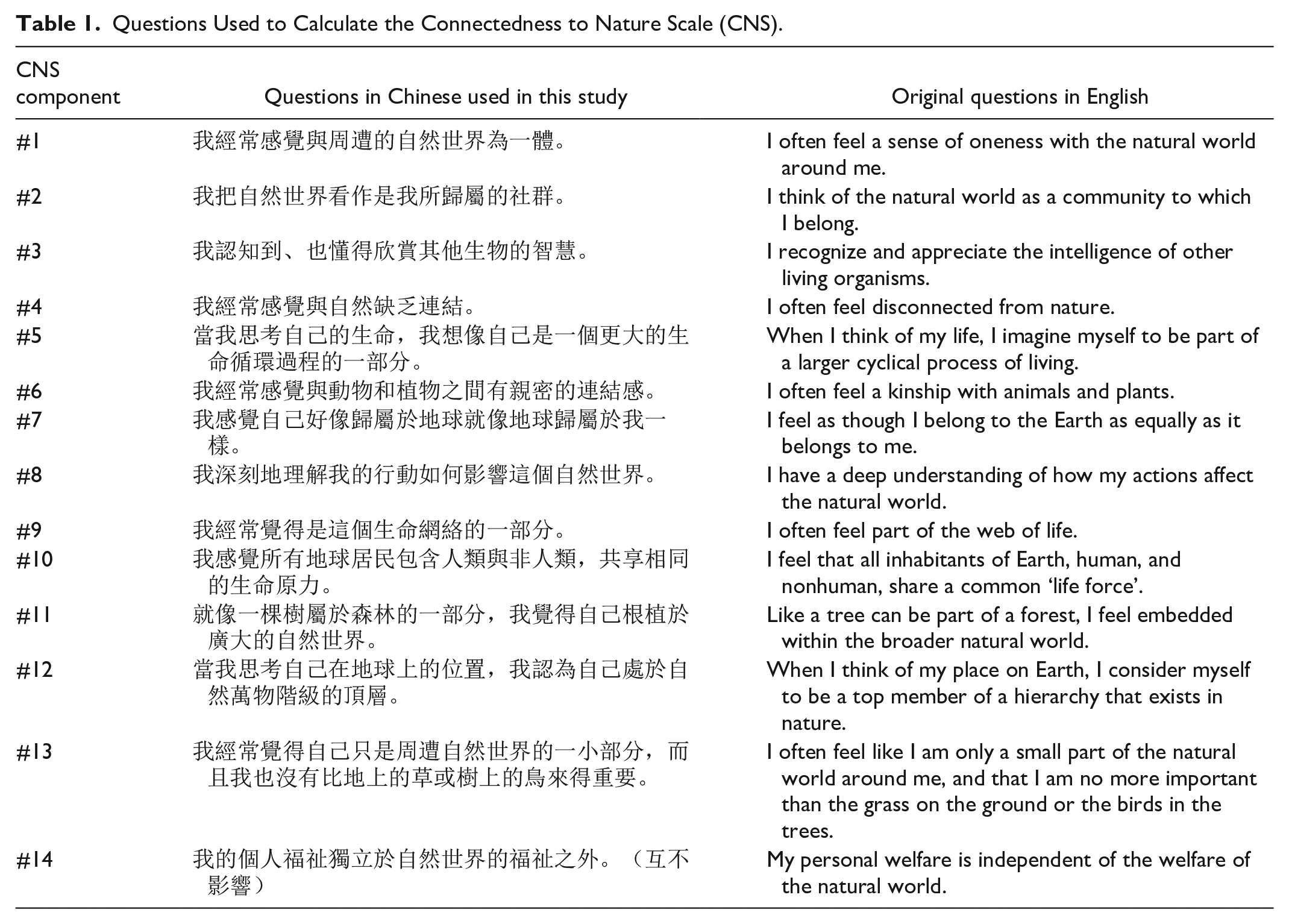
The CNS includes at least two different dimensions of the self-construal, that is, a view of the self in relation to nature. Most questions (particularly Questions #1, #4, #7, #9, and #11) focus on examining whether or not the respondent conceptualizes her/his self and nature as interdependent. An individual who conceptualizes her/his self to be separate from nature assume that the basic unit of the world is an atomized element. Consequently, s/he assumes that one’s self exists independently from nature and that the self then creates relationships with nature in accordance with one’s own necessity and desires. That is, relationships with nature are assumed to be secondary. In contrast, an individual who conceptualizes her/his self and nature as interdependent assumes that relationships rather than entities are the constituent elements of the world. That is, entities including self are assumed to co-arise out of primary relationships with nature and therefore entities are ontologically inseparable from webs of relations. Questions #12 and #13 are different from other questions in that they focus on examining whether or not the respondent conceptualizes her/his self to be equal to other beings (both organic and inorganic) in nature. Indeed, these questions ask whether the respondent considers herself/himself as more important than other beings in nature.
To measure the likelihood of ecological behaviors, the team members created an Ecological Behavior Scale (EBS) based on their experiences at the National Taiwan University campus. Similar to the CNS, the EBS was also calculated based on the responses to a series of questions (Table 2). These questions were about respondents’ habit of promoting sustainable consumption, affecting other people’s ecological behavior, and participating in environmental activities. Respondents were expected to answer to the questions by selecting one of the five options: (5) strongly agree, (4) somewhat agree, (3) neutral, (2) somewhat disagree, and (1) strongly disagree. The responses to Questions #3 and #5 were reversed scored. The scores for the responses to all the questions were averaged to obtain the composite score of EBS. Note that this study measured the likelihood of students’ ecological behavior based on students’ self-reports. Although the relationship between self-reported ecological behaviors and actual behaviors had not been examined thoroughly, several studies reported a good correspondence between these two (see Frantz & Mayer, 2014).
Questions Used to Calculate the Ecological Behavior Scale (EBS).

The questionnaires for the CNS and EBS were posted on three social media platforms that were frequently visited by National Taiwan University students. The first one was the PTT Bulletin Board System (https://www.ptt.cc/index.html), the largest bulletin board system in Taiwan. We posted on one board named “NTU”, which was commonly used by National Taiwan University students. The other two were the Facebook site called “National Taiwan University Student Exchange Board” (https://www.facebook.com/groups/NTU.Head/) and D-Card (https://www.dcard.tw/f/ntu) that were exclusively used by National Taiwan University students. The measurement period was between December 25, 2020 and January 6, 2021. Note that this measurement period did not include the long new year holiday (Chinese lunar new year) in Taiwan, which is celebrated in late January or early February.
Methods of Analysis
To investigate whether the university has contributed to the transformation of students’ self-construal for greater environmental sustainability, we first examined the relationship between the CNS and EBS to test whether the CNS would successfully predict the likelihood of students’ ecological behaviors. One major focus here was whether the CNS created and mainly tested in the West would be applicable to an East Asian context. The CNS created by Mayer & Frantz (2004) and other similar scales had been rarely tested in an East Asian context (Restall & Conrad, 2015), which was one major omission: previous studies in cultural psychology and other related fields often reported that psychological tests created in the West did not function well in other cultural contexts, particularly when the focus was on self-construal (Hitokoto & Uchida, 2015; Rappleye et al., 2019; Uchida et al., 2004). Our supplementary analysis also examined the relationships between the 14 sub-components of the CNS and the 10 sub-components of the EBS for a more nuanced understanding of the relationship between connectedness to nature and ecological behaviors. This sub-component analysis would allow to examine whether different dimensions of self-construal (i.e., interdependence between the self and nature and equality between the self and other beings) were related to different ecological behaviors.
We then examined the differences in the CNS and EBS scores between students for different academic years. For this, we used data for undergraduate students primarily because of its high uniformity. Our preliminary analysis of the relationship between students’ age and academic years revealed that most undergraduates were enrolled in National Taiwan University at roughly the same age (typically between 18 and 20 years old) after the graduation from middle schools in Taiwan. Such uniformity was unavailable for graduate students. Using data with high uniformity would enable higher detectability of the differences in the CNS and EBS scores between students with different academic years.
To interpret the differences in the CNS between students with academic years, we used the difference in the CNS for university students reported in a previous study as a benchmark (Lankenau, 2016). Lankenau (2016) observed a difference in a CNS for university students before and after attending an ecology course that specifically targeted changing students’ worldviews. The observed difference in the CNS was 0.53 of Cohen’s d (see below) for the students attending the course, whereas no difference was observed for students attending an alternative ecology course that targeted knowledge acquisition. It should be noted that the CNS used by Lankenau (2016) was the one proposed by Nisbet et al. (2009), not the one used in this study. However, previous studies including that of Lankenau (2016) suggested that the CNS of Nisbet et al. (2009) was conceptually similar to that of Mayer & Frantz (2004) used in this study (Restall & Conrad, 2015; Tam, 2013). More importantly, we used Cohen’s d for comparison. Cohen’s d was a dimensionless parameter that would allow comparison between different CNSs.
Statistical Analyses
To examine relationships between variables, we used a simple correlation analysis using the Pearson correlation coefficient (r). Because r is greatly affected by outliers, we calculated 95% confidence intervals (CIs) to examine the stability of the correlation. CIs were calculated using a bootstrapping method with replacement (Diadonis & Efron, 1983; Fox, 2008). To examine differences between two variables, we used Cohen’s d defined by the difference in the means for the two variables divided by the pooled standard deviation (Cohen, 1988, 1992). The pooled standard deviation was calculated using the equation used by Hedges (1981), see also Ellis, 2010).
We did not conduct hypothesis testing to examine statistical significance throughout this study. One major reason was that any relationship/difference could be statistically significant if a large number of samples was available. This point had already been noted by prominent statisticians for years ago (e.g., Berkson, 1938), and had again become a concern for statisticians and scholars in related fields in recent years (Komatsu & Rappleye, 2017a,b; Nuzzo, 2014; Thompson, 2002). These statisticians and scholars recommended to report effect size parameters and their CIs instead of statistical significance (Komatsu et al., 2015; Ellis, 2010; Lambdin, 2012).
Results
Data Overview
We obtained 176 responses from students, with one judged to be invalid because that response selected the same option to all the questions. Among the 175 valid responses, 91 were from female, 83 were from male, and 1 elected not to disclose their gender. We received 122 responses from undergraduate students and 53 from graduate students. Responses were obtained from all the 11 colleges of National Taiwan University.
The mean (±standard deviation, SD) for the composite CNS for the 175 valid responses was 3.39 (±0.57), whereas that for the composite EBS was 3.04 (±0.69). We observed differences in both the CNS and EBS between genders (Table 3), where Cohen’s d values were respectively 0.615 and 0.956. We also observed differences in the CNS and EBS between students’ affiliations (Table 3). Among colleges with relatively large sample sizes (>20), the maximum CNS difference was observed between College of Science and College of Social Sciences (0.414 of Cohen’s d). The maximum EBS difference was observed between College of Science and College of Engineering (0.591 of Cohen’s d).
Mean (±SD) of the Connectedness to Nature Scale (CNS) and Ecological Behavior Scale (EBS).

Relationship Between CNS and EBS
The CNS was moderately correlated with EBS. The correlation coefficient (r) was 0.511 with the CI of [0.371, 0.624] (Figure 1). The strength of this correlation was comparable to those reported in previous studies. Previous studies, most of which were conducted in Western country contexts, reported a correlation coefficient between 0.35 and 0.58 (Frantz & Mayer, 2014). This indicates that the CNS would be a useful scale for predicting the likelihood of students’ ecological behaviors in National Taiwan University.

Relationship between the composite CNS and EBS. The solid line indicates the linear regression line determined using the least-squares method.
Although we generally observed moderate correlations between CNS components and EBS components (r was typically 0.3), the results were different for different components (Table 4). Component #14 of CNS was poorly correlated with all the components of the EBS. The highest r was only 0.130, suggesting that this component would not help predict the 10 ecological behaviors examined in this study. This component was thus dropped from the further analysis.
Correlations Between Components of the CNS and Those of the EBS.

The lower limit of the bootstrapping Confidence Interval (CI) was greater than zero.
The lower limit of the CI was greater than 0.1.
The lower limit of the CI was greater than 0.2.
Component #5 of the EBS (i.e., the habit of riding motorbikes and driving fuel cars) was poorly correlated with all the components of the CNS (Table 4). The highest r was merely 0.157. The mean r value for Component #5 of the EBS was lower than those for the other components of the EBS. These results suggest a limited role of psychological dimensions on the habit of riding motorbikes and driving fuel cars. Component #3 of the EBS (i.e., the habit of meat eating) was correlated considerably only with Components #12 and #13 of the CNS that were related to the concept of equality between the self and other beings, whereas it was correlated poorly with the other components of the CNS (Table 4). This suggests that the habit of meat eating was related to the concept of equality rather than the concept of interdependence between the self and nature.
Differences in the CNS and EBS Between Academic Years
The composite CNS scores for third- and fourth-year undergraduate students were higher than that for first-year undergraduate students (Figure 2(a)), where Cohen’s d values for these differences were respectively 0.376 and 0.159. The difference in the CNS between the first- and fourth-year students (i.e., 0.099) was slightly higher than the difference caused by all the fourth-year students rating one rank higher for one of the 14 question components than all the first-year students. This difference in the CNS was not explained by the difference in the gender ratio between academic years, because the gender ratio was approximately the same for different academic years. Cohen’s d in CNS between first- and fourth-year students (i.e., 0.159) was smaller than 0.53, the difference achieved by one ecology course targeted for changing worldviews rather than knowledge acquisition.

The mean (a) CNS and (b) EBS for students with different academic years. A vertical bar indicates the standard deviation. We merged data for fifth- and sixth-year students of College of Medicine with those for fourth-year students. This treatment did not change our results considerably because of the small sample size for fifth- and sixth-year students.
The composite EBS scores for third- and fourth-year students were higher than that for first-year students (Figure 2(b)), where Cohen’s d values for these differences were respectively 0.061 and 0.098. The difference in the EBS between first- and fourth-year students (i.e., 0.057) was roughly equivalent to the difference caused by half of the fourth-year students rating one rank higher for one of the 10 question components than the first-year students.
Discussion and Conclusions
Relationship Between the CNS and the EBS
The correlation between the CNS and the EBS observed in this study (Figure 1) suggests that the CNS would be applicable to both Western and East Asian country contexts. This finding is important, because CNSs, including the one we used, had been rarely tested in East Asian countries (Howell et al., 2011; Mayer & Frantz, 2004; Navarro et al., 2017; Olivos et al., 2011; see Restall & Conrad, 2015 for review). Our results, together with those in a few exceptional studies that applied the CNS in East Asia (Leong et al., 2014; Tam, 2013), suggest the usefulness of the CNS in East Asian contexts. The CNS thus would be one choice for universities in East Asia when measuring students’ self-construal for greater campus sustainability.
Another contribution of this study is that it created Chinese translation of the questionnaire for the CNS that had been most widely used among others (Mayer & Frantz, 2004). Tam (2013) applied the CNS to Hong Kong samples and therefore s/he might have created the Chinese translation of the questionnaire. However, Tam’s paper did not present the Chinese translation of the questionnaire. Our Chinese translation of the questionnaire will be used widely by future studies, considering the large population and environmental impacts of Chinese speakers in the world (Dong et al., 2018).
The supplementary analysis of the relationship between components of the CNS and those of the EBS allows to come up with intervention strategies of National Taiwan University to promote students’ ecological behaviors. The poor correlations between Component #5 of the EBS and all the components of the CNS suggests that the habit of riding motorbikes and driving fuel cars might be primarily induced by structural factors rather than by psychological factors. One plausible hypothesis is that using public transportation might not be an economically viable option in Taiwan due to low fuel prices. The exclusive correlation of Component #3 of the EBS with Components #12 and #13 of the CNS suggests that meat eating specifically conflicts with the concept of equality between the self and other beings, whereas it does not conflict with the concept of interdependence between the self and nature. When designing a campaign to reduce meat consumption, it would be effective to emphasize equality rather than interdependence.
Differences in the CNS and EBS Between Academic Years
The difference in the CNS between undergraduate students for academic years observed in this study was smaller than the change in the CNS induced by one ecology course that targeted changing worldviews (Figure 2(a)). These results suggest that although National Taiwan University definitely improves students’ knowledge about environmental sustainability, it fails to shift students’ self-construal for greater sustainability. Note that we cannot attribute the small differences in the CNS between different academic years to ceiling effects. The mean CNS for our case fell in the typical range (3.2–3.8) of the CNS for other studies that targeted university students (Howell et al., 2011; Mayer & Frantz, 2004; Navarro et al., 2017; Olivos et al., 2011).
To our best knowledge, this study is the first examining changes in the CNS at a university scale. This is one major novelty of our study, although we are fully aware of the preliminary nature of our study (e.g., the lack of longitudinal data). There are a few previous studies that examined changes in connectedness to nature for students at a smaller scale. Nisbet et al. (2011) conducted a longitudinal study and found no obvious increase in connectedness to nature for undergraduate students taking environmental courses in a Canadian university. Similarly, Lankenau (2016) observed no clear increase in connectedness to nature for undergraduate students in the United States who participated in an ordinary ecology course. The results of these studies and our study collectively imply that universities in the modern era have been unsuccessful in shifting students’ self-construal for greater environmental sustainability, although further studies should be needed to examine the generality of this implication. This implication is in congruent with that most universities in the modern era primarily focus on cognitive dimensions (i.e., knowledge) rather than ontological and behavioral dimensions. Mainstreaming ontological and behavioral dimensions would thus be one potential way for universities to move toward greater environmental sustainability.
Some readers might argue that education for ontological and behavioral changes sounds ideological, perhaps even violating the autonomy and independence of university students. Indeed, students’ autonomy and independence are regarded as norms in most modern universities (Fryberg et al., 2013; Stephens et al., 2012). We fully understand the importance of critically clarifying how ideology and ontological and behavioral changes are related. However, readers should also note that even education for promoting students’ autonomy and independence is not neutral. It is actually an ideology itself posited by European Enlightenment scholars and their philosophical descendants emerging out of the Western Christian tradition (e.g., Kilpatrick, 1918, 1951; Rousseau, 1762 [1979]; see Dewey, 1930; Komatsu & Rappleye, 2017a for discussion). For this very reason, a number of education scholars and philosophers do not unthinkingly valorize autonomy and independence, deeming these instead as elements of a cultural ideology-turned-worldview that now poses a major obstacle to environmental sustainability (Bowers, 1995; Komatsu et al., 2020; Rappleye & Komatsu, 2020; Silova, 2021; Stengers, 2020). Less challengingly, education promoting connectedness to nature has stand-alone desirable outcomes. That is, many studies have reported associations between connectedness to nature and positive psychological indicators: correlations of connectedness to nature with life satisfaction (Mayer & Frantz, 2004), well-being (Howell et al., 2011; Nisbet et al., 2011), mindfulness (Howell et al., 2011), happiness (Zelenski & Nisbet, 2014), positive emotions (Mayer et al., 2009), and even innovative thinking (Leong et al., 2014), although there are a few exceptions that reported no clear correlations (Leary et al., 2008).
For these reasons, mainstreaming an ontological approach may be one effective option for universities to move toward sustainability. This is exactly the point that several forward-looking education scholars have addressed during the recent three decades (e.g., Bowers, 1995; Shephard, 2008). Monitoring the transformation of students’ self-construal is merely a first step toward this goal. The next step will require the examination of current education practices (e.g., learning materials used in courses, teachers’ concept of nature-human relationships, and pedagogical approaches) to explore the reasons why current education practices have been failing to shift self-construal. For this exploration, education scholars and practitioners can refer to the findings in the field of transformative education. This field has already initiated exploring the relationship between education practices and shift of students’ ontological and behavioral dimensions (Sterling et al., 2018; Taylor & Cranton, 2012; see also Stephens et al., 2015). To identify potential interventions for shifting students’ self-construal, universities may learn from indigenous cultural resources. Traditions in many non-western countries still hold the idea that learning should cover both cognitive and ontological dimensions (Shiah, 2016; Silova, 2020; Silova et al., 2020; Tabulawa, 2013; Wang, 2016; You, 2019), as well as place a heavy emphasis on shifting ontological framework of self (Komatsu & Rappleye, 2017a; Nishihira & Rappleye, 2021). More importantly, several traditional cultures including those in East Asia assume that realizing interdependence between oneself and nature is one explicit goal of learning (Komatsu & Rappleye, 2020; Frazer, 2006; Takayama, 2020; Tobin et al., 2009; Zhao, 2015). It is true that such a concept of learning has been marginalized after the advent of modernity. However, sensitive scholars have found practices that support such a learning concept not only in temples and martial arts schools (e.g., Hori, 1994; Uchida, 2013) but in formal schooling settings (Cave, 2016; Gerbert, 1993; Komatsu & Rappleye, 2017a; Rappleye & Komatsu, 2017; Takayama, 2018). Locating such practices and understanding their importance would be one starting point to mainstream ontological and behavioral dimensions in the learning at a university level for greater environmental sustainability.
Footnotes
Acknowledgements
We would like to thank Nynia Etienne and Yun-Chen Lai (National Taiwan University) for their help with designing and implementing psychological measurements. We also greatly acknowledge Ko-Jung Lo (National Taiwan University) for checking our Chinese translation of the CNS questionnaire. Thanks are also due to Yu-Chieh Chang (National Taiwan University) for her help with quantitative analysis.
Declaration of Conflicting Interests
The author(s) declared no potential conflicts of interest with respect to the research, authorship, and/or publication of this article.
Funding
The author(s) disclosed receipt of the following financial support for the research, authorship, and/or publication of this article: This research has been supported by a Research Grant of the Ministry of Science and Technology, Republic of China (#110-2313-B-002-004-MY3).
